
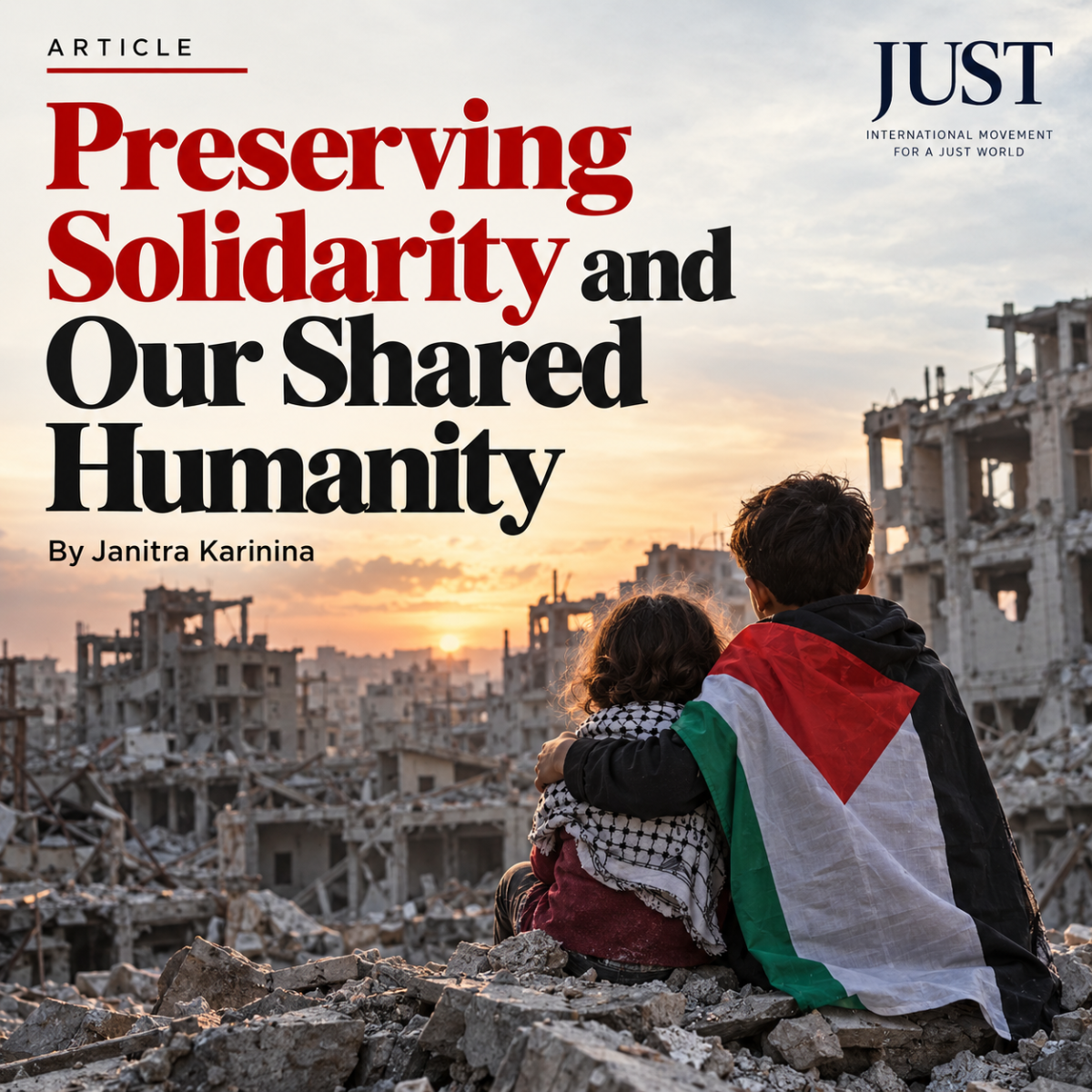
By Janitra Karinina
Abstract
This article reflects on Gaza Genocide Commemoration Week 2026, a civil-society initiative in Malaysia that brought together various non-governmental organisations in solidarity with the Palestinian people. It discusses the importance of continuing to highlight the Palestinian cause, particularly at a time when prolonged conflict risks becoming normalised or forgotten by the wider international community. The article also examines solidarity as more than an expression of sympathy, presenting it as a commitment to shared moral values such as justice, compassion, human dignity and respect for human life. Drawing from my experience participating in the commemoration through the International Movement for a Just World (JUST), the article further reflects on the important role of civil society and non-state actors in maintaining public awareness of international humanitarian issues. Ultimately, it argues that injustice against Palestinians should concern humanity as a whole and that preserving solidarity is essential to preserving our shared moral values.
From 5 to 11 October 2026, Malaysian civil-society organisations came together for Gaza Genocide Commemoration Week 2026 under the theme “End the Genocide, Free Palestine.”
Participating in an event connected to this commemoration was a meaningful experience for me. It gave me the opportunity to see how organisations can come together around an international humanitarian issue, while also encouraging me to reflect on why the Palestinian cause must continue to receive attention. When suffering continues for a long of time, there is a risk that people gradually become used to hearing about it. Events such as this remind us that prolonged suffering should never become normal simply because it has continued for many years.
The commemoration brought together organisations from different backgrounds and areas of work. Among the participating groups were BDS Movement Malaysia, Team Alpha, Al-Quds Foundation Malaysia (QFM), SEJAGAT Malaysia, the Malaysian Women’s Coalition for Al-Quds & Palestine (MWCQP), Sekretariat Solidariti Palestin (SSP), Humanitarian Care Malaysia (MyCARE), Global Alliance for Palestine (GAFP), MAPIM, International Movement for a Just World (JUST), Pertubuhan IKRAM Malaysia, among others.
The participation of different organisations gave the event greater meaning. Although each organisation has its own mission, experience and area of focus, they were able to come together around a shared concern for Palestinian dignity, human rights and justice. This cooperation demonstrated that solidarity with Palestine does not belong to only one organisation or community. It can bring together different parts of society through a common concern for humanity.
For me, this was particularly meaningful because I participated through my internship with the International Movement for a Just World (JUST). It allowed me to see how civil society can engage with an international issue outside the classroom and how organisations can work together to keep an important humanitarian concern visible.
Gaza Genocide Commemoration Week was not intended to be only a symbolic event. The official press statement also announced a peaceful march on 9 October 2026, beginning after Friday prayers at Tabung Haji and continuing towards the United States Embassy in Kuala Lumpur. Representatives of the coalition planned to submit a memorandum calling for accountability and concrete action concerning Palestine.
Commemorations are important because they help preserve collective memory. When people repeatedly see reports of destruction, displacement and loss, there is a danger that these realities begin to feel distant or ordinary. What was once shocking can slowly become another headline, while the human beings behind those headlines may be forgotten.
Events such as Gaza Genocide Commemoration Week matter. They bring attention back to the people whose lives are directly affected and remind us that international conflicts are not simply about politics, borders or diplomatic disagreements. They are also about families, communities and individuals.
Why Palestine Must Continue to Be Highlighted
The Palestinian issue has remained part of international politics for generations, but its long history should never make it less important.
One of the biggest challenges surrounding any long-running conflict is the possibility of normalisation. When suffering continues for years, people may begin to accept it as something unavoidable. News coverage also changes quickly, and international attention often moves from one crisis to another.
However, a reduction in media attention does not mean that the experiences of those affected have ended. The coalition’s press statement highlights continuing concerns involving Palestinian deaths, destruction in Gaza, displacement, land seizures and the situation of Palestinian communities in the West Bank. These concerns help explain why civil-society organisations in Malaysia continue to organise events, campaigns and public activities related to Palestine.
Palestinians should not be viewed only as figures in news reports or statistics. They are individuals, families and communities who seek safety, dignity and a future just like people anywhere else in the world. Continuing to highlight Palestine is therefore also a way of resisting indifference. It reminds us that human suffering should not become less important simply because the world has heard about it for a long time.
Solidarity Beyond Borders
Another important message I took from the event was the meaning of solidarity. Malaysia is geographically far from Palestine, yet the participation of Malaysian NGOs showed that geographical distance does not have to create moral distance. We do not need to share someone’s nationality, religion or background to recognise their suffering or respect their dignity. Solidarity begins with recognising that the experiences of other people matter, even when they are very different from our own.
The official press statement called on different sections of Malaysian society, including students, trade unionists, professional networks and concerned citizens, to participate in peaceful collective action. It described such involvement as more than a symbolic gesture, presenting it as a way to challenge silence and call for meaningful action. Solidarity should not be understood only as sympathy. It is also about maintaining awareness, refusing to ignore suffering and recognising that human dignity should not be limited by national borders.
Preserving Our Shared Moral Values
Solidarity is important because it helps preserve the values that we claim to share as human beings.
Justice, compassion, dignity and respect for human life only have meaning when they are applied consistently. If we believe that civilians deserve protection, then that principle should apply regardless of nationality. If we believe children deserve safety and families deserve access to basic necessities, those beliefs should not change according to geography or political circumstances.
The coalition’s memorandum also placed humanitarian needs at the centre of its concerns, calling for safe and sustained access to food, clean water, fuel, medical supplies, medicines, shelter and other essential necessities for people in Gaza. These concerns go beyond politics. They relate to the most basic conditions needed for people to live with dignity.
Injustice Against Palestinians Is an Injustice Against Humanity
One of the strongest ideas I took from this commemoration is that injustice against Palestinians is an injustice against humanity.
For me, this statement is about recognising the equal value of human life. When people lose their homes, experience displacement, lose family members or live with prolonged insecurity, their suffering should concern us because they are human beings.
An injustice does not become less important simply because it happens far away from us. The Palestinian cause therefore raises a wider moral question about how society responds to the suffering of others. If we only defend dignity and human rights when the people affected are similar to us, then those principles cannot truly be considered universal.
This is why solidarity with Palestinians is also connected to protecting our shared moral values. It means recognising that Palestinian lives have the same human value as any other lives and refusing to allow prolonged suffering to become something the world simply learns to accept.
The Role of Civil Society
As an International Relations student, participating in this event also helped me understand the role of civil society in international affairs more clearly.
International Relations often focuses on governments, diplomacy, international organisations, conflict and relations between states. However, international issues are also shaped by non-state actors such as NGOs, humanitarian organisations, advocacy groups and community networks.
The organisations involved in Gaza Genocide Commemoration Week provided a clear example of this. Some focus on humanitarian assistance, while others concentrate on advocacy, public awareness, justice or community mobilisation. Their areas of work may differ, but they were able to cooperate around a common international concern.
Through my involvement with JUST, I was able to see this process directly. Instead of only learning about civil society and non-state actors through academic theories, I was able to observe how organisations build networks, communicate shared concerns and work collectively around an international humanitarian issue.
The experience reminded me that International Relations is not only something that happens between governments. It also exists in the connections between communities, organisations and individuals who believe that issues beyond their own national borders still matter.
Ultimately, Gaza Genocide Commemoration Week 2026 carries an important message about the need to remember.
International attention can change very quickly. New conflicts appear, political priorities shift and issues that once dominated public discussion may gradually receive less coverage. However, human suffering does not become less important simply because it is no longer at the centre of the news.
This is why solidarity must continue beyond moments when Palestine receives widespread international attention. Genuine solidarity means continuing to care even when an issue is no longer trending. It means remembering when others begin to forget and recognising that the struggle of another community for dignity and justice can still matter to us even when it takes place thousands of kilometres away.
Participating in this commemoration and seeing Malaysian civil-society organisations come together reinforced this message for me. Although the event focused on Palestine, the values behind it were much broader. It was about justice, compassion, human dignity and the belief that the suffering of others should never be met with indifference. The Palestinian cause must continue to be highlighted because prolonged suffering should never be allowed to become invisible or normal. Preserving solidarity with Palestinians is therefore not only about remembering Palestine; it is also about preserving our willingness to recognise the humanity of others.
Injustice against Palestinians is an injustice against humanity, and maintaining solidarity is one way of ensuring that our shared moral values remain meaningful in practice.
Janitra Karinina is currently pursuing a Bachelor’s Degree in International Relations at Taylor’s University, Malaysia. She is currently undertaking her internship with the International Movement for a Just World (JUST) in Malaysia, where she is gaining practical experience in international affairs, engagement and contemporary global issues.
5 October 2026