
By Farooque Chowdhury
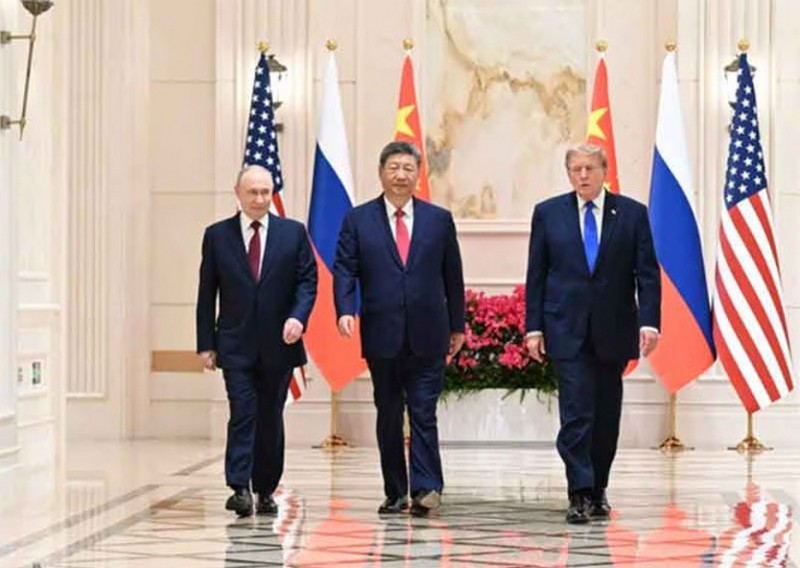
The world is witnessing seemingly dramatic developments on the geostrategic stage. The latest is the China-Russia-US summit in Shenzhen, China.
Other developments that preceded the summit include Iran’s heroic resistance to imperialist war; the imperialist abduction of the President and First Lady of Venezuela; threats to Cuba to wipe out the island country’s political and economic system; the US President’s desire to meet the North Korean leader; Ukraine’s failure to successfully play the role of a stooge of the imperialist camp in turning itself into a staging ground for an assault on Russia; fault lines within the European imperialist camp and across Europe; Lula making history in Brazil; countries in Africa asserting their rights over their natural resources; Japan failing to play the leading role in the imperialist world order that it once played; the emergence of BRICS+ and the New Development Bank; the increasing trend of de-dollarisation and trade between countries using their respective currencies instead of the US dollar; and the rise of the extreme Right in various countries.
The days when the entire world was threatened with a declaration of the following kind – either you’re with me or you’re my enemy – are over, however.
Iran is still struggling. Citing data compiled by maritime organisations, an ABC News report, “What’s Behind the Uptick in Attacks in the Strait of Hormuz?” (November 21, 2026), said:
“Reported attacks in and around the Strait of Hormuz have been higher in number in October and November than any previous months since the war between the U.S., Israel and Iran began in late February”.
The report by the US media outlet admits:
“To deploy a large force halfway around the world is enormously expensive.
“The attacks appear to be a bid to complicate U.S.-led efforts to keep oil flowing through the economically crucial Strait of Hormuz despite an Iranian-declared blockade, experts told ABC News.”
Doesn’t this demonstrate Iran’s resoluteness and imperialism’s problems and, in fact, its limitations?
On the NATO-Ukraine war front, one round of trilateral negotiations involving Russia, Ukraine and the US has recently concluded. Ukraine’s European friends found no place at the negotiating table. It is hoped that, in the next round of negotiations, the European “peace-loving” imperialists will find chairs. But the European camp has problems within its own ranks.
Russian aircraft capable of carrying nuclear weapons recently completed a visit to Vietnam. Doesn’t this carry any meaning?
Against this backdrop, China’s President Xi Jinping, Russia’s President Vladimir Putin and US President Donald Trump issued a joint declaration after their meeting in China. In the post-World War II world, this is historic.
It is historic because, in place of the old tripod – the US, Europe and Japan – a new tripod is emerging in the imperialist world order. It is historic because capitals engaged in competition over land masses, seas, oceans and space are trying to identify areas to exploit, spheres to redraw, and possibilities and threats to their respective domains. It is historic because new regional powers – India, South Africa and Brazil – are trying to widen and strengthen their spaces and autonomy.
The three leaders of China, Russia and the US, during the summit, pledged to prevent nuclear war, strengthen global security and reform international institutions.
The summit declaration said that the three leaders had held “an in-depth exchange of views on the current international situation”.
The declaration outlines the three powers’ commitments on nuclear security, energy cooperation and the reform of international institutions.
They expressed their commitment “to maintaining strategic stability and international security”.
As permanent members of the UN Security Council, they expressed their commitment to “reform the UN so that the UN can respond more effectively to global challenges and conform to its fundamental mission of international peace and security.”
Russia and China have long been demanding this: that the UN assert its fundamental mission and play a pivotal role in resolving security concerns around the world.
The imperialist power – the US – simply ignored this call. At the same time, it repeatedly trampled on the UN Charter and its declared role.
Now, the imperialist power has to theoretically come to an agreement with Russia and China on certain broader issues. This shows the diminishing strength of the imperialist power and the increasing power of Russia and China.
But a question remains: Will all the dominant factions of the imperialist power abide by this pledge or share this desire?
There is a possibility that another faction within the dominant camp of the imperialist state, upon assuming political power, may miscalculate the changing international power dynamics and return to warmongering. This will largely depend on the capitals driving that faction. Moreover, that faction has a long-practised tendency: “Go global – trample the sovereignty of countries, initiate regime change processes, etc.” These actions serve the expansion of the capital it represents.
The summit declaration made other good-sounding pledges, including plans to increase the production and supply of refined petroleum products for the benefit of all nations, given the need for stable energy flows.
What shall happen to Venezuela? Will Venezuela have legitimate control over the energy resources it owns? Will it see an end to the plunder of its hydrocarbon resources?
What shall happen to Cuba? Will the Cuban people have the opportunity to freely procure fuel to get through dark nights and address the dire situation facing hospitals because of fuel scarcity? Will Cuba have the right to freely explore oil off its shores?
Will Bangladesh have the opportunity to procure fuel according to its choice, with a better bargaining position and the scope to obtain fuel at a cheaper rate if it finds a less expensive source?
The declaration recognised that “a nuclear war can’t be won”. A nuclear war “must never be fought”. It also called for “dialogue on reducing nuclear risks and preventing the proliferation of nuclear weapons.”
What shall happen to the already deployed US “arms in orbit”, a very deadly development in the history of the arms race that was officially announced weeks ago but mostly went unnoticed, undiscussed and unprotested by anti-war and anti-nuclear organisations and movements?
Shall a country that fails to properly feed, shelter and provide medical treatment and education to its citizens, and also ignores immediate steps to ensure a safer environment and ecology, be told to stop sending its citizens abroad to literally beg for money while pouring money into procuring arms and maintaining nuclear weapons?
Shall the continents of Asia, Africa and Latin America, as well as the oceans, be declared nuclear-weapon-free zones?
It is not expected that the questions raised above will be resolved overnight. But a process should be initiated.
The anti-imperialist forces, the progressive forces and those forces that do not act as imperialism’s proxy sepoys should begin discussions on the questions raised above and start making demands on these issues. This is the time to raise their voices.
Whatever happens with the above issues, it is crystal clear that the days of the unipolar world have ended with the declaration made by the three leaders in China, as the imperialist power is failing in many areas to maintain its domination. This process of failure has begun from within.
The imperialist capital that drives the imperialist state is in trouble, and that trouble began long ago. The trouble is now visible to a section of the mainstream and to a faction of the dominant interests in the imperialist country.
Whatever happens to the declaration – whether it is followed up by further discussions, agreements and concrete steps – it is crystal clear that the imperialist power is feeling compelled to compromise in certain areas. It is not only trying to reach compromises with a superpower but also with regional powers such as India. It would not be astonishing if the imperialist power makes compromises with Iran and North Korea tomorrow.
Thus, the declaration carries far-reaching significance. Its foremost significance is the end of the unipolar world order. It shows that the “great and noble” G7 club is no longer working effectively to ensure the expansion of the capitals it represents.
That means a new stream of competition between different sections of world capital is seeking new ways forward. One may refer to Lenin’s famous book on imperialism to understand this new effort on the world stage.
As an immediate expectation, one may hope that the threat of wars hanging over the world will diminish. But this expectation may nosedive if, tomorrow, another faction of the dominant interests in the imperialist country fails to realise the limitations of the imperialist state machinery and the problems its capitals are facing.
Therefore, instead of concentrating only on the declaration, a close look should be taken at the paths and directions the concerned capitals are pursuing.
Russia and China are not rivals. These two economies will not enter into conflict with each other, as the dominant imperialist power – the US – is still trying to outmanoeuvre both countries and take away parts of their respective spheres of influence.
The end of the unipolar world was unimaginable before NATO’s war in Ukraine against Russia. Imperialism’s war in Ukraine made the process of its decline visible. Its war against Iran made the process even more visible.
Sections of Europe, particularly the capitals driving those sections, are yet to realise that their power to unilaterally impose their desires, demands and plans on countries has come to an end. Within a short time, this realisation will come.
There are, however, questions that remain unanswered: How will the capitals in Europe adjust to the changing reality? How will they align? How will they compete? How will they plan to redivide the parts of the world that have already been divided or are close to being divided?
Europe’s grip on Africa is slackening. Its grip on Latin America is experiencing the same decline. In Asia, Europe has lost its tight grip, except in a few places.
Capitals in Europe have already suffered major blows in the Ukraine war. The myth of their power has been exposed. There are many hollow sounds and numerous failures, with the fading of the glamour of the European crown, crafted through the loot of their colonies and neocolonies.
However, there is still a long path ahead for Russia, China and their allies. China and Russia are well aware of this long journey. The two economies know that they have to work together and will continue to do so, as their economies demand this joint journey.
The unity of the Southern Sphere with Russia and China will provide the South with space to manoeuvre, greater autonomy and the opportunity to move away from the imperialist sphere.
Therefore, BRICS must be further consolidated and strengthened, and South-South cooperation must be expanded.
People in countries of the South should take a more active and stronger anti-imperialist stand in the political and economic spheres. They should create pressure on the dominant interests in their respective countries to move away from the sphere of imperialism and move closer to the South-South trend. In practical terms, this means raising the following demands:
- Join BRICS and the New Development Bank, or move closer to them.
- Initiate bilateral trade using respective national currencies.
- Set up industries using their own raw materials in their respective countries instead of exporting those raw materials to imperialist countries, as a number of African countries have already begun doing.
- Diversify export markets.
- Build anti-imperialist solidarity.
- Codify bans on actions such as the abduction of state leaders.
- Oppose imperialist wars, interventions and regime-change tactics.
Farooque Chowdhury is a political commentator
22 November 2026
Source: countercurrents.org