
By Feroze Mithiborwala
Passes Executive Orders Prioritising: Working Class Rights and Dignity, Enforcing Tenancy Rights, Affordable Housing, Public Land, Economic Justice, Human Services, Defends Free Speech and Right to Protest, Scraps IHRA & Reinstates BDS
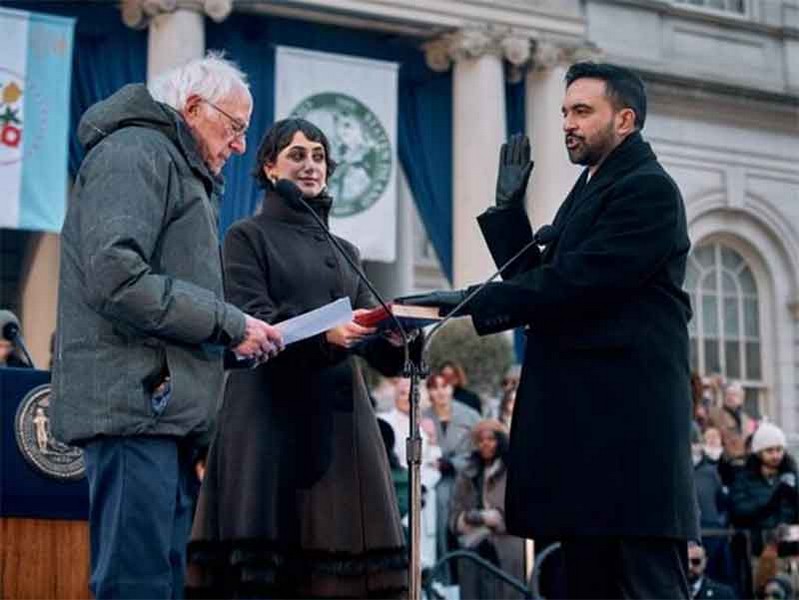
Zohran Mamdani’s inauguration on January 1, 2026 was not staged as a ritual of elite continuity but as a declaration of political alignment. Standing on the steps of City Hall, Mamdani delivered his oath and inaugural address in the presence of Bernie Sanders and Alexandria Ocasio-Cortez, the two figures most closely identified with the insurgent democratic socialist tradition that carried him into office. Sanders invoked New York’s working-class history and warned that “a city governed by billionaires is not a democracy,” while Ocasio-Cortez framed Mamdani’s victory as proof that “organized people can defeat organized money — even in the capital of real estate.”[1]
Mamdani’s speech echoed their themes. He spoke not of managerial competence or market confidence, but of rent, debt, wages, dignity, and power — insisting that government must be an instrument for those “who keep this city alive but are being priced out of it.”[2]
At his side stood Rama Duvaji, New York City’s new first lady, whose composed presence, her quiet elegance and mystique drew immediate attention. Comparisons to Princess Diana — less about royalty than about symbolic intimacy with public life — were not accidental. Duvaji’s visibility reinforced the sense that this administration understood politics not merely as policy, but as moral narrative and popular identification.
What followed in Mamdani’s first hours in office made clear that this was not rhetoric detached from action.
Clearing the Slate: Revoking the Adams Era
Mamdani’s first executive decision was sweeping and unambiguous. He signed an order revoking all executive orders issued by former mayor Eric Adams after September 26, 2024, the date of Adams’s federal indictment.[3]
Roughly nine executive orders were nullified, spanning antisemitism policy, restrictions on political expression, policing practices, and immigration enforcement.[4]
The choice of cutoff date was deliberate. By tying the revocation to the indictment, Mamdani framed the late Adams administration as politically compromised, a period in which executive authority was increasingly exercised without democratic legitimacy. The move provided Mamdani not merely a symbolic reset, but a legal foundation for reconstructing executive power in line with his mandate.
IHRA, BDS, and the End of Ideological Enforcement
Among the rescinded orders were two that had become flashpoints in New York politics.
The first was the formal adoption of the IHRA “working definition” of antisemitism, imposed across city agencies in mid-2025.[5]
Civil liberties advocates had long argued that IHRA’s expansive language was being used to collapse criticism of Israel into antisemitism, chilling speech and targeting Palestinian solidarity organizing.
The second was an executive order barring participation in the Boycott, Divestment, and Sanctions (BDS) movement, prohibiting city agencies and officials from supporting or engaging in boycotts or divestment related to Israel.[6]
Those New Yorker’s who stand for the cause of Palestine, who speak out against the ongoing Israeli genocide of Gaza, who speak up for the children of Gaza, now can speak, can protest without fear of being criminalised as an antisemite.
The order placed municipal power on one side of a global political struggle, restricting constitutionally protected political expression.
The backlash was swift. Several Jewish organizations accused Mamdani of weakening protections against antisemitism.[7]
Mamdani responded by drawing a clear distinction: antisemitism must be confronted forcefully, but political dissent cannot be policed by executive decree.
Importantly, he indicated that certain institutional functions created under Adams — including the Office to Combat Antisemitism — would continue under new frameworks and oversight.[8]
Reorganizing Power Inside City Hall
Mamdani’s break with the old order extended inward. Executive Order 02 reorganized mayoral governance, elevating housing, economic justice, and human services into core deputy mayor portfolios.[9]
This restructuring was a rejection of the neoliberal city model, where social policy is subordinate to “business confidence.” Mamdani embedded class politics directly into executive authority, signalling that inequality would not be treated as a downstream problem but as the central task of governance.
Tenants Move from the Streets to the State
Housing was central to Mamdani’s campaign, and it quickly became central to his governance. Executive Order 03 revived and empowered the Mayor’s Office to Protect Tenants, a body long marginalized even as rents soared and displacement accelerated.[10]
In a city where nearly 70 percent of residents are renters, and where more than half are rent-burdened, the move carried immediate political weight. The office is tasked with coordinating tenant protections across agencies, enforcing housing codes, and legitimizing tenant organizing as a driver of policy rather than a nuisance to be managed.
Public Land, Public Purpose
Mamdani’s Land Inventory Fast Track (LIFT) Task Force, created through Executive Order 04, aims to identify and deploy city-owned land for housing development.[11] Unlike the past that enriched developers while delivering minimal affordability, LIFT is explicitly oriented toward long-term public benefit, union labour, and durable affordability.
Economically, the task force signals a potential reassertion of public power over land use, challenging decades of real-estate dominance over urban planning.
The Meaning of Mamdani’s First Days
Taken together, Mamdani’s early executive acts mark a decisive shift in New York City politics. He has:
· Rolled back ideologically driven executive orders
· Restored democratic legitimacy after a compromised administration
· Shifted power toward tenants and working people
· Brought back focus on the public sector as an active shaper of markets
This is not moderation; it is alignment.
Mamdani is governing as he campaigned.
Conclusion: Governing as Promised
Zohran Mamdani’s first days in office demonstrate what it looks like when an administration takes its mandate seriously.
The policies will face resistance — from real estate interests, political elites, and ideological gatekeepers. But the direction is unmistakable.
For the first time in years, New York City is not pretending neutrality. City Hall has taken sides.
And that, in the capital of American urban capitalism, is already a profound assertion of people’s power.
References
Sanders, B., & Ocasio-Cortez, A., Inauguration remarks, NYC, Jan 1, 2026.
Mamdani, Z., Inaugural Address, Jan 1, 2026.
Haaretz, “BDS, Synagogue Protest Bans Revoked as Mamdani Scraps Adams-Era Orders,” Jan 2026.
ArcaMax Publishing, “Mamdani Axes
Adams Executive Orders,” Jan 2026.
Madhyamam, “NYC Mayor Revokes IHRA Definition,” Jan 2026.
Madhyamam, “Mamdani Revokes Anti-BDS Order,” Jan 2026.
Times of Israel / JNS reporting, Jan 2026.
Axios, “What Mamdani Keeps and Cuts,” Jan 2026.
NYC Mayor’s Office, Executive Order 02, Jan 2026.
NYC Mayor’s Office, Executive Order 03, Jan 2026.
NYC Mayor’s Office, Executive Order 04, Jan 2026.
Feroze Mithiborwala is an expert on West Asian & International Geostrategic issues. He is the Founder-Gen. Sec. of the India Palestine Solidarity Forum.
3 January 2026
Source: countercurrents.org