
By Bharat Dogra
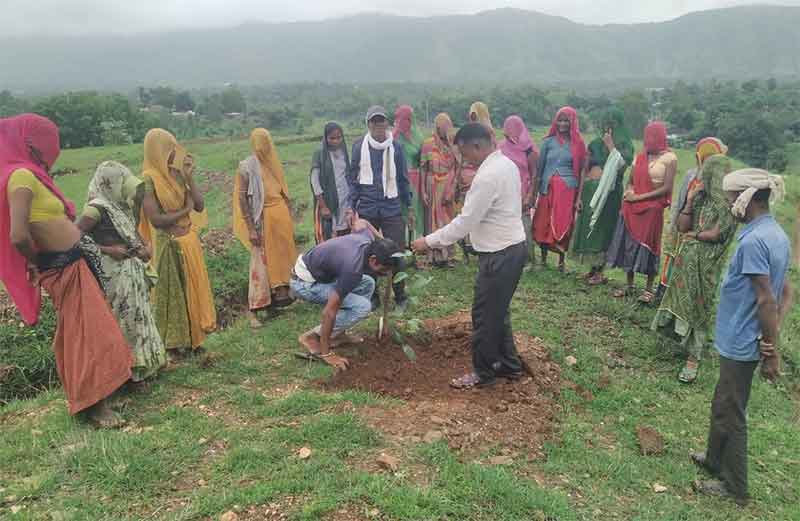
Kherwara block of Udaipur district has emerged as an important center of pasture regeneration initiatives. Jaan Mohammad has been closely involved in some important initiatives relating to this. Speaking about his experiences of taking up this work in Valibol village on about 75 hectares of land, he says that in some parts the regenerated greenery became so dense that it was not easy to walk through the trees.
While this was an important achievement from the point of view of the protection of environment, this also turned out to be great for sustainable livelihoods as people had more grass and leaves to feed their animals and also the green cover proved a blessing for water conservation and improved farming. The trees also could provide many more opportunities to those villagers who wanted to collected honey, gum, timru leaves and fruit (a fruit somewhat similar to chikoo).
During the COVID pandemic there was a serious livelihood crisis. In these conditions a woman Naduphoola started collecting plenty of timru fruits and selling these in nearby areas, thereby more than recovering the loss she had suffered due to the loss of other sources of livelihoods.
Another woman Dhanu made up her losses by collecting fallen branches and selling these as firewood. Thus even in most difficult times the regenerated trees and pastures could provide great relief to people.
Jaan Mohammed has similar experiences from his pasture regeneration efforts in Suveri. His friend Salim Bhai has also contributed to successful pasture regeneration efforts in Javas village, where apart from benefits to people significant increase in wild life has also been reported.
In Gogarwara village I met Manilal and his friends who drew inspiration from the earlier pasture regeneration work in a nearby village Dhanawara. They have made an important contribution to tree planting and fencing work. Nearly 15 species of trees including fruit trees like seetafal, mahua and jamun have been planted, apart from bamboo. Despite the threat faced from some wild animals, people here are very enthusiastic about these efforts. This year nearly 13500 pulis of grass could be collected and shared by people (one puli costs about Rs. 20). As Manilal says, people here got plenty of local employment for digging trenches and fencing work. Wage payments were made more promptly than happens in the context of NREGA work, he said. Rasik Lal, another villager, said that all this work will be of great benefit in future for improving and strengthening the main livelihood base of animal husbandry and farming in the village. Such is the enthusiasm of people that they have made voluntary contributions to create a community building near the newly regenerated pasture land.
What is common to all these initiatives is that these have been helped and promoted by a leading c voluntary organization Seva Mandir (SM). A senior member of SM who has been involved in these efforts for a long time Narayan Joshi says, “Nearly 90 pasture regeneration efforts have been made in Kherawar block and this has emerged as a leading center of this work. This work has also involved the removal of illegal encroachments. A lot of community effort with unity was involved to make this possible. Despite several local obstructions and problems, this work has been progressing very well.”
Apart from problems relating to harm caused by herds of wild animals particularly Neelgais to small plants, another serious threat has emerged in recent years in the form of destructive mining practices in some places. Several of these involve illegal mining of marble and other stones. In the Kalyanpur belt community actions taken up with unity were successful in stopping a part of the illegal mining work. Attempts were also made to regenerate some of the vacated land, but success here was less than in other places as the fertility of the land had been badly eroded.
In recent years a very significant new opportunity has emerged as nearly 70 community forest plots in this block have been identified and approved for management by communities in such ways that the communities protect the forests while also benefiting from them in the form of taking grass and other minor forest produce in sustainable and protective ways.
While this work has already started in the right spirit, the challenge is a very big one and it will need a lot more efforts and time. However when this progresses well, this will add further to the reputation of Kherwara as a leading center of pasture and forest regeneration by communities. In addition the reputation of this region for integrating in significant ways protection of environment and sustainable livelihoods will be further enhanced. This also provides a very promising model for taking forward climate mitigation and adaptation work with the enthusiastic involvement of people.
Bharat Dogra is Honorary Convener, Campaign to Save Earth Now.
23 February 2026
Source: countercurrents.org