
By Bharat Dogra
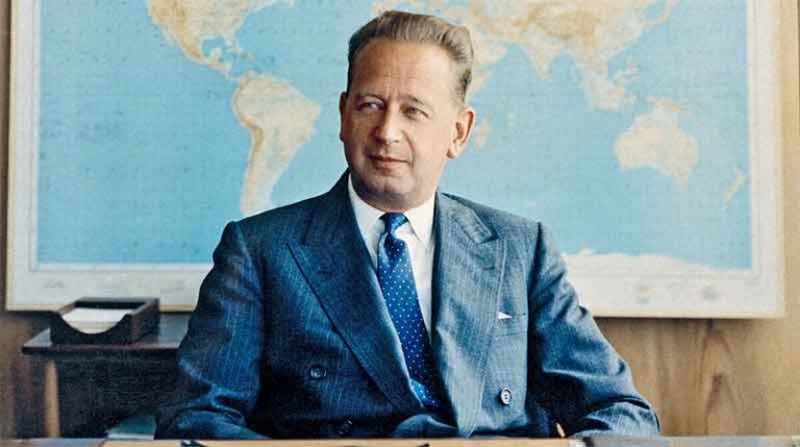
The death in highly suspicious circumstances of the Secretary General of the United Nations Dag Hammarskjold in 1961 has been widely debated. There have been several allegations that this was not an airplane accident as stated officially at that time. Instead, it has been alleged, the likelihood is much higher that the famous Secretary General known for his deep commitment to peace, and to peace and stability in Africa in particular, was the target of a plot to kill him.
Dag Hammarskjold was the youngest ever Secretary General of the UN and he alone has received the Nobel Peace Prize posthumously. He created the earliest UN peace-keeping operations, including those in Congo. Although in the context of Congo his work was at times criticized by both the USA and the Soviet Union, his work is now widely believed to be non-partisan and sincerely committed to peace. His commitment to peace is well-established, and his personality had significant philosophical and spiritual dimensions. While he was an eminent economist and diplomat, he also had important literary accomplishments. Surely the death in mysterious circumstances of such an eminent and many-sided personality should have been properly investigated, and it is very much to be regretted that 65 years after his death the truth has not been uncovered.
Here it needs to be noted that before Dag Hammarskjold died on 18 September 1961 along with 15 other passengers in an airplane, the Prime Minister of the newly independent country Congo Patrice Lumumba had been killed on 17 January 1961, at the beginning of the same year. Regarding the killing of Patrice Lumumba it is now widely agreed that the USA’s CIA as well as Belgium were involved in this. The Belgium government has already apologized and belatedly trial against a 90 year old diplomat, the only surviving official among the Belgium officials accused, was started recently. The reason behind this killing of a highly popular and capable leader deeply committed to the welfare of his people was that due to the vast mineral resources of Congo, the USA and its allies like Britain and Belgium were not willing to accept the leadership of a left-oriented democratic leader who could have nationalized the mines or otherwise used the minerals only in the interests of the people. It was to prevent this that secessionist violence was instigated and in the course of this a suitable opportunity was found to isolate, humiliate and kill Lumumba.
As became clearer later, while getting rid of patriotic leaders committed to welfare of people, other leaders who were promoted by the forces of imperialism were those who continued policies of colonial plunder while repressing and torturing people.
It is within this wider reality that the reasons for killing Dag Hammarskjold must be traced. Dag was deeply committed to peace in Africa. The extent of his commitment to Africa and its people should be evident from the fact that from 18 December 1959 to 31 January 1960 he visited as many as many as 21 African countries and territories and tried to meet people with many points of view to obtain better understanding of peace possibilities.
When Lumumba saw the coming violence, he appealed to the UN Secretary General for help. Hammarskjold responded well in organizing a peace mission. He personally visited Congo four times. It was in the course of the last attempted visit that he died.
The names of CIA, representatives of mining interests in Belgium (going back to colonial connections) and a South African para-military outfit have been mentioned in some reports in this context. It should also be remembered that the 1960s were the worst years for alleged CIA (with related organizations) involvement in assassinations of leaders committed to peace and justice, including great leaders within the USA like President John Kennedy. The name of Allen Dulles, former CIA director, has often come up in the context of these plots.
The investigation into the death of Dag Hammarskjold cannot ignore these wider realities of those times. President Kennedy had referred to him as one of the greatest statesmen. Using his highly respected status and high likelihood of support from President Kennedy (despite some initial differences), Hammarskjold could have been the key figure in saving Congo from the path of plunder and ruin by securing justice based peace and unity here. There is a high likelihood that the journey in the course of which he was likely to take important steps forward in this direction was disrupted and he was killed.
The UN has taken up several investigations but has not come up with a firm conclusion so far. However its investigation report in year 2024 stated that some member states have been reluctant in making available those documents from their archives which can help in finding the truth. These documents are particularly likely to be available in the USA, UK and South Africa.
One hopes that the truth regarding these tragic happenings of the past can be uncovered soon with the UN playing a lead role. After all, the UN can hardly become a symbol of justice if it fails to find the truth of the circumstances of death of its own most admired Secretary General for 65 years.
Bharat Dogra is Honorary Convener, Campaign to Save Earth Now.
5 April 2026
Source: countercurrents.org