
By Rima Najjar
For the first time in the history of the U.S.–Israel relationship, Washington has moved beyond arming, funding, and diplomatically shielding Israeli violence and has instead inserted its own military personnel, intelligence systems, and command structures into Israel’s war machine. It is doing so through a two-center mechanism that places U.S. military coordination on the ground while projecting civilian oversight through an international hub.
This essay traces the transformation across three dimensions: the strategic expansion of U.S. control over Israel’s battlefield decisions, the reduction of Arab and international agency to decorative multilateralism, and the recasting of Gaza from a site of national liberation into a permanently administered humanitarian problem. And yet, even within this daunting architecture of military, diplomatic, and bureaucratic force, Palestinians still retain points of leverage — narrow but real spaces in which to act, disrupt, and reassert political agency. Diagnosis alone is insufficient. The final section sets out concrete counter-moves — legal, diplomatic, institutional, and political — that Palestinians and their allies can deploy to expose the fragility of a trusteeship built without consent.
I. The Ceasefire Oversight Farce
For seventy-five years, the U.S.–Israel military relationship rested on distance: Washington armed, funded, and shielded; Israel acted. That distance has now collapsed. Roughly 200 U.S. personnel operate around the clock inside Israel, and on paper their mandate includes monitoring the ceasefire — watching Israeli conduct in real time. But this presence has neither curbed nor penalized Israeli violations. The shift from enablement to “oversight” is cosmetic; the structure of impunity remains intact.
The Civil–Military Coordination Center (CMCC), a CENTCOM-led hub located in a secure facility inside Israel, is the core of this new arrangement. Equipped with independent drone feeds, satellite imagery, and signals intelligence, it is the first disclosed American military institution built inside Israel with an explicit mandate to track ceasefire compliance and humanitarian access. U.S. reconnaissance flights now generate the primary operational picture around Khan Younis; American officers, not Israeli liaisons, feed coordination data into the battlefield. Every aid convoy, corridor, and “pause” is routed through a U.S.-run room. What is presented as monitoring is, in practice, immersion.
This immersion in Israeli operations is the essence of tutelage. As Palestinian analyst Rami al-Shaqra notes, since October 2023 “the administrative decision over what happens in the occupied Palestinian territories has become American par excellence.” Even the Trump-aligned admission that they are “more careful about Israel’s interests than the Israeli government itself” exposes the logic plainly: Washington sees itself as the responsible adult in the room, supervising a client it refuses to restrain.
Yet this tutelage is performed without the only form of leverage that could alter Israeli behavior — conditioning military aid. Instead of pressure, Washington has chosen proximity. The result is a hybrid in which Israel retains formal sovereignty and the final trigger, but the tempo and political sustainability of its violence are increasingly shaped by American officers watching their screens in Tel Aviv and Tampa.
Nowhere is this clearer than in the management of the ceasefire. Since the nominal 10 October 2025 ceasefire, Israeli forces have repeatedly violated it through drone strikes, raids, and targeted assassinations, killing more than 360 Palestinians, including 70 children. Rather than treating each breach as a violation demanding enforcement, the CMCC folds it into the system as a logistical disturbance to be managed. When an Israeli drone strike kills civilians — as in the 29 November 2025 attack in Beni Suhaila that killed two children gathering firewood — the incident is reclassified as an “operational irregularity.” Aid convoys are rescheduled, corridors rerouted, and diplomatic messaging recalibrated to insist the ceasefire “remains broadly intact.”
For Palestinians, each violation is another layer of deprivation normalized as coordination. For Israel, each violation is politically costless, its consequences absorbed by an American-run system that manages fallout rather than restraining the trigger. Oversight is now the mechanism through which Israeli impunity is reproduced — until the watched begin to watch the watchers, and the managed refuse to be managed.
II. The Multilateral Façade: Forty Nations with No Authority
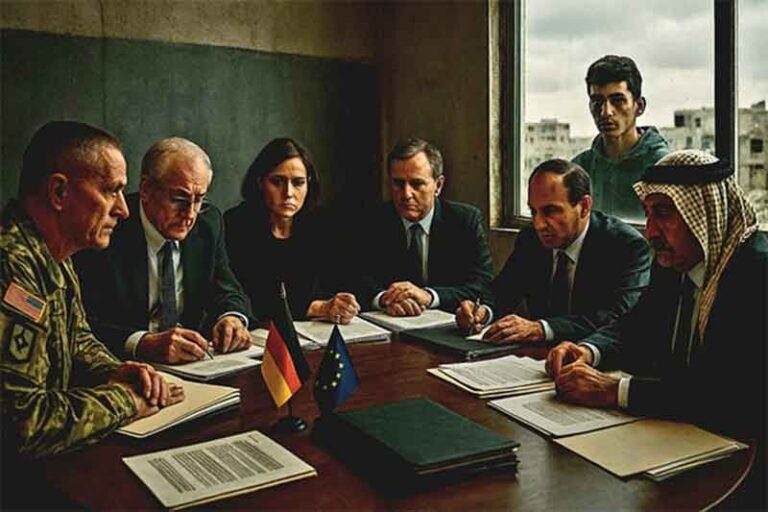
The International Gaza Coordination and Monitoring Center (ICMC), housed across the border in Egypt near Rafah and al-Arish, is presented as the civilian face of Phase Two of Trump’s ceasefire plan. It is a forty-nation “hub” meant to project multilateral legitimacy. In principle, multilateralism implies cooperation under shared rules and institutions, distributing authority through collective decision-making. In practice here, it has been hollowed out: diplomats from Europe, North America, and a handful of Arab capitals sit in air-conditioned rooms, issuing press releases about humanitarian corridors and security-sector reform, while real authority over borders, airspace, and the use of force remains exclusively Israeli.
On paper, the mandate looks sweeping — supervise aid entry, monitor corridors, liaise with an interim administration, facilitate disarmament. Yet each task assumes conditions that do not exist: low violence, fixed lines of control, a legitimate Palestinian governing partner, and Israeli willingness to accept binding limits. None are present. Israel’s violence never ended in Gaza or the West Bank. Aid trucks cleared by the hub still rot for days at Rafah under shifting Israeli “dual-use” criteria — a moving standard that allows Israel to recast civilian goods and spaces as military threats whenever convenient. Maritime corridors from Cyprus deliver symbolic quantities while land routes — the only ones that matter — remain choked.
Arab states have been deliberately relegated to logistical subcontractors. As one Egyptian diplomat admitted, “We control Rafah, we train police, but we are not consulted on who governs Gaza.” Qatar and the UAE provide funds and mediation but refuse troop deployments; a Qatari official told Reuters, “Our role is financial and political, not military.” Saudi Arabia has withheld engagement until there is a time-bound path to statehood… The region that will live with the consequences has thus been reduced to observer status inside its own crisis.
Egypt’s position exposes the imbalance most clearly. Cairo is operationally indispensable — co-sponsor of negotiations, host of Sinai infrastructure, controller of Rafah, anchor of Gaza’s logistics, and trainer (with Jordan) of Palestinian police units. This gives Egypt leverage, which Egyptian analysts openly acknowledge, yet Cairo remains wary of troop commitments that would entangle it in enforcing an externally designed order and absorbing its political costs. Egypt enables the system; it does not design it.
Qatar’s role is narrower: financier and mediator, not enforcer. Officials in Doha stress that funding has never been the obstacle — access has — and warn against treating Gaza as a technical management problem severed from a political horizon.
Saudi Arabia and the Gulf states close the circle. Draft U.S. proposals to authorize a stabilization force and Board of Peace have drawn sustained concern over vague sovereignty language and sweeping authority vested in an externally controlled body. The UAE has declined participation without a UN-backed legal mandate, while Saudi Arabia ties any engagement to explicit, time-bound commitments to Palestinian statehood. Gulf capitals are willing to finance reconstruction and provide diplomatic backing, but they withhold troops and enforcement roles by design.
European and non-Arab states mirror this pattern. EU officials have admitted that the CMCC lacks Palestinian representation, stressing that “there’s no Gazans there, there’s no Palestinians” in the monitoring process. The UK, Japan, Canada, and others have signed joint statements demanding Israel comply with humanitarian law and allow sufficient aid, but none have offered troops or binding enforcement. Their role is limited to funding, diplomatic pressure, and symbolic presence inside the forty-nation hub.
Despite their reservations… the forty states said nothing when Trump announced that “phase two is going to happen pretty soon.” No objections. No conditions. No delay. They know there is no ceasefire, no fixed lines, no Palestinian partner, no enforcement. They move anyway.
What ties the CMCC and the ICMC together is a shared political purpose: to convert Palestine from a question of rights and self-determination into a technical problem of governance, security, and humanitarian management. The priority is to confine Palestinian political agency, not to enable it. This is the political essence of the trusteeship: a sequence — stabilization → interim administration → disarmament → reconstruction — in which every phase defers the next, ensuring Palestinian political agency remains perpetually “not yet ready.”
The Board of Peace, the technocratic committees, the vetted police units — all exist to administer Palestinians, not to represent them. If the CMCC is Washington’s war room, the ICMC is its civilian façade — a stage on which international actors perform coordination without authority.
III. Institutional Incoherence in Practice
Institutional incoherence is visible the moment the system begins to operate. Each component — military, diplomatic, humanitarian — moves according to a different logic, producing a structure that generates activity without alignment, authority, or a shared understanding of what the system is meant to achieve.
- The military track: expansion without strategy
By late November 2025, the CMCC had grown into a warehouse-sized operations floor, its massive real-time map and daily agenda fed by U.S. drone, satellite, and signals-intelligence streams. Reporters visiting on 20–24 November 2025 described a center that had already expanded to include “nearly 50 countries and organizations,” even as Israeli strikes continued. The military logic is straightforward: expand surveillance, expand coordination, expand presence. It treats volatility as a technical problem to be monitored, not a political crisis to be resolved. - The diplomatic track: performance without leverage
Diplomatically, the system performs consensus it cannot produce. CENTCOM’s 17 October 2025 framing of the CMCC as a hub for “stabilization efforts” presumes conditions — ceasefire enforcement, fixed lines, a Palestinian counterpart — that do not exist. Diplomats continue to speak the language of progress while the military track grows in ways that contradict the very idea of a negotiated settlement. The diplomatic logic is theatrical: maintain the appearance of multilateral agreement while avoiding the confrontations required to build it. - The humanitarian track: improvisation under shifting rules
Humanitarian actors operate under a different logic entirely — one shaped by collapsing institutions and constantly shifting access rules. On 28 November 2025, the Gaza Humanitarian Foundation abruptly shut down, deepening the access crisis just as the CMCC assumed control of aid movement. Aid groups described a “severe access gap” as every convoy became dependent on Israeli clearance and rules that changed by the hour. The humanitarian logic is reactive and improvisational, shaped by constraints it cannot influence. - The outcome: a system that cannot cohere
These logics do not converge. The military track expands control; the diplomatic track performs consensus; the humanitarian track struggles to function. Mandates contradict one another, responsibilities overlap, and every actor assumes another is enforcing what no one is enforcing. The system produces motion without direction — an apparatus that manages symptoms it cannot resolve and performs order it cannot impose.
IV. Counter-Moves: How to Break the Trusteeship (Risks & Mitigations)
Refusal remains the most powerful weapon Palestinians have ever had. Now is the time to wield it without compromise and without pause.
- Legal asphyxiation at the ICC and ICJ
The strongest lever remains international law, but wielding it invites retaliation. Israel and the United States have already threatened sanctions against ICC personnel and cooperating states, and any new ICJ case on the trusteeship itself would be portrayed as “lawfare” to justify escalation. Mitigation: file through a coalition of 30–40 states so that sanctions become politically and economically impossible. Pre-publish the entire evidentiary package — CMCC drone logs, post-ceasefire victim testimonies, U.S.-approved targeting data — so that any retaliation is immediately seen as obstruction of justice. Quietly secure Chinese and Russian commitments not to veto a future Chapter VII resolution.
Who/How/When: Palestine’s legal team (Ammar Hijazi + Raji Sourani) + South Africa (Minister Ronald Lamola) + Malaysia (PM Anwar’s envoy) coordinate the text in a closed Pretoria meeting January 2026; 35-state joint ICJ request is tabled at UNGA February 2026; Al-Haq/B’Tselem deliver sealed ICC dossiers to Prosecutor Khan simultaneously.
- Coordinated Arab diplomatic rupture
An ultimatum from Egypt, Jordan, and Saudi Arabia would force Washington to choose between its Arab order and its Israel policy, but the immediate price could be brutal: withheld U.S. arms to Egypt, secondary sanctions, or threats to Camp David funding. Mitigation: the three capitals must move together and publicly. One country alone gets crushed; three acting in concert are untouchable. Frame the rupture as defence of Arab national security against “Iranian chaos.” Riyadh and Doha have already discussed a six-month financial backstop.
Who/How/When: Sisi’s national-security adviser, King Abdullah II, and MBS meet secretly in Sharm el-Sheikh or NEOM January 2026; joint 90-day ultimatum letter is hand-delivered to the White House 1 February 2026; $15 bn Arab Solidarity Fund activates automatically if U.S. retaliates.
- Total Palestinian institutional refusal
Blanket non-cooperation risks Israel punishing the entire population by cutting electricity, fuel, salaries, and aid. Mitigation: pre-stockpile three months of essentials, publish collaborators’ names instantly, and activate parallel popular committees from day one.
Who/How/When: Unified National Leadership for Popular Resistance (Hamas + Fatah + IJ + PFLP + unions) issues signed public pledge in Gaza City (livestreamed) 20 December 2025; collaborator lists go live on Telegram same day; popular committees already operating in camps declare themselves sole legitimate authority 1 January 2026; Egyptian/Jordanian Red Crescent warehouses open buffers the moment Israel tightens siege.
- BDS 2.0 against U.S. contractors
Targeting Anduril, Palantir, Constellis, etc. will trigger lawsuits and anti-BDS laws. Mitigation: start in Europe and Global South, use shareholder resolutions, pair every campaign with geolocated killing footage.
Who/How/When: BDS National Committee + IfNotNow/JVP + ECCO launch public database cmcc-profiteers.org on 1 February 2026; first divestment demands hit Norway’s $1.7 tn fund and Dutch ABP pension fund 15 February 2026; footage-verification unit run by 7amleh publishes weekly evidence packets.
- Narrative disruption — the “Gaza Live” platform
Real-time footage risks bans and “Pallywood” smears. Mitigation: decentralized infrastructure, triple-verification protocol, pre-funded legal defense.
Who/How/When: 7amleh + Syrian Archive tech team + Al Jazeera innovation lab launch the 24/7 platform 1 January 2026 on Mastodon/IPFS + 200 Starlink terminals already inside Gaza; triple-verified clips are pushed by 200 trusted creators who survived 2023–25; London/Dublin legal fund (already seeded by Qatar) activates day one.
- Exploiting the European fracture
Suspension of the EU–Israel Association Agreement will hit German-Dutch vetoes. Mitigation: start with unilateral national bans by recognizing states, then force Brussels to follow.
Who/How/When: Spanish PM Sánchez, Irish Taoiseach Harris, Norwegian FM Eide, Belgian and Slovenian counterparts hold joint Madrid press conference 10 March 2026 announcing immediate national bans on settlement goods and CMCC-linked companies; joint letter invoking Article 2 is sent to von der Leyen same day.
- Poisoning the reconstruction funding pipeline
Gulf donors could cave under U.S. pressure. Mitigation: lock the money in a Palestinian-vetoed escrow and hold donors publicly to their 2025 pledges.
Who/How/When: Qatar’s Deputy PM Mohammed bin Abdulrahman and Saudi Finance Minister al-Jadaan issue joint written declaration (already drafted November 2025) on 1 February 2026 freezing every dollar; Palestinian-controlled escrow account at Qatar National Bank or Credit Suisse Zürich is activated same week with public disbursement conditions (e.g., Netzarim corridor evacuation).
- Convening a Third Palestinian National Council in exile
A democratic PNC including Hamas and IJ will be branded “terrorist.” Mitigation: host in a protected state, invite UN observers, base program on unassailable 1988/2006 documents.
Who/How/When: PLO Executive + Hamas political bureau + diaspora networks choose Algeria or South Africa as venue by 15 January 2026; secure online + in-person voting opens 1 March 2026 across refugee camps and diaspora; 1,000-delegate congress convenes and is livestreamed June 2026; first resolution dissolves all trusteeship bodies and reaffirms PLO sole representation.
Taken together, these eight lines of pressure share one strategic logic: make the occupation’s sophisticated new management structure politically radioactive, diplomatically unsustainable, and financially ruinous.
Trusteeship survives by appearing inevitable. Counter-moves work by turning the trusteeship from ‘inevitable’ into ‘unbearable.’
Rima Najjar is a Palestinian whose father’s side of the family comes from the forcibly depopulated village of Lifta on the western outskirts of Jerusalem and whose mother’s side of the family is from Ijzim, south of Haifa.
7 December 2025
Source: countercurrents.org