
By Rima Najjar
How Israel Processes Theft
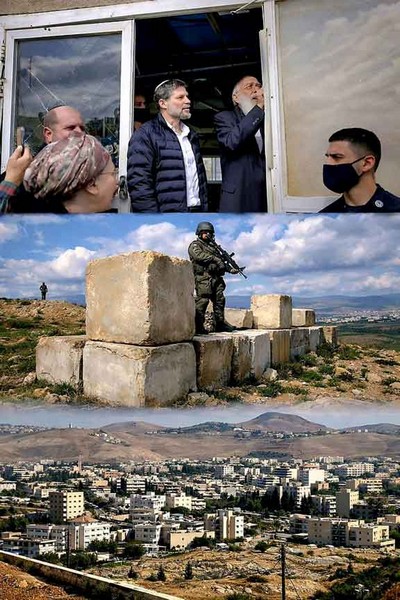
My opening collage freezes a moment in the accelerating machinery of Israel’s annexation of the West Bank: a grotesque tableau where bogus religious sanctity, corrupt ministerial clout, and raw military brutality meld into a unified assault. The images, based on photographs published by AP’s Ohad Zwigenberg on January 19, 2026, is a perfect distillation of impunity. They show Israel’s finance minister stepping into a newly “legalized” settlement outpost as a rabbi fastens a mezuzah to its doorway — blessing the eternal plunder — while Israeli soldiers enforce armed control over land overlooking the Palestinian town of Beit Sahour. In this single frame, Israel “regulates” Palestinian dispossession through legal structures that brazenly defy international law, rendering the theft routine and legitimate for its own institutions, its settler vanguard, and its international enablers.
While the world’s attention remains riveted on the devastating humanitarian catastrophe in Gaza, a quieter but equally transformative crisis is reaching its culmination in the West Bank. There, Israel is rapidly entrenching a permanent, unequal regime through accelerated de facto annexation, physically transforming the territory at an alarming speed. Recent government decisions in February 2026 formalize this acceleration: repealing decades-old Jordanian laws banning direct land sales to Jews, unsealing land registries for easier seizures, transferring building and enforcement authority (including in Hebron and parts of Areas A and B) from Palestinian bodies to Israeli control — measures the UN Secretary-General has condemned as unlawful and gravely erosive of a two-state path long foreclosed by Israel’s own actions and the facts on the ground. This stark disparity prompts a critical question: Can the international community, which has mustered unprecedented pressure over Gaza, summon comparable force to halt the West Bank’s annexation?
A legal watershed has provided the international community with its most potent tool to date. On July 19, 2024, the International Court of Justice (ICJ) declared Israel’s continued presence in the Occupied Palestinian Territory unlawful, affirming the West Bank, East Jerusalem, and Gaza as a single territorial unit that must be preserved as one. Critically, it concluded that all states have a duty not to recognize the situation as lawful and to refrain from aiding or assisting it — transforming a protracted political dispute into a concrete, multilateral legal obligation under international law.
This foundation was powerfully reinforced in the ICJ’s subsequent Advisory Opinion of October 22, 2025. Responding to Israel’s obstruction of humanitarian relief — including prolonged aid blockages and restrictions on UNRWA — the Court unanimously reaffirmed that Israel’s obligations as an occupying power increase “commensurate with the degree of its effective control” — a control it found had “increased significantly” since October 2023 through retained authority over borders, airspace, taxation, and intensified military influence. It ruled that Israel must ensure the population is supplied with essentials, facilitate humanitarian relief without impediment, and cooperate fully with UN agencies. Applying a functional “effective control” test, the Opinion concluded that occupation law remains continuously applicable to Gaza, solidifying a crucial legal principle: Israel’s status as the occupying power — and the attendant duties of all other states — persists across the entire Occupied Palestinian Territory.
Thus, the ray of hope is agonizingly narrow. It lies not in new law, but in a newly activated and specific enforcement mechanism for third states. The shift is not in what is forbidden — annexation has always been illegal — but in who is now formally obligated to act against it and what those actions must be. The ICJ has provided a “legal crowbar.”
This crowbar empowers action on three concrete fronts derived from the Court’s opinions and the UN’s follow-up resolutions:
- Legal & Diplomatic Isolation: The 2024 opinion compels states to review and sever dealings that recognize Israeli sovereignty in the occupied territories, including in trade agreements, diplomatic practice, and any measures that fail to distinguish between Israel and the Occupied Palestinian Territory.
- Economic & Corporate Pressure: The duty of non-assistance provides grounds for sanctions on settlement entities, mandatory differentiated labelling of settlement goods, and public guidance warning businesses of the legal and reputational risks of involvement in activities that sustain the unlawful situation.
- Accountability & Aid Enforcement: The 2025 opinion gives states a firm legal mandate to demand Israel allow unimpeded humanitarian access, facilitate relief without impediment (including via UN agencies like UNRWA), and hold it accountable for violations — supporting actions at the International Criminal Court and other tribunals.
This tool disrupts the cost-benefit calculus of third states. It empowers domestic parliaments, courts, and civil societies to increase this cost internally, making sustained complicity with annexation increasingly untenable. The question is no longer about the clarity of the law, but about the political will to use the powerful legal lever the world’s highest court has now placed in the international community’s hands.
A Fragmented Counter-Offensive: The Deliberate Incrementalism of Third-State Action
The ICJ’s ruling handed the world a crowbar, but the initial prying attempts have been cautious and fragmented. States are testing the tool’s strength through incremental legal and political challenges, seeking to signal compliance with international law while avoiding a full-scale diplomatic rupture with Israel and its primary protector, the United States.
- In Australia (February 2026), civil society coalitions — including Amnesty International Australia, the Jewish Council of Australia, and others — along with legislators, used ICJ language to challenge the government during President Herzog’s visit. They filed legal petitions and complaints framing standard diplomatic protocol as potential complicity in the unlawful occupation, forcing Foreign Minister Penny Wong into televised and public justifications that exposed the government’s legal vulnerability amid widespread protests.
- Within the European Union, sanctions under the Global Human Rights Sanctions Regime have expanded beyond violent settlers to entities supporting settlement infrastructure. More significantly, the proposed suspension of the EU-Israel Association Agreement — advanced by the European Commission in September 2025 — threatens preferential tariffs on billions of euros in trade, marking a qualitative escalation that remains under Council consideration.
- In national courts, lawsuits targeting corporations — like ongoing multi-jurisdictional actions against travel platforms Airbnb and Booking.com in France, the UK, Ireland, and elsewhere — seek to establish a critical legal precedent: that commercial activity in settlements constitutes actionable “aid or assistance,” opening a new front of corporate liability post-ICJ opinions.
- Through unilateral state measures, initiatives like Ireland’s progressing Occupied Territories Bill (revised 2025 to ban goods imports from settlements) and Norway’s sovereign investment exclusions (via its pension fund’s ethics-driven divestments) legally recast political support for a two-state solution into a mandatory duty to sever economic ties with settlement enterprises.
The Mechanism of Political Delay
Yet, this nascent pressure model is chaneled by powerful states through a cautious, strategically narrow and slow calculus. They direct the “non-assistance to Israel” duty into lawsuits against individual corporations and condemnations of specific crises — actions that manage reputational risk for states without threatening the underlying structure of the occupation or challenging the geopolitical shield that protects it. The unmet September 2025 deadline of the UN General Assembly’s resolution (ES-10/24), which endorsed the ICJ opinion and demanded Israel’s withdrawal from the unlawful presence, is the definitive emblem of this gap: a consensus on legal principle exists, but the collective political will to activate its most consequential enforcement mechanisms does not.
The most significant brake is the explicit political shield provided by the United States. As Israel’s primary military and political ally, the U.S. has rejected both the ICJ’s July 2024 opinion and its October 2025 Advisory Opinion as “not binding” and politicized — dismissing the latter as “baseless” and unfairly targeting Israel while defending restrictions on UNRWA. Washington has vowed to continue its policy of unconditional support of Israel, including the steady flow of $3.8 billion in annual military aid.
The US position neutralizes the most powerful tools of international law — such as a UN Security Council-mandated arms embargo or coordinated state-level sanctions — by making them politically unfeasible for other allies unwilling to contravene the provider of aid to them.
The delay, therefore, carries a crushing sense of déjà vu. It is a managed stall — a choice to use the crowbar of the ICJ’s ruling to chip at the edges of the settlement enterprise rather than to lever it from its foundation. The unmet UN deadline is its symbol; the unwavering flow of American military aid is its engine. This gap between legal principle and political enforcement is the space in which annexation advances and where activist efforts, though increasingly potent, are systematically outpaced by the accelerating facts of annexation on the ground.
The Race’s Final Lap
The final phase is a 21st century race between the Hare and the Tortoise. The Hare — Israel’s annexation — sprints with brutal speed, betting that material facts will outpace political will. It’s racing to lock in the plunder before the tortoise can catch up.
The transformation of the West Bank that began decades ago with outposts and land grabs is now turbocharged by the February 8, 2026 security cabinet decisions: repealing Jordanian era bans on direct Jewish land purchases, unsealing land registries for easier seizures, shifting building permits and enforcement powers (including in Hebron and over sensitive sites like the Tomb of the Patriarchs) from Palestinian authorities to Israeli control, and extending administrative reach into Areas A and B. Smotrich and Katz frame these as “security” and “Zionist interest,” but the hare’s sprint is about securing the occupation itself — deepening roots, burying Palestinian statehood, and rendering reversal impossible through irreversible facts on the ground. These are steps the UN Secretary-General has condemned as unlawful and gravely erosive of a two-state path that Israel has spent decades rendering impossible — and that the latest measures now bury for good.
The Tortoise — the pro Palestine international community — now moves with the ICJ’s “legal crowbar” in hand: a tool for slow, steady, cumulative pressure derived from the 2024 and 2025 opinions, obligating states to non-recognition, non-assistance, and active disruption of the settlement enterprise. These rulings expose the real dynamics of the struggle: Israeli annexation has long structured the West Bank, and the current acceleration simply sharpens its administrative edge; political hesitation by powerful states sustains the system they claim to oppose; and the legal burden now rests squarely on governments that present themselves as guardians of international law. The race unfolding is shaped by this tension — between a project racing toward permanence and a global legal framework that requires states to act before the window for meaningful enforcement closes.
The crowbar exists. The test is whether the Tortoise will use it with the relentless, strategic patience the moment demands — before the Hare’s self-justifying “security” dash reaches the finish line.
Rima Najjar is a Palestinian whose father’s side of the family comes from the forcibly depopulated village of Lifta on the western outskirts of Jerusalem and whose mother’s side of the family is from Ijzim, south of Haifa.
11 February 2026
Source: countercurrents.org