
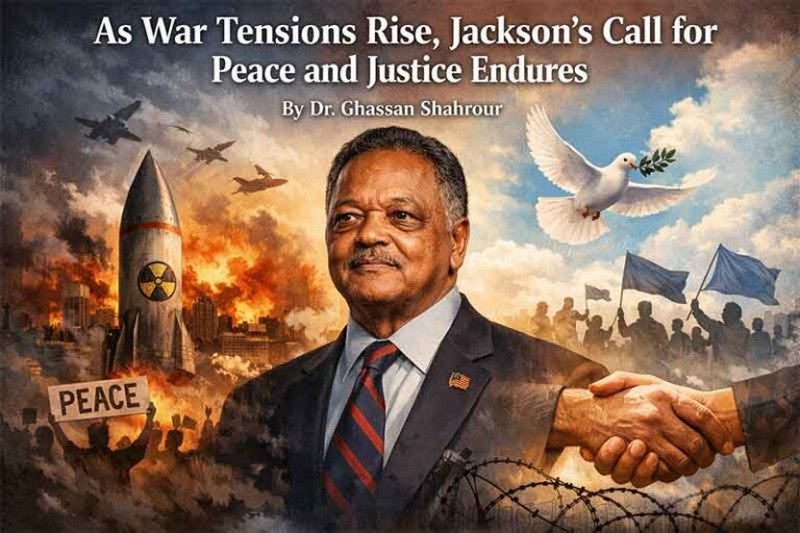
By Dr. Ghassan Shahrour
Rev. Jesse Jackson, who passed away on February 17, 2026, leaves behind a legacy that extends far beyond the civil-rights milestones that first defined his public life. As founder of Operation PUSH (People United to Save Humanity) — later People United to Serve Humanity — Jackson built an institution grounded in economic justice, educational opportunity, and the empowerment of marginalized communities. PUSH was not merely an organization; it was a moral vision that placed human dignity at the center of public life.
Equally defining, though less widely acknowledged, was Jackson’s unwavering commitment to peace and disarmament. From the 1980s onward, he emerged as one of the most consistent American voices urging an end to the nuclear arms race. He warned that humanity could not survive a world governed by fear, militarization, and the unchecked spread of weapons. His message feels even more urgent today, as global tensions rise, military budgets swell, and new technologies accelerate conflict. In an era drifting toward escalation, Jackson’s voice reminds us that human security begins with justice, not armament.
This urgency is sharpened by the expiration of the New START Treaty in February 2026, which removed the last remaining legal limits on the world’s two largest nuclear arsenals. For the first time in more than half a century, no binding framework restrains U.S.–Russian nuclear forces. Jackson spent his life urging nations to step back from the brink; the disappearance of these guardrails underscores how vital — and how fragile — the work of peace truly is.
For those engaged in humanitarian disarmament and human-security advocacy, Jackson’s passing resonates deeply. We know — from years of documenting suffering, negotiating with policymakers, and mobilizing communities — that change is slow, fragile, and often resisted. Advocacy demands patience, resilience, and the belief that moral clarity can outlast political cycles. Jackson embodied that endurance.
His international humanitarian work reflected the same convictions. He negotiated the release of hostages in Syria and Cuba, supported peace efforts in Central America, stood firmly against apartheid, and consistently defended Palestinian rights, insisting that no people should live without freedom, dignity, or hope.
As we reflect on his passing, one truth stands out: the most faithful tribute to his legacy is to resist the normalization of war and the quiet expansion of armament, and to defend justice wherever it is threatened. Accepting conflict as inevitable is a moral failure. Peace is not a distant aspiration — it is a shared and urgent responsibility.
Dr. Ghassan Shahrour, Coordinator of Arab Human Security Network, is a medical doctor, prolific writer, and human rights advocate specializing in health, disability, disarmament, and human security.
18 February 2026
Source: countercurrents.org