
By A Correspondent
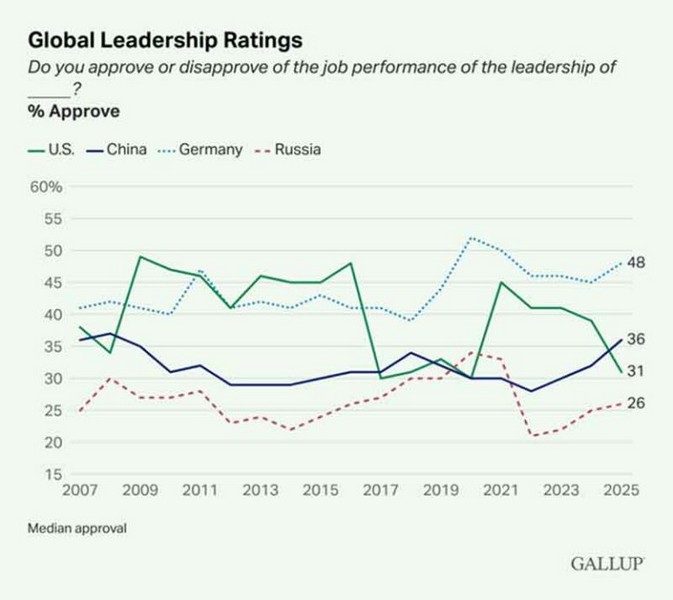
China has surpassed the U.S. in global leadership rating. China’s leadership approval climbs to 36% while the U.S. leadership’s falls to 31%.
According to a new Gallup poll released April 3, 2026 [https://news.gallup.com/poll/707945/china-edges-past-global-approval-ratings.aspx], global approval of China surpassed the U.S. in 2025, the widest favorability gap between the two countries in almost 20 years.
Gallup said: “China’s five-percentage-point advantage over the U.S. is the widest Gallup has recorded in China’s favor in nearly 20 years.”
The poll-organization said: “The latest results are based on Gallup surveys conducted in 2025 in more than 130 countries; they notably predate several major developments in early 2026, including the U.S. withdrawal from 66 international organizations in January and the outbreak of war with Iran in late February.”
Gallup’s findings include that China’s global approval rating last year reached a median of 36 percent in support of China’s leadership while the U.S. leadership experienced its median approval rating drop to 31 percent – a fall of 8 percentage points since 2024. China’s approval rose from 32 percent in 2024.
Gallup found: Disapproval of China’s leadership remained flat at 37 percent while the U.S. leadership’s disapproval reached a record-high of 48 percent.
Gallup also found: China saw the strongest relative alignment from countries like Russia, Pakistan, Tunisia and Singapore, and these countries’ preferences “reflect deep negativity toward the U.S. more than strong enthusiasm for China” while countries that include Israel, Poland, Kosovo, the Philippines and Albania favor the U.S. Their net approval resembles their net disapproval of China.
According to the poll:
- Most countries do not have a strong preference for either China or the U.S.
- China saw strong alignment from 8 percent of countries compared to 5 percent strongly aligned with the U.S.
- Another 40 percent are weakly aligned to the two countries, with 32 percent to China and 8 percent to the U.S.
Another 40 percent are weakly aligned to the two countries, with 32 percent to China and 8 percent to the U.S.
Gallup said:
“The recent shift reflects a decline in U.S. ratings alongside an increase for China. Median approval of U.S. leadership fell from 39% in 2024 to 31% in 2025, returning to earlier lows, while China’s approval rose from 32% to 36%.
“For the past two decades, Gallup has asked residents of every country polled as part of its annual World Poll to rate the leadership of the four leading economic or military powers — the U.S., China, Russia and Germany.”
The poll-organization said: “Before the most recent survey, China had led the U.S. in leadership approval twice: once during the Bush administration and once during the first Trump administration.”
U.S. Ratings Fall Sharply Across Countries
Gallup found:
- “Approval of U.S. leadership declined by 10 points or more in 44 countries between 2024 and 2025, while it increased by a similar amount in only seven. The declines were concentrated among U.S. allies, including many NATO partners.”
- “Germany led the world in declines; its approval of U.S. leadership fell by 39 points, followed closely by Portugal (down 38 points). Several other long-standing U.S. partners — including Canada, the United Kingdom and Italy — also showed substantial decreases.”
- “U.S. standing improved by more than 10 points among Israelis, marking an exception among U.S. allies. Approval of U.S. leadership in Israel, which surged after the October 2023 Hamas attack and then fell sharply in 2024, rebounded to 76% in 2025 after Trump’s return to the White House — a 13-point increase, among the highest levels globally.”
- “These patterns echo the distribution of declines seen at the start of Trump’s first term, when approval dropped most sharply among U.S. allies. The current shift is widespread, with large declines spanning many countries and regions.”
- “Overall, China’s move ahead of the U.S. more broadly reflects a decline in U.S. ratings rather than an increase in China’s ratings. Approval of China’s leadership increased by double digits over the past year in 23 countries (versus 44 showing a similar decrease for the U.S.). However, many of China’s increases occurred in countries where U.S. approval fell, including allies such as the U.K., Spain, Italy and Ireland.”
More Countries Lean Toward China Than the U.S.
The poll found:
- “Comparing net approval at the country level reveals which ones lean toward one power over the other in terms of public opinion. The countries and territories most aligned with the U.S. — those that have strong net approval of the U.S. that roughly mirrors their net disapproval of China — span several regions, and include Kosovo, Israel, Poland, Albania and the Philippines.”
- “Russia, Pakistan, Tunisia, Singapore and Hong Kong show the strongest relative alignment with China, though notably, their preferences reflect deep negativity toward the U.S. more than strong enthusiasm for China.”
Gallup said: “Grouping countries by their relative net approval figures offers a clearer picture of alignment strength. Countries with a gap above 50 points in either direction are classified as strongly aligned; gaps of 30-49 points indicate aligned; 10-29 points, weakly aligned; and 0-9 points, contested.”
It said: “Despite China’s overall lead in net approval, most countries do not have a strong preference for one power over the other. Last year, 8% of countries were strongly aligned with China, compared with 5% strongly aligned with the United States. Alongside the 30% of countries with no clear alignment, another 40% are only weakly aligned to either power: 32% to China and 8% to the U.S.”
China Leads U.S. in Net Approval, Though Both are Negative
Gallup said:
“Looking at net approval — the percentage who approve minus those who disapprove — provides a more complete view of global sentiment toward the U.S. and China.
“2025 was only the second year on record in which both Washington and Beijing registered negative net approval ratings worldwide. China’s median net approval of –1 was barely negative, while the median net approval of –15 for the U.S. was its lowest on record, marginally below the –13 measured in 2020.
“Net approval of China fell gradually for several years after 2008, but first turned negative in 2020 and has remained negative since. By contrast, net approval of the United States has fluctuated more in line with changes in political leadership.
“In 2025, as both approval and disapproval shifted for the U.S. and China, the percentage expressing no opinion reached some of the lowest levels seen in the past two decades. This suggests that global views of both powers are becoming more defined, with more people forming clear opinions in both positive and negative directions.”
Nearly Half of All Countries Hold a Negative View of Both Powers
Gallup said:
“China leads the U.S. on three leadership approval statistics: global median approval (36% vs. 31%), net approval (–1 vs. –15), and relative net approval (54% of countries aligned vs. 16%). Yet Beijing’s advantage over Washington tells only part of the story.
“Nearly half of all countries surveyed last year (45%) delivered negative net approval ratings to both powers, meaning more people disapproved than approved of each. Fewer than one in three countries (29%) gave positive net approval ratings to both. Aside from 2020, when fewer countries were surveyed because of the pandemic, this is the most negative the world has been toward both powers in two decades.”
Towards a Multipolar Order
Gallup said:
“The shifting perceptions of U.S. leadership over the past two decades reflect a world that has moved toward a more multipolar order. Many countries, particularly U.S. allies, may be open to balancing relationships across major powers than aligning clearly with one.
“For policymakers in some allied countries, this may make alignment with the U.S. more politically sensitive, even as engagement with China appears somewhat more acceptable. For businesses and investors, it signals a less predictable environment, where public sentiment may shape market access, regulation and partnerships.”
A Declining Power
After the WW II, the Empire lent the Marshall Plan and similar plans to its friends and client-states. Almost at the same time, the Empire gained the power to print money for use in international trade and finance. Scholars serving the Empire termed the time as the “American Century.” “The U.S. predominance”, write Harry Magdoff and Paul M. Sweezy, “in production, trade and finance, backed by formidable military power straddling the globe, furnished a powerful stimulus to domestic prosperity during the early postwar years. But this too began to wane as other advanced capitalist nations gathered strength, entered into vigorous competition and even overtook the United States in some areas. …
“The relative loss of competitive strength in world trade intensified the difficulties connected with the dollar’s role as an international currency, thus limiting the ability of the United States to take advantage of its hegemonic position by flooding world markets with dollars.” [The Deepening Crisis of U.S. Capitalism, MR Press, 1980]
More developments have followed within the Empire and on the world stage, since H Magdoff and P M Sweezy found the reality cited above. The rise of China as an economic power was unimaginable to the Empire and the camp it leads years ago. The NATO’s Ukraine War, the unprecedented sanctions the NATO-camp imposed on Russia, the way Russia countered those sanction-measures, and the increasing use of national currencies in bilateral trades are important developments that get reflected in the area of leadership domestically and internationally. The latest Gallup findings reflect this reality moving against the Empire. In Africa, China’s and Russia’s role is increasing. China has economically made noteworthy inroads in Latin America, which leads the Empire to openly violate international laws and sovereignty of a Latin American country – Venezuela, and threaten other countries – Cuba, Colombia and Mexico – with voice heard during the medieval age. This voice of threat is a weapon in the hands of the Empire, which will turn blunt after a certain time. After end of the Empire’s Iran War, the Empie’s leadership position will wane further, which means its influence, and commanding and bargaining power will erode further.
6 April 2026
Source: countercurrents.org