
By Ranjan Solomon
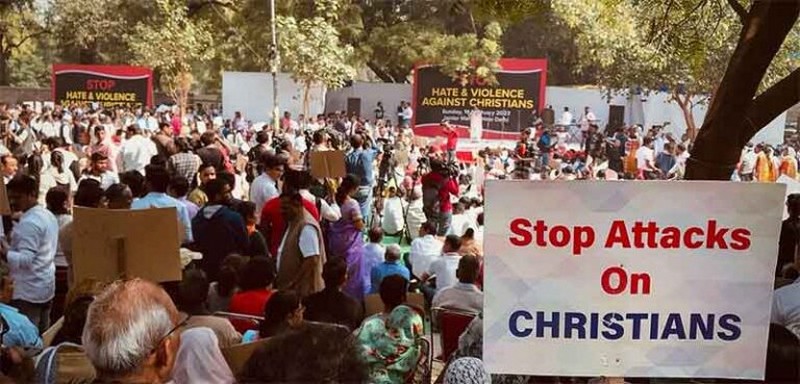
Christmas 2025, traditionally a season of worship, prayer, carol singing, and communal celebration across India, has been overshadowed by intimidation, harassment, and targeted violence against Christians. Across Chhattisgarh, Madhya Pradesh, Uttar Pradesh, and other central Indian states, congregations faced disruption of prayer meetings, physical assaults on carol singers, and arrests under allegations of conversion. These incidents are not isolated expressions of communal tension—they are symptomatic of a systematic effort to criminalise religious expression and intimidate minority communities.
The persecution during Christmas underscores a deeper crisis: the steady erosion of constitutional protections, the normalisation of vigilantism, and the selective enforcement of laws. It demonstrates that peaceful worship can be construed as criminal behaviour, and that even festive celebration is not immune from scrutiny and harassment. How else must Christians, in particular, and society as a whole, view the disruption of Christmas church services and tear down decorations around the country by right wing Hindu extremists. What is most worrying is that the ruling party is complicity having closed their eyes, failed to provide protection, and provided the perpetrators virtual ‘carte blanche’ to bring on the mischief.
Disruption of Carol Singing and Prayer Meetings
Carol singing, a core component of Christian cultural and religious life in India, became a flashpoint for intimidation and physical assault this Christmas. In Delhi, women participating in carol singing were confronted by right-wing groups and verbally harassed for alleged proselytization. In Odisha, Christian groups performing carols in public spaces faced threats and were told to cease their activities. In Madhya Pradesh, prayer meetings in several districts were disrupted based on unsubstantiated allegations of forced conversion. Police were called, not to ensure the safety of worshippers, but to demand permits, question participants, and in some cases halt the gatherings entirely.
Only through judicial intervention were some of these events restored, with courts affirming that public worship and carol singing are constitutionally protected. That such fundamental freedoms must repeatedly be defended in court highlights the failure of administrative and executive mechanisms to uphold constitutional rights proactively.
The targeting of carol singers illustrates a disturbing trend: even expressions of joy and celebration are now treated as potentially criminal acts when performed by minority communities. The policing of worship signals a broader intention to regulate faith itself, converting benign religious expression into a site of suspicion.
Chhattisgarh: Mass Arrests and Criminalisation of Worship
Chhattisgarh represents the most striking example of systematic repression. Reports indicate that over 110 Christians were arrested under the state’s stringent anti-conversion laws, accused solely of attending prayer meetings or “converting” others. The arrested included pastors, laypersons, and tribal Christians, many from rural and semi-urban communities. These actions were taken without evidence of coercion, inducement, or fraud, relying solely on the ideological presumption that Christian worship inherently involves conversion.
The legal framework in Chhattisgarh allows for collective punishment and reversal of the presumption of innocence, effectively criminalising ordinary religious activity. Bandhs called against Christians intensified hostility, while local authorities failed to protect congregants. In some areas, tribal families were denied access to gravesites for burials, prayer halls were vandalised, and congregations were forcibly dispersed. The systematic application of anti-conversion laws in this context transforms law from a protective instrument into a tool of political and social control.
These arrests underscore the chilling effect on minority communities: the very act of worship becomes a risk, deterring public religious expression and instilling fear.
Madhya Pradesh and Central India: Preventive Policing and Selective Law Enforcement
In Madhya Pradesh and parts of central India, preventive policing disrupted Christmas prayer meetings based on complaints by Sangh-linked organisations. Police action, ostensibly for “maintaining peace,” involved stopping congregations, questioning participants, and imposing restrictions. These measures were applied selectively; majoritarian religious processions routinely violate noise regulations and traffic laws without interference, highlighting the ideological bias in law enforcement. To indulge in hooligan-style misbehaviour, shouting slogans such as ‘Jai Shree Ram in the middle of a serious worship, is an illustration of lost civilizational values.
Jabalpur alone witnessed two attacks against Christian prayer meetings, on December 20 and 22. In the first instance, BJP’s district vice president Anju Bhargawa assaulted a visually impaired woman in the presence of onlookers including children. The Minute reports how a man who goes by the name Sri Satyanisth Arya was seen yelling at a public event, “No Christians shall follow the Bible. Am I clear?” followed by calls of “Jai Shri Ram” and “Jesus Christ is not ours, ours is Ram Bhagwan.”
Reports document numerous incidents of violence and harassment against Christian communities in India during the Christmas season, carried out by Hindu right-wing groups, which contradicts the concept of Hinduism as the “most tolerant religion” as espoused by some of its proponents. The perpetrators often justify their actions by making accusations of forced religious conversions. These right-wing elements have no serious religious footing. They have been taught hate and intolerance. They come from militant groups such as the ABVP, Bajrang Dal, RSS, and are blessed by the BJP. Notice their silence on a serious law and order matter. It is only fair to demand that the Home Minister resigns and goes home. The country needs peace and a Home Minister who shuts his eye and mind off when violence is being perpetrated by commissioned vigilantes must throw up his hands, and admit failure.
The use of preventive policing as a tool of intimidation demonstrates how administrative machinery has been co-opted to enforce ideological conformity. Minority communities are effectively forced to operate under a constant threat of interruption, with the exercise of basic religious rights contingent upon the tolerance of local authorities and majoritarian groups.
The virus has spread to Kerala
Another report from the “The News Minute”: Kerala also saw reports of schools cancelling Christmas celebrations at the last minute, citing religious reasons. A school in Thiruvananthapuram allegedly cancelled celebrations and returned the Rs 60 that was collected in this regard from each child. Parents alleged that this was after the Sangh Parivar called for a boycott on Christmas celebrations, and said that no boards, streamers, or decorations should be displayed in schools for Christmas.
Vigilantism, Ideology, and the Weaponisation of Allegation
Right-wing vigilante organisations, particularly those linked to the Sangh Parivar, have increasingly assumed the role of enforcers of ideological orthodoxy. Allegations of “forced conversion,” frequently unsubstantiated, serve as triggers for police action and harassment. Mob pressure combined with administrative complicity creates a climate in which Christian worship is criminalised while similar behaviour by majority communities is tolerated.
This deliberate targeting of minorities during high-visibility festivals such as Christmas serves multiple purposes: it reinforces ideological conformity, mobilises social anxiety against religious minorities, and consolidates political bases by projecting minorities as suspect or disruptive. The result is not isolated incidents but a pattern of systemic intimidation and control.
Silence and Complicity of Authorities
The Union government has not issued any public condemnation of the attacks, mass arrests, or disruptions of worship. The absence of action from the Prime Minister and Home Minister is significant: in a highly centralised political system, silence functions as tacit approval. Local authorities and police forces take cues from the political environment, and impunity is reinforced when harassment of minorities is tolerated at the highest levels.
Modi’s clearly holds double Standard on Violence Against Religious Minorities. India’s prime minister was right to condemn the violence that broke out in front of a Hindu temple in Canada. If only he paid as close attention to violence in India against religious minorities in his own backyard, what a difference that would make.
Under Modi’s BJP rule, the levels of violence against religious minorities have touched distressing elevations, with no penalties for the vigilante groups responsible for the violence and no compassion or acknowledgment from the side of the Indian government. The failure to actively safeguard constitutional rights signals to communities and perpetrators alike that intimidation will go unpunished. This selective enforcement undermines the credibility of institutions tasked with protecting all citizens and emboldens further harassment.
Constitutional Betrayal
India’s Constitution guarantees religious freedom, equality, and personal liberty. Article 25 guarantees the freedom to profess, practice, and propagate religion. Article 14 ensures equality before the law, and Article 21 protects life and liberty. Anti-conversion laws, as applied in Chhattisgarh and Madhya Pradesh, subvert these guarantees by presuming guilt, inverting the burden of proof, and empowering authorities to act on ideological assumptions rather than evidence.
Historical precedents in Indian courts have affirmed minority rights to freely worship, gather, and celebrate festivals. Yet the persistence of arrests and harassment illustrates a widening gap between constitutional principle and executive practice. Reliance on judicial intervention cannot substitute for the proactive enforcement of rights by administrative authorities.
Christmas as a Democratic Stress Test
The events of Christmas 2025 are a stark test of India’s democratic character. The criminalisation of celebration, policing of worship, and weaponisation of law against peaceful communities reflect a governance model in which rights are conditional, and citizenship is graded. When one minority’s freedoms can be curtailed with impunity, it poses a threat to all.
Disruption of prayer meetings, silenced carols, and mass arrests illustrate that celebration itself is no longer guaranteed. Christmas, a festival historically symbolising hope and joy, has become a site of fear and state scrutiny. The broader lesson is clear: the liberties of minorities are a litmus test for the health of a democracy.
What lies ahead
The persecution of Christians during Christmas 2025 is neither accidental nor episodic. Arrests in Chhattisgarh, disruptions in Madhya Pradesh, and harassment across central India reveal a consistent pattern of state-enabled intimidation. Anti-conversion laws, preventive policing, and the complicity of authorities combine to criminalise basic religious expression.
Christmas, which embodies hope, community, and spiritual freedom, has been repurposed into a reminder of vulnerability and fear. The events of 2025 signal that the protection of minority rights is central to preserving India’s constitutional democracy. Criminalising worship and celebration is not just an attack on a single community – it is a test of the Republic itself. Upholding freedom, equality, and liberty is not optional; it is the foundation upon which India’s democratic character rests.
Selected References
· Catholic Connect, “Attacks on Christians: A Rare Christmas Gift,” 2025.
· The Wire, “Targeted Attacks Disrupt Christmas Prayer Meetings in Madhya Pradesh,” 2025.
· The News Minute, “In India, Christmas Is Marked by Reports of Sangh-Linked Organisations Attacking Christians,” 2025.
· Catholic Culture, “India: Attacks on Christmas Worshippers,” 2025.
· Civil society reports and legal interventions, 2025.
· https://thediplomat.com/2024/11/modis-double-standard-on-violence-against-religious-minorities
Ranjan Solomon has worked in social movements since he was 19 years of age in Social Movements.
25 December 2025
Source: countercurrents.org