
By Feroze Mithiborwala
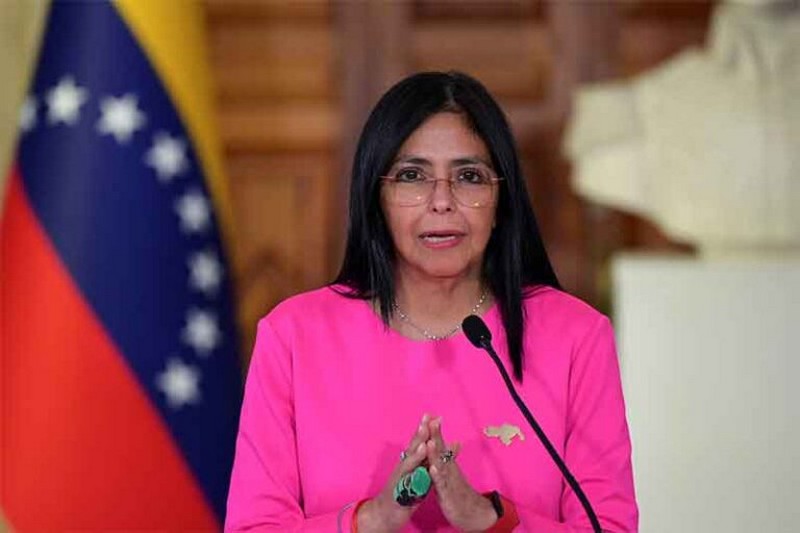
Delcy Rodriguez, daughter of Jorge Rodríguez a leading Ideologue and Martyr. She comes from a rich heritage rooted in Bolivarian Socialism, Anti-Imperialism, and Popular Sovereignty.
When the United States carried out what the Venezuelan government has described as the illegal abduction of President Nicolás Maduro and First Lady Cilia Flores, Caracas entered one of the most dangerous moments in its modern history. In the midst of shock, military threat, and diplomatic siege, Delcy Eloína Rodríguez Gómez—long a central figure of the Bolivarian state—assumed the role of caretaker president, vowing continuity, resistance, and national sovereignty.¹ To understand Delcy Rodríguez is to understand inheritance—of struggle, ideology, and sacrifice.
A Revolutionary Lineage
Delcy Rodríguez was born in Caracas on May 18, 1969, into a family deeply rooted in Venezuela’s revolutionary left. Her father, Jorge Antonio Rodríguez, was a founding leader of the Liga Socialista, a Marxist organization that emerged from the remnants of the 1960s guerrilla movement and sought to challenge the political and economic order of Venezuela’s Fourth Republic.²
In 1976, Jorge Rodríguez was arrested by Venezuela’s political police, the Dirección de los Servicios de Inteligencia y Prevención (DISIP), under the government of President Carlos Andrés Pérez. He died shortly thereafter in custody. Although authorities claimed suicide, contemporaneous reporting, testimony from fellow detainees, and later historical investigations have documented strong evidence of torture during interrogation.³ His death has been widely recognized by scholars as emblematic of Cold War repression in Venezuela under U.S.-CIA-backed regimes that combined state power with systematic political repression, torture and violence.⁴
Thus for Delcy Rodríguez, this legacy is ideologically deeply rooted in struggle and sacrifice — it is personal, political and formative.
Her brother, Jorge Rodríguez Gómez, today serves as President of Venezuela’s National Assembly and has been a central political strategist within the Bolivarian movement, further situating the Rodríguez family within the revolutionary project.⁵
From Chávez to Maduro
A lawyer trained at the Central University of Venezuela, Delcy Rodríguez entered public life during the ascent of Hugo Chávez, whose Bolivarian project sought to dismantle Venezuela’s entrenched elite pact and reclaim state sovereignty over oil revenues.⁶
Rodríguez later served as Foreign Minister from 2014 to 2017, becoming internationally visible for denouncing sanctions, U.S. interventionism, and violations of international law at forums including the United Nations and the Non-Aligned Movement.⁷
In 2018, Rodríguez was appointed Executive Vice President and later assumed a central role in economic coordination during the escalation of U.S. sanctions, which economists and human rights bodies have linked to sharp declines in living standards and excess civilian mortality.⁸
Her ideological orientation has remained consistent: Bolivarian socialism, anti-imperialism, and popular sovereignty.
The Abduction and the Constitutional Response
Following the January 2026 U.S. operation—described by Washington as a “law-enforcement action” and by Caracas as an “act of international piracy” —multiple international legal scholars and Global South governments questioned its legality under international law, citing violations of state sovereignty and due process.¹
Rodríguez’s designation as caretaker president followed constitutional succession norms previously analyzed by comparative constitutional scholars studying Venezuela’s crisis governance framework.⁹
In her first public address, she stated: “There is only one president of Venezuela, Nicolás Maduro Moros. What has occurred is an abduction, not a transition.”¹⁰
She accused the Trump administration of acting as an imperial enforcer for transnational capital, citing oil interests, sanctions profiteering, and Venezuela’s steadfast support for Palestine.
US Gangster Capitalism, Zionism, and the Architecture of Aggression
Rodríguez has framed the operation as an expression of “gangster capitalism”—a term used by critical political economists to describe the fusion of coercive force, sanctions regimes, and corporate extraction in contemporary imperial strategy.¹¹ UN special rapporteurs have previously characterized U.S. sanctions on Venezuela as causing “devastating humanitarian consequences” that may amount to violations of international law.¹²
Crucially, Rodríguez has been explicit that the assault on Venezuela cannot be separated from the strategic U.S.–Israeli alliance and the political project of Zionism, which she has consistently described as a colonial ideology rather than a religious identity.
In public statements before and after the abduction of Maduro, Rodríguez argued that Venezuela was targeted not only for its oil reserves but for its uncompromising alignment with Palestine, its condemnation of apartheid Israel’s on-going genocide and ethnic cleansing in Gaza, and thus its refusal to submit to U.S.–Israeli geopolitical diktats and threats.¹³
She further identified Zionist political networks as operating in convergence with sanctions enforcement, regime-change policy, and militarized coercion against governments in the Global South that reject Western hegemony.¹⁴
This framing is consistent with Venezuela’s long-standing foreign policy since the Chávez era, including the severing of diplomatic relations with Israel following the 2008–09 genocidal war on Gaza and repeated denunciations of Israeli apartheid at the United Nations.¹⁵
Rodríguez’s intervention thus situates Venezuela’s crisis within a broader global confrontation between an imperial order anchored in Washington and Tel Aviv, and a Global South asserting sovereignty, multi-polarity, and resistance to colonial violence.
The Social Missions: Why the People Still Defend the Revolution
At the core of Rodríguez’s political legitimacy lie the Bolivarian social missions initiated under Chávez. These programs have been extensively studied by international institutions, development economists, and UN agencies.
Mission Barrio Adentro expanded primary healthcare access with Cuban medical cooperation; Mission Robinson led UNESCO to declare Venezuela free of illiteracy in 2005; Mission Ribas and Mission Sucre dramatically increased secondary and university enrollment among working-class Venezuelans.¹⁶ Food distribution systems such as Mercal and later CLAP, alongside the Gran Misión Vivienda Venezuela, were designed to buffer the population against market volatility and sanctions-induced shortages.¹⁷
Peer-reviewed economic studies demonstrate that between 2003 and 2012 Venezuela achieved one of the sharpest reductions in poverty and income inequality in Latin America.¹⁸ While sanctions and macroeconomic collapse later reversed many gains, scholars widely agree that the missions permanently altered social access and political consciousness.¹⁹
Rodríguez has consistently defended this redistributive model, arguing that oil revenues must serve social development rather than foreign capital accumulation.²⁰
Popular Support and Political Reality
Multiple independent surveys and regional analysts note that a significant segment of Venezuela’s population—particularly among the poor—continues to reject U.S. intervention regardless of dissatisfaction with economic conditions.²¹ Rodríguez’s authority rests less on personal charisma than on social welfare, empowerment of the poor, institutional continuity and anti-imperialist legitimacy.
Conclusion
Delcy Rodríguez stands today as a political embodiment of resistance—shaped by the torture-death of her father, forged in Chávez’s revolution, tested under Maduro’s siege, and now confronting direct U.S. military coercion. History’s verdict remains unwritten. What is already clear is this: Venezuela did not submit—and Delcy Rodríguez did not bow.
Footnotes
- Alfred de Zayas, statements on extraterritorial coercion and sovereignty, UN Independent Expert archives; International Association of Democratic Lawyers, legal brief, January 2026.
- Steve Ellner, Rethinking Venezuelan Politics (Lynne Rienner, 2008), 42–45.
- Greg Wilpert, Changing Venezuela by Taking Power (Verso, 2007), 29–31.
- Eva Golinger, The Chávez Code (Pluto Press, 2006), 18–22.
- Steve Ellner and Miguel Tinker Salas, eds., Venezuela: Hugo Chávez and the Decline of an Exceptional Democracy (Rowman & Littlefield, 2007).
- Fernando Coronil, The Magical State (University of Chicago Press, 1997).
- United Nations General Assembly, Sixth Committee debates, 2015–2017.
- Francisco Rodríguez, “Sanctions and the Venezuelan Economy,” Peterson Institute Working Paper, 2019.
- Javier Couso, “Constitutional Crisis and Executive Power in Venezuela,” International Journal of Constitutional Law 17, no. 2 (2019).
- Associated Press and Reuters, reports quoting televised address, January 2026.
- David Harvey, The New Imperialism (Oxford University Press, 2003).
- UN Human Rights Council, Special Rapporteur on Unilateral Coercive Measures, A/HRC/39/47/Add.1 (2018).
- Delcy Rodríguez, statements on Gaza and Palestine, cited in Telesur English, November 2024.
- Delcy Rodríguez, address to the Non-Aligned Movement ministerial meeting, reported in Al Mayadeen English, January 2026.
- United Nations General Assembly, Venezuelan statements on Palestine and Gaza, 2009–2024.
- UNESCO, Venezuela Declared Free of Illiteracy, 2005.
- FAO, Food Security Policies in Bolivarian Venezuela, regional report, 2013.
- Mark Weisbrot and Luis Sandoval, The Venezuelan Economy in the Chávez Years (CEPR, 2008).
- Julia Buxton, The Failure of Political Reform in Venezuela (Ashgate, 2018).
- Delcy Rodríguez, remarks cited in Telesur English, 2024.
- Latinobarómetro, regional opinion surveys, 2018–2024.
Feroze Mithiborwala is an expert on West Asian & International Geostrategic issues. He is the Founder-Gen. Sec. of the India Palestine Solidarity Forum.
6 January 2026
Source: countercurrents.org