
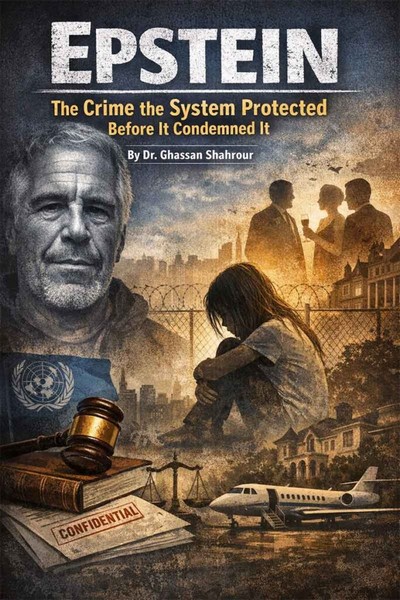
By Dr. Ghassan Shahrour
Some crimes are not dangerous because they are hidden, but because they unfold in plain sight—within systems designed to protect, yet collapsing silently when confronted with power. The case of Jeffrey Epstein is not merely the story of a predatory individual or a deviant network. It is the exposure of a double betrayal: a child-protection system that abandoned its moral and legal mandate, and elites who transformed wealth and influence into a shield for exploitation.
Epstein’s acts—trafficking minors, systematic sexual exploitation, coercive recruitment, and cross-border transportation of victims—constitute clear violations of the Convention on the Rights of the Child, particularly Articles 34, 35, and 36, as well as the Optional Protocol on the sale of children, child prostitution, and child pornography. These are not legal grey zones. They are explicitly defined crimes that impose binding obligations on states to prevent, investigate, and prosecute, and to assist and protect children who have been abused.
For decades, the Convention on the Rights of the Child has been celebrated as one of humanity’s most significant moral achievements. Yet the Epstein case reveals not merely a failure of implementation, but a profound ethical regression. The system faltered when confronted with privilege. It hesitated when courage was required. The law was not simply violated—it was neutralized, reduced to a decorative façade that collapsed under the weight of power.
What makes this case even more damning is that the crimes did not occur in secrecy. They unfolded within a social, financial, and media ecosystem that knew—or should have known. Political, financial, and cultural elites were not passive bystanders. They formed part of a wider architecture of complicity: those who facilitated, those who remained silent, those who used influence to shield, and those who participated. These were not isolated lapses; they were a betrayal of the responsibility that accompanies power.
Behind this architecture stood girls whose safety—and sense of meaning—were stolen. Childhoods were interrupted. Trust in the world was shattered before it had fully formed. Lives were forced into survival rather than discovery. Their names are rarely spoken, their faces rarely seen, yet their absence is the most enduring evidence of the crime. This story is not about Epstein alone; it is about a world that failed those it was morally and legally bound to protect.
The failure extended further. Much of the media—and even segments of the activist sphere—reduced the case to celebrity intrigue rather than human suffering. Exploitation became spectacle; victims were pushed to the margins of their own story. The girls at the center were treated as footnotes to scandal, not as children whose lives were reshaped by trauma. This erasure reflects a deeper cultural failure: when abuse is sensationalized, responsibility dissolves.
While survivor-led groups and some advocates demanded accountability, the broader institutional response remained timid. Following the unsealing of Epstein-related files, UN human-rights experts warned that no person or institution should be beyond the reach of justice and called for full, transparent investigations into the wider network. Their message was clear: accountability requires independent inquiries into institutional complicity, stronger due-diligence obligations under child-rights law, and media standards that recognize child exploitation as a structural human-rights crisis—not entertainment.
Yet major human-rights organizations largely fell silent. There was no sustained pressure for independent investigations, no insistence on dismantling enabling networks, no accountability for institutions that ignored or normalized abuse. Once again, children’s rights proved easier to celebrate in principle than to defend in practice—especially when power demanded discomfort.
The victims were not only stripped of dignity; they were forced into silence in a world that should have listened first. What is often described as a “legal failure” is, in reality, a life burdened with the cost of a silence never chosen.
The Epstein case is not a closed chapter sealed by the perpetrator’s death. It is a mirror held up to a system that retreated before power and allowed the exploitation of children in full view. Silence, hesitation, and premature closure are not neutral acts—they are extensions of the crime the system protected. If human-rights institutions are serious about their mission, they must press for independent investigations, expose enabling networks, and demand reforms that place children’s safety above elites’ comfort. Until those networks are fully uncovered and held to account, the world remains complicit in an injustice it prefers to forget rather than confront.
Dr. Ghassan Shahrour, Coordinator of Arab Human Security Network, is a medical doctor, prolific writer, and human rights advocate specializing in health, disability, disarmament, and human security.
4 February 2026
Source: countercurrents.org