
By Dr Ram Puniyani
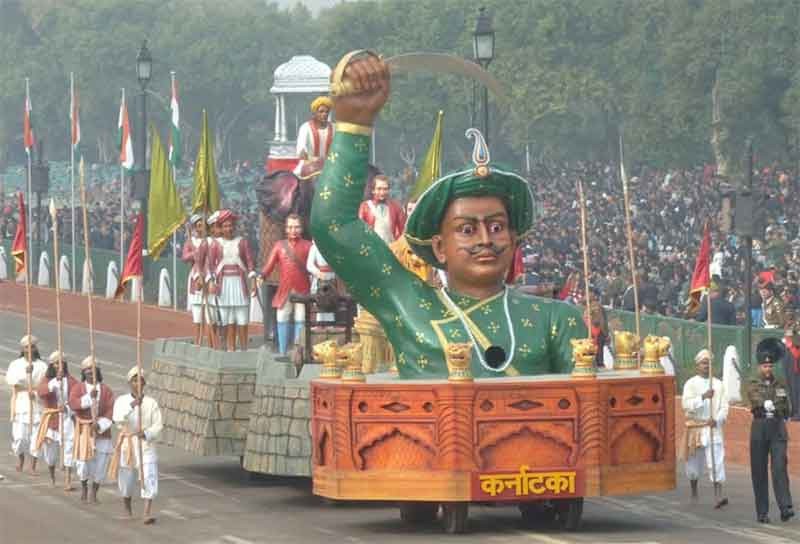
Tipu Sultan has been in the news quite often, particularly in Karnataka, more so during state-sponsored celebrations of his birth anniversary. The BJP regularly creates obstacles to these celebrations, and a ruckus is usually the result. This time, he is in the news from Malegaon in Maharashtra. The newly elected Deputy Mayor of Malegaon, Shan-e-Hind Nihal Ahmad, had put up a portrait of Tipu Sultan in her office. Shiv Sainiks noticed this and got it removed through the intervention of the authorities. Some protests were also held.
Following this, the Maharashtra Pradesh Congress Committee President, Harshvardhan Sapkal, opposed the removal of the portrait, stating that Tipu Sultan’s contributions to Mysore are equivalent to those of Chhatrapati Shivaji Maharaj in Maharashtra. This statement was opposed by Chief Minister Devendra Fadnavis, who said that comparing Tipu to Shivaji Maharaj is an insult to the latter. Subsequently, a Congress office was stoned by BJP workers, and nearly seven people were injured in the mayhem.
The BJP’s objection to Sapkal’s statement is based on the claim that Tipu was a mass murderer of Hindus and that he attempted to convert them to Islam. Many such allegations have been made against Tipu by Hindu nationalists, portraying him as anti-Hindu and a cruel ruler. This is far from the truth. Many of these myths are part of a communal narrative, accentuated by British accounts that were particularly hostile to Tipu because he was one of the few rulers who actively resisted colonial expansion. Tipu had urged the Nizam and the Peshwas to oppose the armies of the East India Company, foreseeing the dangers of British entrenchment in India.
His administration was inclusive, with many high-ranking Hindu officials. Purnaiah served as Mir Miran (head of a department) and played a crucial role in governance. Krishna Rao was his treasurer, Shamaiya Iyengar held a senior ministerial position, and Narsimha Iyengar served in the postal department. Tipu Sultan also provided grants to the Sringeri Shankaracharya, including funds for rebuilding the temple and reinstalling the goddess Sharada. He granted land and endowments to various temples, and during his reign, the ten-day Dussehra celebrations were an integral part of Mysore’s social life.
In 1791, Maratha forces led by Raghunath Rao Patwardhan attacked and plundered the Sringeri Sharada Peetham, forcing the Shankaracharya to flee. Upon learning of this, Tipu Sultan expressed deep anguish and declared that those responsible would be punished. He promptly sent funds, gifts, and letters to restore the temple and reconsecrate the idol. This episode occurred during the Third Anglo-Mysore War, when Maratha forces caused extensive destruction, including looting property and harming people. Tipu, who maintained respectful correspondence with the Sringeri Jagadguru, ordered his administration to assist in restoration efforts. Evidence of this survives in Kannada letters preserved in the monastery’s records, where he also requested prayers for his kingdom’s prosperity.
Tipu was a staunch opponent of British rule. There are also accusations that he persecuted certain Hindu and Christian communities. However, historians argue that such actions were political rather than religious. Historian Kate Brittlebank notes that “this was not a religious policy but one of chastisement.” The communities targeted were seen as disloyal to the state. These actions were not limited to Hindus; Tipu also acted against some Muslim groups, such as the Mahdavis, who were aligned with the British and served in the East India Company’s forces. Historian Susan Bayly similarly argues that his actions against certain groups outside Mysore must be understood in a political context, especially given his close relations with diverse communities within his kingdom.
Sarfaraz Shaikh, in his book Sultan-e-Khudad, reproduces the “Manifesto of Tipu Sultan,” in which he declares that he would not discriminate on religious grounds and would defend his empire until his last breath. Tipu also showed keen interest in rocket technology, a contribution noted appreciatively in A.P.J. Abdul Kalam’s Wings of Fire.
It is noteworthy that the RSS itself, in its children’s series on Indian history, published a book on Tipu in the 1970s. BJP leader B.S. Yediyurappa even donned Tipu’s headgear while campaigning in the 2010 Karnataka elections. Former President Ram Nath Kovind, who has an RSS background, praised Tipu on Tipu Jayanti in 2017, calling him a hero who died fighting the British and a pioneer in the use of Mysore rockets. Tipu’s image also appears in the original handwritten copy of the Indian Constitution (Part XVI, page 144), alongside Rani Lakshmibai, as one of the figures who resisted British rule.
Due to his policies, Tipu was popular among the people of Mysore. Folk songs in villages continue to praise him. It is in this context that renowned playwright Girish Karnad remarked that had Tipu been a Hindu, he would have enjoyed a status similar to that of Shivaji Maharaj in Maharashtra. This is very close to what Sapkal stated—nothing more.
The controversy over the removal of Tipu’s portrait from the Deputy Mayor’s office is yet another instance of communal forces exploiting divisive politics. Kings should not be judged by their religion alone; rather, their policies toward people of different faiths and their commitment to public welfare should be the primary criteria. By this measure, Tipu stands tall as a ruler of considerable religious tolerance. The half-baked propaganda of communal forces seeks only to divide communities.
One of the most significant tributes to Tipu came from Subhas Chandra Bose, who adopted Tipu’s “springing tiger” as the insignia of the Azad Hind Fauj. Tipu’s greatest contribution was forewarning Indian rulers about the growing threat of the East India Company. He fought bravely against the British and laid down his life in the Fourth Anglo-Mysore War. Those who seek to demonise him today belong to an ideological stream that did little to resist British rule.
Dr Ram Puniyani was a professor in biomedical engineering at the Indian Institute of Technology Bombay, and took voluntary retirement in December 2004 to work full time for communal harmony in India.
19 February 2026
Source: countercurrents.org