
By Vikas Parashram Meshram
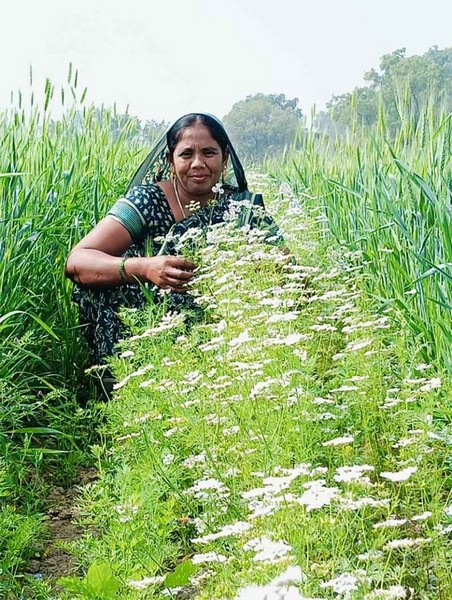
In the Sajjangarh block of Banswara district, located at the southern tip of Rajasthan, lies a small village called Ghoti ki Todi. Kamladevi Bhagora, a 43-year-old woman from this village, has done something that has become an exemplary inspiration—not just for her own village, but for women across many others. A mother of three sons from a farming family, this ordinary woman fought for her land, her rights, and her dreams with remarkable courage—and she won.
Kamladevi’s childhood was spent in the fields. She learned the art of sowing seeds, growing crops, watering, and harvesting from the very courtyard of her home. From a young age, her hands formed a deep bond with the soil. But one thing she had always observed was this: in the fields, her mother worked just as hard as her father, yet decision-making power remained in the hands of men. What to plant, how much to sell, where to spend money—all of this was decided according to the wishes of men. Women contributed their labor but had no say. This social imbalance stayed in young Kamladevi’s mind like an unanswered question—one she would later strive to answer.
Kamladevi’s life began to take a new turn when she joined Vaagdhara, an organization working in the tribal regions of Rajasthan on women’s empowerment, organic agriculture, and community rights. Through her association with Vaagdhara, she formed Mahila Saksham Samuh (Women’s Empowerment Groups) and Gram Swaraj Samuh (Village Self-Governance Groups) across seven neighboring villages. The Mahila Saksham Samuh brought together 140 women, while the Gram Swaraj Samuh included 140 members—both women and men. These groups aimed to increase villagers’ participation—especially women’s—in gram panchayat affairs. Through them, Kamladevi began addressing issues such as women’s rights, land ownership, and sustainable agriculture, emerging as a powerful grassroots leader.
Vaagdhara provided her with in-depth training on land rights, organic farming, and women’s participation in the Panchayati Raj system. Through capacity-building workshops and field visits, her understanding and vision expanded considerably. She realized that meaningful change is impossible unless women farmers become aware of their rights.
When Kamladevi began discussing sustainable organic agriculture with women farmers, she encountered a challenge. They listened and understood—but hesitated to act. Reflecting on this, she realized the absence of a relatable role model. Without a living example, shifting from chemical to organic farming felt too risky.
Determined to change this, Kamladevi resolved: “If I want to show others the way, I must walk it myself first.”
She farms approximately 4 bighas of land with her family and began practicing sustainable organic agriculture on 3 bighas. Without waiting for expensive inputs, she used what was available at home. With 2 cows and 8 goats, she prepared compost from cow dung and used traditional bio-pesticides like Dashparni and Neemastra. She eliminated dependence on chemical fertilizers and pesticides entirely.
Her main crops included indigenous varieties of maize and tur (pigeon pea), along with vegetables such as brinjal, tomatoes, bottle gourd, okra, and onions for household use. She paid special attention to preserving local seed varieties, saving seeds from each harvest for the next season. This reduced costs and ensured resilience to local climatic conditions. Her farm became a living example for the village. Women who had once hesitated began to see that organic farming works—lower costs and better-quality produce gradually built trust.
Kamladevi also strengthened her household economy through goat rearing. Between 2021 and 2025, she earned a total of ₹1,02,500 by selling goats. This demonstrated how integrating animal husbandry with farming can significantly improve a family’s financial stability. Cow dung became compost; goats became income—an integrated system that ensured resilience.
Through her groups, she encouraged women to attend panchayat meetings and claim their legal rights: rights to land, participation, and access to government schemes. Gradually, women’s voices grew stronger, and they began to speak up and participate in decision-making.
Seed Banks: The Foundation for the Future
Kamladevi’s vision extended further. She recognized that preserving local seeds reduces costs and safeguards agricultural heritage. She has been working to establish community seed banks, enabling farmers to share seeds, preserve indigenous varieties, and reduce dependence on market-bought seeds. Though seemingly small, this initiative has far-reaching implications for food sovereignty and sustainability.
A Wave of Inspiration: Light Reaches Over 200 Women
Today, Kamladevi has inspired more than 200 women farmers across seven villages to adopt organic farming. These women now prepare bio-fertilizers, use local seeds, and are moving away from chemical agriculture.
Surekha Dama, a member of the Mahila Saksham Samuh, shares: “Adopting organic farming has been very beneficial—it has reduced our household expenses. All of this is because of Kamla. She boosted my confidence and gave me the opportunity to voice my opinions. Earlier, we just worked; now our views are heard.”
Surekha’s words echo across hundreds of lives transformed by Kamladevi’s leadership. When one woman rises and uplifts others, an entire community begins to change.
The Mark of a True Leader
Kamladevi’s greatest strength lies in her example. She did not merely speak—she acted. Her farming practices, animal husbandry, and community organizing all stand as proof of her leadership. While Vaagdhara’s training shaped her perspective, the courage to act came from within. She has shown that lack of resources is not a barrier to transformation—when there is determination, the path emerges.
Vikas Parashram Meshram is a journalist
Email: vikasmeshram04@gmail.com
20 February 2026
Source: countercurrents.org