
By Quds News Network
Gaza (Quds News Network)- Three Palestinian children have died from extreme cold in the Gaza Strip over the past 24 hours, raising the storm-related death toll to 14 as families displaced by Israel’s two-year genocide are trapped in flooded shelters as a winter storm, now in its third day, brings heavy rain and strong winds.
On Friday, medical sources confirmed that nine-year-old Hadeel al-Masri died in a shelter for displaced people west of Gaza City. Baby Taim al-Khawaja also passed away in the Shati refugee camp in Gaza City.
The grandfather of the baby boy said his family had been sheltering in a house with no roof after their house was bombed during an Israeli attack.
“Yesterday, we were surprised to hear his mother screaming, saying, ‘My son is blue!’ so we carried the boy and went to al-Rantisi Hospital,” the grandfather explained.
“His temperature remained between 33 and 34 degrees, which has affected all his organs. His brain began to deteriorate, and that was the end of it,” he added.
A day earlier, 8-month-old Rahaf Abu Jazar also died of exposure to the brutal weather conditions after her family’s tent in southern Gaza’s Khan Younis took in water.
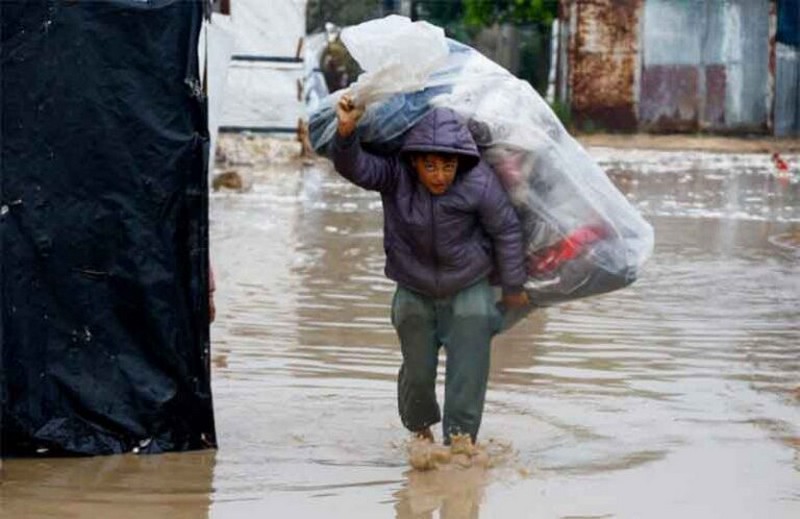
Displaced Palestinians in the Gaza Strip are waking up to inches of water flooding their tents, after nights of heavy rainfall that left their shelters and belongings soaked.
Three days of cold thunderstorms are expected to hit Palestine starting from Wednesday, the Palestinian Meteorological Department has warned, unleashing flash floods, high winds and even hail.
Gaza’s Government Media Office has called on the world to respond “to save the catastrophic humanitarian reality” in Gaza as cold weather and rain bears down on the enclave.
The storm Byron hit occupied Palestine, including Gaza, on Wednesday and is set to last until Friday, bringing with it heavy rains that are flooding the tens of thousands of tents sheltering Gaza’s displaced people.
It is also bringing heavy winds, fierce waves from the sea and thunderstorms, according to the Office.
The Office said the weather “may cause extensive damage to tens of thousands of families living in tents and primitive shelters that do not protect them from the cold winter or the harshness of weather lows.”
On Thursday, the Palestinian Civil Defense reported that its crews in southern Gaza evacuated 14 tents flooded by rainwater in various areas of Khan Younis, moving displaced Palestinians to other locations . The Civil Defense crews also freed two cars stuck in sandy, muddy roads, despite the difficult access and limited resources.
On Wednesday morning, the rescue group warned that the coming hours are extremely dangerous and that Gaza may once again “witness a disaster as displaced families face severe flooding. We are in a very difficult situation, and global action is urgently needed to save Gaza from being submerged.”
The Gaza City Municipality also confirmed that the storms pose a major threat to the displaced people and to residents due to the destruction of the infrastructure after two-year Israeli genocide.
It noted the Israeli occupation has destroyed more than 85% of the equipment, “which hinders our ability to assist the population,” adding “the situation in the Strip is catastrophic due to the storms and the severe shortage of essential supplies.”
Gaza City Mayor Yahya al-Sarraj said on Wednesday, “We expect another wave of the storm, but we lack the necessary equipment to deal with it. We rely on equipment rented from the private sector, which is old and unsuitable for dealing with the storm.”
“The storm is exacerbating the humanitarian crisis amid the destruction of infrastructure and a lack of resources,” the mayor added.
Shelters, makeshift tents and damaged homes have borne the brunt of the storm, collapsing under the pressure of strong winds and rainfall, leading to the deaths of displaced Palestinians.
On Friday, the Office confirmed that the death toll from Storm Byron has increased to 14 as homes collapse under strong winds and flooding.
According to the Office, the storm has begun to materialise on the ground in the enclave, leaving Gaza’s one and a half million displaced people in “direct confrontation with the danger of drowning and collapses”.
“The Gaza Strip has witnessed dangerous developments, including: 14 casualties, including martyrs and missing people, as a result of the storm’s impact and the collapse of bombed buildings across all governorates of the Gaza Strip,” the statement read.
“The collapse of at least 13 homes, most recently in the al-Karama and Sheikh Radwan neighbourhoods of Gaza City, with civil defence teams still responding to hundreds of calls for help; the flooding and destruction of more than 27,000 tents belonging to displaced people, which were either inundated, swept away by floods, or torn down by strong winds,” it added.
The Ministry of Interior and National Security in Gaza also said on Friday that the operating teams have received more than 4,300 distress calls from people across the enclave since the onset of the storm.
Over the past few hours, at least 12 incidents were recorded of previously shelled buildings collapsing as a result of the strong wind and heavy rains, it said in a statement.
The Ministry said its police forces are helping civil defence and municipal teams conduct rescue operations despite limited resources as several people remain missing and are believed to be under the rubble.
“What is happening now is a wakeup call for everyone to face up to their responsibilities,” the statement said, calling on the international community to intervene in order for Israel to allow more humanitarian aid into Gaza.
Earlier, the spokesperson for UN Secretary-General Antonio Guterres criticised Israeli restrictions on supplies going into Gaza.
Despite the UN providing tents, tarpaulins, blankets and winter clothes, more lasting preparedness for shelters and floods remains impossible, Stephane Dujarric told reporters.
“You will recall that a major impediment to shelter response is the restrictive registration requirements for NGOs imposed by the Israeli authorities,” Dujarric told reporters in a daily briefing.
“Many of our NGO partners remain blocked from bringing in relief, and nearly 4,000 pallets of shelter materials have been rejected by Israeli authorities,” he said.
“Gaza urgently needs heavy machinery, tools and many more shelter items to prevent catastrophic flooding,” he said.
It is now the third winter displaced Palestinians have endured since the start of the two-year Israeli genocide.
Videos and photos circulating on social media show displaced families’ tents flooded by rain on Wednesday, with mattresses, blankets, and personal belongings soaked.
People were also seen taking shelter from the rain with little clothing to protect them. Videos showed the displaced trying to remove large amounts of water from their tents with buckets.
According to the UN agency for Palestinian refugees, UNRWA, nearly all of the Gaza Strip’s residents have been displaced. Following the start of the ceasefire, many families tried to return to their homes, most to find only rubble. However, according to the UN Satellite Centre, around 81% of all structures are damaged.
As the ceasefire enters its third month, humanitarian agencies say that far too little aid is reaching Gaza, as hunger persists and old tents start to fray.
The Israeli military has refused to allow the entry of many tents and mobile homes to Gaza despite the harsh weather conditions and the destroyed infrastructure.
According to the Norwegian Refugee Council (NRC), nearly 1.5 million people already required tents and other emergency shelter materials and more than 282,000 housing units have been damaged or destroyed across Gaza, leaving families without protection, privacy, or adequate shelter as temperatures drop.
On Tuesday, Israeli forecaster Tzachi Peleg mocked Gaza’s displaced residents, saying: “Not a single tent will remain… and I have no problem if people don’t survive either.”
Peleg predicted that strong winds and heavy rain could destroy most tent camps in the Gaza Strip. He excitedly said that drainage infrastructure is largely destroyed and will not withstand the storm. Underground tunnels are also expected to flood, he added.
Save the Children called on Israel to allow tent poles and other banned items to enter Gaza, along with tents, winter clothes and blankets, to better protect families from Storm Byron’s effects.
Since the ceasefire took effect in October, Israel has not allowed the Strip to receive timber, tent poles or tools because it considers them “controlled dual-purpose” items.
“No child should lie awake all night freezing in sewage-sodden bedding. This is unconscionable,” said Ahmad Alhendawi, the organisation’s regional director for the Middle East, North Africa and Eastern Europe.
“What Palestinian children in Gaza need immediately is tents including tent poles, shelter, warm clothes, blankets and bedding”, as well as repairs to the sanitation system.
Last month’s storms forced half of Save the Children’s child-friendly spaces to close as camps were deluged with flooding, sewage and water damage, while attendance at its remaining four spaces has halved, the group said.
Nearly 850,000 people, currently sheltering in 761 displacement sites in the Gaza Strip, face the highest risk of flooding this week, according to the UN Office for the Coordination of Humanitarian Affairs (OCHA).
In an update, OCHA said it had tracked more than 3,500 displacement movements between December 7 and 8, likely in anticipation of the heavy thunderstorms forecast to batter Palestine starting Wednesday.
Flooding has previously been recorded at more than 200 of the highest-risk sites, the office said, affecting more than 140,000 people.
UNRWA said on Thursday some streets in Gaza are flooded and tents are soaked after the latest winter rains, making dire living conditions even worse for the enclave’s forcibly displaced population.
“Cold, overcrowded, and unsanitary environments heighten the risk of illness and infection,” the agency said. “This suffering could be prevented by unhindered humanitarian aid, including medical support and proper shelter.”
UN Special Rapporteur Francesca Albanese said Palestinians have been left to starve amid the storm, as the unstoppable “nightmare” continues in the enclave.
13 December 2025
Source: countercurrents.org