
By Hassan Herzallah
Break of dawn in Gaza used to have its own rhythm, smell and sounds.
As fishers set out to sea, the sound of the engines on their vessels would carry far and wide on a salty breeze.
The calm belied the bustle that would come as markets filled up and restaurants across Gaza prepared for customers filing in for fresh fish.
Fishing is more than a job in Gaza. Gaza’s is a maritime population. Fishing has always been part of the culture, part of the collective memory here. It is the kind of living that is passed down from fathers and grandfathers who have lived by this shore for generations.
But over the past two years, this same sea – once a source of livelihood for an estimated 110,000 people in Gaza – has instead borne witness to great suffering, its shoreline a last refuge for those trying to survive amid famine, bombardment and siege.
Since the age of 10, Muhammad al-Nahal, 26, would accompany his father and older brothers on daily fishing trips aboard their launch, or small boat. It was a daily routine and a family ritual, a tradition passed down through generations in a family that has always lived by the sea.
Before the genocide, Israel’s navy would allow Gaza’s fishers to sail up to six nautical miles into the sea – far short of the 12 miles they should have been allowed under international law. But Muhammad said the sea was generous enough.
“We would cast the nets for just a short while, and because there were so many fish, we used to fill 10 to 15 boxes, each with around 15 kilos of different kinds of fish.”
Pricing was simple, from the cheaper but always popular sardines – “3 kilos for $3,” Muhammad remembered happily – to the more expensive denise or sea bream (“never more than $15”).
Fishing was easier. It took less effort and less time. The engines ran on fuel and the sea offered bounty.
Fishing during genocide
From the first days of the genocide, however, the sea seemed to close its doors on Gaza’s fishers. Israeli patrol boats watched every movement, the waves carried the smell of gunpowder instead of salt, the winds the sound of bombings.
Fishing was no longer a daily routine; it became a deeply precarious task that could end in death or detention.
“One night we were out when we found ourselves directly in the line of fire,” said Samir Tabasi, 21, a fisherman local to Khan Younis. “Shells were fired at us. One landed in the water, luckily not hitting us. As we were coming out of the sea, we were shot at on the shore. One of our friends was injured, and the tents along the beach were also targeted, resulting in one death.”
Of course, even the 6 miles were now denied them, and fishers said they were barely able to get a single mile out to sea … when they were allowed out at all.
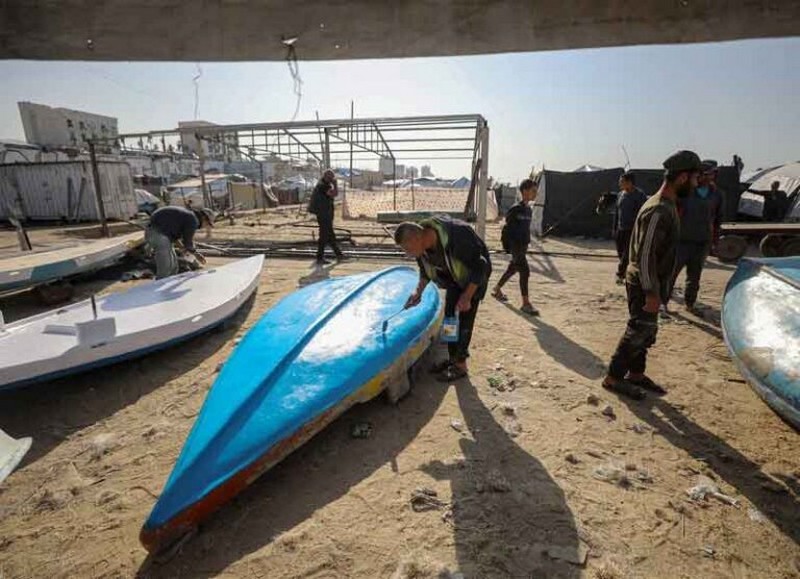
And with fuel running out and the Israeli military systematically targeting ports and boats, they were left with only small rowing vessels to work from.
According to Gaza’s Ministry of Agriculture, as of December 2024, the Israeli military has attacked and destroyed Gaza’s only seaport and three landing sites, in addition to 270 out of 300 fishers’ stations.
The UN’s Food and Agriculture Organization estimates that Gaza’s fishing sector has lost 94 percent of trawlers, 100 percent of big purse seiners (large specialized fishing vessels), 62 percent of small purse seiners, 71 percent of long-line and fixed-net vessels, and 70 percent of feluccas, traditional wooden sail boats used for fishing.
“There isn’t a single fishing boat left in the Strip,” said Muhammad. “They’re all destroyed. Now we have to rely on our senses, moving with only the strength of our arms and getting exhausted for nothing.”
Many chose not to fish, until this year, between May and August, when hunger proved more powerful than fear. Israel had almost completely cut off aid deliveries since early March and the famine had intensified. People again turned to the sea as their only means of survival.
Many families had nothing to eat except the few, small fish that could be caught in the relatively shallow waters fishers were able to reach.
“We went fishing just to survive,” said Nour al-Nahal, 22. “There was no meat, no chicken. We would grill the fish on charcoal and eat it – what mattered was staying alive.”
Continued targeting
But the sea was not a safe haven. Israel would regularly shell vessels at sea, and Israeli navy boats would fire even at those on shore. On many days, fishermen would go out and never return.
By May, the UN estimated, based on Gaza’s agriculture ministry figures, that over 200 fishers had been killed.
The ceasefire-that-is-not-a-ceasefire has not improved the situation.
“Today, if we go even a mile farther, they shoot at us,” Nour said.
Some are detained, while others just went missing at sea. According to Gaza’s Fishermen’s Committees, since 10 October, when the ceasefire came into effect, Israel has detained more than 20 fishers.
In addition to the direct danger, the fishers have also lost their source of income. Despite soaring prices – one kilo of sardines can now fetch up to $20 – “there’s barely any fish,” Muhammad said, in the areas they are able to reach.
Israel’s navy continues to target fishers, and the shore is still shelled.
“Even after the ceasefire, if I try to move just one meter forward, I put my life at risk,” said one fisher, who declined to be named.
Gaza’s fishing sector has suffered a “catastrophic collapse,” according to the UN, and the sector operates at just 7.3 percent of its pre-genocide production capacity. This dramatic decline is having a “devastating impact on food security, income generation and community resilience across Gaza.”
As winter approaches, there has never been more need for fishers in Gaza. But cold winds and high waves test their remaining fragile boats, while the constant threat of targeting makes every trip to the sea a potentially deadly undertaking.
Still they go, said Samir. They have little choice but to “continue risking their lives just to put food on the table.”
Hassan Herzallah is a Gaza-based Palestinian writer.
18 December 2025
Source: countercurrents.org