
By Dr. Ranjan Solomon
“We cannot fight for our rights and our history as well as future until we are armed with weapons of criticism and dedicated consciousness.” – Edward Said
Hamas has expressed conditional openness to an international peacekeeping force (or “Internal Security Force”) in Gaza, but with major caveats that directly challenge the “external control” model favoured by the US and Israel.
Hamas has firmly rejected foreign interference in the territory’s “internal affairs” and opposes any international guardianship or mandate that includes disarming its fighters.
While agreeing to a technocratic committee for civil administration, Hamas is pushing to integrate its roughly 10,000-strong existing police force into the new security structure.
Despite ceasefire agreements, Hamas has been quietly reasserting its grip by placing loyalists in key administrative and security roles.
In short, Hamas appears willing to accept a foreign presence that acts as a buffer against Israel, but rejects any external force that replaces its control or disarms its personnel. It aims to retain its, or its affiliates’, role in the future—even under a nominally “independent” or “technocratic” governance framework. Hamas has asserted that any discussions on Gaza must begin with a total halt to Israeli “aggression”. Israel, in direct contrast, insists that Hamas disarm as a precondition for the commencement of reconstruction.
Hamas Wants Peacekeeping—For and By Palestinians
Hamas spokesperson Qassem stated unequivocally:
“We want peacekeeping forces that monitor the ceasefire, ensure its implementation, and act as a buffer between the occupation army and our people in the Gaza Strip, without interfering in Gaza’s internal affairs.”
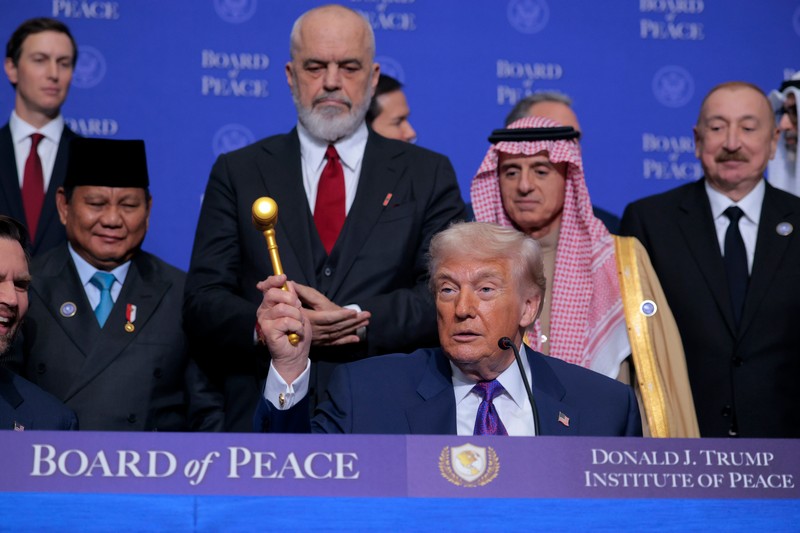
Trump’s “Board of Peace” (BOP), by contrast, is portrayed as a mechanism to colonise, exploit, and profit from Gaza. The very composition of the Board and the roles assigned to key actors obscure what critics argue is its real intent: the gradual corporatisation of Gaza.
The long-term plan is for the ISF to comprise 20,000 international soldiers and to train and support 12,000 local Palestinian police officers. Hamas has made its position clear: training Palestinian police within a national framework is acceptable if it is aimed at maintaining internal security and addressing instability created by occupation and militias. Any deviation from this principle, however, is likely to be non-negotiable.
Five countries have committed to providing troops to the ISF: Indonesia, Morocco, Kazakhstan, Kosovo, and Albania. Egypt and Jordan have committed to training Palestinian police officers, fulfilling training and logistical needs. Indonesia is expected to serve as deputy commander, with a significant troop commitment of around 8,000 personnel.
Despite these arrangements, analysts question the very foundations of the BOP. The proposal has been met with scepticism and indifference, with many countries expressing concern that it could overlap with or undermine the role of the United Nations. European Council President Antonio Costa has stated that the EU has serious doubts about key elements of the Board, including its scope, governance, and compatibility with the UN Charter.
Moreover, the BOP’s 11-page charter—comprising eight chapters and 13 articles—does not mention Gaza even once. This omission raises serious questions about the sincerity of US intent, suggesting that it may be acting in alignment with Israeli strategic interests and, critics argue, even private interests linked to Trump.
The plan’s second phase calls for the complete disarmament of Hamas and the destruction of its underground tunnel network—a core Israeli demand. While the Board of Peace seeks to fundamentally reshape Gaza in ways that benefit Israel, its success hinges on the implementation of disarmament and the establishment of a stable security force. If the vision is to transform Gaza into a European-style “Riviera”, it is likely to remain a non-starter.
At a recent summit, it was declared that “the war is over” and that “peace is possible”.
The Myth of “War Is Over”
Such declarations reflect an ongoing debate about the sustainability of agreements brokered by the Trump administration. While President Trump has repeatedly announced the end of conflicts—particularly in the Middle East—these claims have often been met with scepticism, continued violence, or only partial implementation.
On October 13, 2025, during a visit to Israel and Egypt, Trump declared the war in the Middle East over, citing a ceasefire, hostage releases, and the supposed disarmament of Hamas. However, reports indicated that Israeli troops remained in more than half of Gaza. By early 2026, analysts continued to describe the ceasefire as fragile, with ongoing violence rendering such declarations premature.
Critics view these announcements as “deal-making narratives” rather than definitive resolutions. In most cases, the underlying causes of conflict remain unresolved, while sporadic violence and diplomatic tensions persist. As such, claims of peace in Gaza appear overstated and premature.
Donald Trump’s Announcements and Unrealised Claims
As of early 2026, despite Trump’s claims of brokering lasting peace, the situation in Gaza remains volatile, with continued reports of strikes and ceasefire violations. While the October 2025 ceasefire reduced the intensity of violence, it has not led to a comprehensive peace.
A brief assessment of the situation as of February 2026 reveals a fragile ceasefire that critics describe as little more than a temporary pause rather than a durable truce. Israeli strikes and violations continue, resulting in casualties and heightened tensions. At the same time, the humanitarian crisis has worsened, with thousands displaced, widespread destruction of infrastructure, and limited access to aid. Despite official claims of improvement, reports from the ground indicate a far more chaotic and violent reality.
The hard truth is that the US administration appears to have a limited understanding of Palestinian realities and remains unwilling to acknowledge this gap. The ceasefire, critics argue, risks becoming a theatrical exercise that masks deeper strategic objectives.
Minimum Conditions for a Just and Lasting Settlement
A just and lasting settlement for Palestine requires several foundational conditions to be met. These include a permanent ceasefire accompanied by the full withdrawal of Israeli forces, the return of all hostages, and the disarmament of Hamas, potentially alongside amnesty for those willing to commit to peaceful coexistence.
Equally important is political reorganisation, including the reunification of Gaza and the West Bank under a reformed Palestinian Authority or a transitional technocratic administration capable of ensuring accountable governance. A durable solution also depends on ending Israeli occupation, dismantling illegal settlements in the West Bank, and lifting the blockade on Gaza.
International recognition of a sovereign Palestinian state based on the 1967 borders, with East Jerusalem as its capital, remains central to achieving self-determination. In parallel, sustainable peace requires security guarantees for both Palestinians and Israelis, supported by broader regional normalisation contingent on resolving the Palestinian question.
Finally, addressing the Palestinian refugee crisis through a just and negotiated settlement, in accordance with international law, is indispensable to any meaningful and lasting peace.
The international community, including the United Nations, continues to support a two-state solution based on these principles as the most viable path to ending the conflict.
Dr. Ranjan Solomon has worked in social justice movements since he was 19 years of age.
22 February 2026
Source: countercurrents.org