
By Dr. Ranjan Solomon
Imran Khan’s political career—particularly his tenure as Prime Minister of Pakistan (2018–2022), along with his subsequent ouster and imprisonment—has been marked by intense polarization. The political establishment appears unwilling to acknowledge the deep trust and support he continues to command among the masses. Such unconditional public backing remains elusive for the generals and the ruling elite.
Khan campaigned for the prime ministership on a strong anti-corruption platform, positioning himself as an outsider challenging an entrenched and corrupt political class. His supporters have consistently viewed him as a rare and honest leader.
For the establishment, producing credible evidence of corruption against Khan has proved akin to finding a needle in a haystack—and that needle remains elusive. If he were even remotely as corrupt as his opponents allege, how does one explain his enduring popularity? Khan has repeatedly denied all charges, calling them politically motivated and orchestrated by the military establishment to exclude him from power.
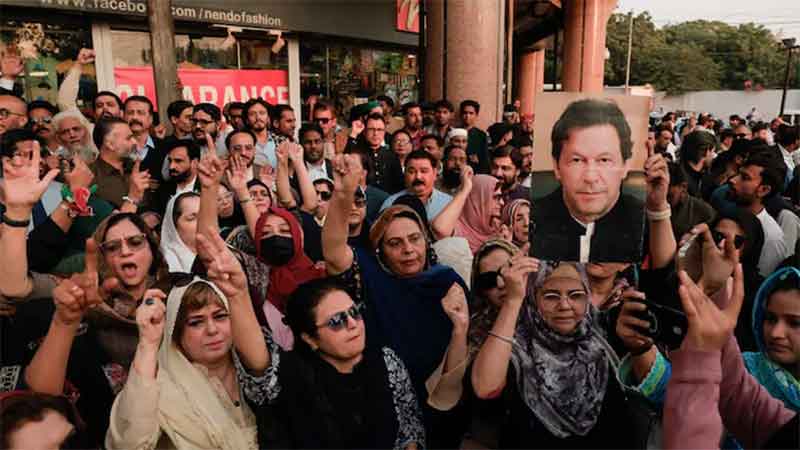
Several high-profile convictions from 2024 were later overturned or suspended on appeal. Despite his incarceration in December 2023, a Gallup poll identified Khan as Pakistan’s most popular politician. In the 2024 general election, independent candidates backed by his party, Pakistan Tehreek-e-Insaf (PTI), secured the highest number of seats—defying a severe state crackdown and the loss of their official party symbol, the cricket bat. Many viewed this as a powerful affirmation of his popularity.
His appeal is often contrasted with his strained relationship with Pakistan’s powerful military, which played a key role in both his rise and fall. He enjoys strong support, particularly among youth and urban middle-class voters disillusioned with traditional dynastic parties.
This popularity was evident in the 2022 by-elections, where his party won six out of seven seats. While supporters see him as an “unbeatable,” incorruptible visionary, critics argue that his tenure was marred by authoritarian tendencies and governance failures. Analysts frequently attribute his legal troubles to the breakdown of his relationship with the military establishment, which once backed him. Khan, however, alleges a conspiracy involving military leadership and political rivals—what he terms the “London Plan”—to sideline him.
Calls for justice have emerged internationally. A group of 14 former international cricket captains—including Sunil Gavaskar, Kapil Dev, and Greg Chappell—has urged the Pakistani government to ensure Khan’s safety and fair treatment. Their February 2026 appeal raised concerns about his health and prison conditions. Former teammates Wasim Akram and Waqar Younis have also called for adequate medical care. Reports from his family and lawyers claim he has suffered significant vision loss in his right eye due to medical neglect. The cricketers have demanded access to independent medical specialists, humane detention conditions, and full legal rights, invoking the spirit of sportsmanship and common humanity.
Despite several acquittals, other cases—particularly those related to the alleged misuse of state gifts—have led to fresh convictions or prolonged imprisonment. Reports from late 2025 and early 2026 indicate that sentences of up to 17 years in corruption cases have been upheld. Khan maintains that these charges are politically driven and intended to keep him out of Pakistan’s political arena.
The Supreme Court of Pakistan has recently intervened, ordering a comprehensive medical examination, including an eye check-up, and permitting him to communicate with his children. However, despite some relief from higher courts, the sheer volume of cases—over 100—and the rapid filing of new charges have ensured his continued imprisonment. Denial of adequate medical care raises serious humanitarian concerns.
These legal battles unfold amid deepening tensions between PTI and the current establishment. Khan’s supporters argue that he is the target of a systematic political crackdown aimed at erasing him from the political landscape.
His party and legal team have consistently described the proceedings as a “sham” and a “fraudulent set-up” designed to prevent his return to power. Human rights organizations have raised concerns about due process violations, including trials held inside Adiala Jail rather than in open court.
In many instances, defense lawyers have reportedly been denied full access or the opportunity to effectively cross-examine witnesses.
Significantly, several high-profile convictions—including those related to state secrets (the cipher case) and the legality of his marriage—were later overturned or suspended, lending weight to claims of political motivation.
Perhaps the most compelling criticism comes from a United Nations Working Group on Arbitrary Detention, which concluded in June 2024 that Khan’s detention was arbitrary and in violation of international law and fair trial standards.
Dr. Ranjan Solomon has worked in social justice movements since he was 19 years of age.
19 February 2026
Source: countercurrents.org