
By Arun Srivastava
The “New India” of the saffron ecosystem, particularly shaped by Narendra Modi, has virtually become the newest colony of imperialist USA in South Asia. Modi has exuberantly accepted the trade deal offered by his “best friend,” Donald Trump, the American President whose name prominently features in the infamous Epstein files. Undeniably, Trump—the modern face of global imperialism—has succeeded in his mission. Earlier, he reinforced the role of US imperialism by forcing Venezuela, home to the world’s richest known oil reserves, and Greenland, rich in rare earths, to fall in line. On February 2, he compelled Modi to compromise by accepting the Indo-US trade deal.
Trump’s design is reminiscent of the strategy of the East India Company, which transitioned from a trading body to a ruling power in India between 1757 and 1858. Initially entering India for commerce in 1600, the EIC gradually seized political control. It was formed to trade in the Indian Ocean region—initially with the East Indies (including the Indian subcontinent and Southeast Asia), and later with East Asia.
That Modi’s “New India” is turning into a new American colony is ratified by the statement of US Secretary of Agriculture Brooke Rollins, who announced that India had agreed to open its market to American farm products. Rollins wrote:
“Thank you @POTUS for ONCE AGAIN delivering for our American farmers. New US-India deal will export more American farm products to India’s massive market, lifting prices and pumping cash into rural America. In 2024, America’s agricultural trade deficit with India was $1.3 billion. India’s growing population is an important market for American agricultural products, and today’s deal will go a long way toward reducing this deficit. America First victory… #FarmersWin #USIndiaTrade #RuralAmerica.”
Historically, when an imperialist power conquered a country in Asia, Africa, or the Caribbean, it completely dominated that nation—altering its administrative, social, and economic structures for imperial benefit. Imperialism led to the acquisition of colonies and colonial rivalries that ultimately resulted in the First World War (1914–1918) and the Second World War (1939–1945).
Imperialist nations amassed enormous profits by exploiting the resources of their colonies. Their primary target was the agrarian economy: forcing colonies to grow commercial crops and destroying rural self-sufficiency. Colonial rule rests on the complete domination of one country over another, leading to systematic exploitation of resources and labour, and often the suppression of indigenous cultures. Under colonialism, people lose sovereignty over land, resources, and political destiny.
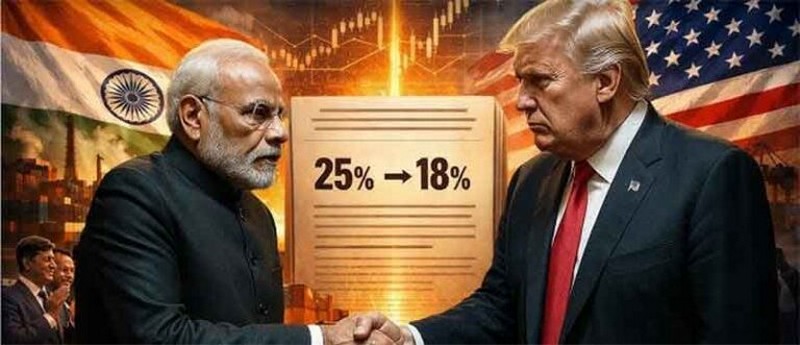
Trump has explicitly directed Modi to commit to buying more than $500 billion worth of American goods. Indian government officials confirmed that these purchases would span multiple sectors, including defence and energy. India has reportedly agreed to stop buying Russian oil and reduce tariff and non-tariff barriers to zero, while Trump continues to impose an 18 percent tariff on Indian goods. This asymmetry reveals the coercive nature of the deal.
Rollins further clarified the commercial motive:
“India’s massive market will reduce America’s agricultural trade deficit.”
Clearly, it is not India’s interests but India’s market that matters to Trump and the US.
Seventy-nine years after liberation from British imperialism, it is uncertain how long India will take to free itself from US-led colonisation imposed by Modi. His audacity is evident in his statement:
“Big thanks to President Trump on behalf of the 1.4 billion people of India…”
How Modi could thank Trump on behalf of the Indian people is beyond comprehension.
As if this were not enough, Modi described himself as “delighted” by reduced tariffs and praised Trump’s leadership, despite Trump later stating that the tariff reduction was granted “out of friendship” and “at Modi’s request.” This exposes the hollowness of Modi’s claims of diplomatic strength—he could not even persuade Trump to waive tariffs entirely.
With US agricultural products entering India at lower prices, how can Indian farmers compete—especially when their produce is burdened by an 18 percent tariff? Trump’s insistence that India purchase $500 billion worth of US goods—when India’s total import bill itself is around $700 billion—amounts to blatant arm-twisting aimed at preventing India from trading with other nations.
Trump also announced the halt to Operation Sindoor on May 10, 2025, and later announced India’s acceptance of the US trade deal—on both occasions Modi maintained silence. The deal will make rice and wheat production costlier, forcing farmers toward cash crops and worsening rural distress.
Agriculture in India is already largely unprofitable, particularly for small and marginal farmers, due to rising input costs, climate uncertainty, low market prices, lack of storage, and exploitative intermediaries. Had agriculture been profitable, farmers would not have been driven to suicide.
Around 70 percent of India’s rural population depends directly or indirectly on agriculture. It contributed about 15 percent to GDP in 2023. According to NSSO, 45.5 percent of India’s labour force was engaged in agriculture in 2022. NCRB data shows that between 1995 and 2014, 296,438 farmers died by suicide. During Modi’s tenure (2014–2022), the figure stands at 100,474. In 2022 alone, 11,290 people from the farming sector died by suicide.
Yet these deaths have failed to move Modi. Farmers staged a year-long protest at Delhi’s borders from November 2020 to December 2021 demanding repeal of the three farm laws and legal MSP. While Modi repealed the laws, MSP remains unimplemented. Budget allocations for agriculture have steadily declined.
In the Union Budget 2026-27, allocation for Agriculture and Allied Activities fell to 3.04 percent from 3.38 percent the previous year. Even the Pradhan Mantri Fasal Bima Yojana saw reduced funding. These priorities reflect the government’s distancing from farmers.
While Rollins claims Modi promised not to compromise farmers’ interests, America simultaneously announces a massive surge in agricultural exports to India. How can these claims coexist?
The discriminatory nature of the deal explains why Modi avoided placing it before Parliament. Had Parliament been consulted, the truth would have been exposed. In this context, Rahul Gandhi’s allegation that Modi “compromised” India’s interests—possibly under pressure related to the Adani case in the US—appears politically valid.
Agriculture has long been the most contentious issue in trade negotiations, especially US demands to open India’s market to genetically modified crops. Modi’s sudden capitulation is deeply suspicious. The so-called “Mother of all deals,” signed after two decades of negotiations, threatens to further devastate India’s rural economy, which remains starved of meaningful revival.
Arun Srivastava is a senior journalist
4 February 2026
Source: countercurrents.org