
By Euro-Med Human Rights Monitor
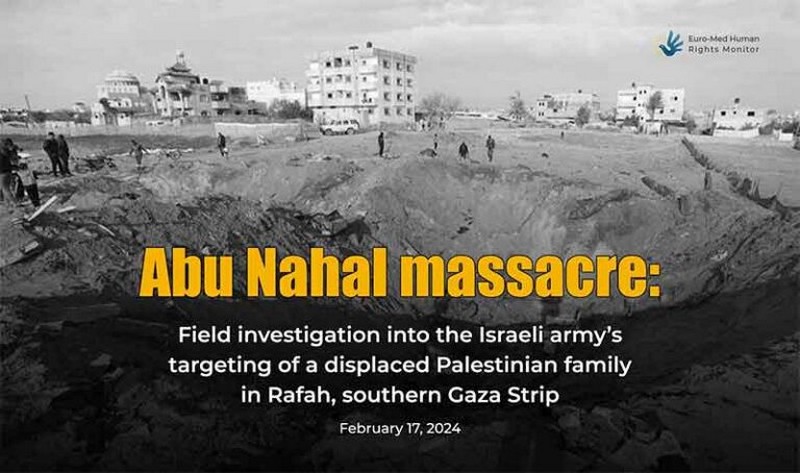
Palestinian Territory – A new investigation by Euro-Med Human Rights Monitor has uncovered the full circumstances of a mass killing carried out by the Israeli army against the Abu Nahal family in Rafah, in the southern Gaza Strip, last year.
The attack killed 15 civilians, including 13 children and women, without any warning or prior notice, and in the absence of any military necessity that could justify the precise and deliberate targeting of the family.
The investigation, published on Monday, is based on extensive field-based work into an airstrike carried out by the Israeli army on the evening of Saturday, 17 February 2024.
An Israeli aircraft struck a family rest house (chalet) in the Khirbat al-Adas area, northeast of Rafah Governorate, using two heavy, US-made bombs, completely destroying the structure on top of its occupants, without any prior warning or alert that could have enabled civilians to escape and save their lives.
The findings of the investigation, based on months of work that included an on-site examination of the crime scene, cross-checking testimonies from survivors and eyewitnesses, and technical analysis of digital materials, indicate that the targeted site was purely civilian in nature.
It was a chalet rented by the family after they were displaced from their original home. The site was located in an open agricultural area, isolated from any other buildings, making its identification as a civilian object easy and clearly visible to aerial surveillance. The location and its surroundings were entirely devoid of any military presence or activities by armed factions, refuting any potential claims of “military necessity” and confirming that the aim was to kill the largest possible number of defenceless civilians.
The investigation also ruled out any possibility that there were military objectives justifying the strike.
Material evidence and documents obtained by the Euro-Med Monitor team, alongside eyewitness testimonies, confirmed that the head of the family, Ibrahim Abu Nahal, had no political or factional affiliations and spent most of his time engaged in trade. He was a well-known merchant in his community before the genocide began in October 2023 and continued his commercial activities throughout it.
The data presented in the investigation further confirmed that the victim, Ibrahim Abu Nahal, exhibited no unusual behaviour suggesting any form of affiliation. He lived a normal life, managed his business by phone throughout the day, and moved regularly and repeatedly to the Rafah crossing to collect consignments of flour, vegetables, or other food supplies. He took no precautionary measures that would indicate he anticipated or feared being targeted.
In detailing the moments preceding the crime, the investigation recorded that 16 members of the Abu Nahal family were gathered in one of the chalet’s rooms around the dinner table, celebrating the marriage of their son Abdullah, 26, to his cousin Mariam, 20.
At approximately 6:50 p.m., Ibrahim Abu Nahal, 57, arrived at the site from his work at the Rafah crossing, where he was engaged in the trade of food supplies and vehicles. Around ten minutes later, Israeli aircraft struck the location, completely destroying the chalet and killing those inside.
The investigation recorded testimonies from survivors and relatives of the victims that convey the scale of the crime. Osama Ibrahim Abu Nahal, 16, the sole survivor of the chalet strike, said: “We were sitting together as a happy family, celebrating my brother’s wedding. Around 6 p.m., without any warning, missiles struck. I remember being thrown into the air and then losing consciousness. I woke up in the hospital covered in wounds.”
He continued: “When I regained consciousness, I saw burns on my body and platinum pins in my hands and feet. I cried bitterly and asked my brother where my mother, father and siblings were. I just wanted to see them. […] the chalet I was in had been targeted, and everyone who was with me there that night had died.”
In another testimony, Sami Ibrahim Abu Nahl, a family member who narrowly survived after leaving the site just minutes earlier to buy groceries from a nearby shop at his mother’s request, said: “I left and walked to a store less than 150 metres away. As soon as I arrived, the sky lit up as if it were daytime, and I heard two explosions that shook the area.
He continued: “I rushed back and found the chalet completely destroyed, with two large craters in its place. I found scattered body parts instead of my family members. They were all gone.”
Regarding the recovery of the victims, Khalil Ibrahim Abu Nahal, a family member who had been displaced to another area and rushed to the site upon hearing the news, told the Euro-Med Monitor team: “I found myself carrying a plastic container and collecting the remains of my family: my sister’s head, my brother’s leg and his hand. […] I then went to the hospital and found only half of my father’s body, my brother’s headless corpse and the bodies of seven members of my family. The rest had been vaporised by the force of the bombs.”
Analysis conducted by the Euro-Med Monitor team of the scene, particularly the two deep craters left by the strike, revealed that the Israeli aircraft dropped two heavy bombs, most likely GBU-31 munitions (MK-84 bombs fitted with JDAM guidance kits), each weighing approximately 900 kilograms. These munitions have enormous destructive capacity and are designed to penetrate military fortifications. Their use against a simple, unfortified residential structure caused the soil and human bodies to absorb the force of the blast, resulting in the complete destruction of the site and the dismemberment of the victims’ bodies into small fragments scattered across the surrounding area, reaching even the rooftops of neighbouring houses.
The crime did not end with killing and destruction, but extended to the violation of the sanctity of the dead. The investigation documented that in May 2024, during the ground invasion of Rafah, Israeli military bulldozers levelled the mass grave in which the family’s victims had been buried near the Philadelphi Corridor, destroying the graves and their headstones, an act that reflects a deliberate attempt to erase Palestinian existence and violate human dignity even after death.
Euro-Med Monitor noted that, as of the publication of the investigation, the Israeli army had issued no statement clarifying the circumstances of its attack on the chalet where the Abu Nahal family had been staying, nor had it provided any justification for the motives, objectives, or outcomes of the attack. This recurring pattern reflects a complete disregard for civilian lives and a total neglect of Israel’s obligations under international humanitarian law.
Euro-Med Monitor stresses that the use of excessive destructive force against an exposed civilian target, without any warning, demonstrates a premeditated intent to kill and to inflict the maximum possible number of casualties. As such, this crime constitutes both a war crime and a crime against humanity and represents additional material evidence of genocide currently under scrutiny by the International Court of Justice.
The international community must immediately fulfil its obligations to prevent and halt the crime of genocide through binding, practical measures that go beyond verbal positions. These include imposing an immediate and permanent ceasefire, stopping attacks on civilians, shelters, and displacement sites, and adopting effective protection measures for the civilian population to prevent the recurrence of Israeli crimes against civilians.
All relevant states and entities must impose targeted political and economic sanctions on those responsible for the most serious Israeli crimes, as well as on parties that enable, finance, or provide practical cover for them. This includes freezing assets, imposing travel bans, halting all forms of military, security, and intelligence cooperation, and suspending bilateral agreements that grant material or technological advantages or trade or research preferences that may contribute to the continuation of crimes or to impunity. Sanctions should also extend to entities and companies that supply equipment or services essential to targeting operations.
States with jurisdiction, including those exercising universal, territorial or personal jurisdiction, must initiate independent and effective criminal investigations into crimes committed in the Gaza Strip, including genocide, war crimes and crimes against humanity. This includes issuing arrest warrants where legal thresholds are met.
The International Criminal Court must accelerate its investigation into the situation in the State of Palestine and expand its scope to include all those involved at both the political and military levels, as well as expedite the issuance of additional arrest warrants to ensure that perpetrators do not evade accountability.
Euro-Med Human Rights Monitor is a Geneva-based independent organization with regional offices across the MENA region and Europe
30 December 2025
Source: countercurrents.org