
Just International

Assange: ‘My Naivete Was Believing in the Law, I’m Free Because I Pled Guilty to Journalism’

By Julian Assange

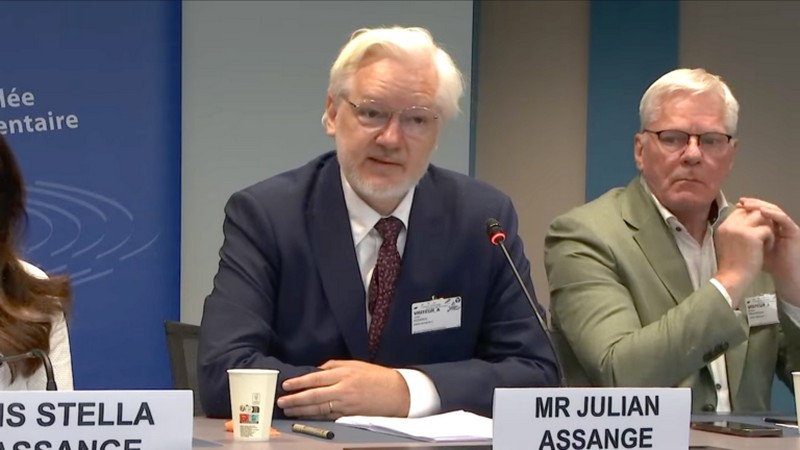
1 Oct 2024 – Read the full text of Julian Assange’s remarks to the Committee on Legal Affairs and Human Rights of the Parliamentary Assembly of the Council of Europe (PACE) in Strasbourg today on the plea deal,WikiLeaks work, the Espionage Act, the C.I.A.’s retribution, the repression of journalism, and his responses during Q&A.

Ladies and gentlemen, the transition from years of confinement in a maximum security prison to being here before the representatives of 46 nations and 700 million people is a profound and a surreal shift. The experience of isolation for years in a small cell is difficult to convey. It strips away one sense of self, leaving only the raw essence of existence.

I’m yet not fully equipped to speak about what I have endured. The relentless struggle to stay alive, both physically and mentally. Nor can I speak yet about the death by hanging, murder and medical neglect of my fellow prisoners.

I apologize in advance if my words falter, or if my presentation lacks the polish you might expect from such a distinguished forum. Isolation has taken its toll. Which I am trying to unwind. And expressing myself in this setting is a challenge. However, the gravity of this occasion and the weight of the issues at hand compel me to set aside my reservations and speak to you directly.

I have traveled a long way, literally and figuratively, to be before you today. Before our discussion or answering any questions you might have. I wish to thank PACE for its 2020 resolution, which stated that my imprisonment set a dangerous precedent for journalists. I noted that the U.N. Special Rapporteur on torture called for my release. I’m also grateful for Pace’s 2021 statement, expressing concern over credible reports that U.S. officials discussed my assassination again, calling for my prompt release, and I commend the Legal Affairs and Human Rights Committee for commissioning a renowned rapporteur.

Sooner I will start to investigate the circumstance surrounding my detention and conviction, and the consequent implications for human rights. However, like so many of the efforts made in my case, whether they were from parliamentarians, presidents, prime ministers, the pope, U.N. officials and diplomats, unions, legal and medical professionals, academics, activists or citizens, none of them should have been necessary.

None of the statements, resolutions, reports, films, articles, events, fundraisers, protests and letters over the last 14 years should have been necessary. But all of them were necessary because without them, I never would have seen the light of day. This unprecedented global effort was needed because the legal protections of the legal protections that did exist, many existed only on paper when not effective in any remotely reasonable time.

On the Plea Deal

I eventually chose freedom over and realizable justice. After being detained for years and facing 175 year sentence with no effective remedy. Justice for me is now precluded, as the U.S. government insisted in writing into its plea agreement that I cannot filed a case at the European Court of Human Rights or even the Freedom of Information Act request over what it did to me as a result of its extradition request.

I want to be totally clear. I am not free today because the system worked. I am free today after years of incarceration because I pled guilty to journalism. I pled guilty to seeking information from a source. I pled guilty to obtaining information from a source. And I pled guilty to informing the public what that information was. I did not plead guilty to anything else.

I hope my testimony today can serve to highlight the weakness, the weaknesses of the existing safeguards and to help those whose cases are less visible but who are equally vulnerable. As I emerge from the dungeon of Belmarsh, the truth now seems less discernible, and I regret how much ground has been lost during that time period. How expressing the truth has been undermined, attacked, weakened and diminished.

I see more impunity, more secrecy, more retaliation for telling the truth and more self-censorship. It is hard not to draw a line from the U.S. government’s prosecution of me. It’s crossing. Crossing the Rubicon by internationally criminalizing journalism to the true climate for freedom of expression that exists now.

On WikiLeaks’ Work

When I founded WikiLeaks, it was driven by a simple dream to educate people about how the world works, so that through understanding, we might bring about something better. Having a map of where we are lets us understand where we might go. Knowledge empowers us to hold power to account and to demand justice where there is none. We obtained and published truth about tens of thousands of hidden casualties of war and other unseen horrors about programs of assassination, rendition, torture and mass surveillance.

We revealed not just when and where these things happened, but frequently the policies, the agreements and the structures behind them. When we published Collateral Murder, the infamous gotten camera footage of a U.S. Apache helicopter crew eagerly blowing to pieces Iraqi journalists and their rescuers. The visual reality of modern warfare shocked the world, so we also used interest in this video to direct people to the classified policies for when the U.S. military could deploy lethal force in Iraq.

How many civilians could be and how many civilians could be killed before gaining higher approval? In fact, 40 years of my potential 175 year sentence was for obtaining and releasing those policies.

The practical political vision I was left with after being immersed in the world’s dirty wars and secret operations, is simple. Let us stop gagging, torturing, and killing each other for a change. Get these fundamentals right and other political, economic and scientific processes that have space to educate. We’ll have space to take care of the rest.

WikiLeaks work was deeply rooted in the principles that this Assembly stands for. Our journalism elevated freedom of information and the public’s right to know. It found its natural operational home in Europe. I lived in Paris and we had formal corporate registrations in France and in Iceland. A journalistic and technical staff was spread throughout Europe. We publish to the world from servers based in France, in Germany and in Norway.

Manning’s Arrests

But 14 years ago, the United States military arrested one of our lead whistleblowers, Private First Class Manning, a U.S. intelligence analyst based in Iraq. The U.S. government concurrently launched an investigation against me and my colleagues. The U.S. government illicitly sent planes of agents to Iceland, paid bribes to an informant to steal our legal and journalistic work product and without formal process, pressured banks and financial services to block our subscriptions and to freeze our accounts.

The U.K. government took part in some of this retribution. It admitted at the European Court of Human Rights that it had unlawfully spied on my U.K. lawyers during this time.

Ultimately, this harassment was legally groundless. President Obama’s Justice Department chose not to indict me. Recognizing that no crime had been committed, the United States had never before prosecuted a publisher for publishing or obtaining government information. To do so would require a radical and ominous reinterpretation of the U.S. Constitution. In January 2017, Obama also commuted the sentence of Manning, who had been convicted of being one of my sources.

C.I.A.’s Retribution

However, in February 2017, the landscape changed dramatically. President Trump had been elected. He appointed two wolves in MAGA hats. Mike Pompeo, a Kansas congressman and former arms industry executive, as C.I.A. director, and William Barr, a former C.I.A. officer, as U.S. attorney general.

By March 2017, WikiLeaks had exposed the C.I.A.’s infiltration of fringe political parties. Its spying on French and German leaders, its spying on the European Central Bank, European economic ministries, and its standing orders to spy on French on the street as a whole. We revealed the C.I.A.’s vast production of malware and viruses, its subversion of supply chains. Its subversion of antivirus software, cars, smart TVs and iPhones.

C.I.A. Director Pompeo launched a campaign of retribution. It is now a matter of public record that under Pompeo’s explicit direction, the C.I.A. drew up plans to kidnap and to assassinate me within the Ecuadorean Embassy in London and authorize going after my European colleagues, subjecting us to theft, hacking attacks and the planting of false information. My wife and my infant son were also targeted.

A C.I.A. asset was permanently assigned to track my wife. And instructions were given to obtain DNA from my six month old son’s nappy. This is the testimony of more than 30 current and former U.S. intelligence officials speaking to the U.S. press, which has been additionally corroborated by records seized and the prosecution brought against some of the C.I.A. agents involved.

The C.I.A. is targeting of myself, my family and my associates through aggressive, extrajudicial and extraterritorial means. Provides a rare insight into how powerful intelligence organizations engage in transnational repression. Such repressions are not unique. What is unique is that we know so much about this one. Due to numerous whistleblowers and to judicial investigations in Spain.

This assembly is no stranger to extraterritorial abuses by the C.I.A.. Pace’s groundbreaking report on C.I.A. renditions in Europe exposed how the C.I.A. operated secret detention centers and conducted unlawful renditions on European soil, violating human rights and international law. In February this year, the alleged source of some of our C.I.A. revelations, former C.I.A. officer Joshua Schulte, was sentenced to 40 years in prison under conditions of extreme isolation.

His windows are blacked out and a white noise machine plays 24 hours a day over his door so that he cannot even shout through it. These conditions are more severe than those found in Guantanamo Bay.

But transnational repression is also conducted by abusing legal processes. The lack of effective safeguards against this means that Europe is vulnerable to having its mutual legal assistance and expedition treaties hijacked by foreign powers to go after dissenting voices in Europe. In Michael Pompeo’s memoirs, which I read in my prison cell, the former C.I.A. director bragged about how he pressured the U.S. attorney general to bring an extradition case against me in response to our publications about the C.I.A..

Indeed, acceding to Pompeo’s requests, the U.S. attorney general reopened the investigation against me that Obama had closed and re-arrested Manning, this time as a witness, and he was held in a prison for over a year, fined $1,000 a day. In a formal attempt to coerce her into providing secret testimony against me, she ended up attempting to take her own life.

We usually think of attempts to force journalists to testify against their sources. But Manning was now a source being forced to testify against the journalist.

By December 2017, C.I.A. Director Pompeo had got his way and the U.S. government issued a warrant to the U.K. for my extradition. The U.K. government kept the warrant secret from the public for two more years, while it, the U.S. government and the new president of Ecuador moved to shape the political, legal and the diplomatic grounds for my arrest.

When powerful nations feel entitled to target individuals beyond their borders, those individuals do not stand a chance unless there are strong safeguards in place and a state willing to enforce them without this. No individual has a hope of defending themselves against the vast resources that a state aggressor can deploy.

If the situation were not already bad enough, in my case, the U.S. government asserted a dangerous, dangerous new global legal position. Only U.S. citizens have free speech rights. Europeans and other nationalities do not have free speech rights, but the U.S. claims its Espionage Act still applies to them, regardless of where they are. So Europeans in Europe must obey the U.S. secrecy law with no defenses at all.

As far as the U.S. government is concerned, an American in Paris can talk about what the U.S. government is up to. Perhaps, but for a Frenchman in Paris, to do so is a crime with no defense. And he may be extradited, just like me.

Criminalizing News-Gathering

Now that one foreign government has formally asserted that Europeans have no free speech rights, a dangerous precedent has been set. Other powerful states will inevitably follow suit. The war in Ukraine has already seen the criminalization of journalists in Russia. But based on the precedent set in my expedition, there is nothing to stop Russia or indeed any other state from targeting European journalists, publishers or even social media users by claiming that their domestic secrecy laws have been violated.

The rights of journalists and publishers within the European space are seriously threatened.

Transnational repression cannot become the norm here. As one of the world’s two great norms, setting institutions, PACE must act.

The criminalization of news-gathering activities is a threat to investigative journalism everywhere. I was formally convicted by a foreign power for asking, for receiving and publishing truthful information about that power. While I was in Europe.

The fundamental issue is simple journalists should not be prosecuted for doing their jobs. Journalism is not a crime. It is a pillar of a free and informed society.

Mr. Chairman, distinguished delegates. If Europe is to have a future where the freedom to speak and the freedom to publish the truth are not privileges enjoyed by a few, but rights guaranteed to all. Then it must act. So what has happened in my case never happens to anyone else.

I wish to express my deepest gratitude to this assembly, to the conservatives, Social Democrats, liberals, leftists, Greens and independents who have supported me throughout this ordeal and to the countless individuals who have advocated tirelessly, tirelessly for my release. Is heartening to know that in a world often divided by ideology and interests, there remains a shared commitment to the protection of essential human liberties.

Freedom of expression and all that flows from it is at a dark crossroad. I fear that unless institutions like PACE wake up to the gravity of the situation, it will be too late. Let us all commit to doing our part to ensure that the light of freedom never demands that the pursuit of truth will live on, and that the voices of the many are not silenced by the interests of the few.

Responses During Q&A

After 14 years detained in the U.K., including over five years in a maximum security prison and facing 175 year sentence, with the prospect of years more in prison before being able to, have a shot at the European Court of Human Rights.

I, accepted, a plea offer from the United States that would release me from prison immediately. The United States insisted, that I not be allowed to take a case in relation to what had happened to me, in relation to its extradition proceedings. Nor that I could even file a Freedom of Information Act request, on the U.S. government, to see what was done.

There will never be a hearing into what has happened. And that’s why, it’s so important that, PACE, the uncertainty within Europe as to the defenses that can be used by journalists here to protect themselves from transnational repression and extradition. If left in its current state, will inevitably be abused by other states. Yeah. So, you know, I’m setting institutions like PA pace must move to make the situation clear that what happened to me cannot happen again.

Why He Attended

I am here because I believe it is an essential first step for PACE to act, to get the ball rolling, to address the problems of transnational repression and also to make it clear that national security journalism is possible within European borders. As for my adaptation to the big wide world, outside of how serious an embassy siege and maximum security prison, it sure takes some adjustment.

It’s not simply the spooky sound of electric cars that are very spooky. But it’s the it is also the change in the society. Where we once produced a pourtant, where he once released, important war crimes videos. That stirred public debate. Now, every day there are live streaming horrors from the wars in Ukraine and the war in Gaza.

Hundreds of journalists have been killed in Gaza and Ukraine combined.

The impunity. Seems to mount, and it is still uncertain what we can do about it.

By reputation to the world, of course, includes some positive but still tricky things. Becoming a father again to children who have grown up without me. Becoming a husband again. Even dealing with a mother in law.

These, trying family issues. No, she’s. She’s a very lovely woman. I like. I like them very much.

On Asylum

Political asylum is an absolutely essential relief valve for human rights abuses within states. That people can leave a state that is persecuting them not only saves individual lives. It provides a mechanism where journalists can continue to report on their societies after they have been hounded out, and ultimately, the threat of people leaving a state, is what the final analysis controls.

We have seen examples in history of states that made it difficult or impossible for people to leave. And we can see how the situation for people living there collapsed. It must be competition between states, to be good places for people to live and to work.

The assault on asylum through means of transnational repression. It’s another matter in my case.

It was difficult to find a state that would give asylum, that I was able to get to. There is a big gap in the asylum system for people. Who are not fleeing their own state, but fleeing an ally of that state. Or any third state. That was my case. Asylum law does not easily cover the case where, let’s say an Australian is fleeing persecution by the United States.

Or we could imagine a Kazakhstani fleeing persecution by Russia or China. I was not able to apply for asylum within the U.K.. Of course, the U.K. has its own particular political angle. It might have been difficult to convince the courts to give me, or in fact anyone, asylum in relation to the United States in the U.K.. But there wasn’t even a chance because citizens from third states, under the 1951 convention, as it’s implemented in most European states, cannot apply for asylum.

On the High Court Case

In the final U.K. High High Court case, which I won and the U.S., appealed against.

I won under the basis of nationality discrimination. That is in the U.K. Extradition Act. You’re not meant to discriminate. At trial or during a penalty phase against someone on the basis of their nationality.

The U.S. tried different tricks to get around that in the U.K. system, and it was uncertain whether we, whether I, or the United States would ultimately prevail. However, there is nothing in the European Charter. That prevents nationality discrimination in relation to extradition. So this is a small protection. It was hard to use within the U.K. Extradition Act.

But it’s not clear that it exists in most European states.

The first part of your questions about the C.I.A., the second part was about, do I see myself as a political prisoner? Answering the first one first? Yes. I was a political prisoner. The political basis for the U.S. government’s retributive acts against me was in relation to publishing the truth about what the U.S. government had done then in a formal legal sense, once the U.S. proceeded with its legal retribution, it used the Espionage Act, a classic, political offense. In relation to the C.I.A.’s, Campaign of transnational repression against Wikileaks.

We felt that something was going on at the time. There were many small signs that came together. But.

Having a ominous feeling and some, subtle input tips from a whistleblower and one of the, security contractors that the C.I.A. had contracted didn’t give me the full and disturbing picture, which later emerged.

It is a interesting example where intelligence organization has targeted and investigated of organization Wikileaks. As a result of our investigations, a criminal case in Spain, and in particular work done by U.S. journalists, which under the precedent that has been established in my case, might will now be themselves criminal. Detailed information about the actions of the C.I.A. took came out.

Those details involved the testimony of more than 30 current or former U.S. intelligence officials. A there are two, resulting processes. A criminal case in Spain with a number of victims, including my wife, my son, people who came to visit me at the embassy, lawyers, journalists, and a civil suit in the United States against the C.I.A. in the United States.

The C.I.A. has, in response to that civil suit declared formally by the C.I.A. director and the attorney general, state secrets privilege to knock out the case, the. Claim is that the C.I.A. may have a defense, but that defense is classified. And, so the case, the civil case cannot go forward. So it’s complete impunity. Within the U.S. system.

On Mistakes Made 

Q: Mr. Assange, if you could go back in time, would you do everything the same? And if not, what would you do differently? I’m not asking just in the terms of personal cost that you suffered, but also in terms of effectiveness or impact of what you tried to do. Thank you.

A: This is a very deep question about free will. Why do people do things when they do them? Looking back. We were often constrained by. Our resources, the number of staff by secrecy, that was necessary to protect our sources. If I could go back and have a lot of extra resources. Of course. Political approaches.

Media approaches, could have maximized even further the impact, the revelations that we made. But I suppose your question is, is trying to say, well, were there any knobs that could be turned in hindsight, of course, thousands of small things. I was not from the United Kingdom. I had a good friend in the United Kingdom, Gavin McFadzean, who’s an American journalist.

A very good man. But it took me time to when I once I was trapped in the United Kingdom, it took me time to understand what U.K. society was about, who you could trust. You couldn’t trust the. Different types of maneuvers that are made, in that society. And, there are different media partners that, perhaps we, could have chosen differently.

Q: You were the subject of a European arrest warrant issued by Sweden. To what extent do you think the European arrest warrants are being used as tools of repression? And to what extent do you think the rules could be changed so that they can no longer be used for that purpose?

A: The European Arrest Warrant System was introduced post-September 11, with the political rationale that it would be used for the fast transfer of Muslim terrorists between European states. The first European arrest Warrant that was issued was issued by Sweden for a drunk driver. We must understand that when we pick a disfavored group, Muslims at that time and. Say, well, this repressive legislation, it’s only going to be for them, inevitably, bureaucrats, elements of the security state will seize upon those measures and apply them more broadly.

Injustice to one person spread soon enough to most people.

I don’t know, the statistics on how often arrest warrants were abused. I was there was an attempt to extradite me without any charge from the United Kingdom by Sweden. The. U.K. government subsequently changed the law to prevent extradition without charge. But in its amendment, to the existing legislation, it included a rider to make sure that it didn’t apply to me.

On First Amendment and Article 10 

We performed a legal analysis to try to understand what the abilities and limitations were within Europe for publishing documents from a number of different countries, including United States.

We understood that in theory, article ten, should protect journalists in Europe. Similarly, looking at the U.S. First Amendment to its constitution, that no publisher had ever been prosecuted for publishing classified information from the United States, either domestically or internationally.

I expected some kind of harassment legal process. I was prepared to fight for that. I believe the value of these publications was such, it is okay to have that fight and that we would prevail because we had understood, what was legally possible. My naivete was believing in the law. When push comes to shove, laws are just pieces of paper, and they can be reinterpreted for political expediency.

They are the rules made by the ruling class more broadly. And if those rules don’t suit what it wants to do, it reinterprets them or hopefully, changes them, which is clearer? In the case of the United States, we angered one of the constituent powers of the United States, the intelligence sector, the security state, the secrecy state.

It was powerful enough to push for a reinterpretation. The U.S. Constitution, the U.S. First Amendment seems pretty black and white to me. It’s very short. It says the Congress shall make no law, restricting speech or the press.

However, that was, the that the U.S. Constitution, those precedents relating to it,

We’re just, reinterpret to the way and yes, perhaps ultimately if I, if it got to the Supreme Court of the United States, and I was still alive in that system, I might have won, depending on what the makeup was of the U.S. Supreme Court. But in the meantime, I had lost 14 years, on the house arrest, embassy siege and maximum security prison.

So I think this is an important lesson that when a major power faction wants to reinterpret the law, it can push to have the element of the state, in this case, the U.S. Department of Justice do that. And it doesn’t care too much about what is legal. That’s something for a much later day. In the meantime, the deterrent effect that it seeks, the retributive actions that it c seeks, have had their effect.

The U.S.-U.K. extradition treaty is one sided. Nine times more people excited to the United States from the U.K. than the other way around. What about the protections for U.S. citizens being exiled to the U.K.? A stronger,

There is no, need to show a prima facie case or reasonable suspicion. Even when the United States seeks to extradite from the U.K.. It’s a allegation extradition system. The allegation is alleged. You do not even have a chance to argue that is not true. All the arguments are based simply upon. Is that the right person? Does it breach human rights?

That’s it. That said, I do not think in any way that U.K. judges are compelled to extradite most people, and particularly journalists, to the United States. Some judges in the U.K. found in my favor at different stages in that process. Other judges did not.

But all judges, whether they were finding in my favor or not in the United Kingdom, showed extraordinary deference to the United States. Engaged in astonishing intellectual backflips, to allow the United States to have its way, on my extradition and in relation to setting precedents that occurred in my case, more broadly, that’s a to my mind, a function of.

The selection of U.K. judges, the narrow section of British society from which they come. They’re. Deep engagement with the U.K. establishment and the U.K. establishment’s deep engagement with the United States. Whether that’s in the intelligence sector via the which is now the largest, largest manufacturer in the United Kingdom, a weapons company, a BP shell, and some of the major banks.

The United Kingdom’s establishment is made up out of people who have benefited from that system for a long period of time. And almost all judges are from it. They don’t need to be told explicitly what to do. They understand what is good for that cohort, and what is good for that cohort is keeping a good relationship with the United States government.

On Lawfare

Lawfare is the use of the law to achieve ends, that would normally be achieved in some other form of conflict. We’re not talking about simply litigating to protect your rights. But rather. Picking laws, to get your man or to get the organization you want to get. Not justice seeking its resolution in law.

We’ve seen a lot of cases like that and obviously experienced ourselves, ourselves in many different domains.

I’m not sure precisely what can be done about it. There is a anti-SLAPP movement in Europe, which I commend. SLAPP is strategic lawsuits against public participation. There is good legislation in California to deal with SLAPP suits, and to reverse liabilities at an early stage, and to make, abusive lawsuits more expensive to conduct.

But I, I think we should understand a bigger picture, which is that whenever we make a law, we create a tool that self-interested bureaucrats, companies, and the worst elements of the security state will use and will expand the interpretation, in order to achieve control over others. And that’s why law reforms are constantly needed, because laws are abused and expanded.

And so it needs, constant vigilance, but also great care in making laws in the first place, because they, will be seized upon and abused.

On Support He Received

Other publications, journalists, unions, freedom of expression, organizations, was different at different stages. The those who saw the threats to everyone else and understood the case first, were the lawyers involved in major publications like lawyers for the New York Times? Freedom of expression. NGOs, were the next to see the threat.

Of the larger media organizations, unfortunately, many of them. Went with their political or geopolitical alignment.

So it was easy to gain support. From media organizations in neutral states, and obviously states hostile to United States, allies of the United States took longer media organizations within the United States. The journalists there, not the lawyers, but the journalists, took longer still.

It is a concern. And I, I can see a similar, phenomenon happening, with the journalists being killed in Gaza. And Ukraine.

That the political and geopolitical alignment of media organizations, causes them to not cover those victims, or cover only certain victims. This is a breach of journalistic solidarity. We all need to stick together, to hold the line. A journalist censored anywhere spread censorship, which can then, affect us all. Similarly, journalists being killed or targeted by intelligence agencies.

Need our firm, commitment in writing, or in broadcast. Sometimes there’s, a debate about whether someone is a journalist or an activist. I understand that debate. I’ve tried in my work, to be rigorously accurate. I believe accuracy is everything. Primary sources are everything. But there is one area, where I am an activist and all journalists must be.

And activists. Journalists must be activists for the truth.

Journalist journalists must be activists for the ability to convey the truth. And that means standing up for each other and, making no apologies about it. Thank you. Now, could I invite any other member of the parliamentary assembly who is not a member of the committee, to indicate if they wish to ask a question, and I can see two hands in the air, could I invite you, first of all, to give your name, and then to ask your question, Mr. Assange.

On Technology

I’m very interested in technology. I was a computer scientist from a young age and studied mathematics and physics. Cryptography. It’s with that cryptography that, we set about our system to protect sources and protect our own organization.

I am, enthused about some of the developments that are happening with cryptography. Some of those developments provide alternatives to what we see as huge media power and concentration in the hands of a few billionaires. They are still embryonic. Other technologies emerged out of. The campaign against mass surveillance, there and the Big Bang was the Snowden revelations that radicalized engineers and programmers, in many places, who saw themselves as agents of history, in including algorithms to protect, people’s privacy, including the communications between journalists and their sources.

On the other hand, as I emerge from prison, I see that. Artificial intelligence, is being used to create mass assassinations, where before there was a difference between assassination and warfare. Now the two of conjoined, when where many, perhaps the majority of targets, in Gaza. Are bombed as a result, of artificial intelligence targeting the connection between artificial intelligence and surveillance.

Is important. And artificial intelligence needs information to, come up with targets or ideas or propaganda and.

And when we’re talking, About, the use of artificial intelligence to conduct mass assassinations, surveillance data from telephones, internet, is key to training those algorithms. So there’s,

A lot has, changed. Some things have remained the same. There’s a lot of opportunity, and a lot of risk. I’m still trying to understand where we are, but hopefully we’ll have something more useful to say in due course.

I’m sorry, I’m getting a bit tired, but, Kristen, perhaps you want to take the.

Kristen Hrafnsson:

The one who loves what journalists do about the, Well, what can be done, when we have, horrible stories about, targeted killings where we have now have, evidence of that in and and of course, it is the reality of, reporting on wars is more severe than ever before.

And it was bad. It was bad in Iraq. Now it is even worse. It is a horror story. It is hard to give out advice for these journalists, how they can deal with that situation. The only thing we can call out, at least, is for an outcry and condemnation that this should be going on because we need information, we need this information.

There are no tools to, to secure individuals in Gaza that are being followed by drones and, are being targeted in mass bombing. There is a little defense from that, but, the outcry and the condemnation should be there. We should not be silent when this happens. Thank you.

Assange’s Final Remarks

In 2010, I was living in Paris, and I went to, to the United Kingdom and never came back. Until now. It’s. Good to be back. And it’s good to be amongst people who, as we say in Australia, who give a damn.

It’s good to be amongst friends. And I would just like to thank all the people who have fought for my liberation. And who have understood, importantly, that my liberation was coupled to their own liberation.

The basic fundamental liberties which sustain us all have to be fought for.

And that when one of us falls through the cracks. Soon enough, those cracks will widen and take the rest of us down. So thank you for your your courage in this and other settings and, keep up the fight.

_______________________________________________

Julian Assange is the founder of WikiLeaks. His most recent book is The WikiLeaks Files (Verso).

7 October 2024

Source: transcend.org

“Bloodied, Bruised and Broken” – More Than 690 Children Injured in Lebanon in Last Six Weeks

By UNICEF

UNICEF calls for a ceasefire to protect children as physical injuries and psychological suffering rise dramatically.

4 Oct 2024 – More than 690 children have reportedly been injured in Lebanon as the conflict has dramatically escalated in recent weeks.

Since 20 August, the number of children injured in the conflict has increased drastically, bringing the total number injured in the last year to 890 as of 2 October, according to the Lebanese Ministry of Public Health.

“This disastrous conflict is exacting a tremendous toll on children,” said UNICEF Regional Director Adele Khodr. “Doctors tell us of treating children who are bloodied, bruised, and broken, suffering both physically and mentally. Many are experiencing anxiety, flashbacks, and nightmares related to explosions. No child should be subjected to such horrific situations.”

The most common injuries reportedly recorded among children include concussions and traumatic brain injuries from the impact of blasts, shrapnel wounds and limb injuries. Hearing loss caused by explosions is also common.

In the last year at least 127 children have been killed, with more than 100 of these deaths occurring in the past 11 days alone, according to the Lebanese Ministry of Public Health.

“These are not mere numbers. They are innocent children, who had dreams and a future just like anyone else,” adds Khodr.

Meanwhile, it is estimated that more than 400,000 children have been displaced from their homes, grappling with fear, anxiety, destruction, and death in an uncertain and unfamiliar environment, and not knowing when they will return home or go back to school. UNICEF is particularly concerned about the long-term impacts of these events on their mental health.

Lebanon’s health system is under immense strain with the increased number of casualties, and has been directly affected by the conflict with at least 10 hospitals sustaining damage, including one neonatal intensive care unit.

In response, UNICEF has delivered 100 tons of emergency medical supplies, with a further 40 tons expected over the weekend. These supplies are being distributed to hospitals, primary health care centres, pop-up clinics, and first responders, to support life-saving care for families, especially pregnant women and children, across Lebanon. UNICEF is also supporting medical services at 50 shelters and psychosocial support sessions.

Given the scale of needs in Lebanon, UNICEF is urgently appealing to the international community to mobilize humanitarian support and ensure that supply routes into Lebanon remain open, allowing for the rapid and safe delivery of life-saving aid to children in need.

UNICEF continues to call for an urgent ceasefire and urges for all parties to protect children and civilian infrastructure, and to ensure that humanitarian actors can safely reach those in need, in accordance with their obligations under international humanitarian law.

7 October 2024

Source: transcend.org
The Chaos Israel Is Sowing Across the Middle East Will Come Back to Haunt It

By David Hearst

Nothing can persuade its Arab neighbours that Israel cannot live with them in peace more than the course on which Netanyahu is currently set.

It’s called the ceasefire ritual – a public display of hand-washing. It’s the charade of pretending that there are honest diplomats out there trying to search every avenue, stretch every sinew, to stop this bedlam from starting.

Much of it is choreographed. Other parts are improvised. But be sure about one thing: it is pantomime. It bears no relationship to reality.

Hours before Israel declared that its ground attack on Lebanon had begun, French Foreign Minister Jean-Noel Barrot was vainly insisting in a media conference in Beirut that his proposed 21-day ceasefire was “still on the table”.

As he was doing so, the US, France’s co-sponsor, was briefing journalists that ceasefire talks had stopped. This position went through several iterations as the afternoon wore on, and the contradictions accumulated.

The US simultaneously wanted a diplomatic solution, while describing Hezbollah leader Hassan Nasrallah’s assassination as an “unalloyed good”. It claimed to have restrained Israel to a limited operation on the border, while also expressing anxiety about the humanitarian aspect of the operation. And it pledged to continue to work on de-escalating tensions while acknowledging that Israel was a sovereign country that made its own decisions.

If this charade sounds horribly familiar, that’s because it is.

Cut through the verbiage and the bottom line – as the Pentagon has confirmed – is that the US supports a ground invasion of Lebanon, and ceasefire plans can go hang.

Desire for vengeance

The same happened in Gaza a year ago. Israel’s “right to defend itself” is shorthand for flattening every neighbourhood unfortunate enough to live next to it.

This macabre dance serves a purpose: virtually every media outlet in the western world on Tuesday described the unfolding operation in Lebanon as “targeted” or “limited” – precise commando raids that go in and come back out – just as they did during the initial phase of the Gaza war.

“We do not expect it will look like 2006,” a US official told The Washington Post.

Meanwhile, Israeli diplomats and generals could not stop themselves from blurting out the truth. Mike Herzog, Israel’s ambassador to the US, said: “The American administration … did not limit us in time. They, too, understand that following Nasrallah’s assassination, there is a new situation in Lebanon and there is a chance for reshaping.”

A “reshaping” of Lebanon does not mean a targeted operation limited to the border. Nor was limitation in the thoughts of one Israeli army commander, who noted: “We have a great privilege to write history as we did in Gaza here in the north.”

Rage and hate speech have reached psychotic levels in Israel. The desire for vengeance directed against the people of Gaza has swiftly found a new target: the people of Lebanon.

Netanyahu and his US backers will change the Middle East by invading Lebanon, that is for sure. But not quite in the way they imagine.

Nir Dvori of Channel 12 News gloated that “Nasrallah died in torment” amid reports that the Hezbollah leader had suffocated. The head of the Shlomi town council welcomed the ground invasion, saying: “It is necessary to cleanse the area.”

Political commentator Ben Caspit dreamed of the “day after” such a cleansing operation, suggesting that even the grandmothers of any fighter in Hezbollah’s elite Radwan Force who crossed back over the Litani River should “die at that moment”.

Funny he should mention the Litani River, whose name has often been invoked as the upper limit of southern Lebanon that Israel wants to clear of Hezbollah rockets – because that, too, is turning into a myth. The military ambitions of this operation go far deeper into Lebanon.

Barely 12 hours after the US State Department said it had limited Israel’s operation, the Israeli military issued evacuation orders to more than 20 towns and villages in southern Lebanon. “You must head immediately to the north of the al-Awali River,” near Sidon, army spokesperson Avichay Adraee said on X (formerly Twitter).

Redesigning the Middle East

This indicates that Israel has claimed as its area of military operations the whole of southern Lebanon, almost one-third of the country. In a stroke, Israel doubled its area of operations.

This is in line with the promise that Israeli Prime Minister Benjamin Netanyahu made in the hours after Hamas’s attack a year ago.

“We are going to change the Middle East,” Netanyahu told officials visiting Jerusalem from the country’s south, where Hamas had struck on 7 October 2023.

Jared Kushner, former US President Donald Trump’s son-in-law and real estate investor who has apparently spent hours studying Hezbollah and considers himself an expert on the subject, wrote similarly on X: “September 27th [the date of Nasrallah’s killing] is the most important day in the Middle East since the Abraham Accords breakthrough … Anyone who has been calling for a ceasefire in the North is wrong.

“There is no going back for Israel. They cannot afford now to not finish the job and completely dismantle the arsenal that has been aimed at them. They will never get another chance.”

Netanyahu and his American backers will change the Middle East by invading Lebanon, that is for sure. But not quite in the way they imagine.

After leading the liberation of southern Lebanon after 18 years of occupation, and having led the battle against Israel in 2006, in Hezbollah’s eyes successfully, Nasrallah kept the northern border quiet for nearly two decades.

Under Nasrallah’s rule, Hezbollah was totally absorbed in another fight altogether: the civil war in Syria. This had many consequences. It downplayed the primacy of the struggle to liberate Palestine. And Hezbollah, as it grew in size and political importance, became easier for Israel’s Mossad to infiltrate.

Some of the major operations over the past month, such as the supply of booby-trapped pagers and walkie-talkies, were years in the making. The exact locations of Hezbollah’s bunkers, and the movement of targets between them, were also the result of years of work and research.

Dramatic contrast

None of what transpired to deliver a body blow to Hezbollah was unprepared, which is why it contrasts so dramatically with the difficulties Israel has experienced in attempting to decapitate Hamas in Gaza.

But Israel was also helped by Hezbollah and Iran’s “strategic patience”, or their lack of response to its mounting attacks on their commanders and leaders. Hezbollah never took revenge for the 2008 assassination of Imad Mughniyeh, the leader of its military wing. Nor did it reply in kind to the assassination of senior Hamas official Saleh al-Arouri earlier this year in its heartland of Dahiyeh in Beirut.

The meekness of the response from Hezbollah and Iran only gave Israel the confidence to redouble its blows on Lebanon and Syria.

Every time this happened, both Hezbollah and Iran went out of their way to say they did not want to start a war with Israel; and that their campaign was in solidarity with Hamas in Gaza and would stop the moment a ceasefire was reached.

What is Israel trying to accomplish with its attacks on Hezbollah and Lebanon? – Analysis

And when they did strike, it was generally, although not exclusively, on Israeli military targets. Hezbollah’s rockets and propaganda videos were demonstrative, designed to show its power, not to use it.

In hindsight, this strategy has proved to be a strategic mistake, for which Hezbollah is paying today – because it gave Israel the confidence to do what it is now doing to Lebanon.

Israel’s attacks on Hezbollah have outnumbered Hezbollah’s replies by five to one.

This is not just the miscalculation of those who are routinely dubbed hardliners in Lebanon and Iran. Reformist Iranian President Masoud Pezeshkian said he was lied to by the Americans, who promised a ceasefire in Gaza if Iran could restrain itself from replying to Hamas leader Ismail Haniyeh’s assassination in Tehran.

It was the failure of Iran’s strategic restraint that led on Tuesday night to the bombardment of more than 180 missiles on targets across Israel. After the attack, Pezeshkian still maintained that Iran did not seek a war with Israel, but the policy of restraint has clearly been dumped. One can expect Hezbollah and all armed groups in Yemen and Iraq to be more active.

But an even bigger miscalculation is being made by Israel in its desire to strike while the iron is hot.

Untamed aggression

Israel is re-engineering the entire Middle East to hate it, while the Palestinian issue remains unresolved. It is reverse engineering a period of three decades, since the Oslo Accords, when the Palestinian conflict lost its supremacy and centrality in the Arab world.

Nothing is doing more than Israel’s untamed aggression to heal the deep divisions in the Arab world created by the counter-revolution to the Arab Spring.

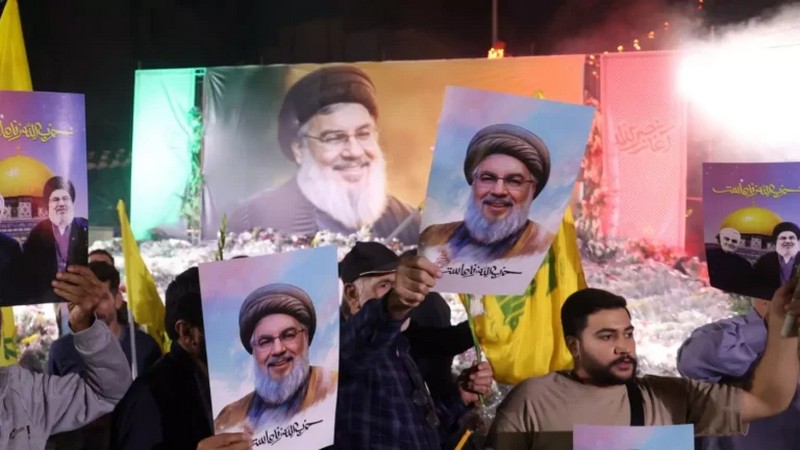
When you drop 80 tonnes of explosives to kill Nasrallah and kill 300 others in doing so, you move him from being a symbol of resistance to a legend.

“The symbol is gone, the legend is born, and the resistance continues” was how Lebanese politician Suleiman Frangieh, a scion of one of the country’s leading Maronite families, put it.

Netanyahu, more than anyone else, is persuading them that an Israel that behaves like this, does not belong to this region.

Ibrahim al-Amin, the editor of Al Akhbar, a newspaper close to Hezbollah, compared Nasrallah to Hussain, the grandson of the Prophet Muhammad who is regarded as the third imam in Shia Islam.

He wrote: “Sayyed Hassan Nasrallah did not imagine himself in the image of Hussain when he fell as a martyr. He is not in Hussain’s position when the world has let him down. Rather, he is in the image of Hussain who got up and fought in defence of a right that the cost of collecting is very high … [Nasrallah] has become an eternal symbol for every rebel in the face of injustice, and … he was martyred in defence of Jerusalem and Palestine.”

Nasrallah had a charismatic appeal as an orator to his Shia constituency and the pro-Palestinian masses in the Arab world, in the same way that former Egyptian President Gamal Abdel Nasser had for the Arab nationalist movement in his time.

In death, Nasrallah promises to do that much.

Profound consequences

Of course, this is not the view of the Arab elites who have spent so much of their careers cosying up to the US and Israel. But even they have to acknowledge the passions coursing through their people.

Saudi Crown Prince Mohammed bin Salman used Israel as a path to being taken seriously by Washington. But even he is brutally candid about his limits as a leader.

“Seventy percent of my population is younger than me,” the 39-year-old ruler reportedly told US Secretary of State Antony Blinken earlier this year. “For most of them, they never really knew much about the Palestinian issue. And so they’re being introduced to it for the first time through this conflict. It’s a huge problem. Do I care personally about the Palestinian issue? I don’t, but my people do, so I need to make sure this is meaningful.”

A Saudi official disputed this account of Mohammed bin Salman’s conversation with Blinken, but it bears the ring of truth.

Yes, the region is being redesigned by an Israel that has broken its leash.

Nothing can persuade its Arab neighbours that Israel cannot live with them in peace more than the course on which Israel is currently set – a course that targets and threatens Christians, Muslims, Shia, and Sunni alike.

Netanyahu, more than anyone else, is persuading them that an Israel that behaves like this, does not belong to this region.

This will have profound strategic consequences for the future. So is Nasrallah’s death truly an “unalloyed good” for the region?

Beware what you wish for, because it just may happen.

________________________________________________

David Hearst is co-founder and editor-in-chief of Middle East Eye. He is a commentator and speaker on the region and analyst on Saudi Arabia.

7 October 2024

Source: transcend.org
Macron Calls for Arms Embargo against Israel

By Juan Cole

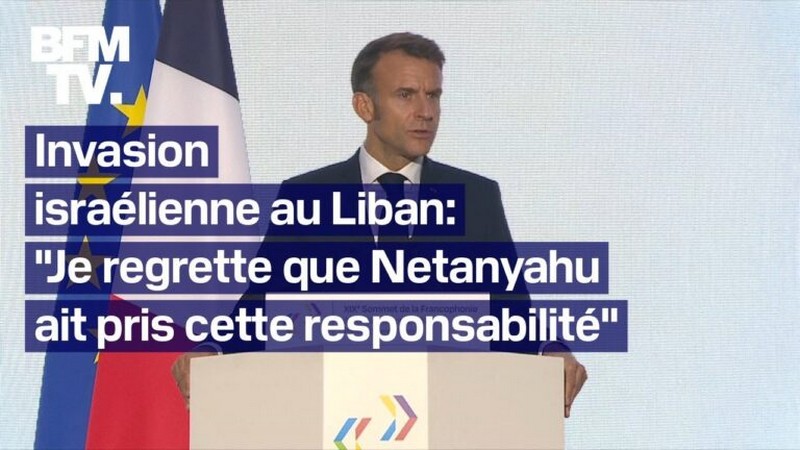
6 Oct 2024 – In a radio interview with France Inter on Saturday, French president Emmanuel Macron called for an arms embargo against Israel over its ongoing attacks on Gaza and now Lebanon.

BFMTV reported that he said, “I think that today the priority is to return to a political solution, and that we must halt the delivery of arms for pursuing combat against Gaza. France will not deliver them.”

He clarified that France would continue to export defensive materiel, such as parts for the Israeli Iron Dome anti-missile defense system.

The station notes that President Joe Biden has often called for the avoidance of civilian casualties but has steadfastly declined to use his leverage with Israel, given its dependence on US weaponry and ammunition, to pressure it. In Britain, the Labour government of PM Keir Starmer has halted 10 out of 350 weapons licenses on the grounds that those ten weapons would likely be used by Israel against civilians.

Macron is the first leader of a major European country to argue for an embargo of offensive weapons to Israel in response to its total war on Gaza.

The French president has been heavily criticized by former French diplomats and other public figures for not showing the spine toward the Israeli Right that his predecessors such as François Mitterand and Jacques Chirac had. He had also come under fire from NGOs such as Human Rights Watch and Oxfam. Last April, 115 French parliamentarians on the left demanded that he announce an arms embargo on Israel. The left more or less won the subsequent elections this summer, which the center-right Macron refused to recognize, appointing a right wing prime minister — which has also embroiled him in controversy.

A solid majority of French Muslims who vote have swung to the leftist Insoumise [Rebellion] Party. About 9% of the French are Muslim, though a large number of them, like the French in general, say they have no religion. Religious “nones” are at least 40% of the French population. France is close to many countries in the Arab world, who will have been filling the Quai D’orsay’s ears with bitter complaints about the Israeli genocide. The French Left and its Muslim component are furious about Israel’s genocide in Gaza, and Macron has been feeling the heat.

Macron underlined his continued commitment to Israel’s right to defend itself. He objected, however, “One does not fight terrorism and against terrorism by sacrificing the civilian population.” He did not, however, express any optimism about the prospects of a ceasefire any time soon. “I think,” he said, “that we are not heard.”

He views the policies of the government of Israeli Prime Minister Benjamin Netanyahu as “a mistake, including for the security of Israel.” He said that both French public opinion and that of the Middle Eastern public is full of resentment toward Israel’s wars, and that it is nurturing hatred.

Unlike the clueless Biden administration “blob,” which is blithely oblivious to the passions that are roiling the Middle Eastern public, the French diplomatic corps and intelligence agencies are full of old Arab hands who know exactly how furious everyone in the Arab world is with not only Israel but its Western backers over the Israeli slaughter of tens of thousands of women and children and its destruction of entire neighborhoods in Gaza — a process it has now begun in Lebanon with its attacks on Dahiyeh in East Beirut.

Macron said it was his priority to avoid an escalation in Lebanon. “The Lebanese people,” he affirmed, “cannot in turn by sacrificed, and Lebanon cannot become a new Gaza.”

There are already indications that the techniques of total war and indiscriminate bombardment deployed by Israel so extensively in Gaza are beginning to be applied to Lebanon.

In a later interview with BMFTV , Macron clarified his position. He was asked by the anchor about his call for an arms embargo, “to whom are you addressing this message?” He wanted to know if Macron was trying to reach President Biden.

The anchor followed up, inquiring whether Macron could be sure that defensive weapons sent by France to Israel weren’t being repurposed for strikes on Gaza or Lebanon.

Macron dismissed the second question, saying “this is absolutely not the case.”

It is true that if France is supplying components for the Iron Dome anti-missile system, they aren’t such that they could be used against Gaza or Lebanon offensively.

Macron pointed out that he has been extremely supportive of Israel in the wake of the October 7, 2023 attacks by Hamas, and that he has hosted the families of Israeli hostages, the release of whom is a firm French demand.

He continued, “Nevertheless, we also strive to be consistent, and when we call for a ceasefire, it applies to Gaza. This was also true for Lebanon last week. So, we strive not to call for a ceasefire while continuing to deliver weapons for war. And I think this is simply a matter of coherence.”

Macron’s logic here is impeccable, and his mere statement of the case shows up how hypocritical and self-contradictory the policies of the Biden administration are toward this issue.

He reiterated his demand for a ceasefire in Gaza and “the resumption of full-scale humanitarian actions,” as well as diplomatic progress toward a two-state solution.

He added, “As for Lebanon, we also call for a ceasefire. I furthermore note that last week in New York, President Biden and I endorsed a ceasefire text, and thus the United States of America was favorable towards Lebanon. This text was discussed with both the Lebanese and Israel, who were urged to adopt it.”

Lebanon was created by the French when they militarily occupied Syria in 1920, since it was a part of Syria along the Mediterranean coast that had a Christian majority, which made it easier for Western, Christian rule to be accepted. Muslim-majority Syria staged a significant revolt in the late 1930s, and by 1945 it had gained independence legally (de facto independence came in 1946 with the French withdrawal). France continues to view Lebanon and Syria as its spheres of influence. Macron rescued then Lebanese Prime Minister Saad Hariri from Saudi Arabia when Mohamed Bin Salman kidnapped him in 2017.

Macron blasted Netanyahu for rejecting the Franco-American call for a ceasefire in Lebanon.

He seemed to target Biden when he said, “So yes, if we call for a ceasefire, coherence means not supplying the weapons for war. I believe that those who provide them cannot call each day alongside us for a ceasefire.”

He pledged to hold an international conference soon on Lebanon, for the provision of humanitarian aid.

He said that “It will also provide support elements to the Lebanese Armed Forces to secure, particularly, southern Lebanon.” With Hezbollah badly hurt, the Lebanese Army may have to finally assert itself in the Shiite South, and it could come into conflict with the Israeli army. Lebanese soldiers have already been killed by Israel. So Macron’s ambition of shoring up the country’s national army wasn’t exactly music to Netanyahu’s ears.

Bonus video:

BFMTV: “Qu’on cesse de livrer des armes” à Israël pour Gaza: Emmanuel Macron maintient sa position”

Juan Cole is the founder and chief editor of Informed Comment. He is Richard P. Mitchell Professor of History at the University of Michigan and author of, among many other books, Muhammad: Prophet of Peace amid the Clash of Empires and The Rubaiyat of Omar Khayyam.

7 October 2024

Source: transcend.org
Biden’s Israel Policy Has Led Us to the Brink of War on Iran

By Medea Benjamin and Nicolas J. S. Davies

2 Oct 2024 – On October 1, Iran fired about 180 missiles at Israel in response to Israel’s recent assassinations of leaders of its Revolutionary Guard (IRGC), Hezbollah and Hamas. There are conflicting reports about how many of the missiles struck their targets and if there were any deaths. But Israel is now considering a counterattack that could propel it into an all-out war with Iran, with the U.S. in tow.

For years, Iran has been trying to avoid such a war. That is why it signed the 2015 JCPOA nuclear agreement with the United States, the U.K., France, Germany, Russia, China and the European Union. Donald Trump unilaterally pulled the U.S. out of the JCPOA in 2018, and despite Joe Biden’s much-touted differences with Trump, he failed to restore U.S. compliance. Instead, he tried to use Trump’s violation of the treaty as leverage to demand further concessions from Iran. This only served to further aggravate the schism between the United States and Iran, which have had no diplomatic relations since 1980.

Now, Israeli Prime Minister Benjamin Netanyahu sees his long-awaited chance to draw the United States into war with Iran. By killing Iranian military leaders and Hamas leader Ismail Haniyeh on Iranian soil, as well as attacking Iran’s allies in Lebanon and Yemen, Netanyahu provoked a military response from Iran that has given him an excuse to widen the conflict even further. Tragically, there are warmongering U.S. officials who would welcome a war on Iran, and many more who would blindly go along with it.

Iran’s newly elected president, Masoud Pezeshkian, campaigned on a platform of reconciling with the West. When he came to New York to speak at the UN General Assembly on September 25, he was accompanied by three members of Iran’s JCPOA negotiating team: former foreign minister Javad Zarif; current foreign minister Abbas Araghchi; and deputy foreign minister Majid Ravanchi.

President Pezeshkian’s message in New York was conciliatory. With Zarif and Araghchi at his side at a press conference on September 23, he talked of peace, and of reviving the dormant nuclear agreement. “Vis-a-vis the JCPOA, we said 100 times we are willing to live up to our agreements,” he said. “We do hope we can sit at the table and hold discussions.”

On the crisis in the Middle East, Pezeshkian said that Iran wanted peace and had exercised restraint in the face of Israel’s genocide in Gaza, its assassinations of resistance leaders and Iranian officials, and its war on its neighbors.

“Let’s create a situation where we can co-exist,” said Pezeshkian. “Let’s try to resolve tensions through dialogue…We are willing to put all of our weapons aside so long as Israel will do the same.” He added that Iran is a signatory to the Nuclear Non-Proliferation Treaty, while Israel is not, and that Israel’s nuclear arsenal is a serious threat to Iran.

Pezeshkian reiterated Iran’s desire for peace in his speech at the UN General Assembly.

“I am the president of a country that has endured threats, war, occupation, and sanctions throughout its modern history,” he said. “Others have neither come to our assistance nor respected our declared neutrality. Global powers have even sided with aggressors. We have learned that we can only rely on our own people and our own indigenous capabilities. The Islamic Republic of Iran seeks to safeguard its own security, not to create insecurity for others. We want peace for all and seek no war or quarrel with anyone.”

The U.S. response to Iran’s restraint throughout this crisis has been to keep sending destructive weapons to Israel, with which it has devastated Gaza, killed tens of thousands of women and children, bombed neighboring capitals, and beefed up the forces it would need to attack Iran.

That includes a new order for 50 F-15EX long-range bombers, with 750 gallon fuel tanks for the long journey to Iran. That arms deal still has to pass the Senate, where Senator Bernie Sanders is leading the opposition.

On the diplomatic front, the U.S. vetoed successive cease-fire resolutions in the UN Security Council and hijacked Qatar and Egypt’s cease-fire negotiations to provide diplomatic cover for unrestricted genocide.

Military leaders in the United States and Israel appear to be arguing against war on Iran, as they have in the past. Even George W. Bush and Dick Cheney balked at launching another catastrophic war based on lies against Iran, after the CIA publicly admitted in its 2006 National Intelligence Estimate that Iran was not developing nuclear weapons.

When Trump threatened to attack Iran, Tulsi Gabbard warned him that a U.S. war on Iran would be so catastrophic that it would finally, retroactively, make the war on Iraq look like the “cakewalk” the neocons had promised it would be.

But neither U.S. Defense Secretary Lloyd Austin nor Israeli Defense Minister Yoav Gallant can control their countries’ war policies, which are in the hands of political leaders with political agendas. Netanyahu has spent many years trying to draw the United States into a war with Iran, and has kept escalating the Gaza crisis for a year, at the cost of tens of thousands of innocent lives, with that goal clearly in mind.

Biden has been out of his depth throughout this crisis, relying on political instincts from an era when acting tough and blindly supporting Israel were politically safe positions for American politicians. Secretary of State Antony Blinken rose to power through the National Security Council and as a Senate staffer, not as a diplomat, riding Biden’s coat-tails into a senior position where he is as out of his depth as his boss.

Meanwhile, pro-Iran militia groups in Iraq warn that, if the U.S. joins in strikes on Iran, they will target U.S. bases in Iraq and the region.

So we are careening toward a catastrophic war with Iran, with no U.S. diplomatic leadership and only Trump and Harris waiting in the wings. As Trita Parsi wrote in Responsible Statecraft, “If U.S. service members find themselves in the line of fire in an expanding Iran-Israel conflict, it will be a direct result of this administration’s failure to use U.S. leverage to pursue America’s most core security interest here — avoiding war.”

Medea Benjamin and Nicolas J. S. Davies are the authors of War in Ukraine: Making Sense of a Senseless Conflict, available from OR Books in November 2022.

7 October 2024

Source: transcend.org
How the US Destabilized the Horn of Africa

By Ann Garrison

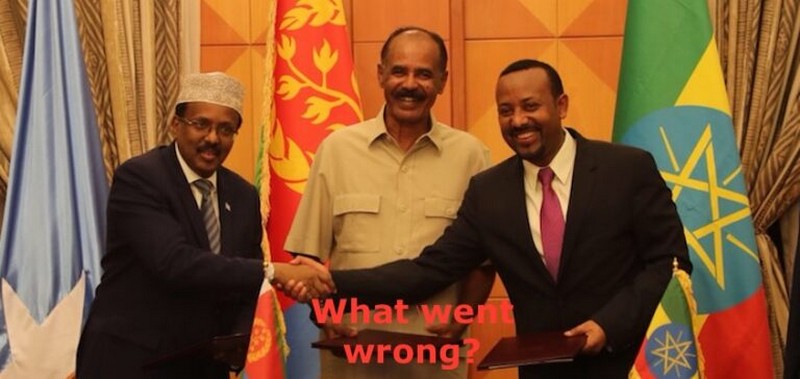
2 Oct 2024 – The Horn of Africa and its key waterways are the geostrategic interface between Europe, Africa, and Asia. They have been the site of more destructive foreign intervention and global power competition than any other region on the continent. It seemed as though consequent strife and instability might be coming to an end in 2018, when Ethiopian Prime Minister Abiy Ahmed, Eritrean President Isaias Afwerki, and then Somali President Mohamed Abdullahi Mohamed, aka Farmaajo, signed the Joint Declaration on Comprehensive Cooperation Between Ethiopia, Somalia and Eritrea , promising that the three countries would work together to promote regional peace and security. They pledged to pursue regional integration with political, social, cultural, economic, and security ties, and established a Joint High-Level Committee to coordinate their efforts.

Now, six years later, that agreement is barely remembered. Ethiopia is wracked by ethnic strife, while Somalia, Eritrea, and Egypt have lined up on one side of hostilities with Ethiopia and the secessionist Somali state of Somaliland. One media outlet after another publish the same sensational headline month after month. Will there be a regional war in the Horn of Africa?

I spoke to Eritrean American scholar, journalist, and podcaster Elias Amare about what went wrong and what the US had to do with it.

ANN GARRISON: Elias, I think we can start by assuming that US goals in the Horn are the same as they are all over the world: hegemony and control of strategic resources and geopolitical positioning. Correct?

ELIAS AMARE: 100%.

AG: And I think we can therefore assume that the US was not happy with the cooperative agreement between Ethiopia, Eritrea, and Somalia, which promised unity, prosperity, and independence from foreign powers including the US. Correct?

EA: 100%.

AG: So what then happened to dash the hopes of 2018 and what did the US have to do with it? 

EA: Hopes had risen in the Horn not only because of the regional agreement but because prior to that, Abiy and Isaias had negotiated peace, ending a decades-long border war between Ethiopia and Eritrea.

Those hopes were dashed when the Tigray People’s Liberation Front (TPLF), an ethnic regional militia, attacked the Ethiopian national army, the Ethiopian National Defense Force (ENDF), then fired rockets into Eritrea. The TPLF attacked on November 3, 2020, the same day that Joe Biden defeated Donald Trump. Such cataclysmic events often happen in Africa when the world is distracted by elections or inaugurations in the US, and in this case, the election brought the national security state actors who had long been allied with the TPLF back to power. They included humanitarian interventionists Susan Rice and Samantha Power, both of whom had been UN Ambassadors under Obama and key players during the NATO destruction of Libya.

Within a matter of hours after the TPLF attacked the ENDF, the hashtag #TigrayGenocide appeared on Twitter. Shortly thereafter Samantha Power, who had become the Administrator of the United States Agency for International Development, began warning of genocide in Tigray and Ethiopians began to fear another Libya-like military intervention to overthrow their sitting government. That intervention never materialized although the US did send a menacing troop deployment to enhance that already stationed at the US military base, Camp Lemmonier, in neighboring Djibouti.

In 2021, the US imposed sanctions on both Ethiopia and Eritrea, even excluding Eritrea from use of the SWIFT system for conducting international financial transactions, and those sanctions remain in place to this day.

In 2022, when the ENDF was close to defeating the TPLF, the US intervened to save it. PM Abiy’s agreement not to fully defeat the TPLF is not a matter of record, but it’s widely believed that Ethiopia was cash strapped by the war and greatly in need of an IMF loan. 

US Special Envoy to the Horn Mike Hammer then flew to Tigray in a US Air Force jet to pick up the TPLF’s leader and fly to Pretoria, South Africa, to negotiate peace with the Ethiopian government. The result was the Pretoria Agreement, which allowed the TPLF to live on politically. It stipulated that the TPLF should disarm, but that stipulation was never enforced.

The TPLF had waged their civil war against the Amhara people of the Amhara Region, who felt betrayed by the agreement that allowed the TPLF to live on politically. The agreement also failed to settle long-running territorial disputes between the Amhara and the Tigrayans.

The Amhara distrusted the federal government for negotiating the agreement and not including them in the negotiations. This distrust grew into armed conflict when Prime Minister Abiy set out to disarm the regional militias, beginning with the Amhara Special Forces and Fano, the irregular Amhara militia that had fought with them against the TPLF. This triggered a civil war between the Fano militia and the national army that continues to this day.

By supporting the TPLF in the Tigray War and the Pretoria Agreement, the US thus succeeded in destabilizing Ethiopia, one of the three partners in the promising regional agreement.

In 2022 the US also played a key role in engineering the electoral defeat of then Somali Prime Minister Mohammed Abdullahi Mohammed, aka Farmaajo, a beloved leader who had the widespread support of the Somali people and one of the signatories of the regional agreement. His successor, Hassan Sheikh Mohamud, weakened the alliance with Ethiopia by initiating an alliance with Egypt, which had long been at odds with Ethiopia over its share of Nile waters, which they perceive to be threatened by the Grand Ethiopian Renaissance Dam.

Then, in late 2023, as the war between the Amhara Fano militia and the Ethiopian government raged on, PM Abiy suddenly made a speech asserting that Ethiopia, a landlocked nation, had a historic right to Red Sea access and that it would seek that access militarily if it couldn’t be negotiated. This ended the trust between Ethiopia, Eritrea, and Somalia, causing Eritrea and Somalia to take a defensive posture against Ethiopia. That defensive posture became more so after Ethiopia negotiated a Memorandum of Understanding  with the breakaway Somali state of Somaliland in January 2024.

Somaliland’s independence from Somalia is not recognized by any state but Taiwan, whose own independence is recognized by only 11 of the world’s 193 UN member states. In their Memorandum of Understanding, Somaliland offered Ethiopia a large tract of seacoast to build a port and a naval base in exchange for Ethiopia’s recognition of Somaliland as an independent nation. Somalia, which has resisted Somaliland secession for 30 years, expressed outrage, formed a defensive alliance with Egypt, and invited Egyptian troops and armaments onto Somali soil. Turkey has attempted to negotiate between Ethiopia and Somalia, but it is widely perceived to be an ally of Somalia. Turkey, Egypt, and Eritrea are now helping Somalia rebuild its army, which has not recovered from state collapse in 1991.

AG: So this is where the Horn is now with nothing left of the 2018 agreement to cooperate regionally, most of all on regional peace. Tragic, no?

EA: Yes, especially after such high hopes.

AG: What role has the US seemed to play in this since the Pretoria Agreement? Have they taken either side in the hostilities between Somalia/Eritrea/Egypt and Ethiopia/Somaliland?

EA: I think we can assume that the US is always at work behind the scenes in the Horn, but it hasn’t taken an official side in the current hostilities. It has repeated that it respects Somali sovereignty and has not recognized the independence of Somaliland, although there are elements within the US foreign policy establishment, including some Congresspeople , who advocate for increased US engagement with Somaliland but stop short of calling for its recognition as an independent nation. The 2022 National Defense Authorization Act proposes increased military collaboration with Somaliland, as though it were an independent nation, but again, stops short of calling for its recognition as such. For some reason, the conservative Heritage Foundation has long called for the independence of Somaliland.

AG: What about the US posture toward the conflict between the Ethiopian government and the Amhara militia?

EA: Members of the Amhara diaspora have sought to enlist the US government on their side in their conflict with the government, as the Tigrayan diaspora did, but without success. Although the US makes statements about the need for peace, its  only clear commitment is to its longstanding ally the TPLF, even though it can no longer hope of seeing it return to power in Addis, where it ruled from 1991 to 2018.

AG: What about the role of the United Arab Emirates, a US ally?

EA: The UAE doesn’t do anything in the Horn without consent of the US and it’s playing a destructive role. It has promised billions of dollars to Abiy Ahmed to build a huge palace and tourist attraction in Addis Ababa. This project is so extravagant and in such contrast to the poverty of so many Ethiopians that it has damaged Abiy’s credibility with his own people.

The UAE has also provided Ethiopia with weapons to fight the Fano militia, but to be fair, it did the same when Ethiopia was fighting the TPLF.

In Somalia, the UAE is engaged in all kinds of machinations, most of all to control the country’s ports, but without taking a stand between Somaliland and Somalia. 

AG: So, whatever role the US may be playing now behind the scenes, its goal of undermining regional cooperation and independence in the Horn has been fully achieved.

EA: 100%.

AG: Thanks for speaking to Black Agenda Report.

EA: You’re most welcome.

_____________________________________

Ann Garrison is an independent journalist based in the San Francisco Bay Area. She attended Stanford University and is a member of the TRANSCEND Network for Peace Development Environment. In 2014 she received the Victoire Ingabire Umuhoza Democracy and Peace Prize for her reporting on conflict in the African Great Lakes region.

7 October 2024

Source: transcend.org
Need for Action

By Mazin Qumsiyeh

30 Sep 2024 – Reminder: There is an ongoing genocide in the Gaza Strip.

Maybe we need reminder of other facts showing why this matters globally and ask how we collectively can act to stop being pushed into a cataclysmic future:

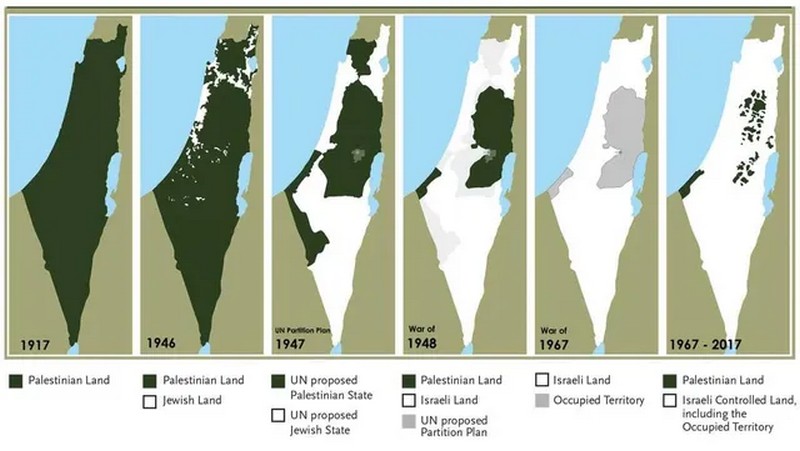
Zionism worked to forcefully transform a multi-ethnic, multi-cultural, multi-religious, and multi-lingual country called Palestine (part of the land of Canaan) to a “Jewish state of Israel”

-(Zionism partially successful): Today there are 15 million of us Palestinians, 8 million are refugees and millions live in shrinking reservations/ghettos/bantustans/concentration camps subject to the most brutal daily attacks and torture for 76 years.

-A genocide started in 1948 with 33 massacres and ethnic cleansing (Nakba) and accelerated in the past year after the Gaza ghetto uprising 7 October 2023. Over 250,000 Palestinians have been killed since 1948, over a million injured.

-Zionism started and promoted from Western Powers using a distorted image of Judaism in the same way that crusaderism used a distorted image of Christianity.

-These western powers (themselves colonial and build on the destruction of hundreds of millions of indigenous people) are supporting now one of the most dangerous colonial power in history (dangerous for all humanity, see below).

Reminder: There is an ongoing genocide in the Gaza Strip

-All colonial powers dubbed any form of local/native resistance as terrorism, barbarism, savagery, etc.

-To be honest with ourselves we must admit that hundreds of millions of people of the global south were (lethally) mistaken in assuming there was relevance to a western (read colonial) created global system that talked about International law and order while committing the most heinous crimes against humanity. Exhibit A: check US behavior at the UNSC.

-Any moral laws in Christianity, Islam, Judaism or other religions are totally meaningless to saving us when their subjects engage in committing horrors like what we saw in the past 200 years (massacres, pogroms, over 50 genocides, etc) and their co-religionists stay silent.

Reminder: There is an ongoing genocide in the Gaza Strip

-This genocide is different than say the genocide of native Americans or aborigines or others: 1) broadcast live (no one can claim they did not know, see ongaza.org for links), 2) accompanied by the largest body of lies perpetuated on (controlled) mass media and pop culture in the West/Global North, 3) originates not from one regime but from several (many under strong Zionist lobbies), 4) Perpetrated by Zionists with an superiority-inferiority complex (claim of perpetual victimhood while claiming superiority over “goyim”), 5) it accelerated in the 21st century in the era of weapons of mass destruction (hyperbaric bombs, nuclear, chemical, mass planting of explosives in common house-hold devises) and mass control (Zionist Pegasus software, control of mass media and technology etc)

-Zionism being in the active phase of colonization does not set its borders. They tell us they are expanding and they expand. Their next occupation/colonization areas being talked about is all the lands from the Nile to the Euphrates. But it goes beond that since Zionists now control education and many business is countries like the USA and the UAE (Exhibit A: watch suppression of free speech on university campuses).

Reminder: There is an ongoing genocide in the Gaza Strip

-Jewish Zionists represent at best 8 million people and Christian Zionists at best 50 million (there are 16 million Jews and 2.38 billion Christians in the world). Zionists thus represent 0.72% of the total world population. Any rational analysis shows how they drive apocalyptic fate of the world against the wishes of 99.28% of the world population (minus those who profit from militarism and the rampant capitalism system, people like Trump and Musk).

-Military spending keeps increasing especially in Western colonial powers (including “Israel”) and in their puppet regimes like “Saudi Arabia” and UAE.

-The military is the largest single contributor to pollution and climate change. Geopolitcal tension and wars also divert people attention away from sustainability issues.

-Colonial oppressive regime used and still use “divide and conquer” strategies to get poor people hating other poor people while the rich get richer (see populist right-wing rhetoric in Western countries for good examples).

-Global joint struggle can work as it did against colonial apartheid South Africa

Reminder: There is an ongoing genocide in the Gaza Strip

Whole families are daily being wiped out in the Gaza strip (and now in Lebanon) while the trends above portend a catastrophic and cataclysmic end of human civilization. People around the world are waking up (hundreds of millions were on the streets). Yet, we must organize better, get our activists better educated, and understand the nature of the evil forces that will make this planet uninhabitable if we do not stop them. The burden is on this generation to stop the rush to our extinction. In particular oppressed people around the world must unite. We are the majority as noted above. Search your city for organizers and events in this week on the anniversary of the acceleration of Genocide or organize your own activity. Let us also all redouble our efforts for boycotts, divestments, and sanctions. We are lucky to live in an era of transformation where we can make a difference and it is an existential struggle for humanity. And yes, there is a path forward 

Mazin Qumsiyeh, associate professor of genetics and director of cytogenetic services at Yale University School of Medicine, is founder and president of the Holy Land Conservation Foundation and ex-president of the Middle East Genetics Association.

7 October 2024

Source: transcend.org
Happy 75th Birthday, Dear China!

By Prof. Jan Oberg

There are many reasons to congratulate China today. This video documents just some of those reasons – among them that China has invented a new type of dynamic society based on its traditional values, lifted 700 million people out of poverty in 30 years and created a modern welfare state serving its 1400 citizens well.

In addition, China’s unique, rapid socio-economic and cultural development has benefited the world like no other country’s. Its Belt and Road Initiative, BRI, counts over 140 member countries with a perspective of a common cooperative future – win-win – for humankind.

Today, China is a thoroughly pleasant and safe society to visit. It functions extremely well and effectively for its people in big and small daily ways. Go anywhere, shoot photos as you like, meet its hospitable and helpful people – it’s easy – and enjoy cultural diversity, exquisite food and marvellous landscapes. There is a totally different real China that contrasts the Western mainstream media’s constructed image of it.

TFF and I are excited to be working with and in China since 2018. We shall stay seized with the matter and with the related world order change in the perspective of the globally desired peace through respect, knowledge, law, vision and mutually beneficial cooperation – a global Unity in Diversity.

We provide the following spaces for research and public education about China:

China And Silk” with about 200 articles, the new specialised “Xinjiang” space – much more to come – and lots of videos on TFF’s YouTube Channel. We are working on the anthology “If You Want To Understand China.” And there is more here on my personal blog and lots of art photographics works on Oberg PhotoGraphics.

Here is now a new bouquet of articles and videos from your truly independent peace research and education source with 38 years of experience in promoting true peace through research and public education:

Prof. Jan Oberg, Ph.D. is director of the independent Transnational Foundation for Peace & Future Research-TFF in Sweden and a member of the TRANSCEND Network for Peace Development Environment.

7 October 2024

Source: transcend.org
Israel’s Bloody Endgame

By Richard Falk

4 Oct 2024– This was initially published by TRT World on 30 Sep and has been modified to take account of subsequent developments in the region including the assassination of Hassan Nasrallah in Beirut and a widening onslaught against Hezbollah, while tensions mount with Iran. These developments have also affected the US relation to the conflict.

**************************************

Netanyahu’s bloody endgame seeks a future Israel with a Minimum Palestinian Presence

In the face of mounting global criticism, Israel is stepping up its military offensive in Lebanon, continuing its genocidal violence against the Palestinians and even intensifying its attacks on the Houthis in Yemen.

Israeli Prime Minister Benjamin Netanyahu holds maps as he speaks during the 79th Session of the United Nations General Assembly at the United Nations headquarters in New York City on September 27, 2024. that erase all traces of a Palestinian claim to statehood and the exercise of their right of self-determination.

Israel in the year since the Hamas-led attacks on October 7 has insisted that it is motivated only by anti-terrorist goals in its original pledge to exterminate Hamas, and more recently expanded by the commitment to destroy Hezbollah as a credible adversary, and in the process weaken its most feared adversary, Iran. Its evident incidental purpose has been to cast Hamas, Hezbollah, and Yemen’s Houthis as proxies for arch-enemy Iran, which stands accused of being the main enabler of “anti-Israeli terrorism” in the Middle East, a coalition of militias and political groups in the Middle East, most on Western lists of terrorist organization, and alleged linked to Iran, and less so Syria, as a so-called ‘axis of resistance.’

Casting new dark clouds over the observance of the grim anniversary of October 7, is the Gaza-like onslaught carried out by Israel in recent months against alleged Hezbollah targets in southern Lebanon, and extending to the Hezbollah controlled neighborhoods of south Beirut.

This latest phase of Israeli hyper-violence culminated in the deadly pager/radio attacks followed days later by the assassination of Hezbollah’s longtime leader, Hassan Nasrallah on September 27. And this was one year after the United Nations Secretary General spoke of the world “as becoming unhinged as geopolitical tensions rise.”

Amid this preoccupation with daily reports of atrocities and severe, massive civilian suffering, a question is recently being posed in reaction to the prolonged excessiveness of Israeli violence coupled with its stubborn refusal to accept the near universal call at the UN and elsewhere for a Gaza ceasefire tied to a hostage/prisoner swap deal: What is Israel’s strategic objective that is worth this much sacrifice in its global reputation as a dynamic and legitimate, if controversial, state?

And lurking behind this unnerving question is a related anxious query: does Israel have an endgame that might vindicate, at least in its eyes, this self-sacrifice along with its sullen acceptance of the criminal stigma of credible allegations of apartheid and genocide, as well as the laundry list of crimes against humanity and its crude defamation of the United Nations?

Netanyahu’s endgame

Last week, Israeli Prime Minister Benjamin Netanyahu appeared in New York to delivered an angry, arrogant speech before a UN General Assembly. Netanyahu managed to blend bitterness toward Israel’s UN critics with an Israeli vision of peace that seemed better treated as a delusional Israel victory speech.

In a diversionary attack, Netanyahu began his remarks by referring to the UN as “a swamp of anti-Semitic bile,” a racist filter through which any allegation against Israel, however perverse, could gain “an automatic majority” against what he pointed out was the world’s only Jewish-majority state “in this flat-earth society” that is the UN. An allegation that seemed to imply that Israel could do no wrong internationally, and if any serious charges were mounted against Israel, no matter how well evidenced, they would be dismissed as nothing more than another instance of antisemitic racist barbs.

AFP

Israeli Prime Minister Benjamin Netanyahu speaks during the 79th Session of the United Nations General Assembly at the United Nations headquarters in New York City on September 27, 2024.

It was in this strained atmosphere that Netanyahu chose to announce his grandiose vision of an Israeli endgame that he claimed would alone bring peace and prosperity to the region. What Netanyahu presented to the almost empty UN chamber (because many delegates left in protest of his speech) was a geopolitical package tied together with the verbiage of “the blessings of peace.”

It was essentially a manifesto in which stage one involved the destruction of Israel’s active adversaries, the proxies of Iran. It was to be followed by a stage two “historic peace agreement with Saudi Arabia” presented as a dramatic sequel to the Abraham Accords reached in the last period of Donald Trump’s presidency four years ago.

These words celebrating the emergence of “a new Middle East” were hyped by Netanyahu, who said, “what blessings such a peace with Saudi Arabia would bring.” Other than those who wanted to be fooled by such an envisioned endgame, informed persons realized it was little other than a crude example of state propaganda with little chance of happening and almost no prospect of delivering a bright, peaceful, prosperous future to the peoples of the region.

Netanyahu displayed a map of his new Middle East that assigned no presence to Palestinian statehood, even though Saudi Arabia has recently indicated that it would not establish peace with Israel until a Palestinian state existed.

Such an omission was not an oversight. The Netanyahu coalition with the far-right religious parties led by such extremists as National Security Minister Itamar Ben-Gvir and Finance Minister Bezalel Smotrich would collapse the instant any genuine commitment to Palestinian statehood was officially endorsed. It is impossible to believe that Netanyahu was unaware of this constraint, and so it seems unlikely, to put it mildly, that he expected any enthusiasm even in Washington for his vision of a peace-building endgame. The US had long hidden its Israeli partisanship behind the two-state mantra that was also a UN consensus that substituted piety for realism.

Probing Israel’s real endgame

Underneath the public relations idea of Israel’s endgame lies a worrisome reality. Even before the Netanyahu government took over at the beginning of 2023, it was evident that Israel’s political agenda was in hot pursuit of a publically undisclosed endgame that would complete the Zionist Project after a century of settler colonial striving.

This first became clear as a publicly endorsed goal when Israel’s government introduced a quasi-constitutional Basic Law in 2018. With it, Jewish supremacist rights were written into Israeli law as conferring the right of self-determination exclusively on the Jewish people, establishing Hebrew as Israel’s sole official language, and extending Israeli protective sovereignty to the occupied West Bank settlements that had been declared ‘unlawful.’

It was this legislative action by the Knesset that confirmed an Israeli endgame of a one-state solution widely known as “Greater Israel,” a formula for extending Israel’s sovereignty over the occupied West Bank and East Jerusalem in violation of international law and the UN consensus, including that of most Western countries.

Such a Basic Law cannot be changed in Israel, which lacks a written constitution, by normal legislative action, but only by a later overriding Basic Law.

When the Netanyahu coalition took over in January 2023 there were provocative signs that this 2018 Basic Law would be coercively expedited as Israel’s number-one priority. It was initially signaled by the informal, yet unmistakable, greenlighting of settler violence in the occupied West Bank with the pointed frequently articulated message to Palestinian residents: “leave or we will kill you.” This violence was tolerated by the IDF, which on some occasions joined in, without even producing a fake censure from Tel Aviv.

In September 2023, Netanyahu’s UN speech featuring a map of the region with no Palestine was reinforced by feverish diplomatic efforts to secure an Abrahamic normalization with some Arab states, further indications to establish so-called “Greater Israel”. These acts along with provocations at the Al Aqsa Mosque compound helped set the stage for the Hamas-led attack on October 7, an event itself now veiled in ambiguity that can only be removed by an international investigation.

Miscalculations on both sides

The world at first largely accepted, or at least tolerated, Israel’s version of October 7, including its retaliatory rationale given an international law cover as an exercise of the “right of self-defense”.

As further information became available, the original Israeli rationalization for its response to October 7 became problematic. It was established that the Netanyahu leadership had received several reliable warnings of an imminent Hamas attack.

After months of training including rehearsals of the Hamas attacks, it strains credulity to accept the official version that Israel’s world-class surveillance capabilities did not detect the impending attack. Further, the immediate magnitude and severity of the Israeli response raised suspicions that Israel was seeking a pretext to induce the forced evacuation of Palestinians from Gaza to be followed by their forced exit from the occupied West Bank.

These developments established a credible prelude to the formal establishment of “Greater Israel”, and the attainment of Israel’s real endgame.

In retrospect, both Hamas and Israel seem to have seriously miscalculated. Israel seems to have counted on genocidal violence producing either political surrender or cross-border evacuation, and a new wave of Palestinian refugees.

Having endured so much, it is hard to envision any kind of acquiescence by the Palestinians, however decimated by the Israeli onslaught, of an endgame that doesn’t include the establishment of a viable Palestine political future.

Israel underestimated Palestinian attachment to the land and to the indignity of being made unwanted strangers in their own homeland, even in the face of total devastation. Israelis undoubtedly anticipate the growth of hostile public opinion around the world after an initial grace period after October 7 of indulging Israeli violence, given the widely endorsed accounts of atrocities inflicted and hostages seized in the Hamas-led attack.

On its side, Hamas underestimated the ferocity of the Israeli response apparently because it conceived of its attack in normal battlefield action and reaction patterns, and not linked to a grandiose Israeli endgame scenario.

Israel’s hollow claims of victory suggest that the Netanyahu coalition is as committed as earlier to the “Greater Israel” endgame, with the enlargement of the combat zone to include Lebanon, and maybe even Syria and Iran, as parts of the Israeli endgame quietly enlarged to include what is being called ‘restored deterrence.’

Having endured so much, it is hard to envision any kind of acquiescence by the Palestinians, however decimated by the Israeli onslaught, of an endgame that doesn’t include the establishment of a viable Palestine political future. This could be either a co-existing Palestinian state with full sovereign rights or a new safeguarded one-state confederation based on absolute equality between these two peoples with respect to the totality of human rights.

In conclusion, the political conditions do not currently begin to exist for an endgame that would satisfy the minimum expectations of both peoples.

Prof. Richard Falk is a member of the TRANSCEND Network, Albert G. Milbank Professor Emeritus of International Law at Princeton University, Chair of Global Law, Faculty of Law, at Queen Mary University London, Research Associate the Orfalea Center of Global Studies at the University of California, Santa Barbara, and Fellow of the Tellus Institute.

7 October 2024

Source: transcend.org
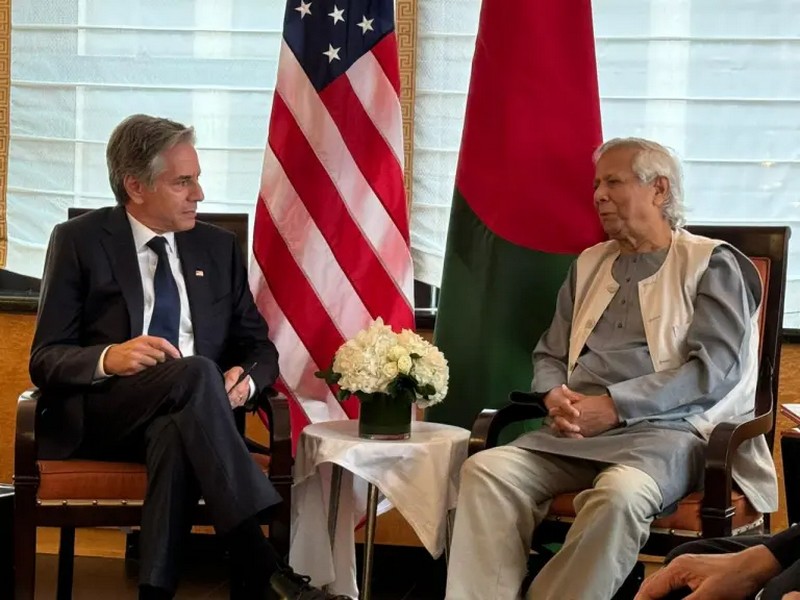
Leaked files expose covert US government plot to ‘destabilize Bangladesh’s politics’

By Kit Klarenberg And Wyatt Reed

Leaked docs reveal that prior to the toppling of Bangladeshi PM Sheikh Hasina, the US govt-funded International Republican Institute trained an army of activists including rappers and “LGBTQI people,” even hosting “transgender dance performances,” to achieve a national “power shift.” Institute staff said the activists “would cooperate with IRI to destabilize Bangladesh’s politics.”

On August 5, months of violent street protests finally toppled Bangladesh’s elected Prime Minister Sheikh Hasina. When the military seized power and announced the imposition of a so-called “interim administration,” video footage showed Hasina fleeing to India aboard a helicopter. As vast swarms of student protesters overran the presidential palace, Western media outlets and many of their progressive-leaning consumers cheered the rebellion, framing it as a decisive defeat of fascism and the restoration of democratic rule.

Hasina’s replacement, Muhammad Yunus, is a longtime Clinton Global Initiative fellow granted a Nobel Prize for pioneering the dubious practice of micro-lending. While Yunus has hailed the “meticulously-designed” protest movement that thrust him into power, Hasina personally accused Washington of working to remove her from power over her alleged refusal to allow a US military base on Bangladeshi territory. The State Department has dismissed allegations of US meddling as “laughable,” with spokesman Vedant Patel telling reporters that “any implication that the United States was involved in Sheikh Hasina’s resignation is absolutely false.”

But now, leaked documents reviewed by The Grayzone confirm the State Department was informed of efforts by the International Republican Institute (IRI) to advance an explicitly stated mission to “destabilize Bangladesh’s politics.” The documents are marked as “confidential and/or privileged.”

IRI is a Republican Party-run subsidiary of the National Endowment for Democracy, which has fueled an array of regime change operations across the globe since it was conceived in the office of CIA Director William Casey over forty years ago.

The newly-uncovered files reveal how IRI spent millions in the lead-up to Hasina’s overthrow covertly coaching opposition parties and establishing a regime change network concentrated among the country’s urban youth. Among the GOP-run Institute’s front line foot soldiers were rappers, ethnic minority leaders, LGBT activists hosting “transgender dance performances” in the presence of US embassy officials – all groomed to facilitate what the US intelligence cutout called a “power shift” in Bangladesh.

[https://twitter.com/ChiefAdviserGoB/status/1838659469523525943]

IRI offers Bangladeshi youth “the knowledge and skills to wield online… tools for change”

The origins of the protests which toppled Hasina can be traced back to 2018. That summer, thousands of young people took the streets of Dhaka to demand safer roads and stricter traffic laws after an unlicensed bus driver killed two high school students. The demonstrations grew despite heavy repression, eventually prompting the Hasina administration to impose more stringent laws on negligent driving.

Since their victory, scores of Bangladeshi students have honed their protest tactics, shutting down transit points in response to what sometimes seemed like trivial abuses. Against a backdrop of intensifying crackdowns, the opposition Bangladeshi Nationalist Party (BNP) held an escalating series of street protests, which often morphed into riots. The simmering war between student protesters and Hasina’s government reached a boiling point this August 4, when the military stepped in and seized power.

Following the coup, pundits have pointed to the role of social media in whipping up anti-government sentiment and driving havoc in the streets of Dhaka. Not coincidentally, the recently-leaked IRI files emphasize the importance of online training and message discipline in affecting political change.

IRI seeks ‘power shift’ in Bangladesh

IRI has operated in Dhaka since 2003, ostensibly “to help political parties, government officials, civil society, and marginalized groups in their advocacy for greater rights and representation.”

In reality, as the documents make abundantly clear, IRI has funded and trained a wide-ranging shadow political structure, comprising NGOs, activist groups, politicians, and even musical and visual artists, which can be deployed to stir up unrest if Bangladesh’s government refuses to act as required.

The student protests of 2018, and the overwhelming electoral victory by Hasina’s Awami League in December of that same year, appear to have inspired the IRI’s regime change aspirations. In 2019, the Institute began conducting research to inform its “baseline assessment” of the country, which consisted of “48 group interviews and 13 individual interviews with 304 key informants.” In the end, “IRI staff… identified over 170 democratic activists who would cooperate with IRI to destabilize Bangladesh’s politics,” according to an IRI report which was submitted to the State Department.

The report, which documented the IRI’s activities in the country between March 2019 and December 2020, shows the US government’s regime change campaign ramped up significantly after Hasina’s “lopsided victory.” Her administration, they declared, had become “entrenched,” and their “political position” had “solidified.”

Meanwhile, the IRI concluded that the BNP opposition had “failed to successfully mobilize” its supporters. The party’s attempts to “foment street movements” had floundered, and it remained “marginal,” leaving the Awami League’s “power… undiminished.” Nonetheless, IRI considered BNP to be “still the most possible party to drive a power shift in the future.”

The idea that this political change might be achieved via the ballot box, however, didn’t appear to be up for consideration. With BNP apparently too “violent, insular, rigid, and hierarchical” to win an election, IRI instead proposed a “broad-based social empowerment project that fostered and expanded citizen-centered, local and non-traditional forums for political engagement.” In other words, street mobilizations.

Much of the IRI’s fascination with street protests and online communication is spelled out in a separate internal report titled, “Social Media, Protest, and Reform in Bangladesh’s Digital Era,” which declared that Bangladeshi students “have again led the country’s most vibrant protest movements, with the help of a tool their predecessors didn’t have: the internet.”

“Moving forward, IRI intends to expand its work with college students across the country,” the report declared.

The document explains that Bangladeshi protesters successfully used social media to promote videos and “short documentaries” of their actions, and compel local and international media to cover the upheaval. For example, Facebook-streamed live videos of police breaking up protests “went viral and helped spread knowledge of the protests across the country.”

One of the most powerful viral moments arrived in the form of a protest anthem by Kureghor, which the IRI called “the biggest internet-based Bangladeshi music band.” IRI staff noted they actively worked “to ensure Bangladesh’s young people have the knowledge and skills to wield online and off-line tools for change,” which helped them “to extract concessions” from elected officials.

“LGBTI people” as US regime change shock troops 

The IRI also supported a variety of “socially conscious artists,” which it called “an underutilized actor” for regime change purposes. “While traditional [civil society organizations] face constant pressure, individual artists and activists are harder to suppress and can often reach a wider audience with their democratic and reformational messages,” the Institute pointed out.

But Washington’s propaganda efforts weren’t just left to individual artists. The IRI also wrote that it had identified three “marginalized communities” to serve as shock troops on wedge issues – “Biharis, plainland ethnic groups and LGBTI people.”

In total, between 2019 and 2020, “IRI issued 11 advocacy grants to artists, musicians, performers or organizations that created 225 art products addressing political and social issues,” which it claimed were “viewed nearly 400,000 times.” Additionally, the Institute bragged that it “supported three civil society organizations (CSOs) from LGBTI, Bihari and ethnic communities to train 77 activists and engage 326 citizens to develop 43 specific policy demands,” which were apparently “proposed before 65 government officials.”

Between October and December of 2020, the IRI hosted three separate “transgender dance performances” across the country. Per the report, “the goal of the performance was to build self-esteem in the transgender community and raise awareness on transgender issues among the local community and government officials.” At the final performance, in Dhaka City, the US Embassy sent its “deputy consul general and deputy director of the Office for Democracy, Rights and Governance” to participate.

Finally, the IRI also carried out “community-specific quantitative and qualitative research,” which included “three focus group reports” and what it called “the largest published survey of LGBTI people in Bangladesh.”

In sum: “IRI’s program raised public awareness on social and political issues in Bangladesh and supported the public to challenge the status quo, which ultimately aims for power shift [sic] inside Bangladesh.”

In the US, Republican Party politicians have traditionally scorned government support for visual artists, transgender dancers, and rappers. But when an opportunity to install a more US-friendly government arose, the GOP’s in-house regime change organ eagerly transformed its domestic cultural enemies into political foot soldiers.

Bangladeshi rappers on the US intelligence payroll

This July, Bangladeshi media celebrated a barrister and Bangla rap artist named Toufique Ahmed as an influential face and voice of the protest movement to topple Hasina, touting his offer of free legal support to protesters arrested during the demonstrations.

IRI documents reveal that Ahmed’s music has been directly subsidized by the US government. According to the Institute’s files, Ahmed “released the first of two music videos under IRI’s small grants program, “Tui Parish” (You Can Do It),” in 2020.

Tui Parish | Towfique | Bangla Rap

The song explicitly targeted “youth with a message of perseverance in difficult times,” while encouraging “those who are committed to strengthen democracy in Bangladesh in every possible way, including protests and street movements.” The lyrics of his second IRI-funded music video addressed “a variety of social issues in Bangladesh including rape, poverty and workers’ rights.” It was explicitly “designed to reveal social issues in Bangladesh and build up disappointment and even dissent to [the] government so as to call for social and political reforms.”

IRI was particularly proud of the fact that its Bangladesh “art program… contributed to American cultural diplomacy in Bangladesh.” By funding local hip-hop artists, “IRI promoted a uniquely American art form,” the group noted. The US has a long history of weaponizing music for soft power purposes, stretching from the CIA’s co-optation of jazz in the 1950s to USAID’s deployment of anti-communist rappers as agents against Cuba’s present-day government.

During one of the IRI’s televised cultural programs, the host “introduced rapper Towfique Ahmed’s music video with a description of rap’s origin in the US.” The Institute boasted that “this message reached over 79,000 households” across the country.

Elsewhere, IRI noted approvingly that in interviews with Bangladeshis “who attended public exhibits or watched IRI’s programs on television,” it was clear that “public consumers of the media products understood the messages of the art.” These responses were said to demonstrate that IRI had moved close to its goal “to drive [a] power shift in Bangladesh through social and political reforms” that year. Effusive praise was heaped on the “non-traditional civic actors” it had trained in the country:

“They are neither solely an artist nor solely an activist; instead, they are functioning as a hybrid agent of change [emphasis added]. While cultural activism in Bangladesh may not directly influence policy change and improve institutional behavior alone, it can certainly shape the political debate, advance social dialogue and raise more public awareness on key issues.”

IRI documents expose the BNP as unpopular, directionless

IRI’s internal documents make clear that the opposition BNP’s lack of popularity necessitated the US government’s infiltration of Bangladesh’s civil society. One IRI report suggested that without a multi-million dollar cash injection from the US regime change apparatus, the BNP would remain trapped in a cycle of “vacillation between violence, boycott and participation,” and near-total rejection by voters.

The IRI’s 2020 final report is even more explicit, noting the BNP “has also failed to successfully mobilize opposition. Since the 2018 election, the BNP political strategy has shifted between boycotting and joining elections while trying to foment street movements against the government. None of these tactics have worked. The BNP remains marginal, and the AL’s power is undiminished. However, the BNP is still the most possible party to drive [a] power shift in the future.”

The Institute wasn’t the only DC-based player involved in efforts to oust the Awami League. An IRI writeup of a September 2019 meeting with BNP leadership notes the participation of a Senior Director for Blue Star Strategies, the controversial lobbying outfit which Hunter Biden helped convince to work on behalf of now-dissolved Ukrainian energy conglomerate Burisma. “The BNP has contracted with Blue Star Strategies,” the report notes, “to manage their communications and advocacy work with US-based policymakers and other key stakeholders.”

US officials have charged that Hasina’s Awami League relied on autocratic methods like vote rigging to compensate for its lack of public support. However, one leaked file related to a secret meeting between IRI and the BNP noted that the opposition party is “a persistent critic of IRI’s public opinion research,” as the figures “consistently” show “high approval ratings for the Awami League and negative ratings for the BNP.”

Elsewhere, a document outlining IRI’s “Bangladesh Strategy 2021-22” acknowledges the BNP “faces external pressure, internal disarray, and declining popularity.” A party activist was quoted as saying BNP members and supporters were “in confusion about who is leading the party,” as it was “missing leadership.”

IRI went on to lament that the BNP “appears to be losing popularity” within an already dwindling base, and that even before COVID-19, its public rallies “were sparsely attended.” Perhaps this is why “political party strengthening” was listed first under a section of an IRI document entitled, “Priority Areas of Work for IRI.”

IRI’s Bangladesh wing would “emphasize the need for support in advance of the next general elections,” while “[steering] away from traditional pre-election activities.” More music videos and art gallery shows were on the way, apparently.

Without any sense of irony, the IRI report concluded by warning of foreign interference in Bangladesh’s internal politics: “predictably, the [Awami League] and Sheikh Hasina would seek re-election by all means under the support of India.” As if to justify its own meddling in Bangladesh, the IRI insisted it was “necessary to counterbalance interference from regional powers” in the vote, which went ahead in January 2024.

The Awami League wound up winning the election in a landslide, while the BNP boycotted the vote, despite overt State Department attempts to compel their participation.

The IRI has not responded to a request from The Grayzone for comment about its activities in Bangladesh.

Pro-US micro-loan maven, Clinton acolyte takes charge in Dhaka

Before the August 2024 coup, Hasina had complained for years about US demands to construct military facilities in the country as part of Washington’s broader Indo-Pacific Strategy of “containing” China.

Refusing to acquiesce to Washington’s pressure, Hasina remained close with India. In May 2024, just days after meeting with Donald Liu, the Assistant Secretary of State for South Asia and Central Asia, Hasina warned that a “country of white-skinned people” had demanded she allow the installation of a military base in the Bay of Bengal. She apparently declined, telling legislators: “I do not want to come to power by leasing out parts of the country or handing it over to someone else.”

Similar obstinance led to the undoing of Imran Khan, the former Prime Minister of neighboring Pakistan, who was removed from power in an April 2022 military coup backed by the US. As economist Jeffrey Sachs noted, “the very strong evidence of the US role in toppling the government of Imran Khan raises the likelihood that something similar may have occurred in Bangladesh.”

With the pesky Hasina government and her Awami League now out of the picture, Washington’s preferred political leaders have taken on the task of dividing up the country and punishing dissidents – like the 150 journalists who’ve been charged since August 4. As Dhaka descends into chaos, with roving BNP gangs engaging in street battles for control of territory, a so-called “interim government” has emerged. It has already granted sweeping police powers to the military, and while it initially claimed to seek power for just a handful of months, one report in The Guardian estimates the unelected new regime could maintain control of the country for “up to five or six years.”

[https://twitter.com/Kanthan2030/status/1840823265121677569]

Leading the new government is Muhammad Yunus. A close associate of Bill and Hillary Clinton, Yunus received a Nobel Prize in 2006 for pioneering the concept of “microlending,” a piratical form of legalized loansharking that has impoverished and immiserated swaths of the Indian subcontinent ever since.

During Hillary Clinton’s tenure as Secretary of State under Obama, Yunus was shielded from prosecution in Bangladesh for corrupt business dealings, and simultaneously showered with millions in US government contracts. Clinton also threatened Hasina’s son with an IRS audit unless the Bangladeshi leader dropped an official probe into Grameen Bank, a microlender Yunus founded. US diplomatic cables released by WikiLeaks confirm multiple covert contacts between Yunus and US officials over the years, and reveal a favorable view of the predatory lender prevailed in American halls of power.

Standing alongside Clinton at the Clinton Global Initiative this September, Yunus boasted that the seemingly spontaneous “revolution” that toppled Hasina had actually been “meticulously-designed.”

“It’s not just [that it] suddenly came, it’s not like that.” Instead, it was “very well designed, even the leadership – people don’t know who the leaders are, so you can’t catch one and say, ‘it’s over.’ It’s not over.”

Yunus is not the only new Bangladeshi leader with clear ties to Washington. In 2021, his new foreign minister, Touhid Hossain, served as a “featured guest presenter” at a USAID workshop which trained Bangladeshi reporters on “countering misinformation.”

Within hours of Hasina’s flight from the country, Bangladesh’s new leaders ordered the release of BNP leader Khaleda Zia, who was serving a 17-year prison sentence for corruption. If Yunus ultimately does decide to cede power, the BNP now appears poised to inherit leadership. That’s because, with the Awami League practically banished from Bangladeshi politics, the once-flailing BNP has become the only possible alternative.

Even establishment analysts have begun to acknowledge that the return of the BNP now appears all but inevitable. As the Crisis Group stated days after Hasina’s ouster, “If an election were to occur tomorrow, the BNP… would probably emerge victorious.”

Now, the stage is set for Dhaka’s return to the US orbit. At a September 26 business luncheon in an upscale New York hotel, Yunus signaled that the country is once again open for business, assuring the assembled foreign investors: “As the US looks for its supply-chain diversification under its Indo-China Policy, Bangladesh is strategically positioned to become a significant partner in fulfilling that goal.”

30 September 2024

Source: thegrayzone.com