Just International

US Military Base in Bangladesh at the Heart of a Revolution

By Steven Sahiounie

22 Aug 2024 – Former Bangladeshi Prime Minister, Sheikh Hasina, has a shocking accusation against the US. On August 12, while in exile in India, she told the Economic Times, “I could have remained in power if I had surrendered the sovereignty of Saint Martin Island and allowed the U.S. to hold sway over the Bay of Bengal. I beseech to the people of my land, ‘Please do not be manipulated by radicals’.”

Hasina resigned on August 5 after weeks of violent street protests by students angry at a law that awards government civil service jobs. The protests began in June 2024 after the Supreme Court reinstated a 30% quota for descendants of the freedom fighters who won the independence for the country in 1971 after fighting against Pakistan with the help of an Indian military intervention. The students felt they were facing an unfair system and would have limited opportunity for a job based on their educational qualifications, instead of ancestry.

On July 15, Dhaka University students were protesting and calling for quota reforms, when suddenly they were attacked by individuals with sticks and clubs.  Similar attacks began elsewhere and rumors circulated that it was a group affiliated with the ruling Awami League.

Some believe the group who began the violence was paid mercenaries employed by a foreign country. Street protesters who were met by a brutal crackdown were the western media description of the March 2011 uprising in Syria. However, the media failed to report that the protesters were armed and even on the first day of violence 60 Syrian police were killed. The question is in cases like Bangladesh: was this a grass-roots uprising, or a carefully staged event by outside interests?

By July 18, 32 deaths were reported, and on July 19, there were 75 deaths. The internet was shut down, and more than 300 were killed in less than 10 days, with thousands injured.

Some call the Bangladeshi uprising the ‘Gen Z revolution’, while others dub it the ‘Monsoon revolution’. But, experts are not yet united in a source of the initial violent attack on student protesters.

Hasina had won her fourth consecutive term in the January 7 elections, which the US State Department called ‘not free or fair’.  Regional powerhouses, India and China, rushed to congratulate the 76-year-old incumbent.

Hasina had held the peace in a country since 2009 while facing Radical Islamic threats. Targeting Bangladeshi Hindus was never the message or the intent of the student movement, according to some student activists.

The Jamaat-e-Islami has never won a parliamentary majority in Bangladesh’s 53-year history, but it has periodically allied with the opposition Bangladesh Nationalist Party (BNP). Jamaat, as the party is widely known, was banned on August 1, when Hasina blamed the two opposition parties for the deaths during the anti-quota protests.

Muhammad Yunus, a respected economist and Nobel Laureate, accepted the post of chief adviser in a transitional government until elections are held. He said he will seek to restore order as his first concern.

The Saint Martin Island is a stretch of land spreading across merely three square kilometers in the northeastern part of the Bay of Bengal, and is the focus of the US military who seek to increase their presence in Southeast Asia as a balance against China.

On May 28, China praised Hasina for her decision to deny permission for a foreign military base, commending it as a reflection of the Bangladeshi people’s strong national spirit and commitment to independence.

Without naming any country, Hasina had said that she was offered a hassle-free re-election in the January 7 polls if she allowed a foreign country to build an airbase inside Bangladeshi territory.

“If I allowed a certain country to build an airbase in Bangladesh, then I would have had no problem,” Hasina told The Daily Star newspaper.

Bangladesh was formerly East Pakistan, becoming a part of Pakistan in 1947, when British India was divided into Hindu-majority India and Muslim-majority Pakistan. Bangladesh was founded in 1971 after winning a war of independence. On August 15, 1975, a military coup took over, and Hasina’s father, Sheikh Mujibur Rehman, was assassinated along with most of his family members.

The US State Department, aided by the CIA, have a long history of political meddling in foreign countries. Examples are the 2003 ‘regime change’ invasion of Iraq, and in the 2011 ‘Arab Spring’ we saw the US attack Libya to overthrow the government, the US support of the ‘freedom fighters’ in Syria who were Al Qaeda terrorists, and the US manipulated election in Egypt which installed a Muslim Brotherhood member as President. The American Lila Jaafar received a 5 year prison sentence for her manipulation of the Egyptian election, but Hillary Clinton evacuated her from the US Embassy in Cairo before she could serve her prison sentence, and she is now the Director of the Peace Corps with a White House office.

The US often uses sectarian issues and strife to accomplish their goals abroad. After the Islamists in Bangladesh drove out Hasina, reports of attacks on Hindu temples and businesses circulated on mainstream Indian TV channels.

Hindus, Muslim-majority Bangladesh’s largest religious minority, comprise around 8% of the country’s nearly 170 million population. They have traditionally supported Hasina’s party, the Awami League, which put them at odds with the student rioters.

In the week after Hasina’s ouster, there were at least 200 attacks against Hindus and other religious minorities across the country, according to the Bangladesh Hindu Buddhist Christian Unity Council, a minority rights group.

The police have also sustained casualties in their ranks, proving the protesters were armed as well, and went on a weeklong strike after Hasina fled to India.

Dhaka-based Bangladesh Institute of Peace and Security Studies said they believe inclusivity and plurality are important principles as Bangladesh navigates a post-Hasina era. Those exact words: inclusivity and plurality are current ‘buzz-words’ used in Washington, DC. based political and security groups.

Hasina is credited with doing a good job balancing Bangladesh’s relations with regional powers. She had a special relationship with India, but she also increased economic and defense ties with China.

In March 2023, Hasina inaugurated a $1.21 billion China-built submarine based at Bangladesh’s Cox Bazaar off the Bay of Bengal coast.

On May 28, China praised Hasina for refusing to permit a foreign air base. Chinese Foreign Ministry spokesperson Mao Ning said, “China has noted Prime Minister Hasina’s speech, which reflects the national spirit of the Bangladeshi people to be independent and not afraid of external pressure.”

Mao said some countries seek their own selfish interests, openly trade other countries’ elections, brutally interfere in other countries’ internal affairs, undermine regional security and stability, and fully expose their hegemonic, bullying nature.

China has invested over USD 25 billion in various projects in Bangladesh, next highest after Pakistan in the South Asian region, who also steadily enhanced defense ties with Bangladesh supplying a host of military equipment, including battle tanks, naval frigates, missile boats besides fighter jets.

Indian Prime Minister Narendra Modi and Hasina had long ignored the democratic backsliding in each other’s countries to forge close ties, and bilateral trade increased with Indian corporations striking major deals

“I also congratulate the people of Bangladesh for the successful conduct of elections. We are committed to further strengthen our enduring and people-centric partnership with Bangladesh,” Modi said in a post on X in January.

Mainstream Indian news outlets, which often serve as mouthpieces for Modi’s Hindu nationalist government, have been focused on a Bangladeshi Islamist party. “What is Jamaat-e-Islami? The Pakistan-backed political party that brought down Sheikh Hasina’s govt,” read one headline. “Jamaat may take control in Bangladesh,” read another, quoting a senior member of Modi’s Bharatiya Janata Party (BJP).

Some critics claimed India “covertly” helped Hasina win the election, while others said New Delhi used its influence to tone down US and European criticisms of the Bangladeshi vote.

Modi’s Hindu nationalist BJP party came to power in 2014, and Modi’s commitment to a Hindu rashtra, or Hindu nation, while turning its back on secularism has undermined a core Indian foreign policy principle.

In 2019, the Modi government passed controversial citizenship laws that were criticized as anti-Muslim. The BJP’s strident anti-migrant rhetoric sees hardline party members often railing against Muslim “infiltrators” with Indian Home Minister Amit Shah infamously calling Bangladeshi migrants “termites” during an election rally in West Bengal.

The revolution to oust a long-serving leader, who kept the Muslim majority and the Hindu minority in a peaceful coexistence, has opened a new chapter for Bangladesh society. Will this prove to be a destabilizing period in which the Islamic party, Jamaat, holds sway over the society? Will the secular history of Bangladesh be forgotten? The final question will be, when will the new US military base be opened on Saint Martin Island?

Steven Sahiounie is a two-time  award-winning journalist and political commentator.

26 August 2024

Source: transcend.org

‘An Entire Generation Is at Risk’: Aid Agencies Warn of Mass Polio Outbreak in Gaza

By Jake Johnson

“Without an immediate cease-fire and access to vaccines and humanitarian aid across the strip, the people of Gaza are facing a public health disaster.”

20 Aug 2024 – Dozens of humanitarian aid groups and medical professionals warned Tuesday that Gaza could soon face a mass polio outbreak that would endanger children across the enclave and the region if Israel does not immediately stop its bombardment and siege of the Palestinian territory.

“Without immediate action, an entire generation is at risk of infection, and hundreds of children face paralysis by a highly communicable disease that can be prevented with a simple vaccine,” said Jeremy Stoner of Save the Children, part of a coalition of aid organizations and physicians that demanded “an immediate and sustained cease-fire to allow polio vaccinations to take place in Gaza.”

“For a polio vaccination campaign to be effective, it must be able to reach at least 95% of targeted children, and this cannot happen in an active war zone,” the coalition said. “Any cease-fire or pause requested by the U.N. must be used to facilitate full humanitarian access, not just for vaccines but for the full range of assistance needed to sustain civilians’ basic needs. All parties to conflict have an obligation to facilitate humanitarian access at all times, regardless of whether conflict is active or not.”

[https://x.com/Save_GlobalNews/status/1825899709929525608]

The groups’ call came days after Gaza health officials found the enclave’s first polio case in more than two decades after testing a 10-month-old child in Deir al-Balah—one of the cities in which Gaza’s health ministry and the World Health Organization detected polio virus in wastewater last month.

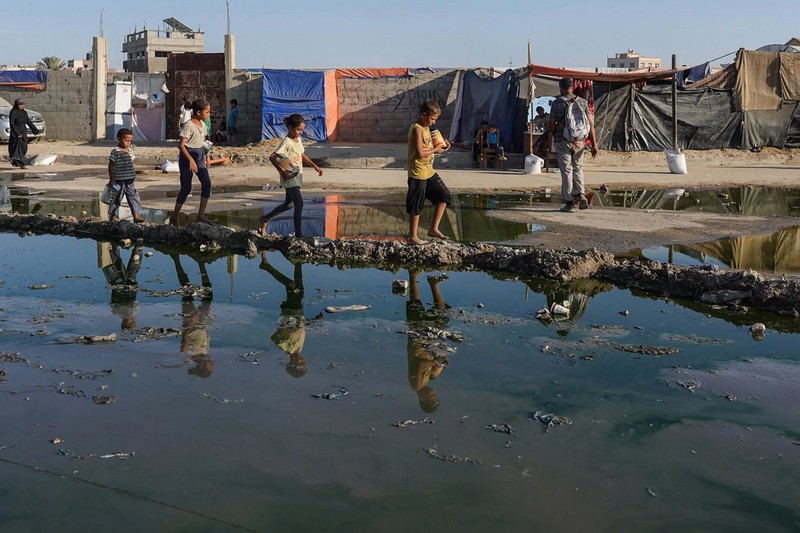
Much of Gaza’s population currently lives in makeshift tents surrounded by rotting garbage and other waste, unsanitary conditions that heighten the risk of infectious disease outbreaks. Israel’s relentless U.S.-backed bombardment of Gaza has decimated the territory’s waste-removal infrastructure and healthcare system, laying the groundwork for a public health catastrophe.

Nahed Abu Iyada, the health program field officer at CARE West Bank and Gaza, said Tuesday that “without an immediate cease-fire and access to vaccines and humanitarian aid across the Strip, the people of Gaza are facing a public health disaster that will spread and endanger children across the region and beyond.”

But the prospects of an imminent cease-fire agreement appeared remote Tuesday as Hamas accused the Biden administration of “buying time for Israel to continue its genocide” by pushing for a deal that grants some of far-right Israeli Prime Minister Benjamin Netanyahu’s major demands.

The New York Times reported that “under the new U.S. proposal, Israeli troops would be able to continue to patrol part of the Gazan border with Egypt, albeit in reduced numbers—one of Mr. Netanyahu’s core demands.”

Hamas has said that “any agreement must guarantee the cessation of aggression against our people, withdrawal from the Gaza Strip, provision of urgent relief in the form of food and medicine, and reaching a real deal to exchange prisoners.”

Jake Johnson is a staff writer for Common Dreams.

26 August 2024

Source: transcend.org

Sudan Peace Agreement: Still a Long Way to Go

By René Wadlow

22 Aug 2024 – U.S.-sponsored talks began in Geneva on 19 Aug 2024 to address the ongoing conflict in Sudan, which has been devastating the country for more than 16 months.  Switzerland is co-host of the effort, but the U.S. has taken the lead. The representatives of the Regular Sudanese Army are not participating in the talks, so little progress is expected.

The civil war has gone on since April 2023 between the Rapid Support Forces led by General Mohamed Hamdan, known by his battle name of Hemedti, and the Sudanese Armed Forces led by General Abdul Fattah al-Burham. The fighting has led to some 15,000 persons being killed and 8 million displaced. The agriculture in the country is disorganized, and many people face acute hunger and, in some areas, famine.

Each of the two generals has created local militias which rob, torture, rape, and create conditions of disorder. Many of the militias use child soldiers in violation of UN treaties on the protection of children. Each of the two generals has opened the door to foreign fighters. There are Russian mercenaries which had been under the control of the Russian Wagner Group who had been fighting in Mali, Chad, Niger, and the Central African Republic. There are Ukrainian mercenaries who have come to fight the Russians.

It is difficult to understand the intensity of the current divisions represented by the two generals who had once been allies. The current divisions do not follow earlier fault lines in Sudan.

The Association of World Citizens has appealed for a ceasefire and the provisions for humanitarian assistance as there is an urgent need for food, medicine and health services.

At this stage it is difficult to know what outside parties might have an influence. We have to keep searching what can be done.

René Wadlow is a member of the TRANSCEND Network for Peace Development Environment

26 August 2024

Source: transcend.org

Why Russia Saved the United States: The Forgotten History of a Brotherhood

By Cynthia Chung

The Arctic: Theater of War or Global Cooperation? A Canadian Patriot Film

Whenever the government of the United States shall break up, it will probably be in consequence of a false direction having been given to public opinion. This is the weak point of our defences, and the part to which the enemies of the system will direct all their attacks. Opinion can be so perverted as to cause the false to seem true; the enemy, a friend, and the friend, an enemy; the best interests of the nation to appear insignificant, and trifles of moment; in a word, the right the wrong, and the wrong, the right. In a country where opinion has sway, to seize upon it, is to seize upon power. As it is a rule of humanity that the upright and well-intentioned are comparatively passive, while the designing, dishonest and selfish are the most untiring in their efforts, the danger of public opinion’s getting a false direction is four-fold, since few men think for themselves.

– James Fenimore Cooper (The American Democrat, 1838)

I think it is evident to most by now that the United States is presently undergoing a crisis that could become a full-blown second civil war.

Some might be wondering, is it really so bad that the United States could possibly collapse in the not-so-distant future? After all, isn’t it acting like the worst of empires? Isn’t it wreaking havoc on the world today? Is it not a good thing that it collapses internally and spares the world from further wars?

It is true that the United States is presently acting more like a terrible empire than a republic based on liberty and freedom. It may even be the case that the world is spared for a time from further war and tyranny, if the United States were to collapse. However, this is unlikely and it most certainly would be only temporary, since the U.S. is not the source of such monstrosities but rather is merely its instrument.

This paper will not only go through why this is the case but will also analyze Russia’s historical relationship to the United States in context to its recognition of this very fact.

The Great Liberators

In 1861, the Emancipation Edict was passed and successfully carried out by Czar Alexander II that would result in the freeing of over 23 million serfs. This was by no means a simple task and met much resistance, requiring an amazing degree of statesmanship to see it through. In a speech made by Czar Alexander II to the Marshalls of Nobility in 1856 he stated:

“You can yourself understand that the present order of owning souls cannot remain unchanged. It is better to abolish serfdom from above, than to wait for that time when it starts to abolish itself from below. I ask you to think about the best way to carry this out.”

The success of this edict would go down in history as one of the greatest accomplishments for human freedom and Czar Alexander II became known as the ‘Great Liberator’, for which he was beloved around the world.

Shortly after, in 1863, President Lincoln would pass the Emancipation Proclamation which declared “that all persons held as slaves” within the rebellious states “are, and henceforward shall be free.” There is astonishingly a great deal of cynicism surrounding this today. It is thought that because Lincoln did not announce this at the beginning of the war it somehow was never genuine. However, Lincoln was always for the abolishment of slavery and the reason for his delay was due to the country being so at odds with itself that it was willing to break into pieces over the subject, an intent that Lincoln rightfully opposed and had to navigate through.

Former slave and Lincoln ally, Frederick Douglass, though himself frustrated with the delay to equal rights, understood after meeting and discussing his concerns with Lincoln that the preservation of the country came first, stating:

“It was a great thing to achieve American independence when we numbered three millions [slaves], but it was a greater thing to save this country from dismemberment and ruin when it numbered thirty millions. He alone of all our presidents was to have the opportunity to destroy slavery, and to lift into manhood millions of his countrymen hitherto held as chattels and numbered with the beasts of the field.”

For more on the Lincoln-Douglass story refer to my paper.

In addition, there are many speeches Lincoln gave while he was a lawyer, where he most clearly and transparently spoke out against slavery. In a speech at Peoria, Illinois (Oct 16, 1854), 7 years before he would become president, Lincoln stated:

“This declared indifference, but as I must think, covert real zeal for the spread of slavery, I cannot but hate. I hate it because of the monstrous injustice of slavery itself. I hate it because it deprives our republican example of its just influence in the world—enables the enemies of free institutions, with plausibility, to taunt us as hypocrites—causes the real friends of freedom to doubt our sincerity, and especially because it forces so many really good men among ourselves into an open war with the very fundamental principle of civil liberty—criticizing the Declaration of Independence and insisting that there is no right principle of action but self-interest.”

During the civil war lord Robert Cecil (later called the Marquess of Salisbury and three-time Prime Minister of Britain) expressed his viewpoint on the matter in the British Parliament:

The Northern States of America never can be our sure friends because we are rivals, rivals politically, rivals commercially…With the Southern States, the case is entirely reversed. The population are an agricultural people. They furnish the raw material of our industry, and they consume the products which we manufacture from it. With them, every interest must lead us to cultivate friendly relations, and when the war began they at once recurred to England as their natural ally.” [emphasis added]

By 1840, cotton made up more than half of American exports. More than 75% of slave cotton was exported to Britain. American slave cotton was the centerpiece of the British Empire’s world cheap-labor system.

The autumn of 1862 would mark the first critical phase of the Civil War. Lincoln sent an urgent letter to the Russian Foreign Minister Gorchakov, informing him that France was ready to intervene militarily and was awaiting England. The salvation of the Union thus rested solely on Russia’s decision to act.

The Foreign Minister Gorchakov wrote in response to Lincoln’s plea:

“You know that the government of United States has few friends among the Powers. England rejoices over what is happening to you; she longs and prays for your overthrow. France is less actively hostile; her interests would be less affected by the result; but she is not unwilling to see it. She is not your friend. Your situation is getting worse and worse. The chances of preserving the Union are growing more desperate. Can nothing be done to stop this dreadful war? The hope of reunion is growing less and less, and I wish to impress upon your government that the separation, which I fear must come, will be considered by Russia as one of the greatest misfortunes. Russia alone, has stood by you from the first, and will continue to stand by you. We are very, very anxious that some means should be adopted–that any course should be pursued–which will prevent the division which now seems inevitable. One separation will be followed by another; you will break into fragments.”

Russia’s proclaimed support in its letters to Lincoln would be put to the test during the summer of 1863. By then, the South’s invasion of the North had failed at Gettysburg and the violent anti-war New York draft riots also failed and Britain, as a result, was thinking of a direct military intervention with the backing of France. What would follow marks one of the greatest displays of support for another country’s sovereignty to ever occur in modern history.

The Russian Navy arrived on both the east and west coastlines of the United States late September and early October 1863.

The timing was highly coordinated due to intelligence reports of when Britain and France were intending their military action. The Russian navy would stay along the US coastline in support of the Union for 7 months! They never intervened in the American civil war but rather remained in its waters at the behest of Lincoln in the case of a foreign power’s interference.

If Russia had not done this, Britain and France would most certainly have intervened on behalf of the Confederate states as they made clear they would, and the United States would have most certainly broken in two at that point. It was Russia’s direct naval support that allowed the United States to remain whole.

Czar Alexander II, who held sole power to declare war for Russia, stated in an interview to the American banker Wharton Barker on Aug. 17, 1879 (Published in The Independent March 24, 1904):

“In the Autumn of 1862, the governments of France and Great Britain proposed to Russia, in a formal but not in an official way, the joint recognition by European powers of the independence of the Confederate States of America. My immediate answer was: `I will not cooperate in such action; and I will not acquiesce. On the contrary, I shall accept the recognition of the independence of the Confederate States by France and Great Britain as a casus belli for Russia. And in order that the governments of France and Great Britain may understand that this is no idle threat; I will send a Pacific fleet to San Francisco and an Atlantic fleet to New York.

…All this I did because of love for my own dear Russia, rather than for love of the American Republic. I acted thus because I understood that Russia would have a more serious task to perform if the American Republic, with advanced industrial development were broken up and Great Britain should be left in control of most branches of modern industrial development.” [emphasis added]

What was Czar Alexander II referring to exactly when mentioning the advanced industrial development of the American Republic? Well, in short he was referring to the Hamiltonian system of economics. Notably, Alexander Hamilton’s 1791 Report on the Usefulness of the Manufactories in Relation to Trade and Agriculture which was published in St. Petersburg in 1807, sponsored by Russian Minister of Finance D.A. Guryev.

It was Hamilton who pioneered a new system of political economy coming out of the war of Independence which saw America bankrupt, undeveloped, and agrarian. Hamilton solved this problem by federalizing the state debts and converting it into productive credit, channelled by national banks into large scale internal improvements with a focus on the growth of manufacturing. Anyone wishing to learn more about this should read Anton Chaitkin’s recent publication Who We Are: America’s Fight for Universal Progress.

In the introduction to the translated Hamilton pamphlet, Russian educator V. Malinovsky wrote:

The similarity of American United Provinces with Russia appears both in the expanse of the land, climate and natural conditions, in the size of population disproportionate to the space, and in the general youthfulness of various generally useful institutions; therefore all the rules, remarks and means proposed here are suitable for our country.”

This “American system” was what Tsar Alexander II recognised as the only economic system to have successfully challenged the system of empire, which he recognized as the root of all slavery. The ineffective and ultimately costly labour of slaves was no match for competing against a machine tool industry to which Frederick Douglass attested. The construction of rail that was made possible through the development of this machine tool industry is what freed countries from Britain’s maritime supremacy.

The “American System”

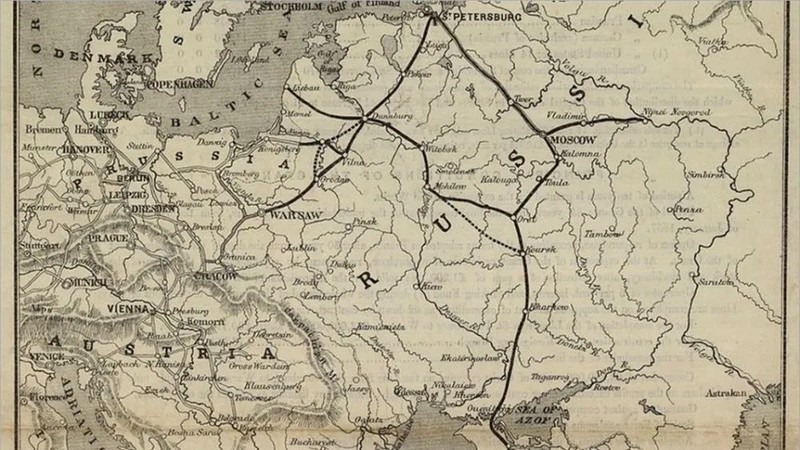
In 1842, Czar Nicholas I hired American engineer George Washington Whistler to oversee the building of the Saint Petersburg-Moscow Railway, Russia’s first large-scale railroad. In the 1860s, Henry C. Carey’s economics would be promoted in St. Petersburg’s university education, organised by US Ambassador to Russia Cassius Clay. Carey was a leading economic advisor to Lincoln and leading Hamiltonian of his age.

Sergei Witte, who worked as Russian Minister of Finance from 1889-1891 and later became Prime Minister in 1905, would publish in 1889 the incredibly influential paper titled “National Savings and Friedrich List” which resulted in a new customs law for Russia in 1891 and resulted in an exponential growth increase in Russia’s economy. Friedrich List publicly attributed his influence in economics to Alexander Hamilton.

Lincoln’s Pacific Railroad superintendent, General Grenville Dodge, advised Russia on its Trans-Siberia railroad, built with Pennsylvania steel and locomotives from 1890-1905.

In his 1890 budget report, Sergei Witte- echoing the Belt and Road Initiative unfolding today, wrote:

“The railroad is like a leaven, which creates a cultural fermentation among the population. Even if it passed through an absolutely wild people along its way, it would raise them in a short time to the level requisite for its operation.”

Sergei Witte was explicit of his following of the American model of political economy when he described his re-organization of the Russian railways saying:

“Faced by a serious shortage of locomotives, I invented and applied the traffic system which had long been in practice in the United States and which is now known as the “American system.”

By 1906, Czar Nicholas II of Russia supported the plan for the American-Russian Bering Strait tunnel, officially approving a team of American engineers to conduct a feasibility study.

Russia would complete the trans-Siberian railway in 1905 under the leadership of “American System” follower Count Sergei Witte. On its maiden voyage the Trans-Siberian rail saw Philadelphia-made train cars run across the Russian heartland, and it is no accident that all of the key players involved in the Alaska purchase were also involved in the Russian continental rail program on both sides of the ocean.

Bismarck’s Zollverein

In 1876 Henry C. Carey organized the centennial exhibition where 10 million people from 37 countries came to Philadelphia to see the achievements of the United States in its advancements in machine tool industry, which propelled their economy to the first in the world.

Only three years later, Otto von Bismarck broke Germany’s free trade system implementing an American style tariff policy for his nation. The kinship between Germany and the United States became so strong at this time that Otto von Bismarck’s speech in the parliament (1879) was quoted by McKinley on the floor in US Congress:

“A success of the United States in material development is the most illustrious of modern time. The American nation has not only successfully born and suppressed the most gigantic and expensive war of all history, but immediately afterward disbanded its army, found employment for all its soldiers and marines, paid off most of its debt, given labour and homes to all the unemployed in Europe as fast as they could arrive within its territory and still by a system of taxation so indirect as not to be perceived, much less felt… Because it is my deliberate judgement that the prosperity of America is mainly due to its protective laws, I urge that Germany has now reached that point, where it is necessary to imitate the tariff system of the United States.”

Otto von Bismarck was heavily organising for the building of the Berlin to Baghdad railway, which after much resistance and delay would only be completed in 1940. If this has been accomplished during Otto von Bismarck’s life, the Middle East could have avoided the Sykes Picot carving up.

In 1869, Japanese modernizers working directly with the Lincoln-Carey strategists ran the Meiji Restoration which industrialized Japan.

In the 1880s and 90s, Lincoln-Carey Philadelphia industrialists were contracted for huge infrastructure and nation-building projects in China. Hawaiian Christian missionary Frank Damon, having participated in the Carey group’s strategies at a very high level, helped instigate, shape, and build the Sun Yat-sen organization that gave birth to modern China.

Sun Yat-sen referred to his admiration of Lincoln’s USA as the basis for a new multipolar system saying:

“The world has been greatly benefited by the development of America as an industrial and a commercial Nation. So a developed China with her four hundred millions of population, will be another New World in the economic sense. The nations which will take part in this development will reap immense advantages. Furthermore, international cooperation of this kind cannot but help to strengthen the Brotherhood of Man.”

How Did We End Up Where We Are Today?

With such a glorious outlay of cooperation and common interests across the globe united against an economic system of empire, it begs the obvious question “What went wrong? How did we end up where we are today?”

To give one a quick glimpse into the reason why, let us look at some of the major assassinations and soft-coups from the late 19th century and early 20th century of American system proponents (refer to the image below).

Henry C. Carey stated it best when he described the situation as such, in his “Harmony of Interests” (1851):

“Two systems are before the world; the one looks to increasing the proportion of persons and of capital engaged in trade and transportation, and therefore to diminishing the proportion engaged in producing commodities with which to trade, with necessarily diminished return to the labor of all; while the other looks to increasing the proportion engaged in the work of production, and diminishing that engaged in trade and transportation, with increased return to all, giving to the laborer good wages, and to the owner of capital good profits… One looks to pauperism, ignorance, depopulation, and barbarism; the other in increasing wealth, comfort, intelligence, combination of action, and civilization. One looks towards universal war; the other towards universal peace. One is the English system; the other we may be proud to call the American system, for it is the only one ever devised the tendency of which was that of elevating while equalizing the condition of man throughout the world.”

We have yet to conclude the victor between these two opposing systems, the fight is not over and we would be foolish to give up at the finishing line. What we do today will decide the course of things in the future, and whether we live under a true recognition of freedom and prosperity, or whether we are ruled-over and our liberties treated as “privilege,” that can be given or taken based on the judgement of a ruling class, remains to be seen.

Thus, let us hearken to the words of Lincoln, who in a debate with the slave power’s champion Stephen Douglas, said:

“That is the issue that will continue in this country when these poor tongues of Judge Douglas and myself shall be silent. It is the eternal struggle between these two principles – right and wrong – throughout the world. They are the two principles that have stood face to face from the beginning of time, and will ever continue to struggle. The one is the common right of humanity and the other the divine right of kings.”

For a more detailed overview of this history watch my lecture linked below:

WHY Russia Saved the United States: The Forgotten History of a Brotherhood

10 Dec 2022

Cynthia Chung is Editor-in-Chief and co-founder of the Rising Tide Foundation and a member of the TRANSCEND Network for Peace Development Environment.

26 August 2024

Source: transcend.org

Neruda’s Beautiful, Humanistic Nobel Literature Prize Acceptance Speech

By Maria Popova

Against the Illusion of Separateness

“There is no insurmountable solitude. All paths lead to the same goal: to convey to others what we are. And we must pass through solitude and difficulty, isolation and silence in order to reach forth to the enchanted place where we can dance our clumsy dance…”

The great Chilean poet and diplomat Pablo Neruda (July 12, 1904–September 23, 1973) was only a small boy, just over the cusp of preconscious memory, when he had a revelation about why we make art. It seeded in him a lifelong devotion to literature as a supreme tool that “widens out the boundaries of our being, and unites all living things.”

Although his father discouraged his precocious literary aspirations, the young Neruda found a creative lifeline in the poet, educator, and diplomat Gabriela Mistral — the director of his hometown school. Mistral — who would later become the first Latin American woman awarded the Nobel Prize in Literature and Chilean consul in Madrid, a post in which Neruda would succeed her during his own diplomatic career — recognized and nurtured the boy’s uncommon talent. Fittingly, Neruda’s first published piece, written when he was only thirteen and printed in a local daily newspaper, was an essay titled “Enthusiasm and Perseverance.”

These twin threads ran through the length of his life, from his devoted diplomatic career to his soulful, sorrowful, yet buoyant poetry. His landmark collection Twenty Love Poems and a Song of Despair, composed before he turned twenty, is to this day the most widely read book of verse in Latin literature and contains some of the truest, most beautiful insight into the life of the heart humanity has ever committed to words.

By the time he was awarded the Nobel Prize in Literature less than two years before his death, Neruda had become an icon. Gabriel García Márquez, whose own subsequent Nobel Prize acceptance speech echoed Neruda’s humanistic ideals, considered him “the greatest poet of the twentieth century in any language.”

On December 13, 1971, Neruda took the podium in Stockholm to deliver an extraordinary acceptance speech, later included in Nobel Lectures in Literature, 1968–1980 (public library). He begins with a lyrical, almost cinematic recollection of his 1948 escape to Argentina through a mountain pass when Chile’s dictatorial government issued an order for his arrest on account of his extreme leftist politics — a long, trying journey which embodied for the poet “the necessary components for the making of the poem.” He recounts:

Down there on those vast expanses in my native country, where I was taken by events which have already fallen into oblivion, one has to cross, and I was compelled to cross, the Andes to find the frontier of my country with Argentina. Great forests make these inaccessible areas like a tunnel through which our journey was secret and forbidden, with only the faintest signs to show us the way. There were no tracks and no paths, and I and my four companions, riding on horseback, pressed forward on our tortuous way, avoiding the obstacles set by huge trees, impassable rivers, immense cliffs and desolate expanses of snow, blindly seeking the quarter in which my own liberty lay. Those who were with me knew how to make their way forward between the dense leaves of the forest, but to feel safer they marked their route by slashing with their machetes here and there in the bark of the great trees, leaving tracks which they would follow back when they had left me alone with my destiny.

Each of us made his way forward filled with this limitless solitude, with the green and white silence of trees and huge trailing plants and layers of soil laid down over centuries, among half-fallen tree trunks which suddenly appeared as fresh obstacles to bar our progress. We were in a dazzling and secret world of nature which at the same time was a growing menace of cold, snow and persecution. Everything became one: the solitude, the danger, the silence, and the urgency of my mission.

Through this dangerous and harrowing journey, Neruda arrived at “an insight which the poet must learn through other people” — a profound understanding of the interconnectedness of each life with every other, echoing his childhood revelation about the purpose of art. In consonance with the Lebanese-American poet and painter Kahlil Gibran’s insight into why we create, Neruda writes:

There is no insurmountable solitude. All paths lead to the same goal: to convey to others what we are. And we must pass through solitude and difficulty, isolation and silence in order to reach forth to the enchanted place where we can dance our clumsy dance and sing our sorrowful song — but in this dance or in this song there are fulfilled the most ancient rites of our conscience in the awareness of being human and of believing in a common destiny.

Echoing physicist Freeman Dyson’s meditation on how our self-expatriation from history makes for a deep loneliness, Neruda adds:

Our original guiding stars are struggle and hope. But there is no such thing as a lone struggle, no such thing as a lone hope. In every human being are combined the most distant epochs, passivity, mistakes, sufferings, the pressing urgencies of our own time, the pace of history.

He concludes with a vision for what it would take to let go of our damaging illusion of separateness and inhabit our shared humanity:

It is today exactly one hundred years since an unhappy and brilliant poet, the most awesome of all despairing souls, wrote down this prophecy: “A l’aurore, armés d’une ardente patience, nous entrerons aux splendides Villes.” “In the dawn, armed with a burning patience, we shall enter the splendid Cities.”

I believe in this prophecy of Rimbaud, the Visionary. I come from a dark region, from a land separated from all others by the steep contours of its geography. I was the most forlorn of poets and my poetry was provincial, oppressed and rainy. But always I had put my trust in man. I never lost hope. It is perhaps because of this that I have reached as far as I now have with my poetry and also with my banner.

Lastly, I wish to say to the people of good will, to the workers, to the poets, that the whole future has been expressed in this line by Rimbaud: only with a burning patience can we conquer the splendid City which will give light, justice and dignity to all mankind.

In this way the song will not have been sung in vain.

****

Complement with Neruda’s beautiful ode to silence and this lovely picture-book about his life, then revisit other timeless Nobel Prize acceptance speeches from great writers: Toni Morrison (the first black woman awarded the accolade) on the power of language, Bertrand Russell on the four desires driving all human behavior, Pearl S. Buck (the youngest woman to receive the Nobel Prize in literature) on writing and the nature of creativity, and Saul Bellow on how art ennobles us.

_______________________________________

My name is Maria Popova — a reader, a wonderer, and a lover of reality who makes sense of the world and herself through the essential inner dialogue that is the act of writing.

26 August 2024

Source: transcend.org

Yemen: Acute malnutrition, looming famine in govt-controlled areas requires immediate intervention to save lives of children under five

By Euro-Med Human Rights Monitor

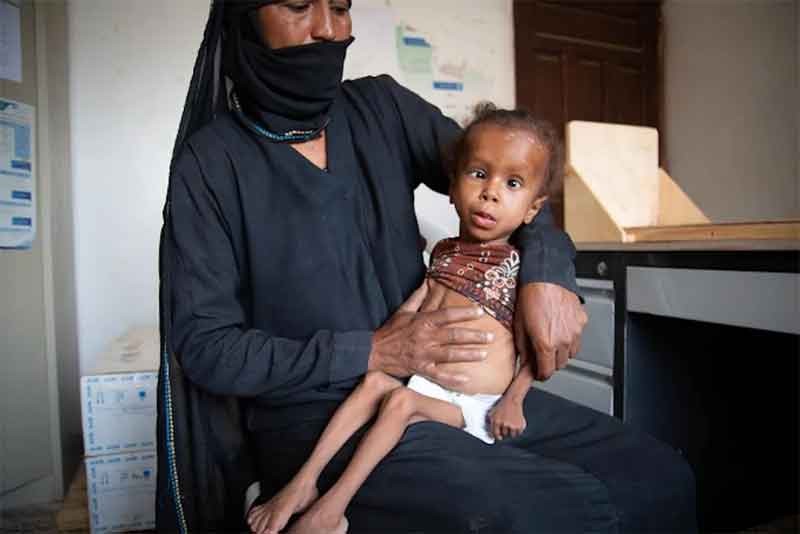
Geneva – Yemen is facing a nutrition emergency of catastrophic proportions, with three districts plunged into severe crisis and four more teetering on the edge of famine. This escalating disaster demands immediate global action and unwavering humanitarian support to avert further tragedy and safeguard countless lives.

While many countries face food insecurity and shortages, famine is only declared by the United Nations when certain conditions are met, using a scale known as the Integrated Food Security Phase Classification (IPC). A famine classification is the highest on the IPC scale, and is declared in an area where at least 20% of the population faces extreme food shortages, acute malnutrition rates exceed 30%, and two out of 1,000 people die from starvation on a daily basis.

For the first time, this level has been reported in Yemen by UN experts in three districts. A report published by the UN’s Integrated Food Security Phase Classification (IPC) Technical Group in Yemen, covering only areas under government control, found that two districts in Hodeidah Southern lowland and one in Taiz lowland (Makha) falls within Phase 5, which is considered the worst phase of the IPC, and four other districts—Mawza and Al Makha in Taiz lowland, and Hays and Al Khawkhah in Hodeidah lowland—are expected to follow by October 2024.

Yemen’s food crisis is a man-made result of the war there, with the most critical cases emerging along the war-torn country’s Red Sea coast. The protracted and devastating conflict that began in March 2015 continues to destroy Yemen, already one of the poorest countries in the Arabian Peninsula and the Middle East and North Africa (MENA) region.

War ruins lives, uproots communities, and wrecks food systems, making it the primary cause of hunger in Yemen. In almost a decade, the conflict and its proxy war have killed more than 150,000 people there, caused economic collapse, and produced one of the world’s worst humanitarian crises.

Today, 21.6 million Yemenis—two-thirds of Yemen’s population—don’t know where their next meal is coming from, and more than 80% of Yemenis live below the poverty line.

As per the IPC report, malnutrition rates in Yemen have significantly worsened due to a combination of drivers, including a lack of drinking water, a shortage of nutritious food, the spread of diseases such as cholera and measles, and broader economic downturn.

The number of acutely malnourished children in the country has increased by 34% compared with last year, including more than 18,500 children under the age of five who are projected to be severely malnourished within the coming months.

Women and girls suffer disproportionately from food insecurity and malnutrition, and coping mechanisms are becoming increasingly desperate. Women eat last and least, giving priority to children and other relatives or using money for other household needs. Around 223,000 pregnant and lactating women are expected to be malnourished by the end of this year. In addition, early marriage has increased since the escalation of the conflict, and girls as young as eight years old are being married off to reduce the number of family members to feed, or as a source of income in order to feed the rest of the family and pay off debts.

Beyond the four districts projected to slip into famine, according to the IPC report, all 117 districts in government-controlled areas are expected to suffer from “serious” levels of acute malnutrition by October 2024.

About half of the country’s population—or 18.2 million people—is in need of humanitarian aid this year, even those hundreds of miles from the front line, because Yemen is critically dependent on imports, humanitarian funding, and incomes that have been knowingly undermined by parties to the conflict.

Euro-Med Human Rights Monitor emphasises the urgent need for the international community to work towards securing an end to this crisis and an inclusive peace in Yemen, stressing the crucial importance of increased humanitarian support and intervention to mitigate the impacts of the famine and acute malnutrition, especially on the lives of vulnerable individuals like pregnant women and children. Euro-Med Monitor also calls on the parties to the conflict to address the health and nutrition emergencies in Yemen and ensure access to sufficient nutritious food and safe drinking water; and notes that this will require the international community to unlock financial commitments and implement political solutions to safeguard the country’s food security and the overall future of Yemen’s population, revitalize the shrinking economy, and pave the way for peace.

Euro-Med Human Rights Monitor is a Geneva-based independent organization with regional offices across the MENA region and Europe

28 August 2024

Source: countercurrents.org

The Black Book

By Vikas Parashram Meshram

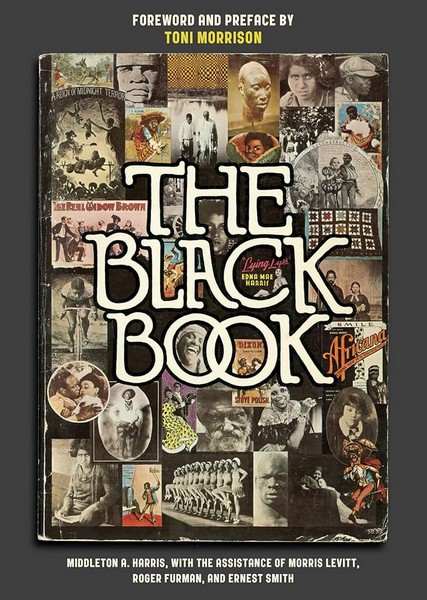
Published in 1974, The Black Book is not just an anthology or a historical document; it is a profound and multifaceted cultural artefact that encapsulates the African American experience from the dawn of slavery in America to the vibrant mid-20th century. Edited by Toni Morrison while she was an editor at Random House, The Black Book is a groundbreaking work that defies easy categorization. It is a scrapbook, a compilation of historical documents, and an exploration of Black culture, history, and identity. The book offers a unique approach to understanding African American history by presenting it through a collage of materials that speak to the resilience, creativity, and struggle of Black people in America.

A Mosaic of African American Life The Black Book is structured not as a linear narrative but as a mosaic, an assemblage of various artifacts that collectively tell a story. The book includes a wide array of materials: photographs, newspaper clippings, advertisements, patent records, slave auction notices, sheet music, recipes, and literary excerpts. This eclectic mix allows the reader to engage with history in a non-traditional way, moving away from the often sanitized or academic accounts of African American history and towards a more visceral, lived experience of the past.

The non-linear structure of The Black Book is one of its most striking features. Rather than guiding the reader through a chronological timeline, the book invites them to make connections between disparate events, individuals, and cultural practices. This structure reflects the complexity of African American history, which cannot be neatly contained within a single narrative. Instead, it is a history of multiple voices, perspectives, and experiences, each contributing to the rich tapestry of Black life in America.

Documenting the Horror and Humanity of Slavery One of the most powerful sections of The Black Book deals with the history of slavery. The book presents a raw and unfiltered look at this dark chapter in American history, including advertisements for runaway slaves, illustrations of slave ships, and legal documents pertaining to the buying and selling of human beings. These artifacts serve as a stark reminder of the brutality of slavery, forcing the reader to confront the dehumanization that African Americans endured.

However, The Black Book does not reduce African American history to a narrative of victimhood. While it acknowledges the horror of slavery, it also highlights the resilience and humanity of the enslaved. For instance, the book includes slave narratives, which provide a first-person account of the experiences of those who lived through this harrowing period. These narratives are crucial in humanizing the enslaved, showing them not just as victims, but as individuals with thoughts, feelings, and a will to survive.

The inclusion of these narratives also serves a broader purpose: it challenges the dominant historical narrative that often marginalizes or ignores the voices of the oppressed. By including these firsthand accounts, The Black Book ensures that the voices of African Americans are not erased from history, but instead are given the prominence they deserve.

Innovation and Creativity in the Face of Oppression While The Black Book documents the suffering endured by African Americans, it also celebrates their creativity and ingenuity. The book includes patents granted to Black inventors, highlighting the often-overlooked contributions of African Americans to American science and industry. These inventors, who operated in a society that systematically denied them opportunities, nonetheless made significant advancements in fields such as agriculture, engineering, and medicine.

One of the most famous examples included in The Black Book is the invention of the gas mask by Garrett Morgan, an African American inventor who made crucial contributions to public safety. By showcasing these achievements, The Black Book counters the stereotype that African Americans were passive recipients of oppression. Instead, it presents them as active agents who, despite the systemic barriers they faced, contributed to the advancement of society.

This focus on innovation is not limited to the sciences. The Black Book also highlights the cultural contributions of African Americans, particularly in the fields of music, literature, and the arts. The book includes sheet music from early African American composers, as well as excerpts from the Harlem Renaissance, a period of intense cultural production that saw the flourishing of Black literature, art, and music.

The inclusion of these cultural artefacts serves a dual purpose. On the one hand, it highlights the richness of African American culture and its contributions to the broader American cultural landscape. On the other hand, it underscores the ways in which African Americans used culture as a form of resistance. Music, literature, and art were not just forms of expression for African Americans; they were also tools for survival, ways to assert their humanity in the face of dehumanization.

Religion and Spirituality: The Soul of the Black Experience Religion and spirituality occupy a central place in The Black Book The African American church, in particular, is portrayed as a pillar of the Black community, providing not only spiritual guidance but also a space for social and political organization. The book includes photographs of church congregations, hymns, and sermons, which together paint a picture of the central role that religion played in the lives of African Americans.

The African American church was not just a religious institution; it was also a site of resistance. During slavery, the church provided a space where enslaved people could gather, share their experiences, and draw strength from their faith. In the post-emancipation period, the church became a hub for civil rights activism, with figures like Martin Luther King Jr. using the pulpit as a platform to advocate for justice and equality.

The spirituals included in The Black Book are particularly significant. These songs, which were sung by enslaved people, often contained hidden messages of resistance and hope. For instance, songs like “Wade in the Water” were used to convey instructions for escaping via the Underground Railroad. The spirituals thus serve as a testament to the ways in which African Americans used their faith as a source of strength and a tool for resistance.

The Role of Memory and History in The Black Book Memory plays a crucial role in The Black Book. The book is not just a collection of historical documents; it is also an act of remembering, a way of preserving the stories and experiences of African Americans for future generations. This focus on memory is evident in the book’s structure, which juxtaposes different time periods and events, creating a dialogue between the past and the present.

Toni Morrison, in her role as editor, was acutely aware of the importance of memory in shaping identity. By compiling these artifacts, she was not just documenting history; she was also creating a cultural memory for African Americans. The Black Book serves as a reminder of the past, but it also speaks to the present, encouraging readers to reflect on how history continues to shape the world in which we live.

This focus on memory is also evident in the way The Black Book challenges the traditional narrative of American history. By centering the experiences of African Americans, the book presents a counter-narrative that challenges the dominant historical discourse. It forces readers to confront the ways in which history has been written, who has been included, and who has been left out.

Morrison’s Editorial Vision: A Literary and Cultural Precursor While Toni Morrison is best known for her novels, her work on *The Black Book* can be seen as a precursor to the themes she would later explore in her fiction. Morrison’s novels often deal with themes of memory, history, and identity, and these themes are also central to The Black Book. The fragmented structure of the book, with its mix of different materials and voices, is similar to the narrative techniques Morrison employs in her fiction, where multiple perspectives and stories are woven together to create a complex and layered narrative.

Morrison’s decision to let the materials in The Black Book  speak for themselves, without heavy editorial commentary, is also indicative of her broader literary approach. In her novels, Morrison often allows her characters to tell their own stories, giving voice to those who have been marginalized or silenced. Similarly, in The Black Book, Morrison gives space to the voices of African Americans, allowing them to tell their own history in their own words.

The Black Book can thus be seen as both a historical document and a literary work. It blurs the boundaries between history and literature, fact and fiction, creating a work that is as much about storytelling as it is about documenting the past. This blending of genres is a hallmark of Morrison’s work and is one of the reasons why *The Black Book* remains such a powerful and enduring text.

The Legacy of The Black Book Since its publication,  has a profound impact on how African American history is understood and taught. It has been used as a resource by scholars, educators, and students, and its innovative approach to documenting history has influenced subsequent works in the field of African American studies.

One of the key legacies of The Black Book is its emphasis on the lived experiences of ordinary African Americans. By including a wide range of materials, from the mundane to the extraordinary, the book presents a more complete and honest portrayal of Black life in America. This approach has inspired other historians and writers to take a more inclusive and holistic approach to documenting history, one that values the contributions of all people, not just the elite or the famous.

The Black Book has also had a lasting impact on African American literature. Its fragmented, non-linear structure and its focus on memory and history can be seen in the works of later African American writers, who have continued to explore these themes in their own work. The book’s influence is particularly evident in the genre of African American historical fiction, where writers like Octavia Butler, Colson Whitehead.

Vikas Parashram Meshram is a social worker and activist working towards the rights of tribal and marginalized communities.

26 August 2024

Source: countercurrents.org

What’s Our Left Strategy Going Forward in the US?

By Kim Scipes

After this week’s Democratic National Convention—which went well on their terms for what the Democratic leaders wanted—I  strongly believe Kamala Harris will defeat Donald Trump for the presidency.  When one looks seriously at her fundraising (almost $500 million in a month), trends in poll numbers, people volunteering to knock on doors, enthusiasm, a successful convention (again, on their terms), media support (especially MSNBC and the New York Times, for example), and especially new first-time voters, this looks like Harris will win.  (Trump’s insane personal attacks on Harris, especially her race and gender, are hurting his political standing, especially among independent voters.)  This obviously does not guarantee a Harris-Walz victory but assumes they will continue and expand their efforts; it will be a close election but likely a larger margin of victory than many pundits expect.

That behooves us on the left—however defined—to begin thinking now about our strategy going forward:  how are we going to proceed in response to Harris’ victory?

This is a question not often asked; it seems most on the left have no strategy or an inadequate one at best.

Strategy

The idea of strategy is to design a plan to guide you to reach one’s self-defined final goal, overcoming your opponent’s program and attacks, while prioritizing projects, increasing fundraising, and recruiting people along the way so as to try to increase your public strength so as to help you achieve your final goal.  That might be to end homelessness in one’s area, or stop a pipeline, or financially support a favorite magazine/journalism, or even elect a candidate:  you must decide one’s goal.  But ideally, you must have an ultimate goal of what you want to achieve:  think of it as “If I were queen/king of the world, what would my successful, 100%, result look like?”

Now, we must recognize that not all people or organizations—hereafter, I’m going to talk only about organizations, no matter how small or large, with each having some concept of self-organization—share the same goals.  Oftentimes, this is because they are focusing on different goals or even different levels of the same goals.  In other words, while they may want to completely change the world, they aren’t now thinking of achieving that anytime soon; they are focusing a more immediate project.  And that’s ok.  But why are they doing this?  If we were to win any of these goals, does that mean that all problems are solved?  Or does it put us in a better place to build upon, to shift to something that gets us closer to our ultimate goal?

I think much of the left has limited itself to thinking only about strategy—when they even think in such terms—to win immediate goals.  And while that is good, I argue it is terribly, terribly insufficient.

I think we need to move from thinking about “where we are” and how do we move forward and move to thinking about “where we want to be; what do we ultimately seek to be…?, and then ask how do our various campaigns move us toward that ultimate goal, with each strengthening us and making our victory more likely?  And who can we work together with so as to have ultimate impact…?

So, this means we need to decide our ultimate goal and then, if you will, work backwards.  For example, there have been something like 70 empires in the course of world history; my ultimate goal would be to ensure that there are no more empires in the world.  That obviously is a global view and, I’d argue, be worth fighting toward.

But I also recognize that’s probably too much for most of us to take on right now; perhaps for the foreseeable future, we (Americans) should focus on addressing the role of the United States in the world:  I argue that the United States is the heartland of the US Empire.

Now, before anyone jumps on me for comparing the US Empire to the Roman Empire, which was based on extensive territorial domination and acquisition, I’ll quickly point out that the US Empire is definitely not based on these factors; it is, however, based on political and economic domination.

This is important to understand:  if you seek only political and economic domination then you do not have to dominate territories, which can add extensive costs to the empire, both economic and political.  So, political and economic domination is cheaper and less transparent than territorial domination.

I claim the US is the heartland of the US Empire.  If you examine the role of the US in the post-World War II period since 1945, although it is projected in the media and by government officials as just another country, its entire foreign policy has been based on dominating the other countries of the world.  And this has been economically, politically, culturally, diplomatically, and militarily.

This has been summed up powerfully by the historian Alfred W. McCoy in his wonderful and highly recommended 2017 book Shadows of the American Century, who points out that

“Calling a nation that controls nearly half of the planet’s military forces and much of its wealth an ‘empire’ became nothing more than fitting an analytical frame to appropriate facts.” Further, “a surprising consensus among established scholars of US foreign policy had formed. The question was no longer whether the United States was an empire, but how Washington might best preserve or shed its global domination” (p. 44).

Yet, if one accepts the concept of empire—which I think is the best way to understand the US’ role in the post-World War II world—then we must confront some of the limitations of Marxism as well as identity politics; in other words, we must challenge some of the legacy of the left, especially since so many of us “Vietnam generation” (born between 1946 and very early 1952 and currently in our 70s) activists overwhelmingly came through some version of Marxism.

I do not claim to be a scholar of Marxism; that said, I have read a lot of Marx as well as successors over the years.  While I question much of the work of “successors,” I have only the highest regard for Karl and the work he and Friedrich Engels produced, even as I’ve come to question important aspects of it over the years.  But for our purposes here, to the best of my knowledge, Marx never grappled with the concept of empire in any developed way.  Lenin tried to do so through development of the concept of “imperialism,” but Lenin’s concept is an economistic one, by which he prioritizes economics over everything else.  (I recognize that, in practice, many Marxists go beyond Lenin’s economistic understanding of imperialism, but I confine my comments here to Marxist theory.)  Doing so, I argue, precludes the understanding of the role of politics and political domination in our understanding of imperialism.

I have been a proponent of the Dutch-born scholar, Jan Nederveen Pieterse (unhyphenated, double last name), for over 30 years since I met him and came across his masterpiece, Empire and Emancipation:  Power and Liberation on a World Scale (Praeger, 1989) while studying for my master’s degree in The Netherlands in the early 1990s.  Nederveen Pieterse sees imperialism as not being limited to economics but recognizes the interaction of economics and politics; sometimes economics is the more important factor, but sometimes politics is the more important factor.  Thus, he incorporates some of the important findings of Marxism into his analysis, but transcends it, by adding to it the concept of politics, which includes cultural, diplomatic, and military domination along with the political.  Thus, he enriches our understanding of imperialism, going beyond that of Marxists.

Yet most Marxists, if I may generalize, have yet to engage with Nederveen Pieterse’s work, which has not been popularized in the US.  I (as well as others) have expanded and developed his work further in a number of publications, but thinkers have been unwilling mostly to engage my work either.  In short, because of this unwillingness to challenge Marxist theory, our understanding of imperialism is theoretically limited.  And I argue we need to have an intellectual debate between these two approaches to imperialism.

Why this is important gets to the heart of my argument:  to accurately understand the role of the United States in today’s world, we must engage with the concept of imperialism:  not all countries have equal political and economic power, and the stronger have historically dominated the weaker.  For example, by 1915, every country in Africa, Asia, Latin America and the Middle East except three (Ethiopia, Siam/Thailand, and Persia/Iran) had been dominated by another country, whether by those in Western Europe; their “settler colonies” of the United States, Australia, Canada, New Zealand, and after 1948, Israel; and Japan.  To ignore this is to distort and misunderstand world history over the past 500+ years.  (Accordingly, instead of using the UN’s sanitized terminology of developed and developing countries, I argue the need to use “imperial” and “formerly colonized” countries, as the large majority of those colonized have gotten at least their political independence from their colonizer.)

My argument, succinctly, is that the US is the heartland of the US Empire, and until we on the left accept that reality, we have only an incomplete and inaccurate of the US role in the world:  coming out of World War II as having the single most developed economy—by the early 1050s, the US produced as many goods and services as the rest of the world combined—along with a global Navy and Air Force, as well as soon (1947) the CIA, the US has been seeking to dominate the countries of the world since at least 1945.

Thus, I argue that our key strategic target should be the ending of the US Empire.

Should we on the left come to a common understanding of this, it would give us significant benefits.  First, it gives our multi-faceted yet fragmented left a common target, upon which we can focus upon and through which we can seek common ground.  It would allow us to take a global approach to ending domination and oppression across the world, organically uniting with oppressed peoples everywhere.  And this understanding would allow us to begin the assault on the insane level of military spending by this country.

I have gone through all of this to lay the groundwork for a practical understanding of our common “mission.”

Three Issues to Advance Our Struggle

I argue that there are three, interconnected issues to advance a left program:  the climate crisis, our economic situation, and limiting and ultimately ending the US Empire.  To be clear, this strategy proposal is based on the necessity of winning large portions of the American people to our side; it rejects the general concept of “armed struggle” or any other fantasies.

Let’s start with the US Empire.  Until we disaggregate the United States (the country) from the US Empire, we cannot get people in general to reject the massive amounts of money being consumed by the “military-industrial complex.”  The elites have long established that the US is threatened by other countries and that we can only defend our “freedoms” by a strong military:  all you need to do is watch a tape of the fourth day of this year’s Democratic National Convention to have that shoved in one’s face, along with the nationalism and celebration of militarism.  The problem is that is a lie.  While we can theoretically debate whether any other country could destroy us by nuclear attack—noting that the US is the only country that has used nuclear weapons against another—what cannot be seriously questioned is that any other country could invade and conquer us.

Arguably, the greatest water-borne invasion in the world was that of Normandy in 1944; US-led forces had to cross 20 miles of the English Channel, dominated by the US Navy and with almost total air superiority, to land in France to attack German forces.  Yet it almost failed; General Dwight Eisenhower, the Supreme Commander, carried a letter of resignation in his jacket on June 6 to submit to President Roosevelt in case it failed.  Think about that:  20 miles.

Now, if Russia or China—today’s supposed protagonists—or anyone else were to attempt to invade the United States, they would have to ferry massive numbers of troops (millions probably) over thousands of miles of hostile waters and in the face of the greatest, the best trained, and most experienced Navy and Air Force in world history.  Should they be able to succeed (which is unimaginable but play along with me), then they have to face 340 million Americans (and other allies), who have more guns than people, and who are very nationalist with a considerable number still racist, and who would go crazy on their asses.  And then they would have to fight over thousands and thousands of square miles of American soil.  Put like that, no (expletive deleted) way!

But until we disaggregate the country from the Empire, this argument cannot be made:  after all, the US military is “defending” us.

When the argument is made that the US Empire is trying to dominate other countries, and that we are spending trillions of dollars to do so—and bankrupting our country in the meantime trying to do this—then we have a chance to successfully get the US public to reject the Empire, although obviously, it will take time to win them to this position.  But, I argue, it is winnable.

Tied to the issue of the Empire, is the economic situation of the United States.  The United States is only in as good of economic situation as it is due to writing “hot checks.”

Let me explain, and here we must consider some economic language, that of deficits and surpluses, along with national debt.  They are simple to understand if you will give some attention.

Every year, the US government develops a budget to guide its spending and tax policies.  (This is similar to your household budget, only with a lot more zeros!)  Governmental officials decide what they want to spend money on each year , based on administration priorities, roughly based on how much money they expect to raise by taxes.  At the end of the fiscal year—September 30 of each year—they will determine if they spent more money than they took in from taxes, a deficit, or if they brought more money in through taxes than they spent, a surplus.  And they will add each surplus/deficit to a cumulative score called the National Debt, that has existed since the US became an independent nation in 1789.

What does that show?  Between 1789 and 1981—from George Washington’s first administration to the end of Jimmy Carter’s, a period of 192 years—the US national debt was $909 billion or $ .9 trillion:  less than $1 trillion.  This includes all wars fought by the US during this time—the War of 1812, the Civil War, the war against the Native Americans on the Plains, the Spanish-American War, the Philippine-American War, World War I, World War II, and the wars in Korea and Vietnam—plus the Tennessee Valley Authority (which electrified parts of the South), the Interstate Highway Program, and the US Space Program, and anything else the various presidents favored.  All total, less than $1 trillion.

Things changed in 1981, with the installation of Ronald Reagan after the 1980 election:  in eight years (1981-1989), after reckless military spending while massively cutting taxes on corporations and the rich, Reagan doubled the National Debt, going from $ .9 trillion to $2.7 trillion, after claiming to be a fiscal conservative!  (When considering this, you cannot include the initial amount, only that going beyond it.)  Each subsequent president, both Democratic and Republican, has increased the National Debt.  The New York Times recently reported that the US National Debt now exceeds $35 trillion! So, in little over 40 years, the National Debt has increased by over $34 trillion.  And it continues to grow.

In other words, the US economy—which is said incessantly by the mainstream media to be “the strongest in the world today”—is doing as well as it is, not because of solid economic production but because the various political administrations have been spending more money than they’ve taken in; in effect, doing as well as we are—and many people are still suffering—because of writing “hot checks” or “insufficient funds.”

And US direct spending on the US military, from Reagan to 2022 under Biden—before the war in the Ukraine—totaled $18.3 trillion, and this doesn’t include veterans’ benefits and other costs, nor the cost of nuclear weapons.

As long as other countries accept this—and it helps keep their economies afloat as well—then we can keep writing our hot checks; and the American public will be none the wiser.  But I can’t imagine it will go on forever.  Why I don’t think any country would intentionally bring down the world economy by revealing that the Emperor (the US) has no clothes, what I worry about is something unintentional doing so; such as the conditions that almost brought down the global economy in 2007-08.  Thus, our economic well-being is a risk to our national security and well-being.

Now, all of this ties into the climate crisis.  The reality is that our global economic system (capitalism) is threatening the very extermination of humans, animals, and most plants on the planet by the end of this century, and this is being led by the United States (see my June 22, 2024 video at https://znetwork.org/zvideo/the-climate-crisis-capitalism-or-human-animal-most-plants-survival).  We know, for example, that the more Carbon Dioxide (CO 2) put into the atmosphere, the more the Earth’s temperature will rise.  [The atmosphere protects the Earth, diverting most solar power (light and heat) into outer space.  For over 800,000 years—no misprint!—the proportion of CO2 inside the atmosphere never exceeded 300 parts per million (ppm).  Since 1911, this proportion has never gone below 300 ppm; and NASA says that, in mid-August 2024, it is at 426 ppm!]  This assures the planet will continue to heat up.

Economic growth is fueled by what are called “fossil fuels” (oil, coal, and methane) that, when burned, emit “greenhouse gases” (such as CO 2, methane or CH4, and nitrous oxide (N2O) and water vapor.  These greenhouse gases attack the very atmosphere that protects the Earth, letting more solar energy inside the atmosphere, warming the planet.  This warming, in turn, heats the oceans, melts the glaciers, adds energy into hurricanes and typhoons adding to their destructive power, and ultimately traps more heat inside the atmosphere, which adds to the problem.

In other words, to protect the current standard of living of Americans, whose support is crucial to supporting the US Empire, our governments—under both parties—are spending more and more money to dominate the other countries of the world, based on a “hot check” economy and not solid economic growth, and in turn, this economy threatens the very existence of humans, animals, and most plants on the planet.  What could possibly go wrong…?

Where to Now?

I argue that a left strategy needs to take on the US Empire in a conscious manner.  I think we can argue to the US people that we can either afford the Empire or we can take care of the American people, but we cannot do both.  My experience, especially teaching at a regional university in Northwestern Indiana over the past 18 ½ years, has shown that, when presented this information, most Americans will choose to take care of other Americans, not to dominate the world.  Thus, I think we must challenge the massive war spending—I refuse to call it “defense”—to demand at least a 90% cut in this spending.

At the same time, we have to demand that taxes be raised dramatically on corporations and the rich:  to hell with this “fair share” shit!  I propose that we fight to raise the tax rate to 100% of all incomes above $500,000 for a couple, and $300,000 for an individual, plus 90% of corporate income, with no corporation paying less than 50% of profits.  We have to use this money to take care of all of our people, and we have to drastically reduce the National Debt.  Not to do that endangers the well-being of most of us and leaves our country at unintended risk.

And finally, we have to repudiate our capitalist economic system, and reduce production to the bare minimum.  (We must give people in the formerly colonized countries more space to grow to overcome the decades if not centuries of exploitation and oppression from the imperial countries, but ultimately, they will have to reduce their production once the necessities have been provided to their peoples; but we in the US must reduce now, while addressing historical inequities inside the US along the way.)  We cannot keep emitting greenhouse gases as is and would prioritize such emissions for public projects at the direct expense of individual, personal projects such as mansions or commercial endeavors.  I believe we can cut our workforce such that people will only have to work one year out of every four, supported by the taxes on the wealthy and corporations that would provide an annual income double of the poverty threshold today (and meaning that something like half of our people would get an increased income!).

Back to Strategy

If the analysis of one if not all of these three issues makes sense, then we have to develop our strategy to achieve it/them.  (I acknowledge that there could be other issues deserving focus, so I hope others will challenge these.)  What I’m arguing is that these are three key issues, and we must make sure whatever programs/projects we initiated work to move us toward reaching these goals (or others so widely accepted).

But we also have to look at what we need to have the best chance of achieving any of these strategic goals.  Four come to mind and must be included in our analysis.

1.  We want to welcome all who seek to join us, and we want to work to enhance the principles of diversity, equity, and inclusion in each organization.  The basis of our interpersonal politics should be on the basis of respect.

2.  We need to support and develop our alternative media.  Obviously, this includes money.  But we want to encourage each media outlet to prioritize the goals we want to achieve; in other words, they need to be responsive to their readers/listeners.  Their time, people and money are limited, so they need to prioritize our strategic goals.  This is most important for established activists so as to keep them as informed as possible, but it also allows us to reach inside the general public.  We must strategize on what we can do to expand their base, and then do so.

3.  We need to build organizations and train our people.  Obviously, not everybody we reach out to is going to accept our analysis.  But some will.  We want to get them involved.  They should have a place to come to so as to be able to talk, learn about the organization, etc.  This could be an office, or it could be a community cultural center, but there needs to be a place.  This is important.

And then, they need to be trained.  Every group should ask itself what are the skills and information people need to be successful activists?  We need to confront any forms of racism, misogyny, and homophobia, much less nationalism; we need to get them to treat everyone they interact with respectfully.  We need to provide such, and always look out for the well-being of our people, always seeking to enhance their skills to the maximum they seek.  Remember, you want to take care of the people who take care of (i.e., contribute most to) the organization.

4.  Finally, we need to seek out ways to develop our programs, reach out to new people, and move our organizations to achieve their goals.  We must teach our activists how to think critically; we want people to be able to think on their own and to have the confidence that others want a chance to hear what they have to say.  And we need to always seek new recruits.

In short, we need to establish “ultimate goals” and then consciously move toward attaining such.  We cannot just flounder around from one thing to the other without understanding their relationships:  we don’t have the time, the energy, the resources, or the capacity to attack all bad things.  We need to prioritize some, while rejecting others, and then strategizing how to achieve these goals.

We really have no alternative!

Kim Scipes, PhD, a former sociologist and printer, is a long time labor and political activist, who has been published widely in the US and around the world.

26 August 2024

Source: countercurrents.org

The coming North Atlantic deep freeze

By Kurt Cobb

In recent years scientists have been watching and measuring the flow of the Atlantic Meridional Overturning Circulation, (AMOC), what Americans often refer to as the Gulf Stream though that flow is only part of this vast ocean current. For a long time the belief was that the AMOC—which transports heat from the tropics to Greenland, Iceland and northern Europe and makes them much warmer than they would otherwise be—would continue to flow with no discernible end date.

But two recent studies suggest that the current could not just slow, but stop altogether sometime around mid-century thereby lowering temperatures dramatically in northern Europe. The earlier study from 2023 suggests a collapse could occur sometime between 2025 and 2095, a wide interval, but actually the blink of an eye in geologic time. The more recent study released this year used a more sophisticated model and narrowed the window from 2037 to 2064. Both studies put the most likely date of collapse at mid-century (either 2050 or 2057).

Rising temperatures due to climate change are resulting in vastly increased meltwater coming from the the Greenland ice sheet—which on average is over one mile thick. This meltwater is being dumped into the North Atlantic where it reduces the salinity of the ocean water, thus making the water less dense. This reduced density appears to be slowing the current where it dives deep into the ocean, a dive that is essential for the current to continue to flow.

Meanwhile, business as usual continues in northern Europe and the rest of the world, too. Greenhouse gases are now accumulating in the atmosphere at a record pace. Far from addressing our climate crisis, we as a species are behaving as if it doesn’t exist (even though in many places leaders give lip service to doing something while they do nothing commensurate with the danger we face).

Cheerleaders for the so-called energy transition love to talk about how carbon dioxide emissions have “decoupled” from economic growth. By this they generally mean that per capita emissions are declining compared to per capita economic growth. And, while some countries have shown actual declines in the RATE of emissions, that does NOT mean that they are at zero emissions. They continue to contribute to the stock of carbon in the atmosphere at prodigious rates. And, the world as a whole still needs to burn ever increasing amounts of carbon to grow.

That makes me believe that the deep freeze in the North Atlantic will more likely than not arrive on schedule. We have no plan to avert it and simply wearing warmer clothing is not going to address the myriad problems that societies unprepared for sudden climate change will suffer.

Kurt Cobb is a freelance writer and communications consultant who writes frequently about energy and environment.

26 August 2024

Source: countercurrents.org
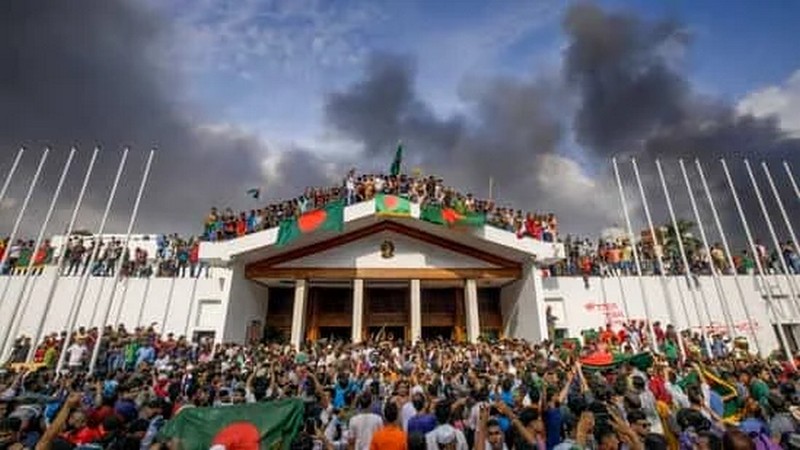
The unpublished genocide diaries of Refaat Alareer

By Refaat Alareer

The following pieces by Dr. Refaat Alareer, the Palestinian poet, professor and beloved mentor who was murdered in an Israeli airstrike on 6 December 2023, have not been published previously. These pieces will also appear in If I Must Die: Poetry and Prose, an anthology of Alareer’s work compiled with an introduction by Yousef M. Aljamal and published by OR Books.

In addition to many other pieces, Alareer contributed to The Electronic Intifada two narratives about his experience during the ongoing genocide: “Israel bombed my home without warning,” published on 22 October 2023, and “Israel’s claims of ‘terrorist activity’ in a children’s hospital were lies,” published on 19 November 2023.

Alareer also appeared several times on The Electronic Intifada livestream, launched at the beginning of the genocide. During the first episode of the livestream, broadcast on 9 October, viewers and listeners could hear the bombs exploding in the background as Alareer described why Palestinians insist on fighting for justice and liberation in the face of Israel’s genocidal violence. Alareer’s last livestream appearance was on 1 December 2023, a few days before his death, but for only a few minutes because his electricity shut off and the connection was lost.

On 26 April 2024, Alareer’s oldest child, Shymaa, was killed in an Israeli attack along with her husband Muhammad Abd al-Aziz Siyam and their 3-month-old son Abd al-Rahman. The infant was born after Alareer’s death and was his first grandchild.

19 October 2023: In Gaza, we have grown accustomed to war

Horrific experiences of death and destruction have permanently impacted Palestinians’ culture, language and collective memory. “Is it war again?” asks my little Amal, 7, memories of the previous Israeli assaults still fresh in her mind.

The wording of the question shows the maturity she has been forced to develop. Last year, Amal asked her mum if it was “another war.”

Yes, it is war again in Gaza! In Gaza, we have grown accustomed to war. War has become a recurrent reality, a nightmare that won’t go away. A brutal normality. War has become like a grumpy old relative, one that we can’t stand but can’t rid ourselves of either.

The children pay the heaviest price. A price of fear and nonstop trauma that is reflected in their behaviors and their reactions. It’s estimated that over 90 percent of Palestinian children in Gaza show signs of trauma. But also, specialists claim there is no post-war trauma in Gaza as the war is still ongoing.

My grandmother would tell me to put on a heavy sweater because it would rain. And it would rain! She, like all Palestinian elders, had a unique sense, an understanding of the earth, wind, trees and rain. The elders knew when to pick olives for pickling or for oil. I was always envious of that.

Sorry, Grandma. We have instead become attuned to the vagaries of war. This heavy guest visits us uninvited, unwelcomed and undesired, perches on our chests and breaths, and then claims the lives of many, in the hundreds and thousands.

A Palestinian in Gaza born in 2008 has witnessed seven wars: 2008–2009, 2012, 2014, 2021, 2022, 2023A and 2023B. And as the habit goes in Gaza, people can be seven wars old, or four wars old. My little Amal, born in 2016, now holds a BA in wars, having lived through four destructive campaigns. In Gaza, we often speak about wars in terms of academic degrees: a BA in wars, an MA in wars, and some might humorously refer to themselves as PhD candidates in wars.

Our discourse has significantly changed and shifted. At night, when Israel particularly intensifies the bombardment, it’s a “party”: “The party has begun.” “It will be a horrific party tonight.” And then there is “The Bag,” capital T and capital B. This is a bag that is hurriedly prepared to contain the cash, the IDs, the birth certificates and college diplomas. The aim is to grab the kids and one item when there is a threat of evacuation.

The collective memories and culture of Palestinians in Gaza have been substantially impacted by these horrific experiences of war and death. Most Gazans have lost family members, relatives, or loved ones or have had their homes damaged or destroyed. It’s estimated that these wars and the escalations between them have claimed the lives of over 9,000 (it was 7,500 when I started drafting this last week!) Palestinians and destroyed over 60,000 housing units.

Death and war. War and Death. These two are persona non grata, yet we can’t force them to leave. To let us be.

Palestinian poet Tamim Al-Barghouti summarizes the relationship between death and the Palestinians that war brings (my translation):

It was not wise of you, Death, to draw near.
It was not wise to besiege us all these years.
It was not wise to dwell this close,
So close we’ve memorized your visage
Your eating habits
Your time of rest
Your mood swings
Your heart’s desires
Even your frailties.
O, Death, beware!
Don’t rest that you tallied us.
We are many.
And we are still here
[Seventy] years after the invasion
Our torches are still alight
Two centuries
After Jesus went to his third grade in our land
We have known you, Death, too well.
O, Death, our intent is clear:
We will beat you,
Even if they slay us, one and all.
Death, fear us,
For here we are, unafraid.

23 October 2023: Five stages of coping with war in Gaza

Our familiarity with war in Gaza has led us to develop a unique perspective and unique coping mechanisms.

We can identify five major emotional stages that Gazans go through during these grim conflicts. The stages are denial, fear, silence, numbness, hope, despair and submission.

This is day 16 and Israel has killed more than 5,000 Palestinians (many are still unaccounted for under the rubble), including over 2,000 Palestinian children, Gaza authorities tell us. More than 15,000 were injured and over 25,000 Palestinian homes were destroyed. And Israel says it is ready for ground invasion.

Stage one: Denial

In the early stages of a crisis, there is often a sense of denial. We convince ourselves that this time won’t lead to war. People are tired of the recurring conflicts, and both sides may appear too preoccupied to engage in warfare. As missiles fall and soar, we maintain a form of partial denial, hoping that this time will not be as lengthy or devastating as past wars.

No, this time it’s not going to be war. Everyone is tired of wars. Israel is too busy to go to war.

Palestinians are too exhausted and too battered to engage in a war. It could just last five days, give or take, we hope.

Stage two: Fear

Soon, denial turns to fear as the reality of another war sets in. Gaza is paralyzed as civilians, including children, are attacked by Israeli bombs. The pictures and videos of massacres, of homes obliterated with the families inside, of high rise buildings toppled like dominoes turn the denial into utter terror.

Every strike, especially at night, means all the children wake up crying and weep. As parents, we fear for our kids and we fear we can’t protect our loved ones.

Stage three: Silence and numbness

This is when Israel particularly intensifies the bombing of civilian homes. Stories are interrupted. Prayers are cut short. Meals are left uneaten. Showers are abandoned.

Therefore, amid the chaos and danger Israel brings, many in Gaza, especially children, withdraw into silence. They find solace in solitude as means of coping with the overwhelming emotion and uncertainty that surrounds them. Silence prevails.

Then numbness follows. As people attempt to protect themselves from the constant onslaught of distressing news, they grow indifferent. Because we could die anyway, no matter where we go. Emotional numbness sets in, as individuals attempt to detach from their emotions to survive.

Stage four: Hope

In the midst of despair, glimmers of hope may emerge. Even in the darkest moments, Gazans may hold onto the belief Israel might at least kill fewer people, bomb fewer places, and damage less. The most hopeful of us wish for a lasting ceasefire or an end to the siege or even the occupation. But this is merely hope. And hope is dangerous.

We hope that politicians will man up. We hitch our hope to the masses taking to the streets to reassure their politicians and warn they will be punished in future elections if they support Israeli aggression against Palestinians in Gaza.

Stage five: Despair and submission

Unfortunately, hope can often be fleeting, and many Gazans have experienced recurring cycles of despair. The repeated loss of life, homes and security lead to deep feelings of helplessness.

In the final stage, there is a sense of submission as Gazans accept the reality that they are unable to change the situation. That they are left alone. That the world has abandoned us. That Israel can kill and destroy at large with impunity. This is a stage marked by endurance, as Palestinians strive to adapt and persevere in the face of ongoing challenges.

These stages of war have become an unfortunate part of life in Gaza, shaping the resilience and perseverance of the Palestinian people in the face of unimaginable hardships imposed by the Israeli occupation.

27 October 2023: What it’s like when Israel bombs your building

I have six children. And so far we have survived seven major Israeli escalations, unscathed. We are an average family. My wife, Nusayba, is a housewife, I have two children in college and my youngest child, Amal, is 7. In Gaza, Amal is already four wars old.

We are an average family in Gaza, but we have had our fair share of Israeli death and destruction.

So far, since the early 1970s, I have lost 20 (and 15 last week) members of my extended family due to Israeli aggression.

In 2014, Israel destroyed our family home of seven flats, killing my brother Mohammed.

In 2014, Israel killed about 20 of my wife’s family including her brother, her sister, three of her sister’s kids, her grandfather and her cousin. And destroyed several of my in-laws’ homes.

Combined, my wife and I have lost over fifty 50 members to Israeli war and terror.

2023 war on Gaza

As the bombs fall and Israel targets sleeping families in their homes, parents are torn between several issues.

Should we leave? But go where, when Israel targets evacuees on their way and targets the areas they evacuate to?

Should we stay with relatives? Or should our relatives stay with us, whose home is relatively “safe?” We can never be sure. It’s been more than 75 years of brutal occupation – and over six major Israeli military onslaughts in the past 15 years – and we have so far failed to understand Israel’s brutality and mentality of death and destruction.

And then there is the fear of what to do if – when – we are bombed. We try to evade them. But how can you evade the bombs when Israel throws three or four or five consecutive bombs at the same home.

The big question Palestinian households debate is whether we should sleep in the same room so that when we die, we die together, or whether we should sleep in different rooms so some of us may survive.

The answer is always that we need to sleep in the living room together. If we die, we die together. No one has to deal with the heartbreak.

No food. No water. No electricity.

This 2023 war is different. Israel has intensified using hunger as a weapon. By completely besieging Gaza and cutting off the electricity and water supplies and not allowing aid or imports, Israel is not only putting Palestinians on a diet, but also starving them.

In my household, and we are a well-off family, my wife and I sat with the children and explained the situation to them, especially the little ones: “We need to ration. We need to eat and drink a quarter of what we usually consume. It’s not that we do not have money, but food is running out and we barely have water.”

And good luck explaining to your 7-year-old that she can’t have her two morning eggs and instead she will be having a quarter of a bomb! (Israel later bombed the eggs.)

As a parent, I feel desperate and helpless. I can’t provide the love and protection I am supposed to give my kids.

Instead of often telling my kids “I love you,” I have been repeating for the past two weeks:

“Kids, eat less. Kids, drink less.” And I imagine this being my last thing I say to them and it is devastating.

Israel bombs our building

If we had a little food last week, now we barely have any because Israel struck our home with two missiles while we were inside. And without prior warning!

My wife Nusayba had already instructed the kids to run if a bombing happened nearby. We never expected [our building] to be hit. And that was a golden piece of advice.

I was hosting four families of relatives in my flat. Most of them were kids and women.

We ran and ran. We carried the little ones and grabbed the small bags with our cash and important documents that Gazans keep at the door every time Israel wages a war.

We escaped with a miracle, with only bruises and tiny scratches. We checked and found everyone was fine. And then we walked to a nearby UN school shelter, which was in an inhuman condition. We crammed into small classrooms with other families.

With that, we lost our last sense of safety. We lost our water. We lost our food and the remaining eggs that Amal loves.

We are an average Palestinian family. But we have had our fair share of Israeli death and destruction. In Gaza, no one is safe. And no place is safe. Israel could kill all 2.3 million of us and the world would not bat an eye.

The quoted verses by Tamim Al-Barghouti are from the second part of his poem “Military Communiqué.”

26 August 2024

Source: countercurrents.org