Just International

US Foreign Policy Is a Scam Built on Corruption

The $1.5 trillion in military outlays each year is the scam that keeps on giving—to the military-industrial complex and the Washington insiders—even as it impoverishes and endangers America and the world.

By Jeffrey D. Sachs

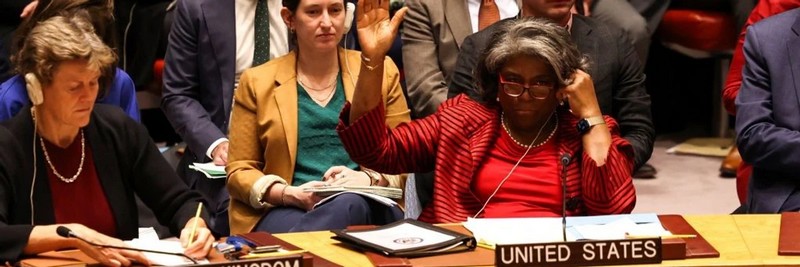
On the surface, US foreign policy seems to be utterly irrational. The US gets into one disastrous war after another — Afghanistan, Iraq, Syria, Libya, Ukraine, and Gaza. In recent days, the US stands globally isolated in its support of Israel’s genocidal actions against the Palestinians, voting against a UN General Assembly resolution for a Gaza ceasefire backed by 153 countries with 89% of the world population, and opposed by just the US and 9 small countries with less than 1% of the world population.

In the past 20 years, every major US foreign policy objective has failed. The Taliban returned to power after 20 years of US occupation of Afghanistan. Post-Saddam Iraq became dependent on Iran. Syria’s President Bashar al-Assad stayed in power despite a CIA effort to overthrow him. Libya fell into a protracted civil war after a US-led NATO mission overthrew Muammar Gaddafi. Ukraine was bludgeoned on the battlefield by Russia in 2023 after the US secretly scuttled a peace agreement between Russia and Ukraine in 2022.

Despite these remarkable and costly debacles, one following the other, the same cast of characters has remained at the helm of US foreign policy for decades, including Joe Biden, Victoria Nuland, Jake Sullivan, Chuck Schumer, Mitch McConnell, and Hillary Clinton.

What gives?

The puzzle is solved by recognizing that American foreign policy is not at all about the interests of the American people. It is about the interests of the Washington insiders, as they chase campaign contributions and lucrative jobs for themselves, staff, and family members. In short, US foreign policy has been hacked by big money.

As a result, the American people are losing big. The failed wars since 2000 have cost them around $5 trillion in direct outlays, or around $40,000 per household. Another $2 trillion or so will be spent in the coming decades on veterans’ care. Beyond the costs directly incurred by Americans, we should also recognize the horrendously high costs suffered abroad, in millions of lives lost and trillions of dollars of destruction to property and nature in the war zones.

The costs continue to mount. US Military-linked outlays in 2024 will come to around $1.5 trillion, or roughly $12,000 per household, if we add the direct Pentagon spending, the budgets of the CIA and other intelligence agencies, the budget of the Veteran’s Administration, the Department of Energy nuclear weapons program, the State Department’s military-linked “foreign aid” (such as to Israel), and other security-related budget lines. Hundreds of billions of dollars are money down the drain, squandered in useless wars, overseas military bases, and a wholly unnecessary arms build-up that brings the world closer to WWIII.

Yet to describe these gargantuan costs is also to explain the twisted “rationality” of US foreign policy. The $1.5 trillion in military outlays is the scam that keeps on giving—to the military-industrial complex and the Washington insiders—even as it impoverishes and endangers America and the world.

To understand the foreign-policy scam, think of today’s federal government as a multi-division racket controlled by the highest bidders. The Wall Street division is run out of the Treasury. The Health Industry division is run out of the Department of Health and Human Services. The Big Oil and Coal division is run out of the Departments of Energy and Interior. And the Foreign Policy division is run out of the White House, Pentagon and CIA.

Each division uses public power for private gain through insider dealing, greased by corporate campaign contributions and lobbying outlays. Interestingly, the Health Industry division rivals the Foreign Policy division as a remarkable financial scam. America’s health outlays totaled an astounding $4.5 trillion in 2022, or roughly $36,000 per household, by far the highest health costs in the world, while America ranked roughly 40th in the world among nations in life expectancy. A failed health policy translates into very big bucks for the health industry, just as a failed foreign policy translates into mega-revenues of the military-industrial complex.

The Foreign Policy division is run by a small, secretive and tight-knit coterie, including the top brass of the White House, the CIA, the State Department, the Pentagon, the Armed Services Committees of the House and Senate, and the major military firms including Boeing, Lockheed Martin, General Dynamics, Northrop Grumman, and Raytheon. There are perhaps a thousand key individuals involved in setting policy. The public interest plays little role.

The key foreign policy makers run the operations of 800 US overseas military bases, hundreds of billions of dollars of military contracts, and the war operations where the equipment is deployed. The more wars, of course, the more business. The privatization of foreign policy has been greatly amplified by the privatization of the war business itself, as more and more “core” military functions are handed out to the arms manufacturers and to contractors such as Haliburton, Booz Allen Hamilton, and CACI.

In addition to the hundreds of billions of dollars of military contracts, there are important business spillovers from the military and CIA operations. With military bases in 80 countries around the world, and CIA operations in many more, the US plays a large, though mostly covert role, in determining who rules in those countries, and thereby on policies that shape lucrative deals involving minerals, hydrocarbons, pipelines, and farm and forest land. The US has aimed to overthrow at least 80 governments since 1947, typically led by the CIA through the instigation of coups, assassinations, insurrections, civil unrest, election tampering, economic sanctions, and overt wars. (For a superb study of US regime-change operations from 1947 to 1989, see Lindsey O’Rourke’s Covert Regime Change, 2018).

In addition to business interests, there are of course ideologues who truly believe in America’s right to rule the world. The ever-warmongering Kagan family is the most famous case, though their financial interests are also deeply intertwined with the war industry. The point about ideology is this. The ideologists have been wrong on nearly every occasion and long ago would have lost their bully pulpits in Washington but for their usefulness as warmongers. Wittingly or not, they serve as paid performers for the military-industrial complex.

There is one persistent inconvenience for this ongoing business scam. In theory, foreign policy is carried out in the interest of the American people, though the opposite is the truth. (A similar contradiction of course applies to overpriced healthcare, government bailouts of Wall Street, oil-industry perks, and other scams). The American people rarely support the machinations of US foreign policy when they occasionally hear the truth. America’s wars are not waged by popular demand but by decisions from on high. Special measures are needed to keep the people away from decision making.

The first such measure is unrelenting propaganda. George Orwell nailed it in 1984 when “the Party” suddenly switched the foreign enemy from Eurasia to Eastasia without a word of explanation. The US essentially does the same. Who is the US gravest enemy? Take your pick, according to the season. Saddam Hussein, the Taliban, Hugo Chavez, Bashar al-Assad, ISIS, al-Qaeda, Gaddafi, Vladimir Putin, Hamas, have all played the role of “Hitler” in US propaganda. White House spokesman John Kirby delivers the propaganda with a smirk on his face, signaling that he too knows that what he is saying is ludicrous, albeit mildly entertaining.

The propaganda is amplified by the Washington think tanks that live off of donations by military contractors and occasionally foreign governments that are part of the US scam operations. Think of the Atlantic Council, CSIS, and of course the ever-popular Institute for the Study of War, brought to you by the major military contractors.

The second is to hide the costs of the foreign policy operations. In the 1960s, the US Government made the mistake of forcing the American people to bear the costs of the military-industrial complex by drafting young people to fight in Vietnam and by raising taxes to pay for the war. The public erupted in opposition.

From the 1970s onward the government has been far more clever. The government ended the draft, and made military service a job for hire rather than a public service, backed by Pentagon outlays to recruit soldiers from lower economic strata. It also abandoned the quaint idea that government outlays should be funded by taxes, and instead shifted the military budget to deficit spending which protects it from popular opposition that would be triggered if it were tax-funded.

It has also suckered client states such as Ukraine to fight America’s wars on the ground, so that no American body bags would spoil the US propaganda machine. Needless to say, US masters of war such as Sullivan, Blinken, Nuland, Schumer, and McConnell remain thousands of miles away from the frontlines. The dying is reserved for Ukrainians. Sen. Richard Blumenthal (D-Conn.) defended American military aid to Ukraine as money well spent because it is “without a single American service woman or man injured or lost,” somehow not dawning on the good Senator to spare the lives of Ukrainians, who have died by the hundreds of thousands in a US-provoked war over NATO enlargement.

This system is underpinned by the complete subordination of the U.S. Congress to the war business, to avoid any questioning of the over-the-top Pentagon budgets and the wars instigated by the Executive Branch. The subordination of Congress works as follows. First, the Congressional oversight of war and peace is largely assigned to the House and Senate Armed Services Committees, which largely frame the overall Congressional policy (and the Pentagon budget). Second, the military industry (Boeing, Raytheon, and the rest) funds the campaigns of the Armed Services Committee members of both parties. The military industries also spend vast sums on lobbying in order to provide lucrative salaries to retiring members of Congress, their staffs, and families, either directly in military businesses or in Washington lobbying firms.

The hacking of Congressional foreign policy is not only by the US military-industrial complex. The Israel lobby long ago mastered the art of buying the Congress. America’s complicity in Israel’s apartheid state and war crimes in Gaza makes no sense for US national security and diplomacy, not to speak of human decency. They are the fruits of Israel lobby investments that reached $30 million in campaign contributions in 2022, and that will vastly top that in 2024.

When Congress reassembles in January, Biden, Kirby, Sullivan, Blinken, Nuland, Schumer, McConnell, Blumenthal and their ilk will tell us that we absolutely must fund the losing, cruel, and deceitful war in Ukraine and the ongoing massacre and ethnic cleansing in Gaza, lest we and Europe and the free world, and perhaps the solar system itself, succumb to the Russian bear, the Iranian mullahs, and the Chinese Communist Party. The purveyors of foreign policy disasters are not being irrational in this fear-mongering. They are being deceitful and extraordinarily greedy, pursuing narrow interests over those of the American people.

It is the urgent task of the American people to overhaul a foreign policy that is so broken, corrupted, and deceitful that it is burying the government in debt while pushing the world closer to nuclear Armageddon. This overhaul should start in 2024 by rejecting any more funding for the disastrous Ukraine War and Israel’s war crimes in Gaza. Peacemaking, and diplomacy, not military spending, is the path to a US foreign policy in the public interest.

Jeffrey D. Sachs is a University Professor and Director of the Center for Sustainable Development at Columbia University.

26 December 2023

Source: www.commondreams.org

Hamas ‘Mass Rape’ Claim Lacks Evidence–but It’s Being Used to Justify Genocide

By Jonathan Cook

Claims of systematic rape on October 7 appeal to a racist trope of the savage, predatory Arab. Which is why western politicians and media are so unconcerned by the dearth of evidence.

18 Dec 2023 – This article is intended as a follow-up to my last article, on the western media’s refusal to investigate what happened on October 7.

As I argued there, journalists are suppressing evidence from credible sources, including the Israeli military, suggesting that Israel was responsible for many of the deaths of its citizens that day, including those whose charred remains are regularly cited as proof of barbarism by Hamas – and by implication, all Palestinians.

My previous article makes the point that these allegations against Hamas are being used to justify a genocidal bombing campaign that it is known to have killed so far more than 19,000 Palestinians, a majority of them women and children, as well as an ethnic cleansing campaign that has driven some 2 million Palestinians from their homes and left them exposed to disease and starvation in a tiny area, pressed up against the short border with Egypt.

The goal is obvious: to push Palestinians out of Gaza and into Sinai.

But here I want to address another, more specific part of what amounts to an Israeli and media psy-op against western publics: the claim that Hamas leaders ordered their fighters to carry out mass rape against Israelis, and that those fighters indeed used sexual assault systematically, as a weapon of war.

If true, this would count in international law as a crime against humanity.

Gaza breakout

The veracity of this claim is now treated as axiomatic by western media and politicians, even though there appears to be no meaningful evidence for it.

Remember the argument being made by those justifying the genocidal bombing campaign in Gaza is not that isolated instances of rape or sexual assault occurred.

Given that Palestinians flooded out of Gaza that day after Hamas fighters broke through the prison fence, only a fool would argue with certainty that no rapes or sexual assaults occurred.

But it should not be incumbent on those questioning the Israeli narrative – the one contending that there was planned, systematic, mass rape on October 7 – to prove that no sexual violence occurred.

Rather, it is the responsibilty of those making the accusation – Israel, western politicians, the western media – to back up their claim with solid evidence. Otherwise they are simply rationalising the far graver and greater crimes now being committed in Gaza against Palestinians.

Producing a few photos that may, or may not, show evidence of sexual violence is not evidence that Hamas ordered, and its fighters carried out, mass rape.

Relaying testimony that a witness saw a gang rape is not evidence that Hamas ordered, and its fighters carried out, mass rape.

And the claims of the highly ideological and unreliable leaders of Zaka’s first responders unit do not count as evidence either – unless they can be substantiated with other kinds of evidence.

The evidential bar in international law is high for a reason: because the charge is so grave.

But in this case, the bar needs to be high for an additional reason: because Israel’s response – the mass slaughter of civilians in Gaza premised on the supposed savagery of Hamas’ crimes – is graver still by an order of magnitude.

Absence of evidence

Two long articles in the respected Haaretz newspaper – Israel’s version of the New York Times – purportedly providing the evidence for mass rape are worth picking apart because they form the backbone of claims being recycled by western politicians and the western media.

The first is a kind of evidential overview. The other is a profile of Cochav Elkayam-Levy, who founded the “Civil Commission on October 7 Crimes by Hamas against Women and Children” which has been at the forefront of making allegations of mass rape by Hamas.

The profile article concludes: “The aggregation of the evidence presents a horrifying picture that leaves no room for doubt: Under cover of the massacre, Hamas carried out a campaign of rape and sexual abuse.”

Having made this bold assertion, however, the article and its companion piece then spend a great deal of time setting out the many and varied reasons why there is little evidence that Hamas carried out systematic, mass rape.

Doubtless, as these articles state, the Israeli military and police were too busy fighting Hamas to record and collect evidence. Doubtless, some bodies were too burned – most likely by Israeli shelling and missile strikes, as my previous article highlighted – for forensic examination to be possible. Doubtless, many potential witnesses were killed that day.

But the absence of evidence cannot be treated as evidence, as it is by Haaretz and the western media. Only those reading these two articles through an entirely ideological lens – one seeking to play on a racist trope of the primitive, savage, predatory Arab male so as to rationalise the mass slaughter of Palestinians in Gaza – can fail to notice that lack of meaningful evidence.

Regarding the claim that the Hamas leadership ordered its fighters to carry out rape, the main overview article cites David Katz, an Israeli police commander investigating the October 7 attack. According to Haaretz, he says “it’s premature to determine whether Hamas terrorists received specific instructions to commit rape”.

In other words, there is no evidence for such an order.

The actual evidence that mass rape was carried out cited in the two articles essentially amounts to this:

“According to a police source, so far, they have one witness account of a rape. The witness’ account was recently revealed in the media. She attested to seeing a woman being gang raped, mutilated and murdered…

“Senior security officials say that some of the terrorists from Hamas’ elite Nukhba Force unit and other Gazans held by the Shin Bet security service and the police have accused their comrades of sexual violence…

“The police also have dozens of accounts from Zaka volunteers and soldiers about women’s bodies being found inside homes without underwear. Those accounts also describe physical signs of sexual abuse on bodies at the crime scenes.”

Fabricated claims

That this amounts to the sum of evidence for the claim that Hamas carried out systematic, mass rape should be shocking to anyone other than the most fanatical Israel defenders.

The idea that the testimonies of Hamas fighters – or of anyone else in Israeli detention – can be treated as credible evidence is patently absurd. As has been well documented, torture is standard practice in interrogations of Palestinians, and is even used against children.

No one can seriously argue that Hamas fighters interrogated by Israel following the October 7 atrocities were not subjected to the most extreme “pressure” techniques. Is it likely that none were willing to falsely “confess” to witnessing rapes to ease that pressure?

Such “testimonies” would be worthless in any court of law outside Israel.

As for the allegations from male Zaka volunteers, a hardline religious organisation best known for collecting Jewish remains for burial, they are best treated with the utmost scepticism.

These are the same male volunteers already caught inventing or relaying the most lurid, fabricated claims against Hamas, such as that it beheaded 40 babies, put a baby in an oven, hung other babies from a clothes line, and ripped a foetus from its mother’s womb.

According to Israel’s own figures, two infants were killed that day.

The Zaka volunteers appear to have an ideological agenda: to fuel as much hatred against Palestinians as possible to justify the kind of genocidal response we have been witnessing over the past two months.

Fearful witnesses

That leaves an anonymous witness testimony, that may or may not be credible, and a handful of photos whose contents are ripe for interpretation and dispute.

Assuming that all of this evidence can be taken definitively at face value, that would still not show that Hamas ordered rape or that Hamas fighters carried out systematic rapes, or even conclusively that Hamas fighters carried out any rapes.

It would at most demonstrate that there were isolated, opportunistic instances of rape, and that they were carried out by a few of the people who broke out of Gaza that day, not necessarily Hamas fighters.

What’s TRUE About Israel’s 10/7 Sexual Assault Claims? (w/ Heidi Matthews)

The reason why Israel’s apologists for genocide need to inflate their claim is because, sadly, opportunistic rape would be entirely unremarkable in any violent, militarised situation – and indeed unremarkable in behaviours towards women in western societies in general.

It would mean that any sexual violence against Israeli women that occurred on October 7 was as representative of a general Palestinian savagery as sexual violence by Israeli soldiers against Palestinian women – examples can be found here and here – is of a general Israeli savagery. Which is not at all.

The same Israelis and westerners who express concern that Israeli women are fearful of coming forward to tell of their experiences on October 7, as Elkayam-Levy stresses, have in the past shown precisely zero concern that Palestinian women, who live under a belligerent military occupation, have been fearful for decades of telling of their experiences at the hands of unaccountable Israeli soldiers.

However, unlike the lack of evidence that Hamas ordered rape as a weapon of war, we do have evidence – from the Israeli media – that an Israeli military leader encouraged Israeli soldiers to rape Palestinian women to “boost morale”.

So how have we reached a point where it is taken as “self-evident” in the West that Hamas ordered systematic, mass rape, and that this forms part of the basis for Israel’s right to wage a genocidal campaign against Palestinians masquerading as “self-defence”?

Burden of proof

Significantly, the claim of systematic rape made against Hamas is being enthusiastically embraced by some Israeli and western feminists as the latest MeToo moment – but on a far greater scale than ever before.

That seems to be the case with Elkayam-Levy, founder of the October 7 civil commission and a former spokeswoman for the Israeli military. She views the issue of Hamas rapes entirely through an ideological lens – and one designed to silence critics of her project, including women.

While claiming victimhood for herself and her commission, she celebrates the fact that its campaigning helped pressure the University of Alberta to sack Samantha Pearson, the head of the university’s sexual assault centre, for requiring evidence of the rape allegations against Hamas.

She names Reem Alsalem, a special rapporteur at the United Nations Human Rights Council on protecting women from violence, as their next target for dismissal. She states: “Our intention is to expose the world to a figure who is just abusing – I have no other word for it – global public funds.”

Elkayam-Levy worries that October 7 is being made to “vanish from the timeline”, even as she recounts the intense interest from western journalists in amplifying the commission’s evidence-lite claims.

And of course, she calls out as “antisemites” those who advise caution and believe evidence is important, especially when a genocide is being rationalised in Tel Aviv and western capitals on the basis of the mass rape allegations.

Faced with the demands for evidence from UN bodies, she expresses outrage: “Am I the one who needs to provide the evidence for the terrorists’ deeds? What kind of travesty is it that they are imposing the burden of proof on me?”

The answer, of course, is that Elkayam-Levy imposed that burden on herself, by founding the commission at the centre of the campaign to accuse Hamas of carrying out systematic, mass rape.

‘Believe women’

The dangerous consequences are all too clear. Crying “Believe women” – or largely in this case, “Believe Hamas torture victims and proven male fabulists from Zaka” – is being weaponised to mean “Kill Palestinians”.

Simply accepting these claims as self-evident when the evidence is absent is to participate in the abuse of rape allegations to justify subjecting Palestinians in Gaza – including many, many thousands of women and children – to atrocities on an even greater scale.

Yes, in theory it might be possible to give the benefit of the doubt to those claiming Hamas committed systematic, mass rape while still opposing the mass slaughter of Palestinians in Gaza as a response. But that is not the world our politicians and media inhabit, or allow us to inhabit.

Which is why the evidential bar has to be high. But in Israel’s case, the evidence is thin indeed.

That high bar is not just relevant for jurists and the law courts. It must apply to those reporting right now on events in Israel and Palestine. Yet, once again, the western media has failed in its most basic duties.

Like doctors, journalists should strive to do no harm. We should record and explain, not smooth the path to genocide by peddling minsinformation.

We should seek to hold the powerful to account, not make the commission of their crimes easier.

And at our best, we should want to strengthen society’s democratic impulses through the dissemination of accurate information, not trade in incitement and defamation.

None of this is happening. The same western media that has suppressed testimonies showing that Israel carried out crimes against its own citizens on October 7 is inflating the number and extent of Hamas atrocities, unsupported by evidence.

The only reasonable conclusion to draw is that the media are willing and active participants in the ethnic cleansing and genocide in Gaza. Those crimes are not just willed by Israel; they are willed by western elites who view Israel as a projection of their power into the oil-rich Middle East.

Jonathan Cook is an award-winning British journalist based in Nazareth, Israel, since 2001.

25 December 2023

Source: transcend.org

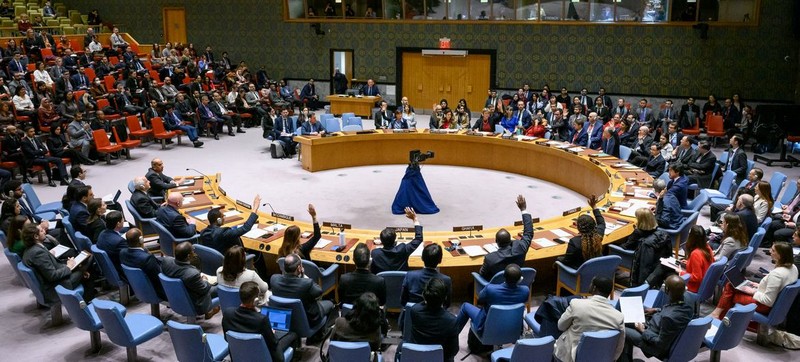
UN Security Council Adopts Resolution on Gaza Crisis

By UN News

22 Dec 2023 – The UNSC has adopted a resolution on the ongoing crisis in Gaza, with 13 votes in favour, and the US and Russia abstaining. The resolution, among other points, demands immediate, safe and unhindered delivery of humanitarian assistance at scale directly to the Palestinian civilian population throughout the Gaza Strip.

In the resolution, the Security Council reaffirmed the obligations of the parties to the conflict under international humanitarian law, especially regarding the protection of civilians and civilian objects, safety of humanitarian personnel, and the provision of humanitarian assistance.

The Council demanded that the parties “allow, facilitate and enable” the immediate, safe and unhindered delivery of humanitarian assistance at scale directly to the Palestinian civilian population throughout the Gaza Strip.

It also requested the UN Secretary-General to appoint a Senior Humanitarian and Reconstruction Coordinator with responsibility for “facilitating, coordinating, monitoring, and verifying” in Gaza, as appropriate, the humanitarian nature of all relief consignments to the enclave provided through States that are not party to the conflict.

It also called for the “expeditious” establishment of a UN mechanism to accelerate aid consignments to Gaza through States that are not party to the conflict, to expedite, streamline and accelerate assistance while continuing to help ensure that aid reaches its civilian destination.

The Resolution

In the resolution, the Security Council reaffirmed the obligations of the parties to the conflict under international humanitarian law, especially regarding the protection of civilians and civilian objects, safety of humanitarian personnel, and the provision of humanitarian assistance.

The Council demanded that the parties “allow, facilitate and enable” the immediate, safe and unhindered delivery of humanitarian assistance at scale directly to the Palestinian civilian population throughout the Gaza Strip.

It also requested the UN Secretary-General to appoint a Senior Humanitarian and Reconstruction Coordinator with responsibility for “facilitating, coordinating, monitoring, and verifying” in Gaza, as appropriate, the humanitarian nature of all relief consignments to the enclave provided through States that are not party to the conflict.

It also called for the “expeditious” establishment of a UN mechanism to accelerate aid consignments to Gaza through States that are not party to the conflict, to expedite, streamline and accelerate assistance while continuing to help ensure that aid reaches its civilian destination.

Full Text of the Resolution

Security Council resolution 2720 (2023)

The Security Council,

Reaffirming the purposes and principles of the Charter of the United Nations,

Recalling all of its relevant resolutions, particularly resolution 2712 (2023), which, inter alia, demands that all parties comply with their obligations under international law, notably with regard to the protection of civilians, calls for urgent and extended humanitarian pauses and corridors throughout the Gaza Strip for a sufficient number of days to enable full, rapid, safe, and unhindered humanitarian access and to enable urgent rescue and recovery efforts, and calls for the immediate and unconditional release of all hostages, as well as ensuring immediate humanitarian access,

Reaffirming that all parties to conflicts must adhere to their obligations under international law, including international humanitarian law and international human rights law, as applicable,

Stressing that the Gaza Strip constitutes an integral part of the territory occupied in 1967, and reiterating the vision of the two-State solution, with the Gaza Strip as part of the Palestinian State,

Expressing deep concern at the dire and rapidly deteriorating humanitarian situation in the Gaza Strip and its grave impact on the civilian population, underlining the urgent need for full, rapid, safe, and unhindered humanitarian access into and throughout the entire Gaza Strip, and taking note of the concerning reports from the leadership of the United Nations and humanitarian organizations in this regard, reaffirming its strong concern for the disproportionate effect that the conflict is having on the lives and well-being of children, women, and other civilians in vulnerable situations, and stressing the humanitarian principles of humanity, impartiality, neutrality, and independence,

Stressing the obligation to respect and protect humanitarian relief and medical personnel,

Reaffirming its call for all parties to refrain from depriving the civilian population in the Gaza Strip of basic services and humanitarian assistance indispensable to their survival, consistent with international humanitarian law,

Commending the indispensable and ongoing efforts of the United Nations, its specialized agencies and all humanitarian and medical personnel in the Gaza Strip to alleviate the impact of the conflict on the people in the Gaza Strip, and expressing condolences for all civilians, including humanitarian and medical personnel, killed in the course of this conflict,

Welcoming the efforts of Egypt to facilitate the use of the Rafah Border crossing by United Nations humanitarian agencies and their implementing partners for the provision of humanitarian assistance for people in need throughout the Gaza Strip,

Taking note of the 15 December 2023 decision by the Government of Israel to open its crossing at Karem Abu Salem / Kerem Shalom for direct delivery of humanitarian assistance to Palestinian civilians in Gaza, which should ease congestion and help facilitate the provision of life-saving assistance to those who urgently need it, and emphasizing the need to continue working closely with all relevant parties to expand the delivery and distribution of humanitarian assistance, while confirming its humanitarian nature and ensuring that it reaches its civilian destination,

Encouraging engagement with relevant states in the implementation of this resolution,

Welcoming the implementation of a recent ‘humanitarian pause’ in the Gaza Strip, and expressing appreciation for the diplomatic efforts of Egypt, the State of Qatar, and other states in this regard, and also expressing grave concerns as to the impact the resumption of hostilities has had on civilians,

Recognizing that the civilian population in the Gaza Strip must have access to sufficient quantities of assistance that they need, including enough food, water, sanitation, electricity, telecommunications and medical services essential for their survival, and that the provision of humanitarian supplies in the Gaza Strip needs to be sufficient to alleviate the massive humanitarian needs of the Palestinian civilian population throughout the Gaza Strip, and recognizing the importance of resuming commercial imports of essential goods and services into the Gaza Strip,

Welcoming financial contributions and pledges by member states in support of the civilian population in Gaza, and taking note of the International Humanitarian Conference for the Civilian Population of Gaza held in Paris on 9 November 2023 and its follow-up meeting on 6 December 2023,

1. Reiterates its demand that all parties to the conflict comply with their obligations under international law, including international humanitarian law, including with regard to the conduct of hostilities and the protection of civilians and civilian objects, humanitarian access, and the protection of humanitarian personnel and their freedom of movement, and the duty, as applicable, of ensuring the food and medical supplies, among others, of the population, recalls that civilian and humanitarian facilities, including hospitals, medical facilities, schools, places of worship, and facilities of the UN, as well as humanitarian personnel, and medical personnel, and their means of transport, must be respected and protected, according to international humanitarian law, and affirms that nothing in this resolution absolves the parties of these obligations;

2. Reaffirms the obligations of the parties to the conflict under international humanitarian law regarding the provision of humanitarian assistance, demands that they allow, facilitate and enable the immediate, safe and unhindered delivery of humanitarian assistance at scale directly to the Palestinian civilian population throughout the Gaza Strip, and in this regard calls for urgent steps to immediately allow safe, unhindered, and expanded humanitarian access and to create the conditions for a sustainable cessation of hostilities;

3. Demands that the parties to the conflict allow and facilitate the use of all available routes to and throughout the entire Gaza Strip, including border crossings, including full and prompt implementation of the announced opening of the Karem Abu Salem / Kerem Shalom Border Crossing, for the provision of humanitarian assistance in order to ensure that humanitarian personnel and humanitarian assistance, including fuel, food, and medical supplies and emergency shelter assistance, reaches the civilian population in need throughout the Gaza Strip without diversion and through the most direct routes, as well as for material and equipment to repair and ensure the functioning of critical infrastructure and to provide essential services, without prejudice to the obligations of the parties to the conflict under international humanitarian law, and stresses the importance of respecting and protecting border crossings and maritime infrastructure used for the delivery of humanitarian assistance at scale;

4. Requests the Secretary-General, with the objective of expediting the delivery of humanitarian assistance to the civilian population in the Gaza Strip, to appoint a Senior Humanitarian and Reconstruction Coordinator with responsibility for facilitating, coordinating, monitoring, and verifying in Gaza, as appropriate, the humanitarian nature of all humanitarian relief consignments to Gaza provided through states which are not party to the conflict, and further requests that the Coordinator expeditiously establish a UN mechanism for accelerating the provision of humanitarian relief consignments to Gaza through states which are not party to the conflict, consulting all relevant parties, with the goal of expediting, streamlining, and accelerating the process of providing assistance while continuing to help ensure that aid reaches its civilian destination, and demands that the parties to the conflict cooperate with the Coordinator to fulfill their mandate without delay or obstruction;

5. Requests that the Coordinator be appointed expeditiously;

6. Determines that the Coordinator will have the necessary personnel and equipment in Gaza, under the authority of the United Nations, to perform these, and other functions as determined by the Security Council, and requests that the Coordinator report to the Security Council on its work, with an initial report within 20 days and thereafter every 90 days through 30 September 2024;

7. Demands the immediate and unconditional release of all hostages, as well as ensuring humanitarian access to address medical needs of all hostages;

8. Demands the provision of fuel to Gaza at levels that will meet requisite humanitarian needs;

9. Calls for all parties to adhere to international humanitarian law and in this regard deplores all attacks against civilians and civilian objects, as well as all violence and hostilities against civilians, and all acts of terrorism;

10. Reaffirms the obligations of all parties under international humanitarian law, including with regard to respecting and protecting civilians and taking constant care to spare civilian objects, including such objects critical to the delivery of essential services to the civilian population, and with regard to refraining from attacking, destroying, removing or rendering useless objects that are indispensable to the survival of the civilian population, as well as respecting and protecting humanitarian personnel and consignments used for humanitarian relief operations;

11. Reaffirms that civilian objects, including places of refuge, including within United Nations facilities and their surroundings, are protected under international humanitarian law, and rejects forced displacement of the civilian population, including children, in violation of international law, including international humanitarian law and international human rights law;

12. Reiterates its unwavering commitment to the vision of the two-State solution where two democratic States, Israel and Palestine, live side by side in peace within secure and recognized borders, consistent with international law and relevant UN resolutions, and in this regard stresses the importance of unifying the Gaza Strip with the West Bank under the Palestinian Authority;

13. Demands that all parties to the conflict take all appropriate steps to ensure the safety and security of United Nations and associated personnel, those of its specialized agencies, and all other personnel engaged in humanitarian relief activities consistent with international humanitarian law, without prejudice to their freedom of movement and access, stresses the need not to hinder these efforts, and recalls that humanitarian relief personnel must be respected and protected;

14. Demands implementation of resolution 2712 (2023) in full, requests the Secretary-General to report to the Security Council in writing within five working days of the adoption of this resolution on the implementation of resolution 2712 (2023), and thereafter as necessary, and calls upon all parties concerned to make full use of the humanitarian notification and deconfliction mechanisms in place to protect all humanitarian sites, including UN facilities, and to help facilitate the movement of aid convoys, without prejudice to the obligations of the parties to uphold international humanitarian law;

15. Requests the Secretary-General to report on the implementation of this resolution in the regular reporting to the Council;

16. Decides to remain actively seized of the matter.

25 December 2023

Source: transcend.org

Injured Patients ‘Waiting to Die’ in Northern Gaza as Last Hospital Shuts Down, Amid Rising ‘Catastrophic’ Hunger Levels

By UN News

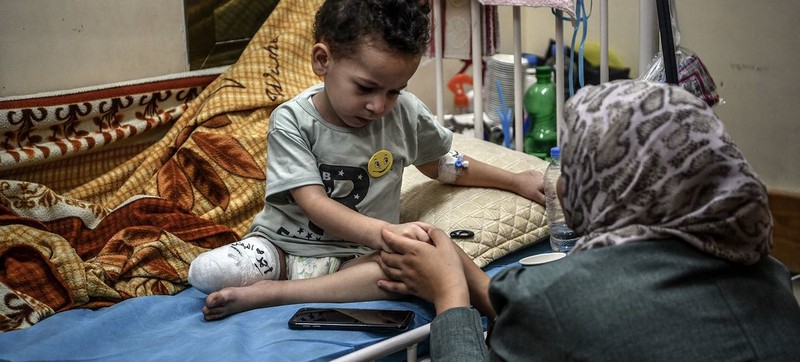
21 Dec 2023 – There are no functioning hospitals in the north of Gaza and injured patients who need surgery and cannot be moved are “waiting to die”, the UN health agency said today, in a plea for a ceasefire to allow more aid into the shattered enclave.

The latest grave assessment from the World Health Organization (WHO) came after UN teams reached Al Ahli Arab hospital and Al Shifa hospital on Wednesday, amid reports of intensifying ground operations by Israeli Defense Forces and continuing airstrikes in the Gaza Strip, in response to Hamas’s 7 October terror attacks on southern Israel.

“Patients were crying out in pain, but they were also crying out for us to give them water,” said WHO Emergency Medical Teams coordinator Sean Casey, describing the scene at Al Ahli Arab hospital, where medical staff were struggling to cope with “no food, no fuel, no water”.

“It looks more like a hospice now than a hospital. But a hospice implies a level of care that the doctors and nurses are unable to provide…. It’s pretty unbearable to see somebody with casts on multiple limbs, external fixator on multiple limbs, without drinking water and almost no IV fluids available.

“At the moment, it’s a place where people are waiting to die unless we are able to move them to a safer location where they can receive care.”

Guterres aid call

Highlighting the need to relieve the deteriorating humanitarian crisis in Gaza, UN Secretary-General António Guterres on Thursday said that “intense fighting, lack of electricity, limited fuel and disrupted telecommunications” had severely restricted the UN’s efforts to provide life-saving aid to people in the enclave.

“Conditions to allow for large-scale humanitarian operations need to be re-established immediately,” the UN chief insisted in a tweet.

Growing hunger 

The high-risk mission to northern Gaza involving the WHO, the UN aid coordination office, OCHA, the UN Mine Action Service (UNMAS) and the UN Department of Safety and Security (UNDSS) ensured the delivery of seven pallets of urgently needed medicines, intravenous fluids and supplies for surgery and to treat the wounded, along with equipment to support women giving birth.

Important though the delivery of medical supplies to the north is to provide some relief to patients, much more worrying is the growing and already widespread shortage of food and water.

“We are behind. There is not enough food, every single person I speak to everywhere I go in Gaza is hungry,” Mr. Casey said, speaking to journalists in Geneva. “The time is now. We are dealing with starving people now, adults, children, it’s unbearable. Everywhere we go, people are asking us for food even in the hospital, I walked around in the emergency department, somebody with an open bleeding wound, an open fracture; they asked for food. If that’s not an indicator of the desperation, I don’t know what is.”

Famine risk intensifies amid ‘catastrophic’ hunger: WFP

More than one in four households in Gaza are enduring “catastrophic” hunger, according to a new food security report published on Thursday by humanitarians, including the UN World Food Programme (WFP).

Data from the Integrated Food Security Phase Classification (IPC) report confirms that there is a risk of famine in the devastated enclave, unless access to adequate food, clean water, health and sanitation services is restored.

The IPC platform analyses data to determine the severity and magnitude of hunger crises, according to internationally-recognized scientific standards.

This figures show the entire population of Gaza – roughly 2.2 million people – is living with crisis or worse levels of acute food insecurity.

It highlights that just over a quarter (26 percent) of Gazans (576,600 people) have exhausted their supplies and coping capacities and now face catastrophic hunger (IPC Phase 5) and starvation.

WFP has warned of this coming catastrophe for weeks. Tragically, without the safe, consistent access we have been calling for, the situation is desperate, and no one in Gaza is safe from starvation.” said Executive Director Cindy McCain.

According to the IPC, there is a risk of famine occurring within the next six months if the current situation of intense conflict and restricted humanitarian access persists.

“These are not just numbers – there are individual children, women and men behind these alarming statistics,” said WFP Chief Economist Arif Husain. “The complexity, magnitude and speed that this crisis has unfolded is unprecedented.”

Crippling shortages

According to the UN health agency, only nine out of 36 health facilities in Gaza are partially functional; all of them are located in the south.

“There are no operating theatres (in the north) anymore due to the lack of fuel, power, medical supplies and health workers, including surgeons and other specialists,” said Dr Richard Peeperkorn, WHO Representative and now acting UN humanitarian coordinator in the Occupied Palestinian Territory, speaking from Jerusalem.

At Al Ahli Arab hospital approximately 10 staff – “all junior doctors and nurses” – have continued to provide basic first aid to some 80 patients now sheltering in a church within the hospital grounds, Dr. Peeperkorn explained. “Some of them are severely injured and have been waiting for surgery for two weeks or have been operated on but are now at risk of post-operation infection due to lack of antibiotics and other drugs. All these patients cannot move and need to be transferred urgently, to have a chance to survive.”

Heavy bombing and clashes

According to the UN aid office OCHA’s latest update on the crisis, “heavy Israeli bombardments from air, land and sea”, continued across Gaza on Wednesday.

The most intense shelling was reported in Beit Lahiya and multiple areas in Gaza city (north), eastern Khan Younis in the south and the eastern and western areas of Rafah city, also in the south.

OCHA also reported “intense ground operations” and continuing clashes between Israeli forces and Palestinian armed groups in northern Gaza, Gaza City, the Middle Area, and Khan Younis, along with the firing of rockets by Palestinian armed groups into Israel.

Latest casualty figures from Gaza’s health authorities from Tuesday shared by OCHA indicated that 19,667 Palestinians have killed in Gaza since 7 October, about 70 per cent are believed to be women and children. More than 52,586 people have been injured, according to the same source, which reported that many more were missing, likely buried under the rubble.

The UN update also noted that two Israeli soldiers were reported killed in Gaza between 19 and 20 December. “Since the start of the ground operations, 134 soldiers have been killed in Gaza, and 740 soldiers have been injured, according to the Israeli military,” OCHA said.

New evacuation order

The update also flagged a 20 December immediate evacuation order from the Israeli military covering about 20 per cent of central and south of Khan Younis city. The area was marked in an online map published on social media. Before the 7 October escalation, the area was home to nearly 111,542 people, according to OCHA, which noted that it also included 32 shelters housing about 141,451 internally displaced persons – the vast majority having been previously displaced from the north.

25 December 2023

Source: transcend.org

Israel’s Latest Weapon Against Palestine Is Egypt’s Debt

By Alfons Pérez and Nicola Scherer

Will Egypt agree to take in the Palestinian population expelled from Gaza in exchange for the cancellation of its external debt?

18 Dec 2023 – A leaked document written by Gila Gamaliel, the Israeli intelligence minister, came to light in late October amid the devastating war in Gaza.

It set out a proposal to relocate the residents of Gaza to Sinai (Egypt) as a solution “which will produce positive long-term strategic results”. But how could Egypt accept such a solution when most of its population appears to be pro-Palestinian?

The answer can be found in the world of macroeconomics: debt.

After being revealed by the Israeli newspaper Calcalist and WikiLeaks, the proposal is getting attention in the Israeli and Egyptian critical press. Tel Aviv appears to be in talks with Egyptian president Abdel Fattah al-Sisi about Egypt taking in Gazans and settling them in Sinai, in exchange for the cancellation of all its debts to the World Bank.

This could mean the Israeli government would take on the debts Egypt owes to multilateral creditors (such as the World Bank, the International Monetary Fund etc.) or that (with the support of the United States) it would convince allied Western countries to write off Egyptian debts to national institutions.

Meanwhile, potential financial aid for specific measures is being negotiated, such as US secretary of state Anthony Blinken’s proposal to fund a tent city (later to be upgraded to residential buildings), which he proposed to the Egyptian government on his October tour of the region.

Opening Egypt’s doors to the Palestinian population under the pretext of humanitarian relief veils the real objective of the Israeli government’s “solution to the crisis”: ethnic cleansing and the colonisation of territory in return for financial favours, in this case writing off the debt of a neighbouring country.

Egypt, a country suffocated by debt

From a macroeconomic perspective, the proposal could be a godsend for Abdel Fattah al-Sisi’s government. Egypt, a nation of 105 million people, is currently facing a historic debt crisis barely noticed by the West. Bloomberg Economics ranks Egypt in second place worldwide behind Ukraine in terms of its vulnerability to becoming unable to repay its debts. Two of Egypt’s principal sources of revenue, tourism and Suez Canal transit fees, have increased, but not sufficiently to repay its external debts, which total $164.7bn as of June 2023. Part of this debt is owed to local creditors, such as Egypt’s Gulf allies, the United Arab Emirates. The rest is owed to less forgiving creditors: Egypt needs to pay $2.95 billion to the International Monetary Fund (IMF) and $1.58 billion to foreign bond holders by the end of 2023.

Egypt, which is one of the world’s largest wheat importers and also relies on imports of other basic foods and fuel, continues to face the impacts of the war in Ukraine, growing inflation, unprecedented price increases and limited access to affordable finance. As a result, the country is completely reliant on international loans from the IMF and the rich Gulf states. This dependency limits Egypt’s foreign policy options, making it difficult and unlikely that Egypt would act independently of the United States which, along with European countries, dominates decision-making in multilateral institutions such as the IMF and the World Bank.

There had been speculation that Abdel Fattah al-Sisi’s government yielding to the far-right Israeli government’s proposal for the forced displacement of the Palestinian people in exchange for the cancellation of its debts, would harm its popularity even further and al-Sisi’s chances at the ballot box. But he was announced winner of the elections today, although this “solution” clashes with the largely pro-Palestinian stance of the Egyptian population, which took to the streets on the 18th October in solidarity with the Palestinian people, shouting “No displacement, no resettlement, the land is the land of Palestine”.

The opposition and the Egyptian population are well aware that Egypt is an ally of the United States, and that the United States’ support of the authoritarian Egyptian government and its repressive measures largely comes down to the existence of Israel. The US counts on the Egyptian government acting as a containing dam against its overwhelmingly anti-Zionist population. If the country’s economic circumstances do not improve and Israel continues to bombard the Palestinian population in Gaza with the brutality it has shown over the past weeks – killing thousands of children and civilians – it is possible that Egypt will have no other choice than to accept de facto the displacement of refugees into its territory in exchange for financial aid and partial relief from its debts.

Debtocracy, a (not very) new colonial tactic

The principles behind the Israel government’s proposal – to offer debt cancellation in exchange for political favours – are not new. Sadly, this is an example of a practice frequently used by the rich countries of the Global North in a world characterised by neo-colonial financial power structures. This means that the impoverished countries which take out loans with the Global North and multilateral financial institutions (such as the IMF, World Bank etc.) are still largely identical to the ex-colonies. This means that debt is not merely a financial issue but can also be used as a tool of oppression and extortion: the creditor is able to wield power over the debtor, influencing their political decisions.

Taking Egypt as an example, this would not be the first time that the United States has used debt cancellation as a lever to make Egypt comply with the US’ political demands. In 1991, the US and its allies – rich governments from the Paris Club – wrote off half of the $20.2 billion that Egypt owed to them in exchange for Egypt’s participation in the second Gulf War as part of the anti-Iraq coalition.

Many social movements (starting with the Jubilee movement in the 2000s) began to denounce “debtocracy” and say that debt is a mechanism for subjugation and for spreading neoliberal policies which are severely harmful to the environment and human rights. As people living in rich Western countries, we should not stay silent in the face of financial proposals which support ethnic cleansing and the colonisation of Palestinian territories by the far-right Israeli government.

Luckily, not everyone in the international community is staying silent in the face of the massacre in Palestine.

Countries including Bolivia, Colombia, Brazil, Argentina, and Mexico, South Africa and Algeria have taken robustly critical positions against the Israeli attacks. Bolivian President Luis Arce has broken off diplomatic relations with Netanyahu’s government, and Colombia, and Chile and South Africa have recalled their ambassadors from Israel. This has accompanied Argentina and Mexico’s condemnation of the attack on Jabalia refugee camp in Gaza. Furthermore, Colombian President Gustavo Petro announced on November 9 that Colombia would support Algeria’s case in the International Criminal Court (ICC) against Israel. There are also critical voices inside the European Union. Three weeks ago, Spain’s president Pedro Sanchez and Belgium’s Prime Minister Alexander De Croo spoke up during their visit to the Rafah border crossing between Egypt and Gaza, against Israel’s killing of innocent civilians, including thousands of children, which led to an ongoing diplomatic crisis.

Belatedly, the UK, Germany and France have also joined calls for a ceasefire in Israel. On 12 December, the United Nations passed a non-binding resolution calling for a humanitarian ceasefire in Gaza, with 153 countries voting in favour, 23 abstaining and 10 against. Ukraine, a country at war, fighting Russian invasion abstained from the vote. Israel and the United States, were among the countries who voted against ceasefire.

25 December 2023

Source: transcend.org

Israel Killed Thousands of Children in Gaza—How Can So Many Israelis Remain Indifferent?

By Amira Hass

Fall 2023 – The Gaza Strip is gradually being erased, along with its families, its people, its children, their smiles and laughter. What enables the majority of Jewish Israelis to support this systematic and mass erasure?

What enables them to see it as the only suitable response to the massacre that Hamas and its accomplices perpetrated, to the military humiliation of Israel and to the indescribable suffering of the hostages, the wounded, the survivors, their families and the families of the hundreds killed?

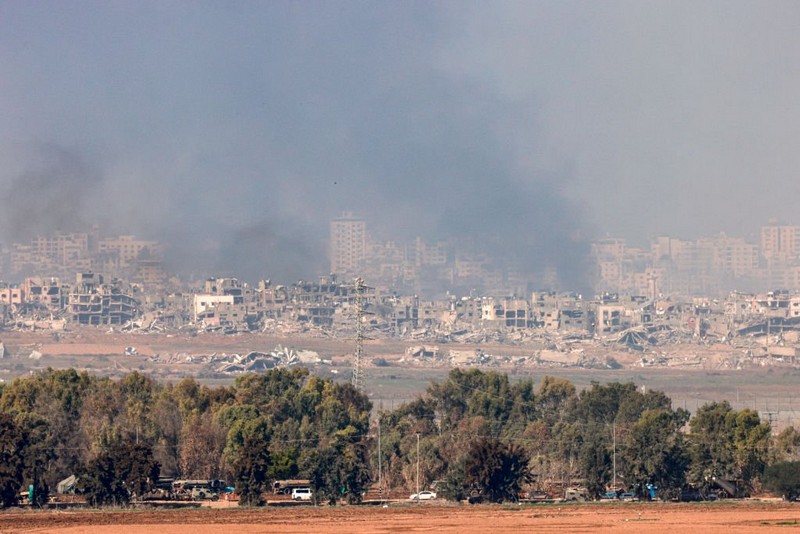
Israel’s military is erasing the streets of Gaza’s cities and the alleys of its refugee camps.

Israel’s military is erasing the streets of Gaza’s cities and the alleys of its refugee camps. It’s erasing Gaza’s beach promenades, villages and its unexpected yet existing agricultural areas. It’s erasing its cultural institutions, universities and archaeological sites.

Hamas’ military infrastructure is being destroyed and may be destroyed entirely. Thousands of its armed men are being killed and will be killed. But the organization will be rebuilt; it and its leaders will flourish in every community and place where the erasure of Gaza continues.

What enables the majority of Jewish Israelis to remain unshocked by the fact that in about two months we’ve killed around 7,000 children (a provisional figure) with the help of America’s improved bombs?

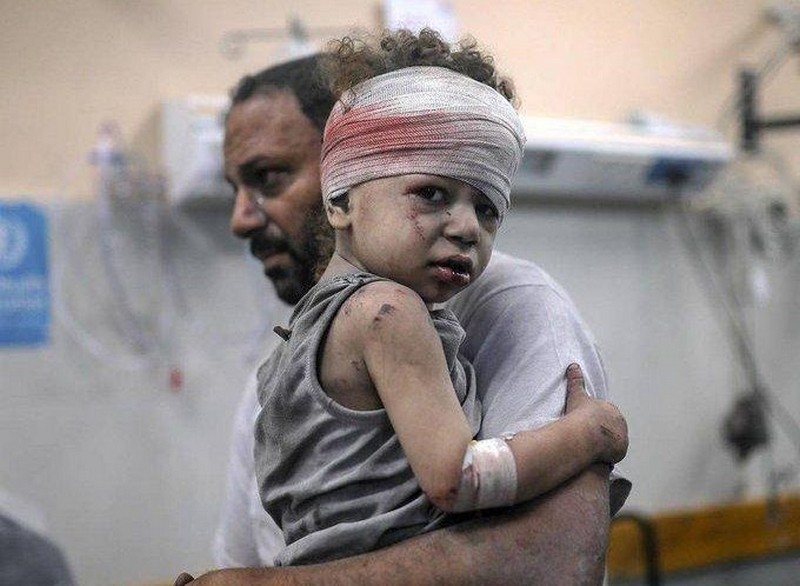
We’ve chosen not to look at the unbearable pictures of trembling Palestinian children, faces gray with dust, being rescued from between bombed concrete walls.

What enables most of the Jews not to gasp in horror at the crowding of 1.8 million or 1.9 million people into about 120 square kilometers (46 square miles), a “safe area” that’s constantly being bombed? What’s preventing those Jewish Israelis from screaming when they hear about the thirst and hunger of 2.2 million Palestinian civilians and the diseases spreading due to the crowding, the water shortage and the out-of-action hospitals?

What enables this erasure and the slaying of children with both our active and passive participation? Here are some answers:

  • For decades we’ve been educated to believe that only military force can ensure the state’s survival and ability to flourish, while denying rights to the Palestinian people.
  • We’ve erased any “context” – incitement has made this word a synonym for support of Hamas and justification of its horrors.
  • We Jews have assumed a monopoly on the suffering caused by the cruelty of the Other.
  • • We’ve chosen not to look at the unbearable pictures of trembling Palestinian children, faces gray with dust, being rescued from between bombed concrete walls. And there’s no way of knowing who’s more fortunate: those children or the ones who were killed.
  • Every mass or gradual killing that we’ve been carrying out against the Palestinians for years, every theft, humiliation and abuse passes through thousands of media, psychological and academic filters. The sifted product is our conviction that the Palestinians are better off than the Somalis or Syrians, so they shouldn’t complain.
  • We remember every massacre of Israelis by Palestinians. We forget every massacre of Palestinians by Israelis.
  • For decades we’ve gotten used to living in comfort while five minutes away Israel (in other words, us) demolishes Palestinian homes and builds for Jews, channels water to Jews and makes Palestinians go thirsty. All the rest is written in the reports of the rights groups HaMoked, B’Tselem and Adalah.
  • For decades we’ve been ignoring the “moderate” Palestinians’ warning that the continuous grab of freedom and land and the settlers’ violence – assisted by the state and inspired by its violence – narrow their children’s horizons and generate despair and faith in arms only and revenge.
  • We’ve embraced an essentialist worldview: The Palestinians are terrorists because that’s the way they are. They were born with genes for hating us – the offspring of Roman Emperor Titus and the pogromists of East Europe’s Khmelnytsky Uprising of the 17th century.
  • We’re convinced that we’re a democracy, even though for 56 years we’ve been ruling over millions of subjects without civil rights, controlling their land, money and economy.
  • We have profound racist contempt for the Palestinians, which we developed to justify, both cognitively and psychologically, our trampling over them.
  • We’ve been in denial of Palestinian history and the rootedness of Palestinian existence between the river and the sea.
  • The erasure of Gaza is possible because since 1994 we have deliberately missed the opportunity – offered to us by the Palestinians – to shed some of our traits as a dispossessing and settling entity and let them have a state on 22 percent of the area west of the Jordan River (including Gaza). I wrote in July 2021 that “in all the heat of the talk about apartheid, a dynamic, active and dangerous dimension of it – the Jewish settler colonialism – has become dulled and blunted.

“According to the ideology and policies of Jewish settler colonialism, the Palestinians are superfluous. In short, it is possible, worthwhile and desirable to live without the Palestinians in this country between the river and the sea. Their existence here is conditional, dependent on our wishes and our goodwill – a matter of time.

“The ideology of ‘superfluousness’ is a poison that spreads especially when the process of settler colonialism is at its height. … Settler colonialism is a continuous process of grabbing land, distorting historical borders, reshaping them and then expelling indigenous peoples.”

I referred to the “superfluousness” of the Palestinians in the West Bank and warned about the intentions to expel them. I assumed then that the viewing of Gazans as superfluous sufficed with severing them from their people and their families on the other side of the Erez checkpoint that separates Gaza from the rest of the land (Israel and the West Bank).

But now the “superfluousness” is being reflected in expulsion, disguised as voluntary under the shelling. It’s being reflected in the physical erasure of the Gazans, and in plans to return Jewish settlers to Gaza. Woe to them and woe to us.

Amira Hass is the Haaretz correspondent for the Occupied Territories.

25 December 2023

Source: transcend.org

Iran Threatens to Shut Strait of Gibraltar as Tensions Ramp Up

By Jörg Luyken

23 Dec 2023 – Iran has threatened to close the Strait of Gibraltar and the Mediterranean Sea unless Israel stops bombing Gaza, as the US warned Tehran was “deeply involved” in attacks on shipping.

“They shall soon await the closure of the Mediterranean Sea, [the Strait of] Gibraltar and other waterways,” Brigadier General Mohammad Reza Naqdi, a senior member of the country’s Islamic Revolutionary Guard Corps said today.

The general did not explain how Iran, which does not border the Mediterranean, intended to make good on its threat.

Iran’s proxy militias in southern Lebanon and Syria do have access to the sea, through which about a fifth of global maritime trade passes.

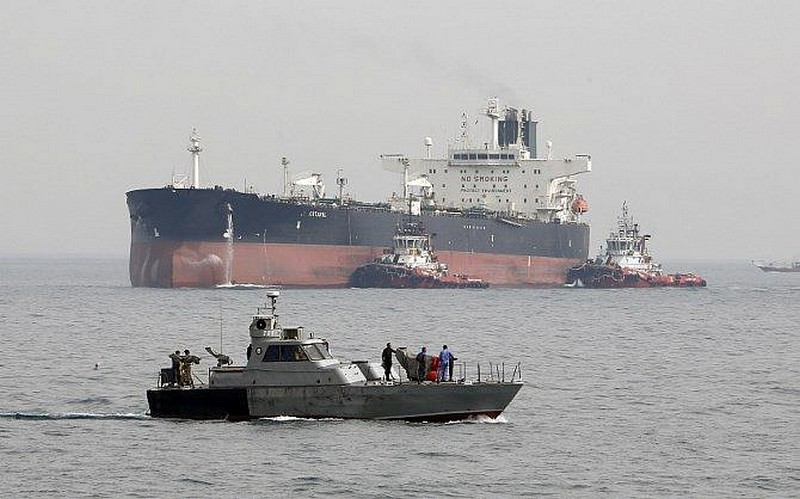
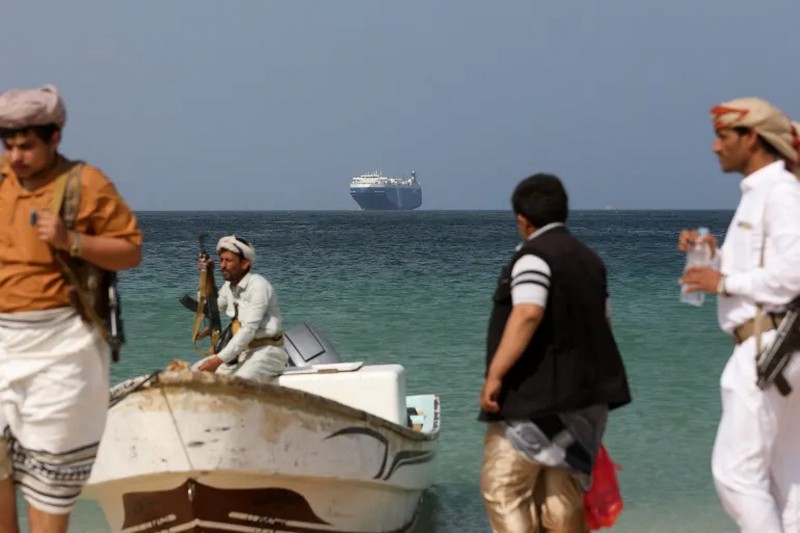
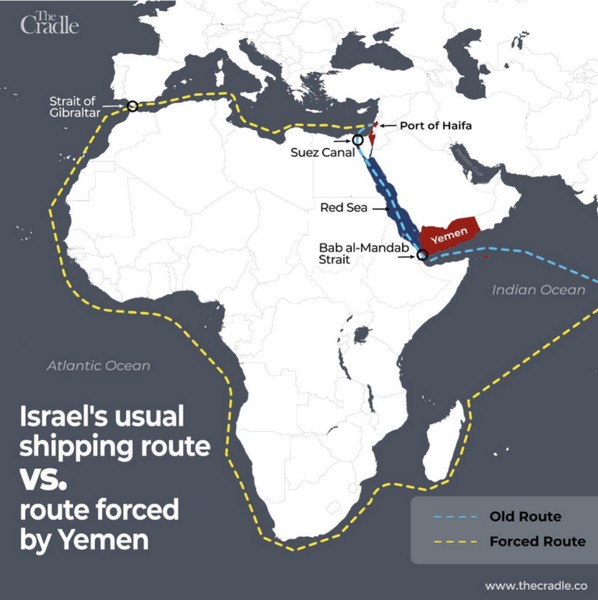
The Houthis in Yemen, which are backed by Iran, have already forced several major shipping companies to reroute their vessels to avoid the Red Sea by targeting merchant craft with drones and missiles.

Today, a Liberian-flagged tanker was struck by a drone while it was sailing in the Arabian Sea off the coast of India, setting it on fire.

“Some structural damage was also reported and some water was taken onboard. The vessel was Israel-affiliated. She had last called at Saudi Arabia and was destined for India at the time,” British maritime security firm Ambrey said.

The fire was extinguished without any casualties being suffered by the crew.

There was no immediate claim of responsibility, but the attack came amid a wave of drone and missile attacks carried out by the Houthis.

“Yesterday, the Persian Gulf and the Strait of Hormuz became a nightmare for them, and today they are trapped … in the Red Sea,” Brig Gen Naqdi said, describing “the birth of new powers of resistance”.

The Houthi leadership have described the attacks as retribution for Israel’s invasion of Gaza, which was run by another Tehran ally, Hamas.

They claim that the attacks are targeted against shipping headed for Israel; however, several ships which have been struck have no connection with Israel or the war.

On Friday [22 Dec], US intelligence accused Tehran of being “deeply involved” in the operational planning of the Red Sea attacks.

US intelligence suggests that Iran has been providing a monitoring system which is essential for the attacks, the National Security Council spokesman Adrienne Watson told US broadcaster CNN.

“Iran has the choice to provide or withhold this support, without which the Houthis would struggle to effectively track and strike commercial vessels navigating shipping lanes through the Red Sea and Gulf of Aden,” Ms Watson said.

Houthi attacks

“Iranian-provided tactical intelligence has been critical in enabling Houthi targeting of maritime vessels since the group commenced attacks in November,” she added.

Iran’s deputy foreign minister rejected the accusations that the country was involved in the Houthi attacks, saying the group was acting on its own.

“The resistance (Huthis) has its own tools… and acts in accordance with its own decisions and capabilities,” Iran’s deputy foreign minister Ali Bagheri told the country’s Mehr news agency.

“The fact that certain powers, such as the Americans and the Israelis, suffer strikes from the resistance movement… should in no way call into question the reality of the strength of the resistance in the region,” he added.

War on Israel

The Houthis, who have been fighting against Yemen’s government in a civil war since 2014, are part of an Iran-led “axis of resistance” against Israel, the US and the West.

The group’s leaders declared war on Israel last month, launching a salvo of drones and ballistic missiles at the southern Israeli city of Eilat more than 1,000 miles away.

Iran has repeatedly warned of a widening conflict, and last month, its foreign minister Hossein Amir-Abdollahian said the intensity of the war has rendered its expansion “inevitable”.

Iran’s president Ebrahim Raisi has said Iran sees it as “its duty to support the resistance groups” but insisted that they “are independent in their opinion, decision and action”.

Last month, Tehran dismissed as “invalid” Israel’s accusations that Houthi rebels were acting on Tehran’s “guidance” when they seized a Red Sea ship owned by an Israeli businessman.

25 December 2023

Source: transcend.org

Can the US-led Maritime Force Stop Yemen’s Houthi Attacks During Gaza War?

By Maziar Motamedi

The Houthis say they won’t stop attacking ships unless Israel stops its attacks on Gaza. So far, the shipping industry doesn’t appear convinced the task force can halt them.

19 Dec 2023 – The United States has announced the establishment of a new multinational maritime security force in response to attacks on ships launched by Iran-aligned Houthi rebels in Yemen.

The initiative is aimed at ensuring ships can pass through busy waterways near Yemen safely as the Houthis have been targeting vessels in protest of Israel’s war on Gaza, which has killed more than 19,000 Palestinians.

But what will the task force do, how will it work and how effective could it be?

What is the new force?

US Defense Secretary Lloyd Austin announced the establishment of a 10-country force on Tuesday in Bahrain.

In addition to the Arab nation, the United Kingdom, Canada, France, Italy, the Netherlands, Norway, the Seychelles and Spain have agreed to join Washington in the new mission.

Some of the countries are expected to conduct joint patrols in the southern parts of the Red Sea, the Bab al-Mandeb Strait and the Gulf of Aden while others will support the force by providing intelligence.

The mission will be coordinated by Combined Task Force 153 (CTF 153), an existing force under a US-led joint effort established in April 2022 with the aim of improving maritime security in the area.

The existing framework has 39 member nations, and there are reports that other countries could join or have already agreed to join the newly formed 10-member maritime effort but don’t want it publicised.

The Houthis have promised to stand up to any US-led efforts and only stop their attacks once Israel stops its war in Gaza. They have signalled they are open to talks, but diplomacy has so far failed to stop their attacks.

For its part, Iran has warned Washington that its joint maritime effort will face “extraordinary problems”.

Shipping companies pause Red Sea journeys after Houthi attacks

How disruptive are the Houthi attacks?

The Houthi group, also known as Ansarallah, started its operations against Israel by launching missiles and drones on the southern parts of Israel, including the port and tourist city of Eilat, in October soon after the war started.

Most of the projectiles were intercepted by Israeli and US defences or fell short due to the roughly 2,000km (1,240-mile) distance between the two countries.

So the Houthis changed tactics, instead focusing on ships near their shores. They have been firing missiles and launching attack drones at commercial ships that they claim are linked to Israel and seized a vessel last month that they are still holding in a Yemeni port.

Their attacks have stopped many ships from making their way to Israel.

“The Houthis are feeling emboldened. They perceive that they have won the civil war in Yemen and that their position is unchallenged domestically,” said Thomas Juneau, an assistant professor at the Graduate School of Public and International Affairs at the University of Ottawa whose research focuses on the Middle East, especially Iran and Yemen. “They also probably assess that the US and its regional partners are keen to avoid an escalation of the war in Gaza into a full-blown regional war.”

At least 12 shipping companies have suspended transit through the Red Sea due to the Houthi attacks. They include some of the largest in the world: Denmark’s AP Moller-Maersk, Germany’s Hapag-Lloyd, the Italian-Swiss Mediterranean Shipping Company and France’s CMA CGM.

Is a new oil crisis brewing?

Markets, including the oil and gas market, have increasingly reacted to the attacks, especially considering the volume of cargo being redirected. For instance, Maersk and Hapag-Lloyd together operate almost a quarter of the world’s shipping fleet.

Bab al-Mandeb, the narrow waterway that separates Eritrea and Djibouti on the Horn of Africa from Yemen on the Arabian Peninsula, is where 10 percent of the world’s seaborne crude oil travels. More than 17,000 ships pass through it each year. It is less than 20km (12 miles) wide, far narrower than the more than 200km (124 miles) of the northern parts of the Red Sea.

The direct impact on oil prices has been relatively limited so far, but experts have warned that things could significantly escalate if the attacks continue and security remains an issue. Insurance premiums and prices of oil and gas products are expected to rise if the conflict is not resolved.

“The Houthis will not be deterred to stop these strikes easily,” Juneau told Al Jazeera.

How will the task force provide protection to ships?

Some of the member nations of the task force have warships in the Red Sea. Two US navy destroyers, the USS Carney and USS Mason, are sailing through the Bab al-Mandeb Strait.

The idea is for the warships to serve as a deterrent to Houthi attacks and to stop them when possible.

The naval ships won’t necessarily escort commercial vessels through the Red Sea but will be on standby to respond to attacks.

Will the task force be able to stop Houthi attacks?

It’s complicated. Houthi fighters landed a helicopter on a ship last month to capture it. The presence of task force military vessels nearby could make a repeat of such a move harder.

The task force’s warships could also strike down incoming missiles from Yemen, just as they have intercepted rockets headed towards Israel. But even Israel’s much-touted Iron Dome missile defence system doesn’t have a 100 percent track record of stopping incoming rockets. So far, the US has not fired back at Yemen.

“It will be difficult for the recently announced, US-led coalition to fully deter the Houthis and put an end to their disruption of maritime shipping,” Juneau said.

At this point, the markets appear unconvinced that the task force will be able to protect shipments through the Red Sea. On Tuesday, Maersk said it was rerouting its ships around Africa to avoid sending them through the Bab al-Mandeb Strait.

Yemen’s Houthi rebels say they have launched a drone attack on the Israeli port city of Eilat

Maziar Motamedi is a Tehran-based journalist who covers Iran.

25 December 2023

Source: transcend.org

Yemen’s Houthis in Defense of Gaza

By Huseyin Vodinali

21 Dec 2023 – The genocide committed by Israel in Palestine continues to break our hearts every day.

Zionazis massacre children, women, babies, elderly journalists and doctors without showing the slightest sign of humanity. 70 days have passed since the war started on October 7.

At least 25 thousand people were killed by the Israeli army, at least 22 thousand of them were civilians and most of the civilians were children and babies.

Not only Muslims, but the whole world is standing up, Christians, Atheists, Buddhists and even Jews are in outrage against this Zionazi genocide.

So, if you ask what Arabs are doing, the answer will be nothing.

Jordan, which said at the beginning of the movie, “If you sweep Gaza, we will fall apart,” is now capturing and destroying the weapons going to the resistance axis on behalf of Israel.

There is no feeling from Egypt either.

Saudi Arabia and the UAE are concerned about opening a new trade corridor to Israel.

You ask why?

Because of the Bab El Mandeb strait closed by the Yemenis, who understand the suffering of the Palestinian people best.

We are talking about the Yemeni Houthis, who have been fighting for years with Saudi Arabia, supported by the USA, Israel and the UK, and which caused at least 150 thousand children to die from hunger and disease during the embargoes imposed.

These men, fighting with slippers on their feet, hit Saudi refineries and shot down F-16s, Eurofighters and Reapers.

A ceasefire was reached after China intervened by reconciling Tehran and Riyadh and Saudi Arabia made a geopolitical move.

Those Yemenis are now dealing a blow to Israel that no one else has dealt.

They stop and confiscate merchant ships going to Israel, and shoot down those that do not stop with missiles (they even have their own missiles called Burkan).

That’s why the four major logistics companies, which provide 53 percent of the world maritime trade, changed their routes and turned to Africa towards the Cape of Good Hope.

This means a delay of at least 3 weeks and a 120 percent increase in freight prices.

That’s why the port of Eilat, which is key in Israel’s supply chain, was disabled.

When Israel started to cry, the USA had to use its navy, which it deployed in the region after October 7, against Yemen this time. US Defense Secretary Austin Lloyd rushed to Israel and then to Bahrain.

In Manama, Bahrain-based American Naval Task Force CTF 153 announced the multinational “Prosperity Guardian” operation to prevent Yemeni attacks on Israel-bound ships in the Bab El Mandeb Strait and the Red Sea.

He also shamelessly said:

“If Iran does not stop the Houthis, world peace will be disrupted.”

Shameless man, you should first stop the genocide of your child Israel!

We have been watching images of babies being dismembered on live broadcast for 70 days, and we see Zionists rejoicing about this.

We read about Zionazis on social media saying ‘Let’s turn Gaza into Aushwitz’ and shouting ‘Palestinians are not human beings’.

All of the USA’s democracy and human rights literature went to the wastebasket of history with Israel.

USA is now not only for people like me! It is a fascist state that wears Hitler’s boots in the eyes of the whole world.

Meanwhile, there were also important developments.

As you know, Vladimir Putin’s last visit to the UAE and Saudi Arabia was very spectacular.

In both countries, Putin was welcomed with grand and magnificent ceremonies.

The Russian leader has also been in intense telephone traffic not only with the Iranian Leadership but also with Egyptian President Sisi since the beginning of the crisis.

I think these attempts bore fruit, and Egypt, Saudi Arabia and the UAE refused to participate in the US “Guardian of Prosperity” operation. (Although Yemenis’ threat to destroy oil and gas fields if the Saudis and the UAE get involved may also have been effective.)

Although oil continues to flow from Ceyhan, Turkey has not participated in the American operation (for now).

The countries participating in the US operation are listed as follows: England, Israel, France, Netherlands, Norway, Seychelles, Canada, Italy and Bahrain.

If we look at the countries other than Bahrain, we can say that a Crusader Navy has been established.

Europe has already shown that it is a vassal of the USA and its neo-Nazis from the beginning of the Ukraine war. Now he serves the Zionazis.

Bahrain is a British colonial country and 60 percent of its population is Shia, like the Houthis in Yemen.

There had already been some uprising attempts before.

Following these developments, the Houthi leadership also called on Shiites and Sunnis in Bahrain to revolt.

Ret. Admiral Cem Gürdeniz, one of Turkiye’s rare geopolitical experts, commented on these developments and warned that they could turn into a war that would engulf the world.

He said:

“This crisis, which emerged as a reaction to Israel’s massacre in Gaza, is a result of activities on land rather than at sea. Therefore, it is impossible to solve it without intervening on land, that is, on the coasts of Yemen under Houthi control. A US-led air or land attack on Yemen would suddenly escalate the Israeli-Palestinian war into the Iran-USA crisis. In a conjuncture where major maritime trade and giant oil companies such as BP have given up on Suez and Bab El Mandeb, the world economy cannot handle such a crisis that will cause the Strait of Hormuz to be closed.”

This time, there are no poor gangs with rifles against USA, there is a strong and organized army.

The resistance axis led by Iran; It consists of the Islamic Jihad in Gaza, various resistance groups in Syria and Iraq (such as Hashd al-Shaabi), the Lebanese Hezbollah, and the Yemeni Houthis.

The militia will reportedly consist of 55,000 volunteer forces with 33,000 ships and will carry 107 mm rockets.

Russia and China also provide serious political, economic and military support to Iran.

The fact that the USA is (once again) stuck in the Middle East quagmire gives Russia’s hand in Ukraine and China’s hand in Taiwan.

These are the geopolitical consequences of the event.

But from a humanitarian perspective, the “Che Guevaras in Slippers” in Yemen became the heroes who saved the crumbling honor of the Arab and Muslim world.

Three days ago, the Ansarullah (Houthi) movement managed to hit an MSC ship traveling at a speed of 25 knots with an anti-ship ballistic missile with a range of 300 km and a speed of Mach 8.

The Houthis told all ships,

“If you are not going to Israel, there is no problem, but we will continue our attacks against those going to Israel until Israel establishes a ceasefire and allows medicine and food to enter Gaza.”

The men do not step back an inch.

Ansarullah Defense Minister said the following about the US-led Operation Prosperity Guardian:

“The Red Sea will be your graveyard. We have weapons that will sink your aircraft carriers and destroyers.”

As we enter 2024, we will be watching a crisis in which the USA plays the leading role turn into a regional war.

By the way, the Houthis’ Slipper Resistance against the genocide will go down in history, after the mother’s slipper, which is the most effective punishment tool!

25 December 2023

Source: transcend.org