Just International

Genocide in Pictures: Worth a Trillion Words

By Antonio C. S. Rosa

Parental Guidance Advised: Pornographic Violence

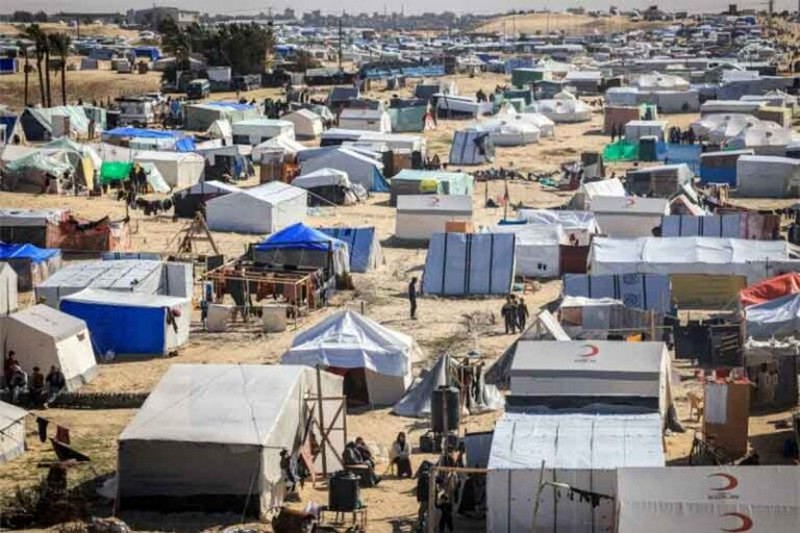
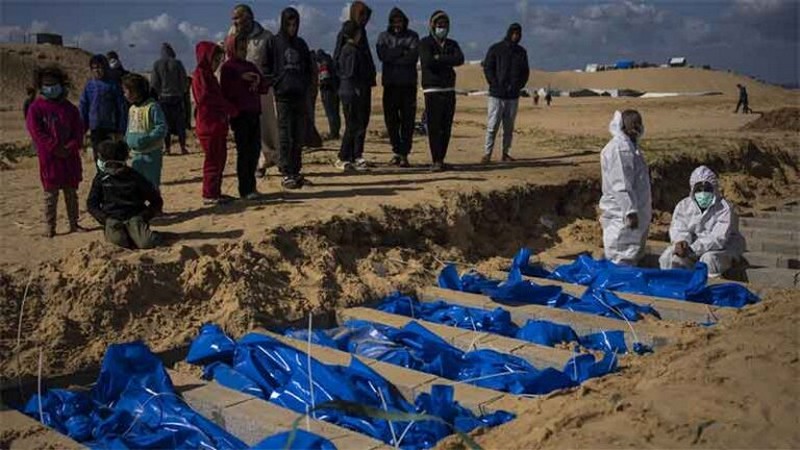
** Gazans have no means to rescue bodies from under the rubble of flattened buildings. Victims are left to die trapped under tons of dirt, making diseases practically inevitable. **

GAZA and WEST BANK, 8 Jan 2024

Up to 7 Jan 2024:

  • 22,835+ killed* and 58,416 wounded in the Gaza Strip
  • 380 Palestinians killed in the West Bank and East Jerusalem
  • Israel revises its estimated October 7 death toll down from 1,400 to 1,147
  • 510 Israeli soldiers killed since October 7, and at least 2,193 injured

* Some rights groups put the death toll number closer to 30,000 when accounting for those presumed dead under the rubble.

8 January 2024

Source: transcend.org

Operation Condor: The Cold War US Conspiracy That Terrorized South America

By Giles Tremlett

During the 1970s and 80s, eight US (Henry Kissinger)-backed right wing military dictatorships jointly plotted the cross-border kidnap, torture, rape and murder of hundreds of their left wing political opponents. Now some of the perpetrators are finally facing justice.

The last time Anatole Larrabeiti saw his parents, he was four years old. It was 26 September 1976, the day after his birthday. He remembers the shootout, the bright flashes of gunfire and the sight of his father lying on the ground, mortally wounded, outside their home in a suburb of Buenos Aires, Argentina, with his mother lying beside him. Then Larrabeiti remembers being taken away by armed police, along with his 18-month-old sister, Victoria Eva.

The two children became prisoners. At first, they were held in a grimy car repair garage that had been turned into a clandestine torture centre. That was in another part of Buenos Aires, the city that their parents had moved to in June 1973, joining thousands of leftwing militants and former guerrillas fleeing a military coup in their native Uruguay. The following month, in October 1976, Anatole and Victoria Eva were taken to Montevideo, the capital of Uruguay, and held at the military intelligence headquarters. A few days before Christmas, they were flown to a third country, Chile, in a small aircraft that climbed high above the Andes. Larrabeiti remembers looking down on snowy peaks from the plane.

Young children do not usually make epic journeys through three countries in as many months without parents or relatives. The closest thing they had to family was a jailer known as Aunt Mónica. It was probably Aunt Mónica who abandoned them in a large square, the Plaza O’Higgins, in the Chilean port city of Valparaíso, on 22 December 1976. Witnesses recall two young, well-dressed children stepping out of a black car with tinted windows. Larrabeiti wandered around the square, hand-in-hand with his sister, until the owner of a merry-go-round ride spotted them. He invited them to sit on the ride, expecting some panicked parents to appear, looking for their lost children. But nobody came, so he called the local police.

No one could understand how the two children, whose accents marked them as foreign, had got here. It was as if they had dropped from the sky. Anatole was too young to make sense of what had happened. How does a four-year-old who finds himself in Chile explain that he does not know where he is, that he lives in Argentina, but is really Uruguayan? All he knew was that he was in a strange place, where people spoke his language in a different way.

The next day, the children were taken to an orphanage, and from there they were sent on to separate foster homes. After a few months, they had a stroke of luck. A dental surgeon and his wife wanted to adopt, and when the magistrate in charge of the children asked the surgeon which sibling he wanted, he said both. “He said that we had to come together, because we were brother and sister,” Larrabeiti told me when we met earlier this year in Chile’s capital, Santiago.

Today, he is a trim, smartly suited 47-year-old public prosecutor with hazel eyes and a shaven head. “I have decided to live without hate,” he said. “But I want people to know.”

What Larrabeiti wants people to know is that his family were victims of one of the 20th century’s most sinister international state terror networks. It was called Operation Condor, after the broad-winged vulture that soars above the Andes, and it joined eight South American military dictatorships – Argentina, Chile, Uruguay, Bolivia, Paraguay, Brazil, Peru and Ecuador – into a single network that covered four-fifths of the continent.

It has taken decades to fully expose this system, which enabled governments to send death squads on to each other’s territory to kidnap, murder and torture enemies – real or suspected – among their emigrant and exile communities. Condor effectively integrated and expanded the state terror unleashed across South America during the cold war, after successive rightwing military coups, often encouraged by the US, erased democracy across the continent. Condor was the most complex and sophisticated element of a broad phenomenon in which tens of thousands of people across South America were murdered or disappeared by military governments in the 1970s and 80s.

Most Condor victims disappeared for ever. Hundreds were secretly disposed of – some of them tossed into the sea from planes or helicopters after being tied up, shackled to concrete blocks or drugged so that they could barely move. Larrabeiti’s mother, Victoria, who was last seen in an Argentinian torture centre in 1976, is one of them. His father, Mario, who was a leftwing militant, probably died in the shootout when they were snatched by the police. Enough victims have survived, however, to tell stories that, when matched against a growing volume of declassified documents, amount to a single, ghastly tale.

In the past two decades, Larrabeiti’s story has been told and retold in half a dozen courts and tribunals around the world. In the absence of a fully formed global criminal justice system, the perpetrators of Condor are being taken to court through a piecemeal process. “The trouble with borders is that it is easier to cross them to kill someone than it is to pursue a crime,” says Carlos Castresana, a prosecutor who has pursued Condor cases and the dictators behind them in Spain. Those seeking justice have had to rely on a judicial spider’s web of national laws, international treaties and rulings by human rights tribunals. The individuals they pursue are often decrepit and unrepentant old men, but a tenacious network of survivors, lawyers, investigators and academics, rather like the postwar Nazi-hunters, has taken up the challenge of ensuring that such international state terror does not go untried.

The process is painfully slow. The first major criminal investigation focusing on Condor – with victims and defendants from seven countries – began in Rome more than 20 years ago. It still has not ended. On a sweltering day in July 2019, a judge in the Rome case handed life sentences to a former president of Peru, a Uruguayan foreign minister, a Chilean military intelligence chief and 21 others for their role in a coordinated campaign of extermination and torture. The defendants are appealing, and a final verdict is due within a year.

Much of what we now know about Condor has been unearthed or pieced together in Rome, Buenos Aires and in dozens of court cases – large and small – in other countries. Further evidence comes from US intelligence papers dealing with Argentina that were declassified on the orders of Barack Obama. In 2019, the US completed its handover of 47,000 pages to Argentina. These documents show how much the US and European governments knew about what was happening across South America, and how little they cared.

When he was seven, Anatole Larrabeiti discovered his true identity, thanks to his tenacious paternal grandmother, Angélica, who tracked the siblings down. Stories had appeared in the Chilean press when they vanished in 1976, though headlines claimed they were abandoned by unidentified “red terrorist parents”. Over the next few years, word of the missing children’s whereabouts spread from one humanitarian organisation to another, before eventually reaching the Brazilian human rights group Clamor, which had activists in Valparaíso, the city in Chile where Larrabeiti and his sister were living. After a tipoff, the activists secretly photographed the children on their way to school and sent pictures to Angélica. She immediately recognised her grandchildren. “My sister was a replica of my mother as a child,” explained Larrabeiti. “And I have her lips.”

By agreement with their biological grandparents, the children remained with their adopted parents in Chile. When Victoria Eva turned nine, she was told about her true identity, and the children started to make family visits to Uruguay. “They were good parents,” said Larrabeiti, of the couple who adopted them. “They kept the links with Uruguay and we had psychological support, which I needed when I became a very angry adolescent.”

The crimes committed by Latin America’s military regimes during the cold war continue to haunt the continent. Only a perverse combination of power and paranoia can explain why these regimes awarded themselves the right not just to murder and torture, but also to steal children such as the Larrabeitis. The men perpetrating such crimes saw themselves as warriors in a messianic, frontierless war against the spread of armed revolution across Latin America.

Their fantasies were overblown, but not entirely baseless. In 1965, the Argentinian revolutionary Ernesto “Che” Guevara had waved an emotional goodbye to his comrade-in-arms Fidel Castro, leaving Cuba. He vowed to initiate a new phase of revolutionary activity, extending guerrilla warfare across Latin America. Che was killed while carrying out his mission in Bolivia in 1967, but the US by then viewed revolution in Latin America as an existential threat – recalling how Russian nuclear weapons had reached Cuban soil during the 1962 missile crisis. In a bid to strengthen anti-communist forces, the US pumped money and weapons to armed forces across the region, vastly increasing the power of the military within these states and eventually, as the American journalist John Dinges has written, ending up in an “intimate embrace with mass murderers running torture camps, body dumps, and crematoriums”. In the 70s, as rightwing military coups and state terror swept the continent, an attempt at coordinating an armed response was made via a loose network known as the Revolutionary Coordinating Junta (JCR). Formed by groups from Chile, Uruguay, Argentina and Bolivia in 1973, the JCR had grandiose plans to pursue Che’s continental uprising, but lacked funds, friends and firepower. Meanwhile, South America’s military regimes began to collaborate more closely, initially striking bilateral agreements that allowed operatives to carry out their work on foreign soil.

Aurora Meloni, a Uruguayan who had gone into exile in Argentina with her husband, Daniel Banfi, and two young daughters, was one of the first to suspect that South America’s violent right was plotting an international network of terror and rendition. At 3am on 13 September 1974, Meloni and Banfi were at home in a suburb of Buenos Aires when about half a dozen armed men burst through their door. Meloni, then aged 23, immediately recognised one of them as the notorious Uruguayan police inspector Hugo Campos Hermida. Back in Uruguay, Hermida had once questioned Meloni and Banfi – then students of literature and history respectively – after they had taken part in a demonstration back home in support of the leftwing Tupamaro guerrilla movement, to which Banfi belonged. “I remembered how he [Hermida] had hit me,” Meloni told me. “He was very aggressive.”

Meloni could not understand why Hermida was working freely in a foreign country. At that time, Argentina was still a democracy, with rule of law. (The military takeover came later, in March 1976.) Foreign policemen had no right to act there. After their apartment had been ransacked for clues as to the whereabouts of other exiled Tupamaros, Hermida took Banfi away. Aurora assumed she would soon discover which police station or jail he had been taken to, but there was silence.

In September 1974, this was still a bizarre event. “We had never heard of people disappearing in Argentina before. I was sure I would find him,” Meloni told me. Eventually she called a press conference. How could someone vanish like that? The answer came five weeks later, when three bodies bearing torture scars were discovered by police 75 miles away. Car headlights and a group of men had been seen in a remote spot at night, and pile of fresh earth had been left behind. Daniel Banfi was one of three murdered Uruguayans found in the hastily dug grave.

The following month, Meloni left Argentina, and eventually moved to Italy, where, since her father was Italian, she had dual nationality. She returned to Uruguay for three spells over the next 25 years, seeking justice. But, just as in Chile and Argentina, the price of ending dictatorship in Uruguay in 1985 was an amnesty, which ruled that state representatives could not be charged with crimes committed during the regime’s 12 years in power. It seemed nothing could be done.

It wasn’t until the end of the century that cracks in the legal status quo began to appear. In the late 90s, a Spanish judge named Baltasar Garzón began testing a previously ignored law that obliged Spain to pursue any alleged human rights abusers anywhere in the world, if their own countries refused to try them. Garzón and a group of progressive prosecutors opened investigations for genocide and terrorism against Argentina’s former military junta and Pinochet’s regime, and “a criminal conspiracy” between them.

Since the accused did not live in Spain, Garzón’s quest was viewed as quixotic. “People laughed at us,” the Spanish prosecutor who brought these cases, Carlos Castresana, told me in Madrid recently. On 16 October 1998, however, Pinochet was arrested by police at a London clinic after a minor hernia operation. He was a frequent visitor to the city, taking tea at Fortnum & Mason and popping in on his old friend and ally Margaret Thatcher.

Amid the headlines and the flurry of paperwork sent to London over the following days, few people noticed that the initial warrant for Pinochet’s arrest was based on a Condor case. It named a Chilean victim who disappeared in Argentina, Edgardo Enríquez, and stated that “there is evidence of a coordinated plan, known as Operation Condor, in which several countries took part”.

Pinochet was held for 17 months while Britain’s law lords twice approved extradition to Spain. Labour party home secretary Jack Straw stymied the extradition, instead sending Pinochet home to Chile on health grounds. On his return, the former dictator made a mockery of that justification by stepping out of his wheelchair to wave joyfully at supporters. Yet something major had changed, as prosecutors, judges and activists realised that South America’s dictators and their henchmen were no longer untouchable.

In 1999, inspired by Garzón, Aurora Meloni brought a murder case in Italy against Uruguayan security officials who were suspected of killing Banfi and others. Families of other Condor victims with Italian citizenship joined Meloni, and the case broadened to cover Condor crimes in several countries. From her home in Milan, Meloni – now aged 69 – has kept the case alive ever since. “It has taken a long time,” she told me. After last year’s sentencing in Rome, the plaintiffs were delighted, but Meloni points out that until we know the outcome of the appeals, the story isn’t over.

When Daniel Banfi was murdered in late 1974, Condor did not yet formally exist. His death can be seen as a precursor, or trial run. Hermida Campos was one of a handful of Uruguayan security officials who were secretly testing ways of hunting down exiles with their Argentinian counterparts.

Another of those preparing the rendition programme with Argentina, which would later be absorbed into Condor, was the Uruguayan navy lieutenant Jorge Tróccoli. Now a grey, jowly 73-year-old, Tróccoli was the only defendant present at the Rome trial. He had moved to Italy and was arrested in Salerno, near Naples, in 2007. In the 90s, Tróccoli wrote two semi-autobiographical novels about how Uruguay’s military had embraced torture, murder and repression. In La Hora del Depredador (The Predator’s Hour), a torturer who appears to act as a proxy for the author (though Tróccoli insists this is fiction) declares: “When this is over, we will have to make peace. And that won’t happen if we use methods like this … What’s more, you will begin to feel bad about it as the years go by.” Yet, in court, Tróccoli showed no remorse, claiming innocence. “He sat beside me one day,” Meloni told me. “He was angry, not ashamed.”

Most of what we know about Operation Condor only emerged years after it was over. Formal coordinating offices existed in several countries, and the network generated considerable paperwork as documents and encrypted cables were sent back and forth over a dedicated communications network called Condortel. But at the time the victims did not understand the scale of the international conspiracy.

For more than a decade, public knowledge of Operation Condor was largely limited to an obscure FBI note quoted in a book, published in 1980, by John Dinges and fellow journalist Saul Landau. They were investigating the murders of a former Chilean ambassador and his American assistant, who were killed in Washington DC in 1976 by Pinochet’s agents. In a cable sent shortly after the killings, an FBI officer wrote: “Operation Condor is the code name for the collection, exchange and storage of intelligence data concerning leftists, communists and Marxists which was recently established between the cooperating services in South America.” The note went on to mention “a more secret phase” of Condor, which “involves the formation of special teams from member countries who are to travel anywhere in the world to carry out sanctions, [including] assassinations”.

Beyond that, relatively little was known. It was in Paraguay where the first major breakthrough took place. In 1992, a young magistrate, José Agustín Fernández, received a tipoff on the whereabouts of the secret police archive of the country’s former strongman Gen Alfredo Stroessner, who grabbed power in 1954 and stayed until 1989. At dawn, three days before Christmas, Fernández made a surprise visit to a police station outside the capital city, Asunción. With a caravan of television cameras as company, but armed only with a warrant signed in his own hand, the magistrate forced Paraguay’s once-untouchable police to hand over the documents. “The journalists had to lend us a truck to take it all back to the court house,” Fernández told me. “Perhaps the most shocking thing were the photographs. They included people who were disappeared by Condor.”

Fernández’s haul became known as the Archive of Terror. Here, buried among half a million sheets of paper detailing three decades of domestic repression under Stroessner, was the story of how Operation Condor was created, and by whom. It was not what Fernández had originally sought, and he was shocked. “We had heard the stories about it, but here was written proof,” he told me.

The documents established that Condor was formally created in November 1975, when Pinochet’s spy chief, Manuel Contreras, invited 50 intelligence officers from Chile, Uruguay, Argentina, Paraguay, Bolivia and Brazil to the Army War Academy on La Alameda, Santiago’s central avenue. Pinochet welcomed them in person. “Subversion has developed a leadership structure that is intercontinental, continental, regional and sub-regional,” Contreras told them, referring to organised resistance from opponents of the continent’s military regimes. He proposed a sophisticated network linked by “telex, microfilm, computers, cryptography” to track down and eliminate enemies.

The club, with the first five countries as members, came into existence on 28 November. Brazil joined the next year, while Peru and Ecuador joined in 1978. At its height, Condor covered 10% of the world’s populated land mass, and formed what Francesca Lessa of Oxford University calls “a borderless area of terror and impunity”.

The Archive of Terror documents were revealing, but they were largely dry, bureaucratic records. Behind them lay a reality of the kidnap, torture, rape and murder of at least 763 people, according to a database that Lessa is building. Yet it was only after the archive was found – and especially after Condor was named in Garzón’s Pinochet case – that the disconnected stories of the victims began to cohere into a bigger story.

Laura Elgueta lives in a small house in La Reina, a tranquil suburb of Santiago where purple jacaranda trees blossom. She is one of Condor’s survivors. Her friend Odette Magnet – whose 27-year-old sister, María Cecilia, disappeared in Argentina in 1976 – lives a five-minute walk away. “When I was looking for somewhere to move to, I wanted to live near her,” Magnet explained as we made the walk to Elgueta’s home. Together, the two women have long shouldered the burden of explaining Condor to Chileans at human rights conferences and in the media.

Although Condor operatives hunted down targets in all member states, their work focused on Argentina in particular, which was a refuge for exiles escaping military dictatorships across the continent before it, too, fell under military control. Condor squads dispatched to Argentina from Uruguay and Chile used a series of makeshift jails and torture centres provided by their hosts. The first was the abandoned car repair garage, Automotores Orletti, where Anatole Larrabeiti was held and his mother Victoria was last seen alive. Larrabeiti still recalls seeing a jar of glittering metal in the garage, in which victims’ wedding rings were kept.

Later, Condor victims were taken to Club Atlético, a codename for the basement of a police warehouse in Buenos Aires. This is where a blindfolded, 18-year-old Laura Elgueta arrived in July 1977 with her sister-in-law, Sonia, after armed Chileans and Argentinians snatched them from her home nearby. At the time, Elgueta’s Chilean family – part of which was now exiled in Argentina – was still searching for her activist brother, Kiko, who had disappeared in Buenos Aires the previous July. “We knew he had been kidnapped, but that was all,” Elgueta told me.

In the car, the sexual, physical and verbal abuse began. It continued at Club Atlético – where the women were stripped, handcuffed, hooded and given their numbers, K52 and K53. “Whoever walked past would insult you, or beat you, or throw you to the ground,” Elgueta recalled. They could hear fellow prisoners walking in chains. The Chilean torturers made no attempt to disguise their nationality, and Elgueta and Sonia’s interrogation focused solely on Chile’s exile community in Argentina. The women were taken to the torture room by turns. Beatings, more sexual abuse and electric shocks followed. “They’d say: ‘Now the party can really start.’ Despite all we know and have read, you cannot imagine what human beings are capable of. It was a house of horrors,” Elgueta told me. “When my sister-in-law came out of one session, they had given her such strong electric shocks that she was still trembling.”

After eight hours, Elgueta and her sister-in-law were released. Their torturers had realised the two women knew nothing about Pinochet’s political or armed opponents. “As I left, the one [torturer] who had decided I was his girlfriend was there shouting: ‘Don’t take her away. I want to be with my girl!’” Elgueta was still blindfolded when she was driven away and dumped on a street corner near her home.

Although Elgueta and Magnet had campaigned for Operation Condor to be investigated in Chile for years, they say that the media and politicians there only became interested after Pinochet was arrested in London. “Countries did not want to recognise that they had allowed armed units from other countries to operate on their territory,” Elgueta told me. “The ignorance about Condor here was incredible.”

Awareness of Condor is now more widespread, and many deaths are finally being investigated by the courts, but that does not mean all Chileans think it was a bad idea. In fact, just as in Argentina, Uruguay and Brazil, a small but significant part of Chilean society defends the dictatorship and its enforcers.

One March afternoon in Santiago, I walked to La Alameda, the broad main avenue, which is officially called Avenida Libertador Bernardo O’Higgins, where daily battles were raging between rock-throwing protesters and teargas-armed police. Protests demanding reforms to the neoliberal state and constitution imposed by Pinochet had rumbled on since October 2019, reflecting broad anger at hangovers from that era – including allegations of police abuse under the conservative government of billionaire president Sebastián Piñera – the country’s fifth-richest man, whose brother served as a minister under Pinochet. Alleged victims, many of whom were demonstrators, talk of torture, rape, killings and attempted killings. “We never thought we would have to come back to Chile under these circumstances,” declared José Miguel Vivanco, of Human Rights Watch, when it presented a report that counted injuries to more than 11,000 people in protests up to November 2019. “We thought this was history.”

On the avenue, an empty teargas canister lying among freshly-hurled stones bore, by coincidence, the name “Condor” – a company that has long supplied the Chilean army and police. Protesters claimed these were being shot directly at people’s faces, helping account for more than 400 eye injuries. Piñera at first condemned protesters as being “at war against all good Chileans”, but has since ordered investigations and replaced his interior minister Andrés Chadwick (a former Pinochet supporter and cousin of Piñera), who was then punished by parliament with a ban from holding public office for five years. A referendum on constitutional change, which had been postponed because of Covid-19, is now scheduled for 25 October.

On the outskirts of the city, Magnet took me to Villa Grimaldi, a detention centre in a former restaurant complex where victims were sometimes locked for days inside tiny wooden boxes. It is now a museum that includes drawings by the English doctor Sheila Cassidy, who was tortured there after treating a wounded leader of the armed opposition to Pinochet. Cassidy later told of how women prisoners were given electric shocks to the vagina and raped, including by dogs. On display at Villa Grimaldi is one of the concrete beams to which victims were tied before they were taken to be dropped into the sea from helicopters.

Magnet and I looked for her sister María Cecilia’s name among the 188 small ceramic plaques set down beside rose bushes to commemorate each of Pinochet’s female victims. Magnet’s sister had been an active part of the exiled opposition. “Sometimes I wish she hadn’t been so brave, and had fled from Argentina before this happened, as others did,” said Magnet. Eventually we found María Cecilia’s plaque, beside a bush of pale yellow roses.

Although many of the men who carried out Operation Condor were alumni of the US army’s School of the Americas – a training camp in Panama for military from allied regimes across the continent – this was not a US-led operation. Recent revelations, however, show just how much western intelligence services knew about Condor.

Shortly before I travelled to Chile in March, startling news emerged about a Swiss company that had, for decades, supplied cryptography machines to military, police and spy agencies around the world. The company, the Washington Post revealed, had been secretly owned by the CIA and West Germany’s BND intelligence service. Any messages sent via its cryptography machines could, unbeknownst to the users, be read by the US and West Germany. Among the company’s clients were the regimes in Argentina, Brazil, Chile, Peru and Uruguay. As the Washington Post put it, the CIA “was, in effect, supplying rigged communications gear to some of South America’s most brutal regimes and, as a result, in [a] unique position to know the extent of their atrocities”.

The new information about the rigged cryptography machines follows the revelations, from a declassified document handed to Argentina by the US last year, that West German, British and French intelligence services even explored the possibility of copying at least part of the Condor method in Europe. A heavily redacted CIA cable from September 1977 is headed: “Visit of representatives of West German, French and British intelligence services to Argentina to discuss methods for establishment of an anti-subversive organization similar to Condor”. The visit coincided with cross-frontier terror campaigns by Germany’s Baader-Meinhof gang, Italy’s Red Brigades and the Irish Republican Army. According to the cable, the visitors explained that “the terrorist/subversive threat had reached such dangerous levels in Europe that they believed it best if they pooled their intelligence resources in a cooperative organization such as Condor”.

There is no evidence that this plan went any further, but we know that by that point, Condor countries were planning a Europe-wide assassination campaign. Chile had already independently carried out attacks in Europe, including an assassination attempt in Rome, in October 1975, on the exiled Chilean politician Bernardo Leighton. Now Condor teams were to kill people of any nationality living in Europe who they deemed terrorist leaders – though “non-terrorists also were reportedly candidates”, a CIA report from May 1977 reveals. The report states that “leaders of Amnesty Internation[al] were mentioned as targets”.

Fortunately for those on the hit list, the blustering nationalism of generals in different Latin American countries, who had spent much of their careers preparing to fight each other – rather than “subversives” at home – came to a head in 1978, when Chile and Argentina fell out over their maritime frontiers in the Beagle Channel. The quarrelling made military cooperation between them impossible, and eventually provoked the collapse of the wider Condor network, putting paid to the campaign in Europe. Just a few years later, Chile would secretly assist Britain in the Falklands war, which would, in turn, lead to the fall of Argentina’s military junta in 1983.

The dictatorships fell, one by one, during the 80s. In the wake of these upheavals, attempts to prosecute human rights abusers in Condor countries were either nonexistent, or easily stalled, amid widespread fear that the military would rebel and reimpose dictatorship. Argentina’s former junta leaders were tried and found guilty of human rights abuses in 1985, but soon pardoned – and an amnesty law introduced. In Uruguay, an amnesty was approved in 1986, hours before Condor officers and others were due in court for the first time. It seemed that some of the most heinous crimes of the 20th century were destined to go unpunished.

That began to change with Pinochet’s arrest in London. “It was Garzón who woke the world up to this,” Laura Elgueta told me. As Pinochet’s arrest highlighted, amnesty laws did not provide universal protection, and Condor was a weak spot. In retrospect, those who expected lifelong impunity for their involvement in Condor made three key mistakes. First of all, they stole children, a crime that even amnesties did not cover. Second, they wrongly assumed that amnesties would cover crimes committed on foreign soil. Finally, they hid their killings by making victims disappear – thereby turning those crimes into ongoing, unresolved kidnappings, which, unlike a murder where a body is found, cannot be covered by a statute of limitations or an amnesty for past events. These errors allowed a bold group of prosecutors and judges to bypass amnesty laws in a handful of carefully selected cases. These, in turn, revealed such ghastly truths that some governments were shamed into voiding the amnesty laws.

In Argentina, the trial of one of Elgueta’s Chilean kidnappers, for a separate assassination in 1974, produced a 2001 court ruling that statutes of limitations did not apply to crimes against humanity – which include torture, murder and kidnapping. As these were crimes routinely committed by a military regime that had “disappeared” more than 20,000 of its citizens during the so-called dirty war, this ruling undermined the Argentinian amnesty laws, and they were annulled in 2003. Uruguay’s amnesty law, meanwhile, was voided in 2011 at the behest of the Inter-American court of human rights in Costa Rica, after it had investigated the case of a kidnapped baby who had been held with Anatole Larrabeiti and his sister at the military intelligence headquarters in Montevideo.

Chile’s amnesty law still stands but, by 2002, a series of court decisions had left it almost toothless, declaring that it could not be applied to operations abroad, forced disappearances or cases with child victims. Of the major Condor countries, only Brazil conserves its amnesty law intact, and it remains the country where least progress has been made in pursuing crimes committed by its military dictatorship.

By 2011, with most amnesties cancelled or deemed largely inapplicable, Condor cases could finally be investigated more freely – and information began to flow between investigators in multiple countries. Two long-running cases – the one instigated by Aurora Meloni in Italy, along with another in Argentina – have come to sentencing in the past five years. In 2016, the trial in Argentina, which centred on 109 Condor victims from six countries, ended with 15 prison sentences – including for former junta president Reynaldo Bignone, who was then 87. Seven other accused men died during the three-year trial. The sentence was the first to recognise “a transnational, illegal conspiracy … dedicated to persecuting, kidnapping, forcefully repatriating, torturing and murdering political activists.” Argentina, it added, had become “a hunting ground”.

The Rome case extended the investigation to suspects from Peru, Bolivia and Chile. As in Argentina, it required unprecedented – if sluggish and sometimes failed – collaboration between countries, but the conclusion was the same: Condor was an illegal international network of state terror. Both sentences provided not only justice but, in their detailed investigation and description of what had happened, a telling of history as well.

Thanks also to dozens of smaller cases across eight countries, many Condor victims have had their day in court. Francesca Lessa has counted a total of 469 Condor victims during its most coordinated phase, between 1976 and 1978, and a further 296 in the years of more bilateral operations immediately prior to and after the main Condor period. They include 23 cases involving children, and at least 370 murders. Almost 60% of those cases have gone through court, or are in the process of doing so – with 94 people handed jail sentences (though often to men who can’t be extradited from their home countries to serve them).

By the standards of human rights investigations, where progress is often slow and halting, that is good work. Yet given the enormity of the crimes, it is hard to feel that justice has truly been served. Only a few dozen people – mostly elderly men who are already in jail – have been found guilty. Many others, such as Campos Hermida, died without having to justify their actions. No one has begged forgiveness or revealed where bodies are buried. “Nobody here has confessed,” said Uruguayan prosecutor Mirtha Guianze, whose country has the most victims but only a handful of convictions.

Fear of rightwing extremist violence still stalks South America, especially among survivors. Brazilian president Jair Bolsonaro’s defence of his county’s dictatorship is especially worrying. The idea that a network similar to Condor might one day reappear is not fanciful. The best shield against that is to ensure perpetrators of state terrorism go to jail, even if that takes decades. “It would be presumptuous to claim that tyranny will stop because of this,” Pablo Ouviña, the prosecutor who led the Buenos Aires trial, told me. “What we can show, however, is that if it does reappear, it will be probably be tried in court later on.” That is the gift victims of Operation Condor can leave for future generations.

Anatole Larrabeiti is nearing the end of his personal judicial marathon. “It has been continuous over almost my whole adult life,” he said. He and his sister first took their case to a civil court in Argentina in 1996, as a way of determining the truth of what had happened to them and receiving compensation. After two decades of fruitless attempts to find redress, and constant rebuffs from Argentinian courts, in 2019 their case was taken up by the Inter-American court of human rights – which can call on states to pay compensation and change laws. “I’m pretty sure we will win,” Larrabeiti said. The court’s decision could oblige Argentina to change the way it handles cases like this, and set precedent for other countries. It may also mean that Larrabeiti and his sister finally receive compensation. But that is not what matters most to him. “Up to now, the task of finding evidence has too often been on us. We want that changed,” he said.

As we finished talking, Larrabeiti admitted that he had felt his voice cracking while he delved through his memories, thinking of his parents or the other stolen children. “Did you notice? It was in my throat,” he said. “My sister was very young, and unlike me she has no concrete memories of our parents, but that does not mean there are no emotional scars.” Justice in court is important for preventing a repeat of the past, he believes, but so too is memory. “We can contribute to that,” he said.

Anatole himself has chosen to live without bitterness, swallowing down the rage that he once felt – even towards his biological parents and the dangers to which they exposed the family. “I was furious. Why did they have children? Then I realised – it was an act of faith,” he told me. “Just as it is an act of faith to talk about it now, even though people may think it impossible that something like this could ever have happened.”

__________________________________________________

Giles Tremlett is a correspondent based in Spain. He is the author of Ghosts of Spain, and biographies of Catherine of Aragon and Isabella of Castile.

1 January 2024

Source: transcend.org

Is grab of gas and oil resources a reason for displacing people of Gaza?

By Bharat Dogra

In recent days the death of at least 22,000 people and enormous other distress including the displacement of a vast majority of the people of Gaza have been caused as a result of the highly disproportionate response of Israel to the terrible attack by Hamas on October 7, 2023.

While several aspects of this tragic situation have been widely discussed, perhaps one aspect which should have received more attention relates to the oil and gas reserves of the region as a motivating cause of this entire tragedy, just as oil and gas resources have been an important factor in several earlier tragedies of this region.

A study by the United Nations Conference on Trade and Development (UNCTAD) has provided very useful background information in this context and has been extensively quoted. This study is titled ‘The Economic Costs of the Israeli Occupation for the Palestinian People—The Unrealized Oil and Natural Gas Potential’. This study was made as a part of studies and technical papers on Palestine.

This study says—Geologists and natural resources economists have confirmed that the Occupied Palestinian Territory lies above sizeable reservoirs of oil and natural gas wealth, in Area C of the Occupied West Bank and the Mediterranean coast off the Gaza strip. However occupation continues to prevent Palestinians from developing their energy fields so as to exploit and benefit from such assets.

This study has stated that the accumulated losses resulting from this amount to billions of dollars.

Further this study states—the new discoveries of oil and natural gas in the Levant basin, amounting to 122 trillion cubic feet of natural gas at a net value of $453 billion (in 2017 prices) and 1.7 billion barrels of recoverable oil at a net value of about $71 billion, offer an opportunity to distribute and share a total of about $524 billion among the different parties.

So what this report is saying is not that the entire resources should belong only to Palestine, but on the basis of the principles of international law and sharing common pool of resources, these should be shared and used in a very fair way to end poverty and deprivation among the Palestinian people, in Gaza as well as in the West Bank.

However if the people of Gaza are displaced on a mass scale by bombing their land on a massive scale and to a large extent indiscriminately, then a situation may emerge in which the people of Gaza are no longer in place to claim their rights to these resources. This is precisely what appears to be happening in recent times.

More recently, reports in several newspapers of Israel and other neighboring countries have also appeared that the Israeli establishment are also considering the possibility of sending several people of Gaza to distant areas. In this context the transfer to the Congo has been particularly mentioned, with reports mentioning attempts being made to reach deals with this and other countries. To give an example The Times of Israel reported on January 3 in a report titled ‘Israel in talks with Congo and other countries on Gaza ‘voluntary migration’ plan’—Netanyahu told a faction of Likud Party “our problem is (finding) countries that are willing to absorb Gazans, and we are working on it.”

However there have been some denials too and the USA has stated that it does not support such displacement.

On the whole it is clear that there has been a big push in recent times by Israel to either move a big share of the people of Gaza towards the border with Egypt, or elsewhere.

A question that needs to be asked is—is this also part of a larger design to grab all benefits of gas and oil reserves while denying the due share to the Palestinians?

Here it may be added that after the Oslo accords the Palestinian Authority had gone ahead with the exploration and tapping work in terms of contract with a reputed company. However later due to increasing domination of Israel the commercial interests started inter-acting more and more with Israel.

With Europe’s need for gas increasing with the sanctions on Russia and the sabotaging of Nord Stream, the profits to be made from tapping the gas and oil reserves and exporting to Europe have increased considerably.

Could this be one of the factors behind the entire chain of recent tragic events, resulting in entirely avoidable loss of human lives among the Palestinians as well as Israelis?

As is well-known by now, there was such amazing neglect of repeated intelligence received from internal as well as external sources by the Israeli security establishment (including neglect of repeated reports sent by Israeli women surveillance officers regarding Hamas training camps close to the fence) that suspicions of deliberate neglect of received intelligence have arisen. Hence a possible sequence could have been—allowing a terrorist attack with the prior plan to use it as a pretext for such a disproportionate response that most people of Gaza are displaced in such a way that their rights to their resources are even more difficult to realize, while Israel can go ahead with using the oil and gas resources for its economic gain, including exports to Europe and elsewhere. This is only one of the several possible explanations of the extremely tragic events here which have thrown up several big questions. These need a fair and unbiased investigation for the truth to be known with certainty.

However the policy recommendation should be definitely only for justice-based sharing of resources for the common benefit of the people of Palestine and Israel. There should be only restrained exploitation of fossil fuels keeping in view the considerations of climate change, and whatever is tapped should be shared equitably, but with a somewhat higher share for the Palestinians keeping in view their higher levels of poverty and the enormous injustice suffered by them in the past at many levels. If only the forces of peace can assert on both sides, there is enough for everyone to share and live happily and peacefully with mutual cooperation, but the forces of aggression and grabbing are not allowing the people to live with peace and cooperation. As Mahatma Gandhi would have said, earth has enough for meeting the needs of all, but not for greed. Greed and grab only lead to aggression and war, as we have seen time and again.

Bharat Dogra is Honorary Convener, Campaign to Save Earth Now.

10 January 2024

Source: countercurrents.org
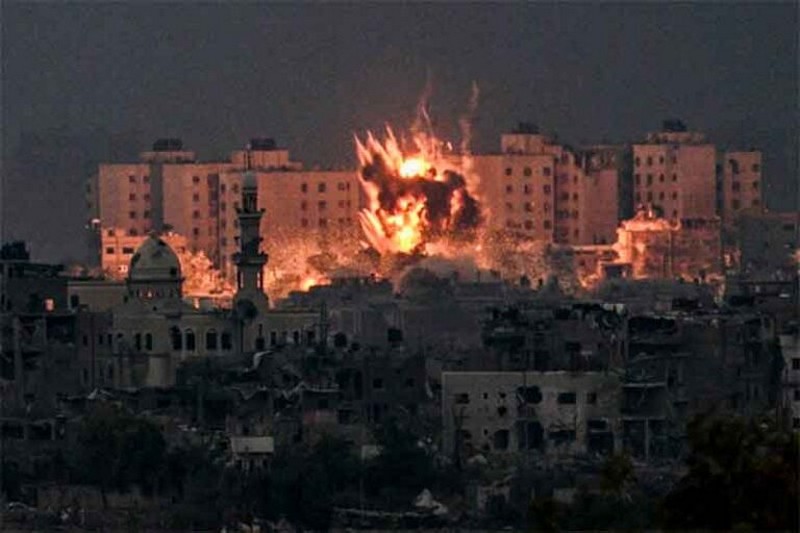
‘Eradication of Journalism in Gaza’ Continues as Israel Kills Two More Reporters

By Jake Johnson

An Israeli airstrike in the southern Gaza city of Rafah on Sunday killed two Palestinian journalists and seriously wounded a third, adding to the war’s grisly toll on media workers.

The Al Jazeera Media Network said in a statement that the Israeli military targeted the journalists’ car as they were driving through the northern part of Rafah. The strike killed Hamza Dahdouh, the 27-year-old son of Al Jazeera‘s Gaza bureau chief, and Mustafa Thuraya, a freelance videographer working with Agence France-Presse. Hazem Rajab was injured in the Israeli strike.

“The assassination of Mustafa and Hamza, Al Jazeera correspondent Wael Dahdouh’s son, whilst they were on their way to carry out their duty in the Gaza Strip reaffirms the need to take immediate necessary legal measures against the occupation forces to ensure that there is no impunity,” the network said, imploring the international community to “hold Israel accountable for its heinous crimes.”

Hamza is the fifth member of Wael Dahdouh’s family killed in Israel’s assault on the Gaza Strip. Earlier in the war, Israeli strikes killed Dahdouh’s wife, younger son, daughter, and grandson. Wael himself was wounded by an Israeli drone strike that killed Al Jazeera journalist Samer Abu Daqqa.

“Hamza was everything to me, the eldest boy, he was the soul of my soul,” Wael said in anguished remarks from the cemetery where his son was buried. “These are the tears of parting and loss, the tears of humanity.”

Christophe Deloire, secretary-general of Reporters Without Borders, expressed “shock” in response to news of Dahdouh and Thuraya’s killing.

“This unbearable massacre must stop,” Deloire wrote on social media. “Israel must be held accountable for this eradication of journalism in Gaza. We will continue to refer to the International Criminal Court so that maximum priority is given to crimes against journalists. Justice must be served.”

Since October 7, Israeli forces have killed dozens of media workers in the Gaza Strip, where around 1,000 journalists were working before the assault. According to the Committee to Protect Journalists (CPJ), more journalists were killed in the first 10 weeks of the war “than have ever been killed in a single country over an entire year.”

“CPJ is particularly concerned about an apparent pattern of targeting journalists and their families by the Israeli military,” the group said last month. An investigation by Reporters Without Borders concluded that Reuters video journalist Issam Abdallah and his colleagues were deliberately targeted in October 13 strikes in southern Lebanon.

Reporters Without Borders has filed two war crimes complaints with the International Criminal Court since early October. The second complaint, submitted last month, accuses the Israel Defense Forces of intentionally killing seven Palestinian journalists.

“Targeting reporters is a war crime,” the group wrote in a social media post on Sunday.

Jake Johnson is a senior editor and staff writer for Common Dreams.

8 January 2024

Source: countercurrents.org
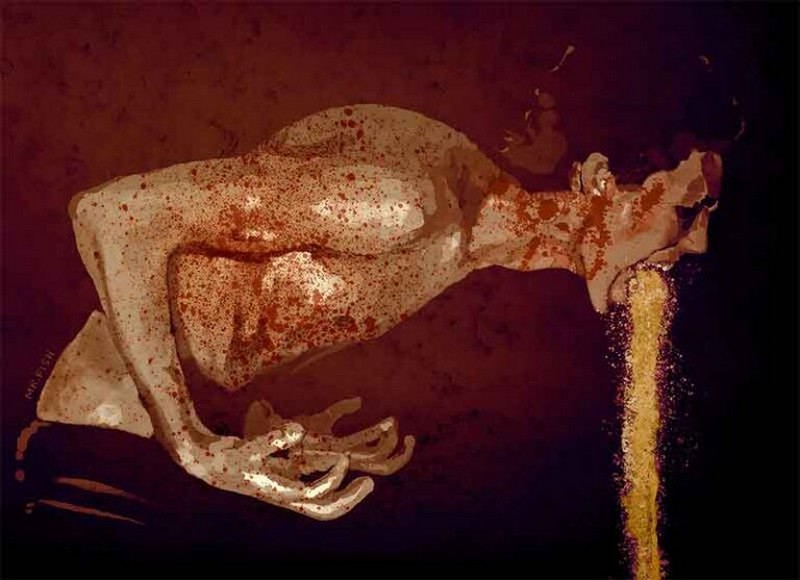
Israel Is Terrified the World Court Will Decide It’s Committing Genocide

By Marjorie Cohn

For nearly three months, Israel has enjoyed virtual impunity for its atrocious crimes against the Palestinian people. That changed on December 29 when South Africa, a state party to the Genocide Convention, filed an 84-page application in the International Court of Justice (ICJ, or World Court) alleging that Israel is committing genocide in Gaza.

South Africa’s well-documented application alleges that “acts and omissions by Israel … are genocidal in character, as they are committed with the requisite specific intent … to destroy Palestinians in Gaza as a part of the broader Palestinian national, racial and ethnical group” and that “the conduct of Israel — through its State organs, State agents, and other persons and entities acting on its instructions or under its direction, control or influence — in relation to Palestinians in Gaza, is in violation of its obligations under the Genocide Convention.”

Israel is mounting a full-court press to prevent an ICJ finding that it’s committing genocide in Gaza. On January 4, the Israeli Foreign Ministry instructed its embassies to pressure politicians and diplomats in their host countries to make statements opposing South Africa’s case at the ICJ.

In its application, South Africa cited eight allegations to support its contention that Israel is perpetrating genocide in Gaza. They include:

(1) Killing Palestinians in Gaza, including a large proportion of women and children (approximately 70 percent) of the more than 21,110 fatalities and some appear to have been subjected to summary execution;

(2) Causing serious mental and bodily harm to Palestinians in Gaza, including maiming, psychological trauma, and inhuman and degrading treatment;

(3) Causing the forced evacuation and displacement of about 85 percent of Palestinians in Gaza — including children, the elderly and infirm, and the sick and wounded. Israel is also causing the massive destruction of Palestinian homes, villages, towns, refugee camps and entire areas, which precludes the return of a significant proportion of the Palestinian people to their homes;

(4) Causing widespread hunger, starvation and dehydration to the besieged Palestinians in Gaza by impeding sufficient humanitarian assistance, cutting off sufficient food, water, fuel and electricity, and destroying bakeries, mills, agricultural lands and other means of production and sustenance;

(5) Failing to provide and restricting the provision of adequate clothing, shelter, hygiene and sanitation to Palestinians in Gaza, including 1.9 million internally displaced persons. This has compelled them to live in dangerous situations of squalor, in conjunction with routine targeting and destruction of places of shelter and killing and wounding of persons who are sheltering, including women, children, the elderly and the disabled;

(6) Failing to provide for or ensure the provision of medical care to Palestinians in Gaza, including those medical needs created by other genocidal acts that are causing serious bodily harm. This is occurring by direct attacks on Palestinian hospitals, ambulances and other healthcare facilities, the killing of Palestinian doctors, medics and nurses (including the most qualified medics in Gaza) and the destruction and disabling of Gaza’s medical system;

(7) Destroying Palestinian life in Gaza, by destroying its infrastructure, schools, universities, courts, public buildings, public records, libraries, stores, churches, mosques, roads, utilities and other facilities necessary to sustain the lives of Palestinians as a group. Israel is killing whole families, erasing entire oral histories and killing prominent and distinguished members of society;

(8) Imposing measures intended to prevent Palestinian births in Gaza, including through reproductive violence inflicted on Palestinian women, newborns, infants and children.

South Africa cited myriad statements by Israeli officials that constitute direct evidence of an intent to commit genocide:

“Gaza won’t return to what it was before. We will eliminate everything,” Israel’s Defense Minister Yoav Gallant said. “If it doesn’t take one day, it will take a week. It will take weeks or even months, we will reach all places.”

Avi Dichter, Israel’s Minister of Agriculture, declared, “We are now actually rolling out the Gaza Nakba,” a reference to the 1948 ethnic cleansing of Palestinians to create the state of Israel.

“Now we all have one common goal — erasing the Gaza Strip from the face of the earth,” Nissim Vaturi, the Deputy Speaker of the Knesset and Member of the Foreign Affairs and Security Committee proclaimed.

Israel’s Strategy to Defeat South Africa’s Case at the ICJ

Israel and its chief patron, the United States, understand the magnitude of South Africa’s ICJ application, and they are livid. Israel usually thumbs its nose at international institutions, but it is taking South Africa’s case seriously. In 2021, when the International Criminal Court launched an investigation into Israel’s alleged war crimes in Gaza, Israel firmly rejected the legitimacy of the probe.

“Israel generally doesn’t participate in such proceedings,” Prof. Eliav Lieblich, an international law expert at Tel Aviv University, told Haaretz. “But this isn’t a UN inquiry commission or the International Criminal Court in the Hague, whose authority Israel rejects. It’s the International Court of Justice, which derives its powers from a treaty Israel joined, so it can’t reject it on the usual grounds of lack of authority. It’s also a body with international prestige.”

A January 4 cable from the Israeli Foreign Ministry says that Israel’s “strategic goal” is that the ICJ reject South Africa’s request for an injunction to suspend Israel’s military action in Gaza, refuse to find that Israel is committing genocide in Gaza and rule that Israel is complying with international law.

“A ruling by the court could have significant potential implications that are not only in the legal world but have practical bilateral, multilateral, economic, security ramifications,” the cable states. “We ask for an immediate and unequivocal public statement along the following lines: To publicly and clearly state that YOUR COUNTRY rejects the outragest [sic], absurd and baseless allegations made against Israel.”

The cable instructs Israeli embassies to urge diplomats and politicians at the highest levels “to publicly acknowledge that Israel is working [together with international actors] to increase the humanitarian aid to Gaza, as well as to minimize damage to civilians, while acting in self defense after the horrible October 7th attack by a genocidal terrorist organization.”

“The State of Israel will appear before the ICJ at The Hague to dispel South Africa’s absurd blood libel,” Prime Minister Benjamin Netanyahu spokesperson Eylon Levy declared. South Africa’s application is “without legal merit and constitutes a base exploitation and contempt of court,” he said.

Israel is pulling out all the stops, including disingenuous accusations of “blood libel,” an anti-Semitic trope that erroneously accuses Jews of the ritual sacrifice of Christian children.

“How tragic that the rainbow nation that prides itself on fighting racism will be fighting pro-bono for anti-Jewish racists,” Levy added ironically. He made the astonishing claim that Israel’s military campaign to destroy Hamas in Gaza is designed to prevent the genocide of the Jews.

As the old adage goes, when you’re being run out of town, get in front of the crowd and act like you’re leading the parade.

The Biden regime rose to defend its staunch ally Israel. U.S. National Security Council spokesman John Kirby lambasted South Africa’s ICJ application as “meritless, counterproductive and completely without any basis in fact whatsoever.” Kirby claimed, “Israel is not trying to wipe the Palestinian people off the map. Israel is not trying to wipe Gaza off the map. Israel is trying to defend itself against a genocidal terrorist threat,” echoing Israel’s preposterous assertion.

Kirby’s contention that Israel is trying to prevent genocide is particularly absurd, given the fact that since Hamas killed 1,200 Israelis on October 7, Israeli forces have killed at least 22,100 Gazans, about 9,100 of whom are children. At least 57,000 persons have been wounded and at least 7,000 are reported missing. Untold numbers of people are trapped beneath the rubble.

Provisional Measures Against Israel Can Have Immediate Impact

South Africa is requesting that the ICJ order provisional measures (interim injunction) in order to “protect against further, severe and irreparable harm to the rights of the Palestinian people under the Genocide Convention.” South Africa is also asking the court “to ensure Israel’s compliance with its obligations under the Genocide Convention not to engage in genocide, and to prevent and to punish genocide.”

The provisional measures South Africa seeks include ordering Israel to “immediately suspend its military operations in and against Gaza” and to cease and desist from killing and causing serious bodily or mental harm to Palestinians, inflicting on them conditions of life intended to destroy them in whole or in part, and imposing measures to prevent Palestinian births. South Africa wants the ICJ to order that Israel stop expelling and forcibly displacing Palestinians and depriving them of food, water, fuel, and medical supplies and assistance.

The judicial arm of the United Nations, the ICJ is composed of 15 judges elected for a nine-year term by the UN General Assembly and the Security Council. It is not a criminal tribunal like the International Criminal Court; rather it resolves disputes between countries.

If a party to the Genocide Convention believes that another party has failed to comply with its obligations, it can take that country to the ICJ to determine its responsibility. This was done in the case of Bosnia v. Serbia, in which the Court found that Serbia violated its duties to prevent and punish genocide under the Convention.

The obligations in the Genocide Convention are erga omnes partes, that is, obligations owed by a state towards all the states parties to the Convention. The ICJ has stated, “In such a convention the contracting States do not have any interests of their own; they merely have, one and all, a common interest, namely, the accomplishment of those high purposes which are the raison d’être of the Convention.”

Article 94 of the UN Charter says that all parties to a dispute must comply with the decisions of the ICJ and if a party fails to do so, the other party may go to the UN Security Council for the enforcement of the decision.

An average ICJ case from start to finish can last several years (it was nearly 15 years from the time that Bosnia first filed its case against Serbia in 1993 to the issuance of the final judgment on the merits in 2007). However, a case can have an immediate impact. The filing of a case in the ICJ sends a strong message to Israel that the international community will not tolerate its actions and seeks to hold it accountable.

Provisional measures can be issued quickly. For example, the ICJ ordered measures 19 days after the Bosnian case was initiated. Provisional measures are binding on the party against whom they are ordered, and compliance with them can be monitored by both the ICJ and the Security Council.

Judgments on the merits rendered by the ICJ in disputes between parties are binding on the parties involved. Article 94 of the United Nations Charter provides that “each Member of the United Nations undertakes to comply with the decision of [the Court] in any case to which it is a party.” The judgments of the court are final; there is no appeal.

Public hearings on South Africa’s request for provisional measures will take place on January 11 and 12 at the ICJ which is located in the Peace Palace in The Hague, Netherlands. The hearings will be livestreamed from 4:00-6:00 a.m. Eastern/1:00-3:00 a.m. Pacific on the Court’s website and on UN Web TV. The court could order provisional measures within a week after the hearings.

Other States Parties to the Genocide Convention Can Join South Africa’s Case

Other states parties to the Genocide Convention can either request permission to intervene in the case filed by South Africa or file their own applications against Israel in the ICJ. South Africa’s application identifies several countries that have referred to Israel’s genocide in Gaza. They include Algeria, Bolivia, Brazil, Colombia, Cuba, Iran, Palestine, Türkiye, Venezuela, Bangladesh, Egypt, Honduras, Iraq, Jordan, Libya, Malaysia, Namibia, Pakistan and Syria.

On January 5, Quds News Network tweeted, “Jordan’s minister of Foreign Affairs, Ayman Safadi, announces that his country backs South Africa’s genocide case against Israel in the ICJ. He added that the Jordanian government is working on a legal file to follow up on the case. Turkey, Malaysia, and the Organization of Islamic Cooperation (OIC) had announced that they back the case too.”

The newly formed International Coalition to Stop Genocide in Palestine, endorsed by more than 600 groups throughout the world, has convened to urge states parties to invoke the Genocide Convention.

The coalition contends, “Declarations of Intervention in support of South Africa’s invocation of the Genocide Convention against Israel will increase the likelihood that a positive finding of the crime of genocide will be enforced by the United Nations such that actions will be taken to end all acts of genocide and those who are responsible for the acts will be held accountable.”

During the first week of January, delegations of “grassroots diplomats,” spearheaded by CODEPINK, World Beyond War and RootsAction, mounted a campaign across the United States urging nations to submit Declarations of Intervention in South Africa’s case against Israel in the ICJ. Activists traveled to 12 cities, visiting UN missions, embassies and consulates from Colombia, Pakistan, Bolivia, Bangladesh, the African Union, Ghana, Chile, Ethiopia, Turkey, Belize, Brazil, Denmark, France, Honduras, Ireland, Spain, Greece, Mexico, Italy, Haiti, Belgium, Kuwait, Malaysia and Slovakia.

“This is the rare case where collective social pressure urging governments to support the South African case can be a sharp turning point for Palestine,” said Lamis Deek, a Palestinian attorney based in New York, whose firm convened the Palestinian Assembly for Liberation’s Commission on War Crimes Justice, Reparations, and Return. “We need more states to file supporting interventions — and we need the court to feel the watchful eye of the masses so as to withstand what will be extreme U.S. political pressure on the Court.”

Suzanne Adely, president of the National Lawyers Guild, noted, “The increasing global isolation of Israel and the U.S. and their European allies is an indicator that this is a key moment for popular movements to move their governments in the direction of taking these steps and being on the right side of history.” Indeed, since October 7, millions of people throughout the world have marched, protested and demonstrated in support of Palestinian liberation.

RootsAction and World Beyond War have created a template that organizations and individuals can use to urge other states parties to the Genocide Convention to file a Declaration of Intervention in South Africa’s genocide case against Israel in the ICJ.

Marjorie Cohn is professor emerita at Thomas Jefferson School of Law, former president of the National Lawyers Guild, and a member of the national advisory boards of Assange Defense and Veterans For Peace, and the bureau of the International Association of Democratic Lawyers.

8 January 2024

Source: countercurrents.org
Israel admits deliberately targeting journalists in strike that killed son of Al Jazeera bureau chief in Gaza

By Andre Damon

The number of journalists killed by Israel in Gaza grew to 109 on Sunday with a targeted drone strike on the car of Al Jazeera reporter Hamza al-Dahdouh, killing him alongside fellow journalist Mustafa Thuraya.

Hamza was the eldest son of the Al Jazeera Gaza bureau chief, Wael al-Dahdouh, and the fifth member of al-Dahdouh’s family to be killed in a series of deliberate and targeted murders by the criminal US-backed Israeli regime.

“Hamza was everything to me, the eldest boy, he was the soul of my soul,” Dahdouh told Al Jazeera on Sunday. “These are the tears of parting and loss, the tears of humanity.”

In a statement published after hours of silence in the face of questions by reporters, the Israeli military confirmed that it deliberately targeted the journalists’ vehicle, referring to the murdered men as “suspects.”

The statement declared:

An Israeli military aircraft identified and struck a terrorist operative who was operating an aircraft that posed a threat to troops. We are aware of reports that during the strike, two other suspects who were in the same vehicle as the terrorists were also hit.

The third man in the car was Hazem Rajab, a photojournalist whose responsibilities include operating photographic drones. The group of journalists was in reality targeted for performing their professional obligations in what Israel officially designated a “safe zone” for civilians.

Speaking in Qatar on Sunday, US Secretary of State Antony Blinken was asked whether the United States condemned the targeting of journalists by Israel.

Blinken refused to condemn either the murder of Hamza or Israel’s practice of deliberately killing journalists, instead shedding crocodile tears about what a “tragedy” his death was.

“I am deeply, deeply sorry for the almost unimaginable loss suffered by your colleagues,” Blinken said. “I am a parent myself. I can’t begin to imagine the horror that he’s experienced not once, but twice. This is an unimaginable tragedy.”

Blinken is a key enabler and supporter of Israel’s policy of massacring journalists. The United States has never condemned the practice and maintains its position that there are no “red lines” for what Israel is allowed to do. The United States has provided Israel with 10,000 tons of military equipment over the past three months, delivered by over 200 cargo planes.

During the 2003 invasion of Iraq, the US military repeatedly targeted and killed Al Jazeera journalists. In a 2003 diary entry, UK Home Secretary David Blunkett urged UK Prime Minister David Cameron to attack Al Jazeera journalists. Blunkett said that the UK should not “rule out” targeting journalists because “they are attempting to win a propaganda battle on behalf of your enemy.”

On October 25, Axios reported that Blinken asked the prime minister of Qatar to “turn down the volume on Al Jazeera’s coverage because it is full of anti-Israel incitement,” and then bragged about it in a meeting.

However the Qatari government responded to Blinken’s demand, Israel has been working to “turn down the volume on Al Jazeera’s coverage” by systematically murdering Al Jazeera correspondents and their families in Gaza.

In October, Israel murdered the wife, two children and infant grandson of Wael al-Dahdouh in an airstrike on their home. In December, a drone strike injured Wael and killed his camera operator near Khan Younis.

In a gesture of heroism and resistance, al-Dahdouh continued to work the day after each attack.

In a statement, Al Jazeera condemned Sunday’s strike:

The assassination of Mustafa and Hamza, Al Jazeera correspondent Wael Al-Dahdoh’s son, while they were on their way to carry out their duty in the Gaza Strip reaffirms the need to take immediate necessary legal measures against the occupation forces to ensure that there is no impunity.

The statement continued:

The assassination of his son Hamza in January 2024 confirms without a doubt the Israeli forces’ determination to continue these brutal attacks against journalists and their families, aiming to discourage them from performing their mission, violating the principles of freedom of the press and undermining the right to life.

It concluded:

We urge the International Criminal Court, governments, human rights organizations, and the United Nations to hold Israel accountable for its heinous crimes and demand an end to the targeting and killing of journalists.

The Committee to Protect Journalists called for an investigation into the killing. Sherif Mansour, Middle East and North Africa program coordinator at the Committee said in a statement:

The Al Dahdouh family and their journalist colleagues in Gaza are rewriting what it means to be a journalist today with immensely brave and never-before-seen sacrifices.

Agence-France Presse global news director Phil Chetwynd declared, “We vigorously condemn all attacks against journalists doing their jobs and it is essential we have a clear explanation as to what happened.”

On Friday, The Euro-Med Monitor reported that 30,676 Palestinians have been killed in Israel Defense Forces attacks since October 7, taking into account both those whose bodies have been identified and those who have been missing for more than two weeks, most buried under the rubble of demolished buildings.

To date, 1.9 million Palestinians have been internally displaced, amounting to 90 percent of the population of Gaza. Many have been forced to flee multiple times, and Israel has destroyed or damaged approximately 70 percent of Gaza’s civilian infrastructure.

Originally published in WSWS.ORG

8 January 2024

Source: countercurrents.org
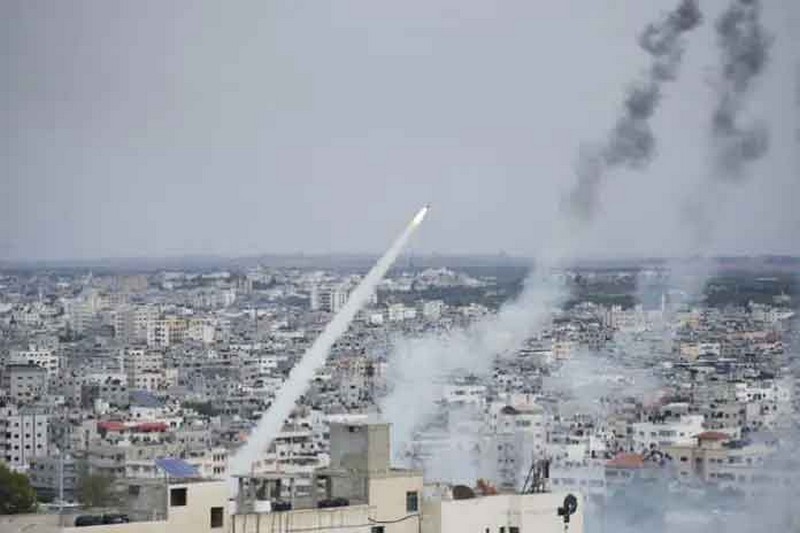
John Scales Avery, One of the Greatest Intellectuals of Our Time Passes Away

By Binu Mathew

I’m informed of the passing of John Scales Avery (1933-2024). He was 91 and passed away on January 4. He was a fierce peace activist. John was part of Pugwash Conferences on Science and World Affairs that shared the 1995 Nobel Peace Prize for their work. He was also Chairman of the Danish Peace Academy. John was a theoretical chemist at the University of Copenhagen.

He was a great friend and well-wisher of Countercurrents.org. He worked till the end. His knowledge was copious, it spanned from theoretical chemistry to Greek literature. In his later years, he wrote without rest. Producing book after book on various topics from peace activism to literature, painting, and the lives of great thinkers and philosophers. He wanted to share as much knowledge as possible with future generations before his passing. I was fortunate enough to compile most of his work on a website in his name https://www.johnavery.info.

I was fortunate enough to meet him at his Copenhagen home. He welcomed me and my friend John Graversgaard warmly and treated us to a sumptuous meal. Without doubt, he was one of the greatest intellectual and peace activists of our time. The world is poorer by his passing.

The family writes:

As you know, for the last four months he was plagued by a broken hip, infections and many hospital stays, but through it all he maintained his characteristic humor, warmth, kindness, great intellect and spirit.

Binu Mathew is the editor of Countercurrents.org

8 January 2024

Source: countercurrents.org
Moral and Strategic Consequences of S. Africa’s Case against Israel at the World’s Court

By Maung Zarni

Three months into the relentless bombardment of Gaza, the Republic of S. Africa, a signatory state (or “state party”, in legalese) of the (binding) Convention on the Prevention and Punishment of the Crime of Genocide (or Genocide Convention), has filed its “application” (or legal case) against Israel, a fellow signatory, with the United Nations’ principal judicial organ The International Court of Justice in The Hague.

S. Africa provided the directly relevant and detailed contextual information about Israel’s policies and deeds with respect to Palestinian residents of Gaza, over nearly a quarter of a century from 2000 to 2023.

It is worth noting that S. Africa’s application of the Genocide Convention came amidst “the Merit Phase” (that is, the two parties in dispute present the Court its evidence and counter-evidence) of the precedent-setting genocide case, namely Gambia vs. Myanmar. The Gambia vs. Myanmar is precedent setting because the signatory African state Gambia which initiated the legal dispute did not, and does not, suffer the impact of Myanmar’s crimes against Rohingya as a victim, residential population of the Southeast Asian country while Myanmar’s failure to prevent and punish the genocide on its own territories is in and of itself tantamount to violating Myanmar’s own treaty obligations towards both other signatory states of the Genocide Convention and the entire family of nations.

On the strength of the apparent or prima facie evidence, the ICJ’s judges granted, in an extraordinary show of unanimity, Gambia’s request for “provisional (or immediate and short-term) measures” ordering Myanmar to stop any and further state acts harmful to the remaining victim population of predominantly Muslim Rohingya which the court officially deemed “a protected group” under the Convention.

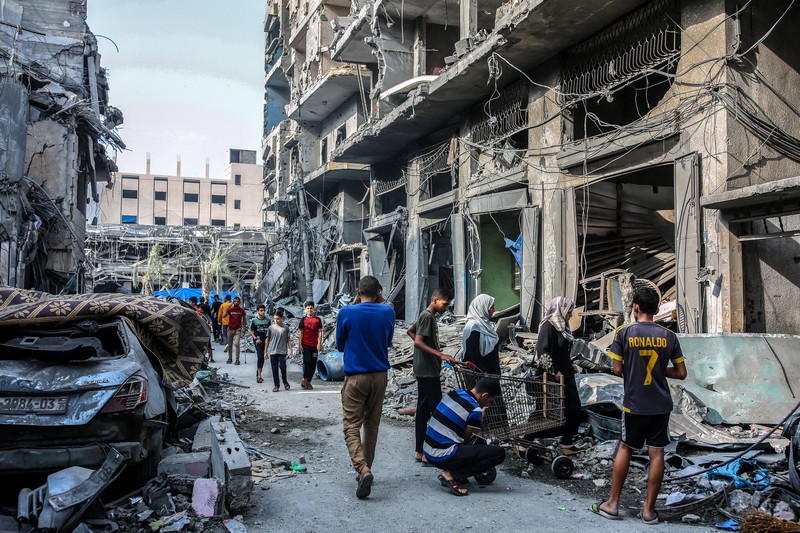
The physical destruction of Gaza 70% of which have been turned into rubble is reminiscent of what really was the carpet-bombing of major German cities (for instance, Berlin, Hamburg, Frankfurt, and Dresden) by the British and American Air Forces.

By way of a historical comparison, the British war-planners were initially for the more “accurate” arial attacks against German cities and ordered more discriminatory bombings of military targets. But, when the precision proved elusive in the face of Nazi air defences the British Air Force leadership shifted its gear and went all out for the carpet bombing of all targeted cities.

In sharp contrast, from the get-go, Israeli senior officials have made it clear that they had absolutely no moral or humanly qualm about the wholesale physical destruction of entire neighbourhoods complete with hospitals, schools, refugee camps, and other sites in Gaza whose population was overwhelmingly civilians – and women and children at that. “Accuracy” in military operations against the Hamas is not a factor in Israel’s official planning. The number of civilian deaths including thousands of children, babies, pregnant women, the elderly speak louder than Israel’s well-rehearsed media mantra of “reducing civilian death tolls”.

In commenting on the genocides in Israel and Myanmar, a word about my professional and personal background may be in order because I am not a legally trained professional. And I do not concern myself with law, as such, here.

I am a long-time human rights activist with over 35 years of involvement in international human rights activism. Academically, for 6 years (1992-98), I was a doctoral student of the pioneering expert on (Nazi) SS and its leader Himmler, the late Robert L. Koehl, at the University of Wisconsin at Madison. My historian mentor interrogated, in his capacity as a US Army Military Intelligence officer, surrendered junior SS officers in the American section of the defeated Nazi Germany. Upon resuming his studies at Harvard after the war, Koehl wrote his PhD thesis in 1953 on the SS and its Himmler, based on both the archival materials from two of the chambers of the Nuremberg Trials, and personal interactions with former SS officers under his custody.

Both Koehl and I shared a lifelong interest in viewing the mass crimes of murderous organizations through the eyes of the perpetrators. He was a German American, born in Kenosha, Wisconsin, and grew up bilingual, German and English, and I, an ethnically dominant Bama from the nationalist heartlands of Myanmar, with 3-generations of family ties with the instrument of Myanmar genocide, the country’s armed forces.

My primary activism has always been focused on ending the military dictatorship in my native country of Burma – now Myanmar. But I devoted the last 10 years of my activism and research to the study of genocides, when I discovered, through numerous United Nations and NGO reports on Myanmar, that the military there was not simply committing egregious human rights crimes against dissidents and other defiant ethnic minorities but, in fact, committing “a textbook case of genocide” against a tiny minority population of Rohingya in Western Myanmar.

My wife and researcher colleague Dr Natalie Brinham and I conducted the first-ever study (of 3 years) of Myanmar’s persecution of Rohingya using genocide as our conceptual framework.

Additionally, and equally important, as an ethnically dominant Myanmar with deep roots in the genocide-perpetrating Myanmar, the crime of genocide is not “simply” a matter of academic or professional interest. It has become a consuming existential matter. Myanmar genocide calls into serious question my sense of Burmese-ness and my attachment to the land from which I have been exiled. For this heinous crime is committed in my ethnic name.

More broadly, genocide is an affront to all who consider themselves decent humans. With such existential dimension to those of us with conscience, from the population of perpetrators, genocide cannot, and must not be left, in the hands of international lawyers, genocide scholars and ultimately national and international courts.

After all, the UN member states – 153 out of the total of nearly 200 – that pledge to uphold the binding Genocide Convention have typically failed to either prevent genocides or punish perpetrating states throughout the Cold War, and thereafter.

That said, after the Cold War Era lull, the principal judicial organ of the United Nations known as the International Court of Justice (ICJ), and based in The Hague, Netherlands, where states bring their legal disputes, has rediscovered its institutional mission, centrality and role, with respect to what is generally perceived as “the crime of all crimes”, genocide, more recently with Gambia vs. Myanmar.

The court was absent in many a cases of state crimes. Enter Suharto’s genocide of 1965 in Indonesia, many an atrocity crime throughout Latin America and Africa, Khmer Rouge of 1975. That’s a story for another day.

The real consequences of the ICJ genocide cases

While the UN’s Court lacks any instrument to enforce its rulings, failures to comply with the court orders will most certainly exact a heavy reputational and moral price for any offending state.

Unlike the International Criminal Court (and any other special ad hoc international criminal tribunals, involving genocide allegations, for instance, Rwanda or former Yugoslavia), the ICJ does not concern itself with the individual criminal responsibility of military, civilian or political leaders with command responsibilities.

However, the immense and unrepairable damage to international, national and moral standing awaits these leaders who were seen or deemed responsible for policies and practices of the state which the ICJ finds to be in breach of its treaty or convention obligations. Myanmar’s Nobel Peace Laureate and State Counsellor Aung San Suu Kyi, herself in captivity since the coup 3 years ago, is a recent case in point.

With respect to S. Africa’s attempts to institute the legal case against Israel, the proceedings will certainly empower the campaigners worldwide striving to end Israel’s international illegal annexation of all lands which it has occupied since the end of its war with the Arab states in 1967 war.

More concretely, the case will give the Boycott, Divestment and Sanctions (BDS) movement against anything Israel worldwide a greater momentum. Additionally, the public proceedings at the court will keep in the international spotlight not only Israel’s physical destruction of Gaza but also the continuing Occupation of that land that the world know to belong to Palestinians as a people.

Without getting mired in the legalese – for and against the genocide case – the lay public, activists and scholars alike, can still comprehend what genocide is.

Despite ICJ’s crucial differences vis-a-vis the Nuremberg Trials of 1945-46 which sought to establish criminal responsibility of individual senior Nazi leaders including the Air Force Chief Hermann Goring, Martin Bormann and J. Ribbentrop, and Hans Frank, the ICJ case against Israel is most certainly going to have intergenerational consequences, both morally, social psychologically and institutionally for Israel (and its public) in particular, and the Jewish diaspora worldwide in general. For centuries, the old Christian Europe and, more recently, the Nazis of the “Enlightened Europe” have inflicted upon the world’s Jewry an intergenerational trauma while the State of Israel is inflicting a profound sense of shame and disdain amongst “the Jews with conscience” towards Netanyahu’s “One and Only Jewish State”. In their view, and as a matter of fact, the Zionist State has weaponized “Never again!”, mobilized Nazi Genocide Memorial museums (including Auschwitz and the US Holocaust Memorial Museum) and resorted to the Bible to justify its genocidal settler colonialism which rests on the land, displacement, mass deportation and corpses of an uncountable number of Palestinian.

Beyond the future legal arguments and counterarguments at the ICJ, and the already raging debate outside amongst genocide scholars, lawyers and lay public, Israel’s physical destruction, as a matter of state policy, of 2.3 million Palestinians in Gaza will become personal – as it should.

For me, the accompanying genocidal ideologies of which “self-defence” is a commonly shared justificatory narrative amongst perpetrating and collaborating states and society. The language of “self-defence” was present in Hitler’s Mein Kampf (1924), just as it was in my native country’s genocidal narrative against Muslim Rohingyas, a decade ago.

As warped as Hitler was, one of his thematic concerns was the presence of the inferior race of Jude who would contaminate the Aryan nation of racially “superior” Germans. Writing several years before Hitler and the Nazi emerged as a marginal ideological force, Kaiser Wilhem II wrote to one of his generals that the Jews (of Germany) were the “parasites” which grew on the beautiful German oak tree. Apparently, Hitler took it upon himself the national duty of self-defence against the parasite. According to the 2-part BBC Documentary Series, the SS Colonel Eichman told, in reems of recorded interview in Argentina, the Dutch Nazi journalist, Hitler uttered the operative word “physical destruction” of what the Nazis considered the contaminating race of the Jews as the “solution”.

And we know what ensued.

To my deepest disgust, Auschwitz-Birkenau Museum, of all the institutions in the world, officially echoed this Hitlerite “self-defence” narrative in its 20 November statement (which received 15.7 million views) supporting unequivocally Israel’s “right to self-defence.

As recent as 3 January, Israel’s Ambassador to the UK, Tzipi Hotovely, had publicly spelled out Hitlerite’s wholesale physical destruction of the unwanted racial population of 2.3 million Palestinians from Gaza, already under total siege subjected to the day and night arial, naval and ground attacks by the Israeli Defence Forces.

n his 4th January-dated letter to David Cameron, UK’s Foreign Secretary, MP for Manchester Afzal Khan wrote, “(s)peaking to Iain Dale (of LBC radio), the Ambassador claimed that in Gaza, “every school, every mosque, every second house, has access to tunnels and munition.” When asked by the presenter whether this was effectively a call for “destroying the whole of Gaza”, the Ambassador simply asked, “do you have another solution?”

No two (genocidal) solutions to the unwanted populations are identical. Not all genocidal racisms and the mono-racialized political states build gas chambers, nor do they copycat the acts of population destruction.

But all genocides in essence seek to destroy a human group or population, marked and unwanted.

Beyond law and courts, and scholarly debates, I will give Raphael Lemkin (1900-1959), the Polish Jewish scholar who studied law at the then Polish city of Lwow (now the Ukrainian city of Lviv, several hours’ drive from the Polish border and Auschwitz) in the early 1920’s and coined the word “genocide” even before the Nazi genocide gathered steam. In his book Axis Rul in Occupied Europe: Laws of Occupation, Analysis of Government, Proposals for Redress (originally published by the Carnegie Endowment for Peace, Division of International Law, 1944; Second Edition by Lawbook Exchange Ltd., 2008), Lemkin wrote:

By “genocide” we mean the destruction of a nation or an ethnic group. … (Genocide) is intended rather to signify a coordinated plan of different actions aiming at the destruction of essential foundations of the life of national groups, with the aim of annihilating the groups themselves. The objectives of such a plan would be disintegration of the political and social institutions, of culture, language, national feelings, religion, and economic existence of national groups, and the destruction of the personal security, liberty, health, dignity, and even the lives of the individuals belonging to such groups. Genocide is directed against the national group as an entity, and the actions involved are directed against individuals, not in their individual capacity, but as members of the national group (p.79).

Here Lemkin proceeded to illustrate his point.

The following illustration will suffice. The confiscation of property of nationals of an occupied area on the ground that they have left the country may be considered simply as a deprivation of their individual property rights. However, if the confiscations are ordered against individuals solely because they are Poles, Jews, or Czechs, then the same confiscations tend in effect to weaken the national entities of which those persons are members (p.79).

In Lemkin’s extremely substantial conception of genocide as a process, “(g)enocide has two phases: one destruction of the national pattern of the oppressed group; the other, the imposition of the national pattern of the oppressor. This imposition, in turn, may be made upon the oppressed population which is allowed to remain, or upon the territory alone, after the removal of the population and the colonization of the area by the oppressor’s own nationals.”

A “textbook genocide” is taking place

In conclusion, those legal scholars and practitioners who oppose Israel’s conduct in Gaza since October 7, 2023 argue that Israel is perpetrating “a textbook genocide” while holding up the legally framed Genocide Convention designed to “legislate” different large scale crimes targeting identity-based groups, racial, ethnic, national or religious. They are not necessarily wrong except that they fall far short of Lemkin’s comprehensive articulation of genocide, which includes even the post-physical destruction of the colonized under the occupation of the oppressor.

Lemkin as the Jewish refugee intellectual who fled the Nazi-occupied Europe and was acutely concerned about the kind of state-organized atrocity crimes (that is, crime against humanity, ethnic cleansing, war crimes and genocide) that the Ottoman Turks committed against the Armenian population amongst them, and that the Nazis were preparing to perpetrate against “racially inferior stocks” to make Lebensraum or “living space” for the Aryan race in East Europe – replace the word “living space” with “settlements” in the Israel Occupied Territories.

Turning his attention to “our own ranks”, Albert Einstein, another Jewish emigre to the United States,  saw through the “Fascist” nature of settler colonial state and the “Terrorism” as a means to this end (of building the Jewish homeland in biblical Zion).

Just listen to the talk of post-Gaza “conflict” administration and demographic arrangement of the residents of Gaza (and West Bank) by Israel and the collaborating states and multilateral bodies – the likes of which include USA, UK, Germany, France, Canada, and the European Union.

What an irony that it is the world’s “One and Only Jewish State” that is morphing into Lemkin’s worst nightmare!

Whatever the ICJ’s eventual ruling, the conceptual words of the Jewish legal genius who bestowed upon our world the almost sacrosanct Law against genocide are proving chillingly prophetic.

The silver lining is this, however: there are “Jews with conscience” – thousands of them in the diaspora, for instance, under the banner of the Jewish Voice for Peace – who feel so incensed and violated that Israel is perpetrating, in the name of the Jews and Judeaism, “this crime of all crimes” against the entire population of people whose land the Israeli political state has “confiscated” – or stolen, to put it in plain English – and whose national culture and ethnic identity have been framed as “inferior” or “human animals”. They will most likely support S. Africa’s genocide case against apartheid Israel, help advance Palestinians’ liberation struggle and work in solidarity with campaigners for a Free Palestine.

Dr Maung Zarni is a scholar, educator and human rights activist with 30-years of involvement in Burmese political affairs, Zarni has been denounced as an “enemy of the State” for his opposition to the Myanmar genocide.

5 January 2024

Source: forsea.co

What will the rocket named after Saleh al-Arouri look like?

By Rima Najjar

It is beyond me how Israel has failed to figure out that a martyred Palestinian leader exerts a vastly more powerful hold on his people’s imagination and will to resist than a living one.

After decades of targeting and killing a long list of Palestinian leaders (or imprisoning them), Israel has not learned that another generation of leaders, stronger and fiercer than their predecessor, emerges inevitably. It makes me wonder if Israel is merely stupid or insane. There is a saying that goes, “Insanity is doing the same thing over and over again and expecting different results.”

To people following Israel’s war on Gaza and unaware of Israel’s policy of targeted killing, the assassination in Lebanon of Saleh al-Arouri, Deputy Chair of the Political Bureau of Hamas and founder of the Martyr Ezzedine al-Qassam Brigades, may have come as a surprise. My own reaction included an element of surprise but for a different reason. I had been betting incorrectly that Israel and the US were smarter than to risk a war with Hezbollah.

Some Israeli ministers who had not received Netanyahu’s memo to keep their mouths shut about the killings foolishly tweeted congratulations to Mossad and Shin Bet on the deed, thus proving that they are not motivated by deterrence, but rather by revenge and hubris.

Not that targeted killing of Palestinian leaders has ever been effective as a deterrence measure. A few days before the assassination of al-Arouri and several of his comrades (collateral damage?), I had watched a presentation on al-Jazeera Arabic showcasing the various families of home-made rockets in the possession of the Palestinian armed resistance. Each slide showed a group of rockets with the picture next to it of an assassinated leader after whom the class of rockets was named.

Image: Ayyash Rocket, named after martyred engineer Yahya Ayyash; Ranteesi Rocket, named after martyred leader Abdel Azziz al-Ranteesi; Abu Shammaleh Rocket, named after martyred leader Mohammad Abu Shammaleh; Attar Rocket, named after martyred leader Raed al-Attar; Ja’abari Rocket, named after martyred leader Ahmad al-Ja’abari; Rocket M90, named after martyred leader Ibrahim al-Maqadmeh

I am certain soon we can look forward to a family of al-Qassam Brigades’ rockets named after martyred leader Saleh al-Arouri.

Image: Al-Qassam Rocket, named after Sheikh Izzedine al-Qassam

Israel has used extrajudicial executions (aka targeted killing) of Palestinian leaders openly since 2001, giving itself a license to kill, including in the territories of other States. By re-characterizing individuals as “terrorists” (al-Arouri was also on the US terrorism list with a bounty of $5m (£4m) on his head since 2018), Israel and the US justify such killing within the framework of the law of armed conflict, thus blurring and expanding that law (also known as international humanitarian law) and making the global order less safe for everybody. Read “10 things the rules of war do” published by the International Committee of the Red Cross, and you will immediately notice that the US and Israel are violating every single rule in Gaza.

In an article titled, ‘Operation Al-Aqsa Flood’ Day 76: Extrajudicial Killings of Men in Front of Their Families in Gaza, we learn that “Israeli forces have reportedly conducted extrajudicial executions in front of families in Gaza as international leaders continue to discuss Israel’s conduct with little to no action, while negotiations between Israel and Hamas waver as war rages on.”

Extrajudicial executions are illegal under international law and are considered a fundamental violation of human rights and an “affront to the conscience of humanity.” In the same way that Israel argues falsely (most recently as it defends itself against genocide accusation at ICJ) that its policy of genocide and ethnic cleansing in Gaza or the West Bank is consistent with international law, “because Israel is engaged in armed conflict with terrorists,” it lies about the people it targets by saying they are “usually killed by conventional military means, not through deception, and the targets of the attacks are not civilians but combatants or are part of a military chain of command.”

The following statistics give an idea of how this policy works in bolstering Israel’s repressive measures against Palestinians: “… from the beginning of the second intifada, on 29 September 2000, to the end of 2010, Israeli security forces killed 4,927 Palestinians in the West Bank and in the Gaza Strip, 970 of them minors (under age 18). At least 2,227 of the fatalities were not taking part in hostilities. Another 239 were the object of a targeted killing. Thousands more were injured. [These figures do not include the casualties in Operation Cast Lead.]

Palestinians have yet to be deterred by Israel’s policies and the cover of impunity the US gives them. Predictably, the reaction is quite the opposite as is evident in the following press statement issued by the joint leadership of the People’s Democratic Party and the Arab Socialist Labor Party in Lebanon on Jan 3, following the assassination of al-Arouri and his comrades. The two parties offered their condolences and affirmed “The natural response to the crime will be to escalate the resistance in Gaza, the West Bank and all supporting fronts, and the enemy entity will be under the fire of resistance from southern Lebanon, Iraq, Yemen and Syria.”

Rima Najjar is a Palestinian whose father’s side of the family comes from the forcibly depopulated village of Lifta on the western outskirts of Jerusalem and whose mother’s side of the family is from Ijzim, south of Haifa.

5 January 2024

Source: countercurrents.org
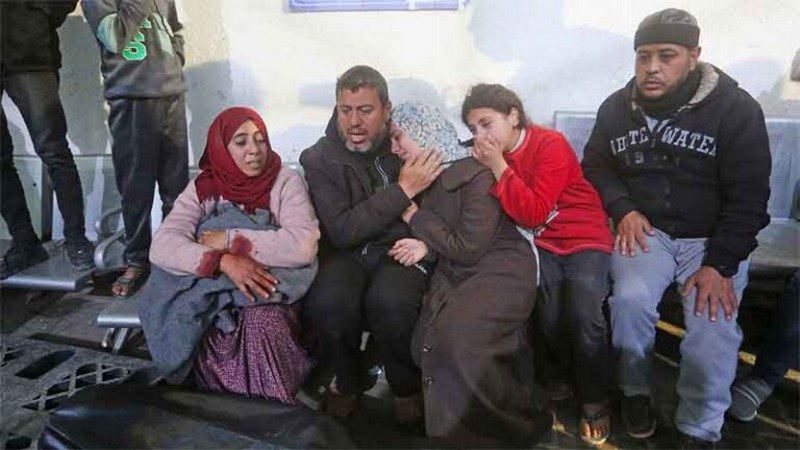
Willful Ignorance – The narratives of the Israeli-US empire

By Jim Miles

It should be obvious by now for those with any level of critical thinking skills that the Israeli-US narrative on Palestine and Gaza in particular is made up of lies, obfuscation, and dissimulation, the latter two a form of lying by using large and misleading words.

The incessant attacks on Gaza by bombing, missiles, and ground forces clearly demonstrates what the Israelis are now openly declaring.  After decades of a slower more methodical means of removing Palestinians from their native land, the Israelis are now clearly announcing their plan to ethnically cleanse Gaza of Palestinians – many already ‘cleansed’ from their previous homes, some several times – while openly disregarding any semblance of reason by calling for killing all Gazans and beyond, all Palestinians in the occupied territories (of which the whole area of Israel is truly occupied Palestinian land).

Israel is not alone.

The U.S. as Israel’s prime benefactor has contributed huge amounts of armaments to keep the Israeli Occupation Force (IOF) supplied with all manner of ordinance.  Regardless of civic disputes domestically, the U.S. political position is unified in its support of the violence carried out by Israel with the same calls for genocide and ethnic cleansing.

Two naval ensembles are assisting in the genocide, not directly by shooting and killing, but indirectly serving as a warning to other parties – Hezbollah, Iran, and all other Arab countries – to not become involved in the war.  The Houthis, who have not much left to lose after a decade of fighting off the U.S. backed Saudi attacks, have effectively blocked the southern Red Sea, and the Bab al-Mandeb Strait leading up to the Suez Canal and Israel’s port of Eilat.

While perhaps perceived as being militarily dominating, they are also somewhat ineffectual, more by the ramifications of their own direct involvement should it come, and the broader war it would generate.  Operation Prosperity Guardian has exposed the weakness of a U.S. naval operation in a modern-day world of asymmetric warfare with drones, and the implications of several supposed strong allies not wanting to participate (Japan, Australia, France, Spain, and all Arab countries except Bahrain, home of the U.S. Fifth Fleet and U.S. Naval Forces Central Command).

Those ships, along with those positioned in the Mediterranean do have a subduing effect on anyone considering entering the conflict on the side of Palestine.  However, it is also recognized they are all susceptible to modern missile attacks, with swarming attacks followed by precision guided hypersonic missiles serving as a strong equalizer in the balance of power in the region.

But Israel still holds all the power, as they do not care about what others think and will continue with its relentless attacks on Palestinians until they are either all dead or all removed, supported by sycophantic politicians from the U.S. empire, the EU, and NATO in particular (while disregarding the sycophantic and useless Abbas PA dictatorship).

There are many narratives to the Israeli mythology: a land without people; making the desert bloom; no one to negotiate with for peace; always the victim; self-defense.  All these and others are subsumed under two major narratives:  that of having the “most moral army” and of being a “democracy”.

Narrative gone – most moral army

Israel has forever proclaimed its army to be the most moral army in the world.  Many have accepted that, and many still do – especially the Christian evangelicals calling for Armageddon – but the reality demonstrates clearly there is nothing moral about the Israeli army.  Its history of extrajudicial murders, support for settler activities ranging from land confiscation to immolation of Palestinians, its known, recorded, and archived history of previous massacres and ethnic cleansing has not, for whatever reason, been enough to quell the “most moral army” lie.

The IOF began its ethnic cleansing of Palestine before they declared independence on May 14, 1948, and after that continued the elimination of around 500 Palestinian towns and villages, creating a massive refugee crisis that has endured and deepened over the decades.  It acted preemptively in the ill-fated attack on Egypt along with Britain and France in order to gain control of the Suez Canal.

The Six Day War, the Nakba, was a preemptive strike by Israel against Egypt, whose main forces at that time were fighting in Yemen (poor Yemen, same old story).  The continuation of that war into Syria to later annex the Golan Heights was an Israeli initiative.  Mostly ignored and clearly a victim of willful ignorance is the associated Israeli attack on the USS Liberty, a clearly marked US spy ship.  This also defines the beginnings of U.S. subservience to Israeli interests over the lives of its own people.

The only war Israel did not start was the Yom Kippur war in 1973, but with much assistance once again from the U.S..  Even then, it was not a war to “defend itself” as Israel at the time occupied Egyptian territory captured in the Six Day war.

After that Israel invaded Lebanon to eliminate the PLO forces under Yassir Arafat, and also to fulfill part of the Ersatz Israel plan to have the land south of the Litani River as part of Israel.  Many years later, and after the creation and defiance of Hezbollah, a resistance organization against Israeli occupation, Israel withdrew.

The first intifada troubled the military as well as the politicians (wherein at the time most politicians were products of the military).  It settled down and disappeared with the false hopes generated by the Oslo accords and the establishment of the Palestinian Authority (PA) and different areas of control, in fact dividing Palestine even more into noncontiguous bantustans.

In 2005 Abbas was elected leader of the PA in elections hampered by Israeli interference, some of it from the IOF.  In 2006 elections for the PA legislative assembly led to a very strong success for Hamas.  This was firmly rejected by Israel, the U.S., Canada, and many other countries.  It eventually resulted in Hamas – originally a religious-social network established in part by Israel – controlling the Gaza strip while the PA controlled the West Bank.

While Gaza is the current focus, the slow ethnic cleansing of other Palestinian areas has continued throughout, culminating in attacks by Israeli settlers on Palestinian towns under the watchful eye of the IOF.

From this point forward the narrative becomes one of continued IOF aggression and attacks against Gaza.  Since 2008 Israel has attacked Gaza four times, “mowing the lawn” as they called it, killing mostly civilians, women and children.   Gaza rather quickly became fully isolated with much of its civic structure destroyed, and at the time of the current conflict being the most densely populated prison camp in the world.  There is nothing in these actions that are “self- defense”, these are actions of an occupying power and its desire for ethnic cleansing.  While other countries call for a “proportionate” response, Israel has always declared that it will hit back disproportionately, and civilians remaining in the line of fire (where else can they go, only to be bombed again) are considered to be terrorists along with those leading the insurrection.

Operating against all military standards as negotiated with the Geneva Accords and the UN Charter and other international laws, Israel’s actions in Gaza are clearly genocidal in word and in deed.  Only those willfully ignorant and incapable of critical thinking can argue that the IOF is a moral army.

Narrative gone – democracy

This narrative is very strongly supported by external sources.  Both Britain in its initial setup of the Palestinian Mandate, and the U.S. after taking over financial and military support, have voiced their idea that Israel is the only democracy in the Middle East, an island of civilization in a savage part of the world.  The narrative above on the moral army is enough in itself to dispel the idea of Israel being a democracy.

A democracy does not use its army and air forces to control an indigenous population.  A democracy does not have separate rules and regulations, both in the so-called military zones and in the green line state, to control the livelihoods, movements, and all aspects of civil life.  A democracy does not have separate roads, hundreds of checkpoints, and hundreds of kilometers of a separation barrier to control an unwanted demographic.  A democracy does not consider itself to have a god given right to do whatever it likes to its indigenous residents.

Currently, the extreme right wing of Israeli politics is denying democracy itself, calling for a theocratic state governed by whatever rules its rabbinical authorities can concoct in the name of god.  Above all, the calls by current politicians in both Israel and the U.S. to eliminate Hamas and also eliminate Palestinians through ethnic cleansing or genocide, are so far beyond anything remotely humane, and arguably so far beyond anything a god would want its people to be doing.

The U.S. argues that it is the indispensable nation, the leader of the free world.  Events have proven it to be a powerful but not a dominant power – as in the sense of full spectrum dominance desired by the neocons.  Its absence from the world would be beneficial to all as its financial and corporate powers would not be backed up by the “hidden fist” of the U.S. military.  With its strange domestic electoral system, essentially a long running theater of domestic power politics, the U.S. is arguably not a democracy itself.  With its foreign affairs and history of meddling in other countries affairs it is inarguably non-democratic.  Its sycophantic support for Israel furthers this non-democratic tradition, as the interplay between the two is a mix of theocracy and power politics.

Conclusion

With all the information available on social media, on the internet, and the strong media presence outside of the western countries, the ideas that Israel has a moral army and that it is a democracy should be well put to rest by anyone able to think critically.  The U.S., while proclaiming “indispensability”, mainly demonstrates it too has no morals when it comes to ethnic cleansing and genocide, as indeed it is part of their own history since its inception.

To retain the notion that Israel’s army is moral and that Israeli politics are democratic is to be willfully ignorant of the reality of tens of thousands of dead and wounded, and millions displaced in a “war” that is all about the ethnic cleansing of an indigenous population for the self-righteous Israeli theocrats.

Jim Miles is a Canadian educator

5 January 2024

Source: countercurrents.org