Just International

The Everyday Violence of Life in Occupied Palestine

By Vijay Prashad

Driving along the Jordan River Valley in the Occupied Palestine Territory (OPT) of the West Bank is a stunning experience. The road is officially called Highway 90. The arable and irrigated land along this road is held militarily and illegally by Israeli settlers, many of whom are not actually Israeli citizens, but residents from the Jewish diaspora. A United Nations Commission report published in 2022 showed that this settlement activity is a crime against international human rights law (transfer of population into an occupied territory). Israeli settlers and the Israeli military that defend them call Highway 90 Derekh Gandhi or Gandhi’s Road. When I first drove along that road over a decade ago, I was puzzled by Gandhi’s name there. Mahatma Gandhi was a leader of the Indian freedom struggle, and had on many occasions—such as in his 1938 article, “The Jews”—offered his sympathy and solidarity with the Palestinian people. In fact, the road that slices through the West Bank—a crucial part of a proposed Palestinian state—is named after Rehavam Ze’evi, who was ironically given the nickname Gandhi.

Ze’evi led the National Union party, which brought together all the most dangerous currents of Israeli far-right politics. As the leader of this party, and, before that, of Moledet, Ze’evi advocated the removal of Palestinians from what he considered to be Israel’s land (East Jerusalem, Gaza, and the West Bank). He supported the creation of Eretz Yisrael that would stretch from the Jordan River to the Mediterranean Sea. In March 2001, Ze’evi—who would later be accused of sexual harassment and of being involved in organized crime—told The Guardian that “it’s not murder to get rid of potential terrorists, or those who have blood on their hands. Each one eliminated is one less terrorist for us to fight.” A few months later, Ze’evi showed that he did not distinguish among Palestinians, calling all of them a “cancer” and saying, “I believe there is no place for two peoples in our country. Palestinians are like lice. You have to take them out like lice.” He was shot to death by fighters of the Popular Front for the Liberation of Palestine (PFLP) in October 2001. The name of the road that cuts across the West Bank—promised to a Palestinian state in the Oslo Accords of 1993—still bears Ze’evi’s name.

Ze’evi was assassinated by PFLP fighters because the Israeli army had killed their leader Mustafa Ali Zibri by firing two cruise missiles at his home in Al-Bireh (Palestine). The assassination of Zibri was not an isolated incident. It was part of Israeli Prime Minister Ariel Sharon’s plan to “cause the collapse” of the Palestinian Authority—created to manage the Oslo Accords—and “send them all to hell.” Apart from the murder of civilians on a punctual basis, from July 2001 the Israeli government killed four political leaders (Islamic Jihad leader Salah Darwazeh and Hamas leader Jamal Mansour in July, and then Hamas leader Amer Mansour Habiri and Fatah leader Emad Abu Sneineh in August). After the killing of Zibri, the Israelis assassinated Hamas’s Mahmoud Abu Hanoud in November. “Whoever gave a green light to this act of liquidation,” wrote military correspondent Alex Fishman in Yediot Ahronot, “knew full well that he is thereby shattering in one blow the gentleman’s agreement between Hamas and the Palestinian Authority; under that agreement, Hamas was to avoid in the near future suicide bombings inside the Green Line [Israel’s pre-1967 borders].”

Hot Violence, Cold Violence

For centuries, Palestinian Christians, Muslims, and Jews lived side-by-side in the lands that would eventually be Israel and the OPT, including along the Jordan River Valley. Since the expulsion of the Palestinian Christians and Muslims and the arrival of European Jews, the legal apparatus—or the “cold violence,” as the writer Teju Cole calls it—worked alongside paramilitary and military violence against the Palestinians to create a fantasy of an ethno-nationalist state project (the Jewish State, as it was then called). The erasure of the non-Jewish Palestinians was key to this project, either by massacres (Deir Yassin in 1948) or the wholesale removal of the Palestinian population from their land (the Nakba of 1948). The massacres and the population transfers came alongside the denial of the reality of Palestine and the Palestinian people. The heir to Ze’evi, current finance minister Bezalel Smotrich said this March, “There’s no such thing as Palestinians because there’s no such thing as a Palestinian people.” This is not an opinion that can be dismissed as a far-right rant. Likud member Ofir Akunis, minister of science and technology, said three years ago, “There’s no place for any formula to establish a Palestinian state in Western Israel.” The phrase “Western Israel” is a chilling statement about the Israeli consensus on full annexation of the West Bank with disregard for international law.

A focus on Gaza is essential. The Israeli “hot violence” is extreme, with the death toll of Palestinians—almost half of them in Gaza of children—over 5,000. The Israeli land invasion has been blocked, for now, by the recognition of high morale among the Palestinian resistance. The latter will fight every Israeli soldier that goes into the ruins of Gaza. Before this Israeli incursion, 450 trucks crossed into Gaza with supplies for the 2.3 million residents; it was taken as a victory when nine United Nations trucks and 11 trucks of the Egyptian Red Crescent crossed into Gaza on October 21. Amnesty International looked at only five bombings of the Israelis and found evidence of war crimes, which should alert the International Criminal Court to re-open its file on Israeli atrocities. This should include the crime of collective punishment by cutting water and electricity to Gaza, and bombing access roads to the Rafah crossing into Egypt, and by bombing the Rafah crossing itself.

Large demonstrations across the world demand a ceasefire (at a minimum) and an end to the occupation. Israel is not interested. Its defense minister Yoav Gallant told parliament that his forces have a three-point plan—to destroy Hamas, to destroy the other Palestinian factions, and to create a new “security regime” in Gaza. The Palestinian people—not just the armed factions—are resolute in their resistance to Israeli occupation. The only way for Gallant’s new “security regime” to work would be to erase this resistance, which means to remove all Palestinians from Gaza either by massacres or by dispossession. The United States is following along with this extermination plan: a U.S. State Department memorandum says that its diplomats must not use phrases such as “de-escalation,” “ceasefire,” “end to violence,” “end to bloodshed,” and “restoring calm.”

Vijay Prashad is an Indian historian, editor, and journalist. He is a writing fellow and chief correspondent at Globetrotter.

25 October 2023

Source: countercurrents.org

We Are Going To Wipe You Off The Face Of The Earth, Israeli Minister Threatens Iran

By Countercurrents Collective

Israeli Economy Minister Nir Barkat said on Sunday that the Israeli forces would “eliminate” Hezbollah and target Iran if the Palestinian militants open up a “northern front.”

“The plan of Iran is to attack Israel on all fronts. If we find they intend to target Israel, we will not just retaliate to those fronts, but we will go to the head of the snake, which is Iran,” Barkat told The Mail on Sunday. He added, “the ayatollahs in Iran are not going to sleep good at night” if they move against Israel.

Barkat warned that Lebanon and the pro-Palestinian militant group Hezbollah “are going to pay a heavy price, similar to what Hamas is going to pay.”

Israel would go “after the heads of Iran” if necessary, the minister said. “Israel has a very clear message to our enemies. We are saying to them, look what is happening in Gaza – you are going to get the same treatment if you attack us. We are going to wipe you off the face of the Earth.”

The statement came after Iranian Foreign Minister Hossein Amir-Abdollahian said on Monday that the security situation for Israel may worsen very quickly. “If the war crimes against the Palestinians are not immediately stopped, other multiple fronts will open and this is inevitable,” he said.

The Iranian diplomat later doubled down, warning the U.S. and Israel that, if they do not stop mistreating the Palestinians, “anything is possible at any moment and the region will go out of control.” Amir-Abdollahian added that further escalation would have “far-reaching repercussions.”

The IDF and Hezbollah have repeatedly exchanged fire since the fighting erupted between the Israeli forces and Hamas earlier this month. Israeli Prime Minister Benjamin Netanyahu stated on Sunday that Hezbollah would suffer “unprecedented destruction” if it officially joins the war against the Jewish state.

The Israeli army made several large-scale incursions in Lebanon to fight the militants there in the past. The most recent invasion took place in 2006.

On October 7, Hamas and allied groups including Islamic jihad attacked multiple Israeli settlements, prompting Israel to begin airstrikes on the Gaza Strip. More than 1,400 Israelis and over 4,300 Palestinians have been killed, according to officials from both sides.

Pentagon Warns Iran Against Escalating Israel Crisis

U.S. Secretary of Defense Lloyd Austin has warned that American forces in the Middle East face increased risk of being attacked as Iran and its allies in the region look to exploit the turmoil created by the Israel-Hamas war.

Bases housing U.S. troops in Iraq and Syria have already been targeted in rocket and drone attacks in recent days, and the Pentagon is concerned about further escalation of the Israel crisis, Austin said on Sunday in an ABC News interview. “In fact, what we are seeing is the prospect of a significant escalation of attacks on our troops and our people throughout the region, and because of that, we are going to do what is necessary to make sure that our troops are in a good position, they are protected, and that we have the ability to respond.”

Shortly after Hamas launched surprise attacks against Israel on October 7, the Pentagon dispatched two aircraft carriers, five guided missile destroyers and other ships to the eastern Mediterranean Sea. One of the strike groups, led by the USS Dwight D. Eisenhower aircraft carrier, was redirected to the Persian Gulf on Saturday, and the Pentagon said it activated additional missile batteries in several undisclosed locations to help protect U.S. forces in the region.

“The additional deployment sends another message to those who seek to widen this conflict,” Austin said. He added, “If any group or any country is looking to widen this conflict and take advantage of this very unfortunate situation that we see, our advice is: Do not. We maintain the right to defend ourselves, and we would not hesitate to take the appropriate action.”

The USS Carney destroyer, located in the Red Sea, shot down three missiles and several drones that were launched from the region of Yemen controlled by Iranian-backed Houthi rebels on Thursday. The missiles were traveling north, potentially toward targets in Israel, a Pentagon spokesman said.

Antony Blinken

U.S. Secretary of State Antony Blinken echoed Austin’s concerns, saying Washington expects additional attacks on American troops by Iranian-backed groups. “We are taking steps to make sure that we can effectively defend our people and respond decisively if we need to,” he said on Sunday in an NBC News interview. “This is not what we want, not what we are looking for. We do not want escalation. We do not want to see a second or third front develop. We do not want to see our forces or our personnel come under fire, but if that happens, we are ready for it.”

The U.S. State Department ordered the departure of all non-emergency government staffers and their families from Iraq on Sunday. The department issued a similar order for its embassy in Baghdad and its consulate in Erbil on Friday, citing increased security threats. The department’s updated travel advisory warned Americans against going to Iraq, citing security risks and the limited capacity of U.S. diplomatic installations in the country to provide support to US citizens.

Gaza Conflict May Spin Out Of Control, Says Iranian Foreign Minister

Iranian Foreign Minister Hossein Amir-Abdollahian has accused the U.S. of waging a “proxy war against Palestinians” and warned that the situation will get out of hand if the bombardment of Gaza is not stopped and Israel launches the ground assault it is preparing for.

Speaking at the joint press conference with his South African counterpart Naledi Pandor in Tehran on Sunday, the Iranian top diplomat said that it was a “bitter and unfortunate reality” that U.S. President Joe Biden made an “extraordinary wartime visit” to Tel Aviv this week to show support for the Benjamin Netanyahu government amid the bombardment of the Palestinian enclave and lack of humanitarian aid.

“It is a great shame that the American president announced that the U.S. would dispatch hundreds of planes, ships and trucks filled with military equipment to the occupied territories to support the mass murder that coordinate plans for only 20 trucks carrying humanitarian aid to enter the besieged enclave,” he noted.

Amir-Abdollahian called the situation in the region a “powder keg” and warned of “heavy and bitter consequences.”

“If he U.S. and the Israeli regime do not stop their crimes against humanity immediately, there will be a possibility of anything at any moment and the region may spin out of control,” Amir-Abdollahian argued.

Hezbollah And Israel Exchange Fire And Warnings Of A Widened War

An earlier AP report said:

Hezbollah announced the deaths of five more militants as clashes along the Lebanon-Israel border intensified and the Israeli prime minister warned Lebanon on Sunday not to let itself get dragged into a new war.

The tiny Mediterranean country is home to Hezbollah, a Shiite Muslim political party with an armed wing of the same name. Israeli soldiers and militants have traded fire across the border since Israel’s war with the Palestinian group Hamas began, but the launches so far have targeted limited areas.

Hezbollah has reported the deaths of 24 of its militants since Hamas’ bloody Oct. 7 rampage in southern Israel. At least six militants from Hamas and another militant group, Palestinian Islamic Jihad, and at least four civilians have died in the near-daily hostilities.

Hezbollah has vowed to escalate if Israel begins a ground invasion of the Gaza Strip, which is likely, and Israel said it would aggressively retaliate.

“If Hezbollah decides to enter the war, it will miss the Second Lebanon War. It will make the mistake of its life,” Israeli Prime Minister Benjamin Netanyahu said Sunday as he visited troops stationed near the border with Lebanon. “We will cripple it with a force it cannot even imagine, and the consequences for it and the Lebanese state are devastating.”

Hezbollah and Israel fought a month long war in 2006 that ended in a tense stalemate.

Lebanon’s state-run National News Agency reported that small arms fire was heard along the tense border coming from near the Lebanese village of Aitaroun toward the northern Israeli town of Avivim where key military barracks are located. Meanwhile, Israel shelled areas near the southeastern Lebanese town of Blida.

Israel sees Iran-backed Hezbollah as its most serious threat, estimating it has some 150,000 rockets and missiles aimed at Israel.

Israeli military spokesman Jonathan Conricus accused the group early Sunday of “escalating the situation steadily.” He said the recent cross-border skirmishes had produced both Israeli troop and civilian casualties but did not provide additional details.

Hezbollah on Sunday posted a video of what it said was a Friday attack targeting the Biranit barracks near the Lebanon-Israel border, the command center of the Israeli military’s northern division. Footage shared by the group showed an overhead view of a strike on what it described as a gathering of soldiers.

During a video briefing, Conricus said the group has especially attacked military positions in Mount Dov in recent days, a disputed territory known as Shebaa Farms in Lebanon, where the borders of Lebanon, Syria, and Israel meet.

“Bottom line is … Hezbollah is playing a very, very dangerous game,” he said. “(It is) extremely important for everybody in Lebanon to ask themselves the question of the price. Is the Lebanese state really willing to jeopardize what is left of Lebanese prosperity and Lebanese sovereignty for the sake of terrorists in Gaza?”

The international community and Lebanese authorities have been scrambling to ensure the cash-strapped country does not find itself in a new war.

Hezbollah’s leader, Hassan Nasrallah, has yet to comment on the latest Hamas-Israel war, though other officials have. Hezbollah legislator Hassan Fadlallah said Sunday said Nasrallah’s silence was part of a strategy to deter Israel from Lebanon and to “prevent the enemy from reaching its goal in Gaza.”

“When the time comes for his His Eminence (Hassan Nasrallah) to appear in the media, should managing this battle require so, everyone will see that he will reflect public opinion,” Fadlallah said.

Hezbollah Is Already In The Heart Of Israel-Hamas War, Says Hezbollah Deputy Leader

Another AP report said:

A top official with Hezbollah vowed that Israel will pay a high price whenever it starts a ground offensive in the Gaza Strip and said Saturday that his militant group based in Lebanon already is “in the heart of the battle.”

The comments by Hezbollah’s deputy leader, Sheikh Naim Kassem, came as Israel shelled and made drone strikes in southern Lebanon and Hezbollah fired rockets and missiles toward Israel. Hezbollah said six of its fighters were killed Saturday, the highest daily toll since the violence began two weeks ago.

For Hezbollah, heating up the Lebanon-Israel border has a clear purpose, Kassem said: “We are trying to weaken the Israeli enemy and let them know that we are ready.” Hamas officials have said that if Israel starts a ground offensive in Gaza, Hezbollah will join the fighting.

Exchanges of fire along the Lebanon-Israel border have picked up in the two weeks since the attack by the Palestinian militant group Hamas that killed over 1,400 civilians and soldiers in southern Israel. Retaliatory Israeli airstrikes on Gaza have killed more than 4,000 Palestinians.

There are concerns that Iran-backed Hezbollah, which has a weapons arsenal consisting of tens of thousands of rockets and missiles as well as different types of drones, might try to open a new front in the Israel-Hamas war with a large-scale attack on northern Israel.

Kassem said his group, which is allied with Hamas, already was affecting the course of the conflict by heating up the Lebanon-Israel border and keeping three Israeli army divisions tied up in the north instead of preparing to fight in Gaza.

“Do you believe that if you try to crush the Palestinian resistance, other resistance fighters in the region will not act?” Kassem said in a speech Saturday during the funeral of a Hezbollah fighter. “We are in the heart of the battle today. We are making achievements through this battle.”

On Friday, the Israeli military announced the evacuation of a border city where three residents were wounded in the crossfire a day earlier.

Lebanon’s state-run National News Agency reported that an Israeli drone fired a missile on a valley in the Sejoud area, about 20 kilometers north of the Israeli border. Hezbollah did not immediately confirm the attack, but if true it would mark a major escalation as it is deep inside Lebanon and far from the border.

An Associated Press journalist in south Lebanon reported hearing loud explosions Saturday along the border, close to the Mediterranean coast.

Hezbollah said its fighters attacked several Israeli positions and also targeted an Israeli infantry force, “scoring direct hits.”

Lebanon’s state-run National News Agency reported Israeli shelling of several villages and said a car took a direct hit in the village of Houla. On Saturday evening, shelling intensified around an Israeli army post across from the Lebanese village of Yaroun.

Hezbollah said six of its fighters were killed Saturday, raising the total of Lebanese militants killed to 19 since Oct. 7.

Israeli army spokesman Avichay Adraee said a group of gunmen fired a shell into Israel and an Israeli drone was launched back toward them. A drone also was dispatched after another group of gunmen fired toward the Israeli town of Margaliot, Adraee said.

“Direct hits were scored in both strikes,” Adraee posted on X, formerly known as Twitter.

Hezbollah’s Kassem spoke about foreign dignitaries who visited Lebanon over the past two weeks asking Lebanese officials to convince the group not to take part in the latest Hamas-Israel battle. He said Hezbollah’s response to Lebanese officials was, “We are part of the battle.”

“We tell those who are contacting us, ‘Stop the (Israeli) aggression so that its (conflict) repercussions and possibility of expansion stops,’” Kassem said, referring to the officials who recently visited Beirut, including the foreign ministers of France and Germany.

Speaking about an expected Israeli ground invasion of Gaza, Kassem, said: “Our information are that the preparedness in Gaza by Hamas and resistance fighters will make (the) Israeli ground invasion their graveyard.”

Hezbollah Is Dragging Lebanon Toward War, Says Israel

A Bloomberg report said:

Israel said Hezbollah risks dragging Lebanon into a wider regional war after another night of intense cross-border fire with the Iran-backed militant group.

As Israel’s military battles Gaza-based Hamas, following the group’s deadly attacks on southern Israel on Oct. 7, it has also been facing the threat to the north posed by Hezbollah, which last fought a war with its neighbor in 2006.

Israel reported that anti-tank missiles were fired again from Lebanon Sunday and that it had intercepted a drone. In one of its most serious warnings yet, the military said Hezbollah was “playing a very, very dangerous game” and “dragging Lebanon into a war that it will gain nothing from but stands to lose a lot.”

More than 60,000 people in Israel have been evacuated along the border with Lebanon including Kiryat Shmona, the area’s largest city, and residents of an additional 14 communities are set to leave, according to the Israeli Ministry of Defense.

Israel shelled border villages late Saturday, reaching areas deep into southern Lebanon primarily Jezzine, Tyre and Bint Jbeil. About 1,500 Lebanese and Syrian families took refuge in schools in Tyre that the municipality had set up in anticipation of worsening violence, Lebanese state-run National News Agency reported.

One of the Middle East’s most powerful militias, Hezbollah is funded by Iran and is also represented by a political party in Lebanon with an extensive network of schools, hospitals, social services and even local lenders. Along with its allies, Hezbollah is one of the most influential parties in the country and has the majority and military might to block any government or parliament decision.

Lebanon’s government, which exerts little to no influence over Hezbollah’s armed wing, has said it was preparing an emergency plan in the case of a war. Lebanon’s national carrier Middle East Airlines has parked some of its fleet in Turkey and authorities have discussed ways to secure its infrastructure and trade routes.

At a televised news conference Sunday a Hezbollah lawmaker said the group’s goal was to prevent Israel from achieving its goals in Gaza. Speaking in southern Lebanon, Hassan Fadlallah also praised the residents for offering “the best of their sons” to face Israel.

Hezbollah has been attacking Israeli army posts and border towns on a daily basis for the past two weeks and has attempted to send drones into Israeli airspace. The series of attacks started a day after Hamas, which is designated a terrorist group by the U.S. and European Union, launched an unprecedented incursion into Israel on Oct. 7, killing more than 1,400 people and abducting dozens more.

Israel responded with an intense bombing campaign on the blockaded Hamas-run Gaza Strip, killing thousands of people. Israel is widely expected to launch a ground invasion, something Iran has said would further escalate tensions.

Caretaker Lebanese Prime Minister Najib Mikati said the government was holding talks with Arab and international parties to stop Israel’s attacks on the southern region and prevent the war spilling over further into Lebanon.

U.S. Secretary of State Antony Blinken spoke with Mikati late Saturday and “noted growing concern over rising tensions along Lebanon’s southern border,” according to the State Department.

Israel’s military spokesperson Daniel Hagari said the fighting with Hezbollah “is mainly in the contact line.” Hezbollah has adopted similar rhetoric, saying the clashes remain within the so-called “rules of engagement,” which limits the battle to Lebanese areas Hezbollah considers occupied.

Hezbollah has so far not entered real combat with Israel probably because it is sensitive to public opinion in Lebanon where people are worried what a war of that kind would cause according to Giora Eiland, a former national security adviser in Israel.

“Hezbollah is aware that if a full scale war emerges in Lebanon, it will bring devastation to the city of Beirut. Beirut will look like Gaza,” Eiland, a retired general and now a media commentator, told journalists at a briefing late Saturday.

Hezbollah has said it has 100,000 fighters and a stockpile of missiles that could reach all of Israel. Its involvement in the Syrian war alongside President Bashar Al-Assad’s forces has given its fighters more experience in guerrilla warfare, experts say.

Hezbollah’s last war with Israel in 2006 left more than 1,000 dead in Lebanon, and more than 100 in Israel, as well as triggering mass displacement and damage. While the group claimed victory back then and enjoyed popular support in the Arab world, some of that landscape is different today.

The group’s fighting against Syria’s popular uprising dented its image in parts of the Middle East. In Lebanon its critics blame the group for the country’s financial crisis and say Hezbollah is to blame for Arab benefactors like Saudi Arabia withholding much-needed funding for Lebanon.

23 October 2023

Source: countercurrents.org

Let Them Eat Cement

By  Chris Hedges

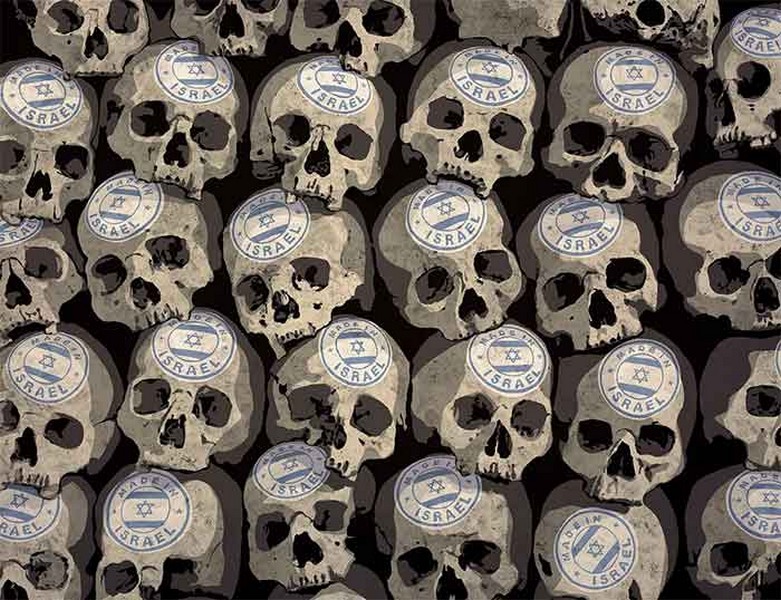
Made in Israel – by Mr. Fish

Israel, with the backing of its U.S. and European allies, is preparing to launch not only a scorched earth campaign in Gaza but the worst ethnic cleansing since the wars in the former Yugoslavia. The goal is to drive tens, most probably hundreds of thousands of Palestinians over the southern border at Rafah into refugee camps in Egypt. The reverberations will be catastrophic, not only for the Palestinians, but throughout the region, almost certainly triggering armed clashes to the north of Israel with Hezbollah in Lebanon and perhaps with Syria and Iran.

The Biden administration, slavishly doing Israel’s bidding, is fueling the madness. The U.S. was the only country to veto the U.N. Security Council resolution calling for humanitarian pauses to deliver food, medicine, water and fuel to Gaza. It has blocked proposals for a ceasefire. It has proposed a draft U.N. Security Council resolution that says Israel has a right to defend itself. The resolution also demands Iran stop exporting arms to “militias and terrorist groups threatening peace and security across the region.”

The U.S. and its Western allies are as morally bankrupt and as complicit in genocide as those who witnessed the Nazi Holocaust of the Jews and did nothing.

The conflict, which has taken the lives of 1,400 Israelis and at least 4,600 Palestinians in Gaza, is widening. Israel carried out a second airstrike on two airports in Syria. It daily trades rocket barrages with Hezbollah militias. U.S. military bases in Iraq and Syria have been attacked by Shia militias. The USS Carney, a guided missile destroyer, shot down three cruise missiles on Thursday, apparently launched by the Houthis in Yemen and heading towards Israel.

Israel is also struggling to quell daily violent clashes in the occupied West Bank. It carried out an airstrike on Sunday on a mosque in the Jenin refugee camp – the first air strike in the West Bank for two decades – that killed at least 2 people. Armed Jewish settlers have been rampaging through Palestinian towns in the West Bank. At least 90 Palestinians in the West Bank have been killed by armed settlers or the Israeli military since the Oct. 7 incursion into Israel by Hamas and other resistance fighters, according to the U.N.’s humanitarian office. Some 4,000 workers from Gaza and 1,000 Palestinians in the West Bank have been arrested in the past two weeks, doubling the number of Palestinian prisoners to 10,000 held by Israel, over half of whom are political prisoners

“Many of the prisoners have had their limbs, hands and legs broken … degrading and insulting expressions, insults, cursing, tying them with handcuffs to the back and tightening them at the end to the point of causing severe pain … naked, humiliating and group search of the prisoners,” the Palestinian Authority’s Commission for Detainees’ Affairs, Qadura Fares, said at a press conference.

B’Tselem, the Israeli human rights organization, told the BBC that since the Oct. 7 attack, it had documented “a concerted and organized effort by settlers to use the fact that the entire international and local attention is focused on Gaza and the north of Israel to try to seize land in the West Bank.”

Inside Israel, Palestinians with Israeli citizenship and Jerusalem IDs are being harassed, detained, arrested and expelled from jobs and universities in what is described as a “witch hunt.” More than 152,000 Israelis have been evacuated from towns and villages near the borders of Gaza and Lebanon.

The U.S., in an effort to thwart a military response by Iran that could trigger a regional war, is deploying an additional 2,000 troops to the Middle East. It will redeploy one of its strike groups to the Persian Gulf and send additional air defense systems to the region. The USS Dwight D. Eisenhower and its strike group — which last weekend was being deployed to the eastern Mediterranean Sea to join the USS Gerald R. Ford — has been redirected to the Persian Gulf. A Terminal High Altitude Area Defense (THAAD) anti-missile battery, and Patriot missile defense system battalions, have also been sent to the Persian Gulf.

Israel has unleashed its Four Horsemen of the Apocalypse – Death, Famine, War and Conquest.

It has given Gazans two choices. Leave Gaza or die.

Palestinians will be killed not only from the bombs and shells, and eventually, with the ground invasion, bullets and tank shells, but from hunger and epidemics such as cholera. Without water, fuel and medicine and with the breakdown of sanitation, diseases will spread swiftly. The U.N. states that hospitals in Gaza “are on the brink of collapse.” Thousands of patients will die once fuel runs out for hospital generators.

A doctor from al-Shifa hospital in Gaza reported in an interview Saturday, “We are collapsing.” He spoke of a lack of oxygen, light and medical supplies, no water in some departments, concerns about cholera and the loss of doctors killed by Israeli airstrikes, including a dentist killed in Israel’s bombing of an Orthodox church that left at least 18 dead, including several children.

The handful of trucks, 37 so far, of aid into Gaza is a cynical public relations gimmick demanded by the Biden administration. It will do little to alleviate the Israeli-engineered humanitarian crisis. The U.N. says it needs at least 100 aid tracks a day. Gaza’s last functioning seawater desalination plant shut down on Sunday because of a lack of fuel.

Israel has no intention of lifting the total siege on Gaza. It announced it will increase its airstrikes. It will continue, as it has for the past two weeks, to extinguish the lives of Palestinians and terrorize and starve them into leaving Gaza.

The ground assault on Gaza will not be quick. It will involve weeks, perhaps months, of street fighting. Secretary of Defense Lloyd Austin compared the looming battle in Gaza to the U.S. assault on the Iraqi city of Mosul, held by ISIS, in 2014. It took the U.S. nine months to recapture Mosul.

When Israel says this will be a “long war” they are, for once, telling the truth.

Israel has requested more military aid from Washington, $14.3 billion including $10.6 billion for air and missile defense. It will get it. Israel is rapidly depleting its stocks as it pounds Gaza, including in the south of Gaza where hundreds of thousands of displaced families from the north have fled.

Israel will not permit the distribution of the $100 million in U.S. aid pledged for Palestinians in the West Bank and Gaza, at least not until their scorched earth campaign is finished. But by then, Gaza will be unrecognizable. Israel will have annexed part or all of it. Maybe the money can go to building more illegal Jewish settlements in the occupied West Bank. And pledging aid is not the same as appropriating it. So perhaps that, too, is part of the illusion.

Egyptian officials are acutely aware of what comes next. Up to half, maybe more, of the 2.3 million Palestinians will be pushed by Israel into Egypt on Gaza’s southern border and never be allowed to return.

“What is happening now in Gaza is an attempt to force civilian residents to take refuge and migrate to Egypt, which should not be accepted,” Egyptian president Abdulfattah al-Sisi warned.

Reports out of Egypt contend that Washington has promised to forgive much of Egypt’s massive $162.9 billion debt, as well as offer other economic incentives in exchange for Egypt’s acquiescence to the ethnic cleansing of Palestinians. The refugees, once they cross the border into Egypt, will be left to rot in the Sinai.

“There is a grave danger that what we are witnessing may be a repeat of the 1948 Nakba, and the 1967 Naksa, yet on a larger scale. The international community must do everything to stop this from happening again,” said Francesca Albanese, U.N. Special Rapporteur on the situation of human rights in the Palestinian Territory occupied since 1967.

Israel has long used war to justify the ethnic cleansing of Palestinians. Government officials have openly called for another Nakba, or “catastrophe,” the term for the events of 1947-1949 when over 750,000 Palestinians were ethnically cleansed from historic Palestine and driven into refugee camps to create the state of Israel. During the 1967 war, which led to Israel’s occupation of the West Bank and Gaza Strip, Israel ethnically cleansed another 300,000 Palestinians during the Naksa, or “day of the setback,” which is commemorated every year by Palestinians.

Israel’s ethnic cleansing of Palestinians, however, is not limited to wars. There has been an ongoing slow motion ethnic cleansing as Israel has steadily built more Jewish-only colonies and incrementally seized Palestinian land. Palestinians, denied basic civil liberties in Israel’s apartheid state, have been robbed of assets, including, often, their homes. They have faced mounting restrictions on their physical movements. They have been blocked from trading and business, especially the selling of produce. They have found themselves increasingly impoverished and trapped behind walls and security fences erected around Gaza and the West Bank. At the same time, they have endured periodic Israeli airstrikes, targeted assassinations and near daily attacks by armed Jewish settlers and the Israeli army.

Israel prevented Palestinians who left the West Bank and Gaza Strip from returning at the rate of about 9,000 Palestinians per year following the occupation of the West Bank and Gaza Strip in 1967, until the signing of the Oslo Accords in 1994, according to the Israel human rights group HaMoked. Israel has also revoked the residency permits for some 14,000 Palestinians who lived in East Jerusalem since 1967 according to B’Tselem.

Israel demolished 9,880 structures, including over 2,600 inhabited residential buildings, displacing over 14,000 people and affecting 233,681 in the West Bank alone between Jan. 1, 2009 and 7 Oct. 7, 2023, according to data from the  U.N Office for the Coordination of Humanitarian Affairs. Since the Oct. 7 attack, a further 38 homes and other structures were demolished in the West Bank affecting an additional 13,613 people and displacing at least 73.

Less than 2.2 percent of Palestinian requests for construction permits made between 2009 and 2020 were approved, according to data from Peace Now and the Israeli newspaper Haaretz.

The number of Israeli colonists in the occupied territories, however, has gone from zero before the June 1967 war, to between 600,000 to 750,000 spread out across at least 250 settlements and outposts throughout the West Bank, including East Jerusalem, all of them in violation of international law.

Israel makes no secret about its intentions.

Israel’s defense minister, Yoav Gallant, told troops preparing to enter Gaza, “I have released all the restraints.”

Knesset member Ariel Kallner, part of Benjamin Netanyahu’s Likud party, called on X, formerly known as Twitter, for “a Nakba that will overshadow the Nakba of 48.”

The Israeli army mobilized Ezra Yachin, a 95-year-old army veteran, to “motivate” the troops. Yachin was a member of the Lehi Zionist militia that carried out numerous massacres of Palestinian civilians, including the Deir Yassin massacre on April 9, 1948, where over 100 Palestinian civilians, many women and children, were slaughtered.

“Be triumphant and finish them off and don’t leave anyone behind. Erase the memory of them,” Yachin said addressing Israeli troops.

“Erase them, their families, mothers and children,” he went on. “These animals can no longer live.”

“Every Jew with a weapon should go out and kill them,” he said. “If you have an Arab neighbor, don’t wait, go to his home and shoot him.”

Where are our humanitarian interventionists? The ones who wept crocodile tears about the human rights of Ukranians, Iraqis, Syrians, Libyans and Afghans, to justify massive arms shipments and war? Where is the old anti-war wing of the Democratic Party and the liberal class? What has happened to the public intellectuals who used to decry the slaughter of innocents and the U.S. war machine? Where are the jurists who uphold the rule of international law? Why are the few lonely voices speaking out about Israel’s genocide of the Palestinians attackedcensored and doxxed?

“The previous president wanted to ban us and probably put us in concentration camps,” said Michigan Congresswoman Rashida Tlaib, who is of Palestinian descent, at a rally in support of a ceasefire on Oct. 20 in Washington in front of the U.S. Capitol. “This one wants us just to die. That’s how it feels. Shame on them.”

Israel will not halt its genocidal campaign in Gaza against the Palestinians until there is a U.S. arms embargo on Israel. Our weapons systems, munitions and attack aircraft sustain the slaughter. We must terminate the $3.8 billion in military aid that the U.S. gives to Israel each year. We must support the Boycott, Divestment and Sanctions (BDS) movement and demand suspension of all free trade and other agreements between the U.S. and Israel. Only when these props are knocked out from under Israel will the Israeli leadership be forced, as was the apartheid regime in South Africa, to integrate Palestinians into one state with equal rights. As long as these props remain, the Palestinians are doomed.

Chris Hedges is a Pulitzer Prize-winning journalist who was a foreign correspondent for fifteen years for The New York Times, where he served as the Middle East Bureau Chief and Balkan Bureau Chief for the paper.

23 October 2023

Source: countercurrents.org

No Peace without Justice: Gaza Has Just Vanquished a 20-Year-Old Israeli Plan

By Dr Ramzy Baroud

Israel had the perfect plan for Gaza – in fact, for all Palestinians, when it decided to redeploy its forces around the Occupied Gaza Strip in 2005.

Despite statements made, back then, by Israeli officials that the ‘disengagement’ plan aimed at severing Israel’s legal and other responsibilities from its role as an Occupier, the actual story was different.

Dov Weisglass, a top adviser to the late Israeli Prime Minister Ariel Sharon, conveyed the real reasons behind the redeployment.

Weisglass knew exactly what he was saying; after all, he was one of the architects of the plan.

But how much of the Israeli plan, as described by Weisglass, was, in fact, implemented? And did the current war in the Strip change those outcomes, as pronounced nearly two decades ago?

“The significance of the disengagement plan is the freezing of the peace process,” Weisglass told Haaretz in 2004.

That part has, indeed, been achieved in full. Not only was the so-called peace process frozen, but Israel has, since then, carried out numerous steps to make sure that there is nothing worth negotiating over.

The exponential growth of illegal Jewish settlements, the killing of Palestinians, the desecration of holy sites and the annexation plans made it unrealistic to even suggest that a two state solution is still practically possible.

But why was Israel keen on freezing a ‘process’ that was futile to begin with?

It was not the peace process that mattered to Israel, but the fact that, so long as such political conversations were still taking place,  the Palestinian political agenda remained relevant.

This logic, long argued by Palestinians, was supported by Weisglass himself, when he said that “When you freeze that process, you prevent the establishment of a Palestinian state, and you prevent a discussion on the refugees, the borders and Jerusalem.”

“Effectively,” he added, “this whole package called the Palestinian state, with all that it entails, has been removed indefinitely from our agenda. And all this with authority and permission. All with a (US) presidential blessing and the ratification of both houses of Congress.”

This explains much of what has happened since the senior Israeli officials made those revelations and predictions.

First, is that all Israeli governments, regardless of their ideological or political orientations, remained faithful to the plan, and never engaged in any genuine political conversations on the future of a Palestinian State, the rights of the Palestinians, let alone a just peace.

This indicates that Israel’s intentions were not open for debate within the country’s political establishment. For Tel Aviv, it was the end of peace efforts, and the start of a new phase, that of entrenching the Occupation.

Second, every US administration since then has either invested in the overall Israeli agenda or disowned the very ‘peace process’ that the Americans had, themselves, invented and sustained.

This, too, did not happen by chance. Israel had invested much lobbying efforts and diplomacy in dissuading the Americans from continuing to pursue their own agenda.

Not only did the Israeli Prime Minister Benjamin Netanyahu get what he wanted, he even managed to convince the Trump Administration in 2017 to follow Israel’s own agenda on Jerusalem, on the refugees, on settlements and even on annexation.

The Biden administration did not alter that new grim political reality established by President Donald Trump, even if some of its language appeared to suggest otherwise.

Third, although unwittingly, Weisglass indicated that Israel does not see Palestinians and their struggle as fragments, but as a unified whole. By blocking one aspect of that struggle, the political process, all others are meant to fall apart like pieces of dominos.

The division of Palestinians, along with the ability of Mahmoud Abbas to sustain his Palestinian Authority for all these years despite its failure to achieve anything of substance, allowed Israel to advance its original plan unhindered.

Frustrated by the insistence of many countries, including the US, that Israel must engage in a political process, Israel, instead, decided to ‘disengage’ from Gaza.

“The disengagement is actually formaldehyde,” Weisglass said. “It supplies the amount of formaldehyde that is necessary so there will not be a political process with the Palestinians.”

The Israeli plan, however, was not a complete success. Palestinians continued to lead a massive campaign of resistance, involving all aspects of society in Gaza, the West Bank and Jerusalem.

And, as was always the case, Israel responded with a massive show of force whenever Palestinians seemed ready to challenge their Israeli jailors.

From the frequent raids on Jenin, Nablus, Jericho to the massive and deadly wars on Gaza, Israel has done everything in its power, not only to crush Palestinians but also to send them a message: no resistance of any kind will be tolerated, and no form of resistance will ever be enough to place Palestine back on Israel’s political agenda, or those of its allies.

A feeling of ‘we won, and you lost’ has pervaded official Israeli institutions and society. Israeli election campaigns seemed entirely disinterested in even discussing the settlements, a Palestinian State, the status of Jerusalem and so on.

Palestinians were still useful, however. The PA served as a line of defense for the ever-growing settlements. And every Palestinian attack against Israeli targets was utilized as  further proof that Israel has no peace partner, thus solidifying the anti-peace position of every Israeli government.

The discussion in the media following the Hamas attack on southern Israel on October 7 focused on the attack itself, on Hamas as a group and, later, although selectively, on the bloodbath created by Israel in Gaza.

But that date was not the start of the war; it is a horrific episode of a war that has already started and is sustained by a very violent Israeli military Occupation and apartheid.

Equally important, regardless of Israeli propaganda and distorted western media coverage, there is no question that Israel has failed.

That failure was initiated by Sharon’s wishful thinking in 2005, and maintained through the illusions and arrogance of every Israeli government ever since.

The truth is that Netanyahu is only a cog in a massive Israeli political machine which aims at dismissing the Palestinian cause, forever.

Even those who insist on supporting Israel at any cost, cannot now genuinely pretend that Palestine is not back on the agenda as the Middle East’s most vital issue. Without a free Palestine, there can never be true peace, security or stability.

Dr. Ramzy Baroud is a journalist, author and the Editor of The Palestine Chronicle.

19 October 2023

Source: countercurrents.org
Stop the Ethnic Cleansing & the Genocidal Israeli War on Palestine! India Stands With Palestine

By Press Release

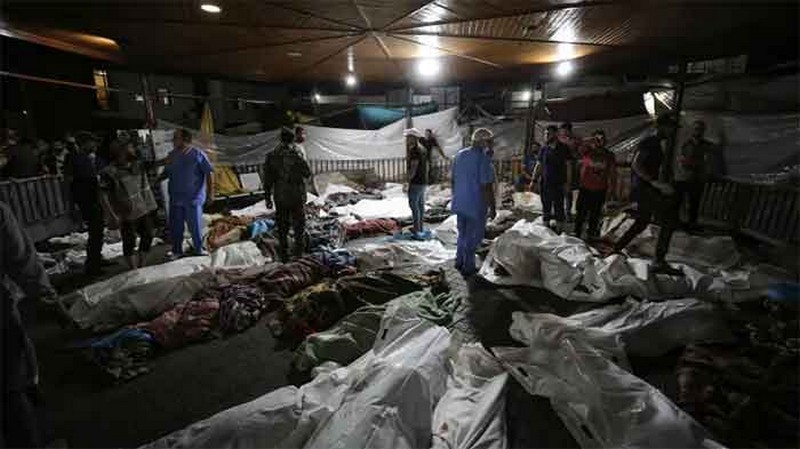
We, the People of India, stand utterly shocked at the depravity & barbarism of the Israeli regime. The missile attack by the Israeli forces on the Al-Ahli Baptist Hospital in Gaza, which has killed more than a thousand innocent civilians, is more evidence of the genocidal intent of the fascist Neo-Nazi Zionist Netanyahu regime. Moreover, Israel has threatened the 1.1 Gazan population in the North with dire consequences if they do not move towards the South, even as they prepare to invade Gaza yet again. Sections of the Jewish Zionist radical leadership have further threatened the entire population if they do not move out to the Sinai desert in Egypt. The Palestinians know that once they leave their land, they will never be allowed to return back to their homeland and will be reduced to refugees.

This clearly constitutes a war crime by international law. The Convention on the Prevention and Punishment of the Crime of Genocide,1948 states:

Article II: In the present Convention, genocide means any of the following acts committed with intent to destroy, in whole or in part, a national, ethnical, racial or religious group, as such:

(a) Killing members of the group;
(b) Causing serious bodily or mental harm to members of the group;
(c) Deliberately inflicting on the group conditions of life calculated to bring about its physical destruction in whole or in part;
(d) Imposing measures intended to prevent births within the group;
(e) Forcibly transferring children of the group to another group.

Clearly, the Israeli political & military leadership is guilty of all of the above.

The agenda is to ethnically cleanse the entire Palestinian population from the Occupied territories of Gaza, the West Bank & East Jerusalem. This is a continuation of “The Nakba” in 1948, “The Catastrophe” that befell the Palestinian nation, when Israel ethnically cleansed 7,50,000 Palestinians, constituting half of the population and reduced them to refugees.

Israel, a creation of British & US imperialism, was imposed upon historic Palestine as a European Settler Colonial Apartheid state, built on the ideology of Zionism, racism & supremacism, a supposed Chosen People, a highly racist & supremacist belief system, which the other nations would have to be subservient to. The entire ethno-religious radical extremist and violent character is there for all the world to see.

At the root cause of the current phase of the violence is the continuous series of genocidal wars over a period of 106 years, ever since the British, in 1917, issued the Balfour Declaration and decided to give away Palestine to create a Jewish homeland, at the human cost of the original people of the land. Thus the root cause is the “Occupation of Palestine by Israel”.  This burning issue, right at the very centre of global geopolitics, needs to be addressed and resolved on the basis of all UN Resolutions 181(11) (1947), 242 (1967) & 338 (1973) and others, as well as other relevant dictums of International Law.

Gaza, which lies at the very epicenter of this crisis, continues to be an Open-Air-Prison-Cum-Concentration-Camp. Just as 4 lakh Jews in the Warsaw Ghetto rose up against the German Nazis in 1944, so have the 25 lakh Palestinian Gazan population against the Israeli Neo-Nazis in 2023. The Israeli siege of Gaza is also being compared to the German Nazi siege of Leningrad during WWII. The lessons of history are exceedingly clear.

The Palestinian Gazan population imprisoned for over 16 years have finally broken out of the Israeli prison. Thus, the powderkeg finally erupted on the 7th of October 2023, when the Palestinian resistance & the population said, enough is enough.

Clearly, Israel is an Apartheid State based on racial and ethno-religious inequality, affirmed by B’Tselem, the leading Israeli human rights organization, as well as Amnesty International in detailed well documented reports.

We indeed condemn any civilian loss of life, be it Palestinian or Israeli. We also condemn the killing of civilians both by the Israeli regime or by Hamas. It must be noted here that the mass murders of Palestinian civilians are on an industrial scale, especially that of women and children, and are far greater in number than that of Israeli civilians. Only since 2008 the Israelis have either killed or injured more than 1,50,000 Palestinians, of which 33,000 are children. This asymmetry must be noted, as the facts are stark and obvious.

The world sits on a precipice, even as we witness Jewish radical fanatics that are committed to destroying the Al Aqsa Masjid & the rebuilding of the Third Temple of Solomon. This is a time bomb waiting to erupt, with grave consequences for all the nations and people’s of the world.

On a daily basis, the Palestinians are subjected to, the destruction of their farms and homes, the growing Jewish Settlements that takeaway their land, the total control over their water, with their wells destroyed, the Check-Points, the Apartheid Wall all across the West Bank, the siege & inhumane blockade of Gaza, the regular murder & brutalisation of Palestinian civilians, the long history of violent provocations – all the decades of frustration and anger erupted on the 7th of October.

Certainly, war is not the solution, ending the occupation is. Thus the international community must immediately step in and call for and establish a cease fire, create a humanitarian corridor to ensure the safety of the Gazan population, and supplies of all essentials, food, water, medicines and electricity to be immediately reinstated. Shamefully, this, too, the US has vetoed in the UNSC. One of the reasons for Israeli brazeness is the political protection of the US veto, the blind support of the Western corporate media, the annual sum of $3.3 Billion & the advanced weaponary that the US provides to Israel. Thus, the US & other Western nations are clearly culpable & complicit in the Israeli war crimes.

In the context of India and our rich anti-colonial history, our rich legacy of our freedom movement from British colonialism & occupation, it was shocking to witness the outright support that PM Modi offered to Israel. This position is both ahistoric, as well as a betrayal of the ideals & principles of our Independence movement led by Mahatma Gandhi, Jawaharlal Nehru, Dr. Babasaheb Ambedkar, Bhagat Singh, Maulana Azad, Netaji Subhash Chandra Bose, Capt. Laxmi Sehgal, Yusuf Meherally, Aruna Asaf Ali, Ashfaqullah, among many other legendary leaders. We continued to stand with all the anti-colonial freedom movements, but support for the Israeli colonial settler state, is clearly in conflict with those principles.

Later, the Ministry of External Affairs corrected the gross strategic error and issued a statement in favour of a Two-State Solution, based on UN resolutions and international consensus.

All that PM Modi required to do was issue a statement along the lines that of the Russia-Ukraine conflict. But he has grievously erred. Even as we witness many nations engaging in serious dialogue and discussions, PM Modi stands sidelined, as the majority of the nations that constitute the Global South see him as a pro-Western US/UK/Israeli ally, with no further role to play. PM Modi has indeed gravely damaged India’s international standing and respect.

We are also perturbed at the Hindutva troll factories, which have now begun to export their hatred and fake news to target the Palestinian nation. The Godi media is now embedded with the Israeli army & promoting a one-sided narrative based on Israeli propaganda, but that again is their dubious role in our country as well. This is the precise reason that the Godi media lacks any sense of credibility.

This meeting demands the following:

1. An immediate ceasefire & an end to the war.

2. End the Israeli siege of Gaza where 2.5 million people reside  of which 40% are children.

3. Ensure humanitarian aid, food, water, medicines, electricity, and the rebuilding of houses, hospitals, universities, schools, colleges, roads, all the civilian infrastructure that has been devastated in the indiscriminate Israeli bombings.

4. Dismantle the Apartheid Wall that imprisons 3 million Palestinians in Bantustans in the West Bank.

5. Dismantle all the Illegal Israeli Settlements across the West Bank, East Jerusalem, and the Gaza District.

6. Immediately move towards a political solution based on all relevant UN resolutions and international law, thereby constituting Two States, namely Palestine with East Jerusalem as its capital and Israel, peacefully co-existing side by side.

7. Set up a war crimes tribunal in the International Criminal Court (ICC),  and investigate and try all those political & military leaders responsible for the deaths of civilians and other war crimes.

This is also an appeal to all Indian democratic forces to come together  & unite in support of Palestine and strengthen the global solidarity movement by taking to the streets and raising our voices against this barbaric genocidal Israeli occupation.

It is only then that peace shall be achieved, a peace based on equality, justice, respect for human dignity and freedom.

Com. Prakash Reddy presided over the meeting, and the speakers included, Kumar Ketkar, MP, Rajya Sabha, Congress Party, Veteran Editor, Feroze Mithiborwala, Expert on West Asian Affairs, IPSF, Prof. K Theckedath, AIPSO, Com. Dr. Rege, Mumbai Secretary, CPM, Meraj Siddiqui, SP, State Secretary, Com. Milind Ranade, Mumbai Secretary, CPI, Com. Ajit Patil, CPI-ML (Liberation), Dr. Salim Khan, Veteran Journalist, Sayeed Khan, Educationist, Compered by Com. Shraddha Mehta.

The public meeting was held at Mumbai Marathi Patrakar Sangh on 18th of October 2023.

ALL INDIA PEACE AND SOLIDARITY ORGANISATION (AIPSO, Mumbai) &
INDIA PALESTINE SOLIDARITY FORUM (IPSF)

For further information contact:
feroze.moses777@gmail.com

19 October 2023

Source: countercurrents.org
 

A Major Empire Falls Unnoticed

By Alfred W McCoy

One of modern history’s major empires is falling apart right now, right before our eyes. Yet precious few in the media have reported on this extraordinary event, much less offered any analysis of its implications for the fast-changing shape of global power.

Over the past 60 years, France has used every possible diplomatic device, overt and covert, fair and foul, to incorporate some 14 African nations into a neocolonial imperium called “Françafrique” — a vast region covering a quarter of Africa and stretching for nearly 3,000 miles from Senegal on the Atlantic coast to Chad in the continent’s center.

While the rest of that continent frequently suffered from wars, coups, and chronic instability, Françafrique long enjoyed comparative peace. By dispatching paratroopers from its many African bases (or secret agents for the occasional assassination), Paris provided a rough version of stability — even if at the price of endemic corruption, entrenched autocratic rule, and deep economic exploitation. Recently, however, a rising nationalist consciousness in many of those relatively new countries has begun chafing against that European land’s repeated transgressions of their sovereignty. As French colonial and post-colonial dominance over this vast region moved ever deeper into its second century, unease bordering on open hostility against that country’s presence began to build.

In less than a year, in fact, the sudden withdrawal of French troops from individual African nations has turned into a full-blown retreat from much of the region. As terrorists affiliated with ISIS first became active in 2014, France deployed some 5,000 elite troops for Operation Barkhane in collaboration with six nations of Africa’s arid Sahel region, the strip of territory extending across the continent, largely south of the Sahara Desert.

Yet just last December, French troops left the Central African Republic after Paris decided that the local government there was “complicit in an anti-French campaign allegedly steered by Russia.” In February, Burkino Faso’s new military government simply expelled French forces and hailed its new “strategic partnership” with Russia. And in August, following back-to-back coups in Mali, that country’s ruling junta grew resentful of the 2,400 French troops stationed there and forced them to withdraw into neighboring Niger, which became the new main base for their operations in the Sahel region. Then, last month, French President Emmanuel Macron was forced to announce that he was pulling his troops and his ambassador out of Niger as well. After seizing power in July, that country’s new military junta had demanded just such a French departure and, to drive the point home, closed its airspace to France. “Imperialist and neocolonialist forces are no longer welcome on our national territory,” the junta announced.

Amid such geopolitical upheaval, a most unlikely man from Moscow appeared on the spot in 2017. His name — now all too well known — was Yevgeny Prigozhin, founder and commander of a notorious mercenary army, the Wagner Group. As the French retreated slowly and exceedingly reluctantly from their post-colonial imperium, Wagner began moving in, becoming Moscow’s surrogate in an ongoing great-power contest for influence and control in Africa.

By the time in late 2022 that France’s failing nine-year effort to secure the Sahel was drawing down, Wagner’s forces were already operating secret gold mines in Sudan, running the largest gold mine in the Central African Republic with projected revenues of $100 million annually, and had earned $200 million since 2021 providing security for Mali, a land roiled by Islamist rebels. In March, Washington warned Chad’s president that Wagner mercenaries were plotting to assassinate him and were also preparing Chadian rebels to attack from their bases in the Central African Republic. After the July coup in Niger, cheering crowds were seen waving (as well as wearing) Russian flags. And as 1,500 French troops and that country’s ambassador were being withdrawn, Niger’s new military leaders promptly contacted Wagner for support, expanding Russia’s sphere of influence in the French imperium it was fast supplanting.

The strategic implications of this shift, should it continue, are potentially profound. As the NATO alliance moved ever closer to Russia’s sensitive western border in the 1990s, Moscow reacted early in this century (prior to the invasion of 2022) with repeated interventions in Ukraine, launched special operations to secure its allies in Central Asia, and, above all, engaged in a little understood geopolitical flanking maneuver across two continents.

The thrust of that move started in 2015 when Moscow leapfrogged over the NATO barrier of Turkey to open a massive air base at Latakia in northern Syria. Soon, Russian planes had reduced rebel-held cities like Aleppo to rubble. In 2021, leapfrogging again, this time over the close American ally Israel, Russia began supplying Egypt with two dozen of its advanced Sukhoi-35 jet fighters so its airmen could compete with Israelis flying advanced American F-35 fighter planes, which Washington refused to supply to Cairo. Completing Moscow’s southern push in the region, Russian President Vladimir Putin began building upon their shared interests as oil exporters to try to befriend Saudi Arabia’s functional leader, Prince Mohammed bin Salman, becoming so close by late last year that Western observers began to express concern about the possible loss of a key ally.

The final geopolitical pivot in Russia’s recent maneuvering proved particularly controversial and so initially remained significantly covert: the Wagner Group was used to extend Russia’s influence country by country, deal by dirty deal, across the Sahel. Should this process continue successfully into the near future, Moscow will have flanked Europe (and so the U.S. as well) by forming a geopolitical arc of influence sweeping south through the Middle East and extending west across the whole of the Sahel that stretches from the Red Sea to the Atlantic Ocean.

For this maneuver to succeed, however, the end of French neocolonialism proved crucial. To appreciate the historical significance of the impending fall of Paris’s post-colonial empire, it’s important to understand something of its tangled history — otherwise it would be hard to grasp the full import of Yevgeny Prigozhin’s extraordinary role as the man on the spot in extending Russia’s influence into Africa for the first time since the Cold War.

The Hidden History of Françafrique

As the bitter, bloody French colonial war in Algeria was winding down to defeat in 1960, President de Gaulle realized that the age of empire was ending and used his enormous prestige to grant independence to 14 West African nations. Yet his move was far from altruistic. As part of his vision of France as an independent global power, he began working to create a post-colonial sphere of influence by subsuming the new nations into an exclusive French zone called Françafrique.

While de Gaulle’s visionary rhetoric inspired an independent foreign policy, his “man of the shadows,” presidential adviser Jacques Foccart, built a full-scale covert apparatus for a post-colonial imperium that became the dark underside of the grand Gaullist state. During his service under Gaullist governments from 1960 to 1997, the shadowy Foccart used the state’s clandestine agency, Service de Documentation Extérieure et de Contre-Espionnage, to maintain a deft, delicate synergy between metropolitan power in France and covert control of Francophone Africa. As head of de Gaulle’s political party and architect of its secret services, he would become the key link between the French executive and Françafrique’s African leaders, whom he personally selected, befriended, and defended with covert action.

At the moment of independence in 1960, Foccart bound all of those former colonies (except Guinea) to Paris by defense agreements that granted France military bases and the right of armed intervention in each country. In the process, he also developed treaties meant to secure strategic materials (cobalt, copper, oil, and uranium) from those countries, as well as a common currency pegged to the French franc that would ensure control of their economies.

Under this postcolonial iteration of informal empire, French troops shuttled in and out of West Africa, conducting more than 40 military interventions between 1960 and 2002, while maintaining a permanent presence at a half-dozen military bases on the continent. Although the rest of Africa suffered 188 coup attempts from 1956 to 2001, the readiness of the French military to quash any such effort provided Françafrique with what political scientist Crawford Young called an “effective inoculation against conspiracies” and so minimized and even controlled coups. Despite vivid personality cults, systemic corruption, and state terror, French complicity in all of the above assured its African allies of an extraordinary political longevity — exemplified by Omar Bongo who ruled Gabon for more than four decades.

With its lucrative oil concessions and its full integration into Foccart’s network, the exemplary state in Françafrique was undoubtedly Gabon — an unbearably poor country of 500,000 people that was surprisingly rich in natural resourcesThree years after independence in 1960, as the country’s president lay dying of cancer in a Paris hospital, Foccart picked Omar Bongo, a veteran of French intelligence with no political base, as the ailing president’s running mate in the next election. That ticket then captured 99.5% of the vote, assuring that Bongo, though still just 31 years old, would succeed the president at his death six months later.

As Gabon’s political opposition revived in 1971, Foccart’s office dispatched the infamous mercenary Bob Denard as a “technical adviser” to President Bongo. Not surprisingly, when an influential opposition leader arrived home one night from the movies, an assassin stepped from the shadows and killed him, also wounding his wife and child. His body was never recovered.

During the long years of his rule, French officials enabled Bongo’s graft, making him a principal shareholder in that country’s lucrative Elf-Total oil company and facilitating illicit payments to him — estimated at $111 million a year — that were only exposed at the 2003 corruption trial of the company’s chief executive.

When he died in 2009 after a rule of 42 years, London’s Telegraph reported that he had looted revenues from the nation’s 2.5 billion barrel oil reserve to “become one of the world’s richest men,” while elevating “corruption to a method of government.” His son Ali-Ben Bongo succeeded him as president, inheriting, along with his siblings, 39 luxury properties in France worth $190 million and a country with a third of its population living on two dollars a day.

The son continued many of his father’s policies, including ruthlessly rigging the 2016 election by enforcing a 99% turnout in key districts. In August, however, after one too many rigged elections and amid an eruption of coups across the region that marked the fading of France’s post-colonial power, Ali Bongo was finally toppled by a military coup, ending a dynasty that had lasted nearly six decades.

Advent of Moscow’s Africa Man

To challenge that French post-colonial imperium built by cunning, corruption, and covert skullduggery, Moscow needed an operative who could match Jacques Foccart’s legendary mastery of the dirty business of empire, measure for measure. And it found him in the person of Yevgeny Prigozhin, one of those quixotic, improbable adventurers who, over the past two centuries, have served as the vanguards of new forms of empire.

Who was that extraordinary individual whose personal initiative shook up the world order in Africa, establishing a Russian mercenary troop presence and ties to governments in at least seven African countries? Emerging from Soviet prisons after a 10-year term for a teenage mugging spree, Prigozhin rose, through Vladimir Putin’s patronage, from a hot-dog vendor on the streets of St. Petersburg to a millionaire caterer for Russian schools and troops.

In 2014, his Wagner group of mercenaries first appeared as the shadowy “little green men” during the Russian seizure of Crimea and then moved on to Syria where they engaged in a war of atrocities. Between conflicts, his troll army fired off disinformation barrages meant to influence the 2016 presidential elections in the United States. As French influence in the Sahel was challenged by terrorist groups, Prigozhin inserted his Wagner mercenaries into the fissures being opened by the ending of Paris’ post-colonial empire and turned those cracks into gaping holes.

When in 2022, as the first year of the Ukraine war was ending with Russian troops suffering demoralizing defeats at Kharkiv and Kherson, Prigozhin expanded his Wagner Syrian and African franchises to Ukraine, fielding some 50,000 convicts as troops for Putin’s military, a force that took heavy casualties while winning the battle for the devastated Ukrainian city of Bakhmut. Instead of celebrating his victory, Progozhin was growing ever more dissatisfied with Russia’s military chiefs.

“These are Wagner lads who died today,” he shouted on camera while pointing at a pile of corpses. “Those bastards who don’t give us ammunition, we will fucking eat their guts in fucking hell!” Within weeks his war of words had escalated into open conflict in Russia itself. In late June, Wagner’s troops were suddenly on the road to Moscow — smashing through barriers, shooting down Russian aircraft, and raising doubts about Vladimir Putin’s grip on power.

Flailing desperately to survive after defying Putin and halting the advance of his troops on Moscow, Prigozhin returned to Africa, landing in his private jet at Bangui, the capital of the Central African Republic where his Wagner Group has gold mines and a security contract. After a private meeting with that country’s president on August 18th, he flew on to Mali and drove out into the desert where he produced what would turn out to be his last video ever. Holding an assault rifle, he proclaimed: “The Wagner PMC [private military company] makes Russia even greater on all continents, and Africa more free.” Five days later, his private jet crashed on a flight from Moscow, killing Prigozhin and everyone else on board.

Even though Prigozhin was undoubtedly assassinated (like so many of Putin’s critics), his extraordinary relationship with Africa highlights an overlooked aspect of modern empires in what still passes for the post-imperial age. Despite the oft-cited role of military power in creating and maintaining them, individuals have often emerged from the covert realm to play surprisingly significant parts in the making of the post-modern version of empire.

Instead of the gentlemen adventurers of the British imperial age, our modern analogues are usually, like Prigozhin, covert operatives, often from anything but gentlemanly backgrounds. And count on one thing: as the struggle to shape and control northern Africa continues through what will undoubtedly be countless new chapters, Prigozhin will not be the last of those extraordinary secret agents, those men on the spot, who leave their fingerprints on the crime scenes of world history.

Alfred W. McCoy, a TomDispatch regular, is the Harrington professor of history at the University of Wisconsin-Madison.

18 October 2023

Source: countercurrents.org
Gaza Conflict May Spark Far Wider War

By Ellen Isaacs

A hospital bombed, thousands killed, made homeless, deprived of food, water and power. The racist degradation of Zionist Israel has reached a new depth as the number lives it annihilates soars. The one thing certain is that the crimes of Hamas will pale by comparison. Israeli leaders, for over a century, have steadfastly cultivated anti-Arab racism in order to justify their land grabs and oppression of Palestinians – and they have succeeded. Barely an Israeli voice is lifted in opposition, although some Jews in the US and elsewhere are rising to oppose genocide in Gaza, including a huge demonstration at the White House on October 16.

Tools of Imperialism All Along

But this is not the whole story by any means –Zionist Jews managing to equal the brutality of their own historical oppressors. No, even these powerful killers are but the creation, the tools of the world’s mightier imperialists. It was the British, and then primarily the US, who promoted the formation of the Israeli state as oil became the preeminent world resource, most of it in the Middle East. As the British empire disintegrated after World War I, they gave the Zionists a disproportionate share of the land and water of Palestine and allowed the natives to be driven into exile. With the French, they had divvied up the other Arab lands into many countries – Jordan, Iraq, Syria, Lebanon, Palestine – where competing nationalisms were fostered as independence was gained.

With the US as its primary post World War 2 sponsor, Israel became a nuclear power with a strong military and intelligence system. More anxious to share in American largesse than to defend Palestinians imprisoned and belittled in the West Bank and Gaza, neighboring Arab nations did not come to their aid when Palestinians rebelled in 1987 and 2000. Recently several have even signed pacts with Israel (that is, with the US) in order to gain an advantage for themselves- enhanced security for the UAE and Bahrain, sovereignty over Western Sahara for Morocco, cancellation of debts and an end to designation as a terrorist for Sudan. Even Saudi Arabia was about to sign its pact.

Since 2007 Gaza has been turned into a total prison for 2.2 million, where poverty, food insecurity, and lack of adequate health care, jobs, water, sanitation and power stalk the population. Since taking power in 2006, the fundamentalist Hamas, which Israel helped create in the 1980s to counter secular nationalism, has further brutalized the population, stealing aid, monopolizing resources, jailing or killing opponents and living in luxury as the standard of living of the majority sank lower and lower. Occasional futile shows of resistance by Hamas with a few rockets brought huge reprisals resulting in the death of at least 6800 through early 2023.

More Big Powers

But it is no longer just the US that is seeking to maintain and expand its power in the region. After the Iranian revolution against the US backed Shah in 1979, Iran began forging alliances to oppose Israel. In addition to Syria and Lebanon, where they sponsored Hezbollah, they began giving aid to Hamas. They offered military training and $30-50 million annually,1 now up to $70-100 million. They also sent artillery rockets and, since 2006, have focused on supplying the knowhow and equipment to produce rockets locally. All is smuggled in via tunnels or the sea.2

There has been conflict over whether Iran actually knew about the attack in Israel by Hamas last week. The Wall Street Journal ran an article that quotes senior members of Hamas and Hezbollah saying that Iranians were involved in training for this mission and gave the go ahead in a secret meeting in Beirut.3 The US has denied having any evidence of such collusion, likely wanting to hedge its own bets to avoid increasing conflict with Iran.

The other even bigger player whose role is to be considered is China, Iran’s main trading partner. Because of Western sanctions, selling oil to China is now one of Iran’s major sources of revenue. China supplies Iran with military equipment, technology and assistance with its nuclear program. China has also long supported the PLO in a bid to be an ally of the Muslim world.4

Since April, 2023, China has launched the Global Security Initiative (GSI), which aims to create an alternative to US control of the international order. Beijing hopes to establish itself as a source of global security, where it would emphasize internal state security and autonomy.  Its main achievement to date was brokering an agreement between Iran and Saudi Arabia, long regional rivals. GSI is being promoted in Africa, Latin America, the Middle East and Pacific Islands, although it has yet to gain much traction.Today, China met with 130 Belt and Road Initiative leaders, including such partners the Taliban, Hungary’s Orban, and Putin.6 What knowledge China may have had of the plans of Hamas remains unclear.

Consequences Unknown

By realizing the breadth of global players involved, we can see beyond the searing tragedy befalling Gaza to possible far wider consequences. Could a disastrous course of Israeli aggression prompt US involvement, Iranian involvement? Already ten US warships are parked or en route to Israel’s coast. Could the supposed distraction of the US prompt Chinese invasion of Taiwan? There are many possible, unpredictable, and cataclysmic consequences to which this conflict could lead, not unlike the war in Ukraine or contests to come. In the larger picture, we must see that we are in some stage of the ultimate contest between the two imperialist giants of the world, the US and China, teetering over the contests between their seconds like Iran, India and Israel, trampling over the small players in Gaza or Syria or Ukraine who will be crushed.

For us there are two major tasks. We must throw off the nationalism and racism that allow us to be used as players in this deadly imperialist game. We must refuse to hate and fear one another and to fight in these wars. And we must build our own power, allying together and rejecting the structures of capitalism and imperialist rivalry. Today it is Jews and Arabs who must see and ally with each other; indeed all of us must reject nationalism and embrace class struggle. If we do not, the consequence may be our annihilation.

Ellen Isaacs is an anti-racist and anti-capitalist activist and co-editor of multiracialunity.org.

18 October 2023

Source: countercurrents.org
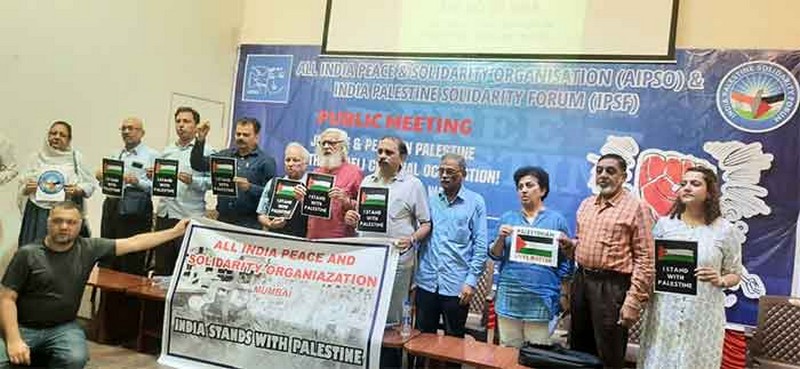
Protest In Middle East Countries Following Gaza Hospital Strike Killing More Than 600

By Countercurrents Collective

The strike on a Gaza Strip hospital that killed more than 600 Palestinians has sparked protests and riots in several Muslim-majority countries on Tuesday night, including Lebanon, Jordan, and Türkiye.

Beirut

In Beirut, where the pro-Palestinian militant group Hezbollah has called for “a day of unprecedented anger,” protesters gathered in front of the U.S. embassy building in the Awkar neighborhood.

They threw stones at the security fence and attempted to scale it. Police responded by firing volleys of tear gas and used water cannons to contain the mob, according to the Lebanese news channel MTV.

Protesters also reportedly attempted to break into the office of the UN Economic and Social Commission for Western Asia (ESCWA) in downtown Beirut.

Amman

Similar scenes unfolded in Jordan’s capital Amman, where an angry crowd burned Israeli flags and tried to storm the Israeli embassy. An AFP correspondent reported that they broke through the first security barrier, but were later pushed back by the police, which used tear gas.

“Police handled and drove a group of protesters who grouped near an embassy in an attempt to reach the building,” Jordan’s Public Security Directorate said, as quoted by Roya News.

Amman was to host a summit of the leaders of the U.S., Jordan, Egypt, and the Palestinian Authority on Wednesday. The Jordanian authorities have since canceled the event in solidarity with the victims in Gaza.

Turkish Cities

Rallies were held in multiple Turkish cities, including Istanbul, Malatya, Gaziantep, and Kayseri.

In Istanbul, Türkiye’s largest city, a huge crowd gathered outside the Israeli consulate, with some protesters launching fireworks, scaling the security fence, and attempting to set the building on fire. Others threw stones and set a US flag on fire, local media reported.

Police intervened, dispersing the rioters. Fahrettin Altun, spokesman for President Recep Tayyip Erdogan, urged those wanting to express “justified anger” over the deaths in Gaza to respect the law and “preserve common sense.”

The Palestinian authorities blamed Israel for the strike on the Al-Ahli Arab Hospital in Gaza City that claimed more than 600 lives on Tuesday.

The Israeli army and Prime Minister Benjamin Netanyahu, however, said that the hospital was hit by a rocket that was launched by one of the Palestinian militant groups and had veered off course. Israeli officials previously accused Hamas, a group that governs Gaza, of using hospitals, schools, and mosques as a cover for its operatives.

The Israel Defense Forces have been conducting retaliatory strikes on Gaza after Hamas and allied militants launched a surprise attack on Israeli cities on October 7.

Hundreds Dead In Gaza Hospital Bombing

More than 600 people have been reported dead and over 900 wounded after a missile struck the Al-Ahli Arab Hospital in Gaza. Hundreds of Palestinians were sheltering in the building, as well as patients receiving treatment, and there are fears the death toll will grow higher. Israel, which is bombarding Gaza following a bloody incursion by Hamas, has denied responsibility for the strike and accused Palestinian Islamic Jihad of hitting the facility.

A Palestinian Red Crescent representative on Tuesday described the destruction of the Baptist Hospital in Gaza City as a war crime and genocide, while a local doctor called it a massacre.

According to a source, the final death toll could easily reach more than 1,000.

Al-Ahli hospital is run by the Episcopal Diocese of Jerusalem, an Anglican Christian denomination.

Its destruction was denounced by the World Health Organization, Egypt, Qatar and Türkiye, among others.

Hamas leader Ismail Haniyeh insisted that such “brutality” by Israel confirmed its “defeat” on October 7, and said the U.S. was ultimately to blame.

He also called for Palestinians in the West Bank to rise up against Israel.

Within minutes of Haniyeh’s statement, a riot broke out in Ramallah, as hundreds of Palestinians protested against President Mahmoud Abbas’ decision to meet with U.S. President Joe Biden on Wednesday. Abbas has reportedly canceled those plans since, citing the hospital attack.

Russia and the United Arab Emirates have called for an emergency session of the UN Security Council on Wednesday, to discuss the Gaza hospital attack.

Israel And Palestinians Trade Blame For Deadly Hospital Strike

Another media report said:

Israel has denied striking the Al-Ahli Arab Hospital in Gaza on Tuesday, alleging that a Palestinian Islamic Jihad misfire was to blame. PIJ has accused Israel of trying to cover their “massacre” while Hamas has argued the U.S. is ultimately to blame.

Israel has denied striking the hospital, however. IDF spokesman Daniel Hagari said that “an enemy rocket barrage was carried out towards Israel, which passed through the vicinity of the hospital when it was hit.”

“According to intelligence information, from several sources we have, the Islamic Jihad terrorist organization is responsible for the failed shooting that hit the hospital,” Hagari added. The same claim was echoed by Prime Minister Benjamin Netanyahu shortly afterwards.

Israeli PM Benjamin Netanyahu reposted the IDF claim.

“The entire world should know: It was barbaric terrorists in Gaza that attacked the hospital in Gaza, and not the IDF. Those who brutally murder our children also murder their own children,” Netanyahu added later.

A spokesman for PIJ responded by calling the Israeli claims “completely incorrect” and accusing the IDF of “trying to cover for the horrifying crime and massacre they committed against civilians.”

One Palestinian doctor in Gaza described the attack to Al Jazeera as a “massacre,” while a Red Crescent representative in the West Bank called it “genocide” and “a war crime.”

Israel declared “war” on Gaza after the October 7 incursion by Hamas militants that has claimed the lives of more than 1,300 Israelis. Hamas leader Ismail Haniyeh told reporters on Tuesday evening that the hospital attack “confirms the enemy’s brutality and the extent of his feeling of defeat,” dubbing it “a new turning point” in the conflict.

Russia and the UAE have called for an emergency UN Security Council session about the incident.

WHO Condemns Gaza Hospital Attack

The World Health Organization (WHO) has denounced the attack on a Gaza hospital, calling for immediate” protection of civilians in the Palestinian territory. Israel has denied responsibility for the strike and blamed Hamas.

The ‘Israel War Room’ account on X, formerly Twitter, said there was “no air activity” by the Israel Defense Force (IDF) at the time of the explosion, and that it “coincided with a salvo of rockets launched at Israel.”

Palestinian President Mahmoud Abbas has cited the hospital strike to back out of a planned meeting with U.S. President Joe Biden, who is expected to visit Israel and Jordan on Wednesday.

Countercurrents is answerable only to our readers. Support honest journalism because we have no PLANET B.

18 October 2023

Source: countercurrents.org
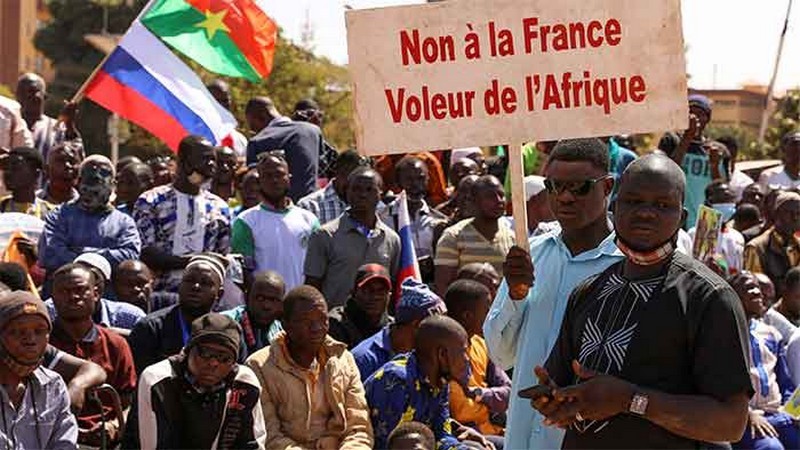
The Hegemonic UN-WEF-NATO Triad: U.N. “Sustainable Development” (SDG 2030) = Endless Wars, Poverty and Famine Worldwide

By Michel Chossudovsky

“Those of us who do understand the nefariousness of the empire, and the ever-increasing danger it represents, must be clear that the effective defense of life on planet Earth, including that of the human species itself, inexorably demands the existence of an independent and democratic world forum for a genuine and effective defense of the rights of Mother Earth and of humanity.

That is why we insist, repeat and say time and again that the United Nations as it exists today is useless, inoperative, dysfunctional and an instrument of the empire. That is why it no longer enjoys any confidence or credibility whatsoever.”

—Miguel d’Escoto Brockmann.  Managua, 28 February 2011

This article is dedicated to the memory of my mentor and lifelong friend Padre Miguel D’Escoto Brockmann.

In 2019, the National University of Nicaragua (UNAN) established the Centro de Desarrollo Miguel d’Escoto Brockman (CEDMEB).

Padre Miguel d’Escoto’s legacy will live forever. 

_______________________________________

Introduction 

The UN system has over the years become of an instrument of U.S. hegemony. In the words of Miguel d’Escoto Brockmann:

We must wrest it from those who have usurped it so that we, the truly concerned for the future of the Earth, can inject new life, relevance and effectiveness into our world Organization.”

Appointed by Washington, UN Secretary General Antonio Guterres has more than usurped our trust. He is the epitome of ambiguity and DoubleSpeak, particularly in relation to the dramatic social and economic crisis affecting the Global South.

“Poverty is increasing and hunger is growing… the conclusion is clear, the world is failing developing countries,” said UNSG General Antonio Guterres in his opening presentation at the September 2023 G77 Conference Venue in Havana.

Global poverty has become part of a convenient political “narrative.” What has Guterres done to reverse the tide of global poverty? Nothing!

“Guterres got the UN job only because he is gullible and corruptible. He is drumming the drums of the ruling elite’s narrative – be it covid, climate or the energy crisis; or whatever else may hit the crisis-board. Fossil fuel causing climate change is a scientifically proven lie. No trillion dollars can undo it.” (Peter Koenig)

Guterres is not only an instrument of the White House, his 2030 UN Sustainable Development Project is being carried out in coordination with Klaus Schwab and the World Economic Forum (WEF), which represents the interests of the global financial establishment. Needless to say, Big Money call the shots. 

The UN-WEF Partnership

A strategic partnership was signed in 2019 at a meeting held at UN headquarters between UN Secretary-General António Guterres and WEF Executive Chairman Klaus Schwab “to accelerate the implementation of the 2030 Agenda for Sustainable Development.”

The 2030 UN Sustainable Development Project is the WEF’s “Great Reset” by another name. 

This partnership is in blatant violation of the UN Charter. The UNSG is in conflict of interest. He has provided a Green Light to the implementation of the WEF’s Agenda on behalf of powerful financial interests and corrupt politicians, which essentially consists in impoverishing the entire planet. 

What should have been debated by the G77 in Havana in September 2023 is the nature of this insidious WEF-UN partnership. It’s a neoliberal agenda to the nth degree on behalf of “Big Money”, to the obvious detriment of the Global South. It is part and parcel of the WEF’s “Great Reset”:

“The UN-Forum partnership will focus on aligning financial systems and accelerating finance flows toward the 2030 Agenda and the Sustainable Development Goals.

Collaboration will seek to build a shared understanding of sustainable investing, especially in small island developing States, least developed countries and landlocked developing countries, and identify and take forward solutions to increase SDG investments” (emphasis added)

To consult the text of the UN-WEF partnership, click here.

“Aligning Financial Systems”

While Guterres refers rhetorically to the failed  “global systems and structures”, he is visibly involved in “aligning financial systems” to the detriment of heavily indebted developing countries, which are the victims of U.S. dollarization.

While the IMF-World Bank Structural Adjustment Program (SAP) launched in the early 1980s prevails, the Neoliberal chessboard has become increasingly complex.

Aligning financial systems” goes far beyond the imposition of “IMF economic medicine”, which historically has triggered mass poverty throughout the Global South.

While the dollar denominated external debt remains the instrument of economic subservience, “Aligning financial systems” is intent upon opening the door to privatization on a large scale affecting entire sectors and regions of both developing countries and the West.

The large portfolio investment funds including BlackRock, State Street and Vanguard (coupled with Wall Street’s banking cartels) are the driving force. “Their holdings are colossal. BlackRock manages nearly $10 trillion in investments. Vanguard has $8 trillion, and State Street has $4 trillion.” (NYT)

“BlackRock Owns the World”

The portfolio companies have strategic investments in all major regions of the World.

BlackRock operates Worldwide with 70 offices in 38 countries. 

“These oligarchs are accompanied by some super-giant financial institutions, like BlackRock, Vanguard, State Street, Fidelity and more which control an estimated 25 trillion dollars-equivalent in assets, giving them a leverage power of well-over a 100 trillion dollars, as compared to the world’s GDP of some 90 trillion dollars. In other words, they can manipulate, control and pressure every government on Mother Earth to do their bidding.” (Peter Koenig)

Video: BlackRock, the Company that Owns the World

Below are three major BlackRock initiatives.

In the case of Ukraine, the levels of indebtedness are beyond description. The agreement with BlackRock is tantamount to the privatization of an entire country.

BlackRock in Brazil’s Amazon Rainforest

The amounts invested in the Amazon are colossal under the auspices of the three portfolio investment giants:

The 20 institutional investors plowed a combined $54.1 billion into nine mining conglomerates … “Of that amount, $14.8 billion came from just three U.S. firms — BlackRock, Capital Group [a US Financial Services Company] and Vanguard — with BlackRock alone pouring $6.2 billion into the mining companies.” (Mongabay)

BlackRock in Kenya

“BlackRock Alternatives’ public-private finance vehicle, Climate Finance Partnership (CFP), has acquired a 31.25% stake in Lake Turkana Wind Power (LTWP), the largest wind farm in Africa. The stake was purchased from Vestas, Finnfund, and the Investment Fund for Developing Countries for an undisclosed sum.” (Kenya Wallstreet Journal)

Ukraine Is Being Bought Up by BlackRock and JPMorgan

In recent developments, BlackRock together with JPMorgan “have  come to the rescue of Ukraine”, whose external dollar denominated debt is beyond description. (See Michel Chossudovsky, Global Research, August 2023)

The stated objective is “to attract billions of dollars in private investment to assist rebuilding projects in a war-torn country”. (FT, June 19, 2023)

The Privatization of Ukraine was launched in November 2022 in liaison  with BlackRock’s  consulting company McKinsey, a public relations firm which has largely been responsible for co-opting corrupt politicians and officials Worldwide not to mention scientists and intellectuals on behalf of powerful financial interests.

In late December 2022, president Zelensky and BlackRock’s CEO Larry Fink agreed on an investment strategy.

The Hegemonic Triad: UN-WEF-NATO

UN-NATO “Cooperation”

In parallel with the UN-WEF Partnership, the United Nations under Secretary General Guterres has developed a strategic relationship with NATO.

While it is described as a dialogue, NATO is increasingly embedded in the UN system, allegedly endorsing “peace support and crisis management”. The realities are otherwise — the UN is endorsing the US-NATO hegemonic agenda of Global Warfare:

“The complexity of today’s security challenges has required a broader dialogue between NATO and the UN. This has led to reinforced cooperation and liaison arrangements between the staff of the two organisations, as well as UN specialised agencies.” (NATO, July 2023)

NATO and the United Nations: partners in global peace and security

The UN Secretary General’s “Public Relations Ploy”

Providing a “Human Face” to Global Capitalism

UNSG Antonio Guterres has launched a stereotyped public relation’s ploy which is intent upon presenting the UN-WEF-NATO Agenda as a means to resolving the climate crisis, eliminating poverty as well as instating “World Peace.” It’s a lie.

In 2021, in preparation of the 76th UN General Assembly, the UNSG appointed  “advocates” to endorse the Sustainable Development Goals.

In September 2021, the UN Secretary-General appointed four new advocates of the SDGs as part of a reprehensible public relations ploy:

  • the 2014 Nobel Peace Prize, Kailash Satyarthi;
  • the president of Microsoft, Brad Smith;
  • the k-pop superstars BLACKPINK
  • Chile’s STEM activist – science, technology, Valentina Muñoz. (Chica Rosadita)

This is how public opinion and media coverage is manipulated at the UN General Assembly.

Censorship is applied. Independent analysts are not invited.

I have high regard and admiration for the k-pop singers, but for UNSG Antonio Guterres to have invited them to present a carefully prepared script (on his behalf) to the 76th UN General Assembly was improper and unbefitting.

BLACKPINK (Secretary-General’s Advocates) at the SDG Moment 2022

Also in 2021, Valentina Munoz (La Chica Rosadita), 19 years old, was invited by Guterres to endorse the UN Agenda 2030 in an address to the UN General Assembly:

Why China’s New Map of Its Borders Has Stirred Regional Tensions

By John P Ruehl

In the waning days of August 2023, closely following a BRICS summit and mere days ahead of the Association of Southeast Asian Nations (ASEAN) and G20 meetings, Beijing revealed its latest seemingly innocuous “standard” map. Having been released regularly since at least 2006, China’s standard maps are aimed to eliminate “problem maps” that do not affirm China’s territorial integrity. But the 2023 edition invited ripples of condemnation throughout China’s near abroad and beyond, as it repeated Beijing’s claims on divisive territorial disputes with its neighbors—including the Philippines, which has seen its struggle with China over a small shoal in the South China Sea escalate significantly over recent weeks.

The release of China’s map, coupled with its aggressive border strategies, has created enormous uncertainty across the Indo-Pacific. In a rapidly evolving geopolitical landscape, various actors are wrestling with how to effectively counter China’s actions.

China’s perception of maritime and international laws as products of Western customs has underpinned its level of adherence to them. “Stealthy compliance” allows China to ambiguously accept international law while interpreting it flexibly to advance its territorial claims. Beijing will also explicitly reject international law, exemplified by its dismissal of a tribunal in The Hague that challenged China’s assertions in the South China Sea in 2016. Regularly publishing maps helps assert China’s claims to domestic and international audiences, without putting Beijing in a position where it has to enforce them simultaneously.

Beijing’s strategy has effectively thwarted regional and Western responses and prevented the outbreak of major conflict. Inflaming territorial disputes serves as a bargaining chip in bilateral negotiations and lays the groundwork for potential future claims as China’s strength is expected to increase. Channeling nationalist sentiment outward has also bolstered the Chinese government’s domestic legitimacy and diverted attention from contentious issues like Tibet, Xinjiang, and Hong Kong.

However, the response to China’s 2023 map reveals growing backlash to Beijing’s approach to its border issues and questions over its long-term sustainability.

China has periodically unveiled its nine-dash line map for decades, delineating its claims in the South China Sea. The mystery shrouding whether these claims pertain to water rights, land features, or both, has kept the region on edge. Regardless, they symbolize China’s desire to reduce U.S. control over regional shipping lanes, secure rights over natural resources, and project power beyond its first island chain into the expansive Pacific.

China’s latest map took a bold step by reintroducing a tenth dash east of Taiwan—a largely dormant claim since 2013. The move not only reaffirmed China’s ownership of Taiwan but also extended China’s reach beyond Taiwan’s recognized territorial waters, a direct challenge to the United Nations Convention on the Law of the Sea (UNCLOS). Reasserting this claim may point to growing confidence in Beijing of being able to impose its various claims in the region. China’s map also continued to emphasize China’s rights to the Senkaku Islands, disputed with Japan. Both Taipei and Tokyo vehemently criticized China for the map’s release.

China and ASEAN had meanwhile been negotiating a code of conduct for the South China Sea, reaching an agreement in July to accelerate the process. The release of the 2023 map just days before the ASEAN summit in Indonesia naturally triggered swift rejection from member states such as Malaysia, the Philippines, and Vietnam, which have longstanding wariness of Chinese maritime territorial ambitions.

China occupied the Paracel Islands, contested by Vietnam, in 1974 and engaged in a brief skirmish with Vietnam over the Johnson South Reef in 1988. The Philippines was meanwhile forced to concede Mischief Reef to China in 1995 but later stranded a warship on the Second Thomas Shoal in 1999 to enforce its claims there. Chinese forces steadily took control over the Spratly Islands (including by creating artificial islands) over the last decade, while the 2012 Scarborough Shoal standoff saw China gain effective control over a shoal against the Philippines. Malaysia has also seen increasing naval confrontations with China in recent years.

Under former Filipino President Rodrigo Duterte, Manila pursued a more hospitable approach to China and its territorial claims. But since 2022 under President Bongbong Marcos, the Philippines has taken a renewed confrontational strategy in confronting China, including blocking Chinese attempts in recent weeks to deny resupply efforts to the Filipino warship on the Second Thomas Shoal. Vietnam has also drawn closer to the U.S. in recent years, largely in response to China, and the 2023 map may also convince Malaysia to do so as well.

However, not all ASEAN states are willing to coordinate with the U.S. and confront Beijing. Indonesian officials downplayed the 2023 map’s significance, and days later inaugurated a China-backed high-speed rail project. Similarly, Brunei raised limited objections to the map, reflecting its pledge with China made in July 2023 for greater cooperation. Many other ASEAN member states maintain substantial trade ties with China, tempering their willingness to take a firm stance even amid the release of another provocative Chinese map.

China’s coast guard, navy (now the world’s largest), and militarized fishing fleets also deter countries from escalating disputes in the South China Sea. However, resisting China’s territorial claims is complicated because many countries are also embroiled in disagreements with one another. Taiwan, for instance, claims Japan’s Senkaku Islands, while Malaysia, Vietnam, Brunei, Indonesia, and the Philippines have their own disputes. By inflaming its own border disputes, China often exacerbates other existing conflicts, and other countries may opt to avoid involvement because they fear it could lead to more tension with their other neighbors.

China’s land border disputes were also thrust into the spotlight with the unveiling of its 2023 map. Longstanding border issues with ASEAN member Myanmar persist, but Myanmar’s internal strife and economic reliance on China have rendered moot any serious opposition to Chinese border policies.

Instead, China’s most serious border dispute is with India, involving a poorly defined 2,100-mile international border that was never demarcated. China and India both claim sovereignty over Aksai Chin and Arunachal Pradesh. In 2020, the two countries had their first deadly skirmish in 45 years, with another violent clash in 2022. Beijing and New Delhi have also authorized infrastructure projects in the disputed regions to solidify their claims and ease logistical issues. India lodged an official diplomatic protest against China for its 2023 map, extinguishing any hopes for a potential thaw in India-China relations that had been suggested after the BRICS summit in South Africa in August.

India has also supported Bhutan in its territorial disputes with China. Bhutan requested and received Indian assistance in 2017 to repel Chinese troops and construction workers that had entered Bhutan, while China made new territorial claims in Bhutan in 2020. But in a surprising turn of events in April 2023, Bhutan appeared to partially acquiesce to China and explore concessions by agreeing to a joint technical team with China to address their territorial issues.

India’s attempt to rally regional opposition against China has also been complicated by Nepal, which has territorial disputes with both China and India. Nepal’s protest against China’s 2023 map also criticized the inclusion of several territories as part of India which it claims as its own. Beijing has consistently accused India of encroaching on Nepalese territory to undermine New Delhi’s territorial claims and take away attention from its own dispute with Nepal.

China’s 2023 map further stirred controversy by reviving a settled dispute with Russia. Although both countries resolved longstanding border disputes in the 1990s and 2000s, China’s latest edition claimed a small island that was divided between the two countries in 2005. Russian officials dismissed the map’s claims, stating the issue had already been resolved.

Marking the island as such may have been a retaliatory gesture by China in response to a Russian map from 2022 showing Aksai Lachin and Arunachal Pradesh in India. It also likely appealed to nationalist elements within China critical of Russia’s territorial gains from unequal treaties during the 19th and 20th centuries. But China’s assertiveness also serves as a signal to Russia as its dependence on China has grown since its invasion of Ukraine. The Kremlin’s tepid response reflected its increasing unwillingness to confront Beijing.

Barely three weeks after the release of China’s map, China and Syria, an important Russian ally, announced the formation of a strategic partnership. Together with competing Chinese and Russian interests in Central Asia, the 2023 map marks another subtle but notable test for the Sino-Russian no-limits partnership announced in February 2022.

China’s assertions are also bolstered by the United States’ historical wavering on international law. The U.S. was accused of breaking international law by the International Court of Justice by mining Nicaraguan harbors and supporting rebels in the country in the 1980s. Furthermore, the U.S. has yet to ratify the UNCLOS, a significant maritime framework. Washington’s inability to mediate the 2012 dispute between the Philippines and China encouraged Beijing to test the United States’ willingness to defend the region. As the U.S. seeks to rally countries into conducting freedom of navigation exercises in the region, China will increasingly aim to disrupt them and establish squatter’s rights.

Concordantly, Beijing will continue to block attempts to “internationalize” its territorial disputes, opting for multilateral or bilateral talks where it can leverage its strengths. Keeping these disputes ongoing (or reigniting them) puts pressure on its neighbors and fuels nationalist sentiment in China, with claims likely to escalate if Beijing perceives its position as stronger.

However, China’s increasingly aggressive foreign policy under President Xi Jinping runs the risk of turning the country into a regional antagonist. Central Asian states, which also solved their territorial disputes with China, are also likely increasingly nervous. The riots in China against Japanese businesses during heightened tension over the Senkaku Islands in 2012 serve as a stark reminder of how exploiting nationalist sentiment can spiral out of control and damage China’s reputation as an attractive place for investment. For the U.S., successfully rallying the region becomes much easier when it can highlight China’s self-interested actions.

China’s enigmatic and assertive border strategies have far-reaching implications for regional and global stability. While its tactics have yielded short-term benefits, they carry the risk of escalating disputes into conflicts and generating significant international backlash. The current geopolitical landscape remains dynamic, with major powers and smaller countries grappling to find an effective response to Chinese calculations.

John P. Ruehl is an Australian-American journalist living in Washington, D.C., and a world affairs correspondent for the Independent Media Institute.

17 October 2023

Source: countercurrents.org