Just International

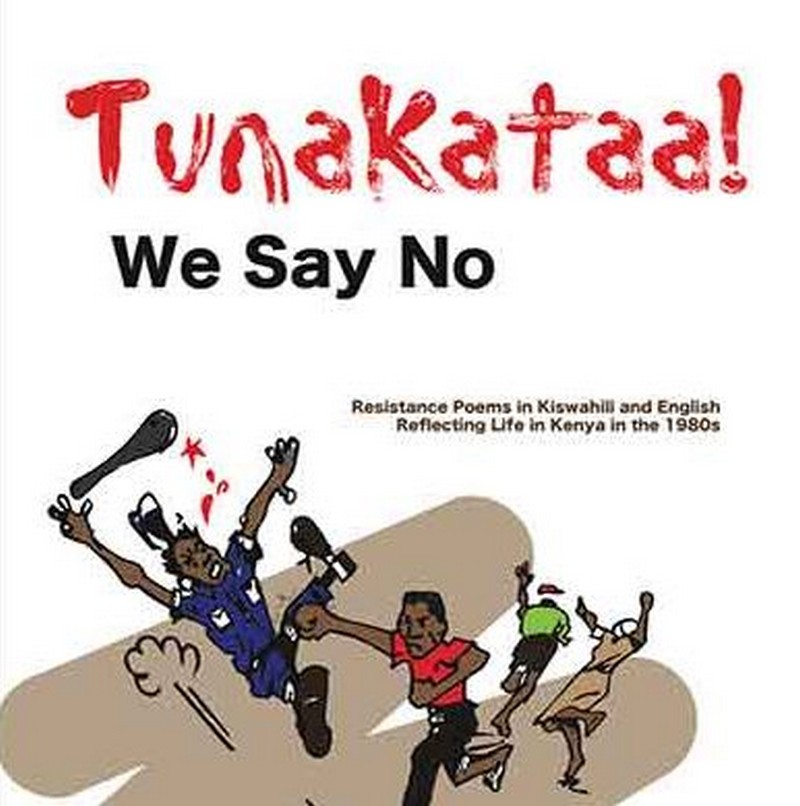
Tunakataa! Saying ‘No’ to Capitalism and Imperialism in Kenya

By Shiraz Durrani

Preface to the book by  Durrani, Nazmi: Tunakataa! We Say No!  Resistance Poems in Kiswahili and English Reflecting Life in Kenya in the 1980s. Forthcoming:  Nairobi:  Vita Books. 

[Tunakataa: Kiswahili – ‘We Say No!]

Kenyans have been saying Tunakataa/We Say No to colonialism and imperialism for over 500 years, ‘No’ to all the exploitation and oppression that are part of these oppressive systems. But the greed and the brute force of the Portuguese initially, then British and USA imperialism blinded their eyes and closed their ears to the voice of people. Resistance was the only way of challenging the invading forces — political, military, religious, cultural, among others . It was the taking up of arms by Mau Mau in the late 1950s that finally brought independence to Kenya. But not an end to capitalism, long planted by British colonialism through various underhand means. The suppression of the rights of working people, the looting of their land and wealth that are the hallmark of capitalism, remained after independence, this time ably managed by the former homeguard collaborators with colonialism, now reincarnated as the rulers of independent Kenya. But they did not have it all their own way. Resistance which had been the characteristic feature during the colonial period, could not be suppressed by the new ruling class although they continued the use of the same instruments of suppression that colonialism had used: massacres, murders, disappearances and targeting resistance organisations, their leaders, their ideologies and their culture. And people have continued to say ‘No’ to all this, as does Nazmi Durrani in these poems.

An understanding of this intense repression under President Daniel arap Moi can provide the background to these poems of resistance. UMOJA (1989, 15) gives a good summary of the first ten years of President’s Moi’s rule which created the conditions reflected in these poems:

Over the ten years, the Moi-KANU regime has been involved in i) torture, killings, political executions and massacres; ii) arrests, political jailings and detentions without trial on a scale that can only mean that Kenya has been under an undeclared state of emergency; iii) the crushing of all independent democratic social organisations; iv) the rigging of elections even under the one-party state to ensure only those candidates loyal to Moi himself go through and v) the cynical arbitrary and frequent changes of laws and constitution to effect, justify and rationalise the above and to meet all the subjective whims of Dictator Moi.

The regime then used the coup of 1982 as an excuse to suppress all opposition to its bloody rule, as UMOJA (1989, 17) shows:

The regime used the coup attempt of August 1982 as a cover for the silencing of all democratic opposition. After suppressing the coup, the regime let loose its loyalist forces on the population. They stopped people in the streets. They raided people’s homes, confiscated a large quantity of people’s property and raped women. A busload of university students was gunned down. No Kenyan seriously believes the official lies about a toll of 159. Church and other independent sources put the death toll at about 2,000. Certainly all the mortuaries in and around Nairobi were full of dead bodies of civilians. It should be emphasised that these deaths had nothing to do with the acts of suppressing the coup attempt – all the killings took place after the coup had been put down.

It is against this background of brutal suppression of people that Nazmi Durrani’s poems need to be read and seen as well, as part of the history of post-independence resistance. Durrani was part of the organised resistance of the underground December Twelve Movement (DTM). The Appendix to this book reproduces an earlier article that touched on some aspects of Durrani’s life and his political activities.  This included turning his flat in Ngara into a centre of political activities of the Ngara Cell of the December Twelve Movement. But one cannot see the writer, the activist and his political work in isolation from the resistance movement in Kenya at that time. He was part of organised resistance and his activities reflected the aims and visions of December Twelve Movement (DTM). A background to DTM is as important as the brutality of Moi in setting the poems in their historical and political context. This is given by Durrani and Kimani (2021, 20):

Earlier attempts by radical groups to continue the vision of Mau Mau within KANU had failed, reflecting the total surrender of the comprador class to imperialist interests. It became the historical role of underground resistance movements to articulate the new phase in Kenyan politics where open tradition of organized underground resistance in Kenya goes back to the beginning of the twentieth century and continued throughout the colonial period and post-independence. Moreover, it carried on throughout the period of Kenyatta’s regime [as it] consolidated its neo-colonial grip on the country. Among the key underground movements was the December Twelve Movement (DTM) which later emerged as Mwakenya.

Within this overall context of resistance, DTM carried out its political and ideological work in various ways, again as described by Durrani and Kimani (2021, 20-21):

DTM opposed the capitalist outlook of the ruling class and their party. It was active in articulating its ideological position, policies, and outlook, not only among its active members grouped in secret cells but also in disseminating these to its actual and potential supporters among the masses. It was not a mass movement, and only accepted into its membership those who showed a clear grasp of its ideological stand and were willing to put into practice their commitments. The emergence of DTM marked the end of the attempts by democratic forces to form legal opposition parties. DTM’s activities and ideological stand are best seen in its publications.

As a member of this resistance movement, Durrani was active in a number of fields — writing on, and documenting, comprador violence and people’s resistance; taking part in resistance theatre; setting up and managing an underground library of socialist and communist literature and, as mentioned earlier, turning his flat into a resistance resource. The poems included in this book reflect one of the cultural aspects of his political work. He wrote many articles — in Gujarati, English and Kiswahili — on resistance leaders in Kenya; he wrote short stories and poems some of which were published in the local media under pseudonyms. He wrote several children’s short stories. In writing the poems included in this book, he combined a number of his activist pursuits. Many of the poems record historical events of police brutality and people’s resistance to these. Some poems record the events which would otherwise have been forgotten, for example Monica Njeri, The Battle of the Tusker Bus Stop, Workers of Shimanzi and Mnjala Killed. Others raise awareness of the state of exploitation under capitalism, for example, Flood of Profits; yet others take up issues of classes and class struggle, such as Class Struggle , Two Towns, We and You and Who Are We? The poems also depict the victories of the struggles, for example Victory at Chinga while others look ahead to the coming revolution, such as Thunder of Revolution. They also reflect the struggles for liberation not only in Kenya but around the world, for example Comrade Samoral the African Hero,The Nicaraguan Revolution Will Be Victorious, Liberation Wars of the Palestinians, The Great Terrorist Reagan and several others on South Africa. Educating people about capitalism as the reason for their poverty is always present, for example in Exploitation is the Reason for Poverty and Oppression and Resistance are Inseparable. 

Yet another aspect that is significant in these poems is the language used. The poems were originally written in Kiswahili, later translated by the author into English. This indicates the audience that they were aimed at — workers, whose struggles the poems reflect.

The question then is: are these poems to be seen as literature, history or politics? Library cataloguers, historians and students of literature can argues over this. At one level, they are a historical record of the 1980s Kenya. They record the daily lives of working people under state repression, their reactions, their hopes and aspirations. They record how they survived under such oppression and kept their hopes alive for a better future. At the same time, they are political communication depicting exploitation of working people and their resistance. The poems are not one or the other: they are history, they are a call to action, they are a lament and they offer hope in a grim, oppressive world. To say ‘no’ to exploitation is ultimately a statement of political commitment, of being positive about the prospect of liberation, of exhorting people everywhere to rise up agains all forms of suppression, oppression and exploitation. And the context of all this cannot be ignored or forgotten: It is saying ‘No’ to capitalism and imperialism, which is another way of saying ‘Yes’ to liberation under socialism.

Durrani emerges from these poems as a keen observer, listener and learner who takes in and re-tells, the experiences of working people and their struggles. He becomes at one with the oppressed and becomes their voice. He shows those who struggle and those who fall by the wayside and those who triumph, however temporarily. The struggle goes on and the author is always there to see, listen and record.

The spirit of the book is captured by the poem It is Our Right to Fight for Our Rights. It also indicates the reason for waging a war against capitalism and imperialism. Listen to the voice of those struggling for liberation: It’s the right of each and everyone To have food clothing and shelter This is a right, the very foundation of life.

Illustration: The Nation is Like a Cow ( By Nazmi Durrani)

It is Our Right to Fight for Our Rights
It’s our right to fight for our rights
it’s our duty to fight for our rights
Not to fight for our rights is a crime
We cannot uphold our rights without struggle

It’s the right of each and everyone
To have food
Clothing and shelter
This is a right, the very foundation of life
It’s the right of people to get these necessities

By way of work, by sweating for them

Not through charity or exploitation

Work is the right of all

If denied the right to work
People have the duty to change
The system that denies them this right

it’s our right to fight for our rights

Illustration: Shamba Langu! (By Nazmi Durrani)

The poems, the history they depict, the hopes and the vision they carry reflect the reality of life for working people in Kenya in the 1980s. But these are not so different from the situation of working people in Kenya today — or indeed of the working people around the world. Capitalism uses the same tactics wherever it goes; it creates the same exploitation and oppression wherever it goes. And the cry of the people, Tunakataa!, We Say No also follows capitalism everywhere. There is a universality in these poems that reflects the exploited world as it resists capitalism and struggles for socialism. The final word is left to the poem, We Say No: 

Sisi wafanyakazi na mafalahi
Ni sisi tu tunazalisha mali

Tunakataa, tunakataa, tunakataa

Kukubali zinyakuliwe na mabepari

Sisi wafanyakazi wa karakana

Tunatoa jasho kuzalisha bidhaa

Tunakataa, tunakataa, tunakataa

Kuruhusu faida ziende Ulaya

We the workers and peasants

It is we who produce wealth

We refuse, refuse totally
To let it be stolen by capitalists

Today, over two decades later, it is difficult to imagine the situation for working people in Kenya in the 1980s, the on-going repression from the Moi government and the resistance from the working people. It is then also difficult to see the full significance of the events shown in these poems. Some historical notes and references have been added in the book under the heading, the Kenya of the Poems, in order to capture the reality of that time. The poems then become a commentary on the life and times of Kenyan working people and their struggles. But it is not only history — it is also the present in Kenya and many other parts of Africa. The relevance of the poems to the reality of today’s Africa is confirmed by two members of the Learning and Teaching WhatsApp Group (L&T). First, Brian Mathenge from Kenya responds to one of the poems, December 12:

This is a powerful one, by Nazmi Durrani, that our freedom was hijacked, blood and sacrifices of our martyrs betrayed.The last bit is encouraging:

We have no doubt we shall win true freedom
But blood must be shed yet again
We will have to fight with arms once again
We’ve learned from history, we won’t be deceived again.

This can be distributed within our circles.

When asked if the poems are relevant to Kenya and Africa in 2020, Mathenge adds:

Yes, they are, there are few progressive history books or revolutionary publishing media in present Kenya, due to deliberate censorship by the state, making it difficult for the young generation to connect with their past, get inspired and keep the conviction of struggle.

With these few, rich and inspirational articles we draw a lot of strength to keep the struggle going… This [referring to the book, Tunakataa!] would be one of the powerful set of literature, it would be helpful, especially in the generational inheritance of struggle. There’s so much that is untold and scrapped from History.

Another member of the L&T Group, Ivy Himani from Zambia gives her views:

It’s very much relevant… most African countries are having the same cry. In Zambia, it’s been years of independence but that’s just in books.In reality, slavery has just been modernized where a few are privileged at the expense of others.

That is the voice of youth in Africa today. They join the demands for justice and equality. Tunakataa! indeed, is the voice of Africa and African youth today.

References

Durrani, Shiraz (2018): Kenya’s War of Independence: Mau Mau and its Legacy of Resistance to Colonialism and Imperialism, 1948-1990..

Durrani, Shiraz and Kimani Waweru (2021): Kenya: Repression and Resistance from Colony to Neo-colony,1948–1990. The Kenya Socialist, 3, 2021, 7-25. Available at: https://vitabooks.co.ke/wp-content/uploads/2021/09/The-Kenya- Socialist-Issue-3-2021.pdf.

UMOJA (1989): Moi’s Reign of Terror: A Decade of Nyayo Crimes against the people of Kenya. London: Umoja (Umoja wa Kupigania Demokrasia Kenya/ United Movement for Democracy in Kenya. Background Document No. 2.

Shiraz Durrani is a Kenyan political exile living in London. He has worked at the University of Nairobi as well as various public libraries in Britain where he also lectured at the London Metropolitan University.

27 September 2023

Source: countercurrents.org

 

Stumbling Towards Old Age And Looking for Someone to Lean On

By Rebecca Gordon

For twelve years starting in 1982, my partner and I in San Francisco joined with two friends in Seattle to produce Lesbian Contradiction: A Journal of Irreverent Feminismor LesCon for short. We started out typing four-inch columns of text and laying out what was to become a quarterly tabloid on a homemade light table. We used melted paraffin from an electric waxer to affix strips of paper to guide sheets the size of the final pages.

Eventually, we acquired Macintosh computers, trekking to a local copy shop to pay 25 cents a page for laser-printed originals. We still had to paste them together the old-fashioned way to create our tabloid-sized pages. The finished boards would then go to a local commercial printing press where our run of 2,000 copies would be printed.

This was, of course, before ordinary people had even heard of email. Our entire editorial process was mediated through the U.S. Postal Service, with letters flying constantly between our two cities. On the upside, through 12 years and 48 issues, we only had to hold four in-person meetings.

All of which is to say that I’m old. That fact — and recent events in the lives of several friends — have brought to mind the first article I ever published in LesCon: “Who’s Going to Run the Old Dykes’ Home?” It’s a question that’s no less pertinent today, and not just for lesbians. My worldview was more parochial back then; I naively believed that someone — the state or their families — would look out for heterosexual elders, but that we lesbians were on our own. It turns out that we — the people of this country — are all on our own.

Playing Aging Roulette

These days, my partner and I seem to be doing a lot of elder care. Actually, I’ve long been a source of tech support for the octogenarian set, beginning with my own father. (“OK, you’re sure you saved the file? Can you remember what name you gave it?”) With our aging friends, we also help out with transport to doctors’ offices, communications issues (with landlines, cell phones, and the Internet), and occasionally just relieving the loneliness of it all.

In recent months, elderly friends of ours have faced losing their housing, their spouses, their mobility, or their cognitive abilities. I find it terrifying and ache because there’s so little I can do to help them.

I shouldn’t be surprised, but I’m daily reminded that getting older can indeed be frustrating and frightening. It pains me to know that my bones are weakening, that I don’t hear as well as I used to, that my skin’s drier and wrinkling, that my once familiar face in the mirror is growing ever stranger. I’m lucky that — like my father who used to say, “After 70, it’s all maintenance” — I’ve managed to maintain a fair amount of brown hair on my head. I especially hate the way words that used to leap down my tongue in merry cadence now frequently lurk sullenly in the backwaters of my brain.

In a piece about our aging political class, Robert Reich, secretary of labor for President Bill Clinton, has written charmingly about the “diminutions” that come with growing older and his own decision to stop teaching after decades of doing so. His take on anomic aphasia is similar to mine. He laments his trouble remembering people’s names, noting that “certain proper nouns have disappeared altogether. Even when rediscovered, they have a diabolical way of disappearing again.” I know what he means. For some years now, whenever I want to talk about cashew nuts, all I can initially think of is “carob.” Some devious gremlin has switched those words somewhere in the card catalog of my brain.

But even as I grieve for capacities lost and departing, I’m still not ready to come face to face with the only true alternative to aging: not some tech bro’s wet dream of eternal life, but the reality of death. I’m opposed to dying and, had the universe consulted me, I’d have left mortality out of its design completely.

No One Else Is Going to Do It for Us

Written more than 40 years ago, parts of my piece “The Old Dykes’ Home” are flat-out embarrassing now. Getting old seemed so strange and far off before I was even 30. When I imagined being aged then, I think it was with the piercing sorrow of Paul Simon’s song “Old Friends/Bookends”:

“Can you imagine us years from today
Sharing a park bench quietly?
How terribly strange to be seventy”

In other ways, my article was depressingly prescient about just how much this country would expect aging people to shift for themselves by the time I reached that strange period of my own life. Not only old dykes, but pretty much anyone who isn’t affluent, can find that old age brings economic desperation.

Yes, U.S. citizens and permanent residents over 65 can get medical attention through Medicare, but the standard program only covers 80% of your bills. Beginning in 2006, we gained access to some prescription drug coverage, but that requires sifting through an ever-changing menu of medications and the ability to predict today what meds you might need tomorrow.

Most people who live long enough will receive some monthly income from Social Security, although the amount depends in part on how much they were able to earn during their working lives. But we’re constantly staving off attacks on Social Security, including attempts to privatize it, reduce benefit amounts, or increase the age at which people can collect because Americans are living longer. That last proposal, as economist Paul Krugman has pointed out, is really another way of penalizing low-wage workers. As he wrote,

“Life expectancy has indeed risen a lot for the affluent, but for the less well-paid members of the working class, it has hardly risen at all. What this means is that calling for an increase in the retirement age is, in effect, saying that janitors can’t be allowed to retire because lawyers are living longer. Not a very nice position to take.”

Suppose the disabilities of age mean you can no longer safely live in your own home. Well, you’re on your own. Unless you can afford to move to some kind of assisted-living facility, you’re in real trouble. Your main alternative is to spend down most of what you own, so you qualify for the pittance that your state Medicaid program will pay a (most likely for-profit) nursing home to warehouse you until you die.

The threat of being old and unhoused is very real. A recent major study of unhoused people in California found that almost half of them are over 50 and 7% over 65. As housing costs continue to rise, we can only expect that more old people will find themselves on the street.

Back then, I wrote that, under capitalism, we could expect the “owners of wealth” to do very little for people who are no longer creating profits through their labor — or indirectly, by doing the work “to make it physically and emotionally possible for the paid laborers to go out in the world and work one more day.” Why, after all, should capital take any interest in people who are no longer a source of profit?

These are the people — old, disabled, permanently unemployed — who, according to the political philosopher Iris Marion Young, experience a particularly sinister form of oppression: marginalization. “Marginalization,” writes Young, “is perhaps the most dangerous form of oppression. A whole category of people is expelled from useful participation in social life and thus potentially subjected to severe material deprivation and even extermination.”

There were some other missing pieces in that article. I left out the fact that it’s easier to justify low pay for the art (and science) of caregiving when most of its practitioners are women. I failed to envision caretakers organizing on their own. I never imagined that, decades later, a National Domestic Workers Alliance would arise to represent the interests of the poorly paid, disrespected workforce of immigrants and women of color who largely do the work of caring for the aged in this country.

I had just lived through an episode in which on the bus to work I suddenly fainted from pain caused by a herniated disk in my back. I found myself lying on my bed for several months recovering while living on a monthly welfare check of $185 and food stamps. Still, the lesson I drew was that the solution to caring for people with chronic disabilities was what had then worked for me: drawing on a community of volunteers, a roster of almost 30 women who took turns shopping for groceries, doing my laundry, and ferrying me to doctors’ appointments. Why couldn’t that work for everyone?

That network of support existed, however, because I belonged to a lesbian community self-consciously constructing a parallel society tucked inside the larger city of Portland, Oregon. It was packed with institutions like a women’s bookstore, a drop-in community center, a women’s mental health project, and a feminist credit union, among others. I acted with a women’s theater company and, at times, worked as a secretary at a women’s law cooperative.

In reality, though, we weren’t nearly as independent as we thought we were. Most of those institutions were staffed by women paid through the Comprehensive Education and Training Act, passed during the presidency of Richard Nixon and continued under Jimmy Carter. When Ronald Reagan and his new brand of Republicans took over in Washington in 1981, those salaries disappeared almost overnight — and with them, most of our community’s infrastructure.

So, my answer to the problem of aging then was to endorse an ethic of volunteerism rooted in specific communities, like our lesbian one. “Feminists,” I wrote, “are rightly uneasy about asking each other to perform any more unpaid work in our lives than we, and centuries of women before us, have already done.”

Nevertheless, I argued, “the truth is… no one is going to pay us to take care of each other… and we can’t afford to believe the capitalist and patriarchal lie that we are cheating each other when we ask each other — even strangers — to do that work for free.”

In retrospect, it seems clear to me that I was then inching my way toward an ethos that could free the project of caring for each other from the claws of capitalism. But I was naïve about the amount of time and energy people would be able to spare outside of their day’s labor — especially as real wages were about to stagnate and then begin to fall. I didn’t imagine a time to come when people without much money would need to work two or even three jobs just to get by. I didn’t think, as I do now, that it would be better, instead, to focus on raising the status and pay of caring work.

Even back in the 1980s, however, I recognized the limits of volunteerism. I knew that I’d been lucky during my period of temporary disability. I was an outgoing person with quite a sizeable set of acquaintances. With a reasonable levity of spirit and a dependable store of gossip, I knew then that I could make taking care of me relatively pleasant.

But I also knew that no one’s survival should depend on having a winning personality. Instead, as I wrote at the time, we needed to “develop simple, dependable structures to serve those among us who require physical care.”

How hard could that be, after all? “A file of volunteers and a rotating coordinator could do the job,” I wrote then. Here, too, I was more sadly prescient than I even realized. In recent years, the market for aging care has indeed found a way to commercialize volunteer efforts like the ones I imagined in the form of Internet-based options like Lotsa Helping Hands and Mealtrain.

On Our Own?

My point back then was that, as lesbians, we were on our own. No one was going to run the Old Dykes’ Home if we didn’t do it ourselves. (Perhaps I should have foreseen then that someone might indeed run it, if they could make money doing so!) I figured we had 10 to 15 years to develop “formal networks of support to deal with illness and disability,” because eventually each of us would need such structures. We lesbians would have to look out for ourselves because we lived then “on the edges of society.” I didn’t realize at the time that we shared those edges with so many other people.

Building volunteer structures was, I thought, just the short-term goal. The longer-term project was something much more ambitious: to build “a world in which the work of caring for each other happens not at the fringes of society, but at its heart.”

I still believe in that larger goal, and not because it’s a lovely fantasy, but because it’s a response to a fundamental reality of life. It’s a fact that human beings, like all beings, live in a web of interdependence. Every one of us is implicated, folded into that web, simultaneously depending on others, while others depend on us. The self-reliant individual is an illusion, which means that constructing societies based on that chimera is a doomed enterprise, bound in the end (just as we’ve seen) to fail so many on whom — though we may not know it — we depend.

Aging really is a roulette game. My partner and I are gambling that good genes, regular exercise, a reasonable diet, and sufficient mental stimulation will keep our limbs, organs, and minds hale enough to, as they say, “age in place.” We plan to stay in the house we’ve occupied for more than 30 years, in the neighborhood where we can walk to the library and the grocery store. We don’t plan to get Parkinson’s or Alzheimer’s or congestive heart failure or (like yet another friend) take a life-changing fall down a flight of stairs. Having somehow forgotten to have children (and never wanting to burden even our hypothetical offspring in any case), we’re planning to take care of ourselves.

Talk about hubris!

The truth is that we have much less control than we’d like to believe over how we’ll age. Tomorrow, one of us could lose the disability lottery, and like so many of our friends, we could be staring at the reality of growing old in a society that treats preparation for — and survival during — old age as a matter of individual personal responsibility.

It’s time to take a more realistic approach to the fact that all of us lucky enough to live that long will become ever more dependent as we age. It’s time to face reality and place caring for one another at the heart of the human endeavor.

Rebecca Gordon, a TomDispatch regular, teaches at the University of San Francisco.

22 September 2023

Source: countercurrents.org
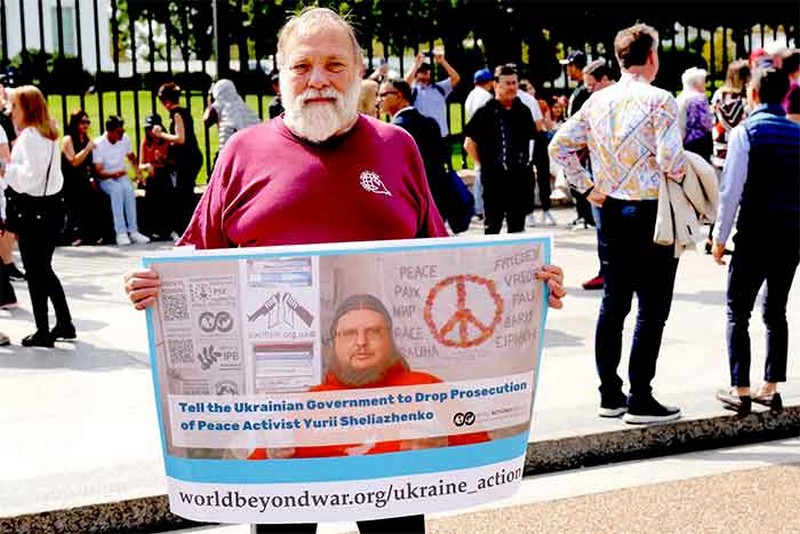
Ukraine Peace Activists Protest During Zelensky White House Visit

By Phil Pasquini

Ukrainian President Volodymyr Zelensky’s visit September 21 with President Biden at the White House today, on this International Day of Peace, was greeted by activists from World Beyond War along with nine other peace groups who protested the visit by calling for the dropping of all charges against Ukrainian peace activist Yurii Sheliazhenko.

Earlier in the week, the group delivered at petition to the Ukraine Embassy that called upon President’s Zelensky and Biden along with other Ukraine diplomats to uphold the rights of conscientious objection along with the right to freedom of expression.

The well-known Ukrainian conscientious objector, Sheliazhenko, who is a journalist, blogger, human rights defender, and legal scholar and does not support the war is opposed to both sides of the conflict. He serves in multiple roles as executive secretary of the Ukrainian Pacifist Movement, a board member of the European Bureau for Conscientious Objection, and a council member of the International Peace Bureau.

The Kiev public prosecutor has accused Sheliazhenko of being “a Russian propogandist” and stated that they intend to stop him in that role. Activists point out that Ukrainian authorities have become increasingly “intolerant for dissent” in the ongoing war.

World Beyond War likens Sheliazhenko’s present situation of being charged as “… extremely common for war supporters to deny the possibility of opposing both sides of a war and to conclude that anyone who does so must actually support whichever side the war supporter opposes.” Sheliazhenko in a written statement characterized the charges brought against him as “fabricated from the motives of ideological hatred of pacifism.”

Organizers have made the demand that “Yurii’s rights to conscientious objection and free speech be respected by a nation that claims to be waging war for democracy and human rights.” They are also calling for the government “to drop any legal proceedings against Yurii Sheliazhenko and to respect human rights, the right to conscientious objection, and the right to freedom of speech. The absurdity of prosecuting someone for justifying Russian war making on the basis of a statement in which he has explicitly condemned Russian war making, is matched by the absurdity of waging war in the name of freedom and democracy while engaging in this sort of harassment of citizens.”

According to Sheliazhenko’s written statement, on August 3, a group of men unknown to him broke down the door of his apartment and announced that they were members of the Ukrainian Security Service (SBU). They said they had a search warrant which they provided to him and refused to wait for his attorney to be present before beginning their search while executing the warrant.

During the ensuing search of the apartment, they collected his electronic devices and other materials as part of their investigation over his objections. Sheliazhenko has claimed that “the materials and equipment that were found cannot be evidence of the commission of crimes on my part and also, taking into account the violations of my rights during these investigative actions, obtained illegally and have no evidentiary value.”

He further asserts the belief “…that this criminal proceeding is illegal, unlawful and politically motivated, a manifestation of repression against the peace movement.”

Sheliazhenko has made three demands in reaction to the criminal charges he is facing. That his human rights activities are not obstructed. That nothing be seized in which he said no “evidence of any illegal actions by me or anyone else was found during the search.” And that he be allowed the opportunity to review the charges brought against him.

On August 8 Sheliazhenko was placed under house arrest by a Kyiv District Court judge and confined to his residence from 10 pm until 6 am the following day, until October 11. The first hearing of his trial was to take place on September 20, but was postponed when the public prosecutor failed to appear in court and has now been rescheduled for October 3.

Activists at the protest stood outside the White House holding banners and signs informing passersby of the situation and calling upon President Biden to address the issue with Volodymyr Zelensky during their bilateral afternoon meeting in the Oval Office. A second group of activists were present at the nearby NW White House appointment gate where they were visible to staff and others who were entering and leaving the secure facility. They busied themselves by handing out information on the issue and engaged with those who wanted to learn more about the situation.

Photo by Phil Pasquini

(This article has appeared in Nuzeink)

Phil Pasquini is a freelance journalist and photographer. His reports and photographs appear in the Washington Report on Middle East Affairs, Pakistan Link and Nuze.ink.

22 September 2023

Source: countercurrents.org
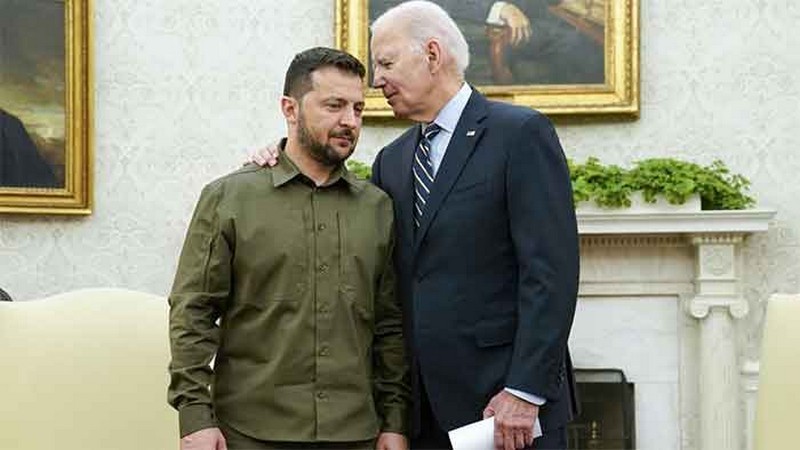
Ukrainian president holds crisis talks in Washington amid failure of “spring offensive”

By Andre Damon

Amid a deepening military crisis triggered by the collapse of Ukraine’s spring offensive, Ukrainian President Volodymyr Zelensky spent hours Thursday meeting behind closed doors at the Pentagon, as well as with US President Joe Biden, top Cabinet officials, the US Senate, and leading House lawmakers.

The meetings followed saber-rattling speeches by Biden and Zelensky at the U.N. Security Council, where Biden ruled out any negotiated settlement of the conflict while Zelensky used ethnically charged language to call Russians “evil” and “terrorists.”

Despite months of media propaganda, the Ukrainian offensive has been a bloody debacle, which US intelligence agencies now admit will fail to achieve its objectives. Over the past month, the Biden administration has facilitated the replacement of virtually all leading officials in Ukraine’s Ministry of Defense, as the US prepares to take an ever more direct role in the conflict.

Zelensky began the day with a meeting with US military officials, including Secretary of Defense Lloyd Austin. The Pentagon said that the meeting sought “to discuss Ukraine’s longer-term capability requirements and how to support them in the future in terms of deterring Russia.”

Following two hours of meetings at the White House, Biden announced that the United States would send yet another major arms shipment to Ukraine, and that Abrams battle tanks would begin arriving on the battlefield imminently.

“Today, I approved the next tranche of US security assistance to Ukraine, including more artillery, more ammunition, more antitank weapons,” Biden said. “And next week, the first US Abrams tanks will be delivered to Ukraine.”

The latest weapons delivery includes additional cluster munitions, a weapon that scatters unexploded ordnance over a wide area, as well as dozens of combat vehicles and over 3 million rounds of ammunition.

Biden continued, “We also focused on strengthening Ukraine’s air defense capabilities to protect the critical infrastructure that provides heat and light during the coldest and darkest days of the year. That includes providing a second HAWK air defense battery with steady deliveries of additional HAWK and other systems each month through the winter. And a new package of launchers and interceptors.”

Following the meeting, Biden declared, “Mr. President, we’re with you, we’re staying with you.”

The announcement comes as the debacle facing the Ukrainian military becomes impossible to conceal. US media outlets published Russian videos showing the destruction of advancing Ukrainian armored vehicles from a distance, citing them as evidence, yet again, that Ukrainian troops were making a “breakthrough.”

A far more realistic picture was presented the same day by veteran journalist Seymour Hersh, who cited a US foreign policy official as saying, “The truth is if the Ukrainian army is ordered to continue the offensive, the army would mutiny. The soldiers aren’t willing to die anymore, but this doesn’t fit the B.S. that is being authored by the Biden White House.”

Tens of thousands of Ukrainian troops have died in the current offensive, likely bringing the total Ukrainian death toll in the war so far to the hundreds of thousands. In July, the New York Times reported that some Ukrainian military units had been wiped out and reconstituted multiple times, and now consisted of older recruits “forced into action.”

In his meeting with Zelensky, Biden called on Congress to pass another $24 billion in funding for the war. “I’m counting on the good judgment of the United States Congress. There’s no alternative,” Biden said.

Zelensky, dressed in military green, gave a secret briefing to the US Senate. Following the briefing, Majority Leader Chuck Schumer asserted that Zelensky told the senators, “If we don’t get the aid, we will lose the war.”

Afterward, Zelensky held a smaller meeting with Republican House Speaker Kevin McCarthy and a group of other members of the House of Representatives. Michael McCaul, the Republican chairman of the House Foreign Affairs Committee, said that the United States would “get [Ukraine] everything they need” and indicated that the US would ultimately provide the ATACMS long-range missile to Ukraine.

He continued, “There are a lot of political machinations right now, but I assure you we are going to get it passed,” in reference to the White House’s request to send an additional $24 billion to Ukraine.

However, revealing the dwindling support for Ukraine in his caucus, McCarthy denied Zelensky the privilege of addressing a Joint Session of Congress, and removed Ukraine military aid from the latest draft of a continuing resolution that must be passed by September 30 to avoid a partial shutdown of the federal government. A growing section of the Republicans in the House, aligned with Trump, wants to prioritize China rather than Russia as the immediate target of US imperialism.

Biden’s speech to the United Nations Tuesday, in which he declared, “Russia alone bears responsibility,” was aimed at precluding any negotiated settlement of the conflict.

The Biden administration is fearful that the outcome of the 2024 election would jeopardize continued US involvement in the conflict and is seeking, by escalating the war into a direct clash with Russia, to create “facts on the ground” that would make it impossible to end the conflict.

With the failure of Ukraine’s offensive, the Biden administration has concluded that the only way to achieve the United States’ sweeping aims in Ukraine is to massively escalate its involvement in the conflict, including the potential direct deployment of US-NATO troops in a shooting war with Russia.

Originally published in WSWS.org

22 September 2023

Source: countercurrents.org
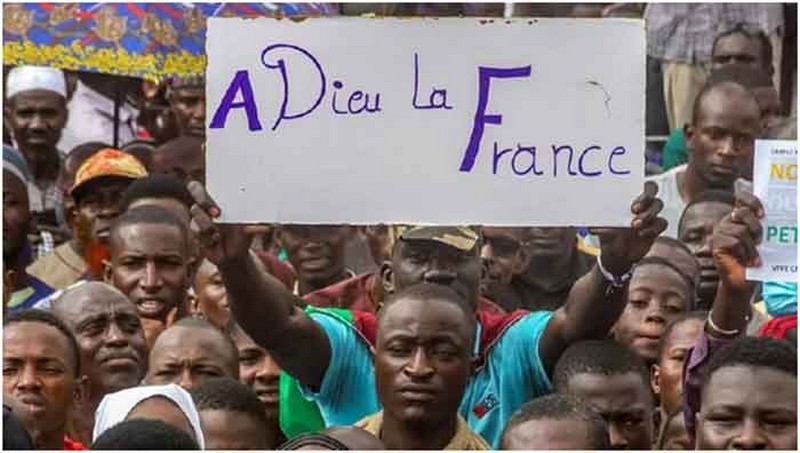
Is This the End of French Neo-Colonialism in Africa?

By Zoe Alexandra and Vijay Prashad

In Bamako, Mali, on September 16, the governments of Burkina Faso, Mali, and Niger created the Alliance of Sahel States (AES). On X, the social media platform formerly known as Twitter, Colonel Assimi Goïta, the head of the transitional government of Mali, wrote that the Liptako-Gourma Charter which created the AES would establish “an architecture of collective defense and mutual assistance for the benefit of our populations.” The hunger for such regional cooperation goes back to the period when France ended its colonial rule. Between 1958 and 1963, Ghana and Guinea were part of the Union of African States, which was to have been the seed for wider pan-African unity. Mali was a member as well between 1961 and 1963.

But, more recently, these three countries—and others in the Sahel region such as Niger—have struggled with common problems, such as the downward sweep of radical Islamic forces unleashed by the 2011 North Atlantic Treaty Organization (NATO) war on Libya. The anger against the French has been so intense that it has provoked at least seven coups in Africa (two in Burkina Faso, two in Mali, one in Guinea, one in Niger, and one in Gabon) and unleashed mass demonstrations from Algeria to the Congo and most recently in Benin. The depth of frustration with France is such that its troops have been ejected from the Sahel, Mali demoted French from its official language status, and France’s ambassador in Niger (Sylvain Itté) was effectively held “hostage”—as French President Emmanuel Macron said—by people deeply upset by French behavior in the region.

Philippe Toyo Noudjenoume, the President of the West Africa Peoples’ Organization, explained the basis of this cascading anti-French sentiment in the region. French colonialism, he said, “has remained in place since 1960.” France holds the revenues of its former colonies in the Banque de France in Paris. The French policy—known as Françafrique—included the presence of French military bases from Djibouti to Senegal, from Côte d’Ivoire to Gabon. “Of all the former colonial powers in Africa,” Noudjenoume told us, “it is France that has intervened militarily at least sixty times to overthrow governments, such as [that of] Modibo Keïta in Mali (1968), or assassinate patriotic leaders, such as Félix-Roland Moumié (1960) and Ernest Ouandié (1971) in Cameroon, Sylvanus Olympio in Togo in 1963, Thomas Sankara in Burkina Faso in 1987 and others.” Between 1997 and 2002, during the presidency of Jacque Chirac, France intervened militarily 33 times on the African continent (by comparison, between 1962 and 1995, France intervened militarily 19 times in African states). France never really suspended its colonial grip or its colonial ambitions.

Breaking the Camel’s Back

Two events in the past decade “broke the camel’s back,” Noudjenoume said: the NATO war in Libya, led by France, in March 2011, and the French intervention to remove Koudou Gbagbo Laurent from the presidency of Côte d’Ivoire in April 2011. “For years,” he said, “these events have forced a strong anti-French sentiment, particularly among young people. It is not just in the Sahel that this feeling has developed but throughout French-speaking Africa. It is true that it is in the Sahel that it is currently expressed most openly. But throughout French-speaking Africa, this feeling is strong.”

Mass protest against the French presence is now evident across the former French colonies in Africa. These civilian protests have not been able to result in straight-forward civilian transitions of power, largely because the political apparatus in these countries had been eroded by long-standing, French-backed kleptocracies (illustrated by the Bongo family, which ruled Gabon from 1967 to 2023, and which leeched the oil wealth of Gabon for their own personal gain; when Omar Bongo died in 2009, French politician Eva Joly said that he ruled on behalf of France and not of his own citizens). Despite the French-backed repression in these countries, trade unions, peasant organizations, and left-wing parties have not been able to drive the upsurge of anti-French patriotism, though they have been able to assert themselves

France intervened militarily in Mali in 2013 to try to control the forces that it had unleashed with NATO’s war in Libya two years previously. These radical Islamist forces captured half of Mali’s territory and then, in 2015, proceeded to assault Burkina Faso. France intervened but then sent the soldiers of the armies of these Sahel countries to die against the radical Islamist forces that it had backed in Libya. This created a great deal of animosity among the soldiers, Noudjenoume told us, and that is why patriotic sections of the soldiers rebelled against the governments and overthrew them.

Anti-Intervention

After the coup in Niger, the West hoped to send in a proxy force—led by the Economic Commission of West African States (ECOWAS)—but the African military leaders demurred. Across the region, people set up solidarity committees to defend the people of Niger from any attack, with the threat provoking “revolt and indignation among the populations,” Noudjenoume explained. Nigerian President Bola Ahmed Tinubu was even forced to back down from ECOWAS’s crusade when his country’s Congress rejected the measure and mass protests occurred against militarily intervening in the neighboring country. As ECOWAS’s ultimatums to restore the deposed Nigerien leader Mohamed Bazoum expired, it became clear that its threat was empty.

Meanwhile, not only did it appear that the people of Niger would resist any military intervention, but Burkina Faso and Mali immediately promised to defend Niger against any such intervention. The new AES is a product of this mutual solidarity.

But the AES is not merely a military or security pact. At the signing ceremony, Mali’s Defense Minister Abdoulaye Diop told journalists, “This alliance will be a combination of military and economic efforts [among]… the three countries.” It will build upon the February 2023 agreement between Burkina Faso, Guinea, and Mali to collaborate on a fuel and electricity exchange, to build transportation networks, to collaborate on mineral resource sales, to build a regional agricultural development project, and to increase intra-Sahel trade. Whether these countries would be able to develop an economic agenda to benefit their peoples—and therefore guarantee that France would have no means to exert its authority over the region—is to be seen.

Zoe Alexandra is the co-editor of Peoples Dispatch.

Vijay Prashad is an Indian historian, editor, and journalist. He is a writing fellow and chief correspondent at Globetrotter.

21 September 2023

Source: countercurrents.org
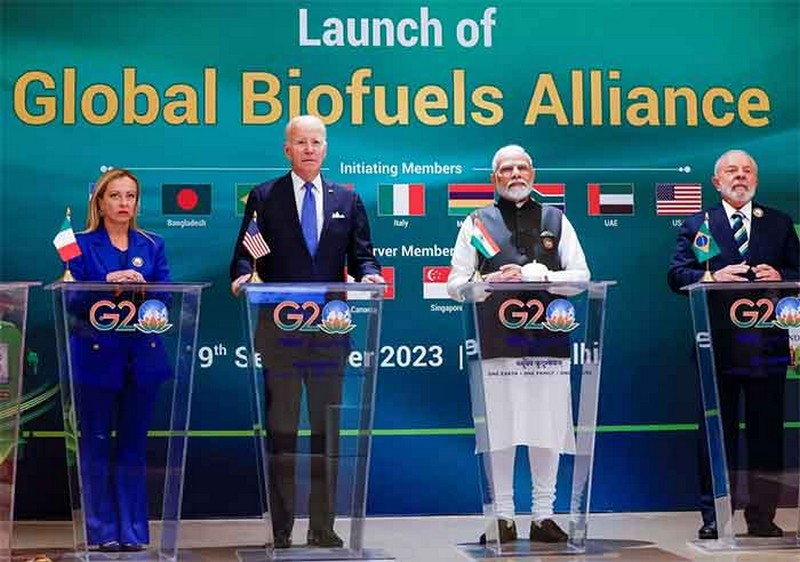
G20 Biofuel Alliance threatens Food security

By Dr. Soma Marla

During the recent G 20 summit India  has launched the Global Biofuel Aliance. Prime Minister Narendra Modi  urged the G20 nations to join the initiative with a plea to take ethanol blending with petrol globally to 20 per cent  to facilitate energy transformation in context of climate change.  Although provision of   environmentally sustainable  green alternative to fossil fuels  sounds good, the basic idea to produce fuel from food is in itself  takes away  food from poor and instead  adds  more cars and other automobiles on our roads.

India has ambitious  targets to  mix bio ethanol   to fossile fuels.  It already mixes 10 percent  bio ethanol to fissile fuels and   aims  to reach  20  percent   by 2025. Currently India  produces  9470 million litres (or 947 crore litres) of bio ethanol, sourced from 619 crore litres of molasses ( sugarcane waste) and 328 crore litres  from grain. A significant quantity of food grains, especially  rice and maize  are being  diverted to production  of high fructose corn syrups in  aerated  cola drinks and others food processing industry.

Indian food grain production  increased by  six times since  it’s independence and in 2023  the  production is estimated to be around 330.5 million tonnes. Although India has millions of tonnes of grain reserves, millions of people are hungry. Food Corporation of India is  presently holding (22nd August, 2023), 523.35 lakh metric tonnes of  rice and wheat. FCI holds nearly 4  times more than the buffer stocks in it’s godowns. Amidst plenty there exists  a serius  hunger in the country. More than 200 million hungry people are in India. Child malnourishment is  also an alarming issue with the country  ranking 107th out of the 121 countries  in  the global hunger index.  The fact that nearly  80 percent population receives every month 5 kg of   subsidised  grain  under Public distribution system itself speaks of the  seriousness of the problem. Also nearly 21,000 people in the world die daily due to hunger  mostly from  South Asia and Africa. While widespread hunger and malnutrition  exist among the people,  it is unethical on part of  governments and policy makers to  divert huge  quantities of staple food crops to produce biofuels.

The National Biofuel Coordination Committee (NBCC, India),  permits   the use of  surplus rice with the FCI for conversion to ethanol. The ethanol will be blended with petrol or used to make alcohol-based sanitisers. In 2020-21 alone,  the Centre allocated about 78,000 tonnes of rice from FCI stocks to distilleries to produce ethanol. That to at a subsidised price of Rs.20 per kg rate to private distilleries.  Government of India  claims, diversion of food grains  and molasis (sugarcane waste) would rise  farmer incomes and  profit them. However, Over the past three seasons, sugar mills and  bioethanol distilleries generated an estimated Rs.22,000 crore (nearly 3 bln dollars) in revenue from selling ethanol to oil marketing companies. However, the companies did not pass on this bounty to farmers neither their long-pending dues from the mills   are not paid.

There is a fast growing worldwide trend towards very heavy diversion of food crops for use as bio-fuels.  As  Agribusiness cartels  find bio ethanol production more profit fetching the crop breeders are  encouraged to  develop more  efficient crops suitable  for  bio fuels.  Farmers  are diverting more fertile lands suitable for food to  bio-fuel,  turning to monocultures of bio-fuel  crops on a large scale.

Diversion of  food crops  to biofuel production is severely affecting  food availability in many countries of African and South America. For example, Corn is the main feedstock for the production of ethanol in the United States. In 2022, corn starch accounted for 94 percent of the production for ethanol fuel production. Remember the 2007 food riots arising from  high prices and shortage of corn and wheat imported from USA and Argentina  and Brazil. As large quantities of corn and weat  were diverted to production of Bio fuels in these countries. For policy makers and  heads of states participating in G 20 summit, these decisions may appear pragmatic, but they affect  food security of millions  world wide.

Pragmatic    for Indian government  to  export  buffer stocks of food grains  to  countries in Sub Sahara and other  African and South Asian nations  instead of  diverting them to Biofuel  production.  A viable  alternative is to  use  paddy  stubbles and other  post harvest crop cellulose residues  for production of   bio ethanol, bio fertilizers and recyclable packing materials.  Microbial and biochemical technologies  needed  for  post harvest crop residues are available  with Indian Council of Agricultueral Research and other scientific institutes.

Large scale diversion of   food grains   for bio fuel  production  is unethical and instead Government of India  should   increase the monthly  ration of food grains  available  to Poor under Public distribution system.  Instead G 20   nations   should conider formation of a Food Bank  using buffer stocks  to meet   any emerging  future emergency  food shortages in global south.

Dr. Soma Marla, Principal Scientist (retd), Indian Council For Agricultueral Research, New Delhi.

21 September 2023

Source: countercurrents.org
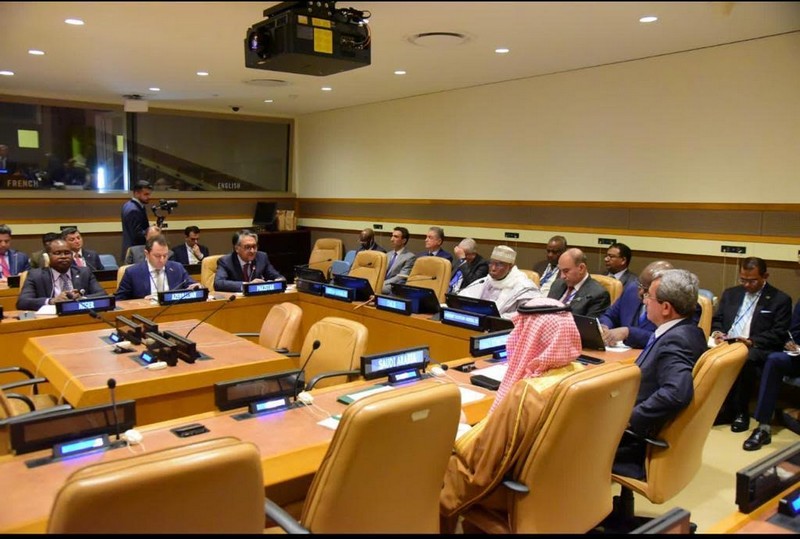
OIC Contact Group on Jammu and Kashmir on the sidelines of 78th session of UN General Assembly

New York. September 20, 2023.

The OIC Ministerial Meeting of the Contact Group on Jammu and Kashmir was held today, September 20, 2023 at the United Nations headquarters, New York on the sidelines of 78th session of the United Nations General Assembly. The meeting was chaired by Mr. Hissein Brahim Taha, the Secretary General of the OIC. It was attended by the foreign ministers and senior officials of Pakistan, Saudi Arabia, Turkey, Azerbaijan, Niger and representative of the people of Jammu and Kashmir. The ministers reaffirmed their support to the people of Jammu and Kashmir in their struggle to achieve the right of self-determination that was promised to them by the United Nations. The ministers also expressed their fervent desire to see an immediate end to the sufferings of the people of Kashmir so that conditions are created for a sustained and meaningful dialogue between Pakistan, India and the leadership of the people of Kashmir.

Ambassador Jalil Abbas Jilani, the foreign minister of Pakistan apprised the members of the Contact Group about the deteriorating and serious situation in Indian occupied Kashmir, saying that “The current Indian leadership is bent upon perpetuating India’s occupation of Jammu & Kashmir.” He warned the members of the Contact Group that newly enacted laws are designed to change the demography of Kashmir. Otherwise, why India has issued millions of domicile certificate to Indian citizens to settle in Kashmir, he asked?

The Minister of Foreign Affairs, Prince Faisal bin Farhan bin Abdullah, participated today in the meeting of the Contact Group on Jammu and Kashmir organized by the Organization of Islamic Cooperation (OIC), on the sidelines the 78th session of the United Nations General Assembly (UNGA 78). Addressing the meeting, Prince Faisal bin Farhan said the Kingdom of Saudi Arabia stands by the Muslim peoples in maintaining their Islamic identity and preserving their dignity.

The foreign minister also reiterated the Kingdom’s support to the afflicted people in areas witnessing conflicts and unrest, including the people of Jammu and Kashmir region.

Saudi Foreign Minister added that the Jammu and Kashmir issue constitutes one of the pressing challenges facing the security and stability of the region, the foreign minister said, warning that leaving the issue unresolved will contribute to regional instability. The Kingdom is exerting unremitting effort to mediate between the parties of the conflict in order to reduce escalation and achieve calm and a peaceful settlement to the issue in accordance with the relevant international resolutions, the foreign minister said. Such efforts emanate from the Kingdom’s unwavering stance in support of Islamic peoples. Deputy Minister for International Multilateral Affairs Dr. Abdulrahman Al-Rassi and Director-General of the Office of the Minister of Foreign Affairs Abdulrahman Al-Dawood attended the meeting.

Dr. Ghulam Nabi Fai, representing the people of Jammu and Kashmir conveyed the gratitude of the people to brotherly member states of the OIC Contact Group for their steadfast and unwavering support extended to them in their struggle for the right of self-determination.

Dr. Fai added that the issue of Indian occupied Kashmir continues to be unresolved and international community has almost relinquished and retracted from the promise that was made to them in 1948. – the promise of right of self-determination under the auspices of the United Nations. To break the will of the people of Kashmir, India has deployed over 900,000 soldiers fully armed and with unlimited powers under the draconian Kashmir specific laws which have wreaked havoc in the region. The atrocities inflicted on the hapless Kashmiris have been documented by Indian and international human rights organizations, like Amnesty International, Human Rights Watch, including 47 pages report issued by the United Nations High Commissioner on Human rights.

The following nine recommendations were made by Dr. Fai to the OIC Contact Group on Jammu and Kashmir for immediate action.

  1. OIC must re-educate the members nations of the UN General Assembly that the conflict of Kashmir is primarily about the right to self-determination, no ifs and no buts.
  2. OIC must persuade the United Nations to convey to the Government of India to rescind the Domicile Law which is designed to change the demography of Kashmir and change the majority Muslim character into a minority community

    3. OIC should also convince the United Nations to prevail upon India to repeal all draconian laws, including Unlawful Activity Prevention Act (UAPA), Public Safety Act (PSA) which are being used to forcibly silence the people into submission.

    4. Given the report, issued by the United Nations High Commissioner on Human Rights on June 14, 2018 & July 8, 2019, regarding the ‘Situation in Kashmir’, we request the OIC members of the Human Rights Council to endorse this report and initiate a joint OIC resolution to set up an enquiry commission on human rights violations in Kashmir during the forthcoming session of the UN Human Rights Council in Geneva to be held in February 2024.

    5. Widely use and disseminate testimony of Dr Gregory Stanton, Chairman, ‘Genocide Watch’, which he gave to the United States Congress on January 12, 2022, and repeated that Kashmir was at the brink of genocide.

    6. The OIC must provide ‘safe havens’ for the Kashmiri Diaspora, especially those fleeing oppression in Occupied Kashmir – scholars, activists, journalists, and businessmen – in OIC member states, in an institutional manner, like opening up visas / jobs / relocation facilitation for such skilled and professional Kashmiris, for whom living in Modi’s India has become unbearable.

    7. In the ‘battle of ideas’ for Azadi (Freedom) of Kashmiri people, OIC must promote the 3 core causes together: PKR (Palestine, Kashmir, Rohingya); establish a special website, combining genocide with resistance.

    8. OIC should allocate emergency scholarship fund to the meritorious students of Kashmir who are the victims of Indian state terrorism.

    9. OIC must persuade the Government of India to release all political prisoners unconditionally, including Mohammad Yasin Malik, Shabir Ahmed Shah, Masarat Alalm, Aasia Andrabi, Khurram Parvez, and others.

A Joint Communique was adopted unanimously during the Contact Group meeting which condemns the protracted detention of the entire Hurriyat leadership, the genuine voice of the Kashmiri political aspirations, and thousands of political activists, journalists and human rights defenders.

The Communique also reads:

Reaffirming the inalienable right to self-determination of the people of Jammu and Kashmir in accordance with the relevant UN Security Council resolutions.

Rejecting the conduct of the G-20 Tourism Working Group Meeting, held in Srinagar on 22-24 May 2023, which aimed to legitimize India’s illegal occupation of the IIOJK and sought to project a facade of normalcy in the occupied territory.

Denouncing India’s continued refusal to allow the OIC Special Envoy, the OIC- Independent Permanent Human Rights Commission (IPHRC), the UN Special Mandate Holders and international civil society organizations to visit IIOJK.

Welcoming the role played by the relevant UN Special Rapporteurs, world leaders, parliamentarians, human rights organizations, and international media, in raising their voice against illegal Indian occupation and then ongoing egregious human rights violations in IIOJK.

The Joint Communique also:

Denounced the Indian authorities’ fresh plea seeking death penalty for one of the renowned Kashmiri leaders, Yaseen Malik, who is incarcerated and has already been awarded life imprisonment; and mandated the Special Envoy on Jammu and Kashmir to take appropriate steps to raise voice against the possible award of death penalty to Malik.

Rejected the illegal and unilateral actions taken by India on August 5, 2019, as well as subsequent steps to undermine the internationally- recognized disputed status of the IIOJK and to alter its demographic structure and political landscape.

Appreciated the countries, which decided to dissociate themselves from the G-20 Tourism Working Group Meeting in Srinagar, and,

Barrister Sultan Mehmood Choudhary, President Azad Kashmir & Mr. Ghulam Mohmmad Safi, representative of All Parties Hurriyat Conference addressed the Contact Group via zoom.

Barrister Sultan Mehmood Choudhary, President, Azad Jammu Kashmir said that Kashmir is one of the oldest issues, pending on the agenda of the United Nations security Council. The urgency dictates the United Nations and the OIC must come forward to support the people of Kashmir in their struggle to achieve the right to self-determination.

Mr. Safi highlighted the grave situation in Kashmir and emphasized that the Kashmir dispute needs to be resolved for the sake of international peace and security. The inaction and passivity of the world powers has given sense of total impunity to 900,000 Indian soldiers in occupied Kashmir, Mr. Safi told the group.

Dr. Fai is also the Secretary General, World Kashmir Awareness Forum.

He can be reached at: 1WhatsApp: 1-202-607-6435.  Or.  gnfai2003@yahoo.com

COVID-19 Vaccine-associated Mortality in the Southern Hemisphere

By Prof Denis Rancourt, Dr. Marine Baudin, Dr. Joseph Hickey, and Dr. Jérémie Mercier

Abstract

Seventeen equatorial and Southern-Hemisphere countries were studied (Argentina, Australia, Bolivia, Brazil, Chile, Colombia, Ecuador, Malaysia, New Zealand, Paraguay, Peru, Philippines, Singapore, South Africa, Suriname, Thailand, Uruguay), which comprise 9.10 % of worldwide population, 10.3 % of worldwide COVID-19 injections (vaccination rate of 1.91 injections per person, all ages), virtually every COVID-19 vaccine type and manufacturer, and span 4 continents.

In the 17 countries, there is no evidence in all-cause mortality (ACM) by time data of any beneficial effect of COVID-19 vaccines. There is no association in time between COVID-19 vaccination and any proportionate reduction in ACM. The opposite occurs.

All 17 countries have transitions to regimes of high ACM, which occur when the COVID-19 vaccines are deployed and administered. Nine of the 17 countries have no detectable excess ACM in the period of approximately one year after a pandemic was declared on 11 March 2020 by the World Health Organization (WHO), until the vaccines are rolled out (Australia, Malaysia, New Zealand, Paraguay, Philippines, Singapore, Suriname, Thailand, Uruguay).

Unprecedented peaks in ACM occur in the summer (January-February) of 2022 in the Southern Hemisphere, and in equatorial-latitude countries, which are synchronous with or immediately preceded by rapid COVID-19-vaccine-booster-dose rollouts (3rd or 4th doses). This phenomenon is present in every case with sufficient mortality data (15 countries). Two of the countries studied have insufficient mortality data in January-February 2022 (Argentina and Suriname).

Detailed mortality and vaccination data for Chile and Peru allow resolution by age and by dose number. It is unlikely that the observed peaks in all-cause mortality in January-February 2022 (and additionally in: July-August 2021, Chile; July-August 2022, Peru), in each of both countries and in each elderly age group, could be due to any cause other than the temporally associated rapid COVID-19-vaccine-booster-dose rollouts. Likewise, it is unlikely that the transitions to regimes of high ACM, coincident with the rollout and sustained administration of COVID-19 vaccines, in all 17 Southern-Hemisphere and equatorial-latitude countries, could be due to any cause other than the vaccines.

Synchronicity between the many peaks in ACM (in 17 countries, on 4 continents, in all elderly age groups, at different times) and associated rapid booster rollouts allows this firm conclusion regarding causality, and accurate quantification of COVID-19-vaccine toxicity.

The all-ages vaccine-dose fatality rate (vDFR), which is the ratio of inferred vaccine-induced deaths to vaccine doses delivered in a population, is quantified for the January-February 2022 ACM peak to fall in the range 0.02 % (New Zealand) to 0.20% (Uruguay). In Chile and Peru, the vDFR increases exponentially with age (doubling approximately every 4 years of age), and is largest for the latest booster doses, reaching approximately 5 % in the 90+ years age groups (1 death per 20 injections of dose 4). Comparable results occur for the Northern Hemisphere, as found in previous articles (India, Israel, USA).

We quantify the overall all-ages vDFR for the 17 countries to be (0.126 ± 0.004) %, which would imply 17.0 ± 0.5 million COVID-19 vaccine deaths worldwide, from 13.50 billion injections up to 2 September 2023. This would correspond to a mass iatrogenic event that killed (0.213 ± 0.006) % of the world population (1 death per 470 living persons, in less than 3 years), and did not measurably prevent any deaths.

The overall risk of death induced by injection with the COVID-19 vaccines in actual populations, inferred from excess all-cause mortality and its synchronicity with rollouts, is globally pervasive and much larger than reported in clinical trials, adverse effect monitoring, and cause-of-death statistics from death certificates, by 3 orders of magnitude (1,000-fold greater).

The large age dependence and large values of vDFR quantified in this study of 17 countries on 4 continents, using all the main COVID-19 vaccine types and manufacturers, should induce governments to immediately end the baseless public health policy of prioritizing elderly residents for injection with COVID-19 vaccines, until valid risk-benefit analyses are made.

Introduction

All-cause mortality by time is the most reliable data for detecting and epidemiologically characterizing events causing death, and for gauging the population-level impact of any surge or collapse in deaths from any cause.

Such data can be collected by jurisdiction or geographical region, by age group, by sex, and so on; and it is not susceptible to reporting bias or to any bias in attributing causes of death in the mortality itself

(Aaby et al., 2020; Bilinski and Emanuel, 2020; Bustos Sierra et al., 2020; Félix-Cardoso et al., 2020; Fouillet et al., 2020; Kontis et al., 2020; Mannucci et al., 2020; Mills et al., 2020; Olson et al., 2020; Piccininni et al., 2020; Rancourt, 2020; Rancourt et al., 2020; Sinnathamby et al., 2020; Tadbiri et al., 2020; Vestergaard et al., 2020; Villani et al., 2020; Achilleos et al., 2021; Al Wahaibi et al., 2021; Anand et al., 2021; Böttcher et al., 2021; Chan et al., 2021; Dahal et al., 2021; Das-Munshi et al., 2021; Deshmukh et al., 2021; Faust et al., 2021; Gallo et al., 2021; Islam, Jdanov, et al., 2021; Islam, Shkolnikov, et al., 2021; Jacobson and Jokela, 2021; Jdanov et al., 2021; Joffe, 2021; Karlinsky and Kobak, 2021; Kobak, 2021; Kontopantelis et al., 2021a, 2021b; Kung et al., 2021a, 2021b; Liu et al., 2021; Locatelli and Rousson, 2021; Miller et al., 2021; Moriarty et al., 2021; Nørgaard et al., 2021; Panagiotou et al., 2021; Pilkington et al., 2021; Polyakova et al., 2021; Rancourt et al., 2021a, 2021b; Rossen et al., 2021; Sanmarchi et al., 2021; Sempé et al., 2021; Soneji et al. 2021; Stein et al., 2021; Stokes et al., 2021; Vila-Corcoles et al., 2021; Wilcox et al., 2021; Woolf et al., 2021; Woolf, Masters and Aron, 2021; Yorifuji et al., 2021; Ackley et al., 2022; Acosta et al., 2022; Engler, 2022; Faust et al., 2022; Ghaznavi et al., 2022; Gobiņa et al., 2022; He et al., 2022; Henry et al., 2022; Jha et al., 2022; Johnson and Rancourt, 2022; Juul et al., 2022; Kontis et al., 2022; Kontopantelis et al., 2022; Lee et al., 2022; Leffler et al., 2022; Lewnard et al., 2022; McGrail, 2022; Neil et al., 2022; Neil and Fenton, 2022; Pálinkás and Sándor, 2022; Ramírez-Soto and Ortega-Cáceres, 2022; Rancourt, 2022; Rancourt et al., 2022a, 2022b; Razak et al., 2022; Redert, 2022a, 2022b; Rossen et al., 2022; Safavi-Naini et al., 2022; Schöley et al., 2022; Sy, 2022; Thoma and Declercq, 2022; Wang et al., 2022; Aarstad and Kvitastein, 2023; Bilinski et al., 2023; de Boer et al., 2023; de Gier et al., 2023; Demetriou et al., 2023; Donzelli et al., 2023; Haugen, 2023; Jones and Ponomarenko, 2023; Kuhbandner and Reitzner, 2023; Lytras et al., 2023; Masselot et al., 2023; Matveeva and Shabalina, 2023; Neil and Fenton, 2023; Paglino et al., 2023; Rancourt et al., 2023; Redert, 2023; Schellekens, 2023; Scherb and Hayashi, 2023; Šorli et al., 2023; Woolf et al., 2023).

We have previously reported several cases in which anomalous peaks in all-cause mortality (ACM) are temporally associated with rapid COVID-19 vaccine-dose rollouts and cases in which the start of the COVID-19 vaccination campaign coincides with the start of a new regime of sustained elevated mortality; in India, Australia, Israel, USA, and Canada, including states and provinces (Rancourt, 2022; Rancourt et al., 2022a, 2022b, 2023).

These studies allowed us to make the first quantitative determinations of the vaccine-dose fatality rate (vDFR), which is the ratio of inferred vaccine-induced deaths to vaccine doses administered in a population, based on excess-ACM evaluation on a given time period, compared to the number of vaccine doses administered in the same time period.

The all-ages all-doses value of vDFR was typically approximately 0.05 % (1 death per 2,000 injections), with an extreme value of 1 % for the special case of India (Rancourt, 2022). Our work, using extensive data for Australia and Israel, has also shown that vDFR is exponential with age (doubling every 5 years of age), reaching approximately 1 % for 80+ year olds (Rancourt et al., 2023).

The clearest example is that of a relatively sharp ACM peak occurring in January-February 2022 in Australia, which is synchronous with the rapid rollout of Australia’s dose 3 of the COVID-19 vaccine; occurring in 5 of 8 of the Australian states and in all of the more-elderly age groups (Rancourt et al., 2022a, 2023).

In contrast, often one must contend with the confounding effect of the intrinsic seasonal variation of ACM; however, in this case for Australia, the said January-February 2022 peak occurs at a time in the intrinsic seasonal cycle when one should have a stable (Southern Hemisphere) summer low or summer trough in ACM. There are no previous examples of such a peak in the summer in the historic record of ACM for Australia (Rancourt et al., 2022a).

Few national jurisdictions have the kind of extensive age-stratified mortality and vaccination data available for Australia and Israel. Two other such jurisdictions are Chile and Peru. Here, we show that Chile and Peru, like Australia, has a relatively sharp ACM peak occurring in January-February 2022, which is synchronous with the rapid rollout of Chile’s dose 4 and Peru’s dose 3 of the COVID-19 vaccine, respectively, occurring for all of the more-elderly age groups.

This shared feature between Chile, Peru and Australia led us to look for more examples of the January-February 2022 ACM-peak phenomenon in the Southern Hemisphere and in equatorial regions. Equatorial countries have no summer and winter seasons and no seasonal variations in their ACM patterns. We found the same phenomenon everywhere that data was available (Australia, Bolivia, Brazil, Chile, Colombia, Ecuador, Malaysia, New Zealand, Paraguay, Peru, Philippines, Singapore, South Africa, Thailand, Uruguay), although incomplete for Bolivia and not as distinctive for New Zealand. Here, we report on those findings.

Data

The sources of mortality and vaccine-administration data are given in Appendix A: Sources of mortality and vaccination data.

Appendix B: Examples of all-cause mortality and vaccination data contains examples of the data: all-ages national ACM by time (week or month), from 2015 to 2023, and all-ages all-doses vaccine administration by week, using Y-scales starting from zero, for the 17 countries considered in the present study: Argentina, Australia, Bolivia, Brazil, Chile, Colombia, Ecuador, Malaysia, New Zealand, Paraguay, Peru, Philippines, Singapore, South Africa, Suriname, Thailand, and Uruguay.

Figure 1 shows the said 17 countries considered, in relation to the equator on a world map.

Figure 1: World map showing the 17 countries considered in the present study, in relation to the equator and the tropics ― Argentina, Australia, Bolivia, Brazil, Chile, Colombia, Ecuador, Malaysia, New Zealand, Paraguay, Peru, Philippines, Singapore, South Africa, Suriname, Thailand, and Uruguay.

Method to Detect Time Transitions to

Regimes of High All-Cause Mortality

We implement the following method developed by one of us (JH) for detecting changes in regime in ACM data by time (day, week, month, quarter).

One is interested in detecting transitions in time (as one advances in time from a stable historic period) to regimes of “higher than usual” or “higher than recent” ACM, which may be associated with the declaration of a pandemic or with rollouts of vaccines. Although the trained eye can detect such transitions in the raw ACM by time data itself, it is useful to apply a statistical transformation, which is designed to largely eliminate the confounding difficulty of seasonal variations in ACM, which occur in non-equatorial countries.

Since the dominant period of the seasonal variations in ACM is 1 year, and since we wish to detect changes moving forward in time, we adopt the following approach. We apply a 1-year backward moving average to the ACM by time data. Each point in time of the 1-year backward moving average is simply the average ACM for the year ending at the said point in time, and we plot this moving average by time. Changes in regime of ACM then appear as breaks (in slope or value) in the moving average by time.

Note that the 1-year backward moving average method produces one significant but easily discerned artifact: Relatively large and sharp peaks in ACM give rise to artificial drops in the moving average at one year ahead of (later than) the said relatively large and sharp peaks in ACM.

Methods to Quantify vDFR from All-Cause Mortality

4.1 Historical-trend baseline for a period (or peak) of mortality (Method 1)

Our first method (Method 1) for quantification of vDFR by age group (or all ages) and by vaccine dose number (or all doses) is as follows (Rancourt et al., 2022a, 2023), here improved to adjust for systematic seasonal effects:

i. Plot the ACM by time (day, week, month) for the age group (or all ages) over a large time scale, including the years prior to the declared pandemic.

ii. Identify the date (day, week, month) of the start of the vaccine rollout (first dose rollout) for the age group (or all ages).

iii. Note, for consistency, that the ACM undergoes a step-wise increase to larger values near the date of the start of the vaccine rollout.

iv. Integrate (add) ACM from the start of the vaccine rollout to the end of available data or end of vaccinations (all doses), whichever comes first. This is the basic integration time window used in the calculation, start to end dates.

v. Apply this window and this integration over successive and non-overlapping equal-duration periods, moving as far back as the data permits.

vi. Start each new integration window at the same point in the seasonal cycle as the start of the basic integration window for the vaccine period, even if this introduces gaps between successive integration periods.

vii. Plot the resulting integration values versus time, and note, for consistency, that the value has an upward jog, well discerned from the historic trend or values, for the vaccination period.

viii. Extrapolate the historic trend of integrated values into the vaccination period. The difference between the measured and extrapolated (historic trend predicted) integrated values of ACM in the vaccination period is the excess mortality associated with the vaccination period.

ix. The extrapolation, in practice, is achieved by fitting a straight line to chosen pre-vaccination-period integration points.

x. If too few points are available for the extrapolation, giving too large an uncertainty in the fitted slope, then impose a slope of zero, which amounts to using an average of recent values. In some cases, even a single point (usually the point for the immediately preceding integration window) can be used.

xi. The error in the extrapolated value is most often overwhelmingly the dominant source of error in the calculated excess mortality. Estimate the “accuracy error” in the extrapolated value as the mean deviation of the absolute value difference with the fitted line (mean of the absolute values of the residuals) for the chosen points of the fit. This error is a measure of the integration-period variations from all causes over a near region having an assumed linear trend.

xii. The said “accuracy error” is generally larger than the “precision error” (or statistical error) in the extrapolated value, as it represents the year-to-year variability of the integrated ACM in the integration window in the years prior to the Covid or vaccination periods.

xiii. If there are too few integration windows in the available normal years prior to the peak or region of interest to obtain a good estimate of the historic year-to-year variability, or if the statistical errors in the integrated values are relatively large, then make use of the statistical errors to best estimate the needed uncertainty.

xiv. Apply the same integration window (start-to-end dates during vaccination) to count all vaccine doses administered in that time.

xv. Depending on particular circumstances in the data, it may be necessary to use different integration bounds (different windows) for the ACM and for the vaccine administration. We saw no need for this, and we did not try to implement or test such an optimization.

xvi. Define vDFR = (vaccination-period excess mortality) / (vaccine doses administered in the same vaccination period). Calculate the uncertainty in vDFR using the estimated error in vaccination-period excess mortality.

The same method is adapted to any region of interest (such as a peak in ACM) of sub-annual duration, by translating the window of integration (of the region of interest) backwards by increments of one year.

The above-described method is robust and ideally adapted to the nature of ACM data. Integrated ACM will generally have a small statistical error.

A large time-wise integration window (e.g., for the entire vaccination period) mostly removes the difficulty arising from intrinsic seasonal variations; and this difficulty is further solved by starting each new integration window at the same point in the seasonal cycle as the start of the basic integration window for the vaccine period (point-vi, above).

The historic trend is analysed without introducing any model assumptions or uncertainties beyond assuming that the near trend can be modelled by a straight line, where justified by the data itself. Such an analysis, for example, takes into account year to year changes in age-group cohort size arising from the age structure of the population. The only assumption is that a locally linear near trend for the unperturbed (ACM-wise unperturbed) population is realistic.

While the above method is designed for cases (jurisdictions) in which there is no evidence in the ACM data for mortality caused by factors other than the vaccine rollouts, such as Covid measures (treatment protocols, societal impositions, isolation and so forth; since no excess mortality occurs in the pre-vaccination period of the Covid period), it can be readily adapted to cases in which mortality in the vaccination period is confounded by additional (Covid period) causal factors that cannot be ruled out.

One approach is simply to adapt the above method to calendar years, irrespective of whether excess mortality occurs prior to the COVID-19 vaccine rollouts. One obtains excess ACM by calendar year, relative to the expected value from the historic trend deduced by linear extrapolation from a chosen range of yearly ACM values for < 2020 (for years prior to 2020, when the 11 March 2020 announcement of a pandemic was made). One then compares the excess ACM for 2020 and for 2021. In many (most) countries, there was essentially no COVID-19 vaccination in 2020, and a rapid rollout essentially started in January 2021.

Special Case of a Single Historic Integrated Point (Method 2)

In cases in which it is not possible or practical to obtain more than one integration value for the needed extrapolation (steps v to ix, above), rather than assume a zero slope for the extrapolation (step x, above), the following second method (Method 2) can be applied.

If Y(−1) is the sole historic integrated point, then simply take the needed extrapolated value, Y(0), to be:

Y(0) = Y(−1) + m ΔT W    (1)

where m is the slope of the best-straight-line fit through the original ACM by time unit (day, week, month…) versus numbered time unit, ΔT is the number of time units between Y(0) and Y(−1) (i.e., between the start of the Y(0) integration window and the start of the Y(−1) integration window), and W is the inclusive width of the integration window in number of time units.

This assumes that the ACM by time varies on a straight line, notwithstanding seasonal variations, on the near segment used to obtain the best-straight-line fit.

The resulting excess mortality for the integration window or period, xACM(0), is then:

xACM(0) = ACM(0) − Y(0)      (2)

where ACM(0) is the integrated ACM in the period of interest.

The statistical error (standard deviation) in xACM(0) is then given by:

sig(xACM(0)) = sqrt [ ACM(0) + Y(−1) + (ΔT W sig(m))2 ]      (3)

where sig(m) is the nominally statistical error in m.

If there is no seasonal variation in ACM, as occurs in equatorial-latitude jurisdictions, then sig(m) is the actual statistical error in m. With seasonal variations in ACM, sig(m) extracted from the least squares fitting to a straight line does not have a simple  meaning. In this case, sig(m) will incorporate uncertainty arising from seasonal variations, and increases with increasing amplitude of the seasonal variation.

Application of the Methods to the Specific Countries

The parameters for applying the methods (Methods 1 and 2) to the data are given in Appendix C: Technical and specific information for applications of the methods to the data.

Click here to read the full report.

18 September  2023

Source: www.globalresearch.ca

International Day of Peace: Fostering Harmony and Unity in a World of Diversity

By Mohd Ziyaullah Khan

International Peace Day, observed on the 21st of September every year, stands as a reminder of our collective responsibility to strive for a more peaceful world. Established by the United Nations in 1981, this day aims to promote peace and cease-fire among nations and peoples. The aspiration is to encourage dialogue, understanding, and collaboration to achieve a world free of conflicts and violence. The theme for International Peace Day changes annually, highlighting various aspects of peacebuilding. However, the overarching goal remains the same: to raise awareness about peace and encourage actions that promote peace in our communities, nations, and the world.

Theme This Year: 

In 2023, we reach the midpoint of the Sustainable Development Goals (SDGs) implementation. Notably, the International Day of Peace in 2023 aligns with the SDG summit on September 18-19, marking this significant milestone. The SDGs are a collective endeavor to move us closer to societies that embody peace, justice, and inclusivity, devoid of fear and violence. Achieving these goals necessitates active involvement from a broad spectrum of stakeholders, including the 1.2 billion young individuals alive today. Their engagement is pivotal for realising the SDGs.

Interestingly, 2023 also marks the 75th anniversaries of the Universal Declaration of Human Rights and the Convention on the Prevention and Punishment of Genocide. The day calls upon the youth to embrace ambition in their roles as positive and constructive social agents, encouraging their participation in the movement toward achieving the SDGs and contributing to sustainable peace. By uniting, we can guide our world towards a future that is environmentally conscious, fair, just, and secure for all.

The Importance of International Peace Day:

International Peace Day offers a platform to raise awareness about the importance of peace in the world. It helps people understand the devastating effects of conflicts on societies, economies, and individuals. Besides, the day can bring in the following things as well, have a look as under:

  • Conflict Resolution

  • Education for Peace

  • Inspire Action for Peace

  • Unity and Solidarity

Ways to Celebrate International Peace Day:

There can be different ways of celebrating this day, some of these include the following:

  • Organise Peace Workshops and Discussions on issues like conflict resolution, tolerance, and peaceful coexistence by inviting experts and activists.

  • Educational Programs in schools and colleges to educate students about peace, non-violence, and the impact of conflict on communities.

  • Cultural Events: Host cultural events that promote diversity and understanding among different cultures and traditions.

  • Social Media Campaigns: Use the power of social media to spread messages of peace, share success stories of peace initiatives, and engage a broader audience in peacebuilding conversations.

  • Acts of Kindness: Encourage individuals to perform acts of kindness and compassion like  helping a neighbour, sharing a meal, or offering a kind word, etc.

Shun Hate and Revive Peace 

In the diverse tapestry of India, it is imperative to shun hate and embrace the harmonious melody of peace. Unfortunately, the act of hate seems to be accelerating in the recent past in our country. Hate, born of prejudice and ignorance, has the potential to fracture the unity that binds us. We must collectively extinguish the flames of hatred that threaten our social fabric. Instead, let us foster understanding, empathy, and respect for one another’s differences.

Reviving peace in India means acknowledging our shared humanity and celebrating the mosaic of cultures, religions, and traditions that enrich our nation. It entails promoting dialogue, inclusivity, and compassion in our daily interactions. By focusing on commonalities and promoting tolerance, we can build bridges that connect hearts and minds, transcending barriers of division.

Let us unite to cultivate an environment where love triumphs over hate, and where understanding paves the way for a peaceful coexistence. Through this collective effort, we can forge a nation that stands as a beacon of peace, unity, and progress for the world to admire and emulate.

Challenges and the Way Forward:

While International Peace Day brings attention to the crucial need for peace, our world still grapples with conflicts, discrimination, and violence. Achieving lasting peace requires addressing deep-rooted issues such as poverty, inequality, injustice, and intolerance.

Moreover, embracing peace means understanding and appreciating the richness of our diverse world. It calls for respecting different cultures, traditions, and beliefs and fostering a sense of empathy and compassion for one another.

Wrapping up 

 International Peace Day stands as a reminder of our shared responsibility to strive for a more peaceful world. It urges us to take action, promote understanding, and work collectively to create a future where peace is not just a day of observance but an enduring reality for all. Only by fostering peace within ourselves and our communities can we hope to achieve lasting harmony and unity on a global scale.

Mohd Ziyauallah Khan is based in Nagpur and works with a leading digital marketing company in Nagpur as the Content Head.

20 September 2023

Source: countercurrents.org

Three Former French Sahel Colonies Form Military Alliance

By Countercurrents Collective

The military governments of three African states, which all deposed their Western-backed leaders in recent years, have agreed to assist each other, individually or collectively, in case of any external aggression or internal threat to their sovereignty.

Media reports said:

Mali’s interim president, Assimi Goita, said on Saturday night that he signed the so-called Liptako-Gourma Charter with the leaders of Burkina Faso and Niger “with the aim of establishing a collective defense and mutual assistance framework.”

“Any attack on the sovereignty and territorial integrity of one or more contracted parties will be considered an aggression against the other parties,” according to the text of the charter, cited by Reuters.

The charter establishes an Alliance of Sahel States, which comprises three countries which had previously been members of the Paris-supported G5 Sahel pact with Chad and Mauritania, that has fallen apart following a series of military coups.

The Defense Minister of Mali, Abdoulaye Diop, explained that this new “alliance will be a combination of military and economic efforts between the three countries” with a priority on the fight against terrorism, particularly in the Liptako-Gourma region where the borders of the three neighbors meet.

Mali and Burkina Faso previously stated that any attack on Niger would be a “declaration of war” against them as well, after several of Niger’s neighbors from the Economic Community of West African States (ECOWAS) threatened to send troops to restore deposed President Mohamed Bazoum.

Paris was forced to withdraw troops from Mali following tensions with the military government in 2020. Earlier this year, it also pulled out of Burkina Faso after the country’s military rulers ordered them to leave.

Niger’s coup leaders also canceled military agreements that allowed French forces to fight jihadists in the Sahel region, giving the former colonial power only a month to pull out its 1,500 troops. France, however, ignored the ultimatum and demands for its ambassador to leave, as it refused to recognize the authority of the new leadership.

France Planning Aggression Against Niger, Claims Niamey

Another media report said:

France is planning to intervene in Niger, as it continues to deploy troops to several countries in the region, the West African state’s military government has claimed. Relations between Niger and former colonial power France have deteriorated since a coup in July.

“France continues to deploy its forces in several ECOWAS countries as part of preparations for an aggression against Niger, which it is planning in collaboration with this community organization,” Colonel Amadou Abdramane, spokesman for the government in Niamey, said in a statement broadcast on national television on Saturday, as quoted by AFP.

ECOWAS has threatened to intervene in the country to restore its ousted president Mohamed Bazoum to office. Top French officials have also stated several times that Paris would support military action by the bloc.

However, according to Niger’s military-appointed Prime Minister, Ali Lamine Zeine, military action by ECOWAS is not supported by all member states. He also told the media on Monday that the new government in Niamey was hoping to reach an agreement with the bloc in the “coming days.”

Nigerien military leaders have previously denounced the presence of French troops in the country as “illegal” and demanded their prompt withdrawal.

While speaking during the G20 summit in New Delhi, French President Emmanuel Macron said that since his country doesn’t recognize the Nigerien military government, any redeployment of its forces might be done only “at the request of President Bazoum.”

Paris already had to withdraw troops from Burkina Faso earlier this year. France also pulled its forces out of Mali following tensions with the military government after a coup in 2020.

Countercurrents is answerable only to our readers. Support honest journalism because we have no PLANET B.

17 September 2023

Source: countercurrents.org