Just International

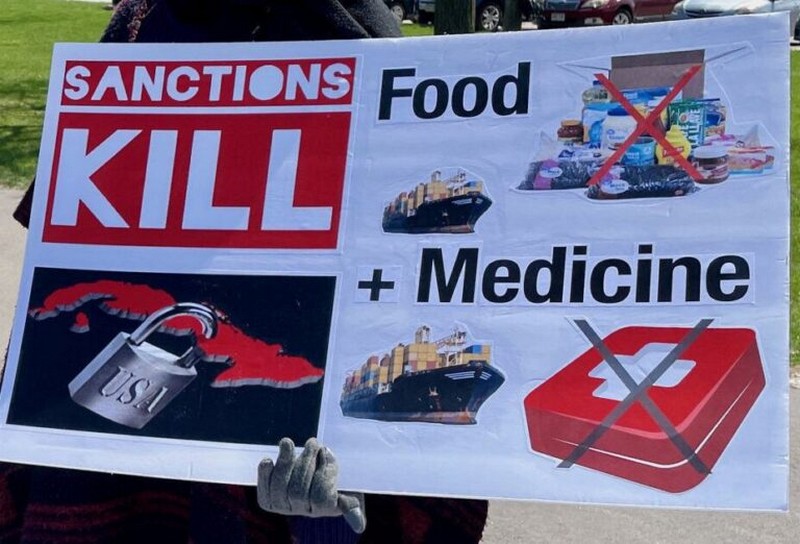
Cuba’s Worsening Food Crisis Means US Blockade Must End Now, Not Later

By W.T. Whitney Jr.

17 Aug 2023 – At a meeting in Havana on August 11 attended by government ministers and the press, Cuban National Assembly President Esteban Lazo communicated a message to Cuba’s Minister of Agriculture from the Assembly, whose recent session ended on July 22. The ministry would be “transforming and strengthening the country’s agricultural production,” to initiate “a political and participatory movement that would unleash a productive revolution in the agricultural sector.”The National Assembly dealt primarily with Cuba’s present food disaster. The lives of many Cubans are precarious due to food shortages, high prices, and low income.

Information emerging from the Assembly’s deliberations attests to the reality of crisis in Cuba. Urgency builds for Cuba’s friends in the United States to resist U.S. policies in new ways, strongly and assertively. Their own government accounts for new suffering and destitution in Cuba.

President Miguel Díaz-Canel emphasized resistance while addressing the National Assembly. He dedicated his remarks to two revolutionary heroes who were present. Admiring “their foot in the stirrup of difficulties and their rifle pointed at mistakes,” he may have been thinking of hard work ahead.

He mentioned “problems of our difficult daily life, such as food production, electricity generation, water availability, crime, rising inflation, abusive prices.” He criticized behaviors “that reinforce the omnipresent blockade through inaction, apathy, insensitivity, incapacity or simple tiredness and lack of faith.”

Díaz-Canel noted approvingly that delegates discussed “closer ties between deputies and the population,” “better management and allocation of the currency,” “greater direct participation of the non-state sector in national production,” “municipal autonomy,” and “downward pressure on prices.”

“Above all,” he insisted, “we must devote ourselves to creating wealth, first of all, by producing food.”

Vice Prime Minister Jorge Luis Tapia Fonseca reported on implementation of Cuba’s 2022 law on Food Sovereignty and Food and Nutritional Security. He noted that food self-sufficiency in local areas was lagging. Crop yields were low. Plant diseases and the lack of inputs hampered grain production.

Cubans individually had consumed only 438 grams of animal protein per month in 2022, and in May 2023, only 347 grams; recommendations call for ingestion of 5 kg monthly. Not enough chickens were been raised; poultry meat and eggs were scarce.

Yields of corn, soy, sorghum and other crops are reduced and animal feed is mostly unavailable. Therefore, pork production is down, milk is unavailable to adults, and fewer cattle are being raised.  Pasturage is poor, due to drought and no fertilizer.

Tapia pointed to failures. The output of state-controlled food producers is low. Producers, distributers, and institutional consumers don’t regularly contract with one another to facilitate food distribution. Producers aren’t being paid, because credit isn’t available. Cattle-stealing has reached new heights, 44,318 head so far this year.

Tapia exploded: “It takes work to produce food. Everyone wants food deliveries, but we do nothing to produce it. We lack a culture of production … We don’t need all these papers, or words. When do we begin to plant? Who will do it?”

The Ministry of Finances and Prices issued a report prior to the National Assembly session. It recognized high inflation, widespread popular dissatisfaction and the need for “concrete solutions.” Minister Vladimir Regueiro Ale indicated prices skyrocketed by 39% during 2022 and 18% more so far in 2023.

Inflation, he explained, varies from province to province and may manifest as abusive price-fixing, especially when agricultural supplies and products are in short supply.

Commenting on the report, National Assembly President Esteban Lazo, reminded delegates that diminished production and inflation were connected: “If there is no production and supply, we will not achieve effective control of prices.” He complained that “practically 100% of the food basket is being imported.”

The Assembly’s Food and Agricultural Commission issued one more report. It mentioned organizational and management problems and reported that only 68% of expected diesel fuel has arrived so far in 2023, 14,700 tons less than in the similar period a year before; 28,900 tons of imported fertilizer were ordered, but only 168 tons arrived. Cuba’s fertilizer production has been nil this year in contrast to 9,600 tons produced in the same months in 2022.

Cuba’s rural communities are troubled. Soon “we won’t have any people left in the countryside,” a delegate said.  Another called for improved “roadways, housing, and connectivity.”  Someone regarding agricultural skills as low called for teaching in “agroecological technics” and “good practices for the producing, processing and commercialization of food.”

The idea circulated that local autonomy would spur food production. As of April, 2023, aspiring farmers had not yet taken possession of 258,388 hectares of idle land made available to them without cost under land-tenure reforms in 2008.

Frei Betto, Brazilian friend of revolutionary Cuba and adviser to Cuba’s Food Sovereignty and Nutritional Education Plan, visited Cuba in June. For him, the “current shortages are more severe than in the Special Period (1990-1995).” He indicated that Cuba now imports 80% of the food it consumes, up from 70% five or so years ago, that it costs $4 billion annually, up from $2 billion. For corn, soy, and rice alone, the outlay now is  $1.5 billion annually.

He indicated too that a ton of imported chicken meat now costs $1.3 million, up from $900,000 a year ago, that “the wheat supply has worsened,” that milk production is down 38 million liters in one year, that less oil from Venezuela, thanks to U.S. sanctions there, means reduced food production in Cuba.

The origins of food shortages in Cuba and the mode of U.S. intervention are highly relevant. Shortages are not solely due to U.S. policies. Drought, hurricane damage, marabou shrub infestation, soil erosion, high soil acidity, poor drainage, and lack of organic material soil have contributed. Bureaucratic and centralizing tendencies of Cuba’s government play a role.

The U.S. economic blockade is central. Food crisis is in line with the proposals of State Department official Lestor Mallory in 1960 for policies leading to “hunger, desperation and overthrow of government.” The Soviet Bloc fell three decades later. The U.S. government tightened economic blockade by means of legislation in 1992 and 1996 and, later, Cuba’s designation as a terrorist-sponsoring nation.

Beyond bans on products manufactured or sold by U.S. companies, proscribed categories soon included products manufactured by foreign companies associated with U.S. ones and products containing 10% or more components of U.S. origin. Now foreign enterprises active in Cuba faced possible U.S. court action.

International loans and international transactions in dollars are usually off limits. Payments abroad don’t reach destinations. Income from exports doesn’t arrive.

Think imports of seeds, fertilizers, herbicides, pesticides, breeding stock, veterinary supplies and drugs, new equipment, spare parts, exports of coffee, rum, and nickel. Think loans for purchasing food and more, loans for agricultural development. Think impediments to restoring rural infrastructure.

The blockade, the U.S. tool of choice, has hit food production in Cuba hard. It is far along in achieving its ultimate purpose. Cuba needs a new order of support from friends in the United States─ Marti’s “belly of the beast.”

Many have so admired Cuba’s brand of socialism as to assume that Cuba’s social gains and exuberant international solidarity would fire up such enthusiasm that, along with considerations of fairness, legality, neighborliness, and revulsion against U.S. cruelty, would make U.S. policymakers think anew about Cuba. It never happened.

Now at a watershed moment in Cuba, a new direction is necessary, one all about persuading, organizing, and unifying left-leaning political groups and anti-war, anti-empire activists of all stripes. Leadership is needed.

Frei Betto says that,

“It is time for all of us, in solidarity with the Cuban Revolution, to intensify the struggle against the U.S. blockade and mobilize international cooperation with the island that dared to conquer its independence and sovereignty against the most powerful and genocidal empire in the history of mankind.”

W.T. Whitney Jr. is a retired pediatrician and political journalist living in Maine.

21 August 2023

Source: www.transcend.org

U.S.-Backed Roll of the Dice Leaves Ukraine in Worse Crisis

By Medea Benjamin and Nicolas J. S. Davies

16 Aug 2023 – President Biden wrote in the New York Times in June 2022 that the United States was arming Ukraine to “fight on the battlefield and be in the strongest possible position at the negotiating table.”

Ukraine’s fall 2022 counteroffensive left it in a stronger position, yet Biden and his NATO allies still chose the battlefield over the negotiating table. Now the failure of Ukraine’s long-delayed “Spring Counteroffensive” has left Ukraine in a weaker position, both on the battlefield and at the still empty negotiating table.

So, based on Biden’s own definition of U.S. war aims, his policy is failing, and it is hundreds of thousands of Ukrainian soldiers, not Americans, who are paying the price, with their limbs and their lives.

But this result was not unexpected. It was predicted in leaked Pentagon documents that were widely published in April, and in President Zelenskyy’s postponement of the offensive in May to avoid what he called “unacceptable” losses.

The delay allowed more Ukrainian troops to complete NATO training on Western tanks and armored vehicles, but it also gave Russia more time to reinforce its anti-tank defenses and prepare lethal kill-zones along the 700-mile front line.

Now, after two months, Ukraine’s new armored divisions have advanced only 12 miles or less in two small areas, at the cost of tens of thousands of casualties. Twenty percent of newly deployed Western armored vehicles and equipment were reportedly destroyed in the first few weeks of the new offensive, as British-trained armored divisions tried to advance through Russian minefields and kill-zones without demining operations or air cover.

Meanwhile, Russia has made similar small advances toward Kupyansk in eastern Kharkiv province, where land around the town of Dvorichna has changed hands for the third time since the invasion. These tit-for-tat exchanges of small pieces of territory, with massive use of heavy artillery and appalling losses, typify a brutal war of attrition not unlike the First World War.

Ukraine’s more successful counteroffensives last fall provoked serious debate within NATO over whether that was the moment for Ukraine to return to the negotiating table it had abandoned at British and U.S. urging in April 2022. As Ukrainian forces advanced on Kherson in early November, La Republicca in Italy reported that NATO leaders had agreed that the fall of Kherson would put Ukraine in the position of strength they had been waiting for to relaunch peace talks.

On November 9, 2022, the very day that Russia ordered its withdrawal from Kherson, General Mark Milley, the Chairman of the Joint Chiefs of Staff, spoke at the Economic Club of New York, where the interviewer asked him whether the time was now ripe for negotiations.

General Milley compared the situation to the First World War, explaining that leaders on all sides understood by Christmas 1914 that that war was not winnable, yet they fought on for another four years, multiplying the million lives lost in 1914 into 20 million by 1918, destroying five empires and setting the stage for the rise of fascism and the Second World War.

Milley concluded his cautionary tale by noting that, as in 1914, “… there has to be a mutual recognition that military victory is probably in the true sense of the word, is maybe not achievable through military means. And therefore, you need to turn to other means… So things can get worse. So when there’s an opportunity to negotiate, when peace can be achieved, seize it, seize the moment.”

But Milley and other voices of experience were ignored. At Biden’s February State of the Union speech in Congress, General Milley’s face was a study in gravity, a rock in a sea of misplaced self-congratulation and ignorance of the real world beyond the circus tent, where the West’s incoherent war strategy was not only sacrificing Ukrainian lives every day but flirting with nuclear war. Milley didn’t crack a smile all night, even when Biden came over to glad-hand after his speech.

No U.S., NATO or Ukrainian leaders have been held accountable for failing to seize that moment last winter, nor the previous missed chance for peace in April 2022, when the U.S. and UK blocked theTurkish and Israeli mediation that came so close to bringing peace, based on the simple principle of a Russian withdrawal in exchange for Ukrainian neutrality. Nobody has demanded a serious account of why Western leaders let these chances for peace slip through their fingers.

Whatever their reasoning, the result is that Ukraine is caught in a war with no exit. When Ukraine seemed to have the upper hand in the war, NATO leaders were determined to press their advantage and launch another offensive, regardless of the shocking human cost. But now that the new offensive and weapons shipments have only succeeded in laying bare the weakness of Western strategy and returning the initiative to Russia, the architects of failure reject negotiating from a position of weakness.

So the conflict has fallen into an intractable pattern common to many wars, in which all parties to the fighting—Russia, Ukraine and the leading members of the NATO military alliance—have been encouraged, or we might say deluded, by limited successes at different times, into prolonging the war and rejecting diplomacy, despite appalling human costs, the rising danger of a wider war and the existential danger of a nuclear confrontation.

But the reality of war is laying bare the contradictions of Western policy. If Ukraine is not allowed to negotiate with Russia from a position of strength, nor from a position of weakness, what stands in the way of its total destruction?

And how can Ukraine and its allies defeat Russia, a country whose nuclear weapons policy explicitly states that it will use nuclear weapons before it will accept an existential defeat?

If, as Biden has warned, any war between the United States and Russia, or any use of “tactical” nuclear weapons, would most likely escalate into full-scale nuclear war, where else is the current policy of incremental escalation and ever-increasing U.S. and NATO involvement intended to lead?

Are they simply praying that Russia will implode, or give up? Or are they determined to call Russia’s bluff and push it into an inescapable choice between total defeat and nuclear war?

Hoping, or pretending, that Ukraine and its allies can defeat Russia without triggering a nuclear war is not a strategy.

In place of a strategy to resolve the conflict, the United States and its allies harnessed the natural impulse to resist Russian aggression onto a U.S. and British plan to prolong the war indefinitely. The results of that decision are hundreds of thousands of Ukrainian casualties and the gradual destruction of Ukraine by millions of artillery shells fired by both sides.

Since the end of the First Cold War, successive U.S. governments, Democratic and Republican, have made catastrophic miscalculations regarding the United States’ ability to impose its will on other countries and peoples. Their wrong assumptions about American power and military superiority have led us to this fateful, historic crisis in U.S. foreign policy.

Now Congress is being asked for another $24 billion to keep fueling this war. They should instead listen to the majority of Americans, who, according to the latest CNN poll, oppose more funding for an unwinnable war. They should heed the words of the declaration by civil society groups in 32 countries calling for an immediate ceasefire and peace negotiations to end the war before it destroys Ukraine and endangers all of humanity.

Medea Benjamin is cofounder of CODEPINK for Peace, and author of several books, including Inside Iran: The Real History and Politics of the Islamic Republic of Iran.

Nicolas J. S. Davies is an independent journalist, a researcher with CODEPINK and the author of Blood on Our Hands: The American Invasion and Destruction of Iraq.

21 August 2023

Source: www.transcend.org

Top 5 U.S. Weapons Contractors Made US$196B in 2022

By Connor Echols

Half of the world’s 20 biggest arms makers are based in the US, according to a new ranking from Defense News.

7 Aug 2023 – U.S. weapons makers continue to dominate the global arms industry, with four U.S.-based companies in the world’s top five military contractors, according to a new Defense News ranking of the top 100 defense firms.

In 2022, the top five U.S. weapons contractors made $196 billion in military-related revenue, according to Defense News. Lockheed Martin dominated all other defense-focused companies, with total military revenue of roughly $63 billion last year. RTX, formerly known as Raytheon Technologies, was a distant second, earning roughly $40 billion in revenue in 2022.

The same five U.S. “prime” contractors have long dominated lists of the world’s biggest arms manufacturers. Lockheed Martin, Northrop Grumman, RTX, Boeing and General Dynamics have remained in the top seven of the Defense News ranking since it began in 2000.

Notably, several Chinese firms have expanded their military operations in recent years as tensions have risen between the U.S. and China. Four Chinese companies are now in the top 20, including one — the Aviation Industry Corporation of China — that became the world’s fourth largest military contractor last year.

The top 5 for 2022 are as follows: Lockheed Martin, RTX, Northrop Grumman, Aviation Industry Corporation, and Boeing.

The U.S., for its part, had 10 companies in the top 20. Italy, the Netherlands, France and the United Kingdom each had at least one of the world’s 20 biggest military firms last year.

The new dataset highlights the extent to which U.S. military contractors rely on government contracts to stay afloat. In 2022, U.S.-based primes got 71 percent of their total revenue from public contracts. Lockheed Martin is by far the most reliant on taxpayer dollars, earning 96 percent of its total revenue from military contracts.

As RS recently reported, these companies invested much of these earnings into controversial stock buybacks, which are meant to attract investors by keeping share prices high; Lockheed Martin alone spent $5.8 billion on stock repurchases last year.

The big five saw a three percent drop in revenue over the past year when compared to fiscal year 2021. But this year’s numbers are unlikely to signal a long-term trend given that many top weapons firms have reported record levels of new orders for military equipment, driven in part by the war in Ukraine.

Connor Echols is a reporter for Responsible Statecraft. He was previously an associate editor at the Nonzero Foundation, where he co-wrote a weekly foreign policy newsletter.

21 August 2023

Source: www.transcend.org

How the US and France Created a Niger Mess for Themselves

M. K. Bhadrakumar

Neo-colonial powers have become entangled in a diplomatic and military impasse borne from a fundamental lack of understanding.

19 Aug 2023 – The military coup in Niger is over three weeks old. The military government is cementing its rule, having gained the upper hand in the shadow play with the Economic Community of West African States (ECOWAS) backed by ex-colonial powers ravaging that desperately poor West African state rich in mineral wealth – France, Germany, and Italy – and the United States.

The prospects of Niger’s pro-Western President Mohamed Bazoum being reinstated look dim. He is an ethnic Arab with a small power base in a predominantly African country, hailing from the migrant Ouled Slimane tribe, which has a history of being France’s fifth column in the Sahel region locked in a struggle with the ancient Tuareg people, the large Berber group that principally inhabits the Sahara in a vast area stretching from Libya to Algeria, Niger, Mali, Burkina Faso, and northern Nigeria.

ECOWAS lost the initiative once the coup leaders defied its August 6 deadline to release Bazoum and reinstate him on pain of military action. In fact, the coup leaders have since audaciously threatened the visiting US Deputy Secretary of State Victoria Nuland (who famously choreographed and navigated the transition following the coup in Ukraine in 2014) that they would physically eliminate Bazoum if she pushed the envelope.

The coup in Niger has been a humiliating setback for France too, and a terrible drama for President Emmanuel Macron, who has been striding the global stage as a passionate advocate of Ukraine’s national sovereignty espousing the ‘this-is-not-an-era-of-wars’ thesis to speak and act in a contrarian direction over Niger. Macron is egging ECOWAS on to invade Niger and rescue Bazoum, but that seems an increasingly futile effort.

For Macron personally, this has been a terrible occurrence, as he has lost his best supporter in Africa for France’s neo-colonial policies. He misread the groundswell behind the coup and gambled that Niger’s military would splinter. To be sure, his overreaction boomeranged as the coup leaders overnight abrogated the military pacts with Paris. And the latent animosity toward France has surged on account of its predatory policies in Niger.

France has ceded the leadership in the emergent situation to Washington. As a political scientist and professor at the French Institute of Political Studies, Bertrand Badi, puts it, this “is a very significant humiliation in the African context and shows that he [Macron] made a mistake in his calculations.” Badi went on to make an interesting point that fundamentally, France has failed to “get rid of all its colonial history.”

“The great drama of France is that it doesn’t know how to turn the page, in France’s inability to redefine itself… France, since independence by the African states, has pursued a schoolteacher diplomacy based on the temptation to give lessons and distribute punishments.” Badi concluded that France probably did not understand that African societies have changed since then.

Not only France, but Western powers on the whole do not understand that the African people have a highly politicized mindset, thanks to the violent, bitterly fought national liberation movements. Unsurprisingly, Africa has been quick to adapt to the space opening up for them in the multipolar setting to negotiate with the ex-colonial masters. The savviness with which the coup leaders in Niamey are acting takes the breath away.

General Abdourahmane Tchiani, the titular head of the coup, refused to meet Nuland. She and other US officials asked to see Bazoum in person when they visited Niger on Monday, but the answer was no. Even with a hefty $200 million of annual US aid at stake, the Nigerien generals weren’t interested in Nuland’s offer.

Instead, she had to sit across the table and negotiate with the commander of Niger’s Special Operations Forces and one of the leaders of the coup, Brig. Gen. Moussa Salaou Barmou, who serves as chief of defense. Barmou attended the US National Defense University and was trained at Fort Benning in Georgia. Yet, he was handpicked to threaten Nuland that the deposed president would be executed if neighboring countries attempted a military intervention to restore his rule. US Senator Chris Murphy later wryly remarked: “It’s a disturbing trend, and a sign of how badly misallocated our national security spending is on the [African] continent.”

The Intercept has since revealed that Barmou was not the only US-trained Nigerien general involved in the coup. “Two weeks after Niger’s coup, the State Department has still not provided a list of the US-connected mutineers, but a different US official confirmed that there are ‘five people we’ve identified as having received [US military] training,’” the investigative news outlet said.

The US faces a messy situation in Niger. The plain truth is, if the Biden administration has not formally labeled the military takeover a coup, it is because such a designation will not permit further security assistance to Niger. The US has a 1,100-strong military presence in the country and, more importantly, a drone base, known as airbase 201, near Agadez in central Niger built at a cost of more than $100 million, which has been used since 2018 for operations in the Sahel.

The US is so much on the back foot that a Reuters report stated that “one of the US officials said if [Russian private military contractor] Wagner fighters turn up in Niger it would not automatically mean US forces would have to leave. The official said a scenario where a few dozen Wagner forces base themselves in Niger’s capital Niamey was unlikely to affect the United States’ military presence. But if thousands of Wagner fighters spread across the country, including near Agadez, problems could arise because of safety concerns for US personnel… Regardless, the US will put a high bar for any decision to leave the country.”

This bravado is notwithstanding the fact that the Wagner Group (whose reported operations in various African countries, though in few cases confirmed by the respective governments and almost never commented on by the Kremlin, are a source of much concern and speculation by Western commentators and officials) is under sanctions by the US – as well as Australia, Canada, Japan, the UK, and the European Union – as a foreign “terrorist organization” on a par with Islamic State.

The good part is that in this bizarre state of play, the US also cannot afford a military intervention in Niger by ECOWAS, lest its military presence become untenable in such a chaotic atmosphere. Of course, the coup leaders in Niamey have been smart enough not to make any demand so far to remove American troops from Niger.

As regards the drone base, the leading Africa specialist at the Center for Strategic and International Studies in Washington, DC, Cameron Hudson, also a former US official, estimates it is likely that Washington will try to keep using the facility irrespective of who is in charge of Niger. Now, that is not really problematic since the Pentagon’s own map of the network of 29 US bases across Africa shows these footprints are far from located in pristine, lily-white democracies.

M. K. Bhadrakumar: I was a career diplomat by profession. For someone growing up in the 1960s in a remote town at the southern tip of India, diplomacy was an improbable profession.

21 August 2023

Source: www.transcend.org

The Crucifixion of Julian Assange

By Chris Hedges

This is a sermon I gave on Sunday 20 Aug in Oslo, Norway at Kulturkirken Jakob (St. James Church of Culture). Actor and film director Liv Ullmann read the scripture passages.

20 Aug 2023 – Hebrew Bible Reading: Jeremiah 37 11- 21

And it came to pass, that when the army of the Chaldeans was broken up from Jerusalem for fear of Pharaoh’s army,

Then Jeremiah went forth out of Jerusalem to go into the land of Benjamin, to separate himself thence in the midst of the people.

And when he was in the gate of Benjamin, a captain of the ward was there, whose name was Irijah, the son of Shelemiah, the son of Hananiah; and he took Jeremiah the prophet, saying, Thou fallest away to the Chaldeans.

Then said Jeremiah, It is false; I fall not away to the Chaldeans. But he hearkened not to him: so Irijah took Jeremiah, and brought him to the princes.

Wherefore the princes were wroth with Jeremiah, and smote him, and put him in prison in the house of Jonathan the scribe: for they had made that the prison.

When Jeremiah was entered into the dungeon, and into the cabins, and Jeremiah had remained there many days;

Then Zedekiah the king sent, and took him out: and the king asked him secretly in his house, and said, Is there any word from the Lord? And Jeremiah said, There is: for, said he, thou shalt be delivered into the hand of the king of Babylon.

Moreover Jeremiah said unto king Zedekiah, What have I offended against thee, or against thy servants, or against this people, that ye have put me in prison?

Where are now your prophets which prophesied unto you, saying, The king of Babylon shall not come against you, nor against this land?

Therefore hear now, I pray thee, O my lord the king: let my supplication, I pray thee, be accepted before thee; that thou cause me not to return to the house of Jonathan the scribe, lest I die there.

Then Zedekiah the king commanded that they should commit Jeremiah into the court of the prison, and that they should give him daily a piece of bread out of the bakers’ street, until all the bread in the city were spent. Thus Jeremiah remained in the court of the prison.

New Testament Readings:

Matthew 4:1-17

Then was Jesus led up of the Spirit into the wilderness to be tempted of the devil. And when he had fasted forty days and forty nights, he was afterward an hungred.And when the tempter came to him, he said, If thou be the Son of God, command that these stones be made bread. But he answered and said, It is written, Man shall not live by bread alone, but by every word that proceedeth out of the mouth of God. Then the devil taketh him up into the holy city, and setteth him on a pinnacle of the temple, And saith unto him, If thou be the Son of God, cast thyself down: for it is written, He shall give his angels charge concerning thee: and in their hands they shall bear thee up, lest at any time thou dash thy foot against a stone.

Jesus said unto him, It is written again, Thou shalt not tempt the Lord thy God.

Again, the devil taketh him up into an exceeding high mountain, and sheweth him all the kingdoms of the world, and the glory of them; And saith unto him, All these things will I give thee, if thou wilt fall down and worship me.

Then saith Jesus unto him, Get thee hence, Satan: for it is written, Thou shalt worship the Lord thy God, and him only shalt thou serve. Then the devil leaveth him, and, behold, angels came and ministered unto him.

I dedicate this sermon to my mentor at Harvard Divinity School, Bishop Krister Stendhal.

Prophets are notoriously difficult people. They are not saints. They are people of agony, as Rabbi Abraham Heschel writes, whose “life and soul are at stake.” The prophet is moved by human anguish. Prophets are not soothsayers. They do not divine the future. Injustice, for the prophet, “assumes almost cosmic proportions.” A prophet, consumed by an unnatural fury, gives witness to “the divine pathos.” “God,” Heschel writes, “is raging in the prophet’s words.” He or she stands unflinchingly with the crucified of the earth, even to the point of their own destruction. “While the world is at ease and asleep,” Heschel writes, “the prophet feels the blast from heaven.” The prophet says “No” to his or her society, “condemning its habits and assumptions, its complacency, waywardness, and syncretism.” And the prophet “is often compelled to proclaim the very opposite of what his [or her] heart desires.”

Prophets believe in justice even when the world around them says there will be no justice. It is not that they transcend reality. It is that they are compelled to strike out against it, refusing to be silent no matter how hard life becomes. They are gripped by what Reinhold Niebuhr calls “a sublime madness in the soul,” for “nothing but such madness will do battle with malignant power” and “spiritual wickedness in high places.” This madness is dangerous, but vital because without it “truth is obscured.” Liberalism, Niebuhr goes on, “lacks the spirit of enthusiasm, not to say fanaticism, which is so necessary to move the world out of its beaten tracks. It is too intellectual and too little emotional to be an efficient force in history.”

But as the priest Amaziah says of the prophet Amos, “The land is not able to bear all his words.”

The Biblical prophets — Elijah, Amos, Jeremiah, Isaiah — believed that anything worth living for was worth dying for. Their enemy was not only suffering, calumny, poverty, injustice, but a life devoid of meaning. “You have to be prepared to die before you can begin to live,” the civil rights icon Fred Shuttlesworth said. Prophets cannot be intimidated. They cannot be bought. They are single-mindedly obsessed. James Baldwin, himself a prophet, understands. He writes:

“Ultimately, the artist and the revolutionary function as they function, and pay whatever dues they must pay behind it because they are both possessed by a vision, and they do not so much follow this vision as find themselves driven by it. Otherwise, they could never endure, much less embrace, the lives they are compelled to lead.”

The powerful and the rich make war on the prophet. They slander and insult the prophet. They question the prophet’s sanity and motives. They make it hard for the prophet to survive removing the prophet’s meager source of income. They punish and marginalize those who stand with the prophet. They silence the prophet’s voice, through censorship, imprisonment and often murder. The list of martyred prophets is long. Socrates. Joan of Arc. Isaac Babel. Federico García Lorca. Miklós Radnóti. Irène Némirovsky. Malcolm X. Martin Luther King Jr. Victor Jara. Ken Saro-Wiwa.

The truth grips the prophet so that he or she is bound so strongly to it that nothing but death can separate them from it. In that truth they find God.

“One can never wrestle enough with God if one does so out of a pure regard for truth,” Simone Weil writes. “Christ likes for us to prefer truth to him because, before being Christ, he is truth. If one turns aside from him to go toward the truth, one will not go far before falling into his arms.”

Who crucified Jesus? Organized religion. Organized politics. Organized business.

The executioners have not changed. They simply changed the story, created a counterfeit gospel, as the poet Langston Hughes writes:

Listen, Christ,

You did alright in your day, I reckon –

But that day’s gone now.

They ghosted you up a swell story, too,

Called it Bible –

But it’s dead now.

The popes and the preachers’ve

Made too much money from it.

They’ve sold you to many

Kings, generals, robbers, and killers –

Even to the Tzar and Cossacks,

Even to Rockefeller’s Church,

Even to THE SATURDAY EVENING POST.

You ain’t no good no more.

They’ve pawned you

Till you’ve done wore out.

The Carthaginian general Hannibal, who came close to defeating the Roman Republic in the Second Punic War, committed suicide in 181 B.C. in exile as Roman soldiers closed in on his residence in Bithynia, now modern-day Turkey. It had been more than 30 years since he led his army across the Alps and annihilated Roman legions. Rome was only able to save itself from defeat by replicating Hannibal’s military tactics.

It did not matter that there had been over 20 Roman consuls since Hannibal’s invasion. It did not matter that Hannibal had been hunted for decades and forced to perpetually flee, always just beyond the reach of Roman authorities. He had humiliated Rome. He had punctured its myth of omnipotence. And he would pay. With his life. Years after Hannibal was gone, the Romans were still not satisfied. They finished their work of apocalyptic vengeance in 146 B.C. by razing Carthage to the ground and selling its remaining population into slavery. Cato the Censor summed up the sentiments of Empire: Carthāgō dēlenda est  — Carthage must be destroyed. Nothing about Empire, from then until now, has changed.

Imperial powers do not forgive those who make public the sordid and immoral inner workings of Empire. Empires are fragile constructions. Their power is as much one of perception as of military strength. The virtues they claim to uphold and defend, usually in the name of their superior civilization, are a mask for pillage, corruption, lies, the exploitation of cheap labor, indiscriminate mass violence against innocents and state terror.

The current American Empire, damaged and humiliated by troves of internal documents published by WikiLeaks, will, for this reason, persecute Julian for the rest of his life. It does not matter who is president or which political party is in power. Imperialists speak with one despotic voice.

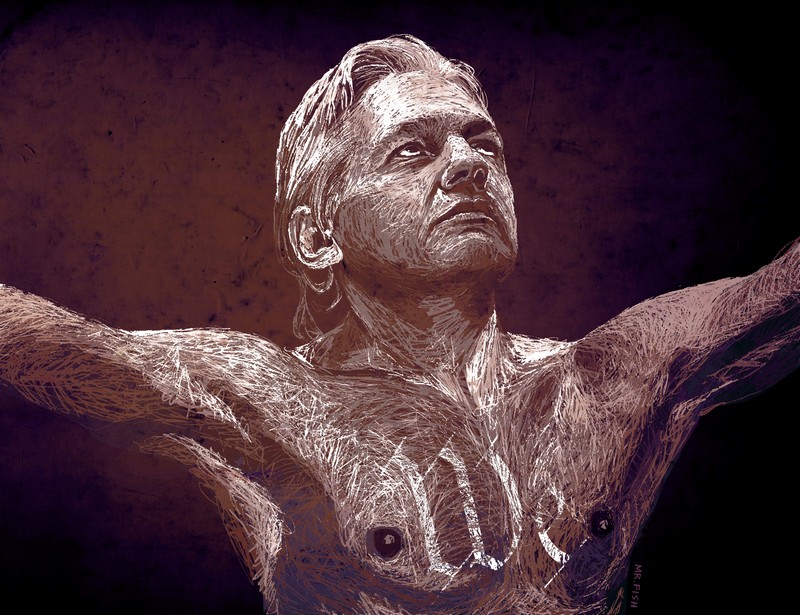
Julian, for this reason, is undergoing a slow-motion execution. Seven years trapped in the Ecuadorian Embassy in London. Four years in Belmarsh Prison. He ripped back the veil on the dark machinations of the U.S. Empire, the wholesale slaughter of civilians in Iraq and Afghanistan, the lies, the corruption, the brutal suppression of those who attempt to speak the truth. The Empire intends to make him pay. He is to be an example to anyone who might think of doing what he did.

Julian had other options. His genius and his skill as a computer programmer and cryptographer would have seen him highly compensated by security agencies, private contractors or Silicon Valley. He could have made a very comfortable living if he served the Empire. His soul, as Christopher Marlow shows us in Doctor Faustus, would have atrophied and died, like the souls of all who prostitute themselves to power, but the material rewards would have been significant. He would have been a success, at least a success as measured by the powerful and the wealthy.

Satan tempts Jesus by offering him power, “all the kingdoms of the world,” accompanied by glory and authority.

“If you, then, will worship me,” Satan says, “it will all be yours.”

This temptation is the fatal disease of those who serve power and with it the hubris and avarice that hastens, as the prophet Amos says, “the reign of violence.”

And yet these malevolent forces are not the most dangerous.

“When I was a rabbi of the Jewish community in Berlin under the Hitler regime…the most important lesson I learned under those tragic circumstances was that bigotry and hatred are not the most urgent problems,” Rabbi Joachim Prinz says. “The most urgent and most disgraceful, the most shameful, the most tragic problem, is silence.”

Julian’s crucifixion is a public spectacle. It is not hidden. And yet we watch passively. We do not flood the streets with our protests. We do not condemn the executioners, including Donald Trump and Joe Biden. We give his crucifixion our silent consent. W. H. Auden in Musee des Beaux Arts writes:

About suffering they were never wrong,
The old Masters: how well they understood
Its human position: how it takes place
While someone else is eating or opening a window or just walking dully along;
How, when the aged are reverently, passionately waiting
For the miraculous birth, there always must be
Children who did not specially want it to happen, skating
On a pond at the edge of the wood:
They never forgot
That even the dreadful martyrdom must run its course
Anyhow in a corner, some untidy spot
Where the dogs go on with their doggy life and the torturer’s horse
Scratches its innocent behind on a tree.

In Breughel’s Icarus, for instance: how everything turns away
Quite leisurely from the disaster; the ploughman may
Have heard the splash, the forsaken cry,
But for him it was not an important failure; the sun shone
As it had to on the white legs disappearing into the green
Water, and the expensive delicate ship that must have seen
Something amazing, a boy falling out of the sky,
Had somewhere to get to and sailed calmly on.

Sacrifice, self-sacrifice, is the cost of discipleship. But few are willing to pay that price. We prefer to look away from suffering, a boy falling out of the sky. And it is our indifference, and with our indifference, our complicity, that condemns all prophets.

“But what of the price of peace?” the radical priest Father Daniel Berrigan, who spent two years in a federal prison for burning draft records during the Vietnam War, asks in his book “No Bars to Manhood”:

I think of the good, decent, peace-loving people I have known by the thousands, and I wonder. How many of them are so afflicted with the wasting disease of normalcy that, even as they declare for the peace, their hands reach out with an instinctive spasm … in the direction of their comforts, their home, their security, their income, their future, their plans—that five-year plan of studies, that ten-year plan of professional status, that twenty-year plan of family growth and unity, that fifty-year plan of decent life and honorable natural demise. “Of course, let us have the peace,” we cry, “but at the same time let us have normalcy, let us lose nothing, let our lives stand intact, let us know neither prison nor ill repute nor disruption of ties.” And because we must encompass this and protect that, and because at all costs—at all costs—our hopes must march on schedule, and because it is unheard of that in the name of peace a sword should fall, disjoining that fine and cunning web that our lives have woven, because it is unheard of that good men should suffer injustice or families be sundered or good repute be lost—because of this we cry peace and cry peace, and there is no peace. There is no peace because there are no peacemakers. There are no makers of peace because the making of peace is at least as costly as the making of war—at least as exigent, at least as disruptive, at least as liable to bring disgrace and prison and death in its wake.

Bearing the cross, living in truth, is not about the pursuit of happiness. It does not embrace the illusion of inevitable human progress. It is not about achieving wealth, celebrity or power. It entails sacrifice. It is about our neighbor. The organs of state security monitor and harass you. They amass huge files on your activities. They disrupt your life. They throw you in prison, even when, like Julian, you did not commit a crime. It is not a new story. Nor is our indifference to evil; palpable evil we can see in front of us, new.

In the reading from the Hebrew Bible we hear the story of the prophet Jeremiah. He, like Julian, exposed the corruption and lust for war by the powerful. He warned of the catastrophe that inevitably comes when the covenant with God is broken. He condemned idolatry, the corruption of kings, priests and false prophets. Jeremiah was arrested, beaten and put in stocks. He was forbidden from preaching. An attempt was made on his life. After Egypt was conquered by Babylon, and Judea began to prepare for war, Jeremiah delivered an oracle warning the king to maintain peace. King Zedekiah ignored him. Babylon besieged Jerusalem. Jeremiah was arrested and imprisoned. He was freed by the Babylonians after Jerusalem’s conquest, but was exiled to Egypt, where, according to the Biblical tradition, he was stoned to death.

Jeremiah, like Julian, understood that a society that prohibits the capacity to speak in truth extinguishes the capacity to live in justice.

Yes, all of us who know and admire Julian decry his prolonged suffering and the suffering of his family. Yes, we demand that the many wrongs and injustices that have been visited upon him end. Yes, we honor him for his courage and his integrity. But the battle for Julian’s liberty has always been much more than the persecution of a publisher. It is the most important battle for press freedom, and truth, of our era. And if we lose this battle, it will be devastating, not only for Julian and his family, but for us.

Tyrannies, from Biblical times to the present, invert the rule of law. They turn the law into an instrument of injustice. They cloak their crimes in a faux legality. They use the decorum of the courts and trials, to mask their criminality. Those, such as Julian, who expose that criminality to the public are dangerous, for without the pretext of legitimacy the tyranny loses credibility and has nothing left in its arsenal but fear, coercion and violence.

The long campaign against Julian and WikiLeaks is a window into the collapse of the rule of law, the rise of what the political philosopher Sheldon Wolin calls our system of “inverted totalitarianism,” a form of totalitarianism that maintains the fictions of the old capitalist democracy, including its institutions, iconography, patriotic symbols and rhetoric, but internally has surrendered total control to the dictates of global corporations.

I was in the London courtroom during Julian’s extradition hearing overseen by Judge Vanessa Baraitser, an updated version of the Queen of Hearts in “Alice in Wonderland”, demanding the sentence before pronouncing the verdict. It was a judicial farce. There was no legal basis to hold Julian in prison. There was no legal basis to try him, an Australian citizen, under the U.S. Espionage Act. The CIA spied on Julian in the embassy through the Spanish company, UC Global, contracted to provide embassy security. This spying included recording the privileged conversations between Julian and his lawyers as they discussed his defense. This fact alone invalidated the hearing. Julian is being held in a high security prison so the state can, as Nils Melzer, the U.N. Special Rapporteur on Torture, has testified, continue the degrading abuse and torture it hopes will lead to his psychological, if not physical disintegration.

The U.S. government directed London barrister James Lewis. Lewis presented these directives to Baraitser. Baraitser adopted them as her legal decision. It was a judicial pantomime. Lewis and the judge insisted they were not attempting to criminalize journalists and muzzle the press while they busily set up the legal framework to criminalize journalists and muzzle the press. And that is why the court worked so hard to mask the proceedings from the public; limiting access to the courtroom to a handful of observers and making it hard, and at times impossible, to access the hearing online. It was a tawdry show trial, not an example of the best of English jurisprudence, but the Lubyanka.

Prophets call for justice in an unjust world. What they demand is not radical. On the political spectrum it is conservative. The restoration of the rule of law. It is simple and basic. It should not, in a functioning democracy, be incendiary. But living in truth in a despotic system is the supreme act of defiance. This truth terrifies those in power.

The architects of imperialism, the masters of war, the corporate-controlled legislative, judicial and executive branches of government and their obsequious courtiers in the media, are illegitimate. Say this simple truth and you are banished, as many of us have been, to the margins of the media landscape. Prove this truth, as Julian, Chelsea Manning, Jeremy Hammond and Edward Snowden have done by allowing us to peer into the inner workings of power, and you are hunted down and persecuted.

In Oct. 2010, WikiLeaks released the Iraq War Logs. The War Logs documented numerous U.S. war crimes — including video images of the gunning down of two Reuters journalists and 10 other unarmed civilians in the “Collateral Murder” video, the routine torture of Iraqi prisoners, the covering up of thousands of civilian deaths and the killing of nearly 700 civilians who approached too closely to U.S. checkpoints. The towering civil rights attorneys Len Weinglass and my good friend Michael Ratner — who I would later accompany to meet Julian in the Ecuadoran Embassy — met with Julian in a studio apartment in Central London. Julian’s personal bank cards had been blocked. Three encrypted laptops with documents detailing U.S. war crimes had disappeared from his luggage en route to London. Swedish police were fabricating a case against him in a move, Ratner warned, was about extraditing Julian to the United States.

“WikiLeaks and you personally are facing a battle that is both legal and political,” Weinglass told Julian. “As we learned in the Pentagon Papers case, the US government doesn’t like the truth coming out. And it doesn’t like to be humiliated. No matter if it’s Nixon or Bush or Obama, Republican or Democrat in the White House. The US government will try to stop you from publishing its ugly secrets. And if they have to destroy you and the First Amendment and the rights of publishers with you, they are willing to do it. We believe they are going to come after WikiLeaks and you, Julian, as the publisher.”

“Come after me for what?” asked Julian.

“Espionage,” Weinglass continued. “They’re going to charge Bradley Manning with treason under the Espionage Act of 1917. We don’t think it applies to him because he’s a whistleblower, not a spy. And we don’t think it applies to you either because you are a publisher. But they are going to try to force Manning into implicating you as his collaborator.”

“Come after me for what?’

That is the question.

They came after Julian not for his vices, but his virtues.

They came after Julian because he exposed the more than 15,000 unreported deaths of Iraqi civilians; because he exposed the torture and abuse of some 800 men and boys, aged between 14 and 89, at Guantánamo; because he exposed that Hillary Clinton in 2009 ordered U.S. diplomats to spy on U.N. Secretary General Ban Ki-moon and other U.N. representatives from China, France, Russia, and the U.K., spying that included obtaining DNA, iris scans, fingerprints, and personal passwords (part of the long pattern of illegal surveillance that included the eavesdropping on U.N. Secretary General Kofi Annan in the weeks before the U.S.-led invasion of Iraq in 2003); because he exposed that Barack Obama, Hillary Clinton and the CIA backed the June 2009 military coup in Honduras that overthrew the democratically elected president Manuel Zelaya, replacing him with a murderous and corrupt military regime; because he exposed that George W. Bush, Barack Obama and General David Petraeus prosecuted a war in Iraq that under post-Nuremberg laws is defined as a criminal war of aggression, a war crime; that they authorized hundreds of targeted assassinations, including those of U.S. citizens in Yemen, and that they secretly launched missile, bomb, and drone attacks on Yemen, killing scores of civilians; because Julian exposed the contents of the speeches Hillary Clinton gave to Goldman Sachs for which she was paid $675,000, a sum so large it can only be considered a bribe, and that she privately assured corporate leaders she would do their bidding while promising the public financial regulation and reform; because he exposed how the hacking tools used by the CIA and the National Security Agency permits the wholesale government surveillance of our televisions, computers, smart phones and anti-virus software, allowing the government to record and store our conversations, images and private text messages, even from encrypted apps.

Julian exposed the truth. He exposed it over and over and over until there was no question of the endemic illegality, corruption and mendacity that defines the global ruling class And for these truths they came after Julian, as they have come after all who dared rip back the veil on power. “Red Rosa now has vanished too,” Bertolt Brecht wrote after the German socialist Rosa Luxemburg was murdered. “She told the poor what life is about, And so the rich have rubbed her out.”

We have undergone a corporate coup, where poor and working men and women are reduced to joblessness and hunger, where war, financial speculation and internal surveillance are the only real business of the state, where even habeas corpus no longer exists, where we, as citizens, are nothing more than commodities to corporate systems of power, ones to be used, fleeced and discarded.

To refuse to fight back, to reach out and help the weak, the oppressed and the suffering, to save the planet from ecocide, to decry the domestic and international crimes of the ruling class, to demand justice, to live in truth, is to bear the mark of Cain. Those in power must feel our wrath, and this means constant acts of mass civil disobedience, it means constant acts of social and political disruption, for this organized power from below is the only power that will save us and the only power that will free Julian. Politics is a game of fear. It is our moral and civic duty to make those in power very, very afraid.

The criminal ruling class has all of us locked in its death grip. It cannot be reformed. It has abolished the rule of law. It obscures and falsifies the truth. It seeks the consolidation of its obscene wealth and power. But to do this, we must, as Julian has done, as all prophets have done, pick up the cross and bear its awful weight on our back.

“This is the cross that we must bear for the freedom of our people…” Martin Luther King Jr. reminds us. “The cross we bear precedes the crown we wear. To be a Christian, one must take up the cross, with all its difficulties agonizing and tension-packed content and carry it until that very cross leaves its marks upon us and redeems us, to that more excellent way which comes only through suffering…When I took up the cross, I recognized its meaning…The cross is something you bear, and ultimately that you die on.”

“Hope has two beautiful daughters,” Augustine writes. “Their names are anger and courage;anger at the way things are, and courage to see that they do not remain the way they are.”

Those who hold fast to the eternal and the sacred, to truth, as the sociologist Emile Durkeim understood, are not merely those who see new truths of which most others are ignorant, but are men and women, possessed by sublime madness, who are driven by a transcendent force that allows them to endure the trials of existence or conquer them. They transform the world through suffering.

My friend Julian is suffering. He is suffering for our sins and our indifference. As Rabbi Heschel reminds us, “some are guilty, but all are responsible.” There are two choices. We stand for the truth, for Julian, and free him. We find the courage to be responsible, to pick up the cross. Or we are complicit in the dark night of corporate tyranny that will envelope us all.

Let us pray:

God of grace and God of glory

In thy people pour thy power;

Crown thine ancient church’s story,

Bring her bud to glorious flower.

Grant us wisdom, grant us courage,

For the facing of this hour

For the facing of this hour. 

Amen

Chris Hedges is a Pulitzer Prize–winning journalist who was a foreign correspondent for fifteen years for The New York Times, where he served as the Middle East Bureau Chief and Balkan Bureau Chief.

21 August 2023

Source: www.transcend.org

Mobilizing for War with China: U.S. Hawks Target “Code Pink”

By Richard E. Rubenstein

For anti-war activists, the preparations for a major war have an aspect that is literally nightmarish.  In this bad dream, one watches as if physically or morally paralyzed while a menacing situation approaches step by step until it is too late to avert a foreseeable disaster.

This is exactly how one feels watching the United States government prepare for a military confrontation with China.  The technical aspects of this preparation remain largely under wraps, except for demonstrative military exercises and occasional impolitic statements like Air Force General Mike Minihan’s remark last January, “My gut tells me that we will fight in 2025.”  But the civilian aspects of this mobilization are increasingly evident and alarming.

A key indicator that civilian populations are being prepared for war is the breaking of relations with the alleged enemy.  Across the United States, universities have been forced to close their Confucius Institutes, Chinese-government supported institutions that teach Chinese language and culture, because of unfounded charges that they were stealing technological and military secrets.  Academic and scientific collaboration between Chinese and American scholars has sharply declined.  Similarly, restrictions on trade between Chinese and American have steadily intensified, culminating in the recent executive order by President Joe Biden blocking U.S. investments in hi-tech Chinese companies.

A second sign of war fever, even more alarming for ordinary citizens, involves concerted efforts by government and news media hawks to defame the character and criminalize the behavior of activists who oppose the continued deterioration of relations with the same alleged enemy.

The anti-China crowd’s latest target is Code Pink, one of North America’s most active peace organizations, well known for its vigorous and colorful opposition to the U.S. invasion of Iraq, the NATO attack on Libya, unconditional US support for Israel, and the U.S. refusal to negotiate legitimate Russian security concerns prior to Putin’s invasion of Ukraine.  Code Pink is in the vanguard of groups publicizing and criticizing the push toward military confrontation with China.

On August 5, 2023 the New York Times published an article entitled “Global Web of Chinese Propaganda Leads to a U.S. Tech Mogul” – a purported expose of “a charismatic American millionaire, Neville Roy Singham, who is known as a socialist benefactor of far-left causes.” The article points out that Singham (the son of the late Archie Singham, a well-known leftist professor and writer) holds favorable views of the current Chinese government and has frequently advocated policies favored by that government.  It also reports that he is married to Jodie Evans, a co-founder of Code Pink, who strongly opposes the U.S. mobilization for war against China and has also defended certain Chinese policies.

The Times article is strangely worded, no doubt to avoid possible defamation lawsuits, and contains vast evidentiary gaps, but its bottom-line message is that Singham and Evans (and, by implication, Code Pink) are Chinese agents, and that they should be compelled to register as such in accordance with the Foreign Agents Registration Act.  The sole basis for this conclusion is the assertion that these activists agree with various Chinese policies.  Anyone who has seen Christopher Nolan’s recent film, Oppenheimer, should recognize this for the McCarthyite smear that it is.  Apparently, Florida’s Republican Senator Marco Rubio has not seen the film, or else he has not understood it.  Immediately upon publication of the Times article, he called for an investigation of the article’s targets and asserted that they should be forced to register as foreign agents.

Whatever Rubio may think, the “evidence” adduced by the Times reporters to support their allegation is not only thin; it is virtually nonexistent.

They note, first, that Roy Singham shares office space with a company “whose goal is to educate foreigners about ‘the miracles that China has created on the world stage.’” Horrors!  Not only is this company being mysteriously unnamed, the Times apparently does not consider lifting a billion and a half people out of poverty and assisting other nations to do the same an achievement worth publicizing.

Second, they report that Jodie Evans, who has criticized Chinese patriarchal attitudes, refused to condemn Beijing’s policies toward the Uyghurs. That’s their evidence of foreign agency!  Evans  must be a Chinese tool because she did not join the chorus chanting “genocide” to describe Beijing’s repressive response to Uyghur separatism.  Whatever one thinks about this issue, the charge that Singham, Evans, and Code Pink are Chinese agents is based on nothing more than their positive views of some Chinese policies. In fact, their real “sin” has been to oppose U.S. imperialism, U.S. refusal to negotiate peace in Ukraine, and U.S. preparations for war with China.

The parallels with the Oppenheimer case are obvious.  The great physicist was branded a Soviet agent and deprived of his security clearance because he opposed U.S. nuclear policies, advocated racial and social justice at home, and worked for international peace with left-wing groups.  The differences are interesting as well.  Code Pink is not privy to state secrets and has no security clearance to lose.  The main villain of the New York Times piece, Roy Singham, is a wealthy high-tech entrepreneur who is accused of “buying” support for Chinese policies in much the same way that George Soros has been said to use his fortune to support liberal activism or the Koch Brothers to bankroll conservative libertarian programs.

Money clearly plays a role in politics. The master of “buying support” for political favorites, quantitatively in a league by itself, has long been the U.S. government with its scores of federal agencies and NGO satellites.  Compared with that sort of influence, Roy Singham is the smallest of small potatoes.  But the New York Times’ allegations against Singham and Jodie Evans do not even rise to the level of an anti-Soros or Koch Brothers expose.  In fact, they are nothing more than the feeblest sort of redbaiting.

Roy Singham’s response to the Times reporters’ charges was short and to the point:

“I categorically deny and repudiate any suggestion that I am a member of, work for, take orders from, or follow instructions of any political party or government or their representatives. I am solely guided by my beliefs, which are my long-held personal views.”

Jodie Evans remarks were equally terse.

“I deny your suggestion that I follow the direction of any political party, my husband or any other government or their representatives.  I have always followed my values.”

Let us give these accused fighters for peace the last word.

Richard E. Rubenstein is a member of the TRANSCEND Network for Peace Development Environment and a professor of conflict resolution and public affairs at George Mason University’s Jimmy and Rosalyn Carter Center for Peace and Conflict Resolution.

21 August 2023

Source: www.transcend.org
Mr. Blue and the CIA

By Edward Curtin

“This is slavery, not to speak one’s thoughts.” – Euripides, The Phoenician Women

Some time ago on a Sunday evening when my wife and I had just sat down to dinner, our phone rang.  Since I didn’t recognize the phone number and it was dinnertime, I hesitated to answer it, but for some chance reason I did. The voice on the other end was agitated, intense, and asked for me.

Could he visit immediately because he had urgent news for me? he asked. He told me his name, one I was not familiar with, and said he was a big fan of my book, Seeking Truth in A Country of Lies—that he had read it numerous times. He wondered how I knew so much about the workings of what we might call the deep state, the power elite, the intelligence/moneyed class connections, the assassinations of JFK, RFK, et al. He had also read a newspaper Op Ed I had written about Robert F. Kennedy, Jr. and wished to talk to me about that as well. He said he had a very important story to tell me. The urgency in his voice was palpable.

Naturally I was wary, so I put him off for a few days. But New England is a relatively small area, the home to so many of the country’s ultra-wealthy families and the traditional Blue Blood ruling power structure, and the little bit he had told me about himself intrigued me. So a few days later I travelled to meet him where he lived, not wanting to open myself to an unknown visitor to my home. On the way I realized that his last name did ring a bell and it was one connected to important U.S. history of the 1960s.  For reasons of privacy, I will not disclose his name.

Call him Mr. Blue.

This is out of the blue,
In the wink of an eye.
No conspiracy that I know of,
Though something on that order
Is not impossible. Between me
And you I would say it flows.
No sense in telling them
What we are up to, or why.
We don’t know ourselves, do we?
Who cares, the knowing is overrated.
What is this, school we are still in,
0r haven’t we graduated to the world
Of living? Out of the blue,
In the wink of an eye,
Long before we know it,
But not after, never after.

We arranged to meet in a café, but when we did, he asked to converse away from the cafe on a bench in the open air instead.  The first thing he said to me was that he was not CIA. I took that in two ways: he was and he wasn’t. But I said little and listened to his story, even while questioning myself for agreeing to meet a stranger after such a bizarre phone call. I was glad not to be sitting over cups of coffee.

He began by telling me about his Blue Blood family heritage, how his family was connected to all the prominent wealthy families whose names are very familiar to many people: the Forbes, Morgans, Choates, Rockefellers, et.al., an index of The Social Register of old money and high society well-connected to all the levers of political and economic power. Primarily based in the northeastern United States, their tentacles stretch around the world because of their power and influence. They attend Yale, Harvard, Princeton and the elite New England prep schools.  They have long held important positions in the media, government, and Wall Street. In short, his family was part of what C. Wright Mills termed “the power elite,” and as he made clear, he and the children of these families were brought up to assume they were born to make the major decisions for the country.  To rule.

But Mr. Blue said he always felt like an outsider even while being an insider in this family nexus.  He seemed burdened with guilt for something, and as he told a long story I became a bit impatient waiting for the crux of the pressing news he wanted to convey to me.  But I listened silently.

He told me about some of what he has done over the decades, which was good work trying to repair the damage caused by major corporations.  It seemed to me he did this as a way of atoning for his family’s sins.  I would interrupt him from time to time to ask a point of clarification about some connection between the people he mentioned and their links to U.S. government agencies or the well-known media people connected to his family.  He was very forthright in his answers.  I grew to trust him the more he talked.

After about an hour, I asked him to please tell me the urgent news he had phoned about. It concerned the assassination of Robert F. Kennedy in 1968. He said he told RFK, Jr. decades ago that the CIA killed his father. This, he said, he learned two days after the assassination from a relative who was a CIA officer.  This relative said to him in person, “We knew.” When I asked him what that meant, he told me it meant that the CIA had killed Senator Kennedy. Then he traced this relative’s connections through the military-intelligence-industrial-political-wealth complex and how it all wound through his family’s history and the prominent families he was connected to. He named many names, including the CIA relative. I wasn’t surprised by all the  interconnections, for they confirmed what I already knew about the upper echelons of power and money. But this was the first time that an insider told me personally, and I kept marveling at their extent and how the names were connected to key events in U.S. history, particularly those involving the intelligence agencies.

We were sitting in a town deeply steeped in the famous names and historic mansions of the old money elites, and as he talked, I kept drawing on my knowledge of these people, which was not just academic but based of personal experience.  We were sitting in the heart of the place where these traditional ruling elites congregated and socialized.

In another similar New England town years before, I had heard endless stories told to me by the famous theologian Reinhold Niebuhr’s widow, Ursula Niebuhr, who was a big name dropper, and liked to point up all the Niebuhrs’ elite connections. (Niebuhr was the most famous U.S. theologian of the 20thcentury; his photo appeared on the cover of Time magazine; he influenced politicians of many stripes; was quoted approvingly and often by Barack Obama and even John McCain; in short, he was the establishment’s God-man during the Cold War and a theological underpinning for the neoliberal warfare state).  She would regularly note how so-and so, her friend and local resident (usually these people had their massive summer homes in addition to city residences) – e.g. Adolph Berle, an intelligence officer in WW I, a member of FDR’s original Brain Trust, Ambassador, Columbia law professor, power broker involved in above and below board foreign intrigue, Cold Warrior – did this and that, etc.

For some reason she shared with me much of her inside knowledge of her elite “friends” as if I shared her values, which I didn’t.  It must have been my theological background. And I guess playing dumb helped.  But I listened—and learned in doing so—that people will tell you many things you may or may not want to hear if they think you are receptive.  Her stories about some of the most famous people of the 20th century – Einstein, T.S. Eliot, her Princeton associates, et al., always referred to by their first names – told me much about the workings of the power elites.  Sometimes the stories were weirdly funny if not revealing of something else.

At lunch with her son Christopher one day, she told me about her “friend” (all the famous people were “friends”) the famous German-American psychoanalyst Erik Erikson.  She said he encouraged her husband Reinhold to stop smoking cigarettes by turning to Danish cigarillos.  She quoted him as saying: “Remember what Freud said, Reinhold: ‘It’s been a long time since I had something hot and wet between my lips.’”  I was taken aback by this seventy-five year-old woman saying this, knowing as I did that Freud smoked cigars his whole life.

But it was typical of a type of double entendre that she often gave about her elite associates that opened my eyes to the inner workings of a social class I was not familiar with.  I took note of all of it and drew connections between various organizations these elites were involved with, many of which at first blush one would not think were involved in their power operations, such as conservation and nature groups, organizations allegedly formed to fight corporate misdeeds, etc.  For decades after, I have come to see more connections than seemed possible, and many in a small geographic area but all connected to the upper class elites and their control of land, resources, and media outlets.

Mr. Blue confirmed all this and more.  He told me about the Cold War bomb shelters under the mansions of his and other wealthy families, the connections between the CIA and corporations, how those seen as the “good guys” were really working for the bad guys, that CIA and Mossad operatives would contact him under the assumption he was on their side, the seamless socializing between all the elite families with so many names and places connected to operations of “deep state” operators – the stuff I have been researching for years and the subject of much of my recent book.  Mr. Blue corroborated  for me the essence of what I had discovered through my own work.   And as I told him, I did it by studying, researching, and listening, something anyone could do if so inclined.

Weeks after our first meeting, Mr. Blue agreed to meet again, this time together with me and a documentary filmmaker.  He told all the same stories, elaborating on many of them and adding others.  He was loose and easy and we talked for nearly five hours.  At one point, when I asked him to repeat what he had told me weeks before about his CIA relative and what that relative meant by the phrase “We knew” about the RFK assassination, and Mr. Blue had then told me that he meant that the CIA had killed Kennedy, he jumped to say, “I never said that.”  This denial startled me.  But he had said it.  After our initial conversation, I had written his exact words in my notes on my drive home.  And he had also said that he told RFK, Jr. that the CIA killed his father.  This was the only time during our long conversation that he grew very agitated.

This was obviously the one revelation that scared him among all the other stories he shared.  I understand his fear.  But time is relentless; we run out of it.  There comes that day when it is too late to find your public tongue.  It is why he remains Mr. Blue, an anonymous good man caught in a family history for which he has tried to atone.  An outsider on the inside still, calling to be heard by another person, in the wink of an eye, out of the blue.

Perhaps someday he will tell the world.

Edward Curtin is a prominent author, researcher and sociologist based in Western Massachusetts. He is a Research Associate of the Centre for Research on Globalization (CRG).

21 August 2023

Source: globalresearch.ca

Anti-China Brainwashing Is the Fast-Track to War. Mike Whitney

By Mike Whitney

The United States has to have an enemy. For the last seven years, the enemy has been Russia. Now the focus has shifted to China. Take a look at these headlines on Google News and you’ll see what I mean:

Get the picture? China is a bigtime threat to the United States. Forget that the US regularly sends its warships into the South China Sea and the Taiwan Strait.

Forget that the US has encircled China with military bases and missile systems.

Forget that the US has sent multiple delegations to Taipei in violation of the “one-China” policy. Forget that the US arms and trains military personnel in the Taiwanese Army.

Forget that the US imposes unilateral tariffs on Chinese goods and sanctions Chinese businessmen. Forget that the US has implemented the most draconian blockade on advanced semiconductors in history. Forget that the US is building anti-China coalitions across the region.

Forget all of these things because—according to the geniuses in the mainstream media—China is the problem, China is the threat, and China is the country that is pushing the world towards war.

Does anyone believe this nonsense? Here’s how columnist Bradley Blankenship summed it up in an article at RT:

The US national security state has exploited deep ideological biases in the media and is bankrolling countless think tanks, non-governmental organizations, and academic programs to churn out constant anti-China propaganda. Self-Reinforcing Propaganda, RT

In other words, the USG is working with its allies in the media to saturate the airwaves with anti-China blather in order to convince Americans that China is the source of the problem. That’s how the government shapes public perception and lays the groundwork for war. Check out this excerpt from an article at The Diplomat:

A key feature of mainstream Western media today is the relentless China-bashing. It is off the charts and tiring, often involving regurgitated trivia or fabricated stories with no evidence to support callous statements about the country, demonstrating a deep lack of understanding. But such stories continue to be churned out with no end in sight.

Countering this in international media by offering more balanced views for a global audience is near impossible as censorship is rife. There almost seems to be a global compact to control the narrative, a propaganda war powered by today’s digital technology….

Typically, the negative stories adhere to three core ideas, which inform the unspoken guidelines within these press rooms when it comes to reporting on China.

First is the belief that China is a threat to the world and that this belief must be relentlessly reinforced at every available opportunity. How and why China is a threat is never explored; such is the deep-rooted and almost religious nature of the belief. Sound arguments do not matter. The basic tenets of good journalism are ignored when it comes to a China story. There is no need to explain or give evidence of why China is a global threat. Anti-China Rhetoric Is Off the Charts in Western Media, The Diplomat

China poses no threat to the West, in fact, China has never invaded another country in its 70 year-long history. Compare that to Washington’s unbroken record of violence around the world. Here’s a brief recap

The United States launched at least 251 military interventions between 1991 and 2022. This is according to a report by the Congressional Research Service, a US government institution that compiles information on behalf of Congress. The report documented another 218 US military interventions from 1798 to 1990.

That makes for a total of 469 US military interventions since 1798 that have been acknowledged by the Congress…. The list of countries targeted by the US military includes the vast majority of the nations on Earth, including almost every single country in Latin America and the Caribbean and most of the African continent.

The Military Intervention Project at Tufts University’s Center for Strategic Studies has documented even more foreign meddling.

“The US has undertaken over 500 international military interventions since 1776, with nearly 60% undertaken between 1950 and 2017,” the project wrote. “What’s more, over one-third of these missions occurred after 1999.”

The Military Intervention Project added: “With the end of the Cold War era, we would expect the US to decrease its military interventions abroad, assuming lower threats and interests at stake. But these patterns reveal the opposite – the US has increased its military involvements abroad.”
US launched 251 military interventions since 1991, and 469 since 1798, Geopolitical Economy

And which country is the “greatest threat to world peace”? China?

Not even close. Take a look:

The U.S. emerged as the greatest threat to world peace, followed by Pakistan and China, in the End of Year global survey conducted by WIN/Gallup International across 65 countries in the world.

Of more than 66,000 people surveyed the world over, 24% of respondents believed that the U.S. was the greatest threat to world peace. Pakistan and China got eight and six percent of the votes respectively while Iran, Israel, North Korea and Afghanistan tied for fourth place with four percent of the votes.
The U.S. Is The Biggest Threat To World Peace, Buzzfeed

So, maybe, China is not the biggest threat, after all? Is that what we’re saying?

Indeed, China is not a threat to the United States, in fact, China’s highest ideal is “peaceful development.” Think about that for a minute: Development without war. Is it even possible?

It is possible, and the US and China should work together to make it happen. There’s no reason why the world’s two biggest economies cannot work together on the shared goals of economic integration, state-of-the-art infrastructure and poverty reduction. We need leaders who will embrace collaboration and cooperation not exacerbate divisions and confrontation. We need to strengthen relations with China not look for ways vilify, coerce or bully them.

Unfortunately—as we all know—the western “rules-based order” is controlled by billionaire oligarchs who bitterly oppose nationalistic leaders who cherish their own sovereign independence and act in the interests of their own people. They won’t allow that. Western elites believe that all material wealth and power should be in private hands (not public hands) which is why they are determined to provoke a war with China, so the matter can be resolved militarily. In short, the conflict with China is shaping-up to be a nuclear cage-match between “the globalists and the nationalists”.

The West’s greatest asset in this struggle is the media whose propaganda helps to garner the public support the elites need to drive the country to war. Regrettably, the plan appears to be working. For example, in 2018 a mere 4 in 10 Americans saw China’s rise as a threat to US vital interests. (The Chicago Council on Global Affairs) Compare those results to the recent survey at Gallup which showed that “66% of U.S. adults consider (China) to be a critical threat to the vital interests of the U.S”.

In just 4 years the media has persuaded a majority of Americans that China poses a clear threat to the United States. How can one explain these results other than pointing to the pernicious impact of state propaganda used to poison the minds of Americans against Washington’s biggest economic rival?

Here’s more from Gallup:

In addition to holding a largely unfavorable opinion of China, more Americans name China as the United States’ greatest enemy than any other nation by a wide margin. This view is closely linked to two other measures in the poll, which find that Americans broadly believe China’s military and economic powers represent a “critical threat” to the United States’ vital interests in the next decade. “Record-Low 15% of Americans View China Favorably, Gallup

“China’s military is a critical threat” to the US? Is that really what Americans think?

And where exactly has China’s military been deployed in the last 30 years: Afghanistan, Syria, Libya, Iraq?

No, for the last 7 decades China’s military has remained in China.

China has invaded no one and certainly has no intention to do so in the future. Americans have no reason to fear China. What they need to fear is the deranged neocons who send US warships into the Taiwan Strait and the South China Sea, 8,000 miles from the United States. That’s who they should fear, because that is a deliberate provocation aimed at triggering a war.

A recent survey by the Pew Research Center appeared to show that public opinion of China has dropped dramatically in 24 countries. But a closer look at the survey shows just the opposite, in fact, Pew helps to prove the point we have been trying to make here, which is, that the countries most dominated by the western media are more likely to have “unfavorable” views of China. It’s not a coincidence. Here’s how Blankenship summed it up:

The agency polled adults in 24 countries; there are 193 United Nations member states, which indicates that it does not show any serious global trend purely based on its methodology. There is also a strong selection bias for high-income countries and American allies. However, some middle-income and poorer countries were polled and the data reveals what many know to be true – the Global South largely has favorable views of China.

For example, the Pew survey found that countries such as Kenya (72%), Nigeria (80%) and Mexico (57%) hold favorable views of China... Since poorer countries are the beneficiaries of bilateral cooperation with China, including on the Beijing-led Belt and Road Initiative (BRI), it is natural that they would have a higher opinion of Beijing. Pew, however, mostly did not select countries with high-level strategic cooperation with Beijing….

there has been a steady downward trend fully in line with American foreign policy, e.g., after 2012 with former President Barack Obama’s ‘Pivot to Asia’, the Trump trade war, and whatever it is that the current administration of President Joe Biden is doing. The US national security state has exploited deep ideological biases in the media and is bankrolling countless think tanks, non-governmental organizations, and academic programs to churn out constant anti-China propaganda….

There is a definitive and ongoing battle for hearts and minds between China and the US, and so-called ‘China experts’ are the Americans’ foot soldiers whether they realize it or not. And there are only bound to be more systemic incentives for China hawks in the future considering members of the US Congress keep introducing legislation, like the Senate ‘Countering Chinese Propaganda Act’ or the House ‘Countering the PRC Malign Influence Fund Authorization Act’, which would see hundreds of millions spent on negative news coverage against China. Both of these bills have been absorbed into the House and Senate’s versions of the America COMPETES Act, which have passed in both chambers but are awaiting minor changes before becoming law. Self-reinforcing propaganda: A new poll shows people dislike China, but there’s a catch, Bradley Blankenship, RT

So—even though a majority of Americans already believe that China is their enemy—Congress wants to spend “hundreds of millions more” to intensify the media’s indoctrination campaign to ensure that any critical thinking person who believes the US should pursue a policy of peaceful engagement with China will be denounced as a coward, a traitor and a puppet of Xi Jinping.

This is the scenario we’ll be facing if we don’t find a candidate who will break with the war-mongering concensus and craft a policy that focuses on a long-term accomodation with China that circumvents a catstrophic confrontation. Avoiding World War 3 should be our top priority.

Michael Whitney is a renowned geopolitical and social analyst based in Washington State.

18 August 2023

Source: globalresearch.ca

Multi-Billion Dollar “Directed Energy Weapons (DEW)” Market, For Military and “Civilian Use” (?). Were DEWs Used in Hawaii?

By Prof Michel Chossudovsky

Directed Energy Weapons (DEW) constitute a buoyant $5.3 Billion dollar business (2022) which is slated to increase to $12.9 Billon dollars by 2027. This profit-driven military-industrial market is dominated by six “Defense Contractors” including Raytheon, Northrup Grunman, BAE Systems (plc), Boeing, Lockheed Martin and L3Harris Technologies.

According to Raytheon:

 “The development of directed energy (DE) technology is used to counter the drone threat”.

There are several sophisticated Directed Energy Weapons technologies: High Energy Laser (Hel), High Power Radio Frequency Weapons, Sonic Weapons, Electromagnetic Weapons. (For details see Table below entitled Directed Energy Market Highlights).

While DEWs are largely intended for military use, so-called “non lethal” and/or “less lethal” Directed Energy Weapons are also envisaged for so-called “Homeland Security applications” (See table below).

The Evidence: Were Directed Energy Weapons Used in Hawaii?

Images confirm the extent and nature of devastation and destruction. (see videos below).

They also suggest that the damage incurred was not attributable to “natural causes”. 

The evidence suggests that Directed Energy Weapons (DEW) may have been used (yet to be fully ascertained) and that the acts of destruction were deliberate.

Video: Houses are Targeted? Green Trees Remain Untouched

Watch below an aerial footage. The location of this Wildfire remains to be confirmed. It may have been in Southern Oregon. [August 19, 2023]

How is it possible to have totally burned down houses in between undamaged trees?

Burned out houses between green trees?

Video: “Intentional Destruction”?

Hawaï : dévastation intentionnelle ?

Maui Directed Energy Weapon assault, like 9/11, Paradise, CA., Malibu and Boulder fires.

Maui residents return after devastating wildfires

Note the above CBS report points to “A Wildfire Disaster”.

Thousands of families have lost their homes, burnt to the ground. The devastating impacts resulting from possible DEW attacks are not mentioned. The official statements point to “Natural Causes”:

Can you imagine calling up a family that has just seen their home burn to the ground and offering to buy their land for below market value?

This is apparently happening in Hawaii right now on a massive scale.”  Michael Snyder, (August 17, 2023)

***

Among the six private companies of the military industrial complex, Raytheon and BAE Systems are also involved in ENMOD technologies on behalf of the U.S. Air Force.

There is a flourishing international market. DEWs are exported Worldwide. There are various technologies including Electromagnetic weapons.

The usage for so-called “Homeland Security applications” includes “non-lethal” civilian applications including Airport protection, riot controls, protection of infrastructure (see below).

A Citizens’ Criminal Investigation?

Are these so-called “non-lethal or “less lethal” DEWs available for acquisition or purchase by private sector and/or governmental entities? Are sales and non-lethal usage of DEWS subject to regulation?

According to MarketandMarkets.com, non military “non-lethal” applications constitute more than 41.2% of the North American market:

“Rising demand for laser weapons for security across land, air, and sea, new development of directed energy weapons, and the adoption of non-lethal weapons are driving the market growth.

A citizens’ investigation is required to establish what is behind this devastating process of destruction in Hawaii and in various  parts of America.

Our thoughts today are with the people of Hawaii.

Below is an examination of the Directed Energy Weapons Market by:

Marketandmarkets.com

click image below to access the complete document

17 August 2023

Source: globalresearch.ca


What’s Happening in Niger Is Far From a Typical Coup

By Vijay Prashad

On July 26, 2023, Niger’s presidential guard moved against the sitting president—Mohamed Bazoum—and conducted a coup d’état. A brief contest among the various armed forces in the country ended with all the branches agreeing to the removal of Bazoum and the creation of a military junta led by Presidential Guard Commander General Abdourahamane “Omar” Tchiani. This is the fourth country in the Sahel region of Africa to have experienced a coup—the other three being Burkina Faso, Guinea, and Mali. The new government announced that it would stop allowing France to leech Niger’s uranium (one in three lightbulbs in France is powered by the uranium from the field in Arlit, northern Niger). Tchiani’s government revoked all military cooperation with France, which means that the 1,500 French troops will need to start packing their bags (as they did in both Burkina Faso and Mali). Meanwhile, there has been no public statement about Airbase 201, the U.S. facility in Agadez, a thousand kilometers from the country’s capital of Niamey. This is the largest drone base in the world and key to U.S. operations across the Sahel. U.S. troops have been told to remain on the base for now and drone flights have been suspended. The coup is certainly against the French presence in Niger, but this anti-French sentiment has not enveloped the U.S. military footprint in the country.

Interventions

Hours after the coup was stabilized, the main Western states—especially France and the United States—condemned the coup and asked for the reinstatement of Bazoum, who was immediately detained by the new government. But neither France nor the United States appeared to want to lead the response to the coup. Earlier this year, the French and U.S. governments worried about an insurgency in northern Mozambique that impacted the assets of the Total-Exxon natural gas field off the coastline of Cabo Delgado. Rather than send in French and U.S. troops, which would have polarized the population and increased anti-Western sentiment, the French and the United States made a deal for Rwanda to send its troops into Mozambique. Rwandan troops entered the northern province of Mozambique and shut down the insurgency. Both Western powers seem to favor a “Rwanda” type solution to the coup in Niger, but rather than have Rwanda enter Niger the hope was for ECOWAS—the Economic Community of West African States—to send in its force to restore Bazoum.

A day after the coup, ECOWAS condemned the coup. ECOWAS encompasses fifteen West African states, which in the past few years has suspended Burkina Faso and Mali from their ranks because of the coups in that country; Niger was also suspended from ECOWAS a few days after the coup. Formed in 1975 as an economic bloc, the grouping decided—despite no mandate in its original mission—to send in peacekeeping forces in 1990 into the heart of the Liberian Civil War. Since then, ECOWAS has sent its peacekeeping troops to several countries in the region, including Sierra Leone and Gambia. Not long after the coup in Niger, ECOWAS placed an embargo on the country that included suspending its right to basic commercial transactions with its neighbors, freezing Niger’s central bank assets that are held in regional banks, and stopping foreign aid (which comprises forty percent of Niger’s budget). The most striking statement was that ECOWAS would take “all measures necessary to restore constitutional order.” An August 6 deadline given by ECOWAS expired because the bloc could not agree to send troops across the border. ECOWAS asked for a “standby force” to be assembled and ready to invade Niger. Then, ECOWAS said it would meet on August 12 in Accra, Ghana, to go over its options. That meeting was canceled for “technical reasons.” Mass demonstrations in key ECOWAS countries—such as Nigeria and Senegal—against an ECOWAS military invasion of Niger have confounded their own politicians to support an intervention. It would be naïve to suggest that no intervention is possible. Events are moving very fast, and there is no reason to suspect that ECOWAS will not intervene before August ends.

Coups in the Sahel

When ECOWAS suggested the possibility of an intervention into Niger, the military governments in Burkina Faso and Mali said that this would be a “declaration of war” not only against Niger but also against their countries. On August 2, one of the key leaders of the Niger coup, General Salifou Mody traveled to Bamako (Mali) and Ouagadougou (Burkina Faso) to discuss the situation in the region and to coordinate their response to the possibility of an ECOWAS—or Western—military intervention into Niger. Ten days later, General Moussa Salaou Barmou went to Conakry (Guinea) to seek that country’s support for Niger from the leader of the military government in that country, Mamadi Doumbouya. Suggestions have already been floated for Niger—one of the most important countries in the Sahel—to form part of the conversation of a federation that will include Burkina Faso, Guinea, and Mali. This would be a federation of countries that have had coups to overthrow what have been seen to be pro-Western governments that have not met the expectations of increasingly impoverished populations.

The story of the coup in Niger becomes partly the story of what the communist journalist Ruth First called “the contagion of the coup” in her remarkable book, The Barrel of the Gun: Political Power in Africa and the Coup d’états (1970). Over the course of the past thirty years, politics in the Sahel countries has seriously desiccated. Parties with a history in the national liberation movements, even the socialist movements (such as Bazoum’s party) have collapsed into being representatives of their elites, who are conduits of a Western agenda. The French-U.S.-NATO war in Libya in 2011 allowed jihadis groups to pour out of Libya and flock into southern Algeria and into the Sahel (almost half of Mali is held by al-Qaeda-linked formations). The entry of these forces gave the local elites and the West the justification to further tighten limited trade union freedoms and to excise the left from the ranks of the established political parties. It is not as if the leaders of the mainline political parties are right-wing or center-right, but that whatever their orientation, they have no real independence from the will of Paris and Washington. They became—to use a word on the ground—“stooges” of the West.

Absent any reliable political instruments, the discarded rural and petty-bourgeois sections of the country turn to their children in the armed forces for leadership. People like Burkina Faso’s Captain Ibrahim Traoré (born 1988), who was raised in the rural province of Mouhoun, and Colonel Assimi Goïta (born 1988), who comes from the cattle market town and military redoubt of Kati, represent these broad class fractions perfectly. Their communities have been utterly left out of the hard austerity programs of the International Monetary Fund, of the theft of their resources by Western multinationals, and of the payments for Western military garrisons in the country. Discarded populations with no real political platform to speak for them, these communities have rallied behind their young men in the military. These are “Colonel’s Coups”—coups of ordinary people who have no other options—not “General’s Coups”—coups of the elites to stem the political advancement of the people. That is why the coup in Niger is being defended in mass rallies from Niamey to the small, remote towns that border Libya. When I traveled to these regions before the pandemic, it was clear that the anti-French sentiment found no channel of expression other than hope for a military coup that would bring in leaders such as Thomas Sankara of Burkina Faso, who had been assassinated in 1987. Captain Traoré, in fact, sports a red beret like Sankara, speaks with Sankara’s left-wing frankness, and even mimics Sankara’s diction. It would be a mistake to see these men as from the left since they are moved by anger at the failure of the elites and of Western policy. They do not come to power with a well-worked out agenda built from left political traditions.

The Niger military leaders have formed a twenty-one-person cabinet headed by Ali Mahaman Lamine Zeine, a civilian who had been a finance minister in a previous government and worked at the African Development Bank in Chad. Military leaders are prominent in the cabinet. Whether the appointment of this civilian-led cabinet will divide the ranks of ECOWAS is to be seen. Certainly, Western imperialist forces—notably the United States with troops on the ground in Niger—would not like to see this torque of coups remain in place. Europe—through French leadership—had shifted the borders of their continent from north of the Mediterranean Sea to south of the Sahara Desert, suborning the Sahel states into a project known as G-5 Sahel. Now with anti-French governments in three of these states (Burkina Faso, Mali, and Niger) and with the possibility of trouble in the two remaining states (Chad and Mauritania), Europe will have to retreat to its coastline. Sanctions to deplete the mass support of the new governments will increase, and the possibility of military intervention will hang over the region like a famished vulture.

Vijay Prashad is an Indian historian, editor, and journalist. He is a writing fellow and chief correspondent at Globetrotter.

16 August 2023

Source: countercurrents.org