By Dr. Habib Siddiqui
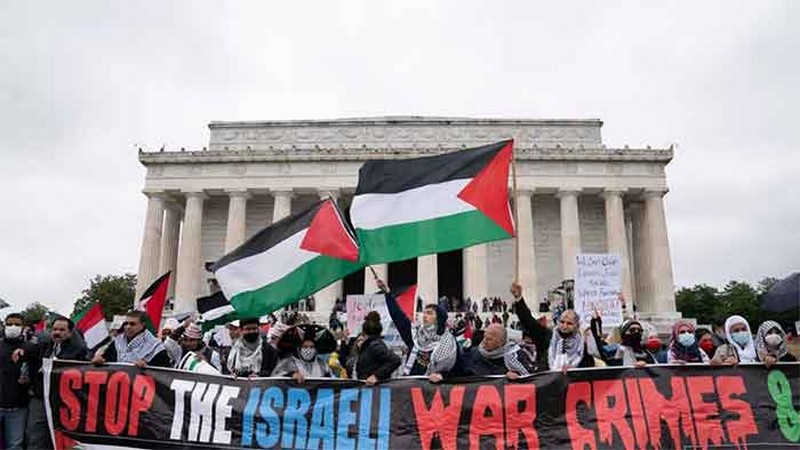
On 8 November 2023 three Palestinian human rights organizations filed a lawsuit with the International Criminal Court (ICC) to request arrest warrants against Israeli leaders—including Prime Minister Benyamin Netanyahu—for genocide.
The file submitted to the ICC strongly urges the Office of the Prosecutor to:
- Consider the inclusion of crimes against humanity, notably apartheid, and the crime of genocide, in the ongoing investigation into the situation in the State of Palestine.
- Issue arrest warrants expeditiously for those suspected of these crimes within the Israeli political, military, and administrative apparatus, especially President Isaac Herzog, Prime Minister Benyamin Netanyahu, defense minister Yoav Gallant and others.
“There is no place for double standards in International Justice,” said attorney Emmanuel Daoud, who also filed a lawsuit with the ICC against Russian leaders for their war crimes against Ukrainians and obtained the issuance of an arrest warrant against President Putin. “Whether war crimes are committed in Ukraine or Palestine, the culprits should be held to account.” “We implore the ICC to acknowledge its moral and judicial responsibilities and act decisively upon our communication,” said Daoud.
Is the State of Israel committing genocide against the Palestinian inhabitants of Gaza? Before we try to answer the question, let us try to understand what does the loaded term mean.
Raphael Lemkin (1900-1959), a Polish lawyer of Jewish descent, is credited for coining the term genocide and for campaigning to establish the Genocide Convention. The term was included in the 1944 research-work “Axis Rule in Occupied Europe”, wherein Lemkin documented mass-killings of ethnic groups deemed “untermenschen“ (lit. subhuman or underman) or inferior by Nazi Germany.
On December 9, 1948, the United Nations approved the Genocide Convention, with many of its clauses based on Lemkin’s proposals.
The Article 2 of the Convention on the Prevention and Punishment of the Crime of Genocide (CPPCG) provides the definition of the term. It says: Genocide means any of the following acts committed with intent to destroy, in whole or in part, a national, ethnic, racial or religious group, as such: a) Killing members of the group; b) Causing serious bodily or mental harm to members of the group; c) Deliberately inflicting on the group conditions of life calculated to bring about its physical destruction in whole or in part; d) Imposing measures intended to prevent births within the group; e) Forcibly transferring children of the group to another group.
Article 1 of CPPCG says: The Contracting Parties confirm that genocide, whether committed in time of peace or in time of war, is a crime under international law which they undertake to prevent and punish.
Article 3 says: The following acts shall be punished: a) Genocide; b) Conspiracy to commit genocide; c) Direct and public incitement to commit genocide; d) Attempt to commit genocide; e) Complicity in genocide.
The Rome Statute of the International Criminal Court was adopted at a diplomatic conference in Rome, Italy on 17 July 1998 to end impunity of those responsible or accountable for four core international crimes: genocide, crimes against humanity, war crimes, and the crime of aggression. Those crimes “shall not be subject to any statute of limitations”. It provides that “genocide” means any of the following acts committed with intent to destroy, in whole or in part, a national, ethnical, racial or religious group, as such (a) Killing members of the group; (b) Causing serious bodily or mental harm to members of the group; (c) Deliberately inflicting on the group conditions of life calculated to bring about its physical destruction in whole or in part; (d) Imposing measures intended to prevent births within the group; (e) Forcibly transferring children of the group to another group.
It is obvious from both the CPPCG and the Rome Statute that the phrase ‘intent to destroy’ is the key element in genocidal crimes. “One has to prove that the perpetrator not only committed the actions, but they committed the actions with a very specific intention of destroying the group,” says Ernesto Verdeja, a professor at the University of Notre Dame who specializes in genocide. “That can be a high bar because very often people contribute to genocidal policies, even if that’s not their direct intention.”
On this main issue, Israeli leaders’ speeches, esp. after the Hamas’ reprisal attack on October 7, 2023, are quite revealing.
“The IDF will immediately use all its power to destroy the capabilities of Hamas. We will beat them to the point of destruction and take revenge with force for this black day they have inflicted on the State of Israel and its citizens,” prime minister Benjamin Netanyahu said in a televised address. “We will turn all the places where Hamas is organized, of this evil city, all the places where Hamas is hiding, operating from, into cities of ruins. I say to the residents of Gaza, get out of there now because we will act everywhere and with all the strength.” [Google translation into English from Hebrew]
Two days later, on October 9, Netanyahu declared, “We have only started striking Hamas.” He said, “What we will do to our enemies in the coming days will reverberate with them for generations.”
Netanyahu has long proven to be a pathological liar and a psychotic mass murderer. But his threat against the Palestinian people was no exaggeration.
Netanyahu is not the only Israeli leader who has made what critics have called genocidal statement in recent weeks. Israeli President Isaac Herzog has set the tone. He asserted early on October that there are no innocent civilians in Gaza. He said, “It’s an entire nation out there that is responsible. This rhetoric about civilians not aware, not involved, it’s absolutely not true. They could’ve risen up; they could have fought against that evil regime which took over Gaza in a coup d’état.”
Defense Minister Yoav Gallant vowed to “eliminate everything” there. On October 9, following an assessment at the Israel Defense Forces (IDF) Southern Command in Beersheba, Gallant said, “I have ordered a complete siege on the Gaza Strip. There will be no electricity, no food, no fuel, everything is closed.”
“Human animals must be treated as such,” IDF Maj. Gen. Ghassan Alian said on Oct. 10. “There will be no electricity and no water [in Gaza], there will only be destruction. You wanted hell, you will get hell.”
In different ways, the sentiment that the Palestinians are collectively responsible for the reprisal actions of Hamas in killing of about 1,000 Israelis and abduction of 199 – and therefore deserve what is coming to them – has been echoed far beyond Israel’s borders.
In the US, Senator Lindsey Graham called for the wholesale destruction of Gaza and so are many morally bankrupt lawmakers in the Capitol Hill that see no evil with Israel’s genocidal crimes.
Ariel Kallner, a member of parliament from Netanyahu’s Likud party, urged a “Nakba that will overshadow the Nakba of ’48,” a reference to the forced expulsion and ethnic cleansing of over 750,000 Arabs from Palestine during the founding of the apartheid state of Israel in 1947-48.
Tally Gotliv, another Likud lawmaker, demanded ”not flattening a neighborhood,” but “crushing and flattening Gaza without mercy.”
More problematically, declaring the start of a “second stage” of Israel’s war on Gaza—which he described as a “holy mission”—Netanyahu said that “you must remember what Amalek has done to you, says our Holy Bible.”
It is worth mentioning here that according to the Hebrew Bible, the nation of Amalek was an ancient archenemy of the Israelites whose extermination was commanded by God to Saul via the prophet Samuel.
“Now go and smite Amalek, and utterly destroy all that they have, and spare them not; but slay both man and woman, infant and suckling, ox and sheep, camel and ass,” states the Hebrew Bible in 1 Samuel 15:3.
The holy text further states that Saul infuriates God by sparing some of the Amalekites and their livestock.
“If it was not obvious from the carpet bombing, use of white phosphorus, and indiscriminate killing that the Zionist government of Israel [has] clear genocidal intentions, then the… reference to Palestinians as Amalek in Netanyahu’s speech describing his plans for Gaza should be enough to convince you,” British religious scholar Hamza Andreas Tzortzis wrote on social media.
“The biblical reference to Amalek is genocidal. The Bible commands to wipe out Amalek, including women, babies, children, and animals,” Tzortzis added.
Lest we forget, Israeli terrorist Baruch Goldstein massacred 29 Palestinian worshippers in the Masjid Ibrahim in Hebron in 1994, likely influenced by Amalekite language employed by the racist Kahane movement of which he was a part. Notably, Israel’s current minister of national security, Itamar Ben-Gvir, a convicted criminal, is also associated with this hate movement.
A prominent Israeli journalist and radio presenter, David Mizrahy Verthaim, has called for wholesale bloodletting. “We need a disproportionate response … If all the captives are not returned immediately, turn the strip into a slaughterhouse. If a hair falls from their head – execute security prisoners. Violate any norm, on the way to victory,” he wrote on X.
As I have noted elsewhere, it is easy to carry out genocide when the enemy is dehumanized. It is no exaggeration to state that while the Nazis used this strategy the Israeli Zionists have mastered this evil art in depicting their enemies as untermenschen or subhuman. Tutsis were debased as “cockroaches” in Rwanda, a word also invoked by Rafael Eitan, then chief of the Israeli defense forces to describe Palestinians. On April 14, 1983, Eitan said, “When we have settled the land, all the Arabs will be able to do about it will be to scurry around like drugged cockroaches in a bottle.” A day earlier, on April 13, 1983, he declared, “We declare openly that the Arabs have no right to settle on even one centimeter of Eretz Israel…Force is all they do or ever will understand. We shall use the ultimate force until the Palestinians come crawling to us on all fours.”
It is worth recalling that Eitan (and his boss – then Defense Minister Ariel Sharon) allowed the massacre by Israeli-allied Christian Phalangist militiamen of thousands of Palestinian refugees residing in Beirut’s Sabra and Shatila refugee camps in 1982.
Some four decades later, the native Palestinians would once again be portrayed as untermenschen or subhuman by another former Israeli general. “We are fighting human animals and we are acting accordingly,” Yoav Gallant declared on October 9, 2023.
Is it any surprise that the IDF has been committing genocide against the Palestinians in Gaza? Nothing has been off-limits to these ‘foreign-cultured’ Israeli settlers.
Other Israeli political, military, and religious leaders have at different times described Palestinians as “a cancer”, “vermin”, and called for them to be “annihilated”. They are frequently portrayed as backward and a burden on the country.
The dehumanization of Palestinians in Israeli society started well before October 7, 2023. Shirts printed by Israeli army units have depicted pregnant Palestinian women and children as military targets; calls of “death to the Arabs” have characterized the annual settler Flag March through the Old City in Jerusalem; and students as young as 13 in Israel sing anti-Palestinian songs, “hoping that your village burns down”, “Muhammad is dead”, “A good Arab is a dead Arab”, and “The second Nakba is coming.”
For years, Israeli leaders have advocated ethnic cleansing, euphemistically called “transfer”, with a discourse that portrays Palestinians as a fake people with no history that matters. In 1989, Netanyahu lamented that Israel missed the opportunity presented by global attention on China’s repression of pro-democracy protests in Tiananmen square “to carry out mass expulsions among the Arabs of the (occupied) territories”.
Opinion polls show that significant numbers of Israelis view Arabs as “dirty”, “primitive”, and as not valuing human life. Generations of Israeli school children have been imbued with the idea that Arabs are interlopers and merely tolerated through the beneficence of Israel.
A 2003 study of Israeli textbooks by the Hebrew University in Jerusalem showed Arabs are principally depicted “with a camel, in an Ali Baba dress”.
“They describe Arabs as vile and deviant and criminal, people who don’t pay taxes, people who live off the state, people who don’t want to develop. The only representation is as refugees, primitive farmers, and terrorists. You never see a Palestinian child or doctor or teacher or engineer or modern farmer,” the study said.
In 2002 during the second intifada, the Tel Aviv newspaper Yedioth Ahronoth published a letter by Israeli children titled: “Dear soldiers, please kill a lot of Arabs”. The paper said dozens of such letters were sent by schoolchildren.
As duly noted by Chris McGreal of the Guardian, some of those same children are now enforcing the occupation in the West Bank where Israeli settlers have largely had a free hand to drive Palestinians off their land and out of their villages, and sometimes to beat and kill. And some are engaged in Israel’s genocidal war in Gaza.
Israeli politics, society and media are now awash with exterminatory language against Palestinians in Gaza.
An interviewee on the pro-Netanyahu Channel 14 called for Israel to “turn Gaza to Dresden.” Channel 12, Israel’s most-watched news station, published a report about left-leaning Israelis calling to “dance on what used to be Gaza.” Meanwhile, genocidal verbs—calls to “erase” and “flatten” Gaza—have become omnipresent on Israeli social media. In Tel Aviv, a banner reading “Zero Gazans” was seen hanging from a bridge.
Raz Segal, a leading Israeli Holocaust scholar who is currently associate professor of Holocaust and genocide studies and endowed professor in the study of modern genocide at Stockton University in New Jersey, has said, “Israeli state leaders, ministers in the war cabinet and senior army officers — people with command authority — have used such language dozens of times since Oct. 7 in a way that constitutes clear “intent to destroy,” according to the United Nations Convention on the Prevention and Punishment of the Crime of Genocide.”
U.S. academic and Informed Comment publisher Professor Juan Cole has accused Netanyahu of declaring “a holy war of annihilation of civilians of Gaza.”
“Netanyahu may have gestured to, and defiled, the Bible by excusing his genocide against the civilians of Gaza with reference to 1 Samuel. But his real bible is Revisionist Zionism with its fascist and explicitly colonial ideology,” Cole wrote on Informed Comment, referring to a form of Zionism—the movement for a Jewish homeland in Palestine—that seeks to conquer not only all of Palestine but also Jordan and parts of Lebanon and Syria.
“The Iron Wall is now advancing into Gaza, doing to small children and pregnant women what the authors of 1 Samuel in prosaic Babylon probably only dreamed of doing to the mythical Amalekites,” Cole added.
Beyond the rhetoric, now let’s look at the numbers to prove the intent of genocide of the settler-colonial, apartheid state of Israel.
===-===
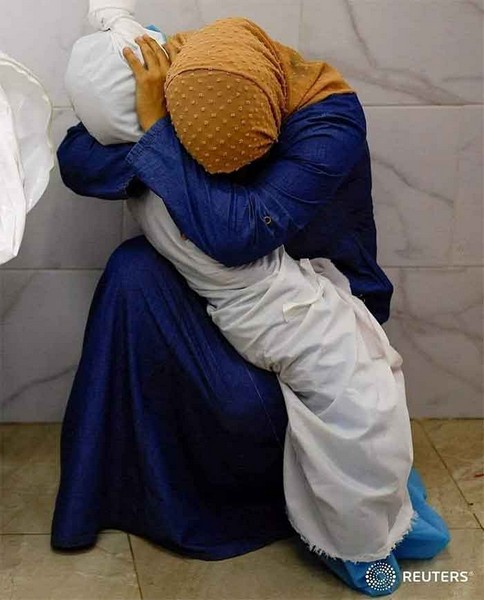
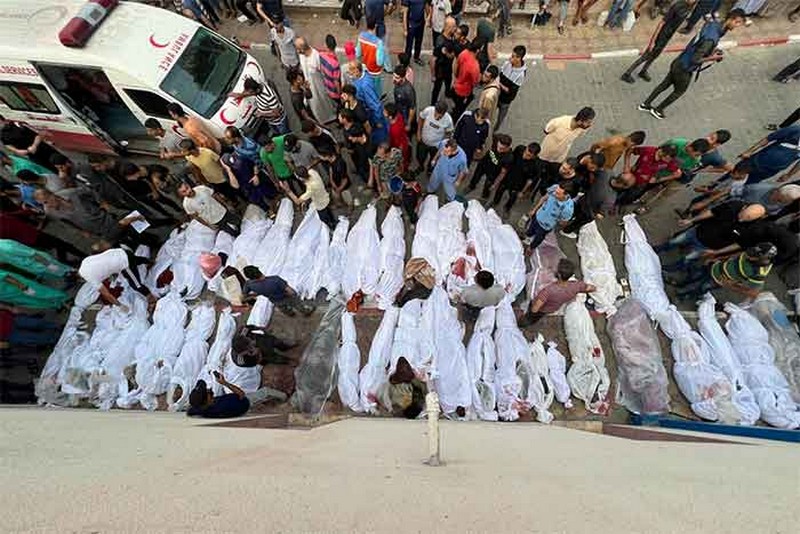
More than 14,500 Palestinians have been killed by the IDF since October 7. Of these, nearly 70% (i.e., more than 9,000) are children and women, and more than 30,000 others have been injured by relentless bombing campaign and missile attacks by Israel. A whopping 1.6 million people, representing 70% of the Palestinian people living in Gaza, have been forcibly displaced from their homes by the IDF. More than 10,000 buildings and 43,000 housing units (i.e., nearly 50% of housing units) have been completely destroyed. Another 225,000 housing units have sustained partial damages. Over 51% of education facilities have also been hit. While most of the destruction has been centered in northern Gaza, even its south, which Israel had declared a safe zone, has not been spared.
According to the UN OCHA (Office for the Coordination of Humanitarian Affairs), significant damage has been inflicted upon critical infrastructure and essential services, affecting people’s ability to maintain their dignity and basic living standards. As of November 18, more than 300 educational facilities have been destroyed, 135 health facilities attacked, 25 hospitals and 52 health care centers are out of service, 55 ambulances damaged, at least 3 churches and 83 mosques damaged. At least 1330 families have sustained multiple fatalities. At least 6,120 fatalities were from 825 families.
Without power or fuel to pump water or run desalination plants, Gazans face a dire water shortage and are down to three liters per day as of Monday (Nov. 18), according to the UN. It is important to note that this amount is only 3% of basic need. The UNRWA waste removal facility has also been forced to shut down. Students have no access to schools. The food security has been described as catastrophic. The last functioning bakery was forced to shut down weeks ago. The UNRWA lost 102 of its own staff members who were killed by the IDF. At least 201 health workers, 62 journalists and 22 civil defense personnel were also killed by the IDF. The UNRWA schools, which provided shelter to fleeing and displaced residents, were repeatedly bombed by the IDF killing dozens of people – mostly women and children.
All the hospitals in northern Gaza are now dysfunctional because of IDF attacks on those facilities. The IDF soldiers have deliberately damaged medical equipment and devices so that necessary services could be disrupted fully. On November 23, Dr. Mohammed Abu Salmiya, the director of Gaza’s largest hospital, Al-Shifa, and several other doctors have been arrested by Israeli forces. Meanwhile, about 450 patients and staff have been forced to evacuate the enclave’s Indonesian Hospital. More remain trapped inside.
The World Health Organization warned that health services in Gaza had suffered “catastrophic” damage, with most hospitals no longer functioning. “We now have 1.7 million people displaced so we have twice or three times the population (in the south of Gaza), using one third of the hospital beds in less than a third of the hospitals available,” Michael Ryan, executive director of WHO’s Health Emergencies Program, said.
The Israeli Air Force, by its own account, has so far dropped more than 6,000 bombs on Gaza, which is one of the most densely populated areas in the world—almost as many bombs as the US dropped on all of Afghanistan during record-breaking years of its war there.
Human Rights Watch has confirmed that the Israel weapons used included phosphorous bombs, which set fire to bodies and buildings, creating flames that aren’t extinguished on contact with water. This demonstrates clearly what Gallant means by “act accordingly”: not targeting individual Hamas militants, as Israel claims, but unleashing deadly violence against Palestinians in Gaza “as such,” in the language of the UN Genocide Convention.
Since October 7, Israel intensified its 16-year siege of Gaza—the longest in modern history, in clear violation of international humanitarian law—to a “complete siege,” in Gallant’s words.
The ongoing Israeli attacks inside Gaza continue to show that all the Palestinians have been effectively transformed into ‘enemies’ of the settler-colonial state, thus, justifying their mass extermination.
Succinctly put, the leaders of the State of Israel not only harbored the intention to commit genocide but have put to practice their evil intention in Gaza.
==-==
How about the views of genocide experts?
“A Genocide in plain sight, for everyone to see, merciless and cold blooded and the West with all its human rights talk, with all its hubris is in full support—maybe give the Palestinians a coffee break before continue killing them, but that’s about the maximum the West is willing to concede to the victims.” These words are the somber assessment of the former U.S. Ambassador Chas Freeman in a YouTube interview.
Within the very first week, Professor Raz Segal has called his country’s (Israel’s) assault on Gaza “a textbook case of genocide.” He believes that Israeli forces are completing three genocidal acts, including, “killing, causing serious bodily harm, and measures calculated to bring about the destruction of the group.” He points to the mass levels of destruction and total siege of basic necessities. He noted, “This turn of phrase that explicitly indexes a plan to bring the siege to its final destination of systematic destruction of Palestinians and Palestinian society in Gaza, by killing them, starving them, cutting off their water supplies, and bombing their hospitals.”
The situation meanwhile has deteriorated considerably. Arguably, with the bombing campaigns against all the hospitals, and stopping all the supplies that has contributed to the death of hundreds of newly born infants, including those in the incubators, Israeli forces are completing all the five genocidal acts. Killing is far worse than transferring children.
Craig Mokhiber, who was the director of the New York office of the UN’s High Commissioner for Human Rights, wrote in his October 28 resignation letter that Israel’s military actions in Gaza were “textbook genocide” and accused the UN of again “failing” to act, referring to previous genocides in Bosnia, Rwanda, and Myanmar. “The current wholesale slaughter of the Palestinian people, rooted in an ethno-nationalist colonial-settler ideology, in continuation of decades of their systematic persecution and purging, based entirely upon their status as Arabs … leaves no room for doubt,” Mokhiber said in his letter to the UN human rights chief, Volker Turk.
In her interview with the host Amy Goodman of the Democracy Now, international criminal law Professor Chantal Meloni of the University of Milan, Italy, says, “I think that what we have witnessed in the past weeks, it’s literally the commission on each and every international crime that you may find listed under the Rome Statute of the International Criminal Court.” She is author of the book: Is there a court for Gaza?
Ernesto Verdeja, a professor at the University of Notre Dame who specializes in genocide, says Israel’s actions in Gaza are moving toward a “genocidal campaign.”
City University of New York professor Victoria Sanford has compared what’s happening in Gaza to the killing or disappearance of more than 200,000 Mayans in Guatemala from 1960-1996, known as the Guatemalan genocide, which is the subject of her book Buried Secrets: Truth and Human Rights in Guatemala. Mayans and Palestinians have both been subject to genocidal acts, she implies. “When we match them to the lived experience of people, there are similar circumstances…if we look at contemporary conflicts like the Israeli invasion of Palestine.”
Professors Sanford and Segal are two of more than a 100 scholars and organizations that signed a letter urging the ICC to take action given the “Israeli intention to commit genocide visibly materializing on the ground.”
Sanford is also one of three scholars who signed a declaration in support of a federal lawsuit announced on November 13 that is filed by the nonprofit Center for Constitutional Rights (CCR). The case was filed on behalf of a group of Palestinians living in Gaza and the U.S., as well as human rights organizations. They have sued President Joe Biden, Secretary of State Antony Blinken and Secretary of Defense Lloyd Austin, accusing them of “failure to prevent and complicity in the Israeli government’s unfolding genocide”.
It is important to note that the 1948 international convention against genocide requires the US and other countries to use their power and influence to stop the killing.
“Numerous Israeli government leaders have expressed clear genocidal intentions and deployed dehumanizing characterizations of Palestinians, including ‘human animals’,” the CCR wrote in the introduction to its complaint.
It said those “statements of intent”, when combined with the “mass killing” of Palestinians, reveal “evidence of an unfolding crime of genocide”.
Numerous legal scholars, rights groups and humanitarians have also called Israel’s actions in Gaza genocide.
“As Israel’s closest ally and strongest supporter, being its biggest provider of military assistance by a large margin and with Israel being the largest cumulative recipient of US foreign assistance since World War II, the United States has the means available to have a deterrent effect on Israeli officials now pursuing genocidal acts against the Palestinian people in Gaza,” the complaint argued.
Instead, the group said, Biden, Blinken, and Austin “have helped advance the gravest of crimes” by continuing to provide Israel with unconditional military and diplomatic support while undermining efforts by the international community to stop Israel’s bombardment.
Professors Barry Trachtenberg of Wake Forest University and John Cox of the University of North Carolina have published widely on the Holocaust. They stress in their report that the “levels of destruction and killings in just over one month, together with the annihilatory language expressed by Israeli state leaders and senior army officers, point not to targeting of individual Hamas militants or Hamas military targets, but to the unleashing of deadly violence against Palestinians in Gaza ‘as such,’ in the language of the UN Genocide Convention.”
In a Los Angeles Times Op/Ed column (Nov. 19), commenting on the above case, Professor Segal writes, “The assessment of the three senior Holocaust and genocide studies scholars is accurate. Gaza now resembles Ukrainian cities after Russian bombings and invasions, but with levels of destruction and killings that have surpassed in less than a month what we have seen in Ukraine in nearly two years: Official U.N. figures from early September note that Russian attacks killed slightly fewer than 10,000 civilians since February 2022, and injured just above 17,500. It is important that Biden described Russia’s attack on Ukraine as “genocide” on April 12, 2022, commenting that “we’ll let the lawyers decide, internationally, whether or not it qualifies, but it sure seems that way to me.” In the same way, Gallant’s “total siege” policy, together with the forced displacement of more than 1.5 million of the 2.3 million Palestinians in Gaza, has created what sure seems like genocide.”
Professor Raz Segal continues, “Palestinians in Gaza are facing a “slow death” of hunger and thirst. “The lack of clean water and the severe overcrowding in the southern part of Gaza — where hundreds of thousands of Palestinians from the northern part have fled — have markedly increased the risk of outbreak of infectious diseases. The lack of fuel and medical supplies, coupled with Israeli bombings of hospitals and the Israeli army operation inside Shifa Hospital, has turned hospitals into sites of mass death. And all along, Israel continues bombing the southern part of Gaza. No place in Gaza is safe from Israel’s assault, which is, in the language of Article 2 (c) of the U.N. Genocide Convention, deliberately inflicting on the group conditions of life calculated to bring about its physical destruction in whole or in part.”
Writing for the Jewish Currents, dated October 13, 2023, Professor Segal, states, “Israel’s genocidal assault on Gaza is quite explicit, open, and unashamed.”
Perpetrators of genocide usually do not express their intentions so clearly. But not so with Israeli leaders who, thanks to the immoral and material support from the leaders of the USA and the Holocaust-guilt ridden Europe, feel emboldened, empowered, untouchable, above any international law.
“The fact that there was no accountability for the last decades of [Israeli] occupation and crimes related to the occupation has created a sense of impunity,” says Reed Brody, a war crimes prosecutor, who is son of a Hungarian Holocaust survivor.
Remember the UN fact-finding mission, the so-called Gladstone report in 2009? It found the closure of the Gaza Strip that had been imposed continuously since 2007 unlawful, collective punishment of the civilian population of Gaza and a possible crime against humanity.
Sadly, we have not seen any warrant of arrest nor any concrete action from the ICC. Will the ICC chief prosecutor Karim Khan confront Israel this time? Will all those Israeli leaders and their western sponsors who aided the genocide of the Palestinians in Gaza be prosecuted for their horrendous crimes?
===-===
The leaders of Israel and their western backers have tried to portray their genocidal war crimes against the Palestinian people as an inalienable right of self-defense. Can they invoke such a right?
U.N. special rapporteur on the Occupied Palestinian Territories, Francesca Albanese, recently answered the question in an address to the Australian Press Club. She said categorically that Israel cannot “claim the right of self-defense against a threat that emanates from the territory that it occupies, from a territory that is kept under belligerent occupation.” “The right to self-defense can be invoked when the state is threatened by another state, which is not the case,” she said.
Albanese was referring to a 2004 advisory opinion by the International Court of Justice (ICJ), which said the construction of Israel’s separation wall in the occupied West Bank was illegal. The ICJ rejected the Israeli argument to build the wall, saying it could not invoke the right to self-defense in an occupied territory.
“The death of a reported 4,710 children, attacks on healthcare, the withholding of water and electricity – these cannot be merely justified as a ‘right to self-defense’,” said Iain Overton, executive director of the London-based Action on Armed Violence, which conducts research and advocacy on armed violence against civilians.
He added that for Israel to claim this right without being challenged “would be a mockery of the international humanitarian law”.
Armed conflicts are governed by international humanitarian law (IHL), a set of rules contained in international agreements like the Fourth Geneva Convention of 1949 as well as other agreements and conventions meant to ensure that all member nations subscribe to a list of fundamental rules during conflicts.
In the current conflict, though, experts said Israel’s actions violated all of the four main principles of IHL: distinction between civilians and combatants, proportionality between anticipated loss of civilian life and damage and the strategic military advantage of an attack, legitimate military purposes and the humane treatment of all individuals from civilians to detainees and hostages.
Neve Gordon, a professor of international law and human rights at Queen Mary University of London, said, “It is also obvious that Israel has committed war crimes in Gaza since October 7.”
As a matter of fact, Israel has been committing such war crimes since its existence.
International humanitarian law insists that medical units must be protected. Similarly, international law also disallows attacks against places that are indispensable to the survival of the civilian population, such as drinking water installations and farmland.
Attacking schools and hospitals during the conflict, as Israel has done, is “one of the six grave violations”, according to the UN Office of the Special Representative of the Secretary-General for Children and Armed Conflict.
Yet Israel has been unrelenting in these attacks despite facing heavy criticism. UN Secretary-General Antonio Guterres called Gaza a “graveyard for children” on November 7.
One in every 5p people living in the Gaza strip has been killed or wounded in the past six weeks. The killing of so many civilians cannot be dismissed as collateral damage. “Not in a refugee camp. And not in a hospital,” the UN human rights chief said.
He further said, “And never in my career of working in many crisis situations around the world have I met such an outpouring of fear, anger, and despair. The people of Gaza, who for years have been profoundly impoverished behind barbed wire fences, are enduring bombardment by the Israeli Security Forces of an intensity rarely experienced in this century.”
The utter destruction since October 7 of the northern and central parts of Gaza, including its entire infrastructure, once again unmasks the evil intent of the barbarous settler colonial state of Israel. Its genocidal acts have thus far resulted in the ethnic cleansing of the Palestinian people from the half of Gaza. Even the southern Gaza is not immune from Israeli attacks.
No one should be surprised either with the escalation of latest genocidal violence when we recall that Netanyahu brandished a map of the Middle East in his UNGA speech in September that showed the West Bank and Gaza as part of Israel.
Truly, the Israeli leaders since its unholy birth in 1948 have never been sincere about the establishment of a Palestinian state, living side by side. Its border remains non-demarcated, and its occupied territories always growing. Mass deportation and periodic mass-slaughters have been the key means to ethnically cleanse the Occupied Territories of its indigenous people, who are culturally different.
Thus, it is no surprise that as the negotiation for a temporary ceasefire, perhaps starting on Friday (Nov. 24), is reached in Doha, Israel has bombed 300 places, including refugee shelters in southern Gaza, on Thursday alone, killing at least 200 Palestinians. Another 90 Palestinians have been taken as hostages – euphemistically called ‘detained’ – by Israel within just 24 hours, while their homes are damaged. Even the picture of the Ka’ba hung on the wall of residential homes are smashed by the intruding Israeli soldiers who want to maximize their pains by every possible means. In a two-tiered apartheid system, justice is denied to the Palestinian victims. They are reminded 24/7/365 to live with such a discriminatory system or leave unless they want to be killed or evicted by force.
In violation of international law, ‘mass detention’ has long been used by Israel as a weapon of war and occupation. It should be mentioned that around 8,300 Palestinian prisoners are currently held in Israeli jails, according to Qadura Fares, head of the Palestinian Commission for Detainees and Ex-Prisoners’ Affairs. Thousands of these are under ‘administrative detention’, i.e., they can be held indefinitely without any charges. Some 300 of these prisoners are children, aged between 8 and 18; their crime – throwing stones at the settler occupation forces. Some 85 prisoners are women. Up to 2,070 arrests were documented in the occupied West Bank and Jerusalem in the month of October alone. It is important to note here that more than a million cases have been launched since 1967 by the settler colonial state as part of unceasing harassment of the Palestinian people.
While the people’s eyes were glued to the TV screens watching IDF’s war crimes inside Gaza, some 3,100 Palestinian civilians have lately been arrested and more than 200 Palestinians killed by the Israeli forces across the West Bank since October 7.
It is obvious that as a settler colonial entity, Israel has no qualms about arresting and killing Palestinians while they promise to release a small fraction as a result of the latest truce. Those Palestinians who would be released in the latest truce may soon end up in the prison cells again. That is the nature of cruel Israeli justice meted out against the Palestinians.
Palestinian Authority Prime Minister Mohammad Shtayyeh told Reuters last week that Israel had been ramping up arrests ahead of a hostage deal. “Israel is preparing for an exchange of prisoners, and they are arresting as many people as they can simply because they are preparing for such a deal,” Shtayyeh said.
=======-=======
Last words
As I see it, the Hamas attack was a reprisal attack by freedom-loving Palestinian youths that revolted against their murderous occupiers. They were partly motivated by their desire to free their loved ones rotting in Israeli prisons. Most of them – children and grand-children of the uprooted Palestinian in the ‘First Nakba of 1948’ – growing up in Gaza, have seen nothing but barbed wires and apartheid walls in a concentration camp that felt worse than an ‘open air’ prison, which could be bombed any time by a savage colonial-settler entity that has no respect for human lives and dignity.
Their case is no less noble than the Jewish uprising in Warsaw that began on April 19, 1943. About 700 young Jewish fighters participated in that uprising. This was the largest uprising by Jews during World War II and the first significant urban revolt against German occupation in Europe.
The Warsaw ghetto was the largest Jewish ghetto in German-occupied Europe. Established by the Germans in October 1940, and sealed that November, the ghetto housed approximately 400,000 Jews. During what was described as the “Great Action,” the Germans deported about 265,000 Jews from Warsaw to Treblinka. They killed approximately 35,000 Jews inside the ghetto during this operation. By early 1943, the surviving Jews in the Warsaw ghetto numbered approximately 70,000 to 80,000 individuals.
The “Great Action” had been disguised as a “resettlement operation.” However, by late summer 1942 it was clear to many ghetto inhabitants that deportations from the ghetto meant almost certain death.
In response to these deportations, several Jewish underground organizations banded together on July 28, 1942. They created an armed self-defense unit known as the Jewish Combat Organization (Żydowska Organizacja Bojowa; ŻOB). It is estimated that ŻOB had roughly 200 members at the time of its formation.
In the end, the Germans razed the ghetto to the ground. They burned and demolished this part of Warsaw, block by block, in order to smoke out their prey.
Police Commander Jürgen Stroop’s internal SS daily report for Friedrich Krüger, written on 16 May 1943, stated: “180 Jews, bandits and sub-humans, were destroyed. The former Jewish quarter of Warsaw is no longer in existence. The large-scale action was terminated at 20:15 hours by blowing up the Warsaw Synagogue. … Apart from 8 buildings (police barracks, hospital, and accommodations for housing working-parties) the former Ghetto is completely destroyed. Only the dividing walls are left standing where no explosions were carried out.”
According to the United States Holocaust Memorial Museum, the uprising was “one of the most significant occurrences in the history of the Jewish people.
In 1968, the 25th anniversary of the Warsaw Ghetto Uprising, Yitzhak Zuckerman, one of the Jewish survivors, was asked what military lessons could be learned from the uprising. He replied: “I don’t think there’s any real need to analyze the Uprising in military terms. This was a war of less than a thousand people against a mighty army and no one doubted how it was likely to turn out. This isn’t a subject for study in military school. (…) If there’s a school to study the human spirit, there it should be a major subject. The important things were inherent in the force shown by Jewish youth after years of degradation, to rise up against their destroyers, and determine what death they would choose: Treblinka or Uprising.”
Truly, what prospect do the Palestinians have in the Occupied Territories, inside and outside Gaza? Can one blame the Hamas militants if they dared to challenge the might of a settler colonial state that epitomizes racism, bigotry, and apartheid character in post-Nazi era? As Nelson Mandela and Bishop Tutu would have said, I understand why they attacked on October 7. In their books, an oppressed and colonized people have every right to free themselves by any means possible.
Today, Days of Remembrance ceremonies to commemorate the victims and survivors of the Holocaust are linked to the dates of the Warsaw ghetto uprising.
On 7 December 1970, West German Chancellor Willy Brandt spontaneously knelt while visiting the Monument to the Ghetto Heroes memorial in the People’s Republic of Poland.
I don’t know if we shall ever see a remorseful Israeli ‘Willy Brandt’ kneeling down in front of the mass graves in Gaza for the horrendous genocidal crimes, past and present, of the Zionist state. But that is truly needed for healing the wounds.
Dr. Habib Siddiqui has over four decades of experience in peaceful activism, especially in defense of the rights of displaced people.
24 November 2023
Source: countercurrents.org