Just International

Are They Really Fighting Terrorists? U.S. Occupation Forces in Syria Receive New Weapons for a Future Conflict with Syrian and Russian Forces

By Timothy Alexander Guzman

In early May, Syria was welcomed back to the Arab League, a development that was sure to anger the US and European establishments so new tensions between US occupation forces and the Russia-Syria alliance have been escalating quite rapidly in the last few months. 

An article published by Reuters ‘Arab League readmits Syria as relations with Assad normalise’ says that “The reinstatement of Syria does not mean normalisation of relations between Arab countries and Syria,” Arab League Secretary-General Ahmed Aboul Gheit told reporters in Cairo. “This is a sovereign decision for each country to make.”

The Syrian government has called on the Arab League to show mutual respect and so far, they have. However, behind closed doors, Washington’s war machine is still planning to remove Syria’s President, Bashar al-Assad. Assad has been trying to end the ongoing conflict, but there is one main problem, and that is the US occupying forces who are stationed in various areas that includes Al-Tanf, which is located close to the Syrian-Iraqi-Jordan border that can be used as a transit hub to bring in newly-equipped terrorists including Takfiri terrorists who are located in areas close to the northwestern Idlib province, in the eastern al-Omar oilfields in Deir Ez-Zor to obviously steal as much oil as possible and in the Hasaka countryside in the Al-Jazeera region:

A U.S. State Department spokesperson said Washington shared the goals of Arab partners in Syria, including building security and stability, but remained “sceptical of Assad’s willingness to take the steps necessary to resolve Syria’s crisis”

It is obvious that the US government is not happy about the outcome of the Arab League’s decision,

“We do not believe Syria merits readmission into the Arab League at this time,” the spokesperson said, adding that U.S. sanctions would remain in full effect.” 

Russia on the other hand applauded the decision, Maria Zakharova, a spokesperson for the Russian Foreign Ministry said that “Moscow welcomes this long-awaited step, the logical result of the process, which has gained momentum, of returning Syria to the ‘Arab family.” Syria and its Arab League partners can cooperate in the political and economic realms that will benefit all sides.  It is also a positive outcome for Arab nations in hopes to finally unite against the US-NATO Alliance and Israel in the Middle East.

However, there are other issues to deal with including sanctions that hurt the Syrian people imposed by the US and the European Union as punishment for their support of their president, Bashar Al-Assad.

The harsh sanctions imposed by the West includes banning imports of much-needed building materials and machines to rebuild homes, hospitals, schools, and bridges that has been destroyed by the Israel Defense Forces (IDF) over the years.

The Syrian people need to rebuild important infrastructures to provide clean drinking water. Syrian business owners from small to mid-size companies cannot import goods or machines used in factories to produce products for public consumption. To make matters worse, those same oil fields that the US military occupies prevents the Syrian people from receiving oil which limits the use of energy including electricity for their homes or gas for their cars.  In other words, the illegal US occupation has been a disaster for the Syrian people.

In the last few months, new tensions between the US and the Russia-Syria alliance have increased. In fact, the US has shipped weapons into its military base in Hasaka. According to the Syrian Arab News Agency(SANA) ‘The US occupation brings in new weapons to its bases in Hasaka countryside’ said that “In order to fortify its illegal presence in Syrian territory, the US occupation intensified its movements, especially in al-Jazeera region, violating international laws and principles, as it brought in during the past 24 hours weapons, ammunition and logistical equipment to its bases in Hasaka countryside.” It seems that the US military is expecting a conflict with Russian and Syrian forces:

A convoy of the occupation consisting of 30 large tankers guarded by armored vehicles raising the flag of the American occupation, and another belonging to QSD militia associated with it, coming from Iraqi territory, entered the city of Al-Shadadi (60 km south of Al-Hasakah) from the east, and its contents were unloaded at the occupation base in the city before heading to the city of Hasakah through the western entrance on the Kharafi road , special sources told SANA.

The sources quoted eyewitnesses belonging to the QSD militia as saying “the load of the convoy that was unloaded at the base included advanced medium weapons, including anti-armored weapons, modern communication and jamming systems, in addition to large quantities of ammunition, including several containers intended to support the QSD militia

The US Military and the Islamic State: Partners in Crime

Last March, US Army General Mark Milley said that having US troops in Syria is “worth the risk” to fight the Islamic state according to a Reuters propaganda piece tiled ‘Syria mission worth the risk, top U.S. general says after rare visit’ claims that “The nearly eight-year-old U.S. deployment to Syria to combat Islamic State is still worth the risk, the top U.S. military officer said on Saturday, after a rare, unannounced visit to a dusty base in the country’s northeast to meet U.S. troops.” Milley went to Syria “to assess efforts to prevent a resurgence of the militant group and review safeguards for American forces against attacks, including from drones flown by Iran-backed militia.” Reuters said that “American officials say that Islamic State could still regenerate into a major threat.”

I agree with that statement, but the problem is that it is the US military who will rearm the Islamic State and other terrorist groups like they did in the past to create a new conflict in a never-ending effort to topple Bashar al-Assad:

While Islamic State is a shadow of the group that ruled over a third of Syria and Iraq in a Caliphate declared in 2014, hundreds of fighters are still camped in desolate areas where neither the U.S.-led coalition nor the Syrian army, with support from Russia and Iranian-backed militias, exert full control

Milley was asked if the mission is worth the risk, his response was “If you think that that’s important, then the answer is ‘Yes.” He continued “I happen to think that’s important,” Milley conveniently mentioned ISIS as the main threat, but the reality is that they are preparing for a future escalation with the Syrian government, Russia, Hezbollah and their main adversary, Iran. “So, I think that an enduring defeat of ISIS and continuing to support our friends and allies in the region … I think those are important tasks that can be done.”

On July 14th, a local news channel in the state of New York, WWNY published a report ‘Soldiers with 2nd BCT leaving Fort Drum for Iraq & Syria’ based on the deployment of the 10th Mountain Division 2nd brigade combat team to Syria and Iraq for up to nine months to fight the reemergence of ISIS “the soldiers will be spending the next nine months in Iraq and Syria as part of Operation Inherent Resolve, an ongoing military operation to defeat the Islamic State.” This is a clear escalation in progress. There are joining another 900 plus US soldiers who are currently stealing Syria’s oil and gas. According to The Syrian Observer, which is described as “Syria’s official press” for “opposition groups, activists and civil society” published ‘HTS and SDF Dialogue Towards a Joint Civil Administration’ mentioned the US-backed Syrian Democratic Forces (SDF) and the infamous Hayat Tahrir al-Sham, a terrorist organization who held several meetings in the last few months to discuss how they will unify their forces to face the Syrian and Russian militaries:

The talks also explored the possibility of establishing a joint civilian administration between HTS and the SDF. This would be contingent on HTS gaining control over areas currently held by the Syrian National Army. The SDF indicated that the United States is supportive of the unification of the northeastern and northwestern regions of Syria

US and Russian forces had several incidents in the last few months. US drones patrolling Syrian skies have faced Russian fighter jets on numerous occasions. Recently, The Associated Press, ‘Russian fighter jet strikes another American drone over Syria in the sixth incident this month’ on the increase of tensions in Syrian airspace:

A Russian fighter jet fired flares and struck another U.S. drone over Syrian airspace on Wednesday, the White House said, in a continued string of harassing maneuvers that have ratcheted up tensions between the global powers.

It’s the sixth reported incident this month, and the second in the past 24 hours, in which the United States has said Russian warplanes have flown dangerously close to American manned and unmanned aircraft, putting crews and the planes at risk and raising questions as to what the U.S. may need to do in response

Apparently, the US already decided what needs to be done in their response to Russia legally flying over Syrian airspace, and I say ‘legally’ because Russia is a close ally of Syria and was invited to help the country fight threats coming from the US, Israel and the rest of their terrorist lapdogs.

It’s the same old story and the same old lie of the US and its allies supposedly fighting terrorists in an oil producing country who is in the way of Israel’s expansionist plans. But the reality is that the West and Israel has been using terrorists to destroy Syria. The West has always called Syria’s conflict a popular uprising or a revolution against the evil Assad, but its about the permanent destruction of Syria and the rest of the Middle East that will allow the “Jewish State of Israel” to become the only so-called viable “democracy.”

The goal of the West is to turn Syria into another Iraq or Libya because a destabilized Middle East benefits the globalists who will have control over the Arab people and their natural resources. This will also allow Israel, who is part of the globalist cabal to be the undisputed hegemonic power in the region. Just imagine that scenario, it would be an absolute nightmare for the Arab world, yet a dream come true for the globalists.

*

Timothy Alexander Guzman writes on his own blog site, Silent Crow News, where this article was originally published. He is a regular contributor to Global Research.

4 August 2023

Source: globalresearch.ca
Attacks on Christianity in Palestine

By Jonathan Kuttab

Attacks by religious fanatics on places of worship and individuals of another religion are a well-known and despicable phenomenon. They go beyond mere racism and discrimination, in that they invoke the name of God Almighty in justifying bitter hatreds and hostilities against entire communities. Those performing the attacks do so with zeal and venom, and a feeling that they are serving God.

Attacks by religious Jews on Muslim holy places in Palestine are often recorded and noted, and they are sometimes used  to explain the ongoing hostilities between the two groups and to warn of the consequences of turning an otherwise political situation into a religious conflict with devastating worldwide consequences. Indeed, it would be horribly tragic if Muslims worldwide start viewing Jews as enemies and start seeking revenge upon them in the name of God. Advocates and proponents of justice for Palestine should always be very careful to avoid such approaches and to insist on framing the situation in its proper political framework. They must not yield to the temptation of seeing it as a religious conflict between Judaism and Islam. To be sure, there are religious differences and conflicting claims to holy places, particularly in Jerusalem, and these conflicts have been used in the past to justify campaigns to conquer Jerusalem, “rid it of infidels,” and assert political control over it. This was also done by crusaders and other groups.

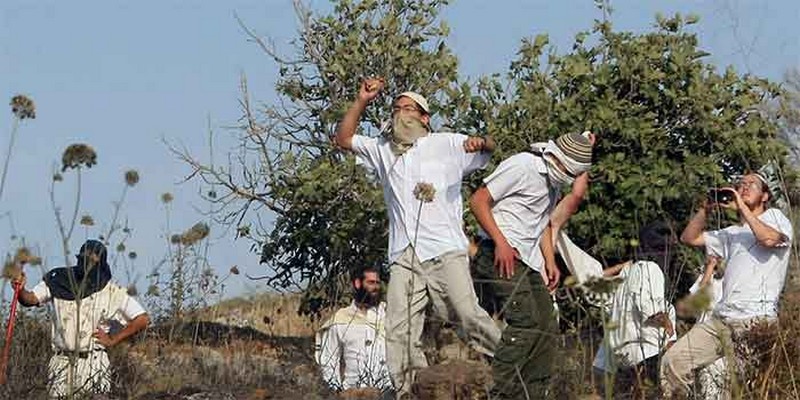
Recently, we have been observing a sharp rise in attacks by Jewish religious fanatics on Christian clergy, cemeteries, and holy places in Palestine, particularly in Jerusalem. These fanatics take advantage of the power of the state (Israel) to attack Christians and to assert political power and control over Jerusalem on behalf of the Jewish state.

The typical reaction in the West has been to totally ignore or downplay such attacks on Christians. One reason is an obvious one: Christians in the West feel they have very little basis for complaining against such bigotry in light of their own despicable millennia of anti-Jewish bigotry and intolerance in their own countries, which has not yet fully subsided as antisemitism continues to raise its ugly head from time to time until this day. The fact that the Christians being attacked in Palestine today are not responsible for western bigotry seems besides the point. Western Christians, who duly report and condemn every attack on synagogues and Jewish cemeteries are not as willing to note or condemn attacks on Christians in Palestine.

Yet these attacks are now becoming a more frequent phenomenon. One frequent type of attack, spitting on clerics and clergy, is literally a daily event in the Old City. One Israeli Jewish reporter, who wanted to investigate these claims, borrowed an abbot’s cassock and walked the streets of the Old City, and sure enough he was spat upon. The Israeli police apparently do nothing, even though the Old City is blanketed with surveillance cameras which record everything that happens in its streets, and given Israel’s facial-recognition technology, which it is marketing to the whole world, it would be easy for them to identify the attackers.

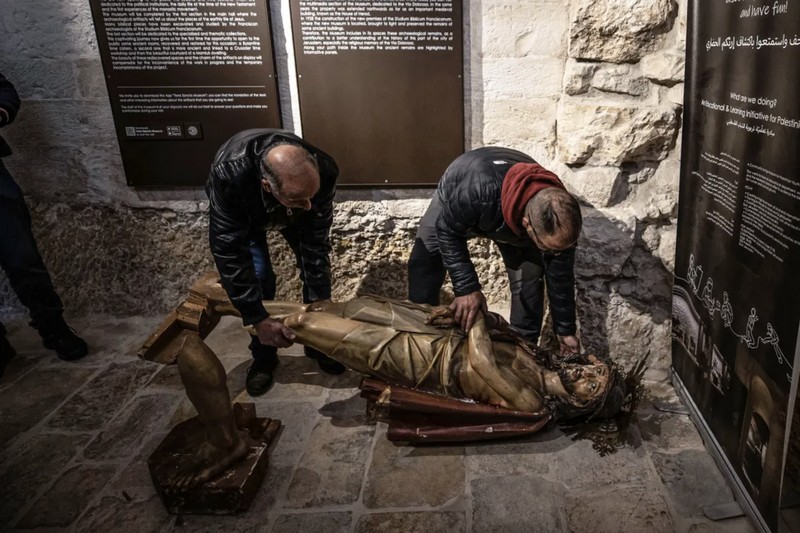
Another manifestation is in the attacks on Christian cemeteries and churches. Hateful graffiti is sprayed on the walls, there are attempts to start fires and burn churches, and cemeteries are broken into and headstones are smashed. In one recent attack on a church in the Old City, statues of Jesus and the Virgin Mary were shattered. In a frightening incident recently, Jewish fanatics attacked the monastery of Stella Maris in Haifa, claiming that it is actually a Jewish holy site to which they want to lay claim. The conflicting claims of the three monotheistic religions, as well as the competing Christian denominations, was carefully set forth in a document referred to as the Status Quo arrangement, enacted by the Turkish Ottomans, adopted by the British, then the Jordanians, and at least formally accepted by Israel. Attempts to alter this arrangement could easily lead to religious conflict.

From a theological point of view, Christians (for the most part at least), thankfully no longer make the kind of claims that were made by Crusaders. After all, the essence of Jesus’ message was to reject the concept of an earthly kingdom. My kingdom is not of this world, he taught. He also addressed the issue of the “holy places” in his conversation with the Samaritan woman at the well. When she asked him where is the proper place to worship God, “here in Samaria or in Jerusalem?” He answered that neither is the true holy place for worship, because “God is spirit and those who worship him must worship him in spirit and in truth.”

Good theological arguments can be found also in Judaism and Islam to battle such bigotry, but the fact remains that there are those who make a practice of agitating and seeking religious domination and supremacy in the name of God. We need to use both religious arguments, rational secular arguments, and proper common sense and decency to reject such atrocious behavior and to promote religious tolerance and understanding. Political strife is bad enough. Religious bigotry on top of that would be disastrous.

4 August 2023

Source: fosna.org

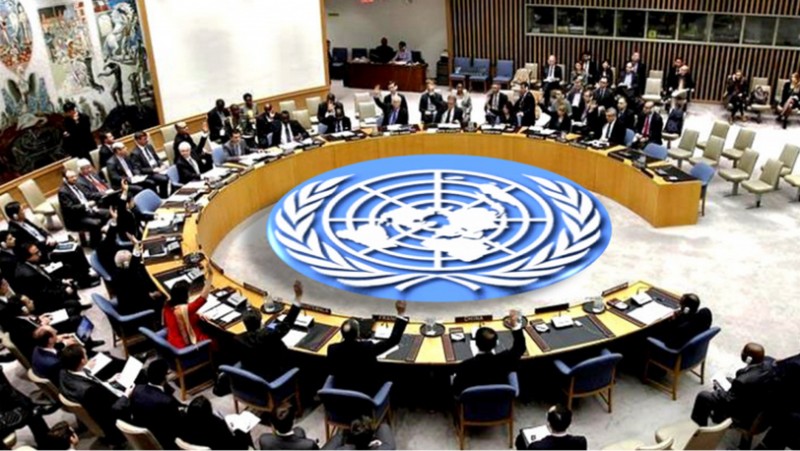
A Brief Neocolonial History of the Five UN Security Council Permanent Members

By John P Ruehl

Understanding the actions and justifications behind territorial colonial behavior by the UN Security Council since 1945.

One of the underlying principles of the UN Charter is the protection of the sovereign rights of states. Yet since 1945, the five permanent members of the UN Security Council (Soviet Union/Russia, France, UK, U.S., and China) have consistently used military force to undermine this notion. And while acts of seizing territory have grown rare, ongoing military domination allows imperialism to further manifest through economic, political, and cultural control.

System justification theory helps explain how policymakers and the public defend and rationalize unfair systems through the surprising capacity to find logical and moral coherence in any societyReframing” neocolonial policies to reinforce system-justifying narratives, often by highlighting the need to defend historical and cultural ties and maintain geopolitical stability, has been essential to sustaining the status quo of international affairs.

Naturally, the five UNSC members have often accused one another of imperialism and colonialism to deflect criticism from their own practices. Yet prolonging these relationships in former colonies or spheres of influence simply perpetuates dependency, hinders economic development, and encourages instability through inequality and exploitation.

France

In response to comments made by Russia’s foreign ministry in February 2023, which singled out France for continuing to treat African countries “from the point of view of its colonial past,” the French foreign ministry chastised Russia for its “neocolonial political involvement” in Africa. The previous June, French President Emmanuel Macron meanwhile accused Russia of being “one of the last colonial imperial powers” during a visit to Benin, a former French colony that last saw an attempted coup by French mercenaries in 1977.

Independence movements in European colonies grew substantially during World War II, and Paris granted greater autonomy to its possessions, most of them in Africa, in 1945. Yet France was intent on keeping most of its empire and became embroiled in independence conflicts in Algeria and Indochina. Growing public sentiment in France, since referred to as “utilitarian anti-colonialism,” meanwhile promoted decolonization, believing that the empire was actually holding back France economically and because “the emancipation of colonial people was unavoidable,” according to French journalist Raymond Cartier.

France left Indochina in defeat in 1954, while in 1960, 14 of France’s former colonies gained independence. And after Algeria won its independence in 1962, France’s empire was all but gone. But like other newly independent states, many former French colonies were unstable and vulnerable to or reliant on French military power. France has launched dozens of military interventions and coups since the 1960s in Africa to stabilize friendly governments, topple hostile ones, and support its interests.

French military dominance has been able to secure a hospitable environment for French multinational companies and preferential trade agreements and currency arrangements. More recently, the French military has consistently intervened in Côte d’Ivoire since 2002, as well as in the countries of the Sahel region (particularly Mali) since 2013, and the Central African Republic (CAR) since 2016. The French-led campaigns have received significant U.S. help. Speaking in 2019 on the French deployments, Macron stated that the French military was not there “for neo-colonialist, imperialist, or economic reasons. We’re there for our collective security and the region.”

But growing anti-French sentiment in former colonies in recent years has undermined Paris’ historical military dominance. Closer relations between Mali and Russia saw France pull the last of its troops out of the country in 2022, with Russian private military company (PMC) forces replacing them. A similar situation occurred in the CAR months later, and in 2023, French troops pulled out of Burkina Faso, with Russian PMC liaisons having reportedly been observed in the country.

Frustration with the negative effects of France’s ongoing influence in former colonies has also been directly tied to problems in immigrant communities living in France. The fatal shooting of a North African teenager by police in the suburbs of Paris in June 2023 caused nights of rioting, with Russia and China accusing France of authoritarianism for its security response.

UK

Shortly after Russia’s invasion of Ukraine, UK Prime Minister Boris Johnson denounced the Russian president for still believing in “imperial conquest.” Yet like France, the UK has often been accused of using military force to help promote British interests in its former empire, including the dominant role of British banks and financial services and other firms, for decades.

As the only European colonial power not defeated by Nazi Germany, British forces were sent to secure Indochina and Indonesia before French and Dutch forces could return after World War II. But London’s focus soon turned to protecting its own empire and emerging independent states. British forces helped suppress a communist insurgency in Malaysia from 1948-1960, fought in the Kenya Emergency from 1952-1960, and intervened across former colonies in Africa, the Middle East, the Caribbean, and Pacific islands.

Additionally, British, French, and Israeli forces invaded Egypt in 1956 after the Egyptian government nationalized the Suez Canal before diplomatic pressure from the U.S. and Soviet Union forced them to retreat. Over the next few decades, almost all former British colonies were steadily granted independence, and by 1980 the rate of British military interventions abroad had slowed.

Nonetheless, the 1982 Falklands War somewhat reversed the perception of the UK as a declining, imperial power. The successful defense of the Falkland Islands’ small, vulnerable population against Argentinian aggression enhanced the perception of the UK as a defender of human rights and champion of self-determination. Additionally, Britain’s focus on naval power “was important to the self-image of empire” as naval strength is often perceived as less threatening than land armies. Prominent British politicians such as former Prime Minister David Cameron have similarly restated Britain’s commitment to protecting the islands from Argentinian colonialism.

More recently, the British military intervened in the Sierra Leone Civil War in 2000 and was also a crucial partner for the U.S.-led wars in Afghanistan in 2001 and Iraq in 2003. And alongside ongoing official deployments, British Special Forces have meanwhile been active in 11 countries secretly from 2011-2023, a report by Action Against Armed Violence revealed. The residual presence of the British military has often made it difficult to embrace the “new and equal partnership” between Britain and former colonies, championed by former British Foreign Minister William Hague in 2012.

The domestic perception of Britain’s colonial legacy continues to play a divisive role in British politics and society. Winston Churchill, the winner of a 2002 BBC poll on the top 100 Great Britons, was “cited as a defender of an endangered country/people/culture, not as an exponent of empire.” Yet during anti-racism protests in the UK in 2020, a statue of the former prime minister was covered up to avoid being damaged by protestors. Believing him to be a figurehead of the cruelty of British colonialism, the covering up of Churchill’s statue shows the contrasting and evolving domestic views of British imperialism.

Soviet Union/Russia

After 1945, Soviet troops were stationed across the Eastern Bloc to deter NATO and suppress dissent. Several military operations in support of communist governments against “counterrevolutionary” protestors were approved in East Germany (1953), Hungary (1956), and Czechoslovakia (1968). Soviet forces also took part in a decade-long conflict to prop up Afghanistan’s government from 1979-1989.

In AsiaAfrica, and Latin America, however, the Soviet Union presented itself as the leading anti-colonial force. It proclaimed an ideological duty to financially, politically, and militarily support numerous pro-independence/communist movements and governments, tying these efforts to confronting the colonial West.

The Soviet collapse forced Moscow to prioritize maintaining Russia’s influence in former Soviet states. But even today, many Russians do not see the Soviet Union and the Russian Empire as empires, as Russians insist that they lived alongside their colonized subjects through a “Friendship of Peoples,” unlike the British or French. This sentiment drives much of the rhetoric defending Russia’s ongoing dominance across parts of the former Soviet Union.

On the eve of the invasion of Ukraine in February 2022, Russian President Vladimir Putin once again called into question Ukrainian statehood. Ukraine, like other former Soviet states, has often been labeled an artificial creation by Russian politicians. Alongside the necessity of military force to protect Russian speakers/citizens, Russian officials have justified conflict and exploitation of fragile post-Soviet borders in separatist regions of GeorgiaMoldova, and Armenia/Azerbaijan since the early 1990s.

Russia has also worked to maintain a dependency on its military power in former Soviet states. The Kazakh government’s reliance on the Russian-led Collective Security Treaty Organization (CSTO) military alliance was clearly demonstrated during the CSTO intervention during protests in January 2022. Prominent Russian politicians such as Sergey Lavrov have consistently compared the CSTO favorably to NATO, but the lack of support from CSTO member states (except for Belarus) for Russia in its war with Ukraine has demonstrated its limitations.

The Russian military has also been active in Syria since 2011, while dozens of Russian private military companies have increased operations across Africa over the last decade. The Kremlin is increasingly tying these conflicts, as well as Russia’s war in Ukraine, to reinforce Moscow’s traditional role as an anti-colonial power. Russia has performed significant outreach to Africa since the start of the war, and at the annual St. Petersburg economic forum in 2023, Putin declared the “ugly neo-colonialism” of international affairs was ending as a result of its war.

By amplifying criticism over the domination of global affairs by the “Golden Billion” in the West, the Kremlin believes it can blunt foreign and domestic criticism over its war in Ukraine, as well as over its approach to other post-Soviet states.

USA

The USA, born out of an anti-colonial struggle, has naturally been wary of being perceived as a colonial power. U.S. Presidents voiced support for decolonization after World War II, particularly John F. Kennedy. But because “anti-communism came before anti-colonialism,” Washington often supported neocolonial practices by European powers to prevent the spread of Soviet influence and secure Western interests.

The U.S. has also been criticized for its own imperial behavior toward Latin America since 1823 when the Monroe Doctrine was first proclaimed. The United States’s sentiment that it had a special right to intervene in the Americas increased during the Cold War as Washington grew wary of communism. U.S. military forces intervened in Guatemala in 1954, Cuba in 1961, the Dominican Republic in 1965, Grenada in 1983, and Panama in 1989 to enforce Washington’s political will.

The U.S. War on Drugs, launched in 1969, also destabilized much of Latin America, while other instances of covertly fostering instability have prevented the emergence of strong sovereign states in the region.

Major foreign conflicts involving U.S. forces since 1945 meanwhile include the Korean War (1953-1953) Vietnam War (1955-1975), the Gulf War (1991), intervention in the Yugoslav Wars (1995,1999), and the War on Terror (2001-present). U.S. forces also intervened in Haiti in 1994-1995 during “Operation Uphold Democracy” and again in 2004, while leading international interventions in Libya (2011) and Syria (2014). These interventions have often been criticized for perpetuating instability and weakening local institutions.

Nonetheless, the global U.S. military presence has continued to grow. Since 2007, United States Africa Command (AFRICOM) has seen the U.S. expand its military footprint across Africa and today, 750 known military bases are spread across 80 countries. U.S. special operations forces are meanwhile estimated to be active in 154 countries. The U.S. global military presence also gives Washington considerable control over transportation routes, with the U.S. Navy routinely seizing ships violating trade restrictions.

U.S. officials have continued to lean on the country’s history as a former British colony to highlight solidarity with other countries and propose greater cooperation. In 2013, for example, U.S. Secretary of State John Kerry stated that the Monroe Doctrine, which allowed the U.S. “to step in and oppose the influence of European powers in Latin America,” was over. And in a 2023 address from the White House briefing room proclaiming the start of Caribbean-American history month, President Biden noted how the U.S. and Caribbean countries are bound by common values and a shared history of “overcoming the yoke of colonialism.”

But domestic divides over Washington’s role in global affairs have increased calls for the U.S. to return to its early foreign policy of isolationism. While this will not be enough for the U.S. to retreat on the global stage, it has helped prevent the U.S. military from committing to new major conflicts in recent years.

China

The conclusion of the Chinese Civil War in 1949 marked the end of China’s “Century of Humiliation” at the hands of European powers, the U.S., and Japan. The victory of the Chinese Communist Party (CCP) allowed Beijing to consolidate power and look toward expanding China’s borders. This included launching the “peaceful liberation” of both Xinjiang in 1949 and Tibet in 1950, steadily bringing these regions under China’s control—though China only took Taiwan’s seat at the UN in 1971.

China’s history of exploitation by foreign powers has frequently been cited by Beijing to increase solidarity with other countries which suffered from Western imperialism. Key to this messaging was fighting against U.S.-led forces in the Korean War, as part of a “Great Movement to Resist America and Assist Korea” and opposing wider Western neocolonialism, while Chinese forces also engaged in border clashes with the Soviet Union as relations between Moscow and Beijing soured in the 1960s.

But Chinese forces have also been involved in clashes with former European colonies. This includes confrontations with India, as well as China’s launch of a major invasion of northern Vietnam in 1979. Tens of thousands of casualties were recorded on both sides during the month-long operation, while continued border clashes between Chinese and Vietnamese forces continued until relations were normalized in 1991.

Since 2003, Chinese officials have instead placed great emphasis on China’s “peaceful rise,” which has seen the country drastically increase its power in world affairs without having to resort to military force. But while large-scale Chinese military operations have not materialized, China has rapidly increased the construction of ports, air bases, and other military installations to enforce its territorial control over the South China Sea over the last decade, at the expense of several Southeast Asian countries. Chinese President Xi Jinping has justified these developments because the islands “have been China’s territory since ancient times.”

China’s extensive maritime militias and civilian distant-water fishing (DWF) fleets have also been accused of asserting Chinese maritime territorial claims while blurring the lines between civilian and military force. Additionally, there is also fear that China’s growing economic and military might will be enough to force countries in Central Asia to accept the Chinese position on various territorial disputes.

While China has avoided any major military operations this century, it has used its growing economic and military might to pressure other countries into accepting its territorial claims. To offset criticism, Chinese officials have turned their attention toward ongoing and historical imperialism by the West. Following British criticism over China’s handling of pro-democracy protests in 2019, China criticized the UK for acting with a “colonial mindset,” and, in support of Argentina, accused the UK of practicing colonialism in the Falklands in 2021. These claims help sustain domestic support for China’s policies, help to increase solidarity among other countries which have suffered from Western imperialism, and put China’s geopolitical rivals on the defensive.

Conclusions

It is true that the U.S. military provides necessary security deterrence to numerous countries, and has also proven essential to responding to natural disasters and other emergencies. But like other major powers, the use of U.S. military force has consistently been abused since 1945. The historical legacy of Western imperialism and interventionism has helped explain why Western calls for global solidarity with Ukraine have often fallen on deaf ears today.

Additionally, some of the consequences of the war in Ukraine, including rising energy and food prices, are being most acutely felt in poorer countries, while the growing dominance of Western firms in crucial Ukrainian economic sectors has also undermined the West’s messaging over Ukraine further.

Honest accountability by major powers for the historical and ongoing exploitation of weaker countries remains rare. But public, government-funded initiatives, such as the U.S. Imperial Visions and Revisions exhibition at the National Portrait Gallery in Washington DC, documents the beginning and justification behind empire-building in the U.S., and is an important step to addressing past and contemporary wrongdoing, as envisioned by the UN Charter in 1945. In 2018, French President Macron meanwhile commissioned a report that discovered that “around 90 to 95 percent of African cultural heritage” was located abroad, prompting the French parliament to pass a bill in 2020 allowing these artifacts to be returned.

The promotion of actual history and accountability may also remove barriers to more selfless assistance to weaker countries by major powers. This approach could, in turn, invite greater cooperation and positive repercussions than costly military interventions, and would also serve as an example for weaker states grappling with their own legacies of violence, exploitation, and suppression.

John P. Ruehl is an Australian-American journalist living in Washington, D.C. He is a contributing editor to Strategic Policy and a contributor to several other foreign affairs publications.

2 August 2023

Source: countercurrents.org

The Day Australian Sovereignty Died

By Dr Binoy Kampmark

If a date might be found when Australian sovereignty was extinguished by the emissaries of the US imperium, July 29, 2023 will be as good as any.  Not that they aren’t other candidates, foremost among them being the announcement of the AUKUS agreement between Australia, UK and the US in September 2021.  They all point to a surrender, a handing over, of a territory to another’s military and intelligence community, an abject, oily capitulation that would normally qualify as treasonous.

The treason becomes all the more indigestible for its inevitable result: Australian territory is being shaped, readied, and purposed for war under the auspices of closer defence ties with an old ally.  The security rentiers, the servitors, the paid-up pundits all see this as a splendid thing.  War, or at least its preparations, can offer wonderful returns.

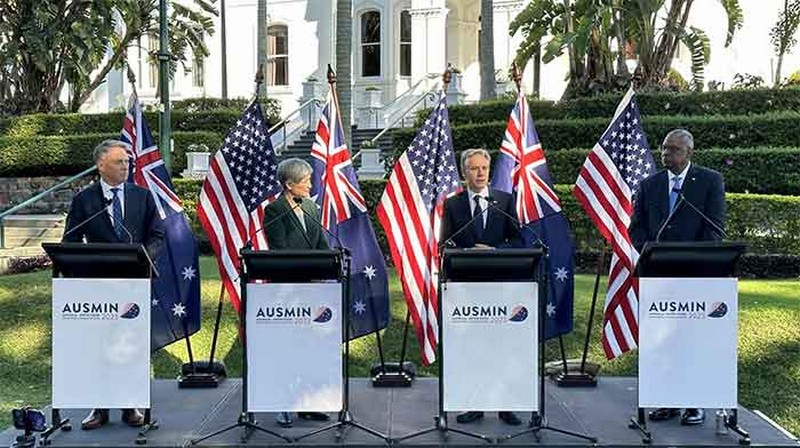
The US Secretary of Defense, Lloyd Austin III, was particularly delighted, though watchful of his hosts.  His remit was clear: detect any wobbliness, call out any indecision.  But there was nothing to be worried about.  His Australian hosts, for instance, proved accommodating and crawling.

Australian Defence Minister Richard Marles, for instance, standing alongside Austin, US Secretary of State Antony Blinken and Australian Foreign Minister, Penny Wong, declared that there was “a commitment to increase American force posture in respect of our northern bases, in respect to our maritime patrols and our reconnaissance aircraft; further force posture initiatives involving US Army watercraft; and in respect of logistics and stores, which have been very central to Exercise Talisman Sabre.”  To the untutored eye, Marles might have simply been another Pentagon spokesman of middle-rank.

The acquisition of nuclear-powered submarines was a process that was well underway (Marles seemed untroubled by grumbling voices in the Republican Party that the US Navy was short-changing itself by transferring three Virginia-class boats to the Royal Australian Navy) and taking place “in terms of an increased force posture of America within Australia.”  Speaking with confidence, Marles was also looking forward to “an increased tempo of visits from American nuclear-powered submarines to our waters as we look towards the establishment of a US submarine rotation, HMS Sterling, later in this decade.”

Australian real estate would be given over to greater “space cooperation”, alongside creating “a guided weapons and explosive ordnance enterprise in this country, and doing so in a way where we hope to see manufacturing of missiles commence in Australia in two years’ time as part of a collective industrial base between the two countries.”  Chillingly, Marles went on to reiterate what has become something of a favourite in his middle-management lexicon.  The efforts to fiddle the export-defense export control legislation by the Biden administration would create “a more seamless defence industrial base between our countries.”  Seamless, here, is the thick nail in the coffin of sovereignty.

Moves are also underway to engage in redevelopment of bases in northern Australia, in anticipation of the increased, ongoing US military presence.  The RAAF Base Tindal, located 320km south-east of Darwin in the Northern Territory, is the subject of considerable investment “to address functional deficiencies and capacity constraints in existing facilities and infrastructure.”  The AUSMIN talks further revealed that scoping upgrades would take place at two new locations: RAAF Bases Scherger and RAAF Curtin.

Australia’s Defence Intelligence Organisation will also be colonised by what is being termed a “Combined Intelligence Centre – Australia” by 2024.  This is purportedly intended to “enhance long-standing intelligence cooperation” while essentially subordinating Australian intelligence operations to their US overlords.  Marles saw the arrangement as part of a drive towards “seamless” (that hideous word again) intelligence ties between Canberra and Washington.  “This is a unit which is going to produce intelligence for both of our defence forces … and I think that’s important.”

In the pro-war press outlets such as The Australian, Greg Sheridan complained that AUSMIN talks had revealed “the appalling state of our defences”.  What bothered him was the expectation that Washington do everything in terms of addressing such inadequacies, while leaving the Australian defence base reliant and emaciated.  “Under the Albanese government we have reverted completely to our worst selves on defence.  We’re going to do almost nothing consequential over the next 10 years other than get the Americans to do more on our land.”  Well, Sheridan, don’t give up hope: Australia might be at war with China under US-direction before a decade is up, vassalized warriors eager to kill and be killed.

From his vantage point as the Australian Financial Review’s international editor, historian James Curran glumly noted that, “The permanent American military presence on Australian soil is now at a scale unprecedented since the Second World War.”  While the US-Australian relationship had previously stressed the value of deterrence, the focus seemed increasingly on the “projection” of power.  “The change from the mid-1990s has been nothing short of staggering.”

The most striking matter in this whole business was the utter absence of parliamentary outrage in Canberra.  There was no registered protest, no red mist rage in the streets, and no debate to speak off, nor even an eloquent funeral oration.  You might even say that AUSMIN 2023 was one of history’s most successful coups, implemented in plain sight by all too willing collaborators.  Its victim, Australian sovereignty, has been laid to rest.

Dr. Binoy Kampmark was a Commonwealth Scholar at Selwyn College, Cambridge.

2 August 2023

Source: countercurrents.org

Niger Is the Fourth Country in the Sahel to Experience an Anti-Western Coup

By Vijay Prashad and Kambale Musavuli

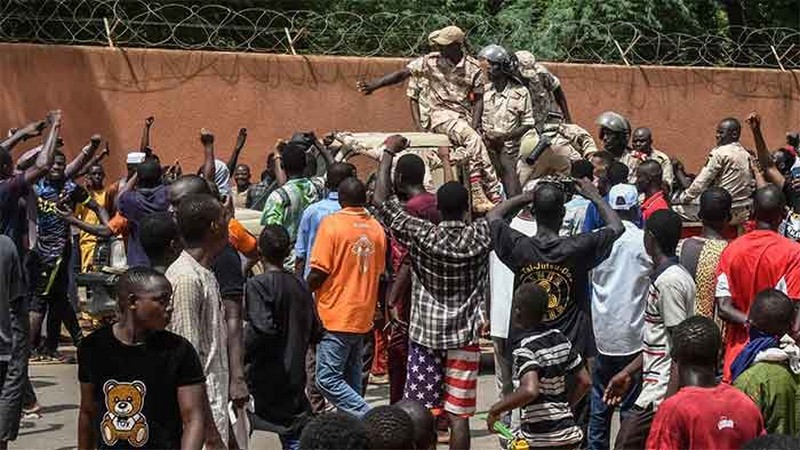
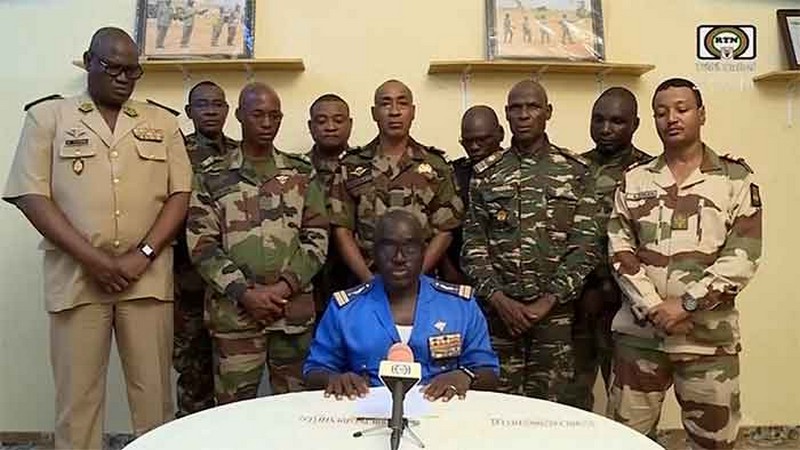
At 3 a.m. on July 26, 2023, the presidential guard detained President Mohamed Bazoum in Niamey, the capital of Niger. Troops, led by Brigadier General Abdourahmane Tchiani closed the country’s borders and declared a curfew. The coup d’état was immediately condemned by the Economic Community of West African States, by the African Union, and by the European Union. Both France and the United States—which have military bases in Niger—said that they were watching the situation closely. A tussle between the Army—which claimed to be pro-Bazoum—and the presidential guard threatened the capital, but it soon fizzled out. On July 27, General Abdou Sidikou Issa of the army released a statement saying that he would accept the situation to “avoid a deadly confrontation between the different forces which… could cause a bloodbath.” Brigadier General Tchiani went on television on July 28 to announce that he was the new president of the National Council for the Safeguard of the Homeland (Conseil National pour la Sauvegarde de la Patrie or CNSP).

The coup in Niger follows similar coups in Mali (August 2020 and May 2021) and Burkina Faso (January 2022 and September 2022), and Guinea (September 2021). Each of these coups was led by military officers angered by the presence of French and U.S. troops and by the permanent economic crises inflicted on their countries. This region of Africa—the Sahel—has faced a cascade of crises: the desiccation of the land due to the climate catastrophe, the rise of Islamic militancy due to the 2011 NATO war in Libya, the increase in smuggling networks to traffic weapons, humans, and drugs across the desert, the appropriation of natural resources—including uranium and gold—by Western companies that have simply not paid adequately for these riches, and the entrenchment of Western military forces through the construction of bases and the operation of these armies with impunity.

Two days after the coup, the CNSP announced the names of the 10 officers who lead the CNSP. They come from the entire range of the armed forces, from the army (General Mohamed Toumba) to the Air Force (Colonel Major Amadou Abouramane) to the national police (Deputy General Manager Assahaba Ebankawel). It is by now clear that one of the most influential members of the CNSP is General Salifou Mody, former chief of staff of the military and leader in the Supreme Council for the Restoration of Democracy, which led the February 2010 coup against President Mamadou Tandja and which governed Niger until Bazoum’s predecessor Mahamadou Issoufou won the 2011 presidential election. It was during Issoufou’s time in office that the United States government built the world’s largest drone base in Agadez and that the French special forces garrisoned the city of Irlit on behalf of the uranium mining company Orano (formerly a part of Areva).

It is important to note that General Salifou Mody is perceived as an influential member of CNSP given his influence in the army and his international contacts. On February 28, 2023, Mody met with the United States Chairman of the Joint Chiefs of Staff General Mark Milley during the African Chiefs of Defense Conference in Rome to discuss “regional stability, including counterterrorism cooperation and the continued fight against violent extremism in the region.” On March 9, Mody visited Mali to meet with Colonel Assimi Goïta and the Chief of Staff of the Malian army General Oumar Diarra to strengthen military cooperation between Niger and Mali. A few days later on March 16, U.S. Secretary of State Antony Blinken visited Niger to meet with Bazoum. In what many in Niger perceived as a sidelining of Mody, he was appointed on June 1 as the Nigerien ambassador to the United Arab Emirates. Mody, it is said in Niamey, is the voice in the ear of Brigadier General Tchiani, the titular head of state.

Corruption and the West

A highly informed source in Niger tells us that the reason why the military moved against Bazoum is that “he’s corrupt, a pawn of France. Nigerians were fed up with him and his gang. They are in the process of arresting the members of the deposed system, who embezzled public funds, many of whom have taken refuge in foreign embassies.” The issue of corruption hangs over Niger, a country with one of the world’s most lucrative uranium deposits. The “corruption” that is talked about in Niger is not about petty bribes by government officials, but about an entire structure—developed during French colonial rule—that prevents Niger from establishing sovereignty over its raw materials and over its development.

At the heart of the “corruption” is the so-called “joint venture” between Niger and France called Société des mines de l’Aïr (Somaïr), which owns and operates the uranium industry in the country. Strikingly, 85 percent of Somaïr is owned by France’s Atomic Energy Commission and two French companies, while only 15 percent is owned by Niger’s government. Niger produces over 5 percent of the world’s uranium, but its uranium is of a very high quality. Half of Niger’s export receipts are from sales of uranium, oil, and gold. One in three lightbulbs in France are powered by uranium from Niger, at the same time as 42 percent of the African country’s population lived below the poverty line. The people of Niger have watched their wealth slip through their fingers for decades. As a mark of the government’s weakness, over the course of the past decade, Niger has lost over $906 million in only 10 arbitration cases brought by multinational corporations before the International Centre for Settlement of Investment Disputes and the International Chamber of Commerce.

France stopped using the franc in 2002 when it switched to the Euro system. But, fourteen former French colonies continued to use the Communauté Financiére Africaine (CFA), which gives immense advantages to France (50 percent of the reserves of these countries have to be held in the French Treasury and France’s devaluations of the CFA—as in 1994—have catastrophic effects on the country’s that use it). In 2015, Chad’s president Idriss Déby Itno said that the CFA “pulls African economies down” and that the “time had come to cut the cord that prevents Africa from developing.” Talk now across the Sahel is for not only the removal of French troops—as has taken place in Burkina Faso and in Mali—but of a break with the French economic hold on the region.

The New Non-Alignment

At the 2023 Russia-Africa Summit in July, Burkina Faso’s leader, President Ibrahim Traoré wore a red beret that echoed the uniform of the assassinated socialist leader of his country, Thomas Sankara. Traoré reacted strongly to the condemnation of the military coups in the Sahel, including to a recent visit to his country by an African Union delegation. “A slave that does not rebel does not deserve pity,” he said. “The African Union must stop condemning Africans who decide to fight against their own puppet regimes of the West.”

In February, Burkina Faso had hosted a meeting that included the governments of Mali and Guinea. On the agenda is the creation of a new federation of these states. It is likely that Niger will be invited into these conversations.

Vijay Prashad is an Indian historian, editor, and journalist.

Kambale Musavuli, a native of the Democratic Republic of Congo (DRC), is a leading political and cultural Congolese voice.

2 August 2023

Source: countercurrents.org


Guantánamo 21 Years Later

By Karen J Greenberg

There can be little question that the grim prison at Guantánamo Bay, Cuba, which still shows no sign of closing anytime soon, is a key legacy — in the worst sense imaginable — of America’s post-9/11 forever wars.  I’ve been covering the subject for decades now and that shameful legacy has never diminished.

Last month, in response to a column I wrote for TomDispatch — one of dozens, I’m sad to say, that I’ve done on Guantánamo over these endless years — I received a surprise email: an invitation to attend a meeting at the British Parliament. A group known as the All Party Parliamentary Group (APPG) for Closing the Guantanamo Bay Detention Facility, formed this April, was gathering for the second time. Its stated purpose is “to urge the U.S. administration to close the Guantánamo Bay detention facility, to ensure the safe resettlement of those approved for release, and to ensure that due process is expedited for all the remaining prisoners.” Nine members of the House of Parliament and four Members of the House of Lords have already joined the group.

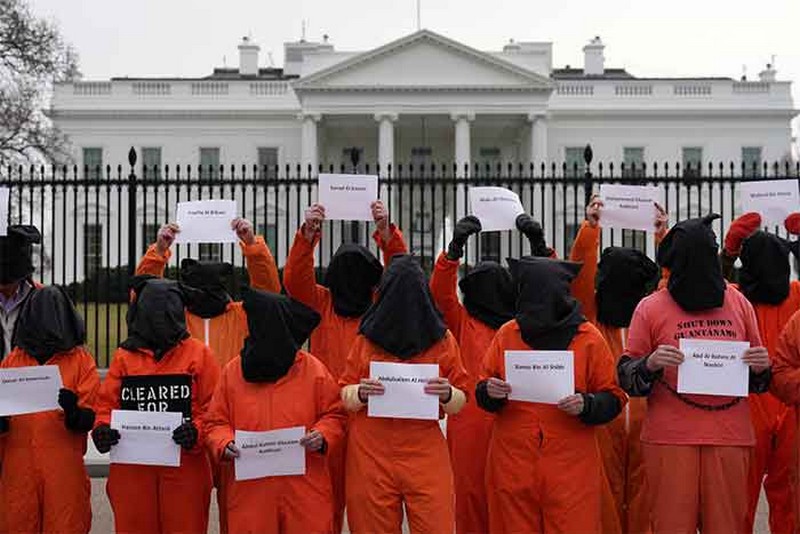
Thirty men remain in custody at that infamous American prison in Guantánamo Bay, Cuba. Sixteen of those detainees have finally been cleared for release; they are, that is, no longer subject to criminal charges or considered a potential danger to the United States and yet they still remain behind bars. Three other prisoners have never either been charged with a crime or cleared for release. Ten more are still facing trial, while one has been convicted and remains in custody there. For the APPG, the release of those 16 cleared detainees is a paramount goal.

That meeting I attended included a handful of MPs from all parties, as well as leading figures from British organizations that have been supporting justice for Guantánamo’s detainees for decades. Also present were two former detainees. One was Moazzem Begg, among the first prisoners released in 2005 and repatriated to England, where he is now a senior director at CAGE, an advocacy group focused on the remaining Gitmo detainees. In 2006, he published Enemy Combatant: My Imprisonment at Guantanamo, Bagram, and Kandahar, an early account of the injustices and cruelties in America’s war-on-terror prisons. The other was Mohamedou Salahi, whose book Guantánamo Diary led to the dramatic film The Mauritanian about his life at that infamous prison. A third former detainee, Mansoor Adayfi, author of Don’t Forget Us Here, had been transferred from Gitmo to Serbia in 2016. Though invited to attend, his visa wasn’t approved in time.

That meeting was but one of several recent events in which organizations outside the United States have issued detailed impassioned calls for this country to finally address the ongoing nightmare it created so long ago at Guantánamo.

Site Visits and U.N. Reports

In April, Patrick Hamilton, the head of the International Committee of the Red Cross (ICRC), made a site visit to Guantánamo and issued “a rare statement of alarm.” It was, as New York Times reporter Carol Rosenberg pointed out, the ICRC’s 146th visit to the prison since it opened in January 2002. That short statement urged American officials to address the deteriorating health of the prisoners there, concluding, “The planning for an aging population,” it concluded, “cannot afford to wait.”.

Then, in mid-June, the U.N. Human Rights Council followed up its own site visit by issuing a comprehensive, devastatingly critical report. Fionnuala Ni Aoláin, that council’s special rapporteur on the promotion and protection of human rights and fundamental freedoms while countering terrorism, focused on the potential war crimes and “crimes against humanity” committed against the detainees during and after their time at that island prison, now in its 21st year of existence.

Ni Aoláin was the perfect person for the job. She’s long defended human rights and international law, with a particular focus on issues of justice and human dignity. In 2013, she co-edited Guantánamo and Beyond: Exceptional Courts and Military Commissions in Comparative Perspective. Her 2023 report, clear, fact-based, and measured in tone, is in many ways a step above that of any of its predecessors.

Hers was, of course, anything but the first U.N. report to address the sins of Guantánamo. In 2010, the U.N. Human Rights Council prepared a detailed report on “global practices in relation to secret detention in the context of countering terrorism.” It focused on violations of international law carried out globally, often involving exceptionally cruel treatment and outright torture. Alongside sections on countries throughout Africa and the Middle East that abused captives, the torture and misuse of prisoners in the American war on terror at CIA black sites around the world and Guantánamo Bay took center stage. The study focused special attention on the lack of accountability when it came to Americans who had implemented or abetted the mistreatment and secret detention of prisoners.

Twelve years later, in March  2022, Ni Aoláin, five years into her role as special rapporteur wrote a follow-up to the report, highlighting “the abject failure to implement the recommendations” of that study and the “tragic and profound consequences for individuals who were systematically tortured, rendered across borders, arbitrarily detained, and deprived of their most fundamental rights.” Her update “reiterates the demand that accountability, reparation, and transparency be implemented by those states responsible for these grave human rights violations.”

Now, she has issued her new 23-page report, adding significantly to the debate over liberty and security that has defined discussions over Guantánamo since its birth in January 2002.

A Singular Report

A notable distinction between this report and those that preceded it is the access the special rapporteur was granted by the Biden administration. It was, in fact, the first visit ever to Guantánamo by an independent U.N. investigator. After two decades in which administration after administration placed severe restrictions on journalists as well as non-governmental and international organizations when it came to covering that prison, the Biden administration granted Ni Aoláin remarkably full access “to former and current detention facilities and to detainees, including ‘high value’ and ‘non-high value’ detainees.”

The interviews she conducted with those still imprisoned there were both confidential and unsupervised. She was allowed to deal with “military and civilian personnel, military commission personnel, and defense lawyers.” She also “interviewed victims, survivors, and families of victims of the September 11, 2001 terrorist attacks, former detainees in countries of resettlement or repatriation, and human rights and humanitarian organizations.” Ni Aoláin commended the Biden administration for allowing such unprecedented access. “Few states.,” as she puts it, “exhibit such courage.”

In the process, she drew a uniquely sweeping picture of Guantánamo — from the period after the horrifying 9/11 attacks through the widespread and gruesome torture of prisoners at CIA black sites to the grim details of detention at Gitmo itself to the often unjust and harmful fates of the detainees who were finally released to the persistent challenges that lie ahead. It’s the first report to tie together, historically as well as legally, the many grim pieces of the post-9/11 story that have previously been underappreciated.

Like its predecessors, Ni Aoláin’s report reiterates the sins of Guantánamo: the physical and psychological abuse and outright cruelties committed there and the lack of any access to justice for its prisoners. She also reminds us that “the vast majority of the men rendered and detained there were brought without cause and had no relationship whatsoever with the events that took place on 9/11.” She calls out the United States for its widespread ongoing violations of human rights and international law and mentions numerous times that the way it dealt with its detainees amounted to “cruel, inhuman, and degrading treatment.”

Her report, however, also potentially shifts the never-ending discussion of Guantánamo to new ground.

Putting the Focus on the Prisoners 

As a start, Ni Aoláin looks beyond policymaking to the more subtle forms of injustice and harm that became the daily essence of Guantánamo. She particularly focuses on what she calls the “arbitrariness” and the damage it has caused. “Arbitrariness,” she concludes, “pervades the entirety of the Guantánamo detention infrastructure,” leading to a persistent lack of predictability in treatment. While Standard Operating Procedures (SOPs) do exist when it comes to “detainee reception and transfer, restraints, cell block searches, mess operations, religious accommodations, and medication distribution,” the deeper reality has been one of constant, cruel, and unpredictable deviations from those SOPs.

In fact, “arbitrariness, confusion, and inconsistency” define life at Guantánamo and have only been exacerbated by the secrecy with which those SOPs are guarded, further intensifying the cruel and inhuman treatment that has always defined that prison. Ni Aoláin suggests that it’s finally time for transparency to come to Gitmo. For example, many of the detainees suffer from the long-term effects of torture, a past all too lacking in transparency, and neither they nor their lawyers have access to their unclassified medical files.

She underscores her focus on finally bringing humanity to Gitmo by arguing that the widespread abuses Americans committed over the years, including by setting up a prison offshore of American justice, also significantly impacted the families of those who were killed in the attacks of September 11, 2001. She begins with torture, suggesting “that the systematic rendition and torture at multiple (including black) sites and thereafter at Guantánamo Bay, Cuba — with the entrenched legal and policy practices of occluding and protecting those who ordered, perpetrated, facilitated, supervised, or concealed torture — comprise the single most significant barrier to fulfilling victims’ rights to justice and accountability.” In her view, the use of torture was “a betrayal of the rights of victims,” too, by making the holding of trials impossible to this day and so making both accountability and closure inconceivable for the victims’ families.

While widening the lens to include a larger pool of victims, Ni Aoláin also widens the time frame.  The mistreatment of detainees at Gitmo, she emphasizes, continues to this day. “Regrettably,” she writes, “the vast majority of detainees continue to experience sustained human rights violations beginning with the very process of transfer to the country of return or resettlement.”

In fact, the transfer of former prisoners from that prison to countries like the United Arab Emirates (UAE), SerbiaKazakstan, and Slovakia has often resulted in yet more degradation, including utter social ostracism, the inability to obtain work, or even additional transfers to countries where yet more cruel and inhuman treatment has subsequently occurred. Sadly, for those “released” from that prison, the term “Guantanamo 2.0” best describes their situations.

One case in particular has been a focal point for the APPG in London: Ravil Mingazov, a Russian citizen granted asylum in Great Britain. He was captured in Pakistan in 2002. Accused of being associated with al-Qaeda and the Taliban, he would then be transported to Gitmo where he remained until 2017 when he was cleared for release to the UAE. After his arrival there, however, he was again imprisoned, despite assurances that his release would include rehabilitation and support for rebuilding his life. He’s now been detained there for six years. In 2021, reports circulated that the UAE was trying to send Mingazov back to Russia, where he would face probable imprisonment and mistreatment. To make matters worse, for the past two years, his family has had no news of him.

Ni Aoláin also highlights American attempts to destroy certain parts of Guantánamo and so functionally erase the record of what went on there. She calls instead for “the preservation and access to both prior and present detention sites,” as well as medical records and digital evidence. The crimes committed at Guantánamo, she emphasizes, need to be kept on the record and addressed, adding that “the U.S. government has an ongoing obligation to investigate the crimes committed [there], including an assessment of whether they meet the threshold of war crimes and crimes against humanity.”

Worse yet, redress for the victims of the 9/11 attacks and their families remains lacking. They continue to need treatment in ways not provided for and she recommends a “comprehensive audit of existing medical support (physical and psychological) for victims and survivors” and a commitment “to comprehensive lifelong holistic support for survivors.”

Succinct, measured, and profoundly disturbing, her report calls for a way forward that directly addresses the crimes of the past, including the need for public apology, compensation to former detainees, and the shutting down of that infamous prison. Her message: after all these years, even decades, the harm and the crimes associated with Guantánamo are still unending.

Where We Are Now

While the U.N., the ICRC, the British Parliament, and various nongovernmental organizations focus on Guantánamo’s sins and its painful legacy, the United States continues to fail to close the prison, even though the need for closure was acknowledged in 2006 by no less than its “founder,” President George W. Bush. On July 14th, when the House passed its version of the latest National Defense Authorization Act, it not only kept in place a prohibition on the use of funds to close Guantánamo but extended a congressional ban on using such funds to transfer detainees to the United States or six countries in the greater Middle East, making the end of Gitmo that much harder.

With her steady hand and deployment of facts, Ni Aoláin was unsparing in her conclusions about the injustice and perpetual cruelty that still is Guantánamo. Yes, she appreciates any movement forward, even at this late date, including “the openness and willingness” of the Biden administration to allow her to visit the prison. Still, she couldn’t be clearer on what, 21 years later, is needed: accountability for the perpetrators and restitution for the victims.

Closing the prison, if it ever actually happens, will not be enough. Sadly, even such an act will not bring true closure to the sins of America’s forever prison.

Karen J. Greenberg, a TomDispatch regular, is the director of the Center on National Security at Fordham Law.

2 August 2023

Source: countercurrents.org

The coup in Niger

By Justin Podur

In the spirit of “every coup deserves a blog post”, here are some basics about the coup in Niger.

Caveats to start: I know a lot about coups, but I do not know a lot about Niger. What follows are from some readings I’ve been looking at, the most valuable being Rahmane Idrissa’s Historical Dictionary of Niger.

There are three threads that provide context for the Niger coup of July 26.

  1. Western – and French in particular – exploitation of the country which, for various French/Western reasons, is deepening and making people more miserable.
  2. Niger’s history of coups – and the recent regional coups in Burkina Faso and Mali.
  3. The roiling and seemingly unending conflict between “jihadi” groups like the Islamic State in the Sahel, etc., and the “French-led” regional counterinsurgency against these groups. (The scare quotes will be explained below).

Let us begin.

1. French exploitation

In the series on the Scramble for Africa, we covered France’s scramble for West Africa in episode 15. After overthrowing the West African states, France re-organized the territories for exploitation. The colonial currency regime (called the CFA Franc, which persists today in many of these countries) is a part of this system. The key references for this are Walter Rodney’s How Europe Underdeveloped Africa and the more recent Africa’s Last Colonial Currency by Pigaud and Samba Sylla. Imposing famines, huge colonial massacres, and the continual drain of resources were the order of the day.

The murderous mission of Voulet-Chanoine

Probably here we should mention the famous expedition of Voulet-Chanoine. These two French officers left from Senegal in November 1898 to try to conquer and unify West Africa under French colonial control. They had a number of troops and hundreds of enslaved porters. The stuff the Europeans needed to scramble for Africa was carried around for them by enslaved porters in chains – in a project all justified at the time in the name of abolishing slavery.

Anyway, back to Voulet-Chanoine. When they reached the Niger outpost, they committed a series of massacres, including one where the French made a big show of murdering children (Sansanne-Haoussa) and another where they murdered thousands of people at Birni-N’Konni. After a number of these massacres, Voulet-Chanoine’s fellow Frenchman Jean-Francois Klobb (a Lt. Colonel who gave Voulet, a captain, a direct order relieving him of command) caught the column and told the French troops to stop, so Voulet killed him too. That night, Voulet tore the galloons off his uniform and told his troops: “I am no longer a Frenchman, I am a Black chief. With you, I will found an empire.” A couple of days later the troops mutinied and killed both Voulet and Chanoine. The expedition continued on and killed more Africans and some of the French leaders went on to have successful military careers.

The French, like the other Europeans in Africa, also exerted control through periodic, murderous “punitive expeditions”.

Hunger and famine in colonial Niger

Shortly after the French consolidated their position in what would become Niger, there was a famine – in 1902-3. And another in 1913. And another in 1920. And another in 1930. Perhaps you will say there were famines before colonialism, and there were. But France imposed qualitatively more hunger and famines than existed before. Walter Rodney cites a Brazilian study by Josue de Castro, which Rodney says “convincingly indicates that the African diet was previously more varied, being based on a more diversified agriculture than was possible under colonialism.” To ensure Africans worked for them, France would prevent them from gathering foods or having gardens and force them to pay taxes in francs. France’s plunder of Africa also included conscripting 164,000 African troops to fight for them in World War I — which caused, among other things, a race panic in Germany – a story for another day.

Uranium was discovered just before Independence in 1959 and its exploitation was organized by a French company. In its generosity, France allowed Niger 5%, then eventually 12%, of the royalties from the exploitation of this resource, which provides some 1/3 of France’s uranium and is 63% owned by French capital (and 37% by Niger).

IMF and World Bank austerity

Between French capital’s control of the country’s resources and infrastructure, neocolonized Niger continued to experience famine and food shortages in 1972-3. The IMF pressured the country to privatize 54 state companies in 1984; the credit union was privatized in 1985. At the end of 1989, the new government followed a World-Bank encouraged policy of drastic cuts to education funding, called Project Education III. Student protests followed with police killing several student protesters in 1990. In 1992, in desperate financial straits, the government got $50M in aid by recognizing Taiwan, which meant China broke diplomatic relations. In 1995, the government signed a structural adjustment package with the IMF, was overthrown in a coup in 1996, and the post-coup government also signed a structural adjustment package. In 1997, the World Bank demanded more public sector cuts, leading to more public sector strikes. In 1998, the IMF congratulated the government for its compliance with austerity, as public sector strikes shut the whole civil service down. In 2000, the prime minister asked deputies to forgo their entire salaries: “The coffers of the state are absolutely empty”, he said. The combination of drought and austerity policy led to a severe food shortage in 2004-5: The IMF took the occasion to force the government to raise taxes on milk, sugar, and corn flour. The government backed off of some of the taxes after a month long strike. Another food crisis followed in 2010-2011.

France needs Africa to subsidize it

Colonialists always present their pillage as a gift to the colonized, but the reality is that the rich countries are generously funded by the poor, and France’s CFA Franc zone is a fountain of free resources for France. Having decided that France is going to join the US in its confrontation with Russia and China, it needs to squeeze the global south – and especially Africa – for the resources to do so. It’s a dangerous plan.

2. A history of coups in Niger

In the years leading up to Niger’s independence, the socialist leader who appeared positioned to take the country into the future was Djibo Bakary of the Mouvement Socialiste Africain, whose party came to be known as Sawaba. He was elected to lead the government in 1957, but he was overthrown and exiled by France in 1958, two years before independence happened. The next elections were rigged and the Sawaba party was disallowed. A Sawaba uprising happened in 1964 and was crushed – hundreds of Sawaba were imprisoned as political prisoners and in one incident, twenty one were suffocated to death at Maradi’s prison.

Besides being a socialist and pan-Africanist, Bakary’s crime was opposing de Gaulle’s idea for a Franco-African community. With Bakary out of the way, the post-Independence government joined the Franco-African community and signed an agreement allowing French troops to occupy Niger (a situation that persisted until the 1974 coup).

Reviewing the Historical Dictionary of Niger, I counted six coups: 1958, 1974, 1996, 1999, 2010, and now 2023. Several of these coups were by military officers who promised to hold elections quickly – and then did so! Other military governments stayed in power for a decade or more.

But the dynamics of a coup are never entirely local, as a perusal of William Blum’s book Killing Hope will show. Alternating between military and civilian governments, intervening in electoral processes where possible and resorting to military coup as needed, was the preferred method for keeping pro-US / pro-Western governments in power all over Africa for many decades after independence.

In recent decades, however, the US strategy has changed, to prefer dysfunctional civilian governments with low-level insurgencies that are then fought, but never defeated, by Western-led counterinsurgency efforts. This way, African militaries are always engaging in counterinsurgency under broad Western command against African populations. African resources still flow to the global north, with illicit flows taking a good share of the total. In endless war situations, land-grabs and resource-grabs are easier to hide (see, e.g. the US in Syria).

Which leads to our next section:

3. The French and US militaries in the region

The governments of West Africa have been under French military control since independence. The US initially exerted its own interests through France, but in recent decades has exerted influence more directly, through AFRICOM, especially since the overthrow of Gaddafi in Libya in 2011. The Niger government signed agreements allowing the US to operate lethal drones in Niger, and declared its support early on for the rebels that would overthrow Gaddafi. There are a large number of Islamist insurgent groups operating in the countries of the region: both Al Qaeda-branded and Islamic State-branded groups murder civilians, attack police stations and military outposts, and kidnap people. The attacks can be severe. Luca Raineri, writing in the journal Terrorism and Political Violence, summarized a series of attacks in west Niger in 2019 alone:

in May, twenty-eight Nigerien soldiers were killed in an armed ambush by ISGS; in July, ISGS stormed a Nigerien military position near Inatès, killing eighteen soldiers; in October, five Nigerien gendarmes were also killed in an ambush by ISGS near Abarey; in November, ISGS attacked the Malian military base of Indelimane, just across the Nigerien border, killing fifty-three Malian soldiers; in December, ISGS mounted a large-scale attack against the military base of Inatès, which claimed the lives of seventy Nigerien militaries; and in January 2020, a new ISGS assault on a Nigerien military post in Chinegodar killed at least eighty-nine soldiers.

This is a little bit more than a state can be asked to simply “live with” or “manage”, when the prescription for dealing with this violence is another decade of Western-led operations that seem to lead nowhere. After the destruction of the Libyan state, the so-called “jihadi” insurgencies have targeted states of the region and the US/France have been completely ineffective. The African militaries that have been subordinated in these counter-terrorism efforts have good reason to be impatient: their Western advisers are advising them to death.

Niger’s neighbours, Burkina Faso, and Mali, have both recently seen their civilian governments overthrown by the military. In all three coups, the militaries have complained about the handling of the fight against the “jihadist” insurgencies.

This is where Russia and China enter the story. Since the collapse of the USSR and until recently, African states had no alternative but Western military cooperation, even to try to resolve military problems like the Islamic State that were created by the West in the first place. But having watched Russia help Syria actually sweep the Islamic State out of Syria, the post-coup West African states might be wondering if they could pull off something similar.

Likewise, before the Belt and Road Initiative, African states had no alternative but to go to the IMF and World Bank and impose austerity, even though it trapped their people in debt and misery. Now there may be better deals to be found. Or at least, that thing capitalists supposedly love – a fair competition. Take a look at the visual capitalist from EIGHT years ago:

So, there are big stakes, and a wider conflict over the future of Africa, at work in this coup.

Justin Podur is the author of Haiti’s New Dictatorship (Pluto Press 2012).

1 August 2023

Source: countercurrents.org

The Profiteers of Armageddon-Oppenheimer and the Birth of the Nuclear-Industrial Complex

By William D Hartung

Unless you’ve been hiding under a rock for the past few months, you’re undoubtedly aware that award-winning director Christopher Nolan has released a new film about Robert Oppenheimer, known as the “father of the atomic bomb” for leading the group of scientists who created that deadly weapon as part of America’s World War II-era Manhattan Project. The film has earned widespread attention, with large numbers of people participating in what’s already become known as “Barbieheimer” by seeing Greta Gerwig’s hit film Barbie and Nolan’s three-hour-long Oppenheimer on the same day.

Nolan’s film is a distinctive pop cultural phenomenon because it deals with the American use of nuclear weapons, a genuine rarity since ABC’s 1983 airing of The Day After about the consequences of nuclear war. (An earlier exception was Stanley Kubrick’s Dr. Strangelove, his satirical portrayal of the insanity of the Cold War nuclear arms race.)

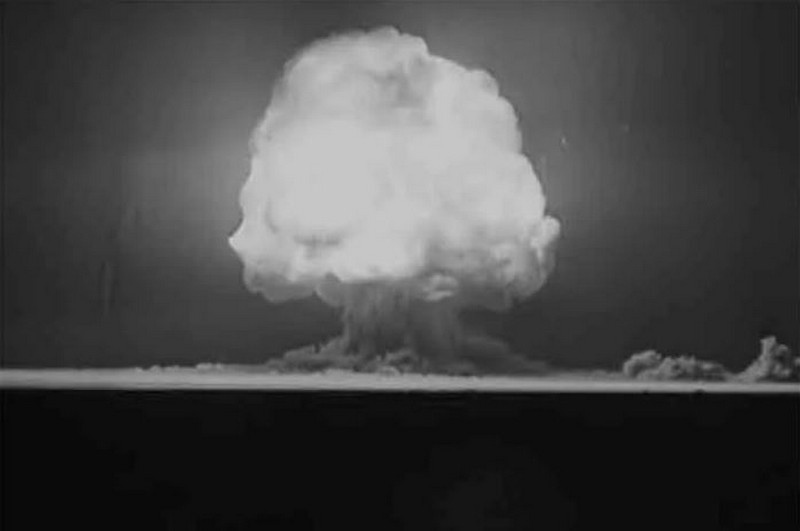
The film is based on American Prometheus, the Pulitzer Prize-winning 2005 biography of Oppenheimer by Kai Bird and Martin Sherwin. Nolan made it in part to break through the shield of antiseptic rhetoric, bloodless philosophizing, and public complacency that has allowed such world-ending weaponry to persist so long after Trinity, the first nuclear bomb test, was conducted in the New Mexico desert 78 years ago this month.

Nolan’s impetus was rooted in his early exposure to the nuclear disarmament movement in Europe. As he said recently:

“It’s something that’s been on my radar for a number of years. I was a teenager in the ‘80s, the early ‘80s in England. It was the peak of CND, Campaign for Nuclear Disarmament, the Greenham Common [protest]; the threat of nuclear war was when I was 12, 13, 14 — it was the biggest fear we all had. I think I first encountered Oppenheimer in… Sting’s song about the Russians that came out then and talks about Oppenheimer’s ‘deadly toys.’”

A feature film on the genesis of nuclear weapons may not strike you as an obvious candidate for box-office blockbuster status. As Nolan’s teenage son said when his father told him he was thinking about making such a film, “Well, nobody really worries about nuclear weapons anymore. Are people going to be interested in that?” Nolan responded that, given what’s at stake, he worries about complacency and even denial when it comes to the global risks posed by the nuclear arsenals on this planet. “You’re normalizing killing tens of thousands of people. You’re creating moral equivalences, false equivalences with other types of conflict… [and so] accepting, normalizing… the danger.”

These days, unfortunately, you’re talking about anything but just tens of thousands of people dying in a nuclear face-off. A 2022 report by Ira Helfand and International Physicians for the Prevention of Nuclear War estimated that a “limited” nuclear war between India and Pakistan that used roughly 3% of the world’s 12,000-plus nuclear warheads would kill “hundreds of millions, perhaps even billions” of us. A full-scale nuclear war between the United States and Russia, the study suggests, could kill up to five (yes, five!) billion people within two years, essentially ending life as we know it on this planet in a “nuclear winter.”

Obviously, all too many of us don’t grasp the stakes involved in a nuclear conflict, thanks in part to “psychic numbing,” a concept regularly invoked by Robert Jay Lifton, author of Hiroshima in America: A History of Denial (co-authored with Greg Mitchell), among many other books. Lifton describes psychic numbing as “a diminished capacity or inclination to feel” prompted by “the completely unprecedented dimension of this revolution in technological destructiveness.”

Given the Nolan film’s focus on Oppenheimer’s story, some crucial issues related to the world’s nuclear dilemma are either dealt with only briefly or omitted altogether.

The staggering devastation caused by the bombings of Hiroshima and Nagasaki is suggested only indirectly without any striking visual evidence of the devastating human consequences of the use of those two weapons. Also largely ignored are the critical voices who then argued that there was no need to drop a bomb, no less two of them, on a Japan most of whose cities had already been devastated by U.S. fire-bombing to end the war. General (and later President) Dwight D. Eisenhower wrote that when he was told by Secretary of War Henry Stimson of the plan to drop atomic bombs on populated areas in Japan, “I voiced to him my grave misgivings, first on the basis of my belief that Japan was already defeated and that dropping the bomb was completely unnecessary.”

The film also fails to address the health impacts of the research, testing, and production of such weaponry, which to this day is still causing disease and death, even without another nuclear weapon ever being used in war. Victims of nuclear weapons development include people who were impacted by the fallout from U.S. nuclear testing in the Western United States and the Marshall Islands in the Western Pacific, uranium miners on Navajo lands, and many others. Speaking of the first nuclear test in Los Alamos, New Mexico, Tina Cordova of the Tularosa Basin Downwinders Consortium, which represents that state’s residents who suffered widespread cancers and high rates of infant mortality caused by radiation from that explosion, said “It’s an inconvenient truth… People just don’t want to reflect on the fact that American citizens were bombed at Trinity.”

Another crucially important issue has received almost no attention. Neither the film nor the discussion sparked by it has explored one of the most important reasons for the continued existence of nuclear weapons — the profits it yields the participants in America’s massive nuclear-industrial complex.

Once Oppenheimer and other concerned scientists and policymakers failed to convince the Truman administration to simply close Los Alamos and place nuclear weapons and the materials needed to develop them under international control — the only way, as they saw it, to head off a nuclear arms race with the Soviet Union — the drive to expand the nuclear weapons complex was on. Research and production of nuclear warheads and nuclear-armed bombers, missiles, and submarines quickly became a big business, whose beneficiaries have worked doggedly to limit any efforts at the reduction or elimination of nuclear arms.

The Manhattan Project and the Birth of the Nuclear-Industrial Complex

The Manhattan Project Oppenheimer directed was one of the largest public works efforts ever undertaken in American history. Though the Oppenheimer film focuses on Los Alamos, it quickly came to include far-flung facilities across the United States. At its peak, the project would employ 130,000 workers — as many as in the entire U.S. auto industry at the time.

According to nuclear expert Stephen Schwartz, author of Atomic Audit, the seminal work on the financing of U.S. nuclear weapons programs, through the end of 1945 the Manhattan Project cost nearly $38 billion in today’s dollars, while helping spawn an enterprise that has since cost taxpayers an almost unimaginable $12 trillion for nuclear weapons and related programs. And the costs never end. The Nobel prize-winning International Campaign to Abolish Nuclear Weapons (ICAN) reports that the U.S. spent $43.7 billion on nuclear weapons last year alone, and a new Congressional Budget Office report suggests that another $756 billion will go into those deadly armaments in the next decade.

Private contractors now run the nuclear warhead complex and build nuclear delivery vehicles. They range from Raytheon, General Dynamics, and Lockheed Martin to lesser-known firms like BWX Technologies and Jacobs Engineering, all of which split billions of dollars in contracts from the Pentagon (for the production of nuclear delivery vehicles) and the Department of Energy (for nuclear warheads). To keep the gravy train running — ideally, in perpetuity — those contractors also spend millions lobbying decision-makers. Even universities have gotten into the act. Both the University of California and Texas A&M are part of the consortium that runs the Los Alamos nuclear weapons laboratory.

The American warhead complex is a vast enterprise with major facilities in California, Missouri, Nevada, New Mexico, South Carolina, Tennessee, and Texas. And nuclear-armed submarinesbombers, and missiles are produced or based in California, Connecticut, Georgia, Louisiana, North Dakota, Montana, Virginia, Washington state, and Wyoming. Add in nuclear subcontractors and most states host at least some nuclear-weapons-related activities.

And such beneficiaries of the nuclear weapons industry are far from silent when it comes to debating the future of nuclear spending and policy-making.

Profiteers of Armageddon: The Nuclear Weapons Lobby

The institutions and companies that build nuclear bombs, missiles, aircraft, and submarines, along with their allies in Congress, have played a disproportionate role in shaping U.S. nuclear policy and spending. They have typically opposed the U.S. ratification of a Comprehensive Nuclear Test Ban treaty; put strict limits on the ability of Congress to reduce either funding for or the deployment of intercontinental ballistic missiles (ICBMs); and pushed for weaponry like a proposed nuclear-armed, sea-launched cruise missile that even the Pentagon hasn’t requested, while funding think tanks that promote an ever more robust nuclear weapons force.

A case in point is the Senate ICBM Coalition (dubbed part of the “Dr. Strangelove Caucus” by Arms Control Association Director Daryl Kimball and other critics of nuclear arms). The ICBM Coalition consists of senators from states with major ICBM bases or ICBM research, maintenance, and production sites: Montana, North Dakota, Utah, and Wyoming. The sole Democrat in the group, Jon Tester (D-MT), is the chair of the powerful appropriations subcommittee of the Senate Appropriations Committee, where he can keep an eye on ICBM spending and advocate for it as needed.

The Senate ICBM Coalition is responsible for numerous measures aimed at protecting both the funding and deployment of such deadly missiles. According to former Secretary of Defense William Perry, they are among “the most dangerous weapons we have” because a president, if warned of a possible nuclear attack on this country, would have just minutes to decide to launch them, risking a nuclear conflict based on a false alarm. That Coalition’s efforts are supplemented by persistent lobbying from a series of local coalitions of business and political leaders in those ICBM states. Most of them work closely with Northrop Grumman, the prime contractor for the new ICBM, dubbed the Sentinel and expected to cost at least $264 billion to develop, build, and maintain over its life span that is expected to exceed 60 years.

Of course, Northrop Grumman and its 12 major ICBM subcontractors have been busy pushing the Sentinel as well. They spend tens of millions of dollars on campaign contributions and lobbying annually, while employing former members of the government’s nuclear establishment to make their case to Congress and the executive branch. And those are hardly the only organizations or networks devoted to sustaining the nuclear arms race. You would have to include the Air Force Association and the obscurely named Submarine Industrial Base Council, among others.

The biggest point of leverage the nuclear weapons industry and the arms sector more broadly have over Congress is jobs. How strange then that the arms industry has generated diminishing job returns since the end of the Cold War. According to the National Defense Industrial Association, direct employment in the weapons industry has dropped from 3.2 million in the mid-1980s to about 1.1 million today.

Even a relatively small slice of the Pentagon and Department of Energy nuclear budgets could create many more jobs if invested in green energy, sustainable infrastructure, education, or public health – anywhere from 9% to 250% more jobs, depending on the amount spent. Given that the climate crisis is already well underway, such a shift would not only make this country more prosperous but the world safer by slowing the pace of climate-driven catastrophes and offering at least some protection against its worst manifestations.

A New Nuclear Reckoning?

Count on one thing: by itself, a movie focused on the origin of nuclear weapons, no matter how powerful, won’t force a new reckoning with the costs and consequences of America’s continued addiction to them. But a wide variety of peace, arms-control, health, and public-policy-focused groups are already building on the attention garnered by the film to engage in a public education campaign aimed at reviving a movement to control and eventually eliminate the nuclear danger.

Past experience — from the Campaign for Nuclear Disarmament that helped persuade Christopher Nolan to make Oppenheimer to the “Ban the Bomb” and Nuclear Freeze campaigns that stopped above-ground nuclear testing and helped turn President Ronald Reagan around on the nuclear issue — suggests that, given concerted public pressure, progress can be made on reining in the nuclear threat. The public education effort surrounding the Oppenheimer film is being taken up by groups like The Bulletin of the Atomic Scientists, the Federation of American Scientists, and the Council for a Livable World that were founded, at least in part, by Manhattan Project scientists who devoted their lives to trying to roll back the nuclear arms race; professional groups like the Union of Concerned Scientists and Physicians for Social Responsibility; anti-war groups like Peace Action and Win Without War; the Nobel Peace prize-winning International Campaign to Abolish Nuclear Weapons; nuclear policy groups like Global Zero and the Arms Control Association; advocates for Marshall Islanders, “downwinders,” and other victims of the nuclear complex; and faith-based groups like the Friends Committee on National Legislation. The Native Americanled organization Tewa Women United has even created a website, “Oppenheimer — and the Other Side of the Story,” that focuses on “the Indigenous and land-based peoples who were displaced from our homelands, the poisoning and contamination of sacred lands and waters that continues to this day, and the ongoing devastating impact of nuclear colonization on our lives and livelihoods.”

On the global level, the 2021 entry into force of a nuclear ban treaty — officially known as the Treaty on the Prohibition of Nuclear Weapons — is a sign of hope, even if the nuclear weapons states have yet to join. The very existence of such a treaty does at least help delegitimize nuclear weaponry. It has even prompted dozens of major financial institutions to stop investing in the nuclear weapons industry, under pressure from campaigns like Don’t Bank on the Bomb.

In truth, the situation couldn’t be simpler: we need to abolish nuclear weapons before they abolish us. Hopefully, Oppenheimer will help prepare the ground for progress in that all too essential undertaking, beginning with a frank discussion of what’s now at stake.

William D. Hartung, a TomDispatch regular, is a senior research fellow at the Quincy Institute for Responsible Statecraft and the author of “More Money, Less Security: Pentagon Spending and Strategy in the Biden Administration.”

31 July 2023

Source: countercurrents.org

The Unsettling Settlers-Severely Damaging Americans

By Dan Lieberman

Unimpeded Jewish settler violence has left the Palestinian people in desperation. “Between 2010 and 2019, nearly 3,000 Israeli settler attacks killed at least 22 Palestinians and injured 1,258 others across the occupied West Bank.” “Data collected by the UN Office for Coordination of Humanitarian Affairs reveals that there have been at least 570 attacks against Palestinians in the West Bank in the first six months of 2023 – an average of three attacks a day.” With the settler attacks intensifying, the plight of the Palestinians grows more menacing.

Israeli Human Rights organization, B’Tselem,  describes how the Israeli government encourages the settlements

Most of the settlements in the West Bank are defined as national priority areas. Accordingly, the settlers and other Israeli citizens working or investing in the settlements are entitled to significant financial benefits. These benefits are provided by six government ministries: the Ministry of Construction and Housing (generous loans for the purchase of apartments, part of which is converted to a grant); the Israel Lands Administration (significant price reductions in leasing land); the Ministry of Education (incentives for teachers, exemption from tuition fees in kindergartens, and free transportation to school); the Ministry of Industry and Trade (grants for investors, infrastructure for industrial zones, etc.); the Ministry of Labor and Social Affairs (incentives for social workers); and the Ministry of Finance (reductions in income tax for individuals and companies).

Benefits are an inducement and not an excuse to acquire stolen property and are no reason to harass neighbors in an extreme and violent manner. Criminally attacking innocent Palestinians in adjacent villages gives the settlers a feeling of being all-powerful, all-commanding, all-authoritative, and having the right to murder, rob, and torch anyone they want.

The world treats the settlers as ultra-nationalists, as people with overzealous prophecies who are eager to fulfill a commitment to their God. They run amok because their beliefs are amok. Their violence must be stopped and, hopefully, legal and moral forces will subdue them. The word, as usual, is naive.

These hilltop villains arrive with a twisted mission — to bring their select group back to a land they fanatically believe God has given to them. People are entitled to their myths and ahistorical stories as a central focus to hold their ethnicity together; they are not entitled to take fantasy, pose it as a reality, and use the subverted reality for diabolical purposes. The settlers’ existence depends upon denying existence to others. The settlers’ principal purpose in life is to disturb the lives of others. They have often operated as a murderous contingent, completely unattached to reality, and finding pleasure in dominating their victims.

Not wanting the Israel Defense Forces (IDF), a euphemism for the Israel Offensive Forces (IOF), to be identified with the intended genocide of the Palestinian people, the Israeli government has purposely selected and conveniently installed the Orthodox Jews to play the role of shock troops for the government, commit the mayhem and carry out the vicious deeds. The ever-alert and just-around-the-corner police and military forces always arrive too late to halt the crimes committed against Palestinian villagers. No matter how severe the crime, the criminals are rarely apprehended, and if apprehended, never severely punished.

After decades of suffering under extreme oppression, with no end in sight, with oppressors who could live as well in other places, the destruction of the Palestinian people has unique qualities that defy rational thought. Particularly unique is the Western world’s assistance to the destruction, where, for the first time in history, external forces support and encourage mass violence against an established community, done in solicitation from Israel and in cooperation with foreign groups.

Examine the attacks from the promotions by the underwriters to the actions of the perpetrators and we learn that the attacks are a conspiracy of the unsettled and the deadly strikes on the Palestinians reverberate throughout the world; we are all menacingly affected and do not realize it.

Religious Right evangelists, multitudes of Jewish organizations, compromised political hacks, and the easily deluded, without compunction and without care of the damage they do to others, actively assist Israel in its deliberate repression of the Palestinians. The calamities that these partners in crime inflict upon the Palestinians are identifiable; their effect upon much of the rest of the world’s population is not understood. Political and policy subversion, financial corruption, moral degradation, harmful machinations against individuals that feature false charges of anti-Semitism, indoctrination, and unnecessary military actions are some of the calamities perpetrated against American citizens.

Military Action

In the invasion of Iraq, the U.S. government fooled its population and Americans suffered casualties from the treachery. The “intelligence assessment” that Sadaam Hussein was prepared to finalize the development of weapons of mass destruction (WMD) and attack the United States proved false and the reasons for the invasion became a hoax. Not revealed was that the hoax was a hoax. The George W. Bush administration’s reason for the invasion was not due to its fear of Hussein acquiring advanced weapons of mass destruction, it was due to the Israel-friendly neoconservatives — Richard Perle, Paul Wolfowitz, John Bolton, Douglas Feith, and Elliot Abrams — convincing the administration that a strong Iraq could become the central military power of the Middle East, be able to confront Israel, and should be defeated. How do we know this

It is ridiculous to assume that a government and its intelligence agencies could believe that Sadaam Hussein was “secretly creating biological agents using mobile laboratories in “road-trailer units and rail cars.” Laboratories for biological agents are fixed in tightly controlled and specifically designed buildings to maintain clean air and prevent escape of the deadly agents. How was this “secret operation” discovered? It wasn’t; it came from a supposed interview by German intelligence with one person, an Iraqi dissident, Rafid Alwan, known as Curveball. CNN investigated Curveball.

Subsequent U.S. investigations into the intelligence failure around the claims found that German intelligence considered the defector “crazy” and “out of control,” while friends said he was a “liar.” Just days after Powell’s presentation, U.N. weapons inspectors presented evidence they said disproved those claims. But six weeks later, on March 20, 2003, the United States launched its invasion, toppling Hussein’s government in three weeks but locking itself in a war against an insurgency that has cost more than 4,000 American lives. No biological weapons, no germ labs, no weapons of mass destruction of any kind were found in Iraq after the invasion.

Did Saddam Hussein try to acquire uranium yellowcake or aluminum tubes for developing nuclear weapons? He did not, but even if he did, the Iraqi leader did not have the equipment for enriching the uranium. What did he need and how long would it take to enrich the yellowcake? Iran claimed to have converted a few tons of yellowcake in 2004 and they still do not have sufficient uranium for a nuclear weapon.

Why did the U.S. government and its expert intelligence agencies believe Hussein was manufacturing biological weapons and seeking material for making a nuclear weapon? They could not and they did not believe the ridiculous propositions; it was just a way to trick the populace into thinking evidence was available that proved Hussein sought weapons of mass destruction and to justify the invasion without disclosing the real reason.

The neocons were intimately involved with Israel and promoted Israel’s interests. They had already produced a 1996 policy paper titled “A Clean Break: A New Strategy for Securing the Realm” for Israeli PM, Benjamin Netanyahu, and the document recommended the removal of Saddam Hussein. Couple the fact that the United States had no reason to attack Iraq with the constant urgings by the influential neocons in the Bush administration to topple Hussein and we have the reason for the unreasonable invasion of Iraq.

International Terrorism

International terrorism has caused havoc to Americans. This violent phenomenon would exist apart from Israel, but Israel’s oppression of the Palestinians has strengthened the terrorist ranks. How has Israel contributed to international terrorism? Osama bin Laden clarified that conjecture

Osama Bin Laden Warns America, CBS News by Joel Arak, October 30, 2004

He (bin-Laden) said he was first inspired to attack the United States by the 1982 Israeli invasion of Lebanon in which towers and buildings in Beirut were destroyed in the siege of the capital.

“While I was looking at these destroyed towers in Lebanon, it sparked in my mind that the tyrant should be punished with the same and that we should destroy towers in America, so that it tastes what we taste and would be deterred from killing our children and women,” he said.

From Lawfare

Recently declassified information from the first-ever interrogation of someone presumed to be a senior al-Qaeda operative captured after 9/11 provides dramatic new insights into Osama bin Laden’s plans for a follow-up attack to Sept. 11. Specifically, bin Laden was plotting a major attack in Israel, a move consistent with his obsession with the Arab-Israeli conflict and U.S. support for Israel. The attack was thwarted at the last minute.

The Middle East Institute connects Israel to the rise of Jihadists.

A number of jihadist groups have made Palestine a central tenet of their political goals. Over the years, Al Qaeda, one of the most powerful global jihadist outfits, has often mentioned Palestine in its various communications.
Consequently, the [ISIS} narratives target the United States, as a key ally of Israel and a direct contributor to the plight of the Ummah. Several European nations, along with Australia and Canada are also criticized for their recent calls to boycott the United Nations conference on racism — aimed at demonstrating Israel’s apartheid on Palestinians.

Financial

The American public rebels at swollen government budgets, huge government deficit spending, and punishing government debt, all intended to help the American nation, and refrains from voicing anger at the unnecessary government contributions to the foreign nation of Israel and its people.

As part of an agreement, signed by former president Barack Obama in 2016, the U.S. taxpayers pledged to give the Israel war machine $3.8 billion annually until 2029. The agreement releases Israel from budgeting funds for its military and diverts those funds to build settlements. In effect, Obama told Netanyahu, “You build the settlements and we’ll supply the weapons for militarizing them.”

As of March 1, 2023, the Congressional Research Service documents that the “United States has provided Israel $158 billion in bilateral assistance and missile defense funding.” The Jewish Virtual Library has a similar figure of $152 billion until the year 2022.

Unknown to most of the American public is how it subsidizes the settlements. The Washington Post had  a revealing opinion story on the subject

From 2009 to 2013, more than $220 million was sent across the ocean and into schools, synagogues and playgrounds dotting the hills of Judea and Samaria. Millions of tax-subsidized dollars have gone to Jewish settlements in Hebron, helping to sustain a grim reality in the segregated part of the city, where Palestinian movement is sharply restricted and their economic life has been suffocated.

Political System

In 2020, 28% of voters referred to themselves as white evangelicals. Overwhelmingly, they cast their votes for Republican candidates. The two most important issues for these churchgoers are Right to Life and support for Israel. The former is more talk than walk; candidates who run on a platform that includes women’s rights to abortion have done well. The latter issue, which is losing adherents in a younger bloc of the “saved,” serves Israel; many politicos have lost the evangelical vote and elections because they lacked unwavering support for Israel. Trump would be in Nowheresville if he defied the evangelicals and criticized Israel.

Led by Pastor John Hagee, founder and chairperson of Christians United for Israel (CUFI), dozens of spokespersons for the evangelical community spend prime time praising Israel to the faithful. In 2013, a Pew poll showed that 82 percent of white evangelicals agreed with the statement, “Israel was given by God to the Jews.”

Former Israel Prime Minister, Menachem Begin, courted the American evangelicals and Benjamin Netanyahu solidified the courtship after meetings with the most popular evangelical personalities, Jerry Falwell and Pat Robertson. Each July, thousands of conservative evangelicals gather in Washington, DC for an annual summit of CUFI. Besides voting massively for candidates who support Israel, estimates have the conservative evangelical community contributing between $175 and $200 million annually to the apartheid state.

The evangelist community votes are insufficient to assure Israel gets its chosen candidates into office. Individual Political Action Committees (PAC) operating under the umbrella of the American Israel Public Affairs Committee (AIPAC), pro-Israel groups, such as United Democracy Project (UDP), Democratic Majority for Israel, Republican Jewish Coalition, and Pro-Israel America, and wealthy Jewish individuals supply campaign contributions in big numbers. According to the Center for Responsive Politics, gambling casino operator, “Sheldon Adelson, and his wife, Miriam, spent $123 million on the 2018 midterm elections, all of it benefiting Republicans.”

PACs allied with AIPAC “poured more than $24m into defeating Democratic primary candidates critical of Israel. …it celebrated defeating former congresswoman Donna Edwards, who was the favorite to win a Maryland seat until the UDP spent $7m to unleash an advertising blitz against her.” In the 2022 Democratic primary for a congressional seat in northwestern Detroit, the UDP spent more than $4m to defeat Andy Levin, an Israel supporter who “dissented from AIPAC’s support for hardline Israeli policies.”

No argument with individuals and PACs legally contributing to the campaigns of candidates they favor and feel will propose policies benefiting the American people. AIPAC and its allied Jewish organizations and individuals contribute to the campaigns of candidates that favor the policies that benefit a foreign government, Israel, and, often, purposely steer elections for one narrow reason — to defeat candidates who may be rewarding to the American electorate but criticize Israel.

Reshaping U.S. policies

In 2010, the FBI uncovered 10 unregistered Russian agents living in the U.S. as ordinary citizens, engaged in harmless activities, such as meeting people in high places in order to influence their attitudes and reporting American views on foreign and domestic affairs to Moscow. Multiply the number of discovered Russian agents by thousands and you will have the number of Israeli expatriates in the U.S. who do the same for Israel and more; by becoming U.S. citizens they vote for Israel-friendly candidates.

In 2014, the Israeli government ministries and the Los Angeles-based Israeli American Council, which represents Israelis across the United States and promotes their interests, estimated between 500,000 and 800,000 Israelis lived in the U.S., about 150,000 living in the New York area, 120,000 in Los Angeles, and 80,000 in Miami. What are the more important voting areas in the United States? New York, California, and Florida are significant. Enough dual-citizen American-Israelis can shape the ballot in those regions and may have done that in Florida during the disputed 2000 presidential election.

Has Israel purposely selected citizens to emigrate to the United States and influence voters? I have known Israelis living and working in the United States who have invited people into their homes and propagandized for Israel, persuaded synagogues to display the Israeli flag, and collected statistical information for Israel. Others went to Israel, became allied with a known Israeli institute, returned with a grant from a Jewish institution, and, due to previous ties with a recognized Israeli institute, became scholars at recognized think tanks.

In addition to its allied PACS’ efforts to steer American elections, AIPAC functions as a Congressional lobby. Funding annual trips to Israel for senators and representatives is an essential part of the “wooing” of Congress. According to Legistorm, “AIPAC’s charity arm has spent $15.7 million on congressional visits to Israel since 2000. On gift travel disclosures, AIPAC says the purpose of these trips is ‘educating policymakers about the U.S.-Israel relationship.’”

Important congressional leaders attend its annual convention in Washington, where AIPAC displays its influence in shaping the federal government and its policies. During the Covid epidemic in 2020, AIPAC convention speakers included Vice President Mike Pence, House Minority Leader Kevin McCarthy, former Democratic presidential candidate Michael Bloomberg, Secretary of State Mike Pompeo, Democratic Sens. Chuck Schumer and Cory Booker, Democratic Rep. Nita Lowey, and New York Governor Andrew Cuomo. These influential political figures must have a reason (getting elected?) for paying homage to the Lobby for Israel group.

Harmful machinations against individuals

Unable to respond to the obvious reality of an Israel built upon the theft of Palestinian lands and oppression of the Palestinian people, Israel’s supporters resort to slander and vicious attacks on Americans to deter the population from understanding the Middle East crisis.

Canary Mission, AMCHA Initiative, anti-Defamation League, and other Jewish organizations ferret out groups and persons that support the Palestinians and harass and defame them with the usual charge of anti-Semitism. The attacks lead to the proposition that Anti-Zionism equals Anti-Semitism, an identity that has become the final resting place of the word “anti-Semitism.”

Stealing another community’s lands, ethnically cleansing a population, and instituting a severe repression that terrorizes the community — controls their daily life, purposely denies agriculture, water rights, and fishing rights, willfully ruins cherished olive and orange groves, interferes in acquiring livelihood and employment, and reduces their ontological security — describes the Zionist intrusion into the land of Palestine and is a Goddamn awful way to behave. Being against Zionism is a positive and meritorious action. No sound person can argue with that recommendation.

If anti-Zionism is a positive and meritorious action, then the equation anti-Zionism = anti-Semitism indicates that anti-Semitism is a positive and meritorious action. Can that be? No, it cannot be, and Israel’s supporters are guilty of defaming Jews and should be reproached for their insistence that anti-Zionism = anti-Semitism. Or, maybe this shows the unworthiness of the word anti-Semitism, that it is not a word to describe hate; it is a hateful word used to prevent debate and harm people.

Conclusion

Pro-Israel organizations have used nefarious methods to skew voting patterns, manipulate the American mindset, and prevent legitimate debate. They have made a mockery of American democracy and allied Americans as partners in an intended destruction of the Palestinian people.

The manner in which the Israeli settlers have inflicted their deadly operations on the Palestinians characterizes the happenings in an insane world. Imagine someone running through the streets, injuring innocent pedestrians and onlookers saying, “That’s not nice, you shouldn’t be doing that and others saying, “How can I help? And, when you’re finished, come over for a cup of coffee.”

Everything should be done to stop this madness; too little has been done and that little has been ineffective. The reason for this deficiency is obvious, a thought exists that bringing Israel to the Court of Justice harms the Jewish people. Just as anti-Zionism equates to anti-Semitism is an oxymoron, “bringing Israel to the Court of Justice harms the Jewish people” is also a contradiction. The Jewish people have already harmed themselves. Helping other people is a high priority in a moral world. Helping the Palestinians to escape destruction is one of the high priorities. Accomplishing that task will not harm the Jewish people; it will prevent an eventual moral and physical destruction of the people of the book, a win-win proposition for all participants in the crisis.

Dan Lieberman publishes commentaries on foreign policy, economics, and politics at https://dlieb10gmailcom.substack.com/.

28 July 2023

Source: countercurrents.org

That Other War – Struggle and Suffering in Sudan

By Priti Gulati Cox and Stan Cox

It’s been devastating, even if no one’s paying attention.

Three months of fighting in Sudan between the army and a paramilitary group called the Rapid Support Force (RSF) has left at least 3,000 people dead and wounded at least 6,000 more. Over two million people have been displaced within the country, while another 700,000 have fled to neighboring nations. According to the World Health Organization, two-thirds of the health facilities in Khartoum, the capital, and other combat zones are now out of service, so the numbers of dead and injured are believed to be far higher than recorded, and bodies have been rotting for days in the streets of the capital, as well as in the towns and villages of the Darfur region.

Almost all foreign nationals, including diplomats and embassy staff, are long gone and so, according to Al Jazeera, hundreds or thousands of Sudanese who had visa applications pending have instead found themselves marooned in the crossfire with their passports locked away inside now-abandoned embassies. In the Darfur region, according to non-Arab tribal leaders, the RSF and local Arab militias have been carrying out mass killings, raping women and girls, and looting and burning homes and hospitals. Earlier this month, United Nations humanitarian chief Martin Griffiths told the Associated Press, “If I were Sudanese, I’d find it hard to imagine that this isn’t a civil war… of the most brutal kind.”

According to the United Nations, half the country’s population, a record 25 million people, is now in need of humanitarian aid. And worse yet, half of those are children, many of whom were in dire need even before this war broke out. Tragically, global warming will only compound their misery. Among 185 nations ranked by the Notre Dame Global Adaptation Initiative, Sudan is considered the sixth most susceptible to harm from climate change.

Heat waves, drought, and flooding are projected to become ever more frequent and intense as the atmosphere above Sudan warms further. This summer war and weather have been converging in strikingly deadly ways. With cloudless skies, water and electricity services largely knocked out, and daily temperature highs in the capital recently ranging from 109° to 111° Fahrenheit, the misery is only intensifying. Meanwhile, in the Darfur region and across the border in eastern Chad, the season of torrential rains is about to begin. The country director for Concern Worldwide in Chad says that many of the quarter-million Sudanese refugees there “are living in makeshift tents made from sticks and any material they can find, which means they are not protected from the heavy rains. The situation is catastrophic.”

This Conflict Will Not Be Televised

Among the refugees from this war are some of our own relatives and in-laws, part of an extended Indian-Sudanese family who have lived in Khartoum all their lives. In May, they fled the escalating violence, some via a perilous, hair-raising 500-mile road trip across the Nubian Desert to Port Sudan. There, they caught a ship across the Red Sea to Jeddah, Saudi Arabia. Their goal, as they informed us in June through voice messages, was Egypt — so far, the most common destination for Sudanese refugees over the past three months. And mind you, desperate as they may be, our relatives are in a far less perilous situation than people fleeing the Darfur region for Chad. Still, they are leaving behind a life built up over decades, without knowing if they will ever be able to return to Khartoum.

And here — for us — is a disturbing reality. We’ve had to do a lot of searching to find significant information in the U.S. major media about the struggle in Sudan, no less the plight of its refugees — though recently there were finally substantive reports at NPR and in the Washington Post. Still, the contrast with 16 months of breathless, daily, top-of-the-hour reporting on the Ukraine war and the millions of people it’s displaced has been striking indeed.

There’s a major difference as well between Washington’s responses to each of those wars. Before the fighting broke out in Sudan, the country had about 30% fewer people living in need of humanitarian assistance than Ukraine. Now, it has almost 50% more than Ukraine. Given those relative needs, U.S. humanitarian aid to Sudan in Fiscal Year 2023 ($536 million) was not all that skimpy compared with the humanitarian aid going to Ukraine ($605 million). — not, at least, until you add in the $49 billion in military aid Washington has been sending to Kyiv — 80 times the civilian aid, to which has only recently been added fundamentally anti-humanitarian cluster bombs. In the past year, in other words, Ukraine got 13% more humanitarian aid than Sudan but 93 times more total aid when you count war assistance.

And the U.S. is not alone. The entire world is lagging badly in its response to the humanitarian tragedy in Sudan. William Carter of the Norwegian Refugee Council recently lamented, “I haven’t seen it treated with urgency. It’s not ignorance; it’s a case of apathy.” Admittedly, conditions in Sudan and Chad make aid delivery difficult now, but Western powers, Carter pointed out, are simply “not willing to stick their necks out.”

Sidelining Civilians, Coddling Generals

Washington has assisted Ukraine massively since the war there began. In contrast, its actions in the months leading up to Sudan’s current conflict were not only ineffective but may even have made war more likely.

Some background: Four years ago, a popular uprising overthrew the country’s longtime autocratic president, Omar al-Bashir. A Sovereignty Council was formed to negotiate a transition to democracy. Susan Page, who served as the first U.S. ambassador to the Republic of South Sudan, has written that the council’s designation as a “civilian-led transitional government” was “always a bit of a fig leaf,” given that its membership included more military officials than civilians. The transition was even led by military officials, including the two men who command the forces now locked in battle, Sudanese army chief General Abdel-Fattah Burhan and General Mohamed Hamdan, who leads the RSF paramilitary group.

After two years of obstructing the work of the Sovereignty Council, that odd duo joined forces in an October 2021 coup and took control of Sudan. The negotiations over a democratic transition, mediated by the United States, Great Britain, the United Arab Emirates, and Saudi Arabia nonetheless went on for another 18 months, while those generals continued to stonewall. According to Democratic Senator Chris Coons of Delaware, the generals even stooped to outright extortion, hinting that if they didn’t get full backing from the West, they’d create a fresh migration crisis in Europe by kicking out hundreds of thousands of their fellow Sudanese and sending them northward. Still, last February, with military-civilian negotiations bogged down, Coons remained hopeful, writing,

“The Sudanese people… are not backing down in the defense of their political gains. Even in the face of persistent killings, sexual violence, and arrests by the regime, a massive, nationwide pro-democracy movement has for months maintained nonviolent street protests. The determination these thousands of people have shown as they risk their lives against heavily armed security forces should serve as a reminder the world over of how precious democracy truly is.”

Coons urged the Biden administration to throw its weight behind the pro-democracy movement, with sanctions that would hit the military leaders hard while sparing civil society: “A modern, comprehensive set of sanctions on the coup leaders and their networks,” he wrote, “will disrupt the military’s revenue streams and their grip on power, creating an opening for the nation’s nascent democracy movement to grow.” As is now painfully obvious, Biden didn’t take Coons’s advice and, six weeks later, the shooting started.

In an article published soon after the outbreak of fighting, Edward Wong and three colleagues at the New York Times reported that some of the people who played a part in the negotiations told them “the Biden administration, rather than empowering civilian leaders, prioritized working with the two rival generals,” even after they’d seized power in that coup. A high-level government adviser assured the Times that senior American diplomats “made the mistake of coddling the generals, accepting their irrational demands, and treating them as natural political actors. This fed their lust for power and their illusion of legitimacy.”

“A Critical Puzzle Piece”

The broad lack of concern for the Sudanese people in the U.S. and other rich countries also contrasts sharply with the intense geopolitical interest in Sudan of certain regional powers. Mohammad Salami of the International Institute for Global Strategic Analysis observes that Washington’s Persian Gulf allies have big plans for Sudan, thanks to its strategically important Red Sea coastline, its wealth in mineral resources, and its potential for tourism and agricultural production. (We can’t help wondering if they’re taking into account the degree to which its farming may, in the future, be clobbered by climate change.) Looking ahead, Salami writes, “The United Arab Emirates and Saudi Arabia have long-term plans for Africa, and for Sudan as their gateway to it.”

Until the recent chaos began, Sudan had also been a gateway for refugees from Asia, the Middle East, and other parts of Africa. Writing less than three weeks into the Sudan conflict, MSNBC columnist Nayyera Haq observed that many of the people then fleeing the country were, in fact, repeat refugees, having fled previous conflicts in Syria, Yemen, and Myanmar, among other places. As Western diplomats and embassy staff across Khartoum rushed for the exits (echoes of Kabul and Kandahar two summers ago!), Haq concluded,

“Sudan, once considered a far-off nation, is now a critical puzzle piece in this era of great power competition among global economies. As boundaries continue to blur because of technology and climate change, forced migration is more common: millions flee north from Latin America to the U.S., from Syria to Europe, and now across East Africa. But the same countries eager to extract oil and minerals from Africa are quick to shut down, only watching out for their own as Sudan devolves into chaos.”

Sudan is indeed rich in mineral resources that span the alphabet: aluminum, chromium, cobalt, iron, manganese, nickel, rare earths, silver, and zinc. All of those are important to the world’s renewable energy and battery industries. But Sudan’s biggest source of wealth lies in its gold deposits. The gold-mining industry is largely owned by a Russian-Sudanese joint venture headquartered in the northeast of the country. The wealth it’s generated hasn’t benefited the Sudanese people. Before the recent chaos, in fact, it was being split by the military regime, the Russian government, and none other than the infamous warlord Yevgeny Prigozhin’s Wagner Group, which had been managing the joint venture’s gold-mining and processing operations since 2017. And Wagner being Wagner, they also have now taken sides in Sudan’s war, according to the U.S. Treasury Department, by providing surface-to-air missiles to the RSF paramilitary forces.

Unworthy Victims

The paucity of attention paid to civilian victims of the conflict in Sudan compared to Ukrainian civilians brings to mind the contrast between “worthy” and “unworthy” victims drawn by Edward Herman and Noam Chomsky in their 1988 book Manufacturing Consent. They contrasted the extensive mass-media coverage of the 1984 murder of a Polish priest, Jerzy Popieluszko, during the Cold War with the lack of the same when it came to more than two dozen priests and other religious people slaughtered by governments and death squads in El Salvador and Guatemala in those years., Having been murdered by agents of a Communist government. Popieluszko was regarded as worthy of attention in the American media of the time, while his counterparts slaughtered by Central American governments allied with the U.S. weren’t. In a similar fashion, white Europeans now being killed, wounded, or rendered homeless by Russian troops are victims worthy of media attention, while Sudanese facing similar fates aren’t.

To be fair, a previous horrific conflict that gripped Sudan’s Darfur region from 2003 to 2008 did receive significant coverage in the Western media thanks to a convergence of unusual circumstances. The chief among them: the massive attention it received from celebrities of the time, including Angelina Jolie, George Clooney, Lady Gaga, and Mia Farrow. Sudan’s media appeal of 15 years ago was, however, an exception to the rules of this world of ours. Today, such celebrities and the media seem to be gripped by a kind of compassion fatigue.

Of course, like most Americans, we were paying no attention whatsoever to developments in Sudan before the fighting started — and before we learned that our own kinfolk were in danger. Now, what choice do we have but to keep up with the latest developments?

For weeks, our relatives were in limbo, trying to reach Egypt. Some were already in Jeddah, Saudi Arabia, but stuck there. Others had made it to Addis Ababa, Ethiopia. We were by then in touch and they acknowledged that they were “better off than most,” meaning they weren’t being pinned down in a deadly 110° war zone without passports, electricity, or running water, nor were they, like so many Sudanese, trapped in squalid refugee camps.

Only the other day, we finally learned that they had arrived safely in Egypt. Back in Khartoum they’d operated a small school, and they’re now hoping, if they can work their way through Cairo’s bureaucracy, that, as one of them put it, “Next year, Inshallah, we can start our school here, if we are still here and still war-driven.” Their futures have indeed been driven by war into a hard-to-imagine future. As one put it, “Nothing seems to be settling down in Sudan anytime soon.”

Sadly, their assessment seems all too accurate. Since April, at least 10 ceasefires between the army and that paramilitary outfit have broken down more or less instantly. In mid-July, leaders of the six countries bordering Sudan met, in the impressive-sounding words of Egyptian President Abdel Fattah el-Sissi, to formulate “an executive action plan to reach a comprehensive solution to the Sudanese crisis.”

Not so surprisingly, though, no such plan has yet emerged. Given its resources and its geographical centrality, an assortment of richer, stronger countries all want a piece of Sudan, but none of those plans include the war’s victims. To make matters worse, in this war (as in others to come), climate disruption will be a “threat multiplier.” Worse yet, as long as our media fails to see the Sudanese conflict or, more importantly, the Sudanese people as worthy of extensive reporting, the realities of the ongoing war there will continue to lie somewhere beyond the horizon.

Priti Gulati Cox, (@PritiGCox), a TomDispatch regular, is an artist and writer.

Stan Cox, a TomDispatch regular, is the author of The Path to a Livable Future: A New Politics to Fight Climate Change, Racism, and the Next Pandemic.

28 July 2023

Source: countercurrents.org