Just International

This Kennedy speech is still the most sincere voice by any US president on world peace

By Bharat Dogra

Recently a speech made by President John Kennedy 60 years back on June 10, 1963 at the American University, Washington has been widely cited in the context of the peace efforts particularly to improve US-Russia relations. At the same time, however, its wider significance should not be missed.

This wider significance rests partly in the greatness that Kennedy had already achieved while, together with Nikita Khrushchev, pulling the world back from the very edge of a likely exchange of nuclear weapons. In the case of Kennedy the credit was even greater than that for Khrushchev because Kennedy had to take this step in the face of opposition of some of his own top military and intelligence officials. He was thus taking a great personal risk in this effort ( as events later proved the series of steps he took to make the US systems more responsive to peace and justice ultimately led to a very severe backlash by entrenched powerful interests, culminating in his assassination).

Kennedy’s deep commitment to peace was enhanced by his wisdom in maintaining a dialogue with Khrushchev to increase trust which was of vital importance for securing a deal that relied a lot on verbal assurance—while the Soviet Union was to withdraw nuclear missiles immediately, the USA made secret promises to withdraw its nuclear missiles from Turkey after some time, a promise it kept. Thus with their wisdom and mutual trust these two leaders were able to save the world from nuclear war despite a flashpoint having been reached.

Thus President Kennedy was very sincerely and firmly on the path of world peace when he made this speech; he had a lot of moral strength to back what he said. This cannot be said of any recent Presidents, whether Clinton or Obama or Bush, who reminded one of hypocrisy whenever they spoke of peace, and as far as Joe Biden is concerned, the least said the better. Of course even in the speech of Kennedy sometimes the USA’s commitment to peace at that time is described to be more than the reality, but this is because the President is trying to take his people forward on the path of peace in a more gentle and less controversial way, knowing well how much opposition there is from powerful interests. Let us not forget that when this speech was made, the previous president Eisenhower’s famous warning regarding the military industrial complex had already been voiced.

While making a strong pitch for world peace, President Kennedy asked—“what kind of peace do I mean? What kind of peace do we seek?” He replied—“Not a Pax Americana enforced on the world by American weapons of war. Not the peace of the grave or the security of the slave. I am talking about genuine peace, the kind of peace that makes life on earth worth living, the kind that enables men and nations to grow and to hope and to build a better life for their children–not merely peace for Americans but peace for all men and women–not merely peace in our time but peace for all time.”

This definition of peace—the kind of peace President Kennedy advocated—must be considered by the present US leadership because at present when they speak of peace it is the kind that was very specifically negated by President Kennedy.

Then he spoke words which are clearly even more relevant today—“Total war makes no sense in an age when great powers can maintain large and relatively invulnerable nuclear forces and refuse to surrender without resort to those forces. It makes no sense in an age when a single nuclear weapon contains almost ten times the explosive force delivered by all the allied air forces in the Second World War. It makes no sense in an age when the deadly poisons produced by a nuclear exchange would be carried by wind and water and soil and seed to the far corners of the globe and to generations yet unborn.”

Looking at some contradictions of world’s understanding of security he said, “Today the expenditure of billions of dollars every year on weapons acquired for the purpose of making sure we never need to use them is essential to keeping the peace. But surely the acquisition of such idle stockpiles–which can only destroy and never create–is not the only, much less the most efficient, means of assuring peace.”

Then he spoke of the great importance of the agenda of peace and why it should not just look at rivals or supposed enemies but must look inwards at our own attitudes. President Kennedy said—

“I speak of peace, therefore, as the necessary rational end of rational men. I realize that the pursuit of peace is not as dramatic as the pursuit of war–and frequently the words of the pursuer fall on deaf ears. But we have no more urgent task.

“Some say that it is useless to speak of world peace or world law or world disarmament–and that it will be useless until the leaders of the Soviet Union adopt a more enlightened attitude. I hope they do. I believe we can help them do it. But I also believe that we must reexamine our own attitude–as individuals and as a Nation–for our attitude is as essential as theirs. And every graduate of this school, every thoughtful citizen who despairs of war and wishes to bring peace, should begin by looking inward–by examining his own attitude toward the possibilities of peace, toward the Soviet Union, toward the course of the cold war and toward freedom and peace here at home.”

Speaking on more practical aspects of a peace program he invited his audience to focus on “more attainable peace– based not on a sudden revolution in human nature but on a gradual evolution in human institutions–on a series of concrete actions and effective agreements which are in the interest of all concerned. There is no single, simple key to this peace–no grand or magic formula to be adopted by one or two powers. Genuine peace must be the product of many nations, the sum of many acts. It must be dynamic, not static, changing to meet the challenge of each new generation. For peace is a process–a way of solving problems.

“With such a peace, there will still be quarrels and conflicting interests, as there are within families and nations. World peace, like community peace, does not require that each man love his neighbor–it requires only that they live together in mutual tolerance, submitting their disputes to a just and peaceful settlement. And history teaches us that enmities between nations, as between individuals, do not last forever. However fixed our likes and dislikes may seem, the tide of time and events will often bring surprising changes in the relations between nations and neighbors.”

Speaking of Soviet Union, he asked his people to go beyond narrow view to see the common stake of both countries in peace, He said—“Among the many traits the peoples of our two countries have in common, none is stronger than our mutual abhorrence of war. Almost unique among the major world powers, we have never been at war with each other. And no nation in the history of battle ever suffered more than the Soviet Union suffered in the course of the Second World War. At least 20 million lost their lives. Countless millions of homes and farms were burned or sacked. A third of the nation’s territory, including nearly two thirds of its industrial base, was turned into a wasteland–a loss equivalent to the devastation of this country east of Chicago.

“Today, should total war ever break out again–no matter how–our two countries would become the primary targets. It is an ironic but accurate fact that the two strongest powers are the two in the most danger of devastation. All we have built, all we have worked for, would be destroyed in the first 24 hours. And even in the cold war, which brings burdens and dangers to so many nations, including this Nation’s closest allies–our two countries bear the heaviest burdens. For we are both devoting massive sums of money to weapons that could be better devoted to combating ignorance, poverty, and disease. We are both caught up in a vicious and dangerous cycle in which suspicion on one side breeds suspicion on the other, and new weapons beget counter weapons.

“In short, both the United States and its allies, and the Soviet Union and its allies, have a mutually deep interest in a just and genuine peace and in halting the arms race. Agreements to this end are in the interests of the Soviet Union as well as ours–and even the most hostile nations can be relied upon to accept and keep those treaty obligations, and only those treaty obligations, which are in their own interest.”

President Kennedy pleaded—“If we cannot end now our differences, at least we can help make the world safe for diversity. For, in the final analysis, our most basic common link is that we all inhabit this small planet. We all breathe the same air. We all cherish our children’s future. And we are all mortal.”

Now we come to words which are very relevant in the context of very recent events. President Kennedy said, we must “persevere in the search for peace in the hope that constructive changes within the Communist bloc might bring within reach solutions which now seem beyond us. We must conduct our affairs in such a way that it becomes in the Communists’ interest to agree on a genuine peace. Above all, while defending our own vital interests, nuclear powers must avert those confrontations which bring an adversary to a choice of either a humiliating retreat or a nuclear war. To adopt that kind of course in the nuclear age would be evidence only of the bankruptcy of our policy–or of a collective death-wish for the world.”

Expressing commitment to diversity of views and systems, President Kennedy said—“We are unwilling to impose our system on any unwilling people–but we are willing and able to engage in peaceful competition with any people on earth…There can be no doubt that, if all nations could refrain from interfering in the self-determination of others, the peace would be much more assured.”

Calling for increased understanding with the Soviets, he said that increased understanding will require increased contact and communication. One step in this direction is the proposed arrangement for a direct line between Moscow and Washington, to avoid on each side the dangerous delays, misunderstandings, and misreading of the other’s actions which might occur at a time of crisis.

President Kennedy said, “We have also been talking in Geneva about the other first-step measures of arms control designed to limit the intensity of the arms race and to reduce the risks of accidental war. Our primary long range interest in Geneva, however, is general and complete disarmament– designed to take place by stages, permitting parallel political developments to build the new institutions of peace which would take the place of arms.

“The one major area of these negotiations where the end is in sight, yet where a fresh start is badly needed, is in a treaty to outlaw nuclear tests. The conclusion of such a treaty, so near and yet so far, would check the spiraling arms race in one of its most dangerous areas. It would place the nuclear powers in a position to deal more effectively with one of the greatest hazards which man faces in 1963, the further spread of nuclear arms. It would increase our security–it would decrease the prospects of war. Surely this goal is sufficiently important to require our steady pursuit, yielding neither to the temptation to give up the whole effort nor the temptation to give up our insistence on vital and responsible safeguards.”

Making an important announcement he stated, “I am taking this opportunity, therefore, to announce two important decisions in this regard.

First: Chairman Khrushchev, Prime Minister Macmillan, and I have agreed that high-level discussions will shortly begin in Moscow looking toward early agreement on a comprehensive test ban treaty. Our hopes must be tempered with the caution of history–but with our hopes go the hopes of all mankind.

Second: To make clear our good faith and solemn convictions on the matter, I now declare that the United States does not propose to conduct nuclear tests in the atmosphere so long as other states do not do so. We will not be the first to resume.”

Finally, President Kennedy drew a close link between the pursuit of world peace and domestic reforms, something that is all too often ignored in foreign policy. He called upon fellow Americans—“let us examine our attitude toward peace and freedom here at home. The quality and spirit of our own society must justify and support our efforts abroad. We must show it in the dedication of our own lives… Wherever we are, we must all, in our daily lives, live up to the age-old faith that peace and freedom walk together. In too many of our cities today, the peace is not secure because the freedom is incomplete. It is the responsibility of the executive branch at all levels of government–local, State, and National–to provide and protect that freedom for all of our citizens by all means within their authority. It is the responsibility of the legislative branch at all levels, wherever that authority is not now adequate, to make it adequate. And it is the responsibility of all citizens in all sections of this country to respect the rights of all others and to respect the law of the land.”

Thus at various levels President Kennedy seeks to chart out a path of peace and disarmament which is idealistic yet also practical enough to be implemented in real conditions and goes on to make important announcements which are significant breakthroughs in this direction on their own and also clear the path for further actions. It is also an exceptionally well-written speech, an inspiring document that still gives hope. As a historical document, it provides firm evidence of how firmly committed President Kennedy had become to the pursuit of world peace at a relatively early stage of his presidency. Surely he would have achieved much more by the time he completed his first term , and much, much more if the highly popular president was re-elected, as was likely, to serve two full terms ( 8 years).

Very sadly, very unfortunately, President Kennedy was assassinated less than six months after making this speech.

Bharat Dogra is Honorary Convener, Campaign to Save Earth Now.

15 June 2023

Source: countercurrents.org

Permanent Apartheid in Palestine: This is Why Israel Wants to Reactivate E1 Plan

By Dr Ramzy Baroud

The Israeli government is at it again, actively discussing the construction of thousands of illegal settlement units as part of a massive settlement expansion scheme known as E1.

Though Israeli construction in the East Jerusalem area has supposedly been halted under international pressure, the Israeli government has found ways to keep the plan alive.

It did so through constant expansion of the various settlements in the name of ‘natural expansion’, confiscation of Palestinian land and the ruthless yet routine demolition of Palestinian homes.

But why does Washington, Israel’s main defender and benefactor, oppose, at least verbally, the construction in E1, while turning a blind eye to illegal construction throughout the West Bank?

The answer lies in the fact that E1 will further expand the Jerusalem municipal boundaries, minimize any Palestinian demographic presence in the city (from the current 42 percent to about 20 percent), and prejudice any political solution that includes East Jerusalem.

East Jerusalem is a Palestinian city, occupied by Israel during the June 1967 war. It is recognized by the United Nations and international law as part of the Occupied Palestinian Territory. Israel should have neither legal rights nor jurisdiction there.

Washington, which rarely cares about the rights of Palestinians, is concerned that, without East Jerusalem as part of the political equation, any discussion of a ‘two-state solution’ will become forever obsolete.

In other words, the US is more worried about the political, not territorial consequences of the Israeli decision. Indeed, the US’ entire political program in Palestine and Israel is situated within the two-state solution template. Without it, Washington’s role would cease to serve any purpose.

This is precisely why US Secretary of State Antony Blinken criticized Israeli settlements during his speech to the American Israel Public Affairs Committee (AIPAC) on June 5.

Though he covered the habitual US commitment to Israel’s security, describing it as “non-negotiable” and “ironclad”, he also warned against “any move toward annexation of the West Bank … disruption of the historic status quo at holy sites (and) the continuing demolitions of homes.”

These steps, and more, will “damage prospects for two states”, the cornerstone of US foreign policy in the Middle East.

Israel, on the other hand, is neither interested in a two-state, one-state or any ‘solution’ to its military occupation and apartheid in Palestine. Instead, Tel Aviv is working towards a specific end, a formula of permanent domination, one that would satisfy its quest for ‘security’, demographic superiority and ‘defensible’ borders.

It matters little that Israel’s vision for its own border lines is largely inconsistent with international law. All that matters to the current, in fact, all Israeli governments, are the ‘national interests’ of the country’s Jewish population, whose future has been linked to the crushing of political aspirations and civil rights of the country’s native Arab, Palestinian inhabitants.

Jerusalem’s particular significance stems from two factors: one, its historical, spiritual, economic and administrative centrality to all Palestinians and, two, the fact that it has been the Holy Grail of Israel’s settler colonialism in Palestine for the last 75 years.

A quick look at the map of Occupied East Jerusalem is enough to explain Israel’s ultimate motive in the Palestinian city: Maximum land with an absolute Jewish majority.

For this to take place, much work has to be done, namely ensuring the territorial continuity between the massive illegal Jewish settlement of Ma’ale Adumim and Jerusalem.

Israel’s motives are not a secret. A long report by the Zionist Jerusalem Center for Public Affairs champions and illustrates Tel Aviv’s objectives in detail. The report warns against allowing “security and urban discontinuity between Jerusalem and Ma’ale Adumim, or the reversion of Jerusalem to a border-town status … that would preclude the city’s eastward development.”

The reference to ‘eastward development’ is particularly dangerous, as many illegal Jewish settlements have purposely been planted in various parts of the West Bank, all the way to the Jordan Valley for the sole purpose of linking them all up, thus dividing the West Bank into two main regions, south and north.

Considering the current administration and ‘security’ divisions of the Occupied West Bank, a major territorial division will deny Palestinians any sense of physical continuity, let alone statehood. In other words, apartheid will become permanent and, from Israel’s perspective, also sustainable.

As for the westward expansion, connecting Ma’ale Adumim to the so-called “metropolitan Jerusalem” through construction in E1 will help Israel resolve a fundamental component of its expansionist strategy. According to the Zionist Jerusalem Center, such a merger will “incorporate both settlement and security as two vital, complementary components of Israel’s national interest.”

And, wherever there is Israeli construction in Occupied Palestine, there is always the destruction of Palestinian properties and confiscation of land.

According to the European Union Office in Palestine, in 2022, 28,208 illegal settlement units “were advanced” in East Jerusalem and the West Bank, compared to 22,030 in 2021. A higher number is expected in 2023.

As for Palestinian home demolition, the United Nations Office for the Coordination of Humanitarian Affairs (OCHA) paints a grim picture: in the first quarter of 2023 alone, 290 Palestinian structures in East Jerusalem and the West Bank were demolished or seized. This represents an increase of 46 percent, compared to the same period of the previous year.

East Jerusalem has had a major share of this destruction, specifically 95 homes and other structures between January 1 and March 28, according to the World Council of Churches. The outcome has been the displacement of 149 Palestinians. Among them, 88 children have been rendered homeless.

The price of Israel’s major plans in East Jerusalem and the rest of the West Bank is not just humanitarian. It is essentially political, aimed at cutting off Palestinian communities from one another, isolating Jerusalem completely, and ensuring a Jewish demographic majority for generations to come.

Though Secretary Blinken tries to emphasize the danger of such actions to the two-state solution, the real danger lies in the fact that such measures threaten the very fabric of Palestinian society and the political future of the Palestinian people.

Israel’s quest to reactivate its E1 plan requires not just mere condemnation, but tangible and decisive action, especially as Benjamin Netanyahu’s far-right government is more unhinged than ever before.

Dr. Ramzy Baroud is a journalist, author and the Editor of The Palestine Chronicle.

15 June 2023

Source: countercurrents.org

Indigenous people stage heroic protests against law stripping them of land rights in Brazil

By Harsh Thakor

Lawmakers in Brazil authorised a proposal that will unleash a mortal blow to Indigenous land rights and environmental protection.

On the 30th of May the National Congress of Brazil passed a new law draft, officially titled PL 490 or PL 2903, or the Marco Temporal. It would strip indigenous people of their claims to rights of their ancestral lands if they cannot prove that they were the actual inhabitants of the land before 5th of October 1988, when the current constitution of Brazil was chartered.. This is the most lethal privatization of land in the history of Brazil backing the vested interests of large landowners.

This change in titling rules will make the tribal communities vulnerable to land sharks who will find it easier to divert forest land for natural resource exploration and mining, experts said. This will threaten their lives and livelihoods.

On the aftermath of the imposition of the law in the congress, protests by various indigenous peoples were ignited in ten federal states of Brazil, propagating the central demand of land for the indigenous people.

Some truly heroic forms of resistance ignited in Pirituba, Xingu River and Paar highway. Illustrates their striking capacity to confront a powerful enemy. Remarkable the manner they combated the police onslaught with traditional weapons, like bows and arrows.

Background

There are 764 Indigenous territories prevailing in Brazil, but more than 300 have yet to be officially chalked and remain in legal domain. Most are situated in the Amazon and are considered insulation from deforestation.

President Luiz Inácio Lula da Silva identified six new territories back in April. He has promised to protect Indigenous rights and reverse years of rainforest destruction. Under the previous far-right administration of President Jair Bolsonaro, Indigenous land demarcation was initiated.

Lula had constructed a new Ministry of Indigenous Peoples. Its minister, Sonia Guajarara, called the new bill a “genocide against Indigenous peoples” as well as an “attack on the environment.”

The indigenous people were mercilessly displaced from their lands on innumerable occasions by large landowners and corporations, which made it an arduous task to prove their occupation of land. Indigenous organizations criticized the law for obliterating the history of the indigenous people before 1988, as well as paying a deaf ear the violence they experienced. The time span of 1988 is a pure legal document to justify the land robbing.

The Supreme Court of Brazil was assigned to give a ruling on the constitutionality of the law on the 7th of June, but the judge pleaded for more time to consider the issue, giving also the lawmakers’ greater time to induct the law before the ruling.

Protests (reports from A Nova Democracia)

In São Paulo the Guarani people obstructed the Bandeirantes highway, and faced the wrath of merciless repression from the military police, who suppressed the protest with water cannons, tear gas and pepper spray.

In the north-eastern federal states of Ceará, Bahia and Maranhão numerous highways were blocked for hours while in the northern Rondônia, Pará, Amazonas and Acre there were massive protests.

In Rondônia, the state’s main highway was besieged by protesters, who installed burning barricades comprising logs and tires.

In the south-western part of Pará, in the municipality of Bom Jesus, there was a protest lodged with burning barricades, and the highway BR-222 was besieged for over three hours. In the capital city of Pará, Belém, protests too, flared.

The Transamazônica Highway was blocked in Amazonas and in Acre; with banners against the new law distributed. In the Federal District indigenous peoples marched to the National Congress, fluttering banners protesting the law.

A ferry inlet of the Xingu river was blocked by Kayapó people. In Mato Grosso, Indigenous people obstructed the highway in Pará. Protest in Ceará.

On June 4th a large protest erupted in Pirituba, North Zone of São Paulo ,raising banners against the law and for land. The protesters at the fiercest scale protested the repression amidst a barrage of threats carried out by the military police against protesters at the blockade of the Bandeirantes highway. The decision of the Court of Justice of São Paulo ruling that further protests on the highway are prohibited and designating the military police to prevent any new attempts was vociferously condemned.

The military police manhandled the participants of the march. The law is now in the process of being be passed by the Senate and ultimately endorsed by President Lula. Lula and his government have been criticized by indigenous activists for pardoning such a law despite his promises of defending the welfare and rights of the indigenous people.

Harsh Thakor is a freelance journalist who has covered mass movements.

13 June 2023

Source: countercurrents.org

The Fuel Shortages in Cuba are Worse Than You Think

By Kaitlin Blanchard and Eli Smith

One hundred and fifty young people from the United States and Canada arrived in Cuba in late April 2023, just days before International Workers Day. As members of CODEPINK’s youth cohort, our goal was to understand the Cuban political system, the US blockade and its impacts on everyday life. We sat in a room upon our arrival, listening to our trip hosts explain the issue of fuel shortages on the island. Before they were done talking, the microphones went silent. The power had gone out. The rest of the presentation sounded like faint whispers to the delegates sitting in the back of the room. We tried our best to hear, trying to silence all the background noise to no avail. Thinking of it now, there was no better way to understand how dire the situation was than to see it for ourselves.

In 1960, following the Cuban Revolution that propelled Fidel Castro to power, a memorandum from the Deputy Assistant Secretary of State for Inter-American Affairs to the Assistant Secretary of State for Inter-American Affairs was written and later declassified. It stated that a majority of Cubans supported Fidel, and if the US wanted to counter the rise of communism in its backyard, it would have to deny “money and supplies to Cuba, decrease monetary and real wages, to bring about hunger, desperation, and an overthrow of the government.”

The US imposed a blockade which still restricts necessary items from entering Cuba and prevents other countries from selling them to the island. On top of the embargo, the Biden Administration keeps Cuba on a state-sponsor of terrorism list, further restricting economic development. The goal of these policies are explicit in the 1960 memorandum: the US is trying to starve socialism out of Cuba. The purpose of the US policy towards Cuba is to create misery, and it’s proudly displayed on the State Department website.

And we certainly saw misery with our own eyes. Usually for May Day, millions of Cubans rally in Havana, celebrating socialism and workers. May Day was scaled down this year due to fuel shortages – Cuba has to conserve the fuel it has for farming and other necessities. US media certainly reported on it, but without any mention that it was the US government that was causing shortages of all kinds in Cuba.

Leading up to May Day, a massive storm swept through the island, causing emergencies that the Cuban government couldn’t effectively deal with because of the lack of fuel. We sat through multiple power outages, even in a hotel that had decent fuel access. We toured neighborhoods in transformation, learning how Cubans were developing their own communities to have better access to medical care, food and other life affirming services. Even those tours, full of hope and self determination, were plagued by outages. Tourism is a huge industry that helps sustain the Cuban economy, so tourists like us are usually shielded from occurrences like this. We had no way of truly grasping the day to day effects that these power shortages were having on Cubans outside of Havana.

Even though the people we met in Cuba had a thorough understanding of what our country was doing to theirs, they welcomed us with open arms. Not only were they kind to us, they were also hopeful for the kind of future we would build together – one where our two countries can base foreign policy on the person-to-person relationships we build rather than deferring to the dinosaurs in Washington who value the victory of their ideologies over millions of Cuban lives.

Our cohort visited the Blas Roca Contingent where we were warmly welcomed with fresh coconuts, t-shirts, and hats. We joined delegations from all over the world: Switzerland, Australia, Uruguay, Panama, just to name a few. It was amazing to see union leaders and organizers from all over the world come to Cuba to show support for the Cuban project. It was also transformative to see how well Cuban workers are taken care of. The entire facility we were in was a place for the workers and their entire families to come for food, community, and fun. The union even obtained 3 farms in the area in order to grow food for the workers and their families.

Later, a smaller group of us took a tour with a worker at the facility. He told us how his father had grown up very poor before the revolution and how much his family’s life changed for the better after the revolution. He spoke of the hardships of the blockade, especially not having access to fertilizers for farming which could easily double their yields. He also mentioned how he has had family emigrate to the USA and while he doesnt fault them for leaving, he himself could never leave the Cuban revolutionary project behind. He is a revolutionary through and through. His story is the kind that the policy makers in the US choose to ignore. Cubans on the island are charting their own course outside US hegemony and it is clear that the US’s policy is to try and deny them that right.

All of us, like the delegations that have gone before us and the countless ones who will go after, returned to the US with a deeply held commitment to end our country’s blockade on the Cuban people.

Eli Smith and Kaitlin Blanchard are members of the CODEPINK youth cohort the Peace Collective.

13 June 2023

Source: countercurrents.org

Vienna’s International Summit for Peace in Ukraine Issues a Global Call for Action

By Medea Benjamin

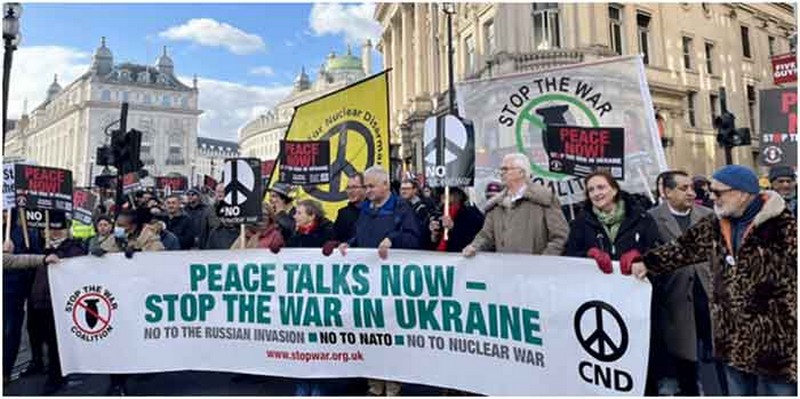
During the  weekend of June 10-11 in Vienna, Austria, over 300 people representing peace organizations from 32 countries came together for the first time since the Russian invasion of Ukraine to demand an end to the fighting. In a formal conference declaration, participants declared, “We are a broad and politically diverse coalition that represents peace movements and civil society. We are firmly united in our belief that war is a crime against humanity and there is no military solution to the current crisis.”

To amplify their call for a ceasefire, Summit participants committed themselves to organizing Global Weeks of Action–protests, street vigils and political lobbying–during the days of September 30-October 8.

Summit organizers chose Austria as the location of the peace conference because  Austria is one of only a few neutral non-NATO states left in Europe. Ireland, Switzerland and Malta are a mere handful of neutral European states, now that previously neutral states Finland has joined NATO and Sweden is next in line. Austria’s capital, Vienna, is known as “UN City,” and is also home to the Secretariat of the OSCE (the Organization for Security and Cooperation in Europe), which monitored the ceasefire in the Donbas from the signing of the Minsk II agreement in 2015 until the Russian invasion of Ukraine in 2022.

Surprisingly, neutral Austria turned out to be quite hostile to the Peace Summit. The union federation caved in to pressure from the Ukrainian Ambassador to Austria and other detractors, who smeared the events as a fifth column for the Russian invaders. The ambassador had objected to some of the speakers, including world-renowned economist Jeffrey Sachs and European Union Parliament member Clare Daly.

Even the press club, where the final press conference was scheduled, canceled at the last minute. The Austrian liberal/left newspaper Der Standard piled on, panning the conference both beforehand, during and afterwards, alleging that the speakers were too pro-Russian. Undaunted, local organizers quickly found other locations.The conference took place in a lovely concert center, and the press conference in a local cafe.

The most moving panel of the conference was the one with representatives from Ukraine, Russia and Belarus, who risked their lives to participate in the Summit. Yurii Sheliazhenko, secretary treasurer of the Ukrainian Pacifist Movement, is unable to leave the country and therefore spoke to attendees from Kyiv via Zoom.

“Like many Ukrainians, I am a victim of aggression of Russian army, which bombs my city, and a victim of human rights violations by the Ukrainian army, which tries to drag me to the meat grinder, denying my right to refuse to kill, to leave the country for my studies in University of Münster … Think about it: all men from 18 to 60 are prohibited from leaving the country, they are hunted on the streets and forcibly abducted to the army’s serfdom.”

Sheliazhenko told the Summit that the Armed Forces of Ukraine had tried to deny conscientious objector status to Ukrainian war resisters, but relented when international pressure demanded that the Ukrainian military recognize rights secured under the European Convention on Human Rights.

Several groups at the Summit pledged to provide support for conscientious objectors from Ukraine, Russia and Belarus, and also took up a collection for Ukrainian families lacking access to clean water following the recent destruction of the Kakhovka dam.

Highlights of the Summit also included remarks by representatives from the Global South, who came from China, Cameroon, Ghana, Mexico and Bolivia. Bolivia’s Vice President  David Choquehuanca inspired the crowd as he spoke of the need to heed the wisdom of indigenous cultures and their mediation practices.

Many speakers said the real impetus to end this war will come from the Global South, where politicians can see the widespread hunger and inflation that this conflict is causing, and are taking leading roles in offering their services as mediators.

Almost all of Europe was represented, including dozens from Italy, the country  mobilizing the continent’s largest peace demonstrations, with over 100,000 protesters. Unlike in the United States, where the demonstrations have been small, Italian organizers have successfully built coalitions that include trade unions and the religious community, as well as traditional peace groups. Their advice to others was to narrow and simplify their demands in order to broaden their appeal and build a mass anti-war movement.

The eight-person U.S. delegation included representatives from CODEPINK, Peace in Ukraine, the Fellowship of Reconciliation and Veterans for Peace. U.S. retired colonel and diplomat Ann Wright was a featured speaker, along with former Congressman Dennis Kucinich, who joined remotely.

Despite the uniform bottom line of the participants, which was a call for peace talks, there were plenty of disagreements, especially in the workshops. Some people believed that we should continue to send weapons while pushing for talks; others called for an immediate end to weapons transfers. Some insisted on calling for the immediate withdrawal of Russian troops, while others believed that should be the result of negotiations, not a pre-condition. Some put more blame on the role of NATO expansion and the interference of the U.S. in Ukraine’s internal affairs, while others said the blame belongs exclusively at the doorstep of the Russian invaders.

Some of these differences were reflected in discussions surrounding the final declaration, where there was plenty of back and forth about what should and should not be mentioned. There were strong calls to condemn NATO provocations and the role of the U.S./UK in sabotaging early attempts at mediation. These sentiments, along with others condemning the West, were left out of the final document, which some criticized as too bland. References to NATO provocations that led to the Russian invasion were deleted and replaced with the following language:

“The institutions established to ensure peace and security in Europe fell short, and the failure of diplomacy led to war. Now diplomacy is urgently needed to end the war before it destroys Ukraine and endangers humanity.”

But the most important segment of the final document and the gathering itself was the call for further actions.

“This weekend should be seen as just the start,” said organizer Reiner Braun. “We need more days of action, more gatherings, more outreach to students and environmentalists, more educational events. But this was a great beginning of global coordination.”

Medea Benjamin is cofounder of CODEPINK for Peace, and author of several books, including Peace in Ukraine: Making Sense of a Senseless Conflict.

13 June 2023

Source: countercurrents.org

Nuclear Powers Expanding Nuclear Arsenals, Says SIPRI

By Countercurrents Collective

Nuclear powers are actively modernizing and expanding their arsenals amid rising geopolitical tensions, said SIPRI Yearbook 2023, a report by the Stockholm International Peace Research Institute (SIPRI) released on Monday.

Of the total global inventory of an estimated 12 512 warheads in January 2023, about 9576 were in military stockpiles for potential use — 86 more than in January 2022 (see the table below). Of those, an estimated 3844 warheads were deployed with missiles and aircraft, and around 2000 — nearly all of which belonged to Russia or the USA — were kept in a state of high operational alert, meaning that they were fitted to missiles or held at airbases hosting nuclear bombers.

World nuclear forces, January 2023

– = nil or a negligible value.
Notes: All estimates are approximate. SIPRI revises its world nuclear forces data each year based on new information and updates to earlier assessments. The data for Jan. 2023 replaces all previously published SIPRI data on world nuclear forces. Countries are ordered by date of first known nuclear test. There is no conclusive open-source evidence that Israel has tested its nuclear weapons. The figures for Russia and the USA do not necessarily correspond to those in their 2010 Treaty on Measures for the Further Reduction and Limitation of Strategic Offensive Arms (New START) declarations because of the treaty’s counting rules.
a ‘Deployed warheads’ refers to warheads placed on missiles or located on bases with operational forces.
b ‘Stored warheads’ refers to stored or reserve warheads that would require some preparation (e.g. transport and loading on to launchers) before they could be deployed.
c ‘Total stockpile’ refers to warheads that are intended for use by the armed forces.
d ‘Total inventory’ includes both stockpiled warheads and retired warheads awaiting dismantlement.
e SIPRI previously estimated that the UK had about 45 retired warheads awaiting dismantlement; however, SIPRI’s assessment as of Jan. 2023 is that these warheads are likely to be reconstituted to become part of the UK’s growing stockpile over the coming years and the stockpile number remained at 225 in Jan. 2022.
f The British government declared in 2010 that its nuclear weapon inventory would not exceed 225 warheads. It is estimated here that the inventory remained at that number in Jan. 2023. A planned reduction to an inventory of 180 warheads by the mid 2020s was ended by a government review published in 2021. The review introduced a new ceiling of 260 warheads.
g Information about the status and capability of North Korea’s nuclear arsenal comes with significant uncertainty. North Korea might have produced enough fissile material to build 50–70 nuclear warheads; however, it is likely that it has assembled fewer warheads, perhaps around 30.

Table: SIPRI ©  Source: SIPRI Yearbook 2023.

The SIPRI analysts warn the world is “drifting into one of the most dangerous periods in human history”.

The SIPRI estimated that as of January 2023, Russia, the U.S., the UK, France, China, India, Pakistan, North Korea and Israel had a total of 12,512 warheads, with 9,576 stored in military stockpiles for potential use – an increase of 86 from one year previously.

The report also claimed that as of January, Russia and the U.S. – which between them possess almost 90% of the world’s nuclear weapons – had 1,674 and 1,770 deployed warheads respectively. Last year, Russia had approximately 1,588 warheads while the US had 1,744.

The SIPRI noted that “the sizes of their respective nuclear arsenals seem to have remained relatively stable in 2022, although transparency regarding nuclear forces declined in both countries” following the outbreak of hostilities in Ukraine.

Over the course of the year, China’s nuclear arsenal grew from 350 warheads to 410, SIPRI estimated, adding that by the end of the decade China “could potentially have at least as many intercontinental ballistic missiles as either the USA or Russia.”

Elsewhere, the UK is not thought to have increased its arsenal in 2022, although its number of warheads is expected to grow in the years to come.

France has continued its nuclear development program, while India and Pakistan appear to be expanding their nuclear arsenals, the report said.

North Korea is said to be prioritizing its nuclear program and is estimated to have assembled some 30 warheads. Israel, which has not publicly admitted to possessing nuclear weapons, is also believed to be modernizing its nuclear arsenal, SIPRI added.

The SIPRI also pointed to the erosion of global arms control architecture amid the Ukraine conflict, noting Washington’s decision to freeze strategic stability dialogue with Russia and Moscow’s suspension of the 2010 New START Treaty, which places limits on U.S. and Russian nuclear arsenals.

Russian President Vladimir Putin announced the move in February, pointing to the refusal of Western powers to permit inspections of their nuclear facilities. He confirmed that Moscow would continue to abide by the deal’s limits on deployed warheads.

A SIPRI news said:

‘Most of the nuclear-armed states are hardening their rhetoric about the importance of nuclear weapons, and some are even issuing explicit or implicit threats about potentially using them,’ said Matt Korda, Associate Researcher with SIPRI’s Weapons of Mass Destruction Programme and Senior Research Associate with the FAS Nuclear Information Project. ‘This elevated nuclear competition has dramatically increased the risk that nuclear weapons might be used in anger for the first time since World War II.’

‘With billion-dollar programmes to modernize, and in some cases expand, nuclear arsenals, the five nuclear weapon states recognized by the Nuclear Non-Proliferation Treaty seem to be moving further and further from their commitment to disarmament under the treaty,’ said Wilfred Wan, Director of SIPRI’s Weapons of Mass Destruction Programme.

It said:

The USA and the UK both declined to release information to the public concerning their nuclear forces in 2022, which they had done in previous years.

‘In this period of high geopolitical tension and mistrust, with communication channels between nuclear-armed rivals closed or barely functioning, the risks of miscalculation, misunderstanding or accident are unacceptably high,’ says Dan Smith, SIPRI Director. ‘There is an urgent need to restore nuclear diplomacy and strengthen international controls on nuclear arms.’

Global security and stability in increasing peril

The 54th edition of the SIPRI Yearbook reveals the continuing deterioration of global security over the past year. The impacts of the war in Ukraine are visible in almost every aspect of the issues connected to armaments, disarmament and international security examined in the Yearbook. Nevertheless, it was far from being the only major conflict being waged in 2022.

‘We are drifting into one of the most dangerous periods in human history,’ says Dan Smith, SIPRI Director. ‘It is imperative that the world’s governments find ways to cooperate in order to calm geopolitical tensions, slow arms races and deal with the worsening consequences of environmental breakdown and rising world hunger.’

Countercurrents is answerable only to our readers. Support honest journalism because we have no PLANET B.

13 June 2023

Source: countercurrents.org

Amritsar: The Indian city where no one goes hungry

By Srishti Chaudhary & Raphael Reichel

Amritsar, a north Indian city of two million people, is famous for many things: delectable cuisine, its historical old town and the spectacular Golden Temple – the most significant shrine of the Sikh religion. Yet, what stands out everywhere, from the temple to the people in the streets, is a feeling of generosity that is linked to the very founding of the city.

Amritsar was established in the 16th Century by a Sikh guru and is located in the region of Punjab where Sikhism originated. The religion is known for its tradition of seva – a voluntary service performed for others without any expectations or reciprocity. Sikhs all over the world do seva in gurudwaras (Sikh temples), most often in simple acts like cleaning the floors, serving meals and maintaining order in the temple. Others perform seva in their private life through acts of generosity and charity. In April 2021 when Covid devastated families across India, the Sikh community rose to the challenge of delivering oxygen cylinders and other medical supplies to those in desperate need.

“Seva means selfless service, and in Sikhism it is not just an exhortation and a guide but a daily practice,” writes Jasreen Mayal Khanna in her book Seva: Sikh Wisdom for Living Well by Doing Good. “Kind has been cool among Sikhs way before it became a Brooklyn hipster motto.”

“The other name for seva is love,” said 23-year-old Abhinandan Chaudhary, who has been doing seva with his family since he was eight. “A common teaching is that one should be so discreet and selfless, that if you are doing seva from the left hand, even your right hand should not find out about it.”

In an increasingly individualised and capitalistic world, it is a refreshing way of living.

The spirit of generosity in Sikhism can be seen across the world. During Covid lockdown, Sikh volunteers in a gurudwara in England delivered thousands of meals a day to NHS staff, while Sikhs in various US cities cooked hundreds of thousands of free meals. In crisis or emergency situations, Sikhs have rallied their full force to help those in need, whether it may be storm-hit Canada or cyclone-struck New Zealand.

But in Amritsar, the beating heart of the Sikh religion, the fulfilment of seva is taken to another level. It is known throughout India that no person ever has to go to bed hungry in Amritsar. That’s because there is always a hot meal ready for anyone who should want it at the Golden Temple, the most significant shrine of the Sikh religion.

The Golden Temple’s langar, a free, communal kitchen, is the largest in the world, serving 100,000 people per day, seven days a week. Everybody is welcome to eat here, without discrimination, for as long as they need shelter and food, and meals are available 24 hours a day.

The New York based, Michelin-star chef Vikas Khanna, who distributed millions of meals in India during Covid lockdown, pointed out: “I was born and raised in Amritsar and we have a huge community kitchen where everyone gets fed. The entire city can eat there… My sense of hunger came from New York, when I was struggling here from the very bottom.”

I was born and raised in Amritsar and we have a huge community kitchen where everyone gets fed

Like all gurudwaras, the Golden Temple is run smoothly and with utmost discipline by an armada of volunteers, who serve up a basic yet delicious meal of lentils, chapattis (flatbread), chickpea stew and yoghurt on stainless steel plates day in, day out. People sit cross-legged on the floor in huge halls that can easily accommodate 200 people at a time: men and women, old and young, rich and poor. There is an implicit choreography behind it that everyone seems to know. While some people ask for more food, others just quickly finish their plates and leave. After every 15 minutes or so, volunteers clean up and prepare the hall for the next round of hungry eaters. It is a never-ending cycle of eating and serving.

Right from the temple to the people on the streets, friendliness, generosity and helpfulness are a given in Amritsar. When we visited, smiles followed us around and we only needed to look lost or confused before somebody would approach to ask if they could help. Walking on the street at night, random passersby told us to take care of our bags in busy areas. When we arrived at Kesar da Dhaba, a famous eatery with long waiting times, people squeezed up at the communal tables to make space for us, even if it meant banging elbows while eating. A sense of welcome and sharing was ubiquitous; an affable glance and a smile was enough for strangers to invite us to tea and talk about their lives.

“Growing up in Amritsar, there was a feeling of living within a big community,” said Rahat Sharma, who was born and raised here. “I grew up playing hide-and-seek in the Golden Temple, where all of us did seva. Everyone would look out for each other, and the Sikhs and Hindus, the two majority faiths in the city, lived together lovingly, despite often opposing political circumstances.”

It only makes sense that the city is so full of vigour, for as much as Amritsar is a city of the divine, it is a city of life. The local, streetside cuisine, with its kulchas (flatbreads) and chole (chickpea stew), phirni (rice pudding) in traditional clay pots and hearty glasses of buttermilk, is the stuff of envy across India. The stunning although neglected old town, a maze of narrow streets, junctions and small squares, is full of lively and bustling bazaars and seems to be lost in time.

However, at the heart of Amritsar’s magnanimous and open character is a dark contemporary history that has played a crucial part in shaping the city’s – as well as Sikhism’s – self-conception and dynamics.

As the second-biggest city in Punjab, Amritsar was often a hotspot for gatherings and protests during British colonial rule. One such event took a brutal turn in 1919, when a British general gave orders to fire upon a peaceful meeting of people, which came to be known as the Jallianwala Bagh Massacre, where up to 1,500 people died.

Additionally, when the British hastily left India in 1947, the violence that engulfed Indian Partition heavily affected Amritsar due to the city’s location next to the newly drawn border. (Due to this history, India’s first and only Partition Museum opened in Amritsar in 2017.)

In 1984, Amritsar once again became the site of tragic events. A momentous military operation ordered by Prime Minister Indira Gandhi involved the storming of the Golden Temple by military forces to weed out secessionists, the jitters of which are felt even today. It led to the assassination of Gandhi by her two Sikh bodyguards some months later, and a massacre of thousands of innocent Sikhs across India in the subsequent days.

It is important for the Sikhs to preserve the memories of these events; tales of Sikh martyrs are a large part of their cultural memory, even recited in their prayer, the ardas. “But these tales weren’t retold to incite hatred or seek revenge. On the contrary, our legacy of being protectors was emphasised,” Khanna wrote.

And that is why it is even more admirable that a community that has suffered so many collective traumas is still so giving and accepting of all. According to Khanna, these traits are an integral part of being Sikh. “Guru Nanak (the founder of Sikhism) made seva the song of the Sikhs… Sikhs just choose to make selflessness a big part of their lives, inspired by their gurus’ words and deeds.”

The tradition of seva and Sikhs’ acceptance and welcoming of people regardless of their faith or creed, is testament to their generosity – and of the city that grounds this sentiment in the most exemplary way. In Amritsar, no matter how bleak and dark things may seem, a spirit of kindness, love and generosity seems to always prevail.

*

If you liked this story, sign up for the weekly bbc.com features newsletter called “The Essential List”. A handpicked selection of stories from BBC Future, Culture, Worklife and Travel, delivered to your inbox every Friday.

13 June 2023

Source: www.bbc.com

Haiti: Stop the Destruction of a Nation

By Seth Donnelly

“As the people of Haiti continually attest, we women in the Grandans are clear that since the coup d’etat of February 29, 2004, this has been the plan to wipe out the Haitian people and our country. We call on all women’s organizations, popular organizations, students and all to stand against this system that generates the high cost of living, misery, corruption and rape that are destroying our lives…”

– From a press release on March 17th, 2023, by Haitian women’s and popular organizations in the Grandans Department of Haiti

6 Jun 2023 – As the current crisis in Haiti has metastasized into one of the worst human rights disasters in the Americas, Haitian activists in the popular movement and in diaspora are increasingly charging the US government– the key force behind the 2004 coup and subsequent occupation of Haiti– with genocide, as reflected in the above quote. They recognize that the ongoing, systematic destruction of the Haitian people as a sovereign nation is not some “random” work of “gangs’, but instead the deliberate outcome of the efforts by the US and “Core Group” powers– in collaboration with members of the Haitian oligarchy– to prevent the vast majority of Haitians from exercising genuine self-determination and popular democracy.

Ever since the Haitian people successfully overthrew slavery and colonialism in 1804, they have been subjected to interventions and policies by the French and US governments– from devastating “debt” collection to brutal military occupation, from coups to neocolonial puppet dictatorships– designed to destroy their existence as sovereign people, as an independent nation. There is extensive evidence to prove the genocidal nature of these historical interventions, including the brutality of the US invasion and occupation of Haiti between 1915-1934. The subsequent US-backed dictatorship of “Papa Doc” Duvalier who ruled Haiti from 1957–1971. Tens of thousands of Haitians were tortured, murdered, and disappeared while even more perished through the structural genocide of impoverishment, malnutrition, death by preventable disease, and extreme exploitation. As journalist Nathalie Baptiste stated:

“Papa Doc presided over the murders of an estimated 30,000 people. Thousands of others simply disappeared or were imprisoned at the notorious Fort Dimanche, a prison known for torture, mutilation and death.”

After “Papa Doc” Duvalier died in 1971, even The New York Times conceded that this US-backed dictator– who had been maintained in power and showered with millions of dollars by the US government– left this legacy in Haiti:

“The Tontons [Papa Doc’s private deathsquad system], sunglass‐wearing thugs whose fanatical loyal ty to Duvalier was rewarded with virtual licenses to torture and kill, murdered thousands of their fellow Haitians. Often they slit the throats of their victims and left them tied to chairs or hanging in market places for days as “examples”of what could happen to anti Duvalierists…By 1971, more than 13 years after he assumed power, little had changed for the great majority. Almost 90 per cent of the people were illiterate and were plagued by yaws, tuberculosis and malnutrition. Per capita income for Haiti’s 4.5‐million people was about $75 a year, compared with the Latin‐American average of about $400.” [emphasis mine]

It is documented that the notorious Tonton Macoutes received training by the US military.

Between 1971 and 1986, the US government maintained and funded the dictatorship of “Baby Doc” Duvalier, perpetuating the same system of terror and exploitation considered a “favorable investment climate” for US corporations.

Openly admitting the US domination of Haiti, Forbes magazine noted on September 22nd, 2022, that “Haiti has been a ward of the US government and international agencies for decades.” And what have been the consequences?

Compare these basic life indicators in Haiti to those in revolutionary Cuba, which broke free from US control in 1959. According to UN data compiled by the Macrotrends, Haiti’s infant mortality rate in 1959 was a staggering 192 deaths per 1000 live births. Despite advances in global health and vaccines over the past 70 years, leading to a dramatic, global reduction in infant mortality, the infant mortality rate in Haiti today remains one of the highest in the world, at 48 deaths per 1000 live births. In stark contrast, as David Blumenthal, former President of the Commonwealth Club, noted in 2016: “Since its 1959 revolution, Cuba’s infant mortality rate has fallen from 37.3 to 4.3 per 1000 live births—a rate equivalent to Australia’s and lower than the United States’ (5.8).” How is that in Haiti today, under US/ UN occupation, the infant mortality remains twelves times higher than that of revolutionary Cuba? This disparity between the countries cannot be explained by the pre-existing 1959 disparity ratio in which Haiti’s infant mortality was only approximately five times higher than that of Cuba. In other words, the disparity ratio in deaths between the two countries has more than doubled following Cuba’s revolution while Haiti has remained firmly under US domination during the ensuing decades to the present.

A similar picture of disparity emerges when it comes to indicators of acute hunger and malnutrition in Haiti and Cuba. According to data by the World Food Programme, “A total of 4.9 million Haitians – nearly half the population – do not have enough to eat, and 1.8 million are facing emergency levels of food insecurity.” [emph.mine] In contrast, regarding Cuba, the World Food Programme states: “Over the last 50 years, comprehensive social protection programmes have largely eradicated poverty and hunger.”

It is impossible to understand these disparities without taking into account and centering the significance of genocidal interventions by the US and French governments in reaction to the Haitian revolution of 1804 and the recolonization of Haiti by the US in the 20th century.

The pattern of US domination was interrupted briefly when the grassroots, non-violent mass movement of the Haitian people later called Lavalas (meaning flood in Kreyol) successfully dismantled the US-backed Duvalier dictatorship in 1986. This created the conditions for the first truly fair and free elections in 1990, resulting in the landslide election of Jean-Bertrand Aristide. The US quickly moved to support the Haitian military and elite to violently overthrow this democracy within 8 months. During the following 3 years of military dictatorship, the US-funded Haitian military and US-funded paramilitary death squad known as FRAPH killed thousands of Haitians. FRAPH leader Emmanuel (Toto) Constant was on the CIA payroll during this reign of terror, threatening to restore the old order.

The democratic resistance by the Haitian people, joined by intensive international solidarity, pressured President Clinton to support President Aristide’s return, although Clinton tried to coerce Aristide into accepting destructive US-prescribed economic policies. Aristide and the Lavalas popular movement refused to follow Clinton’s prescription. The popular, democratic Fanmi Lavalas governments headed by President Aristide– in power at two intervals between 1994 and 2004– pursued development policies that were created and driven by the Haitian people for the benefit of the Haitian people. These policies involved refusing to privatize national resources, increasing the minimum wage, investing public funds in healthcare, education, and cooperatives, subsidizing access to vital resources, and much more. The achievements in poverty reduction and human rights during this decade of popular democracy were undeniable, explaining Aristide’s vast popularity with the Haitian people and the respect for Fanmi Lavalas by international humanitarian leaders such as the late Dr. Paul Farmer. Yet these achievements, just like the brief opening to democracy in 1990, would be destroyed in a second US-backed coup in 2004, waged against President Aristide and thousands of other democratically elected officials on all levels.

Following this coup, Haitians have once again experienced the systematic destruction of their democracy and the social-economic conditions that permit them to exist as a sovereign people, as an independent nation. Crimes against humanity have returned and are intensifying.

Today, there is not a single elected official left in the entire country since the ruling US-installed Haitian Tet Kale Party (PHTK) regime has failed to hold, nor is capable of holding, fair and free elections. On January 9th, 2023, the terms of the last ten remaining Senators in Haiti’s parliament expired, leaving Haitians with no Constitutional representation at any state level. This latest development only lays bare that Haitians have been deprived of meaningful, consistent representation since the 2004 coup, through political repression and US-sponsored fraudulent elections that brought the PHTK into power.

Immediately after the 2004 coup, there was a massive wave of violent repression, targeting officials and activists with Fanmi Lavalas, the most popular political party in the country. Thousands upon thousands of people were killed. In an investigative report published by the British medical journal The Lancet on August 31st, 2006, Athena R. Kolbe and Dr. Royce A. Hutson found that during the first 22-months of the U.S.-backed coup regime, 8,000 people were murdered in the greater Port-au Prince area alone. 35,000 women and girls were raped or sexually assaulted. The violence was politically motivated as part of the coup regime’s war on Haiti’s popular movement.

Subsequent US-sponsored “elections” cemented this political repression by excluding Fanmi Lavalas from participation, as in the 2010–2011 election— dominated by the US and personally manipulated by Secretary of State Hillary Clinton– that resulted in the “victory” of PHTK godfather Michel Martelly. The next election in 2016 that put PHTK puppet Jovenel Moise in power was likewise based on blatant fraud. The result of this political repression is to deprive the Haitian people of political sovereignty.

Under the US/UN occupation, Haitians– particularly in impoverished neighborhoods that are bases of pro-democracy, pro-Lavalas activism– have been subjected to relentless massacres: first those perpetrated directly by UN occupation forces such as the 2005 massacre in Site Soley (Cite Soleil), and in more recent years those perpetrated by the US-funded/ trained Haitian National Police (HNP) and heavily weaponized paramilitaries, most notably the G9 Family and Allies, working with the PHTK dictatorship, such as the 2018 Lasalin massacre (see this video) and the 2019 massacres in the Tokyo and Site Vensan (Cite Vincent) neighborhoods. The Harvard Law School International Human Rights Clinic documented this pattern in its 2021 report “Killing with Impunity: State-Sanctioned Massacres in Haiti”. On May 21st, 2023, the National Human Rights Defense Network in Haiti released a detailed report on recent massacres in Bel Air and Cite Soleil, noting that from “2018 to the present, at least twelve (12) massacres and armed attacks have been carried out in the disadvantaged neighborhoods of Port-au-Prince. In the first 10 cases, the survivors lodged a complaint with the judicial authorities against their aggressors, most of whom were notorious armed bandits and well-known state authorities” [emphasis mine].

The paramilitaries, an outgrowth of the PHTK regime, have also utilized other forms of terror to expand their power. Rape and kidnappings have proliferated along with the massacres under the US/UN occupation and the PHTK regime. The paramilitaries have taken over neighborhoods, burning down houses, and creating a massive internal refugee crisis. In October, 2022, the International Organization for Migration (IOM) released a report showing that the number of people displaced by “gang violence” in Port-au-Prince over the past five months had tripled. Between June and August of 2022 alone, the IOM documented that 96,000 people in Port-au-Prince had been forced into internal exile. Within my own relatively small number of close friends in Haiti, there have already been several deaths and widespread displacement.

Of course, the paramilitary violence has the political function of terrorizing impoverished communities like Bel Air, Cite Soleil, and Lasalin as well as rural areas that are bases of Lavalas resistance, making it all the more difficult for people to assemble and protest for fear of their lives and the lives of their loved ones. But the violence also has the economic function of depopulating these communities, thereby facilitating land grabs. Such brutal dispossession was evident in the early years of the PHTK dictatorship under President Martelly.

Moreover, the paramilitary violence is designed to force people to accept the structural genocide being imposed onto them by the PHTK regime, implementing the austerity dictates of the IMF and the US model of neoliberal “development”, something the Haitians have called the “death plan”. Like IMF-imposed “structural adjustment programs” throughout the Global South, the “death plan” involves these measures by the ruling regime backed by the US and the IMF:

+ Engaging in pervasive corruption and the massive looting of public funds.

+ Perpetuating land grabs and the dispossession of Haitian farmers, including by former PHTK President Jovenel Moise himself to enlarge his personal banana republic, as well as the plunder of Haiti’s vast natural resources (gold, petroleum, bauxite and more) by domestic oligarchs and foreign corporations. The “open” investment climate supported by the PHTK regime is noted in this 2018 US State Department Report on “doing business in Haiti”.

+ Underwriting the super-exploitation of Haitian workers like the Caracol Industrial Park initiative with the Clintons.

+ Eliminating government subsidies on staples such as fuel, consequently plunging even more people into misery.

Predictably, in the aftermath of an agreement with the IMF made in June, 2022, the PHTK regime proceeded to eliminate fuel subsidies in September, 2022, resulting in cost-push inflation ruthlessly punishing the poor majority. By March 2023, a record 4.9 million people were experiencing acute hunger, nearly half the population. Haiti’s food inflation is among the highest in the world, increasing by 48% between February 2022 and February 2023.

The Haitian people have consistently shown steadfast resistance to the US-backed coup and to the neo-colonial policies of the “death plan”. Witness the huge mobilizations right after the coup calling for the return of President Aristide, as captured by the documentary “We Must Kill the Bandits”. Witness the immense protests against Jovenel Moise despite lethal police repression. Witness the courage of activist students like Gregory Saint-Hilaire who organized on his campus and was assassinated by police on October 2nd, 2020. Witness the courage of journalists like Romelson Vilsaint who was shot in the head and killed by police on October 30th, 2022, for his activism. Witness the courage of so many survivors who are still willing to speak out in the face of ongoing terror. Witness the singular act of resistance by Karl Udson Azor on May 21st, 2023, a medical student who publicly took off his shirt and shoes and laid them alongside a Haitian flag on the steps of the Monument of the Heroes of Vèrtières in Cap-Haitien, erected to the last battle of Haitian independence. Azor handed out his money to passing strangers, then sat down, doused himself with gasoline, and burned himself to death in protest over the ongoing destruction of Haiti, as reported in the Haitian media.

In the face of this resistance to mounting genocide, the Haiti Action Committee put out a call for protests throughout the US and the world on May 18th, 2023, Haitian Flag Day. The actions were coordinated to raise international solidarity with the Haitian people and their struggle for national liberation against the US-installed PHTK dictatorship and ongoing US/ UN occupation.

Emory Douglas, revolutionary artist and former Minister of Culture of the Black Panther Party, recently created this art in solidarity with the people of Haiti. His art was widely taken up by solidarity activists around the US and the world for May 18th Day of Action. At the top of his art, he chose the words: “Stop the Genocide”, based upon internationally recognized criteria. Similarly, the ongoing, systematic destruction of Haiti as a nation conforms to the criteria established in The Convention on the Prevention and Punishment of the Crime of Genocide (1948) by the United Nations.

Dozens of organizations within and beyond the US endorsed and participated in these actions. Protests inside of the US were held in San Francisco, Washington, D.C., Los Angeles, San Pedro, Atlanta, and Philadelphia. Beyond the US, there were protests in London, Belize, and Guyana. All protests were unified in demanding that the US government and the Core Group:

  • No more foreign intervention in Haiti. Support the right of the Haitian people to establish their own transition government free from US and Core Group interference. Oppose the fiction– being perpetuated by the Biden Administration– that the Ariel Henry dictatorship is capable of organizing fair and free elections.

It is past time for the world to act in solidarity with the Haitian people. Haiti, historically and currently, continues to live up to the true meanings of revolution, liberation, and solidarity. The mobilizations on May 18th were another step towards this goal of intensifying international solidarity. As called for in the press release of the women’s and popular organizations of the Grandans, international solidarity is needed now to stop the genocide that is unfolding in Haiti, a genocide made in the USA, subsidized by US tax dollars, and aided and abetted by the “Core Group” and the UN. The array of attacks against Haiti’s grassroots movement for national liberation includes military interventions, fraudulent elections, phony economic assistance, media disinformation to maintain the status quo that benefits foreign multinationals and the Haitian oligarchy. Mobilizations are needed globally to condemn US and UN support for the Ariel Henry dictatorship and to end their policies that are destroying lives in Haiti. Solidarity actions including disruptive non-violent forms of resistance will need to be employed on greater and greater scales–in coordination with the decisive resistance on the ground in Haiti– until the Haitian people can complete their heroic revolution of 1804 and claim true victory once and for all.

___________________________________________________

Seth Donnelly is a member of the Haiti Action Committee and the author of The Lie of Global Prosperity: How Neoliberals Distort Data to Mask Poverty and Exploitation (MR Press 2019).

19 June 2023

Source: www.transcend.org

A History of Ceasefires & Peace in Ukraine

By Ann Wright

14 Jun 2023 – Negotiations, ceasefires, armistices and peace agreements are as old as wars themselves.

Every war ends with some version of one of them.

Wars have been studied endlessly, but lessons learned on how to end the wars have generally been ignored by those conducting the world’s latest wars.

To stop the killing in the Russia-Ukraine conflict, people of conscience must do everything they can to make negotiations for a ceasefire become a reality.

That was the purpose of the International Summit for Peace in Ukraine held in Vienna last weekend.

Over 300 persons from 32 countries attended the conference and participated in the robust program to discuss how to create conditions for a ceasefire and ultimately an agreement to stop the killing.  The websites for the International Peace Bureau and the Peace in Ukraine summit were hacked the day after the conference but should be up and running soon.

If history is our guide, negotiations for peace will take weeks, months or perhaps years, to get Ukraine and its allies to agree on a negotiating strategy — and even longer to come to an agreement with Russia after negotiations begin.

Even if all parties, Ukraine, Russia, U.S./NATO, would agree to negotiations tomorrow, and if the talks would ultimately succeed, it could possibly be months or years before the killing would end. That’s why negotiations must begin now.

History gives us an important insight into negotiations during a war and what we might expect to end today’s extremely dangerous international violence.

In the case of the Korean armistice finally signed 70 years ago on July 27, 1953, 575 meetings between North Korea, China, the U.S. and South Korea were required over two years from 1951 to 1953 to finalize the nearly 40 pages of the agreement. During those two years, millions of Koreans, 500,000 Chinese and 35,000 U.S. and tens of thousands of U.N. Command soldiers were killed.

Vietnam Peace Talks

Fifteen years later, U.S. and North Vietnamese representatives met in Paris on May 10, 1968, to begin peace negotiations, the first time negotiators from both nations met face-to-face. Formal negotiations opened three days later, but immediately came to a standstill.

Five years after the 1968 meeting, on Jan. 27, 1973, the “Agreement on Ending the War and Restoring Peace in Vietnam,” otherwise known as the Paris Peace Accords, was signed by the Democratic Republic of Vietnam, the Republic of Vietnam, the Provisional Revolutionary Government (Viet Cong) and the United States.

The Paris Peace Accords officially ended U.S. involvement in the Vietnam War, although the majority of U.S. troops would not leave until August 1973 and the fighting between North and South Vietnam continued until April 30, 1975, when North Vietnamese Army (NVA) tanks rolled through the gate of the Presidential Palace in Saigon, South Vietnam, effectively ending the war.

Millions of Vietnamese and tens of thousands of U.S. military were killed during the years of negotiations.

We know much about the lead-up to negotiations to end the U.S. war on Vietnam. In a nationally televised speech on March 31, 1968, President Lyndon Johnson announced that he was “taking the first step to de-escalate the conflict” by halting the bombing of North Vietnam (except in the areas near the DMZ) and that the United States was prepared to send representatives to any forum to seek a negotiated end to the war.

Johnson followed this declaration with surprising news that he did not intend to seek reelection that year.

Three days later Hanoi announced that it was prepared to talk to the Americans. Discussions began in Paris on May 13 but led nowhere. Hanoi insisted that, before serious negotiations could begin, the United States would have to halt its bombing of the rest of Vietnam.

However, fierce fighting continued. The North Vietnamese high command followed the Tet attacks with two more waves in May and August 1968. At the same time, U.S. General William Westmoreland ordered his commanders to “keep maximum pressure” on the communist forces in the South, which he believed had been seriously weakened by their losses at Tet. The result was the fiercest fighting of the war.

In the eight weeks following Johnson’s speech, 3,700 Americans were killed in Vietnam and 18,000 wounded.  Westmoreland’s headquarters, which was notorious for inflated body counts, reported 43,000 North Vietnamese and Viet Cong killed. The South Vietnamese military’s (ARVN) losses were not recorded, but they were usually twice that of the U.S. forces.

After winning the 1968 election, President Richard Nixon, with his National Security Advisor Henry Kissinger, decided to follow the Tet offensive with a “maximum pressure” campaign with increased U.S. bombing of North Vietnam and Cambodia which ended up with large death counts of North Vietnamese, South Vietnamese and Cambodians, as well as U.S. military

“Maximum pressure” is already a part of the U.S./NATO approach to Russia with its extensive sanctions regime and its provision of a massive number of weapons to Ukraine.

48 Ceasefires Between 1946 & 1997 

We can look to many more examples of how negotiations ultimately have brought killing to an end in other conflicts .

Using data from 48 conflicts between 1946 and 1997, political scientist Virginia Page Fortna has shown that strong agreements that arrange for demilitarized zones, third-party guarantees, peacekeeping, or joint commissions for dispute resolution and contain specific (versus vague) language produced more lasting cease-fires that provide conditions for dialogue for an armistice or agreement.

Figuring out how to make the cease-fire be effective will be the key task.  Despite its less-than-stellar track record, the U.S. as a co-belligerent should work with the Ukrainian government to figure out effective cease-fire measures.

Ukrainian President Volodymyr Zelensky has already described any new negotiations as “Minsk 3,” a reference to the two cease-fire deals that were brokered with Russia in the Belarusian capital in 2014 and 2015, after its annexation of Crimea and fighting in the Donbass region.

The Minsk 1 and 2 agreements included no effective mechanisms for ensuring the parties’ compliance and failed to end the violence. Minsk 1 and 2 were later acknowledged by NATO and the European Union as a ploy for “buying time” for the West’s buildup of Ukrainian forces and equipment.

Ceasefire Do’s & Don’t, for the Record

Having been in the U.S. Army/Army Reserves for 29 years and working as a U.S. diplomat for 16 years, I can testify to the results of endless studies of the consequences of war. One example is the year-long U.S. Department of State Iraq Study Group, being ignored by U.S. politicians and policy makers, and lessons learned on how to end deadly conflicts being ignored by U.S. military and national security experts.

I suspect that few Ukrainian, Russian, U.S. and NATO policy makers know of the United Nations’ 18-page guide to the Do’s and Don’ts of Ceasefire Agreements, based on their experience in conflicts.

Therefore, for the record, I want to mention the main points of the “Do’s and Don’ts of Ceasefire Agreements,” so no one can say, “We Didn’t Know” such work has been done already and the pitfalls of ceasefire agreements well identified.

Each of the following elements has an entire section written about it in the 18-page guide.

PART A Who, When & Where 

  1. No room for “creative” ambiguity;
  2. The need for precision in regard to the geography of the ceasefire;
  3. The need for a precise specification of the dates and times on which the obligations imposed by the ceasefire fall due;
  4. Designating or qualifying permitted activities;
  5. Application of the provisions of the agreement to all members of all armed forces.

PART B Monitoring and Enforcement 

  1. Provision for monitoring;
  2. Verification;
  3. Complaints mechanism;
  4. Enforcement;
  5. Providing for the political resolution of disputes by the parties.

PART C Organization & Conduct of Armed Forces 

  1. Military Mission and Mandate;
  2. Codes of Conduct;
  3. Confidence building measures;
  4. Long term treatment of combatants and casualties;
  5. Command & Control;
  6. Liaison & Information Exchange;
  7. Integration;
  8. Disarmament, Demobilization and Downsizing.

PART D Humanitarian Matters 

  1. Demining & Civilian Protection Generally;
  2. POW’s and other Political Prisoners;
  3. Free movement of goods, people and aid;
  4. Dealing with the past.

PART E Implementation 

  1. Funding
  2. Information to rank-and-file and to civilians
  3. Verification of size of forces
  4. Amendment of the agreement
  5. Anticipating lead times
  6. Avoiding Media Warfare
  7. Collateral Agreements/Legislation
  8. Civil Security
  9. Buy-in by Regional Powers

What Else Can Be Done? 

To show how militarized is the U.S. government’s thinking, while an entire new U.S. military command element, the Security Assistance Group–Ukraine, led by a three-star general with a staff of 300, has been set up by the U.S. government, currently, there is not a single official in the U.S. government whose full-time job is conflict diplomacy to end the killing in the Russia-Ukraine war.

If the U.S. becomes serious about the loss of life in Ukraine, which it currently appears not to be, President Joe Biden should appoint a special presidential envoy who can begin informal discussions with Ukraine and among its allies in the G-7 and NATO about the endgame of negotiations.

Additionally, the United States must establish a regular channel of communication regarding the war that includes Ukraine, U.S. allies and Russia to allow participants to interact continually, instead of in one-off encounters.

This would be similar to the contact group model used during the Balkan wars, when an informal grouping of representatives from key states and international institutions met regularly and privately.

Satisfaction Not Guaranteed

We must acknowledge that even if negotiations did produce a ceasefire and then an agreement of some sort, neither Ukraine, Russia, the U.S. or NATO would be fully satisfied.

In spite of its recent history in Afghanistan and Iraq, many politicians, especially in the U.S. and now in Ukraine and Russia, want absolute victories, not long wars without a clear resolution.

But if we look to the Korean armistice, which was not viewed as the best U.S. foreign policy at the time it was signed, in the nearly 70 years after, the armistice has held and there has not been another war on the peninsula.

However, converting the armistice to a peace treaty has been one step too far for the U.S. while the North Koreans continue to ask for a peace declaration from the U.S and South Korea before they abandon their nuclear and missile programs.

In the case of the U.S. war on Vietnam, 60 years later, after the 1973 peace agreement, the country has now become a trading partner of the U.S. and the West.

How the negotiations for a ceasefire would work out is anyone’s guess.

But a ceasefire followed by an armistice would give Ukraine the opportunity to end the destruction of more of its infrastructure, to begin recovering economically and most importantly to end the death of more Ukrainians and the return of millions of Ukrainians to their homes.

An armistice would give the Russian Federation an opportunity to possibly come out from some of the sanctions the West has imposed, to work within the international community on common issues and end its military mobilization and the death of more Russians.

For the entire world, a Russian-Ukrainian armistice would reduce the risks of a direct military clash with the U.S./NATO that could include use of nuclear weapons with its terrible global consequences for all of us on this planet.

At the International Summit on Peace in Ukraine, the “Campaign for a Global Ban on Weaponized Drones” was launched. This campaign reflects the opinion of many in the world that the use of this weapons system should be ended by all countries.

We know it is an uphill battle to call for an end of types of military weapons and even if there are treaties enacted by the United Nations, such as on cluster munitions, land mines and nuclear weapons, some countries, led by the United States, will not abide by the treaties.  But, as people of conscience, we must continue to act on what our conscience tells us is wrong.

Likewise, people of conscience in this world must continue to wo

rk for peace and non-violent resolution of international issues despite politicians’ seeming thirst for continuation of violence in the name of peace.

____________________________________________

Ann Wright is a 29-year US Army/Army Reserves veteran, a retired United States Army colonel and retired U.S. State Department official, known for her outspoken opposition to the Iraq War.

19 June 2023

Source: www.transcend.org

Emergence of a New Non-Alignment

By Vijay Prashad

15 Jun 2023 – A new mood of defiance in the Global South has generated bewilderment in the capitals of the Triad (the United States, Europe, and Japan), where officials are struggling to answer why governments in the Global South have not accepted the Western view of the conflict in Ukraine or universally supported the North Atlantic Treaty Organisation (NATO) in its efforts to ‘weaken Russia’. Governments that had long been pliant to the Triad’s wishes, such as the administrations of Narendra Modi in India and Recep Tayyip Erdoğan in Türkiye (despite the toxicity of their own regimes), are no longer as reliable.

Since the start of the war in Ukraine, India’s Foreign Minister S. Jaishankar has been vocal in defending his government’s refusal to accede to Washington’s pressure. In April 2022, at a joint press conference in Washington, DC with US Secretary of State Antony Blinken, Jaishankar was asked to explain India’s continued purchase of oil from Russia. His answer was blunt: ‘I noticed you refer to oil purchases. If you are looking at energy purchases from Russia, I would suggest that your attention should be focused on Europe… We do buy some energy which is necessary for our energy security. But I suspect, looking at the figures, probably our total purchases for the month would be less than what Europe does in an afternoon’.

However, such comments have not deterred Washington’s efforts to win India over to its agenda. On 24 May, the US Congress’s Select Committee on the Chinese Communist Party released a policy statement on Taiwan which asserted that ‘[t]he United States should strengthen the NATO Plus arrangement to include India’. This policy statement was released shortly after the G7 summit in Hiroshima, Japan, where India’s Prime Minister Narendra Modi met with the various G7 leaders, including US President Joe Biden, as well as Ukraine’s President Volodymyr Zelenskyy.

The Indian government’s response to this ‘NATO Plus’ formulation echoed the sentiment of its earlier remarks about purchasing Russian oil. ‘A lot of Americans still have that NATO treaty construct in their heads’, Jaishankar said in a press conference on 9 June. ‘It seems almost like that is the only template or viewpoint with which they look at the world… That is not a template that applies to India’. India, he said, is not interested in being part of NATO Plus, wishing to maintain a greater degree of geopolitical flexibility. ‘One of the challenges of a changing world’, Jaishankar said, ‘is how do you get people to accept and adjust to those changes’.

There are two significant takeaways from Jaishankar’s statements. First, the Indian government – which does not oppose the United States, either in terms of its programme or temperament – is uninterested in being drawn into a US-led bloc system (the ‘NATO treaty construct’, as Jaishankar put it). Second, like many governments in the Global South, it recognises that we live in ‘changing world’ and that the traditional major powers – especially the United States – need to ‘adjust to those changes’.

In its Investment Outlook 2023 report, Credit Suisse pointed to the ‘deep and persistent fractures’ that have opened up in the international order – another way of referring to what Jaishankar called the ‘changing world’. Credit Suisse describes these ‘fractures’ accurately: ‘The global West (Western developed countries and allies) has drifted away from the global East (China, Russia, and allies) in terms of core strategic interests, while the Global South (Brazil, Russia, India, and China and most developing countries) is reorganising to pursue its own interests’. These final words bear repeating: ‘the Global South… is reorganising to pursue its own interests’

In mid-April, the Japanese Ministry of Foreign Affairs released its Diplomatic Bluebook 2023, in which it noted that we are now at the ‘end of the post-Cold War era’. After the Soviet Union collapsed in 1991, the United States asserted its primacy over the international order and, along with its Triad vassals, established what it called the ‘rules-based international order’. This thirty-year-old US-led project is now floundering, partly due to the internal weaknesses of the Triad countries (including their weakened position in the global economy) and partly due to the rise of the ‘locomotives of the South’ (led by China, but including Brazil, India, Indonesia, Mexico, and Nigeria). Our calculations, based on the IMF datamapper, show that for the first time in centuries, the Gross Domestic Product of the Global South countries surpassed that of the Global North countries this year. The rise of these developing countries – despite the great social inequality that exists within them – has produced a new attitude amongst their middle classes which is reflected in the increased confidence of their governments: they no longer accept the parochial views of the Triad countries as universal truths, and they have a greater wish to exert their own national and regional interests.

It is this re-assertion of national and regional interests within the Global South that has revived a set of regional processes, including the Community of Latin American and Caribbean States (CELAC) and the BRICS (Brazil-Russia-India-China-South Africa) process. On 1 June, the BRICS foreign ministers met in Cape Town (South Africa) ahead of the summit between their heads of states that is set to take place this August in Johannesburg. The joint statement they issued is instructive: twice, they warned about the negative impact of ‘unilateral economic coercive measures, such as sanctions, boycotts, embargoes, and blockades’ which have ‘produced negative effects, notably in the developing world’. The language in this statement represents a feeling that is shared across the entirety of the Global South. From Bolivia to Sri Lanka, these countries, which make up the majority of the world, are fed up with the IMF-driven debt-austerity cycle and the Triad’s bullying. They are beginning to assert their own sovereign agendas.

Interestingly, this revival of sovereign politics is not being driven by inward-looking nationalism, but by a non-aligned internationalism. The BRICS ministers’ statement focuses on ‘strengthening multilateralism and upholding international law, including the purposes and principles enshrined in the Charter of the United Nations as its indispensable cornerstone’ (incidentally, both China and Russia are part of the twenty-member Group of Friends in Defence of the UN Charter). The implicit argument being made here is that the US-led Triad states have unilaterally imposed their narrow worldview, based on the interests of their elites, on the countries of the South under the guise of the ‘rules-based international order’. Now, the states of the Global South argue, it is time to return to the source – the UN Charter – and build a genuinely democratic international order.

The word ‘non-aligned’ has increasingly been used to refer to this new trend in international politics. The term has its origins in the Non-Aligned Conference held in Belgrade (Yugoslavia) in 1961, which was built upon the foundations laid at the Asian-African Conference held in Bandung (Indonesia) in 1955. In those days, non-alignment referred to countries led by movements rooted in the deeply anti-colonial Third World Project, which sought to establish the sovereignty of the new states and the dignity of their people. That moment of non-alignment was killed off by the debt crisis of the 1980s, which began with Mexico’s default in 1982. What we have now is not a return of the old non-alignment, but the emergence of a new political atmosphere and a new political constellation that requires careful study. For now, we can say that this new non-alignment is being demanded by the larger states of the Global South that are uninterested in being subordinated by the Triad’s agenda, but which have not yet established a project of their own – a Global South Project, for instance.

As part of our efforts to understand this emerging dynamic, Tricontinental: Institute for Social Research will be joining with the No Cold War campaign, ALBA Movimientos, Pan-Africanism Today, the International Strategy Center (South Korea), and the International Peoples’ Assembly to host the webinar ‘The New Non-Alignment and the New Cold War’ on 17 June. Speakers will include Ronnie Kasrils (former minister of intelligence, South Africa), Sevim Dağdelen (deputy party leader for Die Linke in the German Bundestag), Stephanie Weatherbee (International Peoples’ Assembly), and Srujana Bodapati (Tricontinental: Institute for Social Research).

In 1931, the Jamaican poet and journalist Una Marson (1905–1965) wrote ‘There Will Come a Time’, a poem of hopefulness for a future ‘where love and brotherhood should have full sway’. People in the colonised world, she wrote, would have to pursue a sustained battle to attain their freedom. We are nowhere near the end of that fight, yet we are not in the position of almost total subordination that we were in during the height of the Triad’s primacy, which ran from 1991 to now. It is worthwhile to go back to Marson, who knew with certainty that a more just world would come, even if she would not be alive to witness it:

What matter that we be as caged birds
Who beat their breasts against the iron bars
Till blood-drops fall, and in heartbreaking songs
Our souls pass out to God? These very words,
In anguish sung, will mightily prevail.
We will not be among the happy heirs
Of this grand heritage – but unto us
Will come their gratitude and praise,
And children yet unborn will reap in joy
What we have sown in tears.

_______________________________________________

Vijay Prashad is an Indian historian, editor and journalist. He is a writing fellow and chief correspondent at Globetrotter.

19 June 2023

Source: www.transcend.org