Just International

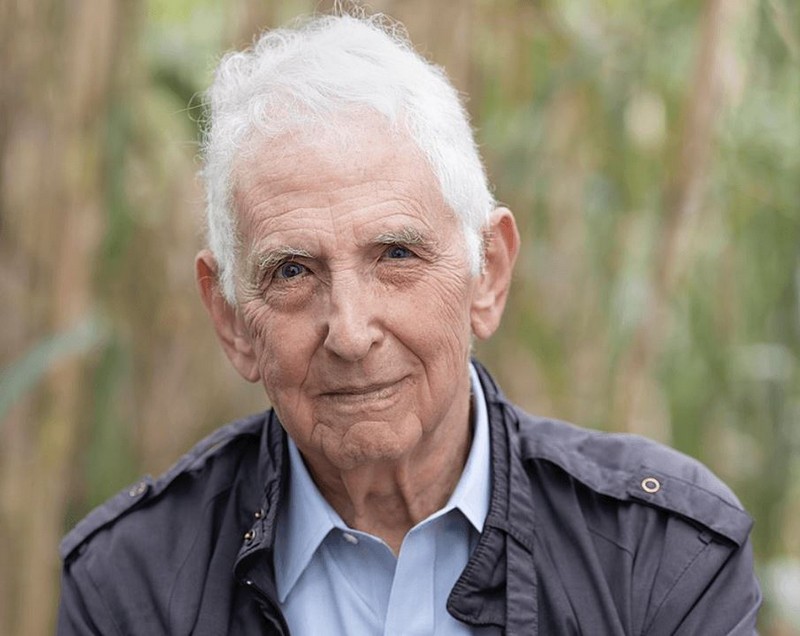
Daniel Ellsberg Has Foiled Those Who Want Him Confined to the Past

By Norman Solomon

11 Apr 2023 – In just a few words — “those who control the present, control the past and those who control the past control the future” — George Orwell summed up why narratives about history can be crucial. And so, ever since the final helicopter liftoff from the U.S. Embassy’s roof in Saigon on April 30, 1975, the retrospective meaning of the Vietnam War has been a matter of intense dispute.

The dominant spin has been dismal and bipartisan. “We went to Vietnam without any desire to capture territory or to impose American will on other people,” Jimmy Carter declared soon after entering the White House in early 1977. “We went there to defend the freedom of the South Vietnamese.” During the next decade, presidents ordered direct American military interventions on a much smaller scale, while the rationales were equally mendacious. Ronald Reagan ordered the 1983 invasion of Grenada, and George H.W. Bush ordered the 1989 invasion of Panama.

In early 1991, President Bush triumphantly proclaimed that reluctance to use U.S. military might after the Vietnam War had at last been vanquished. His exultation came after a five-week air war that enabled the Pentagon to kill upwards of 100,000 Iraqi civilians. “It’s a proud day for America,” Bush said. “And, by God, we’ve kicked the Vietnam syndrome once and for all.”

Two decades later — delivering what the White House titled “Remarks by the President at the Commemoration Ceremony of the 50th Anniversary of the Vietnam War” — Barack Obama did not even hint that the U.S. war in Vietnam was based on deception. Speaking in May 2012, after he had more than tripled the number of U.S. troops in Afghanistan, Obama said: “Let us resolve to never forget the costs of war, including the terrible loss of innocent civilians — not just in Vietnam, but in all wars.”

Moments later, Obama flatly claimed: “When we fight, we do so to protect ourselves because it’s necessary.”

Such lies are the opposite of what Daniel Ellsberg has been illuminating for more than five decades. He says about the Vietnam War: “It wasn’t that we were on the wrong side; we were the wrong side.”

Outlooks like that are rarely heard or read in U.S. mass media. And overall, news outlets have much preferred to make only sanitized references to Ellsberg as a historic figure. Much less acceptable is the Daniel Ellsberg who, since the end of the Vietnam War, was arrested nearly a hundred times for engaging in nonviolent civil disobedience against nuclear weapons and other aspects of the warfare industry.

After working inside the U.S. war machinery, Ellsberg became its highest-ranking operative to opt out — bravely throwing sand in its gears by revealing the top-secret Pentagon Papers, at the risk of spending the rest of his life in prison. The 7,000-page study exposed lies about U.S. policies in Vietnam told by four successive presidents. During the 52 years since then, Ellsberg has continually provided key information and cogent analysis of pretexts for U.S. wars. And he has focused on what they’ve actually meant in human terms.

Ellsberg has explained, most comprehensively in his 2017 landmark book The Doomsday Machine, what is worst of all: The nation’s military-industrial-media establishment refuses to acknowledge, let alone mitigate, the insanity of the militarism that is logically headed toward nuclear war.

Helping to prevent nuclear war has been an overriding preoccupation of Ellsberg’s adult life. In The Doomsday Machine — subtitled “Confessions of a Nuclear War Planner” — he shares exceptional insights from working for the doomsday system as an insider and then working to defuse the doomsday system as an outsider.

An upsurge of media attention to Ellsberg resulted from the emergence of other heroic whistleblowers. In 2010, U.S. Army private Chelsea Manning was arrested for leaking a vast quantity of documents that exposed countless lies and war crimes. Three years later, a former employee of a National Security Agency contractor, Edward Snowden, went public with proof of mass surveillance by a digital Big Brother with mind-boggling reach.

By then, Ellsberg’s stature as the Pentagon Papers whistleblower had risen to near-veneration among many liberals in media and others happy to consign the virtues of such whistleblowing to the Vietnam War era. But Ellsberg emphatically rejected the “Ellsberg good, Snowden bad” paradigm, which appealed to some eminent apologists for the status quo (such as Malcolm Gladwell, who wrote a specious New Yorker piece contrasting the two). Ellsberg has always vigorously supported Snowden, Manning and other “national security” whistleblowers at every turn.

Ellsberg disclosed in a public letter in early March that he was diagnosed with pancreatic cancer, with a prognosis of three to six months to live. Now, in the closing time of his life, he continues to speak out with urgency, in particular about the need for genuine diplomacy between the U.S. and Russia, as well as the U.S. and China, to avert nuclear war.

Many recent interviews are posted on the Ellsberg website. Ellsberg remains busy talking with journalists as well as activist groups. Last Sunday, vibrant and eloquent as ever, he spoke on a livestream video sponsored by Progressive Democrats of America.

Grassroots activists are organizing for the national Daniel Ellsberg Week, April 24-30, “a week of education and action,” which the Ellsberg Initiative for Peace and Democracy, based at the University of Massachusetts in Amherst, is co-sponsoring with the RootsAction Education Fund (where I’m national director). A central theme is “to celebrate the life’s work of Daniel Ellsberg, to take action in support of whistleblowers and peacemakers, and to call on state and local governments around the country to honor the spirit of difficult truth-telling with a commemorative week.”

No matter how much the defenders of the militaristic status quo have tried to relegate Daniel Ellsberg to the past, he has insisted on being present — with a vast reservoir of knowledge, an awesome intellect, deep compassion and commitment to nonviolent resistance — challenging systems of mass murder that go by other names.

Norman Solomon is the national director of RootsAction.org and executive director of the Institute for Public Accuracy.

17 April 2023

Source: www.transcend.org

Bombing Khartoum; CIA’s Latest Attempted Coup in Africa

By Thomas C Mountain

As I write the Sudanese Air Force is bombing Sudan’s capital city of Khartoum, an act of desperation really, because the war launched by the CIA backed coup attempt is not going very well for the coupsters. Reliable reports from Sudan say over 75% of the country is under the control of “opposition” fighters of the Rapid Strike Forces (RSF) with the head of Sudans National Intelligence surrendering along with a senior general and with another senior general being captured.

The CIA’s henchman, Sudanese Supreme Commander Gen. Burhan and self styled “Sultan of Sudan” was set on dismantling/crushing his main opposition, Gen. Hemeti, head of the RSF and preventing a civilian government from taking power from him, something Gen. Hemeti supports. Hemeti was the one who first pushed through the return to civilian rule after the former gangster President Bashir was overthrown in a palace coup by…Gen. Burhan (https://www.counterpunch.org/2019/07/18/africans-solving-african-problems-bringing-peace-to-sudan/). Burhan has since staged another coup against the civilian government, and is the absolute ruler of Sudan today.

Apparently the CIA couldn’t get Gen. Burhan to act quickly enough to wipe out the RSF and arrest Hemeti, his main rival. The RSF, true to their name, struck first last week and the Sudanese Army under Burhan has been on the back foot from the get go.

The RSF has captured a long rumored Egyptian Air Force base in south Sudan, broadcasting images of Egyptian Air Force personnel and several Egyptian Air Force fighter bombers. This base was where the Egyptian military, whose salaries are paid by $1.5 billion in US funds dispersed by the CIA, were threatening to launch an attack on Ethiopia’s Grand Renaissance Dam if  Ethiopia didnt agree to give Egypt control of the Nile River’s water.

Gen. Burhan is well known for sending dozens of flights of heavy Antonov cargo planes with hundreds of tons of weapons to the CIA backed TPLF attempted coup against the Ethiopia government during the “ceasefires” the CIA forced the Ethiopians to accept during the war from 2020-2022.

Hemeti is supported by the Eritreans, from which he returned from a visit last month, and the Ethiopians, who have been threatened repeatedly by the Egyptians. Last year Hemeti visited Russian for an extended period and when he returned it turns out, thanks to a Burhan press conference, that Sudan and Russia had agreed to a Red Sea naval base for the Russian Navy.

Burhan is the one who has been pressing for normalization of relations with Israel, something not popular with the Sudanese people but very much supported by the CIA.

Now Burhan has sent “his” air force force to bomb “his” capital city, something never before done in history. Questions are being raised about who is actually piloting the planes dropping high explosives on the citizens of Khartoum for most of the families of the Sudanese Air Force pilots live in Khartoum. Speculation is that Egyptian pilots are the only ones Burhan can rely on to carry out some pretty desperate acts, war crimes really, as his forces on the ground are being routed.

Hopefully this war, which came out of the blue and has developed rapidly will come to an end soon and the long suffering Sudanese people will be able to live in peace once again. Unfortunately, not if the CIA has its way, they want their henchman Burhan or no one, the US way or let all hell break loose. Happily, it looks so far that the latest CIA coup attempt in the Horn of Africa is being defeated. We will see what the future brings for Sudan. One thing is for sure, Eritrea and Ethiopia are not going to sit by and watch the CIA destroy peace in Sudan like they tried to do in Ethiopia.

Thomas C. Mountain is an historian and educator with 40 years background in Africa, living and reporting from Eritrea from 2006-2021.

18 April 2023

Source: countercurrents.org

Political Opportunism!

By Cedric Prakash

‘Opportunism’ is normally defined as “the practice of using situations unfairly to get an advantage for yourself without thinking about the consequences, of how your actions will affect other people”. At a different and far serious level is ‘political opportunism’ which is based on the political philosophy of Niccolò Machiavelli, as described in The Prince and which is often regarded as a classic manual of opportunist scheming; a Machiavellian is nowadays ‘a cunning, immoral, and opportunist person’; today, several of our politicians very easily fit the bill. Political opportunism therefore refers ‘to the attempt to maintain political support, or to increase political influence, possibly in a way which disregards relevant ethical or political principles. At the top, are those who have mastered the art of political chicanery- and we all know who!!

So, when the Prime Minister Narendra Modi paid a visit to the Sacred Heart Cathedral in Delhi on 9 April 2023, Easter Sunday, it definitely raised several eyebrows and more! Not that it was unique in any way. Prime Ministers and Presidents of India have visited Churches and participated in Christian religious events before; besides, it is within their legitimate right to visit and even pray not only in a Church, but also in a mosque, in a gurudwara or in fire- temple! We have that classic image of Pope Francis praying in the Blue Dome Mosque in Istanbul. There is the fact that once the Prime Minister expresses his desire to visit a Church, the Church authorities would certainly do everything within their means, with the ceremony and protocol. to accord a welcome befitting of the office of the Prime Minister,

The reality in India however, is different today. Given the constant attacks on the miniscule Christian population today, no one is willing to accept (with the exception of the gullible, the naive and the ‘bhakts ‘) that the visit of the Prime to the Cathedral was but one of sheer ‘political opportunism’. The attacks on Christians in India today (and also on other minorities, particularly the Muslims) take place with frightening regularity. These are not aberrations or isolated instances, as even some of the Christian prelates have the spinelessness to make them out to be. Christians in several BJP – ruled states are hounded and harassed; prayer services are disrupted; places of prayer and worship are demolished; false cases are foisted on pastors and Christian worshippers. The votaries of the Sangh Parivar spew hate and instigate violence on the Christians. Then we have the draconian and unconstitutional anti -conversion laws that have been promulgated in several states that denies one the Fundamental right to legitimately preach, practise and propagate one’s religion. The Constitutional provisions of rights to minorities are downscaled and are even being scrapped altogether. There is substantial documentation to evidence all of this.

It is important to note that those who indulge in the attacks against Christians, do so, because they know that nothing will happen to them! They have all the protection and immunity they need from their political bosses. They attack with impunity because they know they have the immunity! FIRs are not registered against these goons as we saw in the blatant intimidation of a couple of Catholic schools in Gujarat a few weeks ago. Many Christians are certainly not ready to accept second – class citizenship in a country which belongs to them and are fighting for their Constitutional rights. There was a massive protest in Delhi against the persecution of Christians in mid- February and one in Bombay as recently as 12 April!

The Prime Minister is in the know of all this! If he has any genuine concern for the Christian citizens of the country he should first openly and directly stop his regimes and ilk for all the irreparable harm that is being done not only to the Christians, but to the Constitution of the country, and particularly to its pluralistic fabric. He should be publicly stating, over and over again, that no one would be spared for demonizing, denigrating, discriminating against the minorities particularly the Christians and Muslims; and ensure appropriate action on them!

Visiting a Church, lighting a candle before the statue of the Risen Lord, listening to an English hymn are all good, if done in the right spirit and attitude. Otherwise, they are mere ‘theatrics and this Prime Minister, the world knows, is high on drama. What did he say when he visited the Cathedral? Did he assure the bishops and the others present, that he would abide by the Constitution and would protect their Constitutional rights and freedoms at whatever the cost? There is absolutely no record in the print or electronic media of what the Prime Minister said – just visuals: photo- ops for all! The fact is that the elections in Karnataka and Kerala are due shortly and that General elections will take place in 2024 – is not lost on concerned citizens of the country and particularly on discerning political analysts.

It is also interesting to see what the Bishops who welcomed the Prime Minister had to say to him? Were there only pleasantries and small talk (and some ‘prayers’) exchanged? Could not the Bishops have made it an occasion to highlight and in writing, the abysmal depths the country has fallen to in every sphere – and particularly the lot of the poor and the marginalised, the small farmers and the migrant workers, the excluded and the exploited? Should they have not made a strong statement on the plight of the Christians (and the Muslims) in India? Here was certainly a golden opportunity which was badly missed; a real opportunity which cannot be compared with the political opportunism of the Prime Minister!

Interestingly it is good to be reminded that Archbishop Anil Couto of Delhi who was the main prelate to welcome the Prime Minister to the Cathedral, wrote a letter to his diocese on 8 May 2018. At that time the country was burning with several issues as it is today. The modified media instead of taking on the Government on its lack of governance took on the Archbishop and made his innocuous letter prime time news. In his letter. Archbishop Couto requested special prayers until the General Elections of 2019. The letter was a call for prayer beginning on “May 13, 2018 which marks the Anniversary of the Apparition of the Blessed Mother at Fatima, consecrating ourselves and our nation to the Immaculate Heart”. At that time most thinking citizens had the following conclusions to make:

  • As an Indian citizen, the Archbishop has every right to voice his opinions/views
  • As the Archbishop of Delhi, it is his duty to be a Pastor and instruct the Catholics under his care both on spiritual and temporal matters
  • It is an age-old practice for Bishops all over the world to send out Circular or Pastoral Letters before any major event (including elections) which could affect their people in any way!
  • The letter clearly does NOT take sides; does not name any political party; does not tell people whom to vote for
  • The letter is addressed to a particular group of people (that is the Catholics of Delhi) it is directional in nature; a request and certainly not mandatory
  • The letter is a call to prayer! (anything wrong with that?)

Archbishop Anil begins his letter with the words “We are witnessing a turbulent political atmosphere which poses a threat to the democratic principles enshrined in our Constitution and the secular fabric of our nation.” There could not be perhaps a better opening statement, so down-to-earth, so contextual- which sets the tone of why one needs to pray and fast. Can one deny the fact that what we witness in India is not ‘a turbulent political atmosphere’? When a ‘few’ decide what one should eat and wear; see and write; or whom to worship; when the very core of the country’s secular and pluralistic fabric stands to be destroyed; when all that is sacred in the Constitution is being eroded – how can one ever abstain from making such a statement? It is a sin not to do so.

It would be appropriate at this juncture that Archbishop Anil and in fact all the Bishops of India should write another relevant pastoral letter (in the lines of Pope Francis) and in the context of the realities which today have gripped the nation. Can the Church take a visible and vocal stand on the brutal murder of Atique Ahmed and several others in encounters by the State of Uttar Pradesh?  Should we not speak out about the thousands of Christian and Muslim names missing from the Electoral rolls in Karnataka? What is the stand of the Church on corruption – and on the manner in which the likes of Adani have looted the nation? Can we dare accompany the likes of Bilkis Bano in her relentless struggle for justice? Many issues and many more unanswered questions!

Mohan Bhagwat, the Supremo of the Rashtriya Swayamsevak Sangh (RSS), is very clear of his agenda: to make of India a state based on the ‘Hindutva’ ideology. He has been using every possible occasion to lambast Christianity, missionaries and foreigners. On 17 April, addressing a gathering in Burhanpur, Madhya Pradesh he slammed the missionaries saying that the missionaries took advantage of the situations wherein people feel the society is not with them, in an apparent reference to ‘religious conversions. On Ambedkar Jayanti (14 April) addressing a gathering of RSS workers in Ahmedabad, without decrying the caste system he said, “we were once united, but we created divisions in the form of castes which were later widened by foreigners. For the progress of our country, we must strive to become one again.” On Good Friday (7 April) at a three-day Rashtriya Sewa Sangam of the RSS in Jaipur, once again took on the Christians, saying that, “when we talk of services, common people mention the names of missionaries who run schools and many organizations across the world. However, the service rendered by Hindu saints are no less. It came to my notice that the services of the saints who are engaged in spiritual works in four states of south India are many times more than the service of the missionaries put together.”

St Oscar Romero was a bishop of and for his suffering people. He was brutally gunned down by the brutal regime of his country El Salvador on 24 March 1980. The day before he was killed in his Sunday homily, he called out to his government saying, “In the name of God, and in the name of his suffering people; those who have suffered so much and whose laments cry out to heaven with greater intensity each day, I implore you, I beg you, I order you in the name of God: stop the repression immediately! “The Christian hierarchy and clerics have much to learn from Romero; in India today, we desperately need to emulate his prophetic courage based on the person and message of Jesus.

The American poet Lawrence Ferlinghetti in his poem ‘Pity the Nation’ puts it incisively


Pity the nation whose people are sheep

And whose shepherds mislead them

Pity the nation whose leaders are liars

Whose sages are silenced

And whose bigots haunt the airwaves

Pity the nation that raises not its voice

Except to praise conquerors

And acclaim the bully as hero

And aims to rule the world

By force and by torture

Pity the nation that knows

No other language but its own

And no other culture but its own

Pity the nation whose breath is money

And sleeps the sleep of the too well fed

Pity the nation oh pity the people

who allow their rights to erode

and their freedoms to be washed away

My country, tears of thee
Sweet land of liberty!”

His poem is truly worth reflecting upon given the reality we are gripped with today as a nation Succumbing to sheer political opportunism will be the death knell of our nation. We need to awake now- before its too late!

(Fr Cedric Prakash SJ is a Human Rights, Reconciliation and Peace activist/ writer.

19 April 2023

Source: countercurrents.org
80th Anniversary of Warsaw Ghetto Uprising

By Harsh Thakor

80 years ago the world witnessed one of the most heroic uprisings in the history of the world. Manifesting the spirit of liberation from tyranny, courage scaled heights almost unparalleled in rebellion of a persecuted community  On the eve of Passover 1943 — the nineteenth of April — a group of several hundred poorly armed young Jews lit the spark of  the Warsaw Ghetto Uprising, rising like a phoenix from the Ashes to mark the first insurrections against Nazism. The Jewish uprising in Warsaw testified how people’s organised revolt with Marxist spirit could challenge the most brutal or mightiest of oppressors. It integrated the proletarian Marxist spirit at a helm in regard to liberation of the Jewish community. It expressed the action of a proletarian core, and overall had an electrifying effect on the Polish Resistance.

Quoting Ernest Erber “Only those with a sense of history, with an understanding of the political meaning of resistance to the end, that is to say, the political idealists, choose to fight, not in blind desperation, but to die with a purpose. The heroes of the Ghetto fell with arms in hand because all their Socialist convictions had prepared them for that course of action. Their struggle was not a mere last act of vengeance against the hated enemy. It was a blow for freedom – the Socialist freedom to which they had dedicated their lives.”

For a small group of fighters, realizing that “dying with arms is more beautiful than without,” an isolated group of Jewish militants reminiscent of David confronting the Goliath, resisted for twenty-nine days against a much larger force, aiming to give the most mortal blow to the fascists as they could before they themselves were killed. The uprising, etched into the collective memory of postwar Jewry, lives in people’s minds like an inextinguishable flame

Their heroism was far from being a spontaneous one of the masses, was the product of organisation, planning and preparation from a relatively small — incredibly young — group of Jewish radicals, knitted together in a cohesive force.

Within a few weeks of the Nazi invasion of Poland, Governor Hans Frank ordered four hundred thousand Warsaw Jews to enter a ghetto. By November 1940, around five hundred thousand Jews from across Poland had been entrapped behind its walls, isolated from the outside world and placed in social oblivion.. Surrounded by a ten-foot-high barrier, the creation of the ghetto meant the relocation of approximately 30 percent of Warsaw’s population into 2.6 percent of the city, the designated area being no more than two and a half miles long and having previously housed fewer than 160,000 people.

In the ghetto, Jews were subjected to chronic hunger and poverty. Many families inhabited single rooms, and the dire lack of food meant that roughly one hundred thousand people survived on no more than a single bowl of soup per day. By March 1942 onwards, five thousand people died each month from disease and malnutrition, with entire collapse of sanitation system and breeding of diseases.

The initial response of the Jewish community leadership was passive. Following the creation of the Judenrat Jewish Council) — a collaborationist organization established with Nazi approval to permit easier implementation of anti-Jewish policies — some inhabitants fell into a false sense of security. A predominate idea engulfed the ghetto, examined through the glasses  of Jewish history, that Nazism was an inevitable  form of persecution that the Jewish people must accept.

Withstanding this demoralization, circles of defiance could be located in the self-organization of the left-wing of the Jewish community. Communists, Socialist-Zionists of varying descriptions, and social democrats organized themselves into sections in the ghetto, aiming to convert the misery into a constructive political organization. All parties — the Bund , a social-democratic mass organization that had enjoyed huge pre-war popularity; the Marxist-Zionist youth group Hashomer Hatzair the left-wing Zionist party Left Poale Zion  and the Communist Party dedicated themselves to this strategy, organizing cells that aimed to resurrect collectivist approach  among an emotionally battered d Jewish youth.

In dark times, the cell structures of youth organizations built base for combating hunger and depression. “The day I was able to re-establish contact with my group,” wrote the Young Communist militant Dora Goldkorn, “was one of the happiest days in my hard, tragic ghetto life.” In the project to cultivate resistance leadership among the youth, keeping morale high was crucial; acts of friendship such as the sharing of food were as important as distributing anti-Nazi literature.

By 1942, the various youth organizations felt confident enough to establish the formation of an “Anti-Fascist Bloc.” On the insistence of the Communists, a manifesto was drafted that advocated to unite the Jewish left in the Warsaw Ghetto, with the hope of crystallising  this political unity across other ghettos.

Calling for a “national front” against the occupation, for the unity of all progressive forces on the basis of common demands and for armed antifascism, the manifesto projected the pre-war Popular Fronts in its organizational methodology.

The Left Poale Zion enthusiastically joined, as did the Hashomer Hatzair — who re-emphasized their fidelity to the Soviet Union, despite the Kremlin’s opposition to Zionism. The Bund, however, were less reliable, due to their historic anticommunism and rejection of specifically Jewish armed action; a party that resolutely stated Poland was the home for Polish Jews, many Bundists refused avenues other than Polish-Jewish unity of action.

The paper of the Anti-Fascist Bloc, Der Ruf, reached publication twice. Its contents placed great accent on upholding Soviet resistance and urging the ghetto inhabitants to accept unconditionally, liberation at the hands of the Red Army.

The bloc’s fighting squads contained militants belonging to all varieties of labour movement groups, but the lynchpin of the organization was Pinkus Kartin  A stalwart of communism in prewar Poland and a veteran of the International Brigades to Spain, Kartin was a leader both politically and militarily. It was the arrest and murder of Kartin in June 1943 that culminated the end for the Anti-Fascist Bloc. His arrest ignited an intense repression against the prominent Young Communists, who saw their numbers dwindling and were forced into hiding.

During this period, figures from the right-wing of the Jewish community formed a rival group, the Jewish Military Union (ZZW). Led by the right-wing Zionist group Betar and funded by high society, the ZZW relied upon ex-army officers who could fight orthodox warfare with the Nazis using regular army discipline — unlike the ZOB, which considered itself the armed manifestation of the Jewish workers’ movement..

By contrast, in the eyes of Israel Gutman, the typical ZOB volunteers were “young men in their twenties, Zionists, Communists, socialists — idealists with no battle experience, no military training.” While the propaganda of the ZZW was principally nationalistic, the ZOB’s propaganda and literature propounded antiracist internationalism, offered intellectual positions on the world situation, and debated the labour movement.

Resistance

The ZOB set out to launch an anti-Nazi insurrection. However, it recognized that it was an imperative task in consolidating of the organization’s position in the wider community — it was decided that it had to carry out the intimidation and execution of Jewish collaborators with the occupiers.

For ZOB militants, collaborators represented an auxiliary wing of fascism that was instrumental in facilitating the deportation of Polish Jewry. ZOB militants chose to execute Jewish policeman Jacob Lejkin. For his “dedication” in deporting Jews to Auschwitz, Lejkin was shot, and his example shook the collaborating establishment to its knees.. This was followed by the execution of Alfred Nossig in February 1943. Józef Szeryński, the former head of the ghetto police, committed suicide to avoid his own fate.

These acts ensured ZOB’s vanguard role in the resistance movement, and also sparked resistance from beyond their ranks. In a short period of time they won over many ghetto inhabitants to this position.

Between June and September 1942, three hundred thousand Jews had been deported or murdered. People lost everyone and many young people began to dispense with anxieties about protecting their families and commit instead to militant political activity.

Contempt was shown for the self-determined martyrdom of Adam Czerniakow, the Judenrat leader who committed suicide in July 1942. For young Jewish socialists such as the prominent Bundist Marek Edelman, Czerniakow had “made his death his own private business,” a symbol of privilege in contrast to Edelman and his working-class comrades awaiting their turn on the deportation lists. For them, he said, the overwhelming sentiment in these times was that political leadership necessitated that “one should die with a bang.”

Uprising

On the morning of Monday, January 18, six months after the first mass deportations of Warsaw Jews (which reduced the number of ghetto inhabitants from four hundred thousand to approximately seventy to eighty thousand), ZOB militants sprouted from the crowds of deportees to attack German soldiers, killing several. A protracted combat followed over four days, where militants infiltrated lines of slave labourers marching towards the Umschlagplatz [Deportation of Jews], stepped out of rank at a given signal, and assassinated their German guards. Though scores of ZOB fighters succumbed, the confusion created by the fighting paved way for some to escape — and demonstrated to others that Nazi bodies were not infallible.

By April 1943, there was a general sensation that the ghetto was to be entirely liquidated. On April 19, five thousand soldiers led by SS general Jürgen Stroop entered the ghetto to remove the final inhabitants; in response, approximately 220 ZOB volunteers spectacularly began their attack, located in ersatz positions in cellars, apartments, and rooftops, each armed with a single pistol and several Molotov cocktails.

The revolt created pandemonium, taking the Nazis by complete surprise and killing many Wehrmacht and SS soldiers. In response, the humiliated German army, suffering losses at the hands of prisoners they thought long vanquished, formulated a policy of systematically burning out the fighters. Intense hand-to-hand combat broke was waged for days, and by late April coordinated warfare by the ZOB collapsed, with the conflict now reaching stage of the Germans burning small groups of armed Jews out of bunker hideouts created to evade capture.

Both the red flag and the blue-and-white flag of the Zionist movement fluttered over ZOB-seized buildings. The youngest fighter killed had been a Bundist activist aged thirteen. Though clearly inexperienced as a fighting force, an anonymously authored Bund internal document that reached London in June 1943 stressed the outstanding political unity and “fraternity” between leftist groups in combat. The relentless dedication to which the young fighters of the ZOB exhibited to their dreams of socialism was manifested to perfection in a May Day rally staged in the scenario of ghetto’s ruins.

The entire world, was celebrating May Day on that day but never in history had the Internationale been sung amist conditions where an entire nation was on the verge of perishing. The words and the song reverberated from the charred ruins portrayed that socialist youth [were] still waging combat in the ghetto, and that even in the face of death they were remained relentless in pursuit of their ideals.

Leading militants of the ZOB committed mass suicide on May 8, surrounded by the German army at their base on Mila 18. By mid-May, the ghetto had been razed, and the Great Synagogue of Warsaw personally blown up by General Stroop on May 16 to celebrate the end of Jewish resistance. A mere forty ZOB combatants had escaped onto the “Aryan” side of Warsaw, where scores more fell before war’s end in the subsequent city-wide uprising of 1944.

Relevance Today

This very spirit of the April 1943 Warsaw ghetto uprising needs to be resurrected with neo-fascism engulfing every corner of our globe, and rising to unparalleled heights. Today in similar light the Palestinians are facing the most perilous conditions. Farmers and workers are facing torments of the worst ever economic crisis, with neo-colonialism enslaving them in another form. Nation chauvinism,Racism,intolerance of religions  and victimisation of immigrant communities is rampant, or fervouring at a height, as never earlier. In India, Hindutva saffron fascism is embarking on the same path as the Nazi fascists, stripping the Muslim minorities and dalits of their rights, and political dissent is crushed to dust. Thousands of political prisoners languish within prison walls world over, being denied proper human rights.

Important that the event is not treated with a Zionist tilt but upheld with a Marxist-Leninist perspective.

Harsh Thakor is a freelance journalist who has extensively studied liberation movements.

19 April 2023

Source: countercurrents.org
Japan Signals an Attitude Shift to the Growing Power of the Global South

By Vijay Prashad

In mid-April, the Japanese Ministry of Foreign Affairs released its Diplomatic Bluebook 2023, its most important guidebook on international affairs. Japan’s foreign minister, Yoshimasa Hayashi, wrote the foreword, which begins: “The world is now at a turning point in history.” This phrase is key to understanding the Japanese approach to the war in Ukraine. Hours after Russian forces entered Ukraine, the Japanese government signed the G7 statement that condemned the “large-scale military aggression” and called for “severe and coordinated economic and financial sanctions.” The next day, Hayashi announced that Japan would sanction “designated individuals related to Russia,” freeze assets of three Russian banks, and sanction exports to Russia’s military. In its Diplomatic Bluebook 2022, Japan condemned Russia and urged the Russian government to “withdraw its troops immediately, and comply with international law.” Russia’s war, the Japanese argued, “shakes the very foundation of the international order,” an order whose attrition, as the new Bluebook argues, has brought the world to this “turning point.”

National Interests

Despite all the talk of sanctions, Japan continues to import energy from Russia. In 2022, 9.5 percent of Japan’s imported liquefied natural gas came from Russia (up from 8.8 percent in 2021). Most of this energy came from Russia’s Sakhalin Island, where Japanese companies and the government have made substantial investments. In July 2022, Hayashi was asked about Japan’s continued imports from Sakhalin-2. His answer was clear: “Sakhalin-2 is an important project for energy security, including the stable supply of electricity and gas in Japan.” Since July, Japan’s officials have continued to emphasize Japan’s national interests—including through the Sakhalin-2 natural gas project—over its obligations to the G7 and to its own statements about the war. In August 2022, the Japanese government asked two private firms—Mitsui and Mitsubishi—to deepen its involvement in Russia’s Sakhalin-2; “We will respond by working with the public and private sectors to protect the interests of the companies and secure [a] stable supply of liquefied natural gas,” said former Minister of Economy, Trade and Industry Kōichi Hagiuda.

In March 2022, Kyodo News reported that a leaked version of the Diplomatic Bluebook 2022 used a rather startling phrase—“illegal occupation”—to describe Russian control over islands north of Hokkaido. The Japanese government had not used that phrase since 2003, largely because of increased diplomatic activity between Japan and Russia driven by the collaboration over the development of Sakhalin-2. As it turned out, the draft that Kyodo News had seen was altered so that the officialDiplomatic Bluebook of 2022 did not use this phrase. Instead, the Bluebook noted that the “greatest concern between Japan and Russia is the Northern Territories issue,” which “is yet to be resolved.” Japan could have taken advantage of the Western animosity against Russia to press its claim on these islands, but instead, the Japanese government merely hoped that Russia would withdraw from Ukraine and return to “negotiations on a peace treaty” regarding the islands north of Japan.

Three New Points

The Diplomatic Bluebook 2023 makes three important points: that the post-Cold War era has ended, that China is Japan’s “greatest strategic challenge” (p. 43), and that Global South countries must be taken seriously. The Bluebook highlights Japan’s confusion, caught between its reliance upon Russian energy and the growing confidence of the Global South.

The Bluebook from 2022 noted, “The international community is currently undergoing an era-defining change.” Now, however, the Bluebook 2023 points to the “end of the post-Cold War era” (p. 3), which is illustrated by the collapse of the U.S.-led world order (which both the United States and Japan call the “rules-based international order”). Washington’s power has declined, but it is not clear what comes next.

Anxiety about the growing role of China in Asia is not new for Japan, which has long contested the Diaoyu (China)/Senkaku (Japan) islands. But now, there is a much more pronounced—and dangerous—assessment of the situation. The Bluebook 2023 notes the close alignment between China and Russia, although it does not focus on that strategic partnership. Rather, the Japanese government focuses on China, which it now sees as Japan’s “greatest strategic challenge.” Even here, the Japanese government acknowledges that the two countries “have held a series of dialogues to discuss common issues.” The “efforts of both Japan and China” are important, says the Bluebook, to build a “constructive and stable” relationship (p. 43).

Finally, the Japanese government accepts that there is a new mood in the Global South, with countries across Africa, Asia, and Latin America unwilling to submit any longer to the will of the Western states. In January 2023, a reporter from Yomiuri Shimbun asked the Foreign Ministry’s press secretary Hikariko Ono how Japan defined the “Global South.” Her tentative reply is instructive. “The Government of Japan does not have a precise definition of the term Global South,” she said, but “it is my understanding that in general, it often refers to emerging and developing countries.” The Ministry of Foreign Affairs, she noted, must “strengthen engagement with the Global South.” In the Bluebook 2023, the Japanese recognize that Global South countries are not following the Western position on Ukraine and that berating the countries of the Global South raises accusations of “double standards” (wars by the West are acceptable, but wars by others are unacceptable) (p. 3). Japan will promote multilateralism, building “an inclusive approach that bridges differences.” A new “attitude is required,” says the Bluebook.

In March, Japan’s Prime Minister Fumio Kishida met with President Volodymyr Zelenskyy in Ukraine. Both sides said that they were working to share security information, but Japan once more refused to send weapons to Ukraine. A few weeks after Kishida left Ukraine, Mitsuko Shino, Japan’s Deputy Permanent Representative to the United Nations warned in a guarded statement about the “risks stemming from violations of the agreements regulating the export of weapons and military equipment” and about the importance of the Arms Trade Treaty. Japan remains caught in the horns of its own dilemma.

Vijay Prashad is an Indian historian, editor, and journalist. He is a writing fellow and chief correspondent at Globetrotter.

19 April 2023

Source: countercurrents.org
China Will Be The World Economy’s Biggest Growth Driver In The Next 5 Years, Doubling The U.S. Contribution, Says IMF

By Countercurrents Collective

China will become the biggest driver of global growth over the next five years and will contribute double what the U.S. adds, according to the International Monetary Fund.

Based on Bloomberg calculations from data in the IMF’s World Economic Outlook (A Rocky Recovery, April 2023, https://www.imf.org/en/Publications/WEO/Issues/2023/04/11/world-economic-outlook-april-2023) released last week, China’s slice of global gross domestic product expansion will be at 22.6%, India’s will be 12.9%, and the U.S. will add 11.3%.

They are followed by Indonesia, Germany, Turkey, and Japan, each with a less than 3.6% contribution.

Three-quarters of global growth will stem from 20 countries, and over 50% will come from just China, India, the U.S., and Indonesia.

The IMF expects growth contributions from Brazil, Russia, India, and China to outpace Group of Seven nations.

Overall, the IMF anticipates global growth to expand about 3% over the next five years in a higher-interest-rate environment. It is the weakest outlook in over 30 years.

The group’s report highlighted that recent bank turmoil and sticky inflation have heightened recession risks. March brought the collapse of Silicon Valley Bank and Signature, in addition to trouble with Silvergate, Credit Suisse, and other names.

“Risks to the outlook are squarely to the downside,” the IMF said. “Much uncertainty clouds the short- and medium-term outlook as the global economy adjusts to the shocks of 2020–22 and the recent financial sector turmoil. Recession concerns have gained prominence, while worries about stubbornly high inflation persist.”

The World Economic Outlook is a survey by the IMF staff usually published twice a year. It presents IMF staff economists’ analyses of global economic developments during the near and medium term. It gives an overview as well as more detailed analysis of the world economy; considers issues affecting industrial countries, developing countries, and economies in transition to market; and addresses topics of pressing current interest.

The IMF said:

Tentative signs in early 2023 that the world economy could achieve a soft landing — with inflation coming down and growth steady — have receded amid stubbornly high inflation and recent financial sector turmoil. Although inflation has declined as central banks have raised interest rates and food and energy prices have come down, underlying price pressures are proving sticky, with labor markets tight in a number of economies. Side effects from the fast rise in policy rates are becoming apparent, as banking sector vulnerabilities have come into focus and fears of contagion have risen across the broader financial sector, including nonbank financial institutions. Policymakers have taken forceful actions to stabilize the banking system. As discussed in depth in the Global Financial Stability Report, financial conditions are fluctuating with the shifts in sentiment.

It said:

Debt levels remain high, limiting the ability of fiscal policymakers to respond to new challenges.

The IMF said:

The baseline forecast, which assumes that the recent financial sector stresses are contained, is for growth to fall from 3.4 percent in 2022 to 2.8 percent in 2023, before rising slowly and settling at 3.0 percent five years out –– the lowest medium-term forecast in decades. Advanced economies are expected to see an especially pronounced growth slowdown, from 2.7 percent in 2022 to 1.3 percent in 2023. In a plausible alternative scenario with further financial sector stress, global growth declines to about 2.5 percent in 2023 –– the weakest growth since the global downturn of 2001, barring the initial COVID-19 crisis in 2020 and during the global financial crisis in 2009 –– with advanced economy growth falling below 1 percent. The anemic outlook reflects the tight policy stances needed to bring down inflation, the fallout from the recent deterioration in financial conditions, the ongoing war in Ukraine, and growing geoeconomic fragmentation. Global headline inflation is set to fall from 8.7 percent in 2022 to 7.0 percent in 2023 on the back of lower commodity prices, but underlying (core) inflation is likely to decline more slowly. Inflation’s return to target is unlikely before 2025 in most cases. Once inflation rates are back to targets, deeper structural drivers will likely reduce interest rates toward their pre-pandemic levels.

It said:

Risks to the outlook are heavily skewed to the downside, with the chances of a hard landing having risen sharply. Financial sector stress could amplify and contagion could take hold, weakening the real economy through a sharp deterioration in financing conditions and compelling central banks to reconsider their policy paths. Pockets of sovereign debt distress could, in the context of higher borrowing costs and lower growth, spread and become more systemic. The war in Ukraine could intensify and lead to more food and energy price spikes, pushing inflation up. Core inflation could turn out more persistent than anticipated, requiring even more monetary tightening to tame. Fragmentation into geopolitical blocs has the scope to generate large output losses, including through its effects on foreign direct investment.

The IMF said:

Policymakers have a narrow path to walk to improve prospects and minimize risks.

U.S. Credit Crunch Has Started, Says Morgan Stanley

A media report said:

The collapse of Silicon Valley Bank (SVB) and the ensuing banking crisis have triggered a credit crunch in the US, claims Morgan Stanley’s top stock strategist Mike Wilson. He pointed to data that shows a tightening of lending standards by financial institutions.

The warning comes over a month after massive deposit runs caused two lenders, Silicon Valley Bank and Signature Bank, to fail within days. A third lender, First Republic, ended up being the recipient of a $30-billion rescue from top Wall Street banks in the form of deposits. The big players stepped in over investor fears that First Republic would become the next institution to fail.

In a note seen by Business Insider, Wilson said that lending levels have seen the steepest decline on record over the past two weeks. He attributes the drop to US banks’ attempts to offset the breakneck pace of deposit flight in the month since the collapse of SVB.

“The data suggest a credit crunch has started,” the analyst said in a Sunday note, noting that $1 trillion in deposits has been withdrawn from U.S. lenders since the Federal Reserve began its series of rate hikes nearly a year ago.

According to Wilson, major stock indexes holding steady since the failure of SVB should not be taken as an indication of recovery, but rather a sign that stocks are at risk of a sudden drop similar to what has been seen in small caps and bank stocks since March.

“To those investors cheering the softer-than-expected inflation data last week, we would say be careful what you wish for,” Wilson warned, pointing to the March Consumer Price Index report that revealed the inflation rate has been climbing less than projected.

“If/when revenues begin to disappoint, that margin degradation can be much more sudden, and that is when the market can suddenly get in front of the earnings decline we are forecasting.”

In February, Wilson projected U.S. stocks that had previously soared to unsustainable highs could crash 26% within months.

Countercurrents is answerable only to our readers. Support honest journalism because we have no PLANET B.

19 April 2023

Source: countercurrents.org
Will the West Turn Ukraine into a Nuclear Battlefield? Why Depleted Uranium Should Have No Place There

By Joshua Frank

It’s sure to be a blood-soaked spring in Ukraine. Russia’s winter offensive fell far short of Vladimir Putin’s objectives, leaving little doubt that the West’s conveyor belt of weaponry has aided Ukraine’s defenses. Cease-fire negotiations have never truly begun, while NATO has only strengthened its forces thanks to Finland’s new membership (with Sweden soon likely to follow). Still, tens of thousands of people have perished; whole villages, even cities, have been reduced to rubble; millions of Ukrainians have poured into Poland and elsewhere; while Russia’s brutish invasion rages on with no end in sight.

The hope, according to Ukrainian President Volodymyr Zelensky, is that the Western allies will continue to furnish money, tanks, missiles, and everything else his battered country needs to fend off Putin’s forces. The war will be won, according to Zelensky, not through backroom compromises but on the battlefield with guns and ammo.

“I appeal to you and the world with these most simple and yet important words,” he said to a joint session of Great Britain’s parliament in February. “Combat aircraft for Ukraine, wings for freedom.”

The United Kingdom, which has committed well over $2 billion in assistance to Ukraine, has so far refused to ship fighter jets there but has promised to supply more weaponry, including tank shells made with depleted uranium (DU), also known as “radioactive bullets.” A by-product of uranium enrichment, DU is a very dense and radioactive metal that, when housed in small torpedo-like munitions, can pierce thickly armored tanks and other vehicles.

Reacting to the British announcement, Putin ominously said he would “respond accordingly” if the Ukrainians begin blasting off rounds of DU.

While the UK’s decision to send depleted-uranium shells to Ukraine is unlikely to prove a turning point in the war’s outcome, it will have a lasting, potentially devastating, impact on soldiers, civilians, and the environment. The controversial deployment of DU doesn’t pose faintly the same risks as the actual nuclear weapons Putin and his associates have hinted they might use someday in Ukraine or as would a potential meltdown at the embattled Zaporizhzhia nuclear facility in that country. Still, its use will certainly help create an even more lethal, all too literally radioactive theater of war — and Ukraine will end up paying a price for it.

The Radioactive Lions of Babylon

Stuart Dyson survived his deployment in the first Gulf War of 1991, where he served as a lance corporal with Britain’s Royal Pioneer Corps. His task in Kuwait was simple enough: he was to help clean up “dirty” tanks after they had seen battle. Many of the machines he spent hours scrubbing down had carried and fired depleted uranium shells used to penetrate and disable Iraq’s T-72 tanks, better known as the Lions of Babylon.

Dyson spent five months in that war zone, ensuring American and British tanks were cleaned, armed, and ready for battle. When the war ended, he returned home, hoping to put his time in the Gulf War behind him. He found a decent job, married, and had children. Yet his health deteriorated rapidly and he came to believe that his military service was to blame. Like so many others who had served in that conflict, Dyson suffered from a mysterious and debilitating illness that came to be known as Gulf War Syndrome.

After Dyson suffered years of peculiar ailments, ranging from headaches to dizziness and muscle tremors, doctors discovered that he had a severe case of colon cancer, which rapidly spread to his spleen and liver. The prognosis was bleak and, after a short battle, his body finally gave up. Stuart Dyson died in 2008 at the age of 39.

His saga is unique, not because he was the only veteran of the first Gulf War to die of such a cancer at a young age, but because his cancer was later recognized in a court of law as having been caused by exposure to depleted uranium. In a landmark 2009 ruling, jurors at the Smethwick Council House in the UK found that Dyson’s cancer had resulted from DU accumulating in his body, and in particular his internal organs.

“My feeling about Mr. Dyson’s colon cancer is that it was produced because he ingested some radioactive material and it became trapped in his intestine,” Professor Christopher Busby, an expert on the effects of uranium on health, said in his court testimony. “To my mind, there seems to be a causal arrow from his exposure to his final illness. It’s certainly much more probable than not that Mr. Dyson’s cancer was caused by exposure to depleted uranium.”

The U.S. Department of Defense estimated that American forces fired more than 860,000 rounds of DU shells during that 1991 war to push Iraqi autocrat Saddam Hussein’s military out of Kuwait. The result: a poisoned battlefield laced with radioactive debris, as well as toxic nerve agents and other chemical agents.

In neighboring southern Iraq, background radiation following that war rose to 30 times normal. Tanks tested after being shelled with DU rounds had readings 50 times higher than average.

“It’s hot forever,” explains Doug Rokke, a former major in the U.S. Army Reserve’s Medical Service Corps who helped decontaminate dozens of vehicles hit by DU shells during the first Gulf War. “It doesn’t go away. It only disperses and blows around in the wind,” he adds. And of course, it wasn’t just soldiers who suffered from DU exposure. In Iraq, evidence has been building that DU, an intense carcinogenic agent, has led to increases in cancer rates for civilians, too.

“When we were moving forward and got north of a minefield, there were a bunch of blown-out tanks that were near where we would set up a command post,” says Jason Peterson, a former American Marine who served in the first Gulf War. “Marines used to climb inside and ‘play’ in them … We barely knew where Kuwait was, let alone the kind of ammunition that was used to blow shit up on that level.”

While it’s difficult to discern exactly what caused the Gulf War Syndrome from which Dyson and so many other soldiers suffered (and continue to suffer), experts like Rokke are convinced that exposure to depleted uranium played a central role in the illness. That’s an assertion Western governments have consistently downplayed. In fact, the Pentagon has repeatedly denied any link between the two.

“I’m a warrior, and warriors want to fulfill their mission,” Rokke, who also suffers from Gulf War Syndrome, told Vanity Fair in 2007. “I went into this wanting to make it work, to work out how to use DU safely, and to show other soldiers how to do so and how to clean it up. This was not science out of a book, but science done by blowing the shit out of tanks and seeing what happens. And as we did this work, slowly it dawned on me that we were screwed. You can’t do this safely in combat conditions. You can’t decontaminate the environment or your own troops.”

Death to Uranium

Depleted uranium can’t produce a nuclear explosion, but it’s still directly linked to the development of atomic weaponry. It’s a by-product of the uranium enrichment process used in nuclear weapons and fuel. DU is alluring to weapons makers because it’s heavier than lead, which means that, if fired at a high velocity, it can rip through the thickest of metals.

That it’s radioactive isn’t what makes it so useful on the battlefield, at least according to its proponents. “It’s so dense and it’s got so much momentum that it just keeps going through the armor — and it heats it up so much that it catches on fire,” says RAND nuclear expert and policy researcher Edward Geist.

The manufacturing of DU dates back to the 1970s in the United States. Today, the American military employs DU rounds in its M1A2 Abrams tanks. Russia has also used DU in its tank-busting shells since at least 1982 and there are plenty of accusations, though as yet no hard evidence, that Russia has already deployed such shells in Ukraine. Over the years, for its part, the U.S. has fired such rounds not just in Kuwait, but also in Bosnia, Iraq, Kosovo, Syria, and Serbia as well.

Both Russia and the U.S. have reasons for using DU, since each has piles of the stuff sitting around with nowhere to put it. Decades of manufacturing nuclear weapons have created a mountain of radioactive waste. In the U.S., more than 500,000 tons of depleted-uranium waste has built up since the Manhattan Project first created atomic weaponry, much of it in Hanford, Washington, the country’s main plutonium production site. As I investigated in my book Atomic Days: The Untold Story of the Most Toxic Place in America, Hanford is now a cesspool of radioactive and chemical waste, representing the most expensive environmental clean-up project in history with an estimated price tag of $677 billion.

Uranium, of course, is what makes the whole enterprise viable: you can’t create atomic bombs or nuclear power without it. The trouble is that uranium itself is radioactive, as it emits alpha particles and gamma rays. That makes mining uranium one of the most dangerous operations on the planet.

Keep It in the Ground

In New Mexico, where uranium mines were primarily worked by Diné (Navajo People), the toll on their health proved gruesome indeed. According to a 2000 study in the Journal of Occupational and Environmental Medicinerates of lung cancer in Navajo men who mined uranium were 28 times higher than in those who never mined uranium. The “Navajo experience with uranium mining,” it added, “is a unique example of exposure in a single occupation accounting for the majority of lung cancers in an entire population.”

Scores of studies have shown a direct correlation between exposure to uranium and kidney disease, birth defects in infants (when mothers were exposed), increased rates of thyroid disease, and several autoimmune diseases. The list is both extensive and horrifying.

“My family had a lot of cancer,” says anti-nuclear activist and Indigenous community organizer Leona Morgan. “My grandmother died of lung cancer and she never smoked. It had to be the uranium.”

One of the largest radioactive accidents, and certainly the least reported, occurred in 1979 on Diné land when a dam broke, flooding the Puerco River near Church Rock, New Mexico, with 94 million gallons of radioactive waste. The incident received virtually no attention at the time. “The water, filled with acids from the milling process, twisted a metal culvert in the Puerco and burned the feet of a little boy who went wading. Sheep keeled over and died, while crops curdled along the banks. The surge of radiation was detected as far away as Sanders, Arizona, fifty miles downstream,” writes Judy Pasternak in her book Yellow Dirt: A Poisoned Land and the Betrayal of the Navajo.

Of course, we’ve known about the dangers of uranium for decades, which makes it all the more mind-boggling to see a renewed push for increased mining of that radioactive ore to generate nuclear power. The only way to ensure that uranium doesn’t poison or kill anyone is to leave it right where it’s always been: in the ground. Sadly, even if you were to do so now, there would still be tons of depleted uranium with nowhere to go. A 2016 estimate put the world’s mountain of DU waste at more than one million tons (each equal to 2,000 pounds).

So why isn’t depleted uranium banned? That’s a question antinuclear activists have been asking for years. It’s often met with government claims that DU isn’t anywhere near as bad as its peacenik critics allege. In fact, the U.S. government has had a tough time even acknowledging that Gulf War Syndrome exists. A Government Accountability Office report released in 2017 found that the Veterans Affairs Department had denied more than 80% of all Gulf War illness claims by veterans. Downplaying DU’s role, in other words, comes with the terrain.

“The use of DU in weapons should be prohibited,” maintains Ray Acheson, an organizer for the International Campaign to Abolish Nuclear Weapons and author of Banning the Bomb, Smashing the Patriarchy. “While some governments argue there is no definitive proof its use in weapons causes harm, it is clear from numerous investigations that its use in munitions in Iraq and other places has caused impacts on the health of civilians as well as military personnel exposed to it, and that it has caused long-term environmental damage, including groundwater contamination. Its use in weapons is arguably in violation of international law, human rights, and environmental protection and should be banned in order to ensure it is not used again.”

If the grisly legacy of the American use of depleted uranium tells us anything, it’s that those DU shells the British are supplying to Ukraine (and the ones the Russians may also be using there) will have a radioactive impact that will linger in that country for years to come, with debilitating, potentially fatal, consequences. It will, in a sense, be part of a global atomic war that shows no sign of ending.

Joshua Frank, a TomDispatch regular, is an award-winning California-based journalist and co-editor of CounterPunch.

19 April 2023

Source: countercurrents.org
U.S. Must Stop Encouraging War In Ukraine, Says Lula

By Countercurrents Collective

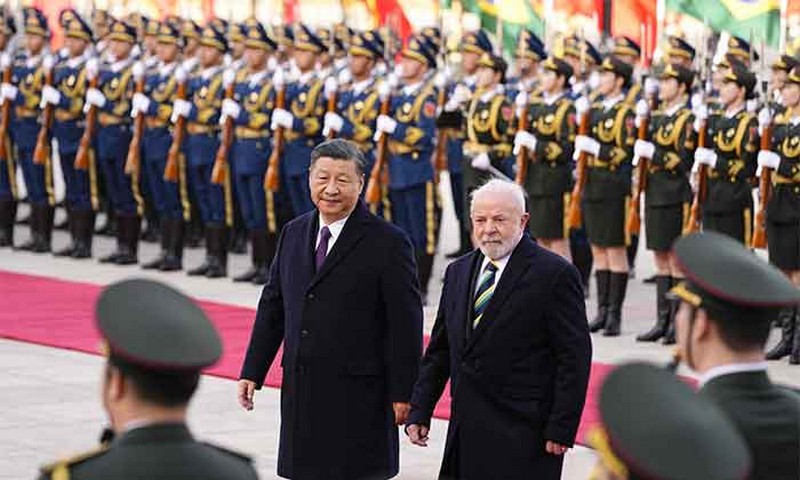
Brazilian President Lula da Silva said on Saturday: The U.S. and its allies should focus on promoting peace instead of fueling the Ukraine conflict by arming Kiev.

Lula has concluded a state visit to China, his country’s primary trading partner.

“The united States needs to stop encouraging war and start talking about peace,” Lula told reporters in Beijing. “The European Union needs to start talking about peace.”

He added that, in doing so, world leaders might be able to “convince” both Russian President Vladimir Putin and his Ukrainian counterpart Vladimir Zelensky that “peace is in the interest of the whole world.”

In contrast to many Western nations, neither Brazil nor China has imposed sanctions on Moscow following the onset of the conflict in Ukraine last year.

Prior to the trip, Lula, the left-wing leader who returned as Brazilian president after succeeding Jair Bolsonaro at the start of this year, had sought to position himself as part of a group that could mediate in the conflict. He did not elaborate on the nature of any such talks with Chinese President Xi Jinping following their meeting on Friday.

CNN reported earlier this week that Beijing had requested the removal of issues surrounding Ukraine from the list of topics to be discussed by the two leaders.

“It is important to have patience,” Lula suggested on Saturday. He said: “But above all, it is necessary to convince the countries that are supplying weapons, encouraging the war, to stop.”

China has been a key trading partner for Brazil since 2009. In 2022 alone, Beijing imported close to $90 billion worth of Brazilian commodities such as soy, iron ore and petrol. Brazil is also the largest single market for Chinese products on the South American continent.

Lula’s comments on Ukraine, as well as the strengthening of economic ties with Beijing, are likely to draw the attention of Washington, with whom Brasilia has sought a closer relationship under his rule. In February, he met with U.S. President Joe Biden in the White House, where they primarily discussed efforts to combat climate change and combat anti-democratic extremism.

Brazil Calls To Move Away From Dollar

Brazilian President Luiz Inacio Lula da Silva has stated that developing nations should move away from the U.S. dollar in favor of their own currencies in order to push back against U.S. dominance over the global financial system.

Speaking in Shanghai on Thursday during an official visit to China, Lula said the BRICS group – comprising Brazil, Russia, India, China and South Africa – should look for an alternative currency to the dollar for trade.

“Every night I ask myself why all countries have to base their trade on the dollar. Why cannot we do trade based on our currencies?” he said. “Who was it that decided that the dollar was the currency after the disappearance of the gold standard?”

The leftist leader went on to lament that “everyone depends on just one currency,” referring to the dollar, and proposed “a currency to finance trade relations between Brazil and China, between Brazil and other countries.”

Lula kicked off his trip to China with an event to mark the appointment of former Brazilian President Dilma Rousseff as the head of the New Development Bank, also known as the ‘BRICS bank,’ which he said could free emerging economies “from submission to traditional financial institutions, which want to govern us.”

Brazilian Finance Minister Fernando Haddad also traveled with the president to China, where he told reporters that Brazil would aim to create trade mechanisms for developing countries to bypass the use of the dollar.

“The advantage is to avoid the straitjacket imposed by necessarily having trade operations settled in a currency of a country not involved in the transaction,” he said.

Lula’s visit to China comes as Beijing increasingly promotes the use of its own currency, the renminbi, to settle international transactions. Last month, Russia said it had adopted the yuan as one of its primary reserve currencies amid a massive sanctions campaign linked to the conflict in Ukraine, highlighting a gradual shift away from the Western financial system by some major powers.

Trade between China and Brazil has seen a significant boost over the last decade, with more than $150 billion in business recorded last year. Chinese firms have bought up large amounts of minerals and agricultural goods in the South American country, and invested in Brazilian infrastructure.

The Brazilian president arrived in China on Wednesday night. He stayed in China until April 15. After his speech in Shanghai, Lula headed off to Beijing, where he met with President Xi Jinping on Friday. The two leaders focused on issues related to trade and foreign policy – such as China’s Belt and Road Initiative, which aims to develop roads, highways and other infrastructure in foreign countries – according to the Financial Times.

A Blow To U.S. Dollar-powered Bullying

A commentary said:

China and Brazil have secured a deal to conduct bilateral trade in their own respective currencies, eliminating the U.S. dollar as an intermediary.

The decision by Brazil and China to pursue non-dollar trade is an important geopolitical moment, and a sign that countries are seeking to move away from using the U.S. currency, in direct response to Washington’s abuse of the global reserve currency for its own hegemonic aims. Although the U.S. Dollar will of course remain a prominent force in global trade and economics, the U.S.’s ability to use it as a tool with which to bully and quash other countries is diminishing.

Countercurrents is answerable only to our readers. Support honest journalism because we have no PLANET B.

16 April 2023

Source: countercurrents.org
Pentagon Leaks Show A Failing US-NATO proxy war in Ukraine

By Dr Pedro Mzileni

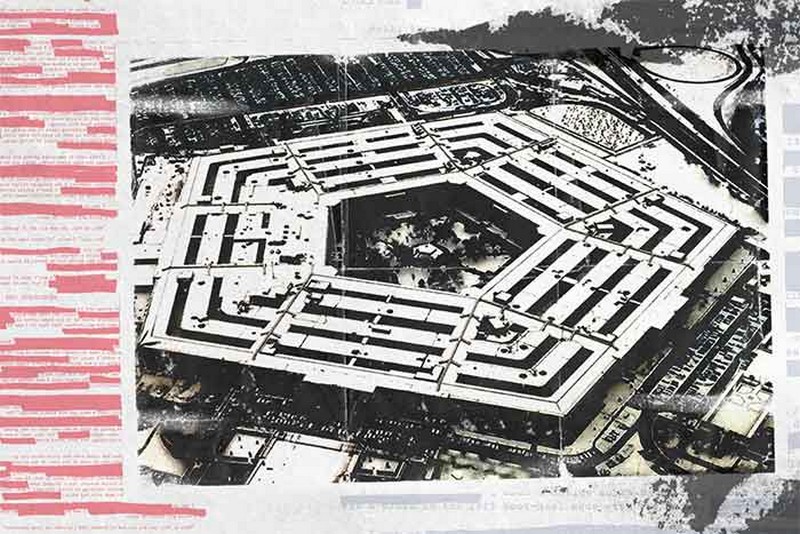
21 year old American Air National Guard member Jack Teixeira has been arrested and charged in the US District Court in Boston for leaking highly classified intelligence documents of the US defence force concerning the NATO-led war in Ukraine. These documents have come to be known across international media as the “Pentagon leaks”. The top brass of the US military had earlier tried to minimise the extent of these leaks and going to the extent of labelling some of them as fake.

But the spokesperson of the Pentagon Chris Meagher has finally confirmed that the documents are similar to the ones they gave to their senior military leadership and, he said, “they pose a very serious risk to national security”. In addition, some of the documents show classified writings such as “top secret”, which is the highest level of classification in the US intelligence. Classifications and labels of such as kind on US defence force documents indicate that the files were prepared by the chief of staff of the US military.

In plain language therefore, the documents are real and that is why Jack Teixeira was hunted down within a space of a few days and was brought to book. But the gain that we have received as the public out of these documents is a clear picture of what is going on in Ukraine and around the world concerning conflicts, wars and peace efforts.

For too long, we have relied on politicians driven by their interests and biased media who all have been providing distorted reports, exaggerations and minimisations about instances of violence, occupation, power and future projections about important issues such as the world economy.

Three things are now clear from these leaks.

Firstly, the US is highly involved in the invasion of Ukraine together with NATO. Their occupation of the Russian territory, the Eastern Europe border and the rest of Global North is a continuation of decades and centuries of imperialism, settler colonialism and genocide in the region. To achieve these evil deeds across many generations – from the Cold War, to the collapse of the Soviet Union and the Berlin Wall, and up to the present times – they have used wars and sanctions as weapons to dominate and control the colonised territories.

The coalition of the US and NATO to invade countries, steal land, occupy, kill and drive regime change in the name of protecting human rights is not a new phenomenon. In 2011, the US and NATO both invaded Libya, killing innocent civilians and children in the process, and they again drove regime change activities when US President Barack Obama executed the assassination of Libyan President Muammar Gaddafi.

Till today, Libya has never been the same place again. It is now ravaged by high levels of poverty, disease, malnutrition and child mortality. The International Criminal Court has never issued warrants of arrests against Barack Obama, Hillary Clinton and Anders Fogh Rasmussen for committing these war crimes.

Today, Russia under President Putin has finally decided to use its own military force to resist this NATO-US cruel invasion of Ukraine and its territory – similarly to how the anti-apartheid movement of Palestine also decided to fight for its own land by taking up arms to fight against the settler colonialist state of Israel. Russia is involved in a war of resistance, an anti-Western war aimed at resisting and dismantling the neocolonial domination coalition of the US, the UK, the EU and NATO.

Secondly, the Pentagon leaks show that the coalition of the US and NATO was caught unprepared to stand against Russian forces. In addition, the Ukraine military itself is very small, inexperienced and so disorganised to match the force of the Russian military. This information is so different from the false public statements that have been made by Joe Biden and Volodymyr Zelenskyy lately whom present their side as being more powerful against Russian forces in the battlefield.

Thirdly, the Pentagon leaks shows that the US is spying on everyone involved in Ukraine – including its own allies. The US and NATO have huge egos of violent dominant and they want to perpetuate the war for as long as possible. They have no interest in ceasefire and peace agreements despite the devastating cost of the war on the people of Ukraine.

The Ukraine leadership is fully aware of this and it is willing to cooperate with US-NATO military violence propaganda in order to gain economic and political benefits from other Western allies in the EU – even if it means putting the lives of its people and children to achieve its selfish interests.

As Dr Matteo Capasso argued in the People’s Forum in New York last week, people must not be surprised when Ukraine leader Volodymyr Zelenskyy earns a Nobel Peace Prize soon for cooperating with the colonial intentions of the US and NATO on Russia. This is the same Nobel Peace Prize that was given to the biggest war criminals such as Barack Obama and the biggest Israel apologists and apartheid genocide architects such as FW De Klerk.

Therefore, the public needs to now understand that the war in Ukraine is supported by the EU, the US, NATO and all colonial powers as a proxy war to continue the Western domination of the world. The main target of the US in this conflict is China – and they are willing to use all means necessary to dethrone it, even if it means utilising nuclear weapons when their losses become more desperate. The sudden interest of the US in neighbouring Taiwan is the beginning of a gateway to occupy a vulnerable territory that can be used to invade China in the name of protecting human rights.

The US has realised that it is losing its world dominance to the alternative world order that China is providing in alliance with Russia and the rest of the Global South where the world’s majority resides supports an alternative world but they remain silenced with sanctions and threats of disinvestment.

This is precisely why South Africa, a BRICS partner under neocolonised Africa, is unable to speak confidently and in condemnation of the US-NATO war in Ukraine. Our domestic media perpetuates the Western propaganda of presenting Russia as the evil of the world that is responsible for the energy crisis and rising living costs. The Western agenda is actually much bigger and we must seek alternative sources of information to pay attention.

Dr Pedro Mzileni is a sociology lecturer at the University of the Free State, South Africa.

16 April 2023

Source: countercurrents.org

Macron’s Warning

By Countercurrents Collective

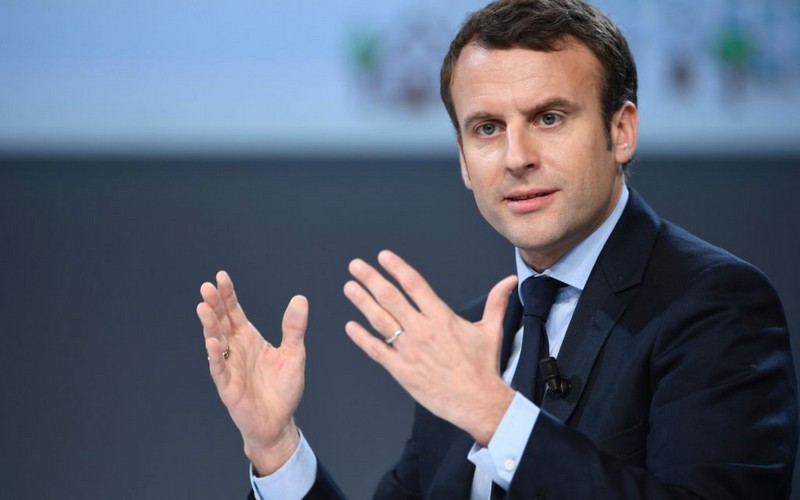
French President Emmanuel Macron’s recent remarks to journalists on his way home from China visit about the three-way relationship between China, Europe and the U.S. did more to rile his EU partners. This incident is a show of condition within the EU and future possibilities.

An AFP report — Macron’s China remarks exasperate EU allies, April 13, 2023 — said:

French President Emmanuel Macron’s recent trip to Beijing was billed as a chance to showcase European unity and persuade Chinese leader Xi Jinping to help rein in Russian aggression.

But remarks that Macron made to journalists on his way home about the three-way relationship between China, Europe and the United States did more to rile his EU partners.

In an interview with French daily Les Echos and news platform Politico, Macron warned against Europe being dragged into a conflict between Washington and Beijing.

If the stand-off over Taiwan accelerates, he said, Europe might not have the time nor the resources to build the “strategic autonomy” to act without US leadership that France seeks.

Then, EU members would “become vassals, whereas we can be the third pole if we have a few years to build it.”

The Chinese government was delighted by its guest’s remarks. Brussels diplomats less so.

“The French president speaks always for the French Republic,” a senior EU official told reporters. “If the German Chancellor says something does also everybody say this is the policy of the European Union?”

Since the interview was published last weekend, French diplomats have scrambled to insist that Europe becoming a “third pole” does not mean seeking equidistance between an American democratic ally and an autocratic Chinese rival.

But Macron’s warning against subordination to U.S. interests, along with the perception — rejected by Paris — that he was suggesting that Europe should not stand up to China over Taiwan, annoyed many EU partners.

The report said:

EU members from the east of the bloc have long been wary of Europe escaping Washington’s embrace, seen as their key security guarantee against Russian aggression and as Ukraine’s most important defense.

Poland’s Prime Minister Mateusz Morawiecki, on a visit to Washington, slammed fellow EU leaders like Macron, and before him Germany’s Chancellor Olaf Scholz, for seeking trade contracts in Beijing.

“Short-sightedly they look to China to be able sell more EU products there at huge geopolitical costs,” he said.

“Hence, I do not understand the concept of European strategic autonomy if it means the fact of shooting ourselves in our own knee.”

Lithuania’s foreign minister, Gabrielius Landsbergis was scathing about the argument that Europe can persuade Xi to intercede with Russia’s President Vladimir Putin to de-escalate Moscow’s war in Ukraine.

“I propose we recognize the benefits and necessity of trans-Atlantic unity. I do not suggest begging for dictators to help secure peace in Europe,” he tweeted.

The negative reaction in EU countries on Russia’s borders was perhaps to be expected, and Macron has never been shy of making provocative statements to stir debate on the future of European strategy.

But traditional French partners in western Europe were also skeptical of his diplomatic freelancing.

German Defense Minister Boris Pistorius said: “We have never been in danger of becoming or being a vassal of the United States.”

“I found this comment unfortunate but I think the Elysee has corrected it somewhat,” he told ZDF television.

Shortly after his return to Europe from China, Macron set off on a state visit to the Netherlands while debate still raged over his comments.

His host, Prime Minister Mark Rutte, was careful not to criticize his guest, but said “the US is indispensable and without that support it is inconceivable that Ukraine could have withstood the waves of violence of the past year.”

In Brussels there is regret that Macron’s comments have overshadowed the efforts of European Commission president Ursula von der Leyen to coordinate an EU stance on China.

Before setting off to accompany Macron on his Beijing visit, von der Leyen made a well-received speech on the need for the EU to “de-risk” itself from dependence on China while not “de-coupling” from its huge market.

But she was seen to have received a cold shoulder in China while Macron hogged the headlines.

The president of the European Council, Charles Michel, took to the airwaves to defend — and to try to explain — Macron’s stance and Europe’s strategic ambitions.

“On strategic autonomy, there’s much more support than there was a few years ago,” he told French television.

The AFP report said:

The bond between Washington and Brussels were threatened during former president Donald Trump’s term, as the U.S. leader cosied up to Putin and threatened to quit NATO.

This focused European minds on the need to shore up their own defenses, for a while, but when Russia invaded Ukraine Washington’s military aid to Kyiv far surpassed the EU contribution.

Even supporters of a stronger united European geopolitical role, like centre-right French MEP Arnaud Danjean, fault Macron for pushing on without taking into account allies’ concerns.

While the idea that Europe should be better able to stand on its own two feet is accepted, any suggestion that the allies should distance themselves from the US before building up their own forces is unrealistic.

“We struggle to convince our partners essentially because we put the cart before the horse,” he tweeted.

“Without first focusing on developing the means of autonomy, making grand declarations by presenting it as a given can only irritate.”

Macron Holds His Position

An AP report — Emmanuel Macron says his position on Taiwan is unchanged, April 12, 2023 — said:

French President Macron commented on his published remarks on China and Taiwan that raised questions after he visited Beijing last week, insisting Wednesday that his views have not changed.

“The position of France and the Europeans on Taiwan is the same. We are for the status quo, and this policy is constant,” Macron told reporters in Amsterdam near the end of a two-day state visit to the Netherlands. “It has not changed. It’s the policy of one China and the peaceful settlement of the question.”

He was referring to remarks published Sunday from an interview with French newspaper Les Echos and Politico Europe. The remarks elicited doubts about whether Macron’s views were in line with the European Union’s position on Taiwan’s status. Beijing claims that the island is a Chinese territory that must be brought under its control, by force if necessary.

“The question we need to answer, as Europeans, is the following: is it in our interest to accelerate (a crisis) on Taiwan? No,” Macron was quoted as saying in the interview. “The worst thing would be to think that we Europeans must become followers on this topic and take our cue from the U.S. agenda and a Chinese overreaction.”

Macron said he spoke to U.S. President Joe Biden before he traveled to China. A string of foreign politicians have visited Taiwan in recent months, including then-U.S. House Speaker Nancy Pelosi and numerous politicians from the EU.

The French leader addressed other topics during his trip to the Netherlands. Earlier Wednesday, Macron said that protests in France and the Netherlands were a social price that has to be paid as governments in the two countries push ahead with reforms.

“We must sometimes accept controversy,” Macron said. “We must try to build a path for the future.”

He was speaking to members of the French community in Amsterdam, on the second day of a state visit that has been dogged by small protests against his deeply unpopular pension reform, which will raise the retirement age from 62 to 64.

The reforms have sparked massive and sometimes violent protests in France. In the Netherlands, farmers and their supporters protested for months about plans to rein in emissions of nitrogen oxide. At times last year, Dutch farmers used tractors to blockade supermarket warehouses, torched bales of hay alongside roads and dumped garbage including manure and asbestos on highways.

A populist, pro-farmer political party made major gains in recent provincial elections in the Netherlands.

“Sometimes in France we think that we are the only country where there are protests,” Macron said in his speech in Amsterdam. “You who live here know very well that there is also a strong, profound protest movement here.”

Earlier in the day, police tackled and detained a protester who ran, shouting, toward Macron as he arrived at a University of Amsterdam science campus.

It was the second straight day that protesters targeted Macron. On Tuesday, demonstrators shouted and held up banners at the start of a speech in The Hague.

Dutch Prime Minister Mark Rutte said that free speech is an important right but he regretted the protests.

“We are hosts, so you don’t want that,” he said, standing alongside Macron at the Amsterdam Mayor’s official residence.

Earlier, French and Dutch ministers signed an agreement to strengthen cooperation in moves to develop digital technology and make the countries’ industrial sectors more sustainable.

The Pact for Innovation and Sustainable Growth aims to promote partnerships in areas including “semiconductors, quantum, critical raw materials, sustainable mobility and energy infrastructure,” the Dutch government said in a statement.

Macron was wrapping up his two-day state visit with talks between the two countries’ government ministers and a visit to a sell-out exhibition of paintings by Dutch master Johannes Vermeer at Amsterdam’s Rijksmuseum.

Macron’s Stronger Tone

Another report said:

Paris is an ally and not a “vassal” of Washington, French President Emmanuel Macron said on Wednesday, defending his comments about strategic autonomy” of the EU regarding the rising tensions between the U.S. and China.

“Being an ally does not mean being a vassal, does not mean that we do not have the right to think for ourselves,” Macron said in Amsterdam at a joint press conference with Dutch Prime Minister Mark Rutte.

Asked for the French position on Taiwan, Macron said Paris supports the status quo, meaning the “One Chine policy and the search for a peaceful resolution to the situation.”

Returning from his trip to China on Sunday, Macron argued that the EU can’t just be “America’s followers,” and that it is not in the bloc’s interest to stoke tensions over Taiwan. “The worst thing would be to think that we Europeans must become followers on this topic and take our cue from the U.S. agenda and a Chinese overreaction,” he told reporters.

The remarks earned a swift rebuke from U.S. Senator Marco Rubio, a Florida Republican on the foreign affairs committee, who suggested Washington might leave the EU to handle the Ukraine conflict by itself.

Taiwanese Parliament Speaker You Si-kun on Tuesday argued that France had forsaken its motto of ‘liberty, equality, fraternity’, and that advanced democracies should not “ignore the lives and deaths of people in other countries,” adding that Macron’s comments left him “puzzled.”

Meanwhile, French Finance Minister Bruno Le Maire said that Macron was “perfectly right to demand European independence and sovereignty,” while the president of the European Council, Charles Michel, noted that “quite a few” leaders of EU countries think like Macron, even though they “would not say things the same way.”

When asked about the French president’s comments on Monday, the U.S. State Department said France is a long-standing ally and that occasional disagreements do not detract from the “deep partnership” with Paris. As for the EU position, a State Department spokesman cited a recent speech by the bloc’s president, Ursula von der Leyen, which described China as “a national and economic security threat,” and said there is “immense convergence” between Washington and Brussels on the matter.

Truss Talks About Biden

A report by The Telegraph — Biden was part of resistance that ousted me from power, says Truss, April 13, 2023 — said:

Former UK PM Liz Truss said Joe Biden, the U.S. president, was part of the “coordinated resistance” she blamed for ending her brief premiership in a U.S. speech intended to revive her economic and political agenda.

The former prime minister also hit out at Emmanuel Macron, the French president, and Ursula von der Leyen, the European Commission president, for showing “weakness” by meeting Xi Jinping, the Chinese premier.

Speaking at the Heritage Foundation in Washington DC, Ms Truss warned that a “new kind of economic model” was taking hold on both sides of the Atlantic, focused on “redistributionism”, “stagnation” and “the imbuing of woke culture” into businesses.

She cited Mr Biden’s Inflation Reduction Act – the $454 billion (£363.4bn) flagship bill aimed at tackling climate change, tax and healthcare – as an example, saying the legislation would “encourage US industry to spend their time rent-seeking”.

She added: “It’s also going to cut competitors out of the market, including companies in the United Kingdom.”

Ms Truss hit back at Mr Biden’s criticism of her tax-cutting policies while in Number 10, saying: “It is not a matter for the U.S. president, it is a matter for the UK Government how we best have tax rates that deliver for everybody across our country.”

She criticized the Organization for Economic Co-operation and Development’s plans for a minimum corporation tax rate, first proposed by Mr Biden, saying: “We need a UK-U.S. trade deal, not a UK-U.S. tax deal.”

The former UK PM conceded that her ousting from Downing Street after just 49 days following the disastrous mini-Budget had been a “major setback”, but stressed that the point of her speech on Wednesday was to “take on those who resist change”.

Reflecting on her brief tenure, she said she had “simply underestimated the scale and depth of resistance” to her economic agenda.

She said: “We did not just face coordinated resistance from inside the Conservative Party, or even inside the British corporate establishment. We faced it from the IMF, and even from President Biden.”

Ms Truss was delivering the Right-wing think tank’s annual Margaret Thatcher freedom lecture in which she made the case for “Anglo-American capitalism”, espousing the values of privatization and limited government championed by Thatcher and Ronald Reagan.

“Last autumn, I had a major setback. But I care too much to give up on this agenda,” she said. “And over the coming months I will be setting out ideas about how we together can take this battle forward.”

Her fiercest criticism was reserved for Mr Macron and Ms von der Leyen, who travelled to Beijing last week to urge Mr Xi to “reason” with Russia and help end the war in Ukraine.

She said: “I believe that was a sign of weakness. It’s also why it’s wrong for President Macron to suggest that Taiwan is simply something not of direct interest to Europe. I do not agree with that at all. What we have seen is accommodation and appeasement by the West of these authoritarian regimes.”

She warned of the immediate danger China posed to the world order, saying that “the invasion of Taiwan could come sooner than we expect”.

German Foreign Minister On Way To China

A Reuters report — Germany foreign minister embarks on post-Macron ‘damage control’ in China trip, April 13, 2023 – said:

Germany’s foreign minister begins a visit to China on Thursday aiming to reassert a common European Union policy toward Beijing days after remarks by French President Emmanuel Macron suggested disarray in the continent’s approach to the rising superpower.

Macron provoked a backlash in the U.S. and Europe when he called on the European Union to reduce dependence on the U.S. and cautioned against being drawn into a crisis over Taiwan driven by an “American rhythm and a Chinese overreaction.”

Many European politicians, diplomats and analysts saw Macron’s comments in an interview with Politico and French daily Les Echos as a gift to what they called Beijing’s goal of dismantling transatlantic unity.

As a result, the stakes of the inaugural trip by German Foreign Minister Annalena Baerbock have risen, with many EU members hoping Berlin will use this opportunity to set out a clear and united EU line on China, analysts said.

Macron was widely seen as taking a weak line on Taiwan by warning Europe should not get “caught up in crises that are not ours” — although his office insisted this was not his intended meaning and his position on Taiwan and China had not changed.

“Now it is about damage control to a large degree … But the cloud of Macron’s visit is very big and still it is very unclear how this balance will play out in the end,” Alicja Bachulska, a China-EU relations researcher at the European Council on Foreign Relations in Warsaw, told Reuters.

Even without Macron’s remarks the trip would have been delicate for Baerbock, who has been more hawkish on China than Chancellor Olaf Scholz and is drafting a China policy aimed at reducing Germany’s economic dependence on Beijing.

“She was sort of perceived as being a troublemaker. I would be surprised if this does not play a role at all in her visit,” Tim Ruehlig, China expert at the German Council on Foreign Relations, told Reuters.

Baerbock must now make Germany’s position on Taiwan clear during her visit, German foreign policy parliamentarian Nils Schmid told Reuters, adding Macron’s remarks had destroyed a hoped-for impetus for a common European China policy.

The foreign minister is due to meet her counterpart Qin Gang and China’s top diplomat Wang Yi on the two-day trip.

Speaking ahead of her visit, Baerbock said the top of her agenda would be reminding China of its responsibility to influence Russia to end its invasion of Ukraine and underlining a common European conviction that a unilateral change in the status quo in the Taiwan Strait would be unacceptable.

Europe’s view of China as partner, competitor and systemic rival is the compass of its policy, she added.

“It is clear to me that we have no interest in economic decoupling, but we must take a more systematic look at the risks of one-sided dependencies and reduce them,” Baerbock said.

Some EU capitals – particularly those in Central and Eastern Europe, which cherish their ties with the U.S. – will be hoping Baerbock’s stance is closer to the one expressed by European Commission President Ursula von der Leyen who visited Beijing at the same time as Macron.

Many analysts drew a contrast between Macron’s remarks and those from von der Leyen that were widely seen as more critical of Beijing. Just days before the visit she said Europe must “de-risk” diplomatically and economically with a hardening China.

“More von der Leyen than Macron should be her guideline,” conservative foreign policy lawmaker Johann Wadephul, who will join Baerbock on her trip, told Reuters.

Countercurrents is answerable only to our readers. Support honest journalism because we have no PLANET B.

14 April 2023

Source: countercurrents.org