Just International

India-Malaysia to Trade in Rupees Bypassing US Dollar

By Timothy Alexander Guzman

There is a worldwide movement to stop using what is considered a toxic currency, the US dollar.  The concept of de-dollarization is accelerating, now India, the “I” in the BRICS Coalition has also made significant moves to bypass US dollars.

Livemint.com published an interesting article that is a testament to what is taking place in regards to the US dollar reserve currency status, ‘Union Bank becomes first to open special vostro account for India-Malaysia trade settlement in rupee reported that the development of a new trading option between India and Malaysia was to begin with the implementation of using rupees as the Union Bank of India becomes the first bank in the country to open a Special Rupee Vostro Account through its corresponding bank in Malaysia i.e. India International Bank of Malaysia. This means that trade between India and Malaysia can now be settled in the Indian rupee, in addition to the current modes of settlement in other currencies.” The article mentions the Reserve Bank of India’s recommendations following a publication from last July on how to settle international trade using rupees, Union Bank’s officials said that “this measure is aimed at facilitating the growth of global trade and to support the interests of the global trading community in Indian Rupee” they added that “the mechanism will allow the Indian and Malaysian traders to invoice the trade in Indian Rupee and therefore achieve better pricing for goods and services traded.  On July 11th, 2022, the Reserve Bank of India published ‘International Trade Settlement in Indian Rupees (INR) which recommended that global trade should involve INR’s (Indian Rupee):

In order to promote growth of global trade with emphasis on exports from India and to support the increasing interest of global trading community in INR, it has been decided to put in place an additional arrangement for invoicing, payment, and settlement of exports / imports in INR. Before putting in place this mechanism, AD banks shall require prior approval from the Foreign Exchange Department of Reserve Bank of India, Central Office at Mumbai

The recommendations include Invoicing exports and imports that “may be denominated and invoiced in Rupee (INR).” It also involves a new exchange rate between trading partners and settlement of trade transactions, all in rupees.

The next G20 meeting will be hosted in New Delhi, a venue where India can push rupees for international trade settlements as another report by Livemint.com, ‘India to use G20 gathering to push rupee trade’ said that “India will use the G20 platform to push international trade settlement in rupees, especially with countries that are facing currency issues, commerce secretary Sunil Barthwal said on Monday.”  Barthwal said that we are interested in improving the trade with respect to the currencies of the countries which are trading (with India).  In a statement from the Ministry of Commerce and Industry, they made it clear that the intentions under India’s leadership is to build a shared understanding of the challenges being faced in accelerating global trade and investment, and how existing opportunities can be harnessed to formulate human-centric concrete outcomes and deliverables.” The Reserve Bank of India has moved forward with authorizing dealer banks to open Special Rupee Vostro Accounts (SRVAs) to correspond with banks in more than 18 countries so far:

As per data presented in the Parliament on 14 March, RBI has approved domestic and foreign authorized dealer banks in 60 cases for opening of special rupee vostro accounts (SRVAs) of correspondent banks from 18 countries. These include Botswana, Fiji, Germany, Guyana, Israel, Kenya, Malaysia, Mauritius, Myanmar, New Zealand, Oman, Russia, Seychelles, Singapore, Sri Lanka, Tanzania, Uganda, and United Kingdom, junior finance minister Bhagwat Karad said in the Rajya Sabha

The acceleration of de-dollarization is taking place on every continent, India is just one country on board that seeks to enhance its growing economy by using their own currency, the Indian Rupee (INR).

There is no stopping this trend, many countries see this as an opportunity to ditch the US dollar before Washington can impose some sort of sanctions on their respective economies especially if they were to decide on doing business with Russia, China, or Iran.  Besides the fact that when the US receives its imports, they export its dollars in exchange thus resulting in inflationary pressures for those on the receiving end, Washington has weaponized their world reserve currency status to impose their will on sovereign countries for a long time, just ask those who suffered thru sanctions or embargoes such as Iran, Russia, China, Cuba, and others who has defied Washington.

The US dollar has been used as a weapon against those who are not obedient, but times are changing for the US establishment and their ambitions to continue their hegemonic objectives, therefore undermining its currency can end its global dominance.  The US dollar was one of their main weapons of choice, and it has clearly backfired. but a serious question remains, what will Washington, its banker class, the Pentagon, and its Military-Industrial Complex do to stop or slow-down the global rush to de-dollarize their economies? Perhaps start another war with another global power who is leading the charge to abandon the US dollar?  Maybe they will release another virus? One of these scenarios will take place in the foreseeable future because the globalists who are in charge in Washington and elsewhere will do anything to remain in power even if it means starting a new world war.

*

Note to readers: Please click the share button above. Follow us on Instagram and Twitter and subscribe to our Telegram Channel. Feel free to repost and share widely Global Research articles.

Timothy Alexander Guzman writes on his own blog site, Silent Crow News, where this article was originally published.

7 April 2023

Source: www.globalresearch.ca
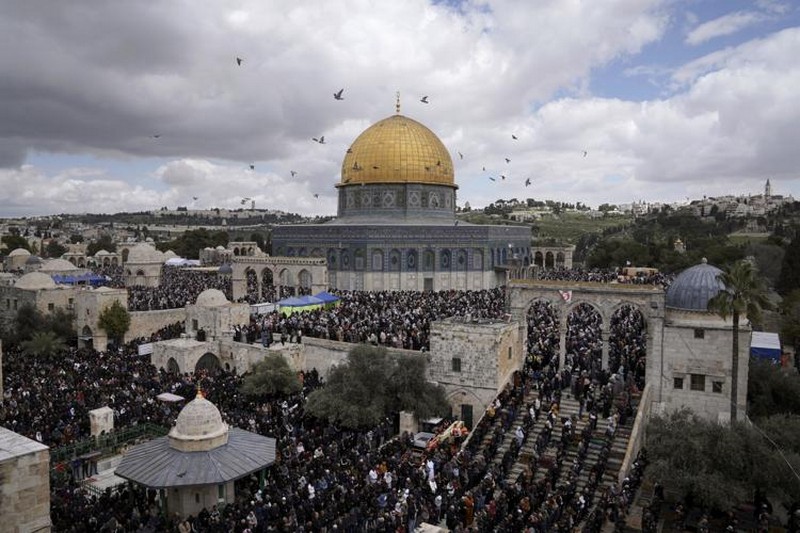
Let’s Be Clear: Israeli Minister Ben-Gvir Incited Violence at Al-Aqsa Mosque

By Yousef M. Aljamal

The world watched in shock as the Israeli occupation forces broke into the al-Aqsa Mosque compound in Jerusalem, beating worshippers and forcing them out of the third holiest site in Islam during the holy month of Ramadan. Some 400 Palestinians were arrested, a hundred were injured, two of whom are in a critical condition, while the invading forces destroyed a small clinic attached to the mosque to prevent providing medical care to those in need. Ambulances and hundreds of Palestinians, who protested outside the gates of the mosque, were prevented from entering.

Israeli forces broke into al-Aqsa and forced worshippers out to clear the way for right-wing Israeli settlers who planned to storm the holy site during Passover on Wednesday, April 5. These Israeli provocations are the immediate result of an incitation by radical Israeli National Security Minister Itamar Ben-Gvir, who was formerly convicted of criminal charges and who, as a lawyer, defended and celebrated Israeli settlers burning a Palestinian family.

During an interview on Israeli Channel 12 on April 4, Ben-Gvir said, “Jews should storm the Temple Mount (al-Aqsa Mosque), because it is not only for Arabs; I call on Jews to storm the Temple Mount. It is the most important site for the State of Israel. I don’t accept that only Muslims enter the site … Jews, too, have human rights in this country, and they have the right to break into the site; I will, too, storm it, but not on Wednesday.”

His proposal was that Israeli settlers should break into al-Aqsa, but without offering sacrifices, again because “there are human rights for Jews too in this country.” Palestinians know these human rights well—they have been deprived of them for 75 years. Human rights and what remains of democracy in Israel today is only for Jews. It is no coincidence that the so-called democracy protests in Israel almost completely ignore Israel’s ongoing occupation of Palestine and concentrate exclusively on the rights of Israeli Jews rather than the rights of Palestinians, who don’t even come second in this narrative.

Protests in Israel as aggression against the Palestinians continue

Some Israelis today feel threatened by the growing influence of right-wring religious parties, which make the majority of Netanyahu’s government. These fears, however, have nothing to do with the Palestinians. Most Israelis, be they on the right or left of the political spectrum, agree on the need to continue the occupation and they have no problem with what the world recently witnessed at al-Aqsa. The world will get used to it—or so they tell themselves. Instead, they are concerned that the Israeli government, which was formed on the premise of making life for the Palestinians who are already second-class citizens even worse, might suppress some of their rights.

Palestinians have no place in this equation and that’s why they are not involved in the ongoing protests in Israel. One of the demands Ben-Gvir was conceded and a quid pro quo for postponing judicial reforms until the summer was forming a new force under his command, which mainly aims to target Palestinians—as if Israeli police and army violence directed against them, especially during Ramadan, was not satisfactory. In other words, Ben-Gvir, who provoked storming al-Aqsa, will have a new force under his command that will further crush the Palestinians, as we have seen on April 5, in return for postponing judicial reforms in Israel, which have nothing to do with Palestinians.

Israel has been implementing a plan to divide al-Aqsa Mosque between Muslims and Jews, both in terms of space and time, as it did with the Ibrahimi Mosque in Hebron. This is why we see an increasing number of raids into the holy site during Ramadan, which sees increasing Muslim worship and presence there. Israel has been gradually implementing its plans to divide al-Aqsa Mosque.

Until three years ago, it rarely conducted raids into the mosque during the month of Ramadan. Now, not only do Israeli settlers break into al-Aqsa during Ramadan, but they also raise the Israeli flag in it. The next step will be allowing biblical sacrifices inside, and performing the biblical “epic falling”, in which they fall on the ground as part of their prayers, at the sacred site, which is an open call for a religious war in the Middle East.

This will necessarily translate into escalation in the Palestinian Territories, which, as the last two years have shown us all, Palestinians will pay for heavily. Soon after Israel assaulted worshipers at al-Aqsa, homemade projectiles were fired into southern Israel from Gaza, to which Israel responded by targeting several sites in the coastal enclave. Similar to May 2021, such provocations will likely lead to further escalations, leaving more destruction and loss of lives on the Palestinian side.

Are international condemnations enough?

Except for shy condemnations, the world chose not to take action to bring Israel’s right-wing government to account. This silence will encourage the Israeli government to implement more aggressive and expansionist polices in the coming weeks, which will take the region, especially considering the ongoing domestic crisis in Israel, into a new military escalation. The world has to act now to prevent such escalation, which is building up at al-Aqsa and in Gaza as Palestinians will not stand watching as Israel violates their right to worship at the holy mosque. Israel is trying to export its internal crises into Jerusalem and Gaza, and Palestinians will likely pay dearly for their policy as they always have.

The world should boycott the Israeli government, comprised of far-right, radical settlers. Their plans and policies deny the existence of the Palestinian people and view them as aliens on their own land. The Israeli government not only encourages storms into al-Aqsa, but provides the support and cover to make them happen. The world should not accept normalizing beating Palestinians, killing them, and annihilating their villages, as an Israeli minister shamelessly advocated recently.

The Palestinians are here to stay, because they have no other place to go to and all of Israel’s policies will not force them to leave. It is high time for the international community to end the suffering and misery of the Palestinian people under Israel’s prolonged military occupation. While militarily occupying another nation and beating worshippers during their holy month, calls for “democracy protests” in Tel Aviv appear meaningless and shallow.

Israeli minister Ben-Gvir, who incited violence against Palestinians at al-Aqsa without a shame, should be boycotted and not welcomed anywhere in the world. Israel’s Western allies who contribute to the suppression of the Palestinian people through their silence should speak up as they readily do for Ukraine. Their silence will only translate into more violations against Palestinians who seem to be forgotten as the world celebrates the so-called democracy protests in Tel Aviv and allows Israel to control the lives of the Palestinian nation for more than seven decades now.

Yousef M. Aljamal is a researcher in Middle Eastern Studies and the author and translator of a number of books.

6 April 2023

Source: politicstoday.org

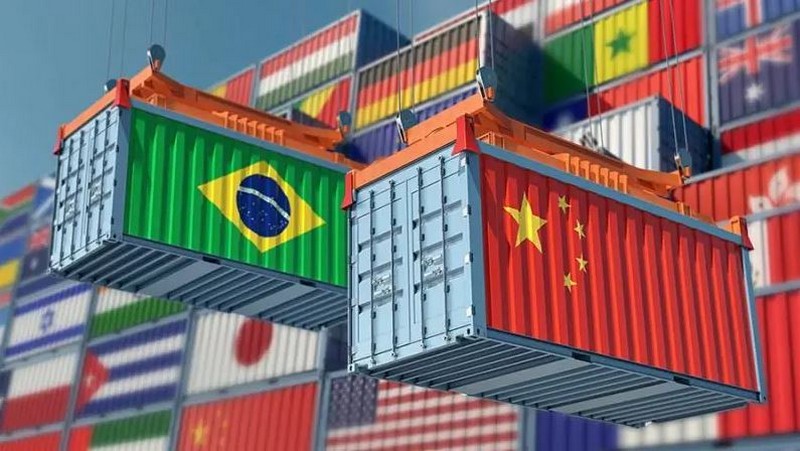
China and Brazil Deal a Blow to US Dollar-powered Bullying

By Timur Fomenko

Ditching the American currency in trade will diminish Washington’s ability to impose its will.

1 Apr 2023 – China and Brazil have secured a deal to conduct bilateral trade in their own respective currencies, eliminating the US dollar as an intermediary.

The agreement between the two BRICS countries, which have $150 billion in annual trade, would probably have been signed in Beijing this week had Brazilian President Luiz Inacio Lula da Silva’s scheduled visit not been postponed due to illness. At around the same time, China also conducted its first-ever trade of liquified natural gas settled entirely in yuan with France’s TotalEnergies.

The decision by Brazil and China to pursue non-dollar trade is a huge geopolitical moment, and a sign that countries are seeking to move away from using the US currency, in direct response to Washington’s abuse of the global reserve currency for its own hegemonic aims. Although the greenback will of course remain a prominent force in global trade and economics, the Americans’ ability to use it as a tool with which to bully and quash other countries is diminishing.

The hegemony of the dollar

Since the end of World War II, the United States dollar has been the global reserve currency and a standard for international trade following the establishment of the Bretton Woods system of monetary management by the US and its allies in 1944. Global commodities are priced according to the US dollar, while Washington has positioned itself as the nexus of the global financial system, where most capital is concentrated. As such, banks borrow and lend in terms of dollars, thus making the greenback the lifeblood of the interwoven global economy.

Having consolidated such great power over the global financial system, the US has subsequently been able to utilize the dollar as an overt geopolitical weapon in order to enforce its will on other countries, both directly and indirectly. This has been done through actions or threats of cutting off targeted individuals, entities and even countries at will. These measures are genuinely effective, because being blacklisted from the US dollar can see a serious business lose everything, and not just the American market. This can have such significant influence that third-party entities, including those not even based in the US, may choose to avoid dealing with sanctioned entities due to the risks it brings.

To be fair, such measures can serve worthy purposes. For example, US sanctions can cut off funding for terrorist groups and tackle organized crime, and therefore have a genuine security benefit. However, US sanctions in recent years have increasingly become a means of unilaterally attempting to impose America’s will on third-party countries, and with the intention to serve geopolitical ends. Washington has become obsessed with sanctions and has distributed thousands of them, often with the goal of comprehensively isolating and impoverishing smaller countries, such as Syria, North Korea and Iran. Although the US will always claim it doesn’t sanction food or humanitarian aid deliveries to these countries, the sanctions are often so broad and extensive that all legitimate means of doing business with the target country are closed off.

Currency multipolarity

It is no surprise, given Washington’s industrial-scale abuse of sanctions as a political weapon, that there is growing pushback from other countries that increasingly see the dollar as arbitrary and unreliable. As a result, political momentum for alternative payment systems is growing, which is seen as a sign of defending national sovereignty in an uncertain world increasingly defined by geopolitical competition. For China, a mammoth trading nation that is being subjected to increasing hostility by the US, this is a growing priority as it faces a potential scenario of a war over control of the US-backed island of Taiwan.

If such a war broke out, the US would likely respond in a similar manner to how it did with Russia, and attempt to blacklist thousands of Chinese firms from the US dollar in an attempt to cripple the country’s economy. Therefore, developing dollar-less currency and financial systems outside US control is a priority, especially with like-minded countries that have a vested interest in multipolarity (which is pretty much anyone outside of the collective West). As such, these are not just countries designated as “adversaries” by Washington. As President of Indonesia Joko Widodo told the media: “Be very careful. We must remember the sanctions imposed by the US on Russia.” He urged the development of domestic payment methods, noting “offshore settlements and dependence on foreign payment networks such as US Visa or Mastercard will no longer be necessary.”

In conclusion, the growing traction for alternative currency and payment systems is a political reaction to the increasing politicization and weaponization of the US dollar as a means to control other countries. Additionally, the US Federal Reserve, through decisions such as interest rate hikes, may also make economic choices which benefit America at the expense of the rest of the world. As a result, many nations increasingly see the US dollar as an obstacle to their own economic sovereignty and development, and this is why nations such as those in BRICS are acting now to de-dollarize their economies. Of course, the gravity of the dollar will always be strong, but the days of it being used to abuse and impoverish others are fading as multipolarity arrives.

Timur Fomenko is a political analyst.

3 April 2023

Source: www.transcend.org

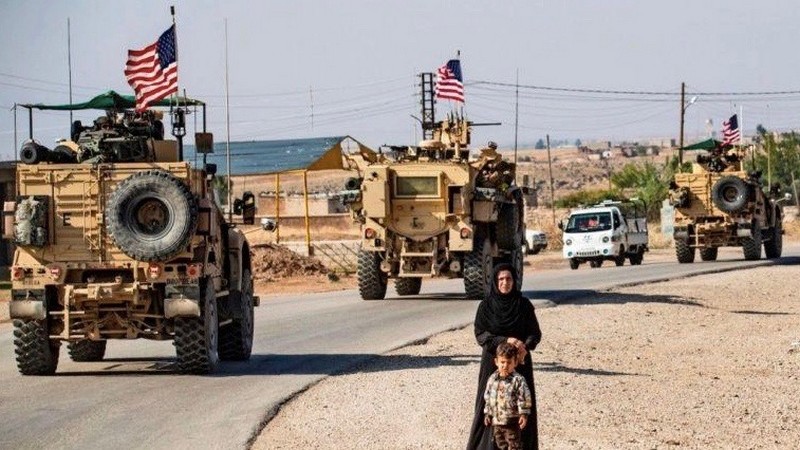
US Occupiers Lash Out as Syria War Draws to an End

By M. K. Bhadrakumar

US Is Stirring Up Syrian Cauldron

Washington is worried about a peace between Damascus and its estranged Arab neighbors — as well as Turkey — that is marginalizing the U.S. and its allies, the “collective West”.

27 Mar 2023 – The circumstances surrounding the flare-up in Syria between the US occupation forces and pro-Iranian militia groups remain murky. President Biden claims that the US is reacting, but there are signs that it is likely being proactive to create new facts on the ground.

The US Central Command claims that following a drone attack on March 23 afternoon on an American base near Hasakah, at the direction of President Biden, retaliatory air strikes were undertaken later that night against “facilities used by groups affiliated with Iran’s Islamic Revolutionary Guards Corps.”

However, this version has been disputed by the spokesman of Iran’s Supreme National Security Council who accused Washington of “creating artificial crises and lying.” The Iranian official has alleged that “Over the past two days, American helicopters have carried out several sorties with the aim of increasing instability in Syria and transferred Daesh (Islamic State) terrorists in the territory of this country.”

He said Washington must be held accountable for such activities. The official warned that Tehran will give a prompt response to any US attack on whatever false pretext against Iranian bases that exist on Syrian soil at the request of Damascus for fighting terrorism.

Is the US deliberately ratcheting up tensions in Syria even as the China-brokered Saudi-Iranian rapprochement is radically changing the security scenario in the West Asian region in a positive direction?

There is optimism that Syria stands to gain out of Saudi-Iranian rapprochement. Already, the Saudi Foreign Ministry revealed on Thursday that talks are going on with Syria for resuming consular services between the two countries, which will pave the way for the resumption of diplomatic relations and in turn make it possible to reinstate Syria’s membership of the Arab League.

Saudi Arabia has established an air bridge with Syria to send relief supplies for those affected by the devastating earthquake in February.

The backdrop is that the normalization of relations between Syria and its estranged Arab neighbors has accelerated. It must be particularly galling for Washington that these regional states used to be active participants in the US-led regime change project to overthrow the government of President Bashar al-Assad. The Saudi-Iranian rapprochement badly isolates the US and Israel.

From such a perspective, it stands to reason that the US is once again stirring up the Syrian cauldron. Lately, Russian aircraft have been reported as frequently flying over the US’s military base At Tanf on the Syrian-Iraqi border where training camps for militant groups are known to exist.

Israel too is a stakeholder in keeping Syria unstable and weak. In the Israeli narrative, Iran-backed militia groups are increasing their capability in Syria in the last two years and the continued US occupation of Syria is vital for balancing these groups. Israel is paranoid that a strong government in Damascus will inevitably start challenging its illegal occupation of Golan Heights.

A key factor in this matrix is the nascent process of Russian mediation between Turkey and Syria. With an eye on the forthcoming presidential and parliamentary election in Turkey in May, President Recep Erdoğan is keen to achieve some visible progress in improving the ties with Syria.

Erdoğan senses that the Turkish public opinion strongly favours normalization with Syria. Polls in December showed that 59% of Turks would like an early repatriation of Syrian refugees who are a burden on the Turkish economy, which has an inflation rate of 90%.

Evidently, Turkey is ending up as a straggler when the West Asian countries on the whole are coasting ahead to normalize their relations with Damascus. But the catch is, Assad is demanding the vacation of Turkish occupation of Syrian territory first for resuming ties with Ankara.

Now, there are growing signs that Erdoğan may be willing to bite the bullet. The consummate pragmatist in him estimates that he must act in sync with the public mood. Besides, the main opposition party CHP always maintained that an end to the Syrian conflict needs to be anchored firmly on the principles of Syria’s unity and territorial integrity.

The influential Beirut newspaper Al-Akhbar has reported citing sources close to Damascus that Erdoğan is weighing options that would meet Assad’s demand with a view to restore relations. The daily reported that one possibility is that Turkey may propose a timetable for the withdrawal of its troops in Syria.

Significantly, Erdoğan telephoned Russian President Vladimir Putin on Saturday and the Kremlin readout mentioned that amongst “topics concerning Russian-Turkish partnership in various fields,” during the conversation, “the Syrian issue was touched upon, and the importance of continuing the normalization of Turkish-Syrian relations was underlined. In this regard the President of Türkiye highlighted the constructive mediatory role Russia has played in this process.”

Earlier, on Wednesday, Turkish Defense Minister Hulusi Akar held telephone talks with his Russian counterpart Sergei Shoigu to discuss developments in Syria where he underscored that the “sole purpose” of its deployment in northern Syria is to secure its borders and fight terrorism.

It is entirely conceivable that Erdoğan has sought Putin’s help and intervention to reach a modus vivendi with Assad quickly. Of course, this is a spectacular success story for Russian diplomacy—and for Putin personally—that the Kremlin is called upon to broker the Turkish-Syrian normalization.

The China-brokered Saudi-Iranian normalization hit Washington where it hurts. But if Putin now brokers peace between two other rival West Asian states, Biden will be exposed as hopelessly incompetent.

And, if Turkey ends its military presence in Syria, the limelight will fall on the US’ illegal occupation of one-third of Syrian territory and the massive smuggling of oil and other resources from Syria in American military convoys.

Furthermore, the Syrian government forces are sure to return to the territories vacated by Turkish forces in the northern border regions, which would have consequences for the Kurdish groups operating in the border region who are aligned with the Pentagon.

In sum, continued US occupation of Syria may become untenable. To be sure, Russia, Turkey, Iran and Syria are on the same page in seeking the vacation of US occupation of Syria.

Thus, an alibi is needed for the US to justify that although dialogue and reconciliation is in ascendance in West Asian politics, Syria is an exception as a battleground against “terrorism.” The US is vastly experienced in using extremist groups as geopolitical tools.

The US’ real intention could be to confront Iran on Syrian soil—something that Israel has been espousing—taking advantage of Russia’s preoccupations in Ukraine. The Russian-Iranian axis annoys Washington profoundly.

The specter that is haunting Washington is that the stabilization of Syria following Assad’s normalization with the Arab countries and with Turkey will inexorably coalesce into a Syrian settlement that completely marginalizes the “collective West.”

In retrospect, the unannounced visit by General Mark Milley, chairman of the US Joint Chiefs of Staff to northern Syria, in early March falls into perspective. Milley told reporters traveling with him that the nearly eight-year-old US deployment to Syria is still worth the risk!

The time may have come for the militants, including ex-Islamic State fighters, who were trained in the US’s remote At Tanf military base to return to the killing fields for “active duty.”

Tass reported that on Friday, the terrorist group known as Hayat Tahrir al-Sham tried to break into the Aleppo region which has been under Syrian government control and relatively stable in recent years.

M. K. Bhadrakumar: I was a career diplomat by profession. For someone growing up in the 1960s in a remote town at the southern tip of India, diplomacy was an improbable profession.

3 April 2023

Source: www.transcend.org

Martin Luther King: Beyond Vietnam, Iraq, Afghanistan…

By Leonard Eiger

1 Apr 2023April 4th is a day of remembrance – the day the USA lost a great prophet and truth teller, and a leader in the ways of nonviolence. Dr. Martin Luther King, Jr. was assassinated on that day in 1968 at the Lorraine Motel in Memphis, Tennessee.

On April 4, 1967, exactly one year before he was assassinated, Dr. Martin Luther King, Jr. delivered an extraordinary and prophetic speech titled “Beyond Vietnam: A Time to Break Silence” at Riverside Church in New York City.

Dr. King is known for many powerful speeches and sermons, and yet Beyond Vietnam was a watershed moment in which he articulated – with the help of Vincent Harding, who drafted the speech – a far-reaching and prophetic vision and warning to our nation, speaking to the deep-seated racism, greed, militarism and hubris that was driving – and continues to do so today – an out-of-control empire to inflict unspeakable violence both at home and around the world.

Beyond Vietnam speaks to us as clearly today as it did 56 years ago. One need only change the names of the wars – from Vietnam to Iraq and Afghanistan – to bring it up to date. And therein lies the tragedy of our failing empire – we have not been able to shake the bonds of hatred, greed and xenophobia that make our nation what King called, “the greatest purveyor of violence in the world.”

When we hear about Dr. King – generally once a year around the time of his birthday, January 15th – the corporate news media has often referred to him as “the slain civil rights leader.” But Dr. King was so much more than that. The TV images the media convey are always the same ones – battling segregation in in 1963; reciting his dream of racial harmony in 1963; marching for voting rights in 1965; and lying dead on the motel balcony in 1968.

In the early 1960s when Dr. King was challenging rampant, legalized racial discrimination in the South, most major media seemed to be his allies, showing graphic footage of police dogs, bullwhips and cattle prods used against southern African Americans who sought the right to vote or eat at a public lunch counter.

After the passage of the Civil Rights Acts in 1964 and 1965 Dr. King began challenging our nation’s fundamental priorities. He maintained that the civil rights laws meant nothing without human rights, including economic rights. He spoke out against the huge gaps between rich and poor, and called for “radical changes in the structure of our society” to redistribute wealth and power.

Dr. King did not suddenly become an opponent of war (and nuclear weapons) once the major civil rights struggle was over. As early as 1954 he said in one of his sermons that “the great danger facing us

today is not so much the atomic bomb that was created by physical science. Not so much the atomic bomb that you can put in an airplane and drop on the heads of hundreds and thousands of people – as dangerous as that is. But the real danger confronting civilization today is that atomic bomb which lies in the hearts and souls of men, capable of exploding into the vilest of hate and into the most damaging selfishness – that’s the atomic bomb we’ve got to fear today.”

Dr. King understood that the overt manifestations of violence – war and nuclear weapons – were deadly symptoms of a much deeper malady of the human heart. He understood violence all too well, both through experiencing it firsthand and through a deep study of Christian and Gandhian nonviolence.

By 1967 Dr. King had become one of the country’s most prominent opponents of the Vietnam War as well as a staunch critic of overall foreign policy. He spoke of the difficulty of working for peace in an atmosphere of mass conformity. “Even when pressed by the demands of inner truth, men do not easily assume the task of opposing their government’s policy, especially in time of war. Nor does the human spirit move without great difficulty against all the apathy of conformist thought within one’s own bosom and in the surrounding world. Moreover, when the issues at hand seem as perplexing as they often do in the case of this dreadful conflict, we are always on the verge of being mesmerized by uncertainty. But we must move on.”

He went on to say that, “the calling to speak is often a vocation of agony, but we must speak. We must speak with all the humility that is appropriate to our limited vision, but we must speak.” There is no other choice for us, because, “silence is betrayal.”

Dr. King saw the connection between war and the evisceration of social programs in this country. He “knew that we would never invest the necessary funds or energies in rehabilitation of its poor so long as adventures like Vietnam continued to draw men [sic] and skills and money like some demonic, destructive suction tube. So, I was increasingly compelled to see the war as an enemy of the poor and to attack it as such.”

Dr. King spoke of “a far deeper malady within the North American spirit” that is greed. He said that it is our “refusing to give up the privileges and the pleasures that come from the immense profits of overseas investments” that governs our foreign policy, and makes the United States the “greatest purveyor of violence in the world today.” He called for a “radical revolution of values” wherein we “shift from a thing-oriented society to a person-oriented society.” He said that playing “the Good Samaritan on life’s roadside…will be only an initial act. One day we must come to see that the whole Jericho Road must be transformed so that men and women will not be constantly beaten and robbed as they make their journey on life’s highway. True compassion is more than flinging a coin to a beggar. It comes to see that an edifice which produces beggars needs restructuring.”

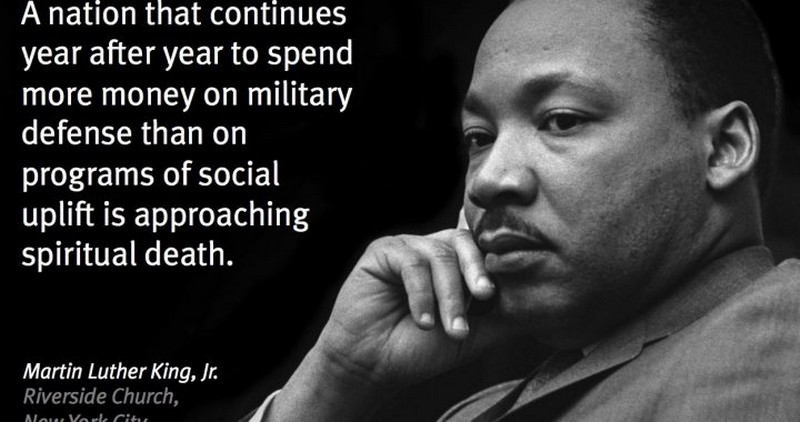
As a true modern-day prophet Dr. King was not afraid to warn people in the U.S. that, “a nation that continues year after year to spend more money on military defense than on programs of social uplift is approaching spiritual death.” He hammered away at the need for everyone to speak out and use the most creative methods of protest possible, not just against the war, but also for “significant and profound change in U.S. life and policy.” He believed that, “Our only hope today lies in our ability to recapture the revolutionary spirit and go out into a sometimes hostile world declaring eternal hostility to poverty, racism, and militarism.”

I work with Ground Zero Center for Nonviolent Action, which has, for 46 years, worked to recapture that revolutionary spirit as we too seek “to keep the world from committing the suicide of nuclear war.” In a grand experiment in truth we “explore the meaning and practice of nonviolence from a perspective of deep spiritual reflection, providing a means for witnessing to and resisting all nuclear weapons” (from Ground Zero’s mission statement).

Michael Honey, a professor at University of Washington,who teaches African-American and labor history and Martin Luther King Studies, in his book “Going Down the Jericho Road,” spoke clearly to King’s commitment to nonviolent direct action in a passage about James Lawson, who worked closely with King. “Like King, he [Lawson] spoke of ‘soul force’ or satyagraha, as the crucial ingredient needed to keep the world from committing the suicide of nuclear war and to defeat racism. For him, pacifism meant: ‘We will make the choice according to the methods that we use, not according to the ends that we seek.’”

That quote goes to the heart of Ground Zero – although we seek an end to nuclear weapons, the ends do not justify just any means. We understand the dangers of compromising the spirit of nonviolence in order to hasten the process. We understand that we may not see the fruits of our labors in our lifetime(s), yet we continue speaking out and resisting nonviolently, unabated in the struggle, knowing that the alternative is unspeakable. There is no other choice for us because “silence is betrayal” (to future generations).

We live in an unparalleled time in human history – While we have developed and refined the very means of our own extinction, we have yet to learn the key lessons necessary for our survival. So it seems fitting to let Dr. King have the final word:

“It is no longer a choice, my friends, between violence and nonviolence. It is either nonviolence or nonexistence. And the alternative to disarmament, the alternative to a greater suspension of nuclear tests, the alternative to strengthening the United Nations and thereby disarming the whole world, may well be a civilization plunged into the abyss of annihilation, and our earthly habitat would be transformed into an inferno that even the mind of Dante could not imagine.”

– Martin Luther King, Jr., Remaining Awake Through A Great Revolution

Click Here to read the entire text of Dr. King’s Beyond Vietnam speech.

Author’s Note: The Martin Luther King, Jr. Research & Education Institute is a valuable resource on Dr. King. Two books that I have found indispensable as references are A Call to Conscience: The Landmark Speeches of Martin Luther King, Jr. and A Knock at Midnight: Inspiration from the Great Sermons of Martin Luther King, Jr.

Leonard Eiger is an activist and coordinates communications and outreach for Ground Zero Center for Nonviolent Action (gzcenter.org).

3 April 2023

Source: www.transcend.org

Why Zelensky Will NOT Take Back Crimea

By Rick Sterling

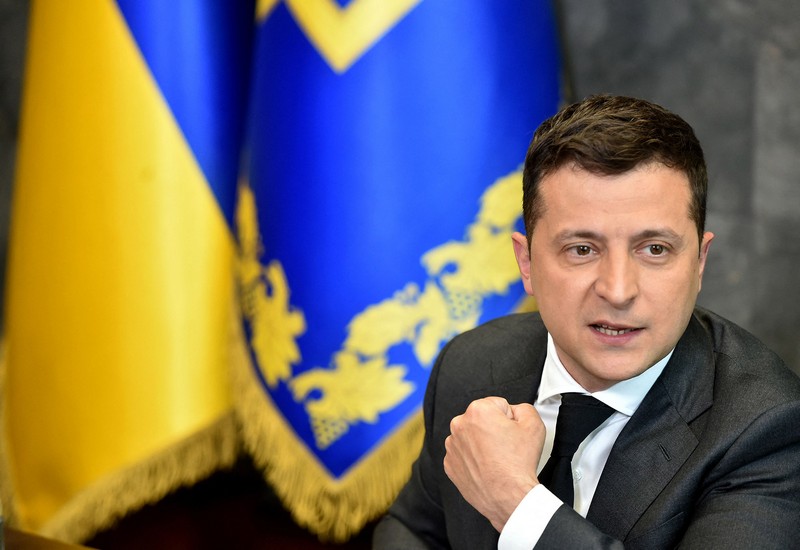
2 Apr 2023Seventeen months ago the US State Department officially declared the US will “NEVER” recognize Crimea as part of Russia. Three months ago Ukrainian President Zelensky vowed to “take back” Crimea.  Is this possible?

In June 2016 I visited Crimea with a delegation from the Center for Citizen Initiatives (CCI). This is a US organization which has conducted people to people exchanges with Russia for decades. They have never received financial support from Russia but did receive some grants from USAID in the 1990’s. CCI especially promotes exchanges with Rotary clubs.

In Crimea, we were based in Yalta, a small city on the Black Sea. From Yalta we did trips to  the capitol Simferopol, the naval port at Sebastopol, the “valley of death”  and many other destinations.

Crimea is beautiful and the people were very friendly and  happy to see us.  At that time, they had been under Western sanctions for two years because of their decision to secede from Ukraine in March 2014.  Tourist ships that previously visited their ports no longer stopped because of sanctions. Students who graduated from Crimean universities no longer had their academic achievements recognized in the Europe. Visa and Mastercard could not be used. The sanctions caused a myriad of problems.

We met with many groups including the elected city council of the capital Simferopol, college students,  high school students, Armenian and Tatar ethnic groups, a Rotary business group  and more. They all said the decision to secede from Ukraine was overwhelmingly popular. The official referendum results confirmed what they said:  with 83% of the voting public participating, 97% of voters said they wanted to “re-unify” with the Russian Federation.

When we asked why they preferred to be part of Russia, there were various explanations. Everyone referred to the Feb 2014 coup which overthrew President Yanukovich.  Over 75% of the Crimean population voted for Yanukovich in the 2010 election which was deemed to free and fair by European monitors. They did not like the violent coup which ousted their elected president.

Another reason was because the coup government immediately repealed legislation that the Russian language could be used in schools and institutions. The majority of the population in eastern Ukraine and Crimea have Russian as their native language. The hostility of  the coup government was unmistakable.

A third reason was because of the violence and thuggery of the forces which drove the coup. Over a few days almost 100 people  were killed on the Maidan plaza. There is overwhelming evidence the killing was done by snipers shooting from rooms and the roofs of  opposition controlled buildings. The fact that BOTH protesters and police were killed indicates purposeful intent to exacerbate and ignite the crisis which is exactly what happened.

A fourth reason for the Crimean decision was because of an incident on the night of Feb 20. Hundreds of Crimeans had gone to Kyiv to peacefully demonstrate in favor of the government and against the increasingly violent mob. When the killing peaked on Feb 20, they realized it was too dangerous and peaceful protests were hopeless. They headed home in an 8 bus convoy.  One hundred miles south of Kyiv the bus convoy was stopped by ultra-nationalist thugs. All the passengers were terrorized, many were beaten and seven killed.  News of this violence rapidly spread and shocked the people of Crimea. The referendum was quickly organized and held without violence on March 16.  Turnout was huge and the results decisive. Two days later, Russia welcomed  Crimea  into the Russian Federation.

When we visited, just two years after the coup, we learned there were no regrets about the decision to leave Ukraine despite the problems caused by western sanctions. People told us that Crimea had been neglected under Ukraine. Now, as part of the Russian Federation, all sorts of  infrastructure improvements were being made. We saw this first hand at the new Simferopol airport. We  heard about the coming Kerch Straight bridge, which was completed a few years later. We saw the remodeling and rebuilding of the famous Artek youth summer camp.

It was very interesting to meet with young Tatars. This is an Muslim indigenous ethnic group in Crimea. When asked  if western NGOs were active in promoting opposition, they smiled and said “Yes ….Soros”.  Looking it up later, I learned that the US billionaire gave grants of  $230 million to influence Ukraine.

On our trip we also learned about Crimea’s long history as part of Russia. The Crimea peninsula and naval port at Sebastopol has been Russian ever since 1783.  It has been the Russian Navy’s only southern freshwater port for 240 years.

In 1954 Crimea was designated to the Ukrainian republic by Soviet Premier Krushchev. There was no consultation but it was not critical because  they were all part of a centralized Soviet Union. When the Soviet Union broke up, 94% of Crimean voters wanted to leave Ukraine and  re-establish the Crimean Soviet Socialist Republic. Those wishes were ignored by Kyiv.

The 2014 coup  was the last straw.  The Maidan violence, coup government decisions on language, and attacks on civilians made it imperative to quickly secede. Russia already had soldiers in Crimea at the leased naval base at Sebastapol. The referendum proceeded quickly and peacefully.

Western hypocrisy and double standards are breathtaking.  The West actively promoted the breakup of Yugoslavia, the secession of Kosovo from Serbia and South Sudan from Sudan. The right and popular will of Crimeans to secede from Ukraine and re-unify with Russia is clear. Yet the West continues to falsely claim that Russia “occupies” Crimea.

In November 2021 the US signed a “Charter on Strategic Partnership” with Ukraine. It declares,

“The United States does not and will never recognize Russia’s attempted annexation of Crimea.”

Evidently it does not matter what the Crimeans think and want.  What kind of “democracy” is this?

Any attempt by a Ukrainian government to “take back” Crimea would be met with firm opposition and resistance from the people who live there. The chance of this happening is near zero.

The misinformation about Crimea shows how distorted media coverage of the entire Ukraine conflict is.

Rick Sterling is a member of the TRANSCEND Network and an investigative journalist who lives in the SF Bay Area, California.

3 April 2023

Source: www.transcend.org

Hersh: US Bombed Nord Stream to Prolong the Ukraine Proxy War

By Aaron Maté interviews Seymour Hersh

3 Mar 2023

Seymour Hersh joins Aaron Maté to discuss his report on how the Biden administration bombed the Nord Stream gas pipelines, which blew up not only a vital Russian-German infrastructure project but a key off-ramp to peace in Ukraine.

Hersh: US bombed Nord Stream to prolong the Ukraine proxy war

Seymour M. Hersh’s investigative journalism and publishing awards include one Pulitzer Prize, five George Polk Awards, two National Magazine Awards, and more than a dozen other prizes for investigative reporting. Hersh won a National Magazine Award for Public Interest for his 2003 articles “Lunch with the Chairman,” “Selective Intelligence,” and “The Stovepipe.” In 2004 he exposed the Abu Ghraib prison scandal in a series of pieces; in 2005, he again received a National Magazine Award for Public Interest, an Overseas Press Club award, the National Press Foundation’s Kiplinger Distinguished Contributions to Journalism award, and his fifth George Polk Award, making him that award’s most honored laureate. He lives in Washington DC.

27 March 2023

Source: www.transcend.org

Human Rights Watch Deliberately only Scratched the Surface in Exploring Ukraine’s Use of Banned ‘Petal’ Mines

By Eva Bartlett

29 Mar 2023 – Since Ukraine dropped thousands of mines on the Donetsk People’s Republic (DPR) in July, 104 people have fallen victim to the internationally-banned PFM-1 ‘petal’ (otherwise known as ‘butterfly’) devices. Nine of them are children. Of which three died.

Among the most recent civilians to be injured, on March 19, were two 60-year-old men. On February 26, a woman in her sixties was wounded in her neighborhood. On February 14, a teenager stepped on a petal mine near a school. These are just a few documented examples from recent weeks.

The first wave of over 40 victims came within the first few weeks after Ukrainian forces deployed the mines over Donetsk en masse in July 2022, and the number has more than doubled since. Since then I, along with other reporters on the ground, have documented their lingering presence and the civilian victims.

NGO reports… selectively

After signing the 1997 Mine Ban Treaty in 1999, Kiev was obligated to destroy its stockpile of 6 million PFM-1s. It denies using them, but abundant evidence incriminates Kiev in this particular war crime. While the West has yet to turn its attention to the victims of the  petal mines in the Donbass, reports of Ukraine using them elsewhere have emerged.

In its January 2023 report on banned landmines, the Human Rights Watch NGO notes, In 2021, Ukraine reported to the UN secretary-general that 3.3 million stockpiled PFM mines still need to be destroyed.” HRW then advised Ukraine to investigate itself for its use of the prohibited mines.

The report is titledUkraine: Banned Landmines Harm Civilians. Ukraine Should Investigate Forces’ Apparent Use; Russian Use Continues, implying that not only is Russia also deploying the petal mines, but that Russia’s use of them is beyond question, while Kiev’s use is open to debate.

Yet, much like in 2020, when the UN accused Russia of war crimes in Syria based on “we say so” and unnamed sources, you won’t find proof of Russia’s use of petal mines in the HRW report. In fact, buried there is a HRW admission that it has not verified claims of Russian forces using PFM mines in the armed conflict.” This is a standard media tactic: boldly state one thing in a headline and quietly clarify the opposite in the body of the article, which most people won’t bother reading.

On the other hand, HRW claims it interviewed over 100 people, “including witnesses to landmine use, victims of landmines, first responders, doctors, and Ukrainian de-miners,” regarding Ukraine’s use of the objects in Izium (a city in the Kharkov region, north of Donetsk) while it was briefly under Moscow’s control. The HRW team entered the city after Russian forces withdrew in September. Everyone interviewed, the report noted, “said they had seen mines on the ground, knew someone who was injured by one, or had been warned about their presence during Russia’s occupation of Izium.

The testimony records that the areas were all, “close to where Russian military forces were positioned at the time, suggesting they were the target,” and that residents in Izium said that rocket attacks, “happened frequently during the Russian occupation.”

The report cited 11 civilian mine-casualties, and noted that HRW had seen “physical evidence of PFM antipersonnel mine use,” including, “unexploded mines, remnants of mines, and the metal cassettes that carry the mines in rockets.”

It has to be noted that HRW has been banned in Russia since April 2022, making it impossible for the organization to gather evidence on the ground in areas controlled by Russian forces. However, lack of access to evidence has not stopped it from using its report to carry accusations against Russia, citing Ukraine’s former prosecutor general Irina Venediktova’s claim that “Russian forces used PFM mines in the Kharkivska region as early as February 26”. In contrast, the numerous credible reports of Kiev’s use of petal mines in Donetsk, available through open sources, are absent from the report.

HRW’s history of targeted condemnations

Human Rights Watch is one of many Western-funded NGOs with a history of whitewashing NATO and its allies’ crimes while pretending to be a neutral observer. Over the years, I’ve pointed out the hypocrisy of Ken Roth, who was the George Soros-funded NGO’s executive director from 1993-2022. In March 2021 he pushed Washington’s propaganda about Russia starving Syria. More glaringly, in 2015, Roth used footage from an eastern Gaza neighbourhood (Shuja’iyya) that had been flattened by Israel, to claim the footage depicted Syria’s Aleppo. He went on to likewise push the 2013 Ghouta “chemical” narrative, which had long been widely-discredited by journalists and by the so-called “rebels” themselves.

If dubious claims from HRW or its representatives aren’t indication enough of their allegiances to Western narratives, then their links to the US government should be. The vice chair of its board of directors, Susan Manilow, according to this 2014 article, describes herself as “a longtime friend to Bill Clinton, who helped manage his campaign finances. Bruce Rabb, also on the board, lists in his biography that he served as staff assistant to President Richard Nixon from 1969-70 – the period in which his administration secretly and illegally carpet-bombed Cambodia and Laos.

The article further notes that the advisory committee for HRW’s Americas Division has even boasted the presence of a former Central Intelligence Agency official, Miguel Díaz. According to his State Department biography, Díaz served as a CIA analyst and also providedoversight of US intelligence activities in Latin America for the House Permanent Select Committee on Intelligence.

So, when HRW recently decided to finally discuss Ukraine’s deployment of the insidious petal mines (tens of thousands of which have been fired into the Donbass by Ukraine over the course of the past year), it is not because the body has suddenly become neutral and impartial, but it is rather a grasp at credibility: reporting what is widely known – that, in violation of international law, Ukraine has been deploying Petal mines – but avoid providing the whole story.

By downplaying and ignoring Kiev’s widespread use of petal mines throughout the DPR, HRW is deliberately downplaying war crimes, much like the entirety of Western corporate media.

Kiev’s Western supporters may even have to deal with its use of the petal mines at their own expense down the line – Canadian Prime Minister Justin Trudeau has recently announced his country would invest $2.2 million into de-mining Ukraine. Of course, no mention was made of the Ottawa Treaty-banned munitions which will have to be cleared.

Kiev’s deadly delivery

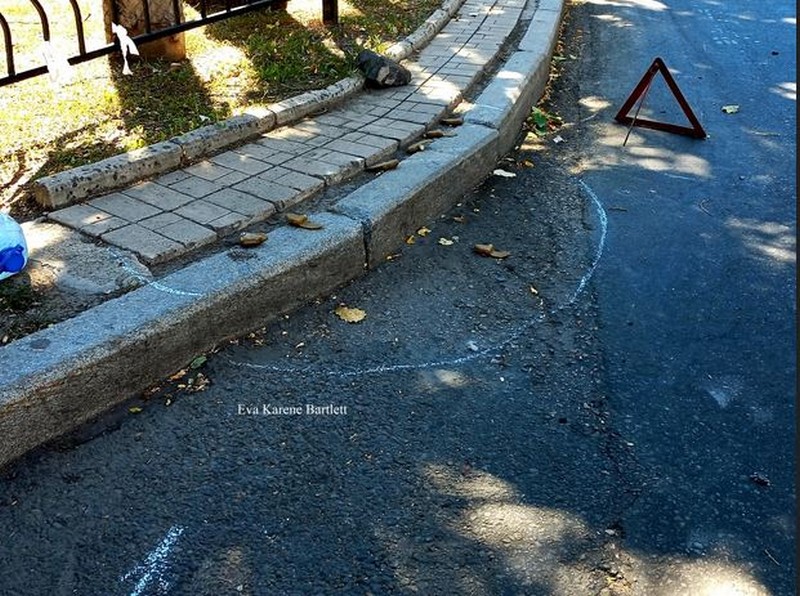
In one incident I witnessed first hand, an attack took place just after 9 pm on July 30, 2022. Ukraine fired rockets, each packed with over 300 mines, onto Donetsk, its suburbs, and other cities, including Yasinovataya, Makeevka and Gorlovka. The rockets exploded in the air to ensure greater distribution of devices on the ground. The attack mirrored previous ‘deliveries’ to the hard-hit Donetsk districts of Kievskiy, Kirovsky and Kuibyshevkiy.

The morning after, I walked the central Donetsk streets extremely carefully, wary of every leaf or piece of cardboard which could be obscuring or covering a Petal mine, so difficult are they to pick out from their surroundings. They cannot seriously damage military vehicles, which means that scattering them over Donetsk only has one purpose – to target and maim civilians. Some models of the petal mines have a self-destruct timer. Others, including those used by Kiev, can stay on the ground for years.

The innocent victims of Donbass

Since reporting the initial bombardment in late July, I have been following up on the methodical destruction of these mines by Russian sappers, as well as on civilians harmed by the illegal munitions. One of the more recent victims was 14 year old Nikita. His foot was blown off when in early November, 2022, he stepped on a mine in a playground while on his way to visit his grandmother.

RT journalist Roman Kosarev recently spoke with another recent teenage victim,  who stepped on a petal mine when getting into a car.

Kosarev also spoke to the Director of the Donetsk Republic’s Trauma Center, Andrey Boryak, who said: “The injury from such a mine is very severe, and immediately leads to a handicap. It’s almost impossible to save the foot and the lower part of the leg.

HRW has had over 6 months to investigate Ukraine littering the DPR with Petal/PFM-1 mines… but it has not, and will not. It’s once again the case that the lives of Donbass civilians don’t matter when it comes not only to Western media reporting but also to supposedly-neutral human rights bodies. Even worse still is the knowledge that in spite of the valiant efforts of sappers in the DPR, the mines will inevitably claim more innocent civilians as their victims.

Eva Bartlett is a Canadian independent journalist and activist.

3 April 2023

Source: www.transcend.org

UN Committee on the Exercise of the Inalienable Rights of the Palestinian People

BUREAU CONDEMS ISRAEL FORCES INTRUSION AND VIOLENCE AGAINST PALESTINIAN
WORSHIPERS IN HOLY SITES IN JERUSALEM

Wednesday, 05 April 2023

The following statement was issued today by the Bureau of the General Assembly’s Committee on the Exercise of the Inalienable Rights of the Palestinian People:

The Bureau of the United Nations General Assembly’s Committee on the Exercise of the Inalienable Rights of the Palestinian People condemns the raid by Israeli Forces inside the Aqsa Mosque Compound/Al-Haram al-Sharif on 4 April, which resulted in hundreds of Palestinian worshippers beaten, injured and detained while also causing damage to the building of Al-Qibli mosque. This violence is particularly egregious during a time of heightened religious sensitivity with the observance of Ramadan, Passover and Easter.

Israel’s illegal policies and practices have continued to entrench its illegal occupation of the Palestinian Territory it has occupied since 1967, including East Jerusalem, with the Gaza Strip additionally severely isolated under a nearly 16-year blockade. Since the start of 2023, Israel has increased its military operations inside the Occupied Palestinian Territory, resulting in the killing of at least 95 Palestinians, including 17 children. The Bureau calls for accountability for all of these violations.

The Bureau reiterates its calls for respect of international law, including humanitarian and human rights law, in the Occupied Palestinian Territory. Israel must comply with its international legal obligations, including in accordance with United Nations resolutions. The Bureau also reiterates its calls for respect of the historical status quo of the Holy Sites, respect for the sanctity of all places of worship, and for a halt of provocations by Israeli forces and incitement by extremist Israeli settlers in and around them. Furthermore, the Bureau calls for respect the freedom of all worshippers to access the religious sites in accordance with established parameters.

Finally, the Bureau calls on leaders to exert influence and ensure de-escalation and calm during religious festivities. The Bureau believes that a just and lasting peace will only be achieved with the end of Israel’s occupation, the realization of the inalienable rights of the Palestinian people, including the Palestine refugees and the achievement of the two-State solution according to international law and past agreements resulting in the independence of the State of Palestine with East Jerusalem as its capital.

END

****

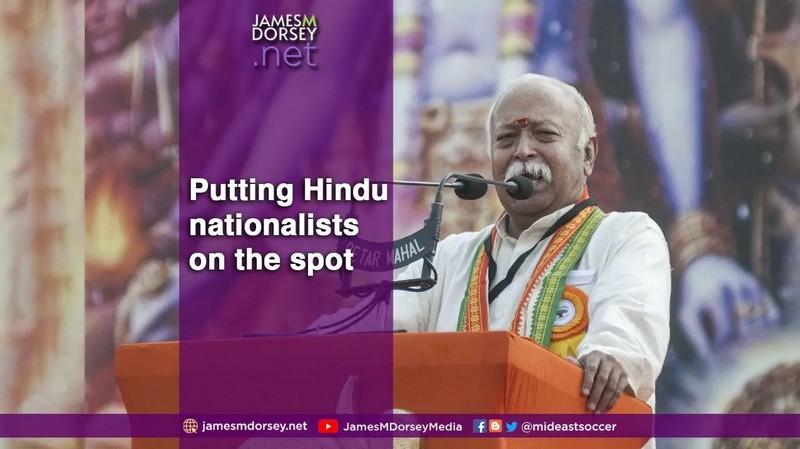
Putting Hindu nationalists on the spot

By James M. Dorsey

An Indian Supreme Court ruling coupled with calls by Indian Muslims for an end to sustained Islamophobic attacks on the world’s largest Muslim minority put Hindu nationalists on the spot.

The ruling and calls increase pressure to counter what amounts to a campaign against Muslims on Prime Minister Narendra Modi’s Hindu nationalist government as well as his ruling Bharatiya Janata Party (BJP) and its ideological cradle, the Rashtriya Swayamsevak Sangh or RSS, a five million-strong paramilitary group.

They also spotlight a dialogue between the RSS and Indonesia’s Nahdlatul Ulama, the world’s largest, most moderate Muslim civil society movement.

Last month, the court described Indian states as “impotent” for failing to rein in hate speech across the country. Judges insisted that only by taking religion out of politics would India reduce inter-communal tensions.

“Every day, fringe elements are making speeches to vilify others, including on TV and at public forums. The problem arises when politicians are mixing politics with religion. The moment politics and religion are segregated, this will come to an end,” the judges said.

The statement justified the court’s refusal to drop contempt of court charges against the Maharashtra government for failing to act on police reports of hate speech incidents.

Indian media reported that there had been since November at least 50 rallies in Maharashtra calling for a boycott of Muslims in response to an alleged ‘love jihad,’ the purported luring by Muslim men of Hindu women into marriage so that they would convert to Islam, and a supposed ‘land jihad’ to control public spaces and government land for the construction of Muslim religious and residential structures.

The rallies are organised by a Hindu nationalist umbrella group, Sakal Hindu Samaj. Many of the group’s constituent parts are linked to RSS.

Mr. Modi’s BJP has officially distanced itself from the rallies, but party officials and parliamentarians attended and addressed many gatherings.

The RSS has not commented on the court ruling and the calls nor has a senior RSS figure who was asked for comment.

The court ruling coincided with a letter to RSS chief Mohan Bhagwat from prominent Indian Muslims, led by former Delhi lieutenant governor Najeeb Jung. The letter decried the mounting anti-Muslim rhetoric.

Mr. Jung, who shared the letter with this writer, and his colleagues have engaged in a dialogue with the RSS.

“There is virtually no letup in the consistent barrage of hate speeches, calls for genocide and acts of violence against Muslims…. Most of this is in police presence, without any action, and even if there is action, it’s perfunctory and people are let off with ease,” the letter said.

Referring to the dialogue, Mr. Jung and his colleagues warned that “there is a sense of dismay and a question on the usefulness of our efforts… It is absolutely imperative that voices such as yours, as indeed from senior echelons of the Sangh (RSS), are heard loud and clear to condemn such acts.”

The RSS’s reticence to condemn anti-Muslim violence and rhetoric shouldn’t come as a surprise given the movement has sent mixed signals.

In an interview in January, Mr. Bhagwat asserted that Hindus “have been at war for over a thousand years. “ Mr. Bhagwat suggested that “it is natural for those at war to be aggressive.”

To drive the point home, Mr. Bhagwat added that “this war is not against an outside enemy, but against an enemy within.”

At about the same time, a senior RSS official implicitly argued that the RSS, unlike Mr. Modi’s BJP, was not looking at its dialogue with Indian Muslims for electoral gains.

With elections scheduled for next year, the BJP is widely believed to see inter-communal tension and polarization as a way of winning votes.

“We are not looking for any electoral gains or any political benefit. We are not choosing any specific group of Muslims. We are reaching out to everyone… interested in a long-term solution. We all are working for a social civilisational solution to this age-old communal conflict,” the official said.

Liberal Indian Muslims note that they are doing their part to build bridges and address RSS concerns by calling for a pluralist approach to Islamic teachings.

They also garnered support from major Indian Muslim organisations for their dialogue with Hindu militants.

“The Muslim laity must shed its docility and challenge the ‘religious authorities’ to be open to Islam’s pluralistic teachings,” said A. Faizur Rahman, secretary-general of the Islamic Forum for the Promotion of Moderate Thought, in an article in The Hindu in 2021.

The widening dichotomy between Mr. Modi’s BJP and the RSS has consequences that extend far beyond inter-communal relations in India.

It reflects the BJP’s failure since coming to power in 2014 to strike a balance between what scholar Rajesh Basrur describes as the “linkage between a state-centric and a civilization-centric worldview” rooted in Hindutva or Hindu nationalism.

Discussing Mr. Modi’s handling of foreign relations, Mr. Basrur suggested that “the BJP’s lack of a clear and distinct foreign policy might be traced to its foundational ideology of Hindutva (i.e., Hindu-ness), which underpins its approach to the world,” Mr. Basrur said.

The BJP’s failure has fuelled the divergence with the RSS.

The failure also complicated the government’s handling of its chairmanship of the Group of 20 or G20 which groups the world’s largest economies.

In the run-up to the G20 summit that this year is scheduled to be held in New Delhi in September, various engagement groups, including business, civil society, labour, science, women, and youth are likely to formulate recommendations for their political leaders.

Against the backdrop of the Supreme Court ruling and mounting Indian Muslim frustration that dialogue with Hindu nationalists is at best producing empty promises, the government is grappling with whether to include a religious engagement tack and if so, what Muslim group(s) it should choose as a partner.

Indonesia, the world’s largest Muslim-majority country and democracy, last year institutionalised religion as an official G20 engagement group with a summit of religious leaders in Bali in November. A Nahdlatul Ulama think tank manages the permanent secretariat of the Religion Forum 20 or R20.

A participant in the Bali R20, the RSS has sought to forge a partnership with Nahdlatul Ulama even though the Indonesian group sees Muslim religious reform as an incentive for other faiths, including Hinduism, to take a critical look at their potentially problematic tenets.

Nahdlatul Ulama’s approach, including its R20 initiative, has allowed it to forge ties with major faith groups across the globe. These include some of the most influential Indian Hindu religious leaders.

Those relationships raise the significance of the RSS’s ties to Nahdlatul Ulama, independent of government attitudes.

Even so, the RSS’s failure to engage with Indian Muslims more proactively, acknowledge the Supreme Court ruling, and distance itself from anti-Muslim rhetoric and violence is likely to increasingly raise eyebrows about Nahdlatul Ulama’s willingness to engage.

In the ultimate analysis, the question for the RSS and powerful Hindu religious leaders is how long they can afford to seemingly endorse, at least tacitly, anti-Muslim sentiment and expect Muslims to engage rather than radicalize.

Nahdlatul Ulama sees engagement as a process that takes time to produce results. The problem is that amid the mounting anti-Muslim sentiment in the run-up to next year’s elections, Indian Muslims feel time is a luxury they don’t have.

As a result, the question for Nahdlatul Ulama is at what point does it demand from the RSS as well as Hindu religious leaders that they either fish or cut bait.

Thank you for joining me today. I hope you enjoyed the newsletter and/or podcast. Diplomats, policymakers, investors, executives, journalists and academics listen to my twice-weekly podcast and/or read my syndicated newsletter that is republished by media across the globe. Maintaining free distribution ensures that the podcast and newsletter have maximum impact Paid subscribers help me cover the monthly cost of producing the newsletter and podcast. Please consider becoming a paid subscriber. You can do so by clicking on Substack on the subscription button at www.jamesmdorsey.substack.com and choosing one of the subscription options or support me on Patreon at www.patreon.com/mideastsoccer.  Please join me for my next podcast in the coming days. Thank you, take care and best wishes.

Dr. James M. Dorsey is an award-winning journalist and scholar, an Adjunct Senior Fellow at Nanyang Technological University’s S. Rajaratnam School of International Studies, and the author of the syndicated column and podcast, The Turbulent World with James M. Dorsey.

4 April 2023

Source: jamesmdorsey.substack.com