Just International

Blood Does Not Wash Away Blood

By Kathy Kelly

Those who have an insatiable appetite for war seldom heed the wreckage they have left behind.

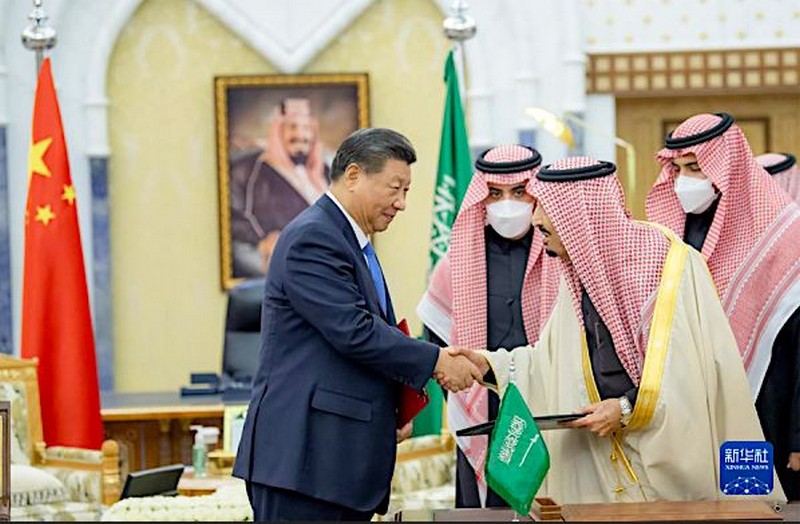
The extraordinary March 10, 2023 announcement that China’s top diplomat, Mr. Wang Yi, helped broker a rapprochement between Saudi Arabia and Iran suggests that major powers can benefit from believing that, as Albert Camus once put it, “words are more powerful than munitions.”

This concept was also acknowledged by General Mark Milley, Chairman of the U.S. Joint Chiefs of Staff who said on January 20th, 2023, that he believes Russia’s war in Ukraine will conclude with negotiations rather than on the battlefield. In November of 2022, asked about prospects for diplomacy in Ukraine, Milley noted that the early refusal to negotiate in World War One compounded human suffering and led to millions more casualties.

“So when there’s an opportunity to negotiate, when peace can be achieved … seize the moment,” Milley told the Economic Club of New York.

Twenty years ago, in Baghdad, I shared quarters with Iraqis and internationals in a small hotel, the Al-Fanar, which had been home base for numerous Voices in the Wilderness delegations acting in open defiance of the economic sanctions against Iraq. U.S. government officials charged us as criminals for delivering medicines to Iraqi hospitals. In response, we told them we understood the penalties they threatened us with (twelve years in prison and a $1 million fine), but we couldn’t be governed by unjust laws primarily punishing children. And we invited government officials to join us. Instead, we were steadily joined by other peace groups longing to prevent a looming war.

In late January 2003, I still hoped war could be averted. The International Atomic Energy Agency’s report was imminent. If it declared that Iraq didn’t have weapons of mass destruction (WMD), U.S. allies might drop out of the attack plans, in spite of the massive military buildup we were witnessing on nightly television. Then came Secretary of State Colin Powell’s February 5, 2003, United Nations briefing, when he insisted that Iraq did indeed possess WMD. His presentation was eventually proven to be fraudulent on every count, but it tragically gave the United States enough credibility to proceed at full throttle with its “Shock and Awe” bombing campaign.
Beginning in mid-March 2003, the ghastly aerial attacks pounded Iraq day and night. In our hotel, parents and grandparents prayed to survive ear-splitting blasts and sickening thuds. A lively, engaging nine-year-old girl completely lost control over her bladder. Toddlers devised games to mimic the sounds of bombs and pretended to use small flashlights as guns.
Our team visited hospital wards where maimed children moaned as they recovered from surgeries. I remember sitting on a bench outside of an emergency room. Next to me, a woman convulsed in sobs asking, “How will I tell him? What will I say?” She needed to tell her nephew, who was undergoing emergency surgery, that he had not only lost both his arms but also that she was now his only surviving relative. A U.S. bomb had hit Ali Abbas’s family as they shared a lunch outside their home. A surgeon later reported that he had already told Ali that they had amputated both of his arms. “But,” Ali had asked him, “will I always be this way?”

I returned to the Al-Fanar Hotel that evening feeling overwhelmed by anger and shame. Alone in my room, I pounded my pillow, tearfully murmuring, “Will we always be this way?”

Throughout the Forever Wars of the past two decades, U.S. elites in the military-industrial-Congressional-media complex have manifested an insatiable appetite for war. They seldom heed the wreckage they have left behind after “ending” a war of choice.
Following the 2003 “Shock and Awe” war in Iraq, Iraqi novelist Sinan Antoon created a main character, Jawad, in The Corpse Washer, who felt overwhelmed by the rising numbers of corpses for whom he must care.
“I felt as if we had been struck by an earthquake which had changed everything,” Jawad reflects. “For decades to come, we would be groping our way around in the rubble it left behind. In the past there were streams between Sunnis and Shi͑ites, or this group and that, which could be easily crossed or were invisible at times. Now, after the earthquake, the earth had all these fissures and the streams had become rivers. The rivers became torrents filled with blood, and whoever tried to cross drowned. The images of those on the other side of the river had been inflated and disfigured . . . concrete walls rose to seal the tragedy.”
“War is worse than an earthquake,” a surgeon, Saeed Abuhassan, told me during Israel’s 2008-2009 bombing of Gaza, called Operation Cast Lead. He pointed out that rescuers come from all over the world following an earthquake, but when wars are waged, governments send only more munitions, prolonging the agony.
He explained the effects of weapons that had maimed patients undergoing surgery in Gaza’s Al-Shifa Hospital as the bombs continued to fall. Dense inert metal explosives lop off people’s limbs in ways that surgeons can’t repair. White phosphorus bomb fragments, embedded subcutaneously in human flesh, continue to burn when exposed to oxygen, asphyxiating the surgeons trying to remove the sinister material.
“You know, the most important thing you can tell people in your country is that U.S. people paid for many of the weapons used to kill people in Gaza,” Abuhassan said. “And this also is why it’s worse than an earthquake.”
As the world enters the second year of war between Ukraine and Russia, some say it’s unconscionable for peace activists to clamor for a cease-fire and immediate negotiations. Is it more honorable to watch the pile-up of body bags, the funerals, the grave digging, the towns becoming uninhabitable, and the escalation that could lead to a world war or even a nuclear war?
U.S. mainstream media rarely engages with professor Noam Chomsky, whose wise and pragmatic analysis rests on indisputable facts. In June 2022, four months into the Russia-Ukraine war, Chomsky spoke of two options, one being a negotiated diplomatic settlement. “The other,” he said, “is just to drag it out and see how much everybody will suffer, how many Ukrainians will die, how much Russia will suffer, how many millions of people will starve to death in Asia and Africa, how much we’ll proceed toward heating the environment to the point where there will be no possibility for a livable human existence.”
UNICEF reports how months of escalating devastation and displacement affect Ukrainian children: “Children continue to be killed, wounded, and deeply traumatized by violence that has sparked displacement on a scale and speed not seen since World War II. Schools, hospitals, and other civilian infrastructure on which they depend continue to be damaged or destroyed. Families have been separated and lives torn apart.”
Estimates of Russian and Ukrainian military casualties vary, but some have suggested that more than 200,000 soldiers on both sides have been killed or wounded.
Gearing up for a major offensive before the spring thaw, Russia’s government announced it would pay a bonus to troops that destroy weapons used by Ukrainian soldiers which were sent from abroad. The blood money bonus is chilling, but on an exponentially greater level, major weapons manufacturers have accrued a steady bonanza of “bonuses” since the war began.
In the last year alone, the United States sent $27.5 billion in military assistance to Ukraine, providing “armored vehicles, including Stryker armored personnel carriers, Bradley infantry fighting vehicles, Mine-Resistant Ambush Protected vehicles, and High Mobility Multipurpose Wheeled vehicles.” The package also included air defense support for Ukraine, night vision devices, and small arms ammunition.
Shortly after Western countries agreed to send sophisticated Abrams and Leopard tanks to Ukraine, an adviser to Ukraine’s Defense Ministry, Yuriy Sak, spoke confidently about getting F-16 fighter jets next. “They didn’t want to give us heavy artillery, then they did. They didn’t want to give us Himars systems, then they did. They didn’t want to give us tanks, now they’re giving us tanks. Apart from nuclear weapons, there is nothing left that we will not get,” he told Reuters.

Ukraine isn’t likely to get nuclear weapons, but the danger of nuclear war was clarified in a Bulletin of the Atomic Scientists statement on January 24, which set the Doomsday Clock for 2023 to ninety seconds before the metaphorical “midnight.” The scientists warned that effects of the Russia-Ukraine war are not limited to an alarming increase in nuclear danger; they also undermine global efforts to combat climate change. “Countries dependent on Russian oil and gas have sought to diversify their supplies and suppliers,” the report notes, “leading to expanded investment in natural gas exactly when such investment should have been shrinking.”

Mary Robinson, the former U.N. High Commissioner for Human Rights, says the Doomsday Clock sounds an alarm for all humanity. “We are on the brink of a precipice,” she said. “But our leaders are not acting at sufficient speed or scale to secure a peaceful and livable planet. From cutting carbon emissions to strengthening arms control treaties and investing in pandemic preparedness, we know what needs to be done. The science is clear, but the political will is lacking. This must change in 2023 if we are to avert catastrophe. We are facing multiple existential crises. Leaders need a crisis mindset.”

As do we all. The Doomsday Clock indicates we’re living on borrowed time. We needn’t “always be this way.”

Over the past decade, I was fortunate to be hosted in dozens of trips to Kabul, Afghanistan, by young Afghans who fervently believed that words could be stronger than weapons. They espoused a simple, pragmatic proverb: “Blood does not wash away blood.”

We owe to future generations every possible effort to renounce all war and protect the planet.

Kathy Kelly, a peace activist and author, co-coordinates the Merchants of Death War Crimes Tribunal and is board president of World Beyond War.

14 March 2023

Source: countercurrents.org
The Not-So-Winding Road from Iraq to Ukraine

By Medea Benjamin and Nicolas J. S. Davies

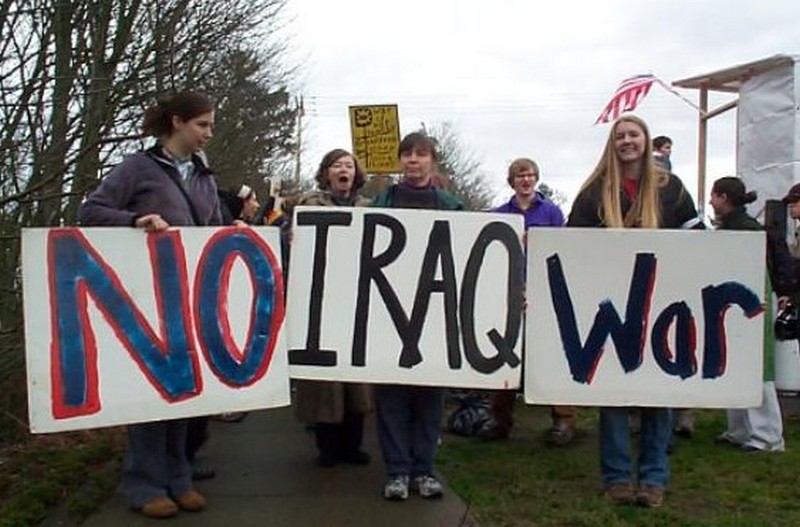
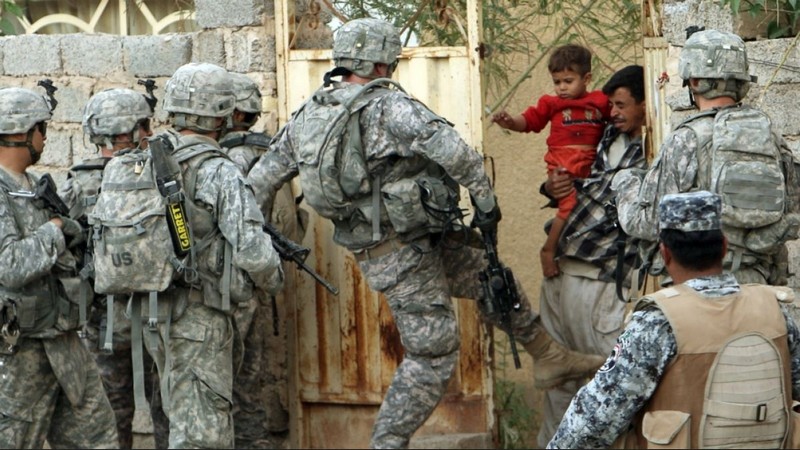
March 19th marks the 20th anniversary of the U.S. and British invasion of Iraq. This seminal event in the short history of the 21st century not only continues to plague Iraqi society to this day, but it also looms large over the current crisis in Ukraine, making it impossible for most of the Global South to see the war in Ukraine through the same prism as U.S. and Western politicians.

While the U.S. was able to strong-arm 49 countries, including many in the Global South, to join its “coalition of the willing” to support invading the sovereign nation of Iraq, only the U.K., Australia, Denmark and Poland actually contributed troops to the invasion force, and the past 20 years of disastrous interventions have taught many nations not to hitch their wagons to the faltering U.S. empire.

Today, nations in the Global South have overwhelmingly refused U.S. entreaties to send weapons to Ukraine and are reluctant to comply with Western sanctions on Russia. Instead, they are urgently calling for diplomacy to end the war before it escalates into a full-scale conflict between Russia and the United States, with the existential danger of a world-ending nuclear war.

The architects of the U.S. invasion of Iraq were the neoconservative founders of the Project for a New American Century (PNAC), who believed that the United States could use the unchallenged military superiority that it achieved at the end of the Cold War to perpetuate American global power into the 21st century.

The invasion of Iraq would demonstrate U.S. “full spectrum dominance” to the world, based on what the late Senator Edward Kennedy condemned as “a call for 21st century American imperialism that no other country can or should accept.”

Kennedy was right, and the neocons were utterly wrong. U.S. military aggression succeeded in overthrowing Saddam Hussein, but it failed to impose a stable new order, leaving only chaos, death and violence in its wake. The same was true of U.S. interventions in Afghanistan, Libya and other countries.

For the rest of the world, the peaceful economic rise of China and the Global South has created an alternative path for economic development that is replacing the U.S. neocolonial model. While the United States has squandered its unipolar moment on trillion-dollar military spending, illegal wars and militarism, other countries are quietly building a more peaceful, multipolar world.

And yet, ironically, there is one country where the neocons’ “regime-change” strategy succeeded, and where they doggedly cling to power: the United States itself. Even as most of the world recoiled in horror at the results of U.S. aggression, the neocons consolidated their control over U.S. foreign policy, infecting and poisoning Democratic and Republican administrations alike with their exceptionalist snake oil.

Corporate politicians and media like to airbrush out the neocons’ takeover and continuing domination of U.S. foreign policy, but the neocons are hidden in plain sight in the upper echelons of the U.S. State Department, the National Security Council, the White House, Congress and influential corporate-funded think tanks.

PNAC co-founder Robert Kagan is a senior fellow at the Brookings Institution and was a key supporter of Hillary Clinton. President Biden appointed Kagan’s wife, Victoria Nuland, a former foreign policy adviser to Dick Cheney, as his Under Secretary of State for Political Affairs, the fourth most senior position in the State Department. That was after she played the lead U.S. role in the 2014 coup in Ukraine, which caused its national disintegration, the return of Crimea to Russia and a civil war in Donbas that killed at least 14,000 people.

Nuland’s nominal boss, Secretary of State Antony Blinken, was the staff director of the Senate Foreign Relations Committee in 2002, during its debates over the impending U.S. assault on Iraq. Blinken helped the committee chairman, Senator Joe Biden, choreograph hearings that guaranteed the committee’s support for the war, excluding any witnesses who did not fully support the neocons’ war plan.

It is not clear who is really calling the foreign policy shots in Biden’s administration as it barrels toward World War III with Russia and provokes conflict with China, riding roughshod over Biden’s campaign promise to “elevate diplomacy as the primary tool of our global engagement.” Nuland appears to have influence far beyond her rank in the shaping of U.S. (and thus Ukrainian) war policy.

What is clear is that most of the world has seen through the lies and hypocrisy of U.S. foreign policy, and that the United States is finally reaping the result of its actions in the refusal of the Global South to keep dancing to the tune of the American pied piper.

At the UN General Assembly in September 2022, the leaders of 66 countries, representing a majority of the world’s population, pleaded for diplomacy and peace in Ukraine. And yet Western leaders still ignore their pleas, claiming a monopoly on moral leadership that they decisively lost on March 19, 2003, when the United States and the United Kingdom tore up the UN Charter and invaded Iraq.

In a panel discussion on “Defending the UN Charter and the Rules-Based International Order” at the recent Munich Security Conference, three of the panelists–from Brazil, Colombia and Namibia–explicitly rejected Western demands for their countries to break off relations with Russia, and instead spoke out for peace in Ukraine.

Brazilian Foreign Minister Mauro Vieira called on all the warring parties to “build the possibility of a solution. We cannot keep on talking only of war.” Vice President Francia Márquez of Colombia elaborated, “We don’t want to go on discussing who will be the winner or the loser of a war. We are all losers and, in the end, it is humankind that loses everything.”

Prime Minister Saara Kuugongelwa-Amadhila of Namibia summed up the views of Global South leaders and their people: “Our focus is on solving the problem…not on shifting blame,” she said. “We are promoting a peaceful resolution of that conflict, so that the entire world and all the resources of the world can be focused on improving the conditions of people around the world instead of being spent on acquiring weapons, killing people, and actually creating hostilities.”

So how do the American neocons and their European vassals respond to these eminently sensible and very popular leaders from the Global South? In a frightening, warlike speech, European Union foreign policy chief Josep Borrell told the Munich conference that the way for the West to “rebuild trust and cooperation with many in the so-called Global South” is to “debunk… this false narrative… of a double standard.”

But the double standard between the West’s responses to Russia’s invasion of Ukraine and decades of Western aggression is not a false narrative. In previous articles, we have documented how the United States and its allies dropped more than 337,000 bombs and missiles on other countries between 2001 and 2020. That is an average of 46 per day, day in day out, for 20 years.

The U.S. record easily matches, or arguably far outstrips, the illegality and brutality of Russia’s crimes in Ukraine. Yet the U.S. never faces economic sanctions from the global community. It has never been forced to pay war reparations to its victims. It supplies weapons to the aggressors instead of to the victims of aggression in Palestine, Yemen and elsewhere. And U.S. leaders–including Bill Clinton, George W. Bush, Dick Cheney, Barack Obama, Donald Trump, and Joe Biden—have never been prosecuted for the international crime of aggression, war crimes or crimes against humanity.

As we mark the 20th anniversary of the devastating Iraq invasion, let us join with Global South leaders and the majority of our neighbors around the world, not only in calling for immediate peace negotiations to end the brutal Ukraine war, but also in building a genuine rules-based international order, where the same rules—and the same consequences and punishments for breaking those rules—apply to all nations, including our own.

Medea Benjamin and Nicolas J. S. Davies are the authors of War in Ukraine: Making Sense of a Senseless Conflict, published by OR Books in November 2022.

15 March 2023

Source: countercurrents.org
Israel acts without any sense of discretion

Palestine Update 635
Comment

Israel acts without any sense of discretion
Israel has no sense of discretion when it takes to bombing Gaza. The bombing in 2021 of a studio, called ‘Hollywood beach’, sent shockwaves because no one expected the studio to be a target. “Built without a roof, it was clearly not much of a hiding place for anyone or anything, and it should have been obvious to any drones flying overhead what the site was used for”.

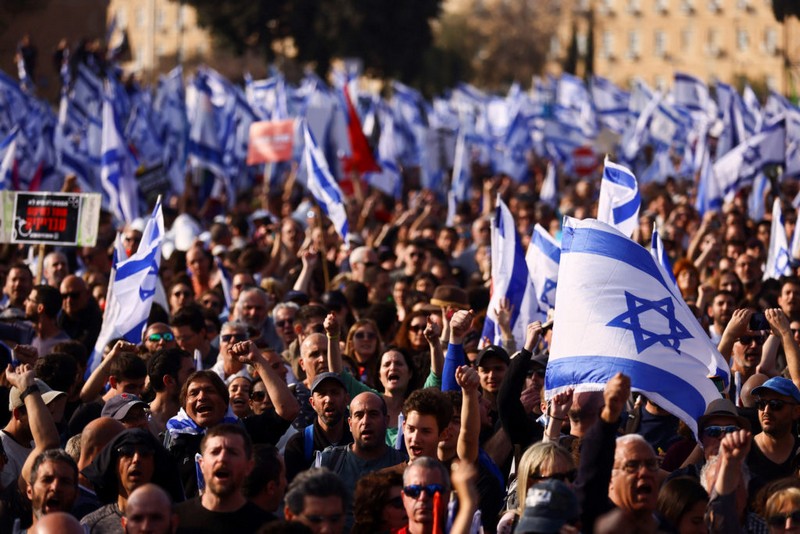
There is surprise and amusement among BDS activists over how boycotts, divestments, and sanctions — though not explicitly named as such — have become central strategies of the Israeli protest movement. “Large swathes of society are not just distancing themselves from the government’s agenda, but are actively pursuing nationwide disruption and international intervention to stop it. The stability of the economy, security, and day-to-day life are all necessary sacrifices in the name of saving “democracy.” At this scale, the movement has gone beyond merely ending public complicity; it is, in effect, a civil revolt”.

Rather surprisingly, until recently, the EU elite were smug over the patterns of Israeli “democracy” merely because they conducted frequent elections to conclude who had the right to rule Israel (and misrule Palestinian territories). The EU deemed, rather naively, that the sheer “regularity of elections was proof that freedom reigned in Israel.  It was only when the current ruling coalition began its assault on the judiciary that the EU began to treat Israeli “democracy” as an endangered species. “In this world of myth and illusions, nobody acknowledges that Israel was set up to prevent Palestinians having any democratic rights.”

As if to prove the point, Right-wing politicians have demanded vigorous measures against Palestinians in response to a terror attack that seriously wounded an Israeli man in the northern West Bank town of Huwara, the second shooting attack there in three weeks. A spokesperson for a far-right coalition urged the government to “wipe out” the entire town as revenge.

Anglican bishop Husam Naoum expressed grief over finding that more than 30 tombstones and crosses were smashed to pieces by at least two Jewish extremists.  A Palestinian man has thwarted an attempted Israeli attack on a Christian church in occupied East Jerusalem on Sunday, the Palestinian Authority (PA) said. Two Israelis entered the Church of Gethsemane and attempted to damage items inside. A Palestinian man at the scene stopped them. The occupation is taking more and more illegal forms of punitive actions that are illegal and totally beyond political morals.

On behalf of MLN Palestine Updates

Ranjan Solomon


Hollywood Beach, the photo studio Israel keeps bombing
It was while rebuilding his photography studio a third time that Muhammad Hajjaj, 23, decided to see the repeated destruction of his dream project in a new light. An English-language business administration graduate, Hajjaj always conceived of running a business of his own that did not rely on his certificate or a boss, a consequence of the high unemployment rate and low prospects in Gaza’s battered and captive economy.

Further, he also chose to work with his passion. Since childhood, Hajjaj was relentlessly positive; interested in fashion and design and in making others smile. “I wanted to offer a service for people that helps them keep some beautiful memories,” Hajjaj told The Electronic Intifada. A photography studio was the perfect fit, and a good enough idea – not least because, as Hajjaj said, “there are always weddings in Gaza” – that in 2021, he and a friend, Muhammad Nassar raised $30,000 with support from their families to turn it into reality.

They built the studio on the beachfront in Gaza City. They took great care to fill it with trees, plants and flowers, colorful walls and photo backdrops. The design and decor, unusual in Gaza, as well as the location on the beach, made it unique. And in addition to photos, the studio also planned to offer a video service for weddings, graduation ceremonies, and birthday parties. Hajjaj named the studio Hollywood Beach to impart a sense of glamor and style.

Just two days before the studio was due to open, Israel launched its 11-day aggression on the Gaza Strip in May 2021. On the third day of the onslaught, an airstrike hit the studio. When reports of the bombing came, people were shocked because no one expected the studio to be a target. Built without a roof, it was clearly not much of a hiding place for anyone or anything, and it should have been obvious to any drones flying overhead what the site was used for.
Read more in Electronic Intifada

Israelis, welcome to BDS
Though not named as such, BDS tactics have been central to Israel’s anti-government protests. And the hypocrisy is not lost on Palestinians.

It took only two months for Israelis to shatter one of their biggest political taboos in the fight against the far-right government. Riled by the coalition’s relentless power trip, Jewish opposition parties have pledged not to participate in the Knesset’s final votes on legislation aimed at overhauling the judiciary. Israeli diplomats and envoys are quitting their posts in protest. Army reservists are objecting to service en masse, affecting every unit from combat troops to the air force. Tech companies and venture capital firms are relocating abroad and transferring out hundreds of millions of dollars. Artists, writers, and intellectuals are calling on world leaders to shun meetings with senior Israeli officials, including the prime minister. None of these groups will admit it, but this is, by all accounts, one of the most impressive BDS campaigns ever witnessed.

In the topsy-turvy Israel of today, boycotts, divestments, and sanctions — though not explicitly named as such — have become central strategies of the Israeli protest movement. Large swathes of society are not just distancing themselves from the government’s agenda, but are actively pursuing nationwide disruption and international intervention to stop it. The stability of the economy, security, and day-to-day life are all necessary sacrifices in the name of saving “democracy.” At this scale, the movement has gone beyond merely ending public complicity; it is, in effect, a civil revolt.
Read more in 972 Mag

Why is the EU suddenly worried about Israeli “democracy”?
I had a flashback upon hearing that the European Parliament will voice grave concern this week about how Israeli “democracy” is deteriorating. Suddenly, I found myself transported back to that distant month of January 2023. Visions of the same European Parliament flooded my mind. Immaculately dressed, its top representatives were queuing up to have their photographs taken with a visiting Israeli president. Just a few hours earlier Israel had committed a massacre in the occupied West Bank city of Jenin. That did not perturb the great and the good in Brussels. They were completely fixated on celebrating how the European Union and Israel are entwined by history and values. Welcome to a world of myths and illusions.

Until quite recently, the EU elite were complacent about Israeli “democracy.” The regularity of elections was considered proof that freedom reigned in that little oasis. It was only when a crude coalition began its assault on the judiciary that the EU began to treat Israeli “democracy” as an endangered species. In this world of myth and illusions, nobody acknowledges that Israel was set up to prevent Palestinians having any democratic rights.

Israel’s police force has played an essential role in strangling democracy. Long before the far-right pyromaniac Itamar Ben-Gvir became the minister in charge of that force, its officers were attacking Palestinian gatherings – even funerals – and carrying out extrajudicial executions.
Read full narrative in Electronic Intifada

Coalition lawmakers urge escalation against Palestinians following terror attack
Huwara must be ‘wiped out’; Ben Gvir urges death penalty for culprits
Right-wing politicians called Sunday for forceful measures against Palestinians in response to a terror attack that seriously wounded an Israeli man in the northern West Bank town of Huwara, the second shooting attack there in three weeks. A spokesperson for a far-right coalition MK urged the government to “wipe out” the entire town as revenge. David Stern from the settlement of Itamar, a former US Marine in his 40s who works as a weapons instructor, was seriously hurt after sustaining gunshot wounds to his head and shoulder in the attack on the Route 60 highway.

A woman in the car, identified as Stern’s wife, was also taken to a hospital suffering from traumatic shock. She was not hit by the gunfire, medics said. The Israel Defense Forces said the Palestinian terrorist was shot by both the victim and soldiers immediately after the attack, before he fled the scene on foot. After a brief chase, troops located and detained the gunman, who had been wounded by the victim’s and troops’ gunfire, the IDF said, adding that his makeshift submachine gun was seized. Prime Minister Benjamin Netanyahu said he was praying for the “wounded hero” who succeeded in shooting the terrorist attacker, adding: “Whoever tries to harm Israeli citizens will bear the responsibility.”
Read full report in Times of Israel

Palestinian man thwarts Israeli attack on East Jerusalem church
Palestinian man has thwarted an attempted Israeli attack on a Christian church in occupied East Jerusalem on Sunday, the Palestinian Authority (PA) said. Two Israelis entered the Church of Gethsemane and attempted to damage items inside. A Palestinian man at the scene stopped them. The attempted attack came after two Israeli radicals defaced a Christian cemetery in East Jerusalem on New Year’s Day. “It really grieves us to see what happened over the New Year holiday when we discovered that more than 30 tombstones and crosses were smashed to pieces by at least two Jewish extremists,” Anglican bishop Husam Naoum said at the time. “I ask for action to be taken; the perpetrators brought to the law and are a lesson for others.” The bishop attributed the attack to increased hate speech within Israeli society. Palestinians in Jerusalem experience frequent violence from Israeli settlers and forces and both Christian and Muslim holy places come under attack. The Al-Aqsa Mosque compound, which is the third-holiest site in Islam and the most-sacred Muslim place in Palestine, often faces raids.
Read more from The New Arab

20 March 2023

Source: nakbaliberation.com

Israel’s continuing settler colonial legacy grows crueler

Palestine Update 634
Comment

Israel’s continuing settler colonial legacy grows crueler

In a very recent issue of Al Jazeera we read that “what happened in Huwara is seen simply through the prism of Netanyahu’s right-wing coalition government… a regrettable symptom of the Israeli regimes shift to the right and the inevitable emboldening of Israeli settlers in the West Bank. This is an astoundingly deluded take on reality. After all, as many scholars in colonial studies have argued, settlers, unlike migrants, do not come to a country to assimilate with the indigenous people who are already living there; rather, they come to replace a population that is living on land that they see as rightfully theirs.

Settler cruelties visit peace activists from overseas too: Cassandra Auren, a peace activist from Wisconsin, was standing with an Italian activist on land that belongs to the residents of the Palestinian village Tuba, when a group of settlers from a nearby outpost, Havat Ma’on, ran toward them. Auren saw one of the attackers stood behind her, and as she was turning to face him, he hit her in the head with a weapon that she described as looking “like a baseball bat.” Barbarism, we would call that. Hard to think of parallels elsewhere in the civilized world!

Haaretz in a sharp and stunning report narrates how the “Negev has seen a sharp increase in home demolitions and the issuing of demolition orders and warnings. A few weeks ago, the Israel Land Administration land preservation unit issued 450 pre-demolition warnings throughout the Negev – for residential buildings, fences, sheep pens and other structures – as part of an operation dubbed Southern Hawk. The administration said the unusual increase was thanks to the launch of an AI-based system to locate unauthorized structures built within the previous three years. Buildings that fall under this category can be demolished without a judicial process”.

The Palestinian sense of dignity never allows them to surrender: Palestinian prisoners announced plans to step up their protest against the harsh treatment they have received since Itamar Ben Gvir was appointed Israel’s national security minister. Ben Gvir, whose portfolio includes overseeing prisons within the Green Line, has promised a brutal crackdown on Palestinian prisoners’ conditions, bringing an end to what he calls “the summer-camp conditions of murderous terrorists.”

Please read and disseminate widely.

For MLN Palestine Updates

Ranjan Solomon

Israel was built on burned Palestinian villages

“For these Israelis and Zionists, what happened in Huwara is seen simply through the prism of Netanyahu’s right-wing coalition government. In other words, as a regrettable symptom of the Israeli regimes shift to the right and the inevitable emboldening of Israeli settlers in the West Bank. This is an astoundingly deluded take on reality. Indeed, portrayals of Israeli settlers in the West Bank as completely separate and inherently different to the rest of Israel are a demonstration of cognitive dissonance par excellence. One does not have to dig that deep to discover that the burning of Palestinian villages is not a new tactic in the Zionist playbook, rather it is a core feature…While the discourse of the far right has undoubtedly led to more settler attacks on Palestinians in the West Bank in recent years…the erasure of the Palestinian people is in the essence of the Israeli regime. To separate the actions of settlers in the West Bank from the rest is an attempt to conceal the reality of Israeli settler colonialism that exists from the Jordan River to the Mediterranean Sea. That is why the pogrom in Huwara has to be understood as a simple continuation of a settler colonial legacy.”

Read more in Al Jazeera

The Rapid and Predictable Rise of Israeli Settler Violence against Palestinians

“As many scholars in colonial studies have argued, settlers, unlike migrants, do not come to a country to assimilate with the indigenous people who are already living there; rather, they come to replace a population that is living on land that they see as rightfully theirs. This inherently entails devising some way of forcing said population to abandon the land. While prominent Israeli politicians have been more willing to publicly acknowledge their goals of territorial expansion and settlement in recent years, the totality of Israeli policy over the past 75 years leaves little doubt that Israel does not now, nor has it ever seen a sovereign Palestinian state as a realistic prospect. In light of this fact, the violence of settlers should not be seen as an anomaly that merely requires stricter law enforcement, but rather must be understood as a tool of Israeli colonial violence that is all but openly encouraged by the state itself. As Israeli NGO B’Tselem argues, the Israeli state should not be seen as a potential solution to settler violence, but as an enabler, in large part due to its retroactive legalizations of land takeovers and its legitimization of physical violence against Palestinians. Only by fully acknowledging the central role that settler expansion and violence play in the Israeli state’s broader goals can the situation be resolved. Mere calls for “de-escalation” are insufficient and unjust.”
Read more in Arab Center

See also (Humans of Masafer Yatta)

‘Who hits a 64-year-old woman with a bat?’, +972

“A 64-year-old American citizen was attacked last Tuesday by a group of masked settlers in the South Hebron Hills of the occupied West Bank. Cassandra Auren, a peace activist from Wisconsin, was standing with an Italian activist on land that belongs to the residents of the Palestinian village Tuba, when a group of settlers from a nearby outpost, Havat Ma’on, ran toward them. Auren said that one of the attackers stood behind her, and as she was turning to face him, he hit her in the head with a weapon that she described as looking “like a baseball bat.” She immediately passed out from the blow and was hospitalized with a fractured skull and internal bleeding in her head…Israeli authorities have yet to make any arrests for the assault”
Read report in 972 Mag

Israel’s Government Is a Clear and Present Danger for Its Arab Palestinian Citizens
“Below the frantic headlines about the attempted judicial capture, the government has advanced laws that target Arabs in far more dangerous ways, by marking those convicted of terrorism for deportation, or even death. One of the laws, which has already passed, allows Israel to strip the citizenship of citizens convicted of acts of terror who receive financial support from the Palestinian Authority, and deport them to the West Bank or Gaza…Another bill has been called “barbaric,” by Israel Democracy Institute scholar Amir Fuchs. That’s because it requires the death penalty for terrorists”
Read more in Haaretz

Sharp Increase in Demolition Orders Raises Suspicion and Fear among Israeli Bedouin

“Residents and activists say that since the government was sworn in at the end of December, the Negev has seen a sharp increase in home demolitions and the issuing of demolition orders and warnings. A few weeks ago, the Israel Land Administration land preservation unit issued 450 pre-demolition warnings throughout the Negev – for residential buildings, fences, sheep pens and other structures – as part of an operation dubbed Southern Hawk. The administration said the unusual increase was thanks to the launch of an AI-based system to locate unauthorized structures built within the previous three years. Buildings that fall under this category can be demolished without a judicial process. The land administration said that warnings and orders were given only to structures less than three years old. But Haaretz found that in some cases, they were given to decades-old structures. One example is the case of the Aloul family, which is considered precedent-setting…The orders and demolitions gave rise to a protest at the Be’er Sheva court that issued them, with over 1,000 Negev Bedouin and about 100 Jews participating. The coordinator of the Regional Council of Unrecognized Villages in the Negev said: “The ministers have bad intentions and want to remove us from our land by force. There isn’t a day that they don’t come and demolish. That’s new and much worse than before. In recent weeks, there are daily demolitions.”
Read more in Haaretz

As crackdown intensifies, Palestinian prisoners gear up for Ramadan protest

“On March 5, Palestinian prisoners announced plans to step up their protest against the harsh treatment they have received since Itamar Ben Gvir was appointed Israel’s national security minister. Ben Gvir, whose portfolio includes overseeing prisons within the Green Line, has promised a brutal crackdown on Palestinian prisoners’ conditions, bringing an end to what he calls “the summer-camp conditions of murderous terrorists.” Prisoners have launched a series of actions in defiance of these threats, which will culminate in a collective hunger strike beginning on the first day of the fasting month of Ramadan. According to Palestinian sources who spoke to +972, as well as reports in Palestinian media, the prisoners’ coordinated efforts could compel Palestinians throughout the West Bank and Gaza to join in resisting other forms of Israeli oppression.”
Read more in 972+ Mag

17 March 2023

Source: nakbaliberation.com


My Childhood Connection with Nalanda and ​Its Uncompromising Tradition of Intellectual Freedom

By Maung Zarni

‘Nalanda: The university that changed the world,  an essay by  Sugato Mukherjee (23rd February 2023), published as a part of the ‘BBC Travel series looking into how a destination has made a significant impact on the entire planet’, was a rather fascinating read, with fresh information – like the invention of Zero, the world as we know as a representation or reflection of mind, maths, medicine and astronomy, logic (Reason) and philosophy.

In this era of decolonization (of both social and institutional relations and popular Consciousness, most importantly, in the vast world of formerly Europe-colonized societies), the wealth of information this ‘little’ essay offers, and a tiny window it  flings open for readers is long overdue and very much welcome.

The Pursuit of Knowledge and Human Understanding based on ‘Reason’ and what is termed ‘empiricism’ also took place outside the Greco-Romanic World, typically presumed to be the philosophical cradle of Western Civilization and the European Enlightenment.

To belabour the obvious, centres of intellectual enlightenment move around the globe, and centuries before the standard view that Scientific/Empirical Knowledge is the exclusive domain of what has come to be known as The West.

From Harvard’s star psychologist Steven Pinker and Oxford’s evolutionary biologist Richard Dawkins to Cambridge’s deceased anthropologist Ernest Gellner, advanced human understanding takes place within what they falsely believe in the Secular West with its Reason and Rationality.

In his Minute on Education (dated 2nd February 1835), the Oxford-educated historian and a Scotsman who served on the Council of India, wrote his rather conceited, but profoundly ignorant view on the knowledge systems outside the Franco-English language world.   After insisting that French and English were keys to unlock what he considered real/empirical knowledge of the world – as opposed to myths and mystical views about ancient deities in the worlds of Arabic, Sanskrit and Egyptian traditions, the Hon’ble Macaulay proceeded to write:

‘I have no knowledge of either Sanscrit or Arabic. But I have done what I could to form a correct estimate of their value. I have read translations of the most celebrated Arabic and Sanscrit works. I have conversed, both here and at home, with men distinguished by their proficiency in the Eastern tongues. I am quite ready to take the oriental learning at the valuation of the orientalists themselves. I have never found one among them who could deny that a single shelf of a good European library was worth the whole native literature of India and Arabia. The intrinsic superiority of the Western literature is indeed fully admitted by those members of the committee who support the oriental plan of education (italics added).’

[See Minute on Education (1835) by Thomas Babington Macaulay (columbia.edu), 1835.]

At the close of the 19th century, a principal of Balliol College was quoted, in the university’s alumni magazine published in 2008, as saying, ‘I know knowledge.  If I know not (something), that is not knowledge.’

So when Richard Dawkins, Professor for Public Understanding of Science at New College, Oxford, sent his deeply racist and arrogant tweet that reads ‘All the world’s Muslims have fewer Nobel Prizes than Trinity College, Cambridge. They did great things in the Middle Ages, though’, Dawkins is merely echoing the foundational thought of Euro-Supremacy.  Ironically, Dawkinsian Euro-Supremacy emerged after the Middles Ages during which peoples in Europe were slaughtering one another as their favourite pastimes, to paraphrase Noam Chomsky’s pointed observation about the Old Europe.

[See ‘Richard Dawkins’ tweets on Islam are as rational as the rants of an extremist Muslim cleric’ Nesrine Malik  The Guardian, 8 August 2013.]

In the elite scholarly discourses peddled in prestigious university circles, it is the Greek (and the Romans) that were the intellectual founders of ‘Western Civilization’ and Givers of Logic, Philosophy, Law, and all that that is considered worth learning as a matter of discipline.  Think of the countless number of high priests of western university tradition who have made a meal of expounding on Plato’s Republic and Socrates’ dialogues.

Gellner for one got carried away, when he in effect attempted to make the case for Reason as if it were the exclusive property that was found in the advanced civilizations – you guessed it! – of Europe.   On Freedoms and Democracy, you have Timothy Garton Ash, Professor of European Studies at St Antony’s College, Oxford and proud adviser to US Presidents (such as George W. Bush) and UK Prime Ministers (such as the late Lady Thatcher) who cannot conceal his view that both freedoms and democracy are exclusively European.

Against this pathetic backdrop of the quintessentially Eurocentric Ignorance dressed up as the Established Wisdom of the grey eminences of Oxbridge and the Ivy League, Nalanda stands out as an empirical challenge.

Nalanda (427 CE-1197 CE) the renowned ancient monastic university is only one of the best known amongst several major centres of Buddhist learning.  Vikramashila, again in present-day Bihar, and Takshashila or Taxila in Pakistan are among the cluster of old centres of higher learning.  These were important pillars of the Buddhist world of ideas and intellectual practices – including modes of sifting and winnowing of fact from fiction, knowledge from hearsay, knowledge of Self and the external World – not simply the faith-based devotional places.

On a personal level, a child in the predominantly Buddhist heartland of Burma, I took an interest in Plato and Socrates, whatever limited Burmese translations of their work, however half-baked my understanding of their work may have been.   But I was made aware of an equally important intellectual tradition and modes of Knowing (or Epistemologies, if you like), which serve as the theoretical bedrock of ‘the Burmese Mind’, ancient India of Buddhism and Buddhist scholar-practitioners.

Admittedly, there are genocidal Buddhists, including scripturally versed Saffron-robed monks in Sri Lanka, Myanmar, Thailand.  But they fall outside the intellectual tradition which seeks to advance not only Understanding but also Being.  The Dalai Lama’s valid criticism of Western schooling as the education exclusively of the mind not the heart applies to these Buddhist scholars who miss the central tenet of Buddhist intellectual advancement.   Knowledge is about not simply Knowing Self and the world, but transforming both.

When you have Buddhist monks who can recite the mantra of Loving Kindness but do not have the wisdom nor the heart developed or advanced enough to apply their scriptural expertise on Metta Sutra to Muslims, minorities, women, the LGBTQ and, broadly, Others, then we have ‘Buddhists’ turning their lands of Enlightenment into genocidal slaughterhouses and killing fields.  This was evidenced in Sinhalese Buddhists in Sri Lanka in their war of subjugation against the Tamil Hindu minority.  And more recently, in my native Myanmar, the Rohingya genocide of 2017.

Towards that end of the pursuit of Knowledge as vehicle for the dual purpose of Understanding and Transforming Self and the World, the Buddhist intellectual tradition established a very clearly articulated principle of Intellectual Freedom – for rejection and acceptance of Truth Claims.

The best known articulation of this principle of free inquiry is encapsulated in the answer which the founder Buddha the Enlightened offered, when he was confronted with a group– known as Kalamas or residents of the town called Kesaputta, who openly expressed doubt and uncertainty on his teachings.

‘Come, Kalamas. Do not go upon what has been acquired by repeated hearing; nor upon tradition; nor upon rumour; nor upon what is in a scripture; nor upon surmise; nor upon an axiom; nor upon specious reasoning; nor upon a bias towards a notion that has been pondered over; nor upon another’s seeming ability; nor upon the consideration, “The monk is our teacher”. Kalamas, when you yourselves know: “These things are good; these things are not blamable; these things are praised by the wise; undertaken and observed, these things lead to benefit and happiness”, enter on and abide in them.’

This was something I grew up with – Buddhist paradigm as radical empiricism, something that requires independent thinking.   As my late father told me, with some concealed pride, when I became a known dissident against Myanmar’s military dictatorship, ‘Son, you always talked back since you were a young boy.’   Thinking for oneself, and ‘talking back’ are habits cultivated through the intellectual tradition that dates back to the time of Kalama – 2,600 years ago.

So, reading Mukherjee’s concise but well-researched essay triggers a rush of memories not only of my childhood stories told by the elders in our extended Buddhist family of three-generations but more immediately a visit to Nalanda I made about six years.

I spent three years at Oxford University on its margins as a visiting scholar from 2006-09.  One of the things that struck me about Oxford was how magnificent the general architecture of its 30-plus colleges is.   I have also been to a large number of famed campuses of universities, ancient and modern, in Europe, N. America and Asia.

When I stepped into the demarcated compound of Nalanda University – much of the original structures remain unexcavated – I felt a familiar sense of awe every time I feel at any great modern university.  In addition to Oxbridge, I have seen Bologna (built in AD 1088). I have seen the Sorbonne.  I have seen the Thomas Jefferson-designed University of Virginia – and many other comparable institutions.

But the impression I felt walking among the ruins of Nalanda far surpassed these latter-day institutions of higher learning.    The sheer numbers of what must have been magnificent lecture halls, meditation sites (where one meditates to gain insights into Self and the World/Principles of Impermanence), the residential rooms (with charred beams from the arson by invading troops that destroyed the great university), the geometric symmetrically arranged open spaces that dot the ruins, and so on would leave a lasting favourable impression of the great residential university.

And above all, the intellectual freedom that was Nalanda’s foundational stone– as articulated in Kalama Sutra – stands in sharp contrast to the intellectual censorship which culminated in the Inquisition of the Church, and the Church-controlled  European centres of learning at Bologna, the Sorbonne, and Oxford, just to name a few.    The breach of intellectual freedom that had put Harvard University Kennedy School of Government in the widely reported denial of a senior visiting fellowship to Human Rights Watch director Ken Roth – because he calls Israel or The Jewish State apartheid – speaks volumes about how in the year 2023 the spirit and principle of Free Inquiry  remain an issue.

Buddhist intellectual tradition institutionalized Freedom of Inquiry and Debate 2,600 years ago.   Nalanda was an institutional embodiment of this principle.

It is a shame that the worthwhile intellectual project, with Amartya Sen as its founding chair, to revive this 2,600-years old tradition of Free Inquiry – at the new Nalanda University has gone aground as Prime Minister Modi attempted to bend it for his Hindu fundamentalist ends.

17 March 2023

Maung Zarni is a Burmese educator, academic, and human rights activist. He is noted for his opposition to the violence in Rakhine State and Rohingya refugee crisis.

Seismic Iran-Saudi Rapprochement Isolates US

By Joe Lauria

11 Mar 2023 – Ever since the 1979 Islamic Revolution that overthrew the U.S.-allied Shah of Iran, the rivalry between the two major Middle East powers — Iran and Saudi Arabia — has been at the heart of every conflict across the region.

The announcement on Friday that Iran and Saudi Arabia have normalized relations could have a seismic effect on all these conflicts and leave the U.S. on the outside looking in.

In Lebanon, Iranian-backed Hezbollah and Saudi-backed parties might begin to resolve their differences, a unity that would worry Israel and lessen U.S. influence in the country.

In Syria, Hezbollah and Iranian militias have been battling Saudi-backed jihadists for more than a decade.  The Syrian war could now come to an end.

In Yemen, U.S.-backed Saudis have been fighting the Houthi, who have been driven into a closer alliance with Iran. Obstacles to a peace deal could now have been removed.

In Iraq, reconciliation between Sunni and Shia could make the U.S. presence and influence irrelevant and unwelcomed by all sides.

In Bahrain, Iranian-backed Shi’ites no longer in conflict with the Saudi-aligned monarchy could sideline the presence of the U.S. Fifth Fleet in a region on the mend.

And in Saudi Arabia itself, the state’s tensions with Shi’tes in the eastern oil regions should lessen.

Transforming

In short, the historic rapprochement and resumption of formal diplomatic ties between Saudi Arabia and Iran could transform the Middle East.

And the United States doesn’t like it one bit.

The U.S. has depended on the Saudi-Iranian divide to pursue its interests in the region.

After this development, the U.S.-Israeli front against Iran should lose their chief Arab ally, Saudi Arabia. The Saudis are now in a position to defy U.S. economic sanctions on Iran — a nightmare for Washington.

An end to the Yemen war, which the Biden administration has been making noises about, would mean having to accept Iranian influence on the Arabian peninsula.

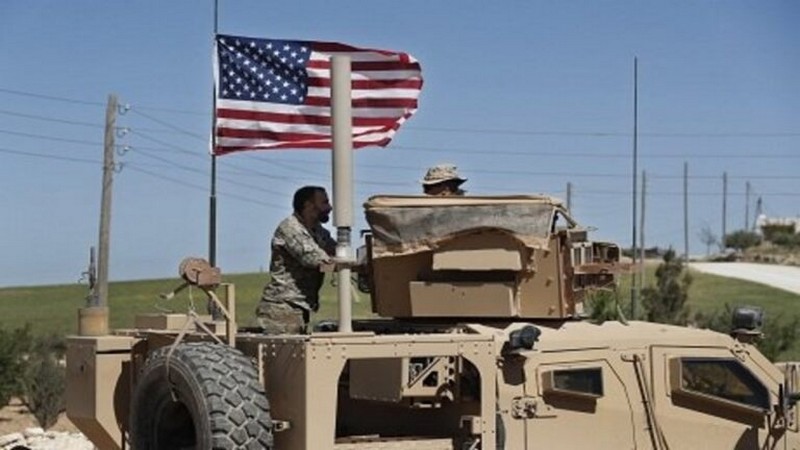
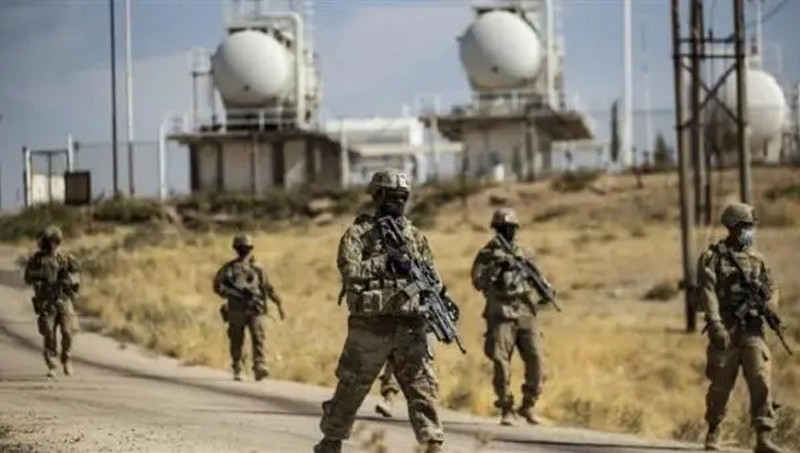
An end to the war in Syria would be the death knell for the American regime change project in that country. It will put U.S. occupying forces in the east of Syria in an uncomfortable position.

And it could spell the end of covert support for some of the most vile jihadists in the region, which depended on Saudi backing.

Worst of all for the United States, China has stepped in to be the statesman the U.S. refused to be to resolve differences that have ripped the Middle East apart. That has to produce sleepless nights inside the Beltway. If anything proves that China is committed to stability in the world and the U.S. to instability, it is this deal.

Dealing With It

The U.S. had already been alarmed by Saudi overtures to join the BRICS alliance and thereby grow closer to China and Russia. Talk about replacing the petrodollar with a petro yuan was already raising blood pressure in the District of Columbia, Arlington and Langley.

Israel reacted angrily to the announcement, saying it demonstrated Washington’s and Israel’s “weakness” towards Teheran.  “There was a feeling of U.S. and Israeli weakness and this is why the Saudis started looking for new avenues. It was clear that this was going to happen,” a senior Israeli official told reporters traveling with Prime Minister Benjamin Netanyahu, as reported by Axios.

The development certainly complicates Israel’s longstanding goal to strike Iranian nuclear facilities and Washington’s plans to overthrow the Iranian government.

The U.S. has tried to put a brave face on it.

“The Saudis did keep us informed about these talks that they were having, just as we keep them informed on our engagements, but we weren’t directly involved,” said U.S. National Security Council spokesman John Kirby. “We support any efforts to de-escalate tensions there and in the region. We think it’s in our interests, and it’s something that we worked on through our own effective combination of deterrence and diplomacy.”

But this is a diplomatic outcome the U.S. never seriously pursued. And it is costing Washington and benefiting its chief global rival.

Aaron David Miller, who served as a Middle East policy adviser at the State Department for 25 years, told NBC News: “I think it demonstrates that U.S.’s influence and credibility in that region has diminished and that there is a new sort of international regional alignment taking place, which has empowered and given both Russia and China newfound influence and status.”

The stunning development of the Chinese-brokered normalization of ties has happened in the year since Russia intervened in the Ukrainian civil war.

That move has sped up a process that was inching its way towards realization: namely a world in which the United States no longer calls the shots in the Middle East and elsewhere, where it is a declining power pushed to the margins of a new world arising in defiance of  its interests.  This new world led by China, Russia and India — and followed by much of Africa and Latin America — has ignored U.S. calls to sanction Russia and instead is creating a new economic and political order that is turning its back on the vestiges of Western dominance.

What Seemed Unattainable

The idea of a Saudi-Iranian accommodation that could change the face of the region long seemed like an unattainable goal — as long as the U.S. was the powerbroker in the Middle East.  But it was a dream that some quarters, including Consortium News, long pushed for as the key to regional peace.

Gareth Porter, in a piece that appeared on CN on  Aug. 14, 2015, said:

“In an interview with National Public Radio two days later, [President Barack] Obama suggested that things could improve if Iran changed its ways: ‘[I]t is possible that as a consequence of this engagement, that as a consequence of Iran being able to recognize that what’s happening in Syria for example is leading to extremism that threatens their own state and not just the United States; that some convergence of interests begins to lead to conversations between, for example, Saudi Arabia and Iran; that Iran starts making different decisions that are less offensive to its neighbors; that it tones down the rhetoric in terms of its virulent opposition to Israel. And, you know, that’s something that we should welcome.’ …

Both of those interviews were marked by a deliberate avoidance of any explicit admission that the United States might actually want to make any political-diplomatic moves toward cooperation with Iran. As presented by Obama, the most his administration would do is to lecture Iran on what it needed to do to correct its misbehavior. Possible positive developments were cast in terms of actions that others might take, and subsequent U.S. support for such actions.

An optimistic reading of his remarks might interpret them as veiled allusions to diplomatic aims that Obama intends to pursue: cooperation with Iran as well as Russia on a Syrian settlement, efforts to bring Iran and Saudi Arabia together and to get them to reach an accommodation. But such an interpretation would exaggerate the readiness of the Obama administration to break with the political consensus in Washington about Iran and the region.”

On June 26, 2017, I wrote for Consortium News:

“If [President Donald] Trump wanted the U.S. to act like a Great Power he would go even a step further to use American leverage to force an accommodation between the Saudis and the Iranians. Their rivalry has impacted conflicts in Syria, Lebanon, Yemen, Bahrain, Afghanistan and now Qatar too.

In May, [Mohamed] bin-Salman threatened to directly attack Iran and Iran returned the threat. The Saudis and Iranians blame each other as aggressors. But neither is going anywhere. A balance of power is needed to bring stability to the region.

Instead of facilitating this, Trump is lowering the U.S. to the level of the sectarian combatants, openly siding with Sunni Riyadh while threatening Iran, thus risking an even larger regional war. A U.S. green light to invade Qatar could well be the prelude to an attack on Iran.”

The success of the Iranian-Saudi normalization and its effect on the Middle East remains to be seen. But it is a start that few thought they’d ever see as long as the U.S. stood in the way.

____________________________________________

Joe Lauria is editor-in-chief of Consortium News and a former correspondent for The Wall Street Journal, Boston Globe and numerous other newspapers, including The Montreal Gazette and The Star of Johannesburg.

13 March 2023

Source: www.transcend.org

US House of Representatives Votes to Defeat Resolution Demanding Troop Withdrawal from Syria

By Peoples Dispatch

10 Mar 2023 – A resolution asking for the complete withdrawal of US troops from Syria within six months was defeated on Wednesday, March 8, in the US House of Representative despite drawing bipartisan support.

The resolution was proposed by Republican representative Matt Gaetz from Florida, who claimed that the presence of US troops in Syria has no justification and no clear objective. The resolution received 103 votes in favor and 321 votes against. Despite the expressed support of the Progressive Caucus, the resolution was only supported by 56 Democrats and 47 Republicans in the House, which has a total strength of 435.

After the vote, Gaetz claimed that his resolution was the beginning of his “fight to end forever wars and bring our troops home.” He was reported claiming: “Syria is my lead-off hitter. We’re going to take a trip around the globe. We may go to Yemen, we may have stops in Niger, we may have stops in Sudan, maybe ultimately, we’ll end in Ukraine.” Gaetz is an extreme right-wing Republican and a supporter of Donald Trump. Sections of the US right wing are in favor of winding up military operations and military aid in some countries abroad so that the resources that are freed up can be used to focus on China or be deployed against migrants in the border.

First deployed in the country in 2014, most of the US troops in Syria have been withdrawn since the declaration of victory over the Islamic State (ISIS) in 2019. There are still around 900 US troops in the country who work in collaboration with Kurdish-led Syrian Democratic Forces (SDF) in the country’s north and eastern areas.

The primary justification for the presence of the US forces in Syria post 2019 has been the alleged threat of the reemergence of ISIS. Former President Donald Trump reversed his decision to withdraw all troops from Syria within days in 2019, claiming that their presence in the country was necessary to prevent ISIS from exploiting its oil resources.

The Syrian government, however, has termed the presence of US forces in the country illegal and accused the US forces operating from the illegal base in Al-Tanf in Homs province of aiding the anti-government forces to prolong the war in the country. It has also said that, in alliance with the SDF, the US forces have been looting billions of dollars of its oil resources.

The Syrian government had strongly objected to General Mark Milley, chairman of the US Joint Chiefs of Staff, visiting the country earlier this month without permission or notice, calling it an illegal visit. It rejected the claims made by the US that the visit was to assess the preparedness of its forces to deal with the possible resurgence of ISIS, claiming that “the international community knows very well that Daesh (the Arabic name for ISIS) is an illegitimate offspring of US intelligence.”

13 March 2023

Source: www.transcend.org

My Fifty Years with Dan Ellsberg

By Seymour M. Hersh

8 Mar 2023 – I think it best that I begin with the end. On March 6, I and dozens of Dan’s friends and fellow activists received a two-page notice that he had been diagnosed with incurable pancreatic cancer and was refusing chemotherapy because the prognosis, even with chemo, was dire. He will be ninety-two in April.

Last November, over a Thanksgiving holiday spent with family in Berkeley, I drove a few miles to visit Dan at the home in neighboring Kensington he has shared for decades with his wife Patricia. My intent was to yack with him for a few hours about our mutual obsession, Vietnam. More than fifty years later, he was still pondering the war as a whole, and I was still trying to understand the My Lai massacre. I arrived at 10 am and we spoke without a break—no water, no coffee, no cookies—until my wife came to fetch me, and to say hello and visit with Dan and Patricia. She left, and I stayed a few more minutes with Dan, who wanted to show me his library of documents that could have gotten him a long prison term. Sometime around 6 pm—it was getting dark—Dan walked me to my car, and we continued to chat about the war and what he knew—oh, the things he knew—until I said I had to go and started the car. He then said, as he always did, “You know I love you, Sy.”

So this is a story about a tutelage that began in the summer of 1972, when Dan and I first connected. I have no memory of who called whom, but I was then at the New York Times and Dan had some inside information on White House horrors he wanted me to chase down—stuff that had not been in the Pentagon Papers.

I was planning to write about my friendship with Dan after he passed away but last weekend my youngest son reminded me that he still had some of the magic trick materials that Dan had delighted him with in the mid-1980s, when Dan was crashing with our family, as he often did when visiting Washington. “Why not write about him now?” he asked. Why not?

I first learned of Dan’s importance in the summer of 1971, when he was outed for delivering the Pentagon Papers to the New York Times a few weeks after the newspaper began a series of shattering stories about the disconnect between what we were told and what really had been going on. Those papers remain today the most vital discussion of a war from the inside. Even after the New York Times exposures, their seven thousand pages would be rarely read in full.

I was then working for the New Yorker on a Vietnam project and had learned that it was Dan who did the leaking a week or so before his name became public. His outing was inevitable, and on June 26, after hiding out in Cambridge, Dan strolled to the U.S Attorney’s office in Boston—there were scores of journalists waiting—and had a brief chat with the reporters before turning himself in for what all expected would be the trial of the decade. He told the crowd that he hoped that “the truth will free us of this war.” And then, as he fought his way to the courthouse steps, a reporter asked him how he felt about going to prison. His response struck me then and still makes me tingle: “Wouldn’t you go to prison to help end this war?”

I had done my bit in exposing the My Lai massacre and publishing a book about it in 1970. I was then in the process of writing a second book on the Army’s cover-up of the slaughter. “Hell, no,” I thought to myself, “No way I would go to jail—especially for telling an unwanted truth.” I followed Ellsberg’s subsequent trial in a Los Angeles federal court and even wrote about the wrongdoing of the White House creeps who broke into the office of Ellsberg’s psychoanalyst—at the request of President Nixon. (The government’s case was thrown out after the extent of the White House-ordered spying on Ellsberg became public.)

It was early in the election year summer of 1972 when Ellsberg and I got in touch with each other. I was banging away on the losing Vietnam war and CIA misdeeds for the Times. Nixon looked like a sure thing, despite continuing the hated war, because of stumble after stumble for the campaign of the Democratic nominee, Senator George McGovern. Dan had two stories that he thought could change the dynamics of the November election.

I liked him right off the bat. He was so earnest, so bright, as handsome as a movie star, and so full of the kind of inside information about the Vietnam War that few others had. And so willing to share them with no worry about the consequences. He understood that as the source of highly secret information and procedures he was taking all the risks and that as a reporter I was going to write stories that would get acclaim and put me at no risk. At some point in our chats, I brought him home for a good meal. His campaign against the Vietnam War was literally consuming him, and he immediately engaged with my wife and our two small children. He did magic tricks, he was marvelous on the piano—Dan could play the Beatles and Beethoven—and he connected with all of us. Our friendship was locked in—forever. I confess that late at night—we were both night owls—he and I would walk the dog and find time to sit on a curb somewhere and smoke a few Thai sticks. How Dan always managed to have a supply of these joints from Southeast Asia I chose not to ask. He would talk about all the sealed and locked secret files of the Vietnam War that he could recall, with his photographic memory, in near perfect detail.

In the early 1980s I was writing a long and very critical book about Henry Kissinger’s sordid days as Nixon’s national security adviser and secretary of State, with a focus on Vietnam. At one point, Dan spent more than a week in our home, rising at 6 am to read the 2,300 pages of typed manuscript. He understood that I did not want his analyses or disagreements with my conclusions, but only factual errors. One morning Dan told me I had misread a mid-1960s Washington Post piece on the war by Joe Kraft, whose column was then a must-read. I argued, and he was adamant. So I drove downtown to my office, dug through boxes of files and found the column. Dan had remembered the details of a two-decade-old column in a daily newspaper. His memory was scary.

There were two White House abuses he wanted me to expose before the presidential election in the fall of 1972. Dan told me that Nixon and Kissinger—for whom Dan had written an important early policy paper he was appointed national security adviser—had been wiretapping aides and cabinet members. The second tip Dan had for me was that Kissinger had ordered some of his aides to produce a plan for using tactical nuclear weapons in South Vietnam, in case they were needed to end the war on American terms. If I could get one or two sources—by this time there were a number of former Kissinger aides who had quietly resigned over the Vietnam War—on the record, Dan said, it just might get the Democrats into office. It was the longest of long shots, but I tried like hell all summer to find someone who had firsthand information, as Dan did not, and who was willing to confirm Dan’s information, even if on background. Of course, it was understood I would have to tell Abe Rosenthal, executive editor of the Times, who my off-the-record source was.

It was a lousy summer for me, because there were a few former Kissinger aides who easily confirmed Dan’s information, but would not agree to my providing their names to the Times. In one case, with a very decent guy who very much hoped he would get a senior job in a future administration, I came close, aided by the fact that his wife—I always conducted such visits at night—said to her husband, “Oh, for God’s sakes just tell him the truth.” She said it over and over. Talk about a painful experience. Needless to say, their marriage did not last long. The wife’s anger that the truth was not being told helped me understand Dan’s obsession with a war whose worst elements were simply not known to the public. I wasn’t able to get any source on the record in time for the election, but in subsequent years I did get the stories.

There was one story Dan told me in late 1993 that seemed to capture the secret life on the inside of a major war. He had gone back and forth on short missions to South Vietnam while working as a senior State Department official, but he jumped at a chance in mid-1965 to join a team in Saigon committed to pacification—winning hearts and minds—of the villagers in the South. Its leader was Ed Lansdale, a CIA hero of counterinsurgency for his earlier efforts in routing communist insurgents in the Philippines.

I always took good notes in my meetings with Dan, not because I planned to write about him at some point—I knew he would write his own memoirs—but because I was getting a seminar on how things really worked on the inside. Read his words, and you can judge for yourself how complicated life could be at the top.

“In 1965,” Dan began, “I had done a study of the Cuban missile crisis and I had four operational clearances above top secret, including U-2 clearances” and National Security Agency clearances. He had also interviewed Bobby Kennedy two times about his role in the crisis. Ellsberg’s clearances were so sacrosanct that he was supposed to register in a special office upon arrival in Saigon and from then on he would not be allowed to travel outside of Saigon without an armored car or in a two-engine airplane or better. He got around the system by not deigning to register, a rarity in a world of war where top secret clearances were seen by many as evidence of machismo.

And so Ellsberg went off to work in Saigon with Lansdale. “For one and one half years,” Ellsberg said, “I spent nearly every evening listening to Lansdale talk about his covert operations in the Philippines and earlier in North Vietnam in the 1950s. By this time I’d been working with secrets for years and thought I knew what kind of secrets could be kept from whom. I also thought Ed and I had a good working knowledge of each other and our secrets. Every piece of information was cataloged in your mind and you knew to whom you could say and what you could say. In all of this, Jack Kennedy was mentioned and so was Bobby, but there was no mention by Lansdale of Cuba and no mention that Lansdale had ever worked for Jack and Bobby Kennedy.”

A decade later, after both Kennedy brothers had been assassinated, I wrote a series for the New York Times on the CIA’s spying on hundreds of thousands of American anti-Vietnam war protesters, members of Congress and reporters—all in direct violation of the agency’s 1947 charter barring any domestic activity. It led to the establishment of the Senate’s Church Committee in 1975. It was the most extensive Congressional inquiry into the activities of the CIA since the agency’s beginning. The committee exposed the assassination activities of the CIA, operations undertaken on orders that clearly came from Jack and Bobby Kennedy, although no direct link was published in the committee’s final report. But the committee reported extensively on a secret group authorized by Jack Kennedy and run by his brother Bobby to come up with options to terrorize Cuba and assassinate Fidel Castro. The covert operation had the code name Mongoose. And it was led, the committee reported, in 1961 and 1962 by Ed Lansdale.

Ellsberg told me he was flabbergasted. “When I heard about Lansdale and Mongoose,” he said, “it revealed to me an ability to keep secrets on an insider level that went far beyond what I had imagined. It was like discovering your next-door neighbor and your weekend fishing companion”—Ellsberg, it should be noted, never went fishing in his life—“and close, dear friend who, when he died, turned out to have been the secretary of State.

“It was astounding, because Mongoose was exactly the kind of operation I’d expected to hear about from Lansdale. He told about covert operations all the time. I think Ed had been told by President Kennedy to ‘keep his fucking mouth shut.’

“When you’ve been in a system with as high a level as possible of secrecy, you understand that things do get talked about. And you get a sense of what is usually held back. I was hearing all about other covert operations, but somebody—not Landsdale—had put a lid on Mongoose.”

After the assassination of Jack Kennedy, Ellsberg theorized, “any far reaching investigation into his death would have to lead to many covert operations.” His point was that there was no evidence that the Warren Commission set up to investigate the assassination had done so.

In all of Dan’s many hours of tutoring, as I understood years later, he understood and empathized with my eagerness—even my need—to learn all that I could about his world of secrets and lies, things said out loud and hidden in top-secret documents. And so he happily became my tutor and taught me where and how to look inside the recessed corners of the American intelligence community.

In return, I gave him my friendship and welcomed him into my family. He loved long talks with my wife, a doctor, teaching the kids magic tricks, and playing Billy Joel songs and similar stuff on the piano for them. We all sensed early on that there was a need for him to be an innocent kid, too, if only to serve as a brief respite from his constant anxiety and the guilt he carried in his soul about what his America had done to the Vietnamese people.

Dan was showing me an insider’s love, just as he and Patricia radiated love and acceptance to all their many friends and admirers who, like me, will never forget the lessons he taught us and what we learned.

No way I’m going to wait for him to move along without saying what I want to say right now.

_________________________________________

Seymour M. Hersh’s investigative journalism and publishing awards include one Pulitzer Prize, five George Polk Awards, two National Magazine Awards, and more than a dozen other prizes for investigative reporting.

13 March 2023

Source: www.transcend.org

‘They Were Burning Our House with Kids Inside–the Army Didn’t Let Us Through’

By Yuval Abraham

Children trapped by settlers. A mutilated pet. Checkpoints blocking aid. A Palestinian family recounts the horrifying night of the Huwara pogrom.

Content warning: The following article contains graphic depictions of violence and animal cruelty.

2 Mar 2023 – When their first son was born six years ago, Uday Dumeidi and his wife, Ahlas, decided to adopt a ginger kitten. They built a small house on a small street in the town of Huwara in the occupied West Bank, next to an olive grove. They named their boy Taym, which comes from one of the Arabic words for “love,” and their cat Bousa, which means kiss. This is how Dumeidi told me the story, shivering as he hovered above a pool of dark blood.

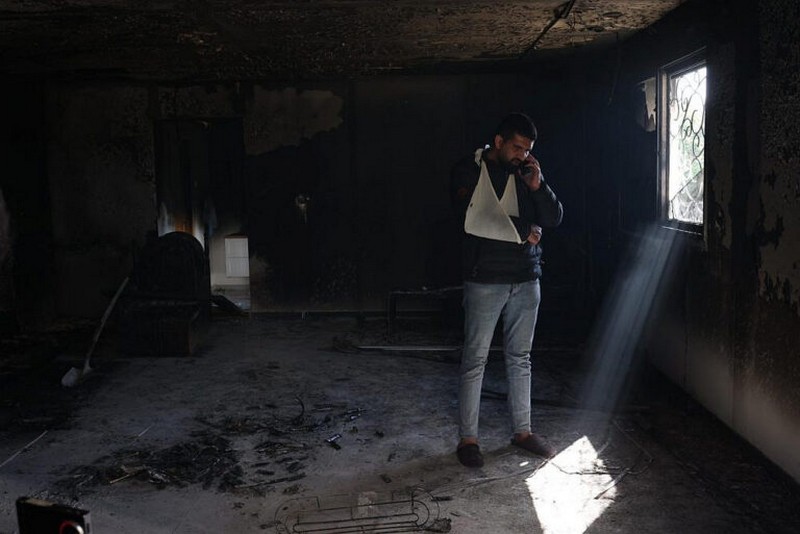
On the night of the Huwara settler pogrom last Sunday, someone mutilated the cat and left it in the Dumeidi family’s yard, right next to the guest room, which was burned in its entirety.

The night after the pogrom, Dumeidi and I stood quietly in front of the blackened walls and the blood that had congealed on the ground. An empty can of cat food, a sparkly pillow where the cat once slept, and shards of glass lay around the floor. Dumeidi said that he has loved animals since childhood, that he knows how to communicate with them. “They are like a mirror of my feelings,” he said.

A silence spread across the town after the violence. Few dared to leave their homes. Earlier in the day, I walked on the main road on the way toward Uday’s home; soldiers stood next to the shuttered stores, next to burned-out cars, and only Israeli vehicles were allowed into the town, whose main road serves as a central artery for settler traffic crossing the West Bank from north to south.

A car slowed down next to me. “What are you looking at?” I heard a voice bellow from inside. Before I could answer, two Israeli settlers jumped out of the car. Only when I said a word in Hebrew did they return to the car and drive off.

According to the Huwara town council, settlers set at least 10 homes ablaze. Israeli reports stated that 400 settlers took part in the pogrom, in revenge for the killing of Hillel and Yagel Yaniv, two brothers from the nearby settlement of Har Bracha. This is the story of one of the families who survived that pogrom.

Preparing for what comes next

It started at 6 p.m., Dumeidi said. He was at work when his wife called him. “She said [the settlers] were breaking into our house. I heard shouting in the background. My two children were screaming on the phone: ‘Dad come, Dad come.’”

Ahlas, Dumeidi’s wife, said she locked their two small sons in the bathroom. She saw the attackers from the window. She recounted the events without pausing. “There were dozens of settlers outside, they surrounded the house. At first they smashed all the windows. Then they set fire to cloth soaked in gasoline, and tried to set fire to the house through the windows. They managed to set fire to one room. The window in the bathroom is terribly small, which is why I hid the children there. They tried to enter through the door. At that moment, I don’t know what happened, I just froze. I couldn’t move anymore.” At some point during the attack, the settlers also tried to set fire to the gas tank in the yard, hoping it would explode. Luckily, it did not.

Ahlas left Huwara on Monday morning and returned to her parents’ home in the city of Salfit. She took her two children, Taym and four-year-old Jood, with her, after they received medical treatment for smoke inhalation the night before. Since then, they have been struggling to sleep.

Several families in Huwara said that they temporarily moved their children to a safer location, mostly to relatives living in larger cities such as Nablus and Salfit. Huwara is a small town located in “Area B” of the West Bank, which, under the Oslo Accords, means the Palestinian police have no security authority and are not allowed to act without coordination with the Israeli army. Israeli soldiers, then, are the ones who are supposed to protect the Palestinians in these areas. There have been enough incidents to show that, in practice, the soldiers provide cover for settler attacks. Palestinians are thus forced to fend for themselves.

I met Dumeidi as he was sitting at home alone, among the broken glass. Some relatives later came to be with him, to help protect themselves in case they were attacked again.

That night, Ahlas called him several times from Salfit, concerned for his wellbeing. Each time, Dumeidi apologized to me, looked away, and spoke softly into the phone. He told her that he was calm for now. That they are prepared for whatever happens next. He asked her if she had eaten, then wondered about what she had eaten, and his eyes suddenly welled up with tears.

‘You are completely alone’

On the night of the pogrom, it took Dumeidi an hour to reach his home because of the army checkpoints. “I was standing on the main road close to my house, at the height of the attack, but soldiers wouldn’t let me pass,” he recounted. “I went crazy. I only know a little Hebrew. My father was with me, and he shouted to them in Hebrew: ‘They are burning our house, there are small children and women inside!’ But they did not let us pass.”

Dumeidi described how he took out his phone to show the soldiers a photo of Jood, which he uses as a screensaver. “But they did not have time to look at it because my wife called. I put her on speakerphone so they could hear. All you could hear were screams. I remember hearing someone [one of the settlers] yelling in Hebrew: ‘Open up, you slut.’ That’s when one of the soldiers let me through.”

Several other witnesses who were wounded during the pogrom told similar stories. Immediately after the attack, the army imposed a curfew on Huwara. Traffic to and within the town was closed off by checkpoints. At around 6 p.m., hundreds of settlers breezed through the barriers. For at least an hour, the attackers set fire to homes inside the village, while soldiers stood on the outskirts of the village, physically preventing local residents from entering.

Dumeidi ran to his home. The air was red from the fires, he said. The attackers had divided themselves into groups, according to residents, and conducted themselves in a relatively organized manner. Around Dumeidi’s home were 30 people, a small number of them masked. Some were holding stones, Molotov cocktails, and metal rods. Others were armed with weapons. They tried to set the house on fire. He approached them from behind.

“I thought to myself: how can I get into the house like this? So I tried to pretend I was one of them. I took stones in my hands, put a hood on my head, and stood alongside them. It worked. I shouted to my wife from the window: ‘I’m here, I’m here.’ Then they realized who I was, that I was the owner of the house. They began throwing stones at me.” Dumeidi’s back still bears the marks from the stones. When I met him, he was also limping from the beatings he took.

As Dumeidi approached his home, he saw his mother lying unconscious next to the front door of the adjacent home, where she lives with his grandmother. He immediately crossed the yard to the next house, only to find his grandmother in the living room.

“She is 87 years old and suffers from a neurological disease,” he said. “She was on the floor in the living room, shaking, and something was coming out of her mouth, like foam. Her eyes were open but the pupils were not visible. She did not speak. I don’t know how to describe how I felt. Where should we go [to help] my mother, my grandmother, the children? As I’m tending to my mother, I see the settlers breaking everything from the outside. You are completely alone, and you have to protect yourself.”

A familiar dynamic

Two Palestinian eyewitnesses said that throughout this time, several Israeli soldiers were standing next to the settlers. “They just looked on,” Dumeidi concurred.

At a certain point, when more relatives and neighbors arrived at the house, the Palestinians began throwing stones, cups, and other kitchen utensils at the settlers. Soldiers then began to push back the settlers while firing tear gas at the Palestinians, before one of the soldiers opened fire on the residents. According to witnesses and the local clinic in Huwara, four Palestinians were wounded by gunfire while defending their family home; three were shot in the leg, the other was hit in the arm.

This is a familiar dynamic that repeats itself in similar attacks throughout the West Bank. A group of Israeli settlers invades a village, and when local residents throw stones at them, soldiers shoot at the Palestinians in order to protect the attacking Israelis. Thus, the attack is actually prolonged — and sometimes turns fatal.

Since 2021, army fire has killed at least four Palestinians in villages in the northern West Bank during documented attacks by masked settlers: Muhammad Hassan, 21, in Qusra; Nidal Safdi, 25, in Urif; Hussam Asaira, 18, from Asira al-Qabilyia; and Oud Harev, 27 years old, in Ashaka. It would not be surprising if Sameh Aqtesh, who was killed during Sunday’s violence in Huwara, died under similar circumstances, although the exact details of his death have not yet fully come to light.

The neighbors who came to Dumeidi’s aid eventually managed to drive the attackers away. The settlers burned one room and stole watches, a television, and a laptop. “They took everything out from the inside, and the last one who came out burned the room,” Dumeidi said. When the family came outside, they found their cat, Bousa, mutilated.

‘Isn’t it a shame to die like this?’

Late at night, as I headed to my car to make the journey back to Jerusalem, I heard whistling from one of the rooftops. A group of 10 Palestinian men stood above me on top of a home whose windows had all been smashed, and motioned for me to be careful. They told me to walk slowly in their direction, because they saw from the roof that settlers had just entered the village again. Someone came down, opened a locked gate, and took me upstairs. They suggested that I wait with them until the storm passed, and told me to hope that they wouldn’t burn my car, which was parked on the main road.

On the roof, I saw two buckets full of stones and a few slingshots. The group explained that during the pogrom, no one was able to arrive to protect their homes in time, which is why the settlers were able to do so much damage. Around 15 relatives and neighbors had traveled for an hour on winding roads from Nablus to circumvent the army checkpoints and reach Huwara. It is important to be here together, as a family, should anything happen, they said.

It was dark. Someone offered me a coat. The roofs around us were also full of families, looking on. Waiting. Below, on the quiet main street, white lights shone. Above was a tall mountain, a round silhouette, and at its peak a thin strip of light. These are the houses of the settlement of Yitzhar. A phone suddenly flashed. Someone got a message. “There was an attack in Jericho, there are casualties.” Someone else asked me if it was true that there were demonstrations in Israel against the pogrom.

When he heard that I am Jewish, the eldest man in the group held out his hand and said in fluent Hebrew: “What is all this good for? All these people who die, on our side and your side. Isn’t it a shame to die like this, for land? Our destiny is to live here together.” He said that he had worked all of his life in Israel, participated in dialogue groups, and that real peace is needed, with equality and respect for his people, who live “as second-class subjects of the army, with green IDs.”

A young man next to him grinned. Then he said to me in Arabic: “Look, look,” as he picked up a stone, placed it in the slingshot, and released it. The stone smashed against the walls of the roof. He offered me a cigarette. I tried to break the ice, saying that it looks like there may be a war soon. “I wish,” he responded casually.

It turned out that we are both exactly the same age. But he has never left the West Bank. He has never seen the sea nor visited Jerusalem. His father was imprisoned during the Second Intifada, and since then the entire family has been on the Shin Bet’s blacklist, meaning they cannot receive permits, and soldiers stop them from time to time at checkpoints. He knew almost no Hebrew. Like all the young men who were waiting there, alert on the roof, he is part of a generation born into Israel’s permit regime and under the shadow of the separation wall.

We spoke for an hour about violence. He said it had increased since the election of the new government, but it had always been there. He talked about the frustration with the Palestinian Authority, which “does everything Israel says” and only maintains the occupation, and how he hopes that something will change already — even if it’s a war — as long as there is change. He told me about a friend of his who was shot by soldiers for throwing stones, and how since then he has been in a rage that he cannot let go.

Below us, a group of settlers carrying Israeli flags tried entering Huwara again. Soldiers blocked them this time. On this roof, at least, the night passed quietly.

_________________________________________________

Yuval Abraham is a journalist and activist based in Jerusalem.

13 March 2023

Source: www.transcend.org

US Occupation of Syria Will Continue

By M. K. Bhadrakumar

6 Mar 2023 – The sudden unannounced arrival of the top US military officer General Mark Milley, chairman of the Joint Chiefs of Staff, at a dusty American base in Syria’s remote northeast on Friday may call to mind a famous quote by Dick Cheney, vice-president in the George W Bush presidency:

“The good Lord didn’t see fit to put oil and gas only where there are democratically elected regimes friendly to the United States. Occasionally we have to operate in places where, all considered, one would not normally choose to go. But we go where the business is.”

According to eyewitness accounts, as recently as last week, on 27 February, US troops transported at least 34 tankers filled with stolen Syrian oil through the illegal Al-Mahmoudiya border crossing to their bases in Iraq. In the estimation of the Syrian foreign ministry, the cumulative losses incurred by the country’s oil and gas sector on account of theft and other US actions were to the tune of $107 billion as of August last year.

Oil is a unique mineral that anaesthetises thought, blurs vision, corrupts. But according to a Reuters report, Milley’s visit was about something else than oil —  purportedly “to assess efforts to prevent a resurgence” of the Islamic State militant group and “review safeguards for American forces against attacks, including from drones flown by Iran-backed militia.”

Now, that is a stretch for two reasons — one, there are only around 900 US troops all in all in Syria and Milley doesn’t have to undertake such routine mission; two, there is actually no history of the Islamic State [ISIS] having ever attacked the US forces in Syria.

On the contrary, the folklore among regional states is that the US mentors the Islamic State, gives training to the cadres of the shadowy militant group at the remote American base at Al-Tanf on the Syrian-Iraqi border, and even provides logistical support to the group’s operations in Syria’s desert region.

It is unclear whether Milley met with commanders of the Kurdish-led Syrian Democratic Forces that have been the main ally of US forces in north-eastern Syria.

One plausible explanation will be that Milley came on White House instructions against the backdrop of a legislation to end the US involvement in Syria that will be up for a vote in the US Congress this week. US Congressman Matt Gaetz (Republican from Florida) who last month introduced a  War Powers Resolution to direct President Joe Biden to remove the US Armed Forces from Syria has frontally attacked Milley’s visit.

Gaetz said in a statement on Friday,

“If General Milley wants this war so bad, he should explain what we are fighting for and why it is worth American treasure and blood. An America First foreign policy demands realism, rational thought, and seriousness.”

He pointed out that

“Syria is a quagmire of a tinderbox. America has no discernible interest in continuing to fund a fight where alliances shift faster than the desert sands.”

But Milley is unfazed. Asked by reporters if he believed the Syria deployment is worth it, Milley said,

”I happen to think that’s important.” Milley added, “So I think that an enduring defeat of ISIS and continuing to support our friends and allies in the region … I think those are important tasks that can be done.”

Congressman Gaetz tabled the draft legislation following a press release by the US Central Command on February 17 announcing that four service members were wounded during a helicopter raid in northeastern Syria when an explosion was triggered from the ground.

The bottom line is that there is no rationale other than geopolitical considerations for the continued US occupation of about a third of Syrian territory. These considerations are principally:

  • Need to keep US footprint in the strategic Eastern Mediterranean;
  • US’ troubled relations with Turkey;
  • Israel’s security;
  • Russian bases in Syria;
  • the Russian-Syrian-Iranian axis; and, most important,
  • the geo-strategy to keep Syria weak and divided for the foreseeable future.

A commentary last year in the government-owned China Daily poignantly captured the Syrian tragedy:

“The alleged plunder of Syrian oil by the United States and its proxies will only worsen conditions in the sanctions-hit country as it struggles to rebuild after years of war… consumption of Syria’s limited resources by the hegemonic power and its proxy groups in the troubled nation will encourage militancy and undermine efforts to stabilise the wider region.”

The commentary cited the Syrian Foreign Ministry to the effect that the presence of US forces in the country’s northeast and the plundering of Syrian oil is an attempt to obstruct a political solution and undermines stability and security. It said

“the way Washington is acting and its unlimited support of terrorist groups show the hypocrisy of the US in the region, a situation that is no longer acceptable morally or politically.”

The Assad government’s normalisation process with the regional states in the Gulf — especially, Saudi Arabia, the UAE and Qatar — as well as Egypt and Turkey has put the US in a predicament. It is particularly galling for the US that Russia is mediating the Turkish-Syrian rapprochement.

Russian Deputy Foreign Minister Mikhail Bogdanov announced on Monday that his country, Turkey, Iran, and Syria are discussing organising a meeting of their respective foreign ministers —

“We are working on it. I can say that we agreed not to disclose details for the time being; not everything is so simple; we must work discretely on the principles of quiet diplomacy,” he added in an oblique reference to devious attempts to derail the process.

Suffice it to say that Washington is increasingly left with no option but to stir up the Syrian pot again and create turmoil with a view to create an alibi for the continued occupation of Syria. The Syrian government has drawn attention to this in a statement condemning Milley’s “illegal visit to an illegal US military base.”

The statement alleged that

“the international community knows very well that Daesh [ISIS] is an illegitimate offspring of US intelligence… [and] the support provided by the US forces to terrorist and separatist militias in the areas of its occupation is a declared American stance aimed at prolonging the terrorist war against Syria for goals that are no longer hidden from anyone.”

Milley himself has been candid that the US military occupation must continue. Given Milley’s professional reputation as a ‘yes’ man, who is acutely conscious of the ‘wind factor’ (as the Chinese would say) in the corridors of power in DC at any given time, it is entirely conceivable that President Biden will now get exactly the feedback and recommendation he needs to block the momentum in the US Congress for withdrawal of American troops from Syria.

The Moscow daily Vedmosti reported today, citing an informed diplomatic source, that Assad plans to pay an official visit to Russia in mid-March. Assad last visited Russia in September 2021.

The Russian daily estimated that humanitarian issues relating to the recent earthquake and Russian assistance would be the focus of the talks, but it is also “important for the parties to compare each other’s positions and develop common approaches” on a range of political issues. Russia, Turkey, Iran and Syria have a common position calling for an end to the 7-year old US occupation of Syria.

___________________________________________

M. K. Bhadrakumar: I was a career diplomat by profession. For someone growing up in the 1960s in a remote town at the southern tip of India, diplomacy was an improbable profession.

13 March 2023

Source: www.transcend.org