Just International

Targeting China, US Navy to purchase 100 new ships

By Andre Damon

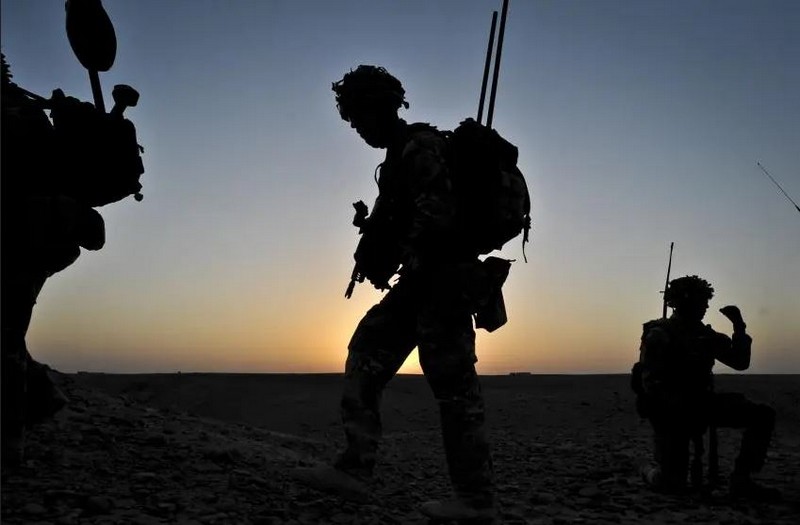
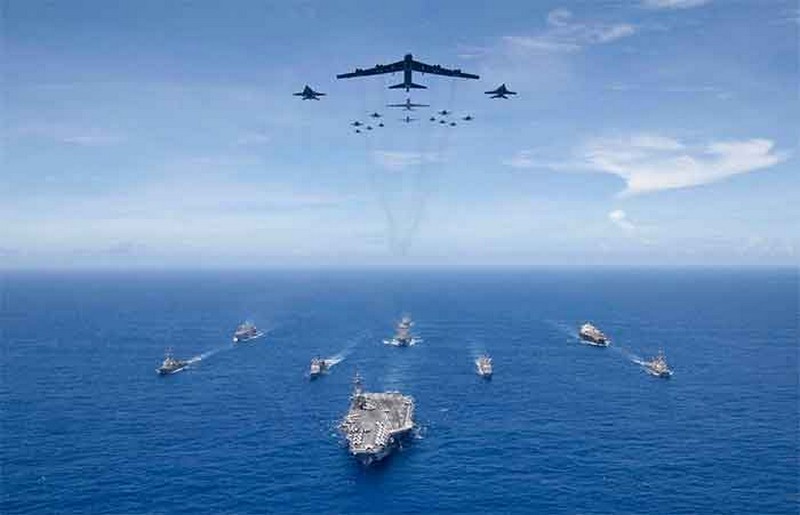
Speaking at a hearing of the Senate Appropriations defense subcommittee Tuesday, the US Navy’s operations chief said the United States Navy is currently building 56 new warships and has contracted the building of 76 more, as part of a massive military buildup in preparation for conflict with China.

“We have 56 ships under construction and another 76 that are under contract,” said Admiral Michael M. Gilday.

The move is part of a plan by the US navy to have a total of 373 manned and 150 unmanned ships, up from 296 this year.

Opening the hearing, Democratic Committee Chairman Jon Tester declared that “China remains our number one pacing threat, we must continue to modernize our military to stay ahead of that threat.”

Earlier this month, Congressman Mike Gallagher said the United States’ “competition” with China will not be “polite,” describing the US conflict with China as an “existential struggle over what life will look like in the 21st century.”

He later added, “If you think about what a coherent grand strategy vis a vis China would be, hard power would be the most important part of that and the Navy would be the most important component of your hard power investments.”

China currently has two operational aircraft carriers, both of which are diesel-fueled. In contrast, the United States has a fleet of 11 nuclear-powered aircraft carriers, which can carry more than 1,000 attack aircraft, exceeding the combined number of attack aircraft carried by all other nations’ navies.

The Navy’s budget for the fiscal year 2024 exceeds $250 billion, representing an increase of $11 billion from the previous year. It sets aside $32.8 billion in Fiscal Year 2024 for the acquisition of nine ships. These ships include one Columbia-class ballistic missile submarine, two Virginia-class attack submarines, two Arleigh Burke-class destroyers, two Constellation-class frigates.

In fiscal year 2025, the Navy plans to purchase seven more vessels, which includes two submarines, two destroyers, one frigate, one ocean surveillance ship and its initial Landing Ship Medium.

“We are modernizing our capabilities, ensuring that our forces today stay combat ready now and into the future… we’re continuing to build our capacity, ensuring that we have relevant lethal platforms to achieve warfighting advantage,” Gilday said at the hearing.

General David H. Berger, Commandant of the Marine Corps added, “We’re not waiting for 2030 or 2027 or 2025. Our Marines are ready to handle any crisis anywhere now.”

As the United States actively builds up its navy for a conflict with China, US military officials are openly discussing what a naval war with China would look like.

In an interview with “60 Minutes” last week, Admiral Samuel J. Paparo, head of the US Pacific Fleet, said that if China were to invade Taiwan, “the bulk of the United States Navy will be deployed rapidly to the Western Pacific to come to the aid of Taiwan. If the order comes to aid Taiwan in thwarting that invasion is the US Navy ready?

He added, “the Navy is always on alert. 1/3 of the Navy is always deployed and operating at all times. The Navy’s mustering right now about 300 ships, and there are about 100 ships at sea right now all around the globe.”

Beyond merely expanding and modernizing the Navy, the Biden administration has used the war in Ukraine as a pretext for the implementation of multi-year, no-bid arms procurement contracts that will massively expand the US arsenal.

“Ukraine’s war has taught us that we must transition from just in time stockpiles of weapons and munitions to just in case stockpiles,” Republican Senator Susan Collins said at the hearing.

A signal is “being sent by the department of defense that we will be purchasing these missiles for a long period of time,” said Navy Secretary Carlos Del Toro.

“Our industrial base can’t be just in time, if we have to go to a conflict. We got to… have the depth in that industrial base to account for a big surge,” Berger said.

In January, Air Force Gen. Michael Minihan told his command that he anticipates the US to engage in warfare with China by 2025. He stated, “My gut tells me we will fight in 2025,” and recommended that airmen under his command prepare themselves for war by getting their “personal affairs” in order.

On March 11, Director of National Intelligence Avril Haines, said that President Biden’s declaration that the US would go to war with China over Taiwan was not simply the president’s individual belief, but rather an actual policy of the United States.

30 March 2023

Source: countercurrents.org

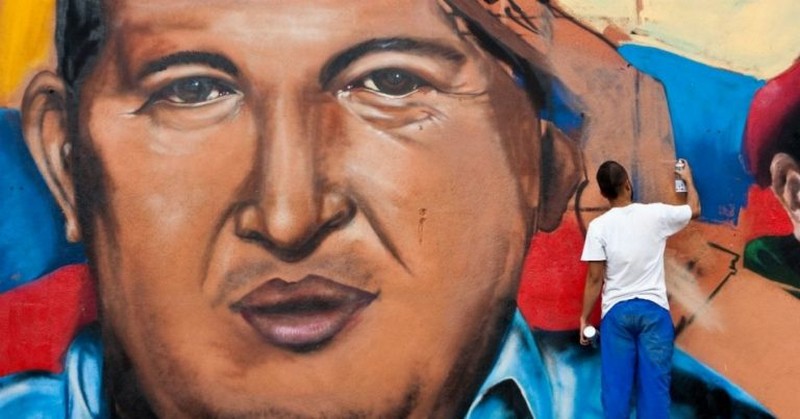
In memory of Hugo Chavez on 10th death Anniversary

By Harsh Thakor

A few weeks s ago on March 5th, we commemorated the 10th death anniversary of Hugo Chavez of Venezuela. Without doubt one of the most progressive or impactful leaders in shaping the destiny of a Latin American nation ,who confronted and gave a mortal blow to American imperialism at it’s strongest point, and paved the path towards liberation. Few Third world leaders in the last few decades have created such an electric effect in crystallising anti-imperialist consciousness and people’s striking power. Chavez checked the infiltration and monopoly of neo-colonial capital as no third world leader in recent times.

As president of Venezuela, Chavez was the target of a coup attempt in 2002 and countless campaigns of vilification by the US and the Venezuelan reactionaries. Still he always managed to come out stronger than ever before. He was part and parcel of the great Latin American tradition of patriotic military officers in the 19th century, like Simon Bolivar, Simon Rodriguez and Ezequiel Zamora and those military officers of the ruling system who embarked o the road of revolution and anti-imperialism in the 20th century, like Luis Carlos Prestes of Brazil, Jacobo Guzman Arbenz of Guatemala, Juan Alvarado Velasco of Peru and Omar Herrera Torrijos of Panama.

When Chávez addressed the workers and peasants, the spirit of the masses underwent an elevation, reminiscent of lightning and thunder. Hugo Chávez was simply the mascot of the poor and downtrodden He resurrected life in them and they saw themselves in him. For them, Hugo Chávez and the Revolution had one and the same meaning.

Comrade Chavez in his lifetime shimmered the spark unflinchingly for   national independence and socialism .He shimmered the banner of Bolivarian Revolution in order to initiate major social, economic, political and cultural reforms to improve the lot of the impoverished and toiling masses of workers and peasants, the women and indigenous people.

Comrade Chavez was an outstanding fighter against imperialism, neoliberal economic policy and the wars of aggression unleashed by the US and NATO, in defended peoples, nations, countries and governments under attack by imperialism and relentlessly advocated socialism as the banner of the 21st century

For decades Venezuela was governed by a ruthless, decadent corrupt and degenerate oligarchy. There was a so-called two party system in which both parties manifested the interests of the oligarchy. When Chávez founded the Bolivarian Movement, he wished to give a striking blow to Venezuelan political life.

Today with wind of imperialism and globalisation sweeping the world as never before to strangulate or tighten the noose on people in every corner of the globe, it is vital that a Hugo Chavez is ressurected.

Background

He originated from a working class family and experienced the pangs of hunger and poverty. From dire straits, he entered the military academy and became a military officer. There he developed contempt for   the ruling system of the local oligarchy bowing down to US imperialism. He wished to fight to the last tooth for national independence and social justice. Thus, he founded the clandestine Revolutionary Bolivarian Movement (MBR)-200 among military officers in the early 1980s in order to overthrow the ruling system

On 27 February 1989, the poor people living in the shanty towns surrounding Caracas poured over the streets in protest against a new hike on public transportation prices. It became a nationwide uprising known as the Caracazo. The government of Carlos Andres Perez sent armed troops to mercilessly impart bloodshed. Official figures place the death toll at just under 300, but other estimates indicate up to 3,000 were gunned down. In 1989, up to 3,000 were gunned down in a nationwide uprising known as the Caracazo ..Image: Prensa Presidencial Government of Venezuela

Without the Caracazo possibly Hugo Chávez might have remained an army officer pursuing a normal military career unknown to the public.

The Caracazo and the mortal counter blow simmering discontent, led to an unsuccessful military uprising led by Chávez in 1992. He was imprisoned but subsequently released under pressure from the masses. From the standpoint of the poor and downtrodden, Hugo Chávez was the man who made them rise like a phoenix from the ashes , by his great reserves of   personal courage, to acts of heroism, almost unparalleled..

The MBR launched a coup d’etat in 1992 and failed. However it was a blessing in disguise as it made known to the entire nation Hugo Chavez and what he and his movement represented.. After release from prison, he established the   social democratic party, the Fifth Republic Movement, and engaged in alliances with communist and other Left forces in order to obtain the presidency of Venezuela in the elections of 1998 and in subsequent elections up to 2012. He established the United Socialist Party of Venezuela as a democratic socialist party in 2007.

. When Chávez addressed the workers and peasants, the spirit of the masses underwent an elevation, reminiscent of lightning and thunder. Hugo Chávez was simply the mascot of the poor and downtrodden He resurrected life in them and they saw themselves in him. For them, Hugo Chávez and the Revolution had one and the same meaning.

Achievements

Chavez e will always be cherished or renowned for the formulation of a constitution beneficial to the people, the institution of participatory democratic councils, the nationalization of the oil and other key industries, the establishment of worker-managed cooperatives, a program of land reform, greatly increased government funding for health care, education and housing and the significant reduction of poverty

He would always be loved and remembered for the anti-imperialist foreign policy orientation of his government. He maintained and developed strong alliances with the Cuban and other governments assertive of national independence in Latin America. He was a key leader in Latin American and Caribbean cooperation. Chavez was an architect in establishing the Union of South American Nations, the Bolivarian Alliance for the Americas, the Bank of the South and the regional television network Telesur.

Chavez procured great strides in domestic and foreign policy because he placed complete faith on the  broad masses of the people, especially the workers and peasants.

He led the people to snatch from the imperialists and the local oligarchs control over the oil resources of his country and used the income to benefit the people and support the cooperation and development of countries subjected to imperialist plunder under the Washington Consensus.

Chavez, left no stone unturned in confronting the power of the oligarchy and combating the iron feet of American imperialism. Even his known enemies and critics acknowledged his great colossal courage. And in giving a courageous example he conjured up tremendous forces that have lain dormant in the depths of Venezuelan society for generations.

Hugo Chávez was the very soul of the “wretched of the earth”, and he built a tunnel or avenues to those millions with no voice. They never forgot it. He won another sweeping endorsement when he was triumphantly re-elected as president last October.

The Revolution undertook serious reforms in the interest of the workers and the poor in the key fields of and health. It constructed 250,000 homes and delivered to families who needed them in the last 2 years, while in Spain, for instance, in the same period there have been 250,000 mortgage repossessions.

At a time when every other government was  declaring staggering  cuts in spending on public health and education, Venezuela had developed  a system of free public medicine and on huge scale magnified  availability of  education at all levels including free of charge university education. In Europe, but particularly in the weakest capitalist countries in the South of Europe, unemployment is reaching unscaled proportions and in Spain and Greece over 60% of the youth are unemployed. The Bolivarian revolution eradicated poverty and unemployment, to a considerable extent. Yet the capitalist media hypocritically talks about “economic chaos” in Venezuela!

However, the most important achievement  of the was that it instilled in  the masses pride, a sense of their own self-respect or dignity  as human beings, it has created an awareness for  justice, it has given them a renewed confidence to enhance and establish  their  own striking power, and placed in  them hope for the future. From the standpoint of the ruling class and imperialism, it was a mortal blow.

Hugo Chávez’s Bolivarian Revolution struck  US imperialism in it’s very belly  setting a  model  to the oppressed masses in the rest of Latin America. Ever since the Monroe Doctrine was announced, the rulers of the USA have seen Latin America as their own private backyard. A revolutionary current swept the Latin American continent and Hugo Chávez palyed a major role in shaping   the revolutionary movement throughout the continent. This made him public enemy number one for Washington.

Chavez represented  a faction of the bourgeoisie itself; but it is a less powerful sector, a group which formerly was not directly involved in the management of the state administration but which, for decades, have been displaced and today feel affected, therefore they were interested in uprooting the government. Chavez has assumed an anti-oligarchic discourse; in his electoral campaigns he has targeted that sector of the bourgeoisie that has dominated that country for decades. In his actions there are nationalist overtones of resistance to foreign domination with  these positions consolidating the  struggle of the people against imperialist domination.

In the beginning, the Venezuelan oligarchy estimated Chavez   was for sale. As soon as they realised that they could not buy Chávez, they chalked out plans to overthrow him. On 11 April 2002, they organized a coup. Backed by the landlords, bankers, capitalists,  the media, the Church, generals, police chiefs, corrupt trade union leaders and the CIA.

Chávez was arrested and hijacked. The plotters installed themselves in the palace of Miraflores. But within 48 hours they were overpowered by a spontaneous uprising of the masses. Units of the army loyal to Chávez went over to the masses, and the coup was brought to an abrupt end on April 13. For the first time in the history of Venezuela, the masses overthrew a coup. Morally powers was in their hands, but tragically were unaware of it.

Similarity of Chavez with Mao Tse Tung

Chavez’s ideas had strong overtones of MaoTse Tung’s ideas. There are interesting similarities between Chávez and Mao. Chávez established close relations with China, which he called a “strategic ally.” He used to tickle the Chinese leaders, because he would bring up Mao when he was with them, quoting from the Little Red Book. He treated Mao just as he treated Bolívar, that is, as someone who is alive and among us. Still the Chinese leadership preferred Mao to be treated as something more distant and static – more like an icon – because of course most of them embarked on the capitalist-path..

There was a very important resemblance between Chavez’s conception of the transition to socialism and some key Maoist ideas. When Chávez decided that the commune was the road to socialism, he popularised the reading of Inside a People’s Commune: Report from Chiliying, the book by Chu Li and Tien Chieh-yun.

In fact, in his last major discourse, the so-called Strike at the Helm [2012], Chávez criticized his ministers for not having read the book, which he had published as a pamphlet and from which he read sections on national television. Chávez thought that the experience of Chinese communes – which was a landmark Maoist policy undertaken in the Great Leap Forward – was an important guideline or model   for Venezuelan commune and a basic foundation of socialism in Venezuela.

There   is an extraordinary similarity between the ideas of István Mészáros, who was the most important Marxist thinker for Chávez, and Mao’s project in the Cultural Revolution.. The coincidence between Mészáros’s thought and the project of the Cultural Revolution [1966-1976], shows how the key ideas of socialism are part of a universal legacy because they respond to the same problems and challenges (namely, the problems of overcoming capitalism, which is a world system). Mao and Mészáros faced the same problems of real socialism at roughly the same time. The central problem was the persistence of the logic of capital – what Maoists called bourgeois practices and capitalist tendencies (in spite of the fact that the bourgeoisie had been defeated and removed in China).

Just as Maoists aspired, during the Cultural Revolution, to wipe out these bourgeois practices that prevailed  in the bureaucracy, party, and management in China, so Mészáros argued in his book Beyond Capital [1995] that even though a society might cease to be  capitalist, it might be dictated  by the logic of capital.

Weaknesses of Chavez

There was no real revolution in Venezuela. Chavez did not embark on the programme of an agrarian revolution, completely put a stamp on foreign capital or eradicate bourgeois parliamentary democracy. In important ways he deviated from Marxism-Leninism.

One  must be sufficiently objective to gauge , in his politics, Chavez has also approved laws to protect the interests of the banks; his policies have also included the implementing of privatization in certain areas, which does not exactly make him an opponent of neo-liberalism. That is the contradiction in Chavez’s politics.

It is because of what we have just mentioned that many problems that affect the popular sectors have not been addressed, much less resolved. In 2001. Poverty and hunger was  rampant  in Venezuela, unemployment and corruption is staggering, the crisis is getting more acute  and the social effects are not greater only due to the great production and export of oil, which last year benefited from the increase in the price of oil on the international market. If we look at the total picture, the Venezuelan economy is among those that experienced the lowest growth in the year 2001. All this has been used to justify the campaign unleashed by the oligarchy to overthrow Chavez.

The national oil-strike of 2002, and the continuous spate of hunger strikes of medicos, nurses, and member of civil society, made evident that the benefits of this Socialist Revolution were limited only to a selected few.

Venezuela Today

10 Year since death of Hugo Chavez what is the road for those committed to establish socialism in Venezuela? In the last period of his life Chávez would frequently visit a project site and turn to those present, usually including a few of his cadres, who would then become sheepish, querying: “Where is socialism here?” I think that question was Chávez’s admission that only by investigating those concrete points of rebellion against the existing order could socialism proceed in Venezuela. Remember that Chávez had already tried to decree socialism with the constitutional reform of 2007, which led to his first and only electoral defeat. That defeat enabled him to realize that socialism could be constructed by championing concrete, grassroots experiments from below. Socialism would be built not from above, but only through practice and struggle from the very grassroots.

Today ideology of Socialism, has frugal presence in the government’s main .Socialism in Venezuela has it’s place  in those junctures of rebellion against the prevailing capitalist order: the few and always embattled communes, the campesinos who continue to seize and occupy land, the Pobladores movement that propels  self-organized housing projects, trying to reconstruct  urban life beyond the logic of capital.

Alarmingly, most people who engage with the Venezuelan project from abroad seem uninterested in the question of where socialism exists in the country or whether it can be restored.They feel Venezuelan socialism is a merely local trend that they, as outsiders, are not involved in. On the contrary, socialism, more than any other political project, is a shared and international endeavour. Adapting Chávez’s question and integrating it with Mao’s injunction to remember class struggle we should be asking ourselves: “Where is popular rebellion against the capitalist order in Venezuela?”

The socialist goal in Venezuela will probably be defeated (for both internal and external reasons). Without advancing, without crystallising people’s resistance up from below, socialism will meet it’s doom. It means intensifying privatizations mercantilization, and a general orientation championing local bourgeoisies (both emergent and old) and international capital.

Harsh Thakor is a freelance journalist who has extensively studied liberation Movements.

28 March 2023

Source: countercurrents.org

Xi’s ‘Chilling’ Remarks: A Multipolar World Offers Challenges and Opportunities to the Middle East and Africa

By Dr Ramzy Baroud

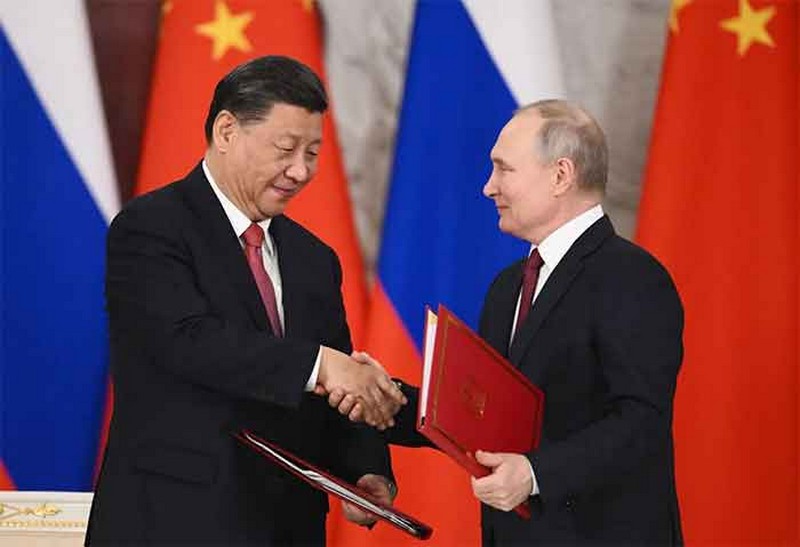
The final exchange, caught on camera between visiting Chinese President Xi Jinping and his Russian host and counterpart, Vladimir Putin, sums up the current geopolitical conflict, still in its nascent stages, between the United States and its Western allies on the one hand, and Russia, China and their allies, on the other.

Xi was leaving the Kremlin following a three-day visit that can only be described as historic. “Change is coming that hasn’t happened in 100 years and we are driving this change together,” Xi said while clasping Putin’s hand.

“I agree,” Putin replied while holding Xi’s arm. ‘Please take care, dear friend,” he added.

In no time, social media exploded by sharing that scene repeatedly. Corporate western media analysts went into overdrive, trying to understand what these few words meant.

“Is that part of the change that is coming, that they will drive together?” Ian Williamson raised the question in the Spectator. Though he did not offer a straight answer, he alluded to one: “It is a chilling prospect, for which the west needs to be prepared.”

Xi’s statement was, of course, uttered by design. It means that the Chinese-Russian strong ties, and possible future unity, are not an outcome of immediate geopolitical interests resulting from the Ukraine war, or a response to US provocations in Taiwan. Even before the Ukraine war commenced in February 2022, much evidence pointed to the fact that Russia and China’s goal was hardly temporary or impulsive. Indeed, it runs deep.

The very language of multipolarity has defined both countries’ discourse for years, a discourse that was mostly inspired by the two countries’ displeasure with US militarism from the Middle East to Southeast Asia; their frustration with Washington’s bullying tactics whenever a disagreement arises, be it in trade or border demarcations; the punitive language; the constant threats; the military expansion of NATO and much more.

One month before the war, I argued with my co-writer, Romana Rubeo, that both Russia and China might be at the cusp of some kind of unity. That conclusion was drawn based on a simple discourse analysis of the official language emanating from both capitals and the actual deepening of relations.

At the time, we wrote,

“Some kind of an alliance is already forming between China and Russia. The fact that the Chinese people are taking note of this and are supporting their government’s drive towards greater integration – political, economic and geostrategic – between Beijing and Moscow, indicates that the informal and potentially formal alliance is a long-term strategy for both nations”.

Even then, like other analysts, we did not expect that such a possibility could be realized so quickly. The Ukraine war, in itself, was not indicative that Moscow and Beijing will grow closer. Instead, it was Washington’s response, threatening and humiliating China, that did most of the work. The visit by then-US House Speaker, Nancy Pelosi, to Taiwan in August 2022 was a diplomatic disaster. It left Beijing with no alternative but to escalate and strengthen its ties with Russia, with the hope that the latter would fortify its naval presence in the Sea of Japan. In fact, this was the case.

But the “100 years” reference by Xi tells of a much bigger geopolitical story than any of us had expected. As Washington continues to pursue aggressive policies – with US President Joe Biden prioritizing Russia and his Republican foes prioritizing China as the main enemy of the US – the two Asian giants are now forced to merge into one unified political unit, with a common political discourse.

“We signed a statement on deepening the strategic partnership and bilateral ties which are entering a new era,” Xi said in his final statement.

This ‘no-limits friendship’ is more possible now than ever before, as neither country is constrained by ideological confines or competition. Moreover, they are both keen on ending the US global hegemony, not only in the Asia and Pacific region, but in Africa, the Middle East and, eventually, worldwide as well.

On the first day of Xi’s visit to Moscow, Russia’s President Putin issued a decree in which he has written off debts of African countries worth more than $20 billion. Moreover, he promised that Russia is “ready to supply the whole volume sent during the past time to African countries particularly requiring it, from Russia free of charge ..,” should Moscow decide “not to extend the (grain) deal in sixty days”.

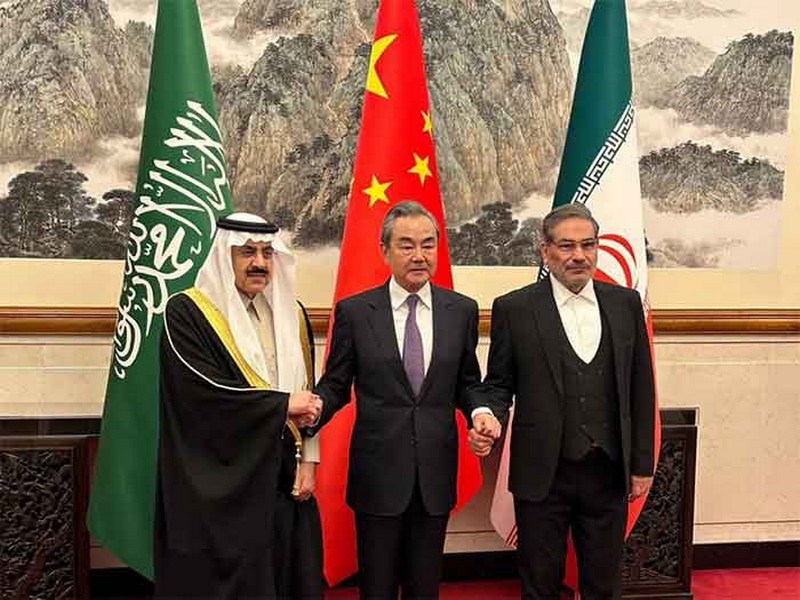
For both countries, Africa is a major ally in the upcoming global conflict. The Middle East, too, is vital. The latest agreement, which normalized ties between Iran and Saudi Arabia is earth-shattering, not only because it ends seven years of animosity and conflict, but because the arbitrator was no other than China itself. Beijing is now a peace broker in the very Middle East which was dominated by failed US diplomacy for decades.

What this means for the Palestinians remains to be seen, as too many variables are still at work. But for these global shifts to serve Palestinian interests in any way, the current leadership, or a new leadership, would have to slowly break away from its reliance on western handouts and validation, and, with the support of Arab and African allies, adopt a different political strategy.

The US government, however, continues to read the situation entirely within the Russia-Ukraine war context. US Secretary of State Antony Blinken responded to Xi’s trip to Moscow by saying that “the world should not be fooled by any tactical move by Russia, supported by China or any other country, to freeze the war (in Ukraine) on its own terms.” It is rather strange, but also telling that the outright rejection of the potential call for a ceasefire was made by Washington, not Kyiv.

Xi’s visit, however, is truly historic from a geopolitical sense. It is comparable in scope and possible consequences to former US President Richard Nixon’s visit to Beijing, which contributed to the deterioration of ties between the Soviet Union and China under Chairman Mao Zedong.

The improved relationship between China and the US back then helped Washington further extend its global dominance, while putting the USSR on the defensive. The rest is history, one that was rife with geostrategic rivalry and divisions in Asia, thus, ultimately, the rise of the US as the uncontested power in that region.

Nixon’s visit to Beijing was described by then-Ambassador Nicholas Platt as “the week that changed the world”. Judging that statement from an American-centric view of the world, Platt was, in fact, correct in his assessment. The world, however, seems to be changing back. Though it took 51 years for that reversal to take place, the consequences are likely to be earth-shattering, to say the least.

Regions that have long been dominated by the US and its western allies, like the Middle East and Africa, are processing all of these changes and potential opportunities. If this geopolitical shift continues, the world will, once again, find itself divided into camps. While it is too early to determine, with any degree of certainty, the winners and losers of this new configuration, it is most certain that a US-western-dominated world is no longer possible.

Dr. Ramzy Baroud is a journalist, author and the Editor of The Palestine Chronicle.

28 March 2023

Source: countercurrents.org
Ben-Gvir’s Militia

By Jonathan Kuttab

It seems the announcement by Netanyahu that he is “pausing” the “Judicial reforms,” in order to give a chance for talks and negotiations, is hardly the end of the crisis that has rocked Israeli society to the core and brought hundreds of thousands into the streets to protest.

For one thing, Netanyahu made it clear that he is only “pausing” the reform process to avoid civil war, and he is determined to push through the changes he needs one way or another. The tectonic changes within Israeli society that led to the formation of the current Israeli government have not been addressed at all. Yet, as I said in a previous article, the results of the recent elections were predictable, inevitable, and irreversible.

More worrying is the difficulty Netanyahu faced in even arriving at such a temporary “pause.” In order to prevent the government from collapsing, under the threat of resignation by Itamar Ben Gvir, Netanyahu agreed to Ben Gvir’s demand for the creation of a private militia under his direct control.

The creation of this private militia has long been a goal for Ben Gvir, and his desire for it only grew after being told that his position as Minister of Police was not enough. He was specifically informed that the Minister of Police only sets policy and must leave the actual implementation of policies to the police.

Ben-Gvir was actually rebuffed when he attempted to order the police in Tel Aviv to take harsher measures against demonstrators, when he tried to get them to shoot at Palestinians in Sheikh Jarrah, and when he ordered the closure of neighborhoods in East Jerusalem.

The prospect of directly channeling vast amounts and resources to thugs and violent settlers, granting them official sanction and authority is truly frightening. For many years, these elements have enjoyed the tacit support of the army and its complicity. To grant them now direct authority is frightening not only for Palestinians but for the army and the police authorities themselves, who have often viewed Ben Gvir as a convicted terrorist, inciter to violence, and a problematic agitator who creates headaches for them. He was rejected for army service, convicted for terrorism and incitement. He was a politician who has built a reputation for openly calling for near-genocidal practices. He famously went to Sheikh Jarrah, promising a Second Nakba (referring to the ethnic cleansing of 1948) while waving his pistol around. He promised greater violence once he joined the government. It was bad enough that he became Minister of Police and his equally dangerous colleague Bezalel Smotrich was given control over COGAT with direct responsibility for security in the West Bank, but now Ben Gvir is being given his own militia with direct operational authority over its members. Smotrich publicly stated that the recent pogrom at Huwara, and even erasing it (employing a biblical phrase), should have been done not by private citizens but by the government itself. Maybe he had Ben Gvir’s militia in mind.

Some Israeli protestors are reportedly afraid that this new militia may be used against them in a future civil war scenario, and they have not been mollified by Ben-Gvir’s assurances that the new force will only be used against Arabs. The protesters are still missing the main point, however, which is that there can be no true democracy without addressing the issue of equality. The gradual slide into open fascism, which scares them, is an inevitable consequence of the policies of Jewish supremacy pursued by government leaders of both Zionist camps (the so-called Left Block and Right Block). There can be no return to an Israel that is Jewish and democratic, because such an Israel has never existed for its non-Jewish citizens or for the rest of the Palestinian population under its control.

The desire for a constitution, checks and balances, guarantees for the rights of the individual and minorities from the oppressive actions of an electoral majority are all ideas which have become central in the current protests. They are essential elements in any democracy. To think that the protesters can obtain these benefits without sharing them with Palestinians is a foolish mirage. Even in their own interest, they cannot successfully fight off fascism without bringing along Arab allies, who bring their own concerns, fears, and, yes, even their flag. If however, the protesters insist on closing their eyes and seeking a solution that serves Jews only, they are bound to fail.

This is a difficult conversation for Israeli Jews, who have so far tried to keep Palestinian flags and concerns out of their demonstrations against Netanyahu and his extremist government. It is a position that is bound to fail for practical reasons, not only because it lacks morality and ethics. The biblical exhortation known to Christians as the Golden Rule has long been central to Jewish ethics, even before Christ. To remind Israelis of it now may be profoundly revolutionary, as it seems to threaten the very foundations of an exclusivist ideology that is at the root of Zionism and the state of Israel. But this has always been the role of the prophet: to speak truth to those in power. In the world of today, this means Zionist Israelis and those who support an ideology based on the domination and oppression of others. Failing to follow an ethical path leads sooner or later to disaster.

Perhaps it is not too late for Jewish Israelis, who have shown great passion and tenacity in fighting Netanyahu, to recognize this truth and open themselves to new realities that include all the Palestinians living with them in the same land.  Those who care about Israel in this country must also find a way to transmit that same message.  There can be no democracy without equality.  There can be no democracy with apartheid and occupation.

31 March 2023

“Facing Clear Evidence of Peril” in a Country of Lies. “Money is the Dirty Secret of all News”

Wealth and power are the main drivers of media chicanery

By Edward Curtin

“In my seventy-plus years from 1946 to now, the chorus of fear-mongering bullshit has never ceased – only grown louder. The joke is on us. Ha Ha Ha.” – Oliver Stone, Chasing the Light

Perhaps silence is the best response to the endless cavalcade of official lies that is United States history. The Internet and digital technology have allowed those lies to increase exponentially in number and frequency with the result that people’s minds have become like 7-Eleven stores, open 24/7 for snack-crap “news.”

But once you become conscious that it’s lies night and day, it sets your head aswirl and plunges your soul into depths of despair.  You are tempted to retreat from such knowledge and talk of trees and trivia.  But you are ashamed of your country.  It’s hard to laugh.  You feel you are drowning.  You flounder and gasp for air.  You look around and wonder why most people are able to go their merry ways believing the lies and whistling in the dark.  Junk news nation, indeed.

Yes, there are alternative voices who tell the truth, but their audiences and monetary support are very small or non-existent compared to the corporate mainstream media and those who shout and scream across the Internet as they take in a lot of money from naive followers.

The recent revelations about Alex Jones’s wealth probably don’t bother his diehard fans, but they should.  Likewise, the funding sources for websites and writers of various persuasions are important to know, for they reveal possible biases in their work.  Snake oil salesmen are commonplace, and there are many naive customers lining up for their wares.

Wealth and power are the main drivers of the media chicanery that has captured so many minds. Writers, of course, should be fairly paid for their work, but in this Internet age, most are not.  As with the movies and book publishing, the income gap between the big names – the celebrity stars – and less well-known writers, even if their work is excellent, is huge.

Some sites and writers make a lot of money, but who they are is a guessing game.  No one’s talking.  Some regularly tell their readers that if they don’t receive enough contributions, they will be unable to continue to write or publish, even when the sites do not pay their contributors.  Whether this is good marketing or income-by-threat is up for grabs.  Whichever it is, it seems to work, as far as I can tell, for these writers and websites don’t disappear.

Money is the dirty secret of all news and commentary.  To paraphrase someone: It is very difficult to get truth from writers whose income is dependent on pleasing those who fund them.

You may have noticed how many former military officers, CIA agents, mainstream journalists, pharmaceutical company executives, and sundry other government and corporate bigwigs appear in the mainstream and alternative media to support or oppose government policies.  The mainstream ones doing the propaganda they always did, while the alternative ones appear as converts to the dissident faith.  No one ever explains how and by whom these people are financed or how their lucrative pensions affect their consciences.  “Former” is a funny word.  Ha Ha Ha.

Confidence “men” come in all shapes and sizes with no one talking money.

So let me fess up.  I received about $200 in support last year for edwardcurtin.com, my website.  Nothing before that and not a cent over the last 5-6 years for many hundreds of articles that have appeared very widely across the Internet.  Before the Internet, publications paid for work, mine and others.  Not now, at least for me.  How much money writers are receiving, and who is supporting their sites, is a taboo subject.

So I am thinking about selling mugs at my site with my name and mug shot on them and a line of supplements that will increase one’s testosterone and estrogen in equal measure to make sure no one takes offense in this era of delicate feelings.  Ha Ha Ha.  Yes, the joke is on us.  I identify as a man since I am one.  Don’t be offended.

Jokes aside, as Leonard Cohen sang:

“Oh, like a bird on the wire
Like a drunk in a midnight choir
I have tried in my way to be free”

If you are stubborn enough and have the good fortune to find inspiration from those brave dissidents who have gone before us and those who continue to lead us on, you realize silence is betrayal and that you must speak, even if all seems hopeless at times.  Even when no one is paying you, or maybe more accurately, because no one is paying you.  Even though it is hopeless, even though it isn’t.  This is another secret.  There are many.

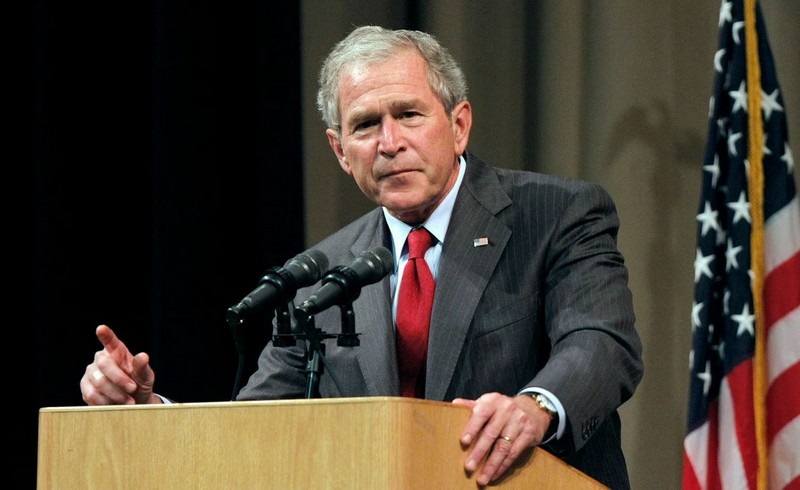
It’s been twenty years since the U.S. brutally invaded Iraq.  When George W. Bush, at a staged pseudo-event in Cincinnati on October 7, 2002, as he set Americans up for the invasion of Iraq in March 2003, said, “Facing clear evidence of peril, we cannot wait for the final proof, the smoking gun, that could come in the form of a mushroom cloud,” no one laughed him out of the house.  His claim was simply an evil joke that was reported as truth.  It was all predictable, blatant deception.  And the media played along with such an absurdity, which is their job and what they always do.  I pointed it out at the time in a newspaper column, but who listened to a hick writer in a regional newspaper.

Iraq obviously had no nuclear weapons or the slightest capability to deliver even a firecracker on the U.S.  But the mainstream media, Senator Joe Biden, politicians galore, celebrities like Oprah Winfrey with her guest, the eventually disgraced Judith Miller of the New York Times, the despicable Tony Blair, et al., all supported Bush’s blatant lies.  Soon Colin Powell, the “hero” of George H. W. Bush’s 1991 made-for-TV Gulf War of aggression against Iraq, would do his Pinocchio act at the United Nations and the U.S. military was off to get Saddam Hussein, Osama bin Laden’s evil twin, both the latest Hitlers until Vladimir Putin replaced them.  I guess I skipped some others such as Muammar Gaddafi and Bashar Al-Assad.  New Hitlers proliferate so fast it’s hard to keep track of them.  Ha Ha Ha.  The joke is on us.

As everyone knows, or should, more than a million Iraqis died because of George W. Bush, but how many cared?  How many cared when once Bush was gone, Barack Obama, aided and abetted by the cackling Hilary Clinton, destroyed Libya and ignited the war against Syria?  You want examples?  There are too many to name here.  But let it be said these lies span all American administrations, whether it’s Bill Clinton continuously bombing Iraq and Serbia through Trump bombing Syria and Somalia, up to the present day with Biden attacking Russia via Ukraine, etc.  All these presidents are liars, but their followers treat them otherwise.  Biden says Jimmy Carter asked him to deliver his eulogy.  What does that tell you?  Shall we laugh?  Sing?

On the clear understanding
That this kind of thing can happen
Shall we laugh?
Shall we laugh?
Shall we laugh?

Shall we laugh harder if I mention the Covid-19 propaganda and all those writers who have failed to even address it, as they have failed to question 9/11 and other obvious official lies?  Is it not evident that if they did so, their money flows might dry up?  Here and no further is a widespread rule, for they must adhere to the boundaries imposed by “responsible thought” and the “no go” zones with which they tie their own hands in order to keep their wallets full.

If you are lucky, as I was, when you are young you discover how fearful of free thought and how corrupt our institutional authorities are.  You don’t spend decades feasting off the spoils of those institutions only to “wake up” once you have made your name and secured your fortune, which seems to be the way of so many wise luminaries of the Internet Age who are either trying to ease their consciences as they get ready to kick the bucket or are perhaps putting us on.

When I was twenty-four years-old, I accepted my first teaching job at a small Catholic college where I taught theology.  I had been trained in the latest and best scholarly work of the most renown international theologians.  Rather than indoctrinating my students with rote learning, I taught them to read widely and think deeply in the tradition of a liberal arts education.  To seek out the best scholarship.

But doing so became quickly apparent to the college and Church authorities who were stuck in the inquisitorial age of obedience or else and no thinking allowed.   Although my students loved my courses and felt freed up for the first time to think about their spiritual lives, I was hounded to correct my heretical teaching, which of course I refused to do.

At one point when I was at lunch in the cafeteria, a nun who was a professor, stole my brief case with my notes and left the cafeteria.  One of my students saw her do this and chased her into the ladies’ room where the nun hid in a stall.  The nun kept flushing the toilet to scare the student away, but the student wouldn’t let her out until she returned the briefcase.  Ha Ha Ha.  It sounds funny to recount but was an example of my experience at this college.  Someone vandalized my office door and ripped down anti-war posters that were on it.  I was gone from that college soon thereafter.  It taught me a lot.  Obey or else.

Heresy: The Latin word is from Greek hairesis, a taking or choosing for oneself, a choice.

At another teaching job a year or so later, I had a more chilling experience.  I was known as an anti-war activist, a conscientious objector from the Marines, etc., and one day, a late Friday afternoon when few were around, an administrator asked to meet me on a deserted stairwell where he proceeded in hushed tones to try to convince me to join him in Army Intelligence to spy on others.  He said I would be perfect for the job since I was known as an anti-war dissident.  I told him to fuck off, but I was shocked by his double life and his request.

I have since learned that this guy the spy was not an anomaly, for government confidence men are widespread.

I’ve had many other such early experiences for which I am very grateful, even though when I was fired from jobs and lost income it was traumatic at the time.  By my thirtieth year, I knew the system was corrupt to its core and subsequent experience has only ratified that conclusion.  I got the joke.

I recount these incidents not because my experiences are singular and I’m special, for others have suffered the same youthful fate.  But such good fortune can fortify you for life or break your spirit.  If the former, you don’t wait to retire to push back against all the lies or regret your past.  You find that it’s all good and life has set you on the heretic’s path of freedom and choice. You realize that what you went through is absolutely nothing compared to people around the world who have and continue to suffer at the hands of the U.S. military industrial complex.  You realize your experiences are trivial in the larger scope of things and that your government’s conduct is beyond condemnation.  It is an abomination.  You feel ashamed to live in a land where killing is a game.

The sociologist Peter Berger puts it well in his little classic, Invitation to Sociology, when he discusses experiences that lead to seeing through the play-acting nature of social life:

Experiences such as these may lead to a sudden reversal in one’s view of society – from an awe-inspiring vision of an edifice made of massive granite to the picture of a toy-house precariously put together with papier mâché. While such metamorphosis may be disturbing to people who have hitherto had great confidence in the stability and rightness of society, it can also have a very liberating effect on those more inclined to look upon the latter as a giant sitting on top of them, and not necessarily a friendly giant at that. It is reassuring to discover that the giant is afflicted with a nervous tick.

Notice the giant George W. Bush’s clicking eyes as he delivers his “facing clear evidence of peril” lies for the invasion of Iraq.  He and his presidential good friends are cardboard cartoon characters whose eyes reveal their evil intentions.  “It’s a Barnum and Bailey world/Just as phony as it can be,” but it would all fall to pieces if it weren’t for you and me failing to see through all the bad actors, not just presidents but the whole cast of characters that populate the Spectacle of news and opinion.

George W. Bush – Cincinnati Speech on Iraq Threat

The Russians are coming!  Ha Ha Ha.  Yes, Oliver, the joke’s on us.

But it’s not really funny, except in the most sardonic and dark way, for we now do really face clear evidence of peril as a result of Biden and his crazy predecessors who have run U.S. foreign policy for so long. They have brought us to the edge of nuclear war with Russia by surrounding Russia with NATO bases and nuclear weapons, while doing the same to China.

Bertolt Brecht was right in his poem “To Those Born After”:

Truly I live in dark times!
Frank speech is naïve. A smooth forehead
Suggests insensitivity. The man who laughs
Has simply not yet heard
The terrible news.

What kind of times are these, when
To talk about trees is almost a crime
Because it implies silence about so many horrors?
When the man over there calmly crossing the street
Is already perhaps beyond the reach of his friends
Who are in need?

*

Edward Curtin is a prominent author, researcher and sociologist based in Western Massachusetts.  He is a Research Associate of the Centre for Research on Globalization (CRG).

29 March 2022

Source: www.globalresearch.ca

Video: War and Crimes against Humanity. “Fake Intelligence” and the Destruction of Countries. Michel Chossudovsky

By Prof Michel Chossudovsky and Caroline Mailloux

US War Crimes

In this video interview, Michel Chossudovsky reviews the war crimes committed by US-NATO against numerous countries in the wake of World War II, as well as the “fake intelligence” and media propaganda used to justify the invasion of sovereign countries. 

It is worth noting that “U.S. military forces were directly responsible for about 10 to 15 million deaths during the Korean and Vietnam Wars and the two Iraq Wars”

“The American public probably is not aware of these numbers and knows even less about the proxy wars for which the United States is also responsible. In the latter wars there were between 9 and 14 million deaths in Afghanistan, Angola, Democratic Republic of the Congo, East Timor, Guatemala, Indonesia, Pakistan and Sudan”

According to James A. Lucas’ carefully documented study, the “U.S. Regime Has Killed 20-30 Million People Since World War II”

“Fake Intelligence” Used to Justify the March 2003 Invasion of Iraq

Colin Powell’s “intelligence report” presented to the UN Security Council in early February 2003 was FABRICATED. It was copied and pasted from the internet by members of Tony Blair’s staff.

“Fake intelligence”  was presented to the UN Security Council by Secretary of State Colin Powell on February 5, 2003.

Damning evidence refuting Colin Powell’s official intelligence report was revealed by Dr. Glen Rangwala, Newham College, Cambridge  (image right) on  Britain’s Channel 4 TV on February 6, 2003, on the day following Secretary of State Colin Powell’s historic Iraq WMD presentation to the UN Security Council:

“I would call my colleagues’ attention to the fine paper that the United Kingdom distributed . . . which describes in exquisite detail Iraqi deception activities.” (Colin Powell, UN Security Council, February 5, 2003)

Powell was referring to “Iraq Its Infrastructure Of Concealment, Deception And Intimidation”, published on January 30, 2003.

According to Rangwala, the  British intelligence document was fake. It had not been prepared by British intelligence. It was copied and pasted from the internet by members of Tony Blair’s staff

Video: Interview with Michel Chossudovsky

Caroline Mailloux of Lux Media, Montreal Interviews Michel Chossudovsky

MICHEL CHOSSUDOVSKY – WAR & CRIMES AGAINST HUMANITY

Below is the text presented by Dr. Rangwala to the House of Commons Select Committee on Foreign Affairs 

It was presented in June 2003, in the wake of the invasion and occupation of Iraq

THE PRESENTATION OF THE 30 JUNE 2003 DOSSIER

30 March 2022

Source: www.globalresearch.ca

The Long Arm of Washington Extends Into Africa’s Sahel

By Vijay Prashad

On March 16, 2023, U.S. Secretary of State Antony Blinken announced—during his visit to Niger—that the United States government will provide $150 million in aid to the Sahel region of Africa. This money, Blinken said, “will help provide life-saving support to refugees, asylum seekers, and others impacted by conflict and food insecurity in the region.” The next day, UNICEF issued a press release with information from a report the United Nations issued that month stating that 10 million children in the central Sahel countries of Burkina Faso, Mali, and Niger need humanitarian assistance. UNICEF has appealed for $473.8 million to support its efforts to provide these children with basic requirements. According to the Human Development Index for 2021, Niger, despite holding large reserves of uranium, is one of the poorest countries in the world (189th out of 191 countries); profits from the uranium have long drained away to French and other Western multinational corporations. The U.S. aid money will not be going to the United Nations but will be disbursed through its own agencies, such as the U.S. Agency for International Development’s Bureau for Humanitarian Assistance.

Northeast of Niger’s capital Niamey, near the city of Agadez, is Air Base 201, one of the world’s largest drone bases that is home to several armed MQ-9 Reapers. During a press conference with Blinken, Niger Foreign Minister Hassoumi Massoudou affirmed his country’s “military cooperation” with the United States, which includes the U.S. “equipping… our armed forces, for our army and our air force and intelligence.” Neither Blinken nor Massoudou spoke about Air Base 201, from where the United States monitors the Sahel region, trains Niger’s military, and provides air support for U.S. ground operations in the region (all of this made clear during the visit by Chief Master Sergeant of the Air Force JoAnne S. Bass to the base at the end of December 2021). The U.S. will spend $280 million on this base—twice the humanitarian aid promised by Blinken—including $30 million per year to maintain operations at Air Base 201.

Blinken is the first U.S. Secretary of State to visit Niger, a country that his own department accused of “significant human rights issues” like “unlawful or arbitrary killings, including extrajudicial killings by or on behalf of government” and torture. When a reporter asked Blinken during the press conference what the U.S. will do “to bring democracy” to Burkina Faso and Mali, he replied that the United States is monitoring the “democratic backsliding, the military coups, which so far have not led to a renewal of a democratic constitutional process in these countries.” The military governments in Burkina Faso and Mali have ejected the presence of the French military from their territories and have indicated that they would not welcome any more Western military intervention. A senior official in Niger told me that Blinken’s hesitancy to directly speak about Burkina Faso and Mali might have been because of the distress about the faltering democracy in Niger.

Niger President Mohamed Bazoum has faced serious criticisms within the country about corruption and violence. In April 2022, president Bazoum wrote on Twitter that 30 of his senior officials had been arrested for “embezzlement or misappropriation,” and they would be in prison “for a long time.” This was a perfectly clear statement, but it obscured the deeper corruption within Bazoum’s own administration—including the detention of his Communications Minister Mahamadou Zada on corruption charges—which was revealed through an audit of the country’s 2021 spending that highlighted millions of dollars of missing state funds. Furthermore, a third of the money spent by Niger to buy $1 billion in weapons from arms companies between 2011 and 2019 was pilfered by government officials, according to a report by the Organized Crime and Corruption Reporting Project.

In December 2022, during the U.S.-Africa Leaders Summit, President Bazoum joined Benin’s President Patrice Talon to be part of the U.S. project known as the Millennium Challenge Corporation (MCC). The U.S. government pledged $504 million toward facilitating transportation between Benin and Niger, to help increase trade between these two neighbors. The MCC, set up in 2004 in the context of the U.S. war on Iraq, has been expanded into an instrument used by the U.S. government to challenge the Chinese-led Belt and Road Initiative (BRI). Senior officials in Niger, who requested anonymity, and several studies by independent authorities indicate that this MCC money is being used to upgrade African farmlands and that the corporation has been working with U.S.-funded institutions such as the Alliance for a Green Revolution in Africa (funded by the Bill and Melinda Gates and Rockefeller foundations), and turn these agricultural resources over to multinational agribusinesses. The MCC grants, the senior officials said, are used to “launder” Niger’s land to foreign corporate interests and to “subordinate” Niger’s political leadership to U.S. government interests.

At the press conference, Blinken was asked about Russia’s Wagner Group. “Where Wagner has been present,” Blinken said, “bad things have inevitably followed.” Statements have been made recently about the Wagner Group operating in Burkina Faso and Mali by the U.S. State Department’s Vedant Patel after the second coup in the former country in September 2022, and by the RAND Corporation’s Colin P. Clarke in January 2023. Governments in both Burkina Faso and Mali have denied that Wagner is operating from their territory (although the group does operate in Libya), and informed observers such as the Nigerien journalist Seidik Abba (author of Mali-Sahel, notre Afghanistan à nous, 2022) said that countries in the Sahel region are being wary about any foreign intervention. Despite repeating many of Washington’s talking points about Wagner, Niger Foreign Minister Massoudou conceded that focus on it might be exaggerated: “As for the presence of Wagner in Burkina… the information that we have does not allow us to say that Wagner is still in Burkina Faso.”

Before Blinken left for Niger and Ethiopia, U.S. Assistant Secretary of State for African Affairs Molly Phee said that Niger is “one of our most important partners on the continent in terms of security cooperation.” That is the most honest assessment of U.S. interests in Niger—largely about the military bases in Agadez and Niamey.

Vijay Prashad is an Indian historian, editor, and journalist. He is a writing fellow and chief correspondent at Globetrotter.

25 March 2023

Source: countercurrents.org
Saudi – Iran rapprochement: A chance for peace

By Mir Adnan Aziz

The disintegration of the Soviet Union left the Middle East bereft of any alternatives to US leadership. Washington, a prisoner of American Exceptionalism and Manifest Destiny – the mythical doctrine used by the US to expand and extend its dominion, never proved itself up to the leadership role. The US foreign policy was and remains nothing but a true manifestation of the Maslow dictum that “If the only tool you have is a hammer, you tend to see every problem as a nail”. The Middle East, as does much of the world today, bears stark testimony to Washington’s futile hammer and nails policy.

“Wars and chaos in the Middle East will not end until Saudi Arabia and Iran can find a way to share the neighborhood and make some kind of peace”. This, as expressed in an interview by President Obama, was the key to Middle East peace. Stephen Walt, International Affairs professor at Harvard’s Kennedy School, noted “Obama’s legacy is one of near-total failure”. The Nobel Peace Laureate, instead of practicing what he preached, encouraged Israel, fueled wars and wrought genocidal destruction in Syria and the Middle East.

It was an extension of the post 9/11 Bush legacy that had set the tone for wars and destruction throughout the Middle East. Dubbed as The New Middle East project, it was launched from Tel Aviv in 2006 by Secretary of State Condoleezza Rice and Israeli Prime Minister Ehud Olmert. The predictor to the New Middle East was supposed to be the Iraq invasion. Noted geopolitical analyst Mahdi Darius Nazemroaya writes that constructive chaos, enabling violence and wars extending from Lebanon, Palestine, Syria, Iraq, Iran and the Persian Gulf with possible extension to central Asia, would be used by the US, Britain and Israel to redraw the Middle East’s map”.

After the invasion of Kuwait the US imposed crippling sanctions on Iraq. The catastrophic effects saw half a million children perish. When veteran journalist Lesley Stahl, host of CBS 60 Minutes, questioned Madeleine Albright about the deaths, she chillingly replied, “We think, the price is worth it”. In June 2006, Israel invaded Lebanon. Its aircraft carried out more than 3000 sorties bombing hospitals, schools, bridges, roads and ports; more than 300 civilians perished. Condoleeza Rice earned notoriety by terming it the birth pangs of a new Middle East as she asked Israel to ignore the ceasefire calls.

In essence, this heartless attitude has been Washington’s Middle East policy since decades. It has been enforced with impunity and arrogance. Post 9/11, Washington has viewed the Middle East through the murky lens of its war on terror. It has clubbed Palestinian-Israel conflict as terrorism rather than the legitimate right of the brutalized Palestinians. The result has seen a leadership vacuum and extreme destabilization of the Middle East. It has also led to the birth of ISIL and its seizing ominous roles in Syria, Iraq, Yemen and Libya apart from Afghanistan and sub-Saharan Africa. The war against terror too has been Washington’s abysmal failure.

In this destructive chaos, the recent China brokered agreement between Iran and Saudi Arabia is certainly a breath of life-saving fresh air. The rapprochement ends seven years of diplomatic rupture that saw protesters attack Saudi diplomatic missions in Iran and the 2019 drone attacks on the Saudi Arabian oil facilities at Abqaiq and Khurais. This was countered by the Saudi led sanctions on Iran.

The Saudi-Iran accord, a modest first step that it may seem, has seen China emerge a peacemaker as against a hammer bearing fractious Washington. As mutual confidence builds up it may well lead to Riyadh ending sanctions on Iran, building commercial ties and refusing Israel over-flights for any adventurism against Iran. This can be reciprocated by Iran with its positive role in Yemen and other Saudi-centric issues. The detente will also de-escalate regional tensions and might lead to other accords to stabilize the Middle East.

Like all other powers, China too has self-interest at heart. However, China has extended its interests globally with mutually beneficial economic and political engagements. It has zealously avoided military or political interventions that have been the hallmark of Washington’s heavy-handed policies. China has also shown no interest in selling its military hardware but chosen to rely on infrastructure based economic and commercial ties.

With a mutual trade of around 90 billion dollars with Saudi Arabia, China has shown absolutely no inhibitions with the Saudi government signing a 37 billion dollar deal with Boeing to purchase aircraft for its recently announced Riyadh Air. Prudent policies see China as a 20 trillion dollar and steadily growing economy. China, secure in itself, has no issues with Riyadh being Washington’s security partner or the latter being Saudi Arabia’s main arms supplier.

China is Saudi Arabia’s largest trade partner and a major buyer of Saudi oil. Iran is overly reliant on China as a major buyer of its oil and a primary source for much needed foreign currency who can dare defy the US sanctions on buying Iran’s oil. With so many mutual stakes at work, the three countries have enough incentive to ensure that this agreement holds.

This welcome respite for the Middle East is fraught with spoilers who would like to scuttle this accord. The greatest one remains Israel, Washington’s enfant terrible. It has worked overtime to build and support a Washington aided anti-Iran axis in the Middle East. It shall take much of China’s Confucian patience and Sun Tzu’s art of engagements to counter the imminent sabotaging acts directly or through the many agent provocateurs that the Washington-Tel Aviv duo have cultivated and nurtured over the years.

Into his record third term, President Xi Jinping’s greatest endeavor shall be to ensure stability by de-escalating conflict in the Middle East. The US flitted away its role and goodwill in the region as it has done in the rest of the world. Nature abhors a vacuum, so does the leadership role. China, the oldest living civilization with over 3500 years of written history, may well prove itself up to the sagacious role.

The writer tweets @miradnanaziz and can be reached at miradnanaziz@gmail.com

25 March 2023

Source: countercurrents.org
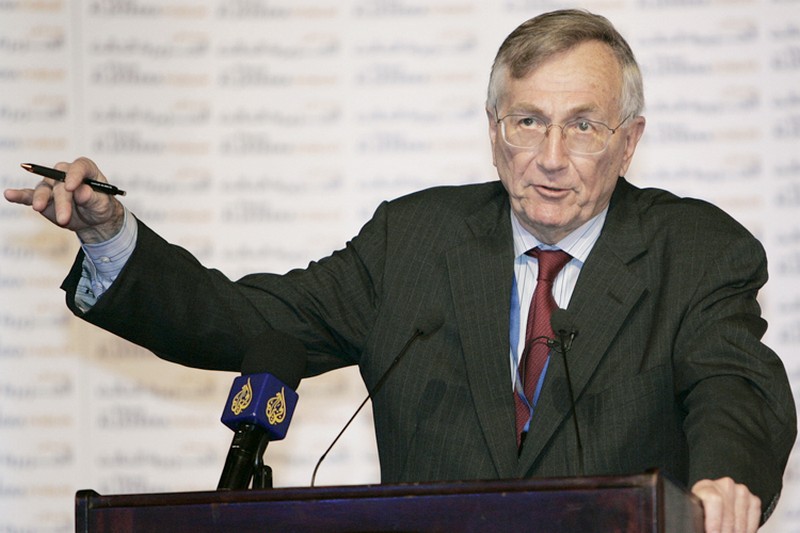
Nord Stream sabotage was to undercut Germany, says Seymour Hersh

By Countercurrents Collective

U.S. President Joe Biden ordered the sabotage of the Nord Stream pipelines because he was unhappy with the level of support provided by German Chancellor Olaf Scholz to Ukraine in its conflict with Russia, veteran investigative journalist Seymour Hersh has claimed.

Hersh first accused Washington of destroying the key European energy route in an article released in February, and made more allegations in an interview with the China Daily newspaper published on Friday.

“The [U.S.] president was afraid of Chancellor Scholz not wanting to put more guns and more arms [to Ukraine]. That is all. I do not know whether that it was anger or punishment, but the net effect is that it cut off a major power source through Western Europe,” Hersh claimed.

Despite attempts by the U.S. to deny its involvement in the Nord Stream attack, “Europe is in crisis now” and Biden will receive “a lot of criticism for what he did” in the coming months, the journalist argued.

The Pulitzer Prize winner alleged that “the people that were initially asked to do the job” of destroying the pipelines were contacted by U.S. National Security Advisor Jake Sullivan towards the end of 2021.

The initial purpose of mining Nord Stream 1 and 2, built to deliver Russian gas to Europe through Germany, was “to give the [U.S.] president an option to say [Russian] President Putin, ‘If you go to war [in Ukraine], we are going to destroy the pipelines,” Hersh claimed.

Biden himself publicly confirmed that stance but “unfortunately, those people in the Western press seemed to have forgotten,” the journalist stated.

Just under three weeks before the launch of Moscow’s military operation in Ukraine, Biden warned during a press conference on February 7 that “if Russia invades, there will be no longer be a Nord Stream 2. We will bring an end to it.”

According to Hersh, the U.S. leader decided to order the detonation of mines at the bottom of the Baltic Sea last September because the conflict “was not going great in Ukraine” from a U.S. perspective. There was “at best a stalemate” during that period, in what Hersh described as “the American war that President Biden was so eager to support.”

Danish Navy Present Near Nord Stream 2, Repots Media

The Royal Danish Navy is believed to be conducting a diving operation to the east of the island of Bornholm, not far from the Nord Stream 2 gas pipeline damaged by a blast. Newspaper Berlingske reported on Tuesday that a Flyvefisken-class patrol vessel used by military divers had been seen there along with two other military ships. The Danish military confirmed its presence east of Bornholm but would not comment on the ships’ mission, Berlingske said.

Last week, Denmark’s Foreign Minister Lars Rasmussen announced that his government could corroborate a report by the Russian gas giant Gazprom, the operator of the undersea pipeline, about a strange object found near Nord Stream 2.

The company sent pictures of the item to Danish authorities, while the Russian government made a formal inquiry through its embassy, the minister said. Copenhagen treats the discovery seriously and will investigate further, Rasmussen pledged at the time.

The object was mentioned last week by Russian President Vladimir Putin in a TV interview. He said it was found during a Gazprom survey about 30 kilometers away from where the pipeline was breached. The device may be an antenna used in remotely detonating a charge, the president suggested, citing experts.

Moscow asked for permission to explore further, Putin added, necessary because the object is located in Denmark’s exclusive zone. Russia could organize a mission “on its own, jointly with [the Danes], or, better yet, with an international group of experts in explosives who are trained to work at such depth.”

Rasmussen said such permission would not be granted, triggering a rebuke from the Russian Foreign Ministry.

The sabotage of the two Nord Stream pipelines, which mostly run next to each other but divert a bit near Bornholm, involved explosions in two different general locations, one in Danish waters, the other in the Swedish zone. Three of the four strings comprising the key energy links were ruptured.

According to a report by veteran investigative journalist Seymour Hersh, the operation was ordered by U.S. President Joe Biden, with the militaries of the U.S. and Norway planting the charges. Both nations have denied any responsibility.

Countercurrents is answerable only to our readers. Support honest journalism because we have no PLANET B.

25 March 2023

Source: countercurrents.org

Video: Most Serious Economic and Social Crisis in World History. Michel Chossudovsky