Just International

The Dark Origins of the Davos Great Reset

By F. William Engdahl

[Note from TMS editor: The Great Reset Initiative is an economic recovery plan drawn up by the World Economic Forum in response to the COVID-19 pandemic. The project was launched in June 2020, with a video featuring the then Prince of Wales Charles III released to mark its launch.
— Wikipedia]

******************

25 Oct 2022 – Important to understand is that there is not one single new or original idea in Klaus Schwab’s so-called Great Reset agenda for the world. Nor is his Fourth Industrial Revolution agenda his or his claim to having invented the notion of Stakeholder Capitalism a product of Schwab.

Klaus Schwab is little more than a slick PR agent for a global technocratic agenda, a corporatist unity of corporate power with government, including the UN, an agenda whose origins go back to the beginning of the 1970s, and even earlier.  The Davos Great reset is merely an updated blueprint for a global dystopian dictatorship under UN control that has been decades in development. The key actors were David Rockefeller and his protégé, Maurice Strong.

In the beginning of the 1970s, there was arguably no one person more influential in world politics than the late David Rockefeller, then largely known as chairman of Chase Manhattan Bank.

Creating the new paradigm

At the end of the 1960s and into the early 1970s, the international circles directly tied to David Rockefeller launched a dazzling array of elite organizations and think tanks. These included The Club of Rome; the 1001: A Nature Trust, tied to the World Wildlife Fund (WWF); the Stockholm United Nations Earth Day conference; the MIT-authored study, Limits to Growth; and David Rockefeller’s Trilateral Commission.

Club of Rome

In 1968 David Rockefeller founded a neo-Malthusian think tank, The Club of Rome, along with Aurelio Peccei and Alexander King. Aurelio Peccei, was a senior manager of the Fiat car company, owned by the powerful Italian Agnelli family. Fiat’s Gianni Agnelli was an intimate friend of David Rockefeller and a member of the International Advisory Committee of Rockefeller’s Chase Manhattan Bank. Agnelli and David Rockefeller had been close friends since 1957. Agnelli became a founding member of David Rockefeller’s Trilateral Commission in 1973. Alexander King, head of the OECD Science Program was also a consultant to NATO.  [i] That was the beginning of what would become the neo-Malthusian “people pollute” movement.

In 1971 the Club of Rome published a deeply-flawed report, Limits to Growth, which predicted an end to civilization as we knew it because of rapid population growth, combined with fixed resources such as oil. The report concluded that without substantial changes in resource consumption, “the most probable result will be a rather sudden and uncontrollable decline in both population and industrial capacity.”

It was based on bogus computer simulations by a group of MIT computer scientists. It stated the bold prediction, “If the present growth trends in world population, industrialization, pollution, food production, and resource depletion continue unchanged, the limits to growth on this planet will be reached sometime within the next one hundred years.” That was 1971. In 1973 Klaus Schwab in his third annual Davos business leader meeting invited Peccei to Davos to present Limits to Growth to assembled corporate CEOs. [ii]

In 1974, the Club of Rome declared boldly, “The Earth has cancer and the cancer is Man.” Then: “the world is facing an unprecedented set of interlocking global problems, such as, over-population, food shortages, non-renewable resource [oil-w.e.] depletion, environmental degradation and poor governance.” [iii] They argued that,

‘horizontal’ restructuring of the world system is needed…drastic changes in the norm stratum – that is, in the value system and the goals of man – are necessary in order to solve energy, food, and other crises, i.e., social changes and changes in individual attitudes are needed if the transition to organic growth is to take place. [iv]

In their 1974 report, Mankind at the Turning Point, The Club of Rome further argued:

Increasing interdependence between nations and regions must then translate as a decrease in independence. Nations cannot be interdependent without each of them giving up some of, or at least acknowledging limits to, its own independence. Now is the time to draw up a master plan for organic sustainable growth and world development based on global allocation of all finite resources and a new global economic system. [v]

That was the early formulation of the UN Agenda 21, Agenda2030 and the 2020 Davos Great Reset.

David Rockefeller and Maurice Strong

By far the most influential organizer of Rockefeller’s ‘zero growth’ agenda in the early 1970s was David Rockefeller’s longtime friend, a billionaire oilman named Maurice Strong.

Canadian Maurice Strong was one of the key early propagators of the scientifically flawed theory that man-made CO2 emissions from transportation vehicles, coal plants and agriculture caused a dramatic and accelerating global temperature rise which threatens “the planet”, so-called Global Warming.

As chairman of the 1972 Earth Day UN Stockholm Conference, Strong promoted an agenda of population reduction and lowering of living standards around the world to “save the environment.”

Strong stated his radical ecologist agenda:

“Isn’t the only hope for the planet that the industrialized civilizations collapse? Isn’t it our responsibility to bring that about?” [vi]

This is what is now taking place under cover of a hyped global pandemic.

Strong was a curious choice to head a major UN initiative to mobilize action on the environment, as his career and his considerable fortune had been built on exploitation of oil, like an unusual number of the new advocates of ‘ecological purity,’ such as David Rockefeller or Robert O. Anderson of Aspen Institute or Shell’s John Loudon.

Strong had met David Rockefeller in 1947 as a young Canadian  eighteen and from that point, his career became tied to the network of the Rockefeller family.[vii]  Through his new friendship with David Rockefeller, Strong, at age 18, was given a key UN position under UN Treasurer, Noah Monod. The UN’s funds were conveniently enough handled by Rockefeller’s Chase Bank. This was typical of the model of “public-private partnership” to be deployed by Strong—private gain from public government. [viii]

In the 1960s Strong had become president of the huge Montreal energy conglomerate and oil company known as Power Corporation, then owned by the influential Paul Desmarais. Power Corporation was reportedly also used as a political slush fund to finance campaigns of select Canadian politicians such as Pierre Trudeau, father of Davos protégé Justin Trudeau, according to Canadian investigative researcher, Elaine Dewar. [ix]

Earth Summit I and Rio Earth Summit

By 1971 Strong was named Undersecretary of the United Nations in New York and Secretary General of the upcoming Earth Day conference, United Nations Conference on the Human Environment (Earth Summit I) in Stockholm, Sweden.  He was also named that year as a trustee of the Rockefeller Foundation – which financed his launch of the Stockholm Earth Day project.[x] In Stockholm the United Nations Environment Program (UNEP) was created with Strong as its head.

By 1989 Strong was named by the UN Secretary General to head the 1992 UN Conference on Environment and Development or UNCED (“Rio Earth Summit II”). He oversaw the drafting of the UN “Sustainable Environment” goals there, the Agenda 21 for Sustainable Development  that forms the basis of Klaus Schwab’s  Great Reset, as well as creation of the Intergovernmental Panel on Climate Change (IPCC) of the UN. Strong, who was also a board member of Davos WEF, had arranged for Schwab to serve as a key adviser to the Rio Earth Summit.

As Secretary General of the UN Rio Conference, Strong also commissioned a report from  the Club of Rome, The First Global Revolution, authored by Alexander King which admitted that the CO2 global warming claim was merely an invented ruse to force change:

“The common enemy of humanity is man.
In searching for a new enemy to unite us, we came up
with the idea that pollution, the threat of global warming,
water shortages, famine and the like would fit the bill. All these
dangers are caused by human intervention, and it is only through
changed attitudes and behavior that they can be overcome.
The real enemy then, is humanity itself.” [xi]

President Clinton’s delegate to Rio, Tim Wirth, admitted the same, stating,

“We have got to ride the global warming issue. Even if the theory of global warming is wrong, we will be doing the right thing in terms of economic policy and environmental policy.” [xii]

At Rio Strong first introduced the manipulative idea of “sustainable society” defined in relation this arbitrary goal of eliminating CO2 and other so-called Greenhouse Gases. Agenda 21 became Agenda 2030 in Sept 2015 in Rome, with the Pope’s blessing, with 17 “sustainable” goals. It declared among other items,

“Land, because of its unique nature and the crucial role it plays in human settlement, cannot be treated as an ordinary asset, controlled by individuals and subject to the pressures and inefficiencies of the market. Private land ownership also is a principal instrument of accumulation and concentration of wealth and therefore contributes to social injustice…Social justice, urban renewal, and development, the provision of decent dwellings and healthy conditions for the people can only ‘be achieved if land is used in the interests of society as a whole.”

In short private land ownership must become socialized for “society as a whole,” an idea well-known in Soviet Union days, and a key part of the Davos Great Reset.

At Rio in 1992 where he was chairman and General Secretary, Strong declared:

“It is clear that current lifestyles and consumption patterns of the affluent middle class— involving high meat intake, consumption of large amounts frozen and convenience foods, use of fossil fuels, appliances, home and work place air-conditioning, and suburban housing — are not sustainable.”  [xiii] (emphasis added)

By that time Strong was at the very center of the transformation of the UN into the vehicle for imposing a new global technocratic “paradigm” by stealth, using dire warnings of planet extinction and global warming, merging government agencies with corporate power in an unelected control of pretty much everything, under the cover of “sustainability.” In 1997 Strong oversaw  creation of the action plan following the Earth Summit,  The Global Diversity Assessment, a blueprint for the roll out of a Fourth Industrial Revolution, an inventory of every resource on the planet, how it would be controlled , and how this revolution would be achieved.[xiv]

At this time Strong was co-chairman of Klaus Schwab’s Davos World Economic Forum. In 2015 on Strong’s death, Davos founder Klaus Schwab wrote,

“He was my mentor since the creation of the Forum: a great friend; an indispensable advisor; and, for many years, a member of our Foundation Board.” [xv]

Before he was left UN over an Iraq Food-for-Oil corruption scandal, Strong was member of the Club of Rome, Trustee of the Aspen Institute, Trustee of the Rockefeller Foundation and Rothschild Foundation.  Strong was also a director of the Temple of Understanding of the Lucifer Trust (aka Lucis Trust) housed at the Cathedral of St. John the Divine in New York City,

“where pagan rituals include escorting sheep and cattle to the alter for blessing. Here, Vice President Al Gore delivered a sermon, as worshippers marched to the altar with bowls of compost and worms…” [xvi]

This is the dark origin of Schwab’s Great Reset agenda where we should eat worms and have no private property in order to “save the planet.” The agenda is dark, dystopian and meant to eliminate  billions of us “ordinary humans.”

Notes:

[i] Biographies of 1001 Nature Trust members, Gianni Agnelli, accessed in http://www.bibliotecapleyades.net/sociopolitica/sociopol_1001club02.htm

[ii] Klaus Schwab, The World Economic Forum: A Partner in Shaping History–The First 40 Years: 1971 – 2010, 2009, World Economic Forum, p. 15, https://www3.weforum.org/docs/WEF_First40Years_Book_2010.pdf

[iii] Quoted from Club of Rome Report, Mankind at the Turning Point, 1974, cited in http://www.greenagenda.com/turningpoint.html

[iv] Ibid.

[v] The Club of Rome, Mankind at the Turning Point, 1974, quoted in Brent Jessop,  Mankind at the Turning Point – Part 2 – Creating A One World Consciousness, accessed in http://www.wiseupjournal.com/?p=154

[vi] Maurice Strong, Opening Speech to UN Rio Earth Summit, Rio de Janeiro, 1992, accessed in http://www.infowars.com/maurice-strong-in-1972-isnt-it-our-responsibility-to-collapse-industrial-societies/

[vii] Elaine Dewar, Cloak of Green: The Links between key environmental groups, government and big business, Toronto, James Lorimer & Co., 1995, pp. 259-265.

[viii] Brian Akira, LUCIFER’S UNITED NATIONS, http://www.fourwinds10.com/siterun_data/religion_cults/news.php?q=1249755048

[ix] Elaine Dewar, op cit. p. 269-271.

[x] Ibid., p. 277.

[xi] What is Agenda 21/2030 Who’s behind it ? Introduction, https://sandiadams.net/what-is-agenda-21-introduction-history/

[xii] Larry Bell, Agenda 21: The U.N.’s Earth Summit Has Its Head In The Clouds, Forbes, June 14, 2011, https://www.forbes.com/sites/larrybell/2011/06/14/the-u-n-s-earth-summit-has-its-head-in-the-clouds/?sh=5af856a687ca

[xiii] John Izzard, Maurice Strong , Climate Crook, 2 December, 2015, https://quadrant.org.au/opinion/doomed-planet/2015/12/discovering-maurice-strong/

[xiv] What is Agenda 21/2030 Who’s behind it ? Introduction, https://sandiadams.net/what-is-agenda-21-introduction-history/

[xv] Maurice Strong An Appreciation by Klaus Schwab, 2015, https://www.weforum.org/agenda/2015/11/maurice-strong-an-appreciation

[xvi] Dr. Eric T. Karlstrom, The UN, Maurice Strong, Crestone/Baca, CO, and the “New World Religion”, September 2017, https://naturalclimatechange.org/new-world-religion/part-i/

F. William Engdahl is strategic risk consultant and lecturer, he holds a degree in politics from Princeton University and is a best-selling author on oil and geopolitics.

31 October 2022

Source: www.transcend.org
My War Never Ends

By The Chris Hedges Report

25 Oct 2022 – As this century began, I was writing War Is a Force That Gives Us Meaning, my reflections on two decades as a war correspondent, 15 of them with the New York Times, in Central America, the Middle East, Africa, Bosnia, and Kosovo. I worked in a small, sparsely furnished studio apartment on First Avenue in New York City. The room had a desk, chair, futon, and a couple of bookshelves — not enough to accommodate my extensive library, leaving piles of books stacked against the wall. The single window overlooked a back alley.

The super, who lived in the first-floor apartment, smoked prodigious amounts of weed, leaving the grimy lobby stinking of pot. When he found out I was writing a book, he suggested I chronicle his moment of glory during the six days of clashes known as the Stonewall Riots, triggered by a 1969 police raid on the Stonewall Inn, a gay club in Greenwich Village. He claimed he had thrown a trash can through the front window of a police cruiser.

It was a solitary life, broken by periodic visits to a small antique bookstore in the neighborhood that had a copy of the 1910-1911 Encyclopedia Britannica, the last edition published for scholars. I couldn’t afford it, but the owner generously let me read entries from those 29 volumes written by the likes of Algernon Charles Swinburne, John Muir, T.H. Huxley, and Bertrand Russell. The entry for Catullus, several of whose poems I could recite from memory in Latin, read: “The greatest lyric poet of Rome.” I loved the certainty of that judgment — one that scholars today would not, I suspect, make, much less print.

There were days when I could not write. I would sit in despair, overcome by emotion, unable to cope with a sense of loss, of hurt, and the hundreds of violent images I carry within me. Writing about war was not cathartic. It was painful. I was forced to unwrap memories carefully swaddled in the cotton wool of forgetfulness. The advance on the book was modest: $25,000. Neither the publisher nor I expected many people to read it, especially with such an ungainly title. I wrote out of a sense of obligation, a belief that, given my deep familiarity with the culture of war, I should set it down. But I vowed, once done, never to willfully dredge up those memories again.

To the publisher’s surprise, the book exploded. Hundreds of thousands of copies were eventually sold. Big publishers, dollar signs in their eyes, dangled significant offers for another book on war. But I refused. I didn’t want to dilute what I had written or go through that experience again. I did not want to be ghettoized into writing about war for the rest of my life. I was done. To this day, I’m still unable to reread it.

The Open Wound of War

Yet it’s not true that I fled war. I fled my wars but would continue to write about other people’s wars. I know the wounds and scars. I know what’s often hidden. I know the anguish and guilt. It’s strangely comforting to be with others maimed by war. We don’t need words to communicate. Silence is enough.

I wanted to reach teenagers, the fodder of wars and the target of recruiters. I doubted many would read War Is a Force That Gives Us Meaning. I embarked on a text that would pose, and then answer, the most basic questions about war — all from military, medical, tactical, and psychological studies of combat. I operated on the assumption that the simplest and most obvious questions rarely get answered like: What happens to my body if I’m killed?

I hired a team of researchers, mostly graduate students at Columbia University’s School of Journalism, and, in 2003, we produced an inexpensive paperback — I fought the price down to $11 by giving away any future royalties — called What Every Person Should Know About War.

I worked closely on the book with Jack Wheeler, who had graduated from West Point in 1966 and then served in Vietnam, where 30 members of his class were killed. (Rick Atkinson’s The Long Gray Line: The American Journey of West Point’s Class of 1966 is the story of Jack’s class.) Jack went on to Yale Law School after he left the military and became a presidential aide to Ronald Reagan, George H.W. Bush, and George W. Bush, while chairing the drive to build the Vietnam Veterans Memorial in Washington.

He struggled with what he called “the open wound of Vietnam” and severe depression. He was last seen on December 30, 2010, disoriented and wandering the streets of Wilmington, Delaware. The next day, his body was discovered as it was dumped from a garbage truck into the Cherry Island Landfill. The Delaware state medical examiner’s office said the cause of death was assault and “blunt force trauma.” Police ruled his death a homicide, a murder that would never be solved. He was buried in Arlington National Cemetery with full military honors.

The idea for the book came from the work of Harold Roland Shapiro, a New York lawyer who, while representing a veteran disabled in World War I, investigated that conflict, discovering a huge disparity between its reality and the public perception of it. His book was, however, difficult to find. I had to get a copy from the Library of Congress. The medical descriptions of wounds, Shapiro wrote, rendered “all that I had read and heard previously as being either fiction, isolated reminiscence, vague generalization or deliberate propaganda.” He published his book, What Every Young Man Should Know About War, in 1937. Fearing it might inhibit recruitment, he agreed to remove it from circulation at the start of World War II. It never went back into print.

The military is remarkably good at studying itself (although such studies aren’t easy to obtain). It knows how to use operant conditioning — the same techniques used to train a dog — to turn young men and women into efficient killers. It skillfully employs the tools of science, technology, and psychology to increase the lethal force of combat units. It also knows how to sell war as adventure, as well as the true route to manhood, comradeship, and maturity.

The callous indifference to life, including the lives of our soldiers, sailors, airmen and marines, leapt off the pages of the official documents. For example, the response to the question “What will happen if I am exposed to nuclear radiation but do not die immediately?” was answered in a passage from the Office of the Surgeon General’s Textbook of Military Medicine that read, in part:

Fatally irradiated soldiers should receive every possible palliative treatment, including narcotics, to prolong their utility and alleviate their physical and psychological distress. Depending on the amount of fatal radiation, such soldiers may have several weeks to live and to devote to the cause. Commanders and medical personnel should be familiar with estimating survival time based on onset of vomiting. Physicians should be prepared to give medications to alleviate diarrhea, and to prevent infection and other sequelae of radiation sickness in order to allow the soldier to serve as long as possible. The soldier must be allowed to make the full contribution to the war effort. He will already have made the ultimate sacrifice. He deserves a chance to strike back, and to do so while experiencing as little discomfort as possible.

Our book, as I hoped, turned up on Quaker anti-recruitment tables in high schools.

“I Am Sullied”

I was disgusted by the simplistic, often mendacious coverage of our post-9/11 war in Iraq, a country I had covered as the Middle East bureau chief for the New York Times. In 2007, I went to work with reporter Laila Al-Arian on a long investigative article in the Nation, “The Other War: Iraq Veterans Bear Witness,” that ended up in an expanded version as another book on war, Collateral Damage: America’s War Against Iraqi Civilians.

We spent hundreds of hours interviewing 50 American combat veterans of Iraq about atrocities they had witnessed or participated in. It was a damning indictment of the U.S. occupation with accounts of terrorizing and abusive house raids, withering suppressing fire routinely laid down in civilian areas to protect American convoys, indiscriminate shooting from patrols, the large kill radius of detonations and air strikes in populated areas, and the slaughter of whole families who approached military checkpoints too closely or too quickly. The reporting made headlines in newspapers across Europe but was largely ignored in the U.S., where the press was generally unwilling to confront the feel-good narrative about “liberating” the people of Iraq.

For the book’s epigraph, we used a June 4, 2005, suicide note left by Colonel Theodore “Ted” Westhusing for his commanders in Iraq. Westhusing (whom I was later told had read and recommended War is a Force That Gives Us Meaning) was the honor captain of his 1983 West Point class. He shot himself in the head with his 9mm Beretta service revolver. His suicide note — think of it as an epitaph for the global war on terror – read in part:

Thanks for telling me it was a good day until I briefed you. [Redacted name] — You are only interested in your career and provide no support to your staff — no msn [mission] support and you don’t care. I cannot support a msn that leads to corruption, human right abuses and liars. I am sullied — no more. I didn’t volunteer to support corrupt, money-grubbing contractors, nor work for commanders only interested in themselves. I came to serve honorably and feel dishonored.

The war in Ukraine raised the familiar bile, the revulsion at those who don’t go to war and yet revel in the mad destructive power of violence. Once again, by embracing a childish binary universe of good and evil from a distance, war was turned into a morality play, gripping the popular imagination. Following our humiliating defeat in Afghanistan and the debacles of Iraq, Libya, Somalia, Syria, and Yemen, here was a conflict that could be sold to the public as restoring American virtue. Russian President Vladimir Putin, like Iraqi autocrat Saddam Hussein, instantly became the new Hitler. Ukraine, which most Americans undoubtedly couldn’t have found on a map, was suddenly the front line in the eternal fight for democracy and liberty.

The orgiastic celebration of violence took off.

The Ghosts of War

It’s impossible, under international law, to defend Russia’s war in Ukraine, as it is impossible to defend our invasion of Iraq. Preemptive war is a war crime, a criminal war of aggression. Still, putting the invasion of Ukraine in context was out of the question. Explaining — as Soviet specialists (including famed Cold War diplomat George F. Kennan) had — that expanding NATO into Central and Eastern Europe was a provocation to Russia was forbidden. Kennan had called it “the most fateful error of American policy in the entire post-Cold War era” that would “send Russian foreign policy in directions decidedly not to our liking.”

In 1989, I had covered the revolutions in East Germany, Czechoslovakia, and Romania that signaled the coming collapse of the Soviet Union. I was acutely aware of the “cascade of assurances” given to Moscow that NATO, founded in 1949 to prevent Soviet expansion in Eastern and Central Europe, would not spread beyond the borders of a unified Germany. In fact, with the end of the Cold War, NATO should have been rendered obsolete.

I naively thought we would see the promised “peace dividend,” especially with the last Soviet leader Mikhail Gorbachev reaching out to form security and economic alliances with the West. In the early years of Vladimir Putin’s rule, even he lent the U.S. military a hand in its war on terror, seeing in it Russia’s own struggle to contain Islamic extremists spawned by its wars in Chechnya. He provided logistical support and resupply routes for American forces fighting in Afghanistan. But the pimps of war were having none of it. Washington would turn Russia into the enemy, with or without Moscow’s cooperation.

The newest holy crusade between angels and demons was launched.

War unleashes the poison of nationalism, with its twin evils of self-exaltation and bigotry. It creates an illusory sense of unity and purpose. The shameless cheerleaders who sold us the war in Iraq are once again on the airwaves beating the drums of war for Ukraine. As Edward Said once wrote about these courtiers to power:

Every single empire in its official discourse has said that it is not like all the others, that its circumstances are special, that it has a mission to enlighten, civilize, bring order and democracy, and that it uses force only as a last resort. And, sadder still, there always is a chorus of willing intellectuals to say calming words about benign or altruistic empires, as if one shouldn’t trust the evidence of one’s own eyes watching the destruction and the misery and death brought by the latest mission civilizatrice.

I was pulled back into the morass. I found myself writing for Scheerpost and my Substack site, columns condemning the bloodlusts Ukraine unleashed. The provision of more than $50 billion in weapons and aid to Ukraine not only means the Ukrainian government has no incentive to negotiate, but that it condemns hundreds of thousands of innocents to suffering and death. For perhaps the first time in my life, I found myself agreeing with Henry Kissinger, who at least understands realpolitik, including the danger of pushing Russia and China into an alliance against the U.S., while provoking a major nuclear power.

Greg Ruggiero, who runs City Lights Publishers, urged me to write a book on this new conflict. At first, I refused, not wanting to resurrect the ghosts of war. But looking back at my columns, articles, and talks since the publication of War is a Force That Gives Us Meaning in 2002, I was surprised at how often I had circled back to war.

I rarely wrote about myself or my experiences. I sought out those discarded as the human detritus of war, the physically and psychologically maimed like Tomas Young, a quadriplegic wounded in Iraq, whom I visited recently in Kansas City after he declared that he was ready to disconnect his feeding tube and die.

It made sense to put those pieces together to denounce the newest intoxication with industrial slaughter. I stripped the chapters down to war’s essence with titles like “The Act of Killing,” “Corpses” or “When the Bodies Come Home.”

The Greatest Evil Is War has just been published by Seven Stories Press.

This, I pray, will be my final foray into the subject.

Chris Hedges is a Pulitzer Prize–winning journalist who was a foreign correspondent for fifteen years for The New York Times, where he served as the Middle East Bureau Chief and Balkan Bureau Chief.

31 October 2022

Source: www.transcend.org
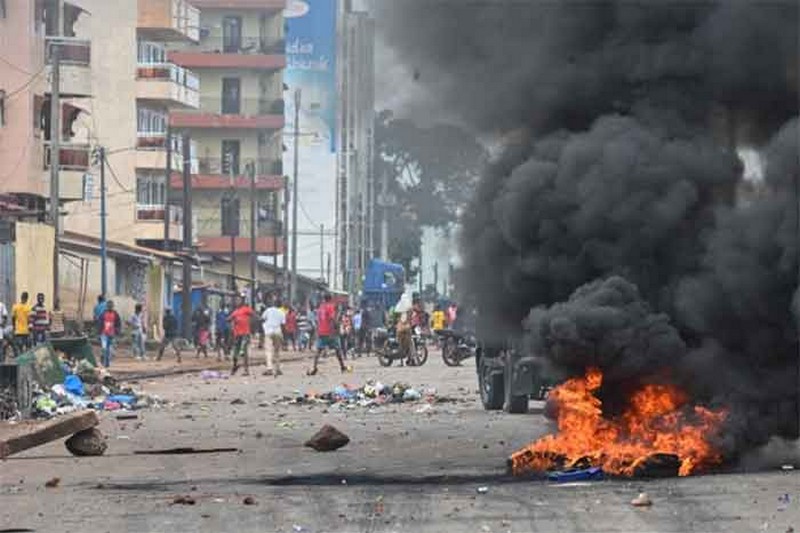
Guinea’s Plight Lays Bare the Greed of Foreign Mining Companies in the Sahel

By Vijay Prashad

On October 20, 2022, in Guinea, a protest organized by the National Front for the Defense of the Constitution (FNDC) took place. The protesters demanded the ruling military government (the National Committee of Reconciliation and Development, or CNRD) release political detainees and sought to establish a framework for a return to civilian rule. They were met with violent security forces, and in Guinea’s capital, Conakry, at least five people were injured and three died from gunshot wounds. The main violence was in Conakry’s commune of Ratoma, one of the poorest areas in the city.

In September 2021, the CNRD, led by Colonel Mamady Doumbouya, overthrew the government of Alpha Condé, which had been in power for more than a decade and was steeped in corruption. In 2020, then-President Alpha Condé’s son—Alpha Mohamed Condé—and his minister of defense—Mohamed Diané—were accused of bribery in a complaint that the Collective for the Transition in Guinea (CTG) filed with the French National Financial Prosecutor’s Office. The complaint alleges that these men received bribes from an international consortium in exchange for bauxite mining rights near the city of Boké.

Boké, in northwestern Guinea, is the epicenter of the country’s bauxite mining. Guinea has the world’s largest reserves of bauxite (estimated to be 7.4 billion metric tons) and is the second-largest producer (after Australia) of bauxite, an essential mineral for aluminum. All the mining in Guinea is controlled by multinational firms, such as Alcoa (U.S.), China Hongqiao, and Rio Tinto Alcan (Anglo-Australian), which operate in association with Guinean state entities.

When the CNRD under Colonel Doumbouya seized power, one of the main issues at stake was control over the bauxite revenues. In April 2022, Doumbouya assembled the major mining companies and told them that by the end of May they had to provide a road map for the creation of bauxite refineries in Guinea or else exit the country. Doumbouya said, “Despite the mining boom in the bauxite sector, it is clear that the expected revenues are below expectations. We can no longer continue this fool’s game that perpetuates great inequality” between Guinea and the international companies. The deadline was extended to June, and the ultimatum’s demands to cooperate or leave are ongoing.

Doumbouya’s CNRD in Guinea, like the military governments in Burkina Faso and Mali, came to power amid popular sentiment fed up with the oligarchies in their country and with French rule. Doumbouya’s 2017 comments in Paris reflect that latter sentiment. He said that French military officers who come to Guinea “underestimate the human and intellectual capacities of Africans… They have haughty attitudes and take themselves for the colonist who knows everything, who masters everything.” This coup government—formed out of an elite force created by Alpha Condé to fight terrorism—has captured the frustrations of the population, but is unable to construct a viable agenda to exit the country’s dependence on foreign mining companies. In the meantime, the protests for a return to democracy are unlikely to be quelled.

Vijay Prashad is an Indian historian, editor, and journalist. He is a writing fellow and chief correspondent at Globetrotter.

29 October 2022

Source: countercurrents.org

Does the U.S. Chip Ban on China Amount to a Declaration of War in the Computer Age?

By Prabir Purkayastha

Sanctions can at best slow China from taking the global lead in chip manufacturing. At their worst, they will raise the chances of chip wars spilling into a physical or economic sphere.

The United States has gambled big in its latest across-the-board sanctions on Chinese companies in the semiconductor industry, believing it can kneecap China and retain its global dominance. From the slogans of globalization and “free trade” of the neoliberal 1990s, Washington has reverted to good old technology denial regimes that the U.S. and its allies followed during the Cold War. While it might work in the short run in slowing down the Chinese advances, the cost to the U.S. semiconductor industry of losing China—its biggest market—will have significant consequences in the long run. In the process, the semiconductor industries of Taiwan and South Korea and equipment manufacturers in Japan and the European Union are likely to become collateral damage. It reminds us again of what former U.S. Secretary of State Henry Kissinger once said: “It may be dangerous to be America’s enemy, but to be America’s friend is fatal.”

The purpose of the U.S. sanctions, the second generation of sanctions after the earlier one in August 2021, is to restrict China’s ability to import advanced computing chips, develop and maintain supercomputers, and manufacture advanced semiconductors. Though the U.S. sanctions are cloaked in military terms—denying China access to technology and products that can help China’s military—in reality, these sanctions target almost all leading semiconductor players in China and, therefore, its civilian sector as well. The fiction of ‘barring military use’ is only to provide the fig leaf of a cover under the World Trade Organization (WTO) exceptions on having to provide market access to all WTO members. Most military applications use older-generation chips and not the latest versions.

The specific sanctions imposed by the United States include:

  • Advanced logic chips required for artificial intelligence and high-performance computing
  • Equipment for 16nm logic and other advanced chips such as FinFET and Gate-All-Around
  • The latest generations of memory chips: NAND with 128 layers or more and DRAM with 18nm half-pitch

Specific equipment bans in the rules go even further, including many older technologies as well. For example, one commentator pointed out that the prohibition of tools is so broad that it includes technologies used by IBM in the late 1990s.

The sanctions also encompass any company that uses U.S. technology or products in its supply chain. This is a provision in the U.S. laws: any company that ‘touches’ the United States while manufacturing its products is automatically brought under the U.S. sanctions regime. It is a unilateral extension of the United States’ national legal jurisdiction and can be used to punish and crush any entity—a company or any other institution—that is directly or indirectly linked to the United States. These sanctions are designed to completely decouple the supply chain of the United States and its allies—the European Union and East Asian countries—from China.

In addition to the latest U.S. sanctions against companies that are already on the list of sanctioned Chinese companies, a further 31 new companies have been added to an “unverified list.” These companies must provide complete information to the U.S. authorities within two months, or else they will be barred as well. Furthermore, no U.S. citizen or anyone domiciled in the United States can work for companies on the sanctioned or unverified lists, not even to maintain or repair equipment supplied earlier.

The global semiconductor industry’s size is currently more than $500 billion and is likely to double its size to $1 trillion by 2030. According to a Semiconductor Industry Association and Boston Consulting Group report of 2020—“Turning the Tide for Semiconductor Manufacturing in the U.S.”—China is expected to account for approximately 40 percent of the semiconductor industry growth by 2030, displacing the United States as the global leader. This is the immediate trigger for the U.S. sanctions and its attempt to halt China’s industry from taking over the lead from the United States and its allies.

While the above measures are intended to isolate China and limit its growth, there is a downside for the United States and its allies in sanctioning China.

The problem for the United States—more so for Taiwan and South Korea—is that China is their biggest trading partner. Imposing such sanctions on equipment and chips also means destroying a good part of their market with no prospect of an immediate replacement. This is true not only for China’s East Asian neighbors but also for equipment manufacturers like the Dutch company ASML, the world’s only supplier of extreme ultraviolet (EUV) lithography machines that produces the latest chips. For Taiwan and South Korea, China is not only the biggest export destination for their semiconductor industry as well as other industries, but also one of their biggest suppliers for a range of products. The forcible separation of China’s supply chain in the semiconductor industry is likely to be accompanied by separation in other sectors as well.

The U.S. companies are also likely to see a big hit to their bottom line—including equipment manufacturers such as Lam Research Corporation, Applied Materials, and KLA Corporation; the electronic design automation (EDA) tools such as Synopsys and Cadence; and advanced chip suppliers like Qualcomm, Nvidia, and AMD. China is the largest destination for all these companies. The problem for the United States is that China is not only the fastest-growing part of the world’s semiconductor industry but also the industry’s biggest market. So the latest sanctions will cripple not only the Chinese companies on the list but also the U.S. semiconductor firms, drying up a significant part of their profits and, therefore, their future research and development (R&D) investments in technology. While some of the resources for investments will come from the U.S. government—for example, the $52.7 billion chip manufacturing subsidy—they do not compare to the losses the U.S. semiconductor industry will suffer as a result of the China sanctions. This is why the semiconductor industry had suggested narrowly targeted sanctions on China’s defense and security industry, not the sweeping sanctions that the United States has now introduced; the scalpel and not the hammer.

The process of separating the sanctions regime and the global supply chain is not a new concept. The United States and its allies had a similar policy during and after the Cold War with the Soviet Union via the Coordinating Committee for Multilateral Export Controls (COCOM) (in 1996, it was replaced by the Wassenaar Arrangement), the Nuclear Suppliers Group, the Missile Control Regime, and other such groups. Their purpose is very similar to what the United States has now introduced for the semiconductor industry. In essence, they were technology denial regimes that applied to any country that the United States considered an “enemy,” with its allies following—then as now—what the United States dictated. The targets on the export ban list were not only the specific products but also the tools that could be used to manufacture them. Not only the socialist bloc countries but also countries such as India were barred from accessing advanced technology, including supercomputers, advanced materials, and precision machine tools. Under this policy, critical equipment required for India’s nuclear and space industries was placed under a complete ban. Though the Wassenaar Arrangement still exists, with countries like even Russia and India within the ambit of this arrangement now, it has no real teeth. The real threat comes from falling out with the U.S. sanctions regime and the U.S. interpretation of its laws superseding international laws, including the WTO rules.

The advantage the United States and its military allies—in the North Atlantic Treaty Organization, the Southeast Asia Treaty Organization, and the Central Treaty Organization—had before was that the United States and its European allies were the biggest manufacturers in the world. The United States also controlled West Asia’s hydrocarbon—oil and gas—a vital resource for all economic activities. The current chip war against China is being waged at a time when China has become the biggest manufacturing hub of the world and the largest trade partner for 70 percent of countries in the world. With the Organization of the Petroleum Exporting Countries no longer obeying the U.S. diktats, Washington has lost control of the global energy market.

So why has the United States started a chip war against China at a time that its ability to win such a war is limited? It can, at best, postpone China’s rise as a global peer military power and the world’s biggest economy. An explanation lies in what some military historians call the “Thucydides trap”: when a rising power rivals a dominant military power, most such cases lead to war. According to Athenian historian Thucydides, Athens’ rise led Sparta, the then-dominant military power, to go to war against it, in the process destroying both city-states; therefore, the trap. While such claims have been disputed by other historians, when a dominant military power confronts a rising one, it does increase the chance of either a physical or economic war. If the Thucydides trap between China and the United States restricts itself to only an economic war—the chip war—we should consider ourselves lucky!

With the new series of sanctions by the United States, one issue has been settled: the neoliberal world of free trade is officially over. The sooner other countries understand it, the better it will be for their people. And self-reliance means not simply the fake self-reliance of supporting local manufacturing, but instead means developing the technology and knowledge to sustain and grow it.

Prabir Purkayastha is the founding editor of Newsclick.in, a digital media platform. He is an activist for science and the free software movement.

29 October 2022

Source: countercurrents.org

The growing chorus for peace in Ukraine

By Medea Benjamin and Nicolas J. S. Davies

Ukraine has been wracked by shocking destruction and deadly violence since Russia invaded the country in February. Estimates of the death toll range from a confirmed minimum of 27,577 people, including 6,374 civilians, to over 150,000. The slaughter can only get more horrific as long as all sides, including the United States and its NATO allies, remain committed to war.

In the first weeks of the war, the United States and NATO countries sent weapons to Ukraine to try to prevent Russia from quickly defeating Ukraine’s armed forces and conducting a U.S.-style “regime change” in Kyiv. But since that goal was achieved, the only goals that President Zelenskyy and his Western allies have publicly proclaimed are to recover all of pre-2014 Ukraine and decisively defeat and weaken Russia.

These are aspirational goals at best, which require sacrificing hundreds of thousands, maybe millions, of Ukrainian lives, regardless of the outcome. Even worse, if they should come close to succeeding, they are likely to trigger a nuclear war, making this the all-time epitome of a “no-win predicament.”

At the end of May, President Biden responded to probing questions about the contradictions in his Ukraine policy from the New York Times Editorial Board, replying that the United States was sending weapons so that Ukraine “can fight on the battlefield and be in the strongest possible position at the negotiating table.”

But when Biden wrote that, Ukraine had no position at any negotiating table, thanks mainly to the conditions that Biden and NATO leaders attached to their support. In April, after Ukraine negotiated a15-point peace plan for a ceasefire, a Russian withdrawal and a peaceful future as a neutral country, the United States and United Kingdom refused to provide Ukraine with the security guarantees that were a critical part of the agreement.

As now disgraced British prime minister Boris Johnson told President Zelenskyy in Kyiv on April 9th, the “collective West” was “in it for the long run,” meaning a long war against Russia, but wanted no part in any agreement between Ukraine and Russia.

In May, Russian forces advanced through Donbas, forcing Zelenskyy to admit, by June 2nd, that Russia now controlled 20% of Ukraine’s pre-2014 territory, leaving Ukraine in a weaker, not a stronger position.

Six months after Secretary Austin declared in April that the new goal of the war was to decisively defeat and “weaken” Russia, President Biden is rejecting calls for a new peace initiative. So the United States and United Kingdom had no reservations about intervening to kill peace talks in April, but now that they’ve sold President Zelenskyy on fighting an endless war, Biden insists that he has no say in the matter if Zelenskyy rejects peace negotiations.

But it is axiomatic that wars end at the negotiating table, as Biden acknowledged to the Times. The perennial thorny question for war leaders is “When to negotiate?” The problem is that, when your side seems to be winning, you have little incentive to stop fighting. But when you appear to be losing, there is no incentive to negotiate from a weak position either, as long as you believe that the tide of war will sooner or later shift in your favor and improve your position. That was the hope on which Johnson and Biden convinced Zelenskyy to stake his country’s future in April.

Now Ukraine has launched localized counter-offensives and recovered parts of its territory. Russia has responded by throwing hundreds of thousands of fresh troops into the war and starting to systematically demolish Ukraine’s electricity grid.

The escalating crisis exposes the weakness of Biden’s position. He is gambling with hundreds of thousands of Ukrainian lives, which he has no moral claim over, that Ukraine will somehow be in a stronger military position after a winter of war and power outages, with hundreds of thousands more Russian troops in the areas Russia controls. This is a bet on a much longer war, in which U.S. taxpayers will shell out for thousands of tons of weapons and millions of Ukrainians will die, with no clear endgame short of nuclear war.

Thanks to the moral and intellectual bankruptcy of the U.S. mass media, most Americans have no inkling of the deceptive way that Biden and his bubble-headed British allies cornered Zelenskyy into a suicidal decision to abandon promising peace negotiations in favor of a long war that will destroy his country.

The horrors of the war, the contradictions in Western policy, the blowback on European energy supplies, the specter of famine stalking the Global South and the rising danger of nuclear war are provoking a worldwide chorus of voices urgently calling for peace in Ukraine.

If you’re on a media diet of the thin gruel that passes for news in America these days, you may not have heard the calls for peace from UN Secretary General Guterres, Pope Francis or the leaders of 66 countries speaking at the UN General Assembly in September, representing the majority of the world’s population.

But there are also Americans calling for peace. From across the political spectrum, from retired military officers and diplomats to journalists and academics, there are “adults in the room” who recognize the dangerous contradictions of U.S. policy on Ukraine, and are joining leaders from around the world in calling for diplomacy and peace.

Jack Matlock served as the last U.S. Ambassador to the Soviet Union, from 1987 to 1991, after a 35-year career as a Soviet specialist in the U.S. Foreign Service. Matlock was at the embassy in Moscow during the Cuban missile crisis, where he translated critical messages between Kennedy and Kruschev.

On October 17, 2022, in an article in Responsible Statecraft titled “Why the US must press for a ceasefire in Ukraine,” Ambassador Matlock wrote that as principal arms supplier to Ukraine and the sponsor of the most punitive sanctions on Russia, the United States “is obligated to help find a way out” of this crisis. The article concluded, “Until… the fighting stops, and serious negotiations get underway, the world is headed for an outcome where we all are losers.”

Another veteran U.S. diplomat who has spoken out for diplomacy over Ukraine is Rose Gottemoeller, the Deputy Secretary General of NATO from 2016 to 2019 after she served as President Obama’s senior adviser on arms control, disarmament and nonproliferation. Gottemoeller recently wrote in the Financial Times that she sees no military solution to the crisis in Ukraine, but that “discreet talks” could lead to the kind of “quiet bargain” that resolved the Cuban missile crisis 60 years ago.

On the military side, Admiral Mike Mullen was the Chairman of the Joint Chiefs of Staff from 2007 to 2011. After President Biden chatted at a fundraising party about the war in Ukraine leading to nuclear “Armageddon,” ABC interviewed Mullen about the danger of nuclear war. “I think we need to back off that a little bit and do everything we possibly can to get to the table to resolve this thing,” Mullen replied. “It’s got to end, and usually there are negotiations associated with that. The sooner the better as far as I’m concerned.”

Economist Jeffrey Sachs was the director of the Earth Institute and now the Center for Sustainable Development at Columbia University. He has been a consistent voice for peace in Ukraine ever since the invasion. In a recent article on September 26, titled “The Great Game in Ukraine is Spinning out of Control,” Sachs quoted President Kennedy in June 1963, uttering what Sachs called “the essential truth that can keep us alive today:”

“Above all, while defending our own vital interests, nuclear powers must avert those confrontations which bring an adversary to a choice of either a humiliating retreat or a nuclear war,” said JFK. “To adopt that kind of course in the nuclear age would be evidence only of the bankruptcy of our policy–or of a collective death-wish for the world.”

Sachs concluded, “It is urgent to return to the draft peace agreement between Russia and Ukraine of late March, based on the non-enlargement of NATO… The world’s very survival depends on prudence, diplomacy, and compromise by all sides.”

Even Henry Kissinger, whose own war crimes are well documented, has spoken out on the senselessness of current U.S. policy. Kissinger told the Wall Street Journal in August, “We are at the edge of war with Russia and China on issues which we partly created, without any concept of how this is going to end or what it’s supposed to lead to.”

In the U.S. Congress, after every single Democrat voted for a virtual blank check for arming Ukraine in May, with no provision for peacemaking, Progressive Caucus leader Pramila Jayapal and 29 other progressive Democratic Representatives recently signed a letter to President Biden, urging him to “make vigorous diplomatic efforts in support of a negotiated settlement and ceasefire, engage in direct talks with Russia, explore prospects for a new European security arrangement acceptable to all parties that will allow for a sovereign and independent Ukraine, and, in coordination with our Ukrainian partners, seek a rapid end to the conflict and reiterate this goal as America’s chief priority.”

Unfortunately, the backlash within their own party was so blistering that within 24 hours they withdrew the letter. Siding with calls for peace and diplomacy from all over the world is still not an idea whose time has come in the halls of power in Washington DC.

This is an extremely dangerous moment in history. Americans are waking up to the reality that this war threatens us with the existential danger of nuclear war, a danger most Americans thought we had survived once and for all at the end of the First Cold War. Even if we manage to avoid nuclear war, the impact of a long, bloody war will destroy Ukraine and kill millions of Ukrainians, cause humanitarian catastrophes across the Global South, and trigger a long-lasting global economic crisis.

That will relegate all humanity’s urgent priorities, from tackling the climate crisis to hunger, poverty and disease, to the back-burner for the foreseeable future.

There is an alternative. We can and must resolve this conflict through peaceful diplomacy and negotiation, to end the killing and destruction and let the people of Ukraine live in peace.

Medea Benjamin and Nicolas J. S. Davies are the authors of War in Ukraine: Making Sense of a Senseless Conflict, available from OR Books in November 2022.

28 October 2022

Source: countercurrents.org

Difficult Months Ahead: Why Israel is Afraid of the Lions’ Den

By Dr Ramzy Baroud

This headline in the Israeli newspaper, the Jerusalem Post, only tells part of the story: “The Lions’ Den, Other Palestinian Groups are Endless Headache for Israel, PA.”

It is true that both the Israeli government and the Palestinian Authority are equally worried about the prospect of a widespread armed revolt in the Occupied West Bank, and that the newly formed Nablus-based brigade, the Lions’ Den, is the epicenter of this youth-led movement.

However, the growing armed resistance in the West Bank is causing more than a mere ‘headache’ for Tel Aviv and Ramallah. If this phenomenon continues to grow, it could threaten the very existence of the PA, while placing Israel before its most difficult choice since the invasion of major Palestinian West Bank cities in 2002.

Though Israeli military commanders continue to undermine the power of the newly formed group, they seem to have no clear idea regarding its roots, influence and future impact.

In a recent interview with the Israeli newspaper Yedioth Ahronoth, Israeli Defense Minister Benny Gantz claimed that the Lions’ Den is a “group of 30 members”, who will eventually be reached and eliminated. “We will lay our hands on the terrorists,” he declared.

The Lions’ Den, however, is not an isolated case, but part of a larger phenomenon that includes the Nablus Brigades, the Jenin Brigades and other groups, which are located mostly in the northern West Bank.

The group, along with other armed Palestinian military units, has been active in responding to the killing of Palestinians, including children, elders, and, on October 14, even a Palestinian doctor, Abdullah Abu al-Teen, who succumbed to his wounds in Jenin. According to the Palestinian Ministry of Health, over 170 Palestinians were killed in the West Bank and Gaza, since the beginning of the year.

The Palestinian response included the killing of two Israeli soldiers, one in Shuafat on October 8, and the other near Nablus on October 11.

Following the Shuafat attack, Israel completely sealed the Shuafat refugee camp as a form of collective punishment, similar to recent sieges on Jenin and other Palestinian towns.

Citing Israel’s Hebrew media, the Palestinian Arabic daily Al Quds reported that the Israeli military will focus its operations in the coming weeks on targeting the Lions’ Den. Thousands more Israeli occupation soldiers are likely to be deployed in the West Bank for the upcoming battle.

It is difficult to imagine that Israel would mobilize much of its army to fight 30 Palestinian fighters in Nablus. But not only Israel, the PA, too, is terribly concerned.

The Authority has tried but failed to entice the fighters by offering them a surrender ‘deal’, where they give up their arms and join the PA forces. Such deals were offered in the past to fighters belonging to Fatah’s Al Aqsa Martyrs Brigades, with mixed degrees of success.

This time around, the strategy did not work. The group rejected the PA’s overtures, compelling the Fatah-affiliated governor of Nablus, Ibrahim Ramadan, to attack the mothers of the fighters by calling them ‘deviant’ for “sending their sons to commit suicide.” Ramadan’s language, which is similar to language used by Israeli and pro-Israel individuals in their depiction of Palestinian society, highlights the massive schisms between the PA’s political discourse and those of ordinary Palestinians.

Not only is the PA losing grasp of the narrative, it is also losing whatever vestiges of control it has left in the West Bank, especially in Nablus and Jenin.

A senior Palestinian official told the Media Line that the Palestinian “street does not trust us anymore”, as they “view us as an extension of Israel.” True, but this lack of trust has been in the making for years.

The ‘Unity Intifada‘ of May 2021, however, served as a major turning point in the relationship between the PA and Palestinians. The rise of the Lions’ Den and other Palestinian armed groups are but a few manifestations of the dramatic changes underway in the West Bank.

Indeed, the West Bank is changing. A new generation that has little or no memory of the Second Intifada (2000-2005), had not experienced the Israeli invasion then but grew up under occupation and apartheid, feeding on the memories of the resistance in Jenin, Nablus and Hebron.

Judging by their political discourse, chants and symbols, this generation is fed up with the crippling and often superficial divisions of Palestinians among factions, ideologies and regions. In fact, the newly established brigades, including the Lions’ Den, are believed to be multi-factional groups bringing, for the first time, fighters from Hamas, Fatah and others into a single platform. This explains the popular enthusiasm and lack of suspicion among ordinary Palestinians of the new fighters.

For example, Saed al-Kuni, a Palestinian fighter who was recently killed by Israeli soldiers in an ambush on the outskirts of Nablus, was a member of the Lions’ Den. Some have claimed that al-Kuni was a leading member of Fatah’s Brigades, and others say he was a well-known Hamas fighter.

This lack of certainty regarding the political identity of killed fighters is fairly unique to Palestinian society, at least since the establishment of the PA in 1994.

Expectedly, Israel will do what it always does: amassing more occupation troops, attacking, assassinating, crushing protests and laying sieges on rebellious towns and refugee camps. What they fail to understand, at least for now, is that the growing rebellion in the West Bank is not generated by a few fighters in Nablus and a few more in Jenin, but is the outcome of a truly popular sentiment.

In an interview with Yedioth Ahronoth, translated by Al-Quds, an Israeli commander described what he has witnessed in Jenin during a raid:

“When we enter (Jenin), armed fighters and stone throwers wait for us in every corner. Everyone takes part. You look at an old man … and you wonder, will he throw stones? And he does. Once, I saw a person who had nothing to throw (on us). He rushed to his car, grabbed a milk carton and he threw it on us.”

Palestinians are simply fed up with the Israeli occupation and with their collaborating leadership. They are ready to put it all on the line, in fact, in Jenin and Nablus, they already have. The coming weeks and months are critical for the future of the West Bank, and, in fact, for all Palestinians.

Dr. Ramzy Baroud is a journalist, author and the Editor of The Palestine Chronicle.

20 October 2022

Source: countercurrents.org

US Rejection of Moscow’s Offer for Peace Talks Is Utterly Inexcusable

By Caitlin Johnstone

Russian Foreign Minister Sergei Lavrov said on Tuesday that Moscow was open to talks with the the US or with Turkey on ending the war in Ukraine, claiming that US officials are lying when they say Russia has been refusing peace talks.

Reuters reports:

Lavrov said officials, including White House national security spokesman John Kirby, had said the United States was open to talks but that Russia had refused.

“This is a lie,” Lavrov said. “We have not received any serious offers to make contact.”

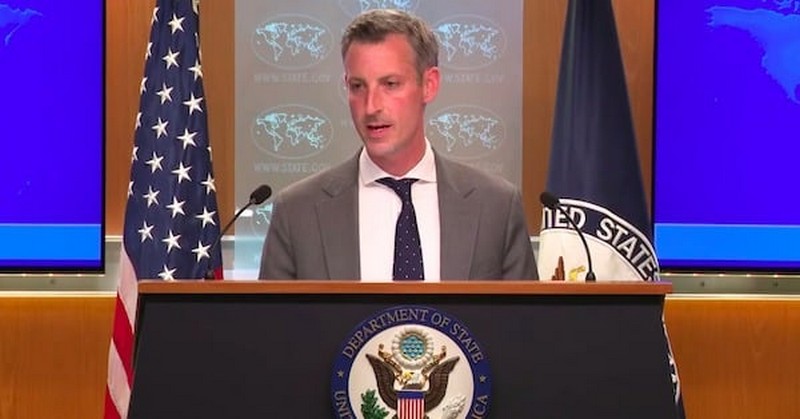
Lavrov’s claim was given more weight when US State Department spokesman Ned Price dismissed the offer for peace talks shortly after it was extended, citing Russia’s recent missile strikes on Kyiv.

“We see this as posturing,” Price said at a Tuesday press briefing. “We do not see this as a constructive, legitimate offer to engage in the dialogue and diplomacy that is absolutely necessary to see an end to this brutal war of aggression against the people and the state, the Government of Ukraine.”

This is inexcusable. At a time when our world is at its most perilous moment since the Cuban Missile Crisis according to many experts as well as the president of the United States, the US government has no business making the decision not to sit down with Russian officials and work toward de-escalation and peace. They have no business making that call on behalf of every terrestrial organism on this planet whose life is being risked in these games of nuclear brinkmanship. The fact that this war has escalated with missile strikes on the Ukrainian capital makes peace talks more necessary, not less.

This rejection is made all the more outrageous by new information from The Washington Post that the US government does not believe Ukraine can win this war and refuses to encourage it to negotiate with Moscow.

“Privately, U.S. officials say neither Russia nor Ukraine is capable of winning the war outright, but they have ruled out the idea of pushing or even nudging Ukraine to the negotiating table,” WaPo reports. “They say they do not know what the end of the war looks like, or how it might end or when, insisting that is up to Kyiv.”

These two points taken together lend even more credibility an argument I’ve been making from the very beginning of this war:

that the US does not want peace in Ukraine, but rather seeks to create a costly military quagmire for Moscow just as US officials have confessed to trying to do in Afghanistan and in Syria. Which would explain why US Secretary of Defense Lloyd Austin said the US goal in Ukraine is actually to “weaken” Russia, and also why the empire appears to have actively torpedoed a peace deal between Ukraine and Russia in the early days of the conflict.

This proxy war has no exit strategy. And that is entirely by design.

WATCH: State Department spokesman Ned Price holds news briefing

Many have been calling for the US to abandon its policy of actively sustaining this war while avoiding peace talks.

“President Biden’s language, we’re about at the top of the language scale, if you will,” former Joint Chiefs of Staff chairman Mike Mullen told ABC’s This Week on Sunday regarding the president’s recent remark that this conflict could lead to “Armageddon”.

“I think we need to back off that a little bit and do everything we possibly can to try to get to the table to resolve this thing,” Mullen said, adding, “As is typical in any war, it has got to end and usually there are negotiations associated with that. The sooner the better as far as I’m concerned.”

“One thing the United States can do is… drop the position, the official position, that the war must go on to weaken Russia severely, meaning no negotiations,” Noam Chomsky argued in a recent appearance on Democracy Now. “Would that open the way to negotiations, diplomacy? Can’t be sure. There’s only one way to find out. That’s to try. If you don’t try, of course it won’t happen.”

“It is time for the United States to supplement its military support for Ukraine with a diplomatic track to manage this crisis before it spirals out of control,” said the Quincy Institute’s George Beebe following the Monday missile strikes on Kyiv, calling it “a major escalation in the war” that was bound to “bring the world closer to a direct military collision between Russia and the United States.”

“The Americans have to come to an agreement with the Russians. And then the war will be over,” Hungarian Prime Minister Viktor Orban said at an event on Tuesday, adding that “anyone who thinks that this war will be concluded through Russian-Ukrainian negotiations is not living in this world.”

It’s absolutely insane that the world’s two nuclear superpowers are accelerating toward direct military confrontation and they aren’t even talking to each other, and it’s even crazier that anyone who says they should be gets called a Kremlin agent and a Chamberlain-like appeaser. Responsible Statecraft’s Harry Kazianis discusses this freakish dynamic in a recent article titled “Talking is not appeasement — it’s avoiding a nuclear armageddon“:

I have fought more than thirty combat simulations in wargames under my own direction for a private defense contract over the last several months, looking at various aspects of the Russia-Ukraine war, and one thing is clear: the chances of a nuclear war increase significantly every day that passes.

In every scenario I tested, the Biden Administration slowly gives Ukraine ever more advanced weapons like ATACMS, F-16s, and other platforms that Russia has consistently warned pose a direct military threat. While each scenario has postulated a different point at which Moscow decides to use a tactical nuclear weapon in order to counter conventional platforms it can’t easily defeat, the chances that Russia uses nukes grow as new and more powerful military capabilities are introduced into the battlefield by the West.

In fact, in 28 of the thirty scenarios I have run since the war began, some sort of nuclear exchange occurs.

The good news is there is a way out of this crisis — however imperfect it may be. In the two scenarios where nuclear war was averted, direct negotiations led to a ceasefire.

I repeat again that it is absolutely pants-on-head gibbering insanity that these direct negotiations are not already presently underway. Let us petition any and all higher powers we have faith in that this changes very soon. Let us also petition the leaders of our individual nations around the world to exert whatever kind of pressure they can muster upon Washington for these talks to commence. This brinkmanship threatens us all, and the managers of the US empire have no business playing these games with our lives.

*

Note to readers: Please click the share buttons above or below. Follow us on Instagram and Twitter and subscribe to our Telegram Channel. Feel free to repost and share widely Global Research articles.

Featured image is from CaitlinJohnstone.com

12 October 2022

Source: www.globalresearch.ca

“Shrink the World’s Population”: Secret 2009 Meeting of Billionaires “Good Club”

By Prof Michel Chossudovsky

For more than ten years, meetings have been held by billionaires described as philanthropists to Reduce the Size of the World’s Population culminating with the 2020-2022 Covid crisis.

Recent developments suggest that “Depopulation” is an integral part of the so-called Covid mandates including the lockdown policies and the mRNA “vaccine”.

Flash back to 2009. According to the Wall Street Journal: “Billionaires Try to Shrink World’s Population”.

In May 2009, the Billionaire philanthropists met behind closed doors at the home of the president of The Rockefeller University in Manhattan.

This Secret Gathering was sponsored by Bill Gates. They called themselves “The Good Club”.

Among the participants were the late David Rockefeller, Warren Buffett, George Soros, Michael Bloomberg Ted Turner, Oprah Winfrey and many more.

In May 2009, the WSJ as well as the Sunday Times reported: (John Harlow, Los Angeles) that

“Some of America’s leading billionaires have met secretly to consider how their wealth could be used to slow the growth of the world’s population and speed up improvements in health and education.”

The emphasis was not on population growth (i.e Planned Parenthood) but on “Depopulation”, i.e,. the reduction in the absolute size of the World’s population.

To read complete WSJ article click here.

According to the Sunday Times report :

The philanthropists who attended a summit convened on the initiative of Bill Gates, the Microsoft co-founder, discussed joining forces to overcome political and religious obstacles to change.

Stacy Palmer, editor of the Chronicle of Philanthropy, said the summit was unprecedented. “We only learnt about it afterwards, by accident. Normally these people are happy to talk good causes, but this is different – maybe because they don’t want to be seen as a global cabal,” he said.

Another guest said there was “nothing as crude as a vote” but a consensus emerged that they would back a strategy in which population growth would be tackled as a potentially disastrous environmental, social and industrial threat.

“This is something so nightmarish that everyone in this group agreed it needs big-brain answers,” said the guest. …

Why all the secrecy? “They wanted to speak rich to rich without worrying anything they said would end up in the newspapers, painting them as an alternative world government,” he said.(Sunday Times)

Shrinking The World’s Population

The media reports on the May 5, 2009 secret gathering focussed on the commitment of “The Good Club” to “slowing down” the growth of the World’s population.

“Shrink the World Population” (the WSJ Title) goes beyond Planned Parenthood which consists in “Reducing the Growth of World Population”. It consists in “Depopulation”, namely reducing the absolute size of the World’s Population, which ultimately requires reducing the rate of birth (which would include reduced fertility) coupled with a significant increase in the death rate.

Secret Meeting: At the Height of the H1N1 Pandemic

On April 25, 2009, the World Health Organization (WHO) headed by Margaret Chan declared a Public Health Emergency of International Concern (PHEIC). And a couple of weeks later, the “Good Club” met in NYC at the height of the H1N1 swine flu pandemic which turned out to be a scam.

It is also worth noting that at very outset of the H1N1 crisis in April 2009, Professor Neil Ferguson of Imperial College, London was advising Bill Gates and the WHO: “40 per cent of people in the UK could be infected [with H1N1] within the next six months if the country was hit by a pandemic.”

Sounds familiar? That was the same Neil Ferguson (generously supported by the Gates Foundation) who designed the coronavirus Lockdown Model (launched on March 11, 2020). As we recall, that March 2020 mathematical model was based on “predictions” of 600,000 deaths in the UK.

And now (Summer- Autumn 2021) a third authoritative “mathematical model” by the same “scientist” (Ferguson) was formulated to justify a “Fourth Wave Lockdown”.

Saving Lives to Achieve “Depopulation”

Was an absolute “reduction” in World population contemplated at that May 2009 secret meeting?

A few months later, Bill Gates in his TED presentation (February 2010) pertaining to vaccination, confirmed the following;

“And if we do a really great job on new vaccines, health care, reproductive health services, we could lower that [the world population] by 10 or 15 percent”.

According to Gates’ statement, this would represent an absolute reduction of the World’s population (2010) of the order 680 million to 1.02 billion.

(See quotation on Video starting at 04.21. See also screenshot of Transcript of quotation)

TED Talk at 04:21:

Bill Gates Innovating to zero!

“The Good Club” Then and Now

The same group of billionaires who met at the May 2009 secret venue at the Rockefeller University in Manhattan, have been actively involved from the outset of the Covid crisis in designing the lockdown policies applied Worldwide including the mRNA vaccine and the WEF’s “Great Reset”.

The mRNA vaccine is not a project of a UN intergovernmental body (WHO) on behalf the member states of the UN: It’s a private initiative. The billionaire elites which fund and enforce the Vaccine Project Worldwide are Eugenists committed to Depopulation.

15 October 2022

Source: www.globalresearch.ca

Imran Khan disqualified from holding office for five years, Pakistan’s election commission rules

By Sophia Saifi, Rhea Mogul and Azaz Syed, CNN

Islamabad, Pakistan CNN —

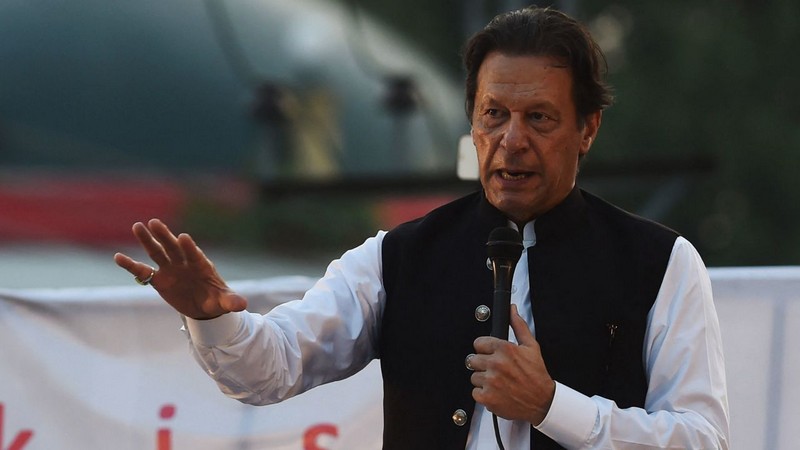
Pakistan’s former Prime Minister Imran Khan will be disqualified from holding political office for five years, the Election Commission of Pakistan (ECP) ruled on Friday, a move likely to further inflame political tensions in the country.

While reading out the recommendation, ECP chief Sikandar Sultan Raja stated that Khan was disqualified for being involved in “corrupt practices.”

The commission said its decision was based on the grounds that Khan had “made false statements” regarding the declaration of the sale of gifts sent to him by the leaders of Saudi Arabia and Dubai while in office – an offense that is illegal under the country’s constitution.

There had been a heavy police presence outside the election commission’s office in the capital Islamabad on Friday, in anticipation of protests by Khan’s supporters. Paramilitary troops have been deployed across the city and the Red Zone, which encases major government buildings, including the election commission, has been mostly sealed off to traffic.

At a press conference right after the announcement by the ECP, leaders from Khan’s party, Pakistan Tehreek-e-insaf (PTI), have said that they will take the matter to the Islamabad High Court, claiming that the ECP’s decision was “biased.”

PTI leader Fawad Chaudhry said Friday this was the “beginning of a revolution” and called for supporters to “come out of their homes and take to the streets to uphold the constitution.”

Widespread popularity
The announcement raises the prospect of Khan being unable to stand in the next general election, expected in 2023. CNN has reached out to Khan’s lawyer for comment.

The commission’s ruling is the latest in a series of setbacks for Khan, who was dramatically removed from office in a vote of no confidence in April.

The Pakistan Democratic Movement political party, which is part of the country’s ruling coalition that ousted Khan from power, had pushed for the commission’s investigation.

However, the cricketer-turned-populist leader maintains widespread popularity.

He has repeatedly claimed that his removal from office was the result of a US-led conspiracy against him. He has also alleged the current Prime Minister Shehbaz Sharif and the Pakistani military were behind his ousting.

His claims have struck a chord with a young population in a country where anger and disillusionment with the political and military establishment is being fueled by a rising cost-of-living crisis and anti-American sentiment is common.

The US, the ruling coalition and the Pakistani military have all denied Khan’s allegations.

His enduring popularity has translated to recent provincial election victories for his party and he has repeatedly called for a new parliamentary vote at mass rallies held since his ouster.

Khan has repeatedly called for early elections and has said he will lead his supporters in a long march to Islamabad.

21 October 2022

Source: cnn.com

Pakistan: Criticizing Chief Of Army Staff = “Inciting Mutiny”, But Wanting to Hang the Former Prime Minister = “Free Speech”

By Andrew Korybko

“Something’s rotten in the state of Pakistan”, and it’s that the country’s institutions have been captured by American proxies through a post-modern coup, after which they began aggressively waging “lawfare” on all their critics.

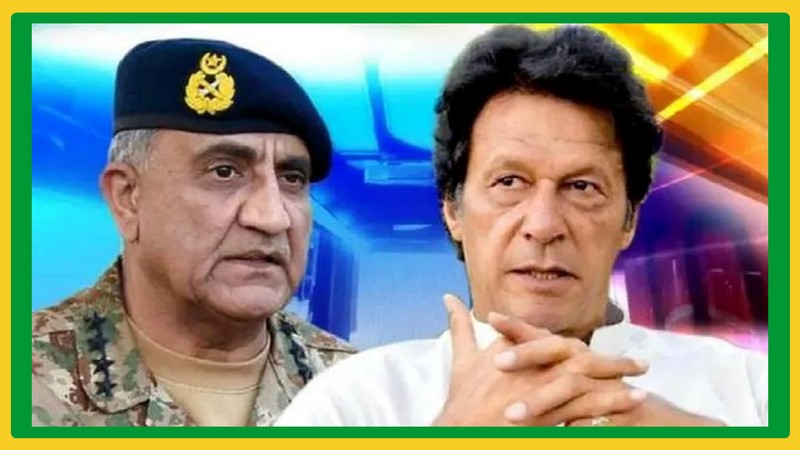
To paraphrase Shakespeare’s famous line from Hamlet, “something is rotten in the state of Pakistan” when criticizing Chief Of Army Staff (COAS) Qamar Javed Bajwa is equivalent to “inciting mutiny” while wanting to hang former Prime Minister Imran Khan is supposedly just “free speech”. PTI Senator Azam Swati was arrested on Thursday for sarcastically tweeting his congratulations to COAS Bajwa after the acquittal of incumbent Prime Minister Shehbaz Sharif – who replaced his predecessor after a US-orchestrated post-modern coup – and his son Hamza in a money laundering case, which the First Information Report (FIR) registered by the Federal Investigation Agency’s Cyber Crime Reporting Centre claimed was intended to incite mutiny, among other charges.

By contrast, Interior Minister Rana Sanaullah has yet to have charges filed against him at the time of this article’s publication despite threatening former Prime Minister Khan that “We will hang him upside down” if he commences his promised Absolute Freedom March on the capital of Islamabad and PTI demanding that the Pakistan Electronic Media Regulatory Agency (PEMRA) take action. Quite clearly, criticizing COAS – who many regard as personally responsible for the US-orchestrated post-modern coup against the former premier as punishment for his independent foreign policy (and especially its Russian dimension) – runs the risk of criminal charges while threatening to publicly execute the country’s former leader can be done with impunity, at least if the one doing so is a top security official.

As could be expected, America almost certainly won’t criticize its newly restored vassal since it tacitly approves of these undemocratic double standards that are implemented out of desperation to prevent a peaceful people’s revolution against its local puppets. It also plans to exploit the emerging regional processes that were unleashed by its latest regime change there to complete the grand strategic reorientation of South Asia, though there’s also speculation that it might be considering the possibility of former Prime Minister Khan returning to office, hence why he and the US have reportedly entered into some sort of contact with each other. It remains to be seen whether anything tangible will come from those reports, but they’re still intriguing to consider.

In any case and however it happens, “The Power Of The Pakistani People Will Defeat Their Unpopular Imported Government” sooner or later, but it would of course be best if the then-former coup regime doesn’t fully discredit the country beforehand. After all, it’s already exploited anti-terrorist legislation to previously charge the former premier for related crimes after he publicly announced his intention to file court cases against the ruling authorities over their allegedly inhumane treatment of his chief advisor. Now, the entire world sees that even serving Senators can’t publicly criticize COAS without fear of being punished on similar trump-up pretexts while the Interior Minister can threaten to publicly execute former Prime Minister Khan without getting in trouble (at least at the time of this article’s publication).

Returning back to the famous passage that was referenced in the introduction, “something’s rotten in the state of Pakistan”, and it’s that the country’s institutions have been captured by American proxies through a post-modern coup, after which they began aggressively waging “lawfare” on all their critics. They’re not just making an example out of Senator Swati, but are inadvertently suggesting that average Pakistanis are also persecuted for expressing similar “politically incorrect” opinions, though their trials and tribulations obviously don’t get any media coverage because they’re not public figures like he is. Likewise, just like Sanarullah threatened to publicly execute the former premier for related reasons, it can’t be discounted that he won’t order the security services to execute average folks too.

With these observations in mind, it should be abundantly clear that the latest example of undemocratic double standards in Pakistan is actually the worst such instance yet. Those watching everything play out from afar should shudder to think what life is like for those average Pakistanis who are displeased with their US-installed post-modern coup regime. They risk imprisonment or worse just like Swati and former Prime Minister Khan respectively if they publicly express similar dissent, though few would probably ever learn of their persecution considering the fact that they aren’t public figures like those two. Nevertheless, those abroad who truly support democracy, free speech, and human rights should raise their voices on those people’s behalf in order to inform the world about what’s happening in Pakistan.

*

Andrew Korybko is an American Moscow-based political analyst specializing in the relationship between the US strategy in Afro-Eurasia, China’s One Belt One Road global vision of New Silk Road connectivity, and Hybrid Warfare.

17 October 2022

Source: www.globalresearch.ca