Just International

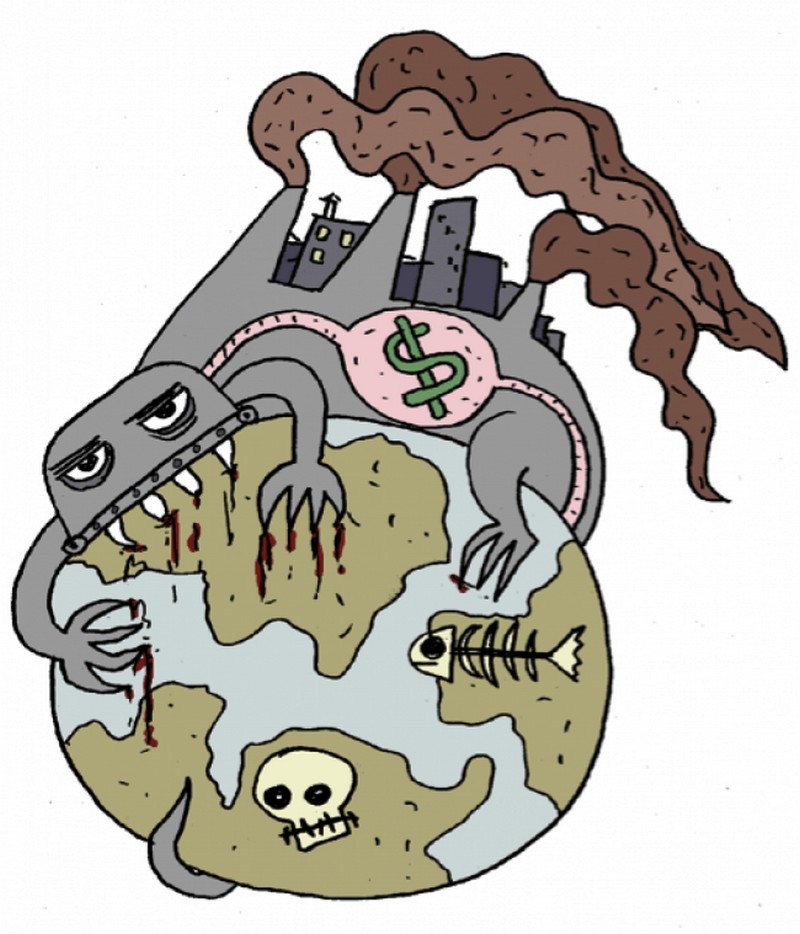
Who Is to Blame for Inflation? The Power Brokers of Capitalism

By Yanis Varoufakis

Inflation as a Political Power Play Gone Wrong – A half-century long strategy, led by corporations, Wall Street, governments, and central banks, is coming undone. As a result, the West’s authorities now face an impossible choice: push conglomerates and states into cascading bankruptcies or allow inflation to go unchecked.

22 Jun 2022 – The blame game over surging prices is on. Was it too much central-bank money being pumped out for too long that caused inflation to take off? Was it China, where most physical production had moved before the pandemic locked down the country and disrupted global supply chains? Was it Russia, whose invasion of Ukraine took a large chunk out of the global supply of gas, oil, grains, and fertilizers? Was it some surreptitious shift from pre-pandemic austerity to unrestricted fiscal largesse?

The answer is one that test-takers never encounter: All of the above and none of the above.

Pivotal economic crises frequently evoke multiple explanations that are all correct while missing the point. When Wall Street collapsed in 2008, triggering the global Great Recession, various explanations were offered: regulatory capture by financiers who had replaced industrialists in the capitalist pecking order; a cultural proclivity toward risky finance; failure by politicians and economists to distinguish between a new paradigm and a massive bubble; and other theories, too. All were valid, but none went to the heart of the matter.

The same thing is true today. The “we told you so” monetarists, who have been predicting high inflation ever since central banks massively expanded their balance sheets in 2008, remind me of the joy felt that year by leftists (like me) who consistently “predict” capitalism’s near-death —akin to a stopped clock that is right twice a day. Sure enough, by creating huge overdrafts for the bankers in the false hope that the money would trickle down to the real economy, central banks caused epic asset-price inflation (booming equity and housing markets, the crypto craze, and more).

But the monetarist story cannot explain why the major central banks failed from 2009 to 2020 even to boost the quantity of money circulating in the real economy, let alone push consumer price inflation up to their 2% target. Something else must have triggered inflation.

The interruption of China-centered supply chains clearly played a significant role, as did Russia’s invasion of Ukraine. But neither factor explains Western capitalism’s abrupt “regime change” from prevailing deflation to its opposite: all prices taking off simultaneously. This would require wage inflation to overtake price inflation, thus causing a self-perpetuating spiral, with wage rises feeding back into further price hikes which, in turn, cause wages to rise again, ad infinitum. Only then would it be reasonable for central bankers to demand that workers “take one for the team” and refrain from seeking higher wage settlements.

But, today, demanding that workers forgo wage gains are absurd. All the evidence suggests that, unlike in the 1970s, wages are rising much more slowly than prices, and yet the increase in prices is not just continuing but accelerating.

So, what is really going on? My answer: A half-century long power play, led by corporations, Wall Street, governments, and central banks, has gone badly wrong. As a result, the West’s authorities now face an impossible choice: Push conglomerates and even states into cascading bankruptcies, or allow inflation to go unchecked.

For 50 years, the US economy has sustained the net exports of Europe, Japan, South Korea, then China and other emerging economies, while the lion’s share of those foreigners’ profits rushed to Wall Street in search of higher returns. On the back of this tsunami of capital heading for America, the financiers were building pyramids of private money (such as options and derivatives) to fund the corporations building up a global labyrinth of ports, ships, warehouses, storage yards, and road and rail transport. When the crash of 2008 burned down these pyramids, the whole financialized labyrinth of global just-in-time supply chains was imperiled.

To save not just the bankers but also the labyrinth itself, central bankers stepped in to replace the financiers’ pyramids with public money. Meanwhile, governments were cutting public expenditure, jobs, and services. It was nothing short of lavish socialism for capital and harsh austerity for labor. Wages shrunk, and prices and profits were stagnant, but the price of assets purchased by the rich (and thus their wealth) skyrocketed. Thus, investment (relative to available cash) dropped to an all-time low, capacity shrunk, market power boomed, and capitalists became both richer and more reliant on central-bank money than ever.

It was a new power game. The traditional struggle between capital and labor to increase their respective shares of total income through mark-ups and wage increases continued but was no longer the source of most new wealth. After 2008, universal austerity yielded low investment (money demand), which, combined with plentiful central-bank liquidity (money supply), kept the price of money (interest rates) close to zero. With productive capacity (even new housing) on the wane, good jobs scarce, and wages stagnant, wealth triumphed in equity and real-estate markets, which had decoupled from the real economy.

Then came the pandemic, which changed one big thing: Western governments were forced to channel some of the new rivers of central-bank money to the locked-down masses within economies that, over the decades, had depleted their capacity to produce stuff and were now facing busted supply chains to boot. As the locked-down multitudes spent some of their furlough money on scarce imports, prices began to rise. Corporations with great paper wealth responded by exploiting their immense market power (yielded by their shrunken productive capacity) to push prices through the roof.

After two decades of a central-bank-supported bonanza of soaring asset prices and rising corporate debt, a little price inflation was all it took to end the power game that shaped the post-2008 world in the image of a revived ruling class. So, what happens now?

Probably nothing good. To stabilize the economy, the authorities first need to end the exorbitant power bestowed upon the very few by a political process of paper wealth and cheap debt creation. But the few will not surrender power without a struggle, even if it means going down in flames with society in tow.

____________________________________________

Yanis Varoufakis, a former finance minister of Greece, is leader of the MeRA25 Party, professor of economics at the University of Athens, and co-founder of DiEM25 (Democracy in Europe Movement).

27 June 2022

Source: www.transcend.org

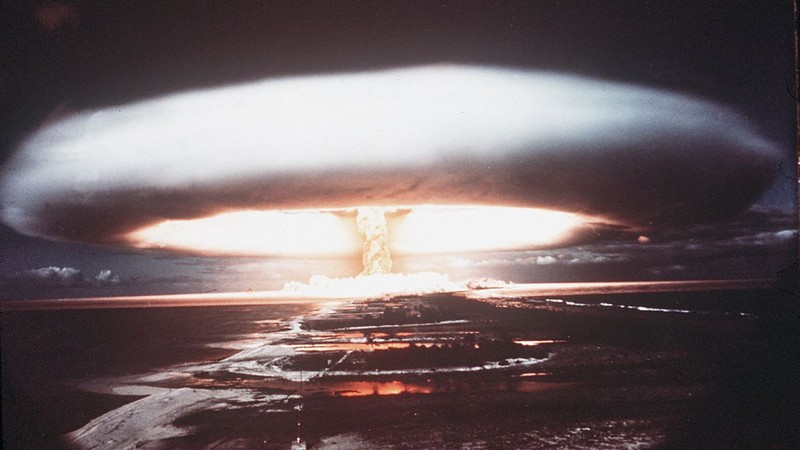
Nuclear-Armed Powers Squander $156.000 per Minute on Their MAD Policy

By Baher Kamal

24 Jun 2022 – They call it MAD: Mutual Assured Destruction. It is about the nuclear-armed powers’ doctrine of military strategy and national security policy. And they spent on their MAD policy more than 156.000 US dollars, every single minute, in just one year–2021.

According to their MAD doctrine a full-scale use of nuclear weapons by an attacker on a nuclear-armed defender, with second-strike capabilities, would cause the complete annihilation of both the attacker and the defender. In short: destruction.

Nine countries are classified as nuclear-armed powers, with the United States, Russia, China, the United Kingdom and France ranking at the top of the list. Others: India, Israel, Pakistan, and North Korea.

Already before the war now unfolding in Europe

In its report “Squandered: 2021 Global Nuclear Weapons Spending,” the International Campaign to Abolish Nuclear Weapons (ICAN) reveals that in 2021 –the year before the Russian invasion of Ukraine– nine nuclear-armed states spent 82.4 billion US dollars on these weapons of mass destruction, that’s more than 156,000 US dollars… per minute.

Specifically, the United States spent three times more than the next in line- a whopping 44.2 billion US dollars, reports ICAN. China was the only other country crossing the ten billion mark, spending 11.7 billion US dollars.

Russia had the third-highest spending at 8.6 billion US dollars, though the United Kingdom’s 6.8 billion US dollars, and the French 5.9 billion, weren’t so far behind.

ICAN adds that India, Israel and Pakistan also each spent over a billion on their arsenals, while North Korea spent 642 million US dollars, according to the 2017 Nobel Peace laureate: ICAN.

Arsenals expected to grow

Another prestigious global peace research body, the Stockholm International Peace Research Institute (SIPRI) on 13 June 2022 launched the findings of its Yearbook 2022, which assesses the current state of armaments, disarmament and international security.

One key finding is that despite a marginal decrease in the number of nuclear warheads in 2021, nuclear arsenals are expected to grow over the coming decade.

The nine nuclear-armed states—the United States, Russia, the United Kingdom, France, China, India, Pakistan, Israel and North Korea —continue to modernise their nuclear arsenals and although the total number of nuclear weapons declined slightly between January 2021 and January 2022, the number will probably increase in the next decade, SIPRI reports.

90% of all nukes, in the hands of Russia and the U.S.

Russia and the USA together possess over 90% of all nuclear weapons.

Of the total inventory of an estimated 12.705 warheads at the start of 2022, about 9.440 were in military stockpiles for potential use.

Of those, an estimated 3.732 warheads were deployed with missiles and aircraft, and around 2000—nearly all of which belonged to Russia or the USA—were kept in a state of “high operational alert,” according to SIPRI’s 2022 Yearbook Global nuclear arsenals are expected to grow as states continue to modernise.

Nuclear Weapons – The United States spent three times more than the next in line- a whopping 44.2 billion US dollars. China was the only other country crossing the ten billion mark, spending 11.7 billion US dollars. Russia had the third highest spending at 8.6 billion US dollars.

Technology adds greater risks

The study Emerging technologies and nuclear weapon risks explains that the specific risks posed by advancements in cyber operations and artificial intelligence are still being discovered, but some risks include:

  • Cyber attacks could manipulate the information decision-makers get to launch nuclear weapons, and interfere with the operation of nuclear weapons themselves;

  • The increased application of advanced machine learning in defence systems can speed up warfare – giving decision-makers even less time to consider whether or not to launch nuclear weapons;

  • Countries may be eager to apply new artificial intelligence technologies before they understand the full implications of these technologies;

  • It is impossible to eliminate the risk of core nuclear weapons systems being hacked or compromised without eliminating nuclear weapons.

‘Eliminate nuclear weapons before they eliminate us’

“These [nuclear] weapons offer false promises of security and deterrence – while guaranteeing only destruction, death, and endless brinkmanship,” UN Secretary-General António Guterres said on 20 June 2022 in a video messageto the First Meeting of States Parties to the UN Treaty on the Prohibition of Nuclear Weapons, in Vienna, Austria.

“Let’s eliminate these weapons before they eliminate us.”

The Treaty on the Prohibition of Nuclear Weapons prohibits a full range of nuclear-weapon-related activities, such as undertaking to develop, test, produce, manufacture, acquire, or stockpile nuclear weapons, or other nuclear explosive devices.

It was adopted in July 2017 and entered into force in January 2021.

‘Recipe for annihilation’

The UN chief also said that the “terrifying lessons” of Hiroshima and Nagasaki are fading from memory, referring to the atomic bombing of these two major Japanese cities during the Second World War.

However, with more than 13,000 nuclear weapons still held across the globe, “the once unthinkable prospect of nuclear conflict is now back within the realm of possibility.”

“In a world rife with geopolitical tensions and mistrust, this is a recipe for annihilation. We cannot allow the nuclear weapons wielded by a handful of States to jeopardise all life on our planet. We must stop knocking at Doomsday’s door.”

The most destructive instruments of mass murder ever created

ICAN has been repeatedly warning that nuclear weapons are the most destructive, inhumane and indiscriminate instruments of mass murder ever created.

The term “catastrophic humanitarian consequences” describes their unique and horrifying effects on people, including lethal harm to those who are not part of the conflicts in which they are used.

The world at Doom’s doorstep

While the past year offered glimmers of hope that humankind might reverse its march toward global catastrophe, the Doomsday Clock was set at just 100 seconds to midnight, on 20 January 2022 warned the Bulletin of the Atomic Scientists.

The time is based on continuing and dangerous threats posed by nuclear weapons, climate change, disruptive technologies, and COVID-19.

“All of these factors were exacerbated by “a corrupted information ecosphere that undermines rational decision making.”

“US relations with Russia and China remain tense, with all three countries engaged in an array of nuclear modernization and expansion efforts—including China’s apparent large-scale program to increase its deployment of silo-based long-range nuclear missiles; the push by Russia, China, and the United States to develop hypersonic missiles; and the continued testing of anti-satellite weapons by many nations.”

Founded in 1945 by Albert Einstein and University of Chicago scientists who helped develop the first atomic weapons in the Manhattan Project, the Bulletin of the Atomic Scientists created the Doomsday Clock two years later, using the imagery of apocalypse (midnight) and the contemporary idiom of nuclear explosion (countdown to zero) to convey threats to humanity and the planet.

_____________________________________________

Baher Kamal, a member of the TRANSCEND Network for Peace Development Environment, is an Egyptian-born, Spanish national, secular journalist, with over 45 years of professional experience — from reporter to special envoy to chief editor of national dailies and an international news agency.

27 June 2022

Source: www.transcend.org

How Finance Is Speculating on the Wheat Crisis – Interview with Dr Vandana Shiva

By Navdanya International

16 Jun 2022 – Vandana Shiva, president of Navdanya International, visited Italy in early June 2022 to present her latest book, From Greed to Care (Dall’avidità alla cura – Emi). The tour started in Naples and continued through Rome and Florence to Turin. In particular, the Indian activist was the guest of the Berlingueriana event in Naples, of the Capital’s administration and the Italian Buddhist Union (UBI) in Rome, and in Turin of Cinemambiente.

We met her to talk about the global situation, rising inequalities and the worrying obesity figures released by the World Health Organisation (WHO). Global issues which have immediate repercussions on the local. This is the case with the war in Ukraine and the wheat crisis, but, Vandana Shiva warns, we must be very careful to avoid financial speculation on food. The Indian activist also dwells on the attempt to propose GMOs as a solution to the alleged food crisis and the organic law just approved by the Italian government.

Does the title of your latest book express a wish or is something moving in this direction? How strong is the influence of multinationals on our lives?

The book is about both a growing trend of life-threatening emergencies and my vision of the better world we can create by abandoning greed as the driving force behind the economy, society and our relationship with nature. We can create this world by making caring for the earth and each other the guiding value. The influence of multinational corporations on our lives has grown over the last thirty years of neo-liberal globalisation. But people have resisted. The attempt to privatise and commodify movements was stopped by the struggle for water democracy in India and Italy. Navdanya and the Seed Freedom movement have resisted the patent system and the corporate monopoly on seeds. Corporations now want to control everything: our bodies, our minds, our food, our health. If we don’t resist, they will own nature and all its life-support systems. Which means they will take over our lives.

The number of billionaires in the world is increasing, as is the number of people living in poverty. A single individual like Bill Gates, with all his investments, has more power than many countries of the world. Is it possible to reverse this trend and the pattern that generates these inequalities?

Everything that has been made by men can be unmade by men. The rise of billionaire rulers like Gates is a repetition of the rule of robber barons like Rockefeller in the US a century ago. Billionaires break social rules and undermine democratic governance to expand their empires. That is why I wrote Oneness vs. the 1% – Shattering Illusions, Seeding Freedom (Chelsea Green Publishing). As Navdanya International, we published a citizens’ report on the Bill and Melinda Gates Foundation. Reversing the trend is not only possible, but necessary if humanity wants to have freedom and a future. Citizens must become aware of the illegitimate power of corporations over our governments and our lives. We must use all the possibilities in our societies and countries to roll back corporate power, as was done in the US in the 1930s when the Rockefellers’ monopoly on oil through Standard Oil was dismantled. And we must create new possibilities to channel the power of the people through mobilising, organising, researching and nurturing alternatives free from corporate control, as we did with seeds, food and agriculture.

The world is shocked by the war in Ukraine. The food crisis, in particular the wheat crisis, has been indicated as a natural consequence of the war. Yet many are claiming that financial speculation is also behind the crisis. What is your position?

Every crisis in history was used by the wheat monopolies to increase their profits and control. The riots over bread in the Arab world, referred to as the ‘Arab Spring’, were the result of rising wheat and bread prices due to financial speculation. Food has been turned into a commodity, a financial asset. During the 2008 crisis, as Kaufman wrote in The Food Bubble: “Imaginary wheat bought anywhere affects real wheat bought everywhere”.

With around the clock electronic trading triggered by the algorithms of composite price indices and commodity derivatives, finances have grown along with the growth of hunger, as the Agribusiness Accountability Initiative has been pointing out since April 2008.

Financial growth and money growth generated by the finance casino do not lead to real growth in the processes that support and sustain life. Deregulation has destabilised the global financial and food system. It created asset management funds like Blackrock and Vanguard. Index management funds can multiply finances, not food.

The general impression is that there are some political parties, supported by the industry lobby, that are trying to take advantage of the war. For example, several are pushing for the deregulation of new GMOs in Europe as a solution to the food crisis. Does this equation really work?

Any disaster has been used as an opportunity by the GMO lobby, which represents the same conglomerate that also sells toxic agrochemicals. They tried to use the Haiti earthquake disaster to impose GMOs. The farmers there created a movement and resisted. When the super cyclone devastated Orissa in 1999, there was an attempt to impose GM maize and soya. We organised and our Ministry of Health banned GMOs. European citizens must rise up and defend their freedom to eat GM-free food, their right to biosafety. They must call the bluff of governments trying to use the war in Ukraine to dump untested and unregulated GMOs on European citizens.

There is an international consensus on the need to create an alternative to industrial agriculture and the large-scale distribution model. Italy has just passed a law for organic farming. Can agroecology contribute to the protection of biodiversity and the well-being of farmers and citizens?

From my 35 years of work in agroecology and biodiversity conservation on the Navdanya farm, I have developed the conviction that chemical-free agriculture, such as agroecology, is necessary to conserve and regenerate biodiversity and, through biodiversity, the wellbeing of farmers and citizens. Pesticides and insecticides are driving insects to extinction, herbicides such as RoundUp/ Glyphosate are driving plants, insects, and the soil organisms that depend on them, to extinction. The destruction of biodiversity in soil and plants is leading to the destruction of biodiversity in our gut microbiome, which is at the root of the increase in chronic diseases. Agroecology based on biodiversity produces more food when measured in terms of nutrition per acre and not in terms of yield per acre. Farmers’ net incomes are higher when they cultivate biodiversity for local food economies, instead of chemical-intensive monoculture products for global supply chains. Biodiversity, chemical-free and local food benefit farmers, citizens and the Earth.

_____________________________________________

TRANSCEND Member Prof. Vandana Shiva is a physicist, ecofeminist, philosopher, activist, and author of more than 20 books and 500 papers.

27 June 2022

Source: www.transcend.org

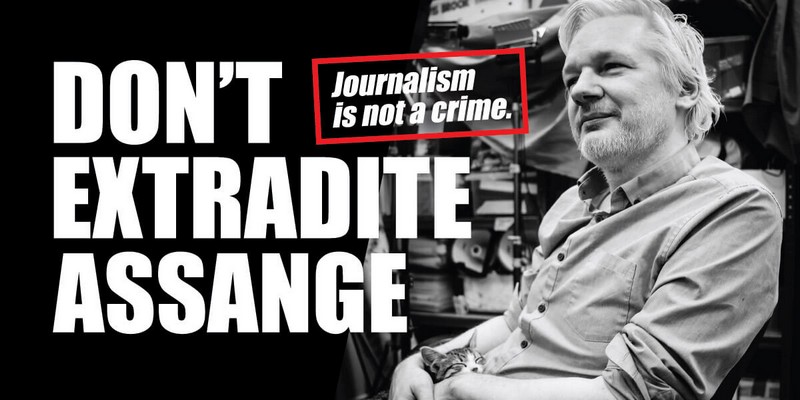
Don’t Extradite Assange

By Media Lens

22 Jun 2022 – Last Friday’s decision by UK Home Secretary Priti Patel to authorise the extradition of Julian Assange to the United States is both deeply shameful and unsurprising. Her action paves the way for Assange to be tried under the 1917 Espionage Act, introduced by the US government shortly after entering World War I, with a sentence of 175 years if found guilty. In essence, the US wishes to set a legal precedent for the prosecution of any publisher or journalist, anywhere in the world, who reports the truth about the US.

Despite all the warnings from human rights groups, advocates of press freedom, Nils Melzer (then UN Special Rapporteur on Torture), doctors, lawyers and many other people around the world, it has long been clear that Washington is determined to punish Assange and make an example of him as a warning to others. As always, US allies will go along with what the Mafia Godfather wants.

US political journalist Glenn Greenwald noted that Patel’s act ‘further highlights the utter sham of American and British sermons about freedom, democracy and a free press.’ Assange is being persecuted relentlessly because he and WikiLeaks have arguably done more than anyone else to expose the vast extent of the crimes of US empire.

Greenwald added:

‘Free speech and press freedoms do not exist in reality in the U.S. or the UK. They are merely rhetorical instruments to propagandize their domestic population and justify and ennoble the various wars and other forms of subversion they constantly wage in other countries in the name of upholding values they themselves do not support. The Julian Assange persecution is a great personal tragedy, a political travesty and a grave danger to basic civic freedoms. But it is also a bright and enduring monument to the fraud and deceit that lies at the heart of these two governments’ depictions of who and what they are.’

Dissident Australian journalist Caitlin Johnstone made a similar point, that Assange’s ‘refusal to bow down and submit’ has:

‘exposed the lie that the so-called free democracies of the western world support the free press and defend human rights. The US, UK and Australia are colluding to extradite a journalist for exposing the truth even as they claim to oppose tyranny and autocracy, even as they claim to support world press freedoms, and even as they loudly decry the dangers of government-sponsored disinformation.’

Peter Oborne, an all-too-rare example of a journalist speaking out on behalf of Assange, called Patel’s decision a ‘catastrophic blow’ to press freedom. But, he said, it was a blow that had been carried out with:

‘the silent assent of much of the mainstream press. Too many British newspapers and broadcasters have treated the Assange case as a dirty family secret. They have failed to grasp that the Assange hearing leading up to the Patel decision is the most important case involving free speech this century.’

Not only was there ‘silent assent’, but much of the media actually cheered and applauded Assange’s arrest in the Ecuadorian Embassy in April 2019 ‘with undisguised glee’, as Alan MacLeod wrote at the time:

‘The Daily Mail’s front-page headline (4/12/19) read, “That’ll Wipe the Smile Off His Face,” and devoted four pages to the “downfall of a narcissist” who was removed from “inside his fetid lair” to finally “face justice.” The Daily Mirror (4/11/19) described him as “an unwanted guest who abused his hospitality,” while the Times of London (4/12/19) claimed “no one should feel sorry” for the “overdue eviction.”

‘The Mirror (4/13/19) also published an opinion piece from Labour member of Parliament Jess Phillips that began by stating, “Finally Julian Assange, everyone’s least favourite squatter, has been kicked out of the Ecuadorian embassy.” She described the 47-year-old Australian as a “grumpy, stroppy teenager.”’

Oborne also noted that Patel’s decision:

‘turns investigative journalism into a criminal act, and licenses the United States to mercilessly hunt down offenders wherever they can be found, bring them to justice and punish them with maximum severity.’

Andrew Neil, the right-wing journalist and broadcaster, reflexively listed Assange’s supposed faults (‘reckless’, ‘stupid’, ‘narcissist’) in a Daily Mail opinion piece. But he still made clear his opposition to Assange’s extradition:

‘It is thanks to Assange that we know many appalling things that America would prefer we didn’t know. He does not deserve to spend the rest of his life in some high-tech American hellhole for doing what should come naturally to all good journalists — exposing what powerful people don’t want to be exposed.’

The BBC’s John Simpson and Mail on Sunday columnist Peter Hitchens have also been supportive of Assange.

But the few editorials that appeared in the British ‘mainstream’, while meekly and belatedly opposing extradition, were much less damning in their comments. According to our searches of the Lexis-Nexis newspaper database, the first edition of the Independent’s editorial was titled, ‘It’s time to release Assange – he has suffered enough’. By the time the editorial appeared online, the title had been watered down to:

‘Justice for Julian Assange should be tempered with mercy’

And an extra line had been added:

‘The WikiLeaks founder is no hero but nor should he be a martyr’

The paper’s praise for the vital work of Assange and Wikileaks was begrudging and limited, with the usual ‘mainstream’ caveats and distortions mixed in (see Johnstone’s powerful demolition of the multiple smears against Assange):

‘We were resolutely unsympathetic to Mr Assange’s claim to have been unfairly treated by the British and Swedish criminal justice systems. We urged him to face justice over the allegations of rape in Sweden, and considered his self-imprisonment in the Ecuadorian embassy in London to be a form of punishment for his refusal to do so.’

The Guardian, which had benefited enormously from Assange’s ground-breaking work – with many of its journalists publishing numerous snide articles and disparaging remarks about him – described Patel’s decision, with pathetic understatement, as ‘a bad day for journalism’. Of course, there was no mention in the editorial of the Guardian’s own shameful role in helping to create the conditions for Assange’s persecution; not least their fake front-page ‘news’ story in November 2018 claiming that Paul Manafort, Donald Trump’s former campaign manager, supposedly held secret talks with Assange in the Ecuadorian Embassy in London.

‘How Far Have We Sunk?’

As Nils Melzer packed up and moved on from his term as the UN Special Prosecutor on Torture, on the day that Patel announced Assange’s extradition, he said:

‘How far have we sunk if we prosecute people who expose war crimes for exposing war crimes?

‘How far have we sunk when we no longer prosecute our own war criminals because we identify more with them than we identify with the people that actually exposed these crimes?

‘What does that tell about us and about our governments?

‘How far have we sunk when telling the truth becomes a crime?’

The questions were left hanging in the air. But anyone with basic standards of ethics and wisdom knows that a society which has sunk this low is being governed by so-called ‘leaders’ who:

  • are lacking in ethics and wisdom;
  • are driven by concerns shaped by power and profit;
  • will attempt to crush anyone who dares to expose their crimes;
  • spout deceptive rhetoric – faithfully amplified and propagated by state-corporate media – proclaiming the West’s supposed virtues and respect for ‘freedom’, ‘human rights’ and ‘democracy’.

The persecution of Julian Assange has brought all this to the fore.

Yes, there are tiny windows in the ‘MSM’ for eloquent expressions of the truth; such as Peter Oborne’s Guardian opinion piece cited above. But the general drift of the ‘Overton Window’ – the ‘acceptable’, tightly limited range of news and debate – has shifted towards the hard right, with journalists and commentators squeezed out for being deemed ‘toxic’, ‘radioactive’ or otherwise ‘dangerous’.

Thus, in 2018, John Pilger, one of the finest journalists who has ever appeared in the British media, observed that:

‘My written journalism is no longer welcome in the Guardian which, three years ago, got rid of people like me in pretty much a purge of those who really were saying what the Guardian no longer says any more.’

The Guardian is a prime stoker of revitalised Cold War rhetoric about the ‘threat’ of Russia and China, mirroring what is prevalent across the whole ‘spectrum’ of ‘mainstream’ news. Indeed, as revealed by Declassified UK, an independent investigative news website, the UK’s leading liberal newspaper has essentially been ‘neutralised’ by the UK security services. Mark Curtis, editor and co-founder of Declassified UK, observed that the paper’s:

‘limited coverage of British foreign and security policies gives a misleading picture of what the UK does in the world. The paper is in reality a defender of Anglo-American power and a key ideological pillar of the British establishment.’

Selective Moral Outrage

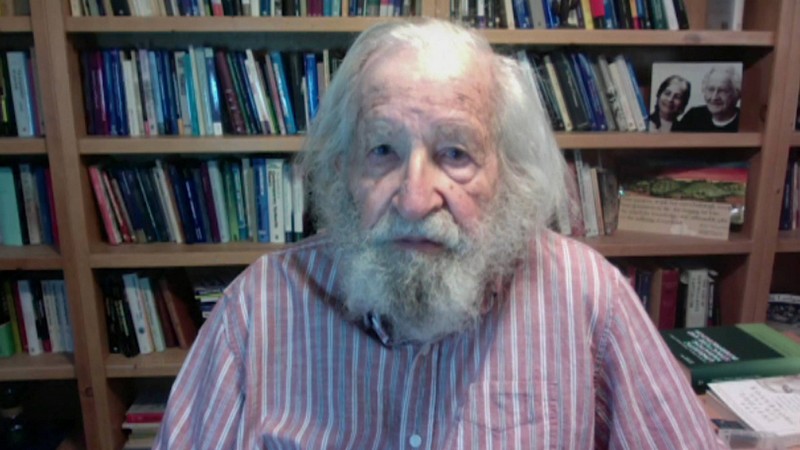
In a recent interview, David Barsamian asked Noam Chomsky:

‘In the media, and among the political class in the United States, and probably in Europe, there’s much moral outrage about Russian barbarity, war crimes, and atrocities. No doubt they are occurring as they do in every war. Don’t you find that moral outrage a bit selective though?’

Chomsky responded:

‘The moral outrage is quite in place. There should be moral outrage. But you go to the Global South, they just can’t believe what they’re seeing. They condemn the war, of course. It’s a deplorable crime of aggression. Then they look at the West and say: What are you guys talking about? This is what you do to us all the time.’

So, when the long-suffering people of the Global South encounter western news reports about Putin being the worst war criminal since Hitler:

‘They don’t know whether to crack up in laughter or ridicule. We have war criminals walking all over Washington. Actually, we know how to deal with our war criminals. In fact, it happened on the twentieth anniversary of the invasion of Afghanistan. Remember, this was an entirely unprovoked invasion, strongly opposed by world opinion. There was an interview with the perpetrator, George W. Bush, who then went on to invade Iraq, a major war criminal, in the style section of the Washington Post — an interview with, as they described it, this lovable goofy grandpa who was playing with his grandchildren, making jokes, showing off the portraits he painted of famous people he’d met. Just a beautiful, friendly environment.’

In the UK, the war criminal Tony Blair – another key player in the post-9/11 ‘War on Terror’ that led to at least 1.3 million deaths in Iraq, Afghanistan and Pakistan – was recently ‘honoured’ by the Queen. He became ‘a member of the Order of the Garter, the most senior royal order of chivalry’. This archaic nonsense is yet another symptom of the deeply-embedded, medieval stratification of British society, and the baubles that are handed out to preserve ‘order’ and ‘tradition’. This is revealing of the sickness at the heart of our society.

Chomsky gave another example of how the West’s war criminals are lauded:

‘Take probably the major war criminal of the modern period, Henry Kissinger. We deal with him not only politely, but with great admiration. This is the man after all who transmitted the order to the Air Force, saying that there should be massive bombing of Cambodia — “anything that flies on anything that moves” was his phrase. I don’t know of a comparable example in the archival record of a call for mass genocide. And it was implemented with very intensive bombing of Cambodia.’

The ‘justification’ for the extreme violence meted out by the West towards the Middle East and the Global South is always couched in propaganda terms proclaiming the protection of ‘human rights’, ‘democracy’ and ‘global security’. But, noted Chomsky:

‘The security of the population is simply not a concern for policymakers. Security for the privileged, the rich, the corporate sector, arms manufacturers, yes, but not the rest of us. This doublethink is constant, sometimes conscious, sometimes not. It’s just what Orwell described, hyper-totalitarianism in a free society.’

Chomsky concluded:

‘Meanwhile, we pour taxpayer funds into the pockets of the fossil-fuel producers so that they can continue to destroy the world as quickly as possible. That’s what we’re witnessing with the vast expansion of both fossil-fuel production and military expenditures. There are people who are happy about this. Go to the executive offices of Lockheed Martin, ExxonMobil, they’re ecstatic. It’s a bonanza for them. They’re even being given credit for it. Now, they’re being lauded for saving civilization by destroying the possibility for life on Earth. Forget the Global South. If you imagine some extraterrestrials, if they existed, they’d think we were all totally insane. And they’d be right.’

The appalling treatment of Julian Assange, especially set beside the ‘honouring’ and eulogising of the West’s war criminals, is symptomatic of this insanity.

In a brave and eloquent interview, Stella Assange, Julian’s wife and mother of their two young children, declared that:

‘We’re going to fight.’

An appeal to Britain’s High Court will be lodged within 14 days of Patel’s decision by Assange’s lawyers. As Stella Assange noted, one of the many unjust aspects of the US case against her husband is that, under the Trump administration, the CIA had plotted to assassinate Assange:

‘Extradition to the country that has plotted his assassination is just – I have no words. Obviously, this shouldn’t be happening. It can never happen.’

She continued:

‘That is just the tip of the iceberg of the criminal activity that has gone on, on behalf of those putting Julian in prison. For example, inside the [Ecuadorian] Embassy his legal meetings – his confidential privileged legal conversations with his lawyers – were being recorded and shipped to the United States.

‘All these elements have come out since Julian’s arrest and incarceration. And we now know so much about the abuse and outright criminality that has been going on against Julian. There’s no chance of a fair trial’.

She added:

‘And then you have the actual case. He’s charged under the Espionage Act. He faces 175 years. There is no public interest defence under the Espionage Act. It’s the first time it’s being repurposed; it’s being used against a publisher. It’s an Act that’s been repurposed in order to criminalise journalism, basically. And, of course, if you say that publishing information is a crime, then Julian’s guilty. He published information and he faces a lifetime in prison for it.’

In conclusion, she said:

‘The case is a complete aberration. That’s why you have all these major press freedom organisations and human rights organisations saying that this has to be dropped.’

We can take a significant step towards a saner society by shouting loudly for Julian Assange to be freed immediately. A good start would be to share widely this video from Double Down News in which Stella Assange describes the importance of the case and how we can all help.

____________________________

Media Lens is a UK-based media watchdog group headed by David Edwards and David Cromwell. In 2007, Media Lens was awarded the Gandhi Foundation International Peace Prize.

27 June 2022

Source: www.transcend.org

What Is ‘Socialism with Chinese Characteristics’? Inside China’s Economic Model

By Ben Norton

22 May 2022 – How does socialism with Chinese characteristics differ from Western neoliberal capitalism?

Multipolarista editor Benjamin Norton discussed China’s socialist model with economist John Ross, a senior fellow at the Chongyang Institute for Financial Studies at Renmin University of China.

Ross criticized Western left-wing academics like David Harvey, who have argued that China’s economy is capitalist or even neoliberal.

“The Chinese model has nothing to do whatever with neoliberalism. And that’s why it produced totally different results,” Ross said.

“China has raised, by World Bank criteria, since 1978, 850 million people out of poverty,” he emphasized. “This is the greatest contribution to human rights in the entire world.”

“There has never been such an alleviation of poverty in the whole of world history,” he noted. “It’s more than 70% of all those people taken out of poverty on the world scale.”

What is ‘socialism with Chinese characteristics’? Inside China’s economic model

20 June 2022

Source: www.transcend.org

‘Not a Justification but a Provocation’: Chomsky on the Root Causes of the Russia Ukraine War

By Dr Ramzy Baroud

One of the reasons that Russian media has been completely blocked in the West, along with the unprecedented control and censorship over the Ukraine war narrative, is the fact that western governments simply do not want their public to know that the world is vastly changing.

Ignorance might be bliss, arguably in some situations, but not in this case. Here, ignorance can be catastrophic as western audiences are denied access to information about a critical situation that is affecting them in profound ways and will most certainly impact the world’s geopolitics for generations to come.

The growing inflation, an imminent global recession, a festering refugee crisis, a deepening food shortage crisis and much more are the kinds of challenges that require open and transparent discussions regarding the situation in Ukraine, the NATO-Russia rivalry and the responsibility of the West in the ongoing war.

To discuss these issues, along with the missing context of the Russia-Ukraine war, we spoke with Professor Noam Chomsky, believed to be the greatest living intellectual of our time.

Chomsky told us that it “should be clear that the (Russian) invasion of Ukraine has no (moral) justification.” He compared it to the US invasion of Iraq, seeing it as an example of “supreme international crime.” With this moral question settled, Chomsky believes that the main ‘background’ of this war, a factor that is missing in mainstream media coverage, is “NATO expansion”.

“This is not just my opinion,” said Chomsky, “it is the opinion of every high-level US official in the diplomatic services who has any familiarity with Russia and Eastern Europe. This goes back to George Kennan and, in the 1990s, Reagan’s ambassador Jack Matlock, including the current director of the CIA; in fact, just everybody who knows anything has been warning Washington that it is reckless and provocative to ignore Russia’s very clear and explicit red lines. That goes way before (Vladimir) Putin, it has nothing to do with him; (Mikhail) Gorbachev, all said the same thing. Ukraine and Georgia cannot join NATO, this is the geostrategic heartland of Russia.”

Though various US administrations acknowledged and, to some extent, respected the Russian red lines, the Bill Clinton Administration did not. According to Chomsky, “George H. W. Bush … made an explicit promise to Gorbachev that NATO would not expand beyond East Germany, perfectly explicit. You can look up the documents. It’s very clear. Bush lived up to it. But when Clinton came along, he started violating it. And he gave reasons. He explained that he had to do it for domestic political reasons. He had to get the Polish vote, the ethnic vote. So, he would let the so-called Visegrad countries into NATO. Russia accepted it, didn’t like it but accepted it.”

“The second George Bush,” Chomsky argued, “just threw the door wide open. In fact, even invited Ukraine to join over, despite the objections of everyone in the top diplomatic service, apart from his own little clique, Cheney, Rumsfeld (among others). But France and Germany vetoed it.”

However, that was hardly the end of the discussion. Ukraine’s NATO membership remained on the agenda because of intense pressures from Washington.

“Starting in 2014, after the Maidan uprising, the United States began openly, not secretly, moving to integrate Ukraine into the NATO military command, sending heavy armaments and joining military exercises, military training and it was not a secret. They boasted about it,” Chomsky said.

What is interesting is that current Ukrainian President Volodymyr Zelensky “was elected on a peace platform, to implement what was called Minsk Two, some kind of autonomy for the eastern region. He tried to implement it. He was warned by right-wing militias that if he persisted, they’d kill him. Well, he didn’t get any support from the United States. If the United States had supported him, he could have continued, we might have avoided all of this. The United States was committed to the integration of Ukraine within NATO.”

The Joe Biden Administration carried on with the policy of NATO expansion. “Just before the invasion,” said Chomsky, “Biden … produced a joint statement … calling for expanding these efforts of integration. That’s part of what was called an ‘enhanced program’ leading to the mission of NATO. In November, it was moved forward to a charter, signed by the Secretary of State.”

Soon after the war, “the United States Department acknowledged that they had not taken Russian security concerns into consideration in any discussions with Russia. The question of NATO, they would not discuss. Well, all of that is provocation. Not a justification but a provocation and it’s quite interesting that in American discourse, it is almost obligatory to refer to the invasion as the ‘unprovoked invasion of Ukraine’. Look it up on Google, you will find hundreds of thousands of hits.”

Chomsky continued, “Of course, it was provoked. Otherwise, they wouldn’t refer to it all the time as an unprovoked invasion. By now, censorship in the United States has reached such a level beyond anything in my lifetime. Such a level that you are not permitted to read the Russian position. Literally. Americans are not allowed to know what the Russians are saying. Except, selected things. So, if Putin makes a speech to Russians with all kinds of outlandish claims about Peter the Great and so on, then, you see it on the front pages. If the Russians make an offer for a negotiation, you can’t find it. That’s suppressed. You’re not allowed to know what they are saying. I have never seen a level of censorship like this.”

Regarding his views of the possible future scenarios, Chomsky said that “the war will end, either through diplomacy or not. That’s just logic. Well, if diplomacy has a meaning, it means both sides can tolerate it. They don’t like it, but they can tolerate it. They don’t get anything they want, they get something. That’s diplomacy. If you reject diplomacy, you are saying: ‘Let the war go on with all of its horrors, with all the destruction of Ukraine, and let’s let it go on until we get what we want.’”

By ‘we’, Chomsky was referring to Washington, which simply wants to “harm Russia so severely that it will never be able to undertake actions like this again. Well, what does that mean? It’s impossible to achieve. So, it means, let’s continue the war until Ukraine is devastated. That’s US policy.”

Most of this is not obvious to western audiences simply because rational voices are “not allowed to talk” and because “rationality is not permitted. This is a level of hysteria that I have never seen, even during the Second World War, which I am old enough to remember very well.”

While an alternative understanding of the devastating war in Ukraine is disallowed, the West continues to offer no serious answers or achievable goals, leaving Ukraine devastated and the root causes of the problem in place. “That’s US policy”, indeed.

Dr. Ramzy Baroud is a journalist and the Editor of The Palestine Chronicle.

26 June 2022

Source: countercurrents.org

UN report declares “perpetual occupation” as “the underlying root cause” of Israeli-Palestinian conflict

By Jean Shaoul

A report commissioned by the United Nations’ Human Rights Council states that Israel’s “perpetual occupation” of Palestinian areas and its refusal to end it underpin the tensions between Palestinians and Israelis.

The authors insist that ending of the occupation of the West Bank, East Jerusalem and Gaza since their capture by Israel in the 1967 Arab Israeli war in full conformity with the UN’s Security Council resolutions is essential to end “the persistent cycle of violence.”

The report, published June 7, is the first by a Commission of Inquiry headed by former UN human rights chief Navi Pillay and two other experts from India and Australia, set up last year following an 11-day war between Israel and Hamas in Gaza. That war killed at least 261 people, including 67 children, in Gaza, and 14 people, including two children, in Israel.

The Commission is the first to have an “ongoing” mandate from the UN human rights agency. This includes alleged human rights abuses before and after the war and the investigation of the “root causes” of the tensions.

The report states, “What has become a situation of perpetual occupation was cited by Palestinian and Israeli stakeholders to the commission as the one common issue” that amounts to the “underlying root cause” of recurrent tensions, instability and protracted conflict. The evidence convincingly indicates that Israel has no intention of ending the occupation. Instead, it is pursuing “clear policies for ensuring complete control” over the Occupied Palestinian Territories, including East Jerusalem, and is taking steps to alter the demography through its creation of a repressive environment for the Palestinians and a favourable one for Israeli settlers.

The Commission says that Israel has failed to uphold international law and conventions relating to war and human rights and carry the UN’s previous recommendations. These include ending the occupation, ceasing settlement expansion, ending forced evictions, ceasing the policy of administrative detention, particularly of children, lifting the restriction of freedom of movement that fragment Palestinian society, including by lifting the blockade on Gaza, allowing Palestinians access to their natural resources, and eliminating laws and practices that discriminate against Palestinians, including road segregation for the exclusive use of the Israeli population.

The commission accuses Israel of affording “different civil status, rights and legal protection” for Palestinians living in Israel, noting that Israel operates a three-tier system of laws granting different rights to Jewish Israeli citizens, Palestinian citizens of Israel and East Jerusalem’s Palestinian residents. It cites Israel’s Nation-State of the Jewish People Law (2018) as effectively constituting racial discrimination by granting nationality rights only to its Jewish as opposed to Palestinian citizens and the recent renewal of a law that denies citizenship to Palestinians married to Israelis, calling for action to ensure equal human rights.

Last week, Prime Minister Naftali Bennett’s fragile coalition lost its razor-thin majority and was unable to secure the first reading of a bill renewing civilian legal rights for Jewish settlers in the West Bank. Opposition leader and former Prime Minister Benjamin Netanyahu’s political bloc had opposed it trying to bring down the government. If the bill does not pass by the end of this month, Israeli settlers will be formally placed, like the Palestinians, under military law and denied entry into Israel.

The report warns that “impunity” for perpetrators of violence is feeding resentment among Palestinians in the West Bank, Gaza and East Jerusalem. This is an implicit indictment of Washington and the major European powers that have built up Israel’s military and provided political and diplomatic support, particularly at the UN Security Council where the US has vetoed scores of resolutions condemning Israel’s actions. The commission will, it concludes, examine the responsibilities of “third States in ensuring respect for and full compliance with international humanitarian law and human rights law in the Occupied Palestinian Territory, including East Jerusalem, in Israel and in the occupied Syrian Golan.”

The report will be discussed at the UN Human Rights Council in Geneva next week, which has no power to make legally binding decisions.

Israel predictably dismissed the report. The Ministry of Foreign Affairs called it “a waste of money and effort” that amounted to a witch-hunt. Israel had boycotted the inquiry, accusing it of bias, and barred entry to its investigators.

State Department spokesperson Ned Price cynically reiterated the US’s opposition to the inquiry, saying the report does nothing to alleviate US concerns over “a one-sided, biased approach that does nothing to advance the prospects for peace.” The Trump administration pulled out of the UN Human Rights Council in 2018 over what it described as its “chronic bias” against Israel, with the Biden administration only fully rejoining this year.

The world’s mainstream press has not seen fit to comment on the UN’s report, including those champions of human rights imperialist intervention the New York Times and the Guardian. Their silence underlines the hypocrisy of US/NATO claims to be defending “democracy” in Ukraine while they provide support for an apartheid and militarist regime in Israel.

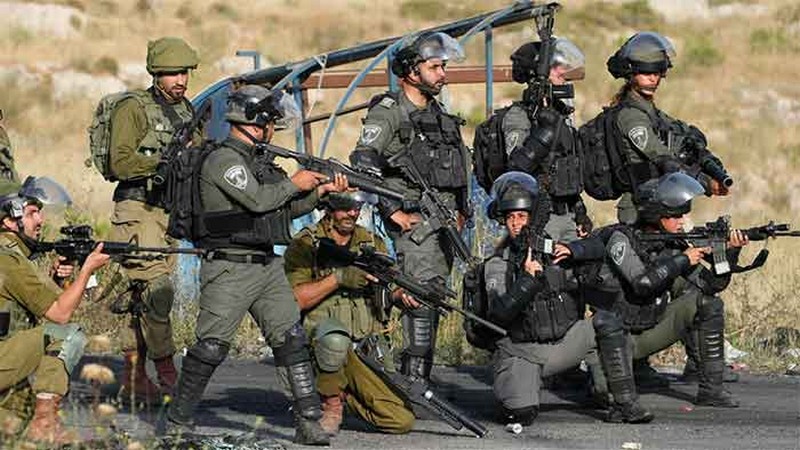
The commission’s report comes as Bennett’s coalition government, made up of parties across the political spectrum including those ostensibly supporting a Palestinian statelet, is unleashing a torrent of repression against the Palestinians in the West Bank, including deliberate killings and injuries, arbitrary arrests, torture, persecution and collective punishment. Last Wednesday and Thursday, Israeli forces killed four Palestinians across the West Bank in just 24 hours, bringing the total number of Palestinians killed this year to 62. Riot police and mounted units have injured hundreds of protesters and arrested hundreds more as they crack down on those protesting Israeli brutality and unbearable social conditions.

As far as Israel is concerned, no one is immune from its murderous activities. Last month, the Israeli military deliberately shot and killed Shireen Abu Akleh, the widely respected veteran Al Jazeera Arabic reporter, who was clearly visible and wearing a press identifier. According to Reporters Without Borders, this brings to 35 the number of journalists killed while working in Israel and the Occupied Palestinian Territories since 2000. Abu Akleh’s murder and the police’s attack on her funeral procession make clear that Israel will not tolerate the reporting of its brutal suppression of the Palestinians.

Bennett has issued orders to shoot Palestinians who pose no immediate threat and called for the formation of armed vigilante groups, based in part on civilian volunteers, including from the “New Hashomer” (The New Guardian), a far-right militia.

The silence of the imperialist powers confirms the cynicism of their use of “human rights” rhetoric to justify wars, military interventions, coups, regime change operations, referral to the International Criminal Court and sanctions against those who threaten their predatory interests.

The US and NATO have denounced Russia for “war crimes” in Ukraine and China for committing “crimes against humanity and genocide against Muslim Uyghurs” based on unconfirmed or non-existent evidence. Washington’s support for Israel is bound up with Tel Aviv’s role as its attack dog against its rivals in the region and its own policy of normalising wars of conquest, occupation and repression. It signifies that the brutal methods used by Israel in suppressing the Palestinians will be used against the working class and youth that revolt against the ruling elites’ dictates putting the pursuit of corporate profit before human need.

10 June 2022

Source: countercurrents.org

The Global Ruling Class, Endless War, and the Culture of Mass Death

By Chris Hedges

The global ruling class is cementing into place a world where they govern without accountability, we are reduced to serfdom, the climate crisis accelerates, and mass death is normalized.

It is hard to be sanguine about the future. The breakdown of the ecosystem is well documented. So is the refusal of the global ruling elite to pursue measures that might mitigate the devastation. We accelerate the extraction of fossil fuels, wallow in profligate consumption, including our consumption of livestock, and make new wars as if we are gripped by a Freudian death wish. The Four Horsemen of the Apocalypse—Conquest, War, Famine and Death—gallop into the 21rst century.

Those who rule, servants of corporations and the global billionaire class, accompany the suicidal folly by cementing into place corporate tyranny. The plan is not to reform. It is to perpetuate the corporate pillage. This pillage, more and more onerous for the global population, necessitates a new totalitarianism, one where the billionaire class lives in opulence, workers are serfs, rights such as privacy and due process are abolished, Big Brother watches us all the time, war is the chief business of the state, dissent is criminalized and those displaced by conflicts and climate breakdown are barred entry into the climate fortresses in the global north. Portions of the human species, the most privileged, will, in theory, hold out a little longer before they succumb to the great die off.

The persecuted and the abandoned, now in the tens of millions, know the future. For them, the future has already arrived. Julian Assange, the most important publisher of our generation, whose extradition to the US was approved on Friday by the British Home Secretary Priti Patel, is an example of what will befall all publishers and journalists that expose the inner workings of power. His imprisonment for revealing the war crimes, mendacity, cynicism, and corruption of the ruling class, including the Democratic Party, heralds a new era. Investigations into the centers of power, the life blood of journalism, will be a criminal offense.

It does not matter that Assange, who suffered a stroke and is in poor physical and psychological health, is not a U.S. citizen or that WikiLeaks is not a US-based publication. It does not matter that all of Assange’s meetings with his attorneys were recorded by UC Global, the Spanish security firm at the Ecuadorian Embassy where Assange lived for seven years, and turned over to the US, obliterating attorney-client privilege. The campaign against Assange, and I have sat in on hearings in London, is a Dickensian farce, the persecution of an innocent and heroic man, far more reminiscent of the Lubyanka than the best of British jurisprudence. He is being used to send a message— if you expose what we do we will destroy you.

Workers, whether in the vast sweatshops in China or the decayed ruins of the rust belt, struggle on subsistence wages without job protection or unions. They are cursed by trade deals, deindustrialization, austerity, rising interest rates and rising prices. They, too, know the future.

The decision to raise interest rates by three-quarters of a percentage point, with new rate hikes on the way, will further depress wages, which have stagnated for decades, increase unemployment and personal debt and make food and other basic necessities more expensive. Raising interest rates usually induces a recession. But the oligarchs are more than willing to extract blood from the working class. Inflation reduces investment returns. It disrupts leveraged financial strategies.

Prices are not rising because of wages. They are rising because of supply shortages and price gouging by corporations and oil conglomerates. US corporations posted their biggest profit growth in decades by raising prices during the pandemic. Corporate pretax profits rose last year by 25 percent to $2.81 trillion, according to the Bureau of Economic Analysis. That’s the largest annual increase since 1976, according to the Federal Reserve. When taxes are included, last year’s corporate profit rose to 37 percent, more than any other time since the Fed began tracking profits in 1948.

Antitrust laws and breaking up monopolies would ease the strain of inflation and lower prices. Rationing would break inflation. So would a wage-price freeze. Nationalization, reversing the capture of public utilities, the health care system, banking, and other services by corporations, would also blunt price rises. But the billionaire class is not about to impose measures that diminish their profits. They will keep their monopolies. They will keep their grip on what were once public assets. The message from the billionaire class is this: the economy is run for our benefit, not yours.

Ukrainians, enduring a war of attrition with the infusion of tens of billions of dollars of weapons from the US and Europe, know the future. War is the chief business of the state. It enriches the arms industry. It expands the military budget. The US now sends $130 million a day in military aid and assistance to Ukraine, part of the $55 billion in aid promised by Washington.

The US, struggling with societal breakdown and an ailing economy, sees its military as the only mechanism left to destroy global competitors, especially Russia and China. Russia, hemmed in by an expanding NATO in Central and Eastern Europe, and China harassed by a succession of carrier groups in the South China Sea, which Washington has called a “national interest,” have been united as US adversaries. China sees the waterways of Asia and the Pacific as part of its sphere of influence, as Russia sees Ukraine and other neighboring states. The aggressive military posturing of the US on the borders of China and Russia has provoked an unnecessary cold war, one many Washington policy makers nonchalantly expect may evolve into a hot war amongst nuclear armed nations that would potentially obliterate life on the planet.

There is an intensifying scramble for control, with Russia’s invasion of Ukraine and China’s building of air bases from Japan to Australia along the Asian littoral, giving it the ability to attack warships, including aircraft carriers, in the western Pacific. The refusal of the U.S. to accommodate itself to a multipolar world and to chase the chimera of unrivaled global hegemony has seen Russia and China solidify an alliance, an alliance cold warriors worked hard to prevent. The hostilities, a self-fulfilling prophecy by U.S. warmongers, delights the Washington establishment whose goal is to perpetuate endless war.

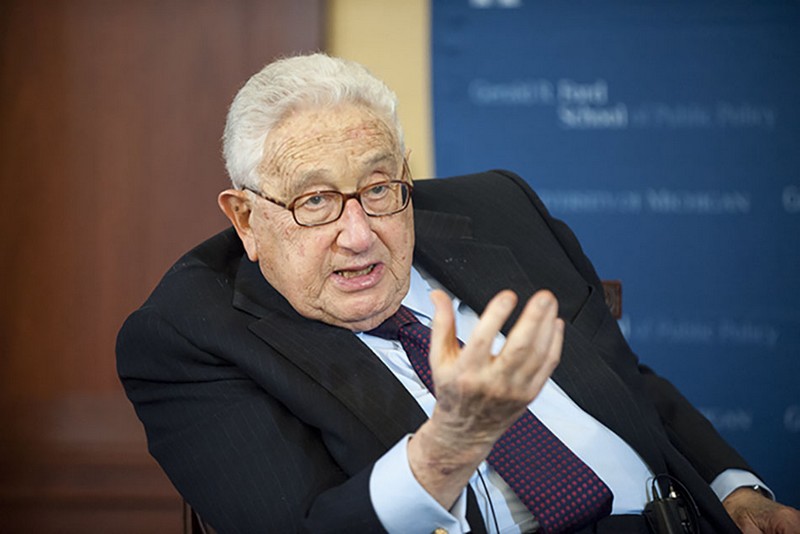
You know you are in trouble when Henry Kissinger, who has called for Ukraine to cede territory to Russia and open negotiations with Moscow “in the next two months before it creates upheavals and tensions that will not be easily overcome,” is a voice of sanity.

Despotic governments need an enemy to justify the repression of dissidents, the reduction and cancellation of social programs and the iron control of information. Wars justify the unjustifiable—black sites, kidnapping, torture, targeted assassinations, censorship, and arbitrary detention—off-the-book war crimes. War induces a state of perpetual paranoia and fear. It demands mass obedience.

“The war is not meant to be won, it is meant to be continuous,” George Orwell writes in 1984. “Hierarchical society is only possible on the basis of poverty and ignorance. This new version is the past and no different past can ever have existed. In principle the war effort is always planned to keep society on the brink of starvation. The war is waged by the ruling group against its own subjects and its object is not the victory over either Eurasia or East Asia, but to keep the very structure of society intact.”

The message of endless war is—if you defy the ruling class, the militarists and the government, you are a traitor.

The 140 million people across the globe suffering from acute hunger, a result of the pandemic, the climate crisis and the war in Ukraine, know the future, along with the families of the 15 million people who died from the pandemic, hundreds of thousands of whom with proper prevention and medical care could have been saved. The refugees fleeing failed states and climate disasters—there could be 1.2 billion climate refugees by 2050 – in the global south know the future.

The message imparted to the poor, the vulnerable, the sick and the weak is this: your lives and the lives of your children do not matter.

The oligarchs in the Democratic Party and the establishment wing of the Republican Party are aware they are in political trouble. Is it due to Russian meddling? Is it due to Donald Trump and his proto-fascist minions? Is it caused by journalists and publishers like Assange who give them a bad name? Is it a failure of messaging? Is it a lack of rigorous censorship of the far-right and leftist critics?

The Democratic Party, now united with the establishment Republican Party, is flailing around for a solution. They are bankrolling far right candidates in the Republican primaries, a tactic that backfired on Hillary Clinton when her campaign worked during the primaries to promote Donald Trump as the Republican nominee. Retrograde Republicans, de facto members of the Democratic Party because they voted to impeach Trump, are being lionized as true patriots, as if they can lure people away from Trump and Trump-like clones. Robert Reich, along with other Democratic leaders, argues that Rep. Cheney—who voted for Trump policies 93 percent of the time as a member of the House but now looks set to lose her bid for reelection in Wyoming—has “demonstrated more courage and integrity than any other politician in America” and might just be “the best president of the United States for the perilous time we’re entering.” Jonathan V. Last, in an article headlined “Mike Pence is an American Hero” in The Atlantic, writes that Pence “did more to protect democracy—both on January 6 and since—than any other person inside the Trump administration.”

Perhaps the expected Supreme Court ruling that will overturn Roe v. Wade will work in their favor. Perhaps the televised hearings on the January 6th assault on the Capitol, an extended campaign commercial, will convince voters to support them. Perhaps the promise of more stringent gun laws will excite the electorate.

What can we expect from a party leadership that believed Michael Bloomberg, who has switched allegiance between the Democratic and Republican parties several times, would save them from progressives such as Bernie Sanders? What can we expect from a party leadership that anointed Joe Biden, who spent his political career dispossessing working men and women, building the world’s largest prison system, militarizing police, destroying the welfare system and funding military fiascos in the Middle East, as president?

The Biden administration is defined by failed expectations, from its stymied Build Back Better Plan to its refusal to raise the minimum wage. It is running on fumes, using gimmicks, empty rhetoric, spectacle and fear to intimidate the electorate.

The descent is pathetic to watch, reminiscent of the moment Romanian dictator Nicolae Ceaușescu tried desperately to placate an unruly crowd from the Balcony of the Central Committee of the Communist Party of Romania building by offering to raise pension and family allowance by $2 a month. He and his wife were executed four days later. The discredited East German Communist Party, which like the Romanian revolution I also covered as a reporter, made similar empty gestures, promising to open its closed party headquarters to the public long after anyone cared.

The billionaire class, or at least many of them, would prefer to loot and pillage under the cover of the old political decorum and rhetoric. They like the fiction of paying homage to an emasculated democracy. It gives them the veneer of respectability.

But this is not to be. The rage of the betrayed is articulated by imbecilic demagogues vomited up from the social and political swamp. Corporations and the billionaire class will continue to exploit, but under a cruder and crueler authoritarianism. The social, political, economic, and environmental breakdown will accelerate. Reality, increasingly unpalatable, will cease to exist in public discourse. It will be replaced by Millenarian cults, such as the Christian fascists, and bizarre conspiracy theories, a retreat into magical thinking where evil is embodied in demonized individuals and groups that must be eradicated. Truth and lies will be indistinguishable. The vulnerable will be cast aside, blamed for their own misery, as well as ours. Those who resist will be criminals. Mass death will sweep across the planet. This is the world our children will inherit unless those who control us are wrenched from power.

Chris Hedges is a Pulitzer Prize–winning journalist who was a foreign correspondent for fifteen years for The New York Times, where he served as the Middle East Bureau Chief and Balkan Bureau Chief for the paper.

21 June 2022

Source: countercurrents.org

The Geopolitics of the New Cold War

By Alfred W McCoy

From his first days in office, Joe Biden and his national security advisers seemed determined to revive America’s fading global leadership via the strategy they knew best — challenging the “revisionist powers” Russia and China with a Cold War-style aggressiveness. When it came to Beijing, the president combined the policy initiatives of his predecessors, pursuing Barack Obama’s “strategic pivot” from the Middle East to Asia, while continuing Donald Trump’s trade war with China. In the process, Biden revived the kind of bipartisan foreign policy not seen in Washington since the Soviet Union collapsed in 1991.

Writing in the December 2021 Foreign Affairs, a group of famously disputatious diplomatic historians agreed on one thing: “Today, China and the United States are locked in what can only be called a new cold war.” Just weeks later, the present mimed the past in ways that went well beyond even that pessimistic assessment as Russia began massing 190,000 troops on the border of Ukraine. Soon, Russian President Vladimir Putin would join China’s Xi Jinping in Beijing where they would demand that the West “abandon the ideologized approaches of the Cold War” by curtailing both NATO’s expansion into Eastern Europe and similar security pacts in the Pacific.

As Russia’s invasion of Ukraine loomed in late February, the New York Times reported that Putin was trying “to revise the outcome of the original Cold War, even if it is at the cost of deepening a new one.” And days later, as Russian tanks began entering Ukraine, the New York Times published an editorial headlined, “Mr. Putin Launches a Sequel to the Cold War.” The Wall Street Journal seconded that view, concluding that recent “developments reflect a new cold war that Xi Jinping and Vladimir Putin have initiated against the West.”

Instead of simply accepting that mainstream consensus, it couldn’t be more important right now to explore that Cold War analogy and gain a fuller understanding of how that tragic past does (and doesn’t) resonate with our embattled present.

The Geopolitics of Cold Wars

There are indeed a number of parallels between our Cold Wars, old and new. Some 70 years ago, in January 1950, Mao Zedong, the head of a Chinese People’s Republic ravaged by long years of war and revolution, met Soviet leader Joseph Stalin in Moscow as a supplicant. He was seeking a treaty of alliance and friendship that would provide much-needed aid for his fledgling communist state.

Within months, Stalin played upon this brand-new alliance by persuading Mao to send troops into the maelstrom of the Korean War, where China soon began hemorrhaging money and manpower. Until his death in 1953, Stalin kept the U.S. military bogged down in Korea, as he sought “an advantage in the global balance of power.” With Washington focused on war in Asia, Stalin consolidated his grip on seven “satellite states” in Eastern Europe — but at a cost. In those years, a newly created NATO would be transformed into a genuine military alliance, as 16 nations dispatched troops to Korea.

Last February, in a reversal of Cold War roles, Putin arrived at that Beijing summit as a supplicant, desperately seeking Chinese President Xi Jinping’s diplomatic support for his Ukrainian gambit. Proclaiming their relations “superior to political and military alliances of the Cold War era,” the two leaders asserted that their entente had “no limits… no ‘forbidden’ areas of cooperation.”

Soon after, the Russian president would invade Ukraine, while ominously putting his nuclear forces on high alert, a warning to the West not to meddle in his war. In a clear parallel to the old Cold War, nuclear weapons are far too dangerous for a direct superpower conflict to break out, so the U.S. and its NATO allies chose surrogate warfare in Ukraine. Just as the Soviet Union once armed North Vietnam with surface-to-air missiles and tanks to bloody the U.S. military, so Washington now began supplying Kyiv with high-tech weaponry to damage the Russian army.

As Ukrainian defenders armed with U.S.- and NATO-supplied shoulder-fired missiles destroyed 2,500 of its armored vehicles, Russia would be forced to pull back from its bid to capture the Ukrainian capital and shift to a months-long slog to seize the Russian-speaking Donbas region near its own border. This effort has, in turn, sparked an artillery duel now fast approaching the sort of strategic stalemate not seen since the Korean War (a conflict that remains unresolved nearly 70 years later).

Beneath such surface similarities between the two eras, however, lies a crucial if elusive difference: geopolitics. As I explain in my recent book, To Govern the Globe, this is essentially a method for the management of empire. At the high tide of the British Empire in 1904, English geographer Halford Mackinder published an influential article arguing that Europe, Asia, and Africa weren’t, in fact, three separate continents but a unitary landmass he dubbed “the World-Island,” whose strategic pivot lay in the “heartland” of central Eurasia. Mackinder later boiled his thinking down to a memorable maxim: “Who rules the Heartland commands the World-Island; Who rules the World-Island commands the World.”

Apply Mackinder’s principles to the old Cold War and you can indeed see an underlying geopolitics that lends coherence to an otherwise disparate conflict spread across four decades and five continents. In the 500 years since European exploration first brought the continents into continuous contact, the rise of every major world power has required one thing above all: dominance over Eurasia, now home to 70% of the world’s population and productivity. Those five centuries of imperial rivalry could be summarized, thanks to Mackinder, in a succinct geopolitical axiom: “The exercise of global hegemony requires control over Eurasia, and contestation over that vast continent thus determines the fate of empires and their world orders.”

By the time the Cold War ended in 1991, Washington had translated that axiom into a three-part geopolitical strategy to defeat the Soviet Union. First, it encircled Eurasia with military bases and mutual-defense pacts to contain Beijing and Moscow behind an “Iron Curtain” stretching 5,000 miles across that vast land mass. Second, the U.S. intervened, using either conventional force or CIA covert operations whenever the communists threatened to expand their power beyond that “curtain” — whether in Korea, Southeast Asia, the Middle East, or sub-Saharan Africa. Finally, Washington aggressively defended its own hemisphere from communist influence of any sort, however homegrown — whether in Cuba, Central America, or Chile.

In a magisterial sweep through a millennium of Eurasian history, Oxford scholar John Darwin found that, after World War II, Washington achieved its “colossal imperium… on an unprecedented scale” by becoming the first power ever to control the strategic axial points “at both ends of Eurasia.” Initially, Washington defended Eurasia’s western axis through the NATO defense pact signed with a dozen allies in April 1949, making the Cold War, at its outset, little more than a regional conflict over Eastern Europe.

In October 1949, however, communists surprised the world by capturing China. Moscow then forged a Sino-Soviet alliance that suddenly threatened to become the dominant force on the Eurasian land mass. In response, Washington moved quickly to counter that geopolitical challenge by forging four bilateral defense pacts, thereby developing a 5,000-mile chain of military bases along the Pacific littoral from Japan and South Korea all the way to Australia. By serving as the frontier for the defense of one continent (North America) and a springboard for its dominance of another (Eurasia), the Pacific littoral would become Washington’s key geopolitical fulcrum.

In the 1960s, the Sino-Soviet alliance would suddenly collapse into a bitter rivalry — a lucky break for Washington that left Moscow without a major ally anywhere in Eurasia. Reeling from their breach with Beijing, the Soviet leaders would spend several decades trying, unsuccessfully, to break out of their geopolitical isolation by expanding into Latin America, Southeast Asia, the Middle East, southern Africa, and, fatally, Afghanistan, catalyzing a succession of local conflicts that led to the deaths of some 20 million people between 1945 and 1990.

A New Geopolitical Balance

At the close of the Cold War, when the U.S. seemed to stand astride the globe like a Titan of Greek legend, Zbigniew Brzezinski, the former national security adviser to President Jimmy Carter and a devotee of Mackinder’s geopolitical theory, warned that Washington should take care to avoid three pitfalls that could erode its global power. It must, he warned, preserve its strategic “perch on the Western periphery” of Eurasia through NATO; it must prevent “the expulsion of America from its offshore bases” along the Pacific littoral; and it must block the rise of “an assertive single entity” in the “middle space” of that vast landmass.

Now, skip three decades and, in response to Russia’s invasion of Ukraine, NATO countries have worked with surprising unanimity to slap sanctions on Moscow, ship advanced weaponry to Kyiv, and even take in previously neutral Sweden and Finland as possible members. In this way, Washington seems to have forged a trans-Atlantic solidarity not seen since the Cold War and preserved, at least for now, Washington’s strategic “perch on the Western periphery” of Eurasia.

By his surprisingly blunt statement last month that the U.S. would “get involved militarily to defend Taiwan” (a key driver of the global economy through its mass production of sophisticated computer chips) and his warning that a possible Chinese attack there would be “similar to what happened in Ukraine,” President Biden has been trying to assert an ever stronger American military presence in the Pacific. China has, however, also been moving in that region, militarily, politically, and diplomatically, potentially winning over islands that were once an American preserve.

Whatever Washington has done to strengthen its “strategic perch” in Europe by rallying NATO and allies in the Pacific as well, it has clearly failed to meet Brzezinski’s critical third criteria for the preservation of its global power. Indeed, the rise of China as “an assertive single entity” in the pivotal “middle space” of Eurasia could potentially prove a fatal geopolitical blow to Washington’s global ambitions, the equivalent of the impact the Sino-Soviet split had on Moscow during the old Cold War.

As its foreign reserves reached an extraordinary $4 trillion in 2014, Beijing announced a trillion-dollar Belt and Road Initiative (BRI) meant to build an economic bloc encompassing the whole of Mackinder’s tri-continental world island. To overcome Eurasia’s vast distances, China quickly began constructing a steel grid of rails, roads, and gas pipelines that, when integrated with Russia’s networks, would reach across the continent. Within just five years, a World Bank study found that BRI transportation projects were boosting trade among 70 nations by up to 9.7% and lifting 32 million people out of poverty. By 2027, Beijing is expected to commit $1.3 trillion to this project, which would make it the largest investment in history — more than 10 times the foreign aid Washington allocated to its famed Marshall Plan that rebuilt a ravaged Europe after World War II.

To strengthen its regional influence and weaken the U.S. grip on the Pacific littoral, China has also used the BRI to court allies in the Asia-Pacific region. In 2020, in fact, it formed a Regional Comprehensive Economic Partnership, the world’s largest trade pact with 15 Asia-Pacific nations representing 30% of global trade.

Taking a leaf out of Stalin’s geopolitical playbook, President Xi has much to gain from Vladimir Putin’s headstrong plunge into Ukraine. In the short term, Washington’s focus on Europe slows any serious strategic “pivot” to the Pacific, allowing Beijing to further consolidate its burgeoning commercial dominance there. By allying with Russia and so meeting its own food and energy needs, while maintaining ties to Europe through formal neutrality in the Ukraine war, Beijing could emerge, like Moscow after the Vietnam War, with its global influence markedly enhanced and the U.S. geopolitical position significantly weakened.

The Limits of Historical Analogy

However strong the geopolitical continuities between the two eras may be, history also spins skeins of discontinuity, making the past, at best, an imperfect guide to the present. During the 30 years after the Cold War ended, a relentless economic globalization has incorporated China as the world’s industrial workshop and Russia as a key provider of energy, minerals, and grains into the world economy.

As a result, despite recent sanctions, geopolitical “containment” of the sort once used against the old Soviet Union’s feeble command economy is no longer feasible. With the war already causing what the World Bank calls an “an enormous humanitarian crisis,” pressures are building for some way to reintegrate Russia into a global economy that is suffering badly from the ostracism of a country that ranks first in world wheat and fertilizer exports, second in gas production, and third in oil output.

By blockading Ukraine’s Black Sea ports and advancing toward its main one, Odessa, Putin has disrupted grain exports from both Russia and Ukraine, which together provide almost one third of the world’s wheat and barley and so are critical to feeding the Middle East, as well as much of Africa. With the specter of mass starvation looming for some 270 million people and, as the U.N. recently warned, political instability growing in those volatile regions, the West will, sooner or later, have to reach some understanding with Russia.

Similarly, Europe’s escalating embargo of Russia’s natural gas and oil exports is proving profoundly disruptive to global energy markets, stoking inflation in the United States and sending fuel prices soaring on the continent. Already, Putin has successfully shifted much of his country’s oil and gas exports from Europe to China and India. Within months, the European Union’s embargo will likely hit a wall as Germany finds its premature closure of nuclear power plants has created an irresolvable dependence on Russian natural gas imports.

As the conflict in Ukraine becomes a protracted military stalemate, there are signs that both sides are reaching their war-making limit and may yet be forced to seek a diplomatic resolution. Even if the flow of heavy weapons from the West continues, Ukraine’s battered army can, at best, push Russia back to the territory it held before the start of current hostilities, perhaps leaving Moscow in control of Ukraine’s southeast, much or all of the Donbas region, and the Crimea.

In contrast to the Pentagon’s triumphalist rhetoric about using the war to render Russia’s military permanently “weakened,” French President Emmanuel Macron has made the sober suggestion that “we must not humiliate Russia so… we can build an exit ramp through diplomatic means.” Although controversial, that view may yet prevail. If so, there might well be a diplomatic agreement in which Ukraine swaps bits of territory for the acceptance of a neutral status akin to Austria’s, allowing it to join the European Union, but not NATO.

By attacking Ukraine and alienating Europe, Putin has suffered a serious but not necessarily fatal geopolitical blow. Blocked from expanding westward, he is now accelerating Russia’s “pivot to the East” and rapidly integrating its economy with China’s. In doing so, he’s likely to consolidate Beijing’s geopolitical dominance over the vast Eurasian land mass, the epicenter of global power, while the United States, wallowing in domestic chaos, suffers a distinctly non-Cold War-ish decline.

In this century as in the last one, the geopolitical struggle over Eurasia has proven to be a relentless affair, one that, in the years to come, will likely contribute both to Beijing’s rise and to the ongoing erosion of Washington’s once formidable global hegemony.

Alfred W. McCoy, a TomDispatch regular, is the Harrington professor of history at the University of Wisconsin-Madison.

22 June 2022

Source: countercurrents.org

Kissinger and the War in Ukraine: The Messenger and the Master

By Peter Koenig

When Henry Kissinger surprised the world with his address at the recent World Economic Forum (WEF) in Davos (22-26 May 2022), by telling Ukraine’s President Zelenskyy, he had to make some concession in return for Peace, he was right.

The Master of “Realpolitik”, Nixon’s Chief Diplomat with the reputation of “opening up” China for the US and the rest of the world in the early 1970s, this very Henry Kissinger, Peace Nobel Prize winner – and let’s not forget, one of the world’s most notorious war criminals still alive – yes, this Henry Kissinger, surprised the world, but he had foresight. There is no Peace without Zelenskyy’s concessions. See this.

There is so much wrong with Ukraine, crime and corruption at all levels, plus MSM-unreported direct NATO interference, plus US funded war-degree (Grade 3) bio-labs throughout Ukraine, Russia would never give in. The war would become either a never-ending war of attrition (à la Afghanistan), or develop into a (nuclear?) WWIII scenario.

At this point, nobody is interested in a WW, let alone a nuclear WW. There would be no winners, as President Putin said many times. It would most probably become a Reset, far, very far, from Klaus Schwab’s dream.

So, yes, addressing the WEF’s keynote speaker, Volodymyr Zelenskyy, whom Klaus Schwab invited to give the Forum’s opening speech, Kissinger said in no mistaken words, that Ukraine has to make some concessions, in return for Peace. He didn’t specify. But looking at the Big Picture, it is pretty clear what type of concession Kissinger was thinking about.

What is more surprising a few days later, President Joe Biden, used almost exactly the same words, addressing Zelenskyy’s relentless requests for more money – billions not millions, and more weapons, always more weapons. Paraphrasing Biden’s words, “Ukraine has to make some concessions for Peace”.

By now, almost everybody knows that Ukraine has no trained military to handle the sophisticated weaponry coming from the US and from NATO countries. Most of these weapons may – or will rather – end up in the hands of criminal mafiosi gangs, so-called terrorist groups.

The billions of dollars of cash Ukraine gets from the west, let alone the 40 billion from the Biden Administration, can under no circumstances be absorbed by a country as bankrupt and corrupt as is Ukraine. The West knows that. Yet, they keep funding the Ukraine’s “fighting” against Russia. The flow of funds is kept alive, with intense lie-propaganda, that Ukraine will win the war against Russia.

All these billions are accumulating as debt, somewhere, especially in the US Treasury and the European Central Bank. But don’t forget, in the US and the EU, debt doesn’t count. Debt will never be paid back. The western monetary system is an enormous, debt-based pyramid system.

How ludicrous is the propaganda assertion that Ukraine will win the war against Russia! If not stopped, it will become a hopeless and endless war – with tens or hundreds of thousands mostly Ukrainians killed.

Maybe the economic support and weapons money doesn’t even leave the US and NATO countries’ treasuries, but goes straight into selective bank accounts, including of the military industrial complex on both sides of the Atlantic.

Just a few days ago, Jens Stoltenberg, NATO Secretary General, said at the Kultaranta Talks in Finland, following a meeting with Finnish President Sauli Niinisto, that the US-led bloc [NATO] aims to strengthen Ukraine’s position at the negotiating table, but added that any peace deal would involve compromises, including on territory. See this.

Is it Kissinger’s Realpolitik observation at the WEF Davos Conference in May that prompted key “decision-makers” like Biden and Stoltenberg, to come to their senses and tell Zelenskyy that Peace has a price?

Or is it the other way around? The US / NATO military controllers, Biden and Stoltenberg, sent Kissinger as a messenger to tell Zelenskyy just that? In which case it looks like a plan that integrates fully into the Great Reset. A war that kills some tens of thousands of people, destroys vital infrastructure of a country, called Ukraine – however corrupt – in the end the people have to pay the price in lives and money.

Maybe Ukraine can be rebuilt as a country of integrity, with a new non-corrupt leadership?

Independently of who does the bidding, Kissinger or the Biden / Stoltenberg hawks, Russia will be able to control not only the Russian speaking and inhabited Donbas area, but also cut Ukraine virtually off sea and waterways access, as Russia controls the Port of Mariupol, the Sea of Azov, the Kerch Straight, linking Crimea with mainland Russia via a newly built bridge. (See Michel Chossudovsky, Black Sea Geopolitics and Russia’s Control of Strategic Waterways: The Kerch Strait and the Sea of Azov)

Russia may also have much influence over the control of the Dnieper River – a huge navigable water way – that runs from Belarus through Ukraine to the port of Kherson, Ukraine, at the Black Sea.

The Black Sea is virtually controlled by Russia, as Odessa, Ukraine’s largest port, for the time being is practically non-operable, because it has been mined by Ukraine’s own forces, preventing Ukraine from exporting up to 75 million tons of grains this year.

Russia has already said, they would demine the Black Sea to assist Ukraine shipping her grain to the Middle East and Europe.

Maybe that’s not what the West wants, because the plan is to bring about a tremendous famine to North Africa the Middle East and Europe.

Sadly, this is part of the Great Reset’s and the UN Agenda 2030’s agenda of depopulation and mental submission to the emerging One World Order (OWO). Many people may die. The survivors will suffer various degrees of famine, famine-related diseases and will be weakened, not only physically, but also in mind and spirit. They won’t have the energy to resist, thus become vulnerable for manipulations by the Dark Cult, or the Deep State, whatever term suits you best.

If Kissinger was indeed only a messenger, it would confirm that the Ukraine war – the NATO provocation of crossing Russia’s Red Line – was but an instrument to:

(i) allow Russia to save the population of the Donbass Region from Kiev’s and the Nazi-Azov Battalions’ atrocities. Since the US-instigated Maidan Coup in February 2014, more than 14,000 civilians, the majority women and children, were killed by Ukrainian (Kiev) forces and the infamous Nazi-Azov Battalions; and

(ii) to draw the world’s attention on the US – Russia proxy-war, so that the seamless continuation of UN Agenda 2030, alias the Great Reset, could be planned and implemented undisturbed behind the noise of bombs and canons.

An important element of this plan is to convert the World Health Organization (WHO) into an all-overarching, tyrannical world health-dictator, abolishing individual nations’ health sovereignty, by pushing through the infamous “Pandemic Treaty”. The first attempt, the first vote at the World Health Assembly (WHA) a couple of weeks ago, failed thanks to a block of 47 African countries, voting vehemently against it.

Incidentally, the WHA conference took place in Geneva, in parallel with the WEF. Strangely, Switzerland is hosting both, the WEF and the WHO. No questions asked about their criminal, world-destructive plans.

While no war is ever justified, ever – it maybe important to illustrate what may have led to this armed conflict in Ukraine. From the very beginning, and after the US instigated Maidan Coup in February 2014, Kiev did not adhere to the Ukraine France Germany Russia Belarus February 2015 Minsk 2 Agreement which, inter-alia, guaranteed autonomy within Ukraine to the Donbas Provinces of Donetsk and Luhansk.

In addition, after months of lies and denials, the US Department of Defense finally admitted having funded and built 46 military-grade (grade 3) bio-labs in Ukraine. See this.

These bio-labs were a national security threat for Russia. Neutralizing them was a priority for Moscow.

What’s next?

This morning – 16 June 2022 – the three principal leaders (sic) of Europe, French President Emmanuel Macron, German Chancellor Olaf Scholz, and Italy’s Prime Minister Mario Draghi, arrived in Kiev by train from Poland for “talks” with President Zelenskyy and supposedly other high-ranking government officials. An official agenda is not known. But it could very well go into the same direction of Biden’s, Stoltenberg’s and Kissinger’s verdict: Peace has a price. Concessions, including territorial concessions are a must.

They may also want to know, totally legitimate, where all the billions, (dollars and euros) go; and by whom and how the weapons were dealt with.

There are forces within the Dark Cult pulling in different directions. While those behind the WEF, mostly the banking and financial giants, seem to cling to their “globalization” mantra, there are those, like the military and “real-politicians”, who realize that globalization is going nowhere, that globalization has alienated the public to a degree that massive peoples’ upheavals may derail their plan of shifting and controlling capital from the bottom and center to the top.

So, a loosening of the grip on society – if only temporary in their minds – may be in order. This is the opportunity for the public at large, for We, The People, to wake up and take matters – responsibility for freedom, people’s and national autonomy and cultural sovereignty – in our own hands.

It is high time and not too late.

Remember – We Shall Overcome!

*

Note to readers: Please click the share buttons above or below. Follow us on Instagram, Twitter and Facebook. Feel free to repost and share widely Global Research articles.

Peter Koenig is a geopolitical analyst and a former Senior Economist at the World Bank and the World Health Organization (WHO), where he worked for over 30 years around the world.

18 June 2022

Source: www.globalresearch.ca