Just International

The Key Issues within Ukraine. The Big Picture

By Rod Driver

In 2014, the journalist and writer John Pilger wrote an article for The Guardian newspaper entitled ‘In Ukraine the US is dragging us towards war with Russia’.[i] Eight years later, in 2022, this prediction came true when Russia invaded Ukraine. Readers should be aware that I am anti-war, and therefore not in favour of any country invading any other. This article is to help readers understand why Russia invaded Ukraine.

A peaceful outcome is possible if negotiators from the US, Ukraine, Europe (particularly Germany and France) and Russia are able to sit down and agree a solution. Negotiations have to deal with two sets of connected problems. The first is about how different regions in Ukraine are governed. The second is about the role that Ukraine plays internationally.

The key issues within Ukraine

Ukraine is a patchwork of regions, whose people have very different backgrounds and loyalties. In simple terms, in the West of Ukraine, most people are pro-Europe, in the East most people are pro-Russia. The US engineered a coup in Ukraine in 2014 to overthrow the pro-Russian leader, Yanukovych, and replace him with the pro-US leader, Yatsenyuk. The current leader, Zelensky (elected in 2019) is also pro-US. During the 2014 coup, there were protests in Maidan Square which began peacefully but were hi-jacked by violent extremists,[ii] who have committed many atrocities.

There are two regions in Ukraine which are particularly relevant for understanding recent events. The first region is Crimea, in the south. This is a Russian-speaking area that contains Russia’s only warm-water port in Sevastopol. In 2014 the people of Crimea overwhelmingly voted to leave Ukraine and become part of Russia. The Ukrainian leader, Zelensky, said in March 2021, “we are taking back Crimea”. Since then, the Ukrainian army have increased the number of soldiers in the south and east of the country.

Russian would like to create a peace agreement where Ukraine has no claims on Crimea.

The second region is known as Donbas, around the cities of Donetsk and Luhansk in the east. The extremists mentioned earlier have been fighting with people in Donbas for the last eight years. The OSCE (Organisation for Security and Cooperation in Europe) have recorded approximately 15,000 deaths in the region. Residents in the region have been asking for Russian help for years.[iii] On 16 Feb 2022, there was a huge increase in the intensity of shelling against Donbas by the Ukrainians. This would normally be the beginning of a large-scale attack.[iv]

There is a concept in International Law known as ‘Responsibility to Protect’. This is usually abused by the US and Britain to justify criminal invasions, but it has relevance in this case. The Russian invasion was necessary to protect the people of Donbas.[v]

The International Situation

Many US experts on International Relations, most notably John Mearsheimer, have been saying for many years that the problems in Ukraine are the US’s fault.[vi] The main reason is the ongoing expansion of a military grouping known as NATO (North Atlantic Treaty Organisation). It was set up in 1949 to protect European countries against a communist invasion. (The threat of such an invasion was hugely exaggerated.[vii]) When the Berlin Wall came down in 1989, and the Soviet Union disintegrated, US leaders promised that NATO would not expand Eastwards towards Russia. Unfortunately, the US has broken that promise. More and more countries in Eastern Europe have joined NATO, seriously increasing the militarization of the region.[viii] NATO has ceased to be a defensive arrangemet. They have actively participated in the destruction of Yugoslavia and Libya.

Whilst Ukraine is not a formal member of NATO, for all practical purposes Ukraine has become a defacto member of NATO. The US, Britain and many other countries have supplied large numbers of weapons to Ukraine, including sophisticated ones such as drones and modern anti-tank missiles. The US has biological weapons labs in Ukraine, many close to the Russian border.[ix] Approximately 260,000 Ukrainian troops have been trained to NATO standards[x] by the US military.[xi] The Russians have stated since 2008 that NATO expansion into Ukraine is an existential threat, because the US could then put nuclear missiles in Ukraine, pointing at Russia.

Russia’s main goal is for Ukraine to be neutral.[xii] This means that Ukraine cannot become a member of NATO, and it cannot have US or other weapons pointing at Russia.[xiii] More generally, Russia wants the US and European countries to sign a binding East-West security agreement. This would involve NATO ending military and naval exercises in nations and seas bordering Russia, and guarantees that NATO will not deploy missiles in other nations bordering Russia.[xiv] (They are already in place from Slovenia to Romania, with Poland to follow). One of the early targets of the Russian invasion was a NATO training-base in Ukraine, which was destroyed by Russian missiles.

There have been discussions about both of these issues for years, but the US and Ukraine have been working against peaceful outcomes. The US (and Britain) has a long track record of pursuing violence, when peaceful alternatives are possible. Hillary Clinton did not want peace negotiations before the US, Britain and France destroyed Libya in 2011, and the US ensured that peace negotiations failed in Yugoslavia in the 1990s. Similarly, British Prime Minister, Margaret Thatcher, avoided peace negotiations before the Falklands War in 1982. It is the US and Ukrainian refusal to engage in genuine negotiations that forced Russia into the current situation.[xv]

Western Propaganda

There is widespread evidence that public relations companies are active in Ukraine, helping the government put out propaganda.[xvi] The mainstream media in Britain and the US are also putting out pro-Ukrainian propaganda. The general portrayal of the situation follows the pattern of Ukraine as innocent victims, Russia as the demonic invader, with little discussion of history or context.

It is difficult to know with absolute certainty about specific events during war, but there have been stories about Russian atrocities which have been contradicted by evidence and eye-witnesses. This includes an attack on a theatre in Mariupol,[xvii] a massacre in Bucha, and an attack on a hospital. The CIA have admitted that they are using fake stories about events in Ukraine.[xviii] These are all reminiscent of the fake story in 2003 about Iraqi soldiers killing Kuwaiti babies in incubators. Occasionally, even mainstream British journalists have criticized the BBC for its flagrant propaganda.[xix]

In some cities the Russians are being welcomed as liberators,[xx] and eye-witnesses report that it is the Ukrainian extremists who have been killing civilians if they try to leave certain cities, such as Mariupol.[xxi] Russia has presented evidence to the ECHR (European Court of Human Rights) about Ukrainian atrocities, where extremists have been murdering and torturing prisoners.[xxii] Zelensky has had opponents and critics tortured and assassinated,[xxiii] and Ukrainian peace negotiators have been murdered.[xxiv]

The evidence indicates that Russia’s invasion has been much more careful than US and British attacks on Iraq and other countries. The US Department of Defense has leaked information indicating that Russia is trying to avoid civilian casualties and property damage.

The Big Picture – Why the US wanted Russia to attack

It is important to understand the broader context of the world we live in. The US government is the biggest criminal organization in the world, having committed the worst crimes of the 21st century in destroying Iraq, Afghanistan, Libya, Syria and (with a little help from their Saudi allies) Yemen. Britain has actively participated in these war crimes. The US also overthrows governments in many other countries by funding protests, known as colour revolutions.

The US also dominates the global economy. China, Russia and many other countries are trying to find ways to change the global economic system so that it cannot be controlled and exploited by the US. This means ending the dominance of the US$, ending US control of international institutions such as the IMF, World Bank and WTO, and creating alternative mechanisms for international payments.

The US wants the existing system to continue. It is trying to weaken Russia, by forcing it into conflict with its neighours. The US wants to stop Germany, and Europe more generally, from developing closer links with Russia.[xxv] The US particularly objects to the Nordstream 2 pipeline that will deliver gas from Russia to Germany. By goading Russia into attacking Ukraine, the US are creating the impression that Russia poses a military threat to Europe.[xxvi] This is intended to encourage NATO countries to have more weapons, and to encourage other European countries, such as Finland and Sweden, to join NATO.[xxvii]

A US think-tank, known as RAND, wrote a report recommending provocations of Russia to force them to invade Ukraine. This included military exercises in Ukraine and in the Black Sea; withdrawing from weapons treaties; and putting offensive weapons in Ukraine. The US has done all of these things.[xxviii] It is quite clear that the US deliberately provoked this war.

During the 1990s, the US imposed extreme economic policies on Russia, with devastating consequences. Parts of the economy were destroyed, millions of people ended up in poverty, and life expectancy was reduced by an amount rarely seen outside of wartime. The Russian leader, Putin, rescued Russia from this situation. The former CIA analyst, Ray McGovern, has pointed out that in a US DIA (Defence Intelligence Assessment) in 2015, Russia was convinced that the US was aiming to overthrow the Russian government. Senior US commentators regularly declare that this is their goal.[xxix]

Invasion is usually, but not always, the worst course of action

There is at least one historical example where the invasion of a neighbouring country was a better course of action than not invading. This was in 1978 when Vietnam invaded Cambodia. Cambodia was ruled by a leader called Pol Pot, and his government was known as the Khmer Rouge. They were committing genocide against the population of Cambodia. The invasion by Vietnam ended the genocide, but it also ensured that the genocidal violence did not cross the border into Vietnam. It is clear when the US and Britain destroy other countries, their motivation is not to protect the people of those countries, or the people of Britain and the US. The Russian invasion of Ukraine is to protect people in Eastern Ukraine, and the people of Russia in the long term.

We must not make the situation worse

It is important that the US and Europe do not make the situation in Ukraine worse by supplying weapons, or sending soldiers to fight. Unfortunately, weapons are pouring into Ukraine. The US is even training ISIS terrorists at a base in Syria and then sending them to Ukraine.[xxx] When ordinary people call for more weapons or no-fly zones, they mistakenly assume that the US, Britain and NATO have ‘good intentions’. This is contradicted by the evidence of recent years. There is clear evidence that some NATO members want the war to continue in order to weaken Russia,[xxxi] despite the fact that this will lead to the deaths of far more people.

Further Reading or Viewing

Jacques Baud, ‘Retired Swiss military-intelligence officer: ‘Is it possible to actually know what has been and is going on in Ukraine?’’, SOTT.net, 22 April 2022, here.

Oliver Stone, ‘Ukraine on Fire’. This documentary explains in more detail what had happened in the previous few years.

*

Note to readers: Please click the share buttons above or below. Follow us on Instagram, Twitter and Facebook. Feel free to repost and share widely Global Research articles.

Rod Driver is a semi-retired academic who writes beginners’ guides to help people understand how the world works, without the nonsense in the mainstream media.

References

[i] John Pilger, ‘In Ukraine the US is dragging us towards war with Russia’, The Guardian, 13 May 2014, at https://www.theguardian.com/commentisfree/2014/may/13/ukraine-us-war-russia-john-pilger 

[ii] Many of the extremists display Nazi insignia on their uniforms.

Robert Parry, ‘U.S. House admits Nazi role in Ukraine’, Consortium News, 12 June, 2015, at https://consortiumnews.com/2015/06/12/u-s-house-admits-nazi-role-in-ukraine/ 

[iii] Eva Bartlett, ‘Under Fire from Ukraine: The people of the DPR share their stories’, BSNews, 5 March 2022, at  https://bsnews.info/under-fire-from-ukraine-the-people-of-the-dpr-share-their-stories/

Brett Redmayne-Titley, ‘The lies…and the eyes…of Ukraine. Reporting from Lviv’, Global Research, 19 April 2022, at https://www.globalresearch.ca/lies-eyes-ukraine/5777824 

[iv] Aaron Mate and Jacques Baud, ‘US, EU sacrificing Ukraine to ‘weaken Russia’: fmr. NATO adviser’, TheGrayzone, 15 April 2022, at https://thegrayzone.com/2022/04/15/us-eu-sacrificing-ukraine-to-weaken-russia-fmr-nato-adviser/

Peter Koening, ‘Kiev’s secret order for a march offensive against Donbass?’, Global Research, 10 March 2022, at https://www.globalresearch.ca/breaking-russian-defense-ministry-publishes-kievs-secret-order-offensive-against-donbass/5773652 

[v] Stephen Sefton, ‘Ukraine, international law, the left and double standards’, Global Research, 10 March 2022, at https://www.globalresearch.ca/ukraine-international-law-left-worth-wanting/5773602 

[vi] Ray McGovern and John Mearsheimer, ‘Putin’s Invasion of Ukraine’, Committee for the Republic, 2 March 2022, at https://www.youtube.com/watch?v=ppD_bhWODDc 

[vii] Jim Garrison and Pyare Shivpuri, The Russian Threat: Its Myths and Realities

[viii] Ian Klinke, ‘NATO: The alliance that should have been dissolved’, AlJazeera, 3 Sep 2014, at https://www.aljazeera.com/opinions/2014/9/3/nato-the-alliance-that-should-have-been-dissolved 

[ix] Mision Verdad, ‘Military Biolabs in Ukraine’: A Pandora’s Box’, Internationalist 360, 20 March 2022, at https://libya360.wordpress.com/2022/03/20/military-biolabs-in-ukraine-a-pandoras-box/ 

[x] Michael Welch and Scott Ritter, ‘Russia is succeeding wildly in its objectives!” Scott Ritter on the war in Ukraine’, Global Research, 29 March 2022, at https://www.globalresearch.ca/russia-is-succeeding-wildly-in-its-objectives-scott-ritter-on-the-war-in-ukraine/5775864

[xi] Dave DeCamp, ‘Report: 8-year secrt CIA training program in Eastern Ukraine helped prepare for Russian invasion’, Antiwar.com, 16 March 2022, at https://news.antiwar.com/2022/03/16/report-secret-cia-training-program-in-eastern-ukraine-helped-prepare-for-russian-invasion/

[xii] C.J.Polychroniou and Noam Chomsky, ‘Noam Chomsky: A no-fly zone over Ukraine could unleash untold violence’, Truthout, 8 March 2022, at https://truthout.org/articles/noam-chomsky-a-no-fly-zone-over-ukraine-could-unleash-untold-violence/

[xiii] Tyler Stone and Doug McGregor, ‘McGregor: Washington wants war to continue as long as possible in hopes to overthrow Putin’, RealClearPolitics, 16 March 2022, at https://www.realclearpolitics.com/video/2022/03/16/macgregor_washington_wants_war_to_continue_as_long_as_possible_in_hopes_to_overthrown_putin.html 

[xiv] John Pilger, ‘War in Europe and the rise of raw propaganda’, 17 Feb 2022, at http://johnpilger.com/articles/war-in-europe-and-the-rise-of-raw-propaganda

[xv] Nick Beams, ‘How the anti-Russian sanctions were planned’, WSWS, 27 March 2022, at https://www.wsws.org/en/articles/2022/03/28/sanc-m28.html 

[xvi] Dan Cohen, ‘Ukraine’s propaganda war: International PR firms, DC lobbyists and CIA cutouts’, MintPressNews, 22 March 2022, at https://www.mintpressnews.com/ukraine-propaganda-war-international-pr-firms-dc-lobbyists-cia-cutouts/280012/

[xvii] Max Blumenthal, ‘BBC correspondent-fixer shaping Ukraine war coverage is PR operative involved in “war-messaging tool”’, The Grayzone, 25 March 2022, at https://thegrayzone.com/2022/03/25/bbc-fixer-war-ukrainian-nationalist-pr-operative/

[xviii] Rodney Atkinson, ‘Railway station bombing by Ukrainian forces. USA admits fake news’, Freenations, 11 April 2022, at http://freenations.net/railway-station-bombing-by-ukrainian-forces-usa-admits-fake-news-ukrainian-bodies-cant-keep-still/ 

Joe Lauria, ‘Pentagon drops truth bombs to stave off war with Russia’, Consortium News, 23 March 2022, at https://consortiumnews.com/2022/03/23/pentagon-drops-truth-bombs-to-stave-off-war-with-russia/ 

[xix] Peter Hitchens, ‘Granny gets her gun – from a bunch of shameless neo-nazis…not that the BBC would ever tell you’, Mail on Sunday, 19 Feb 2022, at https://hitchensblog.mailonsunday.co.uk/2022/02/peter-hitchens-granny-gets-her-gun-from-a-bunch-of-shamelss-neo-nazis-not-that-the-bbc-would-ever-te.html

[xx] Sonja Van den Ende, ‘U.S. media decries brutal Russia invasion of Ukraine – Yet an intrepid reporter finds that the Russinas were welcomed as liberators in the Southern Ukrainian city of Henichesk along the sea of Azov’, Covert Action Magazine, 25 March 2022, at https://covertactionmagazine.com/2022/03/25/u-s-media-decries-brutal-russia-invasion-of-ukraine-yet-an-intrepid-reporter-finds-that-the-russians-were-welcomed-as-liberators-in-the-southern-ukrainian-city-of-henichesk-along-the-sea-of-a/

[xxi] Tyler Stone and Doug McGregor, ‘McGregor: Washington wants war to continue as long as possible in hopes to overthrow Putin’, RealClearPolitics, 16 March 2022, at https://www.realclearpolitics.com/video/2022/03/16/macgregor_washington_wants_war_to_continue_as_long_as_possible_in_hopes_to_overthrown_putin.html 

Brett Redmayne-Titley, ‘The lies…and the eyes…of Ukraine. Reporting from Lviv’, Global Research, 19 April 2022, at https://www.globalresearch.ca/lies-eyes-ukraine/5777824 

[xxii] ‘Russia’s investigation into the crimes committed against the people of Donbas’, Investigative Committee of Russia, April 11, 2022, at https://www.globalresearch.ca/comment-investigative-committee-russia-regarding-crimes-against-peaceful-population-donbass/5777135

[xxiii] Max Blumenthal and Esha Krishnaswamy, ‘”One less traitor”: Zelensky oversees campaign of assassination, kidnapping and torture of political opposition’, The Grayzone, 17 April 2022, at https://thegrayzone.com/2022/04/17/traitor-zelensky-assassination-kidnapping-arrest-political-opposition/

[xxiv] Ben Norton, ‘NATO admits it wants Ukrainians to keep dying’ to bleed Russia, not peace’, Al Mayadeen, 8 April 2022, at https://english.almayadeen.net/articles/analysis/nato-admits-it-wants-ukrainians-to-keep-dying-to-bleed-russi/ 

[xxv] Jochen Scholz, ‘Who is the aggressor? NATO and Russia with a view to Germany and Ukraine’, Current Concern (English edition of Zeit-Fragen), February 2022, at https://www.zeit-fragen.ch/fileadmin/user_upload/zeit-fragen/eins/ganze_Ausgaben/2022/CC_special_edition_2-2022.pdf

[xxvi] Mike Whitney, ‘The crisis in Ukraine is not about Ukraine. It’s about Germany’, Global Research, 26 March 2022, at https://www.globalresearch.ca/crisis-ukraine-not-about-ukraine-about-germany/5770269 

[xxvii] Eric Zeusse, Putin fell into Biden’s trap’, Global Research, 11 April 2022, at https://www.globalresearch.ca/putin-fell-into-biden-trap/5777215

[xxviii] Rick Sterling, ‘RAND report prescribed US provocations against Russia and predicted Russia might retaliate in Ukraine’, Global Research, 28 March 2022, at https://www.globalresearch.ca/rand-report-prescribed-us-provocations-against-russia-predicted-russia-might-retaliate-ukraine/5775595

[xxix] Tyler Stone and Doug McGregor, ‘McGregor: Washington wants war to continue as long as possible in hopes to overthrow Putin’, RealClearPolitics, 16 March 2022, at https://www.realclearpolitics.com/video/2022/03/16/macgregor_washington_wants_war_to_continue_as_long_as_possible_in_hopes_to_overthrown_putin.html 

[xxx] Unnamed Author, ‘New batch of ex-ISIS members transferred from Syria to Ukraine: Report’, TheCradle, 28 March 2022, at https://thecradle.co/Article/news/8465

[xxxi] Dave DeCamp, ‘Turkey says some NATO members want  longer Ukraine war to hurt Russia’, Antiwar.com, 21 April 2022, at https://www.globalresearch.ca/turkey-says-some-nato-members-want-longer-ukraine-war-hurt-russia/5778360

10 May 2022

Source: www.globalresearch.ca

The Persecution of Julian Assange

By Jonathan Cook

4 May 2022 – The British home secretary, Priti Patel, will decide this month whether Julian Assange is to be extradited to the United States, where he faces a sentence of up to 175 years – served most likely in strict, 24-hour isolation in a US super-max jail.

He has already spent three years in similarly harsh conditions in London’s high-security Belmarsh prison.

The 18 charges laid against Assange in the US relate to the publication by WikiLeaks in 2010 of leaked official documents, many of them showing that the US and UK were responsible for war crimes in Iraq and Afghanistan. No one has been brought to justice for those crimes.

Instead, the US has defined Assange’s journalism as espionage – and by implication asserted a right to seize any journalist in the world who takes on the US national security state – and in a series of extradition hearings, the British courts have given their blessing.

The lengthy proceedings against Assange have been carried out in courtrooms with tightly restricted access and in circumstances that have repeatedly denied journalists the ability to cover the case properly.

Despite the grave implications for a free press and democratic accountability, however, Assange’s plight has provoked little more than a flicker of concern from much of the western media.

Few observers appear to be in any doubt that Patel will sign off on the US extradition order – least of all Nils Melzer, a law professor, and a United Nations’ special rapporteur.

In his role as the UN’s expert on torture, Melzer has made it his job since 2019 to scrutinise not only Assange’s treatment during his 12 years of increasing confinement – overseen by the UK courts – but also the extent to which due process and the rule of law have been followed in pursuing the WikiLeaks founder.

Melzer has distilled his detailed research into a new book, The Trial of Julian Assange, that provides a shocking account of rampant lawlessness by the main states involved – Britain, Sweden, the US, and Ecuador. It also documents a sophisticated campaign of misinformation and character assassination to obscure those misdeeds.

The result, Melzer concludes, has been a relentless assault not only on Assange’s fundamental rights but his physical, mental, and emotional wellbeing that Melzer classifies as psychological torture.

The UN rapporteur argues that the UK has invested far too much money and muscle in securing Assange’s prosecution on behalf of the US, and has too pressing a need itself to deter others from following Assange’s path in exposing western crimes, to risk letting Assange walk free.

It has instead participated in a wide-ranging legal charade to obscure the political nature of Assange’s incarceration. And in doing so, it has systematically ridden roughshod over the rule of law.

Melzer believes Assange’s case is so important because it sets a precedent to erode the most basic liberties the rest of us take for granted. He opens the book with a quote from Otto Gritschneder, a German lawyer who observed up close the rise of the Nazis, “those who sleep in a democracy will wake up in a dictatorship”.

Back to the wall

Melzer has raised his voice because he believes that in the Assange case any residual institutional checks and balances on state power, especially those of the US, have been subdued.

He points out that even the prominent human rights group Amnesty International has avoided characterising Assange as a “prisoner of conscience”, despite his meeting all the criteria, with the group apparently fearful of a backlash from funders (p81).

He notes too that, aside from the UN’s Working Group on Arbitrary Detention, comprising expert law professors, the UN itself has largely ignored the abuses of Assange’s rights (p3). In large part, that is because even states like Russia and China are reluctant to turn Assange’s political persecution into a stick with which to beat the West – as might otherwise have been expected.

The reason, Melzer observes, is that WikiLeaks’ model of journalism demands greater accountability and transparency from all states. With Ecuador’s belated abandonment of Assange, he appears to be utterly at the mercy of the world’s main superpower.

Instead, Melzer argues, Britain and the US have cleared the way to vilify Assange and incrementally disappear him under the pretence of a series of legal proceedings. That has been made possible only because of complicity from prosecutors and the judiciary, who are pursuing the path of least resistance in silencing Assange and the cause he represents.

It is what Melzer terms an official “policy of small compromises” – with dramatic consequences (p250-1).

His 330-page book is so packed with examples of abuses of due process – at the legal, prosecutorial, and judicial levels – that it is impossible to summarise even a tiny fraction of them.

However, the UN rapporteur refuses to label this as a conspiracy – if only because to do so would be to indict himself as part of it. He admits that when Assange’s lawyers first contacted him for help in 2018, arguing that the conditions of Assange’s incarceration amounted to torture, he ignored their pleas.

As he now recognises, he too had been influenced by the demonisation of Assange, despite his long professional and academic training to recognise techniques of perception management and political persecution.

“To me, like most people around the world, he was just a rapist, hacker, spy, and narcissist,” he says (p10).

It was only later when Melzer finally agreed to examine the effects of Assange’s long-term confinement on his health – and found the British authorities obstructing his investigation at every turn and openly deceiving him – that he probed deeper. When he started to pick at the legal narratives around Assange, the threads quickly unravelled.

He points to the risks of speaking up – a price he has experienced firsthand – that have kept others silent.

“With my uncompromising stance, I put not only my credibility at risk, but also my career and, potentially, even my personal safety… Now, I suddenly found myself with my back to the wall, defending human rights and the rule of law against the very democracies which I had always considered to be my closest allies in the fight against torture. It was a steep and painful learning curve” (p97).

He adds regretfully: “I had inadvertently become a dissident within the system itself” (p269).

Subversion of law

The web of complex cases that have ensnared the WikiLeaks founder – and kept him incarcerated – have included an entirely unproductive, decade-long sexual assault investigation by Sweden; an extended detention over a bail infraction that occurred after Assange was granted asylum by Ecuador from political extradition to the US; and the secret convening of a grand jury in the US, followed by endless hearings and appeals in the UK to extradite him as part of the very political persecution he warned of.

The goal throughout, says Melzer, has not been to expedite Assange’s prosecution – that would have risked exposing the absence of evidence against him in both the Swedish and US cases. Rather it has been to trap Assange in an interminable process of non-prosecution while he is imprisoned in ever-more draconian conditions and the public turned against him.

What appeared – at least to onlookers – to be the upholding of the law in Sweden, Britain and the US was the exact reverse: its repeated subversion. The failure to follow basic legal procedures was so consistent, argues Melzer, that it cannot be viewed as simply a series of unfortunate mistakes.

It aims at the “systematic persecution, silencing and destruction of an inconvenient political dissident”. (p93)

Assange, in Melzer’s view, is not just a political prisoner. He is one whose life is being put in severe danger from relentless abuses that accord with the definition of psychological torture.

Such torture depends on its victim being intimidated, isolated, humiliated, and subjected to arbitrary decisions (p74). Melzer clarifies that the consequences of such torture not only break down the mental and emotional coping mechanisms of victims but over time have very tangible physical consequences too.

Melzer explains the so-called “Mandela Rules” – named after the long-jailed black resistance leader Nelson Mandela, who helped bring down South African apartheid – that limit the use of extreme forms of solitary confinement.

In Assange’s case, however, “this form of ill-treatment very quickly became the status quo” in Belmarsh, even though Assange was a “non-violent inmate posing no threat to anyone”. As his health deteriorated, prison authorities isolated him further, professedly for his own safety. As a result, Melzer concludes, Assange’s “silencing and abuse could be perpetuated indefinitely, all under the guise of concern for his health”. (p88-9)

The rapporteur observes that he would not be fulfilling his UN mandate if he failed to protest not only Assange’s torture but the fact that he is being tortured to protect those who committed torture and other war crimes exposed in the Iraq and Afghanistan logs published by WikiLeaks. They continue to escape justice with the active connivance of the same state authorities seeking to destroy Assange (p95).

With his long experience of handling torture cases around the world, Melzer suggests that Assange has great reserves of inner strength that have kept him alive, if increasingly frail and physically ill. Assange has lost a great deal of weight, is regularly confused and disorientated, and has suffered a minor stroke in Belmarsh.

Many of the rest of us, the reader is left to infer, might well have succumbed by now to a lethal heart attack or stroke, or have committed suicide.

A further troubling implication hangs over the book: that this is the ultimate ambition of those persecuting him. The current extradition hearings can be spun out indefinitely, with appeals right up to the European Court of Human Rights in Strasbourg, keeping Assange out of view all that time, further damaging his health, and providing a stronger deterrent effect on whistleblowers and other journalists.

This is a win-win, notes Melzer. If Assange’s mental health breaks down entirely, he can be locked away in a psychiatric institution. And if he dies, that would finally solve the inconvenience of sustaining the legal charade that has been needed to keep him silenced and out of view for so long (p322).

Sweden’s charade

Melzer spends much of the book reconstructing the 2010 accusations of sexual assault against Assange in Sweden. He does this not to discredit the two women involved – in fact, he argues that the Swedish legal system failed them as much as it did Assange – but because that case set the stage for the campaign to paint Assange as a rapist, narcissist, and fugitive from justice.

The US might never have been able to launch its overtly political persecution of Assange had he not already been turned into a popular hate figure over the Sweden case. His demonisation was needed – as well as his disappearance from view – to smooth the path to redefining national security journalism as espionage.

Melzer’s meticulous examination of the case – assisted by his fluency in Swedish – reveals something that the mainstream media coverage has ignored: Swedish prosecutors never had the semblance of a case against Assange, and apparently never the slightest intention to move the investigation beyond the initial taking of witness statements.

Nonetheless, as Melzer observes, it became “the longest ‘preliminary investigation’ in Swedish history” (p103).

The first prosecutor to examine the case, in 2010, immediately dropped the investigation, saying, “there is no suspicion of a crime” (p133).

When the case was finally wrapped up in 2019, many months before the statute of limitations was reached, a third prosecutor observed simply that “it cannot be assumed that further inquiries will change the evidential situation in any significant manner” (p261).

Couched in lawyerly language, that was an admission that interviewing Assange would not lead to any charges. The preceding nine years had been a legal charade.

But in those intervening years, the illusion of a credible case was so well sustained that major newspapers, including Britain’s The Guardian newspaper, repeatedly referred to “rape charges” against Assange, even though he had never been charged with anything.

More significantly, as Melzer keeps pointing out, the allegations against Assange were so clearly unsustainable that the Swedish authorities never sought to seriously investigate them. To do so would have instantly exposed their futility.

Instead, Assange was trapped. For the seven years that he was given asylum in Ecuador’s London embassy, Swedish prosecutors refused to follow normal procedures and interview him where he was, in person or via computer, to resolve the case. But the same prosecutors also refused to issue standard reassurances that he would not be extradited onwards to the US, which would have made his asylum in the embassy unnecessary.

In this way, Melzer argues “the rape suspect narrative could be perpetuated indefinitely without ever coming before a court. Publicly, this deliberately manufactured outcome could conveniently be blamed on Assange, by accusing him of having evaded justice” (p254).

Neutrality dropped

Ultimately, the success of the Swedish case in vilifying Assange derived from the fact that it was driven by a narrative almost impossible to question without appearing to belittle the two women at its centre.

But the rape narrative was not the women’s. It was effectively imposed on the case – and on them – by elements within the Swedish establishment, echoed by the Swedish media. Melzer hazards a guess as to why the chance to discredit Assange was seized on so aggressively.

After the fall of the Soviet Union, Swedish leaders dropped the country’s historic position of neutrality and threw their hand in with the US and the global “war on terror”. Stockholm was quickly integrated into the western security and intelligence community (p102).

All of that was put in jeopardy as Assange began eyeing Sweden as a new base for WikiLeaks, attracted by its constitutional protections for publishers.

In fact, he was in Sweden for precisely that reason in the run-up to WikiLeaks’ publication of the Iraq and Afghanistan war logs. It must have been only too obvious to the Swedish establishment that any move to headquarter WikiLeaks there risked setting Stockholm on a collision course with Washington (p159).

This, Melzer argues, is the context that helps to explain an astonishingly hasty decision by the police to notify the public prosecutor of a rape investigation against Assange minutes after a woman referred to only as “S” first spoke to a police officer in a central Stockholm station.

In fact, S and another woman, “A”, had not intended to make any allegation against Assange. After learning he had had sex with them in quick succession, they wanted him to take an HIV test. They thought approaching the police would force his hand (p115). The police had other ideas.

The irregularities in the handling of the case are so numerous, Melzer spends the best part of 100 pages documenting them. The women’s testimonies were not recorded, transcribed verbatim, or witnessed by a second officer. They were summarised.

The same, deeply flawed procedure – one that made it impossible to tell whether leading questions influenced their testimony or whether significant information was excluded – was employed during the interviews of witnesses friendly to the women. Assange’s interview and those of his allies, by contrast, were recorded and transcribed verbatim (p132).

The reason for the women making their statements – the desire to get an HIV test from Assange – was not mentioned in the police summaries.

In the case of S, her testimony was later altered without her knowledge, in highly dubious circumstances that have never been explained (p139-41). The original text is redacted so it is impossible to know what was altered.

Stranger still, a criminal report of rape was logged against Assange on the police computer system at 4.11pm, 11 minutes after the initial meeting with S and 10 minutes before a senior officer had begun interviewing S – and two and half hours before that interview would finish (p119-20).

In another sign of the astounding speed of developments, Sweden’s public prosecutor had received two criminal reports against Assange from the police by 5pm, long before the interview with S had been completed. The prosecutor then immediately issued an arrest warrant against Assange before the police summary was written and without taking into account that S did not agree to sign it (p121).

Almost immediately, the information was leaked to the Swedish media, and within an hour of receiving the criminal reports the public prosecutor had broken protocol by confirming the details to the Swedish media (p126).

Secret amendments

The constant lack of transparency in the treatment of Assange by Swedish, British, US, and Ecuadorian authorities becomes a theme in Melzer’s book. Evidence is not made available under freedom of information laws, or, if it is, it is heavily redacted or only some parts are released – presumably those that do not risk undermining the official narrative.

For four years, Assange’s lawyers were denied any copies of the text messages the two Swedish women sent – on the grounds they were “classified”. The messages were also denied to the Swedish courts, even when they were deliberating on whether to extend an arrest warrant for Assange (p124).

It was not until nine years later those messages were made public, though Melzer notes that the index numbers show many continue to be withheld. Most notably, 12 messages sent by S from the police station – when she is known to have been unhappy at the police narrative being imposed on her – are missing. They would likely have been crucial to Assange’s defence (p125).

Similarly, much of the later correspondence between British and Swedish prosecutors that kept Assange trapped in the Ecuadorian embassy for years was destroyed – even while the Swedish preliminary investigation was supposedly still being pursued (p106).

The text messages from the women that have been released, however, suggest strongly that they felt they were being railroaded into a version of events they had not agreed to.

Slowly they relented, the texts suggest, as the juggernaut of the official narrative bore down on them, with the implied threat that if they disputed it they risked prosecution themselves for providing false testimony (p130).

Moments after S entered the police station, she texted a friend to say that “the police officer appears to like the idea of getting him [Assange]” (p117).

In a later message, she writes that it was “the police who made up the charges” (p129). And when the state assigns her a high-profile lawyer, she observes only that she hopes he will get her “out of this shit” (p136).

In a further text, she says: “I didn’t want to be part of it [the case against Assange], but now I have no choice” (p137).

It was on the basis of the secret amendments made to S’s testimony by the police that the first prosecutor’s decision to drop the case against Assange was overturned, and the investigation reopened (p141). As Melzer notes, the faint hope of launching a prosecution of Assange essentially rested on one word: whether S was “asleep”, “half-asleep” or “sleepy” when they had sex.

Melzer write that “as long as the Swedish authorities are allowed to hide behind the convenient veil of secrecy, the truth about this dubious episode may never come to light” (p141).

‘No ordinary extradition’

These and many, many other glaring irregularities in the Swedish preliminary investigation documented by Melzer are vital to decoding what comes next. Or as Melzer concludes “the authorities were not pursuing justice in this case but a completely different, purely political agenda” (p147).

With the investigation hanging over his head, Assange struggled to build on the momentum of the Iraq and Afghanistan logs revealing systematic war crimes committed by the US and UK.

“The involved governments had successfully snatched the spotlight directed at them by WikiLeaks, turned it around, and pointed it at Assange,” Melzer observes.

They have been doing the same ever since.

Assange was given permission to leave Sweden after the new prosecutor assigned to the case repeatedly declined to interview him a second time (p153-4).

But as soon as Assange departed for London, an Interpol Red Notice was issued, another extraordinary development given its use for serious international crimes, setting the stage for the fugitive-from-justice narrative (p167).

A European Arrest Warrant was approved by the UK courts soon afterwards – but, again exceptionally, after the judges had reversed the express will of the British parliament that such warrants could only be issued by a “judicial authority” in the country seeking extradition, not the police or a prosecutor (p177-9).

A law was passed shortly after the ruling to close that loophole and make sure no one else would suffer Assange’s fate (p180).

As the noose tightened around the neck not only of Assange but WikiLeaks too – the group was denied server capacity, its bank accounts were blocked, credit companies refused to process payments (p172) – Assange had little choice but to accept that the US was the moving force behind the scenes.

He hurried into the Ecuadorean embassy after being offered political asylum. A new chapter of the same story was about to begin.

British officials in the Crown Prosecution Service, as the few surviving emails show, were the ones bullying their Swedish counterparts to keep going with the case as Swedish interest flagged. The UK, supposedly a disinterested party, insisted behind the scenes that Assange must be required to leave the embassy – and his asylum – to be interviewed in Stockholm (p174).

A CPS lawyer told Swedish counterparts “don’t you dare get cold feet!” (p186).

As Christmas neared, the Swedish prosecutor joked about Assange being a present, “I am OK without… In fact, it would be a shock to get that one!” (p187).

When she discussed with the CPS Swedish doubts about continuing the case, she apologised for “ruining your weekend” (p188).

In yet another email, a British CPS lawyer advised “please do not think that the case is being dealt with as just another extradition request” (p176).

Embassy spying operation

That may explain why William Hague, the UK’s foreign secretary at the time, risked a major diplomatic incident by threatening to violate Ecuadorean sovereignty and invade the embassy to arrest Assange (p184).

And why Sir Alan Duncan, a UK government minister, made regular entries in his diary, later published as a book, on how he was working aggressively behind the scenes to get Assange out of the embassy (p200, 209, 273, 313).

And why the British police were ready to spend £16 million of public money besieging the embassy for seven years to enforce an extradition Swedish prosecutors seemed entirely uninterested in advancing (p188).

Ecuador, the only country ready to offer Assange sanctuary, rapidly changed course once its popular left-wing president Rafael Correa stepped down in 2017. His successor, Lenin Moreno, came under enormous diplomatic pressure from Washington and was offered significant financial incentives to give up Assange (p212).

At first, this appears to have chiefly involved depriving Assange of almost all contact with the outside world, including access to the internet, and telephone and launching a media demonisation campaign that portrayed him as abusing his cat and smearing faeces on the wall (p207-9).

At the same time, the CIA worked with the embassy’s security firm to launch a sophisticated, covert spying operation of Assange and all his visitors, including his doctors and lawyers (p200). We now know that the CIA was also considering plans to kidnap or assassinate Assange (p218).

Finally in April 2019, having stripped Assange of his citizenship and asylum – in flagrant violation of international and Ecuadorean law – Quito let the British police seize him (p213).

He was dragged into the daylight, his first public appearance in many months, looking unshaven and unkempt – a “demented looking gnome”, as a long-time Guardian columnist called him.

In fact, Assange’s image had been carefully managed to alienate the watching world. Embassy staff had confiscated his shaving and grooming kit months earlier.

Meanwhile, Assange’s personal belongings, his computer, and documents were seized and transferred not to his family or lawyers, or even the British authorities, but to the US – the real author of this drama (p214).

That move, and the fact that the CIA had spied on Assange’s conversations with his lawyers inside the embassy, should have sufficiently polluted any legal proceedings against Assange to require that he walk free.

But the rule of law, as Melzer keeps noting, has never seemed to matter in Assange’s case.

Quite the reverse, in fact. Assange was immediately taken to a London police station where a new arrest warrant was issued for his extradition to the US.

The same afternoon Assange appeared before a court for half an hour, with no time to prepare a defence, to be tried for a seven-year-old bail violation over his being granted asylum in the embassy (p48).

He was sentenced to 50 weeks – almost the maximum possible – in Belmarsh high-security prison, where he has been ever since.

Apparently, it occurred neither to the British courts nor to the media that the reason Assange had violated his bail conditions was precisely to avoid the political extradition to the US he was faced with as soon as he was forced out of the embassy.

‘Living in a tyranny’

Much of the rest of Melzer’s book documents in disturbing detail what he calls the current “Anglo-American show trial”: the endless procedural abuses Assange has faced over the past three years as British judges have failed to prevent what Melzer argues should be seen as not just one but a raft of glaring miscarriages of justice.

Not least, extradition on political grounds is expressly forbidden under Britain’s extradition treaty with the US (p178-80, 294-5). But yet again the law counts for nothing when it applies to Assange.

The decision on extradition now rests with Patel, the hawkish home secretary who previously had to resign from the government for secret dealings with a foreign power, Israel, and is behind the government’s current draconian plan to ship asylum seekers to Rwanda, almost certainly in violation of the UN Refugee Convention.

Melzer has repeatedly complained to the UK, the US, Sweden, and Ecuador about the many procedural abuses in Assange’s case, as well as the psychological torture he has been subjected to. All four, the UN rapporteur points out, have either stonewalled or treated his inquiries with open contempt (p235-44).

Assange can never hope to get a fair trial in the US, Melzer notes. First, politicians from across the spectrum, including the last two US presidents, have publicly damned Assange as a spy, terrorist, or traitor and many have suggested he deserves death (p216-7).

And second, because he would be tried in the notorious “espionage court” in Alexandria, Virginia, located in the heart of the US intelligence and security establishment, without public or press access (p220-2).

No jury there would be sympathetic to what Assange did in exposing their community’s crimes. Or as Melzer observes: “Assange would get a secret state-security trial very similar to those conducted in dictatorships” (p223).

And once in the US, Assange would likely never be seen again, under “special administrative measures” (SAMs) that would keep him in total isolation 24-hours-a-day (p227-9). Melzer calls SAMs “another fraudulent label for torture”.

Melzer’s book is not just a documentation of the persecution of one dissident. He notes that Washington has been meting out abuses on all dissidents, including most famously the whistleblowers Chelsea Manning and Edward Snowden.

Assange’s case is so important, Melzer argues, because it marks the moment when western states not only target those working within the system who blow the whistle that breaks their confidentiality contracts, but those outside it too – those like journalists and publishers whose very role in a democratic society is to act as a watchdog on power.

If we do nothing, Melzer’s book warns, we will wake up to find the world transformed. Or as he concludes: “Once telling the truth has become a crime, we will all be living in a tyranny” (p331).

___________________________________________

Jonathan Cook is an award-winning British journalist based in Nazareth, Israel, since 2001.

9 May 2022

Source: www.transcend.org

Pope Francis Suggests That NATO’s “Barking” Provoked Russia’s Military Op in Ukraine

By Paul Antonopoulos

4 May 2022 – Pope Francis has suggested to Italian daily Corriere Della Sera that the “barking of NATO at the door of Russia” provoked the military operation in Ukraine and alluded that countries should not supply Ukraine with more arms. Specifically, the Pope said that Russia has “an anger that I don’t know whether it was provoked but was perhaps facilitated” by NATO’s unrelenting expansion towards the Eurasian Giant.

Although Pope Francis denounced the Russian military operation and has concern for civilians, he has refrained from naming Moscow as an aggressor – a reflection of the Vatican’s tradition of neutrality and his own ambition to improve relations with the Russian Orthodox Church.

“In Ukraine, it was other states that created the conflict,” Pope Francis said in the interview without naming any specific states. He did highlight though that those foreign states fomented conflict and suffering in “Syria, Yemen, Iraq, one war after another in Africa.”

“I don’t know how to answer—I am too far away—whether it is right to supply the Ukrainians” with weapons, the Pope said. “What’s clear is that in this land, arms are being tested… Wars are fought for this: to test the arms we have made.”

It is recalled that Kiev has criticized the Pope for describing their conflict with Russia as “fratricidal,” which they have said downplays Moscow’s aggression. At the same time, the Pope expressed his desire to visit Ukraine, but said he wanted to travel to Moscow first to meet with President Vladimir Putin to appeal for an end to the war. However, at this time, the Kremlin has not responded to the offer.

Although Pope Francis is the spiritual chief for 1.3 billion Catholic Christians around the world, this does not correspond with political leadership or influence. Take for example President Joe Biden, described by NBC News as “America’s most prominent Catholic” and only the second Catholic president in the US after JFK. It is highly unlikely that Biden will entertain the Pope’s suggestion that NATO forced Russia’s hand against Ukraine.

In fact, Pope Francis has had very little influence over events in Ukraine. It is recalled that his appeals for an Orthodox Easter truce in Ukraine were ignored, his planned meeting with Patriarch Kirill of Moscow was cancelled, and now evidently a proposed visit to Russia has for now been ignored. The fact is that the Vatican is incapable of making a major mark in geopolitical issues, so for Putin it is less of a priority to meet Pope Francis given the issues Russia has in dealing with a war and severe economic sanctions.

Moscow must also consider though that the Pope does hold significant soft power and moral authority that millions across the world find extremely important. One can only imagine that the Polish people, in which 87% identify as Roman Catholic, a near equal amount oppose Putin and 94% support NATO, must be in a conundrum as they try to reconcile the fact that their spiritual leader suggested the Atlantic Alliance provoked Russia’s military response against Ukraine – something in complete opposition to what the Polish media and political establishment claim.

The Pope has caused a sensation across Western media, with many mainstream outlets shocked that he had made such a comment. However, the fact that he highlighted that the “barking of NATO at the door of Russia” could have provoked the war in Ukraine should not be controversial as Moscow had repeatedly warned that it would not tolerate threats to its national security at its border. NATO has been unrelenting in its pursuit to expand membership to Russia’s borders, even to the point of emboldening Georgia despite the country having no realistic prospect for membership, thus sparking the 2008 Russo-Georgian War.

Although Pope Francis has found himself in a position of having Western media demand to explain his refusal to “call out Russia or President Vladimir Putin by name”— it must be noted that Popes traditionally do not make such denunciations.

It is also interesting to note though that the Pope seemingly, despite his main focus being the spiritual wellbeing of Catholics, has more of a geopolitical nuance then most Western academics, experts, policymakers and think-tankers on understanding the harsh world we live in – endless provocations will lead to retaliations and responses, something the West ignored but was shocked to discover when Russian soldiers started crossing into Ukraine on February 24.

Although the Pope will have little influence over the course of the war, what his statement has done is spark debate, and perhaps even realization for some, that it was NATO that provoked Russia into war with Ukraine. In this way, the Pope is more of a realist then the liberal and neocon thinkers that dominate Western discourse and policy, and perhaps his comments can instigate a more realist discussion in the West on what led to Russia’s actions against Ukraine – such as the persecution of Russian-speakers in Ukraine, Kiev’s ambition for NATO membership and nuclear weapons, and operating bioweapon labs near Russia’s border.

________________________________________

Paul Antonopoulos is an independent geopolitical analyst.

9 May 2022

Source: www.transcend.org

How They Have Lied to You about the Russian Threat for the Last 30 Years

By Jan Oberg, Ph.D.

8 Apr 2022 – Truth will out, as they say, and sometimes it in strange ways. On March 9, 2022, the former Danish Prime Minister and former NATO Secretary-General, Anders Fogh Rasmussen, gave an interview to Danish Television 2. Here a 30 sec excerpt.

In my view, it was deeply shocking for three reasons.

First, what he actually says:

“If we send planes, it’s to protect Ukrainian airspace, and then we have to be ready to shoot down Russian planes. That would undeniably mean war between NATO and Russia.”

That doesn’t worry him. He does not say that the West/NATO should therefore refrain from doing so. See below how he thinks it will go.

“I think if it’s going to deter Putin, we shouldn’t rule anything out. And I’m among those who say we should keep Putin in maximum uncertainty.”

Not ruling out anything in NATO parlance indisputably means that the use of nuclear weapons is also a possibility. And he knows that very well as a former NATO S-G.

Fogh Rasmussen does not mention nuclear weapons. It is better not to. But he does know that NATO is based on nuclear weapons and reserves the right to be the first to use them even against conventional attacks, so that is what he must be interpreted to mean. Precisely with the background he has.

Keeping an adversary in “maximum insecurity” in a dangerous conflict is, from a risk-analytic perperspective, an insane and dangerous philosophy. The conflict is already heavily militarized and both sides have large arsenals of nuclear weapons; moreover, all Western media and commentators are now claiming that Putin has probably gone mad in the psychiatric meaning of mad.

So it is not just a completely irresponsible philosophy. The statement testifies that Fogh Rasmussen, despite his background, is conflict illiterate.

“The Ukrainians have shown an amazing willingness to fight, and we will support them to the end.”

To the end?

In the context of his escalation idea, it is reasonable to assume that he also – by that formulation – includes nuclear bombing of Russia until it stops its military activities in Ukraine.

It also says that in Fogh Rasmussen’s view Ukraine is in effect a NATO member that we should support – even though formally it is not. He does not stress that the West has no obligation to support Ukraine since it is not a NATO member and therefore not covered by NATO’s musketeer oath (Art 5 in the NATO Treaty).

Then TV2 continues: “And should the Russian president end up interpreting the West’s weapons as a declaration of war, the former secretary general has no doubt who would ultimately win?

And listen carefully to Fogh Rasmussen’s answer with no hesitation:

“Putin will be beaten to a pulp by NATO. Once NATO moves, it will be with enormous force. You have to remember that the investments we make in defence are ten times greater than Putin’s,” he says.

So what has not been mentioned in the Danish and Western media so far suddenly comes out here: Russia is a military dwarf compared to NATO’s 30 members. It can beat Putin – Russia – to a pulp (in Danish “Plukfisk” – fish meat torn to pieces).

Says a man who knows NATO from the inside.

In other words, you and I have been deceived – grossly – the last three decades. Tax payers money squeezed out by lying about the immense Russian threat and, thereby, increasing citizens’ fears.

The exact situation right now, I can inform you, is that Russia’s military expenditure is 8% of NATO’s – namely US$ 66 billion and has been decreasing the last few years. There will now be a gigantic further over-armament within NATO – all up to 2% of their GNP, or more.

Germany has shrugged off all restrictions and will henceforth have a military budget of US$ 112 – that alone is almost double Russia’s.

In other words, Fogh Rasmussen speaks as the suddenly militarily superior, victory-proof militarist who in reality does not at all see Russia as a threat but is confident that the formidable alliance can beat Putin – by which he means by definition all of Russia and its people – to a “pulp.”

I wrote “shocking” above.

It is deeply shocking what is actually being said here: nuclear war in Europe is perfectly OK, even if it is not something Fogh Rasmussen wants. But that bastard in Moscow, we can corner even further so he might overreact again – and then we beat the crap out of him.

Russia, which we have heard for decades is a gigantic threat to us, must be crushed with our superior power. We’re not the least bit afraid of Putin Plukfisk!

The second shocking thing is that TV2 does not understand what it is doing – or not doing with these sensational views.

He is allowed to state them unchallenged, without their content being problematised, without others being asked to comment on such extremist positions or point out that Anders Fogh Rasmussen’s statements are completely unacceptable both professionally and ethically.

How long will TV2 – and virtually all other media – continue to cheer on the West’s self-righteous war of revenge? How far will they go? Consciously or because editors and journalists have no relevant expertise on war – let alone peace – but think mainly in terms of ratings.

And then it’s shocking for a third reason. If it had come to light that twenty years ago Fogh Rasmussen had put his hand on a woman’s thigh, the Danish press would be in a frenzy to condemn him in the media court.

So far, he has – only – been partly responsible, as NATO S-G, for the suffering of millions in Iraq and Libya, in total violation of international law and the UN Treaty.

Now he says – only – that we must win over Russia once and for all even if it means major war.

Nuclear war.

And nobody reacts.

In the Danish spirit pond and its media, he is regarded as a great statesman who speaks wise words.

About nuclear war for the sake of good democracies.

Prof. Jan Oberg, Ph.D. is director of the Transnational Foundation for Peace and Future Research,

9 May 2022

Source: www.transcend.org

Prof R Ramakumar, Tata Institute of Social Sciences shares: Sri Lankan Debt Trap?

By Prof R Ramakumar

Sri Lankan Debt Trap?

From the few numbers given it clearly showed that the debt trap which Sri Lanka is suffering is not from loans from China.

China’s loan accounts for only 10% of the total debt of Sri Lanka.

Japan’s loan to Sri Lanka is more than China at 11%. Why no one calls it a debt trap?

Mischievous agenda from the Americans is the reason.

They lied and spread disinformation to smear China without telling the real numbers.

If debt to China is only 10%, Japan 11%, then the bulk of the debt, the real debt trap of 79% came from where?

It is the IMF, the biggest creditor of Sri Lanka, the organisation that is causing all the woes of the Sri Lankans.

This is another perfect example of the treacherous Americans pointing fingers, making wild allegations when they are the real culprits. Sri Lanka’s debt trap is caused by loans from the IMF.

What about the infamous lie of debt trap caused by the Hambantota Port?

Yes, Sri Lanka took a big loan from China’s Exim Bank and unable to pay back the loan.

But Sri Lanka turned it into a revenue by leasing the port to China and was paid US$1.12 billion for it.

Where is the debt? Where is the debt trap when it is a plus for Sri Lanka?

Why the evil Americans still spreading this lie of debt trap because of the port?

Why don’t the Americans admit that the debt trap came from the IMF, an American controlled organisation?

Leasing the port to China is a profitable business like Djibouti leasing its land to the Americans, and a few other nations as military bases.

It is pure business, earning rents. What is wrong with that?

Djibouti is still an independent country and proud of it, unlike the semi-colonies of the American Empire, the Japanese, South Koreans, and the Europeans, that have all lost their independence and being controlled by the Americans and have to host American bases in their own countries, cannot say “No” to the Americans, and have to pay for the Americans’ military presence in their homeland.

When would the American and western media stop their fake news about this debt trap?

When would all the hostile media and so called journalists, reporters, analysts stop smearing China with this fake debt trap lie?

If there is a real debt trap issue, no one would be joining the BRI, the whole of Africa would not be taking loans from China.

Fortunately the leaders of these nations are not stupid and would not be led by the nose by the evil Americans and the West with their disgusting lies and disinformation.

There is no debt trap from China, only white men’s lies.

9 May 2022

R Ramakumar is a Professor of Economics at Tata Institute of Social Sciences.

By Redefining UNRWA, Washington Destroys the Foundation for a Just Peace in Palestine

By Dr Ramzy Baroud

Palestinians are justifiably worried that the mandate granted to the United Nations Agency for Palestinian refugees, UNRWA, might be coming to an end. UNRWA’s mission, which has been in effect since 1949, has done more than provide urgent aid and support to millions of refugees. It was also a political platform that protected and preserved the rights of several generations of Palestinians.

Though UNRWA was not established as a political or legal platform per se, the context of its mandate was largely political, since Palestinians became refugees as a result of military and political events – the ethnic cleansing of the Palestinian people by Israel and the latter’s refusal to respect the Right of Return for Palestinians as enshrined in UN resolution 194 (III) of December 11, 1948.

“UNRWA has a humanitarian and development mandate to provide assistance and protection to Palestine refugees pending a just and lasting solution to their plight,” the UN General Assembly Resolution 302 (IV) of December 8, 1949 read. Alas, neither a ‘lasting solution’ to the plight of the refugees, nor even a political horizon has been achieved. Instead of using this realization as a way to revisit the international community’s failure to bring justice to Palestine and to hold Israel and its US benefactors accountable, it is UNRWA and, by extension, the refugees that are being punished.

In a stern warning on April 24, the head of the political committee at the Palestinian National Council (PNC), Saleh Nasser said that UNRWA’s mandate might be coming to an end. Nasser referenced a recent statement by the UN body’s Commissioner-General, Philippe Lazzarini, about the future of the organization.

Lazzarini’s statement, published a day earlier, left room for some interpretation, though it was clear that something fundamental regarding the status, mandate and work of UNRWA is about to change. “We can admit that the current situation is untenable and will inevitably result in the erosion of the quality of the UNRWA services or, worse, to their interruption,” Lazzarini said.

Commenting on the statement, Nasser said that this “is a prelude to donors stopping their funding for UNRWA.”

The subject of UNRWA’s future is now a priority within the Palestinian, but also Arab political discourse. Any attempts at canceling or redefining UNRWA’s mission will pose a serious, if not an unprecedented challenge for Palestinians. UNRWA provides educational, health and other support for 5.6 million Palestinians in Jordan, Lebanon, Syria, the Gaza Strip and the West Bank, including East Jerusalem. At an annual budget of $1.6 billion, this support, and the massive network that has been created by the organization, cannot be easily replaced.

Equally important is the political nature of the organization. The very existence of UNRWA means that there is a political issue that must be addressed regarding the plight and future of Palestinian refugees. In fact, it is not the mere lack of enthusiasm to finance the organization that has caused the current crisis. It is something bigger, and far more sinister.

In June 2018, Jared Kushner, son-in-law and advisor to former US President Donald Trump, visited Amman, Jordan, where he, according to the US Foreign Policy magazine, tried to persuade Jordan’s King Abdullah to remove the refugee status from 2 million Palestinians currently living in the country.

This and other attempts have failed. In September 2018, Washington, under the Trump administration, decided to cease its financial support of UNRWA. As the organization’s main funder, the American decision was devastating, because about 30 percent of UNRWA’s money comes from the US alone. Yet, UNRWA hobbled along by increasing its reliance on the private sector and individual donations.

Though the Palestinian leadership celebrated the Biden Administration’s decision to resume UNRWA’s funding on April 7, 2021, a little caveat in Washington’s move was largely kept secret. Washington only agreed to fund UNRWA after the latter agreed to sign a two-year plan, known as Framework for Cooperation. In essence, the plan effectively turned UNRWA into a platform for Israel and American policies in Palestine, whereby the UN body consented to US – thus Israeli – demands to ensure that no aid would reach any Palestinian refugee who has received military training “as a member of the so-called Palestinian Liberation Army”, other organizations or “has engaged in any act of terrorism”. Moreover, the Framework expects UNRWA to monitor “Palestinian curriculum content”.

By entering into an agrement with the US Department of State, “UNRWA has effectively transformed itself from a humanitarian agency that provides assistance and relief to Palestinian refugees, to a security agency furthering the security and political agenda of the US, and ultimately Israel,” BADIL Resource Center for Palestinian Residency and Refugee Rights noted.

Palestinian protests, however, did not change the new reality, which effectively altered the entire mandate granted to UNRWA by the international community nearly 73 years ago. Worse, European countries followed suit when, last September, the European parliament advanced an amendment that would condition EU support of UNRWA on the editing and rewriting of Palestinian school text books that, supposedly, ‘incite violence’ against Israel.

Instead of focusing solely on shutting down UNRWA immediately, the US, Israel and their supporters are working to change the nature of the organization’s mission and to entirely rewrite its original mandate. The agency that was established to protect the rights of the refugees, is now expected to protect Israeli, American and western interests in Palestine.

Though UNRWA was never an ideal organization, it has indeed succeeded in helping millions of Palestinians throughout the years, while preserving the political nature of their plight.

Though the Palestinian Authority, various poltical factions, Arab governments and others have protested the Israeli-American designs against UNRWA, such protestations are unlikely to make much difference, considering that UNRWA itself is surrendering to outside pressures. While Palestinians, Arabs and their allies must continue to fight for UNRWA’s original mission, they must urgently develop alternative plans and platforms that would shield Palestinian refugees and their Right of Return from becoming marginal and, eventually, forgotten.

If Palestinian refugees are removed from the list of political priorities concerning the future of a just peace in Palestine, neither justice nor peace can possibly be attained.

Dr. Ramzy Baroud is a journalist and the Editor of The Palestine Chronicle.

5 May 2022

Source: countercurrents.org

Neo-Nazis, War Crimes and the Theater Called ‘Ukraine’

[Print version of this article]

April 23—Those actually concerned about “war crimes” will put a priority upon competent examinations of physical evidence. The waving of a bloody shirt does a great injustice to the victims of an actual war crime. They deserve a serious and early drive for peace, followed by a concerted and sober-eyed investigation. However, those more concerned about waging a propaganda war will rush to judgment, prior to any attempt at credible examinations. Further, those covering up war crimes will display hysteria over any questioning of their “narrative,” meting out immediate “justice” in their righteous fury—as in traditional lynch mobs. There is no attempt to hide the lie. In fact, pushing a lie into people’s faces is a key aspect of this method. The logic of the hostage situation applies—in this case, with the Ukrainian population having been taken hostage, and the world community subjected to blackmail.

However, the flurry of events and charges over the last two months—short of a yet-to-come, competent investigation of actual war crimes—has presented an identifiable, prima facie case of a nasty revival of the “beast-man.” And calling it “radical nationalism” or “neo-Nazism” may be accurate up to a point, but, in a sense, too polite—because it allows people a psychological disconnect. It is insult added to injury to allow the real Nazi horrors of Babi Yar, of the concentration camps, etc., to be merely labeled as something about “history”; and therefore, right or wrong, not something that one has to take seriously. Rather, here, the reality is that you, the reader, have been fed a theatrical series of “narratives,” crafted around your own psychological weak points. (These involve primarily the “buzz” words of “nuclear,” “Nazi,” “motherhood,” and “rape.”)

Do not look to this report for a final adjudication of war crimes. Admittedly, it will be hard to resist certain ugly conclusions. But, presently, that would be a pathetic game about a serious matter.

Several questions worth re-examination in your own quiet moments may arise. For example: Why was not Russia embraced by the West for having departed from communism thirty years ago? Why have such vast sums been spent on expanding the NATO military alliance since then? Why does NATO even exist? What was so threatening about 2013 Ukraine’s decision to work with both Russia and the West, that it required its democratically elected government to be violently overthrown? Who benefits from pitting Ukraine against Russia? What happened to Volodymyr Zelenskyy’s massive 2019 electoral mandate to end the rule of billionaire oligarchs and to work with Russia in ending the war in the Donbas? Such questions are not the direct subject of this report, but should naturally arise if it does its job.

There’s also no attempt here to reprise the solid background found in the excellent EIR study from May 16, 2014. [Reprinted in this issue.]

I. What is the Neo-Nazi Problem in Ukraine?

By March 2021, even the pretense that Kyiv respected the Minsk Accords that it had signed was buried. The possibility of Ukraine peacefully reuniting with the Donetsk and Lugansk Oblasts, as arranged for by those Accords, was openly renounced. Kyiv announced that only a military solution would work. Readers would spend their time profitably to simply acquaint themselves with the step-by-step process outlined in the Minsk Accords—both the 2014 Minsk Protocol and the 2015 Minsk II—designed to walk both sides back from civil war.

After more than six years of Kyiv’s most cursory lip-service to the Accords, and after thousands of civilian deaths from shelling of the Donbas regions by Ukrainian forces, a new and aggressive military buildup ensued. On Feb. 17, 2022, as reported by the Organization for Security and Co-operation in Europe (OSCE) observers there, renewed war broke out with Kyiv’s greatly increased artillery shelling. This was one week before Russia’s intervention. Explosions in Donetsk went from one on Feb. 15, to five on the 16th, and 128 on the 17th. In Lugansk, they only quadrupled over those 48 hours. (It turns out that all the “forecasting” in the Fall and Winter, of an impending Russian invasion, had mostly to do with the simple intent to militarily reduce the Donbas.)

Russia, after years of turning down the requests of the Donetsk and Lugansk Republics out of respect for Ukraine’s sovereign commitment to the Minsk Accords, officially recognized the two republics and then their appeal for military assistance to save them from Kyiv’s military solution.

Neo-Nazis Threaten Zelenskyy and Hold Ukraine Hostage

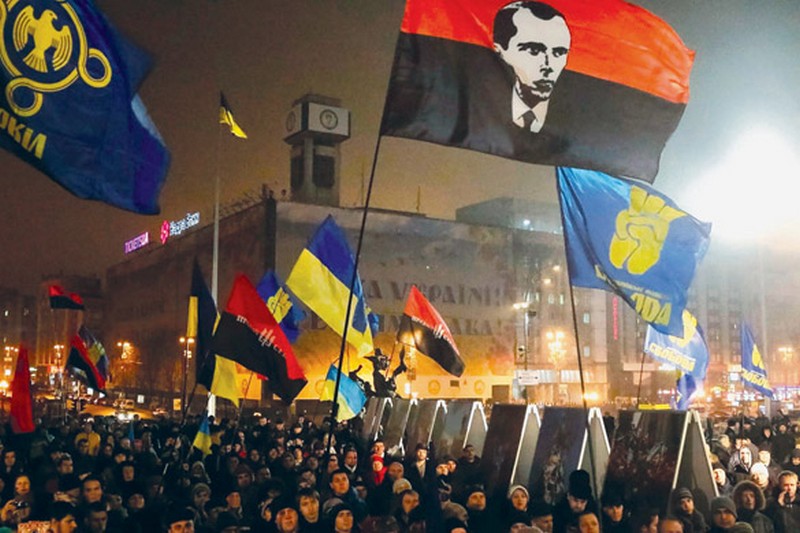
Russia’s special military mission, launched Feb. 24, had two announced goals, denazification and the elimination of the massive NATO military buildup. The latter had to do with their repeated calls upon the West to agree in writing to no nuclear warheads five minutes away from Moscow. The former, denazification, had to do with the dangerous hostage situation inside Ukraine. In brief, no one inside Ukraine was being allowed to implement the Minsk Accords, due to the physical and verbal threats and actions of the armed neo-Nazi groups. (The Azov, the Aidar and the Right Sector groupings, e.g., certainly are “extreme nationalists,” but that is a euphemism for those who model themselves upon Hitler’s collaborator, Stepan Bandera, and who adorn themselves with Nazi symbology.)

Aside from arrests of opposition members of parliament and the shutdown of newspapers, radio stations and websites in the Ukrainian democracy, President Zelenskyy himself, early in his administration, was threatened with violence and even assassination should he take one step to implement the peace treaty. Dmytro Yarosh, a co-founder of the Right Sector and the commander of the Ukrainian Volunteer Army, stated publicly, only a week after Zelenskyy’s inauguration: Zelenskyy “simply does not know the price of this world.” Rather, Zelenskyy speaks of securing a peace. And “Zelenskyy said in his inaugural speech that he was ready to lose ratings, popularity, position” for that peace. But, “No, he would lose his life. He will hang on some tree on Khreshchatyk [a main street of Kyiv] if he betrays Ukraine and those people who died in the Revolution [Maidan] and the War [Donbas].”

Indeed, Yarosh’s credentials revolve around, as he puts it, “the Revolution and the War.” When a compromise was struck by Ukraine’s President Viktor Yanukovych with the Maidan demonstrators, bringing an end to the confrontation, it was Yarosh who refused to disarm his Right Sector forces. Yarosh deliberately blew up the agreed-upon compromise, and Yanukovych fled the country. Hence, the Revolution. Two months later, it was Yarosh’s own 20-man Right Sector operation that went to sabotage the Sloviansk television tower in the Donbas—provoking the Siege of Sloviansk and the opening of the war against the Donbas. Hence, the War.

A few months after Yarosh threatened Zelenskyy, Andriy Biletsky, the first leader of the Azov Battalion, publicly threatened that if Zelenskyy took the first step for an armistice in the Donbas, Biletsky would call out tens of thousands of armed citizens to escalate the war.[fn_1]

Though Biletsky currently claims that he is not a neo-Nazi, his actions and words are pretty clear. He defended Ukraine’s “Social Nationalist” Party (a kissing cousin of the German “National Socialist” Party) and its use of swastikas, objecting to the effort to clean up its image for Western sensibilities. Biletsky set up his unvarnished “Patriot of Ukraine” organization in 2006, and stated that it had to “lead the white races of the world in a final crusade … against Semite-led Untermenschen.” One would think that Biletsky’s choice to use Hitler’s own German term “Untermenschen” (“sub-humans”) should qualify the fellow as more than a white racist, and actually a full-fledged neo-Nazi.

Further, as with Yarosh, Biletsky has also repeatedly demonstrated violent methods against opponents. Even as late as August 2020, Biletsky’s National Corps, an outgrowth of his Azov Battalion, brazenly shot up a bus of Viktor Medvedchuk’s Patriots for Life opposition party, and in broad daylight. Several members were wounded. Russia has had pretty good grounds for its analysis that the neo-Nazi element was indeed holding Ukraine hostage and would never allow Russia and Ukraine to be at peace. But are the physical threats against President Zelenskyy more than just tough talk?

The Peace Negotiations Are Shot in the Head

On March 5 Denis Kireyev, one of Ukraine’s negotiators at the first session with Russia, five days prior, was executed—shot in the head and left on the street in Kyiv. Ukraine’s internal security, the SBU, admits they shot him, but claimed he was resisting arrest and the rough treatment was deserved, as they had recorded him talking with Russians, which proved that he was a traitor. (It doesn’t take much in Kyiv these days to be charged with high treason. Both opposition leader Victor Medvedev and the previous President, Petro Poroshenko, earned that honor in 2021, evidently based upon their involvement in purchasing coal from the Donbas.)

Independent of what the SBU may claim constitutes treason, it is reasonable to presume that Kireyev, given his history as a board member of UkrEximBank, and then as deputy governor of the state-owned Oschadbank, would have been genuinely interested, at least from a business standpoint, in ending the fighting and coming to a common understanding with Russia. Assumedly, some part of the SBU took exception to such an approach to negotiations.

However, common knowledge in Kyiv is that the SBU had simply taken Kireyev into custody, questioned him, and then shot him in the head, before unceremoniously dumping him on the street. But even by the SBU “resisting arrest” version, there could not have been a more chilling message sent to Ukraine’s remaining negotiators regarding their priorities.

Looking back upon the Feb. 28 negotiating session, initial reports indicated that President Zelenskyy was on board and somewhat motivated. Indeed, he had initiated a ceasefire proposal after the second day of fighting, whereupon the Kremlin’s spokesman, Dmitry Peskov, specified two conditions: “This is neutral status, and this is a refusal to deploy weapons”—that is, a refusal to host NATO’s weaponry. Zelenskyy followed the first session by posting a video on Telegram: “We heard from Moscow today that they want to talk about the neutral status of Ukraine.” He seemed to want this to succeed, though compelled to phrase it in “tough guy” fashion: “We are not afraid of Russia, we are not afraid of engaging in talks with Russia, we are not afraid of discussing anything, such as security guarantees for our state, we are not afraid of talking about neutral status.”

However, shortly afterwards, Zelenskyy was nowhere to be found. When he finally re-emerged a few hours later, he was markedly less interested in securing a ceasefire. The location of the next meeting became his objection to taking another step. Conventional wisdom, credible but unconfirmed, has it that he received, in the missing hours, the word from London and/or Washington that he was not to allow the negotiations to go forward.

Peskov noted that during Zelenskyy’s disappearance, the situating of Ukrainian artillery in the residential areas of Kyiv, itself a war crime, began in earnest. It appears that a decision indeed had been made to sacrifice Ukrainian civilians to prevent Ukraine from assuming a neutral status between Russia and the West.

Of particular note, is that, in reporting on the SBU’s claim that Kireyev had been guilty of “high treason,” Kyiv’s Ukrayinska Pravda said Kireyev had had “free access” to the office of the head of the SBU. That office belongs to Ivan Bakanov, Zelenskyy’s longtime associate and colleague from their youth in their common hometown of Kryvyi Rih.

The Blatant Execution of a Former SBU Head

The execution of Kireyev is not proof that men with swastikas are running the SBU, but the execution five days later, on March 10, of Dmitry Demyanenko, the former head of the SBU’s Kyiv office, opens a whole can of worms. And, unlike the case of Kireyev, here, there is actually a video from a street camera of the execution, one that raises doubts about the official version.

Demyanenko’s body, riddled with bullets, was found on Kyiv’s Sadovaya Street. It is claimed that Demyanenko avoided a checkpoint in Kyiv and that the ensuing pursuit resulted in his death. The horrifying video evidences that he seemed to be travelling at a very moderate speed when pulled over, with no evidence of any dramatic situation. Then, aside from the vehicle that pulled him over, suddenly another pulled in front of his vehicle, and a third car appeared. Six to eight men jumped out and surrounded his vehicle, firing on it from all sides.

It is alleged that he pulled out a gun and was resisting arrest. But even if that were true, the former SBU head would have suddenly realized that he was not in a normal traffic stop, and he was going to go down shooting. The video, amongst other things, gives a strong sense of the “Wild West” nature of the Kyiv regime.

The group that dispatched Demyanenko is a protected group, the infamous Myrotvorets militia—the so-called “Peacemakers” militia. Their fame stems from their “enemies of Ukraine” list, begun in the Donbas in 2014. At that time, even a neutral account of an incident in the Donbas would earn the posting of the journalist’s name, address, and phone number on the list. When the UN condemned Myrotvorets for its list, Ukraine’s Parliament, the Verkhovna Rada, refused the UN request to ban the public posting of that list.

Demyanenko had not negotiated with the Russians over a halt to the hostilities. However, what is known, though not appreciated, is that his longtime role was as the SBU official posted to the Ministry of Health, beginning in early 2009. In the days before Demyanenko’s execution, the Russian Ministry of Defense had released documents from Ukraine’s Ministry of Health (MOH), exposing the involvement of the curious Dr. Ulana Suprun in the weaponization of the U.S.-run biological laboratories in Ukraine. We shall see that Dr. Suprun, an American citizen, and her husband, Marko Suprun, a Canadian citizen, were up to their necks in neo-Nazis. Controversially, she was installed as the acting head of the MOH in 2016 and oversaw the consolidation of U.S. control over the bio-labs, and the escalation of highly suspicious research.

On March 7, three days before Demyanenko’s execution, Igor Kirillov of the Russian Defense Ministry had begun a series of press conferences exposing the U.S.-run bio-labs. The one on the morning of Demyanenko’s execution included documents on a U.S. Project UP-4, where: “At least two species of migrating birds were discovered, whose migration routes go predominantly over Russian territory.” His documents exposed Dr. Suprun and others; one showed that in early 2017, the SBU regional office in Kherson had properly objected both to the increase of highly dangerous activity at the bio-labs, and to Suprun’s freezing Ukrainian officials out of knowledge and control of some of the labs. In early March 2022, the SBU had to wonder who Russia’s source was for the MOH documents. Whether or not Demyanenko was the actual source, it appears that the Myrotvorets gang evidently thought the retired SBU officer was suspect #1.

The Curious Dr. Ulana Suprun: Biological Weapons and Neo-Nazis

The matter of weaponization of biological laboratories is beyond the scope of this article. However, what makes the Ukrainian bio-labs suspicious, besides the pattern of secrecy and evasion from U.S. authorities, are the documents that have been made public indicating a) a concentration upon “the highly pathogenic avian influenza,” H5N1, some specifically connected to wild birds that migrate from Ukraine to Russia, b) specific research into strains of aerosolized infectious diseases, along with c) documentation of attempts to acquire drones especially rigged to dispense aerosols. Suprun’s role may have been no more than as a trusted ideologue, one who could be counted upon, as a loyal Banderite, to sacrifice Ukraine’s legitimate interests to wild and illegal ventures. A couple of years ago, she posted on her Facebook page:

Every year Stepan Bandera’s struggle, philosophy, and words become more and more important. After hundreds of years of occupation by Russian forces, from tsarist to Putin’s oppressors, it may be time to listen and hear Bandera’s words: “There is no common language with the Muscovites.”

Would Ulana Suprun be more likely to accommodate, or to rein in research into biological weapons to be deployed against Russia?

Further, while Acting Director of the MOH, she appeared with friends at anti-Russia rallies with her neo-Nazi associate, Serj Mazur,[fn_2] and spoke at his rally.[fn_3] Mazur, self-described as a “tattoo artist,” is a committed member of the C-14 neo-Nazi gang. Aside from their hardline ideology, they also perform the role of Mafia thugs. They have an advertisement that, if you are a friend and/or financial supporter of C-14, your enemies will find that their lives become much more difficult. In Suprun’s first year on the job, Mazur publicly warned Suprun’s “opponents” against feuding with “us.”

The larger role of the C-14 neo-Nazis was explained recently on an early February television broadcast in Kyiv by their leader, one Yevhen Karas:

We have now been given so much weaponry, not because as some say: “West is helping us”; not because they want the best for us; but because we perform the tasks set by the West, because we are the only ones who are ready to do them, because we have fun. We have fun killing and we have fun fighting…. Maidan was the victory of the nationalist ideas. Nationalists were the key factor there, and clearly at the frontlines.

But Karas claimed that a minority of only 8-10% accomplished 90% of what happened at the Maidan. “If not for nationalists, that whole thing would have turned into a gay parade.”

Hence, Ulana Suprun’s friends may be thugs, but, as with Hitler’s Nazis, they are fully capable of turning on the London-based gang that took pains to cultivate them.

Otherwise, it is hard to believe that the American citizen Ulana Suprun would be put at the head of Ukraine’s Department of Health at any time—except when something very unhealthy was afoot.

Marko Suprun and a Witches’ Brew of Nazis

However, Ulana looks tame compared to her husband, Marko—an interface of neo-Nazis, fight clubs, football hooligans, “white power rock,” and your friendly social media censor. A filmmaker, while in Canada Marko had served on the board of the Organization for the Defense of Four Freedoms of Ukraine, an OUN-B front group during the Cold War. In 2013, the Supruns deployed to Ukraine from Winnipeg, Canada, and were involved in documenting Maidan operations from the beginning. Marko then deployed in the Spring of 2014 into the Donbas along with his Maidan veterans. Later, around 300 of such veterans gathered for a special “pre-premiere” screening of what he called his Maidan/Donbas “comedy,” entitled “Lethal Kittens.” It must be said that none of this is made up, including what follows.

Aside from the audience of Azov aficionados, Marko paused for a photo with three special associates. One, Arseniy Bilodub, is the lead “singer” of what is described as a “hate-core band,” Sokyra Peruna, advertised as a Ukrainian “white power rock” group. Two of their “songs” are “Six Million Words of Lies” and “August 17th.” The former needs no explanation; the latter is an homage to Rudolf Hess, said to be the last of the Nazi leaders to die (yes, on August 17th). They have suffered for their “art,” as drummer Dmitry Volkov went to prison for his pogrom against the Brodsky Synagogue in Kyiv. Arseniy Bilodub is also the founder of SvaStone, the far-right clothing brand centered around marketing the Nazi “Black Sun” insignia.

It turns out there is one Russian that Bilodub liked, the neo-Nazi wacko, Denis Nikitin. Together, they launched an annual martial arts tournament in Kyiv. Nikitin also founded a clothing line, titled “White Rex,” with the same marketing draw, the Nazi “Black Sun.” However, Nikitin made sure to found his company on August 14, 2008—significant for its magical 14/08/08 code (a nod to the infamous white racist “14 Words,” combined with the ubiquitous homage, “88”—standing for the “HH” of “Heil Hitler”).

Nikitin has travelled the capitals of Europe organizing nihilistic youth around fight clubs. In trouble in Russia, he moved to Kyiv in 2017 and opened the “Reconquista Club,” a combination restaurant and martial arts center. Robert Rundo, who with three followers incited violence at Charlottesville, Virginia in 2017, took part in Nikitin’s martial arts at “Reconquista,” met with Azov representatives, and got a tattoo with Nikitin’s “White Rex” logo. Bilodub is, in a sense, simply a Kyiv knockoff of Nikitin.

Next in that photo is Diana Vinogradova (aka Kamlyuk), a poetess for Bilodub’s band. She composed while serving time in prison for her role in a group assault upon a Nigerian, whose misfortune was simply walking down the street, and who died from his injuries. Her friend wielding the knife explained that she simply didn’t like blacks. Diana is otherwise known for reciting an anti-Semitic poem on the Maidan.

Last but not least is Oleksandr Voitko, an upstanding member of the C-14 neo-Nazi group, who did such fine work for Marko’s wife, Ulana. Voitko deployed to the Donbas with the militias, and never quite got it out of his system. He later, away from the Donbas, sought out one of his pro-Donbas opponents and kidnapped him. Two of the C-14 associates of Voitko and the above-cited Mazur are charged in the murder of the editor-in-chief of a Russian-language newspaper. Both are out on bail.

Bilodub and Marco Suprun had earlier shared the stage at a Ukrainian “Youth Nationalist Congress” with their “blood brother,” Andriy Sereda—the lead singer of a different rock band, Komu Vnyz. It was Sereda who told the audience that the three of them had been “born” as brothers through the Cossack ritual of mutual bloodletting. Sereda’s address to the Svoboda Party (the re-branded name of the Social Nationalist party), on the occasion of their 20th anniversary, explained that Ukraine was the “motherland of the Aryan race.”

Facebook Censors Neo-Nazi Charges

None of this will you read about or see on Facebook. It turns out that Marko Suprun is also Facebook’s expert on the subject of Russian allegations of neo-Nazi activity. So, if Marko frowns upon the material, it gets disappeared. Facebook says that it partners with “StopFake” to counter fake news and misinformation. And Marko is the go-to guy at StopFake, the “neutral arbitrator” on anything that sounds like Russian disinformation! Of note, the co-founder of StopFake, Evgeny Fedchenko, is an open supporter of the C-14 thugs. He founded StopFake in 2014, shortly after the coup in Ukraine, and it was sponsored by the British Embassy in Ukraine for the next four years. The Embassy offers: “The United Kingdom supports anti-disinformation activities and programs aimed at developing media literacy in Ukraine.”

Marko Suprun argues that what we are documenting here is Russian disinformation trying—

to discredit one of the most important resources in exposing disinformation from Russia—StopFake, with whom I am associated…. There is no collusion between perceived right radicals, StopFake and Facebook…. To suggest that someone’s associations … may impact the work they do, is a priori ridiculous…. There is no story here that the public has a right to know.

There are pictures taken out of context, he says, in order to create a fragment of truth, contributing to disinformation about Ukraine. Sure, he’s met with “people with swastika tattoos.” But tagging militia veterans as neo-Nazis simply defies rational thought. “If they have stood in defense of Ukraine, I will stand beside them.’

While it is likely the case that only a minority of the members of various Ukrainian militia outfits these days are literate neo-Nazis, in the sense of having read the works of Stepan Bandera, Hitler, or Nietzsche, a tour of the world of Marko Suprun makes clear that nihilistic youth, lacking a future, full of rage, are building identities based upon a lethal combination of martial arts, body-building, “white power rock” and mindless acts of violence.

To paraphrase the trenchant analysis of Lyndon LaRouche: You don’t have to wear a swastika to be a Nazi; you just have to be a Nazi. Would militia groups steeped in such a culture have a problem in committing war crimes?

II. War as a Bizarre Theater

Reckless Russians + Nuclear Material = End of World

For a while, the West was treated to bizarrely scripted horror stories. Early on, Ukraine posted troops at the site of Chernobyl’s former nuclear power site. It had no strategic value and is of no use in war or peace. Rather, spent nuclear fuel from the 1986 accident lies in vats of water. However, as the passing Russian armies in the first week were forced to chase the posted troops away, the staged incident could generate the appropriate headlines, with “Russian army” and “Chernobyl” next to each other. There was no other purpose to the affair.

A couple of weeks later, Ukrainian militia deployed to attack a substation and its power lines, temporarily stopping the delivery of electricity to the general area, including the Chernobyl facility. Kyiv announced to the world that Chernobyl had less than 48 hours left before the reserve diesel generators would give out, and the Russians fighting in the area risked a thermonuclear disaster. The head of Foreign Affairs for the European Union, Josep Borrell, snapped to attention. He tweeted that he had just spoken with the IAEA chief, Rafael Grossi “about the very worrying situation regarding the Chernobyl power plant…. I call on Russia to preserve safety of nuclear infrastructure in #Ukraine. Full support for efforts to find an agreement on practical solutions in these dramatic circumstances.”

Yet the IAEA had to clarify that they weren’t doing anything. There was no need. The electricity ran lights at the facility, where nothing nuclear had been going on for decades, but for the spent fuel lying in the unheated water. Whether or not Kyiv knew there was no danger, they could still count on idiotic bureaucrats in Brussels to push the panic button.

Ukraine does have active nuclear power plants. There are sixteen nuclear reactors producing electricity, thirteen of them installed during USSR days. The largest power plant in Europe is at Zaporizhzhia, with six active reactors. Russia’s army did occupy the facility, early on March 4, with no stoppage of energy generation, and certainly no radiation leakage. There was a fire at a separate building, a training facility, with no injuries. The plant’s operators, who are there to this day, reported that there was never any danger of explosions, nor even radiation, nor even the disruption of electricity. However, President Zelenskyy, in the middle of the night, broadcast:

This is the first time in our history—in the history of mankind. The terrorist state now resorted to nuclear terror. If there is an explosion, it is the end of everything. The end of Europe. This is the evacuation of Europe. Only immediate European action can stop Russian troops.” Zelenskyy secured emergency consultations with President Biden and others, but the fire was long over before the boy who cried wolf secured “immediate European action.”

The two Chernobyl events were obviously staged. Military forces were deployed for no military reason, but only as stage-hands in a nuclear scare story. The actual “military” objective was to get the West into a direct war with Russia.

Russia’s Supposed Desecration of the Holocaust Site, Babi Yar

On March 1, the world learned that the unspeakable Russians had bombed the Holocaust memorial, Babi Yar. Andriy Yermak, the head of Ukraine’s Office of the President, announced:

Just now, a powerful barrage is underway. A missile hit the place where Babyn Yar memorial complex is located! Once again, these barbarians are murdering the victims of Holocaust!

Yermak’s boss, Zelenskyy, tweeted:

To the world: what is the point of saying “never again” for 80 years, if the world stays silent when a bomb drops on the same site of Babyn Yar? At least 5 killed. History repeating.

Babi Yar was the site where in 1941, the German Nazis and their Ukrainian collaborators shot and killed over 33,000 Jews in two days. They were left in a mass grave in the ravine. However, over the course of the Nazi occupation, roughly 100-150,000 people were executed there—Jews, gypsies, Russian soldiers, and Ukrainians suspected of being anti-Nazi. It is, on its face, both ignorant and insulting to think the Russians would desecrate such a site.

In fact, Babi Yar memorial was never bombed nor damaged. The chairman of the advisory board for the Babi Yar memorial, Natan Sharansky, reported from the site that there was no damage. Further, as was standard operating procedure, the Russian military, prior to their attack on the broadcast tower of the Ukrainian Army’s 72nd Main Psychological Operations Unit, broadcast sufficient warnings to everyone in the area that the military site was going to be hit with high-precision weapons. That did occur and evidently five members of the Ukrainian military died in the attack.

Anybody in the Kyiv government who wanted to know what had happened was able to do so. Zelenskyy, in particular, constructed his language to say, “on the same site” as Babi Yar. The site encompasses 370 acres, including various cemeteries for the array of Nazi victims. As Sharansky explained, there was collateral damage to an unfinished sports complex, but the “bomb was of course targeting the radio tower.” The 72nd Main Psychological Operations Unit, by the way, is perhaps the hardest working section of the Ukrainian army, and key to the fraud at Bucha (below).

The portion of the site occupied by the Babi Yar Museum has been desecrated with some regularity, but by Ukraine’s finest neo-Nazis, and not by Russian attacks upon Ukrainian military installations. Zelenskyy’s scandalous abuse of the memory of the Holocaust victims of Babi Yar displays a seriously defective part of his personality.

Russia Bombs Mothers at Maternity Hospital, Rapes by Policy

Mariupol, the port city of Russian-speaking Donetsk, was seized by the Azov Battalion in 2014 and has been ruled by them ever since. There should be no dearth of testimony and documentation coming out of Mariupol, now that the Azov occupiers no longer control the city. Amidst a lot of contradictory claims, serious conclusions cannot be confidently asserted; however, answers are within the grasp.

While it is pretty clear that there were explosions both at the Mariupol Hospital No. 3 on March 9, and at the Mariupol Theater a week later, testimony, along with some video evidence, indicates that neither was the result of bombs being dropped from the air. However, there should be physical evidence at both sites that might address that question. Suffice it to say that Marianna Vishegirskaya, the pregnant woman photographed in front of the hospital March 9, later complained of misrepresentation of her comments by AP. She said that the explosions occurred without accompanying sounds of a missile.

British Ambassador to Ukraine Melinda Simmons is the rape source:

The Russian military is raping civilians not only because they feel impunity, but also because rape is part of their military strategy…. Although we do not yet know the full extent of its use in Ukraine, it is already clear that it was part of Russia’s arsenal…. Women were raped in front of their children, girls in front of their families as a deliberate act of subjugation.

Her quote was featured for the opening of Radio Free Europe’s Svoboda Radio eye-catching article: “Everyone Is Raped … The Sexual Crimes of the Russian Military.” The author, Sashko Shevchenko, attained his master’s degree in journalism from City University, London, and the bolder the claim, the less need for documentation. The closest thing to evidence was the claim that it might be presented at some point: “[T]welve women have agreed to publicly say that they became pregnant due to rape by the occupiers.” After that, it is a matter of really salacious charges. Shevchenko has heard that someone said, “that in the Kherson region, the Russian military raped a 78-year-old grandmother.” The more salacious, the less comfortable anybody is about asking for evidence.

The investigation is in the hands of Ukraine’s Prosecutor General Irina Venediktov, who reported April 7, on Ukrainian TV: “Today in Borodyanka the fact of rape of the grandmother is recorded!” Evidently, since the fact has been recorded, the investigation is completed. Regardless, were normal investigative and judicial procedures allowed to do their work, and were every allegation proven true, this is still a pretty far piece from “rape is part of [the Russian] military strategy.”

Bucha: Russia Leaves Slaughtered Victims Out on the Streets

The Ukrainian Army now claimed they had routed the Russians, who, in their hasty retreat on March 30, left the evidence of their murders of Ukrainian citizens on a main street of Bucha, a suburb of Kyiv. For those who wonder how 20 or so bodies in one city block were not noticed for more than three days after the Russians left, satellite photos prove that the Russians shot a bicyclist a week or two before they left. People stare at photos of a destroyed Russian tank in Bucha, without even a glimmer of a thought that it is possible Ukrainian artillery had fired upon the town at some point.

The Russians announced on March 29 that they would pull back from the suburbs of Kyiv, as a good faith gesture, in recognition of the Ukrainians actually committing to paper their draft of what they would need to adopt a “neutral” status. It fell far short of recognizing Crimea or the Donbas republics, but the world that Tuesday was given a glimmer of hope. Russia had to put to one side the ugly video from 48 hours earlier, of Ukrainian militia torturing and shooting bound Russian POWs at point blank range, murdering at least one of them. Between that Wednesday and Friday, peace threatened to break out, and something had to be done.

Bucha’s mayor, on Thursday March 31, didn’t know of the filthy preparations going on, and simply celebrated his town’s freedom in a video. Things were looking beautiful—and certainly multiple dead bodies were not lying in Yablunska Street, one of the main streets. He was clearly off script. By Friday morning, a bold and nasty two-day operation was set into motion. The National Police announced that the “Safari” team—variously described as a “special operations” force, a “commando regiment,” and “the representatives of subdivisions of the Special Tasks Police, the Rapid Operational Response Unit, the Tactical Operational Response Police”—was deploying into Bucha to check for Russian mines, and to deal with remaining “saboteurs.” There is video of men with “Safari” patches that Friday and Saturday.

A notorious Azov leader, Sergey Korotkin (aka “Malyuta”), posted a video of a briefing given to some of the deployment team. One fighter asks whether they can shoot at people not wearing the blue armbands, and the answer is, “You bet.” (Since the blue armbands identify their own forces, it seems there is very little of the civilian population of Bucha that is off limits for the safari.) Korotkin removed the incriminating video, but here is Korotkin with an enthusiastic Nazi salute.

A woman in military fatigues named Ekaterina Ukraintsiva appeared on the “Bucha Live” Telegram page that Friday, as a representative of the Bucha City Council. She announced “the cleansing of the city” that now had to occur, and the need to stay off the streets for the duration of the mission. (Evidently, a similar announcement, that Bucha was “being cleared from saboteurs and accomplices of Russian forces,” was put out by Ukraine’s Gorshenin Institute.) There was at least one follow-up message, also supposedly from the City Council, both emphatic and strange:

Dear community of Bucha! We strongly ask you not to go to the territory of the “Delicia” confectionary factory, as russists have mined the territory and poisoned the cookies. Let’s remember about the danger!

The very large Delicia factory and its popular outlet are both right next to Yablunska, though several blocks from where the bodies were found.

Residents of Bucha that had stayed in town and had accepted food and supplies from the Russians were now in the category of collaborationists. By mid-day Saturday, the Bucha kill-shot appeared around the world, both video and photos of multiple dead bodies left on Yablunska Street. It was of course too horrendous to inquire as to who actually carried out the killings and/or “cleansings.” Finally, there is the rather embarrassing detail that this was a video of bodies that the world was supposed to believe had lain on Yablunska Street for at least four days, with no signs of decay, no damage from animals.

The British ambassador to the UN, Dame Barbara Woodward, who had just taken the chairmanship of the Security Council for the month of April, delayed the Russian call for an emergency Security Council session from Sunday, April 3 to Tuesday, April 5, allowing the European Union to arrange with Ukraine’s Prosecutor General Irina Venediktov on an “investigation” without the UN or any other normal international channels. Venediktov is the same one who (see above) seems to think the “recording” of an accusation is an investigation, at least in the case of alleged rape.

Postlude

So, at this point, dear reader, how are your thought processes and your sense of humanity doing? You’ve had nuclear meltdowns and/or explosions, bombings of the dead victims of the Nazi Holocaust at Babi Yar, the targeting of a maternity hospital and rape of grandmothers, topped with multiple executions of Ukrainian civilians left unburied on the street. Does the mere volume of cynical manipulation crush your will to fight through such evil? Does the presence in the world of serial liars, liars who long ago departed from even the pretense of cover stories, depress you, or even scare you?

Perhaps there’s not much choice left, but to become more fully human each and every day. Witness, in conclusion, two different views of Ukrainians. The first is the lawful outcome of the last two months, the horror of the rage-dominated “beast-man.” The second reflects what most Ukrainians have been, and, with an effort, still have the potential to be.

On Palm Sunday, a supposedly pro-Ukrainian video was posted on the Instagram page of Lviv actress Andrianna Kurylets, which shows the self-degradation and sadism of the Nazi “blood and soil” mentality being called forth amongst nihilists, who would destroy Ukraine. In less than two minutes, one witnesses a Ukrainian maiden in a lovely costume, transformed into a vicious beast, performing an ISIS-like execution on camera, for a mysterious and vengeful “Ukrainian God.”

It begins:

For centuries, these swine … trampled on our flag, mocked our language … they starved us, killed us, crucified us in red torture chambers and sent us to the permafrost of the Siberian prison camps. They had been killing until something terrible awoke in a peaceful farming nation. Something had been dormant in the depths of the Dnipro cliffs for centuries.

Initial and ancient Ukrainian God. [She raises a scythe and smiles] And now we are harvesting our bloody harvest! [She slices the throat of a Russian paratrooper on his knees.] [She repeats:] And now we are harvesting our bloody harvest! You will all be killed in memory of victims in Bucha, Irpin, Kyiv, Kharkiv, Odesa, Mariupol. You will all be killed. Your corpses, like the worst carrions, will rot in the fields, along roads and forest belts. They will be eaten by dogs and wild animals. Your mothers will be waiting for you in Tver, Pskov and Ryazan; but you, you sons of the bitch, will never return home. [She tosses the dead man to the ground and smiles broadly] Welcome to Hell!

Russia’s First Deputy Permanent Representative to the UN, Dmitry Polyanskiy, brought this to the attention of the UN Security Council, remarking that it, unfortunately, is what makes denazification necessary. Evgeny Popov, the host of Russia’s “60 Minutes,” told his national audience:

Animalistic cruelty is becoming the norm. Blind hatred is being promoted to incite average people. The methods of ISIS head-cutters organically fit in with Ukrainian politics. Somebody decided that this kind of bigotry will improve morale…. There are now many fewer of those who still didn’t understand what “de-nazification” stands for and why it’s needed.

The “beast-man” is the lawful result of the British Empire, or any empire, succeeding in manipulating countries into a box, where the rules are, “dog-eat-dog.” However, a recent presentation invites the world to remember the Ukraine that was and still can be:

Ukraine used to possess great potential, which included powerful infrastructure, gas transportation system, advanced shipbuilding, aviation, rocket and instrument engineering industries, as well as world-class scientific, design and engineering schools. Taking over this legacy and declaring independence, Ukrainian leaders promised that the Ukrainian economy would be one of the leading ones, and the standard of living would be among the best in Europe.

Today, high-tech industrial giants that were once the pride of Ukraine and the entire Union, are sinking. Engineering output has dropped by 42% over ten years. The scale of deindustrialization and overall economic degradation is visible in Ukraine’s electricity production, which has seen a nearly two-times decrease in 30 years. Finally, according to IMF reports, in 2019, before the coronavirus pandemic broke out, Ukraine’s GDP per capita had been below US$ 4,000. This is less than in the Republic of Albania, the Republic of Moldova, or unrecognized Kosovo. Nowadays, Ukraine is Europe’s poorest country.

Who is to blame for this? Is it the people of Ukraine’s fault? Certainly not. It was the Ukrainian authorities who wasted and frittered away the achievements of many generations. We know how hardworking and talented the people of Ukraine are. They can achieve success and outstanding results with perseverance and determination. And these qualities, as well as their openness, innate optimism and hospitality have not gone.

This is from the July 12, 2021 article by Vladimir Putin, “On the Historical Unity of Russians and Ukrainians”—a presentation much attacked and reviled in London.

The choice is easy. The hard part is getting up in the morning, getting nasty with those juvenile fantasies that sadistic empires play upon, and wrapping one’s identity around building the world out of this mess, knowing that one can make history.

davidshavin@larouchepub.com


[fn_1] See the author’s article “No, Putin Is Not Exaggerating: Neo-Nazis in Ukraine Have Threatened Zelenskyy,” EIR Vol. 49, No. 9, March 4, 2022. https://larouchepub.com/other/2022/4909-no_putin_is_not_exaggerating_n.html [back to text for fn_1]

[fn_2] Dr. Ulana Suprun, with friends, at an anti-Russia rally May 17, 2017 with her neo-Nazi associate, Serj Mazur: https://pbs.twimg.com/media/D7_-xrYXsAEzK6J?format=jpg&name=small [back to text for fn_2]

[fn_3] Dr. Ulana Suprun, speaking at an anti-Russia rally, with Serj Mazur to her left: https://pbs.twimg.com/media/D7_-xMkXUAEVIjR?format=jpg&name=medium [back to text for fn_3]

29 April 2022


Solidarity – Why it applies to justice for Palestine now

Palestine Update 548

Solidarity – Why it applies to justice for Palestine now

Ranjan Solomon
————————-
New Israeli rules on foreigners visiting West Bank stir outrage

“Palestinian legal experts, academics and digital rights groups have expressed outrage over an incoming Israeli policy for the entry and residence of foreigners in the occupied West Bank, which they say further, complicates the rules of movement, and adds restrictions to an already convoluted system. The 97-page ordinance, called Procedure for Entry and Residence for Foreigners in Judea and Samaria Area (PDF), replaces the current four-page document…Foreign-passport holding Palestinians must provide information – for visa purposes – on an application for approval prior to travel, which includes the names and national ID numbers of “first-degree” relatives, or other non-relatives with whom they may stay or visit. Digital rights experts say that personal information on travelers and their families and acquaintances is likely to be used in Israel’s mass surveillance and data collection efforts. “It’s a surveillance exercise,” said Marwa Fatafta, a Palestinian digital rights expert and Al Shabaka policy analyst. “With the new policy, Israeli authorities want to map out the social circles and property of Palestinians who live abroad with foreign passports… “The entire identification system is built to control the most two crucial aspects of Palestine: people and land. Now, in a way, it will also apply to Palestinians with ties to the West Bank,” she told Al Jazeera.”
Read more

Legalized Discrimination: How Israel’s “Citizenship & Entry” law harms Palestinian families by design

Last month, the Israeli Knesset passed a new version of Israel’s infamous “Citizenship and Entry into Israel Law.” This law denies to Palestinian citizens of Israel a fundamental right that Israel’s Jewish citizens take for granted (and, indeed, citizens around the world hold dear): the right to make a life together with one’s chosen spouse, in the country where one hold’s citizenship. Adopted originally by the Knesset in 2003 as a “temporary” measure ostensibly for “security” reasons, the law has been repeatedly renewed for almost 20 years, most recently in March 2022. The renewed law includes explicit provisions referring to its “demographic” purpose, leading Adalah to call it “one of the most racist and discriminatory laws in the world.” In March, Israel’s Minister of Interior Ayelet Shaked celebrated the law’s passage on Twitter, saying; “Jewish & Democratic State – 1; State for all its citizens – 0”
Read more

Listen to this event as a podcast

Palestinians in Detention Without Trial in Israel Hits 5-year High
There are currently 579 Palestinians in administrative detention and over the past month 19 detention orders were issued against Israeli citizens, 2 of whom are Jewish. According to data supplied by the Israel Prison Service to Haaretz, there are currently 579 Palestinians in administrative detention…By comparing the data provided to Haaretz and the statistics obtained by Hamoked, it appears that between March and April of this year, the number of administrative detainees increased by 109. The last time that such a leap was recorded was between May and July of last year – amid the war between Israel and Hamas and its allies in Gaza and widespread riots in mixed Jewish-Arab cities. Despite the increase then, the absolute number of administrative detainees was lower than it is now. In addition to Palestinians under detention without trial, 19 administrative detention orders were issued against Israeli citizens over the past month, 17 of whom are Arab and the other two Jewish.”
Read more

Why is Israel’s antisemitism envoy sharing investigation files against a Palestinian child?,

“Are Israeli security authorities handing over investigation materials to online hasbara stars in order to score points on social media? It certainly seems so. Last Friday, Israeli actress Noa Tishby, who this month was appointed Israel’s first-ever special envoy for combating antisemitism and the delegitimization of Israel, released a video on her personal Instagram account in response to a post by Palestinian-American supermodel Bella Hadid. Hadid had shared a story about Athal al-Azzeh, a 14-year-old Palestinian boy who was arrested two weeks ago by the Israeli army, who accused him of throwing stones – a charge Athal has adamantly denied. In her response video, Tishby featured two photos of a masked Palestinian rolling a tire, which appear to have been part of the Israeli military’s investigation file on Athal — a fact corroborated by his mother, Jinan, who says she was shown the photos by Israeli interrogators several days before Tishby’s post. The investigation file, which is not public, was most likely handed over to Tishby by the authorities…Riham Nassra, an attorney who represents Palestinian detainees in military courts, said that publishing investigative materials before an indictment is issued, as Tishby did, is illegal, and indicates that the materials had in fact been leaked…Noa Tishby did not respond to a request for comment, but following publication of this article took down her original post on Instagram.”
Read full narrative

GEICO rescinds invitation to Palestinian-American activist Linda Sarsour

Zionist organizations pressured the auto-insurance giant GEICO to rescind their invitation to Palestinian-American activist Linda Sarsour to speak at an internal event celebrating Middle Eastern and North African heritage month. GEICO had caved to a smear campaign launched by the American Jewish Committee (AJC) and the Anti-Defamation League (ADL) and canceled the event.

GEICO, in other words, not only disinvited Sarsour. They unquestioningly accepted the anti-Palestinian and Islamophobic logic the ADL and AJC relied on in their attacks by automatically equating Sarsour’s presence with condoning hatred. GEICO’s actions did not merely deprive Sarsour of a platform. They normalized the racist Zionist idea that Muslims and/or Palestinians who advocate for Palestinian freedom are inherently anti-Semitic, when in reality the fight for Palestinian liberation is guided by the principle that all peoples deserve to live free of colonial oppression and racist subjugation.

 “GEICO decided they were more comfortable publicly vilifying and dehumanizing a prominent advocate for Arab Americans, US Muslims, Palestinians and other marginalized communities, than simply having a conversation,” reads a petition by MPower Change, the Muslim advocacy organization for which Sarsour is executive director. The petition was included in a mass email sent out by the organization to its followers on 8 April, just a day after Jonathan Greenblatt, CEO of the ADL, took to Twitter to credit his organization with successfully pressuring GEICO to disinvite Sarsour.
Read full report

Boycotting Apartheid Is a Moral Duty

This week (26 April 2022), the Palestine Solidarity Campaign, along with forty-seven other civil society organisations, released a statement opposing government plans to introduce an ‘anti-boycott bill’ to stop public bodies from boycotting or divesting from companies involved in human rights abuse or environmental destruction. Such a bill will threaten so many campaigns for social and climate justice, including international solidarity campaigns like ours in support of Palestinian rights.

While the statement is intended to raise alarm about the government’s plans, it also reveals something exciting: a wide range of organisations committing to defend our collective right to use boycott and divestment tactics. Signatories include: nine national trade unions (representing millions of workers between them); faith-based institutions; climate justice organisations, large and small; anti-militarism and anti-war groups; human rights groups; community organisations; and more. When the bill is finally tabled, likely before the summer recess, we expect even more to take up the call to defend our #RightToBoycott.

The text of the bill has not appeared yet, but we have indications of its contents based on the government’s 2016 attempt to ban local government pension schemes from using ‘divestment and sanctions against foreign nations and UK defence industries’. PSC took the government to court over it, and we won a landmark case in the Supreme Court in 2020, forcing the government to scrap its unlawful regulations.

The government hit back threatening primary legislation to ‘ban public bodies from imposing their own direct or indirect boycotts, disinvestment or sanctions campaigns against foreign countries, or those linked to them; the sale of goods and services from foreign countries; UK firms which trade with such countries, where such an approach is not in line with UK Government sanctions’.
Source:

Palestine Updates is a clearing house for historical and current
information about happenings especially in the Palestinian territories,
global campaigns, Israeli peace movement initiatives, and critiques of
government policies in Israel and Palestine which hurt the people.

29 April 2022

Source: palestineupdates.com

Video: Col. Richard Black — U.S. Leading World to Nuclear War

Col. Richard Black: U.S. Leading World to Nuclear War

Mike Billington with Executive Intelligence Review interviews Col. Richard Black (ret.).

BILLINGTON: Hi, this is this is Mike Billington with Executive Intelligence Review and the Schiller Institute. I am here today with Col. Richard Black, Sen. Richard Black, who, after serving 31 years in the Marines and in the Army, then served in the Virginia House of Delegates from 1998 to 2006, and in the Virginia Senate from 2012 to 2020. I’ll also allow Colonel Black to describe his military service himself.

So, Colonel Black, welcome. With the with the U.S. and U.K. and NATO surrogate war with Russia, which is taking place in Ukraine, and the economic warfare being carried out directly against Russia, this has been accompanied by an information war which is intended to demonize Russia and especially President Vladimir Putin. One repeated theme is that the Russian military is carrying out ruthless campaigns of murder against civilians and destruction of residential areas, often referring to the Russian military operations in Syria, claiming that they had done the same thing in Syria, especially against Aleppo. These are supposedly examples of their war crimes and crimes against humanity.

You have been a leading spokesman internationally for many years, exposing the lies about what took place in Syria and the war on Syria. So first, let me ask: How and why did Russia get involved in Syria militarily? And how does that contrast with the U.S. and NATO supposed justification for their military intervention in Syria?

BLACK: Well, let me begin, if I could, by telling our listeners that I’m very patriotic: I volunteered to join the Marines and I volunteered to go to Vietnam. I fought in the bloodiest Marine campaign of the entire war. And I was a helicopter pilot who flew 269 combat missions. My aircraft was hit by ground fire on four missions. I, then, fought on the ground with the First Marine Division, and during one of the 70 combat patrols that I made, my radioman were both killed, and I was wounded while we were attacking and trying to rescue a surrounded Marine outpost.

So I’m very pro-American. I actually was a part of NATO and was prepared to die in Germany, to defend against an attack by the Soviet Union.

But Russia is not the Soviet Union at all. People don’t understand that because the media have not made it clear. But Russia is not a communist state; the Soviet Union was a communist state.

Now, one of the things that I’ve seen claimed, that has been particularly irritating to me because of my experience with Syria: I have I have been in Aleppo city. Aleppo city is the biggest city in Syria, or it was at least before the war began. And there was a tremendous battle. Some some call it the “Stalingrad of the Syrian war,” which is not a bad comparison. It was a terribly bitter battle that went on from 2012 until 2016. In the course of urban combat, any forces that are fighting are forced to destroy buildings. Buildings are blown down on a massive scale. And this happens any time that you have urban combat. So I have walked the streets of Aleppo, while combat was still in progress. I have looked across, through a slit in the sandbags at enemy controlled territory; I’ve stood on tanks that were blown out and this type of thing.

What I do know, and I can tell you about Aleppo is that Russia was extremely reluctant to get involved in combat in Syria. The war began in 2011, when the United States landed Central Intelligence operatives to begin coordinating with Al Qaeda and other terrorist groups. And we had been unwavering supporters of Al Qaeda, since before the war formally began. We are supporters of Al Qaeda today, where they’re bottled up in Idlib province. The CIA supplied them under secret Operation Timber Sycamore. We gave them all of their anti-tank weapons, all of their anti air- missiles. And Al Qaeda has always been our proxy force on the ground. They, together with ISIS, have carried out the mission of the United States, together with a great number of affiliates that really are kind of interchangeable. You have the Free Syrian Army soldiers move from ISIS to Al Qaeda to Free Syrian Army, rather fluidly. And so we started that war.

But the United States has a strategic policy of using proxies to engage in war. And our objective was to overthrow the legitimate government of Syria, and in order to do that, we employed proxy soldiers who were the most vile of all terrorists. Something very similar is happening right now in in Ukraine.

But going back to Aleppo, the Syrian army, together with Hezbollah, which was very effective; there were some troops that were organized by Iran also, but it was pretty much a Syrian show, certainly directed by Syrian generals. And they had fought this bitter urban combat, very brutal, very deadly. And they had fought it for four years, before Russia ever joined the battle. So after four years, the city of Aleppo had enormous destruction. And at that point, the Russians, at the invitation of the legitimate government of Syria, entered the war. But unlike many of the media reports, they did not enter the war as a ground force. Now, they had some small ground forces. They had military police, they had a few artillery units, a few special operations people, and quite a number of advisers and that sort of thing. But they were not a significant ground force.

On the other hand, they were a significant and very effective air force, that supplemented the Syrian Air Force. But it really was just the last year of the war, the battle for Aleppo, just the last year, that they entered and their air power was very effective. And by this time, the Syrians had pretty well worn down the terrorist forces. And the Russian assistance was able to tip the balance, and Aleppo was the grand victory of the entire Syrian war.

But to blame the Russians for the massive destruction that took place within Aleppo, it’s bizarre: Because they were not there, they were not even present when this happened. So this is simply another part of the propaganda narrative, which is which hasbeen very effective for the West, demonizing Russia, and making claims that have no substance. But people don’t remember the history of these things—they’re rather complex. So, no: Russia was not in any respect responsible for the massive destruction of the city of Aleppo.

BILLINGTON: How would you contrast the methods of warfare followed by Russia, as opposed to the U.S. and allied forces in Syria?

BLACK: Well, first of all, the American involvement, the United States war against Syria is a war of aggression. We put a highly secretive CIA special activities center—these are kind of the James Bond guys of the Central Intelligence Agency, total Machiavellian; they will do anything, there’s no it’s no holds barred with these guys. We sent them in and we started the war in Syria. The war didn’t exist until we sent the CIA to coordinate with Al Qaeda elements. So we began the war and we were not invited into Syria.

In fact, the United States has seized, two significant parts of Syria. One is a very major part, the Euphrates River, carves off about a third of the northern part of Syria: The United States invaded that portion. We actually put troops on the ground, illegal—against any standard international law of war—it was it was a just a seizure. And this was this was something that was referred to by John Kerry, who was then the Secretary of State, and he was frustrated at the tremendous victory by the Syrian Armed Forces against Al Qaeda and ISIS. And he said, well, we probably need to move to Plan B. He didn’t announce what Plan B was, but it had it unfolded over time: Plan B was the American seizure of that northern portion of Syria. The importance of taking that part of Syria is, that it is the bread basket for all of the Syrian people. That is where the wheat—Syria actually had a significant wheat surplus and the people were very well fed in Syria, before the war. We wanted to take the wheat away, to cause famine among the Syrian people.

The other thing we were able to do, is to seize the major part of the oil and natural gas fields. Those also were produced in that northern portion beyond the Euphrates River. And the idea was that, by stealing the oil and then the gas, we would be able to shut down the transportation system, and at the same time, during the Syrian winters, we could freeze to death the Syrian civilian population, which in many cases were living in rubble, where these terrorist armies, with mechanized divisions had attacked and just totally destroyed these cities, and left people just living in little pockets of rubble.

We wanted to starve and we wanted to freeze to death the people of Syria, and that was Plan B.

Now, we became frustrated at a certain point that somehow these Syrians, these darned Syrians—it’s a tiny little country, and why are these people resilient? They’re fighting against two-thirds of the entire military and industrial force of the world. How can a nation of 23 million people possibly withstand this for over a decade? And so we decided we had to take action or we were going totally lose Syria. And so the U.S. Congress imposed the Caesar sanctions. The Caesar sanctions were the most brutal sanctions ever imposed on any nation. During the Second World War, sanctions were not nearly as strict as they were on Syria.

We weren’t at war with Syria! And yet we had a naval blockade around the country. We devalued their currency through the SWIFT system for international payments, making it impossible for them to purchase medications. So you had Syrian women who would contract breast cancer, just like we have here in this country. But instead, where in this country where breast cancer has become relatively treatable, we cut off the medical supplies so that the women in Syria would die of breast cancer because they could not get the medications, because we slam their dollars through the SWIFT system.

One of the last things that we did and the evidence is vague on it, but there was a mysterious explosion in the harbor in Lebanon, and it was a massive explosion of a shipload of ammonium nitrate fertilizer. It killed hundreds of Lebanese people. It wounded thousands and thousands, destroyed the economy of Lebanon. And, most importantly, it destroyed the banking system of Lebanon, which was one of the few lifelines remaining to Syria. I don’t think that explosion was accidental. I think it was orchestrated, and I suspect that the Central Intelligence Agency was aware of the nation that carried out that action to destroy Beirut Harbor.

But throughout you see this this Machiavellian approach, where we use unlimited force and violence. And at the same time, we control the global media, to where we erase all discussions of what’s truly happening. So, to the man or the woman in the street, they think things are fine. Everything is being done for altruistic reasons, but it’s not.

BILLINGTON: Part of your military service was as a JAG officer, and for a period of time, you were the Army’s head of the criminal law division at the Pentagon. And in that light, what do you see as of how these Caesar sanctions—how would you look at those from the perspective of international law and military law?

BLACK: Well, now, I was not the international law expert. I was the criminal law expert. But I would say that making war on a civilian population is a crime of grave significance in the law of war.

One of the things that we did as we as we allied ourselves with Al Qaeda, and on and off with ISIS; I mean, we fought ISIS in a very serious way, but at the same time, we often employed them to use against the Syrian government. So it’s kind of a love-hate. But we have always worked with the terrorists. They were the core.

One of the policies that was followed was that under this extreme version of Islam, this Wahhabism, there was this notion that you possess a woman that you seize with your strong right arm in battle. And this goes back to the seventh century. And so we facilitated the movement of Islamic terrorists from 100 countries, and they came and they joined ISIS, they joined Al Qaeda, they joined the Free Syrian Army, all of these different ones. And one of the things that they knew when they arrived is that they were lawfully entitled to murder the husbands—I’m not talking about military people, I’m talking about civilians—they could murder the husbands, they could kill them, and then they could possess and own their wives and their children. And they did it in vast numbers.

And so there was there was a campaign of rape, it was an organized campaign of rape across the nation of Syria. And there actually were slave markets that that arose in certain of these rebel areas where they actually had price lists of the different women. And interestingly, the highest prices went to the youngest children, because there were a great number of pedophiles. And the pedophiles wanted to possess small children, because under the laws that were applied, they were permitted to rape these children repeatedly. They were able to rape the widows of the slain soldiers or the slain civilians, and possess them and buy them and sell them among themselves. This went on.

I’m not saying that the CIA created this policy, but they understood that it was a widespread policy, and they condoned it. They never criticized it in any way.

This was so bad, that I spoke with President Assad, who shared with me that they were in the process—when I visited in 2016; I was in a number of battle zones, and in the capital. And I met with the President, and he said that at that time, they were working on legislation in the parliament, to change the law of citizenship. They had always followed the Islamic law, which was that that a child citizenship derived from the father. But there were so many tens, hundreds of thousands of Syrian women impregnated by these terrorists who were imported into Syria, that it was necessary to change the law, so that they would have Syrian citizenship and they wouldn’t have to be returned to their ISIS father in Saudi Arabia, or in Tunisia. They could be retained in Syria. And I checked later and that law was passed and was implemented.

But it just shows the utter cruelty. When we fight these wars, we have no limits on the cruelty and the inhumanity that we’re prepared to impose on the people, making them suffer, so that somehow that will translate into overthrowing the government, and perhaps taking their oil, taking their resources.

BILLINGTON: Clearly, the policy against Russia today, by the current administration.

BLACK: Yes. Yes. You know, Russia is, perhaps more blessed with natural resources than any other nation on Earth. They are a major producer of grain, of oil, of aluminum, of fertilizers, of an immense number of things that tie into the whole global economy. And no doubt there are people who look at this and say, “if we could somehow break up Russia itself, there will be fortunes made, to where trillionaires will be made by the dozens.” And there’s some attraction to that. Certainly you’ve seen some of this taking place already, with foreign interests taking over Ukraine, and taking their vast resources.

But, we began a drive towards Russia, almost immediately after the Soviet Union dissolved in 1991. The Soviet Union dissolved, the Warsaw Pact dissolved. And unfortunately, one of the great tragedies of history is that we failed to dissolve NATO. The sole purpose of NATO was to defend against the Soviet Union. The Soviet Union no longer existed. NATO went toe toe with the Warsaw Pact. The Warsaw Pact was gone; it no longer existed. There was no purpose in NATO’s continuing to exist. However, we retained it, and it could not exist unless it had an enemy. Russia was desperate to become part of the West.

I met with the head of Gazprom, the largest corporation in Russia, And this was shortly after the demise of the Soviet Union, and he described for me how they were struggling to have their media be as free as it was in the West. And they perceived us as being much more free and open than we were. And he said, you know, we’ve got this problem because we have this uprising in Chechnya, which is part of Russia. And he said the Chechnyan rebels send videos to Russian television and we play them on Russian television, because that’s the way freedom of speech works.

And I said, “Are you kidding me?” I said, “You’re publishing the enemy propaganda films?” He said, “Yeah.” He said, “Isn’t that the way you do it in the United States?” I said, “No. In the Second World War, we took the head of the Associated Press and we put him in charge of wartime censorship, and it was very strict.”

So but this is just an example of how they were struggling. They went from being an officially atheist country, to where they became the most Christianized major nation in Europe, by far. Not only were the people, the most Christianized people in any major country in Europe, but the government itself was very supportive of the church, of the Christian faith. They altered their Constitution to say that marriage was the union of one man and one woman. They became very restrictive on the practice of abortion. They ended the practice of overseas adoptions, where some people were going to Russia and adopting little boys for immoral purposes. So they became a totally different culture and.

In any event, the United States has this long-standing strategy, this political-military strategy, of expanding the empire. We did it in the Middle East, where we attempted to create a massive neocolonial empire. It’s it became rather frayed. The people did not want it. And it seems to be doomed to extinction sometime—but it may go on for another 100 years. But in any event, we are trying to do something similar, as we roll to the East, right up virtually to the Russian border.

BILLINGTON: So, the U.S. and U.K. position on the war in Ukraine, just over these last few weeks has now become not only supporting the war, but victory at all costs. This has been declared by Defense Secretary Austin and others. And they are pumping in huge quantities of not only defensive but offensive military weaponry to the Kyiv regime. What do you see as the consequence of this policy?

BLACK: I think one thing that it will do is it will ensure that a tremendous number of innocent Ukrainian soldiers will die needlessly. A lot of Russian soldiers will die needlessly. These are kids. You know, kids go off to war. I went off to war as a kid. You think your country, right or wrong, everything they’re doing is fine. It just it breaks my heart, when I look at the faces of young Russian boys, who have been who have been gunned down—in some cases very criminally by Ukrainian forces. And likewise, I see Ukrainian young men, who are being slaughtered on the battlefield.

We don’t care! The United States and NATO, we do not care how many Ukrainians die. Not civilians, not women, not children, not soldiers. We do not care. It’s become a great football game. You know, we’ve got our team. They’ve got their team, rah rah. We want to get the biggest score and run it up. And, you know, we don’t care how many how many of our players get crippled on the playing field, as long as we win.

Now, we are shipping fantastic quantities of weapons, and it’s caused the stock of Raytheon, which creates missiles, and Northrop Grumman, which creates aircraft and missiles, all of these defense industries have become tremendously bloated with tax dollars. I don’t think it’s ultimately going to change the outcome. I think that Russia will prevail. The Ukrainians are in a very awkward strategic position in the East.

But if you look at the way that this unfolded, President Putin made a desperate effort to stop the march towards war back in December of 2021. He went so far as to put specific written proposals on the table with NATO, peace proposals to defuse what was coming about. Because at this point, Ukraine was massing troops to attack the Donbas. And so, he was trying to head this off. He didn’t want war. And NATO just blew it off, just dismissed it; never took it seriously, never went into serious negotiations.

At that point, Putin seeing that armed Ukrainians, with weapons to kill Russian troops were literally on their borders, decided he had to strike first. Now, you could see, that this was not this was not some preplanned attack. This was not like Hitler’s attack into Poland, where the standard rule of thumb, is that you always have a 3-to-1 advantage when you are the attacker. You have to mass three times as many tanks and artillery and planes and men, as the other side has. In fact, when Russia went in, they went in with what they had, what they could cobble together on short notice. And they were outnumbered by the Ukrainian forces. The Ukrainian forces had about 250,000. The Russians had perhaps 160,000. So instead of having three times as many, they actually had fewer troops than the Ukrainians. But they were forced to attack, to try to preempt the battle that was looming, where the Ukrainians had massed these forces against the Donbas.

Now, the Donbas is adjacent to Russia. It is a portion of Ukraine that did not join with the revolutionary government that conducted the coup in 2014 and overthrew the government of Ukraine. They refused to become a part of the new revolutionary government of Ukraine. And so they declared their independence. And Ukraine had massed this enormous army to attack against the Donbas. And so Russia was forced to go in to preempt that planned attack by Ukraine. And you could see that Russia very much hoped that they could conduct this special operation without unduly causing casualties for the Ukrainians, because they think of the Ukrainians, or at least they did think of the Ukrainians as brother Slavs; that they wanted to have good relations. But there is a famous picture with a Russian tank, that had been stopped by a gathering of maybe 40 civilians who just walked out in the road and blocked the road and the tank stopped. I can tell you, in Vietnam, if we had had a bunch of people who stood in the way of an American tank, going through, that tank would not have slowed down, in the slightest! It wouldn’t honk the horn, it wouldn’t have done anything; wouldn’t have fired a warning shot. It would have just gone on. And I think that’s more typical—I’m not I’m not criticizing the Americans. I was there and I was fighting, and I probably would have would have driven the tank straight through myself.

But what I’m saying is that the rules of engagement for the Russians were very, very cautious. They didn’t want to create a great deal of hatred and animosity. The Russians did not go in—they did not bomb the electrical system, the media systems, the water systems, the bridges and so forth. They tried to retain the infrastructure of Ukraine in good shape because they wanted it to get back. They just wanted this to be over with and get back to normal. It didn’t work. The Ukrainians, the resistance was unexpectedly hard. The Ukrainian soldiers fought with great, great valor, great heroism. And. And so now the game has been upped and it’s become much more serious.

But it is amazing to look and to see that Russia dominates the air. They haven’t knocked out the train systems. They haven’t knocked out power plants. They haven’t knocked out so many things. They’ve never bombed the buildings in the center of Kyiv, the capital of Ukraine; they haven’t bombed the buildings where the parliament meets. They’ve been incredibly reserved about these things, hoping against hope that peace could be achieved.

But I don’t think I don’t think Ukraine has anything to do with the decision about peace or war. I think the decision about peace or war is made in Washington, D.C. As long as we want the war to continue, we will fight that war, using Ukrainians as proxies, and we will fight it to the last Ukrainian death.

BILLINGTON: How do you project the potential of a war breaking out directly between the United States and Russia? And what would that be like?

BLACK: You know, if you go back to the First World War in 1914, you had the assassination of the Archduke of Austria-Hungary. He and his wife were killed. As a result of those two people being killed, you had a domino effect of all of these alliances, and anger, and media hysteria. And before it was over, I think it was 14 million people had been killed. It’s always hard to get true numbers, but anyway, it was an enormous number of millions of people who died as a result of that.

We need to recognize the risk of playing these games of chicken. Where, for example, the Turkish media just published an article saying that at Mariupol, where there was a great siege, that the Russians ultimately won. The one area they haven’t taken over is this tremendous steel plant. There are a lot of Ukrainian soldiers who are holed up there. And now it has come to light that apparently there are 50 French senior officers, who are trapped in that steel plant along with the Ukrainians. The French soldiers have been on the ground fighting, directing the battle. And this was kept under wraps, ultra-secret, because of the French elections that just occurred. Had the French people known that there were a large number of French officers trapped and probably going to die in that steel plant, the elections would have gone the other way: Marine Le Pen would have won. And so it was very important that for the entire deep state, that it not come to light that these French officers were there.

We know that there are NATO officers who are present on the ground in Ukraine as advisors and so forth. We run the risk. Now, my guess is—and this is this is a guess, I could be wrong—but the flagship of the Russian Black Sea Fleet, the Moskva, was sunk as a result of being struck by anti-ship missiles. My guess is that those missiles, I think there’s a good chance they were fired by the French. Now, I could be wrong, but those missiles are so ultra-sensitive and so dangerous to our ships, that I don’t think that NATO would trust the missiles to Ukrainians, or to anybody else. I think I think they have to be maintained under NATO control and operation. So I think that it was probably NATO forces that actually sunk the Moskva.

And you can see we’re taking these very reckless actions, and each time we sort of up the ante—I happen to be a Republican—but we have two Republican U.S. senators who have said that, “well, we might just need to use nuclear weapons against Russia.” That is insane. I think it’s important that people begin to discuss what a thermonuclear war would mean.

Now, we need to understand, we think, “oh, we’re big, and we’re bad, and we have all this stuff.” Russia is roughly comparable to the United States in nuclear power. They have hypersonic missiles, that we do not have. They can absolutely evade any timely detection, and they can fire missiles from Russia and reach San Francisco, Los Angeles, Chicago, Detroit, Baltimore, Washington, D.C., New York City.

And if you think about just Virginia, where I happen to live, if there were a nuclear war—and keep in mind, they also have a very large and effective fleet of nuclear submarines that lie off the coast of the United States. They have a great number of nuclear-tipped missiles, and they can evade any defenses we have. So just in Virginia, if you look at it, all of Northern Virginia would be essentially annihilated. There would hardly be any human life remaining in Loudoun County, Prince William County, Fairfax County, Arlington, Alexandria. The Pentagon lies in in Arlington County: The Pentagon would simply be a glowing mass of molten sand. There would be no human life there. And there would be no human life for many miles around it. Just across the Potomac, the nation’s capital, there would be no life remaining in the nation’s capital. The Capitol building would disappear forever. All of the monuments, all of these glorious things—nothing would remain.

If you go to the coast of Virginia, you have the Norfolk Naval Shipyard, you have the Port of Norfolk. You have you have the greatest accumulation of naval power on the face of the Earth. This is where we park all of our aircraft carriers, our nuclear submarines, all of those things. There would be nothing remaining. There would be nothing remaining of any of those shipping industries there.

And you can carry this on. You talk about New York City, probably New York City itself, not only would everybody be killed, but it would probably be impossible for people to inhabit New York City for hundreds of years afterwards. But not only would it cease to be a place of vibrant human life, but probably going out for maybe half a millennium, it would not recover any sort of civilization.

We need to understand the gravity of what we’re doing. Perhaps if it were a matter of life and death for the United States, what happens in Ukraine, that would be one thing. Certainly when the Soviet Union put missiles in Cuba, that targeted the United States, that was worth taking the risk, because it was right on our border and it threatened us. And it was it was a battle worth fighting for and a risk worth taking. The Russians are in this in exactly the mirror image of that situation, because for them, the life of Russia depends on stopping NATO from advancing further right into Ukraine, right to their borders. They cannot afford not to fight this war. They cannot afford not to win this war.

So I think, toying with this constant escalation in a war that, really, in a place that has no significance to Americans—Ukraine is meaningless to Americans; it has no impact on our day-to-day lives. And yet we’re playing this reckless game that risks the lives of all people in the United States and Western Europe for nothing! Just absolutely for nothing!

BILLINGTON: Many flag grade officers certainly understand the consequences that you just described in a rather hair-raising way. Why is it that, while there are some generals speaking out in Italy, in France, in Germany, warning that we are pursuing a course that could lead to nuclear war, why are there not such voices from flag grade officers—retired, perhaps—saying what you’re saying here today?

BLACK: You know, there’s been a tremendous deterioration in the quality of flag officers, going back to, well, certainly the 1990s. We had very, very fine flag officers, during the time I was on active duty—I left in ‘94—just superior quality people. But what happened is, subsequently, we had President Clinton take over, later, we had Obama. We’ve got Biden now. And they apply a very strict political screen to their military officers. And we now have “yes men.” These are not people whose principal devotion is to the United States and its people. Their principal devotion is to their careers and their ability to network with other military officers upon retirement. There’s a very strong network that can place military generals into think tanks, where they promote war, into organizations like Raytheon and Northrop Grumman, and all of these defense operations, where they can get on boards and things like that. So there’s quite a personal price that you pay for saying, “Hey, stop. War is not in the interests of the American people.” If we had a better quality of individual, we would have people with the courage who would say, “I don’t care what it costs me personally.” But it is very difficult to get into the senior ranks, if you are an individual guided by principle, and patriotism, and devotion to the people of this nation. That’s just not how it works. And at some point, we need a President who will go in and shake the tree, and bring a lot of these people falling down from it, because they’re dangerous. They’re very dangerous to America.

BILLINGTON: Helga Zepp-LaRouche and the Schiller Institute have a petition — and we held a conference on April 9th on the same theme — that the only way to really stop this descent into hell and into potential nuclear holocaust is for a new Peace of Westphalia. In this case, an international conference to secure a new security architecture and a new development architecture, the right to development for all countries. And like the Peace of Westphalia, one in which all sides sit down together, recognize their interests, their sovereign interests, as including the sovereign interests of the others, and forgiving all past crimes. Anything short of that is going to keep this division of the world into warring blocs. Just like I asked what’s keeping the generals from speaking out, why, and what will it take, to get Americans to recognize that we can and must sit down with Russians, and with Chinese, and with all other nations and establish a true, just world based on the dignity of man and the right to development and security?

BLACK: I think, unfortunately, there’s going to have to be enormous pain to drive that, just as there was with the Peace of Westphalia. A nuclear war would do it; an economic cataclysm of unprecedented proportions, resulting from the unbridled printing of money that we’ve engaged in over the last 20 years, there are things that could bring it about. But at this point, the media have been so totally censored and so biased that the American people really don’t have a perception of the need for anything of that sort. It’s going to be difficult.

You know, here’s something that’s interesting that has happened. Here in this country, you would think the entire world is against Russia. It’s not. In fact, there are major countries of the world that lean towards Russia in this war, starting with China, but then Brazil, you’ve got South Africa, Saudi Arabia—a wide array of countries. India. India is tremendously supportive of Russia. The idea that somehow we have this enormously just cause, it doesn’t strike a great deal of the world that it is just, and much of the world does not accept the latest propaganda about war crimes: this thing about Bucha. That’s probably the most prominent of all the war crimes discussions.

And what was Bucha? There was a film taken of a vehicle driving down the road in Bucha, which had been recaptured from the Russians. And every hundred feet or so there was some person with his hands, zip tied behind his back, and he’d been killed. It was not announced until four days after the Ukrainians had retaken Bucha.

Now, we knew almost nothing about it. We actually didn’t even have proof that people had been killed. But assuming they had, we didn’t know where they had been killed. We did not know who they were. We did not know who killed them. We did not know why they were killed. No one could provide an adequate motive for the Russians to have killed them. The Russians held Bucha for a month. If they were going to kill them, why didn’t they kill them during that month? And if you’re going to slaughter a bunch of people, wouldn’t they all be in one place and wouldn’t you gun them all down there? Why would they be distributed along a roadside, a mile along the way? It makes no sense!

What we do know is that four days after the mayor of Bucha joyously announced that the city was liberated, four days after the Ukrainian army had moved in, and their special propaganda arm of the Ukrainian military were there, all of a sudden there were these dead people on the road. How come they weren’t there when the Russians were there? How come they only appeared after the Russians were gone?

If I were looking at it as simply a standard criminal case, and I was talking to Criminal Investigation Division or the FBI, or military police or something, I’d say, “OK, the first thing, let’s take a look at the Ukrainians.” My guess would be, and you start with a hunch when you’re investigating a crime—my hunch is that the Ukrainians killed off these people after they moved in, and after they looked around, and said, “OK, who was friendly towards the Russian troops while the Russians were here? We’re going to execute them.” That would be my guess. Because I don’t see any motive for the Russians to have just killed a few people on their way out of town.

And nobody questions this, because the corporate media are so monolithic. We know for a fact, from the mouth of the head of a Ukrainian hospital, the guy who ran the hospital, he boasted that he had given strict orders to all of his doctors, that when wounded Russian POWs, when casualties were brought in, they were to be castrated. Now, this is a horrific war crime, admitted from the mouth of the hospital administrator, and the Ukrainian government said, “we’ll kind of look into that,” Like it’s no big thing. I can’t think of a more horrific, horrific war crime, ever. Where did you hear about it, on ABC and MSNBC and CNN and FOX News? Not a whisper. And yet the proof is undeniable. We had another clip where there was a POW gathering point, where the Ukrainians would bring POWs to a central point for processing—and this is about a seven-minute video—and the Ukrainian soldiers simply gunned them all down. And they had probably 30 of these wounded Russian soldiers lying on the ground, some of them clearly dying from their wounds. Some of them, they put plastic bags over their heads. Now, these are these are guys who are laying there, sometimes fatally wounded with their hands zip-tied behind their backs, and they’ve got plastic bags over their heads, making it difficult to breathe. And because they can’t raise their hands, they can’t take the bags off, so that they can breathe. At the end of the video, the Ukrainians bring in a van, and there are three unwounded Russian POWs. Without the slightest thought or hesitation, as the three come off, and their hands are bound behind their backs, they gunned down two of them, right on camera and they fall over. And the third one gets on his knees, and begs that they won’t hurt him. And then they gun him down! These are crimes. And these were not refuted by the Ukrainian government. But you’d never even know that they occurred! So far, I will tell you that the only proven—I’m not saying that there aren’t war crimes happening on both sides. I’m just telling you, that the only ones where I have seen, fairly irrefutable proof of war crimes, have been on the Ukrainian side.

Now, often you hear it said, well, the Russians have destroyed this or destroyed that. Well, I’ve got to tell you, you go back to the wars that we fought when we invaded Iraq, the “Shock and Awe,” we destroyed virtually everything in Iraq, everything of significance. We bombed military and civilian targets without much discrimination. The coalition flew 100,000 sorties in 42 days. You compare that to the Russians, who have only flown 8,000 sorties in about the same period of time. 100,000 American sorties versus 8,000, in about the same time. I think the Russians have tended to be more selective. Whereas we went out — the philosophy of Shock and Awe is that you destroy everything that is needed to sustain human life and for a city to function. You knock out the water supply, the electrical supply, the heat, the oil, the gasoline; so that you knock out all of the major bridges. And then you just continue to destroy everything.

So it’s really ironic. And keep in mind, Iraq is a relatively small country. Ukraine is a huge country. 100,000 sorties in 42 days, 8,000 sorties in about the same time. A tremendous difference in violence between what we did in Iraq, and what they have done in Ukraine. So there’s simply no credibility when you actually get down to the facts and you look at the way that the war has been conducted.

BILLINGTON: Well. Senator Black, Colonel Black. I think the way you have described the horror that’s already taking place, and considering that we can’t wait for a nuclear war to provoke a new a Peace of Westphalia, I would suggest that what you have described is already horrific enough. And when combined with the hyperinflationary breakdown now sweeping the Western world, with everybody being affected, we believe that we have to take that as the adequate horror, and a recognition of a descent into a dark age, to motivate citizens in Europe, in the United States.

We are finding that there is a waking up of people who have not wanted to look at their responsibility to the human race as a whole in the past, but who now are forced to consider that, which is the basis on which we’ve called for this, in this petition, for an international conference of all nations, with the U.S., Russia, China, India and so forth, sitting down to end this horror; but to also bring about a true peace for mankind and an era of peace through development.

And we thank you for giving this breath of ugly truth to a population which needs to hear it. If you have any final thoughts, I ask you to give your final greetings.

BLACK: I’ll just add one thing, and I thank the Schiller Institute for the tremendous effort that you’ve made towards achieving world peace. It is one of the most important efforts ever made, and I certainly applaud that.

If you look at Russia, the Russian troops that went into battle in Ukraine, for the most part had never experienced combat. This is a peacetime army. Russia doesn’t fight overseas wars. Syria is the only significant overseas engagement that they have had. You compare that with the United States, where literally speaking, if a soldier retires today after a 30-year career in the military, he will not have served a single day when the United States was at peace. Kind of an amazing thing. And you contrast that with the Russian military, where, with few exceptions, the country has been at peace.

So we really need to start thinking about peace and about the limits of warfare, this idea that somehow we need a zero sum game where we take from you and that enhances us. We’re in a world where everyone can gain and prosper by peace. But I’m concerned that the hyperinflation may be the wake-up call that jolts the world into a recognition that we must have a new paradigm for the future, and I think the Peace of Westphalia at that point might become a possibility.

So thank you again for the opportunity to be here. There’s always hope and I think there’ll be good things in the future, with the blessings of God.

BILLINGTON: And thank you very much from Schiller Institute, The LaRouche Organization, and EIR. We’ll get this posted as quickly as we possibly can, because it’s going to have a tremendous impact. Thank you.

BLACK: Thank you very much.

30 April 2022

Mike Billington
EIR
16839 Hill Haven Lane
Hamilton, VA 20158

 

Rouble Gains, Euro Falls As Russia Cuts Gas Supplies To Bulgaria and Poland

By Countercurrents Collective

The euro plummeted to a five-year low against the US dollar during Wednesday’s trading, amid heightened fears of a possible energy crisis and an economic slowdown in Europe.

Media reports from Europe said:

As of 11:01am GMT, the euro/dollar exchange rate was down to $1.061 from the previous closing level of $1.0636. Earlier in the day’s trading, the index fell to $1.0586, dropping below $1.06 for the first time since April 2017.

The euro weakened further after Russian energy giant Gazprom cut off gas supplies to Poland and Bulgaria over their refusal to pay in rubles, leading to uncertainty about the bloc’s energy security.

In March, Russian President Vladimir Putin announced that payments for natural gas supplies to the European Union and other countries that had imposed sanctions on Russia, were to be made in the Russian currency. The new payment mechanism has now been implemented, the Kremlin announced on Tuesday.

Rouble Vs Euro In Moscow

A Reuters report said on April 27, 2022:

The rouble soared to a more than two-year high against the euro in Moscow trade on Wednesday, supported by existing capital controls and upcoming income tax payments, after Russia upped the ante in a gas dispute with Europe.

Russia halted gas supplies to Bulgaria and Poland for rejecting its demand for payment in roubles, taking direct aim at European economies in its toughest retaliation so far against international sanctions over Moscow’s actions in Ukraine.

By 1418 GMT, the rouble had gained 1.8% to trade at 75.43 versus the euro, its strongest since early March 2020.

It was 1.1% stronger against the dollar at 72.75.

The suspension of gas supplies to a number of European countries could exacerbate geopolitical tensions and further worsen relations with Europe, negatively impacting sentiment, Veles Capital said in a note.

Promsvyazbank analysts said corporate income taxes due on Thursday could deter the greenback from strengthening significantly against the rouble.

The market is also looking ahead to Friday’s rate decision. The central bank is widely expected to cut its key interest rate by 200 basis points to 15% as it tries to stimulate more lending in the economy in the face of high inflation, a Reuters poll showed.

Lower rates support the economy through cheaper lending but can also fan inflation and make the rouble more vulnerable to external shocks.

Trading activity remains subdued and somewhat erratic compared with levels seen before Feb. 24, when Moscow sent tens of thousands of troops into Ukraine. On the interbank market, the rouble was weaker: banks offered to buy dollars for 74.15 roubles and were selling them for 74.57.

The Reuters report said:

Russian President Vladimir Putin said Russia had withstood the impact of sanctions, but an economy ministry document seen by Reuters on Wednesday showed it expects gross domestic product to shrink by 12.4% in its most conservative scenario, suggesting that sanctions pressure is taking its toll.

European Gas Prices Soar After Supply Disruption

Other media reports said:

Natural gas prices in Europe skyrocketed on Wednesday after Poland and Bulgaria were hit by a supply freeze from Russia in response to the countries’ refusal to pay for deliveries in rubles.

May futures on the Netherlands-based TTF trading hub climbed to $1,374 per 1,000 cubic meters on Wednesday morning, or nearly $125 per megawatt-hour in household terms, according to data from London’s ICE exchange.

Russian state energy giant and major gas exporter Gazprom said earlier on Wednesday it had completely halted gas flows to Bulgaria and Poland after the two countries failed to pay for April supplies in the Russian currency. According to Gazprom, the suspension will remain in force until payment is received in rubles.

Russia demanded in March that its natural gas exports to “unfriendly” countries be paid for in rubles, as Western sanctions over the conflict in Ukraine severely restricted Moscow’s ability to conduct transactions in dollars and euros. Most EU countries refused to accept the terms, leading to concerns that Russian supplies would be halted from April 20, when contract payments were due. Among EU member states, so far only Austria and Hungary have agreed to pay for Russian gas in rubles, with Germany indicating it could be a possibility.

Countercurrents is answerable only to our readers. Support honest journalism because we have no PLANET B. Subscribe to our Telegram channel

28 April 2022

Source: countercurrents.org