Just International

Palestine Update 536

By Ranjan Solomon

18 March 2022

Israel’s expulsion mode, denial of family reunification, Gaza’s growing chaos, and dual standards on BDS on Israel and Ukraine.

Israel persists in its expulsion mode of political oppression. It has been happening year after year beginning 1948. Mass expulsions by the regime against Palestinians have always had catastrophic penalties. In the political lectionary of Israel, ethnic cleansing is routine and carried out without the blink of an eyelid. The international community has, after all, seemingly licensed it by turning a deaf ear and blind eye. The resultant ordeal should have qualified as war crimes some decades ago and a couple of bigwigs thrown into jail for long sentences. Soon the High Court will legitimize the dispossession in eight villages and of 1,300 people. Anything in the corridor to removal will be bulldozed, regardless of whether they are homes, or schools, or wells, or anything of utility to Palestinian survival. Palestinians painfully watch as this happens but are unable to cut short the designs of the occupier for most part.

Alongside this, the enormous uncertainty of family reunification in the face of impending legislation is creating one more painful wound the effects of which will leave scars on families. These moves proceed, despite, the UN Secretary General’s request to “further facilitate family reunification of all citizens and permanent residents of Israel.”

Ironically, Gaza continues to bleed in many new ways despite the attention that the world has been urged to take note of. More hunger, poverty, and now, the growing phenomena of individual indebtedness of people who borrow and can barely pay back. As a report from Electronic Intifada outs it: “Under a 2005 law, Palestinians in the occupied West Bank and Gaza may be imprisoned for up to 91 days per year if they do not repay debts.”

A report on the Palestinian condition these days cannot conclude without juxtaposing the plight of Palestinians and the war in Ukraine. Swift to push BDS on Russia, Palestinian advocacy for retailers to stop selling Israeli goods has been met with unlawful prosecution. Such are two faces of global solidarity. The whole situation in terms of how different nationalities are treated by Ukrainian authorities has shown up racist differentiations and double standards in the West.

Ranjan Solomon

Source: palestineupdates.com

NATO Is Arming and Training Nazis in Ukraine, as US Floods Russia’s Neighbor with Weapons

By Ben Norton

Today, the dangers of military escalation are beyond description.

What is now happening in Ukraine has serious geopolitical implications. It could lead us into a World War III Scenario.

It is important that a peace process be initiated with a view to preventing escalation.

Global Research does not support Russia’s invasion of Ukraine.

The history of this war must be understood.

The bombing and shelling led by Ukraine’s Armed Forces directed against the people of Donbass started eight years ago, resulting in the destruction of residential areas and more than 10,000 civilian casualties.

A bilateral Peace Agreement is required.

NATO is sending weapons and trainers to help neo-Nazis in Ukraine’s white-supremacist Azov movement fight Russia. This follows numerous reports of Western government support for Ukrainian far-right extremists.

The US-led NATO military alliance is sending weapons to neo-Nazi extremists in Ukraine as they battle Russian soldiers.

Since Russia invaded Ukraine on February 24, the US government has flooded the country with arms, authorizing sending $350 million worth of military equipment to Kiev.

In less than a week in late February and early March, the United States and other NATO member states transported more than 17,000 anti-tank weapons, including Javelin missiles, over the borders of Poland and Romania into Ukraine, the New York Times reported.

Washington has also sent Kiev 2,000 stinger anti-aircraft missiles. And the Joe Biden administration gave the “green light” to NATO countries to send fighter jets to Ukraine.

Western governments have invited hardened right-wing militants from around the world to travel to Ukraine to join the fight against Russia – just as they did in Afghanistan in the 1980s, in a strategy that gave birth to al-Qaeda and the Taliban.

Meanwhile, as NATO creates an insurgency in Ukraine, some of the fighters receiving these arms are white-supremacist fascists.

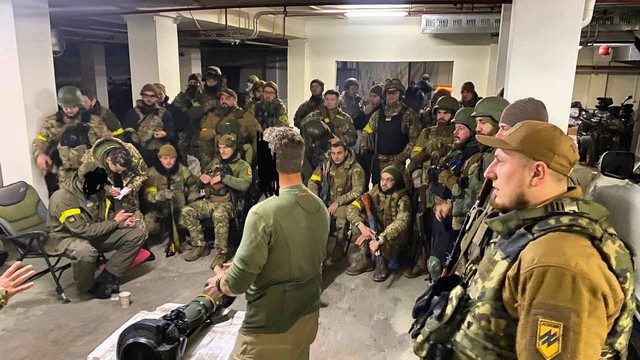
The anti-Russian activist media platform NEXTA tweeted on March 8 that NATO countries had shipped Next Generation Light Anti-tank Weapon (NLAW) guided missiles and sent instructors to the Ukrainian city of Kharkiv.

“The Azov regiment was the first to learn about new weaponry,” admitted NEXTA, a Western-backed Belarusian opposition outlet.

Azov is an explicitly neo-Nazi extremist group.

The Azov movement was founded as a fascist gang that served as the muscle behind a violent US-sponsored coup in Ukraine in 2014, overthrowing a democratically elected government that had maintained political neutrality, and instead installing a pro-Western and viciously anti-Russian regime.

After the 2014 putsch, the Azov Battalion was officially incorporated into Ukraine’s National Guard. It is now known as the Azov Detachment or Azov Regiment, and helps oversee special operations.

Azov preaches a white-supremacist ideology that portrays Russians as “Asiatic” and Ukrainians and “pure” white people. It uses numerous neo-Nazi symbols, including the German wolfsangel and black sun.

Given Azov’s links to white-supremacist fascist groups in the United States, there was actually a short-lived campaign to get the Ukrainian neo-Nazi militia listed as a terrorist organization.

In 2019, Democratic New York Representative Max Rose and 39 more congressmembers wrote a letter to the State Department asking it to label Azov as a terrorist organization.

That designation never came. Instead, Washington and NATO have armed Azov to wage a proxy war on Russia.

US, Britain, France, Germany, Israel, Poland, and Canada support Nazis in Ukraine

The photos tweeted by NEXTA are far from the only piece of evidence showing that Western governments have supported Nazis in Ukraine.

In 2017, US and Canadian military officers met with Azov Nazis in Ukraine and advised them on how to battle Russian-speaking Ukrainian independence fighters in the eastern Donbas region.

Azov published photos of the meeting on its official website.

The Canadian military officials who met with these Ukrainian Nazis later feared being exposed by the media.

The Ottawa Citizen newspaper reported that the exposure of Canadian training for Azov fascists led to an official military review.

Azov Nazis have also received weapons from Israel.

In 2018, mainstream news outlet Haaretz reported that a group of prominent human rights activists filed a petition with Israel’s High Court of Justice demanding that the country stop exporting weapons to Ukraine, after Azov posted a video on its official YouTube channel showing a far-right fighter using Israeli Tavor rifles.

A 2021 study published by George Washington University in Washington, DC showed how Western governments supported another neo-Nazi group in Ukraine, called Centuria.

Centuria is closely linked to Azov, and its extremist members have been photographed or filmed praising Nazi Germany and giving Hitler salutes.

These avowed neo-Nazis are now officers in the Ukrainian military, and were trained by the United States, Britain, France, Germany, Poland, and Canada.

The George Washington University study on this neo-Nazi gang, titled “Far-Right Group Made Its Home in Ukraine’s Major Western Military Training Hub,” stated:

As recently as April 2021, the group claimed that since its launch, members have participated in joint military exercises with France, the UK, Canada, the US, Germany, and Poland.

Meanwhile, several Western governments involved in training and arming Ukrainian troops stated, in response to the author’s request, that Ukraine is responsible for vetting Ukrainian soldiers trained by the West. None of the Western governments contacted—the US, Canada, the United Kingdom, and Germany—vet Ukrainian training recipients for extremist views and ties.

In 2017, NATO published a highly produced propaganda film honoring Baltic Nazi collaborators, known as the Forest Brothers.

The US-led military alliance depicted the fascist extremists as brave anti-Russian heroes for fighting the former Soviet Union, while curiously overlooking their alliance with Adolf Hitler.

Our Newsletter may be free of charge but it costs us money to provide it to you. Please consider supporting Global Research by making a donation or becoming a member.

14 March 2022

Source: www.globalresearch.ca

BHRN strongly condemns the Junta’s forcible evictions through mass destructions of civilians’ homes

15 March 2022

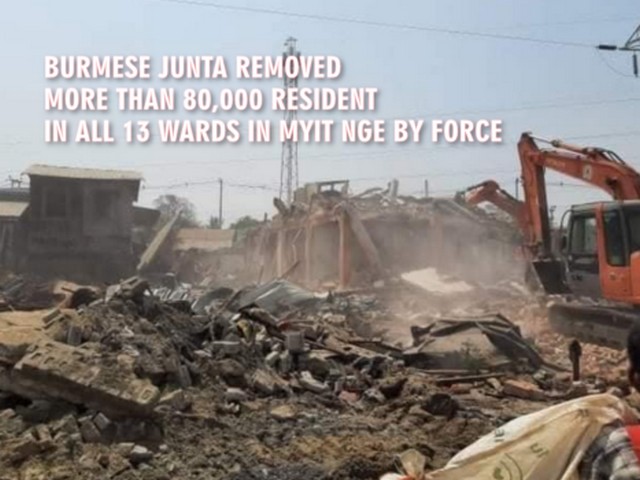
The Burmese military is forcibly evicting civilians as they have struggled to face popular uprisings for more than a year since the coup. The military has overthrown a democratically elected government, committed war crimes, crimes against humanity, and genocide, according to the UN fact-finding mission. The junta has always oppressed people through multiple tactics, such as mass killings, burning homes, abductions, and imprisonment of innocent civilians. They have done this after every coup with the excuse of restoring rule and order during the crises. They are now carrying out clearance operations by destroying civilians’ homes in Yangon’s Hlaing Thar Yar township, Rakhine State’s capital Sittwe and various towns in the Mandalay region, such as Mandalay, Pyin Oo Lwin, and Myit Ngwe.

On 5th March, the junta issued an eviction notice that ordered residents of Myitnge in the Mandalay region to remove their homes within three days for not having proper tenancy documents. It targeted residents from seven out of 13 wards in the town, including over 2000 households with small-scale shops and the staff dormitories of Myanmar Railway (MR). Myitnge has been the home for MR staff members since the British colonial time. According to local sources, BHRN learned that residents paid fees to every successive government for their tenancy. After the coup, the MR staff joined the Civil Disobedience Movement (CDM). Local people said that the junta targeted CDM staff initially. Later, they also pressured civilians’ homes in the wards to be removed; thus, they had to destroy their homes by themselves. People who could not demolish their properties before the junta forces arrived can face forceful destruction by bulldozers from the military. On 7th March, the junta’s people broadcasted a message across the town, which stated that anyone who let the evicted CDM staff stay at their homes would face charges from the military. It mentioned that the army would seal off those homes as penalties.

The junta removed over 70 homes in the railway ward of Sittwe in Rakhine state on 9th March and evicted about 200 houses in the Arr Jaik Daw Kone cemetery in the same city on 10th March.

The junta also sent eviction notices to 133 shops in Ba Htoo Stadium and 95 shops in Aung Myay Mandalar stadium in Mandalay, and 162 shops in the stadium in Pyin Oo Lwin to be removed by 31-3-2022 at the latest.

“The fascist military is using a very cunning tactic – eliminating a demographic of the population that resists the coup. To do so, the Junta has been bombing several villages in ethnic-controlled areas and evicting homes in the outskirts of big cities. However, disrupting a demographic of the population that is strongly resisting the coup could create huge pressure on the uprising to continue,” said BHRN’s executive director U Kyaw Win.

From October to December 2021, the junta claimed the residential areas and shops in eastern Hlaing Thar Yar were squatters and forcefully removed them and destroyed the properties with bulldozers. As a result, thousands of people became homeless. Local sources said those lands have commercial projects related to companies with close ties to the junta.

More than 100,000 households and 450,000 people received smart cards (squatter identity cards) under the previous civilian government in Yangon. Among them, more than 38,000 households are from Hlaing Thar Yar township. Such forceful evictions by the junta breach humanitarian norms and violate Burmese citizens’ fundamental civil and human rights. BHRN concludes that the military’s practices of favoring its cronies and supporters with economic opportunities by oppressing innocent civilians are a significant barrier to nurturing human rights and democratic culture in Burma for both long and short terms.

The international community should not ignore the junta’s gross violations of the civil and human rights of the people in Burma and should hold them accountable for their crimes. We urge the international community to protect innocent civilians’ lives and households and assist in their struggles for democracy and human rights in Myanmar. The international community cannot neglect the crisis in Burma anymore as it is becoming a security threat for the region. A global arms embargo and tougher economic sanctions must be imposed on the Burmese military, preventing them from further committing atrocities against their people.

Organisation’s Background

BHRN is based in London and operates across Burma/Myanmar working for human rights, minority rights and religious freedom in the country. BHRN has played a crucial role in advocating for human rights and religious freedom with politicians and world leaders.

Media Enquiries
Please contact:
Kyaw Win
Executive Director
Burma Human Rights Network (BHRN)
E: kyawwin@bhrn.org.uk
T: +44(0) 740 345 2378

Russia-Ukraine: Western Media Are Acting as Cheerleaders for War

By Jonathan Cook

Journalists are cheering on the arming of militias and civilians making improvised explosives – acts they usually treat as terrorism.

4 Mar 2022 – It is simply astonishing how many western journalists, including normally cautious BBC reporters, are shamelessly fawning over young women building Molotov cocktails on the streets of Ukrainian cities like Kyiv.

It’s suddenly sexy to make improvised explosives – at least, if the media consider you white, European and “civilised“.

That might surprise other, more established resistance movements, especially in the Middle East. They have invariably found themselves tarred as terrorists for doing much the same.

Western journalists’ difficulty containing their identification with, and support for, Ukraine’s civilian “resistance” must be maddening to Palestinians in tiny Gaza, for example, who have been locked into a metal cage by an Israeli militaryoccupier for decades.

Palestinians in Gaza make their own Molotov cocktails. But because they can’t get close to the Israeli army, they have to pack them into balloons that drift over the steel barrier surrounding Gaza and into Israel, sometimes setting fire to fields.

No one from the BBC has celebrated these “incendiary balloons” as a small act of resistance. They are reflexively blamed on Gaza’s governing group Hamas, the political wing of which was recently designated a terror organisation by the British government.

Double standards

Palestinians in Gaza have also suffered a trade blockade by Israel for the past 15 years, one designed to put them on a “starvation diet”. Protesters, including women, children and people in wheelchairs, have regularly turned out to throw a stone in the direction of distant Israeli snipers, hidden behind fortifications, as a symbolic way to demand their freedom. These protesters have often been shot by the Israeli army in response.

The western media offeroccasional anguish at the lives lost or the legs amputated of those targeted by the snipers. But none of them cheerlead this Palestinian “resistance” as they do the Ukrainian one. More usually, the protesters are treated as dupes or provocateurs of Hamas.

Gaza, unlike Ukraine, does not have an army, and its fighters, unlike Ukraine’s, are not being armed by the West.

The Guardian newspaper even censored its cartoonist Steve Bell when he sought to depict one of the victims of Israel’s snipers, a nurse, Razan al-Najjar, who had been trying to help the wounded. The paper implied that the cartoon – of Britain’s then prime minister, Theresa May, welcoming her Israeli counterpart, Benjamin Netanyahu, to London, with al-Najjar a sacrificial victim behind them in the fireplace – was antisemitic.

Assuming the media has in the past been reluctant to encourage ordinary people to confront well-armed soldiers – so as to avoid civilian casualties – then why has that policy suddenly been ditched in Ukraine?

The double standards are glaring and everywhere. It is impossible to claim that the journalists doing this are ignorant of reporting conventions elsewhere. They are mostly veterans of Middle East war zones, well used to covering Gaza, Baghdad, Nablus, Aleppo and Tripoli.

Fuelling the fire

Britain and other European states have chosen to fuel the fires of resistance in Ukraine by sending it weapons that can only lead to greater loss of life, especially of civilians caught in the crossfire. One might have expected the British media to examine the ethical implications of such a policy, and the hypocrisy. But not a bit of it.

In fact, much of the media have not only been acting as lobbyists for more weapons to be sent to the Ukrainian army, they have whipped up support for civilians in the UK to get more involved in the fighting.

That has been the case even after No 10 distanced itself from comments by Liz Truss, the foreign secretary, that Britons should be encouraged to volunteer for Ukraine’s so-called “international legions”, supposedly to defend Europe.

Her position was in conflict with usual government practice, which has treated those heading off to fight in war zones in the Middle East as terrorists. Shamima Begum, who went to Syria aged 15, has been stripped of her British citizenship and denied the right to return for doing what Truss has proposed in Ukraine.

Nonetheless, that did not dissuade the BBC from travelling to Essex to meet “Wozza“, a supplier of surplus British army kit he has been selling cheaply to Ukrainians in Britain so they can head off to the battlefront. Wozza was shown tearing off Union Jack insignia from uniforms so Ukrainian militiamen could use them.

Compare that with the treatment of an entirely peaceful form of resistance by westerners in solidarity with the Palestinians, the international Boycott, Sanctions and Divestment (BDS) movement. It has been treated as barely better than terrorism, with bans on support for BDS across Europe and the US.

Compromised ‘impartiality’

It is hard to remember in all the media agitation over Ukraine that this sympathetic coverage flies in the face of its reporting conventions. It is inconceivable, of course, that Britain would ever send arms to help, for example, Gaza liberate itself.

For that reason, the media will never have the opportunity to exercise their vocal chords in outrage at such a development.

In fact, the western media more typically echo western government opposition to any support for Gaza, even construction materials like cement to rebuild the enclave after one of Israel’s intermittent wrecking sprees. That is because reporters treat uncritically Israeli claims that humanitarian aid will be repurposed by Hamas and bolster “terrorism”.

Back in 2010, for example, a BBC Panorama programme failed to mention that an Israeli naval attack on a humanitarian aid convoy to besieged Gaza was conducted illegally in international waters. Nine activists trying to deliver aid items like medicine to Gaza aboard the Mavi Marmara ship were killed by Israeli commandoes, but the interviews with these masked men were largely uncritical. There was very little sympathy from the BBC for that act of resistance against a brutal occupier.

A year earlier, the BBC broke with tradition and refused to broadcast a long-established aid appeal because on this occasion it was to provide food and shelter to Gaza, following an Israeli assault that destroyed swaths of the enclave. The BBC justified the decision on the grounds that it would compromise its “impartiality” – something it seems entirely unconcerned about in Ukraine.

The BBC had not responded to questions about these inconsistencies by the time of publication.

Fog of war

The battlefield is well known for becoming quickly enveloped in the fog of war. That is one reason why inexperienced journalists are cautioned by their editors to wait for evidence and to be alert to propaganda. In practice, however, one can assess where the media’s sympathies lie – concealed behind flimsy claims of objectivity – by noting when and for whose benefit these caution rules are abandoned, and which side’s narratives are accepted quickly and uncritically.

In the Middle East, it is clear that US, European and Israeli claims are all too readily amplified, even when their veracity is in doubt.

Such media-fuelled lies have been manifold. That Israel urged the Palestinians it expelled in 1948 to return home. That Saddam Hussein’s troops ripped babiesfrom incubators in Kuwait, and that the Iraqi leader colluded with his arch-enemy, al-Qaeda, in the 9/11 attacks. That Muammar Gadaffi’s soldiers in Libya took Viagra to rape civilians in Benghazi. That Russia paid bounties to the Taliban to kill US soldiers in Afghanistan.

These deceptions and fabrications grabbed headlines when they were useful as propaganda, only to be quietly withdrawn much later on.

In the case of Ukraine, a similar pattern appears to be emerging. There were widespread, inciteful and entirely fictitious reports in the western media of Russian troops butchering a contingent of 13 Ukrainian soldiers on Snake Island, in the Black Sea. A fake audio tape was released of the Ukrainians supposedly cursing the Russian invaders. Ukraine’s government promised each of them a Hero of Ukraine award.

But in fact, it was Russian media reports that were true. There were 82 Ukrainian soldiers and they had surrendered. All were alive and well. In another example, a clip from a video game was widely promoted as a heroic lone Ukrainian fighter pilot – dubbed the Ghost of Kyiv – shooting down Russian planes and helicopters.

Misinformation has been shared even more aggressively on western social media accounts, and most of it is designed to evoke sympathy for Ukraine and hostility to Russia.

Softening-up operation

But what we are seeing is more than just an appetite in the media for evidence-free stories and falsehoods so long as they are directed against Russia. And it is about more than the media’s sympathy for Ukrainian “resistance” denied other groups battling their oppressors, when those oppressors are the West and its allies.

The media is chock full of commentators far more rabidly tribal than even western governments and military generals. The media chorus for “more war” seems to be serving as an ideological softening-up operation, clearing the path for governments as they prepare for more extreme propaganda and undemocratic measures.

Along with many others, Mail on Sunday commentator Dan Hodges has beencalling for a no-fly zone over Ukraine that even Boris Johnson has rejected for very obvious reasons. It would lead Europe into a direct confrontation with the Russian airforce and risk confrontation with a nuclear power.

Nonetheless, Hodges has described any rejection of this idea as “an act of appeasement no different to our appeasement of Hitler in 1938”. Russia’s invasion came after nearly a decade of goading by the US using Nato as cover to forge ever tighter military relations with its neighbour.

Rightly or wrongly, Moscow interpreted Nato’s behaviour as an aggressive move by the US and its allies into its “sphere of influence”. The idea that no concession could, and can, be made to Russia – that the only “moral choice”, as Hodges calls it, is risking a potential nuclear war – should be understood as the belligerent provocation it clearly is.

NBC News’ chief foreign correspondent, Richard Engel, tweeted out what he saw as a “risk calculation” and “moral dilemma”: should the West bomb a convoy of Russian tanks on their way towards Kyiv? Apparently concerned by current inaction, he asked: “Does the West watch in silence as it rolls?”

Utter hypocrisy

Condeleeza Rice, an architect of the criminal invasion of Iraq, has not been challenged by the media over her utter hypocrisy in agreeing that “When you invade a sovereign nation, that is a war crime.” If that is the case – and international law says it is – then Rice herself should be on trial at the Hague.

Or what about the media’s horror this week at the shelling of Kharkiv, Ukraine’s second city, where “dozens” were reported killed? Compare that to the media’s breathless excitement over the “Shock and Awe” bombing campaign that likely killed thousands in the opening hours of the US invasion of Iraq in 2003.

What about the media’s mostly complicit silence over many years of Saudi bombing – using British planes and bombs – of civilians in Yemen, leading to a barely imaginable humanitarian catastrophe there? Those in Yemen who resist the Saudi horror show are not heroes to our media, they are simply dismissed as puppets of Iran?

Veteran BBC journalist Jeremy Vine, meanwhile, expressed the view that conscripted Russian soldiers “deserve to die” when they put on a Russian army uniform. “That’s life,” he told a shocked caller to his show.

Did Vine think British and US troops – professional soldiers, unlike Russia’s conscripts – also deserved to die when their armies illegally invaded Iraq? And if not, why not?

The racist undertones and overtones of much western coverage – with commentators and interviewees regularly stressing how Ukrainian refugees are “European”, “civilised”, “blond haired and blue eyed”– is hard to miss.

State propaganda

And in the midst of this rampant, often unhinged western war propaganda, much of its coming from the British state broadcaster, Europe has banned Russia’s state broadcaster RT from the airwaves, while Silicon Valley scrubs its presence from the internet.

There is no doubt that RT generally promotes an editorial line largely sympathetic to Moscow’s foreign policy goals – just as the BBC can invariably be relied on to promote an editorial line largely sympathetic to Britain’s foreign policy goals.

The problem for western audiences is not their exposure to Russian state propaganda. It is their constant exposure to relentless western state propaganda.

If we seek peace – and there are few indications of that at the moment – then we need the western media held to account for its mindless jingoism, its exaggerations, its credulity, its double standards, and its deceptions. But who is going to act as a watchdog on the supposed watchdog of the Fourth Estate?

Right now, we need voices from Russia to understand what Putin thinks and wants, not what the BBC’s “chief international correspondents” think he wants. We need information sources ready to quickly challenge both western and Russian “fake news”.

And most of all we need to stop with our racist view of the world, in which we are always the Good Guys and they are always the Bad Guys, and in which our suffering matters and the suffering of others doesn’t.

Jonathan Cook is an award-winning British journalist based in Nazareth, Israel, since 2001.

14 March 2022

Source: www.transcend.org

Towards a peaceful solution to the conflict in Ukraine!

By Dr Salim Nazzal

The conflict in Ukraine is multi-faceted and not a black and white clash. For example, it can be a conflict between the brothers or a kind of civil war because of the two peoples’ interaction with each other throughout history. Without ignoring that a significant part of the Ukrainian people, especially in western Ukraine, have negative feelings towards Russia, something, I know in my several visits to Ukraine.

Russian leaders who led the post-communist changes had not addressed the Ukraine issue and resolved it in a way that would prevent future conflicts. The reason is probably that Russia itself was in chaos and collapse.

It is a proxy conflict between Russia and the NATO countries, a continuation of the war between the two camps, the Soviet Union and Russia today, the principal heir and the west, especially after the NATO alliance has expanded and includes most of them the former communist countries.

There are also political and legal aspects. Conflicts are often resolved through political consensus and not from a legal perspective. For example, in 1962, Cuba had the right to receive advanced Soviet weapons because it is an independent country and the decision-maker on its territory. But the matter was resolved by negotiation, and the Soviet Union withdrew its weapons from Cuba.

The point here is that we face a complex conflict in which multiple factors overlap.

Nevertheless, even in complex disputes, there is always the possibility of seizing the end of a thread and starting from it to solve the problem.

In my opinion, the golden rule for conflict resolution should be established on two grounds.

The first is to guarantee the territorial integrity of Ukraine. And regions with a Russian majority can have a solution such as autonomy, for example, within the Ukrainian state.

The second point is to address Russian security concerns and not underestimate them, as previously happened.

These two points represent, in my opinion, the pillars for moving towards a better future… War does not solve problems but somewhat complicates them. The poor die in wartime, and arms dealers are the beneficiaries of this. The poor in the world are now paying the price of the price increase, which is expected to rise by about twenty percent.

The Russian-Ukrainian war also threatens world peace because, if not resolved, it may develop into a devastating nuclear conflict.

Salim Nazzal is a Palestinian Norwegian researcher, lecturer playwright and poet, wrote more than 17 books such as Perspectives on thought, culture and political sociology

16 March 2022

Source: countercurrents.org

Appeal of the members of the Presidium of the Russian Academy of Sciences to the world scientific Community

By Press Release

We, members of the Presidium of the Russian Academy of Sciences, appeal to scientists from Russia and all over the world.

The long-term confrontation in Ukraine, accompanied by the death and deprivation of civilians, has grown into an acute military conflict. We consider it extremely important through the negotiation process to achieve a cessation of hostilities and an early peaceful settlement. We experience serious fears for the life and health of people, including our fellow scientists, who are in the war zone in the territory of Donbass and Ukraine.

We stand for the immediate solution of humanitarian issues related, first of all, to ensuring the security and normal living conditions of the civilian population. We appeal to all parties to the conflict to ensure the safety of scientific, educational, medical and cultural institutions, monuments of historical heritage. It is important to prevent the destruction of nuclear energy centers, the chemical industry, and other critical infrastructure facilities.

We call on our colleagues from all over the world, national academies of sciences, international and national scientific associations, as well as our other partners in the scientific and educational space, to refrain from positions and actions dictated not by the interests of science, but by the political situation and the severity of the situation. We consider unacceptable any attempts of political pressure on scientists, teachers, graduate students and students and discrimination on the grounds of nationality or citizenship.

We call on the world scientific community to continue and develop cooperation, strengthen international scientific and educational ties, and prevent any attempts to restrict access to international scientific infrastructure, publication opportunities, and open databases.

We consider it necessary to intensify scientific diplomacy and develop the movement of scientists for peace, international security, conflict resolution, reduction of military tension and prevention of the threat of nuclear war. Информация взята с портала «Научная Россия» (https://scientificrussia.ru/)

Translated by Ashish Singh

14 March 2022

Source: countercurrents.org

Anti-war demonstrations continue in Russia, despite mass repression

By Tom Carter

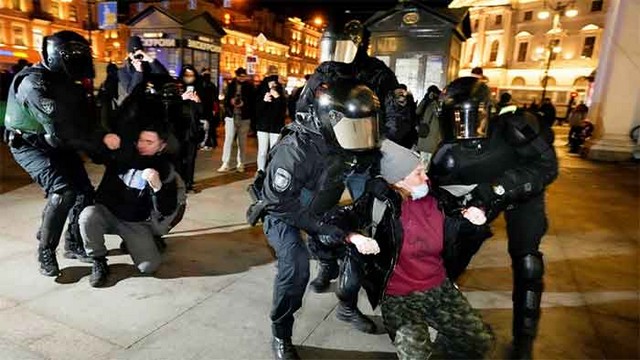
Anti-war protests are continuing in Russia, despite aggressive police repression and a battery of new laws criminalizing opposition to the war in Ukraine. According to the Russian-language human rights project OVD-Info, which receives funding from the European Commission, 668 people had been detained in 36 cities as of the end of the day yesterday.

The previous weekend saw around 10 times as many detentions in twice as many cities. Since the invasion of Ukraine on February 24, OVD-Info has documented more than 14,000 arrests of anti-war demonstrators within Russia, with more than 170 people remaining in custody. Many others have been released but face pending legal actions on the basis of a slew of new laws and regulations that dramatically restrict free speech, as well as limit access to some of the most popular social media platforms, including Facebook, Twitter and Instagram.

One new restriction prohibits any speech or conduct that would “distort the purpose, role and tasks of the Russian Armed Forces, as well as other units during special military and other operations.” The maximum penalty under the expanded new laws, which attaches to any person convicted of knowingly spreading “false fakes,” is a prison sentence of 15 years. The vague language of the law, together with the severe punishment for its violation, opens the door to arbitrary persecution of any expression of dissent relating to the war.

While the anti-war demonstrations have largely been rooted in sections of youth and the middle class, and are politically dominated by the pro-US liberal opposition, they reflect, if in a very limited and distorted sense, anti-war sentiments that are widely and deeply felt throughout the population. The crackdown by the Putin regime is not least of all aimed at intimidating the many workers who have not joined the demonstrations, and at preempting the emergence of a genuine anti-war movement within the working class.

The Kremlin has now banned major social media platforms, including Facebook and Twitter, where many videos and statements opposing the war were shared and watched by millions. Instagram will be blocked starting March 15.

In one short video that has been viewed nearly 10 million times, police in St. Petersburg detained a well-known artist and survivor of the Siege of Leningrad, Yelena Osipova, 77, who was carrying two large hand-made signs calling for the elimination of nuclear weapons worldwide.

Banners at demonstrations have read, “No to war, please,” and “We are for peace.” In videos posted on social media, anti-war protesters chant “Shame,” “Ukraine is not our enemy,” and “Putin, withdraw the troops.” A common chant, which can be heard in the background of Osipova’s arrest, is the simple three-syllable “No to War” (nyet voinye), which has also seen widespread use as a social media hashtag (#нетвойне).

A number of audio recordings purporting to capture the verbal and physical abuse of detained anti-war demonstrators circulated widely on Russian-language social media platforms over the past week, gathering hundreds of thousands of interactions across multiple platforms.

In one, dated March 6, 26-year-old feminist activist Alexandra Kaluzhskikh is verbally and physically abused during an interrogation at a police station in Brateyevo, a suburb of Moscow, after attending a rally at Komsomolskaya Square. In another, 22-year-old Marina Morozova confronts an interrogator who douses her with water, kicks her in the arm, and waves a pistol in front of her face.

The tabloid Komsomolskya Pravda, which is aligned with the Russian Communist Party, published an article claiming that the recordings are “fake,” warning that anyone distributing them can be subject to prosecution under the newly expanded laws against spreading “fakes.”

The recordings have been published and amplified in sections of the Russian media aligned with the right-wing, pro-western opposition within Russia, including imprisoned “opposition leader” Alexei Navalny. This includes platforms like Novaya Gazeta, whose co-founder and editor-in-chief dedicated a recent Nobel Prize to Navalny, and Mediazona, a project founded by two members of the punk band Pussy Riot, which has received substantial support from Western politicians.

The reported abuse of anti-war demonstrators at the Brateyevo police station have also been carried in the pro-NATO western media, where they have been used to underscore the authoritarian character of Russia, contrasting it to its allegedly “democratic” adversaries. Notwithstanding their hypocritical expressions of sympathy for the anti-war protesters persecuted by Moscow, there is no doubt that a genuine anti-war movement in the West, when it emerges, will face similarly brutal repression.

Originally published by WSWS.org

14 March 2022

Source: countercurrents.org

How to Destroy Russia. 2019 Rand Corporation Report: “Overextending and Unbalancing Russia”

By Manlio Dinucci

Force the adversary to expand recklessly in order to unbalance him, and then destroy him. This is not the description of a judo hold, but a plan against Russia elaborated by the Rand Corporation, the most influential think tank in the USA. With a staff of thousands of experts, Rand presents itself as the world’s most reliable source for Intelligence and political analysis for the leaders of the United States and their allies.

The Rand Corp prides itself on having contributed to the elaboration of the long-term strategy which enabled the United States to win the Cold War, by forcing the Soviet Union to consume its own economic resources in the strategic confrontation.

It is this model which was the inspiration for the new plan, Overextending and Unbalancing Russia, published by Rand [1].

CLICK TO ACCESS the complete document of RAND May 2019

According to their analysts, Russia remains a powerful adversary for the United States in certain fundamental sectors. To handle this opposition, the USA and their allies will have to pursue a joint long-term strategy which exploits Russia’s vulnerabilities. So Rand analyses the various means with which to unbalance Russia, indicating for each the probabilities of success, the benefits, the cost, and the risks for the USA.

Rand analysts estimate that Russia’s greatest vulnerability is that of its economy, due to its heavy dependency on oil and gas exports. The income from these exports can be reduced by strengthening sanctions and increasing the energy exports of the United States. The goal is to oblige Europe to diminish its importation of Russian natural gas, and replace it by liquefied natural gas transported by sea from other countries.

Another way of destabilising the Russian economy in the long run is to encourage the emigration of qualified personnel, particularly young Russians with a high level of education.

In the ideological and information sectors, it would be necessary to encourage internal contestation and at the same time, to undermine Russia’s image on the exterior, by excluding it from international forums and boycotting the international sporting events that it organises.

In the geopolitical sector, arming Ukraine would enable the USA to exploit the central point of Russia’s exterior vulnerability, but this would have to be carefully calculated in order to hold Russia under pressure without slipping into a major conflict, which it would win.

In the military sector, the USA could enjoy high benefits, with low costs and risks, by increasing the number of land-based troops from the NATO countries working in an anti-Russian function.

The USA can enjoy high probabilities of success and high benefits, with moderate risks, especially by investing mainly in strategic bombers and long-range attack missiles directed against Russia.

Leaving the INF Treaty and deploying in Europe new intermediate-range nuclear missiles pointed at Russia would lead to high probabilities of success, but would also present high risks.

By calibrating each option to gain the desired effect – conclude the Rand analysts – Russia would end up by paying the hardest price in a confrontation, but the USA would also have to invest huge resources, which would therefore no longer be available for other objectives. This is also prior warning of a coming major increase in USA/NATO military spending, to the disadvantage of social budgets.

This is the future that is planned out for us by the Rand Corporation, the most influential think tank of the Deep State – in other words the underground centre of real power gripped by the economic, financial, and military oligarchies – which determines the strategic choices not only of the USA, but all of the Western world.

The “options” set out by the plan are in reality no more than variants of the same war strategy, of which the price in sacrifices and risks is paid by us all.

*

Manlio Dinucci is a Research Associate of the Centre for Research on Globalization.

10 March 2022

Source: www.globalresearch.ca

On the Worthiness and Unworthiness of War Victims

By Chris Hedges

Dividing the world into worthy and unworthy victims is a tactic used to justify our crimes and demonize our enemies. Conflicts will not be solved until all nations abide by international law and all victims are deemed worthy.

Rulers divide the world into worthy and unworthy victims, those we are allowed to pity, such as Ukrainians enduring the hell of modern warfare, and those whose suffering is minimized, dismissed, or ignored. The terror we and our allies carry out against Iraqi, Palestinian, Syrian, Libyan, Somali and Yemeni civilians is part of the regrettable cost of war. We, echoing the empty promises from Moscow, claim we do not target civilians. Rulers always paint their militaries as humane, there to serve and protect. Collateral damage happens, but it is regrettable.

This lie can only be sustained among those who are unfamiliar with the explosive ordinance and large kill zones of missiles, iron fragmentation bombs, mortar, artillery and tank shells, and belt-fed machine guns. This bifurcation into worthy and unworthy victims, as Edward Herman and Noam Chomsky point out in “: The Political Economy of the Mass Media,” is a key component of propaganda, especially in war. The Russian-speaking population in Ukraine, to Moscow, are worthy victims. Russia is their savior: The 1.5 million refugees and the millions of Ukrainian families cowering in basements, car parks and subway stations, are unworthy “Nazis.”

Worthy victims allow citizens to see themselves as empathetic, compassionate, and just. Worthy victims are an effective tool to demonize the aggressor. They are used to obliterate nuance and ambiguity. Mention the provocations carried out by the western alliance with the expansion of NATO beyond the borders of a unified Germany, a violation of promises made to Moscow in 1990; the stationing of of NATO troops and missile batteries in Eastern Europe; the U.S. involvement in the ouster in 2014 of Ukraine President Viktor Yanukovych, which led to the civil war in the east of Ukraine between Russian-backed separatists and Ukraine’s army, a conflict that has claimed tens of thousands of lives, and you are dismissed as a Putin apologist.

It is to taint the sainthood of the worthy victims, and by extension ourselves. We are good. They are evil. Worthy victims are used not only to express sanctimonious outrage, but to stoke self-adulation and a poisonous nationalism. The cause becomes sacred, a religious crusade. Fact-based evidence is abandoned, as it was during the calls to invade Iraq. Charlatans, liars, con artists, fake defectors, and opportunists become experts, used to fuel the conflict.

Celebrities, who, like the powerful, carefully orchestrate their public image, pour out their hearts to worthy victims. Hollywood stars such as George Clooney made trips to Darfur to denounce the war crimes being committed by Khartoum at the same time the US was killing scores of civilians in Iraq and Afghanistan. The war in Iraq was as savage as the slaughter in Darfur, but to express outrage at what was happening to unworthy victims was to become branded as the enemy, who of course, like Putin or Saddam Hussein, is always the new Hitler.

Saddam Hussein’s attacks on the Kurds, considered worthy victims, saw an international outcry while Israeli persecution of the Palestinians, subjected to relentless bombing campaigns by the Israeli air force and its artillery and tank units, with hundreds of dead and wounded, was, at best, an afterthought. At the height of Stalin’s purges in the 1930s, worthy victims were the Republicans battling the fascists in the Spanish civil war. Soviet citizens were mobilized to send aid and assistance. Unworthy victims were the millions of people Stalin executed, sometimes after tawdry show trials, and sent to the gulags.

While I was reporting from El Salvador in 1984, the Catholic priest Jerzy Popiełuszko was murdered by the regime in Poland. His death was used to excoriate the Polish communist government, a stark contrast to the response of the Reagan administration to the rape and murder of four Catholic missionaries in 1980 in El Salvador by the Salvadorean National Guard. President Ronald Reagan’s administration sought to blame the three nuns and a lay worker for their own deaths. Jeane Kirkpatrick, Reagan’s Ambassador to the United Nations, said, “The nuns were not just nuns. The nuns were also political activists.” Secretary of State Alexander Haig speculated that “perhaps they ran a roadblock.”

For the Reagan administration, the murdered churchwomen were unworthy victims. The right-wing government in El Salvador, armed and backed by the United States, joked at the time, Haz patria, mata un cura (Be a patriot, kill a priest). Archbishop Óscar Romero had been assassinated in March of 1980. Nine years later it would gun down six Jesuits and two others at their residence on the campus of Central American University in San Salvador. Between 1977 and 1989, death squads and soldiers killed 13 priests in El Salvador.

It is not that worthy victims do not suffer, nor that they are not deserving of our support and compassion, it is that worthy victims alone are rendered human, people like us, and unworthy victims are not. It helps, of course, when, as in Ukraine, they are white. But the missionaries murdered in El Salvador were also white and American and yet it was not enough to shake US support for the country’s military dictatorship.

“The mass media never explain why Andrei Sakharov is worthy and Jose Luis Massera, in Uruguay, is unworthy,” Herman and Chomsky write. “The attention and general dichotomization occur ‘naturally’ as a result of the working of the filters, but the result is the same as if a commissar had instructed the media: ‘Concentrate on the victims of enemy powers and forget about the victims of friends.’ Reports of the abuses of worthy victims not only pass through the filters; they may also become the basis of sustained propaganda campaigns. If the government or corporate community and the media feel that a story is useful as well as dramatic, they focus on it intensively and use it to enlighten the public.”

“This was true, for example, of the shooting down by the Soviets of the Korean airliner KAL 007 in early September 1983, which permitted an extended campaign of denigration of an official enemy and greatly advanced Reagan administration arms plans,” Herman and Chomsky write. “As Bernard Gwertzman noted complacently in the New York Times of August 31, 1984, US officials ‘assert that worldwide criticism of the Soviet handling of the crisis has strengthened the United States in its relations with Moscow.’ In sharp contrast, the shooting down by Israel of a Libyan civilian airliner in February I973 led to no outcry in the West, no denunciations for ‘cold-blooded murder,’ and no boycott. This difference in treatment was explained by the New York Times precisely on the grounds of utility in a 1973 editorial: ‘No useful purpose is served by an acrimonious debate over the assignment of blame for the downing of a Libyan airliner in the Sinai Peninsula last week.’ There was a very ‘useful purpose’ served by focusing on the Soviet act, and a massive propaganda campaign ensued.”

It is impossible to hold those responsible for war crimes accountable if worthy victims are deserving of justice and unworthy victims are not. If Russia should be crippled with sanctions for invading Ukraine, which I believe it should, the United States should have been crippled with sanctions for invading Iraq, a war launched on the basis of lies and fabricated evidence.

Imagine if America’s largest banks, J.P Morgan Chase, Citibank, Bank of America and Wells Fargo were cut off from the international banking system. Imagine if our oligarchs, Jeff Bezos, Jamie Diamond, Bill Gates, and Elon Musk, as venal as Russian oligarchs, had their assets frozen and estates and luxury yachts seized. (Bezos’ yacht is the largest in the world, cost an estimated $500 million and is about 57 feet longer than a football field.) Imagine if leading political figures, such as George W. Bush and Dick Cheney and US “oligarchs” were blocked from traveling under visa restrictions. Imagine if the world’s biggest shipping lines suspended shipments to and from the United States. Imagine if US international media news outlets were forced off the air. Imagine if we were blocked from purchasing spare parts for our commercial airlines and our airliners were banned from European air space. Imagine if our athletes were barred from hosting or participating in international sporting events. Imagine if our symphony conductors and opera stars were forbidden from performing unless they denounced the Iraq war and, in a kind of perverted loyalty oath, condemned George W. Bush.

The rank hypocrisy is stunning. Some of the same officials that orchestrated the invasion of Iraq, who under international law are war criminals for carrying out a preemptive war, are now chastising Russia for its violation of international law. The US bombing campaign of Iraqi urban centers, called “Shock and Awe,” saw the dropping of 3,000 bombs on civilian areas that killed over 7,000 noncombatants in the first two months of the war. Russia has yet to go to this extreme.

“I have argued that when you invade a sovereign nation, that is a war crime,” a FOX News host said (with a straight face) recently to Condoleezza Rice, who served as Bush’s National Security adviser during the Iraq War.

“It is certainly against every principle of international law and international order and that is why throwing the book at them now in terms of economic sanctions and punishments is also a part of it,” Rice said. “And I think the world is there. Certainly, NATO is there. He’s managed to unite NATO in ways that I didn’t think I would ever see after the end of the Cold War.”

Rice inadvertently made a case for why she should be put on trial with the rest of Bush’s enablers. She famously justified the invasion of Iraq by stating: “The problem here is that there will always be some uncertainty about how quickly he can acquire nuclear weapons. But we don’t want the smoking gun to be a mushroom cloud.” Her rationale for preemptive war, which under post-Nuremberg laws is a criminal war of aggression, is no different than that peddled by Russian Foreign Minister Sergey Lavrov, who says the Russia invasion is being carried out to prevent Ukraine from obtaining nuclear weapons.

And this brings me to RT America, where I had a show called “On Contact.” RT America is now off the air after being deplatformed and unable to disseminate its content. This was long the plan of the US government. The invasion of Ukraine gave Washington the opening to shut RT down. The network had a tiny media footprint. But it gave a platform to American dissidents who challenged corporate capitalism, imperialism, war, and the American oligarchy.

My public denunciation of the invasion of Ukraine was treated very differently by RT America than my public denunciation of the Iraq war was treated by my former employer, The New York Times. RT America made no comment, publicly or privately, about my condemnation of the invasion of Ukraine in my ScheerPost column. Nor did RT comment about statements by Jesse Ventura, a Vietnam veteran and former Minnesota governor, who also had a show on RT America, and who wrote: “20 years ago, I lost my job because I opposed the Iraq War and the invasion of Iraq. Today, I still stand for peace. As I’ve said previously, I oppose this war, this invasion, and if standing up for peace costs me another job, so be it. I will always speak out against war.”

RT America was shut down six days after I denounced the invasion of Ukraine. If the network had continued, Ventura and I might have paid with our jobs, but at least for those six days they kept us on air.

The New York Times issued a formal written reprimand in 2003 that forbade me to speak about the war in Iraq, although I had been the newspaper’s Middle East Bureau Chief, had spent seven years in the Middle East and was an Arabic speaker. This reprimand set me up to be fired. If I violated the prohibition, under guild rules, the paper had grounds to terminate my employment. John Burns, another foreign correspondent at the paper, publicly supported the invasion of Iraq. He did not receive a reprimand.

My repeated warnings in public forums about the chaos and bloodbath the invasion of Iraq would trigger, which turned out to be correct, was not an opinion. It was an analysis based on years of experience in the region, including in Iraq, and an intimate understanding of the instrument of war those in the Bush White House lacked. But it challenged the dominant narrative and was silenced. This same censorship of anti-war sentiment is happening now in Russia, but we should remember it happened here during the inception and initial stages of the invasion of Iraq.

Those of us who opposed the Iraq war, no matter how much experience we had in the region, were attacked and vilified. Ventura, who had a three-year contract with MSNBC, saw his show canceled.

Those who were cheerleaders for the war, such as George Packer, Thomas Friedman, Paul Berman, Michael Ignatieff, Leon Wieseltier and Nick Kristof, who Tony Judt called “Bush’s useful idiots,” dominated the media landscape. They painted the Iraqis as oppressed, worthy victims, who the US military would set free. The plight of women under the Taliban was a rallying cry to bomb and occupy the country. These courtiers to power served the interests of the power elite and the war industry. They differentiated between worthy and unworthy victims. It was a good career move. And they knew it.

There was very little dispute about the folly of invading Iraq among reporters in the Middle East, but most did not want to jeopardize their positions by speaking publicly. They did not want my fate to become their own, especially after I was booed off a commencement stage in Rockford, Illinois for delivering an antiwar speech and became a punching bag for right-wing media. I would walk through the newsroom and reporters I had known for years looked down or turned their heads, as if I had leprosy. My career was finished. And not just at The New York Times but any major media organization, which is where I was, orphaned, when Robert Scheer recruited me to write for Truthdig, which he then edited.

What Russia is doing militarily in Ukraine, at least up to now, was more than matched by our own savagery in Iraq, Afghanistan, Syria, Libya and Vietnam. This is an inconvenient fact the press, awash in moral posturing, will not address.

No one has mastered the art of technowar and wholesale slaughter like the US military. When atrocities leak out, such as the My Lai massacre of Vietnamese civilians or the prisoners in Abu Ghraib, the press does its duty by branding them aberrations. The truth is that these killings and abuse are deliberate. They are orchestrated at the senior levels of the military. Infantry units, assisted by long ranger artillery, fighter jets, heavy bombers, missiles, drones, and helicopters level vast swaths of “enemy” territory killing most of the inhabitants. The US military during the invasion of Iraq from Kuwait created a six-mile-wide free-fire zone that killed hundreds if not thousands of Iraqis. The indiscriminate killing ignited the Iraqi insurgency.

When I entered southern Iraq in the first Gulf War it was flattened. Villages and towns were smoldering ruins. Bodies, including women and children, lay scattered on the ground. Water purification systems had been bombed. Power stations had been bombed. Schools and hospitals had been bombed. Bridges had been bombed. The United States military always wages war by “overkill,” which is why it dropped the equivalent of 640 Hiroshima-sized atomic bombs on Vietnam, most actually falling on the south where our purported Vietnamese allies resided. It unloaded in Vietnam more than 70 million tons of herbicidal agents, three million white phosphorus rockets — white phosphorus will burn its way entirely through a body — and an estimated 400,000 tons of jellied incendiary napalm.

“Thirty-five percent of the victims,” Nick Turse writes of the war in Vietnam, “died within 15 to 20 minutes.” Death from the skies, like death on the ground, was often unleashed capriciously. “It was not out of the ordinary for US troops in Vietnam to blast a whole village or bombard a wide area in an effort to kill a single sniper.”

Vietnamese villagers, including women, children, and the elderly, were often herded into tiny, barbed wire enclosures known as “cow cages.” They were subjected to electric shocks, gang raped and tortured by being hung upside down and beaten, euphemistically called “the plane ride,” until unconscious. Fingernails were ripped out. Fingers were dismembered. Detainees were slashed with knives. They were beaten senseless with baseball bats and waterboarded. Targeted assassinations, orchestrated by CIA death squads, were ubiquitous.

Wholesale destruction, including of human beings, to the US military, perhaps any military, is orgiastic. The ability to unleash sheets of automatic rifle fire, hundreds of rounds of belt-fed machine-gun fire, 90 mm tank rounds, endless grenades, mortars, and artillery shells on a village, sometimes supplemented by gigantic 2,700-pound explosive projectiles fired from battleships along the coast, was a perverted form of entertainment in Vietnam, as it became later in the Middle East. US troops litter the countryside with claymore mines. Canisters of napalm, daisy-cutter bombs, anti-personnel rockets, high-explosive rockets, incendiary rockets, cluster bombs, high-explosive shells, and iron fragmentation bombs — including the 40,000-pound bomb loads dropped by giant B-52 Strarofortress bombers — along with chemical defoliants and chemical gases dropped from the sky are our calling cards. Vast areas are designated free fire zones — a term later changed by the military to the more neutral sounding “specified strike zone” — where everyone in those zones is considered the enemy, even the elderly, women, and children.

Soldiers and marines who attempt to report the war crimes they witness can face a fate worse than being pressured, discredited, or ignored. On Sept. 12, 1969, Nick Turse writes in his book “Kill Anything That Moves: The Real American War in Vietnam,” George Chunko sent a letter to his parents explaining how his unit had entered a home that had a young Vietnamese woman, four young children, an elderly man, and a military-age male. It appeared the younger man was AWOL from the South Vietnamese army. The young man was stripped naked and tied to a tree. His wife fell to her knees and begged the soldiers for mercy. The prisoner, Chunko wrote, was “ridiculed, slapped around and [had] mud rubbed into this face.” He was then executed.

A day after he wrote the letter, Chunko was killed. Chunko’s parents, Turse writes, “suspected that their son had been murdered to cover up the crime.”

All of this remains unspoken as we express our anguish for the people of Ukraine and revel in our moral superiority. The life of a Palestinian or an Iraqi child is as precious as the life of a Ukrainian child. No one should live in fear and terror. No one should be sacrificed on the altar of Mars. But until all victims are worthy, until all who wage war are held accountable and brought to justice, this hypocritical game of life and death will continue. Some human beings will be worthy of life. Others will not. Drag Putin off to the International Criminal Court and put him on trial. But make sure George W. Bush is in the cell next to him. If we can’t see ourselves, we can’t see anyone else. And this blindness leads to catastrophe.

Chris Hedges is a Pulitzer Prize–winning journalist who was a foreign correspondent for fifteen years for The New York Times, where he served as the Middle East Bureau Chief and Balkan Bureau Chief for the paper.

9 March 2022

Source: countercurrents.org

Understanding the War in Ukraine

By Vijay Prashad

The war between Russia and Ukraine began much before February 24, 2022—the date provided by the Ukrainian government, NATO and the United States for the beginning of the Russian invasion of Ukraine. According to Dmitry Kovalevich, a journalist and a member of a now-banned communist organization in Ukraine, the war actually started in the spring of 2014 and has never stopped since.

He writes to me from the south of Kyiv/Kiev, Ukraine, and recounts an anecdote: “What’s there at the front line?” asks one person. “Our troops are winning as usual!” comes the response. “Who are our troops?” the first person inquires and is told, “We’ll soon see…” In a war, everything is in dispute, even the name of Ukraine’s capital (Kyiv in Ukrainian, and Kiev in Russian, goes the debate online).

Wars are among the most difficult of reporting assignments for a journalist. These days, especially, with the torrent of social media and the belligerence of network news television channels, matters on the ground are hard to sort out. Basic facts about the events taking place during a war are hard to establish, let alone ensuring the correct interpretation of these facts. Videos of apparent war atrocities that can be found on social media platforms like YouTube are impossible to verify. Often, it becomes clear that much of the content relating to war that can be found on these platforms has either been misidentified or is from other conflicts. Even the BBC, which has taken a very strong pro-Ukrainian and NATO position on this conflict, had to run a story about how so many of the viral claims about Russian atrocities are false. Among these false claims, which have garnered widespread circulation, is a video circulating on TikTok that wrongly alleges to be that of a “Ukrainian girl confronting a Russian soldier,” but is instead a video of the then-11-year-old Palestinian Ahed Tamimi confronting an Israeli soldier in 2012; the video continues to circulate on TikTok with the caption, “Little [girls] stand up to Russian soldiers.”

Meanwhile, disputing the date for the beginning of the Russian-Ukrainian war as February 24, Kovalevich tells me, “The war in Ukraine didn’t start in February 2022. It began in the spring of 2014 in the Donbas and has not stopped for these eight years.” Kovalevich is a member of Borotba (Struggle), a communist organization in Ukraine. Borotba, like other communist and Marxist organizations, was banned by the previous U.S.-backed Ukrainian government of Petro Poroshenko in 2015 (as part of this ongoing crackdown, two communist youth leaders—Aleksandr Kononovich and Mikhail Kononovich—were arrested by Ukrainian security services on March 6).

“Most of our comrades had to migrate to Donetsk and Luhansk,” Kovalevich tells me. These are the two eastern provinces of mainly Russian speakers that broke away from “Ukrainian government control in 2014” and had been under the control of Russian-backed groups. In February, however, before the Russian invasion of Ukraine, Russian President Vladimir Putin recognized these “two breakaway regions in eastern Ukraine as independent,” making this contentious move the stepping stone for the final military invasion by Russia. Now, Kovalevich says, his comrades “expect to come back from exile and work legally.” This expectation is based on the assumption that the Ukrainian government will be forced to get rid of the existing system, which includes Western-trained-and-funded anti-Russian right-wing vigilante and paramilitary agents in the country, and will have to reverse many of the Poroshenko-era illiberal and anti-minority (including anti-Russian) laws.

‘I Feel Nervous’

“I feel quite nervous,” Kovalevich tells me. “[This war] looks very grim and not so much because of the Russians but because of our [Ukrainian] armed gangs that are looting and robbing [the country].” When the Russians intervened, Ukrainian President Volodymyr Zelenskyy handed out weapons to any citizen who wanted to defend the country. Kovalevich, who lives in central Ukraine just south of the capital, says, “My area was not affected by military actions—only by the terror of [right-wing] nationalist gangs.”

During the first days of the Russian military intervention, Kovalevich took in a Roma family who had fled from the war zone. “My family had a spare room,” Kovalevich tells me. Roma organizations say that there are about 400,000 Roma in Ukraine, most of them living in the western part of Ukraine, in Zakarpatska Oblast (bordering Hungary, Poland, Romania and Slovakia). “The Roma people in our country are regularly assaulted by [right-wing] nationalists,” Kovalevich says. “The nationalists used to attack them [Roma] publicly, burning their encampments, calling it ‘cleansing garbage.’ The police didn’t react as our far-right gangs always work in cooperation with either the police or with the security service.” This Roma family, who was being sheltered by Kovalevich and his family, is on the move toward western Ukraine, where most of the Ukrainian-Roma population lives. “But it is very unsafe to move,” Kovalevich tells me. “There are nationalists [manning these] checkpoints [along] all roads [in Ukraine, and they] may shoot [anyone] who may seem suspicious to them or just rob refugees.”

Minsk Agreements

The war in the Donbas region that began in 2014 resulted in two agreements being signed in Belarus in 2014 and 2015, which were named after the capital of Belarus, and were called the Minsk agreements. These agreements were aimed at “[ending] the separatist war by Russian speakers in eastern Ukraine.” The second of these agreements was signed by two leading political figures from Ukraine (Leonid Kuchma, the president of Ukraine from 1994 to 2005) and from Russia (Mikhail Zurabov, the ambassador of the Russian Federation to Ukraine, 2009-2016), respectively, and was overseen by a Swiss diplomat (Heidi Tagliavini, who chaired the Independent International Fact-Finding Mission on the Conflict in Georgia, 2008-2009). This Minsk II agreement was endorsed by the UN Security Council resolution 2022 on February 17, 2015. If the Minsk agreements had been adhered to, Russia and Ukraine would have secured an arrangement that would have been acceptable in the Donbas.

“Two Ukrainian governments signed the Minsk agreements,” Kovalevich tells me, “but didn’t fulfill it. Recently Zelenskyy’s officials openly mocked the agreement, saying they wouldn’t fulfill it (encouraged by the U.S. and the UK, of course). That was a sheer violation of all rules—you can’t sign [the agreements] and then refuse to fulfill it.” The language of the Minsk agreements was, as Kovalevich says, “liberal enough for the government.” The two republics of Donetsk and Luhansk would have remained a part of Ukraine and they would have been afforded some cultural autonomy (this was in the footnote to Article 11 of the February 12, 2015, Minsk II Agreement). “This was unacceptable to our nationalists and [right-wing nationalists],” Kovalevich says to me. They “would like to organize purges and vengeance there [in Donetsk and Luhansk].” Before the Russian military intervention, the UN High Commissioner for Human Rights found that more than 14,000 people had been killed in the ongoing conflict in Donetsk and Luhansk despite the Minsk agreements. It is this violence that provokes Kovalevich to make his comments about the violence of the ultra-nationalists and the right-wing paramilitary. “The elected authorities are a cover, masking the real rulers of Ukraine,” Kovalevich says. Ukraine’s President Zelenskyy and his allies in the parliament do not drive the governing process in their country but have “an agenda imposed on them by the far-right armed groups.”

Peace?

Negotiations are ongoing on the Ukraine-Belarus border between the Russians and the Ukrainians. Kovalevich is, however, not optimistic about a positive outcome from these negotiations. Decisions, he says, are not made by the Ukrainian president alone, but by the right-wing ultra-nationalist paramilitary armed groups and the NATO countries. As Kovalevich and I were speaking, the Washington Post published a report about “Plans for a U.S.-backed insurgency in Ukraine”; former U.S. Secretary of State Hillary Clinton implied an Afghanistan-style guerrilla war in Ukraine, saying, “We have to keep tightening the screws.” “This reveals that they [the U.S.] don’t really care about Ukrainians,” Kovalevich says. “They want to use this as an opportunity to cause some pain to the Russians.”

These comments by Clinton and others suggest to Kovalevich that the United States wants “to organize chaos between Russia and the Europeans.” Peace in Ukraine, he says, “is a matter of reconciliation between NATO and the new global powers, Russia and China.” Till such a reconciliation is possible, and till Europe develops a rational foreign policy, “we will be affected by wars,” says Kovalevich.

Vijay Prashad is an Indian historian, editor and journalist. He is a writing fellow and chief correspondent at Globetrotter.

9 March 2022

Source: countercurrents.org