Just International

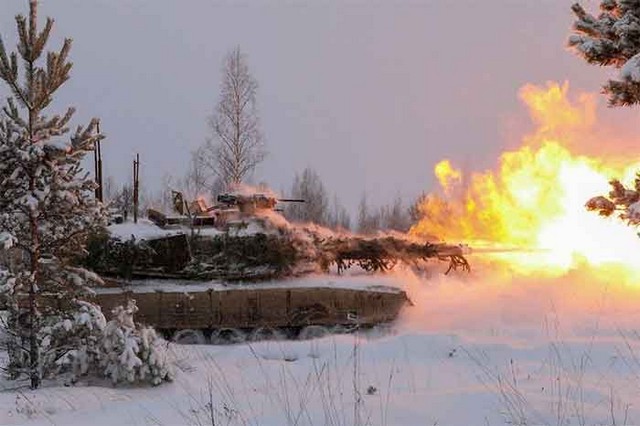
US Congress approves massive $770 billion war budget

By Patrick Martin

By an overwhelming bipartisan margin of 88-11, the US Senate voted Wednesday to approve the largest military budget in history, nearly $770 billion, some $25 billion more than the Biden administration had requested.

The legislation passed the House of Representatives last week by a similar bipartisan margin, 363-70, and it now goes to the White House for President Joe Biden’s signature.

The bill sets policy for the Pentagon and authorizes countless military programs, ranging from nuclear weapons development to a pay raise of 2.7 percent for military personnel, both uniformed and civilian. Congress must still pass appropriations bills, but in the case of the military these are largely a formality.

A National Defense Authorization Act (NDAA) has been passed every year by Congress for more than half a century, and there has always been bipartisan support by huge margins. Whatever disputes there are between the Democrats and Republicans, the two parties are united in their support for the military machine that carries out the predatory policy of American imperialism.

Senate Majority Leader Charles Schumer (D-NY) praised the Democrats and Republicans who joined forces to pass the bill. “For the past six years, Congress worked on a bipartisan basis to pass an annual defense authorization act without fail,” he said. “With so many priorities to balance, I thank my colleagues for working hard over these last few months, both in committee and off the floor, to get NDAA done.”

The bill authorizes spending of $740 billion for the Department of Defense, $27.8 billion for the Department of Energy, which builds and maintains US nuclear bombs and warheads, and nearly $400 million for activities by other government agencies considered “defense-related.”

Besides the vast personnel costs of a military establishment comprising more than 1.3 million uniformed troops and 1.1 million reservists and civilian Pentagon employees, the NDAA calls for staggering amounts to be poured into the procurement of more warplanes, warships, tanks, armored vehicles and artillery, as well as the development of new weapons systems and technologies.

The single highest hardware expenditure is an additional $6.8 billion to buy 85 F-35 fighters built by Lockheed Martin, adding to the most lucrative weapons contract ever awarded by the Pentagon.

Congress approved 12 more F/A-18 Super Hornet fighters than the Pentagon requested and five more Boeing F-15EX jets on top of the 12 requested, as well as increasing the number of new Navy ships from 8 to 13, added to the existing fleet of nearly 500 vessels, the world’s largest.

The US Navy is larger than the navies of the next 13 countries combined, according to a 2015 estimate, when considering total tonnage of the ships it deploys, including 11 huge aircraft carriers and nine helicopter carriers—as many as the rest of the world combined.

The strategic orientation of the huge military bill is to prepare for war against Russia, China or both. As the New York Times acknowledged, “The legislation’s main focus—shifting attention from ground conflicts in the Middle East in favor of a renewed concentration on Beijing and Moscow—aligns with the foreign policy vision Mr. Biden outlined this summer as he ended America’s 20-year war in Afghanistan.”

The main changes in the NDAA from the White House request were to add even more funding for the build-up against China and Russia. The bill authorizes $7.1 billion for the Pacific Deterrence Initiative (PDI), a cross-services effort directed against China, $2 billion more than the Pentagon initially sought. It authorizes $4 billion for the European Deterrence Initiative, directed against Russia, $570 million more than requested, and increases military aid to Ukraine from the $250 million sought by the Pentagon to $300 million.

The NDAA directs the development of a classified “Grand Strategy with Respect to China” and several additional reports on Chinese activities in relation to military technology, military modernization, and in Latin America and the Caribbean.

The PDI includes $500 million to address “unfunded requirements” (essentially a slush fund for anything the military wants to do in the Indo-Pacific) and refocuses the PDI on activities “primarily west of the international dateline,” according to one analysis. The language of the bill suggests that the PDI will grow far above the baseline spending level it spells out.

The NDAA pledges to maintain Taiwan’s military capacity and includes a “statement of policy” that the United States will “resist a fait accompli” against the country—language that suggests US intervention in any military conflict between Taiwan and China.

“We’ve lost a lot of ground to the Chinese while we’ve been focused over the last 20 years on counterterrorism and counterinsurgency, and they’ve caught up in AI machine learning, hypersonics and a lot of other things,” said Democratic Senator Mark Kelly of Arizona, chairman of the Senate Armed Services Committee’s subcommittee on emerging threats. “It’s important to me that we can regain the ground we’ve lost.”

Congressional leaders rode roughshod over the objections of “progressives” in the Democratic Party who claimed that a Biden administration would begin reducing the bloated US military budget and make funds available for social needs. Instead, Congress has passed the largest military budget in history, while the social spending in Biden’s “Build Back Better” legislation is unlikely to pass this year, if ever.

The main opposition to the NDAA came not from the “progressives,” but from Senator Kirsten Gillibrand, who was seeking to reform the process by which the military adjudicates the thousands of sexual assaults taking place each year in its ranks. Under the current procedure, commanding officers have complete control over the court-martial procedure, deciding what charges should be brought, if any, who will be the jurors, and who will be allowed to testify.

The final bill incorporated limited concessions on this issue, but Gillibrand was demanding a completely independent set of military prosecutors outside of the chain of command, which the Pentagon adamantly opposed. She and several Senate supporters voted against the final bill.

The bill also establishes an independent Afghanistan War Commission to “examine” the 20-year US intervention which ended in this summer’s debacle, the collapse of the US puppet regime, and the restoration of the Taliban to power. The bipartisan panel, with equal numbers appointed by the two parties, would exclude any members of Congress or officials involved in US policy for the entire length of the war.

Passage of the NDAA Wednesday followed Tuesday’s vote to raise the federal debt ceiling by $2.5 trillion, necessary for the continued funding of the federal government and regular payments on its debts, a vital step in reassuring the financial markets.

The Democratic-controlled Congress has thus done the bidding of its two main constituencies, Wall Street and the military-intelligence apparatus. While the Democrats profess themselves powerless to enact any increase in domestic social spending, safeguard voting rights or provide legal status for immigrant workers and youth, Congress acts like a well-oiled machine when it comes to the interests of the ruling class.

For both the Pentagon authorization and the increase in the debt ceiling, congressional leaders devised bipartisan shortcuts that enable swift passage of both pieces of legislation.

The debt ceiling was raised after a deal between Senate Majority Leader Chuck Schumer and Minority Leader Mitch McConnell which permitted the bill to pass by a simple majority without a filibuster.

The NDAA passed under an expedited procedure devised by Democratic and Republican leaders of the Senate and House committees responsible for the military, which brought the legislation to the floor of both houses without permitting amendments or any extended debate.

The two parties agreed to shelve a range of tactical disputes and amendments offered for the purposes of political posturing by one or another senator. Several significant policy shifts were set aside at least temporarily, including imposing sanctions to block the construction of the Nordstream 2 pipeline between Russia and Germany, repealing the Authorization for Use of Military Force against Iraq, passed in 2002, and extending draft registration requirements to include women.

Originally published in WSWS.org

16 December 2021

Source: countercurrents.org

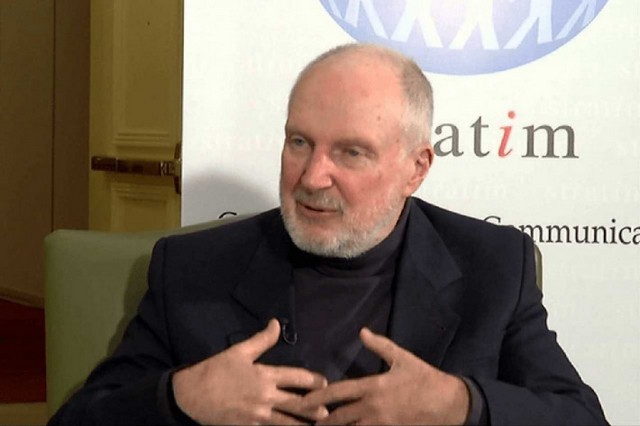
Graham Fuller: End U.S. Addiction to Never Ending War

The following interview with Graham Fuller, a former U.S. diplomat, CIA official, and Islamic scholar, was conducted by Mike Billington, EIR’s Asia Intelligence Director, on Dec. 9, 2021.

EIR: This is Mike Billington with the EIR, Executive Intelligence Review, and the Schiller Institute. I’m here with Graham Fuller, and if you can, perhaps you can give a bit of your various hats in your career.

Fuller: Well, in terms of public service, I was 25 years an operations officer in CIA, serving in Germany, Turkey, Lebanon, Yemen, Saudi Arabia, Afghanistan, and Hong Kong. So a good bit of international background. I graduated from Harvard with a B.A. in Russian language, literature, and history; M.A. in Middle East studies; and had a long interest at the same time in China. After retiring from CIA, I was four years as the vice chairman of the National Intelligence Council, which is the long-range forecasting institution within CIA, and then went to Rand Corporation to do more geopolitical writings and things. And since then I have been kind of freelancing, written two novels, both somewhat political, and a lot of different books about the Middle East, Islam, political Islam, et cetera.

Danger of War With China

EIR: Okay, thanks. So, we sort of came about having this interview because you watched the interview I did with Ambassador Chas Freeman a couple of weeks ago. He warned that the U.S. has already crossed the red line in China by essentially promoting Taiwan independence and breaking all of the U.S.-China agreements in the ’70s that led to the one-China policy and the recognition of Beijing. How do you appraise the danger of a potential war between U.S. and China, even a potential nuclear war?

Fuller: Of course it is serious. I’m not sure that the U.S.—and I’m a huge admirer of Charles Freeman—but I’m not sure the U.S. has actually crossed the red line. But I think we are in the vicinity of doing that. And meanwhile, I think the United States is learning a lot about what it means to have a true peer competitor like China, as opposed to, say, the Soviet Union, which was militarily formidable, but in terms of societal and soft power, not at all. I think the U.S. has actually avoided specifically saying they will support Taiwanese independence, but certainly American policy wants to make it as difficult as possible for China to entertain any military views of re-conquering, re-joining Taiwan to China. It’s going to be a tight game, and I think the main goal really should be for both sides to tamp down the pressure, the level of rhetoric, that is underway now, which makes it very hard for more rational and thoughtful discourse.

Danger of War With Russia

EIR: On the same issue really, on the Russian side, President Putin has also indicated that the accepting of Ukraine into NATO or moving advanced weapons systems into Ukraine or on Russia’s border would be a red line. And Biden, when asked about that, said, “We don’t recognize any red lines.” On the summit Tuesday, Blinken and Sullivan both came out immediately and gave read-outs, which would make it appear that the whole thing was Biden ‘dressing down’ Putin (and Russia) for its aggression and its threats and so forth. But then Biden himself said that he would be announcing tomorrow, Dec. 10, a meeting with four European countries and Russia to address Putin’s request for guarantees that NATO would not move any further east or deploy weapon systems on their border. What, in general, do you think about the summit, and the potential for avoiding the conflict on the Russian side?

Fuller: Well, this is, of course, a long-standing issue. I think in, very broad terms—and this applies to China policy as well as to Russia policy—the United States has been so long in the habit of dominating, not always in a negative sense, but dominating the world since 1945, where other countries would defer to the United States. We, the United States, had the money, the weaponry, the technology, and everything else to be the number one player, really, in the world through that time. So, I think this has been a gradual policy of the rest of the world, much of the rest of the world slowly trying to catch up. Certainly, Europe has, but much of the rest of the world as well. But in the meantime, during the whole Cold War period, the United States was in the position of—the rhetoric was—defender of the Free World, quote unquote. So I think the United States has felt itself really the dominant power, the hegemon of the world, the leader of the free world, whatever terms you choose to use. But the reality in the modern world, and especially since 9-11, has been that the American hegemony, predominance, is a fading quality, and that much of the rest of the world is now rising. This, I think, American mentality, strategic mentality, maybe even cultural mentality finds it nearly impossible, intolerable, to accept the idea that any other country could become a peer competitor with the United States. I remember a couple of years ago, attending some military conferences, wherever, and in Washington, that the term used by the Pentagon in those days was America’s search, or maintenance, for all-horizon dominance. That’s not quite the word. It wasn’t horizon, but all- spectrum dominance, full-spectrum dominance. That says a lot right there. And I think this is a slow, very painful, hopefully learning process, by which the U.S. is going to have to back away ever more carefully, from overt assumption that it’s going to be able to call all the shots anymore. I mean, I think we even saw this with the very unfortunate Blinken, and maybe Sullivan as well, in the Anchorage meeting, when Sullivan, or Blinken, prior to the meeting, announced that he was very confident the meeting would go well and the United States would be dealing with China from a position of strength. Well, you may recall he was dressed down for that quite sharply by the Chinese, who basically said, how dare you say that? You have no right to say that you are dealing with us from a position of strength. We are going to deal, we want to be treated, we WILL be treated as equals by you on an equal footing. I think that pushed back, maybe shocked even, the foreign policy blob in Washington, which has never quite been addressed in those terms, by a country that is pretty demonstrably becoming a peer competitor in almost all respects.

EIR: It reminds me of the Clean Break doctrine in the Nineties. This was [David] Wurmser and [Douglas] Feith and [Dick] Cheney and [Donald] Rumsfeld. They basically said, we need a clean break to defend our friends in Israel. And then literally said—I think this was called the Wolfowitz Doctrine—that we must prevent any country or any combination of countries to reach a position of challenging our dominance, our superiority. I mean, that was literally the thinking.

Fuller: And even challenging Israeli dominance, I think was a good bit part of that. But yes, I mean, times are changing, the world is changing, and it’s going to be a painful lesson. But I think maybe even Biden in his late years, may be beginning to realize that the old rhetoric just doesn’t work quite as well anymore. And Russia is not quite the old Soviet Union, and Russia now working with China certainly represents a very different global force, not just militarily, but I think, you know, strategically, culturally, diplomatically in all senses.

EIR: You know, it’s interesting, several of the Russian readouts on the summit included saying what you just said—one of them called Biden “an old-fashioned politician” who understands the danger of war, and one of them called on Biden to calm down the people around him.

Fuller: Yeah, well put.

U.S.: Revenge On the Afghan and Syrian People

EIR: Yeah, right. Okay, so you were the CIA station chief in Kabul in the 1970s, and I know you’ve remained very active in Afghan policy debates right up until today. Clearly, that country is now in an economic and humanitarian catastrophe. Both the World Food Program and the World Health Organization are screaming as loudly as they can, that many millions of Afghan citizens face death by starvation and lack of medical care as the winter sets in. And yet, the U.S. is maintaining sanctions, and freezing billions of dollars that belong to the Afghan people. How do you explain this, what I consider depraved indifference, and how can we resolve that in your view?

Fuller: Well, as you know, Mike, the Afghan people have been victim of great power rivalry for many, many decades, going back to the initial Soviet invasion of Afghanistan to protect the new communist regime that came into power there in 1978. So Americans, and many Muslim states and others, have been participating in war within Afghanistan that has killed hundreds of thousands, probably millions of Afghans over the many years, leading to civil war, after the Soviet departure, the civil war among the mujahideen, and then utter anarchy within Afghanistan for a number of years. And then the Taliban came in to restore order, a rough sort of frontier justice, peace order, within the country. And then the whole bin Laden business, and then the American invasion. So this has been a nonstop, brutal thing. What I fear is, how gracefully the United States is capable of accepting the fact, that this is yet one more war, which we did not win, and that it is not going to have blood in its eye for the victors of the country, the Taliban. I’m no great admirer of the Taliban, but they are the de facto winners, and I think nearly everybody in the region acknowledges it, for better or for worse. It is the reality. So I think if this is some kind of vengeful policy towards the Taliban, to make them suffer, and who knows, maybe even there are those who hope that civil war might break out, or whatever, and give the U.S. a chance to win a new foothold. I don’t know, but it is a very ugly policy if it goes beyond mere tactical, temporary pressure points to try to get the Taliban to make a few political domestic changes in outlook.

If it goes much beyond that, into a broader vengeance, or a desire to restore the status quo, it will be tragic. And it’s part of such a long tragedy. 

We see this elsewhere as well, I think, in the case of Syria. The United States has been unhappy with Syria as far back as I can remember. When I first went into government in the Seventies, Sixties even, the Assad regime, father and son, have long been hostile to America, and what they perceive as American hegemony in the Middle East, and Israel’s ability to absolutely dominate militarily the entire region, without giving any particular justice to the Palestinians. So I think the United States has had it in for Syria for 40, 50, 60 years of trying to overthrow, not with major force, but with constant undermining of Syria in one way or another. Again, I’m no great admirer of the Syrian regime. It’s never been a democracy, it’s a minority government, but it’s been the reality of the Middle East for a very long time. But even down to today, we can see U.S. involvement in civil wars in Syria, in which much of the goal, still, is to punish Syria, bring down the regime, change it all, and it again has failed. And again, the victims, sadly, are the Syrian people. We just cannot seem to accept the reality that we have been bested again in that kind of a struggle.

Islamist Political Movements Must Be Acknowledged

EIR: You argued at one point that there will be no resolution to the Middle East crisis, unless the Hezbollah and Hamas, and Iran, are recognized, that they have to be a part of this. And yet, the Israelis and many people here in the U.S. consider all three of those institutions terrorists, evil people, and so forth. How is that going to be achieved? I mean, what can be done, especially with the Hezbollah and Hamas issues? And in Syria, how can you resolve that today?

Fuller: Well, as you know, the United States in particular has been ready to slap the label of “terrorist” on any Muslim group that it does not like. I find it frankly almost grotesque, that we have now come to persuade our American countrymen that Iran is the number one terrorist threat in the world. I mean, this is alongside Saudi Arabia, which has been pumping out extraordinarily damaging interpretations of Islam, which really leaves little room for generous accommodation, even among Muslims. So I think the term terrorist—you’re familiar with many countries that are slapped with this label, on groups that are seeking better rights, or even seeking separation. And that applies as well today. Hezbollah is the spokesman, basically, for most Shi’ites in Lebanon. The Shi’ites are the biggest single group in a very multicultural, multi-religious country. They have formidable spirit and drive. Many Lebanese who don’t like them, believe that Hezbollah is the one thing that maybe keeps Israel at bay from interfering or invading Lebanon at will. Indeed, Israel is very nervous about Hezbollah’s strength, and it’s not just purely military, it’s this kind of a drive, a will, not to permit Israel to invade the country. Similarly, with Hamas, I mean, Hamas is the Muslim Brotherhood. The Muslim Brotherhood has not been a terrorist organization, fundamentally, in 50 years. It is a relatively middle-of-the-road Islamist organization. I’m not arguing for Islamist movements, but they are a major force within the Middle East, and there’s a huge spectrum of them, from radical terrorists, genuine terrorists like Bin Laden, or other groups in that region, to rather very moderate Islamic-oriented groups, such as in Turkey.

So you can’t smear them all with one label. The Muslim Brotherhood continues to be concerned with Palestinian rights there. It’s an Arab organization, largely. So, I think if we don’t acknowledge full Palestinian rights, and begin to solve that problem, this is going to continue to be a festering issue, that plays right into the hands of more radical organizations, whether we like them or not. They’re there, and there is a call, an issue, to which they can play. 

Let me just mention one other term which has always been very important to me over the years, from the Egyptian ruler Abdel Nasser, if anybody still remembers him back in the Fifties and Sixties. He was the charismatic leader who sort of put Egypt on the Third World map for the first time, and he became the darling, really, of much of the Arab world. He stood up for Arab rights, and spoke about them. Somebody asked him once, why do you think Egypt has such a major role in the Arab world at that point? And he said, the Arab world is in search of an “actor,” and Egypt is now that actor.

I think that applies to many situations around the world, where there’s a strong need for some political voice to speak up on behalf of one or another injustice of the world, and whatever country takes up that challenge, automatically moves into a position of greater respect, and even support, by much of the world. And sadly, all these three organizations—the Muslim Brotherhood, Hezbollah and Iran itself—are formidable, political, ideological forces in the region. Iran is probably the oldest civilization in the entire Middle East. It has managed to survive decades and decades of American sanctions, and Israeli punishment, and assassinations by Israelis, et cetera, and they’re still holding their own. It’s a strong country, whether again, we may not like it all, but I think we have contributed to pushing Iran into a corner in which it is reacting, perhaps in a much more aggressive, reactive manner than might otherwise be the case. 

And we might talk about this before the interview is over. But just let me say here, we are not thinking enough in this world about why conflicts are coming about. Are they inevitable and can they be avoided? Sadly, I think in American thinking or much of the thinking of the world, these conflicts, wars, are inevitable, but they’re not. They just aren’t. And the trick is deciding how and why to avoid them, because it is doable.

The Military-Industrial Complex

EIR: Well, that obviously brings up the issue of the military-industrial complex that President Eisenhower warned about a long, long time ago, that they need wars to be going on. They’re required by the military industrial crowd and their Wall Street backers, thinking that this cannot be allowed to diminish or they’re going to lose their power. I don’t know what you think about that.

Fuller: Well, it’s very impressive when you look back at what Eisenhower said way back in the day and look at today’s reality. I think he was spot-on in his observation. I try to avoid an entirely conspiratorial view that it’s all Wall Street and military-industrial complex, because there are many huge capitalist organizations, corporations that do not profit from war and seek to avoid war, because it’s not good for business. Many businessmen and capitalists feel, if you’re not producing arms—it may not be necessarily good [to have] war at all. But that said, yes, there is a war lobby and it is linked with the idea that we must preserve American power and hegemony and dominance at all costs. And that plays, of course, into the hands of those who want to support America’s overwhelming military dominance in the world today.

EIR: And yet we lose everywhere we fight.

Fuller: Well, somebody once commented to me, a correspondent who worked at the Pentagon. He said, you know, Graham, you don’t get it (or some somebody in the Pentagon said to him), you don’t get it. It’s not about winning wars. It’s about maintaining the organization, maintaining the infrastructure. As long as the funds keep coming in, as long as we can maintain the structure and the training and the weaponry and all of this, you don’t have to win the wars. That’s secondary. It’s nice to win, but that’s secondary.

EIR: What kind of an image of man is that? Which thinks that secondary issues which murder millions of people and drive millions out of their homes are secondary issues?

Fuller: I agree. I agree. It’s shocking, but I fear it’s the human condition.

Project Ibn Sina To Save Afghanistan

EIR: Well, let’s hope that’s not the case. Actually I’ll bring up this issue of Ibn Sina that I mentioned to you before the interview. Helga Zepp-LaRouche’s idea of this Project Ibn Sina for Afghanistan, is based on that tradition of a great Islamic leader who represented the kind of leader you talked about with Nasser, but at an even higher level, a great philosopher, a great poet. And of course, also a medical genius. So I wondered if you might want to comment. You know the history of Islam quite well. If you want to comment on the role of Ibn Sina, and Helga’s idea of so-called Project Ibn Sina as a way of bringing the world together around the reconstruction of Afghanistan, but also applying that to these issues of festering wars in the Middle East.

Fuller: Yeah, that’s a very interesting question, Mike. Absolutely. I think by now, most Westerners are aware that there was a golden age of Islam. There was a time when intellectual life in the Muslim world, Arab world, Persian world, and beyond in India and even further east, intellectual life was very rich. There were very interesting, open theological discussions about religion, about science, philosophy. There was no shutting down of the mind at that point. Many Muslims have written since then, about, “Has there been a closing down of the Muslim mind?” I think probably you can demonstrate that there has been. The more important question is, why? One simple answer—it’s not the only answer, but it’s an important answer—is, of course, the long centuries of Western imperialism; British, French, German, Italian, Dutch, and American in another sense, that really helped keep these countries infantilized, is the word I would use most readily. They came to rely on outside—they came to fatalistically yield to the power of outside forces that would prevent them from taking charge of their own lives, thinking about these issues more deeply. So, I think many people trace some of the decline of Arab and Persian, and Muslim in general, Muslim intellectual and intellectualism, its sciences, its arts, and this gradual suppression of intellectual tradition within the Muslim world, largely by the ulema, the clerical class that found itself entrenched in positions of power as long as they supported the regime in power.

They could have their voice over religious policy absolutely; that contributed to it. Certainly even the shift of the great trade routes from overland across the Silk Route, to new sea routes around the Indian Ocean to East Asia, that also was a factor in the decline of the Muslim world. But it’s undeniable that this has taken place. I think in this sense, Ibn Sina is a reflection, is an aspiration to go back to what made the Muslim world so rich, so strong, so thoughtful, so productive intellectually in its time. I think it can happen again. There’s no reason why it should not. But the Middle East has been caught in this terrible mess now—you can you can go back many, many, many decades, if not one hundred years of colonialism and foreign control and dominance by dictators supported readily by the West, et cetera. It’s a long, sad story, but Ibn Sina is one great symbol. He’s not the only one; there are many great symbols of a broader vision of Islam, a more open thinking, exploratory Islam.

Turkey and the Arab Spring

EIR: Good. You have something of a specialty on Turkey within the Islamic world, and you wrote a book which was called Turkey and the Arab Spring. I take it this is your reflection on the Muslim Brotherhood, which was sort of the dominant force in the Arab Spring. As I understand it, Erdogan is part of that. Do you want to comment on that now in retrospect, with the downfall of the Arab Spring?

Fuller: Yeah, well, this brings up the very important question that I alluded to briefly earlier about Islamism, Islamic movements, Islamist, whatever, there are many different terms. But basically the idea of Islamists is, to put it in very simple terms, it’s a spectrum of views, as I said, from bin Laden to peace activists from an Islamic perspective. But it essentially is Muslims saying, Look, Islam has something to say about the future of governance and society in the Muslim world. What it has to say, what we choose out of it, just as some of the early European movements, Christian Democrats, et cetera, felt that Christianity had something to say intellectually or religiously or theologically, to say about good governance in Europe. So I think the Muslim movements – some are horrible, brutal, violent, as bin Laden is the major case in point. The Taliban have been quite brutal in their own way. Saudi Arabia has been a very brutal state, supporting many brutal movements and ideas outside the country, indeed fomenting these ideas of intolerance—it’s not only Islam, but there’s only one form of Islam, and that’s the Saudi form of Islam, which is Wahhabi, which is utterly uncompromising and very retrogressive. So anyway, the Muslim Brotherhood in all the spectrum is rather centrist. It has accepted the idea of democracy. It has political parties. These are not secret organizations and terrorist organizations. It hasn’t been that for half a century. It has accepted the idea of elections at the student level, the national level, participating in elections, accepting the idea of some kind of democratic practice.

These ideas are utterly anathema to countries like Saudi Arabia or other Arab dictators, or Muslim dictators anywhere, who see this as subversive. So, they have moved all out—that’s why Saudi Arabia has been quick to condemn the Muslim Brotherhood as terrorists, even though it’s very, very difficult to make that case over the last 50 years. Fifty years ago, yes, they dallied in it, but not since. So I think, Turkey doesn’t officially call itself Muslim Brotherhood, but certainly the ruling party has good ties with it. And again, Turkey, it’s become an abusive democracy, but it’s still a democracy. I mean, there are real elections. It’s an unfair, or illiberal democracy, is the term I think we use. But nonetheless, it still has elections. And I believe that when the day comes that President Erdogan in Turkey is voted out of power, if there aren’t manipulations, I believe fairly surely he will step down. So the question of the compatibility of Islam and democracy that the Muslim Brotherhood in particular, I think has accepted, is far from over. And the debate is far from over. I mean, we’re even arguing in the United States about religious ideas, in social belief, abortion, among other things. So you cannot totally separate moral views from policy views, and moral views are importantly founded often on religious ideas. It doesn’t have to be, but that tends to be their source.

NED: Surrogate of the CIA

EIR: To what extent do you see the NED [National Endowment for Democracy], Open Society, regime-change crowd influence in the Arab Spring? And to what extent would you think that caused a backlash against it?

Fuller: At one time when I was still working in Washington, I was a big believer in the National Endowment for Democracy, and I believed that democracy had a lot to offer to much of the world. I still believe democracy—it’s like Winston Churchill said, it’s the worst form of governance, except for all those that have been tried before it. But somehow, over the years, the National Endowment for Democracy, or NED, really became almost a surrogate for the CIA. The U.S. largely got out of the business of having the CIA overthrow countries—and this wasn’t, by the way, the CIA choosing to overthrow these places; this was by Presidential Order or Kissinger order or whatever. The National Endowment for Democracy became a much nicer face for regime change. Not by violence, but certainly through using all kinds of financial and ideological and training, and other kinds of things, to bring about change. I believed that democracy was a great goal for the United States, but as I began to watch it over the years, I began to see how much of this was cherry picking. That democracy was, as I often said, democracy was a punishment to deliver upon our enemies, to overthrow them. Democracy is never a gift for our allies. You know, we’re not deciding that we’re going to bestow democracy upon Saudi Arabia or any other number of authoritarian regimes around the world. We have all kinds of things to say about the rights of Uyghurs in China, and I care very deeply about the Uyghurs in China. I’ve been there. I’ve written about it. But, I think the fact that they’re in China seems to be the more important point for the U.S. policy than what the state of the Uyghurs is at this particular time. So it’s highly selective, which undermines the credibility, the ideological credibility of the United States in pushing for democracy. We’ll do it when we want to overthrow somebody, but we don’t have much to say about it otherwise. We don’t have much, even in human rights, I mean, this tends to be a weapon used to overthrow or seriously weaken countries. But if it’s a friendly country, we don’t do it. We never talk about the Kashmiris and Indian policy against Kashmir, or Indian policies against Muslims in general, or other religious groups in India, because India—they’re the good guys, so we don’t talk about it. But if it’s Palestinians rights being crushed in Israel, we don’t talk about it. But if it’s Chechens in Russia, or other groups in China, then we’re all over it. So, I just feel we ideologically corrode the very validity of pushing for democracy.

The Uyghurs and China’s Nation Building

EIR: I certainly agree with you on that. Let me take you up on the Uygher, Xinjiang issue. I read the study you and Frederick Starr did in 2004, called “The Xinjiang Problem,” which involved scholars…

Fuller: But it was mainly Jonathan Lipman, who is an outstanding scholar of Muslims in China, who was my partner in writing that essay. Fred Starr very capably brought the book all together, many different disciplines, but it was myself and Jonathan Lipman, who has a wonderful book about Muslims in China. Very readable, delightful book. [see Familiar Strangers: A History of Muslims in Northwest China

EIR: I’ll look that up. Since that time, of course, you had the ISIS-linked Uyghurs who carried out terrorist attacks in Xinjiang, and the Chinese response to that was to launch what they call a mass education or mass re-education campaign for the young people being influenced by the jihadis. But at the same time doing massive economic development in the region; they created new industrial and agricultural projects across Xinjiang. And certainly, that is quite the opposite of the so-called anti-terrorist campaigns in the West, which were largely bombing countries back to the Stone Age. So nonetheless, what China is doing is now, since Pompeo and his ilk, is labeled genocide, and in fact, they’re imposing sanctions on China, and even the so-called diplomatic boycott of the Olympics is because of genocide in Xinjiang. I find this to be not only absurd, but really disgusting, but you certainly know a great deal about the Uyghurs in Xinjiang. How do you look at that now in light of this crisis?

Fuller: You know, it’s a complicated issue, Mike. For starters, I would not accept the term genocide, which I think is being extremely loosely applied by Washington again, not so much on the facts of the issue, because if you looked at Palestinian treatment, the numbers are vastly less. But treatment of Palestinians in the West Bank and in Israel, there might be very comparable things. But anyway, this is not genocide, but I think it is—some people have used the term cultural oppression. Some have even called it culturacide. China is known to be—and I’m a huge admirer of China, I’ve studied Chinese history and literature and things. I have great admiration for China’s past and indeed even present extraordinary accomplishments. But China is also a tough country in which to be a minority. The Han Chinese massively dominate, just numerically, the country, overwhelmingly, so that it’s difficult to be a minority in China anywhere and not get “Han-ized”, if you will, turned into Han Chinese linguistically, culturally, and otherwise. This is not unique to China; other countries have pushed for cultural integration in the past. I don’t know the years exactly, but I think in the 18th Century, France had an extraordinary policy of imposing, with some force, imposing the language of Paris on the entire country and wiping out regional dialects and languages such as Celtic languages or Basque and other such.

So in the process of nation building, whether you like it or not, governments, whether good or bad, or harsh or not, tend to try to push towards homogenization of their population to make it easier to rule, to maybe make it easier for people to get along socially. I don’t know. So the Chinese are part of this long tradition. And it’s easy when you got one-point-four [billion] people — and I don’t know what the statistics are of non-Han minorities, but they’re probably pretty small in comparison. So yes, I do feel that the Chinese have been rather harsh in Xinjiang in the effort to Han-ize, or turn into “good Chinese”, Han Chinese, the Uyghur population. And the Uyghurs, of course, are the furthest away from Beijing of any group in the country, way off to the West. I mean, the capital of Xinjiang province in China is closer to Islamabad than it is to Beijing. So you’re talking about a very distant, culturally long-time Turkic Islamic Muslim society. I deplore the re-education camps. It smacks a bit too much to me of kind of more fascist organizations in the past. But I think, I do not believe that calling this genocide is a legitimate term.

And we also have to come to the deeper question of, who is it that deserves an independent state? The Chechens in Russia and the Soviet Union have been a totally distinct ethnic group. They’re Muslims, not Christians, but they have been pushing, including using violence for years, for over a hundred years, to gain independence from the Soviet Union, or from Russia. So this is an ongoing problem. And I certainly don’t support violence on either side of this. But I do acknowledge that in any process of industrializing China, including its distant western regions, factories are going to be built, and even more to the point, hundreds of thousands, if not millions, of Han Chinese have come into areas that have long been occupied, long inhabited by Muslim Uyghur people, Turkic Muslim Uygur peoples. And they naturally are deeply disturbed at this huge influx of industrial Chinese workers, who are changing the real estate, they’re tearing down their old towns, they’re weakening Islam, closing mosques, you know, imposing Chinese language requirements. Obviously, if you’re going to live in China, you damn well better learn Mandarin. So you can’t say that it’s all brutal, but it’s a complex issue of how do you try to integrate this country without using brutal techniques? And I think China in recent years has moved in the direction of unnecessary harshness in that issue.

The Visionary Belt and Road Initiative

EIR: Well, let me say that they’ve built more mosques in Xinjiang than any area in the world. So you have to take that into consideration, too. What you’re saying about Xinjiang is also true of Tibet, and our organization from the beginning—LaRouche’s idea and the ideas of the Schiller Institute—was always predicated on the idea of peace through development, that you can’t try to bring about peace and then development. You have to actually bring development as a way of addressing the common needs of all people, all religious movements, all ethnic differences, and so forth. And certainly, that’s the way the Chinese have approached both Tibet and Xinjiang, and in the process have dramatically increased the populations of Xinjiang, the Uyghur population, increased their standard of living enormously. And their argument, of course, is that when people complain about human rights, that the most fundamental human right is the right to life and to a decent standard of living. And they’re very proud of having brought the entire country, including all the people of Xinjiang, out of abject poverty. There’s still poverty, but [abject poverty] has been eliminated. A lot of this is also what they launched to take internationally, the process of development, through the Belt and Road. And of course, Xinjiang is a crossroad for the Belt and Road. So let me ask you to say what you think about the whole Belt and Road process, which of course, is also roundly denounced by the anti-China people in the West with all kinds of nasty terms. But it is a basis on which, if you believe in the idea that peace comes through development, that you can resolve these issues not only in China, but in Afghanistan and in the Middle East. In particular, I wonder what you think about the efforts by China to bring the Belt and Road into the Middle East.

Fuller: I think the Chinese idea of the Belt and Road is an extremely imaginative and exciting idea. It is visionary in the sense of uniting and bringing together diverse societies across Central Asia that have not been united since the days of Genghis Khan, who was a brutal conqueror, but for a hundred years thereafter proceeded to run a pretty enlightened and peaceful administration all across Central Asia, as a Chinese dynasty—later, as a Chinese dynasty. So I think it’s inspired. Central Asia has been the backwater of the world for a long, long time. Even though in medieval periods it was a rich center of commerce and trade and ideas and science, et cetera, along the lines of Ibn Sina, who lived in that area himself. This includes Iran, of course. So, I think it’s an extraordinary idea that the Chinese have been developing here, in context with Russia as well. It’s a complicated area. There are many ethnic sensitivities in the area. Muslims traditionally do not like to feel that they’re under the thumb—however, you choose to interpret it—under the dominance, under the overwhelming power of non-Muslim power, and they would view China in that regard.

They would view Russia in that regard, but it doesn’t mean that they will reject it. It just means there are going to be certain sensitivities about Islamic culture, Islamic history and tradition, that will play an important role, I think, in the future of that Belt and Road. And China will need to—and Russia, of course—will need to move very cautiously with full regard for the cultural and religious traditions of that area. But I think, yes, it can do a great deal for the welfare, the livelihood, standard of living, cultural development, and everything else to have this area opened up from an area that will go from, well, you know, you can say Beijing, but in many senses, even from Korea, all the way across land and sea to now Italy, I think, which is the westernmost point at this stage of the Belt and Road concept. It’s very positive, it’s a very highly constructive, imaginative idea.

EIR: Have you looked into the efforts between China and, let’s say, Iraq, for instance, to bring in some of these Belt and Road projects? The last government had agreements of oil for development, which got crushed, unfortunately.

Fuller: Yeah, I’m not terribly familiar with where Iraq stands on the Belt and Road. I mean, inevitably, it will be part, it would be a natural part. I mean, going way back when it ran from Beijing to Beirut in effect, back in the day. I don’t know where it stands now with Iraq, but certainly Iran. And in Iran, already, China is playing a very significant role in helping relieve some of the more oppressive aspects of American sanctions. Iran has been historically a major country, a major culture that was part of that whole Belt and Road civilization. It was a Muslim, Arab, Persian society, Turkic as well. Very important. All those three cultural groups. China does not always have the best reputation, going way back, as fully honoring societies that resist homogenization, and Muslim societies tend to resist, a bit, homogenization into non-Muslim cultures. You could have a long discussion about why. So I think the idea is brilliant, but as I said before, China and Russia need to step cautiously and sensitively with this huge new cultural region, that will benefit that region, I believe, hugely.

Afghan War Targeted China and Russia

EIR: Good. I’d like to ask two other things on Afghanistan before we leave that. One is that I read an article you wrote recently called “Time to Smash the Urge of Imperial Strategic Groupthink”.

Fuller: That wasn’t my title.

EIR: Oh, it wasn’t, Okay. It’s quite a title. Well, anyway, what I noted in there was that you said that the entire Afghan misadventure was less about fighting terrorism and more about establishing a base near the Russian and Chinese borders, sort of as part of the Great Game. There are indications that the pullout of Afghanistan was less about ending regime-change wars and more about repositioning for confrontations with China and Russia. And you may have heard that Tony Blinken just yesterday basically acknowledged that. He said (I wrote it down): “In ending America’s longest war and making sure that we’re not sending a third generation of Americans back to fight and die in Afghanistan, that frees up a tremendous amount of resources and focus for other challenges.” And the reporter even asked, “Do you think the American people have an appetite for other challenges?” And he said, “Oh, I think the appetite is significant.” I wonder what you think about this in terms of going forward.

Fuller: I think it was fairly clear back in 9/11, 2001, that the invasion of Afghanistan was about far more than bin Laden. Bin Laden certainly was the perfect poster-boy enemy for that invasion. And it wasn’t outrageous—9/11 was an outrage, an outrage against the United States and generally, through the use of terrorism and murder. But yes, I think it was not by accident that the U.S. was well aware that Afghanistan sits athwart China, Russia, Central Asia. They understood that all you have to do is read about the British Great Game back in the day, 19th Century, and America supporting the Afghans against the Soviet invasion in 1978. So the idea of the geopolitical significance of Afghanistan is well known. We just didn’t talk about it very much, because it was a much better sell, to talk about terrorism and Afghanistan. I am not sure that the U.S. is quite ready to throw in, give up its spurs in Afghanistan, for the very same reason that it borders on Russia, borders on China, and might in the U.S. eyes be a check, possibly to elements of the Belt and Road. If the U.S. has a better idea than the Belt and Road or could contribute to it or work simultaneously with it, that would be great. But I think now anyway, it seems to be a zero-sum game in American eyes, and it doesn’t want to participate in any way that would facilitate this Chinese venture. I don’t think we’ve really let go quite there, and it won’t be until we start generously helping rebuild that country that we helped to destroy, that we become credible in our willingness to look for better days for the Afghan people and get out of the region.

Drugs and the U.S. Cultural Decay

EIR: So, I want to ask as, I think, a last question, the issue of the cultural decay in the United States and in the western world generally. I read some reviews of your memoir, I didn’t read the memoir, but the book you wrote about the death of your son to drug addiction. And, as you probably know, it was just recently announced that there have been 100,000 overdose drug deaths this last year. That’s by far the highest ever. And the economic and cultural decay in the country has really left a whole generation of children who have no sense of a positive future. They don’t have a sense of a mission in the world. And this, of course, has resulted in some horrible atrocities like the child killers. We had one just the other day in Michigan, and record-high teen suicides. Since you did have that experience, how do you read this yourself, in terms of what we’re going to have to do to revive the culture in the United States?

Fuller: Well, drugs in many ways are the bane of the modern world, everywhere, in some sense. In the United States, as you know, we’ve not had a great deal of luck even with the banning of all kinds of drugs over the years, have not had great success with it. And the so-called war against drugs that’s been going on, what, 20, 30 years, as part of many administrations punishing various Latin American countries for helping produce this stuff, in which we are the main market. This goes back a long way, and with all the problems that you talk about; yes, it’s been, it’s really sad. It’s been exacerbated by COVID. It’s got to be exacerbated by just existential angst from global warming, the future of the world. What I now feel is an excessive sense of individualism within the United States culture. Individualism has been a wonderful feature of American culture, and produced amazing artistic accomplishments and scientific and technical accomplishments, all kinds of things. But it does have a downside. This extreme, extreme individualism of the United States, which means that there’s not so coherent a society, as you might find in, say, slightly more traditional European cultures, but even they are suffering from drugs. So, I’m not sure what the answer to all of this is, but certainly the conditions of American life, the discrepancy between rich and poor, and the negativism that emerges from this, that you can see in the music and the arts and other things, certainly is exacerbating it hugely. But it’s in some senses, it’s a global problem. It’s a human problem.

Addiction to Never Ending Wars

EIR: Let me close by asking if you have anything else you’d like to like to say to our audience.

Fuller: No, just to express my concern about where the U.S. is headed now, the viability of American democratic practice at this point. I think the future of the world is going to be ever more demanding. Obviously, for starters, because of global warming, and pandemics. Also, the negative impacts of technology. Apart from the many wonderful aspects of technology, there are many, many socially negative impacts of technology. My fear is that countries are going to find themselves increasingly unmanageable, in which the power of the state is going to be perceived as more and more necessary. Just in COVID alone, to try to control the spread of COVID and manage the treatment of COVID, has required a great empowerment of the state, not just in the U.S. but globally. So, I think in a country that’s as intensely individualistic as the United States is, where people can say, well, you know, I want to do what I want to do and it’s my freedom, it’s my body. There are all kinds of very good reasons for pushing back against this. But I think in the modern world and the modern world of delicate technology and countries existing on delicate balances of how technologies interact, you can’t really survive in a country that is verging on the anarchistic in many regards, that cannot provide good government and good governance.

So I fear very much for where the future of the U.S. is headed right now. It may not just be the United States. It may be the West, and the West may be ahead of much of the rest of the world. But the problem of control of populations getting ever bigger, and the crises, global warming, disease, technology, et cetera, et cetera, I fear are going to hugely empower states. And China is basically arguing that they are the vanguard of the future in this regard.

I think the thing that I find most deeply depressing about the United States is its still addiction to never ending war. We talked about that briefly before, but I think I am appalled that even with very progressive thinkers like Bernie Sanders, even Bernie Sanders has not dared to grasp the nettle of the Pentagon budget and the ongoing wars, or only very slightly. Its still, you know, we can’t afford medical care, we can’t afford infrastructure, we can’t afford COVID, or one thing or another. But boy, we can afford those damn wars. I’m appalled that even today, nobody, just about nobody is suggesting that maybe, one-third of the Pentagon budget might go a long way to beginning to solve a few of these domestic problems. It’s beyond the pale, that discussion, right now.

EIR: Yeah, either party.

Fuller: Either party.

EIR: Okay, well, thank you very much. This will be most interesting.

Source: schillerinstitute.com

UN’s highest ever humanitarian appeal falls on imperialism’s deaf ears

By Jean Shaoul

On Thursday, the United Nations Office for the Coordination of Humanitarian Affairs (OCHA) launched an appeal to the major powers for a record $41 billion to help the 183 million people most in need of life-saving assistance.

This was a large increase on the $35 billion requested for 2021 and double the amount sought just four years ago. It is needed for some 63 countries, nearly one third of the 193 United Nations member states, most of which came into existence after the national liberation movements took over from the colonial powers that had previously ruled them.

Speaking at a news conference at Thursday’s launch of the appeal, OCHA head and Emergency Relief Coordinator Martin Griffiths stressed that the number of people in need “has never been as high as this.” He said, “The climate crisis is hitting the world’s most vulnerable people first and worst. Protracted conflicts grind on, and instability has worsened in several parts of the world, notably Ethiopia, Myanmar and Afghanistan.”

Worse is to come.

OCHA’s Global Humanitarian Overview 2022report, published the same day, draws on the work of 37 agencies, including various UN agencies and international aid organisations. It said 274 million people worldwide will need some form of emergency assistance next year, up 17 percent from the 235 million in 2021, a record high. One in 29 of the world’s 7.9 billion people will need help in 2022, up 250 percent on 2015 when one in 95 needed assistance.

The report noted that the COVID-19 pandemic, fueled by vaccine inequality, has devastated economies, livelihoods, health systems and education. Testing, diagnosis and treatment for HIV, TB and malaria has fallen. Ante-natal visits dropped by 43 percent and 23 million children missed basic childhood vaccines in 2021. With 2.2 billion children without access to the internet at home, many faced disruption to their education.

The pandemic has increased suffering and extreme poverty, rising again after two decades of decline with women and young workers disproportionately affected by job losses. Some 247 million women live on less than $1.90 a day. Hunger is on the rise and food insecurity has reached unprecedented levels, with 811 million people (11 percent of the world’s population) undernourished and famine “a real and terrifying possibility in 43 countries.”

Political conflicts have hit civilians hard. More than 1 percent of the world’s population is now displaced, of whom 42 percent are children. Millions of internally displaced people (IDPs) live in camps or in impoverished conditions in cities for long periods, unable to return home.

The humanitarian needs are by far the greatest in the Middle East and Africa, thanks to wars provoked, fueled and paid for by the imperialist powers in pursuit of access to raw materials and markets in the interests of the corporations they represent. The priority of the local oligarchies is to remain competitive for foreign investments, while continuing debt payments to the financial vultures, expanding their armed forces and suppressing the revolutionary strivings of the working class and poor peasants.

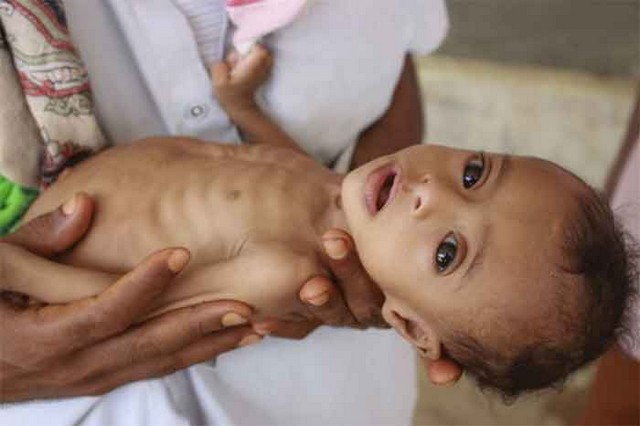
According to the UN’s Food and Agriculture Organisation (FAO), 45 million people are at risk of famine in dozens of countries, with Afghanistan, Syria, Yemen, Ethiopia and Sudan topping the list. In Afghanistan, more than 24 million people are in dire need of assistance as the result of four decades of war and now the worst drought in 27 years.

Syria, which has endured more than 10 years of a US-led war to topple the regime of President Bashar al-Assad, faces a lack of basic commodities amid a horrifically damaged infrastructure. Average household expenditure exceeds income by 50 percent compared with 20 percent in August 2020.

In Yemen, at war since Saudi Arabia, aided and abetted by the US, Britain and the regional powers, invaded its impoverished southern neighbour in April 2015, 16.2 million of the 30 million population face acute food shortages. Even with humanitarian assistance, 40 percent of the population do not have enough food.

In Ethiopia, 25.9 million of its 118 million population need help as a result of the war in Tigray and other parts of the country, Drought and disease are mounting, with many of the country’s 4.2 million IDPs seeking shelter in the towns and cities adding to the social and economic pressures. In South Sudan, 8.4 million of its 11 million people are in need, as a result of the ongoing civil war since independence from Sudan in 2011, and three years of flooding and disease.

As well as the Middle East and Africa, there has been increased demand for humanitarian assistance from Asia and the Pacific, Latin America and the Caribbean. The situation in Myanmar has deteriorated significantly in the wake of last February’s military coup and the pandemic, with 14.4 million of the country’s 55 million people in urgent need of humanitarian assistance. In Haiti, a massive 43 percent of the population need aid, in the wake of last August’s earthquake that affected 800,000 people, on top of the even more devastating one in 2010; the pandemic and the deteriorating economic situation.

Despite the desperate need, funding for 2022 will not be forthcoming. This year’s OCHA appeal garnered just $17 billion, less than half the amount requested, with the 10 most underfunded emergencies receiving less than half what was needed, leading to cutbacks in food rations and life-saving healthcare services. Griffiths acknowledged this, saying, “We’re aware that we’re not going to get the $41 billion, much as we will try hard.” He did not spell out why this was so or the consequences for the world’s most destitute people.

It is not as if there are no resources available. The world’s richest billionaires have seen their wealth increase astronomically this past year and could easily foot the entire bill. According to the Bloomberg Billionaires Index, the net worth of Elon Musk, founder and CEO of Tesla and the richest person in the world as of December 2021 is $311 billion, while that of Amazon founder Jeff Bezos is $201 billion. Yet the world’s governments refuse to tax them or their ilk.

This leaves the OCHA reliant on appeals to donor countries that have become increasingly unsuccessful.

Its parent body and the UN’s humanitarian agency, the UN High Commission for Refugees (UNHCR), was set up in 1950 along with the 1951 Convention on Human Rights and the Convention on the Status of Refugees to address the tens of million refugee, forcibly displaced and stateless people crisis following World War II, in the political context of the Cold War. Then popular revulsion at the Holocaust happened to align with Washington’s strategic interests in asserting its global hegemony, containing the influence of the Stalinist regime in Moscow and above all suppressing the threat of social revolution on a global scale.

Nevertheless, the UNHCR, and the agencies it spawned in the 1990s such as OCHA after the collapse of the Soviet Union, were always funded on an ad hoc basis.

Its approach was based primarily on aiding those in camps and defending the right to seek asylum anywhere but in the imperialist centres. This laid the framework of a global refugee regime, providing the template for the response to multiple crises in the 1960s in Africa, the Middle East, Latin America and Europe within the context of the Cold War.

Today, the majority of IDPs do not reside in camps, while the right to asylum is being obliterated.

OCHA’s appeal and report fell on deaf ears. Indeed, the agency pointed out the complete bankruptcy of its call. Admitting it had no solutions for the crisis, the OCHA declared, “Humanitarian aid cannot provide a path out of protracted crises when such a scarcity of funds persists.”

There was no mention of the appeal in the world’s press, testifying to the degree to which starvation and misery are not only being normalized but becoming the policy of choice—a weapon in the hands of the major imperialist powers that speak for their corporate and financial oligarchs, and their puppet regimes in the world’s poorest countries.

Washington now routinely uses sanctions and secondary sanctions to exert “maximum pressure” on Cuba, Venezuela, Iran and its allies in Syria and Lebanon, to cite but a few, in a bid to force them to toe its line. Israel has blockaded Gaza for more than 14 years; Saudi Arabia has besieged Yemen for six years and the Ethiopian government is blockading the rebel Tigray province to starve them into submission.

The words of Bani Adam, the Children of Adam, the poem written in the 13th century by Sa’adi, are inscribed on a wall-mounted carpet donated by Tehran in the UN building in New York. They read:

beings are members of a whole,

In creation of one essence and soul.

If one member is afflicted with pain,

Other members uneasy will remain.

If you’ve no sympathy for human pain,

The name of human you cannot retain!

Workers must understand that an end to such inhumanity means waging a political struggle against imperialist militarism and the systematic expropriation of the wealth of the planet by the corporate and financial elite. Everywhere, entire populations have been exploited and reduced to penury, while those countries that possess valuable resources have been targeted for military assaults. The struggle is not to reform the capitalist system but to overthrow it as part of a world-wide struggle for the socialist reorganisation of society based on human need not profit.

Originally published in WSWS.org

6 December 2021

Source: countercurrents.org

British Court Rules Assange Can Be Extradited to US

By Jake Johnson

A British court ruled Friday that WikiLeaks founder and publisher Julian Assange can be extradited to the United States to face charges of violating the Espionage Act, a decision that rights groups say poses a profound threat to global press freedoms.

“This is an utterly shameful development that has alarming implications not only for Assange’s mental health, but also for journalism and press freedom around the world,” Rebecca Vincent, director of international campaigns for Reporters Without Borders, said in response to the ruling.

The decision, which Assange’s legal team is expected to appeal, overturns an earlier ruling by Judge Vanessa Baraitser of the Westminster Magistrates’ Court, who argued in January that extradition would endanger the WikiLeaks founder’s life.

“We will appeal this decision at the earliest possible moment,” Stella Moris, Assange’s fiancée, said in a statement. “How can it be fair, how can it be right, how can it be possible, to extradite Julian to the very country which plotted to kill him?”

The Biden administration has thus far ignored pressure from human rights groups to drop the charges, which stem from Assange’s publication of classified information that exposed U.S. war crimes. The Espionage Act charges were filed during the tenure of former President Donald Trump, whose administration reportedly considered assassinating or kidnapping Assange, who has been detained in a high-security London prison since 2019.

“Julian’s life is once more under grave threat, and so is the right of journalists to publish material that governments and corporations find inconvenient,” Kristinn Hrafnsson, editor-in-chief of WikiLeaks, said Friday. “This is about the right of a free press to publish without being threatened by a bullying superpower.”

The British court’s ruling in favor of Assange’s extradition came on the final day of the U.S.-hosted “Summit for Democracy,” an irony that was not lost on critics.

“Biden’s administration cannot reasonably claim to support principles of democracy and human rights while at the same time seeking the extradition of a publisher, Julian Assange, which is opposed by global press freedom organizations,” Shadowproof‘s Kevin Gosztola argued in response to the decision.

Christophe Deloire, executive director of Reporters Without Borders, warned that the British court’s ruling could “prove historic for all the wrong reasons.”

“We defend this case because of its dangerous implications for the future of press freedom around the world,” said Deloire. “It is time to put a stop to this more than decade-long persecution once and for all. It is time to free Assange.”

Originally published in CommonDreams.org

10 December 2021

Source: countercurrents.org

On ‘Gassing the Arabs’ and Other Diseases: Is Israel a ‘Sick Society’?

By Dr Ramzy Baroud

For whatever reason, some mistakenly perceive the Israeli newspaper, Haaretz, as liberal, progressive and even ‘pro-Palestinian’. Of course, none of this is true. This misconstrued depiction of an essentially Zionist and anti-Palestinian newspaper tells of a much bigger story of how confusing Israeli politics is, and how equally confused many of us are in understanding the Israeli political discourse.

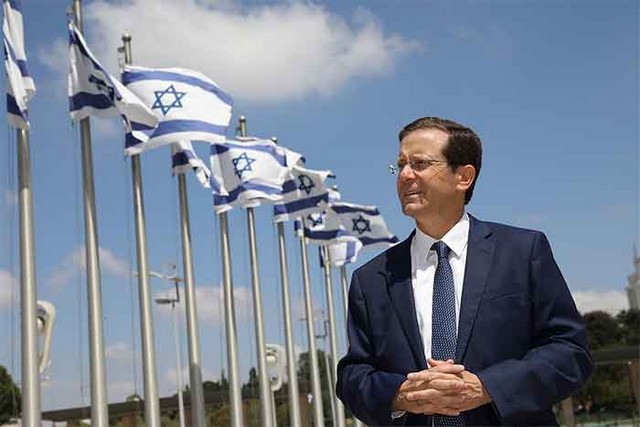
On November 28, newly-elected Israeli President, Isaac Herzog, stormed the Ibrahimi Mosque in the Palestinian city of Al-Khalil (Hebron) with hundreds of soldiers and many illegal Jewish settlers, including the who’s who of Israel’s extremists.

The scene was reminiscent of a similar occurrence where late Israeli Prime Minister, Ariel Sharon, had stormed, along with thousands of soldiers and police officers, the Haram Sharif Compound in occupied East Jerusalem in September 2000. It was this particular event that unleashed the second Palestinian uprising, Intifada (2000-05), which led to the killing of thousands.

Herzog’s gesture of solidarity with the Kiryat Arba settlers was identical to Sharon’s earlier gesture, also made to win the approval of Israel’s burgeoning and influential right-wing extremists.

Only a few months ago, Haaretz had described Herzog as a “centrist, soft-spoken, ‘no drama’” person who had, at times, “felt out of place on Israel’s stormy and fractured political battlefield”. According to Haaretz, Herzog “may be exactly what Israel needs.”

But is this really the case? Marvel at some of the statements made by Herzog as he visited a site where twenty-nine Palestinians were massacred by a Kiryat Arba extremist, Baruch Goldstein, and where many more were shot dead by Israeli soldiers in the aftermath of the tragic event. Not only did many Israelis celebrate the memory of Goldstein with a shrine befitting of heroes and saints, but many of Herzog’s companions during the provocative ‘visit’ are ardent followers of the Israeli Jewish terrorist.

“We have to continue dreaming of peace,” Herzog declared while marking the first night of the Jewish festival of Hanukkah inside the Ibrahimi Mosque compound, which was previously emptied of its Muslim worshippers. Proudly, he “condemn(ed) any form of hatred or violence”. Meanwhile, hundreds of Israeli soldiers were terrorizing 35,000 inhabitants of the old city of Al-Khalil. These Palestinians, who suffer daily violence at the hands of nearly 800 armed Jewish settlers in Kiryat Arba, along with an equal number of Israeli soldiers, were all locked in. Their shops were closed, their life was put on hold, their walls covered with racist graffiti.

“If he had walked around the corner,” the Israeli news website 972Mag reported referring to the Israeli president, “Herzog might have seen the graffiti on the walls reading ‘gas the Arabs.’

Chances are Herzog already understands – in fact, supports – such racism; after all, he was joined by the likes of Eliyahu Libman, who heads Kiryat Arba regional council and Hillel Horowitz, the leader of the Jewish settlers of Al-Khalil. It is these two men who preach extremism and violence against the Palestinians as a matter of course. Aside from hosting the Goldstein grave and shrine, the settlement has a park that carries the name of Meir Kahane, the spiritual leader of Israel’s most violent extremists.

In an emotional speech given by Horowitz in the company of Herzog, the settler leader announced that the Israeli president’s violent storming of the Ibrahimi Mosque “reminds us that we did not take the land of foreigners.” He followed with “Your visit here strengthens our mission.”

From Horowitz, Libman and their ilk’s point of view, their ‘mission’ has been a great success. They have managed to steer Israeli politics almost entirely towards the right. Even the “centrist, soft-spoken” president is now fully embracing their sinister mission.

But will Haaretz acknowledge this reality? That the ‘liberal’ and ‘progressive’ editorial line they have allegedly championed for many years has completely failed, and purposely so, to depict the truth about Israel?

Compare Haaretz’s positive portrayal of Herzog with their coverage of the former right-wing Israeli President, Reuven Litvin. The latter, on various occasions, and rightly so, was criticized for his pro-Likud political line and for his divisive role that contributed to an already fragmented Israeli political scene. But when Rivlin, in October 2014, had declared that “Israeli society is sick, and it is our duty to treat this disease,” a Haaretz columnist lashed out, suggesting that “Rivlin’s comments are positively bursting with Jew-hatred”.

“First he called Jewish society ‘sick’—dredging up anti-Semitic tropes about Jews as carriers of cultural and ideological disease. Then he asked whether Jews are ‘decent human beings’: Questioning their humanity itself,” the article argued.

Of course, the sickness of “violence, hostility, bullying, (and) racism”, that Rivlin had then pointed out, is very much real. Other symptoms of this horrible disease also include military occupation, apartheid and genocidal violence like that frequently meted out against the besieged Gaza Strip.

While this Israeli ‘disease’ is becoming common knowledge globally, with such organizations as Human Rights Watch and many others describing it in the most honest and blunt terms, the vast majority of Israeli society, including their representatives and their ‘soft-spoken’ president, remain blind to it, shielded from the truth by their own hubris, infatuated with their military power and intoxicated by the humiliation and violence to which Palestinians are subjected to, in Al-Khalil, in Gaza, in Jerusalem and throughout occupied Palestine.

There are no indications that Israeli society, government and media – ‘liberal’ or right-wing – will, on their own, develop the necessary antibodies that will cure the disease of racism, military occupation and apartheid. Yes, it will ultimately be the Palestinian resistance that will make the decisive difference of holding Israel accountable. But that can only happen when the international community takes a courageous stance in advocating Palestinian rights and unconditionally supporting the Palestinian quest for freedom.

Whether right-wing, left-wing or center, Israel is committed to its military superiority, its racism and to the military occupation more than ever before. The sooner we accept this fact, and quit subscribing to the illusion that change in Israel will happen from within, the sooner the Palestinian people will finally achieve the justice they need and deserve.

Ramzy Baroud is a journalist and the Editor of The Palestine Chronicle.

9 December 2021

Source: countercurrents.org

Billionaires increased wealth by $3.6 trillion in 2020, as millions died from global pandemic

By Trévon Austin

The World Inequality Report 2022, released by the global research initiative World Inequality Lab, found that the COVID-19 pandemic has widened the financial gap between the rich and poor to a degree not seen since the rosy days of world imperialism at the turn of the 20th century.

The world’s billionaires enjoyed the steepest increase in their share of wealth last year since the World Inequality Lab began keeping records in 1995, according to the study released Tuesday. Billionaires saw their net worth grow by more than $3.6 trillion in 2020 alone, increasing their share of global wealth to 3.5 percent. Meanwhile, the pandemic has pushed approximately 100 million people into extreme poverty, boosting the global total to 711 million in 2021.

“Global inequalities seem to be about as great today as they were at the peak of western imperialism in the early 20th century,” the report said. “Indeed, the share of income presently captured by the poorest half of the world’s people is about half what it was in 1820, before the great divergence between western countries and their colonies.”

The report showed the wealthiest 10 percent of the world’s population takes 52 percent of global income, compared to the 8 percent share of the poorest half. On average, an individual in the top decile earns $122,100 (€87,200) per year, while a person from the poorest half of global earners makes $3,920 (€2,800) a year.

Global wealth inequality is even more pronounced than income inequality. The poorest half of the world’s population only possess 2 percent of the total wealth. In contrast, the wealthiest 10 percent own 76 percent of all wealth, with $771,300 (€550,900) on average.

The ultra-rich have siphoned a disproportionate share of global wealth growth over the last few decades. The top 1 percent took 38 percent of all additional wealth generated since 1995, whereas the bottom 50 percent have only captured 2 percent of it. The wealth of the richest individuals has grown between 6 to 9 percent per year since the mid-1990s, compared to the global 3.2 percent average.

Inequality levels vary across the regions. In Europe, the top decile takes about 36 percent of income share, while it holds 58 percent in the Middle East and North Africa. However, inequalities between countries have declined in the last two decades, whereas inequality within “rich” countries has risen sharply. In the United States, the top 1 percent owned 35 percent of the country’s wealth, approaching Gilded Age levels of inequality.

This massive accumulation of capital has come at the expense of public wealth over the last four decades. The share of wealth held by public actors is close to zero or negative in “rich” countries, indicating that the totality of wealth is privately owned, a trend exacerbated by the coronavirus pandemic.

The report also studied connections between wealth inequality and inequalities in contributions to climate change, showing the top 10 percent of emitters are responsible for close to 50 percent of all greenhouse gas emissions, while the bottom half produces 12 percent of the total. This disparity is also seen within nominally rich countries. The bottom half of the population in Europe, East Asia, and North America is responsible for an average of 3 to 9 metric tons of emissions per person a year. This contrasts sharply with the emissions of the top 10 percent in these regions: 29 metric tons in Europe, 39 in East Asia, and 73 in North America.

Given this diverse and severe inequity, the authors of the report propose a series of “modern progressive taxes” on wealth used to invest in education, health, and ecological restoration.

But such a path is a dead end; All the official and semi-official institutions of government are subordinated to the interests of the financial aristocracy and serve to constrain and block any measure that threatens their hoards of wealth.

This is demonstrated by the disastrous response to the COVID-19 pandemic, with governments around the world declaring the pandemic over and eliminating remaining protective measures. Rather than being driven by concern for public health, the actions of governments have been driven by the effort to protect the wealth and privileges of the upper echelons of society.

The glaring contradiction between the world’s richest people and the precarious circumstances billions are living in is fueling a growing wave of working class militancy. The working class must demand the massive amount of wealth and resources hoarded by the wealthiest layers be seized and directed to fight the global pandemic.

The chief obstacle to solving the world’s burning social questions—whether the devastating impact of COVID-19 or the widespread growth of inequality—is the private profit interests of the capitalist ruling class. To save lives and avert even further disaster, workers must build an international socialist movement based on the interests of the working class.

Originally published by WSWS.org

9 December 2021

Source: countercurrents.org

Behind “The Great Reset” and “The Green Pass” Is Big Finance: Plan for Power Consolidation and Social Control

By Manlio Dinucci

The BlackRock, Vanguard and State Street Investment Giants

25 Nov 2021 – The main vaccines used in Italy in the “Covid-19 vaccine plan” are produced by three U.S. pharmaceutical companies – Pfizer, Moderna and Johnson & Johnson – owned and controlled by the three largest U.S. investment companies: BlackRock, the largest in the world, Vanguard and State Street. These three financial firms also own and control the U.S. pharmaceutical company Merck, which first produced the “anti-Covid pill.”

BlackRock, headed by Larry Fink, has thousands of companies from all sectors in its portfolio. The capital it manages has grown in the last ten years from 3,500 to 9,500 billion dollars (more than 5 times the GDP of Italy) and is increasing further. In this way, BlackRock, Vanguard and State Street have a decision-making voice in the boards of directors of the major multinationals and banks, including central banks. The largest U.S. investment bank, Goldman Sachs (of which Mario Draghi was vice-president), is owned and controlled by the same “Big Three”. The same is true of Standard & Poor Global, the rating agency that monitors the world’s economies, failing or promoting them.

These facts show that behind the Great Reset there is Big Finance, which is implementing a plan to centralize power and social control with tools such as the “green pass”.

To these are now added others that leverage, in addition to the “pandemic risk”, the “climate risk”. As BlackRock states, “climate risk will fundamentally reshape finance and drive a significant reallocation of capital.”

To that end, while making a spectacle of global warming by announcing imminent catastrophe, they ignore the continuing deterioration of air quality, which, according to the European Environment Agency’s 2021 report, causes about 65,000 deaths per year in Italy, roughly the same number attributed to Covid-19.

Manlio Dinucci is a research associate of the Centre for Research on Globalization, a geographer, and geopolitical scientist.

29 November 2021

Source: www.transcend.org

The High Stakes of the U.S.-Russia Confrontation over Ukraine

By Medea Benjamin and Nicolas J. S. Davies

22 Nov 2021 – A report in Covert Action Magazine from the self-declared Donetsk People’s Republic in Eastern Ukraine describes grave fears of a new offensive by Ukrainian government forces, after increased shelling, a drone strike by a Turkish-built drone and an attack on Staromaryevka, a village inside the buffer zone established by the 2014-15 Minsk Accords.

The People’s Republics of Donetsk (DPR) and Luhansk (LPR), which declared independence in response to the U.S.-backed coup in Ukraine in 2014, have once again become flashpoints in the intensifying Cold War between the United States and Russia. The U.S. and NATO appear to be fully supporting a new government offensive against these Russian-backed enclaves, which could quickly escalate into a full-blown international military conflict.

The last time this area became an international tinderbox was in April, when the anti-Russian government of Ukraine threatened an offensive against Donetsk and Luhansk, and Russia assembled thousands of troops along Ukraine’s eastern border.

On that occasion, Ukraine and NATO blinked and called off the offensive. This time around, Russia has again assembled an estimated 90,000 troops near its border with Ukraine. Will Russia once more deter an escalation of the war, or are Ukraine, the United States and NATO seriously preparing to press ahead at the risk of war with Russia?

Since April, the U.S. and its allies have been stepping up their military support for Ukraine. After a March announcement of $125 million in military aid, including armed coastal patrol boats and radar equipment, the U.S. then gave Ukraine another $150 million package in June. This included radar, communications and electronic warfare equipment for the Ukrainian Air Force, bringing total military aid to Ukraine since the U.S.-backed coup in 2014 to $2.5 billion. This latest package appears to include deploying U.S. training personnel to Ukrainian air bases.

Turkey is supplying Ukraine with the same drones it provided to Azerbaijan for its war with Armenia over the disputed territory of Nagorno-Karabakh in 2020. That war killed at least 6,000 people and has recently flared up again, one year after a Russian-brokered ceasefire. Turkish drones wreaked havoc on Armenian troops and civilians alike in Nagorno-Karabakh, and their use in Ukraine would be a horrific escalation of violence against the people of Donetsk and Luhansk.

The ratcheting up of U.S. and NATO support for government forces in Ukraine’s civil war is having ever-worsening diplomatic consequences. At the beginning of October, NATO expelled eight Russian liaison officers from NATO Headquarters in Brussels, accusing them of spying. Under Secretary of State Victoria Nuland, the manager of the 2014 coup in Ukraine, was dispatched to Moscow in October, ostensibly to calm tensions. Nuland failed so spectacularly that, only a week later, Russia ended 30 years of engagement with NATO, and ordered NATO’s office in Moscow closed.

Nuland reportedly tried to reassure Moscow that the United States and NATO were still committed to the 2014 and 2015 Minsk Accords on Ukraine, which include a ban on offensive military operations and a promise of greater autonomy for Donetsk and Luhansk within Ukraine. But her assurances were belied by Defense Secretary Austin when he met with Ukraine’s President Zelensky in Kiev on October 18, reiterating U.S. support for Ukraine’s future membership in NATO, promising further military support and blaming Russia for “perpetuating the war in Eastern Ukraine.”

More extraordinary, but hopefully more successful, was CIA Director William Burns’s visit to Moscow on November 2nd and 3rd, during which he met with senior Russian military and intelligence officials and spoke by phone with President Putin.

A mission like this is not usually part of the CIA Director’s duties. But after Biden promised a new era of American diplomacy, his foreign policy team is now widely acknowledged to have instead brought U.S. relations with Russia and China to all-time lows.

Judging from the March meeting of Secretary of State Blinken and National Security Advisor Sullivan with Chinese officials in Alaska, Biden’s meeting with Putin in Vienna in June, and Under Secretary Nuland’s recent visit to Moscow, U.S. officials have reduced their encounters with Russian and Chinese officials to mutual recriminations designed for domestic consumption instead of seriously trying to resolve policy differences. In Nuland’s case, she also misled the Russians about the U.S. commitment, or lack of it, to the Minsk Accords. So who could Biden send to Moscow for a serious diplomatic dialogue with the Russians about Ukraine?

In 2002, as Under Secretary of State for Near Eastern Affairs, William Burns wrote a prescient but unheeded 10-page memo to Secretary of State Powell, warning him of the many ways that a U.S. invasion of Iraq could “unravel” and create a “perfect storm” for American interests. Burns is a career diplomat and a former U.S. ambassador to Moscow, and may be the only member of this administration with the diplomatic skills and experience to actually listen to the Russians and engage seriously with them.

The Russians presumably told Burns what they have said in public: that U.S. policy is in danger of crossing “red lines” that would trigger decisive and irrevocable Russian responses. Russia has long warned that one red line would be NATO membership for Ukraine and/or Georgia.

But there are clearly other red lines in the creeping U.S. and NATO military presence in and around Ukraine and in the increasing U.S. military support for the Ukrainian government forces assaulting Donetsk and Luhansk. Putin has warned against the build-up of NATO’s military infrastructure in Ukraine and has accused both Ukraine and NATO of destabilizing actions, including in the Black Sea.

With Russian troops amassed at Ukraine’s border for a second time this year, a new Ukrainian offensive that threatens the existence of the DPR and LPR would surely cross another red line, while increasing U.S. and NATO military support for Ukraine may be dangerously close to crossing yet another one.

So did Burns come back from Moscow with a clearer picture of exactly what Russia’s red lines are? We had better hope so. Even U.S. military websites acknowledge that U.S. policy in Ukraine is “backfiring.”

Russia expert Andrew Weiss, who worked under William Burns at the Carnegie Endowment for International Peace, acknowledged to Michael Crowley of The New York Times that Russia has “escalation dominance” in Ukraine and that, if push comes to shove, Ukraine is simply more important to Russia than to the United States. It therefore makes no sense for the United States to risk triggering World War III over Ukraine, unless it actually wants to trigger World War III.

During the Cold War, both sides developed clear understandings of each other’s “red lines.” Along with a large helping of dumb luck, we can thank those understandings for our continued existence. What makes today’s world even more dangerous than the world of the 1950s or the 1980s is that recent U.S. leaders have cavalierly jettisoned the bilateral nuclear treaties and vital diplomatic relationships that their grandparents forged to stop the Cold War from turning into a hot one.

Presidents Eisenhower and Kennedy, with the help of Under Secretary of State Averell Harriman and others, conducted negotiations that spanned two administrations, between 1958 and 1963, to achieve a partial Nuclear Test Ban Treaty that was the first of a series of bilateral arms control treaties. By contrast, all that Trump, Biden and Under Secretary Victoria Nuland seem to have in common is a startling lack of imagination that blinds them to any possible future beyond a zero-sum, non-negotiable, and yet still unattainable “U.S. Uber Alles” global hegemony.

But Americans should beware of romanticizing the “old” Cold War as a time of peace, simply because we somehow managed to dodge a world-ending nuclear holocaust. U.S. Korean and Vietnam War veterans know better, as do the people in countries across the global South that became bloody battlefields in the ideological struggle between the United States and the U.S.S.R.

Three decades after declaring victory in the Cold War, and after the self-inflicted chaos of the U.S. “Global War on Terror,” U.S. military planners have settled on a new Cold War as the most persuasive pretext to perpetuate their trillion dollar war machine and their unattainable ambition to dominate the entire planet. Instead of asking the U.S. military to adapt to more new challenges it is clearly not up for, U.S. leaders decided to revert to their old conflict with Russia and China to justify the existence and ridiculous expense of their ineffective but profitable war machine.

But the very nature of a Cold War is that it involves the threat and use of force, overt and covert, to contest the political allegiances and economic structures of countries across the world. In our relief at the U.S. withdrawal from Afghanistan, which both Trump and Biden have used to symbolize the “end of endless war,” we should have no illusions that either of them is offering us a new age of peace.

Quite the contrary. What we are watching in Ukraine, Syria, Taiwan and the South China Sea are the opening salvos of an age of more ideological wars that may well be just as futile, deadly and self-defeating as the “war on terror,” and much more dangerous to the United States.

A war with Russia or China would risk escalating into World War III. As Andrew Weiss told the Times on Ukraine, Russia and China would have conventional “escalation dominance,” as well as simply more at stake in wars on their own borders than the United States does.

So what would the United States do if it were losing a major war with Russia or China? U.S. nuclear weapons policy has always kept a “first strike” option open in case of precisely this scenario.

The current U.S. $1.7 trillion plan for a whole range of new nuclear weapons therefore seems to be a response to the reality that the United States cannot expect to defeat Russia and China in conventional wars on their own borders.

But the paradox of nuclear weapons is that the most powerful weapons ever created have no practical value as actual weapons of war, since there can be no winner in a war that kills everybody. Any use of nuclear weapons would quickly trigger a massive use of them by one side or the other, and the war would soon be over for all of us. The only winners would be a few species of radiation-resistant insects and other very small creatures.

Neither Obama, Trump nor Biden has dared to present their reasons for risking World War III over Ukraine or Taiwan to the American public, because there is no good reason. Risking a nuclear holocaust to appease the military-industrial complex is as insane as destroying the climate and the natural world to appease the fossil fuel industry.

So we had better hope that CIA DIrector Burns not only came back from Moscow with a clear picture of Russia’s “red lines,” but that President Biden and his colleagues understand what Burns told them and what is at stake in Ukraine. They must step back from the brink of a U.S.-Russia war, and then from the larger Cold War with China and Russia that they have so blindly and foolishly stumbled into.

Medea Benjamin is cofounder of CODEPINK for Peace, and author of several books, including Inside Iran: The Real History and Politics of the Islamic Republic of Iran.

Nicolas J. S. Davies is an independent journalist, a researcher with CODEPINK and the author of Blood on Our Hands: The American Invasion and Destruction of Iraq.

29 November 2021

Source: www.transcend.org

Expert Censored after Demonstrating That a Gas Attack in Syria Was a False-Flag Operation by U.S.-Funded Terrorists

By Jeremy Kuzmarov

22 Nov 2021 – Fearful editors and CIA-connected hacks ganged up to defame top MIT scientist who refused to echo government propaganda and had article exposing truth about alleged Syrian chemical weapons attacks pulled by prestigious scientific journal. Instead, he quit his 30-year job on principle.

Theodore Postol is one of the world’s leading authorities on warfare and weaponry. A physicist with a Ph.D. in nuclear engineering, he is Professor Emeritus of Science, Technology, and International Security at the Massachusetts Institute of Technology (MIT) and a former top policy adviser to the chief of naval operations.

During a career full of honors, he received the Leo Szilard Prize from the American Physical Society for “incisive technical analysis of national security issues vital for informing the public policy debate”; the Hilliard Roderick Prize from the American Association for the Advancement of Science; the Norbert Wiener Award from Computer Professionals for Social Responsibility for “uncovering numerous and important false claims about missile defenses”; and the Richard L. Garwin Award from the Federation of American Scientists “that recognizes an individual who, through exceptional achievement in science and technology, has made an outstanding contribution toward the benefit of mankind.”

Professor Postol was also a senior editorial board member of the Princeton-based Science & Global Security journal for more than 30 years—until he quit in protest over the journal’s refusal to publish an article he wrote that embarrassed the CIA and the U.S. government.

The article provided incontrovertible evidence that the murderous April 4, 2017, sarin gas attack on Syrian civilians was not the work of the Assad government but a false-flag operation by U.S.-funded jihadists designed to make it look like Assad was to blame.

As the professor said in his letter of resignation

To keep Postol’s article from being published, a campaign of character assassination was mounted against Professor Postol to destroy his credibility and smear his reputation. Pressure to refuse the article was exerted on the journal’s editors (many of whom Postol had mentored) by select members of the scientific and academic community—who had long suckled at the government teat, and therefore obediently ganged up on their former colleague with defamatory articles and scandalous letters circulated secretly behind his back.

Bizarrely, in one of these cowardly letters, Gregory D. Koblentz, a Fellow of the Council on Foreign Relations (CFR), even compared Postol to a Holocaust denier.

But Professor Postol was no stranger to controversy, or to confronting and exposing U.S. government lies about its military “triumphs” and “successes.”

Following the 1991 First Persian Gulf War, Postol published an article in Science & Global Security debunking U.S. government claims about the efficacy of the Patriot missile defense system, which had reputedly shot down Scud missiles launched by Iraq over Israel.

The article prompted a congressional investigation and Postol became a minor scientific celebrity with a strong reputation for integrity.

Nearly 30 years later, Postol is still doing what he does best: debunking governmental narratives through cutting-edge scientific research and analysis.

However, the political landscape in America has changed—dramatically for the worse.

Not only can Postol no longer get his research published in leading scientific journals; he is now also forced to endure slanderous personal attacks in which he is labeled as a mental basket case, conspiracy theorist and crank.

In an interview with CAM, Postol said “I could not do the stuff with the Patriot missiles I did today. Nobody has the courage to publish things anymore that go against conventional wisdom on certain key topics related to national security.”

Postol added that “universities and university journals are no longer a source of truth…There is a lack of independence of thought and ability to referee exposés of this nature carefully and a betrayal of the fundamental moral obligation of scientists and academics to society to investigate and then present the truth on important matters—even when it makes people in positions of power uncomfortable.”
Report on Chemical Weapons Use in Khan Shaykhun, Syria

Postol made people in positions of power uncomfortable through his dissection of the official government narrative on chemical weapons attacks in Syria.

An article that he wrote with Goong Chen, a mathematician from Texas A&M University, and five other scientists, “Computational Forensics for the Alleged Syrian Sarin Chemical Attack on April 4, 2017: What Actually Happened?” used forensic computer simulations and three-dimensional image analysis to model the crater that was identified as the source of sarin allegedly released at Khan Shaykhun, an al-Nusra front controlled town in the Idlib province.

The alleged attack served as a pretext for the Trump administration to launch 59 cruise missiles against the Syrian government’s airbase at Shayrat.

Postol and his co-authors determined that the crater and related fragments were almost certainly caused by a vehicle-launched improvised rocket-propelled artillery round with a high-explosive warhead—which the rebels could have possessed—and not an aerial bomb from a Syrian airplane.

No fragments characteristic of an aerial bomb such as tail fins were observed and the size of the crater was too small to be caused by a bomb.

This finding—which was confirmed by a senior intelligence official with experience assessing bomb damage—called into question the scenario of attack described by the U.S. intelligence community, and the UN’s Organization for the Prohibition of Chemical Weapons (OPCW) Joint Investigative Mechanism (JIM).

According to Postol’s team, there was extensive tampering with the crater and debris, which led to misreporting in the media.

A dead goat was found at the scene displaying symptoms of sarin inhalation; however, tracks were found indicating that the goat had been dragged to the scene along with a rope around its neck. Dead birds were also found that appeared to have been very recently released from a cage.

Postol and his team determined that there was no physical evidence of any sarin-containing vessel at the scene.

A pipe was inaccurately identified by the OPCW as a container filled with sarin; in truth it was the casing of the rocket motor that propelled the warhead to the location of the explosion.

Chemical weapons generally do not make large craters in the ground and since no workers sent to clean up the scene were exposed to sarin or died—when any contact with the asphalt around the crater would have been highly lethal in the wake of an attack—it is unlikely sarin was actually used.

According to journalist Seymour Hersh, the impression that sarin had been used was created by a toxic cloud that resulted from the bombing of an agricultural supply depot near the crater possessing fertilizers, disinfectants and other goods whose release caused neurotoxic effects similar to those of sarin.
The Truth Is Suppressed

Postol, Chen et al.’s article “Computational Forensics for the Alleged Syrian Sarin Chemical Attack on April 4, 2017: What Actually Happened?” was published in the Global Journal of Forensic Science and Medicine in November 2020, and was featured by Tulsi Gabbard on her website when she was running for president.

However, the article was withdrawn from publication by the more prestigious journal Science & Global Security one year earlier after the article had initially been accepted and was circulated at the page proof stage.

Postol had served for more than 30 years on the editorial board of Science & Global Security and mentored the three main editors who ultimately blocked publication of his piece.

These editors were a) Pavel Podvig, an affiliate at the Center for International Security and Cooperation at Stanford University; b) Zia Mian, a senior research fellow and Co-Director of Princeton’s Program in Science and Global Security; and c) Alex Glaser, an associate professor in the School of Public and International Affairs at Princeton and in the Department of Mechanical and Aerospace Engineering.

In a letter to Goong Chen obtained by CAM dated December 27, 2019, Podvig, Mian and Glaser said that they had decided to withdraw publication of his and Postol’s article because of their “identification of a number of concerns with the editorial process,” including “concerns about the competence of the reviews and editorial judgments being used as a substitute for a decision by the reviewers to determine if their concerns had been reasonably addressed.”

The editors went on to state that they “accepted responsibility for mishandling the process in this case,” noting that their “discovery of inadvertent mistakes [in the review process] should have come earlier….Given these editorial mistakes, our decision was to return the manuscript to the authors without prejudice. At no point have we suggested that the manuscript has been rejected or retracted.”

This explanation is hollow because if the editors—who admitted to poor judgment—screwed up the review process, they were obliged to find a fair-minded reviewer.

The insinuation that the article was never rejected is also false because it was returned to the authors and never published.
Crank Reviewer and Bellingcat Disinformation

According to Postol, the main peer reviewer selected by Science & Global Security’s editors was a “crank” and “clown.” He was either a member of Bellingcat or closely associated with the organization.

Dubbed “an intelligence agency for the people,” Bellingcat puts out reports that advance U.S. and UK government disinformation about countries targeted for regime change like Russia and Syria.

Supported by the National Endowment for Democracy (NED)—a CIA offshoot—its staff includes former U.S. and UK military and intelligence officers.

Eliot Higgins, Bellingcat’s founder, attacked Postol in a September 13, 2019, blog entitled: “Simulations, Craters and Lies: Postol’s Latest Attempt to Undermine the Last Vestiges of his Reputation.”
Eliot Higgins (C), founder of online investigation group Bellingcat, addresses a press conference on findings in research on Malaysia Airlines flight MH17 in Scheveningen, The Netherlands, on May 25, 2018.

Higgins is a college drop-out who never set foot in the Middle East and, according to Postol, “has no scientific training, knows no science, and is not interested in learning any science.”

Before the Arab Spring, Higgins admitted that he “knew no more about weapons than the average Xbox owners; any knowledge he had came from Arnold Schwarzenegger and Rambo.”

In his blog, Higgins suggested that Postol was a Russian agent who had tried to pass the results of his research to the Russian delegation at the UN.

In fact, Postol and his team sent letters about their findings to all five permanent members of the UN Security Council—China, Russia, France, the United Kingdom and United States—and to the Acting President of the Security Council—Germany—because of their important implications.

According to Higgins, Postol’s study was flawed because the crater simulated in the computer models did not match the one in Khan Shaykhun or look like real-world craters formed by 122-mm artillery rockets.

However, Postol told CAM that the comparisons Higgins offered were flawed and he could not have replicated his team’s supercomputer calculation. The positions of the casings made clear the crater was caused by an artillery rocket, which was confirmed by military manuals.

Higgins’s blog was misleading, furthermore, because it analyzed photos that did not show the original crater and debris on the site at Khan Shaykhun, but ones that were taken after the scene had been tampered with. Also, it analyzed the wrong end of the rocket motor which had been turned upside down.

As such, Postol wrote that Higgins’s forensic analysis was “no more relevant to the truth than DNA evidence would be from the wrong blood samples at a murder trial.”
Breach of Confidentiality and Conflict of Interest

According to Goong Chen, Science & Global Security’s editors were informed in October 2019 that the referee for Chen and Postol’s article had breached confidentiality by divulging the contents of his report to Higgins who told Postol about it during a public panel discussion in London.

Pavel Podvig’s own conflict of interest was apparent in his job as an adviser to the UN Secretary General.

Postol’s article provided science-based evidence that the OPCW has been falsifying reports to the UN Security Council related to chemical gas attacks in Syria—a charge corroborated by OPCW whistleblower Ian Henderson.

Slander by CFR Fellow

Gregory Koblentz, director of the biodefense graduate program at George Mason University’s Schor School of Public Policy and a CFR fellow, was one of the pseudo-experts quoted frequently in Bellingcat’s reports on Syria.

Koblentz obtained his Ph.D. in MIT’s security studies program in 2004 and took classes on nuclear weapons and missile defense from Postol and participated in WMD-related events that he organized.

Koblentz said that “the Ted Postol writing about Syria and chemical weapons is not the Ted Postol I knew back then [at MIT].”

In an attempt to block publication of Postol’s Khan Shaykhun article, Koblentz wrote confidential letters to members of the editorial board and editors of Science & Global Security—which became known when Frank von Hippel, who helped found the journal in 1989, shared his letter with Postol.

Koblentz in the letter—sent on September 27, 2019—never refuted the science in Postol’s article, but rather replicated Higgins’s efforts to smear him. He wrote that he had spent the last two weeks trying to “educate the editors” of Science & Global Security and its editorial board about Postol’s “conspiratorial views about chemical weapon use in Syria,” which in his view had been “debunked by the open-source investigative site Bellingcat.”

Koblentz charged that, if Science & Global Security went ahead and published Postol’s piece, the journal’s “prestige and connection to Princeton University would be used by conspiracy theorists, right-wing extremists, Russian disinformation peddlers, and Assad apologists to whitewash the regime’s most heinous war crimes.”

Koblentz said that Postol’s analysis of chemical-weapons use in Syria exhibited a “pattern of unfounded, unscientific, and illogical assumptions about the world,” a “classic sign of conspiracy theory.”

This conspiracy theory was “quite popular among CW truthers, which include those who deny the Holocaust occurred or that Al Qaeda was responsible for 9/11, as well as among individuals and organizations who support the Syrian and Russian narratives that Syria has not gassed its own people.”

According to Koblentz, “publishing Ted’s latest theory in Science & Global Security is akin to letting Andrew Wakefield publish an article about vaccines and autism in JAMA [Journal of the American Medical Association], Alex Jones to opine about media coverage of the mass shooting of Sandy Hook in the Columbia Journalism Review, or allowing a known climate change denialist to publish an article on global cooling in Science: these are all discredited conspiracy theorists who are best viewed as charlatans, despite any degrees they hold or honors they’ve received.”

Rejection and Dress-Down

After receiving Koblentz’s letter, he, Mian and Glaser consulted other scientists, like Princeton’s Robert H. Socolow, who encouraged them to withdraw Postol’s article from publication.

Mian and Glaser then met with Postol in a one-hour session in which Mian did all the talking. According to Postol, Mian was “very uppity in the meeting though showed signs he had not actually read his paper.” Postol said he felt at the meeting like he was “some South Asian servant being dressed down by a British imperialist in 1965.”
Resignation

Afterwards, Postol resigned from the editorial board of Science & Global Society, on which he had served for 30 years.

He stated that it was “anathema for him to be part of an organization that would intentionally or not seek to suppress or misrepresent valid scientific findings that have implications for international law and the future viability of the chemical weapons convention.”

In an exclusive interview with CAM, Postol said that the whole matter was very emotional for him because of his long friendship and association with the editors of Science & Global Security whom he mentored, helped get papers published and even helped get jobs. He feels that they betrayed him and the scientific community and made a grievous mistake by “failing to stand for their own scientific judgment.”

On October 25, 2019, Postol wrote to congratulate the three editors for allowing a “technically illiterate, third-class political scientist [Koblentz] to stop publication of a careful and comprehensively documented scientific analysis. Great job!”
Academic Cowardice at George Mason University

In November 2019, Postol lodged a formal complaint of academic misconduct against Koblentz with Mark Rozell, Dean of the School of Government and Public Policy at George Mason University where Koblentz teaches.

Postol said that Professor Koblentz has been “misrepresenting himself as an expert on a matter where he demonstrably has no knowledge and he is using his false claims of knowledge to engage in slanderous allegations against me and my colleagues.”

In response to the letter, George Mason Provost S. David Wu (now president of Baruch College) carried out an investigation which determined that, while some of Koblentz’s statements were “undiplomatic,” he had not misrepresented his credentials and that accusations of slander should be handled in the courts.

The investigating committee concluded that “statements some may characterize as undiplomatic or disparaging nevertheless can be part of a discourse conducted within the bounds of academic freedom.”

Postol responded by writing a letter to George Mason University Rector Tom Davis, a former Republican Congressman, in which he reiterated that Koblentz had no scientific expertise to challenge his findings and said that there was no discourse between him and Koblentz that could fall within the boundaries of academic freedom since the letters he sent were secret. Koblentz never sought to debate any questions about his work with him—rather, he posted information that was false to his colleagues without his knowledge.

Postol further alleged that George Mason’s investigation was unprofessional and inadequate. Postol himself was never interviewed and never provided any information about who the panel members were and whether they possessed the requisite expertise to assess Postol’s research and whether it was professionally carried out.

Postol wrote:

I was excluded by a process that appears to have been designed from the beginning to exclude the addition of clarifying evidence or the raising of questions about the accuracy of statements that Koblentz may have made in his defense. In short, the procedure may or may not have been rigged, but they were certainly not constructed so as to get a balanced and comprehensive picture of the situation.

Postol asked for Davis to rectify the problem, but he received no reply to his letter. When CAM tried to contact him, he was impossible to reach.
2013 Chemical Attacks in East Ghouta

Postol wrote another important article debunking official government claims about alleged chemical-weapon attacks in Syria: in Eastern Ghouta, a suburb of Damascus, on August 13, 2013.

The latter attacks provided a pretext for threatened U.S. air strikes, which the Obama administration was poised to launch but held back on because of a lack of public support.

On August 20, 2013, Secretary of State John Kerry gave a dramatic press conference affirming the intelligence community’s conclusion that sarin chemical-weapon attacks had been carried out from “the heart of regime territory.”

Secretary of State John Kerry gives dramatic performance at press conference on August 20, 2013, blaming Bashir al-Assad for sarin gas attacks in Eastern Ghouta seven days earlier. Kerry’s statements were false. [Source: washingtonpost.com]

Seymour Hersh quoted an intelligence officer at the time who suggested that the charade was a false-flag equivalent to the Gulf of Tonkin incident that resulted in the massive U.S. expansion of its war in South Vietnam.

The Obama administration used the attacks to justify Operation Timber Sycamore, a $1 billion program supplying arms to jihadist rebels seeking to overthrow Assad, and to push for air strikes which were called off because congress and the public made clear they did not want them.

Postol’s article is entitled “The 2013 Nerve Agent Attack in Damascus, Syria: A Potentially Disastrous National Intelligence Failure.” As of yet, it has not been published. In one journal to which Postol submitted it, the editor waited five months to give him the peer review after he had received it—an unheard of time-lag.

Postol’s paper demonstrated that the artillery rocket motors which delivered the sarin gas in Eastern Ghouta were sufficiently powerful to propel each heavy sarin-filled steel barrel to a range of 2 to 2.5 km (about 1.5 miles).

Inspection of the map issued with the White House intelligence report showed that the attack could only have come from Syrian government-controlled areas if the rockets had a range of more than 10 km—which they did not.

Human Rights Watch, and The New York Times and other mainstream media outlets echoed the official U.S. government view that the attacks were carried out in Syrian government-controlled territory, which was impossible based on the laws of physics.

The New York Times published the above graphic across its front page on September 17, 2013, thereby bolstering the public misperception that the report issued by U.S. intelligence agencies was correct. The assumption implicitly made by The New York Times author and editors was that the rockets could travel 6 to 10 miles to various impact points in Ghouta. In fact, the rockets could only travel about 1.5 miles. When The New York Times was provided by Theodore Postol with information that showed that its front-page headline story was wrong, it published a short misleading article that did not refer to the seriously flawed headline story, misreporting a much longer range for the rockets allegedly launched from Syrian government territory. In addition, The New York Times author and editors left uncorrected their earlier reported false conclusion that the intelligence data showed the attack had come from Syrian government-controlled territory. [Source: Theodore Postol]

After Postol’s article was written, a UN inspection team corroborated many of its findings. At a press conference on December 16, 2013, Åke Sellström, the Head of Mission of the UN Mission to Investigate Allegations of the Use of Chemical Weapons in the Syrian Arab Republic, said that a 2-km range for the rockets that delivered the nerve agent was a “fair guess.”

Sellström’s conclusion was omitted from the OPCW report and UN leadership never corrected U.S., British and French assertions about the attacks that were false.

James Clapper, the U.S. Director of National Intelligence, additionally never corrected the false intelligence report that was used by the Obama administration to sell war.

New Evidence

After the attacks, a video surfaced which depicted fighters wearing gas masks—identified as members of the opposition faction Liwa Al Islam—launching sarin-filled Volcano rockets on August 21, the night of the attack.

The video was ignored in the media at the time, and dismissed as a fake, though a June 2021 study by Rootclaim—a website founded by tech entrepreneur Saar Wilf—pointed to several landmarks visible in the video that matched with footage from satellite photos.

The video combined with the satellite imagery helped the authors of the Rootclaim article, Michael Kobs and Adam Larson, to locate the launch site to a small field in rebel-held Qaboun with two rows of trees, low vegetation, and a paved platform.

Eliot Higgins suggested that the Syrian army launched the chemical rockets from an area of a military base south of the Air Force Intelligence Branch. However, the Rootclaim study shows it could not have been the source, as the angle was off and a rocket shot from there would have penetrated the northern wall of the target building, not the western wall, the actual one struck.

Three days after the Ghouta attack, as Syrian army forces entered the area, they were attacked by sarin, just 200 meters from the field where the Ghouta attack was thought to have been launched.

This attack was detailed in a UN report that Higgins, Koblentz and Bellingcat not surprisingly ignored.

Their agenda is clear in trying to poison the debate about Syria and defame dedicated scientists like Postol whose research casts important light on the deceptions underlying U.S. policy.

Jeremy Kuzmarov is Managing Editor of CovertAction Magazine and author of four books on U.S.

29 November 2021

Source: www.transcend.org

On the Collective Will of the Human Species to Survive

By Richard Falk

23 Nov 2021 – The human will to survive is often uncritically taken for granted, which was of little consequence prior to the advent of the nuclear age in 1945. That the first atomic explosion was the event chosen by the scientific community agreed to signal the advent of the age of the Anthropocene is of added significance. The general understanding of the Anthropocene is that of human activity that is impactful on the basic equilibrium of the planetary ecosystem. Subsequent developments associated with the relationship between greenhouse gas emissions and global warming have confirmed the alarming extent of reckless human agency with respect to the ecological equilibrium of the planet.

The inverse effects of the Anthropocene have received less attention, that is, of the ecological backlash that imperils the survival of the human species. For the first time in world history the intentional activities of the human species endanger its own existence and future, as well as various global, regional, and local ecosystems that have collapsed or are collapsing. Of course, throughout world history species in particular locales have behaved in ways that brought about their collective destruction, and this certainly includes the human species. In the past, there have been waves of non-human extinction that have altered the biodiversity of the planet. {see Collapse; Elizabeth Kolbert, The Sixth Extinction: The Unnatural History (2014)]. The scale of past threats to human existence were all at the sub-species level, affecting the destinies of imperiled society or civilization. [See Jared Diamond, Collapse: How Societies Choose to Fail or Succeed (2004)].

What is unique about the present historical conjunction of circumstances is that the dominant threats so far posed in this century are directed toward the species as a whole. This threat is compounded by the realities of human experience that have been organized so as to promote sub-species survival, especially, at the level of the territorial sovereign state. This fundamental organizational feature of world order in strongly reinforced by ideologies of nationalism that rely on sub-species optics of appraisal, and unreflectively solidify sub-species loyalty as the loftiest aspiration of a fragmented species. Extra-nationalist identities do exist, sometimes strongly, in the form or religious affiliation, civilizational sentiments of belonging, ethnic, ideological, and gender bonding of various sorts. What does not exist with sufficient strength to counter the tyranny of sub-species primacy are mechanisms of sufficient capability to protect the distinctly human interest in species survival or the global interest in essential forms of inter-species coexistence.

After the major wars of the prior century, there were let loose strong bio-political impulses on the part of publics and leaders of victorious powers to regulate and even institutionalize the human interest. The Just War Doctrine had earlier tried to give a religious and quasi-legal underpinning of universal justice to recourse to and conduct of war, but its interpretation was subordinated to the interpretive manipulations and geopolitical ambitions of leaders of sovereign states especially in the West, making clear that sub-species priorities prevail over international law whenever they clash. The historical disruptions of the major 20th century wars gave rise a widespread sense of human jeopardy in the West that led to the establishment of global institutions.

The carnage of World War I led to the establishment of the League of Nations and the atom bomb imparted a sense of urgency after World War II to the prevention of a feared World War III. Yet the outcomes of these institutional strivings did not seriously challenge sub-species dominance, and provided convenient venues for global communication and cooperative arrangements that served the reciprocal and mutual interests of sovereign states while leaving global hierarchies intact. Despite the rhetoric of globalism, the heavy lifting of war prevention was self-consciously attached to the nationalist mechanisms of sub-species management of statist and alliance security systems that featured deterrence and crisis management. The UN has proved to be valuable in many contexts, despite being designed to fail when it came to the protection of species well-being as distinct from promoting the interests of one category of sub-species political actors, that is, dominant sovereign states.

This deliberate dynamic is signaled in the case of the UN by giving the most dangerous states a generalized veto power that indirectly confers impunity and non-accountability. UN deference to geopolitics was also expressed by leaving funding under the control of the member governments, and by curtailing the authority of the chief executive officer, the Secretary General. This shortcoming of the UN was more telling than the earlier experience with the League as the atomic bomb forewarned of an unprecedented apocalyptic menace to the entire species, a new reality in human experience, perhaps not entirely new, given earlier experiences with pandemics that created political imaginaries of the end of the world and the acknowledged possibility that a giant meteor might crash into the planet changing its orbit and habitability.

Europe has experimented since after World War II with efforts to overcome the dangers of sub-species conflict at the level of the region, with mixed results. Its achievements include almost totally avoiding intra-regional warfare of the sort that had ravaged Europe for centuries, as well as defending Western Europe against real or imagined threats posed by feared Soviet aggression (a result achieved with the help of the American-led NATO alliance). Europe also established a common currency that allowed European economies to flourish over a period of seven decades, and also facilitated trade and travel with Europe.

At the same time, regional identity never took root, and most Europeans continued to define themselves by reference to their country, a dynamic manifested most clearly by the BREXIT withdrawal of the United Kingdom from European Union membership despite the material benefits of belonging. Even if the EU manages to fulfill most of the dreams of its supporters it would still be a sub-species actor, perhaps with a more enlightened outlook, but still subject to the priorities and worldview associated with sub-species perspectives on the formation of global policy. If there were any doubts about this, they were removed in recent years by the hostile receptions accorded to migrants from combat zones in the Middle East and African countries most victimized by global warming.

Even if nuclearism as security posture and near catastrophe didn’t tip the balance in the direction of species due to its abstract character and the coherence of the sub-species regimes set up to exert allegedly rational control under geopolitical auspices, I would have supposed that climate change would do the necessary job of reconstructing in globalist directions the way we think, feel, and act. [See Martin J. Sherwin, Gambling with Armageddon: Nuclear Roulette from Hiroshima to the Cuban Missile Crisis (2020)] Unlike recourse to nuclear war, which stimulated a genre of dystopian literature and scenarios of doom, the climate change threats were confirmed as virtual certainties by a strong consensus prevailing among those climate experts, and presented to the world by a host of reliable interpreters, including the UN Panel on Intergovernmental Panel on Climate Change (IPCC) [See especially dire warnings, Sixth Assessment Report 2021: The Physical Basis (on climate system and climate change)].

In other words, the knowledge paradigm that was associated with modernity, which was supposedly based on science, rationality, empirical observation, data, and experimental validation, would have led to transformative energies that gave emergency backing to a species-scale imperative to transcend national interests in favor of human and global interests.[Naomi Oreskes & Erik W. Conway, Merchants of Doubt: How a Handful of Scientists Obscured the Truth on Issues from Tobacco Smoke to Global Warming (2004)] Yet despite the evidence, the sub-species framework for problem-solving remains unchallenged except by civil society activists. [Robert C. Johansen, Where the Evidence Leads: A Realistic Strategy for Peace and Human Security (2021)]

There is a widespread recognition that the COP-26 Glasgow Climate Change Summit was a major disappointment. Not only was the sub-species architecture entrusted with responding to the multiple challenges, but disparities of national circumstances precluded meaningful levels of sub-species cooperative arrangements and left the commitments that were made in the aspirational language of pledges and voluntary undertakings.

Entrenched interests exerted far too much influence, as did embedded notions of ‘political realism,’ which continued to link security of people to governmental protection against military threats and geopolitical rivalry and paid far too little attention to the critical challenge of a looming bio-ecological-ethical-political-spiritual crisis that cannot be overcome without the emergence of robust collective will of the human species to survive, which implies a radical transformation of what makes life worth living for most human inhabitants of the planet.

Richard Falk is a member of the TRANSCEND Network, an international relations scholar, professor emeritus of international law at Princeton University, Distinguished Research Fellow, Orfalea Center of Global Studies, UCSB, author, co-author or editor of 60 books, and a speaker and activist on world affairs.

29 November 2021

Source: www.transcend.org