Just International

Will this conference that celebrates the Palestinian revolutionary struggle cut through the still deafening media static of Israel’s “narrative?”

By Rima Najjar

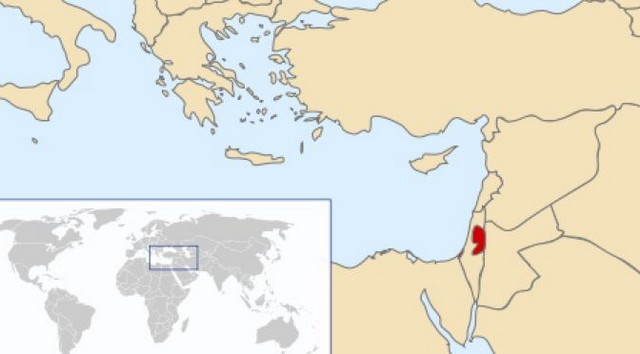
[Rima Najjar: Packing my bags to travel to Madrid, Spain: The Alternative Palestinian Path Conference (Towards a new revolutionary commitment) October-November 2021

Although the world has stood up for Palestine repeatedly through widespread global demonstrations against Israel’s crimes (see The Electronic Intifada’s video clip of May 2021), it still takes a lot of courage for Palestinians to stand up for themselves and declare a clear and unapologetic revolutionary path for their liberation.

That courage will be on full display at the upcoming Alternative Palestinian Path (Masar Badil) conference in Madrid, Spain (October — November 2021). The General Preparatory Committee of the conference has been working hard for over a year to mark the end of the Madrid-Oslo process, declare a new revolutionary commitment and chart a path towards a new stage of struggle for the liberation of Palestine.

Despite all past tragic setbacks, Palestinian resistance and courage have never waned; the history of the Palestine Liberation Organization (PLO) is the history of a revolution.

The best place to learn about this history ahead of Masar Badil is on the site The Palestinian Revolution (Learn the Revolution), a bilingual Arabic/English online learning resource that explores Palestinian revolutionary practice and thought from the Nakba of 1948, to the siege of Beirut in 1982:

The Palestinian revolution took on huge global significance, drawing on energies and resources from across the world, while influencing politics, thought, and culture throughout it. The website introduces readers to this remarkable phenomenon entirely through primary and contemporary sources.

It is this revolution, derailed since Madrid-Oslo of 30 years ago to the day, that Masar Badil aims to revitalize in Madrid now.

But will this conference that celebrates the Palestinian revolutionary struggle for liberation cut through the still deafening media static of Israel’s “narrative?” And by static, I mean such loaded questions as the one put to me by Eyal Nhaisi on Facebook: “Do i understand you correctly.. you want to delete Israël (from the river to the sea) and replace it with a country called Palestine?”

Or what about the static displayed on Canary Mission that conflates Zionism with Judaism and sees the Palestinian struggle for liberation in the following insidious terms: as defending and inciting violence against Jews (after all, “hasn’t the term ‘intifada’, [let alone ‘revolution’], carried the connotation of violence?”), supporting Hamas and spreading anti-Semitic conspiracy theories, glorifying and defending terrorists and terrorism, demonizing Israel, and (horror of horrors) engaging in BDS activity?

Eyal Nhaisi’s question above is on the minds of many people, including some who support Palestinians in their struggle, supporters who don’t seem to understand that apartheid and inequality are not what’s wrong with Israel. Rather, what’s wrong is Israel’s very existence as a settler-colonial Zionist Jewish entity in Palestine.

An example of the above confused mentality was recently expressed by American writer Michael Chabon, who says that he supports the Palestinian people in their struggle because he wants Israel “to survive and thrive.” He says this while simultaneously considering joining the boycott of Israeli publishers [as Irish writer Sally Rooney has done] in the future.

Will the revolutionary struggle for Palestinian liberation end up deleting Israel and “replacing” it with a country called Palestine? As I responded to Eyal on Facebook, this language is inappropriate. Palestine cannot “replace” Israel. Palestine is already placed there!

If the Palestinian struggle for liberation succeeds (most Palestinians and their supporters believe when, not if), the Palestinian Nakba will be reversed, all Palestinian rights in their homeland will be restored and restitution made. Only then, as Omar Barghouti put it back in 2013, can we begin to focus on the ethics and mechanics of decolonization:

Accepting modern day Jewish Israelis as equal citizens and full partners in building and developing a new shared society — free from all colonial subjugation and discrimination, as called for in the democratic state model — is the most magnanimous, rational offer any oppressed indigenous population can present to its oppressors. So don’t ask for more.

The conference comes as Israel is set to approve the construction of 4,400 new Jewish housing units in the West Bank, 3,109 in existing Jewish colonies and 1,300 in the heart of Palestinian villages.

Chabon’s confusion will disappear if we all finally understand the Palestinian struggle within the historical framework of decolonization struggles, part of a late twentieth-century drive of colonial peoples to become sovereign nation-states, just as the former colonial Algeria, Kenya, Southern Rhodesia, Angola, Mozambique and apartheid South Africa did.

Achieving this goal, says Masar Badil’s conference statement and call, requires

taking up this national responsibility at the individual and collective levels. It also requires collective convergence and cooperation to achieve a clear framework of struggle and direct and strategic objectives. Above all, it requires a willingness to sacrifice and broad popular participation in rebuilding our national and popular institutions on the one hand, and confronting the Zionist movement, its institutions and its racist colonial entity in occupied Palestine on the other hand, without neglecting the need to confront simultaneously the project of the Palestinian class that monopolized political decision-making and squandered the sacrifices of the Palestinian people. The major national achievements of the people were destroyed and this sector established, through the disastrous Oslo Accords, a powerless and illegitimate authority, which is the authority of “limited self-government” in areas and cities within the occupied Palestinian West Bank.

Which is why, as I pack my bag to travel to Madrid, I am most excited about the event that will take place on Sunday, October 31, 2021: Popular March for Palestine — Open discussion with the organizations and institutions participating in the conference.

Yes, we are not afraid and we are not alone today.

Related: A Giant Leap for Palestine? Stay tuned!
______________________________

Rima Najjar is a Palestinian whose father’s side of the family comes from the forcibly depopulated village of Lifta on the western outskirts of Jerusalem and whose mother’s side of the family is from Ijzim, south of Haifa.

23 October 2021

Source: countercurrents.org

Taliban is the winner at Moscow conference

By M K Bhadrakumar

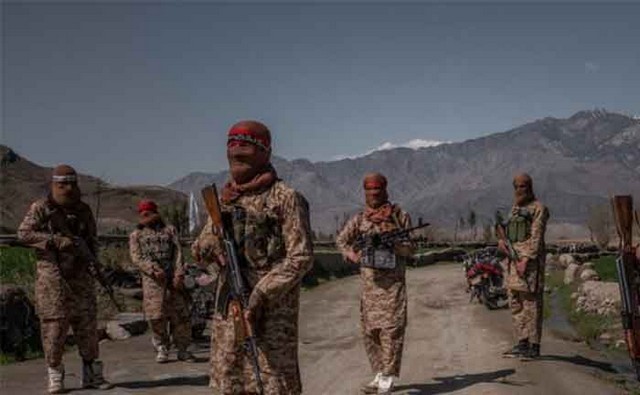
The Moscow meeting of ten regional states and the Taliban officials on Wednesday has produced an outcome that by far exceeds expectations. The salience of the consensus opinion is four-fold, as reflected in the joint statement issued after the event:

  • regional recognition that Taliban government is a compelling “reality”;
  • it is through constructive engagement that regional states should endeavour to influence Taliban;
  • a collective initiative to convene a broad-based international donor conference under the auspices of the United Nations;
  • and, robust regional backing for Afghanistan’s sovereignty, independence and territorial integrity.

Then, there is the ubiquitous geopolitical angle. Simply put, the Biden Administration has lost the plot. The Fox News flashed that “The Taliban won the backing from top US adversaries.” Second, the forceful regional initiative undermines the Western prescriptive attempts to pressure the Taliban government.

Third, Moscow has taken the high ground as the principal mentor, guide and guardian of the collective interests of Afghanistan’s neighbours. The Taliban delegation warmly welcomes this. Fourth, the door is not only slammed shut for establishing any form of US military presence in Central Asia but the regional states are opposed to any foreign power violating Afghanistan’s sovereignty, independence and territorial integrity.   

Finally, against the backdrop of the Moscow conference, the newly created forum of foreign ministers of Afghanistan’s immediate neighbours — Pakistan, Iran, Turkmenistan, Uzbekistan, Tajikistan and China — gains traction as the locomotive to navigate the path forward.

The next meeting of the forum is scheduled for October 27 in Tehran. It will be an in-person event and in an expanded format it will henceforth also include Russian Foreign Minister Sergey Lavrov!

Before the Moscow conference, Lavrov had met with the Taliban delegation. According to the Acting Taliban Foreign Minister Amir Khan Muttaqi, “we have good relations with Russia. We discussed various issues, including economic ties, trade between the two countries and the policy of the new Afghan government at large, aimed at using the location of Afghanistan to stimulate trade between the countries of the region and ultimately the economic integration.”

Lavrov’s opening remarks at the conference testify to the high comfort level Russia feels today vis-a-vis the Taliban government. In his words, “A new (Afghan) administration is in office now. This hard fact places great responsibility on the Taliban. We note the efforts they are making to stabilise the military-political situation and to ensure the smooth operation of the public governance system… the new balance of power in Afghanistan which took root after August 15 has no alternative in the foreseeable future.”

From such a perspective, Lavrov signalled, “We plan to engage our capabilities, including the capabilities offered by the UN, the SCO, the CSTO and other multilateral entities… Importantly, both the SCO and the CSTO have a special mechanism that was created many years ago, which is dedicated to interacting with Afghanistan, and identifying ways to promote stabilisation in that country… We are content with the level of practical cooperation with the Afghan authorities…We are grateful to the Afghan authorities for their assistance to our journalists… We will continue building business relations with Kabul with a view to resolving urgent bilateral issues.” read more

Clearly, the emphasis has shifted from the advocacy of “inclusive government” and the issue of formal “recognition” to the imperative need of averting a humanitarian catastrophe. It is hugely significant that the influential politician who voices the Kremlin opinion, Valentina Matviyenko (speaker of the Russian Federation Council) stated yesterday that

“The Taliban have come to power, they are controlling the entire country and it is necessary to hold a dialogue with them, it is necessary to meet with them… The issue of recognition or non-recognition today is not the priority act. I think, that if as a result of this dialogue the Taliban accepts those conditions I mentioned, not just approves in writing but implements in actions, I think that this will be, of course, their recognition since nowadays they are the actual power there.”       

Indeed, whereas the US has been harping on the recognition issue as a bargaining card to pressure the Taliban, the Moscow conference has deftly undercut the US plank. The Biden Administration will be increasingly hard-pressed to lift the sanctions at some point.

The Moscow conference pointedly called on the US to “shoulder” the costs of financing humanitarian needs in Afghanistan. President Putin hit hard when he said yesterday that “the primary responsibility for what is taking place there (Afghanistan) is borne by the countries that fought there for 20 years. And the first thing that they should do, in my opinion, is to unfreeze Afghan assets and give Afghanistan a possibility to solve top priority social and economic tasks.”

In the final analysis, the Moscow conference has blocked the path of any unilateral interventionism by the US in Afghanistan — either through “out-of-the-region” military operations on the pretext of fighting terror groups or by undermining the Taliban government’s unity and cohesion through covert operations with the help of groups such as ISIS (as had happened in Syria) and thereby create the alibi for direct intervention in future.

Paradoxically, the regional states have become stakeholders in the stability of the Taliban government. China, of course, has been urging such an approach. Conceivably, despite the daunting challenges, Moscow also senses the merit in the argument that the Afghan economy can eventually be turned around as an engine of growth.

A recent commentary by the Global Times noted, “Afghanistan has strong development potential and is worthy of investment…the country is rich in mineral resources… if Afghanistan can rely on minerals mining to overcome fiscal challenges, it will be conducive to regional stability and serve China’s interests. Whether Chinese enterprises invest will largely depend on whether Taliban can effectively ensure safety of domestic production and construction, maintain social order, provide security and fight terrorism to win back investors’ confidence.” read more

The bottom line is that the Taliban can justifiably draw satisfaction that the Moscow conference has virtually made the so-called “legitimacy aspect” of their government a non-issue.

The alchemy of constructive engagement is such that it will incrementally amount to de facto recognition, especially if the UN were to convene a donors’ conference. In sum, the Moscow conference has made sure that the US’ obdurate, vengeful stance against the Taliban will become unsustainable with the passage of time.

Ambassador M K Bhadrakumar served the Indian Foreign Service for more than 29 years.

23 October 2021

Source: countercurrents.org

Political Islam and the democracy crisis in North Africa

By Ramzy Baroud

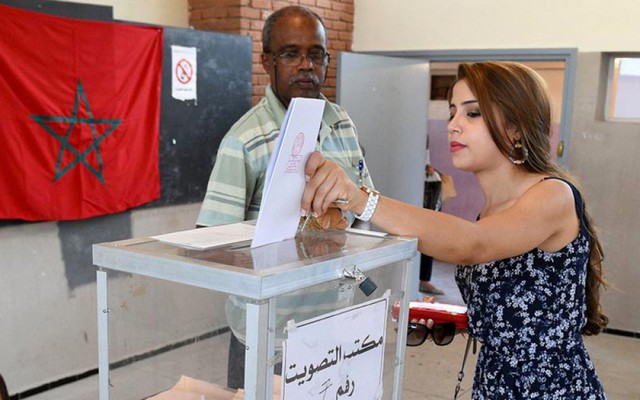
When the news circulated that Morocco’s leading political group, the Development and Justice Party (PJD), had been trounced in the latest election, held in September, official media mouthpieces in Egypt celebrated the news as if the PJD’s defeat was, in itself, a blow to the Egyptian Muslim Brotherhood. Regionally, political commentators who dedicated much of their time to discredit various Islamic political parties – often on behalf of one Arab government or another – found in the news another supposed proof that political Islam was a failure in both theory and practice.

‘Regionally, the news of the (PJD) failure was greeted with jubilation,’ Magdi Abdelhadi wrote on the BBC English website. ‘Commentators regarded the fall of PJD as the final nail in the coffin of political Islam,’ he added.

Missing from such sweeping declarations is that those who greeted the defeat of the PJD with ‘jubilation’ are mostly the very crowd that dismissed political Islam even during its unprecedented surge following the ‘Arab Spring’ in 2011; and the same intellectual mercenaries who unashamedly continue to sing the praises of such dictators as General Abdel Fattah al-Sisi in Egypt and the various Arab monarchs in the Gulf.

The PJD was not only defeated but almost completely demolished as a result of the vote, managing to retain only twelve of the 125 seats it had won in the 2016 election. The reasons behind such failure, however, are being misconstrued by various entities, governments and individuals with the aim of settling old scores and tarnishing political rivals. The ultimate objective here seems to be to cement the status quo where the fate of Arab nations remains in the grip of brutal, corrupt and self-aggrandising rulers who do not tolerate genuine political plurality and democracy.

For those who insist on viewing Arab and Middle Eastern politics through generalised, academic notions, the outcome of the Moroccan election has provided a perfect opportunity to delve further into sweeping statements. These knee-jerk, cliched reactions were boosted by the ongoing political crisis in Tunisia, the main victim of which, aside from Tunisian democracy, is the Ennahda Islamist party.

Democracy crisis in Tunisia

On 25 July, Tunisian President Kais Saied began a series of measures that effectively dismantled the country’s entire democratic infrastructure, while concentrating all power in his hands.

Taking advantage of the poor performances and endemic dysfunction of the country’s major political parties, including Ennahda, as well as the festering economic crisis and the growing dissatisfaction among ordinary Tunisians, Saied justified his actions as a way ‘to save the state and society’.

An academic with no real political experience, Saied provided no roadmap to restore the country’s democracy or to fix its many socio-economic ailments. Instead, on 29 September, he appointed another inexperienced politician, also an academic, Najla Bouden Romdhane, to form a government. Saied’s choice of selecting a woman for the post – making her the first Arab woman prime minister – was probably designed to communicate a message of progressive politics, and to win himself more time. But to what end?

In reviewing Saied’s political programme since July, The Economist argued that the Tunisian president had ‘announced little in the way of an economic program, apart from inchoate plans to fight corruption and use the proceeds to fund development’. Saied’s strategy for lowering inflation is ‘to ask businesses to offer discounts’, according to the London-based publication, hardly the radical reordering of a country’s devastated economy.

Frustrated by the failure to translate Tunisia’s budding democracy into a tangible difference that can be experienced in the everyday life of ordinary, unemployed and impoverished people, Tunisia’s public opinion has shifted gradually over the years. This small nation, which in 2011 had sought salvation through democracy, now links democracy with economic prosperity. According to a public opinion poll conducted by Arab Barometer in July 2021, three-quarters of Tunisians define democracy in terms of economic outcomes. Since the desired outcomes were not delivered under a succession of governments that ruled the country over the past decade, 87 per cent of Tunisians supported their president’s decision to sack the parliament. They may have hoped that Saied’s measures would reverse the devastating economic crisis. However, as it is becoming clear that Saied has no clear plan to steer Tunisia away from the tragic path of Lebanon and other failed economies, protesters are taking to the streets again, demanding a restoration of democracy and a return to plurality.

Deterministic vs Dynamic politics

When the uprisings began in Tunisia late 2010 and spread across the region, it seemed that the fall of dictators and the rise of democracy was inevitable; also certain seemed the rise of Islamic parties, which had registered substantial victories in various democratic elections throughout the Middle East and North Africa. Egypt’s Freedom and Justice Party (FJP) – which was founded by the country’s Muslim Brotherhood – won 37 per cent of the votes in the parliamentary election in 2011; Morocco’s PJD secured over 25 per cent of available seats in the parliament; and Ennahda obtained 89 of 217 seats.

At the time, it was common to discuss Islamic parties as if they were all branches of the same ideological movement. In fact, in the view of some, even the same political movement. ‘Political Islam’ became synonymous with the ‘Arab Spring’. Some saw this as an opportunity for ‘moderate’ Muslims – marginalised, exiled and often tortured and killed – finally to claim what was rightfully theirs; others, namely Israeli and right-wing western intellectuals and politicians, decried what they saw as an ‘Islamic Winter’, claiming that democracy and Islam would espouse an even greater anti-western and anti-Israeli sentiment.

Often missing from most of these discussions was the national context under which all Arab politics, whether Islamic-leaning or otherwise, operate. In Morocco, for example, King Mohammed VI played his own political game to ensure the survival of the monarchy in the age of democratisation. He quickly drew the Islamists nearer to him, offered a veneer of democracy, while practically holding on to all aspects of power.

Though it will take time to reach a conclusive analysis, it is possible that the PJD’s downfall was a result of its willingness to compromise on its declared principles in exchange for a very limited share of power. Indeed, it sometimes seemed as if the Islamic party, elected to steer the country away from the rule of a single individual, was serving the role of the King’s official political party. This was manifested in the PJD’s acceptance and eventual endorsement of Morocco’s normalisation of ties with the State of Israel in December 2020.

The Islamists’ recent defeat in Morocco, however, must not be viewed as a crisis in political Islam, for the latter is a theoretical concept that is in constant flux and is open to various, often radically opposing, interpretations by different scholars and under different historical contexts. While the PJD, for example, signed off on the King’s normalisation with Israel, Ennahda vehemently rejected it. Indeed, each Islamic party seems to behave according to different sets of priorities that are unique to that party, to its socio-economic setting, national context, political objectives and, ultimately, to its own unique interests.

Causes for optimism

Instead of resorting to abstract notions and generalisations, such as ‘the fall of PJD (being) the final nail in the coffin of political Islam’, an alternative, and more sensible reading is possible. First, most Arab voters, like voters everywhere, judge politicians based on performance, not hype, slogans and chants. This is as true for Islamic parties as it is for socialists, secularists and all others; and it is as applicable to the Middle East as it to the rest of the world.

Second, Morocco is a unique political space that must be analysed separately from Tunisia, and the latter from Egypt, or Palestine, and so on. While it is academically sound to speak of political phenomena, generalisations cannot be easily applied to everyday political outcomes.

Third, the fact that the PJD is quietly retreating to the ranks of the opposition and that Ennahda is experiencing a substantial overhaul, is an indication that Islamic parties have, not only in theory but also in practice, accepted some of the main pillars of democracy and constructive plurality: democratic alternation, self-introspection and soul-searching.

Those who have comforted themselves with the misapprehension that political Islam is dead are reminiscent, in their self-deception, of Francis Fukuyama’s theory on the ‘end of history’ after the disintegration of the Soviet Union and the temporarily-uncontested rise of the US as the world’s only superpower. Such provisional thinking is not only irrational, but is itself an outcome of ideologically-motivated wishful thinking. In the end, history remained in motion, as it always will.

While the Justice and Development Party, Ennahda and other Islamic parties have much reflection to do, it must be remembered that the future is not shaped by deterministic notions, but by dynamic processes that constantly produce new variables and, thus, new results. This is as true in North Africa as it has been proven to be in the rest of the world.

Dr Ramzy Baroud is a Non-resident Senior Research Fellow at the Afro-Middle East Centre.

26 October 2021

Source: www.amec.org.za

Taiwan Deaths from COVID-19 Vaccination Exceed Deaths from COVID-19

By Medical Trend

10 Oct 2021 – On October 7th, the death toll after vaccination in Taiwan reached 852, while the death toll after the COVID-19 was diagnosed [largely based on the flawed PCR test] was 844. The number of deaths after vaccination exceeded the number of confirmed deaths for the first time.

According to a “Notice of Adverse Events after COVID-19 Vaccination” issued by Taiwan’s health department, on March 22 this year, Taiwan began vaccination. From that day to October 6, the death toll after vaccination in Taiwan has reached 849.

Among them, the death toll after vaccination with AZ was the largest, reaching 643; the death toll after vaccination with Moderna was 183, and the death toll after vaccination with Taiwan’s self-produced “Medigen” vaccine was 22.

Another news from Taiwan Chinatimes:

Chinatimes reported that Taiwan’s “DCD” updated the “Notice of Adverse Events after COVID-19 Vaccination” on the 8th. According to data, as of 16:00 on the 7th, the “Suspected Serious Adverse Events after Vaccination” The number of deaths was 850, and as of the 8th, the number of deaths from COVID-19 pneumonia was 845.

Notification of adverse events after COVID-19 vaccination (Source: “Taiwan Chinatimes”)

As of the 6th, since the epidemic, the number of deaths due to the confirmed COVID-19 in Taiwan was 844. This is the first time that the number of deaths after vaccination has exceeded the number of confirmed deaths.

According to data released by the Taiwan Epidemic Command Center, on the 7th, there were 4 new confirmed cases of COVID-19 pneumonia in Taiwan, all of which were imported from abroad, and there were no new deaths among the confirmed cases. However, there were 3 new deaths after vaccination. The number of deaths after vaccination still exceeds the number of deaths after diagnosis.

On October 6, the Kuomintang “legislator” Yeh,Yu-Lan bluntly stated in a Facebook post that the vaccine given to save lives has also nearly doubled the number of deaths due to the COVID-19, which is indeed very ironic and confusing.

She mentioned that recently, some hospitals in Taiwan have reported that 25 people were vaccinated with undiluted vaccine stock solution, or the vaccination dose was insufficient. It should have been given 0.5cc, but only 0.1cc was given.

Netizens mentioned that the original appointment to go to the National Taiwan University Hospital for the second dose of Moderna was changed to a “high-end” vaccine. This series of vaccine problems can be clearly felt. The number of vaccination deaths has caught up with the COVID-19 diagnosis. The death toll is not accidental, nor is it accidental.

She said that many people would actively vaccinate to survive, and relevant departments should not turn life-saving vaccines into life-threatening vaccines because of negligence in control. People who are vaccinated in accordance with the island’s policies have become inexplicable victims under the epidemic.

In fact, as early as two weeks ago, the Kuomintang “legislator” Wu I-ding had questioned that the mortality rate after vaccination in Taiwan was higher than that in other regions. At that time, Chen Shih-chung said that “the judgment has not been completed” and death may not be related to vaccination.

Wu I-ding had no choice but to say that she could not get any information from Chen Shih-chung, so she went to the health department and the legal department. Unexpectedly, all parties have been “playing the ball” all the time.

The statement “not necessarily related” is a consistent statement that Chen Shih-chung has always used in the face of all doubts about vaccines, such as adverse reactions and deaths after vaccination.

As mentioned earlier, in the “Notice of Adverse Events after COVID-19 Vaccination” issued by the Taiwan authorities yesterday, the authorities have also been emphasizing that “(this document) itself cannot explain or be used to derive the existence or seriousness of vaccine-related problems. Conclusion of degree, frequency or incidence.”

Sources:

https://www.ettoday.net/news/20211009/2097484.htm

https://news.sina.com.cn/c/2021-10-08/doc-iktzqtyu0213782.shtml

https://www.guancha.cn/politics/2021_10_08_609960.shtml

________________________________________________

The original source of this article is Medical Trend

25 October 2021

Source: www.transcend.org

‘Unconscionable’: Pfizer, Moderna to Rake in Combined $93 Billion in 2022 COVID Vaccine Sales

By Megan Redshaw

A report by health data analytics group, Airfinity, projects “unprecedented” sales and profits for Pfizer and Moderna in 2022. According to the People’s Vaccine Alliance, the companies are pricing their vaccines by as much as $41 billion above the estimated cost of production.

19 Oct 2021 – Vaccine makers Pfizer and Moderna are projected to generate combined sales of $93.2 billion in 2022 nearly twice the amount they’re expected to rake in this year, said Airfinity, a health data analytics group.

Airfinity put total market sales for COVID vaccines in 2022 at $124 billion, according to the Financial Times.

Pfizer vaccine sales are predicted to reach $54.5 billion in 2022, and Moderna’s will hit $38.7 billion. The estimates blow the earlier figures — $23.6 billion for Pfizer and $20 billion for Moderna — out of the water.

“The numbers are unprecedented,” Rasmus Beck Hansen, CEO of Airfinity, told the Financial Times.

Sales of the mRNA shots will continue to rise in 2022 due to boosters and countries stockpiling to ward off variants, Airfinity said.

Pfizer will generate 64% of its sales, and Moderna 75% of its sales, from high-income countries in 2022, the analysts predicted.

In April, Pfizer predicted 2021 COVID vaccine sales of $26 billion. After second-quarter results were reported, Pfizer upped the figure to $33.5 billion. Bernstein analyst Ronny Gal said the company could ring up an additional $10 billion in vaccine sales in 2021.

Gal wrote:

“The numbers are going to be much higher. The guidance of $33.5B reflects contracts signed to today which reflect total commitment to sell 2.1 million doses (at average price of $15.95). Pfizer notes they expect to manufacture 3 million doses. Presumably much of those will be sold as well, albeit at lower average price as consumption shifts to emerging markets. This is probably another $10 billion.”

“The second quarter was remarkable in a number of ways,” Pfizer CEO Albert Bourla said. “Most visibly, the speed and efficiency of our efforts with BioNTech to help vaccinate the world against COVID-19 have been unprecedented, with now more than a billion doses of BNT162b2 having been delivered globally.”

On a conference call, Bourla said that while “it’s very early to speak” about the company’s sales expectations for next year, he put Pfizer’s 2022 production capacity at 4 billion doses.

Moderna, Pfizer, BioNTech reaping ‘astronomical and unconscionable’ profits

According to ActionAid International — a global federation working for a world free of poverty and injustice — Moderna, Pfizer and BioNTech are reaping “astronomical and unconscionable profits” due to their monopolies of mRNA COVID vaccines.

Moderna and BioNTech are reporting 69% profit margins, with Moderna and Pfizer paying little in taxes, the People’s Vaccine Alliance said Sept. 15.

Thanks to patent monopolies for COVID vaccines — development of which was supported by $100 billion in public funding from taxpayers in the U.S., Germany and other countries — the three corporations earned more than $26 billion in revenue in the first half of the year, at least two-thirds of it as pure profit for Moderna and BioNTech.

The Alliance also estimated the three corporations are over-charging, pricing their vaccines by as much as $41 billion above the estimated cost of production.

“Big Pharma’s business model — receive billions in public investments, charge exorbitant prices for life-saving medicines, pay little tax — is gold dust for wealthy investors and corporate executives but devastating for global public health,” said Robbie Silverman, private sector engagement manager for Oxfam.

Silverman said pharmaceutical companies are prioritizing their own profits by enforcing their monopolies and selling their vaccines to the highest bidder. “Enough is enough — we must start putting people before profits,” Silverman said.

According to an analysis by the People’s Vaccine Alliance, based on work by MRNA scientists at Imperial college, Moderna and Pfizer-BioNTech have charged up to 24 times the potential cost of production for their vaccines.

Analysis of production techniques for Pfizer-BioNTech and Moderna, which were developed only thanks to $8.3 billion of public funding, suggest these same vaccines could be made for as little as $1.20 a dose.

Despite benefiting from a multi-billion-dollar public investment in the development of their vaccines, pharma giants have not paid their fair share of taxes, ActionAid International reported.

In the first half of 2021, Moderna paid a 7% U.S. tax rate and Pfizer paid a 15% tax rate — well below the statutory rate of 21%.

BioNTech, the German startup that produced the recipe for Pfizer’s vaccine, paid a significantly higher tax rate of 31% in Germany while reaping a 77% profit margin.

Moderna expects total vaccine sales of $20 billion in 2021. So far this year, Moderna has paid only $322 million in taxes, despite earning billions in profit.

Pfizer’s vaccine now accounts for more than a third of the company’s overall revenue base. Pfizer sold more than $11 billion in vaccines in the first half of this year, and is now projecting $33.5 billion in total vaccine sales for 2021 — making the vaccine one of the top selling pharma products this year and potentially in the history of the pharmaceutical industry.

Pfizer has stated its vaccine profit margins are less than 30%, but because the company doesn’t disclose it’s expenses, it was not possible to independently verify its profit margins, ActionAid International reported.

J&J made $502 million in third-quarter vaccine sales amid booster approval

Johnson & Johnson (J&J) said it made $502 million in sales from its COVID vaccine in the third quarter, according to an earnings report released Tuesday.

J&J’s pharmaceutical business, which developed the single-shot COVID vaccine, generated $12.9 billion in revenue — a 13.8% year-over-year increase, CNBC reported.

Sales of J&J’s vaccine came in lighter than expected, Edward Jones analyst Ashtyn Evans said in a report to clients. But the Dow Jones company still expects $2.5 billion in COVID vaccine sales this year.

The company also said it has maintained its vaccine sales outlook for the year, and it plans to ship as much as it can through the rest of the year, CFO Joseph Wolk said on “Squawk Box.”

J&J’s report experienced criticism due to how the company handled the opioid crisis and development of a comparatively less-effective COVID vaccine under outgoing CEO Alex Gorsky.

On Oct. 15, the U.S. Food and Drug Administration’s (FDA) Vaccines and Related Biological Products Advisory Committee (VRBPAC) unanimously recommended giving a second booster dose to all recipients of J&J’s COVID vaccine over 18 years old.

The FDA panel placed no restrictions on who should receive an additional J&J dose, unlike it did with mRNA vaccines, which are authorized only for use for certain high-risk groups. VRBPAC said the second shot should be given no earlier than two months after the first.

Megan Redshaw is a freelance reporter for The Defender. She has a background in political science, a law degree and extensive training in natural health.

25 October 2021

Source: www.transcend.org

US billionaire wealth increased 70 percent since the start of the pandemic

By Kevin Reed

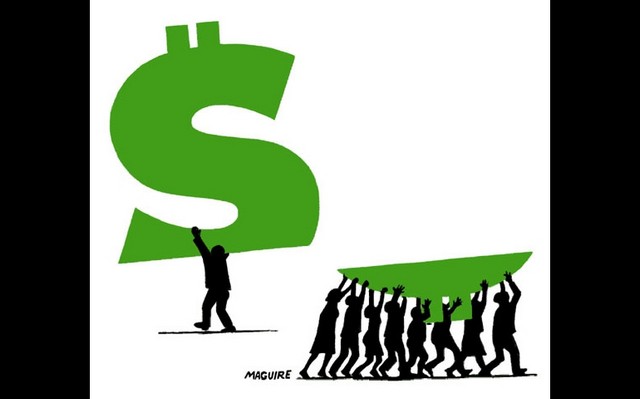
The wealth of US billionaires has increased by a massive $2.1 trillion, or 70 percent, since the onset of the coronavirus pandemic, while tens of millions of working people have faced unemployment and illness, and 724,000 have died from COVID-19. Additionally, the list of American billionaires grew by 131 individuals—going from 614 to 745—during the same period.

According to an analysis of Forbes data about US billionaires by Americans for Tax Fairness (ATF) and the Institute for Policy Studies (IPS) Program on Inequality, the wealth of the richest people in the country increased from “just short of $3 trillion at the start of the COVID crisis on March 18, 2020, to over $5 trillion on October 15 of this year,” and this wealth is “two-thirds more than the $3 trillion in wealth held by the bottom 50 percent of U.S. households estimated by the Federal Reserve Board.”

In an accompanying press release, the ATF and IPS state that the “great good fortune of these billionaires over the past 19 months” is in stark contrast with the “89 million Americans [who] have lost jobs, over 44.9 million [who] have been sickened by the virus” and the nearly three-quarters of a million who have died from it.

The billionaire who increased his wealth the most is Elon Musk. The wealth of the CEO of Tesla and SpaceX grew by an incredible 751 percent during the pandemic, from $24.6 billion to $209.4 billion. Musk became the wealthiest individual in the country, beating out Amazon CEO Jeff Bezos, who went from $113 billion to $192 billion, or a 70 percent increase over the 19-month period.

Other top billionaires who increased their wealth significantly during the pandemic include the founders of Google (now Alphabet, Inc.) Larry Page and Sergey Brin, who saw their fortunes rise by 137.2 percent to $120.7 billion and 136.9 percent to $116.2 billion, respectively. Phil Knight, founder and chairman emeritus of Nike, Inc., nearly doubled his wealth since March 2020 from $29.5 billion to $57.9 billion.

A further analysis of the Forbes data shows that 12 percent of US billionaires are women, including Alice Walton of the Walmart empire with a personal fortune of $64.5 billion, up from $54.4 billion, and MacKenzie Scott, the former wife of Jeff Bezos, who increased her wealth by 54 percent this year from $36 billion to $55.5 billion. There are five billionaires in their twenties, including Sam Bankman, the 29-year-old CEO of the cryptocurrency exchange FTX, who was not previously on the Forbes list until this year, when he amassed $22.5 billion.

California has the largest number of billionaires in the US with 196. There are 182 billionaires in the finance and investment business and 142 in the technology industries. The next highest number is in the fashion and retail sector with 52 billionaires, with the Walton family members and Phil Knight at the top of the list, followed by Leonard Lauder (Estee Lauder), John Menard, Jr. (Menards) and Hank and Doug Meijer (Meijer), each with more than $10 billion in their fortunes.

The ATF and IPS analysis has been published as part of the campaign by Democratic Party senator from Oregon and chairman of the Senate Finance Committee Ron Wyden to get support for a Billionaires Income Tax (BIT) bill in the U.S. Congress. The Wyden tax plan—which he announced on September 23—is part of the negotiations now underway in Washington D.C. over the Biden administration’s Build Back Better Agenda infrastructure plan.

The press statement says that 67 national organizations have sent letters to Congress “expressing concern that neither the Ways and Means committee plan nor President Biden’s plan will adequately tax billionaires,” although the statement says that Wyden’s BIT proposal—the specific details of which have yet to be disclosed—is supported by the White House.

The ATF and IPS press release states that “most of these huge billionaires’ gains will go untaxed under current rules and will disappear entirely for tax purposes when they’re passed onto the next generation.” The statement reveals that, on average, billionaires pay an “effective federal income tax rate of about 8 percent” and that this is a lower rate than many “middle income taxpayers pay like teachers, nurses and firefighters.”

The document further explains how the super-rich avoid paying income tax on their enormous wealth increases. Most of their income comes from “the increased value of their investments such as stocks, a business or real estate, rather than a paycheck like most people,” and they do not have to pay taxes on this wealth unless they sell the assets. “But the ultra-rich don’t sell assets,” the statement says; instead they borrow money against their assets from the banks at extremely low interest rates “and live lavishly tax free.”

Even when they do sell the assets, the super-rich only pay a top capital gains tax rate of 20 percent—plus a 3.8 percent Net Investment Income Tax (NIIT)—that is far below the current top rate of 37 percent they would pay in taxes on an equivalent salary.

The report says that many billionaires have paid zero taxes in recent years, “including Jeff Bezos, Elon Musk, Michael Bloomberg and George Soros” and the top 25 billionaires in the US “paid a tax rate of just 3.4 percent on a $400 billion increase in their collective fortune between 2014-18.”

The ATF and IPS analysis fails to mention that the grotesque increase in the number and wealth of America’s billionaire capitalist elite over the past 19 months has been fueled by a combination of an increase in the exploitation of the working class during the public health crisis and the unprecedented purchase of $7 trillion in financial assets by the Federal Reserve Bank as part of the US government’s pandemic stimulus response.

The staggering sums of billionaire wealth being accumulated at one pole of society, both within the US and on an international scale, are mirrored in the negative by the increasing poverty and suffering of the poor and working-class populations in the billions. The ruling elite is using the pandemic to accelerate, like a runaway train, the process of wealth inequality that has been underway for decades. But the working class is beginning to articulate its response to this crisis in the form of a strike wave developing throughout the United States and around the globe.

Originally published by WSWS.org

20 October 2021

Source: countercurrents.org

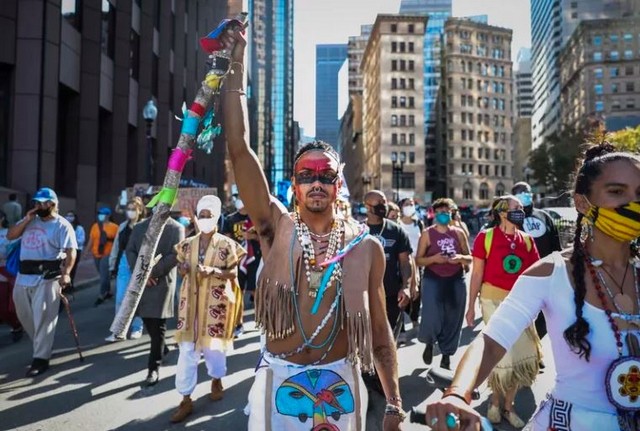
Goodbye, Columbus? Here’s What Indigenous Peoples’ Day Means to Native Americans

By Emma Bowman

11 Oct 2021 – This year marks the first time a U.S. president has officially recognized Indigenous Peoples’ Day.

President Biden issued a proclamation on Friday [8 Oct] to observe this Oct. 11 as a day to honor Native Americans, their resilience and their contributions to American society throughout history, even as they faced assimilation, discrimination and genocide spanning generations. The move shifts focus from Columbus Day, the federal holiday celebrating Christopher Columbus, which shares the same date as Indigenous Peoples’ Day this year.

Dylan Baca, a 19-year-old Arizonan who was instrumental in helping broker the proclamation, is overwhelmed by the gravity of Biden’s action.

“I still don’t think I’ve fully absorbed what that has meant,” he said. “This is a profound thing the president has done, and it’s going to mean a lot to so many people.”

Columbus Day or Indigenous Peoples’ Day?

Four years ago, the Native leader started an organization alongside Arizona state Sen. Jamescita Peshlakai, Indigenous Peoples’ Initiative, with a similar mission: to tell a more positive and more accurate tale of Native Americans by replacing Columbus Day with Indigenous Peoples’ Day.

What is Indigenous Peoples’ Day?

Indigenous Peoples’ Day advocates say the recognition helps correct a “whitewashed” American history that has glorified Europeans like Italian explorer Christopher Columbus who have committed violence against Indigenous communities. Native Americans have long criticized the inaccuracies and harmful narratives of Columbus’ legacy that credited him with his “discovery” of the Americas when Indigenous people were there first.

“It is difficult to grapple with the complete accomplishments of individuals and also the costs of what those accomplishments came at,” said Mandy Van Heuvelen, the cultural interpreter coordinator at the Smithsonian’s National Museum of the American Indian.

There are no set rules on how one should appreciate the day, said Van Heuvelen, a member of the Cheyenne River Sioux Tribe from South Dakota. It’s all about reflection, recognition, celebration and an education.

“It can be a day of reflection of our history in the United States, the role Native people have played in it, the impacts that history has had on native people and communities, and also a day to gain some understanding of the diversity of Indigenous peoples,” she said.

How Columbus Sailed into U.S. History, Thanks to Italians

The idea was first proposed by Indigenous peoples at a United Nations conference in 1977 held to address discrimination against Natives, as NPR has reported. But South Dakota became the first state to replace Columbus Day with Indigenous Peoples day in 1989, officially celebrating it the following year.

Biden’s proclamation signifies a formal adoption of a day that a growing number of states and cities have come to acknowledge. Last week, Boston joined Arizona, Oregon, Texas, Louisiana, Washington, D.C., and several other states in dedicating a second Monday in October to Indigenous Peoples’ Day. Native Americans have borne the brunt of the work to make that happen.

Many state and local governments have gone a step further. More than a dozen states and well over 100 cities celebrate the day, with many of them having altogether dropped the holiday honoring Columbus to replace it with Indigenous Peoples’ Day.

What might seem to some like a simple name change can lead to real social progress for Indigenous Americans, said Van Heuvelen.

“What these changes accomplish, piece by piece, is visibility for Native people in the United States,” she said. “Until Native people are or are fully seen in our society and in everyday life, we can’t accomplish those bigger changes. As long as Native people remain invisible, it’s much more easier for people to look past those real issues and those real concerns within those communities.”

What about Columbus Day?

Columbus Day remains a federal holiday that gives federal government employees the day off from work.

The day was first founded as a way to appreciate the mistreatment of Italian Americans, and Congress eventually made it a federal holiday in 1934.

“Italian American culture is important, and I think there are other times and places to recognize that. But I think it’s also important to also recognize the history of Columbus Day itself,” said Baca. “Should we recognize a man whose labors killed children, killed women and decimated the Native American population here? I don’t think that is something that we want to be honored.”

Monday marks Oregon’s first statewide recognition of Indigenous Peoples’ Day, in place of Columbus Day, after its legislature passed a bill brought by its Indigenous lawmakers. Rep. Tawna Sanchez, one of those lawmakers, says the movement to recognize the day is an ideal time to capitalize on the momentum of political recognition.

“I don’t know that we’ll ever get to a place where people have their land back or have the recognition of who they are, to the degree that we that we need to or should. But the fact that people are paying attention at this very moment — that’s important, because we will have a greater opportunity to educate people and help them understand why we are where we are right now,” she said.

“History is always written by the conqueror,” said Sanchez. “How do we actually tell the truth about what happened and where we sit this very moment? How do we go forward from here?”

18 October 2021

Source: www.transcend.org

Abandoning Yemen

By Kathy Kelly

Why is the UN Human Rights Council Silencing Yemeni Human Rights Victims?

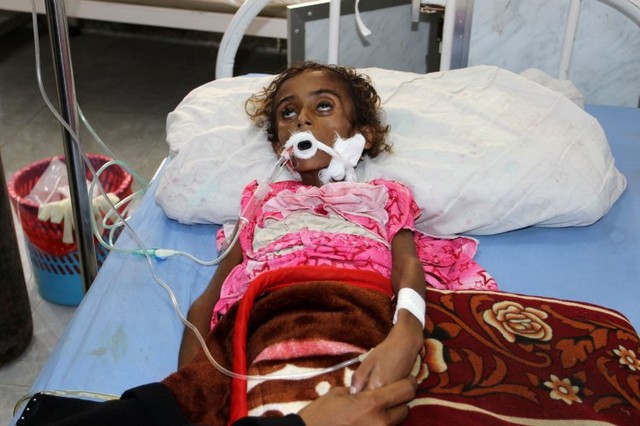
11 Oct 2021 – Saudi Arabia and Bahrain, with the cooperation of the U.S. succeeded this week in killing off a little known U.N. agency that for nearly four years has courageously advocated for hundreds of thousands of Yemenis suffering immensely in the civil war that is being driven forward by Saudi Arabia.

Monday, October 11, marked the official closure of the UN Group of Eminent Experts (Group of Experts or GEE) on Yemen. For close to four years, this highly respected investigative body scrupulously examined alleged violations and abuses of human rights suffered by Yemenis whose basic rights to food, shelter, safety, health care and education are being horribly violated even as they have been bludgeoned by Saudi and U.S. air strikes. “This is a major setback for all victims who have suffered serious violations during the armed conflict,” the Group of Experts wrote in a statement the day after the UN Human Rights Council refused to extend a mandate for them to continue their work. “The Council appears to be abandoning the people of Yemen,” the statement says, adding that “Victims of this tragic armed conflict should not be silenced by the decision of a few States.”

Prior to the vote, there were indications that Saudi Arabia and its allies, such as Bahrain which sits on the UN Human Rights Council, had increased lobbying efforts worldwide in a bid to do away with the Group of Experts. Actions of the Saudi-led Coalition waging war against Yemen have been examined and reported on by the Group of Experts. Last year, the Saudi bid for a seat on the Human Rights Council was rejected, but Bahrain serves as its proxy.

Bahrain is a notorious human rights violator and a staunch member of the Saudi-led Coalition which buys billions of dollars’ worth of weaponry from the U.S. and other countries to bomb Yemen’s infrastructure, kill civilians and displace millions of people.

The Group of Experts was mandated to investigate violations committed by all warring parties, and so it’s possible the Ansar Allah leadership, often known as the Houthis, also wished to avoid the Group’s scrutiny.

The Group of Experts’ mission has come to an end, but the fear and intimidation faced by Yemeni victims and witnesses continues.

Mwatana for Human Rights, an independent Yemeni organization established in 2007, advocates for human rights by reporting on issues such as torture of detainees, grossly unfair trials, patterns of injustice, and starvation by warfare through destruction of farms and water sources. Mwatana had hoped the UN Human Rights council would grant the Group of Experts a multi-year extension. Members of Mwatana rightly fear their voice will be silenced within the UN if the Human Rights Council’s decision is an indicator of how much the Council cares about Yemenis.

“The GEE is the only independent and impartial mechanism working to deter war crimes and other violations by all parties to the conflict,” said Radhya Almutawakel, Chairperson of Mwatana for Human Rights. Doing away with this body will, she believes, give a green light to continue violations that condemn millions in Yemen to “unremitting violence and constant fear.”

The Yemen Data Project, founded in 2016, is an independent entity aiming to collect data on the conduct of the war in Yemen. Their most recent monthly report tallied air raid numbers in September which had risen to the highest monthly rate since March. Sirwah, a district in the Marib province was, for the ninth consecutive month, the most heavily targeted district in Yemen, with 29 air raids recorded in September. Try to imagine a district the size of three city neighborhoods being bombed 29 times in one month.

Intensified fighting has led to large waves of displacement within the governorate, and sites populated by soaring numbers of refugees are routinely impacted by shelling and airstrikes. Pressing humanitarian needs include shelter, food, water, sanitation, hygiene, and medical care. Were it not for the brave reports of the Yemen Data Project about the conduct of the war, the causes of inhumane conditions suffered by people in Sirwah could be shrouded in secrecy. This is a time to increase, not abandon, attention to Yemenis trapped in war zones.

During the first months of 1995, I was among a group of activists who formed a campaign called Voices in the Wilderness to publicly defy economic sanctions against Iraq. Some of us had been in Iraq during the 1991 U.S.- led Desert Storm invasion. The UN reported that hundreds of thousands of children under age five had already died and that the economic sanctions contributed to these deaths. We felt compelled to at least try to break the economic sanctions against Iraq by declaring our intent to bring medicines and medical relief supplies to Iraqi hospitals and families.

But to whom would we deliver these supplies? Voices in the Wilderness founders agreed that we would start contacting Iraqis in our neighborhoods and also try to connect with groups concerned with peace and justice in the Middle East. And so it was that I began asking Iraqi shopkeepers in my Chicago neighborhood for advice. They were understandably quite wary. And one day, as I walked away from a shopkeeper who had actually given me an extremely helpful phone number for a parish priest in Baghdad, I overheard another customer ask what that was all about and then his reply: “Oh, they’re just a group of people trying to make a name for themselves.”

I felt crestfallen. Now, 26 years later, it’s easy for me to understand his reaction. Why should anyone trust people as strange as we must have seemed?

But no wonder I’ve felt high regard for the United Nation’s Group of Experts who went to bat for human rights groups struggling for “street cred” regarding Yemen. When Yemeni human rights advocates try to sound the alarm about terrible abuses, they don’t just face hurt feelings when met with antagonism. Yemeni human rights activists have been jailed, tortured and disappeared.

Yemen’s civil society activists do need to make a name for themselves.

On Thursday, October 7, the day the United Nations Human Rights Council voted not to continue the role of the Group of Experts with regard to Yemen, the United Nations agreed to set up an investigative group to monitor the Taliban. However, the agreement assured the U.S. and NATO that abuses committed under their command would not be subject to investigation.

Politicizing UN agencies and procedures makes it all the more difficult for people making inquiries to establish trusting relationships with people whose rights should be upheld by the United Nations High Commission for Human Rights.

When I was approaching shopkeepers for ideas about people we might contact in Iraq, I was just beginning to grapple with Professor Noam Chomsky’s essays about “worthy victims” and “unworthy victims.” That second phrase seemed a terrible oxymoron. How could a victim of torture, bereavement, hunger, displacement or disappearance be an “unworthy victim?” Over the next forty years, I grew to understand the cruel distinction between worthy and unworthy victims. A powerful country or group can use the plight of “worthy victims” to build support for war or military intervention. The “unworthy victims” also suffer, but because their stories could lead people to question the wisdom of a powerful country’s attacks on civilians, stories about those victims are likely to fade away.

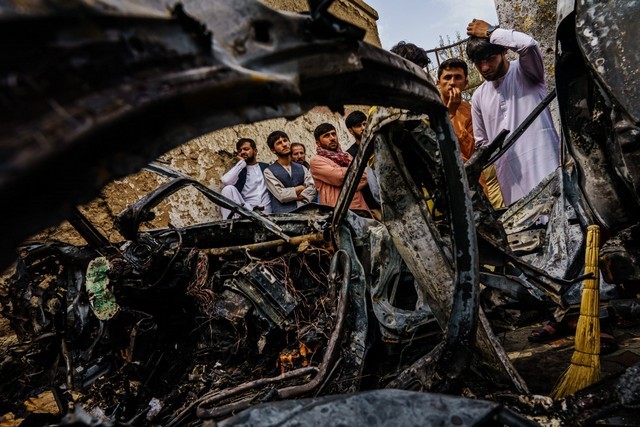
Consider, in Afghanistan, the plight of those who survived an August 29th U.S. drone attack against the family of Zamari Ahmadi. Ten members of the family were killed. Seven were children. As of September 30, the family had not yet heard anything from the U.S.

I greatly hope Mwatana, The Yemen Data Project, The Yemen Foundation, and all of the journalists and human rights activists passionately involved in opposing the war that rages in Yemen become names that occasion respect, gratitude and support. I hope they’ll continue documenting violations and abuse. But I know their work on the ground in Yemen will now be even more dangerous.

Meanwhile, the lobbyists who’ve served the Saudi government so well have certainly made a name for themselves in Washington, D.C. and beyond.

Grass roots activists committed to ending human rights abuses must uphold solidarity with civil society groups defending human rights in Yemen and Afghanistan. Governments waging war and protecting human rights abusers must immediately end their pernicious practices. In the United States, peace activists must tell the military contractors, lobbyists and elected representatives, “Not in our name!” and demand that the United States government do a U-turn, extending a “no strings attached” hand of friendship to people in need and abolishing all wars forever. A good start would be for the U.S. to stop trying to cover-up the atrocities, like the Yemeni war, in which it is involved.

Kathy Kelly is a member of the TRANSCEND Network for Peace Development Environment, an American peace activist, pacifist and author, one of the founding members of Voices in the Wilderness, and currently a co-coordinator Voices for Creative Nonviolence.

18 October 2021

Source: www.transcend.org

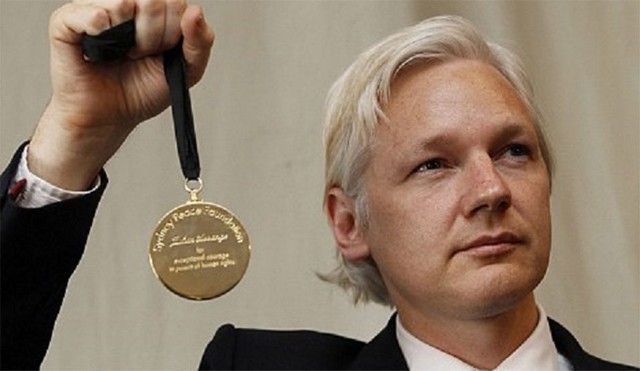
The Nobel Peace Prize Should Have Gone to Julian Assange

By David Adams

11 Oct 2021 – To some extent one must applaud the choice of this year’s Nobel Peace Prize to two journalists who have dared to defy government pressure. It is correct that the free flow of information is essential for peace, as we have maintained in this blog. In fact, it has become the highest priority because, as we have stressed here, the culture of war now uses the manipulation of information as its primary means of defense.

And the journalists who were chosen, Maria Ressa and Dmitry Muratov, certainly merit the distinction.

But there is another journalist who is even more deserving. And his recognition would have contributed far more to the cause of world peace. That is Julian Assange.

As Nobel Peace Laureate Mairead Maguire said in 2019 when she nominated Assange for the Prize,

“Julian Assange meets all criteria for the Nobel Peace Prize. Through his release of hidden information to the public we are no longer naïve to the atrocities of war, neither oblivious to the connections between big business and the acquisition of resources and spoils of war. As his human rights and freedom are in jeopardy, the Nobel Peace Prize would afford Julian much greater protection from governments’ forces.”

His recognition would have contributed far more to the cause of world peace because Assange revealed the secrets of the American Empire, which is the primary force in the culture of war. Those who received the prize this year attacked countries that are secondary: the Philippines and Russia. To be sure these countries are also part of the culture of war, but they are not responsible for the wars in Iraq, Afghanistan, Syria, and Libya, for military bases throughout the world, for the systematic overthrow of anyone who is elected to head a country that does not support the American Empire, and for the support of the worst dictatorships and warmongers responsible for wars like that in Yemen.

Assange revealed the American atrocities in Iraq and Afghanistan and the involvement of the CIA in covert warfare around the world.

And because of his courageous journalism he continues to be under attack by the American Empire, to the point that it was recently revealed that the CIA asked permission from President Trump to assassinate him.

Ironically, the Nobel Peace Prize was awarded to President Obama at a time when he was initiating the prosecution of Assange and when his administration was beginning the secret warfare of drones, perhaps the most dangerous advance of the culture of war. And Assange was revealing the secrets of the Obama administration.

In fact, as long as we are suggesting who should have won the prize, why not add Edward Snowden who is also being sought by the United States for revealing its culture of war secrets? And Daniel Ellsberg who was the first whistle-blower, revealing the secrets of the Vietnam War, and who continues to speak out in favor of Snowden and Assange? And why not add Mordecai Vanunu, imprisoned for 18 years after revealing the secret of Israel’s nuclear arms, and who continues to be harassed by the Israeli government? And Daniel Hale, recently imprisoned for revealing the secrets of America’s drone warfare?

By revealing the secrets of America’s culture of war, all of these whistle-blowers are making a great contribution to the world’s anti-war consciousness which is a key component of the developments that can eventually produce a transition to the culture of peace.

Dr. David Adams is a member of the TRANSCEND Network for Peace Development Environment and coordinator of the Culture of Peace News Network.

18 October 2021

Source: www.transcend.org

No Apologies: The US military often kills civilians – and rarely offers compensation

By Pesha Magid

Civilians are regularly killed by the USA in its numerous wars across the world. The families of these victims rarely receive compensation for their loss. In cases where some payment is made, these ‘condolence payments’ are small, are given without an acknowledgement of responsibility, and are mostly an effort to win civilian support for the US war.

Rua Moataz Khadr kept her three children close as they huddled in a house full of strangers in Mosul, Iraq. Above her, the US-led coalition rained down airstrikes as the battle against the Islamic State group reached its height in 2017. IS fighters had forced Khadr’s family from their home and into this building. A bomb hit the house. Khadr and her two daughters were able to free themselves from the rubble, but her four-year-old son, Ahmed Yahya, was crushed to death. He was among the between 9 000 and 11 000 civilians killed during the yearlong battle for Mosul. Khadr, like most bomb victims in Iraq, has no idea which nation was responsible for the airstrike that killed her son. Was it an American aircraft? British, Dutch? ‘Even if I found out, what would I do?’ Khadr told The Intercept. ‘My son is gone. It won’t help to know or not know.’ She has no hope that she will receive compensation for his loss.

In its final days in Afghanistan, the USA conducted a drone strike that killed ten civilians in Kabul – seven of them children. Their deaths bring up a thorny question surrounding the frequent US killing of civilians in the 9/11 wars: What would justice look like for the families of civilians who have been wrongfully killed? The media attention generated by the Kabul strike prompted a rare admission of guilt from the Pentagon and may ultimately lead to monetary compensation for the survivors. But byzantine laws in the USA make it all but impossible for foreigners to file for compensation if a relative was killed in combat – excluding the majority of wrongful deaths overseas. The US-led anti-IS offensive is a useful example of this. Over four years after the battle for Mosul in 2017, the USA has not compensated the family of a single civilian killed.

The only hope for most survivors is a ‘sympathy’ payment from the US military that does not acknowledge responsibility for causing the deaths. Unsurprisingly, those payments are rare; none were issued in 2020. Meanwhile, US allies involved in bombing campaigns usually hide behind the shield of joint operations to avoid taking responsibility for civilian deaths. The UK has gone further, recently passing a law that limits the time period in which a civilian can file a claim. All of these systems create maze-like blocks for civilians who hope to get some form of justice for the deaths of loved ones killed by airstrikes.

In recent years, the USA and its European allies have decreased the number of ground troops deployed overseas in the so-called war on terror, turning instead to airstrikes, while their local partners carry out ground operations. This increasing reliance on aerial warfare, which renders the identity of the military force that kills a civilian nearly invisible, has made it all but impossible for civilians to get compensation for the loss of family members.

While reparations for civilian harm can never replace a life, they are, at the very least, an acknowledgment that harm was done and a way to help support those who have lost deeply. For instance, the US-led coalition has carried out 34 781 airstrikes in Iraq and Syria since 2014; the UK-based monitoring group Airwars estimates that coalition actions led to the deaths of between 8 317 and 13 190 civilians, of whom 3 715 have been identified. The coalition itself only acknowledges the deaths of 1 417 civilians. An Intercept review of public records shows that only one person whose family members were killed by a coalition airstrike in Iraq or Syria has received official compensation.

At an earlier stage of the 9/11 wars, the USA and its allies did pay compensation to civilians. By 2007, the USA had paid at least USD32 million in compensation for civilians harmed in Iraq and Afghanistan, not including condolence payments. The UK paid over 20 million pounds in compensation claims for violations that occurred during the 2003-2009 British ground presence in Iraq. But as the number of ground troops in these war zones has fallen, the modest stream of compensation payments was all but shut off.

Condolence payments

In the USA, the only way to pursue legal compensation is under the Foreign Claims Act. The law was established in World War II to compensate civilians harmed by US military personnel. But the FCA forbids compensation for injury or death during combat. For example, in a 2006 incident, US soldiers accidentally killed three children, aged 5, 16, and 18. As it was a noncombat scenario – soldiers accidentally fired mortars that killed the children – the USA provided USD35 000 in compensation to a relative of the children. But without troops on the ground, most civilians do not know where to file a complaint. The Pentagon has a website that provides email addresses to submit information on civilian casualties, but the website does not mention compensation – and, of course, a person needs web access to find the email addresses.

While compensation is largely inaccessible, the US military sometimes issues condolence or ‘ex gratia’ payments. These are not legal compensation or an admission of liability, and civilians cannot seek them out – the military issues them at the discretion of commanders. But in 2020, despite Congress approving a USD3 million fund for ex gratia payments, the Pentagon did not issue a single payment. The Department of Defense claims that US military forces killed twenty-three civilians in 2020, most of them in Afghanistan. According to Airwars, the number of civilian casualties was much higher, with a minimum of 102 fatalities.

Additionally, new Pentagon guidelines issued in 2020 make it clear that ex gratia payments should be used as a counterinsurgency tool to improve relations between US troops and the local populace. In other words, conditions for making the payment do not revolve around whether there has been a wrongful death but rather whether the payment will help the USA. ‘What we’ve seen in that recent interim policy is that the U.S. military really sees ex gratia pretty singularly as a counterterrorism tool,’ says Annie Shiel, a senior adviser for the Center for Civilians in Conflict, or CIVIC. ‘This means that they have been used primarily in countries where the U.S. ground troops needed to engage with the local populace, which until recently included Afghanistan.’

During the so-called surge in 2007, the USA had more than 165 000 troops actively engaged in combat in Iraq, so there was ample reason at the time to make condolence payments. Now only 2 500 troops are stationed in Iraq, and they mostly stay in protected military bases, meaning that most Iraqi people do not get the chance to interact with them. As a result, US soldiers are more insulated from retaliatory attacks from bereaved communities. And that, in turn, gives military commanders less motivation to make sympathy payments when a US or coalition airstrike goes wrong.

Over the past five years, while US grounds troops were still in Afghanistan, the USA paid around USD2 million in sympathy payments there. But in Iraq, where US operations were primarily conducted by air, news reports suggest that only around fourteen payments have been made since operations against ISIS began in 2014. In 2019, only six Iraqis received sympathy payments compared to the 605 payments issued in Afghanistan. In 2020, no sympathy payments were issued anywhere in the world. Most ex gratia payments are small – usually between USD2 500 and USD5 000. One of the condolence payments issued in 2019 was only USD131.

With ex gratia payments being distributed in line with its counterterrorism interests, US policy offers no clear means for civilians whose families have been killed and whose homes have been destroyed in bombing campaigns to seek restitution. Not only is there no clear pathway for civilians seeking compensation, but also, as Shiel notes, ‘even internationally recognized NGOs and human rights organizations have struggled to identify the right point of contact to bring cases or to request ex gratia payments. So, given that, it’s hard to imagine what it would be like to be a sole civilian in one of these countries already grieving from an unimaginable loss and then trying to figure out what to do next.’

Statute of limitations

For US European allies, the legal avenues to compensation vary. In the UK, claims follow the guidelines of the Geneva Conventions, under which one can only file a civil claim for wrongful death if the person can prove that the harm to civilians was disproportionate to the military gain from whatever operation killed them.

‘That basically means that unless it is an egregious case, it is very hard to prove that it was unlawful, and certainly, without access to the decision-making process or the decision-making documentation, it is very hard to prove,’ says Mark Lattimer of the Ceasefire Centre for Civilian Rights, an organisation that advocates for reparations for civilians. ‘That’s one of the reasons why successful cases – and there have been hundreds of successful cases – are all basically to do with abuses in detention,’ he adds. The detention cases occurred when UK ground forces were still fighting in Iraq. Once they limited their operations to bombings, civilians stopped having a route to compensation.

In late April, the UK further entrenched legal barriers to compensation, passing the Overseas Operations Act, a law that sets a hard six-year limit for anyone wishing to bring a civil claim against the UK armed forces for acts committed overseas. The act started a ticking clock for civilians who might have legitimate claims that they were unaware of. ‘The Overseas Operations Act is now basically an act to protect the government and the Ministry of Defense and the UK government from civil liability under the pretense of protecting veterans,’ says Lattimer.

The USA and many of its allies use coalition operations as an excuse to weasel out of responsibility for civilian deaths that occur during anti-IS operations in Iraq and Syria. An individual nation’s airstrikes are attributed to the entire coalition, but the coalition states that members often share intelligence and coordinate on airstrikes. This complicates establishing the chain of responsibility, and while the coalition may say there is joint responsibility for a strike, it has no mechanism for addressing the harm, leaving it up to individual member states to take responsibility. Sahr Muhammedally, who has worked for more than two decades for CIVIC and is the current head of its Middle East programme, remembers advising coalition members and the Pentagon to create a joint standard operating procedure in the lead-up to the war against IS. ‘I’m being very honest with you,’ she told The Intercept. ‘They said no. I mean the UK, Australia, France, everybody said no,’ she remembers.

The only public case in which a civilian received compensation for a coalition airstrike took place in the Netherlands after the government acknowledged that a Dutch pilot was responsible for a wrongful airstrike. In that case, the victim, Bassim Razzo, whose wife, daughter, brother, and nephew were killed as a result of a wrongful bombing near Mosul in 2015, was the subject of an in-depth New York Times investigation into civilian casualties during the coalition’s operations against IS. The investigation revealed that wrongful intelligence had led to the strike on Razzo’s house. Razzo initially was unable to secure a meeting with US officials, but after pressure from the New York Times, US officials met with him to issue an apology and offer a paltry USD15 000 ex gratia payment. Insulted, Razzo refused. The Netherlands, in contrast, gave Razzo almost one million Euros. However, while acknowledging that one of its pilots launched the strike, the Netherlands did not accept liability for the action and classified the compensation as a ‘voluntary offer’.

‘That was just because they didn’t want to create a precedent,’ says Liesbeth Zegveld, the lawyer who represented Razzo in the Netherlands. If he had gone to court, she says, ‘which he would have done, then they would have paid for his damages. They would have lost because…they bombed wrongfully with wrong information.’

Media pressure

But Razzo is the rare exception; in most cases, civilians like Khadr, whose son was killed in Mosul, remain in the dark, struggling with the aftermath of the death and destruction, with no idea who was responsible – and no compensation. Some nations release individual strike reports, but the information is often vague. Britain’s Royal Air Force is more transparent than many coalition members, and during operations against IS, it released reports detailing its actions. However, the British reports give nonspecific descriptions of airstrike locations, referring to areas such as ‘North Mosul’ or ‘South East Mosul’. When contacted by The Intercept, the UK’s Ministry of Defence declined to give exact location data for any of their strikes, stating, ‘As a matter of policy, the MOD does not release specific grid references of RAF airstrikes. Likewise, we do not routinely obtain the names or details of enemy or civilian casualties on the ground.’

A spokesperson of Operation Inherent Resolve, the US-led coalition’s anti-IS operations, said the coalition did not release specific locations of airstrikes. This makes it easy for nations that participated heavily in the bombing to claim that their strikes did not kill civilians. The UK, France, and Belgium have refused to acknowledge any civilian casualties during the battle for Mosul, a claim that experts find absurd. ‘You cannot bomb cities and towns without significant civilian harm; it’s just not possible, and any belligerent that claims otherwise is in complete denial and is representing an entirely false picture to their home populations,’ says Chris Woods, the director of Airwars.

Furthermore, member states of the coalition rarely investigate the civilian cost of their strikes. The UK struck 750 targets in Mosul alone during the anti-IS operations. Despite this, in 2017, at the height of the battle of Mosul, the UK shuttered the team it had established in 2010 to investigate crimes committed during the Iraq War. ‘As far as we are aware, the only team working on [civilian casualties] is the press office,’ says Lattimer. ‘They make statements, including claiming that approximately 3 000 IS fighters have been killed in Iraq by the RAF, but that not one civilian has been killed. Which, to anyone aware of the circumstances of the battle of Mosul, is a ridiculous claim.’

There have been several notable exceptions in which public pressure forced some coalition members to investigate civilian deaths. The USA acknowledges more deaths than most coalition actors, but that does not necessarily result in redress for civilians. ‘We know that they have verified many incidents,’ says Muhammedally. ‘But they have not paid out ex gratia payments to those people in Iraq, post-2014.’ For example, the USA took responsibility for carrying out a strike that killed between 105 and 141 civilians in the Mosul neighbourhood al-Jadidah in March 2017. But survivors there have not received compensation.

Dutch media discovered that the Netherlands was responsible for an airstrike that killed at least seventy civilians in the Iraqi town of Hawija in 2015. This caused a massive scandal in the Netherlands, with lawmakers forced to address the issue in parliament. The Netherlands announced a several million-Euro fund to reconstruct Hawija, but at least fifty civilians from the town are still actively seeking compensation. Zegveld, the Dutch lawyer, represents the civilians who were injured or lost relatives due to the Hawija strike. She is hopeful they will receive compensation, but believes the Dutch role in their plight would never have been public if not for media efforts.

‘That’s the sad situation, that no one takes responsibility for anything, and there’s no investigation into civilian casualties whatsoever,’ she says. ‘That’s exactly what the coalition is doing behind the veil of their coordinated attacks: Everyone is responsible and no one is responsible… There will be no investigation into facts whatsoever, let alone recognition of liability.’

The Hawija scandal was a large-scale disaster. But according to Woods of Airwars, ‘The great majority of civilian deaths in war occur in small-scale events of which there are a very large number. So one civilian killed here, two civilians killed there, very low-incident civilian harm, but which cumulatively accounts for the majority of civilian deaths over the duration of conflict.’

On 17 September, the USA acknowledged that its drone strike in Afghanistan had killed ten civilians, calling it a tragic mistake. This admission came after intense media scrutiny that cases like Khadr’s never receive. She has very few expectations that the killing of her son will receive such treatment. As far as she knows, no one has investigated the circumstances of his death, nor has anyone reached out to her. In all likelihood, no one ever will. Khadr knows this, noting, ‘Those who bomb don’t compensate’.

Pesha Magid has reported from Egypt, Iraq, Turkey and other countries on a range of topics that include conflict, politics, gender, and food. She has worked at Mada Masr, an independent news site in Cairo, and has been published in the Guardian, the New York Review of Books, Slate, Al-Monitor, and Quartz, among other publications.

11 October 2021

Source: amec.org.za