Just International

U.S. Lied about Funding “Dangerous Pathogen” Research in Secret Ukrainian Biolabs, Newly Leaked Documents Reveal

By Dilyana Gaytandzhieva

22 Mar 2022 – Newly Leaked Documents Reveal Pentagon Contractors Worked Under $80 Million Program Funded by Defense Department but Kept Hidden from Public

Leaked documents give new information about the Pentagon program in biolaboratories in Ukraine. According to internal documents, Pentagon contractors were given full access to all Ukrainian biolaboratories which handled dangerous pathogens, while independent experts were denied even a visit. The new revelations challenge the U.S. government statement that the Pentagon just funded biolaboratories in Ukraine but had nothing to do with them.

Last week U.S. Under Secretary of State for Political Affairs Victoria Nuland confirmed that “Ukraine has biological research facilities” and the U.S. is worried that “those research materials” may fall into Russian hands. What “research materials” were studied in these biolaboratories and why are U.S. officials so worried that they may fall into Russian hands?

The Pentagon activities in Ukrainian biolabs were funded by the Defense Threat Reduction Agency (DTRA). DTRA allocated $80 million for biological research in Ukraine as of July 30, 2020, according to information obtained from the U.S. Federal Contractor Registration. U.S. company Black & Veatch Special Projects Corp. was tasked with the program.

The Defense Threat Reduction Agency (DTRA) awarded Black & Veatch Special Projects Corp. an $80 million contract under the Biological Threat Reduction Program (BTRP) in Ukraine in 2020.

Located in Overland Park, Kansas, Black & Veatch is an employee-owned engineering firm specializing in infrastructure development in power, oil and gas, telecommunications, mining and banking and finance markets, which previously obtained more than $1 billion worth of contracts in Afghanistan. It obtained revenues of more than $3.7 billion in 2020,

It was sued by dozens of U.S. soldiers, injured in Talban attacks, who accused Black & Veatch of violating the U.S. Anti-Terrorism Act by making illegal protection payments to the Taliban.

The lawsuit estimates that it cost the Taliban about $100 million to $155 million to launch attacks in 2011 and about $300 million to maintain the insurgency. The lawsuit said protection money was one the largest and most reliable sources of income for the Taliban.

Pentagon contractors given full access to Ukrainian biolabs

First constructed following a 2005 agreement spearheaded by then Senator Barack Obama, the Ukrainian biolabs were accessible to Pentagon contractors but not to independent experts, according to internal documents published on Reddit by an alleged former employee of the Ukrainian Ministry of Health. Black & Veatch Special Projects Corp. was given full access to freely operate in all biolabs in Ukraine that were engaged in biological research activities under the DTRA program, according to a letter dated July 2, 2019, from the Ukrainian Minister of Health to DTRA in Ukraine.

A letter dated July 2, 2019, from the Ukrainian Minister of Health Ulana Suprun to DTRA in Ukraine gives Black & Veatch Special Projects Corp. full access to all biolaboratories in Ukraine involved in the U.S. military biological research program. Ulana Suprun is an American national and was conferred Ukrainian citizenship by former president Petro Poroshenko in 2015.

Ukraine rejected proposal for public control over the Pentagon-funded biolabs

While Pentagon contractors were given full access to all biolabs involved in the DTRA program, independent experts were denied such access under the pretext that these biolabs were working with especially dangerous pathogens.

According to a leaked letter, the Ministry of Health of Ukraine denied experts from the scientific journal Problems of Innovation and Investment Development access to the Pentagon-funded biolaboratories. The ministry rejected the proposal made by the scientific journal and did not allow an independent public control group of experts to supervise these biolaboratories.

“The Ministry of Health of Ukraine considers it inappropriate to create a working group for public control and it is not possible to allow members of the group to enter the premises of laboratories of especially dangerous infections of the Ministry of Health of Ukraine,” according to a letter dated 21 October 2016 from the Ukrainian Deputy Minister for European Integration Oksana Sivak to the scientific journal “Problems of Innovation and Investment Development.”

Another DTRA contractor that operated in Ukraine was CH2MHill. The Englewood, Colorado-based company, which previously managed the $5.26 billion Panama Canal expansion project and provided management consultancy services for the Iraq Common Seawater supply project, was awarded a $22.8 million contract (2020-2023) for the reconstruction and equipment of two new biolaboratories: the State Scientific Research Institute of Laboratory Diagnostics and Veterinary-Sanitary Expertise (Kyiv ILD) and the State Service of Ukraine for Food Safety and Consumer Protection Regional Diagnostic Laboratory (Odesa RDL).

According to leaked documents, CH2MHill was tasked with an $11.6 million program “Countering Especially Dangerous Pathogen Threats in Ukraine.”

German-Ukrainian project on bird flu

German and Ukrainian scientists conducted biological research on especially dangerous pathogens in birds (2019-2020). The project was implemented by the Institute of Experimental and Clinical Veterinary Medicine (Kharkov) and the Friedrich Loeffler Institute (Greifswald, Germany). According to the project’s description, the main goal of this project was to carry out sequencing of orthomyxoviruses (causative agents of avian flu) genomes, as well as to discover new viruses in birds.

According to the Russian Ministry of Defense, DTRA funded a similar project in Ukraine—UP-4—in 2020. The project’s goal was to research the potential of especially dangerous pathogens to be transmitted via migratory birds, including the highly pathogenic H5N1 flu, whose lethality for humans can reach 50%, as well as Newcastle disease. The use of migratory birds for possible delivery of pathogens was a major research program between the Smithsonian Institution and the U.S. Department of Defense in the past.

Links to Documents Pointing to Pentagon Funding of Biolabs in Ukraine

(Note: these documents were removed from the U.S. embassy in Kyiv—moved to Lviv on February 24, but have been made accessible by internet sleuths)

https://web.archive.org/web/20170130193016/https://photos.state.gov/libraries/ukraine/895/pdf/dtro-kharkiv-eng.pdf

Click to access dtro-luhansk-eng.pdf

https://web.archive.org/web/20170221125752/https://photos.state.gov/libraries/ukraine/895/pdf/dtro-dnipropetrovsk-eng.pdf

https://web.archive.org/web/20210506053014/https://photos.state.gov/libraries/ukraine/895/pdf/dtro-vinnitsa-eng.pdf

https://web.archive.org/web/20170221125752/https://photos.state.gov/libraries/ukraine/895/pdf/dtro-dnipropetrovsk-eng.pdf

https://web.archive.org/web/20170207122550/https://photos.state.gov/libraries/ukraine/895/pdf/dtro-kherson-fact-sheet-eng.pdf

https://web.archive.org/web/20170208032526/https://photos.state.gov/libraries/ukraine/895/pdf/dtro-zakarpatska-fact-sheet-eng.pdf

https://web.archive.org/web/20170202040923/https://photos.state.gov/libraries/ukraine/895/pdf/dtro-lviv-dl-eng.pdf

https://web.archive.org/web/20170207153023/https://photos.state.gov/libraries/ukraine/895/pdf/dtro-dnipropetrovsk-rdvl_eng.pdf

https://web.archive.org/web/20170207153023/https://photos.state.gov/libraries/ukraine/895/pdf/dtro-dnipropetrovsk-rdvl_eng.pdf
______________________________________________

Dilyana Gaytandzhieva is a Bulgarian journalist and Middle East correspondent.

28 March 2022

Source: www.transcend.org


Yemen: The Largest Humanitarian Crisis That No One Discusses

By Martin Armstrong

Explainer: The War in Yemen Explained in 3 minutes

21 Mar 2022 – Yemen has been at war for the past seven years. A once great land of ancient trade, Yemen has become one of the poorest nations in the Arab world. Their GDP for 2021 was expected to reach only US$ 26.9 billion. The World Bank estimated that over half of Yemen’s population lived in poverty prior to the pandemic, and that figure has now reached 71% to 78%.

The United Nations recently declared that 19 million people will go hungry in the coming months. Yemen is completely reliant on exports for basic necessities and 90% of its food supply is imported. One-third of imported wheat comes from Ukraine and Russia. The World Food Programme (WFP) said five million people are at “immediate risk” of slipping into famine-like conditions, and that their program needs $887.9 million to feed 13 million people over the next six months. Over 20.5 million people are without safe water as well.

Around 75% of the $14 billion donated to the nation came from the United States, Saudi Arabia, the United Kingdom, the United Arab Emirates, Germany, and the European Commission. The World Bank expects inflation to reach 45% in Yemen this year but the rial is already worthless and the nation has yet to adopt a safe reserve currency.

I have yet to see a Yemeni flag or virtue signaling for the people living in this particular war-torn country as it is not part of the agenda. The media rarely reports on Yemen and most journalists likely would not be able to recognize Yemen’s flag. People are not driving around with “We Stand With Yemen” bumper stickers, and schools are not requiring children to make sense of this war. The public does not discuss or shed tears for the people of Yemen who live in unfathomable conditions because they are not a piece of the larger agenda and no one can profit off of their suffering at this time.

Armstrong Economics offers unique perspective intended to educate the general public and organizations on the underlying trends within the global economic and political environment.

28 March 2022

Source: www.transcend.org

UN Condemnation of Russia Endorsed by Countries Run by the Richest, Oldest, Whitest People on Earth

By Roger Stoll

24 Mar 2022 – In the absence of any reliable opinion poll of the world’s 7.9 billion people, this vote may indicate that the majority of humanity sympathizes with Russia in Ukraine. The statistics presented below show that only 41% of the world’s people live in countries that joined the US in voting for the UN resolution.

This lopsided vote is even more striking if you consider the demographics. Populations represented by governments that did not vote for the resolution are much more likely to include the world’s poorest nations, nations with younger populations, “nations of color,” nations of the Global South, and nations in the periphery of the world economic system.

To put it another way, although the war is nominally a conflict between two developed and ethnically white nations, Russia and Ukraine, this UN vote suggests the war may be viewed by much of the world as a fight over the global political and economic system that institutionalizes the imperial hierarchy, the distribution of nations between rich and poor, and global white supremacy.

The UN Vote by Population   

Of the world’s 7,934,000,000 people, 59% live in countries that did not support the resolution and only 41% live in countries that did.2 But that last figure drops to 34% outside of the immediate belligerents and their allies: Ukraine, US, and NATO countries, and on the other side, Russia, Armenia, Belarus, Kazakhstan, Kyrgystan, and Tajikistan (all the countries of the Collective Security Treaty Organization).

41% or 34% amounts to a resounding, humiliating defeat for the US on this non-binding UN resolution. Instead it is reported in the west as a US victory and an “overwhelming” worldwide condemnation of Russia.

The UN Vote and GDP Per Capita

All the countries in the top third of the GDP per capita (nominal) rankings, including Japan and all the countries of Western Europe and North America, voted for the resolution, Venezuela being the only country in the top third that did not.

Of the countries that did not vote for the resolution, most are ranked the poorest in the world, and almost none came above the approximate midpoint rank of 98. The exceptions were: Venezuela (58), Russia (68), Equatorial Guinea (73), Kazakhstan (75), China (76) Cuba (82), Turkmenistan (92), South Africa (95), Belarus (97).3

The UN Vote and the Core/Periphery Divide

Another way to show the wealth divide in the UN vote is by distinguishing core and peripheral countries. In world-systems theory the surplus value of labor flows disproportionately to the core countries: “The countries of the world can be divided into two major world regions: the ‘core’ and the ‘periphery.’ The core includes major world powers and the countries that contain much of the wealth of the planet. The periphery has those countries that are not reaping the benefits of global wealth and globalization.” (Colin Stief, ThoughtCo.com, 1/21/20)

The countries usually considered in the core are: Australia, Austria, Belgium, Canada, Denmark, Finland, France, Germany, Greece, Iceland, Ireland, Italy, Japan, Luxembourg, Netherlands, New Zealand, Norway, Portugal, Singapore, Spain, Sweden, Switzerland, United Kingdom, United States.

The difference here is stark. Every single core country voted for the resolution and every country that did not is either in the periphery or in some cases, like Russia or China, in the semi-periphery.

The UN Vote and Median Age

All the countries ranked in the top third of median age rankings, from Monaco (51.1 years) to Iceland (36.5 years), voted for the resolution, with the following exceptions: China (37.4), Russia (39.6), Belarus (40), Cuba (41.5).

Of the twenty entries with the lowest median ages (15.4 to 18.9), only half voted for the resolution.

The UN Vote and “Countries of Color”

Of the 7,934,000,000 people in the world, 1,136,160,000 live in what are usually recognized as “white countries” (consistently or not) with about 14% of the world’s population. Yet “white countries,” by population, represent about 30% of the total vote in favor of the resolution. This “white vote” accounts for every one of the core countries (except Singapore and Japan). Compare: 97% of the population in the countries that did not vote for the resolution live in “countries of color.” Only Russia, Belarus and Armenia (which did not vote for the resolution) have dominant populations classed as “white.”

Therefore “white countries” are overrepresented in the group that voted for the resolution (30% vs. 14%), and underrepresented in the group that did not (3% vs. 14%).

Before the Intervention

What follows is a brief sketch of events leading to the February 24 Russian intervention that prompted the UN resolution. It is a history seldom mentioned in the mainstream media, though it is easily found in selected alternative and now-suppressed media. It is presented here as a possible, partial explanation of why the UN resolution had so little support measured by population.

US/NATO has directed aggression toward Russia for decades, advancing NATO forces ever closer to Russia’s western border, ringing Russia with military bases, placing nuclear weapons at ever closer range, and breaching and discarding treaties meant to lessen the likelihood of nuclear war. The US even let it be known, through its planning documents and policy statements, that it considered Ukraine a battlefield on which Ukrainian and Russian lives might be sacrificed in order to destabilize, decapitate and eventually dismember Russia just as it did Yugoslavia. Russia has long pointed out the existential security threat it sees in Ukrainian territory, and it has made persistent, peaceful, yet fruitless efforts over decades to resolve the problem. (See Monthly Review’s excellent editors’ note.)

Recent history includes the 2014 US-orchestrated coup in Ukraine, followed by a war of the central government against those in the eastern regions of Donetsk and Lugansk resisting the coup government and its policies. Those policies include a ban on the Russian language, the native tongue of the region and a significant part of the country (ironically, including President Zelensky).

By the end of 2021 the war had taken 14,000 lives, four-fifths of them members of the resistance or civilian Russian speakers targeted by the government. Through years of negotiations Russia tried and failed to keep the Donetsk and Lugansk regions inside a united Ukraine. After signing the Minsk agreements that would do just that, Ukraine, under tight US control, refused to comply even with step one: to talk with the rebellion’s representatives.

As to why the intervention happened now, Vyacheslav Tetekin, Central Committee member of Russia’s largest opposition party, the Communist Party of the Russian Federation, explains:

Starting from December, 2021 Russia had been receiving information about NATO’s plans to deploy troops and missile bases in Ukraine. Simultaneously an onslaught on the Donetsk (DPR) and Lugansk People’s Republics (LPR) was being prepared. About a week before the start of Russia’s operation the plan was uncovered of an offensive that envisaged strikes by long-range artillery, multiple rocket launchers, combat aircraft, to be followed by an invasion of Ukrainian troops and Nazi battalions. It was planned to cut off Donbas from the border with Russia, encircle and besiege Donetsk, Lugansk and other cities and then carry out a sweeping “security cleanup” with imprisonment and killing of thousands of defenders of Donbas and their supporters. The plan was developed in cooperation with NATO. The invasion was scheduled to begin in early March. Russia’s action pre-empted Kiev and NATO, which enabled it to seize strategic initiative and effectively save thousands of lives in the two republics.

All this may have informed the world’s overwhelming rejection of the US-backed UN resolution condemning Russia, which western media perversely considers a US victory simply because the resolution passed. Never mind that it passed in a voting system where Liechtenstein’s vote carries the same weight as China’s.

The Global South also knows from bitter experience that unlike the West, neither Russia nor it’s close partner China habitually engage in bombings, invasions, destabilization campaigns, color revolutions, coups and assassinations against the countries and governments of the Global South. On the contrary, both countries have assisted the development and military defense of such countries, as in Syria, Venezuela, Nicaragua, Cuba, Iran and elsewhere.

Conclusion

Just as the imperial core of North America, Europe and Japan does not represent the world in their population numbers, demographics, wealth, or power, neither does the imperial core speak for the world on crucial issues of war, peace, justice, and international law. Indeed the Global South has already spoken to the Global North so many times, in so many ways, with patience, persistence and eloquence, to little avail. Since we in the North have not been able to hear the words, perhaps we can listen to the cry of the numbers.

NOTES:

1The resolution “Deplores in the strongest terms the aggression by the Russian Federation against Ukraine in violation of Article 2 (4) of the Charter.” (Article 2 (4) reads: “All Members shall refrain in their international relations from the threat or use of force against the territorial integrity or political independence of any state, or in any other manner inconsistent with the Purposes of the United Nations.”) The resolution also “[d]eplores the 21 February 2022 decision by the Russian Federation related to the status of certain areas of the Donetsk and Luhansk regions of Ukraine as a violation of the territorial integrity and sovereignty of Ukraine and inconsistent with the principles of the Charter.” Beyond Russia, the resolution “[d]eplores the involvement of Belarus in this unlawful use of force against Ukraine, and calls upon it to abide by its international obligations.”

2The population of countries voting for the UN resolution is 3,289,310,000. The population of countries voting against the resolution, abstaining, or not voting is 4,644,694,000. (Against: 202,209,000; abstaining: 4,140,546,000; not voting: 301,939,000.)

3Here are the countries that did not vote for the resolution, with their GDP per capita rankings (the lower the number the higher the rank). 5 countries voted against the resolution: Russia 68, Belarus 97, North Korea 154, Eritrea 178, Syria 147. 35 countries abstained: Algeria 119, Angola 128, Armenia 115, Bangladesh 155, Bolivia 126, Burundi 197, Central African Republic 193, China 76, Congo 143, Cuba 82, El Salvador 121, Equatorial Guinea 73, India 150, Iran 105, Iraq 103, Kazakhstan 75, Kyrgyzstan 166, Laos 140, Madagascar 190, Mali 174, Mongolia 118, Mozambique 192, Namibia 102, Nicaragua 148, Pakistan 162, Senegal 160, South Africa 95, South Sudan 168, Sri Lanka 120, Sudan 171, Tajikistan 177, Tanzania 169, Uganda 187, Vietnam 138, Zimbabwe 144. 12 countries did not vote: Azerbaijan 110, Burkina Faso 184, Cameroon 158, Eswatini 117, Ethiopia 170, Guinea 175, Guinea-Bissau 179, Morocco 130, Togo 185, Turkmenistan 92, Uzbekistan 159, Venezuela 58.

28 March 2022

Source: www.transcend.org

The History of Nazism in Ukraine. Who is Stepan Bandera?

By Timothy Alexander Guzman

It’s a tragedy in the making. Russia’s invasion of Ukraine is reprehensible and should never have happened, but it is a fact that Russian President Vladimir Putin for several years had been warning Washington and its allies of an impending danger, that NATO expansion to its borders could lead to military confrontation.

Meanwhile, the Western media is painting a picture of Ukraine as a democracy with a president by the name of Volodymyr Zelenskyy who is a brave soul fighting for freedom and democracy, a small country against the Russian bear, a modern version of David vs. Goliath.

Russia, the bully picking on an innocent Ukraine. But what does the world know about Ukraine?

The Western media has kept us in the Dark. Most Americans do not know about Ukraine’s politics or its history.

Do Americans, Europeans and others around the world know the truth about Ukraine and their history of Nazi ideology?

According to The Times of Israel ‘Hundreds in Ukraine attend marches celebrating Nazi SS soldiers’ reported on a Nazi celebration in 2021 in Ukraine’s city of Kyiv:

Hundreds of Ukrainians attended marches celebrating Nazi SS soldiers, including the first such event in Kyiv. The so-called Embroidery March took place in the capital on April 28, the 78th anniversary of the establishment of the 14th Waffen Grenadier Division of the SS, also known as the 1st Galician. It was a force set up under German occupation auspices comprised of ethnic Ukrainian and German volunteers and conscripts. The marchers held banners displaying the unit’s symbol.

The Kyiv march by about 300 people was an import from the western city of Lviv, which for several years has hosted such events. A day earlier, hundreds attended a larger Embroidery March there. Ukraine has a large minority of ethnic Russians, who oppose the glorification of Nazi collaborators. Such actions were taboo in Ukraine until the early 2000s, when nationalists demanded and obtained state recognition for collaborators as heroes for their actions against the Soviet Union, which dominated Ukraine until 1991

The Father of Nazi Ideology in Ukraine: Stepan Bandera

His name was Stepan Bandera, considered a Ukrainian hero who collaborated with the Nazis during World War II and who was the leader of the Organization of Ukrainian Nationalists (OUN/B), an extreme far-right organization. Bandera was born to a Greek-Catholic family in Galicia which was part of the Austro-Hungarian empire, but later in life he became a radical Ukrainian nationalist after his country of birth had collapsed thus becoming the West Ukrainian People’s Republic, but then it became part of Poland after the Polish-Ukrainian war of 1918-1919.

In 1934, Bandera who was very angry with the new geopolitical development had organized the assassination of Poland’s Minister of the Interior, Bronislaw Pieracki.

Bandera was arrested for the crime, found guilty and sentenced to death but his conviction was later commuted to a life sentence.

In 1939, following the German–Soviet invasion of Poland also known as the September Campaign divided the country under the German-Soviet Frontier Treaty. Soon after, Bandera was released from prison and moved to Kraków, Poland which was already occupied by the Nazis.

Bandera was convinced that working with the Nazis would allow him to establish his own government in Ukraine leading to an independent nation that would be allied with the Nazis and free from Soviet occupation. It was well-known that the Nazis, Bandera and his lieutenants from his organization blamed Jews for establishing communism in Ukraine as a statement from Bandera at the time read that

“The Jews of the Soviet Union are the most loyal supporters of the Bolshevik Regime and the vanguard of Muscovite imperialism in the Ukraine.”

Then in June 1941, the Nazis invaded the USSR and occupied the East Galician capital of Lvov and this was where the OUN/B and the National-Socialist Greater Germany under Adolf Hitler collaborated and launched ‘pogroms’ of genocide against jews and poles including men, women and children of all ages over the duration of the war.

Then the relationship between the Nazis and the Bandera faction got complicated. During the war, a declaration of independence or what is known as the Act of Restoration of the Ukrainian State was announced in homage to Bandera by his own lieutenants.

At the same time, the declaration for an independent Ukraine became a serious concern for the Nazi regime since they wanted Ukraine under their sphere of influence. So, the alliance between the Ukrainian nationalists and the Nazis became problematic.

On September 15th, 1941, the Gestapo began to arrest its leaders including Bandera and Yaroslav Stetsko who was the prime minister of the Ukrainian National government for refusing to dismiss the Act of Renewal of Ukrainian statehood.

By January 1942, Bandera found himself in the Sachsenhausen concentration camp for high-profile political prisoners.

In 1944, the Soviets and allied forces advanced on Nazi-occupied territories, so the Nazis recruited Bandera and Stetsko to create diversions to help destroy Soviet forces who were gaining ground.

Bandera who was still the leader of the OUN/B moved to West Germany with his family and continued to work with anti-communist organizations or we can say the fascists for many years to come such as the Ukrainian Supreme Liberation Council and the Anti-Bolshevik Bloc of Nations.

In 1959, Bandera was poisoned by cyanide gas and two years later, the German judiciary claimed that the KGB was behind his assassination. In 2022, Bandera remains a hero to the neo-Nazis in Ukraine. The US and the European Union support Ukraine who happens to be one of the most corrupt countries in the world with proven human rights abuses that has strong ties to neo-Nazis who admire Adolf Hitler and Stepan Bandera, now if that is not hypocrisy, I don’t know what is.

The CIA and the Nazis: A Match Made in Hell

According to author and journalist Wayne Madsen in 2016 entitled: ‘CIA: Undermining and Nazifying Ukraine Since 1953’

“the recent declassification of over 3800 documents by the Central Intelligence Agency provides detailed proof that since 1953 the CIA operated two major programs intent on not only destabilizing Ukraine but Nazifying it with followers of the World War II Ukrainian Nazi leader Stepan Bandera.”

Nazism has been in existence in Ukraine for a long-time under the CIA’s Project AERODYNAMIC which was “to provide for the exploitation and expansion of the anti-Soviet Ukrainian resistance movement for cold war and hot war purposes” it included several groups including the Ukrainian Supreme Council of Liberation (UBVR) and its Ukrainian Insurgent Army (UPA), the Foreign. Representation of the Ukrainian Supreme Council of Liberation (ZPUHVR) in Western Europe and the United States, and other organizations such as OUN/B will be utilized.

We can say that for close to 70 years, the CIA’s operation of Nazifying Ukraine had been a success.

However, the earlier version of Project AERODYNAMIC was intended to destabilize Ukraine with exiled Ukrainians who were trained by the CIA operating inside Soviet-Ukrainian territories.

The CIA coordinated airdrops of communications, supplies, weapons and ammunition to its operatives inside Ukrainian territory who were trained in West Germany with the US Army’s Foreign Intelligence Political and Psychological (FI-PP) unit. In other words, the CIA is Guilty as charged for helping cultivate the neo-Nazis or what we can call the ‘fascists’ in Ukraine in order to fight the communists.

Today, far-right neo-Nazi groups are a serious problem for the Ukrainian people since many of these extremists are embedded in various levels of the Ukrainian government including members from the notorious Azov and Aidar Battalions.

Both groups were also involved in the 2014 Maidan coup that overthrew pro-Russian President Viktor Yanukovych, a coup that was backed by the US and the European Union.

Other far-right neo-Nazi groups who were also involved in the Maidan coup was the Right Sector and the Svoboda Party. In other words, the US and its European allies have created a monster and it will only get worse for the people in Ukraine in the years to come.

Recently, a Ukrainian television journalist by the name of Fahruddin Sharafmal quoted Adolf Eichmann, a Nazi war criminal on live TV:

Click here to watch the video.

“And Given Russia calls us Nazis, Fascists anyway – I will allow myself to quote Adolf Eichmann who said that in order to destroy a nation, it is imperative to first destroy their children because if you kill parents – these children grow up and seek revenge, but if you kill children – they never grow up and the nation dies out.”

Timothy Alexander Guzman writes on his own blog site, Silent Crow News, where this article was originally published.

27 March 2022

Source: www.globalresearch.ca

Pentagon Drops Truth Bombs to Stave Off War with Russia

By Joe Lauria

Two leaked stories from the Pentagon have exposed the lies of mainstream media about how Russia is conducting the Ukraine war in a bid to counter propaganda intended to get NATO into the conflict, writes Joe Lauria.

The Pentagon is engaged in a consequential battle with the U.S. State Department and the Congress to prevent a direct military confrontation with Russia, which could unleash the most unimaginable horror of war.

President Joe Biden is caught in the middle of the fray. So far he is siding with the Defense Department, saying there cannot be a NATO no-fly zone over Ukraine fighting Russian aircraft because “that’s called World War III, okay? Let’s get it straight here, guys. We will not fight the third world war in Ukraine.”

“President Biden’s been clear that U.S. troops won’t fight Russia in Ukraine, and if you establish a no-fly zone, certainly in order to enforce that no-fly zone, you’ll have to engage Russian aircraft. And again, that would put us at war with Russia,” said U.S. Defense Secretary Lloyd Austin earlier this month. (The administration plan is to bring down the Russian government through a ground insurgency and economic war, not a direct military one.)

But pressure on the White House from some members of Congress and especially the press corps is unrelenting to recklessly bring NATO directly into the war. (Secretary of State Antony Blinken who initially backed a plan to send NATO planes from Poland to Ukraine has backed down and now opposes the no-fly zone.) Ukrainian President Volodymyr Zelensky, hailed as a virtual superhero in Western media, has vacillated between openness to negotiating a peace settlement with Russia and calling for NATO to “close the skies” above Ukraine. To save his country he appears willing to risk endangering the entire world.

(The Pentagon’s mettle will be tested if there is a chemical weapons attack in Ukraine. Biden has said Russia would be a “severe price” but who the perpetrator would be might be murky.)

Meanwhile, Western corporate media, depending almost exclusively on Ukrainian sources, report that Russia is losing the war, with its military offensive “stalled,” and in frustration has deliberately targeted civilians and flattened cities.

Biden has bought into this part of the story, calling Russian President Vladimir Putin a “war criminal.” He has also said that Russia is planning a “false flag” chemical attack to pin on Ukraine.

But on Tuesday, the Pentagon took the bold step of leaking two stories to reporters that contradict those tales. “Russia’s conduct in the brutal war tells a different story than the widely accepted view that Vladimir Putin is intent on demolishing Ukraine and inflicting maximum civilian damage—and it reveals the Russian leader’s strategic balancing act,” reported Newsweek in an article entitled, “Putin’s Bombers Could Devastate Ukraine But He’s Holding Back. Here’s Why.”

The piece quotes an unnamed analyst at the Pentagon’s Defense Intelligence Agency (DIA) saying,

“The heart of Kyiv has barely been touched. And almost all of the long-range strikes have been aimed at military targets.”

A retired U.S. Air Force officer now working as an analyst for a Pentagon contractor, added:

“We need to understand Russia’s actual conduct. If we merely convince ourselves that Russia is bombing indiscriminately, or [that] it is failing to inflict more harm because its personnel are not up to the task or because it is technically inept, then we are not seeing the real conflict.”

The article says:

“As of the past weekend, in 24 days of conflict, Russia has flown some 1,400 strike sorties and delivered almost 1,000 missiles (by contrast, the United States flew more sorties and delivered more weapons in the first day of the 2003 Iraq war). …

A proportion of those strikes have damaged and destroyed civilian structures and killed and injured innocent civilians, but the level of death and destruction is low compared to Russia’s capacity.

‘I know it’s hard … to swallow that the carnage and destruction could be much worse than it is,’ says the DIA analyst. ‘But that’s what the facts show. This suggests to me, at least, that Putin is not intentionally attacking civilians, that perhaps he is mindful that he needs to limit damage in order to leave an out for negotiations.’”

A second retired U.S. Air Force officer says:

“I’m frustrated by the current narrative—that Russia is intentionally targeting civilians, that it is demolishing cities, and that Putin doesn’t care. Such a distorted view stands in the way of finding an end before true disaster hits or the war spreads to the rest of Europe. I know that the news keeps repeating that Putin is targeting civilians, but there is no evidence that Russia is intentionally doing so. In fact, I’d say that Russia could be killing thousands more civilians if it wanted to.”

These Pentagon sources confirm what Putin and the Russian Ministry of Defense have been saying all along: that instead of being “stalled,” Russia is executing a methodical war plan to encircle cities, opening humanitarian corridors for civilians, leaving civilian infrastructure like water, electricity, telephony and internet intact, and trying to avoid as many civilian casualties as possible.

Until these Pentagon leaks it was difficult to confirm that Russia was entirely telling the truth and that corporate media were publishing fables cooked up by Ukraine’s publicity machine.

No Evidence of Chemicals

The second article directly undermines Biden’s dramatic warning about a false flag chemical attack. Reuters reported:

“The United States has not yet seen any concrete indications of an imminent Russian chemical or biological weapons attack in Ukraine but is closely monitoring streams of intelligence for them, a senior U.S. defense official said.”

It quoted the Pentagon official as saying,

“There’s no indication that there’s something imminent in that regard right now.” Neither The New York Times nor The Washington Post published the Reuters article, which appeared in the more obscure U.S. News and World Report.

Never let the facts get in the way of a good story — even if it could lead to the most devastating consequences in history.

Joe Lauria is editor-in-chief of Consortium News and a former U.N. correspondent for The Wall Street Journal, Boston Globe, and numerous other newspapers, including The Montreal Gazette and The Star of Johannesburg.

23 March 2022

Source: www.globalresearch.ca
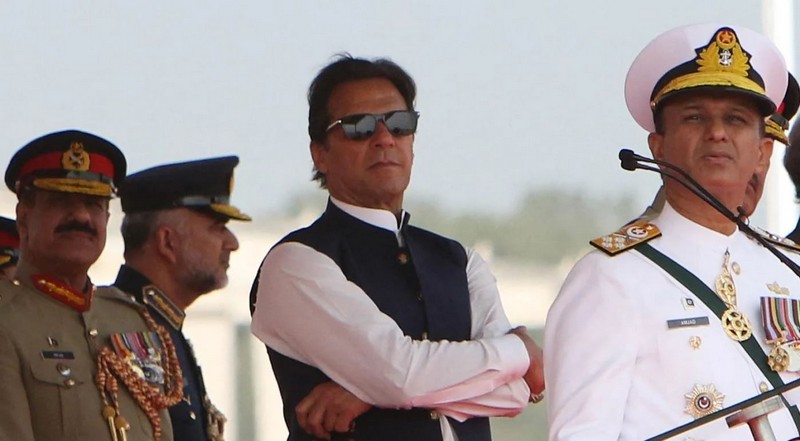
PM Imran Khan urges Muslim countries to make own bloc

By Our Correspondent

The PM Imran Khan said the Muslim world would continue to face the worst human rights abuses unless it forms a united front

In his keynote address at the 48th session of the Organisation of Islamic Cooperation (OIC) Council of Foreign Ministers, he contended that unless the Muslim world had a united front, it would continue to face worst human right abuses. He emphasised a strong voice of the OIC, representing 1.5 billion people, for the settlement of lingering Kashmir and Palestinian issues. He also proposed collective efforts of the OIC and China to push for a ceasefire between Russia and Ukraine, while urging the Islamic counties to remain neutral and be partners in peace instead of becoming part of any bloc.

He said, “We have failed both Palestinians and Kashmiris. I am sad to say that we have been able to make no impact at all despite being the massive voice of 1.5 billion. The world doesn’t take us seriously. We are a divided house and the world powers know it. We are 1.5 billion people and yet our voice to stop this blatant injustice is insignificant”. However, the Prime Minister clarified, “We are not talking about conquering a country. We are simply talking about human rights of people of Kashmir and Palestine.”

He reminded the international community that it had made a pledge to Kashmiris many decades ago to let them decide their own fate. But, he regretted, the status of the occupied valley had been changed illegally with the residents facing worst human rights violations and people from outside being settled there to change the demography of the region and turn Kashmiri Muslims into a minority. “Turning Kashmiri Muslims into a minority is a war crime under the Geneva Convention,” he observed.

The Prime Minister also warned that the world was heading towards a cold war with the chances of countries being divided into blocs. “Unless we as an Islamic platform get united, we will stand nowhere,” he emphasised. Speaking on the Ukraine situation, he proposed considering ways where the OIC countries along with China could play their role in diffusing the worsening conflict. He added that he would hold a discussion with the visiting Chinese Foreign Minister Wang Yi on how China and the OIC could step in to mediate a ceasefire as the war had already started affecting the world badly in the shape of rising prices of oil, gas and wheat.

On Afghanistan, he termed the stability of the country extremely important after 40 years of conflict and called for lifting international sanctions to avert the looming humanitarian crisis, emphasizing the only way to stop terrorism in Afghanistan was to encourage and support a stable government. “As a word of caution, please do not push the proud and independent-minded people of Afghanistan. Let us help them and involve the international community,” he stressed.

PM Imran Khan emphasized that there were no different forms of Islam and Muslims, but the one in line with the teachings of Prophet Mohammad (PBUH). He observed that the 9/11 incident led to demonising Muslims across the world and mocking or ridiculing the Holy Prophet (PBUH) in the name of freedom of expression which was unjustified and unacceptable. He said Pakistan was the only country that had been created in the name of Islam with its Objective Resolution based on the vision of Islam’s first socio-welfare state of Medina. He added Prophet Mohammad (PBUH) was sent to the world as a blessing for entire humanity, not only Muslims.

He regretted that the world was witnessing a situation where the poor countries were being robbed of almost 1.6 trillion dollars every year, which were illegally transferred to rich countries. He contended that an Islamic state must protect the rights of minorities, and imbibe the spirit of compassion and humanity for all.

The two-day meeting of the 57-member body of Muslim countries that is being held at Parliament House under the theme of “Building Partnerships for Unity, Justice, and Development.” OIC Secretary-General Hissein Brahim Taha, Islamic Development Bank President Dr Muhammad Suleiman Al-Jasser, Foreign Minister of Saudi Arabia Prince Faisal bin Farhan Al-Saud, Chinese State Councilor and Foreign Minister Wangi Yi and other foreign ministers joined the session.

Meanwhile, Prime Minister Imran Khan said the ongoing second phase of the China-Pakistan Economic Corridor (CPEC) would reinforce Pakistan’s efforts for economic development with enhanced cooperation in areas such as industrial development, agriculture and Information Technology. In a meeting with Chinese State Councilor and Foreign Minister Wang Yi on the sidelines of the OIC session, he also urged Chinese investors to benefit from attractive opportunities in Pakistan. He also offered condolences on the loss of precious lives in a plane crash. The state councilor conveyed cordial greetings of President Xi Jinping and Premier Li Keqiang to him and reaffirmed the centrality of the Pakistan-China strategic cooperative partnership. The Prime Minister and the state councilor discussed bilateral ties and the evolving regional and international scenario. They also discussed the situation in Ukraine and reiterated the need for an immediate cessation to hostilities and continued efforts for a solution through sustained dialogue and diplomacy.

Prime Minister Imran Khan also briefed him on human rights violations in Indian Illegally Occupied Jammu and Kashmir (IIOJ&K) and India’s irresponsible behaviour, which was impeding regional peace and security. He informed him about the “accidental” firing of a missile from India into Pakistan territory and underlined Pakistan’s call for a joint probe and ensure that it did not happen again. The Prime Minister emphasized that Pakistan and China must continue deeper engagement to promote peace and stability in Afghanistan, and avert the humanitarian crisis there.

Foreign Minister of Saudi Arabia Prince Faisal Bin Farhan Al Saud also called on Prime Minister Imran Khan and discussed matters of mutual interest. The Prime Minister underscored the special significance of the Pakistan-Saudi Arabia relationship, which was based on close fraternal ties, historic links and support at the gross-roots level. The situation in Afghanistan and Indian Illegally Occupied Jammu and Kashmir (IIOJK) also came under discussion. The Prime Minister thanked the Saudi FM for his country’s steadfast support for the just cause of Jammu and Kashmir. The Prince congratulated the PM on the successful holding of the OIC session.

In a meeting with Palestinian Foreign Minister Dr. Riyad al-Maliki, Prime Minister Imran Khan said the Palestine issue was a matter of great anguish for Pakistani people and Muslims all over the world. He stressed fulfilling legitimate aspirations of the Palestinian people. The Palestinian foreign minister said that unresolved issues of Palestine and Jammu and Kashmir were among the root cause of instability in the respective regions. He added that people of Indian Illegally Occupied Jammu and Kashmir (IIOJ&K) were facing grave atrocities and unabated repression for demanding their inalienable right to self-determination.

Iraqi Foreign Minister Fuad Hussein also called on PM Imran Khan. He reaffirmed his desire to further improve Pakistan’s relations with Iraq and also reiterated Pakistan’s support for Iraq’s territorial integrity and sovereignty and acknowledged the successes of the Iraqi government in the fight against terrorism.

Prime Minister Imran Khan also received Kazakhstan Foreign Minister Mukhtar Tileuberdi on the sidelines of the OIC session. Bilateral relations, regional and international issues were discussed in the meeting. – APP

23 March 2022

Source: www.thenews.com.pk

Pakistani premier says he stands with Gaza

By Aamir Latif

KARACHI, Pakistan

Pakistani Prime Minister Imran Khan on Wednesday said his country stands with Palestine amid a recent wave of Israeli airstrikes on Gaza killing dozens and injuring hundreds of others.

“I am PM (prime minister) of Pakistan and we stand with Gaza, we stand with Palestine,” Khan said in a Twitter post, which remained the top trend on the social media blogging website in Pakistan.

He also quoted prominent US intellectual Noam Chomsky as saying “you take my water, burn my olive trees, destroy my house, take my job, steal my land, imprison my father, kill my mother, bombard my country, starve us all, humiliate us all but I am to blame. I shot a rocket back.”

Khan has time and again explained that his country would not recognize Israel until the issue is resolved to the satisfaction of Palestinians.

Violence flared in Palestinian territories on Sunday after Israeli police stormed the Al-Aqsa Mosque in the occupied East Jerusalem and attacked Palestinian worshippers inside the holy site. Around 300 Palestinians were injured in attacks inside the flashpoint complex.

Tensions have been running high in the Sheikh Jarrah neighborhood of East Jerusalem since last week when Israeli settlers swarmed in after an Israeli court ordered the evictions of Palestinian families.

Palestinians protesting in solidarity with residents of Sheikh Jarrah have been targeted by Israeli forces. ​​​​​​

The escalation resulted in airstrikes by Israel on Gaza, which has left scores of people dead and hundreds of others wounded.

Israel occupied East Jerusalem during the 1967 Arab-Israeli war and annexed the entire city in 1980 – a move that has never been recognized by the international community.

12 May 2021

Source: www.aa.com.tr

Imran Khan: India drawing inspiration from Israel in Kashmir

By Peter Oborne, David Hearst

Pakistani prime minister tells MEE threat of conflict over disputed territory is the world’s most dangerous ‘nuclear flashpoint’

India enjoys the same kind of impunity within the international community over its attempts to change the demographic balance of Kashmir that Israel has in the occupied Palestinian territories, Pakistan’s Prime Minister Imran Khan has told Middle East Eye.

He accused his counterpart Narendra Modi, the Indian prime minister, of copying Israel’s playbook by allowing settlers to acquire land in the disputed territory, which has been claimed – and fought over – by both Pakistan and India since 1947.

Khan called Indian-administered Kashmir an open prison. He accused India of breaching the Geneva Convention by changing the Indian constitution to end Kashmiri autonomy.

In August 2019, Modi sent tens of thousands of additional troops into the Muslim-majority state, imposed a curfew and announced the abolition of Article 370 of the Indian constitution – which guaranteed autonomy to Kashmir for more than 70 years.

Many Kashmiris fear the ultimate intention of the Modi government is to fundamentally change the demographic of the region by allowing people from outside the state to buy land.

Khan told Middle East Eye that India had not been challenged more forcefully on the international stage because its western allies saw it as a bulwark against China.

But he said India had also benefited from a deepening strategic and military relationship with Israel, forged by Modi’s visit to the country in July 2017, and by then-Israeli Prime Minister Benjamin Netanyahu’s return visit to India the following year – after decades of diplomatic estrangement.

The relationship has included the joint development by Israel Aerospace Industries and Indian contractors of the Barak-8 aerial defence system for use by both countries’ militaries, which was described by Indian Defence Minister Rajnath Singh last month as a “game-changer”.

Imran Khan: Pakistan’s PM talks to MEE on Afghanistan, China, Islamophobia and cricket

Khan said India had also drawn on Israel’s illegal and brutal occupation of the Palestinian territories and the impunity the country has enjoyed as a consequence of its alliance with the US, in its own quashing of opposition and criticism of its actions in Kashmir.

“[Israel has] built such a strong security apparatus and [they] just crush anything. They send people who kill and assassinate and they have total immunity,” he said.

“Whatever the UN general assembly says, they have complete confidence in the veto the US has in the Security Council. So they get away with anything. And I feel that India feels [it has immunity] because they are being used… as a bulwark against China.”
World’s ‘nuclear flash point’

A ceasefire has generally held along the Line of Control in Kashmir since an agreement in February this year, but tensions remain high and there have been reports of exchanges of gunfire in recent weeks.

The two countries have fought three wars since independence in 1947. The last major flare-up in 2019 was defused after Pakistan handed back an Indian pilot whose plane had been downed in Pakistani airspace.

The incident started when a Pakistan-based militant group attacked Indian soldiers in Indian-administered Kashmir, killing more than 40 paramilitary troops in a car bombing.

Asked by MEE how volatile the current situation was, Khan replied: “If you look at the flashpoints, probably the nuclear flashpoint right now in the world is Pakistan-India because nowhere else is there a situation where there are two nuclear-armed countries who have had three wars before they were nuclear-armed.”

He added: “We have not had a war since then because of the deterrent.”

Still, he admitted that dealing with the flare-up in 2019 in the early months of his premiership had been a nervous and dangerous time: “Once two nuclear-armed countries get into the situation like we did, it can go anywhere.”

11 October 2021

Source: www.middleeasteye.net

One-sided deal imposed on the Palestinians will not work: PM Khan

Pakistani PM says Israel-Palestine issue will not be resolved unless there is a ‘just settlement’ for the Palestinians.

Pakistani Prime Minister Imran Khan says the Israel-Palestine issue will not be resolved unless there is a “just settlement” for the Palestinians, even if more countries decide to recognise Israel.
“Any one-sided settlement which is going to be imposed on the Palestinians is not going to work,” Khan said after he was asked about the recent normalisation of relations between the United Arab Emirates and Israel.

In a wide-ranging interview with Talk to Al Jazeera, the Pakistani prime minister said Israel must “recognise this: that if they do not allow the Palestinians to have a just settlement, a viable state, this issue will not die down.”

“Even if other countries recognise it, it will not die down, the issue will continue to fester. It is in Israel’s interest that there should be a just settlement,” Khan added.

Last month, in a local TV interview, Khan said Pakistan would not recognise Israel until there is a Palestinian state acceptable to the Palestinian people.

A history of Arab-Israeli normalisation

Khan said if Pakistan accepted Israel and ignored the oppression of the Palestinians, “we will have to give up Kashmir as well then”, adding that this was not something Pakistan could do.

Last year India stripped Indian-administered Kashmir of its limited autonomy, angering Pakistan, which claims the Muslim-majority Himalayan region in full but administers it in part.

The UAE on August 13 became the first Gulf Arab country – and third in the Middle East after Egypt and Jordan – to reach a deal on normalising relations with Israel, capping years of discreet contacts between the two countries in commerce and technology.

On Monday, high-level delegations from Israel and the US arrived in UAE, via the first-ever direct flight between the Middle Eastern nations, to put final touches on the controversial pact.

Palestinians have condemned the deal as a stab in the back by a major Arab player while they still lack a state of their own. Turkey threatened to suspend relations with the UAE after normalisation was announced.

On Wednesday, Qatar’s Emir Sheikh Tamim bin Hamad Al Thani told US President Donald Trump’s senior adviser and son-in-law, Jared Kushner, that Doha remained committed to the 2002 Arab Peace Initiative; in the initiative Arab nations offered Israel normalised ties in return for a statehood deal with East Jerusalem as the capital of a Palestinian state and full Israeli withdrawal from territory captured in the 1967 Middle East War.

3 September 2020

Source: Al Jazeera

Palestine Update 536

By Ranjan Solomon

18 March 2022

Israel’s expulsion mode, denial of family reunification, Gaza’s growing chaos, and dual standards on BDS on Israel and Ukraine.

Israel persists in its expulsion mode of political oppression. It has been happening year after year beginning 1948. Mass expulsions by the regime against Palestinians have always had catastrophic penalties. In the political lectionary of Israel, ethnic cleansing is routine and carried out without the blink of an eyelid. The international community has, after all, seemingly licensed it by turning a deaf ear and blind eye. The resultant ordeal should have qualified as war crimes some decades ago and a couple of bigwigs thrown into jail for long sentences. Soon the High Court will legitimize the dispossession in eight villages and of 1,300 people. Anything in the corridor to removal will be bulldozed, regardless of whether they are homes, or schools, or wells, or anything of utility to Palestinian survival. Palestinians painfully watch as this happens but are unable to cut short the designs of the occupier for most part.

Alongside this, the enormous uncertainty of family reunification in the face of impending legislation is creating one more painful wound the effects of which will leave scars on families. These moves proceed, despite, the UN Secretary General’s request to “further facilitate family reunification of all citizens and permanent residents of Israel.”

Ironically, Gaza continues to bleed in many new ways despite the attention that the world has been urged to take note of. More hunger, poverty, and now, the growing phenomena of individual indebtedness of people who borrow and can barely pay back. As a report from Electronic Intifada outs it: “Under a 2005 law, Palestinians in the occupied West Bank and Gaza may be imprisoned for up to 91 days per year if they do not repay debts.”

A report on the Palestinian condition these days cannot conclude without juxtaposing the plight of Palestinians and the war in Ukraine. Swift to push BDS on Russia, Palestinian advocacy for retailers to stop selling Israeli goods has been met with unlawful prosecution. Such are two faces of global solidarity. The whole situation in terms of how different nationalities are treated by Ukrainian authorities has shown up racist differentiations and double standards in the West.

Ranjan Solomon

Source: palestineupdates.com