Just International

The Many Faces of Regime Change in Cuba

By Louis A. Pérez Jr

24 Jul 2021 – After months of casual indifference to conditions in Cuba, the Biden administration reacted with purposeful swiftness to support street protests on the island. “We stand with the Cuban people,” President Biden pronounced. A talking point was born.
“The Biden-Harris administration stands by the Cuban people,” secretary of state Antony Blinken followed. Senate Foreign Relations Committee chair Robert Menéndez also joined to emphasize “the need for the United States to continue to stand with the Cuban people.”

For more than a hundred and twenty years, the United States has “stood with the Cuban people” — or, perhaps more correctly, has stood over the Cuban people. Cuba seems always to be at the receiving end of American history. To stand with the Cuban people has meant armed intervention, military occupation, regime change, and political meddling — all normal events in US-Cuba relations in the sixty years before the triumph of the Cuban revolution. In the sixty years after the revolution, standing with the Cuban people has meant diplomatic isolation, armed invasion, covert operations, and economic sanctions.

It is the policy of economic sanctions — the embargo — officially designated as an “economic denial program,” that gives the lie to US claims of beneficent concern for the Cuban people. Sanctions developed early into a full-blown policy protocol in pursuit of regime change, designed to deprive Cubans of needed goods and services, to induce scarcity and foment shortages, to inflict hardship and deepen adversity.

Nor should it be supposed that the Cuban people were the unintended “collateral damage” of the embargo. On the contrary, the Cuban people have been the target. Sanctions were designed from the outset to produce economic havoc as a way to foment popular discontent, to politicize hunger in the hope that, driven by despair and motivated by want, the Cuban people would rise up to topple the government.

The declassification of government records provides insight into the calculus of sanctions as a means of regime change. The “economic denial program” was planned to “weaken [the Cuban government] economically,” a State Department briefing paper explained, to “promote internal dissension; erode its internal political support . . . [and] seek to create conditions conducive to incipient rebellion.” Sanctions promised to create “the necessary preconditions for nationalist upheaval inside Cuba,” the Department of State Bureau of Intelligence and Research predicted, thereupon to produce the downfall of the Cuban government “as a result of internal stresses and in response to forces largely, if not wholly, unattributable to the U.S.”

The “only foreseeable means of alienating internal support,” the Department of State offered, “is through disenchantment and disaffection based on economic dissatisfaction and hardship. . . . Every possible means should be undertaken promptly to weaken the economic life of Cuba . . . [to deny] money and supplies to Cuba, to decrease monetary and real wages, to bring about hunger, desperation and overthrow of government.”

The embargo has remained in place for more than sixty years. At times expanded, at other times contracted. But never lifted. The degree to which US sanctions are implicated in current protest demonstrations in Cuba is a matter of debate, of course. But that the embargo has contributed — to a greater or lesser extent — to hardship in Cuba can hardly be gainsaid; that has been its intent. And now that hardship has produced popular protests and demonstrations. That, too, is in the “playbook” of the embargo.

But the embargo has had a far more insidious impact on the political culture of Cuba. The Cuban government is not unaware of the United States’ desired policy outcomes from the sanctions. They understand well its subversive reach and interventionist thrust, and have responded accordingly, if not always consistently.

Such a nakedly hostile US policy, which has been ongoing and periodically reaffirmed over such a lengthy period of time, designed purposely to sow chaos, has in fact served Cuban authorities well, providing a readily available target that can be blamed for homegrown economic mismanagement and resource misallocation. The embargo provides a refuge for blamelessness and immunity from accountability. The tendency to attribute the consequences of ill-conceived policies to the embargo has developed into a standing master narrative of Cuban government.

But it is more complicated still. Not a few within the Cuban government view popular protests warily, seeing them as a function of US policy and its intended outcomes. It is no small irony, in fact, that the embargo has so often served to compromise the “authenticity” of popular protest, to ensure that protests are seen as acts in the service of regime change and depicted as a threat to national security.

The degree to which the political intent of the embargo is imputed to popular protest often serves to drive the official narrative. That is, protests are depicted less as an expression of domestic discontent than as an act of US subversion, instantly discrediting the legitimacy of protest and the credibility of protesters. The embargo serves to plunge Cuban politics at all levels into a Kafkaesque netherworld, where the authenticity of domestic actors is challenged and transformed into the duplicity of foreign agents. In Cuba, the popular adage warns, nothing appears to be what it seems.

Few dispute the validity of Cuban grievances. A long-suffering people often subject to capricious policies and arbitrary practices, an officialdom often appearing oblivious and unresponsive to the needs of a population confronting deepening hardship. Shortages of food. Lack of medicines. Scarcity of basic goods. Soaring prices. Widening social inequalities. Deepening racial disparities.

Difficulties have mounted, compounding continuously over many years, for which there are few readily available remedies. An economy that reorganized itself during the late 1990s and early 2000s around tourist receipts has collapsed as a result of the pandemic. A loss of foreign exchange with ominous implications for a country that imports 70 percent of its food supplies.

The Trump administration revived the most punitive elements of US sanctions, limiting family remittances to $1,000 per quarter per person, prohibiting remittances to family members of government officials and members of the Communist Party, and prohibiting remittances in the form of donations to Cuban nationals. The Trump administration prohibited the processing of remittances through any entities on a “Cuba restricted list,” an action that resulted in Western Union ceasing its operations in Cuba in November 2020.

And as a final spiteful, gratuitous gesture, the outgoing Trump administration returned Cuba to the list of state sponsors of terrorism. At the precise moment the Cuban people were reeling from greater shortages, increased rationing, and declining services, the United States imposed a new series of sanctions. It is impossible to react in any way other than with blank incredulity to State Department spokesperson Ned Price’s comment that Cuban humanitarian needs “are profound because of not anything the United States has done.”

Cubans confront all at once a collapsing economy, diminished remittances, restricted emigration opportunities, inflation, shortages of food, scarcity of medicines, all in a time of a national health emergency — and with the United States applying punitive sanctions with the intent of making everything worse. Of course, the Cuban people have the right to peaceful protest. Of course, the Cuban government must redress Cuban grievances.

Of course, the United States must end its deadly and destructive policy of subversion.

Louis A. Pérez Jr is the J. Carlyle Sitterson Professor of History and director of the Institute for the Study of the Americas at the University of North Carolina at Chapel Hill.

26 July 2021

Source: www.transcend.org
Palestine Update 482

EU can’t be trusted with more than lip service to Palestinian rights?
“But Europe’s lip service to Palestinian human rights, EU policy and international law will not hide the obvious fact that Israel’s utter contempt of the EU’s demarches – the most recent, sixth, forcible transfer attempt was perpetrated by the new government under minister of defence, Benny Gantz, from Lapid’s “change coalition”, not by Netanyahu’s government – led to no consequences whatsoever. This will rightly be seen here in Israel as nothing but acquiescence to our government’s policy of destroying Palestinian communities, to further facilitate its takeover of their land.”

UN, EU and World Bank back siege on Gaza
Maureen Clare Murphy*
A new study of Gaza’s reconstruction needs, published by the UN, EU and World Bank, demonstrates anew the harmful role played by these institutions in Palestine. The authors of the “rapid damage and needs assessment,” as the UN, EU and World Bank call their study, go to great lengths to minimize Israeli responsibility for the dire situation in Gaza, exacerbated by the latest episode of bombardment in May. They use the passive voice throughout in an apparent bid to downplay Israel’s direct role in the destruction, for which reconstruction will cost some $345-485 million and take two years to complete. That is assuming Israel won’t obstruct it at every turn. Israeli leaders have sought to condition reconstruction on the return of Israelis held in Gaza. Rebuilding took place at a snail’s pace after the last war. So there is every reason to believe that it will delay and hinder rebuilding once again.

The authors of the “rapid assessment” state that “the May 2021 conflict caused damage” to Gaza’s roads as if this were some unfortunate Act of God rather than the result of missiles deliberately fired by the Israeli military at civilian infrastructure. In one such attack, an Israeli strike made a giant crater in one of the main roads leading to al-Shifa hospital, Gaza’s largest medical facility, blocking the movement of ambulances.

Al-Haq, a Palestinian human rights group, said that the attack on the main roads leading to al-Shifa “amounts to making the hospital the object of the attack.” Israel killed more than 40 Palestinians in that series of strikes on Gaza City’s al-Wihda street. But these specifics are omitted from the “rapid assessment,” which describes Palestinian needs in detail but treats Israel’s responsibility in abstraction, if at all.

Israel’s siege and its deleterious effects on every aspect of life in Gaza are impossible to ignore, even for the UN, EU and World Bank. But these international institutions legitimize Israel’s siege on Gaza by stating that it was imposed “due to security concerns.” Yet, the study’s authors don’t attribute this as a claim made by the Israeli government and instead – shockingly – present it as a given. This shamefully whitewashes a plainly cruel and immoral siege that the International Committee of the Red Cross has affirmed amounts to collective punishment “imposed in clear violation of Israel’s obligations under international humanitarian law” – i.e., a war crime.

As Al Mezan, a human rights group based in Gaza, writes, Israel’s closure regime “cannot be justified under any circumstances.” Israel’s policies in Gaza may “amount to the crimes against humanity of persecution and other inhumane acts.” By accepting the premise that “security concerns justify the siege,” the UN, EU and World Bank demonstrate an eagerness to sanctify Israel’s subjugation of the Palestinians living under its settler-colonial rule.

The true purpose of the siege on Gaza is not to protect Israel’s security. Instead, it is to secure regime change by bringing Gaza’s economy to its knees to weaken Hamas, the faction with an armed wing that has governed the territory’s internal affairs since 2007. Israel long ago admitted that the siege on Gaza is “economic warfare.” After all, it is hard to see how counting the calories that Israel allows into Gaza could reasonably be considered a security measure.

Decades of Israeli closure
Gaza has been under some degree of Israeli closure for the past half-century – decades before Hamas came onto the scene. Israel has long isolated Gaza, rendering the territory “a segregated, debilitated and subjugated colony,” as Ron Smith observed in 2019. “Israel manufactures humanitarian crises through its siege to create permanent isolation and deprivation, which is supported by the international community through its political inaction and its supplying of humanitarian aid in spite of the Israeli government’s legal obligations,” according to Smith.

Israel does this because most of the two million Palestinians in Gaza are refugees with claims to return to their lands in what is now called Israel – claims supported by international law. As Smith writes, that is an untenable prospect for “a settler-colonial state premised on ethnic purity.” But why would the UN, EU and World Bank back the “security concerns” excuse for a policy that has plunged Gaza’s population of two million into “profound levels of poverty, aid dependency, food insecurity and unemployment,” as described by Al Mezan? Because they share the same regime change goal as Israel, as is made clear in the “rapid assessment” report. These international institutions that have crowned themselves in charge of rebuilding Gaza want to see the restoration of Palestinian Authority rule in the territory, as well as “internal Palestinian reconciliation” and a “democratically elected Palestinian Authority.”

Palestinians in the West Bank (excluding East Jerusalem, where Israel forbids any PA presence) and Gaza have not had a general vote since the 2006 legislative elections. Hamas emerged as the surprise victor. Israel and its allies, principally the US, spared no effort in undermining the new Hamas-led PA government to restore power exclusively to Mahmoud Abbas, the West Bank-based PA president whose Fatah party lost the election.When Hamas routed US-backed militias from Gaza in 2007, allowing it to take up the reins of government, its administration was deemed illegitimate because of its refusal “to recognize the Middle East Quartet’s (EU, Russian Federation, UN and US) demands to accept all previous agreements, recognize Israel’s right to exist and renounce violence.”

These parties have made no such demands on Israel, whose war criminal and genocide-advocating leaders are warmly congratulated and welcomed by UN and EU officials.

But human right isn’t their priority.

The key difference between the Abbas-led Palestinian Authority in Ramallah and the Hamas leadership in Gaza is that the former views security coordination with Israel as “sacred” and the latter insists on Palestinians’ right to resist Israeli occupation and colonization of their land.

The PA in the West Bank, it should be noted, was recently chastized by the UN’s human rights chief for violently cracking down on protests following the death of Nizar Banat, a prominent critic, after being beaten in PA custody.

Palestinians were due to have an election in May, but the vote was postponed under a decree issued by Abbas, who cited Israeli restrictions on Palestinian voting in Jerusalem. But that was widely viewed as an excuse to avoid Fatah losing once again to Hamas.

Capitulation
The UN, EU and World Bank want Palestinians to capitulate to Israel and surrender to its rule.

They call for a democratically elected Palestinian Authority “in charge of all essential government functions across the Palestinian territory.” They got that in 2006, but Palestinians made the mistake of electing the wrong government in the view of these international institutions. If Palestinians were to hold elections today, the UN, EU and World Bank would likely not be pleased with the results, given the widespread approval of Hamas and unpopularity of Abbas’ Fatah party following the May escalation.

In their study, the UN, EU and World Bank point to “the lack of an internationally recognized government in Gaza for over a decade” as one of several “structural factors” constraining the Palestinian economy. They fail to acknowledge their own contribution to this “structural factor” by refusing to recognize the Hamas government in Gaza, which they seek to sideline in the reconstruction process.

Meanwhile, Israel has tightened its siege following the May offensive. Rather than unequivocally calling on Israel to lift restrictions, the UN, EU and World Bank seek international efforts to “support, reform and strengthen the mechanism to facilitate and accelerate the import of sensitive goods and materials” needed to rebuild “Gaza’s economic infrastructure and business sector.”

It’s a somewhat oblique reference to the scandalous UN-enforced Gaza Reconstruction Mechanism, devised after the 2014 offensive, allowing Israel to exercise total control over what building materials are allowed into the territory. In other words, the UN, EU and World Bank want to “support, reform and strengthen” Israeli restrictions on the Palestinian economy, particularly in Gaza, rather than do away with them altogether. These institutions are meanwhile promoting a “Building Back Better” approach, ensuring that “recovery and reconstruction efforts factor in resilience and sustainability” and “reduce Gaza’s vulnerabilities.” But for that to actually happen, Palestinians need to be free of Israel’s colonial domination and the agenda of the international institutions that support it.

*Maureen Clare Murphy is senior editor of The Electronic Intifada.

19 July 2021

Cry, the Bedeviled Country: I Weep for My Homeland of South Africa, As I Watch Its Disintegration from Afar

By Jani Allan

17 Jul 2021 – Widespread looting and burning has killed over 100, and wrecked factories, shops and homes, with Indian and whites increasingly the target. Is the country I love, where I spent 30 years of my life, spiralling into racial warfare?

Many years ago, I was invited by Prince Mangosuthu Buthelezi to attend the Shaka Day celebrations in Natal. I was one of a handful of whites. Thousands of Zulus in their traditional garb, swayed, danced and sang praise songs to the great 19th-century warrior king, Shaka kaSenzangakhona, who made his people one of the formidable and feared powers in southern Africa.

Without the support of Chief Buthelezi, the leader of the Inkatha Freedom Party, Nelson Mandela would not have been released from jail. Gavin Relly, the former chairman of Anglo American, has said the Zulu leader was “the anvil on which apartheid was broken”.

But because he refused to join the African National Congress (ANC), due its Marxist underpinnings and his strong belief in “education before liberation”, Buthelezi and his supporters paid a heavy price, and he was frozen out of the highest echelons of power in post-apartheid South Africa.

This week, I watched in horror as my beloved homeland was transmogrified into an apocalyptic hell. The fruits of liberation before education were on full display, as looters and arsonists rampaged across the country. The tragedy was almost Shakespearean. Who could imagine that a nation would loot in order to express their rage at the jailing of the great Looter-in-Chief himself, former president Jacob Zuma?

Nelson Mandela gave the nation a gift: a non-racial constitutional democracy that enshrined freedom, equality and the rule of law. What we saw was the wilful torching of this gift – criminal behaviour emblazoned across the world’s screens. I was ashamed.

The orgy of looting, the burning of shopping malls, the wanton destruction of cars and trucks, and the brutal killing of livestock – all speaks to a descent into a barbarism that is plainly inexplicable. What is clear is that we have reaped what we have sown: a culture of impunity forged over decades of rampant government corruption, lawlessness and maladministration.

High rates of unemployment (70%-plus in many areas), poverty and ill health only partially explain the widespread manifestations of anger and anomie. But they are an insufficient explanation for this barbaric plunder of the economy. If they were, why would rioters loot a sex shop and a funeral parlor?

Revolutionary movements such as the ANC demand unfettered loyalty from the electorate for having defeated the enemy: apartheid. And that loyalty means turning a blind eye to the excesses of the ruling elite’s entitlement to the state’s resources, with which they buy themselves opulent villas, Ferraris and Bentley convertibles, and large farms while millions of the people they promised to set free live in ramshackle wood-and-corrugated-iron shacks in crime-ridden slums without toilets, jobs or hope.

But within the ANC, the ruling elite is not a monolith. The tribal divisions run deep. Zuma is a Zulu in a party that accords hegemony to the dominant Xhosa ethnic group. And this subterranean faultline has been the fatal flaw that, since Mandela departed frontline politics in 1999, has seen it struggle to remain united.

Under Mandela, a Xhosa, Zuma the Zulu could always be contained because of Mandela’s stature. The current president, Cyril Ramaphosa, however, has a much more difficult task reining in his predecessor and his considerable Zulu following, partly because he’s a member of the Venda ethnic group, a minor tribe from the northern regions of the country.

These tribal distinctions are further bedevilled by the political factions within the ANC, which were writ large with the jailing of Zuma. Contempt of court is a foreign concept to the masses, who are not ignorant of the party’s entrenched culture of corruption across the board. South Africa is bankrupt because of the looting of the state treasury for personal enrichment. In this regard, all ANC leaders are culpable.

Every week, another financial scandal erupts, with one of the latest being billions of rands earmarked for Covid vaccines going missing. This against the backdrop of excess mortality rates that suggest the virus has killed at least 160,000 in South Africa, making it the worst-hit nation on the continent.

That Zuma fleeced South Africa with the help of his businessmen chums, particularly the three Gupta brothers – all of whom protest their innocence, of course, and say the charges are politically motivated – is of no consequence to his minions, although the majority of South Africans were outraged by the scandal. What they demand is equal justice before the law. ANC officials who destroyed every state-owned enterprise have not been held accountable and are still walking free.

But Zuma’s followers have overplayed their hand with the wanton destruction of property and life. The image of a mother hurling her baby from a burning building set on fire by looters is seared into the global consciousness.

Aware that they have lost the sympathy both of the nation and of countries across the globe, Zuma’s ANC resorts to the Marxist playbook of turning on old opponents: white and Indian people. Deflection, after all, is the best form of defence. Propaganda messages abound online, urging comrades that “the revolution has begun” and they must take it “into the white areas and to the next level.”

Others call for “the revolution” to be taken to all parts of the country, demanding: “We need to liberate ourselves from these cronies, who are political puppets and sellouts, who are working as the black face/white skin, who are the political puppets of the white supremacy and white monopoly capital … Our struggle is against white supremacy and black subjugation.”

Death toll in South African unrest jumps above 200 as looting and violence continues in KwaZulu-Natal

In another video clip, filmed by a citizen journalist and shared on the social media app Telegram, an apparent ANC official in a rather sharp-looking suit, urges, “Once you are done with the looting, go to Indian areas. Go there and kill Indians and burn their houses. Once you are done with looting, go to white areas and kill them and burn their houses.”

While the provenance of some of these is uncertain, there’s no doubt that there are plenty of high-profile people inciting the violence, including Zuma’s own children and the notorious Julius Malema, of the anti-white, far-left Economic Freedom Fighters revolutionary group.

This inflammatory rhetoric of a race war, inciting the masses to mobilise against an ethnic minority, to destroy all vestiges of so-called white monopoly capital, has been countered by the spontaneous emergence of ad hoc multiracial militias, who have been patrolling their neighbourhoods armed with an array of weapons to keep would-be looters at bay.

President Ramaphosa deployed 74,000 troops during the Covid lockdown in 2020 to enforce regulations; today, as the country burns, there are about 25,000 soldiers on the streets – or at least that’s what the government claims. They are needed – the inept South African Police Service is not only incapable of protecting lives and properties, but some of its officers have joined in the looting themselves.

The newly installed King of the Zulus, Misuzulu KaZwelithini, has likened the ongoing violent protests in his region to a “suicide mission that will haunt the poor and vulnerable in the near future.”

Meanwhile, Ramaphosa has blamed the rioting and looting on “coordinated criminality.” This reluctance to call the violence what it really is, is emblematic of the president’s pusillanimous leadership since he took office.

My prayers go out to all my relatives and friends – black, white and of Indian origin – who still live in my former homeland. And I thank God that I no longer do.

Jani Allan is a writer and talk show host. She has written for the London Sunday Times, the Spectator, the Daily Mail and various other British publications.

19 July 2021

Source: www.transcend.org
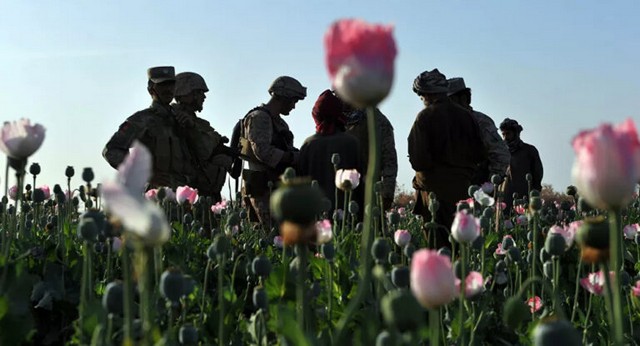
The List Is Here: Find Out How Global Defense Companies Performed in FY20

By Mike Gruss

12 Jul 2021 – The coronavirus pandemic is not yet over — despite our most optimistic thinking — and this year’s Defense News Top 100 list offers hints of how the broader international defense market has coped.

The answer appears to be that national security firms have fared well. Very well.

Consider that six of the 10 largest U.S. defense companies had revenues jump by 6 percent or more — a total of about $11 billion — from fiscal 2019. And all seven Chinese firms on the list grew during the last year as well.

See the 2021 Top 100 list here!

The pandemic has shown — or maybe exposed — a workforce in which everyone is always online, always connected and, during the last 16 months, always on the job. That’s also true of the national security community. During this era of gray zone conflict, information warfare and cyberattacks, it’s often felt like there has been no letting up, no pause, no time to catch a breath.

At the same time, this year’s list marks yet another significant shift in how the industry is changing. Last summer, I mentioned that the Top 100 is part art and part science but that every year we push it a bit closer to science. We succeeded in that vision for 2021.

This year’s list includes more than 20 new names. Part of that is due to mergers since last summer. For example, Raytheon Technologies — the result of a combined United Technologies Corporation and Raytheon Company — makes its debut at No. 2.

Some of those new additions are due to a more aggressive approach on our part to seek out information on defense revenues from companies around the world or from firms we either overlooked or for which we couldn’t previously find revenue figures.

As evidence, last year’s 100th company on the list had just less than $300 million in defense revenue. This year, the 100th firm has just less than $600 million.

And some of the change serves as proof of the shifting demands of modern warfare.

Among the companies that are new — or returning — to the Top 100 are the cyber firm ManTech, the space company Parsons Corporation, the satellite imagery company Maxar Technologies, sensor company FLIR Systems, and emerging technologies company Alion Science and Technology. For all the talk of a digital, net-centric battlespace, this year’s list may best reflect how industry is bending and evolving toward that future.

The primary story in the defense industry has been one of relentless growth. A decade ago, 15 companies had $5 billion in defense revenue. Today, we know of at least 24 companies that reach the same threshold.

By next year at this time, we will know if a coronavirus could slow the defense economy down or if even a once-in-a-generation pandemic is a mere hiccup.

19 July 2021

Source: www.transcend.org

The Turkish Coup Attempt: Five Years Later

By Richard Falk

A modified text of my responses to interview questions of Murat Sofuoglu, a
Turkish journalist associated with TRT World: “On the July 15th Coup Attempt Five Years Later (July 8, 2021).

16 Jul 2021 – Five years ago my Turkish wife and I were strolling in the Karakoy neighborhood of Istanbul amid the crowded cafes on a typical summer night. It was our only day in Istanbul during the entire summer, occasioned by a conference at Koç University scheduled for the next day devoted to refugee policy with special attention to problems of massive human displacement caused by the regional conflicts, particularly Syria and Iraq. We stopped for dinner at a Greek restaurant, encountering unexpectedly Turkish friends who asked to join us. As the meal neared its end, the manager came to our table, speaking in almost a whisper he said that the Bosphorus Bridge, subsequently renamed 15th of July Martyr’s Bridge, was occupied by troops and the scene of violence, and that it seemed a coup was underway. It was a bit eerie as the atmosphere in the restaurant was vibrant and utterly without any sense that a national crisis was in the process of erupting. We paid our bill, and walked slowly back to a nearby hotel where we were staying for the night. Soon jets were flying low over this part of the city fast enough to cause the terrifying explosive sound of sonic booms, obviously with the intention of causing panic on the ground. We cautiously looked out of our hotel window to see police cars blocking the street below. For the rest of the night we were glued to the TV coverage of the rapidly unfolding events climaxed by Recep Tayyip Erdoğan’s dramatic appearance at the Istanbul Airport, greeted by a supportive crowd that walked the streets to greet the President and reaffirm their loyalty to the elected legitimate government. This reassurance by the people of Turkey and all of the political parties that made clear their rejection of the coup attempt contrasted with the silence of NATO governments, the longtime allies of the Ankara government. An impression was created among close observers of the political scene that leading Western governments would have greeted a successful coup with open arms. This impression was undoubtedly shared by leadership circles in Turkey, and has had profound effects on Turkish foreign policy, and particularly with the United States. These effects were initially associated with the Obama and Trump presidencies, but have continued in the early months of the Biden presidency.

1. How has the July 15 coup attempt affected Turkey’s foreign policy?

I believe the principal impact of the failed coup five years ago on Turkish foreign policy has been to cast lingering doubts on the loyalty of Turkey’s NATO partners. There was not only a display on the fateful night of July 15th of ‘wait and see’ attitudes in the principal capitals of Western Europe and of Washington as the coup unfolded, but there was no show of support for the legitimate elected government of Turkey from its longtime, and supposedly closest, allies. This Western diplomacy sent a message to Ankara that for the sake of its future security the government would be well advised to proceed rapidly to diversify its relations with other countries, and in particular, seek to deepen friendly relations with important other countries, including Russia and China.

These impressions were reinforced by the refusal by Washington to give serious consideration to the extradition request of the Turkish Government after the coup to enable the criminal prosecution of Fetullah Gulen, the presumed leader of FETO, the presumed forces behind the coup. Furthermore, in the period after the coup the various anti-Turkish international actors that were situated in various countries, including FETO, Kurdish groups aligned with the PKK, hard-core Kemalists living in the West, and Israel mounted an anti-Turkish international campaign alleging that Turkey was an unreliable ally, and was guilty of undermining Western policy with regard to Iran and the Kurdish presence in the Syrian civil strife.

A final factor for some was a clear indications that the coup attempt had been given a green light to proceed by Washington even if it not receive active, material support. There were several independent reports of CIA involvement and collaboration with FETO, and although never definitively confirmed, it naturally contributed to Turkish attitudes of wariness and some distrust with respect to ongoing relations with the United States, which had already been strained by a vigorous anti-Turkish international campaign.

2. Did the coup attempt make negative effects on US-Turkey relations? If so, how?

My response to the prior question supplies part of the answer. Turkey acted in a manner that stressed its political independence, especially on matters of national security and in relation to regional issues. It made no secret of its support for the Palestinian struggle for basic rights including the right of self-determination and its consistent opposition to Israeli longtime policies and practices. As well, Turkey purchased a defensive missile system—S-400—from Russia, which angered Washington, and was treated as a threat to NATO coherence and a breach of an unwritten NATO code of conduct. .

To an extent difficult to measure the coup attempt intensified preexisting trends in both Ankara and Washington. It has led to a downward trajectory in relations between the two countries. Ever since the AKP was elected to govern in 2002, its leadership made clear that Turkey was no longer a passive ally within the NATO framework as it had been throughout the Cold War. Already in 2003. the Turkish Parliament turned down the U.S. request to invade Iraq from Turkish territory, and in 2010 Turkey, together with Brazil, made efforts to negotiate an agreement on Iran’s Nuclear Program, which although earlier encouraged by the U.S., created tensions with the U.S. when Iran turned out to be receptive to such an initiative with its promise of reduced regional tensions. The coup attempt in 2016 hardened Turkish perceptions that hostile forces were receiving help from governments supposedly friendly with Turkey. In the background was a steady drum-beat of anti-Turkish propaganda on right-wing Western websites such as the Gatestone Institute and Middle East Watch, which are geopolitical propagandists for post-colonial U.S. imperialism, which include unabashed support for Israeli expansionism and denigration of legitimate Palestinian aspirations for an end to apartheid and the attainment of self-determination in their own country.

3. Will the coup attempt’s effects on the Turkish foreign policy have a lasting legacy?

This is hard to predict. It depends, in part, on whether Turkish/Israel relations remain strained, and possible leadership shifts in both countries. If normal diplomatic relations with Israel are restored, a process now mutually pursued, then I would suspect that leading Western governments will not back away from their anti-Turkish policies without offering an explanation. The American president Biden, together with the UK, France, and Germany, seem eager to focus their foreign policy in relation to meeting the multiple challenges posed by China’s rise, and secondarily by Russian territorial ambitions on its borders, and want as few secondary distractions in other regions as possible.

At the same time Turkey is likely for the foreseeable future to continue to hedge its policies, as well as seize its opportunities, by further developing a wide range of positive contacts within the Middle East and beyond, and this seems prudent even if Washington/Tel Aviv back off. Because Turkey is polarized in relation to the governing AKP, which has now held the reins of power since 2002, the originality of the Turkish reality is rarely comprehended as perceptions oscillate between embittered critics of the government and its leadership and its base of ardent supporters.

Richard Falk is a member of the TRANSCEND Network, an international relations scholar, professor emeritus of international law at Princeton University, Distinguished Research Fellow, Orfalea Center of Global Studies, UCSB, author, co-author or editor of 60 books, and a speaker and activist on world affairs.

19 July 2021

Source: www.transcend.org
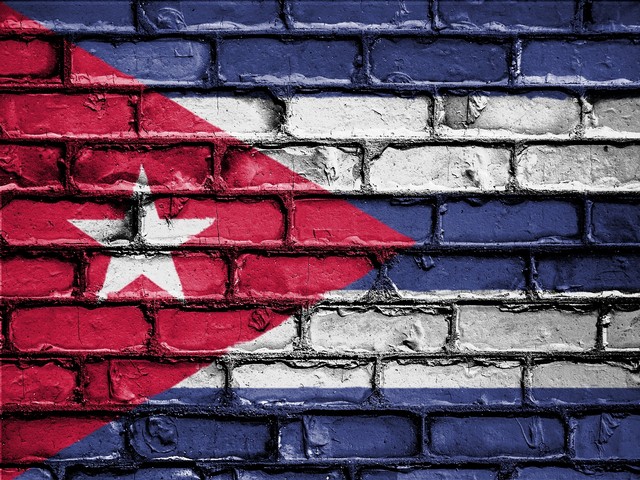
From History: Afghanistan and the CIA Heroin Ratline

By Pepe Escobar

The Persian Gulf harbors an array of extremely compromising secrets. Near the top is the Afghan heroin ratline – with the United Arab Emirates (UAE) positioned as the golden node of a transnational, trillion dollar heroin money laundering operation.

27 Aug 2017 – In this 21st century Opium War, crops harvested in Afghanistan are essentially feeding the heroin market not only in Russia and Iran but especially in the US. Up to 93% of the world’s opium comes from Afghanistan.

Contrary to predominant Western perception, this is not an Afghan Taliban operation. The key questions — never asked by Atlanticist circles — are who buys the opium harvests; refines them into heroin; controls the export routes; and then sell them for humongous profit compared to what the Taliban have locally imposed in taxes.

Beyond Opium: US Could Be ‘Smuggling Uranium Out of Afghanistan’

The hegemonic narrative rules that Washington bombed Afghanistan in 2001 in “self-defense” after 9/11; installed a “democratic” government; and after 16 years never de facto left because this is a key node in the Global War on Terror (GWOT), against al-Qaeda and the Taliban alike.

Washington spent over $100 billion in Afghan reconstruction. And, allegedly, $8.4 billion in “counternarcotics programs”. Operation Enduring Freedom — along with the “liberation” of Iraq — have cost an astonishing several trillion dollars. And still the heroin ratline, out of occupied Afghanistan, thrives. Cui bono?

Have a SIGAR

An exhaustive Afghanistan Opium Survey details the steady rise of Afghan opium production as well as the sprawl in production areas; “In 2016, opium production had increased by approximately 25 times in relation to its 2001 levels, from 185 tons in 2001 to 4800 tons in 2016.”

Another exhaustive report issued by the delightful acronym SIGAR (Special Inspector General for Afghanistan Reconstruction) even hints — discreetly — at the crucial connection; Operation Enduring Freedom feeding America’s heroin epidemic.

Afghanistan is infested by contractors; numbers vary from 10,000 to tens of thousands. Military and ex-military alike can be reasonably pinpointed as players in the heroin ratline — in many cases for personal profit. But the clincher concerns the financing of US intel black ops that should not by any means come under scrutiny by the US Congress.

A Gulf-based intel source with vast experience across the Pentagon-designated “arc of instability” tells the story of his interaction with an Australian intel operative who served in Afghanistan; “This was about 2011. He said he gave US Army Intelligence and the CIA reports on the Afghan heroin trade — that US military convoys from the ports of Pakistan were being used to ship the heroin out of Afghanistan — much of it was raw opium — for distribution as their backhaul.

No one answered.

The Never-Ending War: US Misrepresents Troop Numbers in Afghanistan by Thousands

He then cornered the key army intelligence operations and CIA at a meeting and asked why no action was taken. The answer was that the goal of the US was winning the hearts and minds of the population and giving them the poppies to grow won their hearts. He was then warned that if he brought this issue up again he would be returned to Australia in a body bag.”

The source is adamant, “CIA external operations are financed from these profits. The charge that the Taliban was using the heroin trade to finance their operations was a fabrication and a form of misdirection.”

And that brings us to a key motive behind President Trump‘s going against his instincts and accepting a new Afghan surge; “In the tradition of the opium wars of perfidious Albion in the 19th century, in which opium paid for tea and silk from India, and the taxes on these silk and tea imports financed the construction of the mighty British Navy which ruled the seas, the CIA has built itself up into a most powerful agent based on the trillion dollar heroin trade. It is impossible for Trump to overcome it as he has no allies to tap. The military are working together with the CIA, and therefore the officers that surround Trump are worthless.”

None of this deviates from the CIA’s modus operandi.

Past examples abound. The most notorious concerns the Golden Triangle during the Vietnam war, when the CIA imposed a food-for-opium scheme on Hmong tribesmen from Laos — complete with a heroin refinery at the CIA headquarters in northern Laos and the set up of nefarious Air America to export the opium.

The whole story was exposed on Prof. Alfred McCoy’s seminal The Politics of Heroin in Southeast Asia — which drove Langley nuts.

A contemporary counterpart would be a recent book by Italian journalist Enrico Piovesana detailing the New Opium War in Afghanistan.

The return of Air America

A Pakistani intel source with vast Pashtun/ tribal area contacts delves into even more incendiary territory; “According to our best information the CIA has brought in their al-Qaeda-Daesh proxies into Afghanistan to justify the additional American troops”. That would neatly tie in with Trump being cornered by his generals.

And then, there’s Moscow. Last week, the Russian Foreign Ministry was adamantly denouncing “foreign fighters” transferred by “unknown helicopters” as the perpetrators of a massacre of Hazara Shi’ites in a northern Afghanistan province; “It seems that the command of the NATO forces controlling the Afghan sky stubbornly refuses to notice these incidents.”

It does not get more serious than that; Moscow denouncing sectors of the US-trained Afghan Armed Forces side by side with NATO engaged in covert ops supporting jihadis. Russian intel has hinted — discreetly — for quite some time that US intel is covertly sponsoring Daesh — a.k.a. “ISIS Khorasan” — in Afghanistan.

WikiLeaks CIA Docs: US Lacked Afghanistan-Pakistan Strategy

Russian intel is very much aware of the Afghan chapter in the New Great Game. Russian citizens are “collateral damage” of the Afghan heroin ratline as much as Americans. The Russian Foreign Ministry is tracking how tons of chemicals are being illegally imported into Afghanistan from, among others, “Italy, France and the Netherlands”, and how the US and NATO are doing absolutely nothing to contain the heroin ratline.

Well, Air America, after all, never died. It just relocated from the jungles of Southeast Asia to the arid crossroads of Central and South Asia.

Pepe Escobar is a Brazilian independent geopolitical analyst. He is a frequent contributor to websites and radio and TV shows ranging from the US to East Asia.

19 July 2021

Source: www.transcend.org
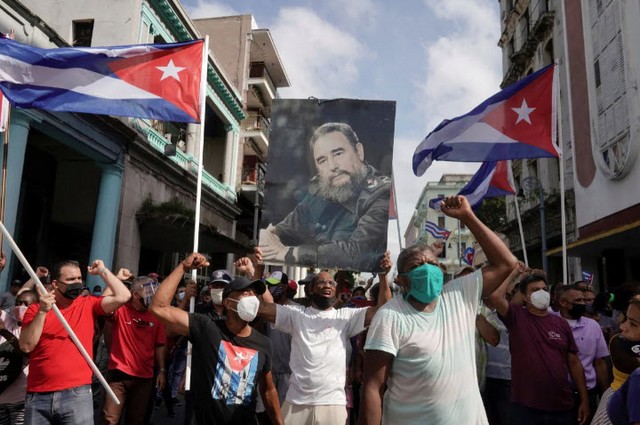
What Happens at Sun Valley, the Secret Gathering of Unelected Billionaire Kings?

By Hamilton Nolan

We are developing a private class of billionaire kings whose will is omnipotent and untouchable by any democratic force.

12 Jul 2021 – There comes a moment in every good gangster movie when all of the villains come together in a remote hideaway to make nefarious plans. If the good guys are smart, this is the moment they swoop in and arrest everyone. In real life America, though, we consistently squander these opportunities, opting instead to sit back and gawk at the villains like a bunch of dazed paparazzi. It’s never too late to change that.

Did you make it to the Allen & Co conference in Sun Valley, Idaho this past week? If you did, go directly to jail. The investment bank sponsors the annual schmooze-fest and “summer camp for billionaires” for the same reason that companies give away their luxury products in Oscars gift baskets: because if you spoil rich people enough, they may develop sufficiently warm feelings towards you to throw you some business one day. At Sun Valley each year, the billionaires are feted by the mere millionaires; the millionaires drum up enough deals to allow them to buy their third and fourth homes; and somewhere down the line, you can get a job as a housekeeper for one of those homes. This is the wondrous model of American capitalism in action – a tiny handful of wealthy people eat cake, and an entire nation gathers downstream, hoping to snatch up a few falling crumbs.

The Sun Valley conference is primarily known as a place where tech and media moguls gather to do a little fly fishing and strike multibillion-dollar merger deals, while various members of the financial press flit about the periphery of the resort like a bunch of tabloid hacks desperate for a snapshot of Mark Zuckerberg in the season’s latest fleece vest. More fundamentally, the conference is, like Davos, a mechanism for the concentration of wealth, dressed up as something friendlier. Here, America’s wealthiest mega-billionaires gather with the chief executive of America’s most powerful companies, the director of the CIA, and America’s most worthless pseudo-journalists (hello, Anderson Cooper) to develop the social and business connections that allow the top 0.00001% of earners to continue to accumulate a share of our nation’s wealth that already exceeds the famously cartoonish inequality of the Gilded Age of Rockefeller and Carnegie. Everything that happens at Sun Valley will contribute to the ability of attendees like Jeff Bezos, Bill Gates, and Mike Bloomberg to increase their society-warping fortunes. They and their fellow billionaires got more than 50% richer during the pandemic year, by doing absolutely nothing but sitting back and watching their capital grow as millions around the world suffered and died. Their power over the course of this country grows ever more unassailable and unaccountable to anything other than their own whims. We are developing a private class of billionaire kings whose will is omnipotent and untouchable by any democratic force. This is the state of affairs that the Sun Valley conference serves to intensify. It is, by any reasonable measure, a threat to the long term stability of our country that far exceeds anything the Taliban could ever dream up.

Yet there is a noticeable lack of Special Forces troops rappelling into the scenic Idaho woods to capture Oprah Winfrey and Tim Cook as they go whitewater rafting. The collective wealth of the small group of people inside that Sun Valley resort is estimated to be a trillion dollars – meaning that confiscating it all could end homelessness in America for the next decade, with a few hundred billion left over. Instead of pursuing this obviously good idea, we opt instead to leave all of that wealth in the hands of the rich, so that Sun Valley attendees Jeff Bezos and Richard Branson can use it to race one another to become the biggest asshole ever to go to space.

Everything that happens at Sun Valley helps attendees like Bezos and Gates to increase their society-warping fortunes.

It is odd that a nation obsessed with identifying threats has developed such a blind spot to the existential threat posed by the rich getting infinitely richer. Americans stockpile guns to fight off imaginary home invaders, flee to gated exurbs to hide from imaginary street crime, and launch doomed forever wars to battle imaginary foreign terrorists. But 40 years of wage stagnation, rising inequality, and the nightmarish gig-ification of all aspects of economic life are not enough to prompt us to cast a wary glance at an annual confab of all the people responsible for creating the conditions that have made it impossible to work one job and retire with dignity. The people who have, in fact, sucked up all of the money that no longer belongs to the mythical American middle class cavort openly in Sun Valley while we fearmonger about antifa breaking the windows of some coffee shop. It is enough to make me think that we are not so skilled at threat assessment, after all.

There is always next year. In 2022, the billionaires will return to Sun Valley. By then, they will almost certainly be richer, and more powerful, and control an even more grotesque share of the fruits of everyone’s labor. They will have continued to bust unions, consolidate control of industries, and wield disproportionate influence over all of our lives, solely for their own benefit. The case for rounding them up and redistributing their wealth will only have grown more convincing. And fortunately, we know exactly where they all will be.

Hamilton Nolan is a New York-based writer.

19 Julai 2021

Source: www.transcend.org

Hands off Cuba: Defend the Revolution!

By Carlos L. Garrido & Edward Liger Smith

Yesterday, the Midwestern Marx co-founders got together to discuss the recent imperialist attacks on Cuba. In the podcast below, Carlos and Edward analyze the Cuban protests in their historical context; beginning from the development of colonial monocropping and the subsequent sugar and tobacco dependency created on the Cuban economy thereof, to the revolution, the process of industry nationalization, and the last 60+ years of the US blockade (which includes military, biochemical, and ideological attacks). Situating the condition in Cuba in its proper historical position, the focus is then turned towards the recent build up towards these protests, which include the US’ exploiting of the pandemic to intensify the conditions created by the reinstatement of the blockade via the Trump administration, the US funding of opposition groups in Cuba, and the role Cuban-opposition artist have played in furthering the imperialist narrative. The duo also examines the role and tactics western media has used to manufacture consent for these opportunists, as well as how they have been able to blow the scope of the protests out of proportion while ignoring the substantially larger pro-revolution crowds that hit the streets after Diaz-Canel’s called on them to defend the revolution. Watch our podcast interview below if you want a complete picture of the current situation in Cuba.

Podcast #11 HANDS OFF CUBA – Defend the Revolution!

Carlos L. Garrido is a philosophy graduate student and professor at Southern Illinois University, Carbondale.

Edward Liger Smith is an American Political Scientist and specialist in anti-imperialist and socialist projects, especially Venezuela and China.

14 July 2021

Source: countercurrents.org

Palestine Update 481

Double standards on Palestine will come back to haunt the EU
Solidarity protests and citizen-based activism against the Israeli occupation have mushroomed across Europe and the Americas, as well as the Arab/Muslim world. Port unions in Italy have refused to reload tankers with ammunition and weapons destined to Israel and activists in the United Kingdom have blocked the gates of Israeli arms manufactures. Protests have taken place among segments of the Jewish diaspora in Canada and parliamentarians across the world are for the first time debating sanctions on Israel, as a result of its flagrant violations of international law.

International civil society is once again on the move. Inspired by the courage and activism of new generations of Palestinians, who have taken it upon themselves to resist and push back against Israel’s state-sanctioned discrimination and colonial expansionism, these voices are also exposing the double standards which have long been cynically applied by the European Union and the United States. Such voices, in occupied Palestine and in the diaspora, are succeeding in penetrating Israel’s powerful media narratives, naming and shaming leaders in the EU and US for their blatant failure to hold Israeli authorities to account for the over five-decades-long occupation.

Whether it is the Black Rights Matter campaign, the Fridays for Future movement, anti-arms-sales campaigners or international Palestine solidarity, these forces are united in pushing for a clear paradigm shift in international politics. While instances of anti-Semitism have also unfortunately increased, efforts to conflate criticism of the Israeli occupation with virulent hatred of Jewish human beings are proving self-defeating. They ignore the root causes of such mobilisations and ultimately risks increasing, rather than decreasing, the appeal and impunity of anti-Semitic actors and beliefs. It is up to Europe’s peoples to campaign and struggle, to ensure that our governments end our states’ support for Israeli apartheid.

Double standards on Palestine will come back to haunt the EU

How Europe sustains Israel

Many people object when first learning that Israel participates in the Eurovision Song Contest. Why is such an obscenely violent and racist human rights-abusing regime allowed to participate in an international competition like that? And Israel isn’t even in Europe, it’s in Asia. Of course, I agree with the first point. Israel should certainly be boycotted and expelled from such competitions until it ends its crimes against Palestinians and its occupation of Syrian and Lebanese land. Technically, the second point is correct, too. But the reality is that Israel is, in essence, a European settler-colony in the heart of the Arab world. Australia, too, is in the Eurovision Song Contest – another white, European settler-colony, one which is even geographically further away from Europe than Israel.

Zionism’s founder Theodor Herzl was quite explicit on this point: the Zionist state in Palestine would be a European colonial phenomenon. At the time, Palestine was under the control of the Ottoman Empire. In The Jewish State, Herzl wrote: “If His Majesty the Sultan were to give us Palestine… we should there form a portion of a rampart of Europe against Asia, an outpost of civilization as opposed to barbarism.”

This supposed Asian “barbarism” that European Zionism was established to struggle against was not explained in Herzl’s short booklet. But there is a clue later in the same paragraph, in which he hints that he considers (European) Christianity to be a superior religion to that of the majority of the people who actually lived (and live) in Palestine: Islam. In the future Jewish state in Palestine, he wrote: “The sanctuaries of Christendom would be safeguarded by assigning to them an extra-territorial status such as is well-known to the law of nations. We should form a guard of honour about these sanctuaries, answering for the fulfilment of this duty with our existence.”

Such outmoded colonial and racist terms are still very much the same ones with which Israel defines itself today: an outpost of “civilisation” among the “barbarous” Arabs in the Middle East. Israel is a European entity, because settler-colonialism is a European phenomenon.

Ironically, of course, Judaism is not a European but an Asian religion in its origins, just as Christianity was also founded in Palestine. Herzl was conceiving Jewishness as European because Jews in Europe are mostly European Jews. They descended from converts to Judaism.

Today, most Zionist fanatics who arrive to settle in occupied Palestine under Israel’s racist laws still come from Europe or the US (which is, of course, another European settler-colony). Far more successful than Herzl’s failed appeal to the Ottoman Sultan to hand Palestine over to Zionist settler-colonialism was his appeal to British imperialism. He wrote to infamous British imperialist Cecil Rhodes, shortly after the latter had colonised the land of the Shona people in Africa, stealing the land and renaming it Rhodesia, after himself. The later state of Rhodesia would prove to be probably the worst and most savage of the apartheid regimes established by Europe in Africa, until it was liberated and renamed Zimbabwe in 1979.

In his letter to Rhodes, Herzl expressed: “You are being invited to help make history. It doesn’t involve Africa, but a piece of Asia Minor; not Englishmen but Jews… How, then, do I happen to turn to you since this is an out-of-the-way matter for you? How indeed? Because it is something colonial. You, Mr Rhodes, are a visionary politician or a practical visionary… I want you to… put the stamp of your authority on the Zionist plan.” Although Herzl didn’t live to see it, the movement’s appeal to British imperialism was fulfilled in 1917, when the British government declared its intention to hand the country over to the Zionist movement, against the wishes of its native population. This was known as the Balfour Declaration. Herzl had promised in his booklet The Jewish State that the Zionist entity would: “Remain in contact with all Europe, which would have to guarantee our existence.” With the Balfour Declaration, the leading European colonial power was indeed guaranteeing the existence of the Zionist settler-colony. Today, things are a little different – except that the US has inherited the mantle of the leading imperial power in the world. But Europe itself still plays a prominent role in guaranteeing the existence of the violently racist settler-colonial regime that occupies Palestine.

The European Union, for example, hands over millions in scientific research grants to help boost the profits of Israeli arms firms. At The Electronic Intifada David Cronin even revealed this week that discussions had been held on possible future cooperation with Israel’s nuclear industry. With such powerful forces aligned against the Palestinians, it is up to Europe’s peoples to campaign and struggle, to ensure that our governments end our states’ support for Israeli apartheid. placards during a protest against the Eurovision Contest 14 May

14 July 2021

Long Live the Cuban Revolution – a Beacon of Hope for all Humanity.

By Gerald A. Perreira

Organization for the Victory of the People (OVP) stands firmly with the revolutionary government of President Diaz-Canel and all the patriotic and anti-imperialist citizens of our Caribbean sister-nation Cuba, as they struggle against this most recent US-backed attempt to provoke counter-revolutionary forces. In the Caribbean and South America, having seen these thinly-veiled US tactics to destabilize progressive and revolutionary governments play out time and time again, most recently in Venezuela, Nicaragua and Bolivia, the scenario is familiar and instantly recognizable.

The Empire’s relentless attempts to wreck Cuba’s economy and break the resolve of the Cuban people since the triumph of the revolution in 1959 is nothing short of a crime against humanity. Last month, for the 29th year in a row, a total of 184 countries voted in favour of a resolution to demand the end of the US economic blockade on Cuba, with only the two rogue states, the United States and Israel voting against. UN agencies estimate that this illegal economic blockade, designed to foment unrest, has over six decades, cost Cuba well over 100 billion dollars.

How can the US speak of freedom and democracy while, against the will of the world’s people, it continues to enforce this tortuous and criminal economic blockade against a small nation, simply because it dares to exercise its inalienable right to sovereignty and self-determination?

The immorality, hypocrisy and tyranny of the US Empire has been further exposed during the COVID 19 pandemic. Increased sanctions on Cuba at this time, when, like all nations of the world, it is struggling to overcome the economic and health crisis caused by the pandemic, was correctly described as “obscene” by Argentine president, Alberto Fernandez. Especially obscene in light of the fact that Cuba sent medical brigades to COVID epicenters around the world in their hour of need, and became the only country in the Global South to develop COVID vaccines, intended for their own citizens and for distribution to countries in South America, the Caribbean and Africa that have been denied access to vaccines by the US and Western Europe. The US imperialists, whose wickedness knows no bounds, have even hindered Cuba’s access to syringes and other supplies to assist in the manufacture and distribution of life-saving vaccines. Cuba’s Foreign Affairs Minister, Bruno Rodriguez Parrilla, rightfully described the sanctions as an “act of genocide” and said that “like the virus, the blockade asphyxiates and kills, it must stop.”

In fact, there are those in our region that predicted that Cuba’s development of vaccines Soberana, Abdala and Mambisa that are different in type and perhaps safer than the vaccines developed in the West, would prompt the Empire to accelerate its attempts to create chaos in Cuba to upset and discredit Cuba’s phenomenal achievements.

It is preposterous and incomprehensible that the US continues to promote itself as a champion of human rights, while being the world’s greatest violator of human rights.

It is equally incomprehensible, after what the entire world has witnessed over the past decade, not only in Iraq, Libya and Afghanistan, but also in the very belly of the beast, the US itself, that anyone of us, in Cuba or elsewhere, could still be deceived and fall prey to the false promise that US intervention and capitalism can lead to prosperity, freedom and democracy. It is important at this time to remember the words of the revolutionary and friend of Cuba, Kwame Ture, “Capitalism and Imperialism does not lie sometimes, they lie all the time.”

In unity and struggle,
Gerald A. Perreira
On behalf of the National Directorate,
Organization for the Victory of the People (OVP)
Guyana

12 July 2021

www.ovpguyana.org