Just International

The War on Freedom: How Tyranny Overran the United States

By Emanuel Pastreich

Slowly, against their will, and against their natural inclination to watch football and eat pizza, Americans are awaking to the reality of a totalitarian system with its tentacles wrapped around every aspect of their existence. Sadly, the true nature of this tyranny still eludes the understanding of most citizens, in part because the process by which America was transformed utterly has been slow, in part because the commercial media points us away from the true causes of this slippage and pins all blame on easily identifiable bad guys.

Those seeped in the progressive political tradition sensed a radical loss of justice and transparency under the George W. Bush administration, a trend that only accelerated under the Trump administration—with a perceived reprieve under Obama and the possibility of a positive turn under Biden.

Those marinated in the juices of conservative politics observed an end of freedom and the spread of fake “leftist,” ideology that oppresses the citizen under Clinton and Obama.

Both interpretive communities refer to the same social and political trends, to the war on freedom that renders us up as sacrificial lambs to the cruel gods of global capital. The rhetoric employed by the two groups is so radically different, however, and the histories of the United States that they embrace are so divergent, that they are lost in intense ideological conflicts even as they describe the same creeping totalitarianism.

That conflict is no accident. That ideological battle over the insignificant is just what the doctor ordered for the interests of high finance. Or as J. P. Morgan put it,

“By dividing the people, we can get them to expend their energies in fighting over questions of no importance to us except as teachers of the common herd.”

The super-rich already had their consultants come up with detailed studies on how to divide up citizens by religion, by ethnic identity, by cultural signifiers, and by class so that they are incapable of unity even in the face of the complete takeover of the economy, the media, education and the political process.

“Progressives” refer to the supporters of Trump in rural areas as “stupid” and fundamentalist Christians refer to the followers of the Democratic Party as “evil.”

This profound misunderstanding is probably reinforced by numerous classified operations in which individuals promoting divisive left-wing, or right-wing, positions are encouraged, and paid, to do so as render those who should have common cause as foes.

There is another reason why we have such a difficult time understanding the transformation of our society. The nature of this totalitarianism runs against the assumptions we were taught by movies, novels, and news reports. Our minds are cluttered with archetypes for dictatorship and evil that are at odds with the reality.

The greatest crime of Hollywood was convincing us that evil takes the form of a monster with fangs and claws, of an evil leader with a sinister smile. Corrupt journalists extend this fiction to the public sphere, explaining how evil is embodied in foreign leaders like Kim Jong-un, Xi Jinping, or Vladimir Putin, or in domestic ill-doers like Hillary Clinton (for the right) or Donald Trump (for the left).

As a result, we are unable to detect, or to understand, the takeover of our society that has taken place.

That is to say that we are confronted by “inverted totalitarianism,” to borrow the term of the philosopher Sheldon Wolin, a cultural and political state in which all aspects of our daily lives are controlled by multinational corporations without our knowing and we lose all freedom.

As a result, our actions are profoundly limited; we are constantly beaten down by an iron fist covered in the soft glove of interest charges, student loans, and constant surveillance.

The totalitarianism that we face is “inverted” in the sense that we expect some dictator standing on top and playing the bad buy, oppressing us out of personal greed, vanity or cruelty. But the true source of our misery is rather the manner in which multinational corporations use supercomputers to calculate profits and then extract as much money as possible from us by making it impossible for us to grow our own food, to heal our own illnesses, to teach ourselves, or to entertain ourselves. Instead, we must buy products, online, or in supermarkets, in transactions from which multinational corporations and banks will invariably take a major cut. The only learning that is recognized and accredited is expensive and is controlled by corporations.

We are offered only false choices between Pepsi or Coke, between Taco Bell or Wendy’s, between action films or romantic comedies, and between the Democratic or Republican Parties.

The process by which citizens lost their self-reliance, their self-sufficiency in food production and in energy production, and the basic skills of sewing, knitting and carpentry, growing dependent on products supplied by corporations, began 100 years ago. We can trace the current crisis back to the campaigns of John D. Rockefeller to force citizens to be dependent on petroleum through the promotion of automobiles and trade, the slashing of budgets for public transportation and the massive funding for highways, the push for the mechanization of farming and the popularization of plastics.

Rockefeller also paid off experts so as to marginalize homeopathic medicine and traditional treatments and create dependency on overpriced hospitals that are tied to corporations, while rendering universities and research institutes dependent on the benevolence of the rich, thus making systematic critiques of the sources of wealth a taboo topic.

To be more specific, the invisible inverted totalitarianism that has taken control of our daily experiences can be traced back to the launch of Windows as an operating system in 1985. Microsoft Word, under the rule of Bill Gates (an ardent student of John D. Rockefeller), set out to control the means by which citizens utilize their computers and later, to control how they interacted with each other over the internet.

Sure, presidential elections were held every four years, and the public was given a chance express itself. Secret secret police did not cart off those who criticized the government—in fact criticism of government was encouraged as way to distract from the impact of bank deregulation.

Most citizens were hardly aware that having one corporation control the system software for all computers that they supposedly “owed” meant that they had lost their freedom.

Yet the shift was profound. Whereas the individual previously could decide for himself where to place files in his office, how to organize documents and layout his papers around his typewriter, the manner in which information is organized within Windows is extremely limited, determined in advance by unaccountable forces and the format and layout cannot be modified by the user.

Needless to say, this first step down the road to tyranny, this fatal loss of basic autonomy, was carefully covered up in the rhetoric of convenience and efficiency, exciting innovation and technological advancement, so that few recognized the loss.

Myths about the importance of convenience, of connectivity and of globalization were swallowed by the entire population. Critical topics like the scientific method, the control of the means of production and the decision-making process in government, and in other institutions, were forgotten.

The next step in this hidden tyranny over our daily lives came in the form of search engines like Google, social networks like Facebook, and other massive, interconnected, corporations that mediated the interactions of the individual with the community, often taking over critical functions that previously belonged to the community or to non-profit institutions like schools or research centers.

Under the guise of greater convenience for the individual, businessmen with unlimited funding from investment banks were able to buy up rivals, block out alternatives that offered search engines as cooperatives, and thereby created search engines that pose as transparent institutions but derive money through the sophisticated manipulation of human interactions using algorithms.

Because Google and Facebook had such resources that they could lose money for years, the manner in which they whittled away at the autonomy of the citizen was almost undetectable. Equally important was the strategy of using short-term stimulation of the brain by postings, instant messages and gaudy news reports, to remap the connections between synapses so as to render most incapable of complex, three-dimensional, thinking. That service, the creation of a dumbed down, passive, population, was true product that internet giants offer to their real clients.

Google controls what information we access to, in what order we have access to it, and it lays out a hierarchy of significance in search results that has some basis in fact, but is primarily a political act for sale to the highest bidder.

Results of Google searches are altered, on a case-by-case basis, in response to the needs of corporations to promote their views to extremely specific audiences.

Although we are trained to think of Google as a public service, its falsehoods, increasingly given authority by the parallel Wikipedia entries created by public relations firms, are not subject to external review. Google users are never permitted to participate in the process of the formulation of policy, or in the review of content. That is to say, the United States calls itself a democracy, but the primary tool that citizens rely on for information is run as a dictatorship.

Another popular cloak for the slip into tyranny is the framing of “opinion” as content in the news. Scientific fact ceased to be central in reporting from 1990s. In its stead, opinion polls of groups selected by polling companies are held up as a confirmation of what is true.

Public opinion polls are the propaganda equivalent of stock buybacks. The billionaires, having radically deregulated the economy and dumbed down the population, merely force-feed their opinions to the public through the media that they control and then claim that the policies they want are demanded by the public.

Facebook gives the appearance that the citizen can express himself freely, and can make friends with anyone. Yet, since Facebook Inc. controls whom a citizen can easily find through its network, and who sees what, and it does not permit users to use their own software, or design their own page, or own the networks they create on Facebook, or to have any say in how Facebook is administered, the freedom is fiction.

Legal concepts like the contract have been twisted beyond recognition in the totalitarian cyberspace that surrounds us.

A contract is a negotiated agreement between two parties. On-line, however, whether it is the decision to accept cookies, or to comply with the rules for a commercial application, the user has no right to make demands of the corporation. He or she is given the false choice of either agreeing with all conditions offered, or not having access to the service. The contract is an empty ritual.

We are accustomed to permitting Facebook, Twitter, SnapChat or Instagram to determine what becomes of information that we share, and we are unaware of the billions in profits those corporations make by selling off the information, the content, and the creative ideas that we supply without giving us any compensation. In a sense, these social networks are a form of virtual slavery.

COVID19 Totalitarianism

Because the thinking of citizens has been degraded for decades, and citizens rely on corporate-sponsored sources for basic information, it became possible, for the first time, to create a virtual pandemic, planned by the super-rich, promoted by the news sources that they own, authorized by experts at the institutes and universities that they fund, and legitimated by government agencies (and international institutions like the World Health Organization) that have been radically privatized.

Previously, a significant number of citizens were capable of assessing the accuracy of information on their own. Research institutes like Harvard University still had an ethical commitment to the scientific method and to academic integrity.

All that is over now. The façades of the NIH and Harvard remain the same, maybe they are even better maintained, but the intellectual innards have rotted away. Distinguished professors are easily assembled to give testimony to ridiculous theories about COVID19.

The dangers of the COVID19 vaccines are not the primary threat. The danger lies rather in the shift of the decision-making process for policy away from science, and away from a transparent policy debate. COVID19 serves a successful precedent for invisible forces at private equity funds to decide medical policy in secret and then feed it to us through authority figures.

Those invisible forces now feel they are free to require of us, without any accountability to science, that we have any substance that they offer injected into our bodies as a condition for the right to attend school, to find employment or to receive medical treatment.

The process was made possible by the interaction of social networks, search engines, commercial media, and other critical components of daily experience that determine opinions concerning reliable and authoritative voices. That process is run as an invisible dictatorship that controls a distracted, confused and unfocused population, drowning in connectivity.

Nothing will get better until citizens recognize the cause of this nightmare was not the legacy of the Bushes, the Clintons, the Obamas or the Trumps, although they all played their role, but rather the end of the self-reliant and informed citizen with access to the writings of experts with a deep commitment to the scientific method and to ethical principles.

Emanuel Pastreich served as the president of the Asia Institute, a think tank with offices in Washington DC, Seoul, Tokyo and Hanoi.

11 July 2021

Source: www.globalresearch.ca
A World of Total Illusion & Fantasy: Noam Chomsky Interview

By Robert Hunziker

Facing Future.TV founder and executive producer Stuart Scott and co-host Dale Walkonen recently broadcast a wide-ranging interview with Noam Chomsky about the state of human existence in the face of universal decadence.

A Conversation with Noam Chomsky

They started by referencing the Doomsday Clock (Science and Security Board Bulletin of the Atomic Scientists), which has pegged humanity’s risk of annihilation at an all-time high of only 100 seconds to midnight. Chomsky feels we’re actuality closer to midnight than that. For example, his opinion is influenced by information in a leaked draft of the IPCC (Intergovernmental Panel on Climate Change) upcoming report, “which is much more grim than earlier reports,” keeping in mind it is only a draft so far, and he believes the final report may temper the initial draft.

With regard to nuclear weapons, the situation is far more dangerous than the last Doomsday Clock report. New weapons systems under development are much more effectively dangerous. The Biden administration, expanding upon Trump’s confrontational approach, has Chomsky at a loss for words to describe the danger at hand. Only recently, Biden met with NATO leaders and instructed them to plan on two wars, China and Russia. According to Chomsky: “This is beyond insanity.” Not only that, the group is carrying out provocative acts when diplomacy is really needed. This is an extraordinarily dangerous situation.

According to Chomsky, the Doomsday Clock setting at 100 seconds to midnight is based upon: (1) global warming (2) nuclear war and (3) disinformation, or the collapse of any kind of rational discourse. As such, number three makes it impossible to deal with the first two major problems. Along those lines, within the Republican Party there’s virtually a disappearance of any pretense of rational discourse. Twenty-five (25%) percent of Republicans believe the government is run by an elite satanic group of pedophiles. Seventy percent (70%) of Republicans believe that the election was stolen. Only fifteen percent (15%) of Republicans believe that global warming is a serious problem. Therein lies an insurmountable problem to solving the main issues that continually tick the clock ever closer to a disaster scenario that will likely be unprecedented in the annals of warfare and environmental degradation.

As a result, Chomsky says: “We’re living in a world of total illusion and fantasy.” Accordingly, “Unless this is dealt with soon, it’ll be impossible to deal with the two major issues within the time span that we have available, which is not very long.”

In Chomsky’s opinion the Republican Party, especially if it regains control in 2024, will take society down the tubes, down for the final count into the depths of a nether world. In Chomsky’s words: “If they return to power, it is very likely it will be an organized death knell for human society.”

However, on a positive note, boots on the ground political activism is still a political factor that works. A prime example is the Sunrise Movement that has effectively lobbied for a civilian climate corp. Chomsky applauds Sunrise as well as The United Mineworkers agreement to support a transition program of miners to sustainable energy via government-sponsored programs. Additionally, nineteen unions in California have agreed to a similar program.

Meanwhile, on the opposite side of the ledger, OPEC is planning to increase investment and production of fossil fuels because the price of oil is going up. According to Chomsky: “It is totally suicidal.” It’ll be suicidal in due course, but over the short term it’ll produce more wealth for Saudi Arabia. However, there’s little doubt that the country will be uninhabitable within a few years in a self-afflicted pogrom.

Chomsky: “Whatever is going on in the minds of human beings, they’re capable of saying let’s destroy ourselves, let’s destroy life for our children, because I can make a few more dollars tomorrow.” Not only are countries blind to an encroaching hothouse Earth, the wealthy countries are basically monopolizing vaccine for Covid 19 in the face of variants of the virus that will come back more powerful and deadly to haunt the wealthy countries. Indeed, the world is at odds with itself!

Chomsky claims there are opportunities and ways to reach people to resolve issues. But, “we do not have much time.” He warns that if the Republicans come back to office in 2024, it may be too late. “The programs they are pursuing offer no hope for survival.” After all, every year that Trump was in office, the Doomsday Clock minute hand moved closer to midnight. Eventually, the Doomsday Clock analysts gave in by shifting from the minutes-hand to the seconds-hand.

There are opportunities that must be grasped to stop the madness. To be effective, change must come from below from the general population not from above or the politicians. For example, Congress passed a resolution calling for a Green New Deal introduced by Representative Alexandria Ocasio-Cortez and Senator Ed Markey. He claims: “It’s a very good proposal.” Extensive activism got it to this point. The key to making things happen is “boots on the ground.” The Sunrise Movement occupied Nancy Pelosi’s office and got support from AOC. That’s grass roots activism at work and it has succeeded, so far.

Chomsky: “There are good people like Ocasio-Cortez and Markey but they’re not going to get anywhere unless there’s extensive popular pressure compelling the legislative authorities, the Congress, the White House to pursue these objectives.” For example, when FDR wanted to pass New Deal legislation, he told the public: “You have to make me do it, I cannot do it myself.” It takes human bodies with boots on the ground to effectively influence legislation. Whereas, clicking a mouse gets nowhere and easily ignored.

In retrospect, it is important to emphasize that throughout history political parties that rely upon lies bring society down to its knees in piles of shameless destruction. A prime example of this is the fall of Rome, which resonates today: “By the time of Augustine (354-430 AD), the Roman Empire had become an Empire of lies. It still pretended to uphold the rule of law, to protect the people from the Barbarian invaders, to maintain the social order. But all that had become a bad joke for the citizens of an empire by then reduced to nothing more than a giant military machine dedicated to oppressing the poor in order to maintain the privileges of the rich. The Empire itself had become a lie: that it existed because of the favor of the Gods who rewarded the Romans because of their moral virtues. Nobody could believe in that anymore: it was the breakdown of the very fabric of society; the loss of what the ancient called the auctoritas, the trust that citizens had toward their leaders and the institutions of their state.” (Source: Cassandra’s Legacy, The Empire of Lies, February 8, 2016).

Robert Hunziker is a writer from Los Angeles

12 July 2021

Source: countercurrents.org

America’s Afghan War Is Over, So What About Iraq – and Iran?

By Medea Benjamin and Nicolas J. S. Davies

At Bagram air-base, Afghan scrap merchants are already picking through the graveyard of U.S. military equipment that was until recently the headquarters of America’s 20-year occupation of their country. Afghan officials say the last U.S. forces slipped away from Bagram in the dead of night, without notice or coordination.

The Taliban are rapidly expanding their control over hundreds of districts, usually through negotiations between local elders, but also by force when troops loyal to the Kabul government refuse to give up their outposts and weapons.

A few weeks ago, the Taliban controlled a quarter of the country. Now it’s a third. They are taking control of border posts and large swathes of territory in the north of the country. These include areas that were once strongholds of the Northern Alliance, a militia that prevented the Taliban from unifying the country under their rule in the late 1990s.

People of good will all over the world hope for a peaceful future for the people of Afghanistan, but the only legitimate role the United States can play there now is to pay reparations, in whatever form, for the damage it has done and the pain and deaths it has caused. Speculation in the U.S. political class and corporate media about how the U.S. can keep bombing and killing Afghans from “over the horizon” should cease. The U.S. and its corrupt puppet government lost this war. Now it’s up to the Afghans to forge their future.

So what about America’s other endless crime scene, Iraq? The U.S. corporate media only mention Iraq when our leaders suddenly decide that the over 150,000 bombs and missiles they have dropped on Iraq and Syria since 2001 were not enough, and dropping a few more on Iranian allies there will appease some hawks in Washington without starting a full-scale war with Iran.

But for 40 million Iraqis, as for 40 million Afghans, America’s most stupidly chosen battlefield is their country, not just an occasional news story. They are living their entire lives under the enduring impacts of the neocons’ war of mass destruction.

Young Iraqis took to the streets in 2019 to protest 16 years of corrupt government by the former exiles to whom the United States handed over their country and its oil revenues. The 2019 protests were directed at the Iraqi government’s corruption and failure to provide jobs and basic services to its people, but also at the underlying, self-serving foreign influences of the United States and Iran over every Iraqi government since the 2003 invasion.

A new government was formed in May 2020, headed by British-Iraqi Prime Minister Mustafa al-Kadhimi, previously the head of Iraq’s Intelligence Service and, before that, a journalist and editor for the U.S.-based Al-Monitor Arab news website.Despite his Western background, al-Kadhimi has initiated investigations into the embezzlement of $150 billion in Iraqi oil revenues by officials of previous governments, who were mostly former Western-based exiles like himself. And he is walking a fine line to try to save his country, after all it has been through, from becoming the front line in a new U.S. war on Iran.

Recent U.S. airstrikes have targeted Iraqi security forces called Popular Mobilization Forces (PMF), which were formed in 2014 to fight the Islamic State (IS), the twisted religious force spawned by the U.S. decision, only ten years after 9/11, to unleash and arm Al Qaeda in a Western proxy war against Syria.

The PMFs now comprise about 130,000 troops in 40 or more different units. Most were recruited by pro-Iranian Iraqi political parties and groups, but they are an integral part of Iraq’s armed forces and are credited with playing a critical role in the war against IS.

Western media represent the PMFs as militias that Iran can turn on and off as a weapon against the United States, but these units have their own interests and decision-making structures. When Iran has tried to calm tensions with the United States, it has not always been able to control the PMFs. General Haider al-Afghani, the Iranian Revolutionary Guard officer in charge of coordinating with the PMF, recently requested a transfer out of Iraq, complaining that the PMFs are paying no attention to him.

Ever since the U.S. assassination of Iran’s General Soleimani and PMF commander Abu Mahdi al-Muhandis in January 2020, the PMFs have been determined to force the last remaining U.S. occupation forces out of Iraq. After the assassination, the Iraqi National Assembly passed a resolution calling for U.S. forces to leave Iraq. Following U.S. airstrikes against PMF units in February, Iraq and the United States agreed in early April that U.S. combat troops would leave soon.

But no date has been set, no detailed agreement has been signed, many Iraqis do not believe U.S. forces will leave, nor do they trust the Kadhimi government to ensure their departure. As time has gone by without a formal agreement, some PMF forces have resisted calls for calm from their own government and Iran, and stepped up attacks on U.S. forces.

At the same time, the Vienna talks over the JCPOA nuclear agreement have raised fears among PMF commanders that Iran may sacrifice them as a bargaining chip in a renegotiated nuclear agreement with the United States.

So, in the interest of survival, PMF commanders have become more independent of Iran, and have cultivated a closer relationship with Prime Minister Kadhimi. This was evidenced in Kadhimi’s attendance at a huge military parade in June 2021 to celebrate the seventh anniversary of the PMF’s founding.

The very next day, the U.S. bombed PMF forces in Iraq and Syria, drawing public condemnation from Kadhimi and his cabinet as a violation of Iraqi sovereignty. After conducting retaliatory strikes, the PMF declared a new ceasefire on June 29th, apparently to give Kadhimi more time to finalize a withdrawal agreement. But six days later, some of them resumed rocket and drone attacks on U.S. targets.

Whereas Trump only retaliated when rocket attacks in Iraq killed Americans, a senior U.S. official has revealed that Biden has lowered the bar, threatening to respond with airstrikes even when Iraqi militia attacks don’t cause U.S. casualties.

But U.S. air strikes have only led to rising tensions and further escalations by Iraqi militia forces. If U.S. forces respond with more or heavier airstrikes, the PMF and Iran’s allies throughout the region can respond with more widespread attacks on U.S. bases. The further this escalates and the longer it takes to negotiate a genuine withdrawal agreement, the more pressure Kadhimi will get from the PMF, and other sectors of Iraqi society, to show U.S. forces the door.

The official rationale for the U.S. presence, as well as that of NATO training forces in Iraqi Kurdistan, is that the Islamic State is still active. A suicide bomber killed 32 people in Baghdad in January, and IS still has a strong appeal to oppressed young people across the region and the Muslim world. The failures, corruption and repression of successive post-2003 governments in Iraq have provided fertile soil.

But the United States clearly has another reason for keeping forces in Iraq, as a forward base in its simmering war on Iran. That is exactly what Kadhimi is trying to avoid by replacing U.S. forces with the Danish-led NATO training mission in Iraqi Kurdistan. This mission is being expanded from 500 to at least 4,000 forces, made up of Danish, British and Turkish troops.

If Biden had quickly rejoined the JCPOA nuclear agreement with Iran on taking office, tensions would be lower by now, and the U.S. troops in Iraq might well be home already. Instead, Biden obliviously swallowed the poison pill of Trump’s Iran policy by using “maximum pressure” as a form of “leverage”, escalating an endless game of chicken the United States cannot win—a tactic that Obama began to wind down six years ago by signing the JCPOA.

The U.S. withdrawal from Iraq and the JCPOA are interconnected, two essential parts of a policy to improve U.S.-Iranian relations and end the U.S.’s antagonistic and destabilizing interventionist role in the Middle East. The third element for a more stable and peaceful region is the diplomatic engagement between Iran and Saudi Arabia, in which Kadhimi’s Iraq is playing a critical role as the principal mediator.

The fate of the Iran nuclear deal is still uncertain. The sixth round of shuttle diplomacy in Vienna ended on June 20th, and no date has been set for a seventh round yet. President Biden’s commitment to rejoining the agreement seems shakier than ever, and President-elect Raisi of Iran has declared he will not let the Americans keep drawing out the negotiations.

In an interview on June 25th, U.S. Secretary of State Blinken upped the ante by threatening to pull out of the talks altogether. He said that if Iran continued to spin more sophisticated centrifuges at higher and higher levels, it will become very difficult for the United States to return to the original deal. Asked whether or when the United States might walk away from negotiations, he said, “I can’t put a date on it, (but) it’s getting closer.”

What should really be “getting closer” is the U.S. withdrawal of troops from Iraq. While Afghanistan is portrayed as the “longest war” the United States has fought, the U.S. military has been bombing Iraq for 26 of the last 30 years. The fact that the U.S. military is still conducting “defensive airstrikes” 18 years after the 2003 invasion and nearly ten years since the official end of the war, proves just how ineffective and disastrous this U.S. military intervention has been.

Biden certainly seems to have learned the lesson in Afghanistan that the U.S. can neither bomb its way to peace nor install U.S. puppet governments at will. When pilloried by the press about the Taliban gaining control as U.S. troops withdraw, Biden answered,

“For those who have argued that we should stay just six more months or just one more year, I ask them to consider the lessons of recent history… Nearly 20 years of experience has shown us, and the current security situation only confirms, that ‘just one more year’ of fighting in Afghanistan is not a solution but a recipe for being there indefinitely. It’s the right and the responsibility of the Afghan people alone to decide their future and how they want to run their country.”

The same lessons of history apply to Iraq. The U.S. has already inflicted so much death and misery on the Iraqi people, destroyed so many of its beautiful cities, and unleashed so much sectarian violence and IS fanaticism. Just like the shuttering of the massive Bagram base in Afghanistan, Biden should dismantle the remaining imperial bases in Iraq and bring the troops home.

The Iraqi people have the same right to decide their own future as the people of Afghanistan, and all the countries of the Middle East have the right and the responsibility to live in peace, without the threat of American bombs and missiles always hanging over their and their children’s heads.

Let’s hope Biden has learned another history lesson: that the United States should stop invading and attacking other countries.

Medea Benjamin is cofounder of CODEPINK for Peace, and author of several books, including Inside Iran: The Real History and Politics of the Islamic Republic of Iran.

Nicolas J. S. Davies is an independent journalist, a researcher with CODEPINK and the author of Blood On Our Hands: the American Invasion and Destruction of Iraq.

12 July 2021

Source: countercurrents.org

Cuba faces loot, whose hands behind?

By Farooque Chowdhury

Imperialist media and its followers are over-active in circulating the news: Protests and loot in Cuba. Then, they draw conclusion: The people in Cuba are rejecting socialism.

The MSM circulated news on Cuba said:

  • Large anti-government protests broke out in Cuba’s major cities. Thousands of protesters marched on Sunday in Havana, Santiago de Cuba and other locales, decrying food, medicine and vaccine shortages.
  • It’s a display of “pro-freedom” sentiment. The protesters were demanding an end to the present communist rule. Numerous videos posted on social media showed crowds marching and chanting such slogans as “Liberty”. In areas, protesters flipped cars and threw rocks at police in Havana and in other places. Some videos showed people vandalizing and looting shops.

Thus, the media-masters cheer and draw conclusion while they show their ignorance in drawing demarcation line between socialism and communism, as the two systems are far-far different.

Nothing to hide: There’re protests in Cuba.

Nothing to hide: There’s incident of loot.

The issue for consideration is what goods were looted. Do food-hungry people loot TV and electronics goods? The masters of the mainstream media obviously have an answer. The looters weren’t food-hungry if TV, etc. were looted. Or, there’s little scope for going hungry if stores were stashed with food products.

The fact-manipulation-efficient-masters have made a mistake in their fabrication of “facts” of protests. The fact that comes out from this inconsistency is there’s something fishy, smelling rotten.

Were not there reports of loot of food products and clothes in cities in the Empire months ago while a section of the populace was raging in protests demanding justice? Those people were at least a bit hungry, at least a bit deprived of clothes. The stories of unemployment and homelessness are another issue for another story. And, there’re reports on members of an important organization of the state machine in the Empire, who were facing hunger, were facing difficulty in procuring food due to salary-shortage.

The Empire is resource-rich. This richness goes for hundreds of years. This richness comes from accumulation of wealth from all corners of the world. The Empire has never, till now, faced any economic embargo.

On the contrary, Cuba, immediately since its emergence as a dignified nation, began facing embargo of all sorts. It’s continuing. It’s not at war in any country, with any country. It has not invaded any country. It has not devastated any country with invasion and war. Yet, an all choking embargo is imposed on Cuba! It’s unprecedented in human history.

How many reports the MSM have produced and circulated on the issues? Which of the MSM can claim that that has circulated reports on the way Cuba’s procurement of raw materials for producing Coronavirus-fighting vaccines was stalled, and who the actors were behind this stalling of a nation’s fight against pandemic? How many reports on Cuba’s unprecedented help to countries including a member of the powerful G-7 in fighting the pandemic the MSM have carried? How many reports on Cuba’s research and successful production of vaccines to fight the coronavirus the MSM have circulated? How many reports on the Cuba’s fight against the pandemic – despite the Empire-imposed embargo, Cuba is the first country in Latin America that has successfully developed and produced two coronavirus-vaccines, and has vaccinated over a quarter of its population with at least one dose while suffering a severe shortage of syringes due to the Empire-imposed embargo –has the MSM produced and circulated? Has a comparison between Cuba and countries with a fat foreign exchange reserve and well-developed infrastructures been made ever? The countries to be compared are not only in Europe. They are in South Asia and South-East Asia also; and a few of these countries have nuclear arsenals, and they regularly tests missiles that can carry nuclear arms and can travel hundreds of miles. “Success”, it’s “success”, “success” with play with vehicles of death! How many stories by the MSM are there?

And, the defeat and loss of face of the Empire in the UN General Assembly, which has turned into an annual event now? That was on withdrawal of the embargo on Cuba. Only 2-3-4 countries including the Empire oppose the resolution while rest of the countries stand for the withdrawal of the decades-long illogical embargo imposed on Cuba. Silence there’s! It’s the MSM-silence!

Isn’t it hypocrisy when reports of protest are partially presented and other basic facts that expose the reality, a major part of which has been created by the Empire, is circulated with electronic speed?

What happened when one of the countries claiming to be the “biggest democracy” abruptly and suddenly imposed joblessness and homelessness on millions of migrant workers? They’re not looting food stores. The helpless walked miles, many of them walked hundreds of miles with wife and children as they frantically tried “fleeing” away from hunger and the pandemic to reach their rural homes. That hundreds of miles-journey was unimaginable!

Now, there in Cuba, the mighty MSM spews facts: “Food-hungry” people, cell phone waving well clothed healthy and young, indeed “food-hungry”, have the physical strength to turn over police cars. Food-hungry people “have” that physical power.

This subcontinent, during its colonized days, faced famines that took millions of lives. In Kolkata, how many cars of the colonial rulers were turned over, how many stores were looted?

Today, it’s well-known that the geographically small country is plagued with shortages of basic necessities – a result of the Empire’s never-ending embargo. The embargo is the Empire’s position on “human” rights – a trade with humanity!

Who denies the pandemic situation – food situation deteriorated by the pandemic? Aren’t countries, from India to the Empire, facing the situation?

The Cuba-“protest”-story has a soul, deep inside, which has been exposed by none, but the mainstream, politicians and the MSM. A certain type of politicians bent to demolish Cuba’s present political system helped the MSM in exposing the “protest”-story.

These politicians jumped into the MSM bandwagon – bring to notice the “protest”, praise the “protest”, extend support to the “protest”.

Marco Rubio, US Senator (R-Florida) well-known for his diehard anti-Cuban Revolution stand, pleaded with US president Joe Biden and secretary of state Antony Blinken to urgently “call on Cuban military forces to not fire on their own people.”

Julie Chung, acting assistant secretary for the US state department’s Bureau of Western Hemisphere Affairs said: “Peaceful protests are growing in Cuba as the Cuban people exercise their right to peaceful assembly to express concern about rising Covid cases, deaths and medicine shortages.”

US Representative Nicole Malliotakis (R-New York) said: “I hope and pray for a free Cuba for my relatives and all suffering under its unbearable communist rule.” [“Communist” rule is “unbearable”, and capitalist rule – capital’s yoke on billions making billions hungry, making millions cannon-fodder is “bearable”. The statement exposes the character of the pray – for capitalism, for exploitation.] Nicole Malliotakis felt encouraged as the “protesters” were demanding end to their “misery”.

Florida Governor Ron DeSantis said on Twitter: “Florida supports the people of Cuba as they take to the streets against the tyrannical regime in Havana. The Cuban dictatorship has repressed the people of Cuba for decades and is now trying to silence those who have the courage to speak out against its disastrous policies.”

These actors are enough to expose the character of the “protest”, of the “protesters” – siblings of the now well-known organizations from the Empire funding “democracy” projects in countries considered not the Empire’s camp.

These actors keep silence when people in other countries oppose Empire-imposed regimes and get killed. These actors keep silence when the Empire creates conditions for shortage of medical and research equipment. These actors keep silence when carelessness for life of ordinary citizens create conditions that find collapse of the health care system and rows of dead bodies waiting to be cremated as that happened in a South Asian country. The number of dead was so staggering that people had to urge the capital city authorities to allow cutting down trees in the city parks so that dead bodies could be cremated. These actors keep silence when the rightist regime in Brazil causes deaths of hundreds of thousands of people by brushing out the medical facts related to the coronavirus. These actors keep silence when thousands of people march in Brazil demanding the country’s rightist regime’s trial for its cruel handling of the pandemic.

These actors are politicians telling “facts”, standing for “freedom”; and these actors’ acts and utterances – political position – are enough to take away all the credibility of the Cuba-story they’re telling.

They don’t tell the fact – funding of subversive activities to topple the revolutionary system in Cuba. They don’t tell the amount already spent for “democracy” propaganda in Cuba.

These actors’ loss of credibility makes the claim Miguel Diaz-Canel, the president of Cuba, has made credible: External forces have incited and expanded the protest, Empire’s media campaign is manipulating sincere protest. In a broadcast to the people of Cuba, Diaz-Canel said:

“We are calling all the revolutionaries in the country, all the Communists, to hit the streets wherever there is an effort to produce these provocations.”

The Cuban leader Twitted:

“The revolution is defended by the revolutionaries. And among the revolutionaries, the Communists are going to the forefront – never as elite, but as a conscious and committed force.”

The Cuba-“protest-story is not a single incident. Similar foreign interference happened in other countries. The Cuba-protest-incident is not going to be last attempt by the Empire. In countries in regions including the South Asia, the Empire is organizing its “democracy” campaigns. There’re its “democracy”-mongering organizations funding and training organizations, groups and individuals for carrying out the Empire’s design.

Farooque Chowdhury writes from Dhaka, Bangladesh.

12 July 2021

Source: countercurrents.org

A Saigon Moment in the Hindu Kush

By Pepe Escobar

The US is on the verge of its own second Vietnam repeated as farce in a haphazard retreat from Afghanistan.

And it’s all over
For the unknown soldier
It’s all over
For the unknown soldier

— The Doors, “The Unknown Soldier”

7 Jul 2021 – Let’s start with some stunning facts on the Afghan ground.

The Taliban are on a roll. Earlier this week their PR arm was claiming they hold 218 Afghan districts out of 421 – capturing new ones every day. Tens of districts are contested. Entire Afghan provinces are basically lost to the government in Kabul, which has been de facto reduced to administer a few scattered cities under siege.

Already on July 1, the Taliban announced they controlled 80% of Afghan territory. That’s close to the situation 20 years ago, only a few weeks before 9/11, when Commander Ahmad Shah Masoud told me in the Panjshir valley , as he prepared a counter-offensive, that the Taliban were 85% dominant.

Their new tactical approach works like a dream. First, there’s a direct appeal to soldiers of the Afghan National Army (ANA) to surrender. Negotiations are smooth and deals fulfilled. Soldiers in the low thousands have already joined the Taliban without a single shot fired.

Mapmakers cannot upload updates fast enough. This is fast becoming a textbook case of the collapse of a 21st-century central government.

The Taliban are fast advancing in western Vardak, easily capturing ANA bases. That is the prequel for an assault on Maidan Shar, the provincial capital. If they gain control of Vardak, then they will be literally at the gates of Kabul.

After capturing Panjwaj district, the Taliban are also a stone’s throw away from Kandahar, founded by Alexander the Great in 330 BC and the city where a certain mullah Omar – with a little help from his Pakistani ISI friends – started the Taliban adventure in 1994, leading to their Kabul power takeover in 1996.

The overwhelming majority of Badakhshan province – Tajik majority, not Pashtun – fell after only four days of negotiations, with a few skirmishes thrown in. The Taliban even captured a hilltop outpost very close to Faizabad, Badakhshan’s capital.

I tracked the Tajik-Afghan border in detail when I traveled the Pamir highway in late 2019. The Taliban, following mountain tracks on the Afghan side, could soon reach the legendary, desolate border with China’s Xinjiang in the Wakhan corridor.

The Taliban are also about to make a move on Hairaton, in Balkh province. Hairaton is at the Afghan-Uzbek border, the site of the historically important Friendship Bridge over the Amu Darya, through which the Red Army departed Afghanistan in 1989.

ANA commanders swear the city is now protected from all sides by a five-kilometer security zone. Hairaton has already attracted tens of thousands of refugees. Tashkent does not want them to cross the border.

And it’s not only Central Asia; the Taliban have already advanced to the city limits of Islam Qilla, which borders Iran, in Herat province, and is the key checkpoint in the busy Mashhad to Herat corridor.

The Tajik puzzle

The extremely porous, geologically stunning Tajik-Afghan mountain borders remain the most sensitive case. Tajik President Emomali Rahmon, after a serious phone call with his Russian counterpart Vladimir Putin, ordered the mobilization of 20,000 reservists and sent them to the border.

Rahmon also promised humanitarian and financial support to the Kabul government.

The Taliban, for their part, officially declared that the border is safe and they have no intention of invading Tajik territory. Earlier this week even the Kremlin cryptically announced that Moscow does not plan to send troops to Afghanistan.

A cliffhanger is set for the end of July, as the Taliban announced they will submit a written peace proposal to Kabul. A strong possibility is that it may amount to an intimation for Kabul to surrender and transfer full control of the country.

The Taliban seem to be riding an irresistible momentum, especially when Afghans themselves were stunned to see how the imperial “protector,” after nearly two decades of de facto occupation, left Bagram airbase in the middle of the night.

Compare it to the evaluation of serious analysts such as Lester Grau, explaining the Soviet departure over three decades ago:

When the Soviets left Afghanistan in 1989, they did so in a coordinated, deliberate, professional manner, leaving behind a functioning government, an improved military and an advisory and economic effort insuring the continued viability of the government. The withdrawal was based on a coordinated diplomatic, economic and military plan permitting Soviet forces to withdraw in good order and the Afghan government to survive.

The Democratic Republic of Afghanistan (DRA) managed to hold on despite the collapse of the Soviet Union in 1991. Only then, with the loss of Soviet support and the increased efforts by the Mujahideen (holy warriors) and Pakistan, did the DRA slide toward defeat in April 1992. The Soviet effort to withdraw in good order was well executed and can serve as a model for other disengagements from similar nations.

When it comes to the American empire, Tacitus once again applies: “They have plundered the world, stripping naked the land in their hunger… They are driven by greed, if their enemy be rich; by ambition, if poor…. They ravage, they slaughter, they seize by false pretenses, and all of this they hail as the construction of empire. And when in their wake nothing remains but a desert, they call that peace.”

In the wake of the hegemon, deserts called peace include in varying degrees Iraq, Libya, Syria – which happen to, geologically, harbor deserts – as well as the deserts and mountains of Afghanistan.

It looks like Think Tank Row in DC, between Dupont and Thomas circles alongside Massachusetts Avenue, have not really done their homework on Pashtunwali – the Pashtun honor code – or on the ignominious British empire retreat from Kabul.

That Afghan heroin rat line

Still, it’s too early to tell whether what is being spun as the US “retreat” from Afghanistan reflects the definitive unraveling of the Empire of Chaos. That’s especially true because this is not a “retreat” at all: it’s a repositioning – with added elements of privatization.

At least 650 “US forces” will be protecting the sprawling embassy in Kabul. Add to that possibly 500 Turkish troops – which means NATO – to protect the airport, plus an undeclared number of “contractors,” aka mercenaries, and an unspecified number of special forces.

Pentagon head Lloyd Austin has come up with the new deal. The militarized embassy is referred to as Forces Afghanistan-Forward. These forces will be “supported” by a new, special Afghan office in Qatar.

The key provision is that the special privilege to bomb Afghanistan whenever the US feels like it remains intact. The difference is in the chain of command. Instead of General Scott Miller, so far the top US commander in Afghanistan, the bomber-in-chief will be General Frank McKenzie, the head of CENTCOM.

So future bombing will come essentially from the Persian Gulf – what the Pentagon lovingly describes as “over the horizon capability.” Crucially, Pakistan has officially refused to be part of it although, in the case of drone attacks, they will have to fly over Pakistani territory in Balochistan.

Tajikistan and Kyrgyzstan also refused to host American bases.

The Taliban, for their part, are unfazed. Spokesman Suhail Shaheen was adamant that any foreign troops that are not out by the 9/11 deadline will be regarded as – what else? – occupiers.

Whether the Taliban will be able to establish dominance is not an issue; it’s just a matter of when. And that leads us to the two really important questions:

  • 1.  Will the CIA be able to maintain what Seymour Hersh initially, and later myself, described as the Afghan heroin ratline that finances their black ops?
  • 2.  And if the CIA cannot continue to supervise opium poppy field production in Afghanistan as well as coordinate the subsequent stages of the heroin business, where will it move to?

Every thinking mind across Central and South Asia knows that the Empire of Chaos, for two long decades, was never interested in defeating the Taliban or fighting for “the freedom of the Afghan people.”

The key motives were:

  • to keep a crucial, strategic forward base in the underbelly of “existential threats” China and Russia as well as intractable Iran – all part of the New Great Game;
  • to be conveniently positioned to later exploit Afghanistan’s enormous mineral wealth;
  • and to process opium into heroin to fund CIA ops. Opium was a major factor in the rise of the British empire, and heroin remains one of the world’s top dirty businesses funding shady intel ops.

What China and SCO want

Now compare all of the above with the Chinese approach.

Unlike Think Tank Row in DC, Chinese counterparts seem to have done their homework. They understood that the USSR did not invade Afghanistan in 1979 to impose “popular democracy” – the jargon then – but was in fact invited by the quite progressive UN-recognized Kabul government at the time, which essentially wanted roads, electricity, medical care, telecommunications and education.

As these staples of modernity would not be provided by Western institutions, the solution would have to come from Soviet socialism. That would imply a social revolution – a convoluted affair in a deeply pious Islamic nation – and, crucially, the end of feudalism.

“Grand Chessboard” Zbignew Brzezinski’s imperial counterpunch worked because it manipulated Afghan feudal lords and their regimentation capacity – bolstered by immense funds (CIA, Saudis, Pakistani intel) – to give the USSR its Vietnam.

None of these feudal lords were interested in the abolition of poverty and economic development in Afghanistan.

China is now picking up where the USSR left. Beijing, in close contact with the Taliban since early 2020, essentially wants to extend the $62 billion China-Pakistan Economic Corridor (CPEC) – one of the Belt and Road Initiative flagship projects – to Afghanistan.

The first, crucial step will be the construction of the Kabul-Peshawar motorway – through the Khyber Pass and the current border at Torkham. That will mean Afghanistan de facto becoming part of CPEC.

It’s all about regional integration at work. Kabul-Peshawar will be one extra CPEC node that already includes the construction of the ultra-strategic Tashkurgan airport on the Karakoram highway in Xinjiang, only 50 kilometers away from the Pakistani border and also close to Afghanistan, as well as to Gwadar port in Balochistan.

In early June, a trilateral China-Afghanistan-Pakistan meeting led the Chinese Foreign Ministry to unmistakably bet on the “peaceful recovery of Afghanistan,” with the joint statement welcoming “the early return of the Taliban to the political life of Afghanistan” and a pledge to “expand economic and trade ties.”

So there’s no way a dominant Taliban will refuse the Chinese drive to build infrastructure and energy projects geared towards regional economic integration – the mullahs’ side of the bargain being to keep the country pacified and not subject to jihadi turbulence of the ISIS-Khorasan variety capable of spilling over to Xinjiang.

The Chinese gameplay is clear: the Americans should not be able to exert influence over the new Kabul arrangement. It’s all about the strategic Afghan importance for Belt and Road – and that is intertwined with discussions inside the Shanghai Cooperation Organization (SCO), incidentally founded 20 years ago, and which for years has advocated for an “Asian solution” for the Afghan drama.

The discussions inside the SCO regard the NATO projection of the new Afghanistan as a jihadi paradise controlled by Islamabad as not more than wishful thinking nonsense.

It will be fascinating to watch how China, Pakistan, Iran, Russia and even India will fill the vacuum in the post-Forever Wars era in Afghanistan. It’s very important to remember that all these actors, plus the Central Asians, are full SCO members (or observers, in the case of Iran).

Tehran plausibly might interfere with potential imperial plans to bomb Afghanistan from the outside – whatever the motive. On another front, it’s unclear whether Islamabad or Moscow, for instance, would help the Taliban to take Bagram. What’s certain is that Russia will take the Taliban off its list of terrorist outfits.

Considering that the empire and NATO – via Turkey – will not be really leaving, a distinct future possibility is an SCO push, allied with the Taliban (Afghanistan is also a SCO observer), to secure the nation on their terms and concentrate on CPEC development projects. But the first step seems to be the hardest: how to form a real, solid, national coalition government in Kabul.

History may rule that Washington wanted Afghanistan to be the USSR’s Vietnam; decades later, it ended up getting its own second Vietnam, repeated as – what else? – farce. A remixed Saigon moment is fast approaching and yet another stage of the New Great Game in Eurasia is at hand.

Pepe Escobar is a Brazilian independent geopolitical analyst. He is a frequent contributor to websites and radio and TV shows ranging from the US to East Asia.

12 July 2021

Source: www.transcend.org

Ethiopian Conflict and International Law

Ann Garrison interviews Francis A. Boyle

8 Jul 2021 –Legal scholar Francis A. Boyle told Ann Garrison that a “Responsibility-to-Protect” intervention in Ethiopia would be illegal and catastrophic.

Ann Garrison: Francis Boyle, you’re an expert in international law, including subsets, international human rights law, and international humanitarian law. Could you explain what international humanitarian law is?

Francis A. Boyle: There is a subset of international human rights law that is called international humanitarian law.

Now, the truth of the matter is that international humanitarian law is really a euphemism for the laws of war. When I was at Harvard Law School, I took a course on the laws of war from Richard R. Baxter, the world’s leading expert on the subject. And there was no such thing as international humanitarian law then. The term “international humanitarian law” was invented by experts who didn’t like identifying as experts on the laws of war.

AG: The humanitarian corridor, a practice guaranteed by international humanitarian law, is one of the biggest issues in Ethiopia right now. The NATO nations, and especially the US are hostile to Prime Minister Abiy Ahmed and the government of Ethiopia. They are arguing that Ethiopia is committing a humanitarian crime by not allowing aid convoys access into Tigray.

The same argument is being made about Idlib Province in Syria. Could you say something about how you see the humanitarian corridor issue in these two instances?

“The NATO nations, and especially the US are hostile to Prime Minister Abiy Ahmed and the government of Ethiopia.”

FAB: Well, certainly in Syria, the Biden administration is simply using this humanitarian corridor argument, as Obama did, to shore up support for their jihadi terrorists.

It’s very simple in Syria. That humanitarian relief could be given to the Syrian government quite legitimately and the Syrian government could distribute it to its own people, as they have done before.

I certainly don’t support Abiy cutting off food to the people in Tigray right now if that’s what he’s doing. And international humanitarian law prohibits starvation of a civilian population as a method of warfare. But I would hope that the UN Security Council (UNSC) would be encouraging Abiy to reestablish food supplies to the people of Tigray to prevent famine conditions and more loss of innocent human life.

AG: No one on the UNSC seems to disagree on the need for aid convoys, but it’s not at all clear that Abiy’s government is hindering them, just because Western powers who are hostile to Ethiopia are claiming he is. The Abiy government says that it is not only allowing aid in but sending aid in , but that it had to establish checkpoints , because at one point, a humanitarian convoy was determined to be carrying weapons and ammunition rather than food and other sorts of aid, and there is history of that in Ethiopian wars. Is this a legitimate stance on their part?

FAB: That’s a legitimate, as long as they are letting aid in. They can check it for weapons. Sure. I don’t see any legal problem with that.

The head of the Tigrayan forces recently said that for now he’s not interested in proclaiming Tigray’s independence from Ethiopia. But he could. And who knows what would happen then? I shudder to think.

AG: I think the first and most contentious issue would probably be the territorial dispute over what the TPLF,  the US, and other Western nations call “Western Tigray,”  but which the Amhara say is ancestral Amhara land. The TPLF redrew boundaries to claim it as their own after coming to power in the 1990s, but the Amhara Regional Forces have taken it back during the conflict that began last November.  So, even if Tigray were to secede from Ethiopia with the government’s agreement, it’s not clear what the boundaries of the secession would be.

FAB: Well, that could set off the crack up of a state, like what Obama and Samantha Power, Anne-Marie Slaughter, and Susan Rice caused in Libya. As I’m sure you know, that whole state cracked up and remains in a dire situation today. We also saw Yugoslavia crack up in the 1990s, and that could be the consequence if Tigray declares independence. It could be what the US wants if it can’t tell Ethiopia what to do.

I’m not saying that Tigray can’t secede. Under international law, people under these circumstances, can declare independence. I’m not encouraging it and I’ve represented several clients over the years who have declared independence, and they have paid a very high price for doing that in blood and treasure. So it’s not something to be taken lightly at all.

AG: So much of what people are now claiming is right and lawful depends on investigations that haven’t been done. And that can’t very well be done in a conflict situation. Various parties to the conflict post photographs of atrocities and several times I’ve noticed that these are photographs I’m familiar with, from other conflicts that took place years ago. So there doesn’t seem to be solid evidence about what is happening in a number of situations.

“The Biden administration is simply using this humanitarian corridor argument, as Obama did, to shore up support for their jihadi terrorists.”

FAB: This is typical of international and internal military conflicts of this nature. It’s very difficult at the beginning to sort out precisely what is going on. And of course, sure, everyone publishes atrocity photos to build up public support for their side, but that cannot justify military intervention like that Obama and Power used to destroy Libya, or Responsibility to Protect (R2P) doctrine. Those are totally fraudulent.

I’ve written about that, in a book, “Destroying Libya and World Order,” and I have a whole chapter in there, just demolishing those two arguments. You can’t allow these allegations of atrocities to manipulate you into supporting the use of outside military force to solve this problem. I’m afraid US military intervention here will only make the situation worse. So I’m calling for a diplomatic intervention in good faith by the United States, assuming they have good faith.

AG: That’s quite an assumption.

FAB: That’s another issue. But the US, Russia and China, the major powers, and the UNSC should try to keep this thing under control and resolve it. Because again, the longer this goes on, the more likely Ethiopia is to crack up as a state. And that would be a catastrophe for the entire Horn of Africa and perhaps even a wider region.

Ethiopia and International Law

AG: The UN Security Council has considered this a number of times with the same result. Russia, China, India, and Kenya speak up for Ethiopia’s sovereignty, and say that this is a matter internal to Ethiopia for Ethiopia to solve. The African Union has come to the same conclusion.

FAB: This is an internal armed conflict. That being said, however, I would still hope that some of the great powers would get involved in international mediation here. There are many techniques for peaceful settlement of international disputes to try to resolve this before Ethiopia does crack up. If Tigray declares independence, all bets are off on anything.

AG: Well, on the other side of the aisle, the other three nations with veto power are the US, UK, and France. And they and their allies are constantly raising humanitarian alarm and seeming to suggest that some sort of intervention to protect the people of Tigray is going to be necessary. Secretary of State Blinken has issued ominous warnings that if the Ethiopian government doesn’t do its bidding, basically, there will be grave consequences. There are already sanctions on specific leaders though not on the people as a whole. And no one is more adamant in all this than Samantha Power.

FAB: Well, now she’s head of USAID, which we all know is a front organization for the Central Intelligence Agency. And unfortunately, she also sits on Biden’s National Security Council. And you know, she’s just a rabid warmonger. She was behind convincing Obama to destroy Libya, along with Mrs. Clinton. And Anne-Marie Slaughter, the head of the State Department policy planning staff. And Susan Rice, Obama’s National Security Council advisor for Obama, who is now part of the Biden Administration.

“Samantha Power is just a rabid warmonger.”

That’s what they did to Libya and then Syria while invoking humanitarian law. It’s the same method of operation. All these Bidenites used to work for Obama, including Biden himself. So yes, this is a dangerous situation, if they’re going to continue to push for some type of military humanitarian intervention.

I’m encouraging diplomatic negotiations before the situation gets completely out of control, and those statements by Biden, Blinken, and Samantha Problem from Hell  Power don’t help anything at all. I think that certainly the Russians and the Chinese would veto any type of Security Council resolution authorizing outside military force under these circumstances.

AG: There’s a UN Office on Genocide and the Responsibility  to Protect, but the doctrine has never been incorporated into the UN Charter, has it? If it had, it would violate the Charter’s first principle, and the first principle of international law, which is the sovereignty of member nations.

FAB: No, it’s never been added to the UN Charter in and, as a matter of fact, what happened was this:

In the 1990s, when Clinton and NATO bombed Serbia over Kosovo, they tried to sell it on grounds of humanitarian intervention, but no one bought that argument. So then they tried to come up with a new euphemism for humanitarian intervention. Old wine in a new bottle. So they called it Responsibility to Protect, and you can go back and read Gareth Evans, the primary author of the Responsibility to Protect Doctrine, and others, and see that the criteria they establish contradicts the UN Charter on the threat and use of force and substitutes the Christian doctrine of a just war for the UN Charter rules on the use of force.

Now think about that for a minute. The Christian doctrine of a just war. I mean, that goes back to St. Agustine. I teach a course on jurisprudence, the philosophy of law, and I lecture my law students on the Christian doctrine of a just war. We have the United Nations Charter to counter it because every state in the world today has agreed upon the rules of the Charter, but they certainly have not agreed upon the Christian doctrine of just war. Or the Hindu doctrine of the just war. Or the Hebrew doctrine of just war, which the Israeli government likes to apply all the time, claiming God gave them the land of Israel. What about the Muslim doctrine of just war? Oh, excuse me, that’s jihad, you know, which everyone condemns all the time.

So the UN Charter was written to transcend these religious doctrines with one set of rules that we can all agree upon. I discussed all this at greater length in my book, “Destroying Libya and World Order, ” about how Obama and Power and Rice and Amy Goodman on Democracy Now, and Juan Cole at the University of Michigan, all tried to justify stealing Libya’s oil and destroying Libya as a state on the grounds of Responsibility to Protect humanitarian intervention.

The tie-in to the Christian doctrine of just war should expose it all right now. That was that, as far as Christians were concerned, any war they ever fought against non Christians was just.

AG: Empire is always self righteous.

FAB: Yes, and these bogus doctrines like humanitarian intervention and R2P have historically been used by powerful military states in Europe and the United States to go to war in Third World countries primarily inhabited by people of color. There are both racial and religious components. So it’s an extremely dangerous doctrine.

And conversely, is anyone talking about humanitarian intervention, or Responsibility to Protect the Palestinians from what Israel is doing to them? That proves the hypocrisy of the doctrine.

Is anyone talking about Responsibility to Protect the Palestinians from Israel?”

AG: There are well over half a million homeless people in the United States, 40% of them black, and 34% of US prisoners are Black, even though the Black population in the US is only 13.4%, but nobody’s daring to say they have a responsibility to protect them.

But is there any situation where a determination that genocide, war crimes, and crimes against humanity are being committed within a nation’s internal armed conflict—not by an outside aggressor—can justify the use of outside force in accordance with international law?

FAB: Not unilateral intervention. But if there are massive atrocities along the lines of genocide or something like that, certainly the Security Council should do deal with it, in my opinion. And that’s what the UN General Assembly said. If war crimes, crimes against humanity, and/or genocide are going on in a country, the Security Council should deal with it. The Charter authorizes the Security Council to organize a multilateral response if they can agree on it.

Chapter Seven of the UN Charter says that the Security Council has authority to deal with breaches of the peace, acts of aggression, or threats of the peace, and certainly outright genocide would be a threat to the peace.

The Security Council would have to agree that the level of humanitarian crisis rose to the level that called for a UN Security Council intervention. Then there are variety of measures that they can take. As is laid out in Chapter 7 of the UN Charter, this would basically require the five permanent members to sit down and come up with an agreement on how to proceed.

AG: But they’re deadlocked, just as they were during the Korean War and the Vietnam War. The Council is now deadlocked on Syria, Venezuela, Ethiopia, and most other situations, except for the Democratic Republic of the Congo, where the major powers seem to have agreed that UN Peacekeepers will manage the conflict while they share the spoils, Congo’s vast natural resource wealth.

Deadlock is better than dominance by the United States, which was the case in the 90s. But it seems extremely unlikely that the Security Council is going to agree on Ethiopia.

FAB: Well, I think we should point out nevertheless that if the US government were serious, it would try to sit down with Russia and China, and come up with measures for the peaceful resolution of this dispute.

There is one other mode here. That is, if there is a deadlock at the Security Council, meaning if at least one of the permanent five members with veto power—the US, UK, France, China, and Russia—is threatening a veto, then, under the Uniting for Peace Resolution , the issue could be turned over to the United Nations General Assembly to deal with. But it’s really the Security Council that’s supposed to take first crack at it. We’ll just have to see.

AG: This is the first time I’ve ever heard of the Uniting for Peace Resolution. Has it ever been used?

FB: Yes. I have also advised the Palestinians to use it and they have repeatedly. See my book “Breaking All The Rules, Palestine, Iraq, Iran and the Case for Impeachment .”

AG: OK, finally, I thought we might have news of the Ethiopian elections by the time we had this conversation, but we don’t.  Instead there’s news that Ethiopia has notified Egypt that it’s begun the second filling of the Grand Ethiopian Renaissance Dam , which Sudan and Egypt are adamantly opposing. Do you have any thoughts about this?

FB: Well, yes, there was going to be a meeting of the Security Council on this matter. It looks like Ethiopia has tried to preempt the Security Council. My understanding is that Ethiopian prefers to have this dealt with by the African Union, which is the appropriate regional organization under Chapter Eight of the United Nations Charter. I do agree here with Ethiopia that the African Union should have been given the first crack at this to resolve this matter, under the terms of the UN Charter, as a regional organization.

That being said, of course, the Security Council can step in. I haven’t looked at this in a long time. I believe there is a treaty involving the riparian states regulating the flow of water. But it might have been imposed by the British when they were a colonial power in the region and therefore may no longer be relevant.

“The African Union should have been given the first crack at this to resolve this matter.”

AG: The Security Council meeting has been requested by the Arab states, who are siding with Egypt and Sudan, and they didn’t want to let the AU deal with it, because there are a lot of Black states there. So that’s why I think they’re trying to jump it up to the Security Council right now.

There is fear of a war over filling the dam, and the dam itself is under military guard. Trump at one point warned Ethiopia that he might help Egypt blow it up.

There’s also fear that, since the US is hostile to the Ethiopian government and its ally, Eritrea, the US might back some sort of proxy war against both led by Egypt.

FAB: That would be a disaster, and the dam would not be grounds for the use of military force by Egypt and Sudan against Ethiopia. All riparian states have right of access to that water.

Francis Boyle teaches law at the University of Illinois at Urbana-Champaign and represents clients, which have included Libya and Palestine, in cases involving international law.

Ann Garrison is an independent journalist based in the San Francisco Bay Area.

12 July 2021

Source: www.transcend.org

World Economic Forum Announces Creation of Orwellian ‘Global Coalition for Digital Safety’

By Leo Hohmann

WEF partners with Big Tech and governments to police Internet, encourage ‘coordinated action’ against unauthorized voices deemed ‘harmful’ to collective psyche.

1 Jul 2021 – The World Economic Forum announced June 29 it will initiate a new “public-private partnership” with Big Tech and governments around the world to identify and uproot all opinions from the Internet that it considers “harmful.”

The WEF is one of those elitist organizations that wields enormous influence over the elected leaders of Western nations but which almost nobody in the general population has heard of.

Its members are internationalist corporate honchos and technocrats who meet once a year in Davos with the stated goal of working to “shape global, regional and industry agendas.”

It made a big splash last year with its highly touted “Great Reset,” which promises to use the pandemic as an “opportunity” to crash the world’s dollar-based, capitalist economic system and “build back better” under a more socialist and globally integrated system that mirrors the United Nations Agenda 2030 goals for Sustainable Development.

Any politician you hear using the term “build back better” [Biden-Harris-Trudeau-Johnson repeat this mantra daily] you know has drunk the poisonous Kool-Aid of the World Economic Forum and its founder, Klaus Schwab.

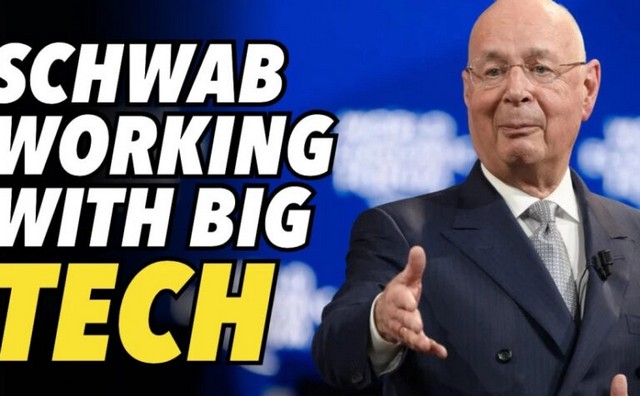
Schwab’s latest venture is the so-called “Global Coalition for Digital Safety” that consists of execs from Big Tech and government officials with the goal of creating a “global framework” for regulating speech on the Internet, wiping it of so-called “harmful content.”

[I could not help but think of the Committee of Public Safety that conducted the reign of terror during the French Revolution.]

And who gets to define what’s “harmful”? Why, the global coalition set up by the elitist WEF of course!

The “harmful” content targeted by this Global Coalition for Digital Safety you can bet will be tailor made to entrap those who stand for limited government, traditional values and individual freedom. Those of us who still believe in such things will not be included in the WEF’s definition “inclusive,” “equality” or “diversity.”

“The Global Coalition for Digital Safety is a public private platform for global, multi stakeholder cooperation to develop innovations and advance collaborations that tackle harmful content and conduct online,” states the WEF on its website.

Microsoft immediately announced it was on board with the WEF’s plan to squelch free speech on the Internet.

Chief digital safety officer for Microsoft Courtney Gregoire stated:

“Technology offers tools to learn, play, connect, and contribute to solving some of the world’s greatest challenges. But digital safety harms remain a threat to these possibilities. As the World Economic Forum is uniquely positioned to accelerate the public-private collaboration needed to advance digital safety globally, Microsoft is eager to participate and help build whole-of-society solutions to this whole-of-society problem.”

Facebook also seems excited to get started on finding new ways to groom users to start thinking about turning in their friends for wrongthink. The social media giant has begun sending cryptic messages to some users that read as follows:

“Are you concerned that someone you know is becoming an extremist?”

This program fits perfectly with the rhetoric coming out of Washington since Biden claimed the presidency.

Biden and his attorney general, Merrick Garland, take every opportunity to talk about “extremists” on the right being the “biggest threat to our democracy.” This is a classic propaganda technique used to turn public sentiment against a targeted demographic. The Nazis perfected this, using the media to blame all of Germany’s problems on Jews before they actually started rounding them up and making them disappear.

The next phase in this evil plan is to encourage Americans to turn each other in to the online thought police. What happens next, after one has been reported to Facebook, Google or Microsoft? Will the tech giants turn those accused of thought crimes by their online “friends” and “followers” over to Biden’s politicized FBI? This is exactly how it works in China.

Readers of this blog know that China is the model being touted by those who believe in the Great Reset. Now their plans are right out in the open on the World Economic Forum website with this announcement of their Global Coalition for Digital Safety.

The WEF states:

“With the growing challenge to counter health misinformation, violent extremist and terrorist content, and the exploitation of children online, there is an urgent need for more deliberate global coordination to improve digital safety.

“The Global Coalition for Digital Safety aims to accelerate public-private cooperation to tackle harmful content online and will serve to exchange best practices for new online safety regulation, take coordinated action to reduce the risk of online harms, and drive forward collaboration on programs to enhance digital media literacy.”

In the above quote, notice how sneakily the WEF lumps spreaders of “health misinformation” – that would be anyone who expresses reticence about experimental mass vaccination programs, COVID lockdowns, mandatory mask wearing, etc. – in with violent extremists, terrorists and child traffickers. How clever.

The WEF has the audacity to claim its coalition will be “impartial” in policing the Internet. This is the same organization run by Schwab, who openly states that the pandemic should be exploited as a “unique window of opportunity” to fundamentally change the way the people live, work, do business and fit into society.

“The Forum is uniquely positioned to leverage its impartial platform and convening power to drive public-private cooperation amongst key stakeholders focused on improving safety online,” the WEF states in its release about the new coalition.

The WEF sets itself up as the global arbiter that defines terms like “harmful content” and “misinformation.” It also laments the fact that encrypted social media channels like Telegram and Signal are able to allow users to communicate free of censorship and spying.

Here are its recommendations for “key focus areas that now require coordinated action” by governments and their Big Tech allies:

  1. Share Best Practices on Safety Standards: Exchange knowledge on policies and practices for improving online safety, considering content policies, remedies, transparency reports, use of data, and new technologies
  2. Address Balance of Privacy and Safety: Share best practices on addressing the growing tension between privacy and safety as harmful content on encrypted channels risks evading detection
  3. Market Competition: Drive better alignment between regulations focused on safety and competition to foster market innovation and enable consumer choice
  4. Cross-Jurisdictional Content Cooperation: Enable action on content that spans jurisdictions and requires greater coordination amongst countries (e.g. content created in one county but causing harm in another)
  5. Definitional Alignment: Support work on consistent definitions for content categories, such as self-harm and cyber-bullying to enable standardized enforcement, reporting, and measurement across regions.

If COVID taught us anything, it’s that Big Tech social-media platforms, in league with global power elites, defined for us what is allowed and not allowed to be said on the Internet.

Posts that challenge the official narrative about the virus and the best way to respond to it were immediately censored, either tagged with warnings meant to discredit the posts or removed all together.

The most typical reason for such censorship was that these posts “violated community standards,” which consist of mysterious, vaguely worded legalese that nobody reads.

Big Tech corporations are also increasingly working in concert with governments around the world, including in the U.S. and the ruling Chinese Communist Party in China, to regulate what people are allowed to see on the Internet.

But all of this control over the free flow of information is not enough for some of the global power elites.

Now they are ready to take their Gestapo tactics to the next level.

They want to turn us against each other.

Don’t let them do it.

Now is the time for all freedom-loving patriots in nations across the world to wake up, rise up, recognize these tactics as divisive and anti-human, and unite against this pernicious group of global predators.

LeoHohmann.com: Investigative reporting on globalism, Christianity, Islam, Judaism and where politics, culture and religion intersect.

12 July 2021

Source: www.transcend.org

The Syria Deception: The Public Has Been Hoodwinked Yet Again into Supporting a Criminal War of Aggression—and One That Has Been Effectively Lost

By Jeremy Kuzmarov

8 Jul 2021 – United States warmakers have become so skilled at propaganda that not only can they wage a war of aggression without arousing protest; they can also compel liberals to denounce peace activists using language reminiscent of the McCarthy era.

Take the case of Syria. The people and groups one would normally count on to oppose wars have been the ones largely defending it. They have also often been the ones to label war opponents as “Assad apologists” or “genocide deniers”—causing them to be blacklisted.

In April, The Nation magazine published an essay by Gilbert Achcar, a professor of international relations at the University of London and co-author with Noam Chomsky of a book critical of U.S. foreign policy in the Middle East, entitled “How to Avoid the Anti-Imperialism of Fools.”

Achcar divides the Left into two factions—one which “opposes all forms of imperialism and oppression,” and one which “supports any regime or force that is the object of Washington’s hostility.” The latter includes “Russia’s thuggish capitalist and imperialist government, or Iran’s theocratic regime or the likes of Slobodan Milošević and Saddam Hussein.”

The binary Achcar paints is misleading because it does not take into account war critics’ attempts to present more nuanced portraits of American targets for regime change like Putin or Milošević or even Hussein that would account for their domestic popularity. Nor the value placed on the principle of national self-determination and sovereignty, and identification of the double standards of U.S. human rights concerns.

Achcar supports military intervention in Syria under the UN doctrine of Responsibility to Protect (R2P), which enables foreign military intervention if it will stop large-scale human rights abuses.

He quotes favorably in his Nation article from a 2019 statement signed by several prominent figures on the American Left—including Judith Butler, Noam Chomsky, the late David Graeber and David Harvey—demanding that the United States “continue military support for the Kurdish-led Syrian Democratic Force,” in the face of Donald Trump’s announced withdrawal.

This position was based on fear that if the U.S. withdrew, the Kurds would be slaughtered by Turkey, the Islamic State in the Levant (ISIS) or the “murderous Assad regime,” as Achcar termed it.

The Kurds, however, were being used as a proxy force by the U.S. in a regime-change operation that would enable foreign exploitation of Syria’s oil and military domination of the Middle East—and would inevitably be abandoned.

Western empires had used the pretext of human rights many times before to justify colonization, and recruited disaffected minority groups, which was no different in this case.

Voices from Syria

Mark Taliano and Basma Qaddour’s book, Voices from Syria—now out in its second edition—offers a strong rebuttal to Achcar and others who consider opponents of U.S. military intervention in Syria to be foolish.

The authors—one a Montreal based teacher, the other a Syrian journalist—point out that the majority of Syrians consider Assad an authentic nationalist who has saved Syria from jihadist terrorists sponsored by the U.S., NATO, Saudi Arabia, Turkey, Israel and Gulf Arab states like Qatar.

The terrorists have killed an estimated 150,000 civilians and another 260,000 fighters and kidnapped thousands more, some of whom were used for illegal organ harvesting.

Their goal is to impose a theocratic regime and to divide, plunder and exploit Syria and open it up to predatory foreign corporations.

Taliano and Qaddour write that “Syria’s stand against the Western agencies of death and destruction is a stand for all humanity against the dark forces that fester beneath our politicians’ empty words and the courtesan media’s toxic lies.”

These lies have ensured that few in the U.S. or West have acknowledged Syria’s heroic victory against colonial aggression—a modern-day equivalent to Vietnam’s victory over the French at the Battle of Dien Bien Phu in 1954.

Long-Standing Plan for Regime Change

Two weeks after the September 11th attacks, General Wesley Clark was visited by a senior general who told him that the U.S. was going to attack Iraq: “The decision has basically been made.”

Six weeks later, when Clark returned to Washington to visit the same general and asked whether the plans for invading Iraq were still in place, the general responded, “‘Oh, it’s worse than that,’ he said, holding up a memo on his desk. ‘Here’s the paper from the Office of the Secretary of Defense [then Donald Rumsfeld] outlining the strategy. We’re going to take out seven countries in five years.’ And he named them, starting with Iraq and Syria and ending with Iran.”

The key to the success of these latter operations was to convince the U.S. public that wars of aggression were military interventions carried out for humanitarian purposes. The way to do that was to give off the illusion that the targeted leaders were brutal dictators intent on waging a campaign of genocide against their own people.

Assad’s Accomplishments

Syria was a main target on Rumsfeld’s list because its leader, Bashar al-Assad, was a secular nationalist like Saddam Hussein and Muammar Qaddafi of Libya, who was defiant of the West.

In 2000, Bashar succeeded his father Hafez al-Assad, who had long been a thorn in the side of the West. He had allied Syria with the Soviet Union during the Cold War, and in 1971 allowed the Russians to establish a naval base at Tartus.

Though vilified in the West, Bashar retains support of the majority of Syrians because he has advanced free health care and education for Syrians and retained Syrian control over most of its economy while rallying the people against foreign aggression.

While certainly there are brutal aspects to his rule like with his father, Assad’s accomplishments before the war, according to Taliano and Qaddour, included: a) construction and restoration of 10,000 mosques and 500 churches; b) construction of 8,000 schools; and c) construction of 600,000 apartment units for young people and 6,000 hospitals and clinics.

Further, salaries increased by 300 percent under Assad’s rule, thousands of new businesses sprung up, agricultural and industrial capacity increased, the illiteracy rate was kept low, and the unemployment rate declined from 28 to 12 percent.

These facts are at odds with the depiction of Assad as a genocidal tyrant.

The latter is part of a demonization campaign initiated by intelligence agencies and embraced by factions of the Left that have unwittingly helped to advance the agenda of the U.S. empire.

“Your Obama Leading Proxy War”

In March 2011, Americans were led to believe that idealistic pro-democracy demonstrations erupted in the southern city of Daraa—inspired by Arab Spring protests in Egypt and Tunisia, and following an incident of police brutality.

Seven police were killed by the demonstrators in the very first protests, and 60 security forces were massacred two weeks later. The plan of the mob was to provoke a police response that would make it seem like the security forces were reacting harshly, which would discredit Assad’s regime.
At least 37 people have died in violent protests since last week in Daraa, the U.N says.

For the first three weeks, police and security personnel were under orders, though, not to carry guns.

As the protests spread, foreign terrorists began descending on Syria and were paid $300-$400 per month. Although Syrian soldiers were paid only one-tenth of that amount, they remained mostly loyal to the Syrian government.

Majd al-Zaim, a Syrian, stated that what had happened in Syria was “not a revolution or civil war [as has been depicted in the Western media]. The terrorists are sent by your government [the U.S.]. They are Al-Qaeda, Jabhat al-Nusra, Wahhabi, Salafist, Talibans and the extremist jihadists are sent by the West, Saudis, Qataris, Turkey…. Your Obama and whoever is behind him or above him are supporting Al-Qaeda and leading a proxy war on my country.”

Historical Background

Historically, Syria faced divisions between secular nationalist and Shia Alawites and Sunni fundamentalists who allied with the Muslim Brotherhood.

In 1982, Hafez al-Assad crushed an Islamic rebellion (the Hama massacre), foreshadowing his son’s actions 30 years later.

A July 1986 declassified CIA document outlined a U.S. strategy in Syria that was hostile to Assad—as it remains. The document stated that “In our view, U.S. interests would be best served by a Sunni regime controlled by business-oriented moderates. Business moderates would see a strong need for Western aid and investment to build Syria’s private economy, thus opening the way for stronger ties to Western governments.”

The report acknowledged that the collapse of the Ba’athist state presided over by Assad could help to empower “religious zealots” seeking to establish “an Islamic Republic.” But this was a risk that Washington was willing to take.

Twenty years later, the Chargé D’affaires at the U.S. embassy in Damascus, William Roebuck, in a leaked diplomatic cable, referred to the threat to the Assad regime from Islamic extremists as “an opportunity that the U.S. should take action to try to increase.”

Roebuck also pushed for better coordination with Egypt and Saudi Arabia in provoking sectarian divisions by exaggerating Iranian influence along with a rumor campaign against Assad, and arming of the Kurds as part of a destabilization strategy, which was implemented under Obama.

An Inhuman Enemy

Voices from Syria tells the stories of the victims of U.S. policy like Ammar, whose sister was killed by a Wahhabi suicide bomber while she was on her way to the local university.

Ammar said that, after the first blast, another suicide bomber blew himself up in the same place, taking advantage of the gathering of people and ambulance teams. At the hospital, Ammar saw many burned and charred bodies, including his sister, who was now a “body without a soul”—like so many others.

Lilly Martin, an American living in Syria, is quoted in Voices from Syria as stating that she could not vote for Hillary Clinton in the 2016 election because Clinton had overseen “the transfer of weapons from Libya to Turkey to be used specifically by the American-backed terrorists.”

These terrorists destroyed Martin’s home on March 21, 2014, beheaded her Christian neighbors and kidnapped and raped the old ladies.

Dr. Declan Hayes described an attack by al-Nusra (U.S.-backed jihadi group) on the village of Kesab where the terrorists swarmed across the border on motorbikes, pick-up trucks, and Western ambulances, and proceeded to desecrate all of Kesab’s churches, loot the village graves and strip the houses of anything of value.

Pepken Djourian and his wife saw their only son executed in front of them, after which his body was left to rot in the sun before being thrown into the ground like a dog.

In another case, terrorists beheaded and executed a captured soldier while he was speaking to his father on the phone so he could hear his son being killed.

The terrorists further roasted bakery workers in a town loyal to Assad in an oven and slaughtered staff at a medical clinic and displayed their severed heads in the marketplace for intimidation.

Operation Timber Sycamore

Some of the head choppers were trained by U.S. military advisers at terrorist training camps in Jordan under the CIA’s $1 billion Operation Sycamore, the largest covert operation since the arming of the mujahadin fighters in Afghanistan to fight the Soviet Union in the 1980s.

Turkish helicopters could be seen overhead during armed terrorist invasions of towns while the Syrian Arab Army was fighting insurgents who wore Turkish military uniforms and carried Turkish military identification.

The Israelis allowed Al Qaeda militants, Jabhat al-Nusra, to use the occupied Golan Heights to fight against the Syrian Army, while the Israeli Air Force repeatedly bombed Syria.

Russia to the Rescue

In “How to Avoid the Anti-Imperialism of Fools,” Gilbert Achcar criticized U.S. and British- based anti-war groups for failing to condemn Russian imperialism in Syria.

Many Syrians, however, laud the Russians for helping to save their country.

Ammar told Taliano and Qaddour that “the Russians provided the biggest humanitarian aid by supporting the Syrian Armed Forces against Western backed barbarian terrorism,” and that Russian aid—including food and medical supplies—was distributed directly to needy people.

Lilly Martin stated that Russia had “saved the Syrian Coast”—along with Syrian towns like Kesab that were on the verge of destruction by the CIA-backed terrorists.

Cruel Economic War

The cruelty of Western policy is exemplified by its economic war on Syria, about which Achcar and his associates have been silent.

The goal of the economic war has been to weaken Syria and demoralize its people so as to pave the way for Syria’s conquest.

Militias affiliated with both the U.S. and Turkey blocked the sale by Syrian peasants of wheat and barley east of the Euphrates, thus exacerbating the food shortage in the country.

They have sold oil illegally in northern Iraq and set fires in an attempt to decimate Syria’s yield of strategic crops. Many of the fires have targeted olive trees, which are used to produce olive oil—a source of livelihood for many Syrians.

The economic sanctions have further prevented needed medical supplies and equipment from getting into Syria and caused milk shortages resulting in the deaths of children.

Fraudulent Pretexts

These sanctions have been legitimated by false propaganda.

The Caesar Syria Civilian Protection Act, which was signed into law in December 2019 by President Donald Trump, was named after a government defector, Caesar, who leaked thousands of photographs alleging torture of civilians by Assad’s security forces.

Nearly half the photos actually showed government soldiers who had been killed and victims of car bombs and other war-related violence, and many others showed soldiers who had died in combat—not government torture centers.

Caesar’s identity was also unclear and he was suspected of being in the employ of the CIA.

More Bright Shining Lies

American-educated opinion about the Syria conflict has been forged by numerous other deceptions.

These include allegations of chemical weapons attacks by Assad—which most Syrians believe were “staged by the terrorists helped by the USA and UK.”

Another deception surrounds the White Helmets—a group of Western-funded humanitarian aid workers that received endorsement from A-list celebrities like George Clooney.

Financed in part by the United States Agency of International Development (USAID), the White Helmets were led by a suspected British MI6 agent, James Le Mesurier, who died under suspicious circumstances in November 2019.

They staged scenes for public relations purposes, assisted in public executions, and functioned as an Al Qaeda affiliate, according to Taliano and Qaddour, which occupied and destroyed more than 7,000 schools.

The War on Terror Is a Fraud

The Syrian War exemplifies that the War on Terror is a fraud.

The U.S. government has claimed for the last two decades to be fighting the scourge of terrorism, but has armed, trained, and supported Islamic terrorists in Syria as part of an imperial strategy designed to control the country’s oil wealth and dominate the entire region.

Another motive is to provoke destabilization so as to justify endless war—which brings huge profits to war industries that fund both major political parties.

U.S. policy in Syria is no anomaly as the U.S. has supported Islamic fundamentalists in Libya, Pakistan, Saudi Arabia, Chechnya, Azerbaijan, Turkey, and Gulf Arab states like Qatar, which allows terrorist financiers to operate in its borders.

Only a very limited number of Americans have recognized the dangers of this strategy—owing in large part to the sophisticated propaganda that has effectively brainwashed many of those who would traditionally identify themselves as antiwar.

NOTE:
1. Declassified British documents obtained by The Grayzone Project showed that Achcar trained British Cultural Defense Units who played a key role in the British war in Afghanistan. The Units have also advised the military on how to operate in other countries, including those that were at one time colonized by Great Britain. See Ben Norton, “Elite UK military unit secretly trained by leftist regime-change advocate Gibert Achcar and other academics,” The Grayzone Project, October 3, 2019, https://thegrayzone.com/2019/10/03/leftist-regime-change-activist-gilbert-achcar-academics-train-uk-military/

Jeremy Kuzmarov is Managing Editor of CovertAction Magazine and author of four books on U.S. foreign policy, including Obama’s Unending Wars (Clarity Press, 2019) and The Russians Are Coming, Again, with John Marciano (Monthly Review Press, 2018).

12 July 2021

Source: www.transcend.org

What Is Wrong With the “Humanitarian Crossing” into Syria?

By Rick Sterling

On Friday July 9 the UN Security Council unanimously agreed to a one year extension of the Bab al Hawa crossing. As part of the agreement, the UN Secretary General needs to report regularly on what is happening with the aid going into the Al Qaeda-dominated zone. Evidently Russia and China thought the time was not right to insist on principle. The problems outlined in this article remain true.

— RS

*************************************

8 Jul 2021 – A friend sent me a link to a Foreign Policy news story about the Turkey / Syria border crossing at Bab al Hawa. He asked, “Is this accurate?” What could be wrong with humanitarian aid?

There have been many such stories, both short and long. The essence of them all in western media is that Bab al Hawa must be kept open for humanitarian reasons. Many of the articles castigate Russia or any other country such as China which might vote to block a renewal of United Nations authorization of the border crossing.

There are important facts which western media stories typically leave out or distort. Here are some reasons why the Bab al Hawa border crossing should NOT be renewed.

* The aid is supporting Syria’s version of Al Qaeda, Hayat Tahrir al Sham (HTS). They control the region on the Syrian side of the crossing. They are the foreigners and hard-core extremists who invaded Idlib from Turkey in 2015 plus those who left Aleppo and other cities when the militants were defeated by the Syrian army. Even if the United Nations inspects all the trucks going into Idlib province in northern Syria, the truck deliveries are ultimately controlled by HTS (formerly called Jabhat al Nusra).

* The aid is effectively supporting the partition of Syria. Idlib province, and the militants which govern there, seek to separate permanently from Syria. They are attempting to Turkify the region through sectarian education, promoting the Turkish language and even using Turkish currency.

* The aid violates the United Nations Charter which says all member countries shall refrain from threatening the territorial integrity of another member state. Turkey and the USA are the major violators, since they have military troops illegally occupying Syrian lands. But it is a shame for the United Nations to be complicit through the authorization of aid to the breakaway Al Qaeda dominated region.

* The aid to northwest Syria is prolonging the conflict instead of helping end it. It is evident that after failing to militarily overthrow the Syrian government, western powers are now using other means to attack Damascus. They continue to interfere in Syria’s domestic affairs. Led by the USA, they have economically attacked Syria while pouring support into the breakaway northwest region.

* Western aid to the Al Qaeda dominated region distracts from the pain, damage, and destruction which US and European sanctions have wreaked on most Syrians. The Caesar sanctions, imposed by the USA amid the Covid19 pandemic, have had a horrendous impact. By outlawing the Syrian Central Bank and making it nearly impossible to trade with Syria, US sanctions have undermined the Syrian currency. Many goods have increased in price by 4 and 5 and even 10 times. Like a modern-day gangster, the US has been openly stealing the oil and wheat from eastern Syria. The US has attacked the electrical grid by prohibiting parts, engineering, or construction to repair or rebuild power plants. “Caesar” sanctions prohibit support for anything government related including schools and hospitals.

According to a December 2020 United Nations General Assembly resolution, Unilateral Coercive Measures such as the “Caesar” law are illegal and a violation of the UN Charter, international law, and international human rights law. Yet because of US global economic dominance, it is still in force and the US claims the right to prohibit any country, company, or individual from supporting or trading with Syria. This is what makes US claims to humanitarian concern so ironic and cynical.

* The western aid to Syrians through Bab al Hawa is discriminatory and serves to divide the country. Before the conflict Idlib province had a total population of 1.5 million persons and the number is LESS today. Much of the population left when the province was over-run by extremists. Some fled into Turkey; others fled to Latakia province to the west. Some opposition militants and their supporters chose to go to Idlib rather than reconcile with the government. For example, when East Aleppo was taken back by government soldiers, there were about thousands of militants and their families transferred – but not hundreds of thousands as was incorrectly predicted in the wave of propaganda before East Aleppo was recaptured. So, in contrast with some estimates, there are one million or fewer persons in Idlib.

The civilians in North West Syria are being effectively bribed to live there through cash payments and vastly greater relief. One thousand trucks per month are taking aid into northwest Syria. As noted in in OCHA document, people are “incentivized by access to services and livelihoods.” This is understandable but the divisive effect is also clear.

In contrast, there are between 14 and 17 million Syrians living elsewhere in Syria. They are receiving little if any of the aid. Instead, they are bearing the brunt of vicious US unilateral coercive measures.

* Aid to civilians in Syria should be distributed fairly and proportionally. This can be done with monitoring or supervision by a respected international agency such as the Red Crescent / Red Cross. In keeping with the UN Charter, western countries should respect the political independence of the Syrian government and stop their continuing interference and efforts at “regime change”.

Weaponizing “Humanitarian Aid”

There are many western NGOs crying out about Bab al Hawa. For example, the International Rescue Committee has raised many millions of dollars which should have gone to help all Syrians but has not. Their literature should be carefully considered however because – according to their 2019 tax returns – western governments are their main funders at $440M in 2019. The CEO, David Miliband, is well compensated at over $1 million per year. We can be sure they keep on message with the US State Department.

Humanitarian aid is big business and has been politically weaponized. While there are many well-meaning people working hard, there political agendas at work.

If Russia and other nations in the UN Security Council veto the extension of the Bab al Hawa crossing, there are good reasons why.

Rick Sterling is a member of the TRANSCEND Network and an investigative journalist who lives in the SF Bay Area, California.

12 July 2021

Source: www.transcend.org

AFGHANISTAN AT A CROSSROADS: Graveyard for Empires or Start of a New Era?

By Helga Zepp-LaRouche

After the hasty withdrawal of U.S. and NATO troops from Afghanistan—U.S. troops, except for a few security forces, were flown out in the dark of night without informing Afghan allies—this country has become, for the moment but likely not for long, the theater of world history. The news keeps pouring in: On the ground, the Taliban forces are making rapid territorial gains in the north and northeast of the country, which has already caused considerable tension and concern in Turkmenistan, Uzbekistan, and Tajikistan, and they have captured the western border town Islam Qala, which handles significant trade flows with Iran. At the same time, intense diplomatic activity is ongoing among all those countries whose security interests are affected by the events in Afghanistan: Iran, Pakistan, India, Russia, China, to name only the most important.

Can an intra-Afghan solution be found? Can a civil war between the Afghan government and the Taliban be prevented? Can terrorist groups, such as ISIS, which is beginning to regain a hold in the north, and Al-Qaeda, be disbanded? Or will the war between Afghan factions continue, and with it the expansion of opium growing and export, and the global threat of Islamic terrorism? Will Afghanistan once again sink into violence and chaos, and become a threat not only to Russia and China, but even to the United States and Europe?

If these questions are to be answered in a positive sense, it is crucial that the United States and Europe first answer the question, with brutal honesty, of how the war in Afghanistan became such a catastrophic failure, a war waged for a total of 20 years by the United States, the strongest military power in the world, together with military forces from 50 other nations. More than 3,000 soldiers of NATO and allied forces, including 59 German soldiers, and a total of 180,000 people, including 43,000 civilians, lost their lives. This was at a financial cost for the U.S. of more than $2 trillion, and of €47 billion for Germany. Twenty years of horror in which, as is customary in war, all sides were involved in atrocities with destructive effects on their own lives, including the many soldiers who came home with post-traumatic stress disorders and have not been able to cope with life since. The Afghan civilian population, after ten years of war with the Soviets in the 1980s followed by a small break, then had to suffer another 20 years of war with an almost unimaginable series of torments.

It was clear from the start that this war could not be won. Implementation of NATO’s mutual defense clause under Article 5 after the 9/11 terrorist attacks was based on the assumption that Osama bin Laden and the Taliban regime were behind those attacks, which would thus justify the war in Afghanistan.

But as U.S. Senator Bob Graham, the Chairman of the Congressional “Joint Inquiry into Intelligence Community Activities Before and After the Terrorist Attacks of September 11, 2001,” repeatedly pointed out in 2014, the then-last two U.S. presidents, Bush and Obama, suppressed the truth about who had commissioned 9/11. And it was only because of that suppression that the threat to the world from ISIS then became possible. Graham said at a November 11, 2014 interview in Florida:

“There continue to be some untold stories, some unanswered questions about 9/11. Maybe the most fundamental question is: Was 9/11 carried out by 19 individuals, operating in isolation, who, over a period of 20 months, were able to take the rough outlines of a plan that had been developed by Osama bin Laden, and convert it into a detailed working plan; to then practice that plan; and finally, to execute an extremely complex set of assignments? Let’s think about those 19 people. Very few of them could speak English. Very few of them had even been in the United States before. The two chairs of the 9/11 Commission, Tom Kean and Lee Hamilton, have said that they think it is highly improbable that those 19 people could have done what they did, without some external support during the period that they were living in the United States. I strongly concur…. Where did they get their support?”

This question has still not been answered in satisfactory manner. The passing of the JASTA Act (Justice Against State Sponsors of Terrorism) in the U.S., the disclosure of the 28 previously classified pages of the Joint Congressional Inquiry report into 9/11 that were kept secret for so long, and the lawsuit that the families of the 9/11 victims filed against the Saudi government delivered sufficient evidence of the actual financial support for the attacks. But the investigation of all these leads was delayed with bureaucratic means.

The only reason the inconsistencies around 9/11 are mentioned here, is to point to the fact that the entire definition of the enemy in this war was, in fact, wrong from the start. In a white paper on Afghanistan published by the BüSo (Civil Rights Movement Solidarity in Germany) in 2010, we pointed out that a war in which the goal has not been correctly defined, can hardly be won, and we demanded, at the time, the immediate withdrawal of the German Army.

Once the Washington Post published the 2,000-page “Afghanistan Papers” in 2019 under the title “At War with the Truth,” at the latest, this war should have ended. They revealed that this war had been an absolute disaster from the start, and that all the statements made by the U.S. military about the alleged progress made were deliberate lies. The investigative journalist Craig Whitlock, who published the results of his three years of research, including the use of documents obtained under the Freedom of Information Act (FOIA), and statements from 400 insiders demonstrated the absolute incompetence with which this war was waged.

Then, there were the stunning statements of Lt. Gen. Douglas Lute, the Afghanistan czar under the Bush and Obama administrations, who in an internal hearing before the “Office of the Special Inspector General for Afghanistan Reconstruction” in 2014 had said: “We were devoid of a fundamental understanding of Afghanistan—we didn’t know what we were doing. … What are we trying to do here? We didn’t have the foggiest notion of what we were undertaking…. If the American people knew the magnitude of this dysfunction … who would say that it was all in vain?”

After these documents were published, nothing happened. The war continued. President Trump attempted to bring the troops home, but his attempt was essentially undermined by the U.S. military. It’s only now, that the priority has shifted to the Indo-Pacific and to the containment of China and the encirclement of Russia that this absolutely pointless war was ended, at least as far as the participation of foreign forces is concerned.

September 11th brought the world not only the Afghanistan War but also the Patriot Act a few weeks later, and with it the pretext for the surveillance state that Edward Snowden shed light on. It revoked a significant part of the civil rights that were among the most outstanding achievements of the American Revolution, and enshrined in the U.S. Constitution, and it undermined the nature of the United States as a republic.

At the same time, the five principles of peaceful coexistence, which are the essence of international law and of the UN Charter, were replaced by an increasing emphasis on the “rule-based order,” which reflects the interests and the defense of the privileges of the trans-Atlantic establishment. Tony Blair had already set the tone for such a rejection of the principles of the Peace of Westphalia and international law two years earlier in his infamous speech in Chicago, which provided the theoretical justification for the “endless wars”—i.e., the interventionist wars carried out under the pretext of the “responsibility to protect” (R2P), a new kind of crusades, in which “Western values,” “democracy” and “human rights” are supposed to be transferred—with swords or with drones and bombs—to cultures and nations that come from completely different civilizational traditions.

Therefore, the disastrous failure of the Afghanistan war—after the failure of the previous ones, the Vietnam war, the Iraq war, the Libya war, the Syria war, the Yemen war—must urgently become the turning point for a complete shift in direction from the past 20 years.

Since the outbreak of the Covid-19 pandemic at the very latest, an outbreak that was absolutely foreseeable and that Lyndon LaRouche had forecast in principle as early as 1973, a fundamental debate should have been launched on the flawed axiomatics of the Western liberal model. The privatization of all aspects of healthcare systems has certainly brought lucrative profits to investors, but the economic damage inflicted, and the number of deaths and long-term health problems have brutally exposed the weak points of these systems.

The strategic turbulence caused by the withdrawal of NATO troops from Afghanistan, offers an excellent opportunity for a reassessment of the situation, for a correction of political direction and a new solution-oriented policy. The long tradition of geopolitical manipulation of this region, in which Afghanistan represents in a certain sense the interface, from the 19th Century “Great Game” of the British Empire to the “arc of crisis” of Bernard Lewis and Zbigniew Brzezinski, must be buried once and for all, never to be revived. Instead, all the neighbors in the region—Russia, China, India, Iran, Pakistan, Saudi Arabia, the Gulf States and Turkey—must be integrated into an economic development strategy that represents a common interest among these countries, one that is defined by a higher order, and is more attractive than the continuation of the respective supposed national interests. This higher level represents the development of a trans-national infrastructure, large-scale industrialization and modern agriculture for the whole of Southwest Asia, as it was presented in 1997 by EIR and the Schiller Institute in special reports and then in the study “The New Silk Road Becomes the World Land-Bridge.” There is also a comprehensive Russian study from 2014, which Russia intended to present at a summit as a member of the G8, before it was excluded from that group.

In February of this year, the foreign ministers of Pakistan, Afghanistan and Uzbekistan agreed on the construction of a railway line from Tashkent, the capital of Uzbekistan, via Mazar-e-Sharif and Kabul, Afghanistan, to Peshawar in Pakistan. An application for funding from the World Bank was submitted in April. At the same time, the construction of a highway, the Khyber Pass Economic Corridor, between Peshawar, Kabul and Dushanbe was agreed to by Pakistan and Afghanistan. It will serve as a continuation of the China-Pakistan Economic Corridor (CPEC), a showcase project of the Chinese BRI.

These transportation lines must be developed into effective development corridors and an east-west connection between China, Central Asia, Russia, and Europe as well as a north-south infrastructure network from Russia, Kazakhstan and China to Gwadar, Pakistan on the Arabian Sea, all need to be implemented.

All these projects pose considerable engineering challenges—just consider the totally rugged landscape of large parts of Afghanistan—but the shared vision of overcoming poverty and underdevelopment combined with the expertise and cooperation of the best engineers in China, Russia, the U.S.A., and Europe really can “move mountains” in a figurative sense. The combination of the World Bank, Asian Infrastructure Investment Bank (AIIB), the BRICS (Brazil, Russia, India, China, South Africa) New Development Bank, New Silk Road Fund, and national lenders could provide the necessary lines of credit.

Such a development perspective, including for agriculture, would also provide an alternative to the massive drug production plaguing this region. At this point, over 80% of global opium production comes from Afghanistan, and about 10% of the local population is currently addicted, while Russia not so long ago defined its biggest national security problem as drug exports from Afghanistan, which as of 2014 was killing 40,000 people per year in Russia. The realization of an alternative to drug cultivation is in the fundamental interest of the entire world.

The Covid-19 pandemic and the risk of further pandemics have dramatically underscored the need to build modern health systems in every single country on Earth, if we are to prevent the most neglected countries from becoming breeding grounds for new mutations, and which would defeat all the efforts made so far. The construction of modern hospitals, the training of doctors and nursing staff, and the necessary infrastructural prerequisites are therefore just as much in the interests of all political groups in Afghanistan and of all countries in the region, as of the so-called developed countries.

For all these reasons, the future development of Afghanistan represents a fork in the road for all mankind. At the same time, it is a perfect demonstration of the opportunity that lies in the application of the Cusan principle of the Coincidentia Oppositorum, the coincidence of opposites. Remaining on the level of the contradictions in the supposed interests of all the nations concerned— India-Pakistan, China-U.S.A., Iran-Saudi Arabia, Turkey-Russia—there are no solutions.

If, on the other hand, one considers the common interests of all—overcoming terrorism and the drug plague, lasting victory over the dangers of pandemics, ending the refugee crises—then the solution is obvious. The most important aspect, however, is the question of the path we as humanity choose—whether we want to plunge further into a dark age, and potentially even risk our existence as a species, or whether we want to shape a truly human century together. In Afghanistan, it holds true more than anywhere else in the world: The new name for peace is development!

Helga Zepp-LaRouche is a German political activist.

11 July 2021