Just International

G7 no longer able to order world around

By Martin Jacques

In these Covid times, “There is an ongoing attempt to reframe G7 as the representative and champion of the democratic world in the struggle against autocracy, shorthand for China…. West’s indifference to the vaccination needs of the developing world will be on full display at the G7 summit”.

***

Fine words will accompany the G7 summit this week. Much will be promised. And little will be delivered. It has long been like this. The G7 is no longer fit for purpose. Comprising the US, UK, Germany, France, Italy, Canada and Japan, in the 1970s the G7 was the overlord of the global economy. Today, the G7 is but a pale shadow of what it once was, reduced to the role of a declining faction within the global economy. It still talks in grandiose terms about its intentions, but the world has learnt to discount them. It is entirely appropriate that this week’s summit will be chaired by UK Prime Minister Boris Johnson, a grandmaster of verbal exaggeration and empty gestures.

The role and importance of the G7 has been greatly diminished by the rise of the developing world. The latter now accounts for almost two-thirds of the global economy compared with one-third by the West: in the 1970s, it was exactly the opposite, the West enjoying a two-third share and the developing world just one-third. The most dramatic illustration of the G7’s waning authority came in 2008 when, at the height of the financial crisis, it was effectively displaced by the more representative G20.

Ever since, the G7 has increasingly become an institution in search of a role. Under Biden, as if to confirm its eclipse as a global institution, there is an ongoing attempt to reframe G7 as the representative and champion of the democratic world in the struggle against autocracy, shorthand for China. To this end, South Korea, India, Australia and South Africa have been invited to attend the G7 summit this week. There is even talk of the G7 becoming the D10 (D being a reference to democracy). This, however, would only serve to emphasize the declining authority of the G7: from global leader to ideological sect.

The truth, however, is that this proposal is unlikely to gain assent either among existing G7 members or potential new members, excepting perhaps Australia. Here we get to the heart of the crisis of the G7. It is the rise of China, above all else, that has transformed the global economy, sidelined the G7 and, at the same time, reconfigured the various G7 economies.

Good relations with China are fundamental to the economic prospects of Germany, France and Italy. That is why they are opposed to the G7 becoming an anti-China crusade. So is Japan; and likewise would-be recruits such as South Korea and South Africa. Here laid bare, then, are the fault lines of the G7 and any potential extended membership.

The West is divided and fragmenting. The authority of the US is in decline, no longer able to get its way as it once was.

The best illustration of the growing impotence of the G7 concerns its relationship with the developing world. For eight years, the West has been trying to find a way of responding to the China-proposed Belt and Road Initiative (BRI). The subject is due to be raised again at this week’s G7 summit.

All the ideas that have been offered as a basis of a Western alternative to BRI have come to nought. This failure is extraordinarily significant and most revealing about the West on the one hand and China on the other.

BRI is an eloquent articulation of China’s relationship with the developing world, rooted in its own semi-colonial past and its position as a developing country.

The West, in contrast, has failed because its history has been precisely the opposite, one of colonization and the exploitation and subjugation of these countries. It has neither the experience, empathy nor motivation that is required. The existential gap between the rich Western world and the developing world is a multidimensional chasm.

A dramatic example of the West’s indifference to the needs of the developing world will be on full display at the G7 summit. Although the US and UK, and increasingly Western Europe, have vaccinated a majority of their populations against COVID-19, the UK, to take one example, has not exported a single dose of vaccine to the developing world. It has kept all its vaccines for itself, even though its existing stock far exceeds its own future needs. As each new variant spreads around the world, however, it has become patently clear to everyone that no country will be protected until every country is protected.

In a pandemic, no country is an island. The US, which has so far failed to export a single dose of vaccine, is promising to export 80 million doses of vaccines later this year. Compare this with China’s record. In addition to the 777 million vaccinations already carried out in China, it has exported more than 300 million doses of vaccines to the developing world. Over half the vaccinations in Latin America, for example, have been sourced by China. It seems all too likely that the West will fail in its moral responsibility to vaccinate the developing world until it is too late and many millions have died unnecessarily.

***

Courtesy : globaltimes.cn, Jun 08, 2021.

Martin Jacques was until recently a Senior Fellow at the Department of Politics and International Studies at Cambridge University.

10 June 2021

SOurce: countercurrents.org

Four members of a Muslim family killed in London, Ontario terrorist atrocity

By Roger Jordan

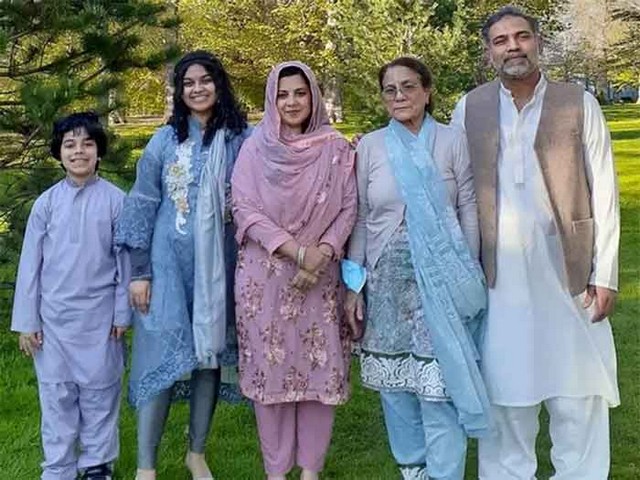
Four members of a Muslim family in London, Ontario were brutally slain Sunday night in a hit-and-run attack that police have described as “premeditated” and motivated by “hate” towards Islam and Muslims.

Police have revealed next to nothing about what they know about the far-right political views and connections of the 20-year-old assailant, Nathaniel Veltman. But they have characterized his murderous attack as a “hate crime” and have said they are considering adding “terrorism charges” to the four counts of murder and one of attempted murder laid against him on Monday.

The victims, whom Veltman struck at high speed with his black pickup truck at 8:40 p.m. Sunday while they were out for a stroll, are 46-year-old Salman Afzaal, his unnamed 74-year-old mother, his 44-year-old wife, Madiha Salman, and their 15-year-old daughter, Yumna Afzaal. Fayez Afzaal, aged nine, survived the attack and remains in hospital with serious injuries.

Salman reportedly came from Pakistan and was a well-known member of the Muslim community in London, which is one of Canada’s oldest. Danveer Chaudry, a family friend, said Salman was involved in community work at the local mosque. “He was a very humble guy, always there for the community. I feel sorry that we were not in touch in the last year because of COVID. When I heard this tragedy, my heart is in so much pain and sorrow,” he told CBC.

The authorities have said the assailant was wearing a body armour-style vest when he was detained by police 10 minutes after the attack. But as of yesterday afternoon, almost 48 hours after his arrest, they have said nothing about his background, including whether he was employed, unemployed or a student, had ties to a far-right group, or made any statement on his arrest.

A Reuters report released Monday night noted that relatives of the deceased had released a statement saying that Veltman’s attack was supported by a group with which he was associated. However, neither their statement nor any other publicly available report has identified the group.

Although details about Veltman’s past and political views are being kept strictly under wraps, the fact that the police are even considering terrorism charges indicates that substantial evidence of his association with the far right must be in their possession.

Adopted on the pretext of the 9/11 attacks, Canada’s draconian anti-terrorism laws have been invoked multiple times against Islamist extremists, including those entrapped by state agents. But Crown prosecutors and the police-security agencies have generally declined to bring terrorism charges against fascist and other far-right assailants.

For example, Alexandre Bissonnette, who killed six Muslims in an armed assault on the Quebec City mosque in January 2017, was convicted on six charges of first-degree murder. However, he faced no terrorism charges, even though his far-right convictions, including support for Trump and the French neo-fascist Marine Le Pen and hatred of Muslims, were well established.

Canadian political leaders acknowledged the political character of Veltman’s bloody crime. “This killing was no accident,” declared Prime Minister Justin Trudeau in a Tuesday House of Commons speech. “This was a terrorist attack.” He placed Veltman’s murderous rampage in the context of the Quebec City mosque shooting, the murder of a man at an Ontario mosque last September, and the harassment of black Muslim women in Edmonton, Alberta. He vowed to “dismantle far-right groups” and pointed to the government’s placing of the Proud Boys on Canada’s terrorism watch list as proof of its readiness to act.

New Democratic Party leader Jagmeet Singh declared that the attack had its source in “pervasive racism” in Canada. “The reality is this is our Canada,” Singh said. “How many more families will be killed before we do something? Another family can’t be mauled down in the streets and nothing happens. Muslims are not safe in this country.”

Behind these crocodile tears, the representatives of the political establishment are unwilling and incapable of acknowledging that the rise of Islamophobia and far-right forces is a direct product of the foreign and domestic policies pursued and supported by all parties in parliament. Contrary to Singh’s fatuous attempt to blame the entire population for anti-Muslim hysteria and discrimination with references to “our Canada,” the reality is that these reactionary sentiments have been systematically stoked and deployed to deadly effect by the Canadian ruling class.

Taking the neocolonial invasion and occupation of Afghanistan as a starting point, Canadian imperialism has been engaged in almost perpetual war for the past 20 years. Canada’s involvement in the US-led onslaughts against Afghanistan, Iraq, Libya and Syria have not only brutalized Canadian society, conveying the impression that all problems can be overcome by resorting to military force and high-powered firearms, but facilitated the eruption of virulent Islamophobia at home. This has proceeded in tandem with a savage assault on social spending and the gutting of democratic rights, including workers’ right to strike, which has ratcheted up social tensions to the breaking point, accelerated the growth of social inequality and created urban landscapes dominated by mass poverty and precarious employment.

To enforce this class war agenda against widespread social opposition, sections of the ruling elite have cultivated direct ties with far-right groups. This includes the use of fascistic thugs by company management at the Federated Cooperatives Ltd. oil refinery in Saskatchewan to intimidate locked out workers.

The Canadian ruling class’s response to the COVID-19 pandemic epitomizes the brutality of contemporary capitalist society. It has systemically prioritized profits over lives. While more than 25,000 Canadians have lost their lives to COVID-19, the country’s 48 billionaires have gained $78 billion in wealth during the 16-month-long pandemic.

Far-right forces, like Maxime Bernier’s People’s Party and the right-wing populist Coalition Avenir Quebec (CAQ), which currently forms Quebec’s provincial government, have undoubtedly spearheaded the demonization of the Muslim population. In 2015, the Conservative government of Stephen Harper, in which Bernier served, proposed setting up a “barbaric cultural practices” snitch line targeting Muslims. In 2019, the CAQ, to wide applause from Quebec’s ruling elite, adopted legislation, Bill 21, that attacks religious minorities, and especially Muslim women, by prohibiting the wearing of “religious signs” by public sector workers, including teachers, in “positions of authority;” and by denying public services, including health care and education, to observant women who wear the burka or niqab.

If these chauvinist and far-right forces have been able to act with such aggressiveness, it is because the discriminatory measures they propose have been given credibility and even endorsed by forces on the so-called “left.” For more than a decade Québec Solidaire, a pseudo-left party that supports Quebec independence, described the reactionary debate over “excessive accommodation” to immigrants and minorities out of which Bill 21 emerged as “necessary.” And while Singh took pot shots Tuesday at “politicians” who “have used Islamophobia for political gain,” the reality is that his own NDP is the lynchpin propping up the Trudeau minority government. A government that has continued and expanded Canada’s participation in US aggression and war in the Middle East and intensified its collaboration, under both Trump and Biden, with the fascistic Immigration and Customs Enforcement in the United States to stop refugees fleeing poverty and American imperialist violence from seeking asylum in Canada.

Trudeau and Singh’s bluster about fighting the far right is a fraud. The Trudeau government has played a central role in ignoring and downplaying the extensive evidence of far-right activities in the Canadian Armed Forces. When a far-right military reservist sought to assassinate Trudeau last July, the incident was trivialized and the assailant faced only minor weapons charges.

These processes are not unique to Canada. Far-right terrorists, nourished by the imperialist-led wars of aggression targeting predominantly Muslim countries and the discrimination and abuse against immigrants and refugees perpetrated by the major powers, have targeted Muslims around the world. The deadliest of these far-right rampages include the brutal shooting spree by fascist terrorist Brenton Tarrant in Christchurch, New Zealand, which claimed the lives of 51 people in two mosques in March 2019, and the July 2011 massacre by Anders Behring Breivik of 77 people, most of whom were members of the Labour Party’s youth movement.

Originally published in WSWS.org

9 June 2021

Source: countercurrents.org

The US Army’s “African Lion”: Hunting for A New Prey

By Manlio Dinucci

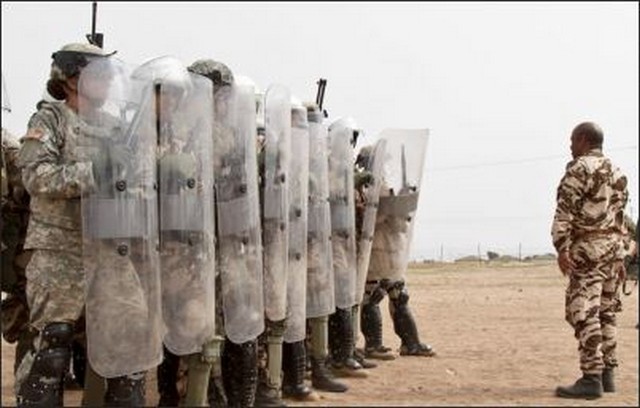
The African Lion, the largest military exercise on the African Continent planned and led by the US Army, has begun. It includes land, air, and naval maneuvers in Morocco, Tunisia, Senegal, and adjacent seas – from North Africa to West Africa, from the Mediterranean to the Atlantic. 8,000 soldiers are taking part in it, half of them are American, with about 200 tanks, self-propelled guns, planes, and warships. African Lion 21 is expected to cost $ 24 million, and has implications that make it particularly important.

This political move was fundamentally decided in Washington: the African exercise is taking place this year for the first time in Western Sahara, i.e. in the territory of the Sahrawi Republic, recognized by over 80 UN States, whose existence Morocco denied and fought by any means. Rabat declared that in this way “Washington recognizes Moroccan sovereignty over Western Sahara” and invites Algeria and Spain to abandon “their hostility towards the territorial integrity of Morocco“. Spain, who was accused by Morocco of supporting the Polisario (Western Sahara Liberation Front), is not participating in the African Lion this year. Washington reaffirmed its full support to Morocco, calling it “major non-NATO ally and partner of the United States”.

The African exercise takes place this year for the first time within the framework of a new US Command structure. Last November, the US Army Europe and the US Army Africa were consolidated into a single command: the US Army Europe and Africa. General Chris Cavoli, who heads it, explained the reason for this decision:

“The regional security issues of Europe and Africa are inextricably linked and can quickly spread from one area to another if left unchecked.”

Hence the decision of the US Army to consolidate the European Command and the African Command, so as to “dynamically move forces from one theater to another, from one continent to another, improving our regional contingency response times”.

In this context, African Lion 21 was consolidated with Defender-Europe 21, which employs 28,000 soldiers and over 2,000 heavy vehicles. It basically is a single series of coordinated military maneuvers that are taking place from Northern Europe to West Africa, planned and commanded by the US Army Europe and Africa. The official purpose is to counter an unspecified “malign activity in North Africa and Southern Europe and to defend the theater from adversary military aggression“, with clear reference to Russia and China.

Italy participates in African Lion 21, as well as in Defender-Europe 21, not only with its own forces but as a strategic base. The exercise in Africa is directed from Vicenza by the US Army Southern Europe Task Force and the participating forces are supplied through the Port of Livorno with war materials coming from Camp Darby, the neighboring US Army logistics base. The participation in African Lion 21 is part of the growing Italian military commitment in Africa.

The mission in Niger is emblematic, formally “as part of a joint European and US effort to stabilize the area and to combat illegal trafficking and threats to security“, actually for the control of one of the richest areas in strategic raw materials (oil, uranium, coltan, and others) exploited by US and European multinationals, whose oligopoly is endangered by the Chinese economic presence and other factors.

Hence the recourse to the traditional colonial strategy: guaranteeing one’s interests by military means, including support for local elites who base their power on their armed forces, behind the contrasting jihadist militias smokescreen. In reality, military interventions aggravate the living conditions of populations, reinforcing the mechanisms of exploitation and subjugation, with the result that forced migrations and consequent human tragedies increase.

Manlio Dinucci is an award winning author, geopolitical analyst and geographer, Pisa, Italy.

8 June 2021

Source: www.globalresearch.ca

Today I Saw Syrians Dancing and Celebrating Life, and a Return to Peace – but, of Course, the Western Media Won’t Report That

By Eva Bartlett

26 May 2021 – Although the West has waged 10 years of war on Syria, and there is much destruction, the entire country isn’t in ruins and the pulse of life continues, albeit strangled by brutal Western sanctions.

After Eastern Ghouta’s liberation in 2018, the Western media predictably went silent on the return of internally displaced Syrians and the rebuilding that had occurred. Today, in towns in the region outside the capital Damascus, behind dusty, battered metal shop shutters, I saw glossy new windows and even more rebuilding than I had when I was here in 2018.

In Douma, I saw lovely, smiling children, excited to practise their English with me. Given that they were born during the war and lived under the horrifically savage rule of the rebel groups Jaysh al-Islam and Faylaq al-Rahman, and their co-terrorists, their exuberance was remarkable. The traumas they endured they have either deeply buried within or miraculously healed from.

Since both the media and leaders in the West made such a big deal over the Douma chemical hoax, it was particularly rewarding to see life in the streets again.

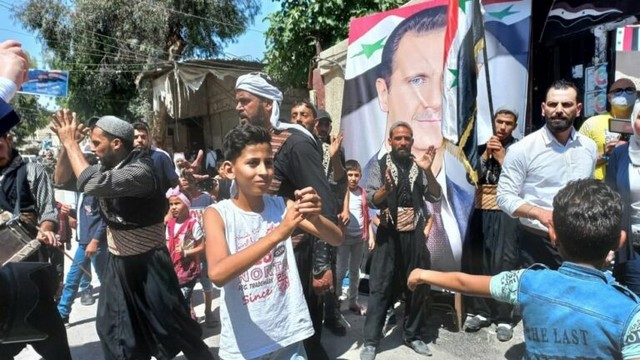
Syrians in Eastern Ghouta were put through a hell that most of us, living safely far from war, cannot begin to fathom. I had seen their tortured faces shortly after their liberation in 2018. That made seeing them smiling, dancing, and celebrating the presidential elections today incredibly moving. The difference between then and now was like night and day.

Some were surprised when I posted videos on social media of a Syrian singer and orchestra performing at the Damascus Opera House two nights ago. Many assume the country has been completely destroyed, others are just unaware that it has a rich culture that hasn’t died, in spite of a decade-long war waged by the West.

Until the liberation, however, Syrians in Damascus risked being maimed or killed every time they went to work, to school, to the market, or even while they remained at home, when terrorist mortars and missiles rained down from Eastern Ghouta.

Back in 2014, leaving behind the hospitality of the small hotel I was staying in near the gate of Bab Sharqi, the Old City’s East Gate, I drifted over to a cluster of tables across from the beautiful Zaitoun Greek Orthodox cathedral and beside a closed restaurant. But instead of working on my laptop, as I’d intended, I ended up getting into a conversation with the owner of that restaurant, now called the Abu Zolouf bar.

As Abu Shadi and I spoke, terrorist-fired mortars fell in nearby districts. I wrote at the time:

“As it happened, I got two of four mortars on audio. The first occurred around 7:05 pm, which Abu Shadi estimated to be 200 metres away. His friend corrected him saying it was only 50 metres away (also about 20 metres from my hotel). Roughly 10 minutes later, the second mortar. There were two other mortars within half an hour. SANA news reported the injury of 17 civilians.”

Our conversation became about the incessant shelling, where the latest mortar had fallen, and his near-death experience with one.

“Two times mortars landed outside my restaurant. One would have killed me, but I went inside just before,”

he said, pointing to a spot on the ground next to the door. He lamented the loss of business as much as the threat posed by the mortars.

The other night, I visited the restaurant with a friend. Seeing Abu Shadi, we sat down with him and chatted about those days. Now, his hostelry is open and well frequented, guests sitting under light-strung olive trees enjoying the early summer evenings.

Also in 2014, one afternoon, wishing to escape the blazing sun, I leaned against the wall encircling the Old City, looking towards Jobar, then occupied by terrorist factions, roughly a kilometer away. As I wrote at the time, while I chatted with a friend,

“bullets whizzed past me, half a meter to my right, to my left. Everyone in the vicinity jumped up and ran, most looking panicked. We ran for about 50 meters, to a point which was apparently out of the terrorists’ range. One woman, hyperventilating and unable to stand, took a good 10 minutes to calm down, repeatedly making the sign of the cross as she wheezed. Later, I chatted with a man selling spinach patties, mentioning that I was surprised the bullets had reached the point where I’d been sitting. ‘They reach as far as here,’ he said, from his hole-in-the-wall bakery another 200 metres from where I’d been sitting.”

My encounters with mortars and their victims were many over the years, including seeing numerous children maimed and with critical injuries from the terrorists’ shelling, many ancient Damascene houses partially destroyed by it.

In 2018, I interviewed the supremely talented violinist and composer, Raad Khalaf, who is also a founder of the all-women Mari Orchestra. Afterwards, we chatted and he mentioned that the shelling had reached the Higher Institute of Dramatic Arts where he taught, near the Opera House.

He told me that the year prior, terrorists had attacked the area with some 37 bombs in one day.

“The students had to stay inside for eight hours – you couldn’t go outside because we didn’t know when or where the next bomb would fall. One student went outside and was killed. Here we lived five difficult years.”

On Monday this week, I went to the Opera House to hear Syrian singer Carmen Tockmaji and the orchestra accompanying her perform. The auditorium was only half-full but lively, everyone evidently enjoying the singer’s talents.

I was surprised to learn later that a front-row ticket cost just 2,000 Syrian pounds (80 US cents), a second-class ticket 1,500 (60 US cents), and a third class ticket 1,000 (40 US cents). Nonetheless, despite the low price, Syria’s poorest can’t afford this, largely because of the brutal sanctions on the country that decisively affected the currency, causing hyperinflation – an intended consequence of the cruel and immoral sanctions leveled against the Syrian people.

I wrote last year (and before) about how these sanctions directly affect civilians:

“On June 17, the US implemented the Caesar Act, America’s latest round of draconian sanctions against the Syrian people, to ‘protect’ them, it claims. This, after years of bombing civilians and providing support to anti-government militants, leading to the proliferation of terrorists who kidnap, imprison, torture, maim, and murder the same civilians. Sanctions have impacted Syria’s ability to import medicines or the raw materials needed to manufacture them, medical equipment, and the machines and materials needed to manufacture prosthetic limbs, among other things.”

Also: US sanctions are part of a multi-front war on Syria, and its long-suffering civilians are the main target

But sanctions have yet another brutal effect: they wreak havoc on the economy. A May 3, 2021 opinion piece by Abbey Makoe on the website of the South African Broadcasting Corporation noted:

“Electricity rationing in Syria has reached its highest levels due to the government’s inability to secure the fuel needed to generate electricity. This is mainly due to the damaging international economic sanctions led by the Western powers, including the IIT [Investigation and Identification Team of the Organisation for the Prohibition of Chemical Weapons] protagonists France, UK and the US. The value of the Syrian pound has crumbled to almost nothing. The Caesar Syria Civilian Protection Act of 2019 … is credited with bringing about starvation, darkness, plague, misery, robbery, kidnappings, increased mortality rate and the certain destruction of a nation that was once a beacon of hope across the Middle East.”

The misery is real, and Syrians are indeed suffering, many unable even to feed their families properly.

Speaking of Opera House performances may seem trite in light of the economic suffering, but the fact that productions such as this do still occur in Syria is another indication that the West’s change-of-government project has failed, despite its 10 years of waging war in Syria.

Seeing this concert just before the presidential elections was moving and poignant. As Carlos Tebecherani Haddad, a Syrian-Brazilian friend I met in 2014 when mortars were raining down around us, wrote:

“Celebrating life, victory over foreign aggression, rebuilding, the strength of Syrian roots, presidential elections and the bright future of the Syrian nation.”

That indeed is what I’ve seen in Syria, including today in Douma, where Syrians amassed to vote. Yet there is much to be done, particularly when it comes to rebuilding the infrastructure – especially as oh-so-benevolent America and its allies, in sanctioning the Syrian people, are directly preventing this.

So, if you’re still pointing a finger at the president and the army, turn that finger back at your governments, ye in the West. They are the cause of the destruction and death in Syria, and they hinder an otherwise achievable return to peace and normality.

Eva Bartlett is a Canadian independent journalist and activist.

31 May 2021

Source: www.transcend.org

The Real Crimes of Myanmar’s Suu Kyi and the Farce of Her Trial

By Maung Zarni

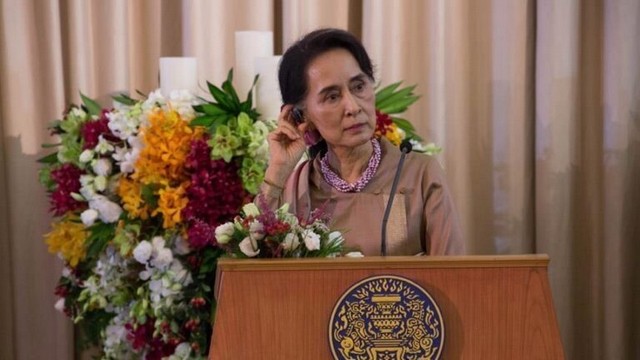
28 May 2021 – This past Monday [24 May], the State Administration Council of Myanmar, the military regime, aired on state TV the still images of the detained National League for Democracy (NLD) leader, Aung San Suu Kyi, as she appeared in a closed-door courtroom, sitting alongside her two NLD deputies, in the dock.

There is absolutely no question about the farcical nature of this trial of the deposed Myanmar state counselor by the regime that has committed — and continues to commit — all the gravest crimes in international law, as the UN International Independent Fact-Finding Mission (2016-18) had emphatically noted. Among the charges against her are the illegal import and possession of walkie-talkies for her security details, breaking the COVID-19 regulations, corruption and most ominously, breaking the State Official Secrets Act.

Alas, the irony should not be lost that the State Official Secrets Act was the charge, Suu Kyi herself, used to defend the arrest and prosecution of Wa Lon and Kyaw Soe Oo, the two Burmese and Rakhine journalists with Reuters, who attempted to report on the summary execution of 10 Rohingya villagers in the midst of the genocidal purge of over 740,000 Rohingya. Suu Kyi told the world that her government was taking legal action against the duo, not because they were journalists doing their job, but because they revealed what was considered state secrets. The two went on to win the Pulitzer Prize for their investigative reporting and were released by Suu Kyi’s government under worldwide pressure.

The images of Suu Kyi sitting in the dock had been imagined by others — but not on trumped-up charges or at a Kangaroo court, but on Myanmar’s international state crimes for which the Burmese leader does bear responsibility.

“I want to be a judge in your trial, Aung San Suu Kyi,” angrily declared Shirin Ebadi, the renowned UK-based human rights defender from Iran.

The occasion was the international conference on Myanmar genocide held at the French National Assembly, the parliament, in Paris. Ebadi’s anger at Suu Kyi’s indifference to the plight of the genocide victims in Bangladesh refugee camps was palpable for those of us in the hall, when she delivered the keynote address before the audience made up of Rohingya refugees, Speaker of the National Parliament of Bangladesh Shirin Sharmin Chaudury, French parliamentarians, and international activists and scholars.

As the main founder of the Nobel Women’s Group, Ebadi knew and met, her “Sister Laureate” at the group’s meeting of which Suu Kyi was a very much welcome member. Ebadi and other laureates, such as Northern Irish peace activist Mairead Maguire and American political activist Jodi Williams actively campaigned for Suu Kyi’s freedom during the 15 years of on-and-off house arrests.

Of course, the Iranian had in mind Suu Kyi’s complicity in the atrocity crimes committed against Rohingya by the latter’s partners in power, the Burmese military generals. In their closed-door meeting with the Burmese sister that took place in New York City in 2013, the American laureate and anti-landmine campaigner, Williams, attempted to raise her concerns about the persecution of the Rohingya, and Suu Kyi’s stance — denial of the gravest crime of genocide and the defense of the perpetrating military.

Suu Kyi shot down the conversation instantly, in a callous tone, “What about them?” according to a friend of mine who was at the meeting and witnessed the exchange.

Several years later, Sir Geoffrey Nice, the prosecutor in the trial of Slobodan Milosevic in the International Criminal Tribunal on the former Yugoslavia, co-authored an op-ed in Foreign Policy, A Genocide in the Making, where he, and co-author, Francis Wade, wrote: “Suu Kyi [as the nation’s popularly mandated leader] should know that inactivity in the face of genocidal actions can carry moral, legal, and even criminal responsibility.”

Yanghee Lee, the former special rapporteur on the human rights situation in Myanmar (2014-2020), who looked to Suu Kyi as an inspirational Asian woman icon, told UK’s Channel Four News, emphatically, that the Myanmar state counsellor should face justice at the International Criminal Court, or any other ad hoc international UN tribunal, for the official role she played in the Myanmar genocide. Lee told me that the Nobel laureate pointedly unveiled a threat of entry visa refusal when they last met, face-to-face, in Suu Kyi’s office in Naypyidaw: “[Y]ou know, if you keep pushing this UN [Human Rights-Up-Front] line, you won’t be able to come here again.”

The Myanmar laureate’s culpability in the state’s international crimes by her countless genocide denials on numerous occasions, both in opposition and in office — and her hostilities toward UN human rights bodies and local human rights defenders and journalists, has been amply noted and roundly condemned worldwide, thanks to the frontpage coverage by the mass media, that turned on the very icon which it helped manufacture, over a few decades.

Against this backdrop, it is deeply troubling that the parallel government, named the National Unity Government (NUG), continues to keep Suu Kyi as its patron-saint, in absentia.

Myanmar’s anti-coup public wildly supports and holds unrealistic expectations of NUG as the sole legitimate body that will seek world recognition, material and financial support from states and non-state actors and communities. Besides Suu Kyi, NUG has lesser mortals whose deeds and words were documented to be a part and parcel of the military-led genocidal process of 2016 and 2017, who now play leading roles, either officially, as Cabinet members, or from behind-the-scenes.

Perhaps most troubling of all, some among the old NLD card-carrying rank and file members, have begun to undertake fanatical and violent acts against anyone who opposes both the murderous coup regime, and the old NLD leaders and anti-Rohingya officials and activists, sitting on the front bench of the NUG. On May 25, one anti-genocide and anti-NLD/NUG Myanmar activist named Bhone Pyi Zone Min became the first casualty of what looks like a hate crime: in his sleep, he was stabbed seven times to death by a fanatical NLD/NUG follower, according to his friends who posted the details of the motive and the kill.

The Myanmar Spring, or New Revolution, led on the streets by Generation Z, or the youth of Myanmar, is ultimately aimed not simply at restoring the tyranny of the racist majority with Suu Kyi as the Mother of the Nation, but to rebuild a new, inclusive society, where Rohingya too, will have their full and equal citizenship.

The deeds and words of the NUG and its supporters, who continue to act as if they are old wine in a new bottle, do not bode well for either the social revolution for an inclusive society, or the violent political revolution, with the objective of totally dismantling the dictatorship, including its instrument of terror — the armed forces.

A Buddhist humanist from Burma, Maung Zarni is a member of the TRANSCEND Network for Peace Development Environment, former Visiting Lecturer with Harvard Medical School, specializing in racism and violence in Burma and Sri Lanka, and Non-resident Scholar in Genocide Studies with Documentation Center – Cambodia.

31 May 2021

Source: www.transcend.org

As Anger toward Belarus Mounts, Recall the 2013 Forced Landing of Bolivia’s Plane to Find Snowden

By Glenn Greenwald

24 May 2021 – U.S. and E.U. governments are expressing outrage today over the forced landing by Belarus of a passenger jet flying over its airspace on its way to Lithuania. The Ryanair commercial jet, which took off from Athens and was carrying 171 passengers, was just a few miles from the Lithuanian border when a Belarusian MiG-29 fighter jet ordered the plane to make a U-turn and land in Minsk, the nation’s capital.

On board that Ryanair flight was a leading Belarusian opposition figure, 26-year-old Roman Protasevich, who, fearing arrest, had fled his country in 2019 to live in exile in neighboring Lithuania. The opposition figure had traveled to Athens to attend a conference on economics with Belarus’ primary opposition leader Svetlana Tikhanovskaya and was attempting to return home to Lithuania when the plane was forcibly diverted.

Protasevich, when he was teenager, became a dissident opposed to Belarus’ long-time authoritarian leader Aleksandr Lukashenko, and has only intensified his opposition in recent years. When Lukashenko last year was “re-elected” to his sixth term as president in a sham election, the largest and most sustained anti-Lukashenko protests in years erupted. Protasevich, even while in exile, was a leading oppositional voice, using an anti-Lukashenko channel on Telegram — one of the few remaining outlets dissidents have — to voice criticisms of the regime. For those activities, he was formally charged with various national security crimes, and then, last November, was placed on the official “terrorist list” by Belarus’ intelligence service (still called the “KGB” from its days as a Soviet republic).

Lukashenko’s own press service said the fighter jet was deployed on orders of the leader himself, telling the Ryanair pilot that they believed there was a bomb or other threat to the plane on board. When the plane landed in Minsk, an hours-long search was conducted and found no bomb or any other instrument that could endanger the plane’s safety, and the plane was then permitted to take off and land thirty minutes later at its intended destination in Lithuania. But two passengers were missing. Protasevich was quickly detained after the plane was forced to land in Minsk and is now in a Belarusian jail, where he faces a possible death sentence as a “terrorist” and/or a lengthy prison term for his alleged national security crimes. His girlfriend, traveling with him, was also detained despite facing no charges. Passengers on the flight say Protasevich began panicking when the pilot announced that the plane would land in Minsk, knowing that his fate was sealed and telling other passengers that he faces a death sentence.

Anger over this incident from American and European governments came swiftly and vehemently. “We strongly condemn the Lukashenko regime’s brazen and shocking act to divert a commercial flight and arrest a journalist,” U.S. Secretary of State Antony Blinken posted on Twitter on Sunday night, adding that U.S. officials “demand an international investigation and are coordinating with our partners on next steps.”

Because the E.U. includes as member states both the departing country of the flight (Greece) and its intended destination (Lithuania), and because Ryanair is based in another E.U. country (Ireland), its officials are expressing similar condemnations. EU Commission head Ursula von der Leyen denounced the forced landing as “outrageous and illegal behavior” and warned it “will have consequences”. The leaders of Lithuania and Ireland demanded serious retaliation and sanctions. It is unclear what retaliatory options are available given the strong international sanctions regime already imposed on Lukashenko and his allies.

There is little doubt that the forced landing of this plane by Belarus, with the clear intention to arrest Protasevich, is illegal under numerous conventions and treaties governing air space. Any forced landing of a jet carries dangers, and safe international air travel would be impossible if countries could force planes flying with permission over their air space to land in order to seize passengers who might be on board. This act by Belarus merits all the condemnation it is receiving.

Yet news accounts in the West which are depicting this incident as some sort of unprecedented assault on legal conventions governing air travel and basic decency observed by law-abiding nations are whitewashing history. Attempts from U.S. officials such as Blinken and E.U. bureaucrats in Brussels to cast the Belarusians’ behavior as some sort of rogue deviation unthinkable for any law-respecting democracy are particularly galling and deceitful.
***
In 2013, the U.S. and key E.U. states pioneered the tactic just used by Lukashenko. They did so as part of a failed scheme to detain and arrest the NSA whistleblower Edward Snowden. That incident at the time caused global shock and outrage precisely because, eight years ago, it was truly an unprecedented assault on the values and conventions they are now invoking to condemn Belarus.

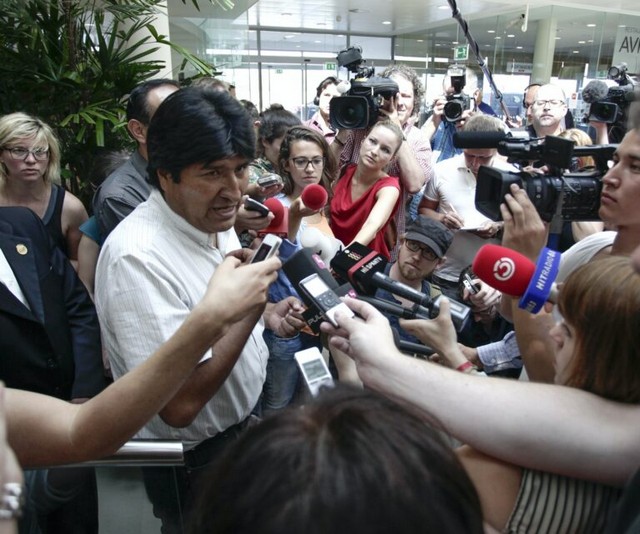
In July of that year, the democratically elected President of Bolivia, Evo Morales, had traveled to Russia for a routine international conference attended by countries which export natural gas. At the time of Morales’ trip, Edward Snowden was in the middle of a bizarre five-week ordeal where he was stranded in the international transit zone of Sheremetyevo Airport in Moscow, unable to board a flight to leave Russia or exit the airport to enter Russia.

On June 23, Hong Kong officials rejected a demand from the U.S. Government that they arrest Snowden and hand him over to the U.S. Hong Kong was the city Snowden chose to meet the two journalists he had selected (one of whom was me) because of what he regarded as the city’s noble history of fighting against repression and for independence and free expression. When announcing their refusal to hand over Snowden, Hong Kong officials issued a remarkably defiant, even mocking statement explaining that Snowden had been permitted to leave Hong Kong “on his own accord.” That statement also accused the U.S. of having issued a legally improper and inaccurate extradition demand which they were duty-bound to reject, and then pointedly noted that the real crime requiring investigation was U.S. spying on the populations of the rest of the world.

Snowden thus left Hong Kong that day with the intent to fly to Moscow, then immediately board a flight to Cuba, and then proceed to his ultimate destination in a Latin American country — Bolivia or Ecuador — in order to seek asylum there. But even after then-President Barack Obama denied that the U.S. Government would be “wheeling and dealing” in order to get Snowden into U.S. custody — “I’m not going to be scrambling jets to get a 29-year-old hacker,” he dismissively claimed during a June press conference — the U.S. Government was, in reality, doing everything in its power to prevent Snowden from evading the clutches of the U.S. Government.

Led by then-Vice President Joe Biden, U.S. officials warned every country in both Europe and South America said to be considering shelter for Snowden of grave consequences should they offer asylum to the whistleblower. Threats to Havana caused the Cuban government to rescind its commitment of safe passage they had issued to Snowden’s lawyer. Under Biden’s pressure, Ecuador also reversed itself by proclaiming the safe passage document issued to Snowden was a mistake.

And on the day that Snowden had left Hong Kong, the U.S. State Department unilaterally cancelled his passport, which is why, upon landing in Moscow, he was barred from boarding his next international flight, destined for Havana. With the Russian government unable to allow him to board a flight due to his invalidated passport and with Snowden’s asylum requests pending both with Russia and close to two dozen other states, he was forced to remain in the airport until August 1, when Moscow finally granted him temporary asylum. He has lived there ever since. This has always been a staggering irony of the Snowden story: the primary attack on him by U.S. officials to impugn his motives and patriotism is that he lives in Russia and thus likely cooperated with Russian authorities (a claim for which no evidence has ever been presented), when the reality is that Snowden would have left Russia eight years ago after a 30-minute stay in its airport had U.S. officials not used a series of maneuvers that barred him from leaving.

(Obama’s claim to not care much about Snowden was issued at roughly the same time that the U.S. and U.K. governments were engaged in other extreme acts, including sending law enforcement agents into The Guardian‘s London newsroom to force them to physically destroy their computers used to store their copy of the Snowden archive, as well as detaining my husband, David Miranda, under a terrorism law at Heathrow Airport, with the advanced knowledge of the Obama administration).

While in Moscow, President Morales — on July 1, the day before he was scheduled to return to Bolivia — gave an interview to a local Russian outlet in which he said Bolivia would be open to the possibility of granting asylum to Snowden. The next day, Morales boarded Bolivia’s presidential jet to fly back to La Paz as scheduled, with a flight plan that including flying over several E.U. member states — including Austria, France, Spain, Italy and Portugal, as well as Poland and the Czech Republic — with a stop to refuel in Spain’s Canary Islands.

The Bolivian plane flew through Poland and the Czech Republic without incident. But flight records show that while flying over Austria toward France the plane suddenly took a sharp turn to the east, back to the Austrian capital of Vienna, where it made an unscheduled landing. Morales and his entourage were stranded there for twelve hours before re-boarding the plane and flying back to Bolivia.

Bolivian officials immediately announced that in mid-flight, they were told by France, Spain and Italy that their permission to fly over those countries’ air space had been rescinded. Without enough fuel to fly an alternative route, the Bolivian pilot was forced to make a U-turn and land in Vienna. Bolivian officials were told that the reason for the mid-air refusal of these E.U. countries to allow use of their airspace was because of assurances they were given by an unspecified foreign government that Snowden was on the plane with Morales, and that he was traveling because Bolivia had granted him asylum.

After Morales’ plane was forced to land at the Vienna airport, Austrian officials quickly announced that they had searched the plane and determined that Snowden was not on it. While Bolivia denied that they consented to any such search of the presidential plane, Bolivian officials angrily mocked the notion that Snowden would be secretly smuggled by Morales from Russia to Bolivia. The whole time this was happening, Snowden was in Moscow. Needless to say, had Snowden been on Morales’ plane that was forced to land in Vienna, Austrian officials would have instantly detained him and turned him over to the U.S., which had by then issued an international arrest warrant. The only reason Snowden did not suffer the same fate that day as the one Protasevich suffered on Sunday is because he happened not to be on the targeted plane that was forced to make an unscheduled landing in Vienna.

The international outrage toward the E.U. and U.S. over the forced downing of the Bolivian presidential plane poured forth just as swiftly and intensely as the outrage now coming from those states to Belarus. Bolivia’s U.N. Ambassador called it an attempted “kidnapping” — exactly the term which the states he so accused are now using for Belarus. Brazil’s then-President Dilma Rousseff expressed “outrage and condemnation.” Then-Argentine President Cristina Kirchner described the downing of Morales’ plane as the “vestiges of a colonialism that we thought were long over,” adding that it “constitutes not only the humiliation of a sister nation but of all South America.” Even the U.S.-dominated Organization of American States expressed its “deep displeasure with the decision of the aviation authorities of several European countries that denied the use of airspace,” adding that “nothing justifies an act of such lack of respect for the highest authority of a country.”

As the controversy exploded, the key E.U. states tried at first to falsely deny that they played any role in the incident, insisting that they had not closed their airspace to Bolivia’s plane. France had quickly claimed that while it had originally denied use of its airspace to the Bolivian plane while in mid-air, then-President Francois Hollande reversed that decision after he learned Morales was on board. Eventually, though, the French fully admitted the truth: “France has apologised to Bolivia after Paris admitted barring the Bolivian president’s plane from entering French air space because of rumors Edward Snowden was on board.”

Meanwhile, Spain also ended up apologizing to Bolivia. Its then-Foreign Minister cryptically admitted: “They told us they were sure… that he was on board.” Though the Spanish official refused to specify who the “they” was — as if there were any doubts — he acknowledged that the assurances they got that Snowden was on board Morales’ plane was the only reason they took the actions they did to force the plane of the Bolivian leader to land. “The reaction of all the European countries that took measures – whether right or wrong – was because of the information that had been passed on. I couldn’t check if it was true or not at that moment because it was necessary to act straight away,” he said. While denying Spanish authorities had fully “closed” its airspace to Morales, they acknowledged what they called “delays” in approving mid-flight air space rights forced Morales to land in Austria and apologized for this having been handled “inappropriately” by Madrid.

Along with numerous other countries, Bolivia had no doubt about who it was who told all these countries, falsely, that they were certain Snowden was on Morales’ plane and thus demanded it be forced to land. Its defense minister, who was on the plane, left no doubt on this question: “This is a hostile act by the United States State Department which has used various European governments.” The Bolivian foreign minister said that these countries, at the behest of the Obama administration, conspired to “put at risk the life of the president.”

Given that it was only the U.S. which was so desperate to get their hands on Snowden — they had already used Vice President Biden to lead a highly coercive effort to threaten countries with punishment if they gave him asylum — few doubted where this false intelligence originated and who was behind the unprecedented act of forcing a presidential plane to land. Indeed, all of this was so glaringly obvious that not even the U.S. government was willing to deny it.

The duty to answer international questions about this incident was left to the spokesperson for the Obama State Department. At the time, that position was occupied by Jen Psaki, now the Biden White House Press Secretary. As he so often does, the Associated Press’s State Department reporter Matt Lee led the way in relentlessly pressing Psaki, demanding answers to what role the U.S. played in this incident. As she so often does, Psaki did everything possible to refuse even minimal transparency — neither admitting nor denying that the U.S. was behind all of this — yet she nonetheless made critical concessions at the July 3 State Department Press Briefing:

QUESTION: Did the U.S. have any role in encouraging Western European countries to block the flight of the Bolivian President yesterday? Was there any communication between the U.S. and those countries in the affair?

MS. PSAKI: Well, as you know because we’ve talked about it quite a bit in here, the U.S. has been in touch – the United States, I should say, officials – have been in touch with a broad range of countries over the course of the last 10 days. And we haven’t – I haven’t listed those countries; I’m certainly not going to do that today.

Our position on Mr. Snowden has also been crystal clear in terms of what we want to happen, and that message has been communicated both publicly and privately in a range of these conversations we’ve had with countries. And let me just repeat: He’s been accused of leaking classified information. He’s been charged with three felony accounts and should be returned to the United States. I don’t know that any country doesn’t think that that is what the United States would like to happen. . . .

QUESTION: There’s been a great deal of criticism though from Latin American leaders about the decision, not least because Snowden doesn’t appear to have been on board. You don’t sound like you’re denying that there were conversations about this. I mean, they – a number of Latin American leaders today have specifically criticized the U.S. for intervening in a diplomatic flight. Are you – am I right in understanding you’re not denying there were conversations about that?

MS. PSAKI: I’m not going to get into diplomatic conversations that happened over the past 10 days and which countries they were with, but I would point you to the countries that you’re referring to and ask you to ask them about decisions that were made.

QUESTION: But Jen, were you in communication with those countries or alerted to the fact that they would be either – well, not allowing a certain plane to land – the President’s plane?

MS. PSAKI: We have been in contact with a range of countries across the world who had any chance of having Mr. Snowden land or even transit through their countries, but I’m not going to outline when those were or what those countries have been.

QUESTION: Jen —

QUESTION: Why isn’t it unseemly for any country to essentially deny a head of state safe passage through its airspace? Why – regardless of whether Snowden was on that plane, why isn’t that in and of itself patently offensive?

MS. PSAKI: Well, Roz, I would point you to those specific countries to answer that question.

QUESTION: But if the – if a similar situation were to happen involving Air Force One, it would be an international incident.

MS. PSAKI: I’m not getting into a hypothetical. That’s not something that is currently happening that we’re currently discussing. . . .

QUESTION: Can you say whether the United States or whether you are aware that the U.S. Government ever at some point had any information that Snowden might be on this plane?

MS. PSAKI: I’m not aware of – I’m not aware of, but not something I would get into even if I did know. . . .

QUESTION: At the airport, the Austrian authorities searched the plane of Morales. Did the U.S. ask for that?

MS. PSAKI: Again, we – I would point you to all of these individual countries to describe to you what happened and why any various decisions were made.

QUESTION: Did you consult with Austrian authorities when they let the plane touch down, when they let plane go on the ground?

MS. PSAKI: I think my last answer answered that question.

That exchange led to headlines confirming what most had already strongly suspected: “US admits contact with other countries over potential Snowden flights.” As Psaki put it, even while refusing to admit that the U.S. was behind the downing of Morales’ plane: “I don’t know that any country doesn’t think that that is what the United States would like to happen.”

Illustrating how little the U.S. cares about even pretending to abide by the standards it imposes on others, the Biden administration on Monday sent out Psaki herself to condemn Belarus’ conduct as “a shocking act” and “a brazen affront to international freedom and peace and security by the regime.” It would not even occur to Biden officials — just for the sake of appearances if nothing else — to try to find someone to do this other than the same person who, in 2013, obfuscated and defended the actions of the U.S. and E.U. in doing the same thing to Bolivia’s presidential plane. U.S. officials simply do not believe that they are bound by the same standards to which its adversaries must be subjected.

None of what happened with this Morales incident has any bearing on the justifiability of what Belarus did on Sunday. That the U.S. and its E.U. allies committed a dangerous international crime in 2013 does not mitigate the criminal nature of similar actions by Belarus or any other country eight years later. The dangers of forcing down airplanes in order to arrest someone who is suspected to be on that plane are manifest. The danger increases, not decreases, as more countries do it.

But no journalist, especially Western ones, should be publishing articles or broadcasting stories falsely depicting Sunday’s incident as an unprecedented assault that could be perpetrated only by a Russian-allied autocrat. The tactic was pioneered by the very countries who today are most vocally condemning what happened. Any reporting of this story that excludes this vital history and context in favor of a false narrative of this being “unprecedented” — as is true of the vast majority of Western media reports about what Belarus did — does a grave disservice to both journalism and the truth. If it is outrageously dangerous and criminal to force the downing of a plane to arrest the passenger Roman Protasevich, then it must be equally dangerous and criminal to do the same in an attempt to arrest suspected passenger Edward Snowden.

Indeed, the only two differences between these situations that one can locate are factors against the Western nations responsible for the downing of Morales’ plane. Unlike what Belarus did, the U.S. and its European allies obviously had no confirmation of Snowden’s presence on the plane. They forced it to land based on a guess, on rumor, on speculation, which turned out to be utterly false. The second difference is that there are obviously additional international and diplomatic implications from forcing the plane of a democratically elected president to land as opposed to a standard passenger jet: that is, at the very least, a profound attack on the sovereignty of that country. Again, there are no valid justifications for what Belarus did, but to the extent one wants to distinguish its actions from what US/EU nations did in 2013, those are the only identifiable differences.

The blatant double standards the U.S. and Europe have endlessly tried to impose upon the world — whereby they are freely permitted to do exactly what they condemn when done by others — is not just a matter of standard lawlessness and hypocrisy. While there was extensive coverage in the Western press on the downing of Morales’ plane, there was not even a fraction of the media indignation expressed over the actions by their own governments as they are now conveying when the same is done by Belarus. In Western media discourse, only Bad Countries are capable of bad acts; the U.S. and its allies are capable, at worst, only of well-intentioned mistakes. Thus do the exact same actions by each side receive radically different narrative treatment from the Western press corps.

When the U.S. media helps to perpetuate this narrative, it deceives and misleads the audience they purportedly inform by concealing the bad acts of the U.S. and implying if not stating that such acts are the sole province of the Bad Countries who are adverse to the U.S. Doing so both enables rogue nation behavior by Western powers and implants jingoistic propaganda. It is hard to imagine a case where this dynamic is more vividly present than this outpouring of outrage at Belarus for doing exactly that which the U.S. and Europe did to Bolivia in 2013.

Update, May 24, 2021, 12:58 p.m. ET:

This article was edited to include the new comments from White House Press Secretary Jen Psaki about this incident, delivered after original publication of this article.

Glenn Greenwald is one of three co-founding editors of The Intercept. He is a journalist, constitutional lawyer, and author of four New York Times best-selling books on politics and law.

31 May 2021

Source: www.transcend.org

‘Rule-Based-International-Order’: A New Metaphor for U.S. Geopolitical Primacy

By Richard Falk

The U.S. Is Leading a Coalition of Governments Committed to Democracy and Human Rights or Is It a Geopolitical Alliance?

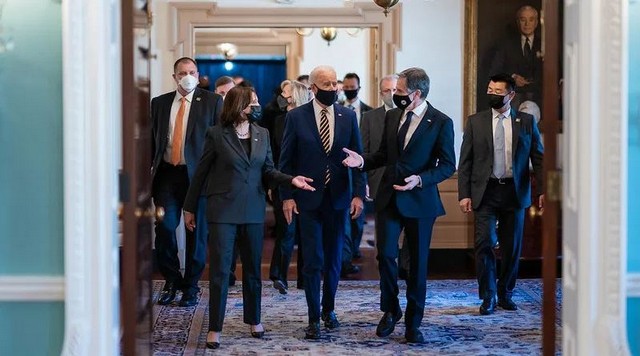
Biden’s Secretary of State, Antony Blinken, has made U.S. adherence to a ‘rules-based-international-order’ the core of American foreign policy. It is being used as a sword against China, Russia, and some other countries that have antagonized Washington for a variety of reasons. It seems to be an aspect of what Biden must have in mind when he speaks about ‘building back better.’ Of course, part of this new wave of American ‘liberal internationalism’ is to get out from under the dark legacy of chauvinistic nationalism and transactional relations with foreign governments that Trump presidency left behind.

Biden wants in contrast to reaffirm U.S. claims to be a benevolent global leader almost as if he is living in the years after World War II. Trump was as confrontational toward China as Biden/Blinken but he validated his hostile and bombastic diplomacy by exclusive efforts to advance the U.S. policy agenda of self-serving national interests. Implicitly, he was telling American Cold War allies including the European democracies that they would have to pay their fair share if they wanted the American NATO alliance to continue providing for their security. The Biden approach seems willing to buy back global leadership by investing whatever it costs to maintain the American global security system of 800 based around the world, navies in all oceans, and an edge in the distinctive weaponry resulting from innovations in cyber technology, robotics, and AI.

There is some foreign policy overlap between two presidencies; Biden like Trump has conceded that regime-changing interventions and prolonged occupation of a hostile society in the global South has compiled a record of costly failures. Biden’s withdrawal from Afghanistan in a few months, overriding Pentagon warnings, was a sign that there would be fewer ‘forever wars’ in the next few years. A second convergence with the Trumpism is to maintain an inflated military budget and to push foreign arms sales, thus ensuring retaining the dubious distinction of being by far the world’s leading annual spender on military preparedness and the dominant player in the lucrative global market place for weaponry.

Where Biden/Blinken diverges most strikingly from Trump/Pompeo is with respect to ideological and normative claims, relating to solidarity with democracies and a robust commitment to human rights. Even before Biden moved into the White House he made clear that his primary motivation in foreign policy would be to lead the democratically oriented governments in an ideological against the autocrats of the world, a division that promised to be divisive and to risk the second coming of the Cold War division of the world into friends and enemies. Worse than the rivalry with the Soviets, this new conflict patterning risks hot wars and diverts resources and energies at a time when other urgent needs, above all, climate change, deserve to be the focus of security concerns. In this important sense, Biden is living dangerously in a long gone past.

Furthermore, when the signifiers of democracy and human rights are examined critically, it turns out that in practice they are more about hostile propaganda than expressive of coherent commitments to democratic forms of governance or respect for human rights. The distinguishing criterion of diplomatic affinity for Biden is the willingness to be a compliant alliance partner, nothing more, nothing less.

In light of this what are we to make of this diplomatic language that sounds so idealistic? If it is carefully considered even from a sympathetic perspective, it is nothing more than a way of calling attention to normative bipolarity. It draws an imaginary line between democrats and autocrats, with the U.S. and its NATO allies leading the democracies and China and Russia leading the autocracies. In existential terms there are some full-fledged autocrats that are welcomed into the democratic tent despite their autocratic resume—for instance, Modi, Mohammed bin Salmon, Sisi, Bolsonaro, and for that matter Netanyahu.

When Israel flagrantly defied the rule of law in its recent military operation against Gaza the United States used its leverage to block calls for a ceasefire at the UN Security Council and blandly told the world that Israel ‘had the right to defend itself’ overlooking its provocative acts (evictions of Palestinian families from the Sheikh Jarrah neighborhood, right-wing settlers marches protect by Israeli police shouting ‘Death to the Arabs,’ and interference with al-Aqsa worshipers at the height of Ramadan), which seemed intended to incite Hamas to attack with its primitive rockets, which would provide Israel with just enough legal cover to launch a massive military operation that caused 20 times the number of civilian deaths in Gaza than were Israelis killed by the Hamas rockets.. It has credibly conjectured that the domestically embattled Netanyahu sought the crisis with the Palestinians as a way to remain in power as the Israeli public has always backed the leadership if Israel was military engaged.

Living in a ‘Rule-Governed International Order’?

Against this background, one would have expected Biden and Blinken at least to couple their enthusiasm for alliance diplomacy with language that indicated respect for international law and support for a stronger United Nations. This is such an obvious oversight that it must be assumed to be deliberate. And it leads us to wonder further what sort of alternative ‘rules-governed international order’ was being put forward. One hypothesis is that Blinken was guilty of a repeated slip of the tongue, and what was intended all along was ‘a ruler governed world’ by ‘guess who?’Diplomatic practice in this early period of the Biden diplomacy makes this reformulation more than a semantic joke.

When it comes to China or Belarus their behavior justifies an opportunistic sounding the alarm due to their alleged failures to abide by the rules of international law. True, China declared an adverse judgment of the Permanent Court of Arbitration a few years with respect to its island resource disputes with the Philippines in the South China Seas. Rather than making China an outlier, such a show of contempt for the decision of an international tribunal makes it seem like it has learned to behave like other members of the geopolitical club. The United States recently flaunted international institutions when it officially repudiated a decision by the International Criminal Court that claimed the legal authority to investigate well-evidenced allegations of U.S. international crimes against humanity in Afghanistan. The reason to emphasize inconsistency in the Blinken claim that they play is to show that the commitment to a rule-based international order is based on moral hypocrisy, and should be perceived for what it is, hostile propaganda.

This pattern of seeing with one eye is even more blatant when it comes to human rights—when the silences scream and the screams are contrived to mobilize hostility. Do we hear from Washington about Duterte’s gangster tactics of governance in the Philippines or the denial of rights to Muslims in India, especially Kashmir? In contrast, the far lesser grievances of the populations of Hong Kong or Tibet become a major concern of Washington and the treatments of the Uyghurs in Xinjiang are inflammatorily portrayed as ‘genocide.’

The compliant Western mainstream media dutifully followed the unwritten guidelines as to erasures and trumpets, while Pentagon planners and think tank militarists urge Congress to increase arms expenditures, and seem to relish prospects of a confrontation in the waters surrounding the Chinese mainland, especially highlighting Chinese threats to the security of Taiwan and U.S. resolve to engage militarily in response. This war-mongering ethos is evident in the call for weapons rather than a plea for avoiding incidents that could lead to uses of force by establishing joint crisis management schemes.

Concluding Remarks

This emphasis on a ‘rules-governed’ world implicitly makes the polemical claim that the United States plays by the rules whereas our adversaries do not. But what can this mean? The United States has projected more deadly force outside its borders than has any state in the course of the last 75 years. It has also intervened repeatedly over the years in disrupting democracies and using its geopolitical prerogatives to block and sanction democratic forms of governance if they refuse U.S. tutelage or display proclivities that can be castigated as ‘socialist.’ The Snowden revelations suggest that the United States has invested more heavily than any government on the planet in developing intrusive surveillance capabilities. The U.S. record of manipulating foreign elections is notorious, and has long been a well-known part of the CIA’s portfolio.

Several conclusions emerge:

  • Blinken’s stress on the virtues of a rules-governed world should not be confused with making a U.S. commitment to conduct its foreign policy in accord with international law:
  • When this rule-governed language is used to criticize the behavior of others, the misleading claim is implied that the U.S. plays by the rules, but its adversaries don’t;
  • Blinken should be pressed to clarify the concept and to explain why he refrains from references to international law and the UN Charter when describing U.S. foreign policy;
  • It should be emphasized by foreign diplomats and international jurists that the only legitimate rules-governed international order is international law, even when critical account is taken of its hegemonic record and its selective enforcement. And more progressive civil society initiatives should use international law, where possible, as a counter-hegemonic tool on behalf of global justice.

__________________________________________

Richard Falk is a member of the TRANSCEND Network, an international relations scholar, professor emeritus of international law at Princeton University, Distinguished Research Fellow, Orfalea Center of Global Studies, UCSB, author, co-author or editor of 60 books, and a speaker and activist on world affairs.

31 May 2021

Source: www.transcend.org

From Karachi to Sheikh Jarrah: The Why and Why Not of Palestine Solidarity in Pakistan

By Sonia Qadir & Junaid S. Ahmad

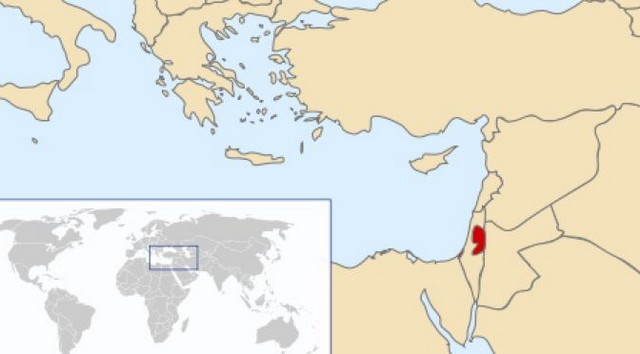
As part of the ongoing Nakba, Israel has once again unleashed its latest reign of terror on Palestine over the past two weeks, in response to resistance by Palestinians against ethnic cleansing of the Sheikh Jarrah neighborhood in East Jerusalem (meant to eviscerate both Palestinian social and cultural life from the city). During this time, Israel has razed Gaza’s residential buildings to the ground, bombed its refugee camps and demolished its already crumbling infrastructure.

Israeli tanks and artillery also launched a ground offensive, supposedly “fighting” a civilian population in northern Gaza, which has little ammunition other than pebbles and stones to defend itself with. Within 48’ Palestine (what are now Israeli cities), armed right-wing Israeli mobs, supported by Israeli police, forced their way into Palestinian homes, terrorizing families, and lynched Palestinians on live television. Palestinian businesses have been ransacked. The infamous “administrative detentions” of Palestinians (indefinite imprisonment without a charge or a trial) also began with renewed vigor.

Mainstream Western, and surprisingly at times even Al-Jazeera, have referred to these events as “clashes”, “a conflict” and “a civil-war”. Meanwhile, Palestinians, and those in solidarity with them, have pointed out that this terminology is grotesquely false, and an attempt to create absurd equivalences between an occupied population and its occupiers. Palestinian Australian scholar Lana Tatour, for instance, has argued that the use of the term “civil war” to describe what is taking place within 48’ Palestine obfuscates the racist, settler-colonial nature of the Israeli state and Israeli “citizenship”.

For a majority of ordinary Pakistanis, Palestine has always been an issue close to their hearts. There is a buried history of Pakistanis going to fight alongside the Palestine Liberation Organization (PLO), and of Pakistani writers and poets penning hundreds of songs of lament against Israeli occupation and its powerful supporters, and in solidarity with Palestinian freedom fighters. One of Yasser Arafat’s closest bodyguards and confidantes was a Pakistani. Large numbers of Palestinian students came to study in Pakistan. In addition, one of Pakistan’s greatest intellectuals, the late Eqbal Ahmad, was one of the closest friends of the most powerful intellectual voice of the Palestinian struggle – the late Edward W. Said. Eqbal was respected not only by Said but also by Yasser Arafat (and the entire leadership of the PLO), so much so that they actively insisted that he become one of their leading advisors, from the first Palestinian intifada onwards.

At the flip end of this coin, is the darker history of Black September. i.e. the 1970 massacre of Palestinians, in which Pakistan’s erstwhile General Zia-ul-Haq (who in 1977 launched a coup in Pakistan and become the military dictator for ten years) collaborated with the Jordanian monarchy in killing Palestinians. As Pakistanis, it is important to acknowledge and condemn this history – to see the face of significant elements of state institutions that would sell-out the oppressed the first opportunity they get, even as they wax lyrical about their commitment to the latter’s liberation.

At the same time, this incident does not undo the commitment that many ordinary Pakistanis have historically expressed, and often practiced, to the Palestinian cause. Unfortunately, the deep connections that were cultivated over decades, slowly died out as the era of third world decolonization and international solidarity withered away. Today, Pakistani ‘civil society’ and popular media have little recollection of involvement in global anti-colonial struggles.

Another important critique that has been made about Pakistan’s politics of solidarity with Palestine, is that here, much like in many other Muslim countries, the commitment to Palestine is due in large part to the issue being framed not only as something of concern for the Muslim ummah, but also as simply emanating from religious differences – or more bluntly, religious animosities. To some, this simply proves the “inherently” anti-Semitic nature of Muslim societies. The often casual anti-Semitism that characterizes public sentiment, commentary by certain analysts and politicians, as well as statements made by right-wing religious groups and parties in Pakistan, is indeed absolutely despicable. It is imperative that we combat it on every level.

Yet recent scholarship has demonstrated that the ‘religionization’ of Zionist colonization of Palestine really only picked up with an avalanche of anti-Semitic sentiments being exported to the Islamicate world from the deeply anti-Semitic Western world itself – in many ways tracing its origins to 1492. It is also worsened by the Israeli State’s own rabid racism and Islamophobia, most glaringly displayed by the military infiltration of the Al Aqsa compound during the month of Ramadan just two weeks ago (and once again at the Friday prayers right after the declaration of the ceasefire).

The scholar Gilbert Achcar, in his book The Arabs and the Holocaust, documents that the orientalist cliché of some inveterate Muslim anti-Semitism is erroneous. Indeed, it was largely in Muslim lands that Jews had felt safe to live for many centuries. It was primarily with the modern settler-colonial and secular nationalist ideology (and praxis) of ethnic cleansing of Arabs embedded in Zionism, as well as the thoroughly developed anti-Semitic ideology of Europe arriving in Muslim lands in the twentieth century; that we begin to see many Muslims join their European counterparts in anti-Jewish racism. A renewed investment in anti-colonial and decolonial struggles then is crucial for us to not only support Palestinian liberation, but also to struggle against anti-Semitism in our own communities.

To this end, it heartening to see the birth of a Palestine Solidarity campaign comprised of many progressive activists, public intellectuals, students and people from all walks of life in Pakistan. Many large and small protests for Palestine have been organized in Pakistan over the last week, and Pakistani mainstream media has reported on the bombardment of Gaza, and the larger issue of Palestinian liberation, with zeal.

Yet one cannot ignore the broader geopolitical juncture at which we stand, or forget that it was only last year that a somewhat different picture seemed to be at play within Pakistan. A number of Arab Muslim countries, most notably the United Arab Emirates (UAE), chose to normalize relations with Israel (finally revealing the open secret of the cozy relationship of the two countries), blatantly ignoring Palestinians’ call for “Boycott, Divestment and Sanctions” of Apartheid Israel. In turn, international pressure grew from the ‘brotherly Muslim countries of the Gulf’ on Pakistan to do the same. This included insidious threats to Islamabad from Riyadh, which under Muhammad Bin Salman (MBS) was very much at the forefront of the push for cementing ties with the Zionist regime.

The threats from MBS to deport Pakistani laborers, to halt oil supplies to Pakistan, to renege on its promised loans, and probably a whole bucket list of other antics that the rather sadistic Saudi Crown Prince could come up with – are in fact regurgitated every time that Islamabad does not prostrate itself completely to Saudi demands. MBS believed he could create enough wedges between Prime Minister Imran Khan who opposed normalizing relations with Israel on the one hand, and the Pakistani military high command on the other, which was keen on the idea, to achieve his goal. This back-dealing between MBS and some of his favored, pliant Pakistani generals also reignited interest on social media in Middle East Eye’s report from back in 2018 (around the same time that Israeli delegations were visiting the UAE and Jordan) of an Israeli plane (or more specifically a private plane that flew from Israel) landing in a Pakistani airbase – claims that were categorically denied by the Pakistani Government.

As the absurd theatrics intensified – obviously funded by the Zionist regimes of the Gulf – it was perhaps no surprise that out of the blue, a number of Pakistani journalists, including prominent establishment-cozy ones such as Kamran Khan of Dunya News and Mubashar Luqman of 24 News HD began discussing the possibility of normalizing relations with Israel. Kamran Khan’s tweet, for instance, declared that, “Nations don’t have permanent friends or enemies, only interests,” and therefore, “Pakistan must also revisit its Israel policy.” Similarly, Moeed Pirzada, a TV anchor and a putative ‘strategic analyst,’ stated on his Youtube channel that Pakistan’s refusal to have any relationship with Israel had depended on (i) Pakistan historically following the lead of Arab countries in order to show its solidarity with the larger Muslim world, (ii) “Israel”, “yahoodi (Jewish)” etc. were “trigger words” in Pakistan akin to Qadiani/Ahmedi and simply played on “emotions.”

Even as he explained that historically Jews and Muslims had amicable relations living side-by-side, he chose to make no distinction between Zionist and Jewish, and between a racist sentiment of Anti-Semitism and a politics of boycotting a brutal, warmongering Israeli settler-colonial state. Now that Arab countries had themselves changed their position, Pirzada argued, it was high time that Pakistan, too, makes a rational calculation and reconsiders its policy towards recognition of Israel.

Perhaps the more shocking, and least remarked upon contribution in this regard came from none other than Dr. Ayesha Siddiqa. A political scientist with a focus on security studies, and the famous author of “Military Inc: Inside Pakistan’s Military Economy,” Dr. Siddiqa is best known for her scathing criticism of the Pakistani military, its interference in politics, and its commercial and economic interests. Importantly, she is not just another International Relations (IR) and Security Studies academic: she identifies as a feminist and has written on the topic; and has a close relationship with many in progressive circles in Pakistan. She has no doubt earned her badge of honor for speaking against human rights abuses in Pakistan, especially where the military in involved – as in when it had engaged in wholesale internal colonization and displacement ventures such as in the Military Farms in Okara. On these matters, Dr. Siddiqa’s work has been laudable.

Yet in an article published in January 2021 on the Indian news site, The Print, Dr. Siddiqa appears to agree that it was in Pakistan’s best interests to recognize Israel. She starts by noting that Saudi Arabia wanted Pakistan to take this step, and that Pakistan’s military was willing to oblige. It was only Prime Minister Imran Khan who had refused, simply because “it would prove politically costly” for him.

The possibility that perhaps there could also be a principled reason for opposing normalizing ties with the Apartheid racist state of Israel seems to have eluded her. She then explains at length what Pakistan could gain from recognizing Israel both in terms of monetary and military aid directly from Israel; as well as diplomatic dividends vis-a-vis India (and a better ability to negotiate with the IMF) through a closer relationship with Israel and the “Jewish” (progressives are of course required to overlook our human rights-loving intellectual’s anti-Semitic language and pretend she simply meant Israeli or Zionist) lobby within the US. She elaborates that Pakistan should have taken this step when it was “more challenging,” i.e., under Trump’s regime when no reciprocal benefits for Palestinians could be negotiated and hence its significance for Israel, and therefore the diplomatic gains for Pakistan, would have been more. Instead, she laments, “Pakistan has certainly missed the moment, yet again.”

She then concludes, in an ever more direct voice, that PM Imran Khan and his party should take ownership of this policy (and ease the country into it); otherwise, if the military goes ahead with it anyway without prior warning, it would “have unpleasant consequences”. This was because Pakistanis have been “educated” that “Zionist-Jews” were Pakistan’s “worst enemies and a major source of all security threats to the country.” Not once does she speak of the lives and horrendous conditions of the Palestinians living under a brutal military occupation, but instead constantly centers the desires and wheeling and dealing of the Gulf states, Israel, the Pakistani PM and Pakistani military high command – all on the backs of the blood, suffering, and dead bodies of Palestinians whose existence she treats here as utterly irrelevant.

Anyone remotely involved in any form of solidarity with Palestinians would be appalled by such a take. The principal cover that Dr. Siddiqa wanted to employ in her defense of the article it seems, is of being an objective IR/Security Studies academic, simply analyzing things as they are. This is perhaps the last refuge of academics beholden to power but masquerading as impartial commentators. One is reminded here of the great American historian Howard Zinn, who, speaking of ostensible scholarly ‘neutrality’ and ‘objectivity,’ had this to say: “Objectivity is neither possible, nor desirable,” and that “You cannot be neutral on a moving train.”

No one should know this better than Dr. Siddiqa herself. One cannot help but wonder whether her commendable passion for exposing injustices was only reserved for the human rights abuses and excesses of the military-industrial complex within Pakistan? Now settled in an academic setting in the UK, does she feel the need to assuage the anxieties of the neoliberal, Eurocentric academy with writings that dare not challenge Zionism?

Over the last two weeks, as even a mainstream American news channel like CNN has been forced to cover the reality of Israeli occupation, it is not surprising perhaps that Dr. Siddiqa and most other analysts, journalists and Pakistani liberals (perhaps finding it untenable not to do so anymore) in addition to more principled progressives, are currently tweeting in support of Palestine. While this is a welcome move, it needs to be noted that Pakistani liberal (as well as conservative) elites failed to show solidarity with Palestine when it was needed most within a Pakistani context, i.e. when the State was close to deciding to build friendly diplomatic relations with Israel – without any commitment to the liberation of Palestine and a fair and just resolution for all Palestinians (as originally promised by Pakistan). Despite her valid penchant for critiquing Pakistan’s military, on the issue of normalizing relations with Israel, Dr. Siddiqa did not have a single word of admonishment for the institution, and instead chose to agree with it.

But why should solidarity with Palestine matter for Pakistanis? Is it simply a cause for bourgeois urbanites with some global awareness, or for the religious right? People from minority communities and those who are engaged in their own struggles of survival and liberation in Pakistan often ask: why invest our energies into solidarity with Palestine and not closer to home? Who will speak of the atrocities being wrought by a twenty-year war in Afghanistan or Waziristan, the internal colonization of Balochistan, the evictions and land theft in Karachi or the cultural and material marginalization of the Seraiki belt?

To answer this, it is imperative to recognize that the struggle for Palestinian liberation is linked to struggles for justice, self-determination and liberation across the world, from Kashmir to Waziristan to Balochistan. While there is an obvious moral imperative here, there is also a significant material reason, one Dr. Siddiqa inadvertently hints at in her article. That is, a crucial reason why certain factions within Pakistan’s military have been keen to normalize relations with Israel is to gain access to Israeli weapons and military technology! Israeli arms manufacturer Elbit Systems for instance sells all kinds of military and surveillance equipment, “field-tested on Palestinians,” to any willing buyer.

Israeli military and police are also infamous for providing training to other militaries and police departments in “counter-terrorism” and “crowd-control” – and have already done this for the US, UK, and countries in Latin America. In plain language, the Zionist state is willing to train security personnel of all fellow repressive states in police and security tactics meant for what Israel knows best: military occupation.

If Pakistan’s military and security forces receive this additional training and equipment, on top of what they already receive from the Unites States and other European countries, where does one reckon it would be used, if not to further suppress the struggles of various communities and social movements within Pakistan itself? It is not hard to see then that the struggle of progressive and liberatory movements in Pakistan have everything to gain and nothing to lose from taking a principled stance against the racist, apartheid, settler-colonial state that is Israel.

In the latest round of the Zionist festival of slaughter in Palestine, it is appreciable that PM Imran Khan bluntly tweeted about the carnage being perpetrated against the Palestinians, especially when most world leaders, including Arab stooges, made tepid statements about de-escalation (and which led Pakistani mainstream media to hail the PM as “the voice of Palestinians internationally” in a rather self-congratulatory manner).

It is also an encouraging development that there has been a powerful display of demonstrations in various cities of Pakistan against Zionist settler colonialism. But it is vital to note that the outpouring of support for Palestine the world over this time, including in Pakistan, has everything to do with how Palestinians have refused to back down in the harshest and most vicious of circumstances, and how they have worked tirelessly to form solidarities with anti-racist movements like Black Lives Matter in the US and Aboriginal rights struggles in Australia.

As the narrative and the sentiment on the ground in a number of Western countries has shifted, and it is no longer “cool” to ignore Palestine, it has also affected opinion among the young and old, progressive and ordinary people in Pakistan. A buried sentiment that always existed, has now returned with renewed anger, disgust, and demonstrations of solidarity.

But ultimately, we must remember: the real voice of Palestine, and the real heroes of this story, are the Palestinians themselves. And we must commit to centering their voices, learning from their struggle, and showing up for them – now and always.

– Sonia Qadir is from Lahore, Pakistan and is a PhD Candidate in Law at the University of New South Wales, Sydney.

– Junaid S. Ahmad teaches Religion and Global Politics and is the Director of the Center for Islam and Decoloniality in Islamabad, Pakistan.

28 May 2021

Source: palestinechronicle.com

After Six Months of Non-Violent Struggle, Farmers in India Should Move Towards Agro-Ecology and Broader Unity

By Bharat Dogra

On May 26 farmers in India observed the completion of six months of their protest dharna (sit-in) at Delhi borders. This was observed as a protest day against the union ( central) government, symbolized by waving of black flags, as the government has all through refused to accept their main demand of taking back three highly controversial farm laws of year 2020. These laws, the protesting farmers have said, move farming in India rapidly towards corporate control while moving away from a system of independent farmers supported by government purchase of farm produce at a fair price. The existing system, they argue further, has enabled India to produce plenty of staple grain (wheat and rice), leaving enough for subsidized public distribution (PDS) as well as nutrition schemes.

These arguments of farmers have received support from a wide section of activists, workers, scholars and most opposition parties. This support is the widest in the so-called green revolution (G.R.) belt of North-West India including Punjab, Haryana and Western Utter Pradesh, fertile areas which received special support of the union government to promote them as granaries of the country by concentrating technology based on abundant irrigation , chemical fertilizers, pesticides and exotic seeds here. From here the protests have travelled to many other parts of the country including Haryana , Madhya Pradesh, Rajasthan, W.Bengal etc. but the protests remain the strongest in this belt of North-West India ,which is also very influential in political terms.

The protest has been peaceful, strong and resilient, refusing to vacate ground in the face of repression, threats and adverse weather conditions. A significant number of farmers, now called martyrs, have died in the various strenuous activities relating to the movement in conditions of often adverse weather and an ongoing pandemic. In fact if one looks at not just the protest sit-in at the Delhi borders but the various scattered but strong protests which preceded it, then the protests have completed around 10 months or more. In the process, several wider problems of the farmers have also been highlighted and their issues have come more to the centre-stage.

Most farmers in India are small farmers and traditionally their problems related to low incomes and small resource base, the resulting resort to debts taken at exploitative high rates, a cycle of interest payments and debt resulting in mortgage of crops and eventually land in many cases. The response of the government, supported to the extent of even being pushed rather heavily by several important western aid agencies, has been to promote higher yields based on heavy doses of chemical fertilizers and pesticides used on exotic seeds. But this also brought ecological ruin and adversely affected natural fertility based on organic content of soil, also destroying earthworms, other soil organisms and natural pollinators like bees and butterflies on a massive scale, while also hugely increasing repeated expenditure of small, low-resources farmers on expensive external inputs. At the same time as the new technology came, farmers took, or in fact were cajoled to take, new loans for tractors and other farm machinery. While debts of farmers increased hugely, the farm-related businesses of big industrialists increased as never before. Some of the subsidies meant for farmers were in fact given to agribusiness interests.

As debts of farmers increased, the more distressed among them lost their land and status as independent farmers, instead becoming tenants or farm workers, or pushed more towards migrant work. Comparison of census data reveals that farmers have been losing their land at the rate of 100 farmers becoming landless per hour. Today India’s villages on the whole are likely to have more landless ( or almost landless) households compared to land-owning farmer households. This sorry situation has been aggravated by the government increasingly giving more attention to finding land for corporate interests, while going back on its commitments of providing land to landless peasants, which was a fairly strong commitment for the first three decades after independence and had also led to a non-violent campaign by Gandhian activists for obtaining voluntary gifts of land ( bhoodan) for the landless.

Hence despite the much flaunted farm development claims of the government, in reality the costs, debts, tensions and crisis of most farmers have been rising, aggravated by the fact that the support systems provided by the government to lessen the difficulties of the expensive technology can at best reach only a limited number of farmers ( particularly those outside the main green revolution belt may be left out more).

In these conditions the three laws brought by the government with undue hurry in 2020 would have further strengthened corporate control over farming, an ongoing process which has been accelerated by the present government’s excessive closeness to some chosen billionaires, and so the farmers movement has been right in opposing these laws, as confirmed by the support for this demand by several senior scholarly persons, including those with a long and distinguished record of serving in government or government-supported institutions.

However the last six months of the movement have also brought forth some of its limitations. Its main demand of repeal of three laws, as well as other demands of a better price for more crops and some other reliefs, while justified, do not go far enough in the direction of resolving the crisis of farmers and for ensuring longer-term conditions of sustainable livelihoods in conditions of protected environment. There is a compelling need for widespread adoption of those farming methods which protect environment and hence sustainability; which protect soil and conserve water, which protect soil dwelling organisms and pollinators, which reduce costs greatly by reducing external inputs, which make best use of local/ traditional skills and resources, which revive lost good cultivation practices and diversity of traditional seeds, which use mixed farming systems that are mutually supportive of each other, which draw on mutual better help and cooperation among communities. India is a land of many diversities and these practices will be implemented in diverse highly decentralized ways, bringing out the skills and genius of local people, particularly women, in highly creative ways, but the common thread will be to increase environment protection, sustainability and self-help, while reducing costs and debts.

Hence it is important for the farmers’ movement to move in this direction of agro-ecology, and to declare clear opposition to highly disruptive technologies, like those of GM Crops, which conflict with this agro-ecology approach.

In addition it is important to announce more clearly accommodation of welfare of landless rural households, by agreeing to some smaller plots of farmland and kitchen gardens for them, supported by better and more secure employment for them in several schemes of rural development , such as regeneration of forests, pastures, ponds, wetlands and other ecosystems and reclamation of degraded farmland ( such as land spoiled by excessive water and erosion).

All this will be even more useful in times of climate change, as increase of green cover, water conservation and increase of organic content of soil can contribute much to climate change mitigation and adaption. Agro-ecology will also contribute greatly to reducing the use of fossil fuels in farming by drastically cutting dependence on chemical fertilizers, pesticides, diesel etc . Hence farmers who walk this path can hope to get financial help from the international funds that are set up to help the efforts of developing countries in achieving climate change mitigation and adaption.

Hence after six months of admirable, non-violent resistance for rather limited objectives, it is time for the farmers’ movement to take up a much wider and longer-term agenda, which will ensure a much more secure future for all rural households, including the poorest ones, and will get more support at national as well as world level.

Bharat Dogra is a journalist and author who has been close to several social movements.

27 May 2021

Source: countercurrents.org

Palestine’s Moment: Despite Massive Losses, Palestinians Have Altered the Course of History

By Dr Ramzy Baroud

The ‘Palestinian Revolt of 2021’ will go down in history as one of the most influential events that irreversibly shaped collective thinking in and around Palestine. Only two other events can be compared with what has just transpired in Palestine: the revolt of 1936 and the First Intifada of 1987.

The general strike and rebellion of 1936-39 were momentous because they represented the first unmistakable expression of collective Palestinian political agency. Despite their isolation and humble tools of resistance, the Palestinian people rose across Palestine to challenge British and Zionist colonialism, combined.

The Intifada of 1987 was also historic. It was the unprecedented sustainable collective action that unified the occupied West Bank and Gaza after the Israeli occupation of what remained of historic Palestine in 1967. That legendary popular revolt, though costly in blood and sacrifices, allowed Palestinians to regain the political initiative and to, once more, speak as one people.

That Intifada was eventually thwarted after the signing of the Oslo accords in 1993. For Israel, Oslo was a gift from the Palestinian leadership that allowed it to suppress the Intifada and use the then newly invented Palestinian Authority (PA) to serve as a buffer between the Israeli military and occupied, oppressed Palestinians.

Since those years, the history of Palestine has taken on a dismal trajectory, one of disunity, factionalism, political rivalry and, for the privileged few, massive wealth. Nearly four decades have been wasted on a self-defeating political discourse centered on American-Israeli priorities, mostly concerned with ‘Israeli security’ and ‘Palestinian terrorism’.

Old but befitting terminologies such as ‘liberation’, ‘resistance’ and ‘popular struggle’, were replaced with more ‘pragmatic’ language of ‘peace process’, ‘negotiation table’ and ‘shuttle diplomacy’. The Israeli occupation of Palestine, according to this misleading discourse, was depicted as a ‘conflict’ and ‘dispute’, as if basic human rights were the subject of political interpretation.

Predictably, the already powerful Israel became more emboldened, tripling the number of its illegal colonies in the West Bank along with the population of its illegal settlers. Palestine was segmented into tiny, isolated South-African-styled Bantustans, each carrying a code – Areas, A, B, C – and the movement of Palestinians within their own homeland became conditioned on obtaining various colored permits from the Israeli military. Women giving birth at military checkpoints in the West Bank, cancer patients dying in Gaza while waiting for permission to cross to hospitals, and more, became the everyday reality of Palestine and the Palestinians.

With time, the Israeli occupation of Palestine became a marginal issue on the agenda of international diplomacy. Meanwhile, Israel cemented its relationship with numerous countries around the world, including countries in the Southern hemisphere which have historically stood beside Palestine.

Even the international solidarity movement for Palestinian rights became confused and fragmented, itself a direct expression of Palestinian confusion and fragmentation. In the absence of a unified Palestinian voice amid Palestine’s prolonged political feud, many took the liberty of lecturing Palestinians on how to resist, what ‘solutions’ to fight for and how to conduct themselves politically.

It seemed that Israel had finally gained the upper hand and, this time, for good.

Desperate to see Palestinians rise again, many called for a third Intifada. Indeed, for many years, intellectuals and political leaders called for a third Palestinian Intifada, as if the flow of history, in Palestine – or elsewhere – adheres to fixed academic notions or is compelled by the urging of some individual or organization.

The rational answer was, and remains, that only the Palestinian people will determine the nature, scope and direction of their collective action. Popular revolts are not the outcome of wishful thinking but of circumstances, the tipping point of which can only be decided by the people themselves.

May 2021 was that very tipping point. Palestinians rose in unison from Jerusalem to Gaza, to every inch of occupied Palestine, including Palestinian refugee communities throughout the Middle East and, by doing so, they also resolved an impossible political equation. The Palestinian ‘problem’ was no longer that of the Israeli occupation of the West Bank, Gaza and East Jerusalem alone, but also of Israeli racism and apartheid which have targeted the Palestinian communities inside Israel. Further, it was also the crisis of leadership and the deep-seated factionalism and political corruption.

When Israeli Prime Minister, Benjamin Netanyahu, decided on May 8 to unleash the hordes of police and Jewish extremists on Palestinian worshippers at Al-Aqsa Mosque, who were protesting the ethnic cleansing of the Sheikh Jarrah neighborhood in East Jerusalem, he was merely attempting to score a few political points among Israel’s most chauvinist right-wing constituencies. He also wanted to remain in power or, at least, to avoid prison as a result of his corruption trial.

He did not anticipate, however, that he was unleashing one of the most historic events in Palestine, one that would ultimately resolve a seemingly impossible Palestinian quandary. True, Netanyahu’s war on Gaza killed hundreds and wounded thousands. The violence he perpetrated in the West Bank and in Arab neighborhoods in Israel killed scores. But, on May 20, it was the Palestinians who claimed victory, as hundreds of thousands of people rushed to the streets to declare their triumph as one unified, proud nation.

Winning and losing wars of national liberation cannot be measured by gruesome comparisons between the number of dead or the degree of destruction inflicted on each side. If this was the case, no colonized nation would have ever won its freedom.

Palestinians won because, once more, they emerged from the rubble of Israeli bombs as a whole, a nation so determined to win its freedom at any cost. This realization was symbolized in the many scenes of Palestinian crowds celebrating while waving the banners of all Palestinian factions, without prejudice and without exception.

Finally, it can unequivocally be asserted that the Palestinian resistance scored a major victory, arguably unprecedented in its proud history. This is the first time that Israel is forced to accept that the rules of the game have changed, likely forever. It is no longer the only party that determines political outcomes in occupied Palestine, because the Palestinian people are finally a force to be reckoned with.

Ramzy Baroud is a journalist and the Editor of The Palestine Chronicle.

27 May 2021

Source: countercurrents.org