Just International

How It All Went Wrong: The Global Response to COVID-19

By Dr Binoy Kampmark

The Independent Panel for Pandemic Preparedness and Response was never likely to hand down a rosy report with gobbets of praise. Organised by the World Health Organization Director-General Tedros Adhanom Ghebreyesus last May, the panel’s gloomy assessment was grim: the COVID-19 pandemic could have been avoided.

Almost nothing in the main report could be seen as remarkable in these jaded times. It reads like a sharp vision of looking backwards, a history of folly and stumbles. The protagonist, SARS-CoV-2, proved wily, moving more rapidly than surveillance could detect it, ducking the monitors and seducing the examiners. The rest of the actors in the show proved, to varying degrees, to be inept, indifferent and even callous.

Such attitudes were shared in a climate of prior warning. Humanity has already faced events of mass viral mortality. That there would eventually be a pandemic of this scale was being discussed well ahead of the novel coronavirus march. But governments, planners and policy makers seemed unmoved. When action took place, it was tardy. “Although public health officials, infectious disease experts, and previous international commissions and reviews had warned of potential pandemics and urged robust preparations since the first outbreak of SARS, COVID-19 still took large parts of the world by surprise.”

The WHO itself is not spared a few chastising blows by the panel members. The organisation’s Emergency Committee should have, they argued, declared the outbreak a Public Health Emergency of International Concern a week earlier than it did: on January 22, at its first meeting, rather than January 30, by which time there were already 98 cases in 18 countries outside China. Not doing so also caused critical delays in mustering a global response. “The meeting of the WHO IHR Emergency Committee called to discuss the outbreak on 22-23 January was split on whether to recommend that the outbreak be declared a PHEIC.”

A central theme emerges: communication. And it is rather unsatisfactory. “It is glaringly obvious that February 2020 was a lost month,” the report states. Various Asian countries speedily responded, introducing intense testing and tracking regimes. But the WHO remained tentative. Evidence was weighed, balanced, and considered. Standard and sober as this was, the WHO did not consider convincing material that would prove to be beneficial. One was the importance of wearing masks.

The result: a pandemic that busily infected 150 million people, killed over three million people, and exposed deep inequalities. (Pandemics remain, historically, the great unmaskers.) “Division and inequality between and within countries have been exacerbated, and the impact has been severe on people who are already marginalized and disadvantaged.”

The report, and its authors, are stern in mood. “If travel restrictions,” former New Zealand Prime Minister Helen Clark and panel co-chair combatively insists, “had been imposed more quickly, more widely, again that would have been a serious inhibition on the rapid transmission of the disease that remains the same today.” Clark, for all the merit of that assertion, ignores the logistical nightmares, hub routes, transit points and freedom of movement principles of such blocs as the European Union.

Not all actors in the COVID-19 disaster show receive a lashing. The conduct of clinicians within the last two weeks of December 2019 and January 2020 receives a nod of approval. They showed “diligence” in noticing “clusters of unusual pneumonia”. They sent samples for screening and “escalated their concerns about this cluster of unexplained disease to local health authorities.”

The panel also makes an assortment of recommendations. They call “for an all-out-effort to reach the world’s population with vaccines within a year and set in place the infrastructure needed for at least 5 billion booster doses annually.” They urge the application of “non-pharmaceutical public health measures systematically and rigorously in every country at the scale the epidemiological situation requires.” High income countries should commit “at least one billion vaccine doses no later than 1 September 2021 and more than two billion doses by mid-2022” through the GAVI COVAX Advance Market Commitment.

The conventional model behind the making of vaccines is also challenged, with the panel insisting on establishing “a truly global end-to-end platform for vaccines, diagnostics, therapeutics, and essential supplies”. Rather than leaving innovation to the market, vaccines and related products should be seen as public goods. Unequal access to such products could be overcome through technology transfer, voluntary licensing and financing of regional manufacturing capacity.

Other suggestions point to a broader, health surveillance system that will not be hostage to national interests and clunky sovereignty. “The emergence of COVID-19,” the report notes, “was characterized by a mix of some early and rapid action, but also by delay, hesitation, and denial”. From this, an epidemic grew; from that, a pandemic. To that end, it was suggested that “surveillance and alert systems at national, regional and global levels must be redesigned”, all should be “able to function at near-instantaneous speed.” The WHO should be given greater powers and a higher budget. Its officials should be permitted access with minimal notice. Many governments are unlikely to agree.

Of some interest is the suggested Global Health Threats Council. Stacked with former presidents and prime ministers of various high-, middle- and low-income countries, it would perform the role of moralising guardian, taking governments to task for not preparing for, or responding to, the public health emergencies as designated by health specialists. Such a body, however, risks becoming a toothless entity with a megaphone.

The panel’s report has a title that sounds much like previous inquiries drawn from despair and destined to be lost: COVID-19: Make it the Last Pandemic. It will be filed in the vault of aspirations along with those noble wars that went wrong with criminal stupidity, the victory by Christmas that never took place, and efforts of failed solidarity in sharing scientific discoveries. “They are trying to grab a moment that everyone knows will pass pretty fast,” suggested Stephen Morrison of the Centre for Strategic and International Studies in Washington, DC. Global public health responses, sporadic, erratic and politically divided, will do everything to impair any such realisation. Nationalism continues to throb and disrupt. However well contained the novel coronavirus is, another threat to public health will be lurking.

Dr. Binoy Kampmark was a Commonwealth Scholar at Selwyn College, Cambridge.

27 May 2021

Source: countercurrents.org

The Third Intifada. Israel’s Crimes. Palestine’s Wrath. Ray of Hope?

By Michael Welch, Richard Falk, Richard Silverstein, and Laith Marouf

“What they need to do is they need to occupy the bases of the Canadian Armed Forces! They need to occupy the military hardware factories! They need to occupy their courts and stop the shipping of these weapons to apartheid Israel! Anything less than that will not actually cleanse them from the blood on their hands as Canadians!”

– Laith Marouf, from this week’s interview

LISTEN TO THE SHOW

The Third Intifada. Israel’s Crimes. Palestine’s Wrath. Ray of Hope?

Click to download the audio (MP3 format)

As of 2:00 am on May 21 by the Israel-Palestine hour this morning, or 7:00pm EDT on Thursday, the two sides of the disputing rivals had ceased hostilities – at least for the time being.[1]

By the standard account, the bitter eruption rose up on May 6 when Palestinians rose up in protest to a Supreme Court of Israel ruling on the matter of evicting six Palestinian families from their housing units in Sheikh Jarrah in East Jerusalem. This was followed the next day by Israeli police storming the Al-Aqsa mosque, the third holiest site in Islam and firing stun grenades, rubber bullets and tear gas at the worshippers in attendance.

Then on May 10, Hamas, the militant force governing over Gaza, wanted Israeli security forces removed from Sheikh Jarrah and the Temple Mount complex, location of the holiest site in Judaism which also housed Al-Aqsa Mosque. When Israel refused they fired rockets on targets in Israel. What followed was a campaign of airstrikes by Israel.

What followed was the most destructive period of violence in years.. [2]

The following clip recorded by Middle East Eye is just a sample of what the last two weeks were like:

Regrettably, violence in the region tends to spring up from time to time. And absent being held to account for past crimes by the UN, Washington, or really anyone, Israel will most likely continue on setting up more shelters on occupied land, and besieging the beleaguered Gaza, and ignoring the human rights of their Palestinian neighbours frankly at levels well beyond the harsh treatment of Blacks in modern day America.

But something is a little different this time. Despite Israel’s ‘Iron Dome’ technology taking out as many as 90 percent of rockets, some projectiles, cruise missiles no less, are punching through and hitting Israel stronger than ever. The Palestinians in Israel are themselves taking action in the streets, in businesses, and synagogues. And even in the United States, while the President continues to disappoint with his tepid remarks about the right of Israel to defend itself, sharp and popular critics in Congress such as Bernie Sanders and Alexandria Ocasio-Cortez are speaking out loudly against continuing to arm Israel despite its ongoing abuses against Palestinians.

Do these and other unique scenarios marking this 11 day period of terror mean things will be different now or in the long term? This is the question running through this Global Research News Hour and its sixty minute broadcast.

On the show in our first half hour, Richard Falk, professor emeritus of law at Princeton university talks to listeners highlighting some of the less talked about elements of the past month, including how it was incited by right wing settlers and during the Islamic holy period known as Ramadan. He also discussed attacks on media and the prospects for victory for Palestinians in the long term.

Following that, we hear from Richard Silverstein, a progressive blogger focused on the Israel-Palestine conflict. He will dwell on the growth in Hamas’ arsenal, the growth of Palestinian solidarity in Israel, and the potential ability of the International Criminal Court to wound Israel’s prospects.

Finally, Palestine activist and commentator Laith Marouf joins us again to dwell on the motives of the new Palestinian resistance, the prospects for the conflict to intensify, and the goals of Canadians wishing to show their solidarity with the damaged but determined victims of 73 years of Israeli confrontation.

Richard Falk is an international law and international relations scholar who taught at Princeton University for forty years and holds the title of professor emeritus. In 2008 he was also appointed by the UN to serve a six-year term as the Special Rapporteur on Palestinian human rights. He contributes regularly to Global Research.

Richard Silverstein is a political writer and commentator. Since 2003 he has authored the progressive Jewish blog Tikun Olam, which focuses on exposing the excesses of the Israeli national security state. He contributes regularly to Middle East Eye, and has contributed in the past to Truthout, Alternet, Haaretz, Mint Press News, Jewish Forward, Los Angeles Times, Comment Is Free and Al Jazeera English.

Laith Marouf is a long time multimedia consultant and producer and currently serves as Senior Consultant at the Community Media Advocacy Centre (www.cmacentre.org) and the coordinator of ICTV, in Canada (www.tele1.ca). Laith derives much of his understanding of Middle Eastern Affairs from his ancestral background of being both of Palestinian and of Syrian extraction. He is currently based in Beirut.

(Global Research News Hour Episode 317)

LISTEN TO THE SHOW

Click to download the audio (MP3 format)

The Global Research News Hour airs every Friday at 1pm CT on CKUW 95.9FM out of the University of Winnipeg. The programme is also podcast at globalresearch.ca .

Other stations airing the show:

CIXX 106.9 FM, broadcasting from Fanshawe College in London, Ontario. It airs Sundays at 6am.

WZBC 90.3 FM in Newton Massachusetts is Boston College Radio and broadcasts to the greater Boston area. The Global Research News Hour airs during Truth and Justice Radio which starts Sunday at 6am.

Campus and community radio CFMH 107.3fm in Saint John, N.B. airs the Global Research News Hour Fridays at 7pm.

CJMP 90.1 FM, Powell River Community Radio, airs the Global Research News Hour every Saturday at 8am.

Caper Radio CJBU 107.3FM in Sydney, Cape Breton, Nova Scotia airs the Global Research News Hour starting Wednesday afternoon from 3-4pm.

Cowichan Valley Community Radio CICV 98.7 FM serving the Cowichan Lake area of Vancouver Island, BC airs the program Thursdays at 9am pacific time.

Notes:

www.bbc.com/news/57200843
www.reuters.com/article/us-israel-palestinians-idUSKCN2D12SV

22 May 2021

Source: www.globalresearch.ca

$150 billion of oil money has been stolen from Iraq since the US-led invasion of 2003

By Countercurrents Collective

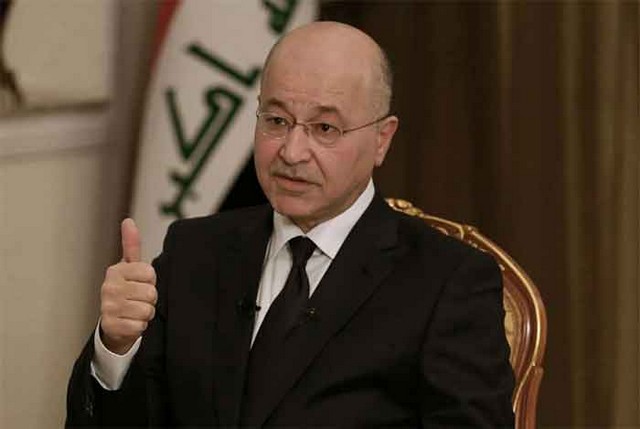
An estimated $150 billion of stolen money has been smuggled out of Iraq in corrupt deals since the US-led invasion of Iraq in 2003, Iraqi President Barham Salih said Sunday.

CNN and The New Arab reports said:

“Of the close to a thousand billion dollars made from oil since 2003, an estimated $150 billion of stolen money has been smuggled out of Iraq,” Salih said in a televised speech.

The statement came as the Iraqi President submitted a draft Corrupt Funds Recovery Act to the Iraqi Parliament.

“The draft law seeks to strengthen the powers of Iraqi nation in order to recover money stolen in corrupt deals, to hold corrupt people accountable and bring them to justice,” according to Salih.

He urged Iraqi lawmakers to discuss and approve the proposed legislation “to help curb this dangerous scourge that has deprived our people of enjoying the wealth of their country for many years.”

Salih said the stolen money would be enough to significantly improve Iraq’s finances.

According to Salih, the legislation would seek to recover the misappropriated funds through the cooperation of other governments and in partnership with international bodies.

“Here I reiterate Iraq’s call, which we have previously issued at the United Nations General Assembly, for the formation of an international coalition to fight corruption along the lines of the international coalition against ISIS,” Salih said.

Salih said the challenge of corruption is no less dangerous than terrorism.

“Terrorism can only be eliminated by draining its sources of funding based on corruption money as a political economy of violent,” Salih added.

Since 2019, hundreds of people have died in violent protests across Iraq against government corruption, unemployment and a lack of basic services, including electricity and clean water, as the country has failed to achieve stability following decades of sanctions and war.

The Biden administration is eying an eventual withdrawal of US troops from Iraq as the country’s security forces grow more capable and the threat of ISIS wanes, the two countries announced in a joint statement in April.

The US currently has some 2,500 troops in Iraq focused on the mission to defeat ISIS as part of Operation Inherent Resolve, the global coalition to defeat what remains of the ISIS caliphate that controlled parts of Iraq and Syria.

The troops have now shifted to training and advisory tasks, “thereby allowing the for the redeployment of any remaining forces from Iraq,” the joint US-Iraq statement said.

Salih presented the draft law to parliament to fight corruption, recover stolen funds and hold perpetrators to account, a statement read.

He called “on parliament to adopt this crucial piece of legislation, in order to curb this pervasive practice that has plagued our great nation.”

Transparency International ranks the country 21st from bottom in its Corruption Perceptions Index.

Endemic corruption was one of the drivers of protests that shook Iraq from October 2019 to June 2020.

“Corruption is an impediment to any nation’s economic and social development,” the Iraqi head of state said, whose powers are limited under the constitution.

Salih said violence and terrorism, which have plagued Iraq for years, “are deeply intertwined with the phenomenon of corruption.”

The draft law targets those who have held positions of director general and above in both government and public companies since the establishment of a new regime in 2004.

Under the law, transactions over $500,000 would be scrutinized as well as bank accounts, particularly those that held over $1 million, and contracts or investments obtained through corruption would be cancelled.

But security and politics expert Fadel Abo Ragheef was skeptical the law would be passed.

“It’s certainly one of the best pieces of legislation proposed by the executive branch since 2003. But will it be adopted? I doubt it,” he told AFP.

“The political parties the lawmakers belong to will act to sabotage it, so it doesn’t pass,” he said.

“In public they will support it, but behind the scenes, they will do everything to prevent its adoption, because many of the politicians are involved in this racket.”

An Iraqi banking source said politicians have smuggled $60 billion out of the country.

However, much of that was via Lebanon, a move now likely to their detriment, as the country is mired in a severe economic crisis, and it is almost impossible to get money out of its banks.

26 May 2021

Source: countercurrents.org

Police are trying to stifle our solidarity with Palestinians. Help us make sure this backfires.

The last few days have been a rollercoaster — let me tell you a bit about it.

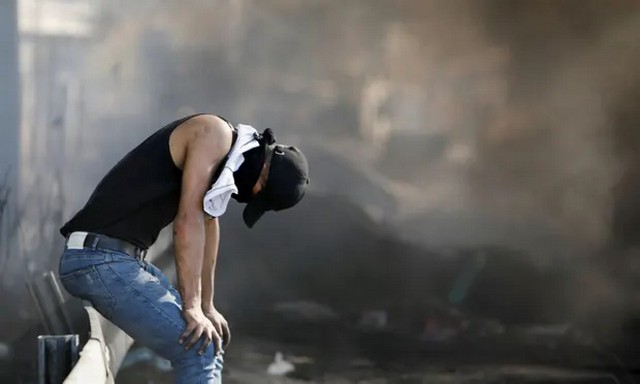
Over the past two weeks, like so many people around the world, I couldn’t tear myself away from the terrible violence against Palestinians. I couldn’t stop scrolling through the images and videos of families being massacred by airstrikes, worshippers being attacked in one of the holiest sites for Muslims in the world, children being arrested, entire residential buildings being bombed to the ground, tens of thousands being forced from their homes, hundreds of people killed, and thousands wounded.

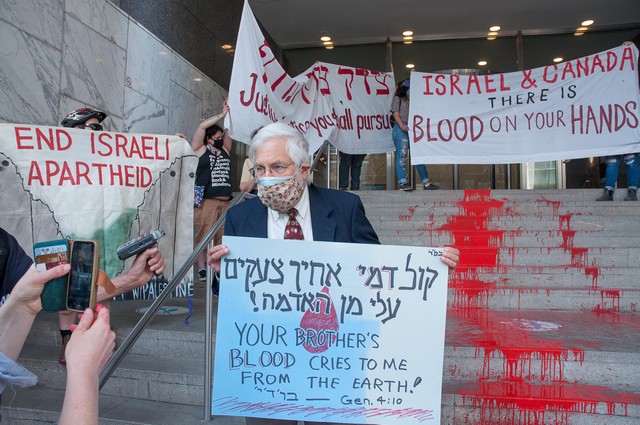
Last week in Toronto I organized fellow Jewish community members and allies to stand up with me in solidarity with Palestinians. We felt a need to respond not only to the Israeli government’s militarized violence but also to the Canadian government’s complicity in it — through its diplomatic support, the Canada-Israel arms trade, and allowing the Israeli embassy to go so far as to illegally recruit Canadians to join the Israeli military.

It felt like the type of rare moment where everyone was seeing the horrific violence of a military superpower for what it was and we had to drop everything to take action.

On Friday we gathered outside the Israeli consulate in Toronto and spilled a river of blood (washable paint) from the building’s doors right down to the street. We made the bloodshed from Israel’s brutal occupation, military attacks, and ethnic cleansing in Gaza and across historic Palestine visible right on the consulate’s doorstep.

We knew we had made a powerful statement but we did not expect the deluge of media. Our protest was covered in dozens of local, national, and international outlets, and translated into many languages. In this CTV news article Israel’s Consul General was even forced to go on the defensive and answer to why a river of blood was coming out of her office.

On Friday night an interview with me was broadcast on the evening TV and radio news by Canada’s national public broadcaster. Here’s a clip.

And right when things were starting to calm down on Saturday evening, we found out the Toronto police were pressing charges on Rabbi David Mivasair.

I was honoured to stand beside Rabbi David on the steps of the Israeli consulate on Friday morning as this longtime solidarity activist and member of Independent Jewish Voices powerfully shared how his Judaism is a part of his resistance (watch this clip filmed live at the consulate). The coverage of his arrest has put the story of our solidarity action all over the media again.

We know Rabbi David’s arrest is an attempt to stifle solidarity with Palestine. Help us make sure this backfires by giving the movement for a #FreePalestine even more press! Please share this post on twitter and on facebook.

We’d love to help you organize similarly powerful actions where you are — simply reply to this email to get in touch.

We also need your help to make sure we can continue to take the bold actions like these that push the antiwar movement forward in those key moments where new things are possible.

Actions like what we did on Friday take organizers. They take ongoing skill-building and training with local activists. They take connecting with legal resources, media strategizing, and building our own power so we can take on powerful institutions, be they government, military, or weapons manufacturers.

That’s why I’m asking you to concretely support us now by giving what you can.

As I was quoted saying in this CBC article, “I come to my solidarity with Palestinians very much as a Jewish person, also as a parent and as a human who will not stand by and allow this to happen.” I feel incredibly fortunate to work somewhere where I can bring my full self to my organizing, and also where I can take risks and mobilize others in struggles for justice and against violence — and where I know that my colleagues and the whole World BEYOND War movement has my back.

Thanks for your solidarity and for all that you do.

Rachel Small
Canada Organizer, World BEYOND War

25 May 2021

Source: worldbeyondwar.org

Why Big Pharma’s Arguments against Patent Waivers Don’t Add Up

By Sonali Kolhatkar

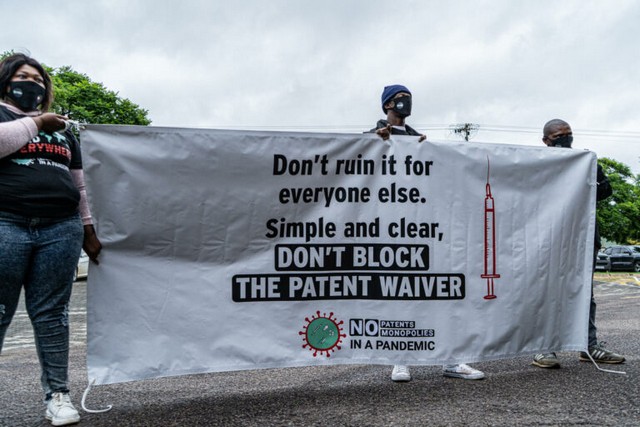
18 May 2021 – Days after he publicly opposed the waiving of patents for lifesaving COVID-19 vaccines, billionaire philanthropist Bill Gates had a change of heart. He released a statement saying, “No barriers should stand in the way of equitable access to vaccines, including intellectual property, which is why we are supportive of a narrow waiver during the pandemic.” His statement came after President Joe Biden, in a surprising move, and in contrast to his European allies, backed a temporary waiver on COVID-19 vaccine patents. U.S. Trade Representative Katherine Tai released a statement saying, “extraordinary circumstances… call for extraordinary measures.” Immediately, the big drugmakers’ share prices fell, and they shot back in anger with a litany of dire predictions.

Gates had been singing a different tune just a few weeks earlier, expressing opposition to vaccine patent waivers when he said in an interview, “The thing that’s holding things back in this case is not intellectual property. There’s not like some idle vaccine factory, with regulatory approval, that makes magically safe vaccines.”

Gates’ initial opposition echoes the pharmaceutical industry’s staunch resistance to waiving the intellectual property rights to COVID-19 vaccine technology. In a letter to the Biden administration, members of an industry group called Pharmaceutical Research and Manufacturers of America (PhRMA) wrote, “Eliminating those protections would undermine the global response to the pandemic, including ongoing effort to tackle new variants, create confusion that could potentially undermine public confidence in vaccine safety, and create a barrier to information sharing.” The signatories added, “Most importantly, eliminating protections would not speed up production.”

Walden Bello, co-founder of the advocacy organization Focus on the Global South and an international adjunct professor at SUNY Binghamton, told me in an interview from Manila, Philippines, that “these arguments are really quite spurious.” Bello had penned an opinion column in the New York Times saying, “A short-term Trips waiver would allow developing nations to quickly ramp up vaccine production and save lives at an affordable cost.”

The demand for vaccine patent waivers originated in October 2020 when the governments of India and South Africa proposed a temporary suspension of the World Trade Organization’s 1995 TRIPS agreement. Now, more than 100 nations support the call. TRIPS stands for the “Trade-Related Aspects of Intellectual Property Rights,” and for years has been a boon to corporations that have manufactured products with the help of public investment and reaped massive profits through the 20-year monopolies that the agreement grants them.

Bello pointed out that even though the U.S.-based vaccine manufacturer Moderna had said it would not enforce its patent on the COVID-19 vaccine, “if others use its patents and its processes, there’s no guarantee. Nobody touches it unless there is an official government waiver. And Moderna knows that, and Pfizer knows that.” Bello’s characterization is not an exaggeration. The United States has been one of the most ardent enforcers of the TRIPS agreement, bringing aggressive cases on behalf of American manufacturers against other governments.

Indeed, Gates, who sees himself as a self-appointed global health leader, has been an ardent supporter of monopolies on vaccine patents. Still, wealthy elites like him know that it is a morally reprehensible position to overtly back profits over public health, and so they have an alternative to sharing know-how: charity. Developing nations need only wait until wealthy countries and corporate boards are done prioritizing themselves before being able to access vaccines and other lifesaving medication and treatments through donations and diplomatic channels.

In his interview with Sky News, Gates said as much. He expressed patronizingly, “some of the rich countries including the U.S. and the UK, even this summer will get to high vaccination levels and that’ll free up so that we’re getting vaccines out to the entire world in late 2021 and through 2022.” In other words, poorer nations must simply wait for the crumbs of the wealthy to fall off their table in order to be fed.

Pharmaceutical companies have also echoed this sentiment, pretending to care about the well-being of billions of people in the Global South and preferring to distribute finished vaccines through COVAX, a World Health Organization initiative. In their letter to President Biden, PhRMA members wrote, “current estimates are that COVID-19 vaccine manufacturers will supply approximately 10 billion doses by the end of 2021, enough to vaccinate the entire current global vaccine eligible population.” Birgitte Markussen, the EU ambassador to the African Union, also said she supports COVAX over a TRIPS waiver. In other words, she and the drugmakers prefer that African nations wait for a handout from wealthier nations rather than be empowered to produce their own lifesaving vaccines. Developing nations know that such offers can easily be revoked or hinged to other conditions.

Western Pharmaceutical companies have also asserted that waiving vaccine patents will strain the supply chain for raw materials. Indeed, in order to mass-produce the new mRNA-based vaccines, raw materials are going to be needed on an unprecedented scale. But if Pfizer and Moderna claim they can produce enough vaccines for the entire world’s population, then clearly there are enough ingredients. What the companies want is a monopoly on the materials, the vaccines, and the resultant profits.

Another spurious argument from billionaires like Gates and pharmaceutical companies against waivers is that sharing vaccine technology will “stifle innovation.” In this neoliberal capitalist worldview, profit-seeking companies are essentially saying they will not strive for excellence unless there is a very large financial carrot dangled in front of them. Only pure market forces, we are led to believe, can spark the best possible innovation in medical technology. Yet it has been massive public spending to the tune of tens of billions of dollars by the governments of the U.S., the EU, Japan, South Korea, and others that fueled the production of COVID-19 vaccines. Similarly, the new mRNA technology on which Pfizer and Moderna based their vaccines was produced through billions of dollars in public investment.

Bello pointed out that a majority of the money that drug manufacturers spend “is going toward marketing, not innovation, and also to executive pay.” He’s right. For example, Pfizer spent nearly twice as much on marketing and sales as it did on research and development in 2019. Pfizer CEO Albert Bourla was rewarded with a $21 million compensation package in 2020—a jump of 17 percent from the year before. Vaccines are a “cash cow” for companies, said Bello. He maintains, “we need to show the real face of these guys. They are robber barons.”

Perhaps the most insulting of all arguments against waivers is the idea that generic vaccines produced in the factories of developing nations could erode public trust in vaccines because of the possibility of counterfeit products or a lowering of quality and standards. “It’s a red herring,” said Bello. He argued that it is deeply condescending “if you say that… Indian or Brazilian manufacturer[s] who have already been through the licensing processes in their own countries will somehow screw up during the manufacturing” of a vaccine. He pointed out that “this is all speculative and it goes against their record where many of these manufacturers have been producing generics for years which are as good [as] if not better than the original brands.”

In 2019, the Serum Institute of India was cited as the world’s “largest producer of affordable vaccines,” combating diseases like measles, rubella, diphtheria, tetanus, H1N1 influenza, polio, and more. To suggest that non-Western vaccine manufacturers would screw up the process of producing COVID-19 vaccines borders on racism.

Furthermore, there have been instances of Western drugmakers making mistakes in manufacturing COVID-19 vaccines, such as the Baltimore-based plant run by Emergent BioSolutions, which has partnered with Johnson & Johnson and AstraZeneca and which contaminated 15 million vaccine doses because of “human error.” Another 62 million doses that were produced at the same plant, were, according to the New York Times, “in jeopardy until it can be determined whether they were also contaminated.” Almost 12,000 doses of Moderna vaccine were thought to be compromised while en route to Michigan in January because the shipping company McKesson stored them at the wrong temperature. Ultimately, the government regulatory processes in place in the U.S. ensured that such screw-ups did not impact the public, and there is no reason to suggest the same would not be true in developing nations with a long history of creating and distributing other vaccines.

Bello welcomed President Joe Biden’s decision to back a TRIPS waiver for COVID-19 vaccines, saying he “did the right thing.” But the WTO still has to either come to a consensus or, if need be, vote on the TRIPS waiver. The task has become politically easier with the U.S. on board. And even if the waiver comes through, it will only be the first step before developing nations can begin manufacturing generic vaccines.

Bello rightly pointed out, “you’re running out of time. You have to start right now. The industry people are just creating all of this nonsense in order to hold on to their cash cows, which are the patents, and the processes of manufacturing.” In the meantime, hundreds of thousands of lives are at risk in the Global South as Western nations are reaching stability via mass vaccinations.

Sonali Kolhatkar is the founder, host and executive producer of “Rising Up With Sonali,” a television and radio show that airs on Free Speech TV and Pacifica stations.

24 May 2021

Source: www.transcend.org

Unity at Last: The Palestinian People Have Risen

By Ramzy Baroud

21 May 2021 – From the outset, some clarification regarding the language used to depict the ongoing violence in occupied Palestine, and also throughout Israel. This is not a ‘conflict’. Neither is it a ‘dispute’ nor ‘sectarian violence’ nor even a war in the traditional sense.

It is not a conflict, because Israel is an occupying power and the Palestinian people are an occupied nation. It is not a dispute, because freedom, justice and human rights cannot be treated as if a mere political disagreement. The Palestinian people’s inalienable rights are enshrined in international and humanitarian law and the illegality of Israeli violations of human rights in Palestine is recognized by the United Nations itself.

If it is a war, then it is a unilateral Israeli war, which is met with humble, but real and determined Palestinian resistance.

Actually, it is a Palestinian uprising, an Intifada unprecedented in the history of the Palestinian struggle, both in its nature and outreach.

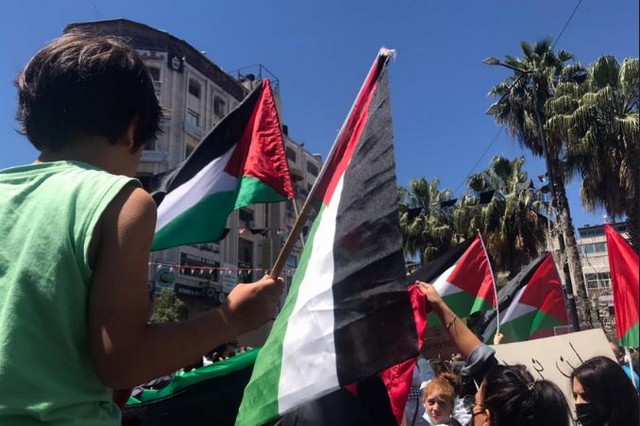
For the first time in many years, we see the Palestinian people united, from Jerusalem Al Quds, to Gaza, to the West Bank and, even more critically, to the Palestinian communities, towns and villages inside historic Palestine – today’s Israel.

This unity matters the most, is far more consequential than some agreement between Palestinian factions. It eclipses Fatah and Hamas and all the rest, because without a united people there can be no meaningful resistance, no vision for liberation, no struggle for justice to be won.

Right-wing Israeli Prime Minister Benjamin Netanyahu could never have anticipated that a routine act of ethnic cleansing in East Jerusalem’s neighborhood of Sheikh Jarrah could lead to a Palestinian uprising, uniting all sectors of Palestinian society in an unprecedented show of unity.

The Palestinian people have decided to move past all the political divisions and the factional squabbles. Instead, they are coining new terminologies, centered on resistance, liberation and international solidarity. Consequently, they are challenging factionalism, along with any attempt at making Israeli occupation and apartheid normal. Equally important, a strong Palestinian voice is now piercing through the international silence, compelling the world to hear a single chant for freedom.

The leaders of this new movement are Palestinian youth who have been denied participation in any form of democratic representation, who are constantly marginalized and oppressed by their own leadership and by the relentless Israeli military occupation. They were born into a world of exile, destitution and apartheid, led to believe that they are inferior, of a lesser race. Their right to self-determination and every other right were postponed indefinitely. They grew up helplessly watching their homes being demolished, their land being robbed and their parents being humiliated.

Finally, they are rising.

Without prior coordination and with no political manifesto, this new Palestinian generation is now making its voice heard, sending an unmistakable, resounding message to Israel and its right-wing chauvinistic society, that the Palestinian people are not passive victims; that the ethnic cleansing of Sheikh Jarrah and the rest of occupied East Jerusalem, the protracted siege on Gaza, the ongoing military occupation, the construction of illegal Jewish settlements, the racism and the apartheid will no longer go unnoticed; though tired, poor, dispossessed, besieged and abandoned, Palestinians will continue to safeguard their own rights, their sacred places and the very sanctity of their own people.

Yes, the ongoing violence was instigated by Israeli provocations in the Sheikh Jarrah neighborhood in East Jerusalem. However, the story was never about the ethnic cleansing of Sheikh Jarrah alone. The beleaguered neighborhood is but a microcosm of the larger Palestinian struggle.

Netanyahu may have hoped to use Sheikh Jarrah as a way of mobilizing his right-wing constituency around him, intending to form an emergency government or increasing his chances of winning yet a fifth election. His rash behavior, initially compelled by entirely selfish reasons, has ignited a popular rebellion among Palestinians, exposing Israel for the violent, racist and apartheid state that it is and always has been.

Palestinian unity and popular resistance have proven successful in other ways, too. Never before have we seen this groundswell of support for Palestinian freedom, not only from millions of ordinary individuals across the globe, but also from celebrities – movie stars, footballers, mainstream intellectuals and political activists, even models and social media influencers. The hashtags #SaveSheikhJarrah and #FreePalestine, among numerous others, are now interlinked and have been trending on all social media platforms for weeks. Israel’s constant attempts at presenting itself as a perpetual victim of some imaginary horde of Arabs and Muslims are no longer paying dividends. The world can finally see, read and hear of Palestine’s tragic reality and the need to bring this tragedy to an immediate end.

None of this would be possible were it not for the fact that all Palestinians have legitimate reasons and are speaking in unison. In their spontaneous reaction and genuine, communal solidarity, all Palestinians are united, from Sheikh Jarrah, to all of Jerusalem, to Gaza, Nablus, Ramallah, Al-Bireh and even Palestinian towns inside Israel – Al-Lud, Umm Al-Fahm, Kufr Qana and elsewhere. In Palestine’s new popular revolution, factions, geography and any political division are irrelevant. Religion is not a source of divisiveness but of spiritual and national unity.

The ongoing Israeli atrocities in Gaza are continuing, with a mounting death toll. This devastation will continue for as long as the world treats the devastating siege of the impoverished, tiny Strip as if irrelevant. People in Gaza were dying long before the Israeli airstrikes began blowing up their homes and neighborhoods. They were dying from the ack of medicine, polluted water, the lack of electricity and the dilapidated infrastructure.

We must save Sheikh Jarrah, but we must also save Gaza; we must demand an end to the Israeli military occupation of Palestine and, with it, the system of racial discrimination and apartheid. International human rights groups are now precise and decisive in their depiction of this racist regime, with Human Rights Watch – and Israel’s own rights group, B’tselem, joining the call for the dismantlement of apartheid in all of Palestine.

Speak up. Speak out. The Palestinians have risen. It is time to rally behind them.

Dr. Ramzy Baroud is a journalist, author and editor of The Palestine Chronicle.

24 May 2021

Source: www.transcend.org

People of Conscience: Palestinians Ask You to Boycott Israel

By Omar Barghouti

19 May 2021 – Toni Morrison wrote in her novel Beloved, “Definitions belong to the definers, not the defined.” Palestinians have learned the hard way that unless we clearly define ourselves, our oppression, and our aspirations, the hegemonic oppressor will do it, erasing our history and subjugating our future.

Sometimes our definitions emerge when unexpected. Three days ago, following a nearby Israeli airstrike targeting a residential neighborhood in Gaza city that shook their building, my friend’s young daughter ran terrified to her mother’s arms shivering. She asked, “I want to be courageous, mama, but I don’t know how when death is so near?” Her question itself, during a televised massacre, defines courage. Palestinians are shattering our fear every day and hoping, and working to ensure, that this courage inspires millions to speak out and act in an effective way to end complicity in Israel’s oppression.

“Why are Palestinians protesting? Because we want to live.”
— Mariam Barghouti

The current Israeli war against Palestinians – in Gaza, Jerusalem, Lydd, Acre, Haifa and elsewhere – and the Palestinian resistance evoke multiple definitions. Conflict, apartheid, resistance, retaliation, self-defense, ethical journalism, co-existence, and justice are among the definitions that are hotly contested. Sometimes the debate itself is used to justify an immoral both-sides-ing that stymies indignation and the duty to act.

To remind the world of this duty, and to protest Israel’s horrific attacks, part of what many Palestinians define as an ongoing Nakba, Palestinians everywhere observed a general strike on Tuesday. Through it, we asserted our unity as an Indigenous people with an overarching quest for liberation, and reiterated our appeal for meaningful international solidarity, especially in the form of Boycott, Divestment and Sanctions (BDS).

Inspired by the South African anti-apartheid struggle and the US civil rights movement, the nonviolent, anti-racist BDS movement was launched in 2005 by the broadest coalition in Palestinian society. It calls for ending Israel’s 1967 occupation, upholding the right of Palestinian refugees to return to their lands, and ending Israel’s institutionalized and legalized system of racial domination, which meets the UN definition of apartheid, as recently acknowledged by Human Rights Watch.

In the face of flagrant oppression anywhere, apathy and inaction are immoral, when one has the ability to act without suffering significantly.

Israel has been waging an all-out war of repression against BDS for years, partly because of its leading role in popularizing the apartheid analysis of Israel among students, academics, artists, trade unions, as well as social, racial and climate justice movements. Israel’s recognition of the “strategic” impact of BDS in mobilizing effective international solidarity with the Palestinian liberation struggle is another key factor.

But perhaps the most important factor behind Israel’s anti-BDS war is the fact that the movement has shattered the apathy of those who do not care and the inaction of those who insufficiently care. BDS has drastically redefined solidarity with the Palestinian struggle for freedom, justice and equality, as an ethical obligation to end complicity, above everything else. In the face of flagrant oppression anywhere, apathy and inaction are immoral, when one has the ability to act without suffering significantly. They are far more immoral, still, when one has not only the ability but also the duty to act because of the complicity of one’s state or institution in the system of oppression.

When more or less democratic states, like the US, UK, Germany, and France, provide Israel with unconditional military funding or weaponry, or shield it from sanctions and accountability under international law, they are complicit in Israel’s crimes against Palestinians.

When corporations profit from providing goods or services that enable Israel to maintain its regime of occupation and apartheid, they are complicit.

When sovereign funds or church or university investment funds hold shares in such corporations, they are complicit.

When artists, athletes or academics cross the Palestinian BDS picket line and participate in events in or sponsored by Israel, they are complicit.

All this complicity generates an ethical responsibility for citizens to act, to prevent their tax money and those who speak in their name from being a partner in Israel’s relentless attempts to turn Gaza and other Palestinian ghettos into “zones of nonbeing,” as Frantz Fanon would call them.

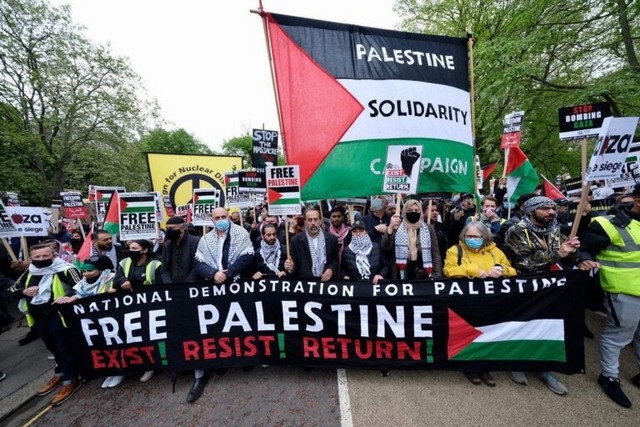
The unprecedented and inspiring outburst of solidarity with Palestinians in recent days indicates that millions around the world now realize this ethical duty and many of them are acting to effect change, even at the policy level. A bright example is the statement by the Movement for Black Lives, which demanded cutting the $3.8bn in annual military funding to Israel and imposing sanctions “until Israel stops its apartheid practices and settler colonial project”. Among lawmakers, Alexandria Ocasio-Cortez, bravely tweeted, “Apartheid states aren’t democracies.”

Major TV network personalities, including MSNBC’s Ali Velshi and HBO’s John Oliver; music icons, like John Legend; and Hollywood figures, like Susan Sarandon, Viola Davis, John Cusack, Wentworth Miller, and Natalie Portman, have all expressed solidarity like never before, some of them tweeting the famous disappearing map of Palestine under gradual settler-colonialism.

On the ground, Palestinians are resisting every day the erasure of our land, identity, and hope. In the midst of the haunting images of death and destruction in Gaza, an image left me with a visceral mix of anguish and hope. It is the image of a young man, Amara Abu Ouf, who flashed a V for victory sign while still being rescued from under the rubble of a building in Gaza leveled to the ground by an Israeli bomb. That’s the definition of the phoenix rising from the ashes, one may say. Well, today, it is the definition of the Palestinian.

Omar Barghouti, born 1964, is a Palestinian human rights defender, founding committee member of the Palestinian Campaign for the Academic and Cultural Boycott of Israel (PACBI) and a co-founder of the Boycott, Divestment and Sanctions movement (BDS).

24 May 2021

Source: www.transcend.org

How the United States Helps to Kill Palestinians

By Medea Benjamin and Nicolas J. S. Davies

17 May 2021 – The U.S. corporate media usually report on Israeli military assaults in occupied Palestine as if the United States is an innocent neutral party to the conflict. In fact, large majorities of Americans have told pollsters for decades that they want the United States to be neutral in the Israeli-Palestinian conflict.

But U.S. media and politicians betray their own lack of neutrality by blaming Palestinians for nearly all the violence and framing flagrantly disproportionate, indiscriminate and therefore illegal Israeli attacks as a justifiable response to Palestinian actions. The classic formulation from U.S. officials and commentators is that “Israel has the right to defend itself,” never “Palestinians have the right to defend themselves,” even as the Israelis massacre hundreds of Palestinian civilians, destroy thousands of Palestinian homes and seize ever more Palestinian land.

The disparity in casualties in Israeli assaults on Gaza speaks for itself.

  • At the time of writing, the current Israeli assault on Gaza has killed at least 200 people, including 59 children and 35 women, while rockets fired from Gaza have killed 10 people in Israel, including 2 children.
  • In the 2008-9 assault on Gaza, Israel killed 1,417 Palestinians, while their meagre efforts to defend themselves killed 9 Israelis.
  • In 2014, 2,251 Palestinians and 72 Israelis (mostly soldiers invading Gaza) were killed, as U.S.-built F-16s dropped at least 5,000 bombs and missiles on Gaza and Israeli tanks and artillery fired 49,500 shells, mostly massive 6-inch shells from U.S.-built M-109 howitzers.
  • In response to largely peaceful “March of Return” protests at the Israel-Gaza border in 2018, Israeli snipers killed 183 Palestinians and wounded over 6,100, including 122 that required amputations, 21 paralyzed by spinal cord injuries and 9 permanently blinded.

As with the Saudi-led war on Yemen and other serious foreign policy problems, biased and distorted news coverage by U.S. corporate media leaves many Americans not knowing what to think. Many simply give up trying to sort out the rights and wrongs of what is happening and instead blame both sides, and then focus their attention closer to home, where the problems of society impact them more directly and are easier to understand and do something about.

So how should Americans respond to horrific images of bleeding, dying children and homes reduced to rubble in Gaza? The tragic relevance of this crisis for Americans is that, behind the fog of war, propaganda and commercialized, biased media coverage, the United States bears an overwhelming share of responsibility for the carnage taking place in Palestine.

U.S. policy has perpetuated the crisis and atrocities of the Israeli occupation by unconditionally supporting Israel in three distinct ways: militarily, diplomatically and politically.

On the military front, since the creation of the Israeli state, the United States has provided $146 billion in foreign aid, nearly all of it military-related. It currently provides $3.8 billion per year in military aid to Israel.

In addition, the United States is the largest seller of weapons to Israel, whose military arsenal now includes 362 U.S.-built F-16 warplanes and 100 other U.S. military aircraft, including a growing fleet of the new F-35s; at least 45 Apache attack helicopters; 600 M-109 howitzers and 64 M270 rocket-launchers. At this very moment, Israel is using many of these U.S.-supplied weapons in its devastating bombardment of Gaza.

The U.S. military alliance with Israel also involves joint military exercises and joint production of Arrow missiles and other weapons systems. The U.S. and Israeli militaries have collaborated on drone technologies tested by the Israelis in Gaza. In 2004, the United States called on Israeli forces with experience in the Occupied Territories to give tactical training to U.S. Special Operations Forces as they confronted popular resistance to the United States’ hostile military occupation of Iraq.

The U.S. military also maintains a $1.8 billion stockpile of weapons at six locations in Israel, pre-positioned for use in future U.S. wars in the Middle East. During the Israeli assault on Gaza in 2014, even as the U.S. Congress suspended some weapons deliveries to Israel, it approved handing over stocks of 120mm mortar shells and 40mm grenade launcher ammunition from the U.S. stockpile for Israel to use against Palestinians in Gaza.

Diplomatically, the United States has exercised its veto in the UN Security Council 82 times, and 44 of those vetoes have been to shield Israel from accountability for war crimes or human rights violations. In every single case, the United States has been the lone vote against the resolution, although a few other countries have occasionally abstained.

It is only the United States’ privileged position as a veto-wielding Permanent Member of the Security Council, and its willingness to abuse that privilege to shield its ally Israel, that gives it this unique power to stymie international efforts to hold the Israeli government accountable for its actions under international law.

The result of this unconditional U.S. diplomatic shielding of Israel has been to encourage increasingly barbaric Israeli treatment of the Palestinians. With the United States blocking any accountability in the Security Council, Israel has seized ever more Palestinian land in the West Bank and East Jerusalem, uprooted more and more Palestinians from their homes and responded to the resistance of largely unarmed people with ever-increasing violence, detentions and restrictions on day-to-day life.

Thirdly, on the political front, despite most Americans supporting neutrality in the conflict, AIPAC and other pro-Israel lobbying groups have exercised an extraordinary role in bribing and intimidating U.S. politicians to provide unconditional support for Israel.

The roles of campaign contributors and lobbyists in the corrupt U.S. political system make the United States uniquely vulnerable to this kind of influence peddling and intimidation, whether it is by monopolistic corporations and industry groups like the Military-Industrial Complex and Big Pharma, or well-funded interest groups like the NRA, AIPAC and, in recent years, lobbyists for Saudi Arabia and the United Arab Emirates.

On April 22, just weeks before this latest assault on Gaza, the overwhelming majority of congresspeople, 330 out of 435, signed a letter to the chair and ranking member of the House Appropriations Committee opposing any reduction or conditioning of US monies to Israel. The letter represented a show of force from AIPAC and a repudiation of calls from some progressives in the Democratic Party to condition or otherwise restrict aid to Israel.

President Joe Biden, who has a long history of supporting Israeli crimes, responded to the latest massacre by insisting on Israel’s “right to defend itself” and inanely hoping that “this will be closing down sooner than later.” His UN ambassador also shamefully blocked a call for a ceasefire at the UN Security Council.

The silence and worse from President Biden and most of our representatives in Congress at the massacre of civilians and mass destruction of Gaza is unconscionable. The independent voices speaking out forcefully for Palestinians, including Senator Sanders and Representatives Tlaib, Omar and Ocasio-Cortez, show us what real democracy looks like, as do the massive protests that have filled U.S. streets all over the country.

US policy must be reversed to reflect international law and the shifting US opinion in favor of Palestinian rights. Every Member of Congress must be pushed to sign the bill introduced by Rep. Betty McCollum insisting that US funds to Israel are not used “to support the military detention of Palestinian children, the unlawful seizure, appropriation, and destruction of Palestinian property and forcible transfer of civilians in the West Bank, or further annexation of Palestinian land in violation of international law.”

Congress must also be pressured to quickly enforce the Arms Export Control Act and the Leahy Laws to stop supplying any more U.S. weapons to Israel until it stops using them to attack and kill civilians.

The United States has played a vital and instrumental role in the decades-long catastrophe that has engulfed the people of Palestine. U.S. leaders and politicians must now confront their country’s and, in many cases, their own personal complicity in this catastrophe, and act urgently and decisively to reverse U.S. policy to support full human rights for all Palestinians.

Medea Benjamin is cofounder of CODEPINK for Peace, and author of several books, including Inside Iran: The Real History and Politics of the Islamic Republic of Iran.

Davies is an independent journalist, a researcher with CODEPINK and the author of Blood On Our Hands: the American Invasion and Destruction of Iraq.

24 May 2021

Source: www.transcend.org

The Xinjiang Genocide Determination as Agenda

By Gordon Dumoulin, Jan Oberg and Thore Vestby

27 Apr 2021 – A Critical Analysis of a Report on China by the Newlines Institute and the Raoul Wallenberg Center

On March 8, 2021, the Newlines Institute for Strategy and Policy in Washington published a report, The Uyghur Genocide: An Examination of China’s Breaches of the 1948 Genocide Convention in cooperation with the Raoul Wallenberg Centre for Human Rights in Montreal.

It states that,

”This report is the first independent expert application of the 1948 Genocide Convention to the ongoing treatment of the Uyghurs in China. It was undertaken by the Newlines Institute for Strategy and Policy, in cooperation with the Raoul Wallenberg Centre for Human Rights, in response to emerging accounts of serious and systematic atrocities in Xinjiang province, particularly directed against the Uyghurs, an ethnic minority, to ascertain whether the People’s Republic of China is in breach of the Genocide Convention under international law.”

The Report – hereafter The Report – has been produced with the contributions of, and upon consultation with, numerous independent experts, including 33 who have agreed to be identified publicly, as it is stated.

The purpose of this TFF analysis is to examine the status of the Newlines Institute and the circle of scholars and others who have produced and contributed to it and their connections. It also takes a closer look at The Report’s methods and content as well as the sources on which The Report bases its extremely serious conclusion, namely that the Chinese state is responsible for committing genocide and violates the central provisions of the said Convention in its policies in the Xinjiang Uyghur Autonomous Region (XUAR) intentionally.

TFF wants to make it very clear from the outset that we do not take a stand on whether or not what happens in Xinjiang is a genocide. As of principle, we would not state such an opinion unless we had also been on the ground in Xinjiang. The sole purpose is to examine what this first independent scholarly documentation – which was covered immediately by a wide range of Western mainstream media – is based on.

We first present the Executive Summary of our findings and then expand on a series of more specific themes and perspectives.

Executive summary

1. The Report and the two institutes behind it are not ”independent”, and the report does not present new materials. Co-produced with the Raoul Wallenberg Centre for Human Rights, it’s the product of cooperation among individuals from at least six, more or less inter-connected, interest groups, or milieus, which are more Near– than Non-governmental – namely:
Christian fundamentalism + hawkish conservative US foreign policy circles + Muslim Brotherhood circles + extreme anti-Communism + pro-Israel lobby circles + the politicising human rights machinery (in which human rights concerns tend to serve various types of interventions by the United States of America).
For a report published by independent scholars from an independent institute, this is problematic.

2. The somewhat haphazardly edited Report may have been published to back up former Secretary of State Mike Pompeo’s ”determination” on January 19, 2021, that what goes in Xinjiang is an ongoing genocide. No evidence accompanied it. Pompeo is known, in his capacity of CIA director and in his own words (2019), to be proud that ”we lied, cheated and stole – we had entire training courses – and it reminds you of the glory of the American experiment.” (Watch him say that 29:15 into this conversation). Mike Pompeo is also known as a Conservative Christian who, while at the West Point Military Academy, was ”brought to Jesus Christ”, and he is known to be extremely critical of China.

3. The Report comes through as containing both fake or dubious but also, significantly and systematically, biased choices of sources and as deliberately leaving out fundamentally important perspectives, theories, concepts and facts.
For an institute that professes to be based on solid scholarship and values, this is problematic.

4. The Report appears – whether knowingly or intentionally or not – as supportive of hardline US foreign policy and as exploiting human rights concerns to promote a confrontational policy vis-a-vis China.
It certainly does not conform to the values of mutual understanding and peace that the Newlines Institute states that it is based on.

5. The Report conveys propaganda in the specific sense of treating China as the subject of all evil but omitting that an understanding of China’s policies must also include its relations, including the conflictual relations it has with the US. China is seen as an independent variable and, therefore, The Report can not produce any comparative perspective. To put it crudely: If what China does in Xinjiang is a genocide, are there other actors/governments who should also be determined as pursuing genocidal policies? Or, how does the Chinese ”war on terror” inside Xinjiang and its human costs compare with the US-led Global War On Terror, GWOT, and its human costs?

6. Given the problems we point out in this analysis, one must be deeply concerned about the Western mainstream media’s systematically uncritical reception and coverage of the Newlines-Wallenberg Report. They gave it immediate and prominent attention, but we have found none of the media checking the sources of The Report or questioning that it is an ”independent” institute and the ”first ’independent’ expert application of the 1948 Genocide Convention.”

What we have found in The Report makes us believe that if this is the highest-quality documentation of a genocide in Xinjiang available, one may seriously doubt whether what goes on in Xinjiang is a genocide. And, most likely, determining it as such will only have negative consequences for US-China relations and even for the United States itself.

What we have also found is that The Report is a rather illustrative example of the discourse and interest circles that characterise what we call the MIMAC, the Military-Industrial-Media-Academic Complex – building and expanding on the concept used for the first time by President Dwight D. Eisenhower, who called it a Military-Industrial Complex, MIC, in his farewell speech in 1961.

The independence of the two organisations, their background and connections

The Newlines Institute

Newlines was founded as late as 2019 by Dr Ahmed Alwani and is an affiliate of FXUA, Fairfax University of America, which is a private, business-oriented higher education institution with personality links to business and various US government institutions. Its founder and president is also Dr Alwani but he is not mentioned on the university’s second homepage above. The university has another homepage, however, where he is presented as its President.

Its corporate advisory council consist of, among others, Ken Logerwell who is also senior vice president of the National Security and Innovative Solutions (NSIS) that ”is an unrivaled problem-solving network that adapts to the emerging needs of those who serve in the defense of our national security. We are dedicated to the work of bringing together defense, academic and entrepreneurial innovators to solve national security problems in new ways.”

It is not clear why the Fairfax University of America has two homepages with different content and why one of the homepages presents a policy-making body, the Board of Trustees, that included Dr Alwani as President, which doesn’t exist on the other. Noteworthy is that three of its six members are also founders or in the leadership of the International Institute of Islamic Thought (IIIT) – an organisation affiliated with the Muslim Brotherhood.

The Newlines Institute set up an Uyghur Scholars Working Group in 2020. It tasked it with ”research and analysis on how best the U.S. government and its allies and partners can deal with Beijing’s efforts to erase Uyghur identity and culture.” So already before the present new report, the Institute had decided that that is what China does. A leading member of this group is Dr Adrian Zenz, whose central role in all this we shall return to.

The FXUA is a small college with about 150 students. According to its Wikipedia page, it has had problems with the quality standards of education; interestingly, the majority of the footnotes there deal with the Newlines/Wallenberg report findings, not the institute as such.

And who is Dr. Alwani who is – or perhaps has been – central in both organisations?

The Newlines Institute presents him this way ”Dr. Ahmed Alwani is the founder and president of Newlines Institute for Strategy and Policy and its parent institution, Fairfax University of America (FXUA). He is a businessman based in northern Virginia with investments in the poultry, real estate, and education/training sectors.”

So he is the founder of both, although he does not exist on the latest homepage of FXUA. The Newlines presentation of him lacks details. He is said to be driven by ”a desire to help improve the human condition,” and has also been on the advisory board the the U.S. military’s Africa Command and is connected with a series of other education institutes and investment firms.

His father, Taha Jabir al-Alwani, was a founding figure of the US Muslim Brotherhood and his death was announced by the above-mentioned IIIT – of which Dr Alwani is presently the Vice President.

The funding for the Newlines Institute – which was formerly (and still is) the Center for Global Policy, CGP – is provided by the FXUA but on its ”About” page it is emphasised that it is independent and also accepts research grants and donation but explicitly not ”from any foreign government or entity and is one of the few think tanks in Washington with no foreign or local agendas.” What this mention no foreign funding and of ”agendas” implies remains unexplained.

There is no explanation why Center for Global Policy changed to Newlines Institute; many of its videos and its Facebook page still use the CGP identity and only March 23 this year welcomed its visitors to the Newlines Institute.

The Newlines Institute is not an independent institute. And with the many changes of identity and relations indicated above, one must naturally wonder: What is it really?

Now to the co-publisher of The Report:

The Raoul Wallenberg Centre for Human Rights

Here its own homepage, and here the Wikipedia entry. The Centre’s mission statement is a 7-page PDF. Still, you quickly gather what kind of human rights the Centre is engaged in: Holocaust remembrance, the struggle against anti-Semitism, human rights issues in Russia, China, Iran, North Korea, Saudi Arabia and Venezuela and no awareness-raising or campaigns concerning the human rights violations committed by Western countries and their allies. In short, the ”right” human rights issues of the US.

The Centre was founded in 2015 by an international human rights lawyer and former Canadian Minister of Justice, Irwin Cotler – Wikipedia and the homepage – who is also its Chair. Among his many connections, he is also a member of the heavily biased ”United Against Nuclear Iran” organisation. He is a defender of everything Israel and had no qualms about attacking distinguished professional colleagues like Richard Goldstone and Richard Falk who have been engaged in the plight of the Palestinian people.

Cotler is a staunch advocate of the Responsibility To Protect, R2P, and argued for it in Libya, criticised Canada for not intervening in Syria and nominated the terrorist-affiliated White Helmets for the Nobel Peace Prize. Already two weeks before The Report was published, he tried to press Canadian PM Trudeau to use the word ”genocide”, arguing that forced sterilizations and abortions and holding more than one million Uyghurs in what he called “concentration camps” violate the Convention.

You may read more about who Mr Cotler is in this well-documented critical analysis by Yves Engler in The Palestine Chronicle which also illustrates his close connections with Israel’s most powerful elites. Furthermore, Cotler’s daughter is a Knesset MP and his wife worked for and was a friend of then PM Menachim Begin. The Jewish Insider carried this interesting interview with Cotler himself on March 15, 2021.

While anyone is entitled to have political views, sym- and antipathies, they should be openly stated and not covered up by words like ”independent scholar.” Dr Cotler is clearly a very political human rights personality.

The sources and worldviews of The Report

The Report is presented in this video as based on consultation with fifty top and highest calibre experts in all relevant fields worldwide plus on ”looking at more than 10 000 testimonials of Uyghur witnesses and accounts from detainees.”

Yonah Diamond is The Report’s principal author. He is a prolific HR writer. On July 15, 2020, he co-authored an article in Foreign Policy and Genocide Watch, which, without indicating sources or evidence, revealed what the Newlines report has now stated 8 months later. Genocide Watch is founded and chaired by Dr Gregory Stanton, a former State Department official. It carries a Xinjiang Genocide Emergency Alert – Level 9: Extermination dated November 2020; this alert implies that the Uyghurs are already being ”exterminated”.

Revealing of Diamond’s political intentions is another article co-authored with Rayhan Asat in Foreign Policy of January 21, 2021, which argues that the US must rethink its failed engagement policy and now ”confront the genocide in Xinjiang first.” (They start out with the story of Ekpar Asat, Rayhan Asat’s brother, who was a media entrepreneur, philanthropist and peacebuilder but is said to have been disappeared upon return from a visit to the US in 2016 and not seen since – ”one victim among millions of government atrocities that the United States have just designated a genocide”).

That was only two days after Pompeo’s statement. The political aims of the stated human rights concerns are obvious.

In the Newlines introductory video from March 31, Diamond (and other participants) emphasise how huge the material collected and analysed is. Still, none of the assertions made by the panellists is documented there. The references are just cited as facts. Furthermore, there is no discussion of methods, data sources or how The Report’s fact base was compiled and organised.

A central argument is brought forward by professor John Packer who states that the problem is that China argues that the issue of repression/genocide is an internal matter and that if that is accepted, how many other parts of international law shall we have to say goodbye to?

Another participant in the video discussion about The Report, Bethany Allen-Ebrahim, who worked with the China Cables project and is now a China reporter at Axios which published only negative reports about China to which she makes a substantial contribution. Although she lived four years in China and is fluent in the language, she comes through as a person who believes that China kind of doesn’t understand its own best.

All four participants in the discussion talk about China as if it was not a party to a conflict with the US. No one mentions US-China policy and its increasingly confrontational character the last few years. Allen-Ebrahim uses phrases such as ”Chinese authoritarianism versus Western liberal democracies, human rights conventions that try to make the world a better place for everybody.”

The black, guilty China and the white innocent US/West seems to be a repeated underlying thought figure – a simplifying dichotomy hardly effective to convince you of independent or solid scholarship.

The choice, according to her, is human rights or money, and she believes that far too few stand up for the former. The CCP, the Chinese Communist Party, doesn’t understand the West, doesn’t understand that internment camps, in the eyes of democracies worldwide, is ”bad, the thing you just don’t do” and that it believes its own propaganda, she also claims. And, further, Xi Jinping has become so powerful that people are afraid, the leadership is in an echo chamber and believes that things have gone so well for so long that nothing can stop it and its ”endless insults” to a series of countries such as India and the United States.

Azeem Ibrahim, Newlines’ director of Special Initiatives and author of The Report’s foreword and also an adjunct professor at the US Army War College, seems to believe that the Chinese believe – as he says – that perhaps if China wants Hong Kong, it will simply take it; if it wants Taiwan, it will simply take it and if it wants to it will also dominate the South China Sea.

In short, The Report omits every conflict analytical approach and treats China as a solitary actor driven by evil motives. While everybody – also scholars – have a right to personal opinions, the systematic value bias and China-negative attitudes held by all contributors makes one wonder how most of the authors and contributors were selected. Such uniform and systematic ”ideological” bias could very likely influence The Report’s choice of data and sources.

Finally, the CVs of the authors and contributors at the end of The Report largely omit mention of these extra-academic affiliations and political connections that are clear when you search a little deeper.

The content of The Report

Now to The Report itself, 55 pages where one notices that the above-mentioned Diamond is the principal author while Cotler, Stanton, Packer and 29 other ”independent experts” have been consulted and/or contributed directly and ”have agreed to be identified publicly.” Logically, that must mean that there have been scholars who did not want to have their names mentioned; that militates against normal, open academic norms (whereas one can understand that, say, Uyghur witnesses or victims, would not like to appear with their names).

All the contributors are Westerners or based in Western institutions, well over 20 from the US and Canada, a couple in the UK and elsewhere. According to The Report, quite a few have government positions and are advocates of the Responsibility to Protect and/or interventionism. And many are related to Holocaust and genocide research and prevention.

The report lacks a systematic method of structuring main chapters and sub-chapters/sections and seems to have been put together hastily (see the strange Table of Content below) – perhaps in the short time between January 19, 2021, when Secretary-of-State, Mike Pompeo, announced that he had ”determined” that China had committed crimes against humanity and genocide and the publishing of The Report on March 8?

The various chapters back up the conclusions stated in the summary: that the independent scholars conclude that Chinese leadership is responsible for committing genocide; that the intent is to destroy the Uyghur group as such, in whole or in substantial part; that this intent is documented by deeds and words by the high-level leadership including President Xi Jinping himself. Then follows documentation of the methods whereby this intent is said to be realised such as mass internment, mass birth-prevention, killings, forcible transfer of children, etc.

The report carries 317 notes, so the authors have obviously wanted to back up their conclusions with open, available and checkable facts. Naturally, some sources are legal texts on genocide, the Vienna Convention, academic journals, UN documents and analyses of other genocides and, of course, the history of the Uyghurs. And there are references to other human rights reports, Amnesty’s and Human Rights Watch’s in particular.

More interesting is the analysis of: What are the main sources in The Report that are used to prove the genocide?

From page 17 you get the sense: The New York Times, The Guardian, BBC News, The Brookings Institution, the Center for Strategic and International Studies (CSIS), the (CIA-initiated) Jamestown Foundation, Financial Times, Associated Press, Wall Street Journal, the International Consortium of Investigative Journalists (ICIJ), The China Files, the Hudson Institute, the Bitter Winter magazine (for religious liberty and human rights in China), The New Yorker, Foreign Policy, the Journal of Political Risk, the Uyghur Human Rights Project (UHRP) and Radio Free Asia.

A couple of important sources indeed stand out.

The Xinjiang Victims Base that appears on an internet address called ”shahit.biz” is important because many of the victim statements in The Report are taken from it – for instance, Victim # 124 (“So many people died from the beatings and torture”). However, there is no ”About” accessible on “shahit.biz”, no information on the methods, the sources, how it was built or what it means that it contains lots of short videos – as also does the Uyghur Pulse YouTube Channel it links to – in which people present and state ”video testimonies for the victims of the slow but de facto genocide in China’s northwestern Xinjiang region.”

Homepages which are completely anonymous would normally be considered of no credibility or other value as a source of documentation – whether academic or political – and should have been left out.

The Journal of Political Risk, referred to a couple of times, covers political risk and opportunities. ”Local issues and their impact on the world are analyzed and presented from a neutral and unbiased perspective. The journal is published by Corr Analytics, an international political risk analysis and consulting firm.” Its publisher is Dr Anders Corr, who lists that he has worked for e.g. United States Army, United States Pacific Command (USPACOM), United States Special Operations Command Pacific (USSOCPAC), Defense Intelligence Agency (DIA), Defense Threat Reduction Agency (DTRA), and the North Atlantic Treaty Organization (NATO). And its editor is Neil Siviter, who currently studies for his MA in War Studies at King’s College London and has interned at the NATO Association and the government in Canada.

You get a sense of Dr Corr, in a lecture on YouTube for the Committee On The Present Danger: China, when he advocates 5 strategies to ”defeat the Chinese Communist Party”, one of them being to double the US defence budget and get the allies to do likewise. (The Committee’s vice chairman, Frank Gaffney, argued right before Trump left The White House that Trump ”must declare the Chinese Communist Part a trans-national criminal group” (see The Committee’s members here).

Why these details? Because The Report refers to this Journal which carries an article by Dr Adrian Zenz to whom we shall soon return because of his central position in the entire issue. One must wonder whether Dr Zenz has chosen more or less extreme-political outlets for his research or his manuscripts have not passed peer-reviews of more relevant academic journals.

One more frequently used (22 times) source deserves special mention, namely Radio Free Asia. It presents itself as a ”private, nonprofit, multimedia news corporation” but these are dubious words. It is one of many US government media outlets with an annual budget of US $ 43 million, with 253 employees, headquartered in Washington D C and comes under the US Agency for Global Media (USAGM).

Like Radio Free Europe/Radio Liberty, it is engaged in promoting US values and perspectives vis-a-vis adversaries. The USAGM has been haunted by political controversies and its origins harken back to CIA’s secret special operations in 1948.

This is not to imply that these sources all tell lies or exaggerate the brutality of events. Some may, some may not – we as authors have no way of knowing. The main point is that the sources used in The Report – literally without exceptions – tilt in the same politico-ideological, Near-governmental direction and that no sources have been used that could, to put it crudely, give a different perspective, critically examine the selected sources or otherwise look into the validity and reliability of the media stories presented which are standard methods in independent academic scholarship.

To summarize, the majority of sources on which The Report is based are Western, particular US, mainstream media plus materials from organisations which, indisputably and without exception, are on a Sinophobic (”anti-China”) mission, see the world (and the China-US relations) in black-and-white terms plus US State Department/Pentagon-related individuals with attitudes promoting US global dominance and intervention policies.

Whether intended or knowingly, or not – The Report and its attempt at documentation of genocide in Xinjiang are perfectly fit to be used for such US policies rather than for a genuine human rights-only campaign and trustworthy advocacy. The Report contains no calls to action directed at human rights organisations; instead, some of its authors have tried to influence government policies directly.

The report does not attempt to distance itself from the elites behind those global dominance policies. It makes excellent use of them – either directly or indirectly (as the above personality connections have documented).

Now to the mentioned Dr Adrian Zenz (1974- ) who is stated everywhere as the expert on Xinjiang.

Dr Adrian Zenz – the world expert on Xinjiang who is guided by God

Zenz appears no less than 41 times through The Report’s 317 notes, most others once or twice. There can be no doubt that The Report’s documentation is based way more on his studies than on any other experts. So who is he?

Since October 2019, he is a Senior Fellow in China Studies at the Victims of Communism Memorial Foundation (VOC) in Washington, D.C. and here is a presentation of him in conjunction with a widely circulated article of his published in 2018 by the Jamestown Foundation of which he is stated to be an analyst. It was set up on the initiative of the CIA and remains an arch-conservative foundation with a board composed of corporate, business and investment people, former US government officials, former CIA leaders and militaries and some experts on terrorism.

It does not seem obvious why a human rights report by Dr Zenz would end up being published by such an organisation (and, as mentioned above, Zens has published with other ”hawkish” outfits like the Corr Analytics) rather than in a scholarly journal or a document for a genuine human rights organisation.

The VOC was established by a unanimous act of the US Congress and George. W. Bush was its honorary chairman 2003-2009, i.e. during the invasion and occupation of Iraq. VOC proudly states in its 2019 report that ”Since joining VOC, Dr Zenz has been mentioned over 240 times in over 120 media outlets, including The Wall Street Journal, The New York Times, and the BBC, and has conducted broadcast interviews with NPR, Bloomberg, and CNN, as well as top German newswires Deutsche Welle and Tagesschau” – that is, within just the three months.

It speaks volumes of the type of uniform expertise sought for by these media – something that is confirmed by the above presentation of media sources underlying The Report. One must wonder whether there were no other experts on human rights in Xinjiang than Dr Zenz? Did the media ever look for others? Did he just fit a particular purpose? Or do they simply not know the importance of diversity and objectivity?

The VOC – that has assets of about US$ 16 million – obviously works to outcompete the Nazi Holocaust when, on its front page, it states that ”Communism killed over 100 million. We’re telling their stories” and, according to Wikipedia, ”In April 2020, the organization announced they would be adding the global victims of the COVID-19 pandemic to their death toll of Communism, blaming the Chinese government for the outbreak and every death caused by it.” So much for its attitude to China.

Here’s the Wikipedia entry for Adrian Zenz. He’s a German anthropologist who used to work at the European School of Culture and Theology, which is related to the Columbia International University, a Bible College not to be confused with Columbia University. Dr Zenz is a born-again Christian and has stated that he feels that God has told him to pursue this research – 17:00 minutes into this Washington Watch interview – on Chinese Muslims and other minority groups in China.

Zenz co-authored a book about the end times in 2012 with his father-in-law, Marlon L. Sias, titled Worthy to Escape: Why All Believers Will Not Be Raptured Before the Tribulation; on the book link, you will see that they are both learned men and that Adrian ”studies New Testament Greek besides teaching (at the time) and preaching at his local church.”

Here is a short January 2021 video interview in which Dr Zenz presents his views also on what the US should do vis-a-vis China. And Jerry Grey, an Australian who has lived in China for 16 years, has written this portrait of Dr Zenz.

Dr Zenz has been criticised by critical media and investigative reporters. A particularly well-documented criticism has been produced by Gareth Porter and Max Blumenthal and published by The Grayzone carrying this subtitle ”US State Department accusation of China ’genocide’ relied on data abuse and baseless claims by far-right ideologue” which displays what they call ”so much statistical malpractise.” Here are other Grayzone analyses related to the issue in general and Adrian Zenz in particular. Blumenthal explains his position here to the Chinese official Global Times.

Adrian Zenz – who seems to have visited China only once and as a tourist in 2007 – has been strongly criticised by China and also by scholars at Xinjiang University (and here and here and here). At least one company in Xinjiang has sued Zenz because it believes that his research is false and rumour-based and therefore harmful to it – for which reason it demands that he apologises and pays compensation. The Chinese government has recently imposed sanctions on him, so he cannot enter China.

Naturally, there are reports and analyses which explain in different terms what is going on – some from their perspective inside China. One such example is Canadian beer brewery owner and Vlogger in Shenzhen, Daniel Dumbrill whom you may learn more about from this report by the South China Morning Post, SCMP. He has 148 000 subscribers to his YouTube Channel.

Professor Graham Perry’s homepage and this video also provide rather different facts, interpretations and perspectives.

It’s reasonable to assume that the criticism of Adrian Zenz, his methods, data collection, interpretations and conclusions – as well as his somewhat peculiar background and divine mandate – impacts considerably on The Report and its credibility. But we do not know why The Report’s authors have chosen him as their main witness instead of presenting different analyses and weighing them against each other.

The US State Department doesn’t seem to know what it knows

As the last thing he did in office on January 19, 2021, Secretary of State Mike Pompeo, ”determined” (here the official text) that what is going on in Xinjiang is a genocide. He also compared it to the Nazi Holocaust, thereby casting China and Xi Jinping in the role of Nazi Germany and Hitler.

However, ”the U.S. State Department’s Office of the Legal Advisor concluded earlier this year that China’s mass imprisonment and forced labor of ethnic Uighurs in Xinjiang amounts to crimes against humanity – but there was insufficient evidence to prove genocide. That placed the United States’ top diplomatic lawyers at odds with both the Trump and Biden administrations, according to three former and current U.S. officials” – writes Colum Lynch in Foreign Policy. ”The Biden administration has reaffirmed Pompeo’s stance and backed off a recent claim Biden’s United Nations envoy pick, Linda Thomas-Greenfield, made in her confirmation hearing that the State Department, under the Biden administration, was conducting a review of the designation.”

Here is what Linda Thomas-Greenfield had to say according to Reuters: ”The State Department is reviewing that now because all of the procedures were not followed,” Linda Thomas-Greenfield told the U.S. Senate Foreign Relations Committee. ”They’re looking to make sure that they are followed to ensure that that designation is held.”

So State Department’s Office of the Legal Advisor is of the opinion that there was not enough evidence and there were procedural problems with designating Xinjiang a ”genocide”. But the Biden administration – and the interests behind The Report – have decided to cement the Trump Administration/Pompeo and Biden/Blinken Administration and ignore that legal advice: It is a genocide!

It deserves mention that China has officially stated that it would welcome a visit by the UN Human Rights Council to Xinjiang.

Does The Report convincingly prove that this is a genocide?

Does The Report prove that the designation/determination ”genocide” is valid according to the classical definition of genocide as a series of acts committed with the intent to destroy, in whole or in part, a national, ethnic, racial or religious group? The words ”intent” and ”destroy” are essentially important here.

At four places, The Report mentions that Chinese officials have used expressions such as ”wipe them out completely – destroy them root and branch” and ”you need to kill them all” and ”break their lineage, break their roots, break their connections and break their origins” and ”eradicating tumours” and likening the mass internment camps to ”eradicating tumours”.

These expressions – which are ascribed to the CCP leadership – stem from one source, namely Austin Ramzy and Chris Buckley “Absolutely No Mercy’: Leaked Files Expose How China Organized Mass Detentions of Muslims” in New York Times, 16 Nov. 2019. Their report presents 403 pages of internal Chinese documents that have leaked.

How has this tremendously important leak happened?

The New York Times says that ”Though it is unclear how the documents were gathered and selected, the leak suggests greater discontent inside the party apparatus over the crackdown than previously known. The papers were brought to light by a member of the Chinese political establishment who requested anonymity and expressed hope that their disclosure would prevent party leaders, including Mr. Xi, from escaping culpability for the mass detentions.”

The New York Times report also states that ”The leaked papers consist of 24 documents, some of which contain duplicated material. They include nearly 200 pages of internal speeches by Mr. Xi and other leaders, and more than 150 pages of directives and reports on the surveillance and control of the Uighur population in Xinjiang. There are also references to plans to extend restrictions on Islam to other parts of China.”

So, if we understand it correctly: There was a member of the Chinese ”political establishment” who in 2019 leaked these documents in order to tie President Xi Jinping and other leaders of the CCP and China to the alleged crimes and debunk the official Chinese claims and explanations and, therefore, that person – who The Guardian also calls a ”political insider” – requested anonymity.

It remains unclear how a Chinese political establishment insider got 403 A4 pages over to The New York Times and how the editors checked the validity of those materials. For instance – did it receive these pages directly from the insider him- or herself or via a chain of couriers? If the latter, how did it check the identity and role of that insider and the authenticity of these pages before publication? Was the insider a person who had already defected to the US, or is s/he still in China and still part of its political establishment?

This point deserves emphasis for the fundamental reason that The Report bases its determination/conclusion/advocacy that this is a genocide for which the highest Chinese leadership is responsible exclusively on this New York Times-published batch of documents the background of which we readers cannot know.

Further, it’s worth noticing also that The Report states (p 3) that ”In 2014, China’s Head of State, President Xi Jinping, launched the ”People’s War on Terror” in XUAR, making the areas where Uyghurs constitute nearly 90% of the population the front line.” This formulation followed by the above-mentioned derogative/humiliating expressions could convey the impression that Xi Jinping was out to call all Uyghurs terrorists and therefore destroy them all, starting rationally in the areas where most of them live.

However, here is how BBC formulated it on May 23, 2014, when an attack in Urumqi killed 31 and wounded 90: ”During a visit to Xinjiang last month, President Xi Jinping promised greater integration and warned terrorists would be isolated “like rats scurrying across a street”. Xi Jinping is obviously talking specifically about Uyghur terrorists and not about all Uyghurs.

The question therefore is: If the Chinese leadership is targeting only what it calls terrorists – like Western countries also do in the GWOT – and not the Uyghur people as such, what is then left of the determination that this is genocide, i.e. the destruction of an ethnic group/nation ”in whole or in part”?

What about terrorism in Xinjiang and elsewhere?

The Report does another interesting thing: It plays down completely that there have been problems with terrorism in Xinjiang. It states that ”Similar restrictions multiplied in the early 2000s, during which time Chinese authorities began referring to Uyghur dissent more frequently as “terrorism,” despite an almost complete absence of terrorist attacks” (our italics). The source for this assertion is Sean Roberts, The War on the Uyghurs: China’s Internal Campaign against a Muslim Minority (Princeton, NJ: Princeton University Press, 2020) and Pablo A. Rodríguez-Merino, “Old ‘counter-revolution’, new ‘terrorism’: historicizing the framing of violence in Xinjiang by the Chinese state,” Central Asian Survey, Vol. 38, No. 1 (2019), 27-45.

Both of these publications are – from the outset – strongly critical of China’s Xinjiang policies and can be interpreted as plädoyers for the Uyghurs. Roberts who is undoubtedly a very capable researcher with lots of on-the-ground experience uses a particular definition of terrorism and the argument that to be called a terrorist is negative and traumatising. It is on the basis of this that he argues that there has been rather little terrorism in Xinjiang, although he does acknowledge (p 20 of his book) the 2009 Urumqi riots and other Uyghur-led acts of violence. On February 10, 2021, Roberts wrote an article in Foreign Affairs in support of Secretary of State, Mike Pompeo’s genocide statement – ”but whatever the merits of the term [e.g. genocide and crimes against humanity], the evidence of the atrocities that China has committed against Uyghurs is undeniable.”

From a review of his book in Foreign Affairs, one understands that Roberts main thesis is that ”Harsh Chinese policies have provoked some reactive violence from Uighurs and have driven what is estimated to be tens of thousands of them to join jihadis in Syria. Roberts provides fascinating new details on that relatively marginal phenomenon, revealing that organized Uighur militancy is almost entirely illusory. Beijing’s policy of repressive assimilation has now reached such an intense stage that Roberts labels it ‘cultural genocide’.”

This is the type of documentation and interpretation the authors of The Report use – no further investigations of possible terrorism activity in Xinjiang over the last 20 or so years. Instead of doing research and also investigate, in all fairness, whether or not China also has a terrorism problem (as the US-led world has had since 2001 and fought in the Global War On Terror, GWOT), the authors seem to simply compile sources that support what they want to prove – namely that China is repressing all Uyghurs because they are Uyghurs and not some because they are Uyghur terrorists.

If they had done their research – instead of ideological opinion-formation – they might have asked themselves: What has the US government itself produced about terrorism in China/Xinjiang? They would then have come across ”Patterns of Global Terrorism 2001” Annual Report from the US State Department and on page 16 found that Presidents George W. Bush and Jiang Zemin met in Shanghai in February 2002 (and other US-China meetings took place in Washington, Beijing and Hong Kong) and that the two countries cooperated and coordinated their policies and concrete policies against terrorism with explicit reference to the terrorist activities of Uyghur groups in Xinjiang.

In this State Department analysis, we find that China is ”increasing its vigilance in Xinjiang, western China, where Uighur separatist groups have conducted violent attacks in recent years” and that ”Several press reports claimed that Uighurs trained and fought with Islamic groups in the former Soviet Union, including Chechnya. Two groups in particular are cause for concern: the East Turkestan Islamic Party (ETIP) and the East Turkestan Liberation Organization (or Sharki Turkestan Azatlik Tashkilati, known by the acronym SHAT). ETIP was founded in the early 1980s with the goal of establishing an independent state of Eastern Turkestan and advocates armed struggle. SHAT’s members have reportedly been involved in various bomb plots and shootouts. Uighurs were found fighting with al-Qaida in Afghanistan. We are aware of credible reports that some Uighurs who were trained by al-Qaida have returned to China.” (It also states that previous crackdowns by China has raised human rights concerns, without specifying which).

As a piquant detail, in 2006, American forces captured 22 Uyghur militants linked to al-Qaeda in Afghanistan and Pakistan and imprisoned them for 5-7 years at Guantanamo and in 2018, Pentagon announced that it had bombed training centers of the East Turkestan Islamic Movement (ETIM) in Afghanistan. More about this extremist organisation created by militant Uyghurs in Xinjiang and reportedly partly funded by Osama bin Laden at the time – here at the US Council of Foreign Relations, an extremely important foreign policy organisation that can hardly be accused of being anti-American or pro-Chinese. ETIM was listed by the US Treasury in 2002 as a terrorist organisation (and taken off again in 2004). (The Council backgrounder also presents the Turkestan Islamic Party (TIP) that has taken credits for violent attacks in several Chinese cities and gives a background to the Uyghurs).

Readers may also find that e.g. retired Cabinet Secretary of the Government of India, B. Raman’s, 2002 analysis ”US and Terrorism in Xinjiang” in the South Asia Analysis Group highlights the immensely complex web of Uyghur-related terrorism and how the US and China cooperated on counter-terrorism. (US State Department seems to have stopped publishing this world-covering terrorism reports after 9/11 or, rather, after the GWOT gained momentum and global terrorism increased).

Perhaps to the surprise of quite a few, the fact is – but not mentioned in The Report – that China has not denied that it is taking hard measures in Xinjiang. Here is a Reuters report concerning an official Chinese government document: ”Authorities in China have arrested almost 13,000 “terrorists” in Xinjiang since 2014…Since 2014, Xinjiang has “destroyed 1,588 violent and terrorist gangs, arrested 12,995 terrorists, seized 2,052 explosive devices, punished 30,645 people for 4,858 illegal religious activities, and confiscated 345,229 copies of illegal religious materials”, it added…It also gave a breakdown of 30 attacks since 1990, with the last one recorded in December 2016, saying 458 people had died and at least 2,540 were wounded as a consequence of attacks and other unrest.”

You may, of course, have decided that you trust nothing coming out of official China. But if you do, these are significant figures concerning the clampdown and repression in Xinjiang. But they are also small figures compared with the human and other costs of the US-led GWOT, which, to take one of many dimensions, has displaced at least 37 million people according to the US-based Brown University’s Cost of War Project. If such a displacement among innocent civilians is not a serious human rights violation, it isn’t easy to see what it is.

To summarize this point, The Report leaves substantial materials about terrorist activities in Xinjiang untold. It thereby conveys the impression that China commits an ongoing genocide on the whole Uyghurs group of 10-12 million citizens. Above, we have only highlighted a few of very many sources on this. The fact is that Wikipedia’s entry on ”Terrorism in China” offers a much more sober, balanced and factual background to this essential issue.

The authors can hardly be ignorant about these facts. Still, they have chosen to omit them and every other source and discussion about possible reasons behind the – hard – clampdown by China on Uyghur terrorism/terrorists.

Summary

The Newlines/Wallenberg Report on Genocide in Xinjiang is not trustworthy

1. The Report is not ”independent” and does not present new materials. It’s the product of cooperation by at least six, more or less inter-connected, interest groups: Christian fundamentalism + hawkish US foreign policy + Muslim Brotherhood circles (Ahmed Alwani) + extreme anti-Communism + pro-Israel circles + the human rights political machinery (in favour of pro-war/humanitarian intervention). They are all Near-governmental rather than Non-governmental.
What combines them is a negative attitude, bordering on hatred, of Russia, Iran, China and a Sinophobic ideology (not only here but in many other earlier cases) on the one hand and pro-US world dominance/ interventionism (enemy image production) on the other.

2. The somewhat haphazardly edited Report may have been published to back up former Secretary of State Mike Pompeo’s ”determination” on January 19, 2021, that what goes in Xinjiang is an ongoing genocide carrying similarity with the Nazi Holocaust – the first time this word and that reference are being used. Pompeo is known to, in his capacity of CIA director and in his own words, be proud that ”we lied, cheated and stole – we had entire training courses – and it reminds you of the glory of the American experiment.” (Watch him say that 29:15 into this conversation). Mike Pompeo is also known as a Conservative Christian who, while at the West Point Military Academy, was ”brought to Jesus Christ”, and he is extremely critical of China.

3. The Report contains both fake and dubious data and a significant, systematically biased choice of sources. It deliberately disregards or omits fundamentally important perspectives, theories, concepts and facts. At least parts of it would hardly pass as a paper for an MA course; it leaves much to be desired in terms of academic rigour, methods, knowledge and evaluation of testing the validity and reliability of materials it makes use of. This is noteworthy because the Newlines Institute professes to differ from other think tanks in that ”Unlike most think tanks, we have established an institutional method for research and analysis.” The Report reveals no such method, whether ex- or implicitly.

4. The Report appears – whether knowingly or intentionally or not – as supportive of hardline US foreign policy and as (mis)using human rights concerns to promote a confrontational policy vis-a-vis China. As shown above, a series of people connected with The Report have urged the US government to take a much harder line with China to stop it from doing anything it pleases (as one of them states in the presentational video). Thus, The Report can reasonably be interpreted as pro-conflict, or pro-Cold War, ideology production that (mis)uses human rights arguments to promote hawkish policies. This is indeed a cause for serious concern because the Newlines Institute also maintains that it is guided by the 5 principles of Peace, Development, Community and Citizenship, Character and Stewardship. The Report is characterised, grosso modo, by the opposite.
It also states under ”About” that its purpose is ”to shape US foreign policy based on a deep understanding of regional geopolitics and the value systems of those regions.”
The Report does not contain any geopolitical analysis and shows no understanding of the Chinese value system. Rather, it is systematically demonising.

5. The Report conveys propaganda in the specific sense of treating China as the subject of all evil but omitting that an understanding of China’s policies must also include its relations, including the conflicts to which China is a party to, such as that with the US. China is seen as an independent variable, and, therefore, The Report can not produce any comparative perspective. To put it crudely: If what China does in Xinjiang is a genocide, are there other governments who should also be determined as pursuing genocidal policies? How does the Chinese ”war on terror” inside Xinjiang and its human costs compare with the US-led Global War On Terror and its human costs?
Of course, a human rights report can not deal with everything and all human rights issues. But since The Report and its associated interests find it urgently important to characterise China as genocidal, one would, per common sense, ask: How does the geopolitical actor who use that – extreme – term operate? And, does The Report function (of course in a small way) like a psycho-political projection that boosts an enemy image with the intention to legitimate one’s own, even more destructive, actions and policies?

6. Given the problems we have pointed out in this analysis, one must be deeply concerned about the Western mainstream media’s systematically uncritical reception of the Newlines/Wallenberg Report. We have found none checking the sources of The Report or questioning the attention-grabbing public relation for The Report that conveys that it is an ”independent” institute and the first-ever documentation, or proof, that China is responsible for genocide.
It should be the first duty of professional reporting to check and cross-check sources rather than – effortlessly – repeating what self-congratulatory press releases may state. Here some examples of the reporting by CNN, The Guardian, Aljazeera, the Danish Broadcasting Corporation, Radio Free Europe/Radio Liberty and AFP devoid of scrutiny of any kind.

It is reasonable to hypothesise that the political narrative of genocide in Xinjiang will end up the way other significant narratives before it has – e.g. of the impending genocide on Kosovo-Albanians in Yugoslavia, the Afghan terrorists committing the crime of 9/11, Saddam’s nuclear weapons, Gaddafi’s planned mass murder in Benghazi, Iran’s almost-status as nuclear power (for about 25 years) and Bashar al-Assad as the only reason behind the violence in Syria – namely as psycho-political warfare, opinion deceptions, or lies, serving the purpose of Cold War politics, military intervention, resource grabbing or destructive wars.

Whatever the truth is about the determination of genocide in Xinjiang, accusations like these serve neither good West-China relation nor the US itself. The question remains – and no one in the US seems to have an answer: How do we build trust, win-win cooperation and peace with China? And if we are truly concerned, how do we convey those concerns in the most effective manner?

End notes – in lieu of conclusion

Because of the world’s fundamental interconnectedness, the increasingly Cold War-like relations between The West and China have negative consequences for both systems and for the rest of the world.

Of all conflicts in our world, The West/China conflict will influence the future world order more than any other conflict. It is therefore of utmost importance to analyse what the conflicting parties say and do – in particular when one or both take steps that tend to increase both the tension and the probability of future use of violence in some form. Such heightened tension will harm them both as well as the rest of us. It will also make concerted efforts to solve all the other problems facing humanity much more difficult.

If you accuse another country of committing an ongoing genocide, the world has a right to expect that the evidence is rock solid.

We’ve written this analysis to show that the empirical basis for accusing China of ’genocide’ is surprisingly weak and that The Report from the Newlines Institute and the Raoul Wallenberg Center – which professes to deliver the ultimate proof of genocide – rests on very selective materials that, when put together, invite further confrontational policies instead of cooperative problem-solving – not to mention Western comparisons or self-reflection concerning human rights.

The Report is politicised and reflects the interests of what we call the Military-Industrial-Media-Academic Complex, MIMAC. It contains serious flaws of investigation as well as a biased selection of sources and expertise. Furthermore, we have made the extremely serious observation that The Report has not been questioned or checked by any Western mainstream media. Despite its politicised, ideological characteristics and extremely serious accusation, it has simply been propagated.

Therefore, we do not believe that The Report is helpful from any rational perspective.

Furthermore, from a meta point of view, we do not believe in zero-sum or win-lose, but in that win-win is possible and should be tried for the common good of the West itself, China and the world. We also believe – perhaps unconventionally for Western scholarship – that multipolarity and respect for different culture’s different codes is desirable. In contrast, unipolarity based on universalising and imposing one’s own ideological norms and values upon other systems is counterproductive and undesirable.

We further believe that it is meaningful – also and particularly when in a conflict situation – to seek dialogue and cooperation rather than offence and confrontation. Cooperation does not build on similarity or common identities and goals. It can take place within the framework of unity/cooperation in diversity. It is clear that, at the moment, it is China that advocates cooperation and dialogue whereas the United States, in particular and the West in general, pursue negative and confrontational policies with a series of other countries and cultures – something indicated also by the US alone having 600+ military facilities around the world and standing for more than 40% of the world’s military expenditures.

Multipolarity and mutually beneficial cooperation – as well as dialogue instead of demonisation – are conducive to violence-risk reduction and confidence-building. Accusations, sanctions, demonisation, name-calling and confrontational characterisations of the political systems and culture of other, by definition, cannot produce security, stability or peace. It closes down dialogue.

And the more this is done short-term, the less security, cooperation and peace there will be in the long-term.

• • •

APPENDIX
Materials critical to the genocide accusation/determination

Since there are so many sources that reach the masses with the genocide accusation, let’s point to a few that argue and document that there are reasons to question the ”determination” of genocide in Xinjiang – sources that do not deny the possibility that various types of involuntary re-education, interment and other human rights violations happen and sources which are not official Chinese resources and do not seem to be driven by any particular, political motive or agenda. And some sources who simply have a different understanding of China in general.

TFF does not endorse any of them or maintain, directly or indirectly, that they are closer to the truth. As of principle, we would not state such an opinion unless we had been on-the-ground in Xinjiang. Please see them as a reading and watching guide for the particularly interested readers.

We only provide the readers here of the opportunity to see other perspectives and we have found them during our own search and re-search and thought them useful also in illustrating what materials authors of The Report have chosen to not refer to or rely on.

Jerry Grey, Inconclusive conclusions lead to inadmissible evidence on Xinjiang and here and his story of living in China and bicycling in Xinjiang (video).

Maxime Vivas, The End of Uygur Fake News (in French)

Graham Perry on China and on Xinjiang

Daniel Dumbrill’s YouTube Channel

The Grayzone – Independent News and Investigative Journalism on Empire
With investigative analyst such as Max Blumenthal (editor-in-chief), Aron Maté, Gareth Porter, Ben Norton, Danny Haiphong, Ajit Singh and others.

Chas Freeman, veteran US diplomat on Grayzone here and on The Transnational here.

The Qiao Collective – in general here and on Xinjiang here.

Carlos Martinez and the No Cold War Campaign, London.

Cyrus Janssen, US expat, investor, his YouTube Channel.

Henry A. Kissinger – former Secretary of State and central in the US-China rapprochement 50 years ago, today warning that if the parties cannot find a basis for cooperative action, the world will slide into catastrophe comparable to World War I.

****************************************************

This TFF Report as PDF:
“The Xinjiang Genocide Determination as Agenda” – Download
______________________

Prof. Jan Oberg, Ph.D. is director of the Transnational Foundation for Peace and Future Research, TFF and a member of the TRANSCEND Network for Peace Development Environment.

Dutch-born Gordon Dumoulin is a TFF Associate. Gordon broke up from a successful business career in The Netherlands and lives in Beijing where he is the founder and CEO at Dumoco Natural Ingredients.

Thore Vestby – born May 30, 1951 in Norway is a TFF Associate.

The Transnational Foundation for Peace and Future Research, TFF in Lund, Sweden is independent of government and corporate funding and thus conducts truly free research.

24 May 2021

Source: www.transcend.org

Analysis | Gaza Lives Erased: Israel Is Wiping Out Entire Palestinian Families on Purpose

By Amira Hass

Fifteen Palestinian nuclear and extended families lost at least three, and in general more, of their members, in the Israeli shelling of the Gaza Strip during the week from May 10 through to Monday afternoon. Parents and children, babies, grandparents, siblings and nephews and nieces died together when Israel bombed their homes, which collapsed over them. Insofar as is known, no advance warning was given so that they could evacuate the targeted houses.

On Saturday, a representative of the Palestinian Health Ministry brought listed the names of 12 families who were killed, each one at its home, each one in a single bombing. Since then, in one air raid before dawn on Sunday, which lasted 70 minutes and was directed at three houses on Al Wehda Street in the Rimal neighborhood of Gaza, three families numbering 38 people in total were killed. Some of the bodies were found on Sunday morning. Palestinian rescue forces only managed to find the rest of the bodies and pull them out from the rubble only on Sunday evening.

Wiping out entire families in Israeli bombings was one of the characteristics of the war in 2014. In the roughly 50 days of the war then, UN figures say that 142 Palestinian families were erased (742 people in total). The numerous incidents then and today attest that these were not mistakes: and that the bombing of a house while all its residents are in it follows a decision from higher up, backed by the examination and approval of military jurists.

An investigation by the human rights group B’Tselem that focused on some 70 of the families who were eradicated in 2014, provided three explanations for the numerous nuclear and extended families that were killed, all at once, in one Israeli bombing on the home of each such family. One explanation was that the Israeli army didn’t provide advance warning to the homeowners or to their tenants; or that the warning didn’t reach the correct address, at all or on time.

In any case, what stands out is the difference between the fate of the buildings that were bombed with their residents inside, and the “towers” – the high-rise buildings that were shelled as of the second day of this latest conflict, during the daytime or early evening.

Reportedly, the owners or the concierge in the towers got prior warning of an hour at most that they must evacuate, usually via phone call from the army or Shin Bet security service, then “warning missiles” fired by drones. These owners/concierges were supposed to warn the other residents in the short time remaining.

Not only highrises were involved. On Thursday evening Omar Shurabji’s home west of Khan Yunis was shelled. A crater formed in the road and one room in the two־story building was destroyed. Two families, with seven people altogether, live in that building.

About 20 minutes before the explosion, the army called Khaled Shurabji and told him to tell his uncle Omar to leave the house, per a report by the Palestinian center for human rights. It is not known whether Omar was there, but the residents of the house all hastened to get out, so there were no casualties.

This very fact that the Israeli army and Shin Bet trouble to call and order the evacuation of the homes shows that the Israeli authorities have current phone numbers for people in each structure slated for destruction. They have the phone numbers for relatives of the people suspected or known to be activists for Hamas or Islamic Jihad.

The Palestinian population registry, including that of Gaza, is in the hands of the Israeli Interior Ministry. It includes details such as names, ages, relatives and addresses.

As the Oslo Accords require, the Palestinian interior ministry, through the civil affairs ministry, transfers current information regularly to the Israeli side, especially concerning births and newborns: The registry data must receive Israeli approval, because without that, Palestinians cannot receive an identity card when the time comes, or in the case of minors – they can’t travel alone or with their parents through border crossings controlled by Israel.

It is clear, then, that the army knows the number and names of children, women and elderly who live in every residential building it bombs for any reason.

B’Tselem’s second explanation for why whole families were erased in 2014 is that the army’s definition of an attackable “military target” was very broad, and it included the homes of Hamas and Islamic Jihad people. These houses were described as operational infrastructure, or command and control infrastructure of the organization or terror infrastructure – even if all it had was a telephone, or just hosted a meeting.

The third explanation in the B’Tselem analysis from 2014 was that the army’s interpretation of “collateral damage” is very flexible and broad. The army claimed and claims that it acts according to the principle of “proportionality” between harm to uninvolved civilians and achieving the legitimate military goal, in other words, that in every case the “collateral damage” caused to Palestinians is measured and considered.

But once the “importance” of a Hamas member is considered high and its residence is defined as a legitimate target for bombing – the “allowable” collateral damage, in other words the number of uninvolved people killed, including children and babies – is very broad.

In the intensive bombing of three residential buildings on Al Wehda Street in Gaza, before dawn on Sunday, the Abu al Ouf, Al- Qolaq and Ashkontana families were killed. In real time, when the number of dead from one family is so great – it is hard to find and encourage a survivor to tell about each family member, and their last days.

So one must make do with their names and ages, as listed in the daily reports of the human rights organizations that collect the information and even note, when they know, if any family member belonged to any military organization. So far, it is not know whether and who among the residents of the Al Wehda buildings was considered such an important target, that “permitted” the obliteration of entire families.

The members of the abu al Ouf family who were killed are: The father Ayman, an internal medicine doctor in Shifa Hospital, and his two children: Tawfiq, 17, and Tala, 13. Another two female relatives were also killed – Reem, 41, and Rawan, 19. These five bodies were found shortly after the bombing. The bodies of another eight members of the Abu al Ouf family were removed from the ruins only in the evening, and they are: Subhiya, 73, Amin, 90, Tawfiq, 80, and his wife Majdiya, 82, and their relative Raja (married to a man from the Afranji family) and her three children: Mira, 12, Yazen, 13, and Mir, 9.

During the air raid on those buildings, Abir Ashkontana was also killed, 30, and her three children: Yahya, 5, Dana, 9, and Zin, 2. In the evening, the bodies of two more girls were found: Rula, 6, and Lana, 10. The Palestinian center’s report does not mention whether these two children are Abir’s daughters.

In the two neighboring buildings 19 members of the Al-Qolaq family were killed: Fuaz, 63 and his four children; Abd al Hamid, 23, Riham, 33, Bahaa, 49 and Sameh, 28, and his wife Iyat, 19. Their baby Qusay, six months old, was also killed. Another female member of the extended family, Amal Al-Qolaq, 42, was also killed and three of her children were killed: Taher, 23, Ahmad, 16, and Hana’a – 15. The brothers Mohammed Al-Qolaq, 42, and Izzat, 44, were also killed, and Izzat’s children: Ziad, 8, and three-year-old Adam. The women Doa’a Al-Qolaq, 39, and Sa’adia Al-Qolaq, 83, were also killed. In the evening, the bodies of Hala Al-Qolaq, 13, and her sister Yara, 10, were rescued from under the rubble. Palestinian center’s report does not mention who their parents were and whether they were also killed in the bombing.

19 May 2021

Source: www.haaretz.com