Just International

Julian Assange’s Ecuadorian citizenship revoked

By Thomas Scripps

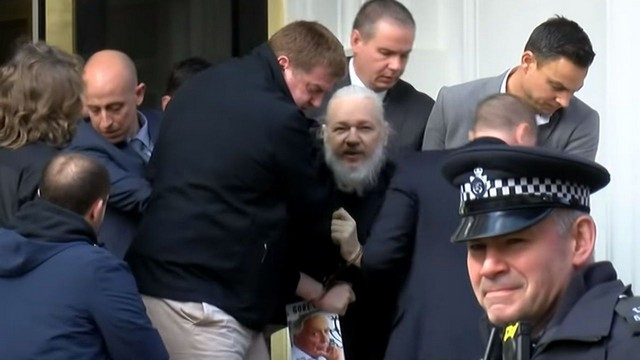
Ecuador has stripped Julian Assange of his citizenship. The move is another outrageous assault on the WikiLeaks founder’s democratic rights, made in preparation for his extradition to the United States on charges under the Espionage Act. He is currently held in the UK’s Belmarsh maximum security prison, pending a case in the High Court.

The decision to revoke citizenship was confirmed by the Pichincha court for contentious administrative matters last week. At the court, a judge backed the Ecuadorian Foreign Ministry’s claims that Assange’s naturalisation letter contained inconsistencies, different signatures and possibly altered documents, and that fees had gone unpaid.

Assange’s lawyer, Carlos Poveda, will appeal the “purely political” decision, which he argued was based on unsubstantiated allegations. He commented, “More than the importance of nationality, it is a matter of respecting rights and following due process in withdrawing nationality.”

Assange was not able to appear in the case, nor given the materials needed to prepare. Poveda explained, “From the first hearing we have said that Julian was not summoned legally, the documents must be translated because his language is English and that was not respected in all documents”.

When he asked for his client to be present at the hearing via a videolink, the Ecuadorian authorities sent a URL, of no use to Assange who is denied access to a computer and the internet.

Ecuador awarded Assange citizenship in December 2017, after granting him asylum in August 2012. He had taken refuge in the Ecuadorian embassy in London two months previously, seeking protection from the looming threat of extradition to the United States. The government of Rafael Correa asked the British government to allow Assange safe passage to Ecuador but was refused, with London threatening to revoke the diplomatic status of Ecuador’s embassy and storm the building. This left Assange trapped in conditions the United Nations condemned as arbitrary detention.

During this time, the Ecuadorian government was placed under substantial pressure by the US and, with a shift to the right following the 2017 presidential election of Lenín Moreno, Assange’s position in the embassy became increasingly tenuous.

On March 27, 2018, a delegation from US Southern Command visited Ecuador, stating that the purpose of the discussions was to strengthen “security cooperation” and “exchange ideas and reiterate US commitment to the longstanding partnership.”

One day later, the Ecuadorian authorities imposed a communications blackout on Assange, blocking any internet or phone contact with the outside world and preventing his friends and supporters from visiting him.

His communications were partially restored in October 2018 under strict, anti-democratic conditions. Assange was required to “comply scrupulously” with a “prohibition” on “activities that could be considered as political and interference in the internal affairs of other States, or that may cause harm to the good relations of Ecuador with any other State.” His visitors were required to provide the Ecuadorian authorities with ID details and surrender their mobile phones and other devices—a procedure that was used to facilitate the US-backed surveillance of Assange and his associates, including his lawyers.

The same month, the US House Foreign Affairs Committee sent a letter to Moreno stating, “We are very concerned with Julian Assange’s continued presence at your embassy in London and his receipt of Ecuadorian citizenship last year.”

The letter made clear that giving up Assange would be necessary for the US “to move forward in collaborating with your government on a wide array of issues,” from “economic cooperation” to “the possible return of a United States Agency for International Development mission to Ecuador.”

In March 2019, Moreno secured a $4.2 billion loan from the International Monetary Fund, amid a deepening financial crisis and in pursuit of a restructuring of Ecuador’s economy. The former Ecuadorian minister of foreign affairs, Ricardo Patiño, commented afterwards, “The arrest of Assange is part of Lenin Moreno’s agreement with the IMF”. This assessment was echoed by John Polga-Hecimovich of the United States Naval Academy, who explained, “Assange impeded Moreno’s ability to seek technical assistance, international loans, and greater security and commercial cooperation with the United States.”

In April 2019, the Ecuadorian authorities allowed British police to enter the embassy in London and arrest Assange, revoking his asylum and suspending his citizenship. The subsequently published diaries of former Foreign Office minister Sir Alan Duncan revealed that this trampling of international law was the product of “many months of patient negotiation” and watched live in the “Operations Room at the top of the Foreign Office.”

Dragged through a two-year legal travesty, Assange was given a faux reprieve this January when the judge blocked his extradition to the US on the sole grounds that to do so would be “oppressive” due to his mental health. This left the door wide open to a US appeal based on promises to ensure Assange’s safety, which the High Court has agreed to hear.

Extradition expert Nick Vamos predicts the appeal has a high chance of success. By confirming its revocation of citizenship, Ecuador has removed another possible complication.

Assange’s case exposes the democratic pretensions of capitalist governments and parties the world over. US imperialism has swept aside every democratic right and principle of international law and employed every form of intimidation and subterfuge possible in pursuit of its target, all with barely a whisper of protest. Governments have lined up to assist the US, from Sweden’s manufactured sexual assault investigation and Britain’s serving as jailer, to Australia’s abandonment of its own citizen and now Ecuador’s withdrawal of asylum and citizenship.

Successive US governments have also been able to count on the uniform support of the political establishment. The Assange manhunt, begun under Obama and escalated by Trump, has been continued seamlessly by the Biden administration—a reality belatedly acknowledged by Amnesty International this Monday.

Speaking with long-time WikiLeaks supporter Stefania Maurizi, Amnesty’s Julia Hall explained, “We had some hope early on, when the Biden Administration first took office in January, and we really thought that potentially there could be a review of the case… Then we saw the appeal. It was really quite disappointing, because we did think that possibly there was an opening there, and for reasons that the Administration has not articulated well so far, they have made the decision to pursue.”

In fact, the US has made its reasons clear: the destruction of Assange as a warning and precedent for those who would expose and oppose imperialist crimes.

Highlighting the extreme danger of Assange’s position, Hall said of the United States’ promises that Assange will be well-treated: “when you look at the assurances and you see that the US government reserves the right to put him in a maximum-security facility or to subject him to Special Administrative Measures, based on his conduct, you are not in a state where the prohibition of torture is absolute.”

She continued, “The US has made it easy for other governments to use assurances, but what this really does is undermine the international prohibition on torture.”

The conclusion which must be drawn from these events is that no confidence can be placed in any government or state institution to win Assange’s freedom. This task falls to the international working class, whose developing struggle against world capitalism and imperialism is the only basis on which Assange’s safety, and democratic rights in general, can be secured.

Originally published in WSWS.org

29 July 2021

Source: countercurrents.org
Medical Complicity With Torture In Israel

By Derek Summerfield

Introduction

This paper concerns torture and medical complicity in its practice. In 2015, Amnesty International noted that 157 states had ratified the UN Convention Against Torture (UNCAT), but 141 states surveyed in the previous 5 years had used torture. Torture is a form of terrorism. The Rome Statute of the International Criminal Court in 1998 defined torture as a crime against humanity.

The World Medical Association (WMA) is the major international watchdog for medical ethics, an independent confederation of over 100 national medical associations. Founded in 1947 as a response to egregious abuses by German and Japanese doctors in World War 2, the WMA Declaration of Tokyo is the seminal anti-torture manifesto for doctors. It lays down a doctor’s unconditional duty not just to take no part in torture but, equally ironclad, to protest, speak out and protect the victim whenever encountered. Inaction is not an option. In two press releases in 2007, the WMA upgraded its call for doctors to document torture and speak out. Then WMA President Jon Snaedal noted that doctors could be a powerful voice in the struggle against torture, emphasising that ‘the absence of documenting and denouncing such acts might be considered as a form of tolerance and of non-assistance to the victims’.

A relevant precedent for the WMA concerned the Medical Association of South Africa (MASA), a member association, who had taken no action against police surgeons who stood by when anti-apartheid activist Steve Biko was tortured and murdered in prison in 1977. In anticipation of imminent expulsion, the MASA withdrew from the WMA, later conceding that the threat of expulsion had been force for change in medical ethics in South Africa.

Torture in Israel

Israel is a signatory to UNCAT but evidence of the routine use of torture on Palestinian detainees has long been accumulating in the public domain. In May 1998, a Human Rights Watch report to UNCAT recorded that Israel ‘continues to use torture and cruel, inhuman or degrading treatment during the interrogation of Palestinian detainees. The magnitude of Israel’s violations of UNCAT is well known to the Committee, having been extensively documented by UN bodies and international, Israeli and Palestinian human rights organisations.’1 In 2007, B’Tselem, the Israeli Information Center for Human Rights in the Occupied Territories, studied the testimony of 73 Palestinian prisoners gathered since 2005 and concluded that Shin Bet, the Israeli intelligence agency, had inflicted physical and mental abuse amounting to torture on almost all of them.2 Amnesty briefed UNCAT in September 2008 regarding Israel’s failure to implement the Convention in the Occupied Territories and intensification of measures amounting to torture.3 In its 2008 Annual Report, the United Against Torture (UAT) Coalition of 14 Palestinian and Israeli human rights organisations concluded that ‘the use of torture and ill-treatment by Israeli authorities against Palestinians is both widespread and systematic. The UAT Coalition has observed and recorded evidence of acts, omissions and complicity by agents of the State at all levels, including the army, intelligence service, police, judiciary and other branches of government.’4 In November 2008, the Public Committee Against Torture in Israel (PCATI) filed a contempt of court motion to the High Court of Justice against the government of Israel and the General Security Service for their responsibility for a policy that granted a priori permits to use torture in interrogations. No Israeli official had ever been charged or sentenced for torture-related crimes.

Medical complicity with torture and the Israeli Medical Association

In 1993, Amnesty International concluded that Israeli doctors working with the security services ‘form part of a system in which detainees are tortured, ill-treated and humiliated in ways that place prison medical practice in conflict with medical ethics’. Amnesty pointed to the implication of statements by Israeli officials (intended to allay concerns about ill-treatment) that detainees were ‘under constant medical supervision’.5

Also in 1993, Amnesty documented the telling example of the Nader Qumsieh case. Five days after his arrest, Qumsieh was brought to a medical centre in Be’er Sheva, where a urologist diagnosed a torn scrotum and bleeding. Qumsieh testified that he had been beaten during interrogation and kicked in the testicles. The urologist later received a call from the Israeli military, and as a result wrote a second report which he antedated by 2 days, without further examination of the patient. In it he recorded that ‘according to the patient, he fell downstairs 2 days before he came to the emergency room.’ This time his medical findings were recorded as: ‘superficial haematoma in the scrotal area, which corresponds to local bruises sustained between 2 and 5 days prior to the examination’. The urologist’s original report disappeared from Qumsieh’s medical file.6

Israeli Medical Association (IMA) President Yoram Blachar defended Israeli practices in a Lancet letter in 1997. He wrote that ‘the guidelines on interrogation recommend only that ‘moderate physical pressure’ be sanctioned. Even this is restricted to cases defined in terms of a ‘ticking bomb’.’ Yet in 1994, UNCAT had reiterated that ‘moderate physical pressure’ was indeed torture, and also outlawed the ‘ticking bomb’ justification. Here a president of a national medical association was defending torture in the pages of a famous medical journal.7 In November 1999, the then Head of Ethics of the IMA Eran Dolev was interviewed by a delegation from the London-based Medical Foundation for the Care of Victims of Torture (where I was then the principal psychiatrist). During the interview he stated that ‘a couple of broken fingers’ during the interrogation of Palestinians was a price worth paying for information. When I quoted this in the Journal of Royal Society of Medicine (JRSM) in 2001, IMA President Blachar castigated this in JRSM as ‘lies and vilification’ and threatened to sue me. The four-delegation members responded in JRSM by affirming that this was exactly what Professor Dolev had said.8

In 2007, PCATI published ‘Ticking Bombs’, the detailed testimony of nine Palestinian men tortured between 2004 and 2006, painting a graphic picture of how Israeli doctors formed an integral part of the running of interrogation units whose output included torture. They alleged that doctors, several of whom were named, saw the prisoners at various points before, between or after experiences of torture (which in one case led to spinal damage and disability), did not take a proper history, made no protest on these men’s behalf as the Declaration of Tokyo demands and typically prescribed simple analgesia before returning them to their interrogators. Several cases had allegedly been known to the chief medical officers of the Israeli Prison Service and Police Service.9

Following repeated requests by PCATI, the IMA eventually agreed to investigate ‘Ticking Bombs’. Professor Avinoam Reches, chairman of the IMA Ethics Board, sent a 14-line letter dated 9 March 2009 back to PCATI to report the outcome. The investigation had amounted to phone calls to a few of the named doctors, all of whom denied involvement, and no examination of the relevant medical files. Reches concluded that there was no evidence ‘other than the word of the prisoners’. What kind of investigation discounts victim testimonies at the outset? When six UK doctors wrote about ‘Ticking Bombs’ in the Lancet in 2007, the IMA threatened to sue.10

The British Medical Association (BMA) is a WMA member and I drew the issue to the attention of the BMA as early as 1997. I was asking them to take the matter up at the WMA, as they were entitled to do. I sent the same material to the then WMA Secretary General Delon Human in 2001, who defended the IMA largely on the grounds that they had ratified the Declaration of Tokyo.11 In 2005, Edwin Borman, chair of the BMA International Committee, wrote to me to say they ‘sought to engage constructively with our Israeli colleagues’ and would not be ‘partisan’.

In now preparing a formal international appeal to the WMA, we were aware that campaigning about human rights issues in Israel–Palestine is qualitatively different from human rights work elsewhere. Publications deemed critical of Israel often evoke vitriolic and ad hominem attacks on writer and medical journal—though little engagement with the cited evidence base. There are calls for journal editors to be disciplined or dismissed. In response to a BMJ paper of mine in 2004, Yoram Blachar, IMA president as well as then WMA Chair of Council (the political head of the WMA), posted a bmj.com Rapid Response stating that ‘the lies and hatred he spews are reminiscent of some of the worst forms of anti-semitism ever espoused’.12 Yet the paper was based on work by a UN rapporteur, the International Court of Justice, Amnesty International, Johns Hopkins and Al Quds Universities, Physicians for Human Rights Israel (PHRI) and the Palestinian Environmental Non-governmental Organisations Network. The same paper produced nearly 1000 hostile emails sent directly to the editor Kamran Abbasi, mostly crude, abusive and with recurrent reference to anti-semitism, some threatening violence against the editor or his family and myself.13 In 2007, the Royal Society of Medicine were pressured by pro-Israel doctors into withdrawing an invitation to me to speak at a conference on religion, spirituality and mental health.14

In May 2009, 725 doctors, including 115 professors, from 43 countries (235 from UK) made a joint appeal to WMA Chair of Council Edward Hill from the USA. I was convenor and Professor Alan Meyers of Boston University and Jewish Voice for Peace USA was lead signatory. We attached a detailed dossier of evidence as above and requested that it be distributed to all council members (these are geographically scattered around the world and only convene yearly). The WMA is mandated to ensure that its member associations do not breach WMA codes like the Declaration of Tokyo. We asked the council to investigate the IMA’s ethical track record in the light of the evidence, and thus to review the probity of their recent appointment of IMA President Yoram Blachar as WMA president. We had public support from Professors Noam Chomsky and Norman Finkelstein in the USA, and from Dr Wendy Orr in South Africa. Orr had been working as a medical officer for the district surgeon in Port Elizabeth in the 1980s and blew the whistle on torture and the complicity of state doctors in cases she saw—her ethical duty under the Declaration of Tokyo.

Our appeal was covered by the BMJ and various newspapers. The Jewish Chronicle quoted Blachar as saying the appeal was a ‘joke’ and ‘you will see that many of the names are Arab’.15 The IMA launched a campaign to gather 10 000 signatures to counter these ‘slanderous charges’. In an unprecedented move in July, the IMA formally announced severance of any further contact with PHRI because PHRI founder, Israeli psychiatrist Ruchama Marton, was one of the 725 signatories, and because PHRI publications were giving comfort to Israel’s enemies. In a letter explaining this to PHRI, Blachar described the IMA as a ‘defensive barrier’ against ‘international anti-Israeli bodies’.

In August 2009, a libel action was initiated against me personally in London by Dr Blachar and the IMA through Mark Stephens of Finer, Stephens, Innocent libel lawyers. The current president of the world’s official medical ethical watchdog was suing someone for pointing to an incriminating evidence base and asking the watchdog to act as mandated. They alleged that I was conducting ‘a malicious campaign of vilification’ that was ‘promiscuous with falsehoods’, and that I had deceived the other 724 signatories. They demanded immediate public retraction in the Lancet, BMJ and Guardian, and substantial damages. I resisted the case and a large number of signatories emailed Mark Stephens direct to assert that they were not deceived. Echoing our appeal, Dr Ishai Menuchin, executive director of PCATI, was reported in the Jewish Chronicle as reaffirming the complicity of Israeli doctors in a ‘black hole’ in which torture was going unchecked.16 The libel action was not pursued.

But from the WMA Council Chair Hill we heard nothing, not even acknowledgement of receipt of the material, even after reminders to him and to Dr Otmar Kloiber, permanent WMA secretary general. Months later, lead signatory Alan Meyers managed to get Dr Hill on the phone at his clinic. Hill told him firmly that the WMA would not be responding and not to send further material. We found out later that our request for the appeal to be circulated from WMA headquarters in France to council members was not honoured. When the WMA presidency passed to Dr Dana Hanson of Canada later in the year, we resent the appeal and evidence base, but with the same result. Calls in the BMJ from the executive directors of PHRI and PCATI for the WMA to act were similarly fruitless.17

Appeals to UN special rapporteurs on torture on the basis of new evidence

Finding the WMA resistant, we turned in 2010 to the UN special rapporteur on torture, who then was Manfred Nowak from Austria. In March 2009, UN Human Rights Council Resolution (A/HRC/10/L.32) had tasked the rapporteur to give particular attention to the problem of medical complicity. We got no acknowledgement from him but repeated the appeal when he was succeeded by Juan Mendez of Argentina (the first rapporteur to have himself been a torture victim). His reports noted that the government of Israel routinely did not respond to representations by the rapporteur.18

A paper copy of a yet more detailed report, ‘Doctoring the Evidence, Abandoning the Victim’, recently published, was given directly to Juan Mendez in London in 2011.19 Based on testimonies and evidence from the files of over 100 torture victims assisted by PHRI/PCATI since 2007, the report demonstrated an institutionalised pattern of active or passive involvement by doctors in torture in Israel. Not one doctor had spoken out and sought to protect the victim. Case studies included doctors’ names. The executive summary concluded that ‘medical professionals abandon their duty by failing to document and report torture; by passing on medical information to interrogators; returning interrogees to the custody of their interrogators when in danger of being exposed to further torture or ill-treatment; and in extreme cases, by taking an active part in the interrogation. Because of their unique social status, the presence of medical professionals in facilities where torture or ill-treatment are carried out indicates the boundaries between the permissible and the impermissible: it grants Israeli Security Agency (ISA) interrogators a stamp of approval. It furthermore precludes the victim from presenting evidence which can aid in pursuing justice through legal or administrative proceedings. Over 700 complaints alleging torture/ill-treatment by ISA interrogators have been filed since 2001 and not one criminal investigation has been initiated. Medical staff in prisons, detention centres and hospitals which treat prisoners are part of the broader administrative systems, primarily the medical apparatus of the Prison Service, the IMA and the Ministry of Health. There are serious doubts that the IMA is willing to enforce these rules: persistently repeated requests by PCATI/PHRI calling the IMA’s attention to cases arousing suspicion of doctors’ involvement in torture and cruel or degrading treatment have not been dealt with substantively.’ PCATI/PHRI noted that IMA ethical codes contained clauses placing the needs of the security apparatus above medical ethics. This is inconsistent with UNCAT and the Declaration of Tokyo, which brook no exceptions. PHRI said that if doctors were taken out of the system in Israel, the practice of torture could not be maintained.

In 2014, the BMJ published a progress report on our campaign 5 years on and asked Rapporteur Mendez to comment.20 He wrote that the IMA’s silence on torture might well be a breach of medical ethics but that the IMA and WMA were outside his mandate.21 It was not clear why he had not taken up directly the evidence in ‘Doctoring the Evidence, Abandoning the Victim’.

Following further representations from us, Hamish Meldrum, BMA Council chair, wrote to signatory Ghada Karmi in March 2010 to say that the BMA had formally written to the WMA regarding the IMA. Nothing came of this.

A fresh appeal to the WMA

In 2015, another incriminating study was published by B’Tselem and by HaMoked, Centre for the Defence of the Individual. It was based on affidavits from 116 Palestinians held and interrogated at the Shikma facility from August 2013 to March 2014. Five were children. Nearly every detainee was exposed to a range of measures described: single or concerted beatings, sometimes with rifle butts and often while detainee was handcuffed and blindfolded; repeated interrogations of up to 35 hours at a time and for up to 40 days while tied tightly in an unnatural position on a special chair; sleep deprivation; solitary confinement; extremes of temperature; threats to the family of the detainee; prolonged periods tied spreadeagled to the four corners of a bed in solitary confinement; poor or absent medical care. Four of the children were subjected to physical violence.22

In January 2016, 71 UK doctors made a fresh appeal to the new WMA president, the prominent UK medical academic Sir Michael Marmot, attaching the new evidence from B’Tselem and PCATI as above, and a paper on the sexual torture of Palestinian detainees.23 I was convenor and Dr Chris Burns-Cox lead signatory. Within days we were astonished to see published on the website of the Simon Wiesenthal Centre a letter from WMA President Marmot on WMA notepaper, dated 25 January, written to Dr Shimon Samuels, director for International Relations at the centre.24 The Wiesenthal Centre is self-described as a Jewish, pro-Israel organisation and was an entirely uninvolved party. WMA President Marmot had instantly exonerated the IMA and afforded them a widely publicised propaganda coup. He wrote that ‘investigations have revealed no wrong doing’ by the IMA. This is contradicted by the whole evidence base cited above. After we published an account as a bmj.com Rapid Response, the BMJ asked Marmot three times for a response but he declined.1 The matter was referred to the General Medical Council (GMC) but I was told that they were unable to appraise the duties of a WMA president.

Our last appeal to the WMA, submitting the new evidence, was in 2017 when the president was now Dr Desai Dhinjlal of India. The result was as before.

A reminder of what is at stake: the recent case of Sameer Arbeed

Amnesty reported that in September 2019, a healthy 44-year-old Palestinian man Sameer Arbeed was arrested in the course of a murder investigation.25 Severe torture led to his admission to intensive care at Hadassah Hospital, reportedly on a ventilator with broken ribs and kidney failure. The authorities were quoted as stating that once he improved he could be taken back for further interrogation. By knowing exactly how Arbeed had sustained his injuries, by treating him but not protesting about the torture, by tolerating his return to a situation in which he could be further tortured, all the hospital doctors who dealt with him were in clear breach of the WMA Declaration of Tokyo. The IMA has remained silent.

Conclusions

A principled, evidence-based appeal by 725 doctors from 43 countries regarding medical complicity with torture in Israel has lasted 12 years to date, spanning four WMA presidencies and two UN special rapporteurs on torture. It has been a litmus test of whether there is rigorous and even-handed regulation of doctors worldwide regarding complicity with torture. We have found that there is not, and that regulation is largely window dressing. The bodies whose mandate it is to address the issue have not acted. If such weight of incriminating evidence, using the case of Israel as example, does not make a difference at the WMA or elsewhere, no evidence ever would. UN rapporteurs seem largely impotent. The WMA acts in partisan violation of its mandate when it acts at all, and does not appear accountable. We endorse public calls for its reform.26 The WMA has spoken out about states like Iran or Bahrain but would not act against Israel or, it seems, other powerful Western states. Political power trumps ethics. The WMA provides a figleaf in that membership per se is held up as evidence of ethical probity. What happens when the national medical association is itself the principally accused party?

Israel is not a unique case. In the recently published ‘The Torture Doctors’, Steven Miles describes medical complicity with torture as ‘pandemic’ and that ‘a complete lack of accountability is the norm’.27 In 2014, the European Centre for Constitutional and Human Rights and Public Interest lawyers detailed 58 separate allegations regarding UK doctors’ involvement in torture in Iraq in 2003–2008, but only one case was ever pursued by the GMC. This was Derek Keilloh, who failed to record fatal torture-inflicted injuries in the Baha Mousa case. In the USA, the American Psychological Association refused to act on cast-iron evidence of active complicity with torture by one of its members after 9/11. Miles quotes a survey which found that 75% of Indian doctors had seen a tortured person and one in seven had actually witnessed torture, yet nothing happens and the Indian Medical Association appears silent. This is what sustains impunity. As the IMA case demonstrates, national medical associations or regulatory bodies like the GMC may function at base as buttresses and shields of the state.

Data availability statement

All data relevant to the study are included in the article.

Ethics statements

Patient consent for publication

Not required.

References

Footnotes

  • Contributors I am the sole author and no contributions from any other party.

  • Funding The authors have not declared a specific grant for this research from any funding agency in the public, commercial or not-for-profit sectors.

  • Competing interests Twenty-nine years of academic and human rights work related to Israel–Palestine.

  • Provenance and peer review Not commissioned; externally peer reviewed.

  • BMJ 2014;349:g4386. Rapid response to:Summerfield D. The campaign about doctors and torture in Israel five years on BMJ 2014; 349 :g4386 doi:10.1136/bmj.g4386

Originally published in Journal of Medical Ethics

Derek Summerfield is an honorary senior lecturer at London’s Institute of Psychiatry and a member of the Executive Committee of Transcultural Special Interest Group at the Royal College of Psychiatry.

26 July 2021

Source: countercurrents.org

 

The 2020-21 Worldwide Corona Crisis: Destroying Civil Society, Engineered Economic Depression, Global Coup d’État and the “Great Reset”

By Prof Michel Chossudovsky

This E-book consists of a Preface and Ten Chapters.

We are dealing with an exceedingly complex process.

In the course of the last 17-18 months starting in early January 2020, I have analyzed almost on a daily basis the timeline and evolution of the Covid crisis. From the very outset in January 2020, people were led to believe and accept the existence of a rapidly progressing and dangerous epidemic.

I suggest you first read the Highlights (below), the Preface and Introduction before proceeding with chapters II through X.

Alternatively you may wish to View the Global Research Video entitled: The 2021 Worldwide Corona Crisis (released in February 2021), which provides a 25 minutes summary.

Each of the ten chapters provides factual information as well as analysis on the following topics:

What Is Covid-19, what is SARS-CoV-2, how Is it identified, how is it estimated?

The timeline and historical evolution of the Corona Crisis,

The devastating economic and financial impacts,

The enrichment of a social minority of billionaires,

How the lockdown policies trigger unemployment and mass poverty Worldwide,

The devastating impacts on mental health.

The E-book also includes analysis of curative and preventive drugs as well as a review of Big Pharma’s Covid-19 “messenger” mRNA vaccine which is an “unapproved” and “experimental” drug affecting the human genome. (It is a dangerous drug. See Chapter VIII)

Also analyzed are issues pertaining to the derogation of fundamental human rights, censorship of medical doctors, freedom of expression and the protest movement.

The last chapter focusses on the unfolding global debt crisis, the destabilization of national governments, the threats to democracy including “global governance” and the World Economic Forum’s “Great Reset” proposal.

This E-Book is made available free of charge with a view to reaching out to people Worldwide. it is accessible in 51 languages by activating the Translate Website Drop Down Menu on the top banner of our home page.

If you wish to make a donation click here to cover the costs of the book (e.g. $10-$20 dollars, that would be much appreciated).

If you want to become Member of Global Research click here

Please help us in this endeavor. Kindly forward to family, friends and colleagues, within your respective communities.

Since its publication in mid-December 2020, the E-Book has been consulted by more than 230,000 readers.

eaders can reach Prof. Michel Chossudovsky at crgeditor@yahoo.com

Video

click the lower right corner to access full-screen

The 2021 Worldwide Corona Crisis – Prof. Michel Chossudovsky


Highlights

We are at the crossroads of one of the most serious crises in World history. We are living history, yet our understanding of the sequence of events since January 2020 has been blurred.

Worldwide, people have been misled both by their governments and the media as to the causes and devastating consequences of the Covid-19 “pandemic”.

The unspoken truth is that the novel coronavirus provides a pretext and a justification to powerful financial interests and corrupt politicians to precipitate the entire World into a spiral of mass unemployment, bankruptcy, extreme poverty and despair.

More than 7 billion people Worldwide are directly or indirectly affected by the corona crisis.

The COVID-19 public health “emergency” under WHO auspices was presented to public opinion as a means (“solution”) to containing the “killer virus”.

If the public had been informed and reassured that Covid is (according to the WHO definition) “Similar to Seasonal Influenza”, the fear campaign would have fallen flat. The lockdown and closure of the national economy would have been rejected outright.

The first stage of this crisis (outside China) was launched by the WHO on January 30th 2020 at a time when there were 5 cases in the US, 3 in Canada, 4 in France, 4 in Germany.

Do these numbers justify the declaration of a Worldwide public health emergency?

The fear campaign was sustained by political statements and media disinformation.

People are frightened. They are encouraged to do the PCR test, which is flawed. A positive PCR test does not mean that you are infected and/or that you can transmit the virus.

The RT-PCR Test is known to produce a high percentage of false positives. Moreover, it does not identify the virus.

From the outset in January 2020, there was no “scientific basis” to justify the launching of a Worldwide public health emergency.

In February, the covid crisis was accompanied by a major crash of financial markets. There is evidence of financial fraud.

And on March 11, 2020: the WHO officially declared a Worldwide pandemic at a time when there were 44,279 cases and 1440 deaths outside China out of a population of 6.4 billion (Estimates of confirmed cases based on the PCR test)..

Immediately following the March 11, 2020 WHO announcement, confinement and lockdown instructions were transmitted to 193 member states of the United Nations.

Unprecedented in history, applied almost simultaneously in a large of number countries, entire sectors of the World economy have been destabilized. Small and medium sized enterprises have been driven into bankruptcy. Unemployment and poverty are rampant.

The social impacts of these measures are not only devastating, they are ongoing under what is described as “A Second Wave”. There is no evidence of a “Second Wave”. Amply documented the PCR estimates are flawed.

The health impacts (mortality, morbidity) resulting from the closing down of national economies far surpass those attributed to Covid-19.

Famines have erupted in at least 25 developing countries according to UN sources.

The mental health of millions of people Worldwide has been affected as a result of the lockdown, social distancing, job losses, bankruptcies, mass poverty and despair. The frequency of suicides and drug addiction has increased Worldwide.

“V the Virus” is said to be responsible for the wave of bankruptcies and unemployment. That’s a lie. There is no causal relationship between the (microscopic) SARS-2 virus and economic variables.

It’s the powerful financiers and billionaires who are behind this project which has contributed to the destabilization (Worldwide) of the real economy. And there is ample evidence that the decision to close down a national economy (resulting in poverty and unemployment) will inevitably have an impact on patterns of morbidity and mortality.

Since early February 2020, the Super Rich have cashed in on billions of dollars.

Amply documented it’s the largest redistribution of global wealth in World history, accompanied by a process of Worldwide impoverishment.

Preface

The fear campaign has served as an instrument of disinformation.

Media lies sustained the image of a killer virus which initially contributed to destabilizing US-China trade and disrupting air travel. And then in February “V- the Virus” (which incidentally is similar to seasonal influenza) was held responsible for triggering the most serious financial crisis in World history.

And then on March 11, a lockdown was imposed on 193 member states on the United Nations, leading to the “closure” of national economies Worldwide.

Starting in October, a “second wave” was announced. “The pandemic is not over”.

The fear campaign prevails. And people are now led to believe that the corona vaccine sponsored by their governments is the “solution”. And that “normality” will be restored once the entire population of the planet has been vaccinated.

The SARS-CoV-2 Vaccine

How is it that a vaccine for the SARS-CoV-2 virus, which under normal conditions would take years to develop, was promptly launched in early November 2020? The mRNA vaccine announced by Pfizer is based on an experimental gene editing mRNA technology which has a bearing on the human genome.

Were the standard animal lab tests using mice or ferrets conducted?

Or did Pfizer “go straight to human “guinea pigs.”? Human tests began in late July and early August. “Three months is unheard of for testing a new vaccine. Several years is the norm.”

This caricature by Large + JIPÉM explains our predicament:

Mouse No 1: “Are You Going to get Vaccinated”,

Mouse No. 2: Are You Crazy, They Haven’t finished the Tests on Humans”

And why do we need a vaccine for Covid-19 when both the WHO and the US Center for Disease Control and Prevention (CDC) have confirmed unequivocally that Covid-19 is “similar to seasonal influenza”.

The plan to develop a vaccine is profit driven. It is supported by corrupt governments serving the interests of Big Pharma. The US government had already ordered 100 million doses back in July and the EU is to purchase 300 million doses. It’s Big Money for Big Pharma, generous payoffs to corrupt politicians, at the expense of tax payers.

In the following chapters, we define the SARS-CoV-2 virus and the controversial RT-PCR test which is being used to “identify the virus” as well establish the “estimates” of the so-called “positive cases”.(Chapter III)

In Chapter II, we examine in detail the timeline of events since October 2019 leading up to the historic March 11, 2020 lockdown.

We assess the broad economic and social consequences of this crisis including the process of Worldwide impoverishment and redistribution of wealth in favour of the Super Rich billionaires.(Chapter IV and V).

The devastating impacts of the Lockdown policies on mental health are examined in Chapter VI.

Big Pharma’s vaccination programme which is currently being imposed on millions of people Worldwide is reviewed in Chapter VIII.

Chapter X concludes with an analysis of the World Economic Forum’s proposed “Great Reset” which if adopted would consist in scrapping the Welfare State and imposing massive austerity measures on an impoverished population.

This E-Book is preliminary. There is a sense of urgency. People Worldwide are being lied to by their governments.

A word on the methodology: our objective is to refute the “Big Lie” through careful analysis consisting of:

  • A historical overview of the Covid crisis, with precise data.
  • Quotations from official documents and peer reviewed reports. Numerous sources and references are indicated.
  • Scientific analysis and detailed review of “official” data, estimates and definitions,
  • Analysis of the impacts of WHO “guidelines” and government policies on economic, social and public health variables.

Our objective is to inform people Worldwide and refute the official narrative which has been used as a pretext and justification to destabilize the economic and social fabric of entire countries.

This crisis affects humanity in its entirety: 7.8 billion people. We stand in solidarity with our fellow human beings Worldwide. Truth is a powerful instrument.

Michel Chossudovsky is an award-winning author, Professor of Economics (emeritus) at the University of Ottawa, Founder and Director of the Centre for Research on Globalization (CRG), Montreal, Editor of Global Research.

27 July 2021

Source: www.globalresearch.ca

Syrian Civilians Attacked by Terrorists Using US-NATO Weapons

By Vanessa Beeley

Vanessa Beeley in Idlib – Children are being killed, homes are being shelled, and fields scorched, often by Al-Qaeda-affiliated terrorists armed with US-made weapons or by Turkish artillery. Where’s the outcry in the West against these war crimes?

23 Jul 2021 – UN Secretary General, Antonio Guterres celebrated the extension of a “humanitarian” border crossing at Bab Al Hawa, on July 10th, as a “lifeline for millions of people” – many Syrians would rather describe it as a “lifeline” for Al Qaeda.

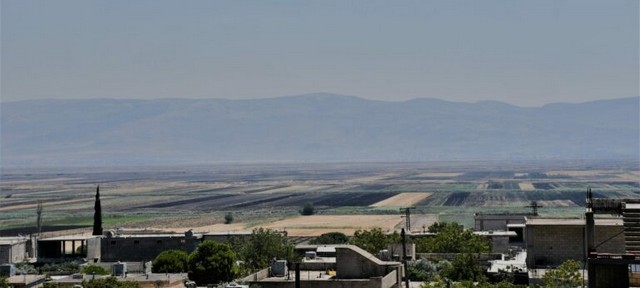
On the 15th July I visited Jurin, a village to the north of the Hama governorate and only 5km from the Syrian allied military frontlines with the Al Qaeda-dominated armed groups controlling Idlib, north-west Syria.

We arrived at around 9 am to the boom of mortar and rocket fire from the Jabal az Zawiya mountain that is under control of Turkish-backed armed groups. Jurin is in the Al Ghab plains at the foot of two mountain ranges and is an easy target for the elevated terrorist positions, occupying Jabal az Zawiya.

On June 20th, a three-year-old child, Massa Akram Saleh, was murdered by the armed groups who targeted her family home, injuring her father and brother, five-year-old Akram Saleh, whose body was lacerated by shrapnel wounds. Massa was rushed to Al Sqeilbiyyeh hospital, a journey of one hour, but later died. Her brother and father are still receiving treatment. Massa’s grandfather told me:

If this had been a child of the militants, the UN would have made a big case of it. Hundreds of children have died in our area but it is as if nobody died at all”

The grandfather describes a daily deluge of attacks from the Turkey-assisted armed groups, targeting the triangle of Jurin, Al Safafeh and Zkereh. He begs the Syrian forces to push the militants at least as far as the M4 highway and away from the region, to bring an end to the ceaseless aggression.

This is an aggression that apparently is not worth mentioning in UN reports on the cross border “humanitarian” activity. He thanks the Syrian Arab Army for doing everything they can to keep the extremist groups at bay.

While the grandfather is talking to me, a mother carrying a baby, hugging her children, is cowering and weeping in the background as the shells continue to fall. Next to her is Massa’s grandmother who cannot move without her walking frame.

One shell had hit the outer wall of the house just before we arrived, another had blown a two meter crater in the garden behind the extended family home. A third exploded five meters from where I was standing while I interviewed a second family member, Ghaith Ghazi Saleh. He told me:

We are being targeted on a daily basis with shells from Az Zawiya mountain. During the last two or three years we have seen Turkish convoys coming into the area not more than 2km from our farmlands, they prevent us from cultivating our farmlands [..] the artillery that bombards us is Turkish. The coordinates are provided by the terrorists”

Vanessa Beeley is an independent journalist and photographer who has worked extensively in the Middle East–on the ground in Syria, Egypt, Iraq and Palestine–while also covering the conflict in Yemen since 2015.

26 July 2021

Source: www.transcend.org

A Sadistic Decision – Damn Them All

By Gideon Levy

15 Jul 2021 – Gideon Levy writes in Haaretz on 15 July 2021:

Damn them all. Damn Rafael Gana, the deputy head of the Israel Prison Service, who wrote to the interior minister: “Your request does not meet the prerequisites for consideration.” Damn Katy Perry, the head of the Israel Prison Service, who approved the decision. Damn Public Security Minister Omer Bar Lev, the heartless coward, who didn’t lift a finger to change this evil decision. And above all, damn the Shin Bet, which probably stands behind the decision, as it stands behind far more than we know.

Damn all those who are partner to this sadistic decision not to release Khalida Jarrar from prison to attend her daughter’s funeral. Damn this new government, which presumed to herald a change, and none of whose ministers acted to oppose the evil institutions that decided to leave Jarrar in prison. Not even ministers Merav Michaeli and Tamar Zandberg, who presumably have far more in common with the secular feminist freedom fighter Jarrar than with their colleague Ayelet Shaked.

And damn the Israeli media, which, with the exception of this newspaper, took no interest in the story, which was reported worldwide but not in Israel. Jarrar is a political prisoner. After a sequence of arrests without trial, she was sentenced to two years in prison for “belonging to an illegal organization,” in a land where there is no organization that is permitted to Palestinians. Jarrar is scheduled to be released September 25, about two months from now. All the existential dangers that lie in wait for the country upon her release will be ready to pounce in another two months.

On Sunday, her daughter Suha was found dead, apparently from cardiac arrest. Suha’s body was found about five hours after her death, after her sister in Canada was unable to reach her by phone and asked friends to break into the house. Suha’s father Ghassan was in Jenin at the time and rushed to her home. The Khalidas have two daughters: Suha, who completed a master’s degree in climate change in Canada and worked for the Al Haq human rights group in Ramallah, and Yafa, who completed a doctorate in law in Canada and lives there.

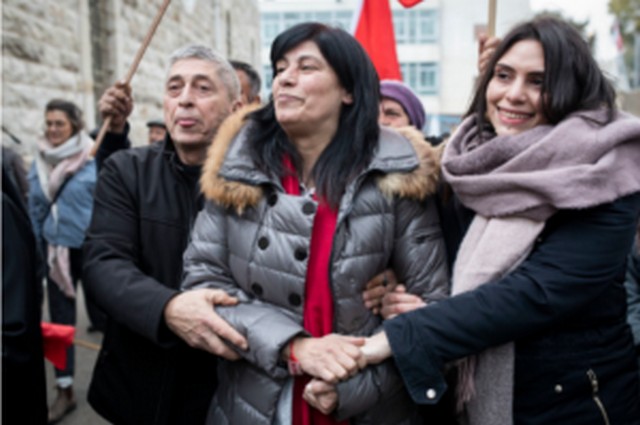
I will never forget that moment in the military court in Ofer in the summer of 2015: Yafa, Suha and Ghassan in the audience, Khalida in the dock, and the Israel Prison Service officer, Bassam Kashkush, suddenly allowed the two young women to approach their mother and embrace her. Even the warden teared up. It was forbidden, against regulations, but what Officer Kashkush dared to permit, in a rare moment of humanity and compassion, the State of Israel, the head of the Prison Service and the interior minister failed to do.

All that was needed was a tiny degree of humanity. All that was missing was a minimal amount of humanity. “He had a mother, after all,” wrote poet Nathan Alterman. They are also parents, after all, Katy and Omer and the Shin Bet agents. Are they capable of imagining what it means to lose a young daughter and not be able to go to her funeral? Not to be with her father and sister during their tragedy? To mourn in grief in a cell in Damon Prison? To hear about the death of their daughter on Radio Palestine?

What else? What else needs to be said about Israeli insensitivity, except for one thing: Jarrar is a human being. But to most Israelis, she isn’t. She’s a terrorist, although she has never been convicted of terrorism, and she is a proud Palestinian, and that is even worse, apparently.

The day after Suha’s death, when there was still hope that Jarrar would be released, the banquet hall in the center of Ramallah was filled with people. The entire secular left of the city came to be with Ghassan, who remained so alone in his mourning. He cried and cried, and everyone cried with him. Fadwa Barghouti, Marwan’s wife, who sat next to me, said their son Aarab was at this moment visiting his father in prison for the first time since the outbreak of the coronavirus. He is the only one in the family allowed to visit Marwan. Fadwa is not allowed to visit her husband, and Khalida is not allowed to attend her daughter’s funeral. Israeli malevolence, how awful it is.

Gideon Levy is a Haaretz columnist and a member of the newspaper’s editorial board.

26 July 2021

Source: www.transcend.org

The Many Faces of Regime Change in Cuba

By Louis A. Pérez Jr

24 Jul 2021 – After months of casual indifference to conditions in Cuba, the Biden administration reacted with purposeful swiftness to support street protests on the island. “We stand with the Cuban people,” President Biden pronounced. A talking point was born.
“The Biden-Harris administration stands by the Cuban people,” secretary of state Antony Blinken followed. Senate Foreign Relations Committee chair Robert Menéndez also joined to emphasize “the need for the United States to continue to stand with the Cuban people.”

For more than a hundred and twenty years, the United States has “stood with the Cuban people” — or, perhaps more correctly, has stood over the Cuban people. Cuba seems always to be at the receiving end of American history. To stand with the Cuban people has meant armed intervention, military occupation, regime change, and political meddling — all normal events in US-Cuba relations in the sixty years before the triumph of the Cuban revolution. In the sixty years after the revolution, standing with the Cuban people has meant diplomatic isolation, armed invasion, covert operations, and economic sanctions.

It is the policy of economic sanctions — the embargo — officially designated as an “economic denial program,” that gives the lie to US claims of beneficent concern for the Cuban people. Sanctions developed early into a full-blown policy protocol in pursuit of regime change, designed to deprive Cubans of needed goods and services, to induce scarcity and foment shortages, to inflict hardship and deepen adversity.

Nor should it be supposed that the Cuban people were the unintended “collateral damage” of the embargo. On the contrary, the Cuban people have been the target. Sanctions were designed from the outset to produce economic havoc as a way to foment popular discontent, to politicize hunger in the hope that, driven by despair and motivated by want, the Cuban people would rise up to topple the government.

The declassification of government records provides insight into the calculus of sanctions as a means of regime change. The “economic denial program” was planned to “weaken [the Cuban government] economically,” a State Department briefing paper explained, to “promote internal dissension; erode its internal political support . . . [and] seek to create conditions conducive to incipient rebellion.” Sanctions promised to create “the necessary preconditions for nationalist upheaval inside Cuba,” the Department of State Bureau of Intelligence and Research predicted, thereupon to produce the downfall of the Cuban government “as a result of internal stresses and in response to forces largely, if not wholly, unattributable to the U.S.”

The “only foreseeable means of alienating internal support,” the Department of State offered, “is through disenchantment and disaffection based on economic dissatisfaction and hardship. . . . Every possible means should be undertaken promptly to weaken the economic life of Cuba . . . [to deny] money and supplies to Cuba, to decrease monetary and real wages, to bring about hunger, desperation and overthrow of government.”

The embargo has remained in place for more than sixty years. At times expanded, at other times contracted. But never lifted. The degree to which US sanctions are implicated in current protest demonstrations in Cuba is a matter of debate, of course. But that the embargo has contributed — to a greater or lesser extent — to hardship in Cuba can hardly be gainsaid; that has been its intent. And now that hardship has produced popular protests and demonstrations. That, too, is in the “playbook” of the embargo.

But the embargo has had a far more insidious impact on the political culture of Cuba. The Cuban government is not unaware of the United States’ desired policy outcomes from the sanctions. They understand well its subversive reach and interventionist thrust, and have responded accordingly, if not always consistently.

Such a nakedly hostile US policy, which has been ongoing and periodically reaffirmed over such a lengthy period of time, designed purposely to sow chaos, has in fact served Cuban authorities well, providing a readily available target that can be blamed for homegrown economic mismanagement and resource misallocation. The embargo provides a refuge for blamelessness and immunity from accountability. The tendency to attribute the consequences of ill-conceived policies to the embargo has developed into a standing master narrative of Cuban government.

But it is more complicated still. Not a few within the Cuban government view popular protests warily, seeing them as a function of US policy and its intended outcomes. It is no small irony, in fact, that the embargo has so often served to compromise the “authenticity” of popular protest, to ensure that protests are seen as acts in the service of regime change and depicted as a threat to national security.

The degree to which the political intent of the embargo is imputed to popular protest often serves to drive the official narrative. That is, protests are depicted less as an expression of domestic discontent than as an act of US subversion, instantly discrediting the legitimacy of protest and the credibility of protesters. The embargo serves to plunge Cuban politics at all levels into a Kafkaesque netherworld, where the authenticity of domestic actors is challenged and transformed into the duplicity of foreign agents. In Cuba, the popular adage warns, nothing appears to be what it seems.

Few dispute the validity of Cuban grievances. A long-suffering people often subject to capricious policies and arbitrary practices, an officialdom often appearing oblivious and unresponsive to the needs of a population confronting deepening hardship. Shortages of food. Lack of medicines. Scarcity of basic goods. Soaring prices. Widening social inequalities. Deepening racial disparities.

Difficulties have mounted, compounding continuously over many years, for which there are few readily available remedies. An economy that reorganized itself during the late 1990s and early 2000s around tourist receipts has collapsed as a result of the pandemic. A loss of foreign exchange with ominous implications for a country that imports 70 percent of its food supplies.

The Trump administration revived the most punitive elements of US sanctions, limiting family remittances to $1,000 per quarter per person, prohibiting remittances to family members of government officials and members of the Communist Party, and prohibiting remittances in the form of donations to Cuban nationals. The Trump administration prohibited the processing of remittances through any entities on a “Cuba restricted list,” an action that resulted in Western Union ceasing its operations in Cuba in November 2020.

And as a final spiteful, gratuitous gesture, the outgoing Trump administration returned Cuba to the list of state sponsors of terrorism. At the precise moment the Cuban people were reeling from greater shortages, increased rationing, and declining services, the United States imposed a new series of sanctions. It is impossible to react in any way other than with blank incredulity to State Department spokesperson Ned Price’s comment that Cuban humanitarian needs “are profound because of not anything the United States has done.”

Cubans confront all at once a collapsing economy, diminished remittances, restricted emigration opportunities, inflation, shortages of food, scarcity of medicines, all in a time of a national health emergency — and with the United States applying punitive sanctions with the intent of making everything worse. Of course, the Cuban people have the right to peaceful protest. Of course, the Cuban government must redress Cuban grievances.

Of course, the United States must end its deadly and destructive policy of subversion.

Louis A. Pérez Jr is the J. Carlyle Sitterson Professor of History and director of the Institute for the Study of the Americas at the University of North Carolina at Chapel Hill.

26 July 2021

Source: www.transcend.org

Palestine Update 482

EU can’t be trusted with more than lip service to Palestinian rights?
“But Europe’s lip service to Palestinian human rights, EU policy and international law will not hide the obvious fact that Israel’s utter contempt of the EU’s demarches – the most recent, sixth, forcible transfer attempt was perpetrated by the new government under minister of defence, Benny Gantz, from Lapid’s “change coalition”, not by Netanyahu’s government – led to no consequences whatsoever. This will rightly be seen here in Israel as nothing but acquiescence to our government’s policy of destroying Palestinian communities, to further facilitate its takeover of their land.”

UN, EU and World Bank back siege on Gaza
Maureen Clare Murphy*
A new study of Gaza’s reconstruction needs, published by the UN, EU and World Bank, demonstrates anew the harmful role played by these institutions in Palestine. The authors of the “rapid damage and needs assessment,” as the UN, EU and World Bank call their study, go to great lengths to minimize Israeli responsibility for the dire situation in Gaza, exacerbated by the latest episode of bombardment in May. They use the passive voice throughout in an apparent bid to downplay Israel’s direct role in the destruction, for which reconstruction will cost some $345-485 million and take two years to complete. That is assuming Israel won’t obstruct it at every turn. Israeli leaders have sought to condition reconstruction on the return of Israelis held in Gaza. Rebuilding took place at a snail’s pace after the last war. So there is every reason to believe that it will delay and hinder rebuilding once again.

The authors of the “rapid assessment” state that “the May 2021 conflict caused damage” to Gaza’s roads as if this were some unfortunate Act of God rather than the result of missiles deliberately fired by the Israeli military at civilian infrastructure. In one such attack, an Israeli strike made a giant crater in one of the main roads leading to al-Shifa hospital, Gaza’s largest medical facility, blocking the movement of ambulances.

Al-Haq, a Palestinian human rights group, said that the attack on the main roads leading to al-Shifa “amounts to making the hospital the object of the attack.” Israel killed more than 40 Palestinians in that series of strikes on Gaza City’s al-Wihda street. But these specifics are omitted from the “rapid assessment,” which describes Palestinian needs in detail but treats Israel’s responsibility in abstraction, if at all.

Israel’s siege and its deleterious effects on every aspect of life in Gaza are impossible to ignore, even for the UN, EU and World Bank. But these international institutions legitimize Israel’s siege on Gaza by stating that it was imposed “due to security concerns.” Yet, the study’s authors don’t attribute this as a claim made by the Israeli government and instead – shockingly – present it as a given. This shamefully whitewashes a plainly cruel and immoral siege that the International Committee of the Red Cross has affirmed amounts to collective punishment “imposed in clear violation of Israel’s obligations under international humanitarian law” – i.e., a war crime.

As Al Mezan, a human rights group based in Gaza, writes, Israel’s closure regime “cannot be justified under any circumstances.” Israel’s policies in Gaza may “amount to the crimes against humanity of persecution and other inhumane acts.” By accepting the premise that “security concerns justify the siege,” the UN, EU and World Bank demonstrate an eagerness to sanctify Israel’s subjugation of the Palestinians living under its settler-colonial rule.

The true purpose of the siege on Gaza is not to protect Israel’s security. Instead, it is to secure regime change by bringing Gaza’s economy to its knees to weaken Hamas, the faction with an armed wing that has governed the territory’s internal affairs since 2007. Israel long ago admitted that the siege on Gaza is “economic warfare.” After all, it is hard to see how counting the calories that Israel allows into Gaza could reasonably be considered a security measure.

Decades of Israeli closure
Gaza has been under some degree of Israeli closure for the past half-century – decades before Hamas came onto the scene. Israel has long isolated Gaza, rendering the territory “a segregated, debilitated and subjugated colony,” as Ron Smith observed in 2019. “Israel manufactures humanitarian crises through its siege to create permanent isolation and deprivation, which is supported by the international community through its political inaction and its supplying of humanitarian aid in spite of the Israeli government’s legal obligations,” according to Smith.

Israel does this because most of the two million Palestinians in Gaza are refugees with claims to return to their lands in what is now called Israel – claims supported by international law. As Smith writes, that is an untenable prospect for “a settler-colonial state premised on ethnic purity.” But why would the UN, EU and World Bank back the “security concerns” excuse for a policy that has plunged Gaza’s population of two million into “profound levels of poverty, aid dependency, food insecurity and unemployment,” as described by Al Mezan? Because they share the same regime change goal as Israel, as is made clear in the “rapid assessment” report. These international institutions that have crowned themselves in charge of rebuilding Gaza want to see the restoration of Palestinian Authority rule in the territory, as well as “internal Palestinian reconciliation” and a “democratically elected Palestinian Authority.”

Palestinians in the West Bank (excluding East Jerusalem, where Israel forbids any PA presence) and Gaza have not had a general vote since the 2006 legislative elections. Hamas emerged as the surprise victor. Israel and its allies, principally the US, spared no effort in undermining the new Hamas-led PA government to restore power exclusively to Mahmoud Abbas, the West Bank-based PA president whose Fatah party lost the election.When Hamas routed US-backed militias from Gaza in 2007, allowing it to take up the reins of government, its administration was deemed illegitimate because of its refusal “to recognize the Middle East Quartet’s (EU, Russian Federation, UN and US) demands to accept all previous agreements, recognize Israel’s right to exist and renounce violence.”

These parties have made no such demands on Israel, whose war criminal and genocide-advocating leaders are warmly congratulated and welcomed by UN and EU officials.

But human right isn’t their priority.

The key difference between the Abbas-led Palestinian Authority in Ramallah and the Hamas leadership in Gaza is that the former views security coordination with Israel as “sacred” and the latter insists on Palestinians’ right to resist Israeli occupation and colonization of their land.

The PA in the West Bank, it should be noted, was recently chastized by the UN’s human rights chief for violently cracking down on protests following the death of Nizar Banat, a prominent critic, after being beaten in PA custody.

Palestinians were due to have an election in May, but the vote was postponed under a decree issued by Abbas, who cited Israeli restrictions on Palestinian voting in Jerusalem. But that was widely viewed as an excuse to avoid Fatah losing once again to Hamas.

Capitulation
The UN, EU and World Bank want Palestinians to capitulate to Israel and surrender to its rule.

They call for a democratically elected Palestinian Authority “in charge of all essential government functions across the Palestinian territory.” They got that in 2006, but Palestinians made the mistake of electing the wrong government in the view of these international institutions. If Palestinians were to hold elections today, the UN, EU and World Bank would likely not be pleased with the results, given the widespread approval of Hamas and unpopularity of Abbas’ Fatah party following the May escalation.

In their study, the UN, EU and World Bank point to “the lack of an internationally recognized government in Gaza for over a decade” as one of several “structural factors” constraining the Palestinian economy. They fail to acknowledge their own contribution to this “structural factor” by refusing to recognize the Hamas government in Gaza, which they seek to sideline in the reconstruction process.

Meanwhile, Israel has tightened its siege following the May offensive. Rather than unequivocally calling on Israel to lift restrictions, the UN, EU and World Bank seek international efforts to “support, reform and strengthen the mechanism to facilitate and accelerate the import of sensitive goods and materials” needed to rebuild “Gaza’s economic infrastructure and business sector.”

It’s a somewhat oblique reference to the scandalous UN-enforced Gaza Reconstruction Mechanism, devised after the 2014 offensive, allowing Israel to exercise total control over what building materials are allowed into the territory. In other words, the UN, EU and World Bank want to “support, reform and strengthen” Israeli restrictions on the Palestinian economy, particularly in Gaza, rather than do away with them altogether. These institutions are meanwhile promoting a “Building Back Better” approach, ensuring that “recovery and reconstruction efforts factor in resilience and sustainability” and “reduce Gaza’s vulnerabilities.” But for that to actually happen, Palestinians need to be free of Israel’s colonial domination and the agenda of the international institutions that support it.

*Maureen Clare Murphy is senior editor of The Electronic Intifada.

19 July 2021

Cry, the Bedeviled Country: I Weep for My Homeland of South Africa, As I Watch Its Disintegration from Afar

By Jani Allan

17 Jul 2021 – Widespread looting and burning has killed over 100, and wrecked factories, shops and homes, with Indian and whites increasingly the target. Is the country I love, where I spent 30 years of my life, spiralling into racial warfare?

Many years ago, I was invited by Prince Mangosuthu Buthelezi to attend the Shaka Day celebrations in Natal. I was one of a handful of whites. Thousands of Zulus in their traditional garb, swayed, danced and sang praise songs to the great 19th-century warrior king, Shaka kaSenzangakhona, who made his people one of the formidable and feared powers in southern Africa.

Without the support of Chief Buthelezi, the leader of the Inkatha Freedom Party, Nelson Mandela would not have been released from jail. Gavin Relly, the former chairman of Anglo American, has said the Zulu leader was “the anvil on which apartheid was broken”.

But because he refused to join the African National Congress (ANC), due its Marxist underpinnings and his strong belief in “education before liberation”, Buthelezi and his supporters paid a heavy price, and he was frozen out of the highest echelons of power in post-apartheid South Africa.

This week, I watched in horror as my beloved homeland was transmogrified into an apocalyptic hell. The fruits of liberation before education were on full display, as looters and arsonists rampaged across the country. The tragedy was almost Shakespearean. Who could imagine that a nation would loot in order to express their rage at the jailing of the great Looter-in-Chief himself, former president Jacob Zuma?

Nelson Mandela gave the nation a gift: a non-racial constitutional democracy that enshrined freedom, equality and the rule of law. What we saw was the wilful torching of this gift – criminal behaviour emblazoned across the world’s screens. I was ashamed.

The orgy of looting, the burning of shopping malls, the wanton destruction of cars and trucks, and the brutal killing of livestock – all speaks to a descent into a barbarism that is plainly inexplicable. What is clear is that we have reaped what we have sown: a culture of impunity forged over decades of rampant government corruption, lawlessness and maladministration.

High rates of unemployment (70%-plus in many areas), poverty and ill health only partially explain the widespread manifestations of anger and anomie. But they are an insufficient explanation for this barbaric plunder of the economy. If they were, why would rioters loot a sex shop and a funeral parlor?

Revolutionary movements such as the ANC demand unfettered loyalty from the electorate for having defeated the enemy: apartheid. And that loyalty means turning a blind eye to the excesses of the ruling elite’s entitlement to the state’s resources, with which they buy themselves opulent villas, Ferraris and Bentley convertibles, and large farms while millions of the people they promised to set free live in ramshackle wood-and-corrugated-iron shacks in crime-ridden slums without toilets, jobs or hope.

But within the ANC, the ruling elite is not a monolith. The tribal divisions run deep. Zuma is a Zulu in a party that accords hegemony to the dominant Xhosa ethnic group. And this subterranean faultline has been the fatal flaw that, since Mandela departed frontline politics in 1999, has seen it struggle to remain united.

Under Mandela, a Xhosa, Zuma the Zulu could always be contained because of Mandela’s stature. The current president, Cyril Ramaphosa, however, has a much more difficult task reining in his predecessor and his considerable Zulu following, partly because he’s a member of the Venda ethnic group, a minor tribe from the northern regions of the country.

These tribal distinctions are further bedevilled by the political factions within the ANC, which were writ large with the jailing of Zuma. Contempt of court is a foreign concept to the masses, who are not ignorant of the party’s entrenched culture of corruption across the board. South Africa is bankrupt because of the looting of the state treasury for personal enrichment. In this regard, all ANC leaders are culpable.

Every week, another financial scandal erupts, with one of the latest being billions of rands earmarked for Covid vaccines going missing. This against the backdrop of excess mortality rates that suggest the virus has killed at least 160,000 in South Africa, making it the worst-hit nation on the continent.

That Zuma fleeced South Africa with the help of his businessmen chums, particularly the three Gupta brothers – all of whom protest their innocence, of course, and say the charges are politically motivated – is of no consequence to his minions, although the majority of South Africans were outraged by the scandal. What they demand is equal justice before the law. ANC officials who destroyed every state-owned enterprise have not been held accountable and are still walking free.

But Zuma’s followers have overplayed their hand with the wanton destruction of property and life. The image of a mother hurling her baby from a burning building set on fire by looters is seared into the global consciousness.

Aware that they have lost the sympathy both of the nation and of countries across the globe, Zuma’s ANC resorts to the Marxist playbook of turning on old opponents: white and Indian people. Deflection, after all, is the best form of defence. Propaganda messages abound online, urging comrades that “the revolution has begun” and they must take it “into the white areas and to the next level.”

Others call for “the revolution” to be taken to all parts of the country, demanding: “We need to liberate ourselves from these cronies, who are political puppets and sellouts, who are working as the black face/white skin, who are the political puppets of the white supremacy and white monopoly capital … Our struggle is against white supremacy and black subjugation.”

Death toll in South African unrest jumps above 200 as looting and violence continues in KwaZulu-Natal

In another video clip, filmed by a citizen journalist and shared on the social media app Telegram, an apparent ANC official in a rather sharp-looking suit, urges, “Once you are done with the looting, go to Indian areas. Go there and kill Indians and burn their houses. Once you are done with looting, go to white areas and kill them and burn their houses.”

While the provenance of some of these is uncertain, there’s no doubt that there are plenty of high-profile people inciting the violence, including Zuma’s own children and the notorious Julius Malema, of the anti-white, far-left Economic Freedom Fighters revolutionary group.

This inflammatory rhetoric of a race war, inciting the masses to mobilise against an ethnic minority, to destroy all vestiges of so-called white monopoly capital, has been countered by the spontaneous emergence of ad hoc multiracial militias, who have been patrolling their neighbourhoods armed with an array of weapons to keep would-be looters at bay.

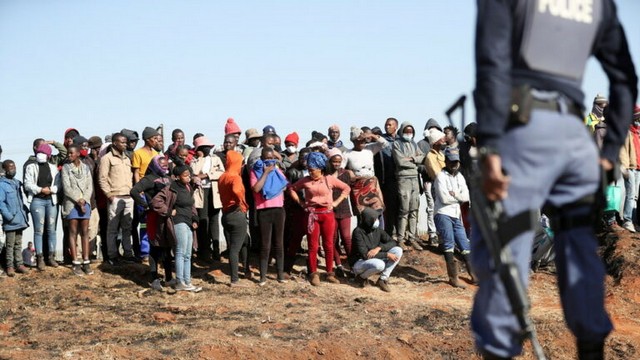
President Ramaphosa deployed 74,000 troops during the Covid lockdown in 2020 to enforce regulations; today, as the country burns, there are about 25,000 soldiers on the streets – or at least that’s what the government claims. They are needed – the inept South African Police Service is not only incapable of protecting lives and properties, but some of its officers have joined in the looting themselves.

The newly installed King of the Zulus, Misuzulu KaZwelithini, has likened the ongoing violent protests in his region to a “suicide mission that will haunt the poor and vulnerable in the near future.”

Meanwhile, Ramaphosa has blamed the rioting and looting on “coordinated criminality.” This reluctance to call the violence what it really is, is emblematic of the president’s pusillanimous leadership since he took office.

My prayers go out to all my relatives and friends – black, white and of Indian origin – who still live in my former homeland. And I thank God that I no longer do.

Jani Allan is a writer and talk show host. She has written for the London Sunday Times, the Spectator, the Daily Mail and various other British publications.

19 July 2021

Source: www.transcend.org

The List Is Here: Find Out How Global Defense Companies Performed in FY20

By Mike Gruss

12 Jul 2021 – The coronavirus pandemic is not yet over — despite our most optimistic thinking — and this year’s Defense News Top 100 list offers hints of how the broader international defense market has coped.

The answer appears to be that national security firms have fared well. Very well.

Consider that six of the 10 largest U.S. defense companies had revenues jump by 6 percent or more — a total of about $11 billion — from fiscal 2019. And all seven Chinese firms on the list grew during the last year as well.

See the 2021 Top 100 list here!

The pandemic has shown — or maybe exposed — a workforce in which everyone is always online, always connected and, during the last 16 months, always on the job. That’s also true of the national security community. During this era of gray zone conflict, information warfare and cyberattacks, it’s often felt like there has been no letting up, no pause, no time to catch a breath.

At the same time, this year’s list marks yet another significant shift in how the industry is changing. Last summer, I mentioned that the Top 100 is part art and part science but that every year we push it a bit closer to science. We succeeded in that vision for 2021.

This year’s list includes more than 20 new names. Part of that is due to mergers since last summer. For example, Raytheon Technologies — the result of a combined United Technologies Corporation and Raytheon Company — makes its debut at No. 2.

Some of those new additions are due to a more aggressive approach on our part to seek out information on defense revenues from companies around the world or from firms we either overlooked or for which we couldn’t previously find revenue figures.

As evidence, last year’s 100th company on the list had just less than $300 million in defense revenue. This year, the 100th firm has just less than $600 million.

And some of the change serves as proof of the shifting demands of modern warfare.

Among the companies that are new — or returning — to the Top 100 are the cyber firm ManTech, the space company Parsons Corporation, the satellite imagery company Maxar Technologies, sensor company FLIR Systems, and emerging technologies company Alion Science and Technology. For all the talk of a digital, net-centric battlespace, this year’s list may best reflect how industry is bending and evolving toward that future.

The primary story in the defense industry has been one of relentless growth. A decade ago, 15 companies had $5 billion in defense revenue. Today, we know of at least 24 companies that reach the same threshold.

By next year at this time, we will know if a coronavirus could slow the defense economy down or if even a once-in-a-generation pandemic is a mere hiccup.

19 July 2021

Source: www.transcend.org

The Turkish Coup Attempt: Five Years Later

By Richard Falk

A modified text of my responses to interview questions of Murat Sofuoglu, a
Turkish journalist associated with TRT World: “On the July 15th Coup Attempt Five Years Later (July 8, 2021).

16 Jul 2021 – Five years ago my Turkish wife and I were strolling in the Karakoy neighborhood of Istanbul amid the crowded cafes on a typical summer night. It was our only day in Istanbul during the entire summer, occasioned by a conference at Koç University scheduled for the next day devoted to refugee policy with special attention to problems of massive human displacement caused by the regional conflicts, particularly Syria and Iraq. We stopped for dinner at a Greek restaurant, encountering unexpectedly Turkish friends who asked to join us. As the meal neared its end, the manager came to our table, speaking in almost a whisper he said that the Bosphorus Bridge, subsequently renamed 15th of July Martyr’s Bridge, was occupied by troops and the scene of violence, and that it seemed a coup was underway. It was a bit eerie as the atmosphere in the restaurant was vibrant and utterly without any sense that a national crisis was in the process of erupting. We paid our bill, and walked slowly back to a nearby hotel where we were staying for the night. Soon jets were flying low over this part of the city fast enough to cause the terrifying explosive sound of sonic booms, obviously with the intention of causing panic on the ground. We cautiously looked out of our hotel window to see police cars blocking the street below. For the rest of the night we were glued to the TV coverage of the rapidly unfolding events climaxed by Recep Tayyip Erdoğan’s dramatic appearance at the Istanbul Airport, greeted by a supportive crowd that walked the streets to greet the President and reaffirm their loyalty to the elected legitimate government. This reassurance by the people of Turkey and all of the political parties that made clear their rejection of the coup attempt contrasted with the silence of NATO governments, the longtime allies of the Ankara government. An impression was created among close observers of the political scene that leading Western governments would have greeted a successful coup with open arms. This impression was undoubtedly shared by leadership circles in Turkey, and has had profound effects on Turkish foreign policy, and particularly with the United States. These effects were initially associated with the Obama and Trump presidencies, but have continued in the early months of the Biden presidency.

1. How has the July 15 coup attempt affected Turkey’s foreign policy?

I believe the principal impact of the failed coup five years ago on Turkish foreign policy has been to cast lingering doubts on the loyalty of Turkey’s NATO partners. There was not only a display on the fateful night of July 15th of ‘wait and see’ attitudes in the principal capitals of Western Europe and of Washington as the coup unfolded, but there was no show of support for the legitimate elected government of Turkey from its longtime, and supposedly closest, allies. This Western diplomacy sent a message to Ankara that for the sake of its future security the government would be well advised to proceed rapidly to diversify its relations with other countries, and in particular, seek to deepen friendly relations with important other countries, including Russia and China.

These impressions were reinforced by the refusal by Washington to give serious consideration to the extradition request of the Turkish Government after the coup to enable the criminal prosecution of Fetullah Gulen, the presumed leader of FETO, the presumed forces behind the coup. Furthermore, in the period after the coup the various anti-Turkish international actors that were situated in various countries, including FETO, Kurdish groups aligned with the PKK, hard-core Kemalists living in the West, and Israel mounted an anti-Turkish international campaign alleging that Turkey was an unreliable ally, and was guilty of undermining Western policy with regard to Iran and the Kurdish presence in the Syrian civil strife.

A final factor for some was a clear indications that the coup attempt had been given a green light to proceed by Washington even if it not receive active, material support. There were several independent reports of CIA involvement and collaboration with FETO, and although never definitively confirmed, it naturally contributed to Turkish attitudes of wariness and some distrust with respect to ongoing relations with the United States, which had already been strained by a vigorous anti-Turkish international campaign.

2. Did the coup attempt make negative effects on US-Turkey relations? If so, how?

My response to the prior question supplies part of the answer. Turkey acted in a manner that stressed its political independence, especially on matters of national security and in relation to regional issues. It made no secret of its support for the Palestinian struggle for basic rights including the right of self-determination and its consistent opposition to Israeli longtime policies and practices. As well, Turkey purchased a defensive missile system—S-400—from Russia, which angered Washington, and was treated as a threat to NATO coherence and a breach of an unwritten NATO code of conduct. .

To an extent difficult to measure the coup attempt intensified preexisting trends in both Ankara and Washington. It has led to a downward trajectory in relations between the two countries. Ever since the AKP was elected to govern in 2002, its leadership made clear that Turkey was no longer a passive ally within the NATO framework as it had been throughout the Cold War. Already in 2003. the Turkish Parliament turned down the U.S. request to invade Iraq from Turkish territory, and in 2010 Turkey, together with Brazil, made efforts to negotiate an agreement on Iran’s Nuclear Program, which although earlier encouraged by the U.S., created tensions with the U.S. when Iran turned out to be receptive to such an initiative with its promise of reduced regional tensions. The coup attempt in 2016 hardened Turkish perceptions that hostile forces were receiving help from governments supposedly friendly with Turkey. In the background was a steady drum-beat of anti-Turkish propaganda on right-wing Western websites such as the Gatestone Institute and Middle East Watch, which are geopolitical propagandists for post-colonial U.S. imperialism, which include unabashed support for Israeli expansionism and denigration of legitimate Palestinian aspirations for an end to apartheid and the attainment of self-determination in their own country.

3. Will the coup attempt’s effects on the Turkish foreign policy have a lasting legacy?

This is hard to predict. It depends, in part, on whether Turkish/Israel relations remain strained, and possible leadership shifts in both countries. If normal diplomatic relations with Israel are restored, a process now mutually pursued, then I would suspect that leading Western governments will not back away from their anti-Turkish policies without offering an explanation. The American president Biden, together with the UK, France, and Germany, seem eager to focus their foreign policy in relation to meeting the multiple challenges posed by China’s rise, and secondarily by Russian territorial ambitions on its borders, and want as few secondary distractions in other regions as possible.

At the same time Turkey is likely for the foreseeable future to continue to hedge its policies, as well as seize its opportunities, by further developing a wide range of positive contacts within the Middle East and beyond, and this seems prudent even if Washington/Tel Aviv back off. Because Turkey is polarized in relation to the governing AKP, which has now held the reins of power since 2002, the originality of the Turkish reality is rarely comprehended as perceptions oscillate between embittered critics of the government and its leadership and its base of ardent supporters.

Richard Falk is a member of the TRANSCEND Network, an international relations scholar, professor emeritus of international law at Princeton University, Distinguished Research Fellow, Orfalea Center of Global Studies, UCSB, author, co-author or editor of 60 books, and a speaker and activist on world affairs.

19 July 2021

Source: www.transcend.org