Just International

A Long-Forgotten CIA Document from WikiLeaks Sheds Critical Light on Today’s U.S. Politics and Wars

By Glenn Greenwald

The Agency knew that their best asset for selling their wars was Barack Obama — the same reason so many in the security state were eager to get rid of Donald Trump.

23 Nov 2020 – The first time I ever wrote about WikiLeaks was back in early 2010, when the group was still largely unknown. What prompted my attention was a small article in The New York Times which began this way:

To the list of the enemies threatening the security of the United States, the Pentagon has added WikiLeaks.org, a tiny online source of information and documents that governments and corporations around the world would prefer to keep secret.

The NYT explained that the Pentagon had prepared a secret 2008 plan in which they plotted how to destroy WikiLeaks, including by purposely leaking to it false documents with the hope that the group would publish the fakes and forever obliterate their credibility — a dastardly scheme which was ironically leaked to WikiLeaks, which promptly posted the document on its website.

Any group that the U.S. security state includes on its “list of enemies” by virtue of publishing its secrets is one that is going to attract my interest, and likely my support. As a result — months before they made international headlines with publication of the Iraq and Afghanistan War Logs and diplomatic cables from Hillary Clinton’s State Department — I immediately investigated everything I could about the group’s founding and mission; interviewed its founder Julian Assange; and urged readers to help support the fledging group, concluding that “one of the last avenues to uncover government and other elite secrets are whistle blowers and organizations that enable them. WikiLeaks is one of the world’s most effective such groups, and it’s thus no surprise that they’re under such sustained attacks.”

The reason for my conclusion was that WikiLeaks had been exposing incriminating secrets of corrupt power centers for years. The technology they pioneered — enabling sources to leak to them troves of documents without anyone, including WikiLeaks itself, knowing the source’s identity — was a major innovation in enabling greater transparency for the world’s most powerful factions.

But it was one WikiLeaks document that particularly caught my attention at first: a classified 2010 CIA “Red Cell Memorandum,” named after the highly secretive unit created by Bush/Cheney CIA Director George Tenet in the wake of the 9/11 attack.

What made this document so fascinating, so revealing, is the CIA’s discussion of how to manipulate public opinion to ensure it remains at least tolerant if not supportive of Endless War and, specifically, the vital role President Obama played for the CIA in packaging and selling U.S. wars around the world. In this classified analysis, one learns a great deal about how the “military industrial complex,” also known as the “Blob” or “Deep State,” reasons; how the Agency exploits humanitarian impulses to ensure continuation of its wars; and what the real function is of the U.S. President when it comes to foreign policy.

What prompted the memo was the CIA’s growing fears that the population of Western Europe was rapidly turning against the War on Terror generally and the war in Afghanistan specifically — as evidenced by the fall of the Dutch Government driven in large part by the electorate’s anger over involvement in Afghanistan. The CIA was desperate to figure out how to stem the tide of anti-war sentiment growing throughout that region, particularly to shield France and Germany from it, by manipulating public opinion.

The Agency concluded: its best and only asset for doing that was President Obama and his popularity in Western European cities.

The premise of the CIA memo was that the populations of NATO countries participating in the War in Afghanistan did not support that war. What those allied governments and the CIA relied upon — as the above headline notes — was what the agency called “public apathy”: meaning that the war’s “low public salience has allowed French and German leaders to disregard popular opposition and steadily increase their troop contributions to the International Security Assistance Force (ISAF).”

In other words, as long as the public stayed sufficiently inattentive, their democratically leaders were free to ignore their wishes and stay fighting in a war that the citizens of that country opposed. But what concerned the CIA most was that simmering dislike for the war in Western Europe would turn into active, concentrated opposition — as had just happened in Holland — forcing the worst of all outcomes: that the governments fighting with the U.S. in Afghanistan for close to a decade would actually have to honor the beliefs of their citizens that the war was not worth it, and pull out, leaving the U.S. to shoulder the burden alone:

Whatever happens, the one thing the CIA cannot not tolerate is having the leaders of allied countries “listening to the voters” (that’s why the CIA has long preferred its “partner” countries be ruled by tyrannies: no need to accommodate bothersome public opinion). But even in western democracies, as long as the population remains sufficiently inattentive, the CIA reasoned, then their anti-war sentiments could be safely ignored.

The problem in 2010 was that there was an increasing awareness in western Europe of how anathema the War in Afghanistan was to their values, how wasteful were the resources expended, and how little any of it had to do with the quality of their own lives. That public opinion problem — or, one might say, the nuisance of democracy — was where, as usual, the CIA came in.

To solve the problem of growing anti-war sentiment in Western Europe, the agency devised two primary solutions: 1) exploit the plight of Afghan women to tug on the heartstrings of the Germans and French and try to persuade them — particularly European women — that the war in Afghanistan was really some sort of humanitarian project to help people, not a geo-strategic effort to control the region and its resources; and 2) use the popularity among Europeans of President Obama, now a Nobel Peace Prize winner, to put a pretty, sophisticated, cosmopolitan face on the war in place of the hardened Evangelical Texan swagger that George W. Bush represented.

But none of this would have worked, in the CIA’s estimation, without having a President who could effectively use his popularity abroad to sell the war not as a barbaric act of endless aggression but as a humanitarian gesture that — like the President himself — was benevolent, noble, and kind. As a result of their positive views of Obama, the agency concluded, the French and Germans would not only “be receptive to [Obama’s] direct affirmation of their importance to the [Afghanistan] mission” — that would be the positive reinforcement — but would also be “sensitive to [his] direct expressions of disappointment in allies who do not help.”

In other words, Obama was like a kind but righteous father whose nobility you believed in even when it came to bombing villages and shooting up schoolyards, and whose moral disappointment (you’re not living up to your duties as an ally) you were eager to avoid. Polling data thus showed that when Europeans were reminded that Obama supported the war in Afghanistan, support increased significantly:

It is hard to overstate how revealing this document is. Just months before the CIA heralded Obama’s unique ability to sell the war and ensure its continuation, the Nobel Peace Prize Committee awarded Obama its highest honor for what it called “his extraordinary efforts to strengthen international diplomacy and cooperation between peoples,” adding: “for 108 years, the Norwegian Nobel Committee has sought to stimulate precisely that international policy and those attitudes for which Obama is now the world’s leading spokesman.”

Yet the CIA, as it so often does, knew the hidden truth: that Obama’s most important value was in prettifying, marketing and prolonging wars, not ending them. They saw him for what U.S. Presidents really are: instruments to create a brand and image about the U.S. role in the world that can be effectively peddled to both the domestic population in the U.S. and then on the global stage, and specifically to pretend that endless barbaric U.S. wars are really humanitarian projects benevolently designed to help people — the pretext used to justify every war by every country in history.

Many have questioned why the CIA would be so vehemently opposed to Donald Trump’s candidacy, and then his presidency. Though he did question many of their most prized pieties — from regime change wars such as in Syria to the ongoing viability of NATO after the fall of the Soviet Union — and did harshly criticize their intelligence failures (which is what prompted Chuck Schumer’s pre-inauguration warning that they would exact revenge on him for doing so), it’s not as if Trump were some sort of peacenik President. He made good on his campaign promise to escalate bombing campaigns in the name of fighting terrorism with fewer constraints than before.

But one major reason for the contempt harbored for Trump among security state operatives was his inability and unwillingness to prettify barbaric U.S. actions and to pretend that the U.S. is something other than it is. Recall the fury and rage provoked in 2017 when, in response to a question by Fox News’ Bill O’Reilly about Putin’s use of violence against journalists and others, Trump responded: “There are a lot of killers. You think our country’s so innocent?”

The rage from that comment was obviously not driven by any doubts about the truth of Trump’s statement. No sentient person would recognize it as anything other than true. The anger was due to the fact that presidents are not supposed to tell the truth about the U.S. and what it does in the world (just as Presidents are supposed to pretend they hate despots even as they support them in every conceivable way). As the 2010 CIA memo reflects, useful presidents are those, like Obama, skilled at deceiving the world and propagandizing them to view U.S. aggression as benign, so as to allow even democratically elected leaders to act in contradiction to public opinion when doing so suits U.S. interests.

As I wrote in 2017 when the foreign policy community and pundit class feigned anger over Trump’s embrace of the Egyptian dictator Abdel Fattah el-Sisi, as if support for tyranny was a violation of U.S. values rather than a staple of post-World-War-II U.S. policy:

What Trump is achieving by opening the White House doors to Sisi is not ushering in a new policy but rather clarifying and illuminating a very old one. This Trumpian effect — unmasking in all its naked ugliness what D.C. mavens prefer to keep hidden — is visible in multiple other areas…..

That’s the reason so many in Washington — who never met a pro-U.S. dictator they weren’t willing to arm and fund — are so upset by all this. Sisi isn’t someone you invite over to your house for dinner; he’s someone you send money and weapons to in secret after you give your pretty speeches in front of American flags about human rights and freedom. What Trump is violating is not any Washington principles or ethics but Washington propaganda tactics.

It’s not just Trump who infuriated powerful U.S. actors by revealing the true face of the U.S. to the world. It’s also Julian Assange who did so, by founding an organization that published documents like this one that revealed such vital truths.

For that exposure, the CIA relentlessly attacked Trump starting from before he was even elected, and for the same reason, Assange is sitting in a British prison on espionage charges from the U.S. Department of Justice. Few things infuriate U.S. foreign policy elites more than those who, unwittingly or otherwise, show the true face of the U.S. security state to the world.

______________________________________________

Glenn Greenwald is one of three co-founding editors of The Intercept. He is a journalist, constitutional lawyer, and author of four New York Times best-selling books on politics and law.

30 November 2020

Source: www.transcend.org

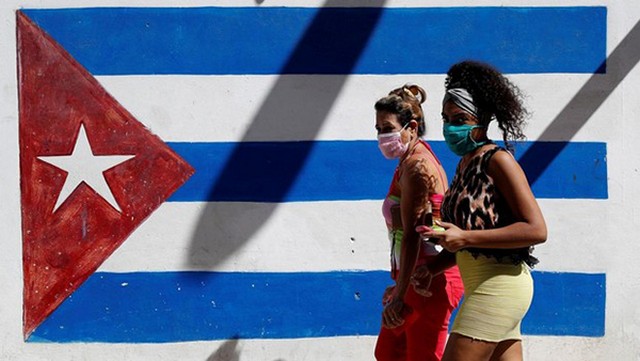
Cuba Successfully Halts Its COVID-19 Outbreak

By Dr. Birsen Filip

A Reflection of the Socialist Revolution and the Legacy of Fidel Castro’s Vision of Health Care

25 Nov 2020 – ‘Private medicine grants privileges to those who have money to the detriment of those who do not have it and nothing could be more inhumane than that. It is unbelievable that rich societies that apply this and many other similar policies speak of human rights and humanity when their own system is the most inhumane, the most egotistic, the most individualistic and the most alienating’ (Fidel Castro, Havana, 1999).

‘Man can’t be a piece of merchandise nor can human health be a piece of merchandise, because selling, trading, profiting from health is like selling, trading and profiting from slaves, trading and profiting from human life…’ (Fidel Castro, Havana 1998).

The success of Cuba’s healthcare system is widely acknowledged, even among the country’s adversaries, critics and enemies. However, little credit is given to Fidel Castro’s role and vision in bringing it to fruition. Before the triumph of the Socialist Revolution, Cuba faced persistent shortages of medical workers and had few hospitals. In fact, Cuba’s many poor people often had no access to healthcare services whatsoever, particularly those residing in rural and remote areas of the island. Meanwhile, it was not uncommon for people to sleep on the floor at the few hospitals that the country did have. This is because doctors mainly served ‘the owners of the sugar mills, [and] the millionaires,’ mostly in Havana (Fidel Castro Havana, 2002). Fidel Castro (Havana, 2002) described the state of health care in Cuba prior to the Socialist Revolution as ‘a crime against the people, against the sick, against the unfortunate, against those who suffer.’

Accordingly, one of the main goals of the Cuban revolutionaries was to establish a good health care system that would be available to everyone. In fact, they believed that it was the duty of the Revolution to provide the people of Cuba with excellent universal health care services. Shortly after the Revolution prevailed, the government essentially launched an ‘attack against diseases,’ and implemented measures so that the nation could effectively ‘save thousands of lives from tetanus, diphtheria and whooping cough, diseases that kill thousands of children every year, and can be caught by any child in any family’ (Fidel Castro 1962). On October 17, 1962, Fidel Castro stated that this would be accomplished by:

preventing these diseases through vaccination. And in this way we will continue to combat disease after disease, and will go on decreasing the number of epidemics, the number of deaths, the number of victims. In this way we will work at fulfilling this worthy goal: to move from therapeutic medicine to preventive medicine.[i]

Since the early days of the Revolution, Fidel Castro was determined to have more students enter into medical school each year so that Cuba could, one day, boast more doctors per capita than any other country in Latin America. However, he was well aware that a good health care system and improvements in ‘medicine or the medical power of a country are not only measured by the number of doctors,’ but also by ‘the way these doctors are trained,’ their knowledge, as well as their spirit (Fidel Castro Havana, 1999).[ii] Ultimately, he wanted the country to have an abundance of well-trained doctors, who were also good human beings.

Fidel Castro advanced the socialist government’s efforts to improve Cuba’s health care system by establishing new medical schools throughout the country, introducing new services and ideas, sending family doctors to remote areas, building and expanding hospitals and polyclinics, and investing in scientific research. Now, ‘good doctors and the best specialists are at the service of all the citizens in whatever part of the country’ they reside, and regardless of the income they earn (Fidel Castro Havana, 1998).[iii] The island has transformed itself into ‘a genuine medical power’ that provides extraordinary services in Cuba and abroad.

To fully appreciate the extraordinary achievements of Cuba’s socialist regime in the area of health care, it is sufficient to examine some current health statistics. In 1962, there were only 3,960 doctors in all of Cuba. Today the country boasts one of the highest doctors per capita in the world. In 2019, it was reported that ‘Cuba has more than 100,000 doctors, the highest number in the history of the country with a proportion of nine doctors per 1,000 citizens.’[iv] That same year, ‘there were 91,375 physicians in Canada, representing 241 physicians per 100,000 population,’[v] or 2.4 doctors per 1,000 citizens. Moreover, Cuba currently produces enough medicines to meet about 90% of the island’s total needs. In October, Doctor Eduardo Martínez Díaz, president of the BioCubaFarma[vi] enterprise group, explained that Cuba has domestically developed and produced vaccines to treat a variety of ailments, including meningitis, diphtheria, tetanus, pertussis, hepatitis B and haemophilus influenzae type B.[vii] He emphasized that Cuban ‘vaccines have international prestige, made evident by the fact that hundreds of millions of doses manufactured on the island have been supplied to more than 40 nations.’[viii] In fact, Cuba was the first nation in Latin America and the Caribbean to bring a COVID-19 vaccine to clinical trials, having developed two potential candidates, SOBERANA 1 and SOBERANA 2. If either of these vaccines are determined to be safe and effective, then Cuba could become a major supplier for many of its neighbours. In discussing Cuba’s efforts to rapidly develop its own vaccine by mobilizing its best scientists and lab technicians, Doctor Eduardo Martínez Díaz stated: ‘We have worked hard, in unity, with intelligence, and we are going to do our duty, which means fulfilling our duty to the people, to Fidel and Raul.’[ix]

The Cuban health care system has faced considerable hardship, largely due to persistent material shortages on account of the American trade embargo, which has been described as ‘an attempt to kill’ Cubans through ‘hunger and disease, in order to destroy’ the Socialist Revolution. The United States has made numerous attempts to undermine Cuba’s Socialist revolution, beginning almost immediately after it succeeded in toppling the Fulgencio Batista dictatorship. In addition to economic and political sanctions, the US has employed anti-Cuban propaganda, sabotage, and terrorism, including chemical and biological warfare. Nonetheless, the vision of Fidel Castro and the determined efforts of the Cuban people have made the dream of achieving excellence in health care for the benefit and well-being of all citizens of the country into a reality. Ultimately, the destructive American economic embargo has forced Cubans to learn how ‘to do a lot with very little,’ as evidenced by their successes in terms of raising life expectancy and lowering child mortality (Fidel Castro Caracas, 1999).

The destructive impacts of the blockade were intensified in an unprecedented manner with the activation of Title III of the Helms-Burton Act in 2019. More precisely, ‘between 2019 and 2020 alone more than 130 measures’ were imposed against Cuba, ‘with the deliberate purpose of stifling the economy, creating discontent and despair in the population.’[x] These measures resulted in the cancellation of significant commercial operations and foreign investment projects in Cuba. In particular, concerns about being subjected to fines, sanctions, and legal proceedings has led many banks and financial institutions to limit their activities and services in Cuba, while a number of shipping and delivery companies have suspended many of their shipments to the island.

Recently, Cuba was even prevented from receiving a donation of medical supplies from the Chinese company Alibaba that included mechanical ventilators, COVID-19 testing kits, face masks and various other items. The considerable challenges imposed on the lives of the Cuban people by the US blockade over last six decades, including the recent intensification by the Trump administration, makes the effectiveness and achievements of its healthcare system even more impressive. This is particularly true when considering its success in terms of managing its COVID-19 outbreak and comparing it to the outcomes observed in some of its free-market oriented counterparts.

Since the COVID-19 outbreak began, Cuba has reported 7,879 cases and 132 deaths with a population of 11.34 million. That translates into about 1.16 deaths per 100,000 inhabitants, much lower than Canada’s 30.47 deaths per 100,000, and the US with 80.29 deaths per 100,000 inhabitants. In fact, New York City alone reported around 301,000 cases and 24,218 deaths with a population of 8.399 million, which amounts to a staggering 288.34 deaths per 100,000 inhabitants. Meanwhile, Brazil fared slightly worse than the US as a whole, with 80.89 deaths per 100,000 inhabitants, which might be fitting given the spectacle that Jair Bolsonaro made by publicly demanding changes to The More Doctors program (Programa Mais Médicos), a Brazilian government initiative designed to provide doctors to underserved areas of the country. Since the program was established by the government of Dilma Rousseff in 2013, approximately 20,000 Cuban health professionals have served in Brazil, including in 700 municipal districts that never had a resident doctor before.[xi]

Recently, President Miguel Mario Díaz-Canel underscored Cuba’s success in its handling of the COVID-19 outbreak by pointing out that ‘across the planet, 75% of the sick have recovered, in the Americas 65%, and in Cuba 91%.’[xii] He also stated that ‘the percentage of active cases as compared to the population in Cuba is seven, while in the world it stands at 21.8% and in Latin America, over 31.4%.’[xiii] Furthermore, ‘there have been no deaths of children, pregnant women or health personnel’[xiv] attributed to COVID-19 on the island. President Díaz-Canel also highlighted the fact that Cuban ‘intensive care units never collapsed’ even though ‘100% of confirmed cases and their contacts have been treated in hospitals.’[xv] Subsequently, they were allowed to go home after they tested negative.

A key factor in the successful handling of the COVID-19 outbreak on the island was the quick and decisive action of Cuba’s socialist government. Like many countries, Cuba closed its borders, businesses and schools shortly after the World Health Organization declared that the global COVID-19 outbreak was a pandemic on March 11, 2020. The government also made face masks mandatory almost immediately. Another important action taken by the government, which is beyond the scope of many other countries, was to deploy doctors, nurses and medical students to all streets and homes throughout the country to check for symptoms.

On a recent visit to Cuba, I had the opportunity to personally observe and experience some of the new measures and rules implemented by the socialist government aimed at protecting the lives of visitors to the island by minimizing the risk of contracting the COVID-19 virus. At the Cuban airport, passengers were put into a line outside of the main entrance as soon as they disembarked the airplane, with Cuban officials ensuring that the 2-metre distancing rule was being respected. Inside, a team of workers disinfected all carry-on baggage and purses, while passengers were made to sanitize their hands. Subsequently, a team of medical professionals checked each passenger’s temperature before collecting samples that were labelled and sent to a lab for testing. Meanwhile, a large contingent of workers were busy continuously cleaning every single area of the airport, as well as any objects that that passengers might have touched or otherwise come in contact with. This was a stark contrast with the airport experience when I returned to Canada, as social distancing was not enforced while waiting in lines, carry-on baggage was not disinfected, no medical personnel were visible, and no mandatory COVID-19 tests were administered.[xvi] Compared to the experience in Cuba, the Canadian airport appeared to be very poorly organized and lacking in resources when it comes to encouraging rigorous and effective hygiene practices, and enforcing social distancing rules.

At the Cuban resorts, employees are regularly tested. There are also nurses and doctors on staff to monitor the health of all their clients, which includes taking everyone’s temperate each morning. Furthermore, all public areas have been organized in a manner that ensures public distancing, while washrooms, tables, chairs, and other items are sanitized immediately after being used by tourists.

Broadly speaking, Cuba’s success in terms of containing its COVID-19 outbreak is due in large part to the centrally planned system’s adherence to the principle that free and universal health care is a fundamental human right. Consequently, its leaders have consistently made extensive investments in health care services since the early days of the Revolution. In addition to providing medical care to all inhabitants of the island, Cuban doctors are renowned for venturing well beyond their borders en masse in order to assist other nations in need, particularly in their most remote areas that are underserved and often have no doctors at all. None of this is particularly surprising, as the Cuban government has committed itself to building ‘awareness,’ and instilling ‘feelings of solidarity and a generous internationalist spirit’ at its medical schools since triumph of the Revolution (Fidel Castro Caracas, 1999).

For Cuban medical workers, their ‘mission is to create a doctrine about human health, to set an example of what can be done in this field’ (Fidel Castrol Havana, 1999).[xvii] Since the Revolution, over 400,000 Cuban health professionals have been sent to 164 countries around the world to help them meet their health care needs, and to provide assistance in times of crisis and in the aftermath of natural disasters.[xviii] Moreover, Cuban medical workers will often remain in foreign countries in order to assist them in the development of their own health care systems and services. Recently, Cuba sent about 4,000 health workers to around 40 countries to help them with their COVID-19 outbreaks.[xix]

Additionally, Cuba helps combat doctor shortages in developing countries by providing free medical school to students from those regions. In fact, Havana’s Latin American Medical School (Escuela Latinoamericana de Medicina (ELAM)) is ‘the largest medical school in the world.’[xx] ‘The University of Toronto has 850 medical students and Harvard University has 735. ELAM has twelve times more students than those two schools combined: 19,550.’ In 2002, Fidel Castro delivered a speech to students of the Latin American Medical School in the presence of former U.S. President Jimmy Carter and stated:

what good would it do if you all went back to your countries to become part of institutions where, sadly, financial concerns, commercialism and selfishness prevail? What good would it do if no one was willing to go work in the mountains, the plains, the remote corners of the countryside or marginal neighborhoods of the cities to practice the noble profession of medicine? More than a medical school, our most fervent hope is that this will be a school of solidarity, brotherhood and justice.[xxi]

During a 2003 visit to Buenos Aires, Argentina, Fidel Castro underscored Cuba’s commitment to preserving human life when he said:

Our country does not drop bombs on other countries, or send thousands of planes to bomb cities; our country has neither nuclear weapons, nor chemical weapons, nor biological weapons. The tens of thousands of scientists and doctors in our country have been educated in the philosophy of saving lives. It would be totally contradictory to their formation to ask a scientist or a doctor to work producing substances, bacteria or viruses capable of causing the death of other human beings…Tens of thousands of Cuban doctors have offered their services on internationalist missions in the most remote and inhospitable places on the planet. I once said that our country could not and would not ever launch preemptive attacks against any dark corner of the world. On the other hand, our country has sent badly needed doctors to the darkest corners of the world. Doctors and not bombs, doctors and not intelligent weapons…[xxii]

Fidel Castro (Havana 1998) believed that, instead of investing massively in the development of weapons to kill in the most efficient and destructive ways imaginable, countries with ‘the resources for it should promote medical research and put the fruits of science at the service of humanity, creating instruments of health and life and not of death.’ He was very proud of the Cuban health care system’s accomplishments, both domestically and internationally, and trusted that Cuban doctors had the integrity and skills necessary in order to save lives anywhere in the world.

Fidel Castro would likely have not been surprised by the failure of health care systems to adequately respond to and manage COVID-19 outbreaks in many of the countries that subscribe to capitalism. He was highly critical of the practice of treating health care services as though they were business transactions in a free-market place. Instead, he often reiterated the point that the commercialization of health care was ‘repugnant,’ and everybody should have free access to adequate health care services. Accordingly, the privatisation of health care would not be permitted on the socialist island nation of Cuba. In addition to denouncing all forms of private health care, Fidel also strongly condemned profit-oriented pharmaceutical companies. He specifically expressed his frustration with large and powerful pharmaceutical companies that dedicate themselves to maximizing their profits instead of demonstrating a genuine commitment to human life when he addressed ‘the special session commemorating the 50th anniversary of the World health Organization,’ in Geneva, Switzerland on May 14, 1998, when he stated:

medicines, that should be made to save lives, are sold at increasingly higher prices. In 1995, the market of pharmaceuticals involved 280 billion dollars. The developed countries with 824 million people, 14.6 percent of the world population, consume 82 percent of the medicines while consumption in the rest of the world with a 4,815 million population is only 18 percent. The prices are actually prohibitive for the Third World where consumption is limited to the privileged sectors. The control of patents and markets by the big transnational companies allows them to raise prices over ten times above production costs. The market price of some advanced antibiotics is 50 times higher than their cost.[xxiii]

Fidel Castro was not only critical of the profit maximizing behaviour of large pharmaceutical companies, he also frequently spoke of the failure of governments to provide adequate public health care services for their citizens. In a 1998 speech in Havana, he claimed that public hospitals in many countries failed ‘because they didn’t have resources, because they didn’t have a budget.’ He recalled that public health care was in a similar state in Cuba prior to the Revolution as, ‘in addition to scarce and diminishing budgets, a part of these budgets was misappropriated’ (Fidel Castro Havana, 1998). He was always a strong advocate of publicly funded and managed healthcare systems, as he stated that ‘If the state is sick, let’s cure the state, let’s give the state health. It’s necessary for the state to function healthily. But let’s not hand the solution of problems of human health over to the market’[xxiv] (Fidel Castro Havana, 1998). Fidel Castro believed that if a state was truly committed to the achievement of the collective good, it would find a way to provide its citizens with universal health care services even in the face of economic difficulties and other problems. This is evidenced by Cuba, as Castro stated:

We have lived the experience and we’ve had the opportunity, with very few resources, to see how public medicine can work and, even today, with a double blockade, it could be said, it works, not with all the resources that we would like, but, for many years, the country invested in hospitals. It first used those that existed and it later built many new hospitals and it built clinics, modest hospitals, including in the mountains, in the countryside, with a network of hospitals and polyclinics being established throughout the country, even managing to create, in addition, that outstanding network for primary care that is now made up of our family doctors, with a new sense.[xxv]

In a 1998 speech in Havana, Fidel Castro underscored the critical importance of family doctors in Cuba, as he explained that:

every doctor that graduates, except in a very few specialties, in order to become a specialist in the varied branches of medicine, first has to be a family doctor, a professional with great knowledge of man, experience, human behavior, who has looked after patients in a community, to know well how they live, in what social conditions. Then, later, if they want, they can acquire a second specialty…But they’re people who already have very wide knowledge. They’ve studied for six years at university and they’ve studied for three years from their office. They’ve had nine years studying and, later, they’ll have to study for another three or four years if they’re going to acquire a second specialty.[xxvi]

According to Fidel Castro, the success of the family doctors system in Cuba could not have been achieved under the auspices of the private sector. While he acknowledged that a number of other nations around the world also utilized family doctors, he pointed out that they often live far away from their patients. To the contrary, family doctors on the socialist island live close to their patients, sometimes right next door. ‘They can be 100 meters from the resident, from the citizen. Others have the doctor 50 meters away if they live nearer the doctor’s office. In the cities, the residents…live with a doctor next door.’[xxvii] Family doctors can essentially be found everywhere in Cuba, including in the nurseries, schools, factories, hotels and resorts, and many other workplaces. Fidel Castro (1999 Havana) made it clear that there could never be enough doctors, stating that Cubans are not ‘afraid of the number of doctors. There will never be too many doctors anywhere, be it a passenger’s plane, a train or a boat.’ [xxviii] In a 1999 speech to students graduating from the Havana Higher Institute of Medical Sciences, Fidel Castro explained that when it was suggested to him that Cuba would not need any more doctors after the island achieved the milestone of 20,000, he responded by saying:

You think that there will be too many doctors? That is not possible…because doctors have to defend people’s health like the CDRs [Comités de Defensa de la Revolución] defend the Revolution; there should be one on every block.[xxix]

Before Socialist Cuba established its health care system, people were often forced to wait for days, or even weeks, in order to have simple health procedures performed at hospitals. Now that family doctors with adequate knowledge and training to diagnose and treat many diseases, illnesses and other health problems are available all over the country, people have the option of avoiding hospitals for relatively minor health issues. However, they can also see a specialist at a polyclinic or hospital if that is their preference. Fidel Castro believed that providing people with such a wide range of choices when it comes to health care is an effective approach for the ‘saving of beds and facilities.’[xxx] It appears that he was correct, as Cuban emergency rooms and hospitals never have to contend with overcrowding. This was particularly evident during the current pandemic, as Cuban emergency rooms were at no point at risk of being overwhelmed, unlike those of a number of capitalist countries.

Cuba’s successful handling of the COVID-19 outbreak relative to many capitalist countries is not overly surprising, given that Cubans have considered health to be a fundamental human right since the Socialist Revolution. This has led the country to make significant investments and expend a massive collective effort in establishing free health care services for all Cubans. However, other features of the socialist regime were also instrumental in successfully combatting the spread of COVID-19 in addition to Cuba’s commitment to universal healthcare. For instance, President Díaz-Canel explained that Cuba’s centrally planned system, one of the fundamental and most criticized aspects of its socialist regime, played an important role by ensuring the availability of basic food items, cleaning supplies, and personal hygiene products since the outbreak began. History has shown that Cuba’s socialist government has always been very capable of swiftly and effectively mobilising its economic, natural and human resources in order to secure the well-being and safety of its citizens when faced with a catastrophic event. In fact, president Díaz-Canel went so far as to describe Cuba’s successful handing of its COVID-19 outbreak as ‘almost a miracle,’ which is an outcome of ‘people, experiences, principles and the thinking of Fidel and Army General Raul Castro Ruz.’[xxxi] He further elaborated that ‘those of us who are members of the band of non-conformists and optimists, like Fidel and Raúl, learned with them and their comrades in struggle that all challenges can be overcome. Cubans are proving, once again, that it can be done.’[xxxii] He also highlighted the key roles of solidarity, collective efforts, dedication and sacrifices on the part of Cubans since the outbreak began.[xxxiii] On October 28, 2020, president Díaz-Canel delivered a speech in ‘closing the Fifth Ordinary Period of Sessions of the National Assembly of People’s Power,’ in which he stated:

There is a component in Cuban DNA, in the magnificent mix of ethnicities and history of continuous resilience, from which emerges from “that sweet word: Cuban.” But there is another factor that is no less important, which is the conscious construction, over more than 60 years, of a work that is larger and stronger than we are, with an authentic leadership, respected and admired in the world, more respected and admired the more it has resisted the blows of the adversary without giving up. I speak, of course, of Fidel, of Raúl, of the Centennial Generation, whom we are honored to follow, with proud dedication to the cause to which they devoted their lives.[xxxiv]

Socialist Cuba has always strived to achieve a more humane and just world order, characterized by solidarity and social cooperation among human beings. Accordingly, its leaders and supporters of the Revolution were acutely aware of the many defects and destructive outcomes of free-market capitalism. In fact, some of the key factors that contributed to COVID-19 being so disastrous on a global level include the poverty of neo-liberal governmental policies, the inflexibility of neo-liberal economists, and the myopic visions of politicians who never cared about the collective good. However, the panic that ensued during the pandemic led many Western governments to suddenly transition to central deliberate planning, after being devoted to free-market capitalism, while also being adamantly opposed government interventions at achieving the collective good, for decades. By essentially transitioning away from the laissez-faire approach and towards central planning, traditionally free-market oriented governments have temporarily abandoned the principles, policies and behaviours that they have adhered to and promoted for the last four decades. In fact, the extent to which these governments have recently involved themselves in the economy, as well as in people’s lives, represents unchartered waters for many of them. Ultimately, the failures of Western countries in dealing with their respective COVID-19 outbreak supports Fidel Castro’s contention that free market capitalism is ill-equipped when it comes to responding to catastrophic events. In this regard, he stated that ‘the state is sick’ and needs to be cured. However, curing the state from the ills of capitalism is not something that can be achieved swiftly or easily.

According to Fidel Castro (Havana 1998), only revolutionary people could dedicate themselves to ensuring that the interests of the masses are ‘aligned with the best causes of humanity,’ which is necessary in order to achieve a more humane and just world order. Furthermore, he believed that ‘the Revolution is not just about putting forward ideas, it is about carrying out ideas. The Revolution is not theory; it is action, above all’ (Fidel Castro Havana, 2002). Cuba has shown that ‘whatever the Revolution has proposed to do, it has achieved. Whatever the Revolution has begun, it has carried on with. And this is the result of ideas turned into reality, of tasks undertaken and carried out’ (Fidel Castro Havana, 2002).

‘Long live free Cuba! Long live the victorious Revolution!’ (Fidel Castro)

Notes

[i] http://www.fidelcastro.cu/en/discursos/speech-ceremony-commemorating-40th-anniversary-victoria-de-giron-institute-basic-medical

[ii] http://www.fidelcastro.cu/en/discursos/speech-students-graduating-havana-higher-institute-medical-sciences-karl-marx-theater

[iii] http://www.fidelcastro.cu/en/discursos/speech-closing-ceremony-health-ministers-meeting-non-aligned-countries

[iv] https://www.telesurenglish.net/news/cuba-cuban-doctors-highest-number-in-history-20190723-0009.html

[v] https://www.cihi.ca/en/physicians-in-canada

[vi] ‘BioCubaFarma, the Cuban organization of Biotechnology and Pharmaceutical Industries, manages the country’s efforts toward manufacturing medicines, diagnostics and medical equipment and providing high quality life science services to improve people’s health. BioCubaFarma serves as a gateway for potential partners and investors interested in accessing the extensive biopharma resources Cuba has to offer.’ https://www.nature.com/articles/d43747-020-00522-5

[vii] http://en.granma.cu/cuba/2020-10-21/the-emergence-of-soberana-1-is-not-a-chance-event

[viii] http://en.granma.cu/cuba/2020-10-21/the-emergence-of-soberana-1-is-not-a-chance-event

[ix] http://en.granma.cu/cuba/2020-10-21/the-emergence-of-soberana-1-is-not-a-chance-event

[x] http://en.granma.cu/cuba/2020-10-30/it-will-always-be-an-honor-to-serve-you-beloved-homeland

[xi] In the first four years of The More Doctors program, the percentage of Brazilians receiving primary health care rose from 59.6% to 70%. Nonetheless, Bolsonaro stated that the 11,420 Cuban doctors working in poor and remote parts of Brazil could only stay if they received 100% of their pay and their families were permitted join them. He also questioned the qualifications of the Cuban doctors and suggested that they might have to renew their licenses in Brazil. In response, Cuba’s health ministry announced its withdrawal from the program, stating that ‘these conditions make it impossible to maintain the presence of Cuban professionals in the program.’ The abrupt withdrawal of Cuban doctors has not only adversely affected Brazil’s healthcare system, with Bolsonaro failing to deliver on promises to quickly find domestic substitutes, it has also hurt Cuba’s economy.

[xii] http://en.granma.cu/cuba/2020-10-09/diaz-canel-in-cuba-life-is-our-principal-treasure

[xiii] http://en.granma.cu/cuba/2020-10-09/diaz-canel-in-cuba-life-is-our-principal-treasure

[xiv] http://en.granma.cu/cuba/2020-10-09/diaz-canel-in-cuba-life-is-our-principal-treasure

[xv] http://en.granma.cu/cuba/2020-10-09/diaz-canel-in-cuba-life-is-our-principal-treasure

[xvi] Additionally, the kiosk display screens that each passenger has to use to fill out their Canada Border Services Agency Declaration (CBSAD) forms were not disinfected after each use. There is also a new COVID-19 form to fill out, which is done at those same kiosks using a couple of pens that have been left there for passengers to share without being disinfected. After getting through customs, the Canadian airport did not demonstrate the same level of commitment to sanitizing the washrooms and other public areas as the one in Cuba, where personnel were observed engaging in frequent cleaning.

[xvii] http://www.fidelcastro.cu/en/discursos/speech-students-graduating-havana-higher-institute-medical-sciences-karl-marx-theater

[xviii] http://www.granma.cu/mundo/2020-03-23/cubasalva-practica-humanista-de-la-revolucion-23-03-2020-01-03-38

[xix] https://www.nbcnews.com/news/latino/cuba-sends-white-coat-army-doctors-fight-coronavirus-different-countries-n1240028

[xx] https://www.ted.com/talks/gail_reed_where_to_train_the_world_s_doctors_cuba/transcript?language=en

[xxi] http://www.fidelcastro.cu/en/discursos/speech-given-during-former-us-president-jimmy-carters-visit-latin-american-medical-school

[xxii] http://www.fidelcastro.cu/en/discursos/speech-given-law-school-university-buenos-aires-argentina

[xxiii] http://www.fidelcastro.cu/en/discursos/speech-special-session-commemorating-50th-anniversary-world-health-organization

[xxiv] http://www.fidelcastro.cu/en/discursos/speech-closing-ceremony-health-ministers-meeting-non-aligned-countries

[xxv] http://www.fidelcastro.cu/en/discursos/speech-closing-ceremony-health-ministers-meeting-non-aligned-countries

[xxvi] http://www.fidelcastro.cu/en/discursos/speech-closing-ceremony-health-ministers-meeting-non-aligned-countries

[xxvii] http://www.fidelcastro.cu/en/discursos/speech-closing-ceremony-health-ministers-meeting-non-aligned-countries

[xxviii] http://www.fidelcastro.cu/en/discursos/speech-students-graduating-havana-higher-institute-medical-sciences-karl-marx-theater

[xxix] http://www.fidelcastro.cu/en/discursos/speech-students-graduating-havana-higher-institute-medical-sciences-karl-marx-theater

[xxx] http://www.fidelcastro.cu/en/discursos/speech-closing-ceremony-health-ministers-meeting-non-aligned-countries

[xxxi] http://en.granma.cu/cuba/2020-10-09/diaz-canel-in-cuba-life-is-our-principal-treasure

[xxxii] http://en.granma.cu/cuba/2020-10-30/it-will-always-be-an-honor-to-serve-you-beloved-homeland

[xxxiii] http://en.granma.cu/cuba/2020-10-09/cuba-saves-heals-and-sows-the-seeds-of-our-future

[xxxiv] http://en.granma.cu/cuba/2020-10-30/it-will-always-be-an-honor-to-serve-you-beloved-homeland

____________________________________

Dr. Birsen Filip holds a Ph.D. in philosophy from the University of Ottawa.

30 November 2020

Source: www.transcend.org

Iran in the Crosshairs: Tracing Overt and Covert Action

By Eric Walberg

The assassination of Iran’s top nuclear scientist, Prof. Mohsen Fakhrizadeh, has seriously complicated any efforts to normalize relations with Iran under a new Biden administration. Walberg contrasts the republican and democratic positions toward Iran while tracing key historical and recent events all in an effort to provide deeper insight into understanding Iran and U.S.-led efforts toward destabilization. –– Editor

As bad as they are on other foreign policy issues, the Biden-Harris victory in the November election is still a cause for optimism in U.S.-Iranian relations, given what we have seen under Trump. At a minimum, it brings (1) hope that the U.S. will come back into the Joint Comprehensive Plan of Action (JCPOA) or 2015 Iran nuclear deal, (2) mitigates the danger of war, and (3) could lead to the reduction or ending of sanctions. However, the recent assassination of Prof. Fakhrizadeh complicates efforts to normalize relations.

The grounds for optimism centers on the fact that there are clear differences between the Republican and Democratic party when it comes to foreign policy and specifically with respect to Iran.

On Iran, the Republicans in 2020 maintained their position from 2016 that the JCPOA was nonbinding without endorsement by two-thirds of the Senate.

In their assessment, the JCPOA had emboldened the regime in Tehran to continue to “sponsor terrorism across the region, develop a nuclear weapon, test-fire ballistic missiles inscribed with ‘Death to Israel’ and abuse the basic human rights of its citizens.”

The Democratic Party platform, by contrast, states that it will “call off the Trump administration’s race to war with Iran,” noting that “the United States should not impose regime change on other countries” and that the party “reject[s] that as the goal of U.S. policy toward Iran.”

The platform calls for returning to the 2015 nuclear deal with Iran, maintaining that it was “always meant to be the beginning, not the end, of our diplomacy with Iran,” and that it “remains the best means to verifiably cut off all of Iran’s pathways to a nuclear bomb.”

In April, Democratic Party presidential candidate Joe Biden called on President Donald J. Trump “to ease economic sanctions on Iran as a humanitarian gesture during the global coronavirus pandemic,” stressing that “the U.S. has a moral obligation to be among the first to offer aid to people in need regardless of where they live when confronting a virus that knows no borders or political affiliations.”

The above statements offer some hope of a thaw in U.S.-Iranian relations with Biden’s election and a new era of peace. However, one should not get one’s hopes up too high.

Iran, where President Hassan Rouhani faces strong opposition from conservatives in elections set for June 2021, is expected to demand a high price to return to the JCPOA, including the immediate lifting of punishing economic sanctions and billions of dollars in compensation, which the new Biden administration is unlikely to grant.

In September Biden told CNN that as president, he would “make sure U.S. sanctions do not hinder Iran’s fight against Covid-19,” but that he would continue to adopt “targeted sanctions against Iran’s human rights abuses, its support for terrorism and ballistic missile program.”

Another precondition for restoring the JCPOA is a temporary freeze on uranium enrichment and reduction of Iran’s large stockpile. Iran, however, would only agree to this if the U.S. and EU would comply with the terms of the JCPOA and lift the sanctions.

By all indications, Biden remains committing to isolating Iran as part of a foreign policy strategy which is designed to sustain U.S. hegemony in the Middle East and access its oil.

The Democratic Party platform does not call for any cutbacks in arms sales to Saudi Arabia, Iran’s Sunni adversary, nor to the United Arab Emirates (UAE) which the Trump administration has sold F-35 jets to. It also reiterates an “ironclad commitment to Israel,” another of Iran’s nemeses.

While seeking to end the blank check offered by Trump, the Democrats remain committed to the modernization of the Gulf monarchies (Qatar, Bahrain, UAE), which are a key part of the U.S. containment strategy directed against Iran.

In addition, the Democratic Party platform does not stray from language that singles out Iran as a rogue state, and emphasizes its desire to “extend constraints” on its nuclear program and other threatening activities, including its “regional aggression, ballistic missile program and domestic repression.”

No parallel program is put forward for Saudi Arabia, whose domestic repression and support for regional aggression is far greater than Iran’s.

Though adopting a softer line than the Republicans, the Democratic Party platform overall does not diverge from the characteristic Western thinking on Iran, shaped by unremitting media hostility, which considers the country as a theocracy, whose oppressive character is reflected in its promotion of the death penalty.

The Iranian government should be criticized, to be sure, for certain things like its jailing trade union activists and dissenters and allowing the oil and gas wealth of the country to line the pockets of corrupt clergymen and their allies, rather than Western corporations like in the days of the Shah (1953-1979).

The U.S., however, has lavished aid to far worse governments—including the Saudis, and Egypt under Fatah al-Sisi—and the threat that Iran represents has been consistently overstated.

Since its 1979 Islamic revolution, Iran has not invaded any of its neighbors and it has repeatedly been falsely accused of supporting terrorist attacks.6 As for the death penalty, it is limited to treason, serious corruption, drug smuggling and murder and it is affected without the Saudi head-chopping.

Iran’s government has serious factional divisions. The group led by current President Hassan Rouhani is far more liberal on many issues and tolerant than the conservatives led by Mahmoud Ahmadinijad, who include anti-semitic elements that want to destroy Israel.

Like with Russia, the concerns of gay rights groups has been used to advance an imperialistic political agenda. Iranians are generally kind and hospitable to foreigners, as many Western travelers have noted, and the country’s cultural heritage is magnificent.

One observer told The Independent that the Iranians were quite a…

“sophisticated and educated people [who] revere their poets…[The population is] very pro-American. They make a clear distinction between the American people and the American government. They have a developed political system…and it makes a difference if the more reformist or conservative factions win the elections. Saudi Arabia has no democracy, it’s just a monarchy where rule is handed down from one king to the next one.”8

Moving beyond media stereotypes, we can generally find many positive things about Iran and its people.

Instead of demonizing the country, trying to cripple its economy and overthrow its government, we in the U.S. and the West more generally can and should embrace it as part of the community of nations.

From Wild Card to Acceptance

While it is not socialist, Iran can be considered one of the principle anti-imperialist nations in the world, along with Cuba, Venezuela, Belarus and North Korea. Because of its anti-imperialism, the U.S. has reserved the full force of its wrath for Iran. The U.S. could never accept the Islamic revolution of 1979, which overthrew the Shah Mohammed Reza Pahlevi, whom the U.S. had installed after overthrowing the democratically elected regime of Mohammed Mossadegh in 1953.

Just as the Soviet Union was blackened, subverted and invaded from 1917 on, Iran is in the sights of U.S.-Israel continuously. Thus, its suspicions about Iranian émigrés and westerners in general are not paranoia.

Obama’s major foreign policy achievement—the JCPOA—got Iran to agree to redesign and convert any nuclear weapons-production facilities, allow for inspections and restrict stockpiles and mining of enriched uranium in return for the lifting of all nuclear-related sanctions, the release of four Americans from Iranian jails, and secret cash payments to help resolve claims over a failed arms deal under the Shah.

Russian leader Vladimir Putin was instrumental in convincing Iran to sign the deal as a means of averting a world war. Iranian assets totaling $150 billion were released because of the lifting of sanctions.

Obama faced a backlash from the political right and extreme right-wing elements in the CIA and Israeli intelligence establishment and politics as well as from members of his own party, like Senator Robert Menendez of New Jersey (D) who said that the administration sounded like “talking points that come straight out of Tehran.”

In an unprecedented step, Israeli Prime Minister Benjamin Netanyahu was invited, without consulting with Obama, to address the Republican-controlled U.S. Congress.

As Gareth Porter convincingly argued in Manufactured Crisis: The Untold Story of the Iran Nuclear Scare (2014),

with the collapse of the Soviet Union and the ending of the Cold War, the whole campaign against Iran’s nuclear program was merely the pretext to keep the CIA at the center of U.S. foreign policy—a new threat that conveniently conflated both Iraq and Iran with “terror” and of “weapons of mass destruction.”

From 1979 on, the Iranian leadership has repeatedly said it was not interested in a nuclear weapons program, and there is no evidence to the contrary.

Prior to the signing of the Iran nuclear deal, Obama had approved a cyberattack on Iran’s nuclear enrichment facility at Natanz in collaboration with Israeli intelligence. Obama’s political career was sponsored from the beginning by Lester Crown, former chairman of the arms manufacturer General Dynamics, who pushed a hawkish line on Iran. In line with his wishes, the Obama administration had further encircled Iran with Raytheon Patriot and Lockheed Martin Aegis missiles equipped with advanced radars placed in Qatar, Bahrain, Kuwait and the UAE.

The Obama administration further waged economic war by pushing Saudi Arabia to raise its oil production to drive prices down (Russia was also a target) and strengthened Bush-era economic sanctions which resulted in a precipitous decline of the rial.

In 2012, Hillary Clinton’s State Department removed the Mujahadin e-Khalq (MEK) from its list of terrorist groups, which left the cult-like dissident organization—its members displayed fealty to the group by divorcing their spouses—free to raise funds and plot sabotage operations against the Iranian government.

MEK had started as a key underground movement under the Shah but then fell out with the Ayatollah Khomeini after the Iranian revolution, and began a campaign of assassinating Iranian leaders in the early 1980s while allying with Saddam Hussein and Iraq.

After taking them off the list of terrorist groups, the Obama administration donated $20 million to the UNHCR refugee agency to help MEK resettle to a massive military-style secret base in Manez, Albania, where locals staged protests, but to no avail.

Obama’s policy toward Iran was, thus, on the whole very hostile to the Iranian regime. In his speech announcing the Iran nuclear deal, he blamed them for “destabilizing behavior across the Middle East and support for violent proxies in Syria and Yemen.”

The latter charges were heavily politicized as it was the U.S. proxy Saudi Arabia which had criminally invaded Yemen, and the U.S. itself which had destabilized Syria by backing the Free Syrian Army (FSA) and jihadist elements in a huge covert operation designed to topple the regime of Bashir al-Assad.

The U.S. had also tried to destabilize Iran through its covert support for MEK and sanctions, and covert strategy of trying to encourage ethnic groups to become secessionists and rise up against the government.

For all the contradictions and problems with Obama’s approach to Iran, the signing of the JCPOA brought some hope that Iran was being welcomed back into the Western fold. Its theocracy, when viewed up close, no longer seemed so bad, as memories of the 1979-81 hostage crisis (where no one died except U.S. military personnel in a failed rescue mission) were put on the back burner.

After the nightmares of the U.S. New World Order since 1991—the dismantling of Eastern Europe and the Soviet Union, the invasion of Afghanistan and Iraq, the 1980-88 Iraq-Iran war (with the U.S. arming both sides, the better for them to destroy each other)—it looked for a moment as if the U.S. might be humiliated enough, and hurting enough, to push it a bit in the right direction, toward peace instead of war. It looked like a bit of the “peace dividend” promised in 1991 and immediately betrayed. (Remember the halcyon days of détente after the Vietnam humiliation?)

But then came Trump.

Trump and the Dogs of War

In September 2018, the Trump White House asked the Pentagon to draw up options for military strikes against Iran in the wake of two incidents in Iraq when mortar shells and rockets fired by militias exploded near U.S. diplomatic facilities.

Contingency planning for potential conflicts is routine but, according to the Wall Street Journal, the seriousness of the request from the National Security Council unnerved defense and state officials.

“It definitely rattled people,” a former senior U.S. administration official was quoted as saying. “People were shocked. It was mind-boggling how cavalier they were about hitting Iran.”

Trump combined his military threats have continued with a series of inflammatory tweets and threats to destroy Iran’s major cultural sites.

The Trump administration stepped up regime-change efforts further by expanding ties to MEK as part of his coalition of Iranian dissidents intent on overthrowing the government.

In 2017, the year before John Bolton became President Trump’s National Security Adviser, he addressed members of the MEK and said that they would celebrate in Tehran before 2019.

Trump had campaigned in 2016 on a platform of overthrowing the Iranian government and, immediately after his inauguration, he began taking steps to scuttle the JCPOA, pulling out completely by 2018 and initiating a U.S.-enforced embargo on all trade with Iran. This has become Trump’s signature foreign policy, with both Iran and Venezuela his bètes noires.

Regime change in Iran had been a key goal of the neoconservatives associated with the Project for a New American Century, who wanted to use the 9/11 attacks to expand U.S. hegemony in the Middle East.

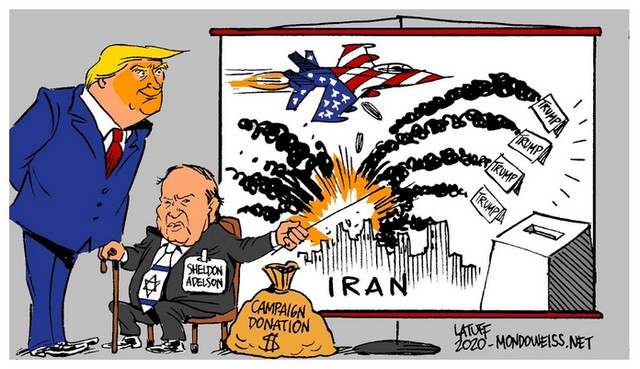
Some of Trump’s top political donors—Sheldon Adelson, Bernard Marcus and Paul Singer—were tied to the Israeli hard-right, which considers Iran an apocalyptic threat. Adelson is so extreme that he once proposed launching a nuclear weapon into the Iranian desert—as a negotiating tactic!

Britain’s own Trump, Boris Johnson, bumbled into the fray when Britain’s colonial outpost Gibraltar seized an Iranian oil tanker accused of violating EU sanctions in 2019. Iran stared Boris down, seizing a British oil tanker in retaliation, then suggesting a swap. Never, joked Boris, … and then swapped. Iran humiliated its nemesis Britain, whose meddling in Iran dates back to the 19th century.

The seizures continued, with four tankers of Iranian oil headed to Venezuela seized by the U.S. in August 2020, even as the UN Security Council voted to abide by the JCPOA and allowed Iran to buy arms through October.

This is outright piracy and is implicitly accepted by the West, watching this as if it is some kind of reality TV show. Trump promised to enforce the “snap-back” clause in the agreement itself and prevent Iran physically from buying necessary arms to defend itself. Trump’s gunfight at the OK Corral continued as the countdown to November approached.

The assassination of General Soleimani in January 2020 was Trump’s signal achievement in his scheme to overthrow the Iranian government. According to political analyst Michael Hudson, the assassination of Soleimani was intended to escalate America’s presence in Iraq to keep control of the region’s oil reserves, and to back Saudi Arabia’s Wahabi troops (ISIS, Al Qaeda in Iraq, Al Nusra and other divisions of what are actually America’s foreign legion) to support U.S. control of Near Eastern oil as a buttress of the U.S. dollar.

Though condemned even by liberal figures like Elizabeth Warren (D-MA) as a “bad man” and “terrorist” who allegedly helped plant roadside bombs targeting U.S. troops in Iraq, Soleimani’s real crime was to fight against ISIS and other U.S.-backed terrorists in their attempt to break up Syria and replace Assad’s regime with a set of U.S.-compliant local leaders—and to support the Iraqi government’s efforts to reclaim its oil fields which Trump had bragged about grabbing.

The illegal, shoot-em-up action was universally condemned, but had no consequences for the U.S. other than a targeted bombing of the U.S. Al-Asad air base as a show of Iranian defiance, killing no one.

It is only a matter of time before Hollywood cashes in, feeding U.S. war lust, Argo part II. Iran’s status keeps growing through all this, as Iran is in the same boat, and for the same reasons, as other defiant regimes—Cuba, Venezuela, Belarus, Bolivia, Russia and China among others.

Economic War Through Sanctions

The sanctions—which Iran’s President Hassan Rohani characterized as an “economic war”—have been devastating for Iran, with even most coronavirus medical aid forbidden. Iran’s GDP contracted 5% in 2018 and shrunk another 9.5% in 2019, according to the IMF. The cost of products like paper tripled, forcing many businesses to close. The price of beef and veal has also risen nearly 50 percent, and the cost of milk has almost doubled. While inflation has increased by 40 percent, Iranians have been deprived of medicines and medical equipment.

The purpose behind the sanctions was explained by Secretary of State Mike Pompeo, who told CBS News on February 14, 2019, that “things are much worse for the Iranian people [with the U.S. sanctions], and we are convinced that will lead the Iranian people to rise up and change the behavior of the regime.”

The Trump administration’s threat to impose sanctions on countries that purchased Iranian oil hit Iran especially hard. President Rohani claimed on December 31, 2019, that the renewed sanctions cost Iran $100 billion in oil income and another $100 billion in foreign investment credit.23

Mehdi Tajabian, a 30-year-old Iranian musician and protest artist, told The Washington Post that “every single day, as soon as people open their eyes, they face a dark and vague future.”

This is designed by Washington as punishment for Iran’s successful defiance of the U.S.-led world order, and overthrow of the Shah who had terrorized Iranians for 25 years after the U.S. and UK overthrew democracy in 1953.

Iran is blessed with just about all climate variations, so no one starves. The theocratic flavor to Iranian politics means there is a sense of responsibility to Allah in government actions. Those are the aces up Iran’s sleeve, making it virtually impossible to starve Iran into submission.

Fateful Triangle: The U.S., Iran and Israel

But we must not forget Israel. Israel’s Settlements Minister Tzachi Hanegbi warned on Wednesday, November 4th, that Biden’s position on the Iran nuclear deal could lead to war between Israel and Iran. Knesset Foreign Affairs and Defense Committee chairman Zvi Hauser took a more optimistic approach. “I assume that even if the Iran Deal is renewed… it will be better than the previous one,” he told Army Radio.

Really, it is U.S.-Israel, as they are inseparable. Israel depends entirely on massive U.S. funding and its illegal settlements are full of U.S. immigrants. If the U.S. sneezes, Israel feels it and shudders. Trump promised to move the capital to Jerusalem and he did. So that, and UAE and Bahrain establishing diplomatic ties with Israel, can be added to assassination as his other achievements in foreign policy.

As a thank-you, Israel has been up to its cyber and sabotage tricks in Iran. A decade ago, joint U.S.-Israeli efforts resulted in the development of the Stuxnet computer worm, which infected key nuclear facilities at Natanz and Parchin, and metastasized around the world. In June 2020, a series of explosions in Natanz, missile sites, petrochemical centers, power plants and medical clinics, showed U.S.-Israel was actively at work inside Iran, no doubt with MEK help.

Both Netanyahu and Trump loudly call for a full-scale attack, doing their best to provoke Iran into providing a “Gulf of Tonkin” newsbyte to set off the fireworks. Iran’s calm, measured actions internationally belie the efficacy of this old ploy. The seizure of four tankers by the U.S. in early August was surely part of a pre-election “October surprise” strategy, intended to push U.S.-Israel into all-out war, a “perfect storm” for both Trump and Netanyahu, faced with fractured societies and electoral defeat and jail terms, which only war can salvage.

Biden-Harris: Back to the Future?

Four more years of Trump would have been a disaster with a huge likelihood of war by U.S.-Israel. With Biden it is more likely a war by Israel.

Biden will have to step right up to the plate before Israel pulls another Iraq-style lightning bombing raid on its nuclear energy facilities and defense installations.

Of course, Israel’s needs must be considered, and the prospect of any alteration of the U.S.-Israeli alliance under Biden-Harris is very slight.

Biden himself famously quipped, “You don’t have to be Jewish to be a Zionist.” On the other hand, Biden has in the past shown a willingness to compromise and has made it clear annexation of the West Bank would not get a “green light” or recognition from his administration. But Biden has stated he would leave the embassy in Jerusalem.

Harris says Israel is “a beautiful home to democracy and justice,” and does not advocate putting conditions on aid to Israel. In short, she has not made any statement that would leave her open to attack from Zionists, and will abide by whatever AIPAC and Biden call for.

Nevertheless, the worst-case scenario under Trump will be averted. Oil companies need not worry. They were against invading Iraq and just as against invading Iran. “Make peace,” they plead, “so we can ‘invade’ Iran (economically).” Despite official hostility to all things U.S., Iranians (like Soviet-era citizens) love all things U.S. except invasion. Even my staunch anti-Mullah friend Ali in Tehran would fight Americans invading.

As for funding by MEK and other anti-Iran lobbyists, there is MEK’s U.S. front group, the National Council of Resistance of Iran (NCRI). President Trump’s Supreme Court pick Amy Coney Barrett briefly advised the NCRI as a client while working at a Washington law firm when the NCRI challenged its State Department designation as a foreign terrorist organization. Her work did not come up in her confirmation hearing.

Former New York Mayor Rudolph Giuliani and former Trump National Security Adviser John Bolton have both been outspoken proponents of the group, as have Democrats like former Pennsylvania Governor Ed Rendell and former Vermont Governor Howard Dean.

But it is the National Iranian American Council (NIAC), the largest organization representing people of Iranian heritage in the U.S., founded in 2002 to promote Iranian-American civic participation, that helped shape the JCPOA during Obama’s presidency. Its guiding force is Trita Parsi, and The Hill cited Parsi and NIAC’s work in support of the Iran nuclear accord as one of the “Top lobbying victories of 2015.”

In January 2020, three Republican senators, Mike Braun (UT), Ted Cruz (TX) and Tom Cotton (AK), requested that U.S. Attorney-General William Barr “evaluate whether an investigation of NIAC is warranted for potential Foreign Agents Registration Act (FARA) violations and to ensure transparency regarding foreign attempts to influence the U.S. political process.”

In response to the letter, dozens of academics, policy professionals, activists, former senior U.S. officials and non-governmental organizations signed a statement denouncing the Senators’ letter and expressing solidarity with and support for NIAC. It will be key to helping Biden get the U.S. back on track.

No doubt MEK and Israel will still try to blow up and assassinate, as we have seen with the assassination of Prof. Fakhrizadeh. But the nightmare of Trumpism is over. And then there are the handful of lefties in Congress demanding Israel shape up or face the consequences. The days of Trump’s Israel-Iran policies appear to be numbered, and hopefully will never come back.

_____________________________________________

Eric Walberg is a journalist specializing in the Middle East and Russia and author of numerous books including Islamic Resistance to Imperialism (2015, Clarity Press) and Postmodern Imperialism: Geopolitics and Great Games (2011, Clarity Press).

30 November 2020

Source: www.transcend.org

Brave Vandana Shiva Speaks Out against the Great Reset

By Prof. Vandana Shiva

12 Nov 2020 – Prof. Vandana Shiva has been courageously speaking out against the insidious ‘Great Reset’ being sprung on us by Klaus Schwab, Bill Gates and the rest of the global capitalist elite.

She warns in a new interview that “The Great Reset is about maintaining and empowering a corporate extraction machine and the private ownership of life”. (1)

Shiva has lately been drawing particular attention to the insidious role of Bill Gates in the technocrats’ assault on food and nature.

In October 2020 she warned:

“With his philanthro-imperialism, Gates is emerging as the Columbus of the digital age, the New Monsanto pushing failed GMOs and trying to introduce new GMOs based on gene editing”. (2)

Gates’ nefarious activity is the subject of a special report produced by Navdanya, the seed and food sovereignty movement founded by Shiva in 1987. (3)

Shiva commented:

“We have seen the Green Revolution and the industrial agriculture model fail, wiping out forests, transforming the land into a monoculture, causing pollution and illness, destroying natural resources and livelihoods. And it is now a major contributor of climate change and species and biodiversity extinction.

“In spite of this, while we are looking at better ways to farm, Gates has pushed the Green Revolution in Africa. He seems too impatient to look at the complexity of the natural world and biodiversity. He’s taking control of the worlds’ seed banks, pushing failed GMOs that we had rejected in India to other countries, taking control of gene traits through gene editing, trying to control the climate through geoengineering, and driving extinction through gene drives”. (4)

Shiva has also been strongly critical of The Great Reset, the global technocratic corporate coup promoted by Gates’ friend and associate Klaus Schwab of the World Economic Forum.

She told Jeremy Loffredo of The Defender:

“The Great Reset is about multinational corporate stakeholders at the World Economic Forum controlling as many elements of planetary life as they possibly can. From the digital data humans produce to each morsel of food we eat”. (5)

Shiva accused the WEF of “parading fake science” with its emphasis on GM food, lab-made proteins and pharmaceuticals and industrial chemicals as “sustainable solutions”.

She added that “for Mr Schwab to promote these technologies as solutions proves that The Great Reset is about maintaining and empowering a corporate extraction machine and the private ownership of life”. (6)

Schwab’s WEF has partnered with an organization called EAT Forum, closely linked to the pharmaceutical industry.

Said Shiva:

“EAT’s proposed diet is not about nutrition at all, it’s about big business and it’s about a corporate takeover of the food system.

“EAT’s uniform global diet will be produced with western technology and agricultural chemicals. Forcing this onto sovereign nations by multinational lobbying is what I refer to as food imperialism”. (7)

NOTES:

1. Jeremy Loffredo, ‘Worl d Economic Forum’s ‘Great Reset’ Plan for Big Food Benefits Industry, Not People‘, The Defender, November 9, 2020.

2. Navdanya International, ‘Is philanthro-capitalism endangering sustainable development?’, Lifegate, October 26, 2020. lifegate.com/philantro-capitalism-sustainable-development

3. Navdanya International, ‘Gates to a Global Empire‘, 2020.

4. Manlio Masucci, ‘The Philanthro-capitalist empire of Bill Gates‘.

5. Loffredo.

6. Ibid.

7. Ibid.

______________________

TRANSCEND Member Prof. Vandana Shiva is a physicist, ecofeminist, philosopher, activist, and author of more than 20 books and 500 papers.

30 November 2020

Source: www.transcend.org

The Real Threat to Democracy Isn’t Julian Assange — It’s the Espionage Case against Him

By Andy Bichlbaum

We have complicated feelings about Assange. But prosecuting him under the Espionage Act would be a disaster for journalism and democracy.

I have a bad case of diarrhea: the Julian Assange story

19 Nov 2020 – Beginning in 2010, we, the Yes Men, developed a friendship with Julian Assange and a collaboration with Wikileaks. In 2015, we made this short video about it, originally for inclusion in our third film, “The Yes Men Are Revolting,” but it didn’t quite fit. We think it shows a charming, funny and thoughtful side of the man, and so — despite our more complicated feelings about him after 2016 — we’re making it available now, given the dire threats facing Assange and free speech more broadly.

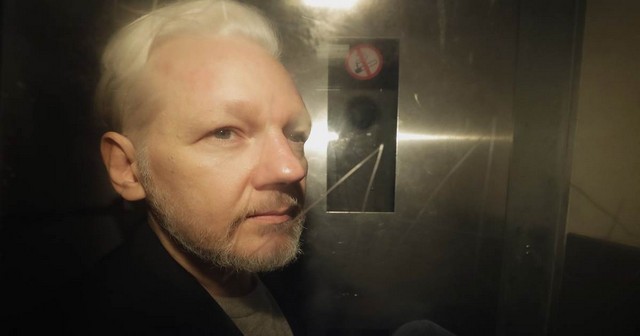
Assange is currently facing extradition to the United States from London, for allegedly violating the U.S. Espionage Act — marking the first time the act has been used to prosecute the publishing of information. If the extradition is successful, he’ll face trial in a Virginia “espionage court” that has never once absolved a national security defendant. Allowing the Virginia court to try (and most likely convict) him would be a disaster for democracy — something even Obama’s Justice Department believed in 2013, when they determined that indicting Assange would mean having to prosecute any news organization or writer who publishes classified material. (They called it “the New York Times problem.”)

Assange’s extradition hearing began in February 2020, with the second part delayed from May until Sept. 7 because of COVID-19. In its apparent eagerness to extradite Assange, the court has committed some egregious abuses — such as introducing new charges in June that Assange couldn’t respond to — that are mentioned in this summary by the Electronic Frontier Foundation and this short film by Wikileaks collaborator Juan Passarelli.

Meeting the mastermind

We first met Assange in the summer of 2010, in an awkward English manor/organic farm. He was under house arrest as he awaited a hearing for extradition to Sweden, where authorities wanted to question him on allegations of sex crimes. (The case was later dropped.) From Sweden, he would have been vulnerable to extradition to the United States, where he might have been subject to torture or worse; all things considered, he seemed pretty calm, not to mention funny and thoughtful, as we hope our little film shows.

We saw Julian again in February of 2011. Wikileaks had received thousands of internal emails from corporate spy agency Stratfor; a few dozen emails showed that Dow Chemical had hired Stratfor to spy on us, which was flattering to say the least.

In 2015, we shared a delicious rotisserie chicken and bottle of wine at London’s Ecuadorian embassy, where Julian was receiving diplomatic protection from Ecuador’s left-wing government.

Angry at the DNC, angry at Wikileaks

Our feelings about Julian got more complicated when, a year later — not long before the disastrous U.S. election of 2016 — Wikileaks released a trove of private emails showing the Democratic National Committee had conspired with the Clinton campaign against Bernie Sanders’ candidacy. The first group of emails came just before the summer congress of the DNC, and the second, more directly linked to Clinton, a week before the election.

Of course, the DNC’s actions against its own party’s populist leanings were loathsome, not to mention myopic and stupid. Forty years of bipartisan neoliberalism had left millions expecting nothing from government, laying the groundwork for the rise of a right-wing populist like Donald Trump. Now, the DNC was squelching the only thing that could have countered him: a left-wing populist like Bernie Sanders, offering much-needed popular solutions based in reality rather than hatred.

Without Sanders in the mix, millions faced a choice between the same old neoliberal shit they’d been offered for decades, and a brand new kind of shit, untested and unproven. Many chose Trump, who became far and away the worst and most dangerous president in American history.

Still, for as much as we’ve mainly blamed Democrats for the horrible outcome of the 2016 election — see our 2017 #DNCTakeBack intervention — we’re also angry that Wikileaks chose to release the DNC emails, especially the second batch, when they did. The timing undoubtedly helped an unhinged authoritarian, in charge of an unhinged party, to win the election. Had Trump been more competent, we could easily be looking at the end of any sort of democracy in America; a Clinton presidency could have been many things, but not that.

Wikileaks claims that releasing the DNC emails when they did was a matter of “journalistic integrity.” But “journalistic integrity” could also have justified not releasing them at that time, considering the widely-supported possibility that the emails came from a concerted foreign campaign against Clinton. (Assange continues to insist they were not from a “state actor,” but it’s hard to see how that could be strictly ruled out.) It also seems that “journalistic integrity” could have meant releasing the emails after the election was over, rather than give the advantage to a scoundrel known to have even worse skeletons in the closet (that were known then but not publicized until later).

Also, “journalistic integrity” would have probably precluded talking to Donald Trump Jr. about what they could do for each other.

The real reasons?

We don’t believe that “journalistic integrity” was Julian’s main reason for releasing those emails at the moments he did. There was also his abiding hatred of at least two things Hillary Clinton represented: her hawkishness and her neoliberalism.

While Clinton had supported the Iraq war, Wikileaks shined a light on U.S. abuses there with its “Collateral Murder” videos. (Among the revelations for which Assange is on trial is Wikileaks’ release of the Army’s rules of engagement, which it used to prove that such drone strikes on civilians are in fact murder.) According to leaked online chats, Assange seems to have believed that Clinton’s hawkish tendencies would only worsen if she became president.

Wikileaks has published a lot of crucial information and revolutionized the idea of what journalism can do, whether or not we like all its results.

And while Clinton was the most prominent champion of the neoliberal consensus — which helped lead to Trump — Assange had long fought that consensus and the financialization it led to. (Financialization, the increase in size and influence of financial institutions and markets, was why Visa, MasterCard, Paypal and others were able to cut off contributions to Wikileaks following its release of the “Collateral Murder” videos, effectively censoring the organization with no legislative recourse to speak of.)

It’s also possible that Julian, like some others on the left, thought a Trump presidency would put a dent in U.S. power abroad, both militarily and economically. But when strongmen succeed the results are predictable — just look at China, Russia or, yes, Germany in the 1930s. Luckily, Trump was too incompetent to succeed, even if he did directly and profoundly affect millions of Americans, including the hundreds of thousands who’ve unnecessarily died of COVID-19. You just can’t tell an American that the gambit was worth it.

Now what?

We intensely regret that Julian acted as he did in 2016, whether it was out of “journalistic integrity,” hatred for Clintonite warmongering or other policies, or a desire to see American power fail.

But we even more intensely believe that extraditing Julian to the United States to face trial under the Espionage Act would be a disaster for journalism and democracy worldwide. Wikileaks is a media organization, and an incredibly effective one at that. It has published a lot of crucial information and revolutionized the idea of what journalism can do, whether or not we like all its results.

________________________________________________

Andy Bichlbaum is a co-founder of the Yes Men, an ever-expanding, increasingly diverse group who, these days, mainly partner with activist groups on creative tactics to further campaigns.

30 November 2020

Source: www.transcend.org

China beat the coronavirus with science and strong public health measures, not just with authoritarianism

By Elanah Uretsky

I live in a democracy. But as Thanksgiving approached, I found myself longing for the type of freedom I am seeing in China.

People in China are able to move around freely right now. Many Americans may believe that the Chinese are able to enjoy this freedom because of China’s authoritarian regime. As a scholar of public health in China, I think the answers go beyond that.

My research suggests that the control of the virus in China is not the result of authoritarian policy, but of a national prioritization of health. China learned a tough lesson with SARS, the first coronavirus pandemic of the 21st century.

How China flattened its curve

Barely less than a year ago, a novel coronavirus emerged in Wuhan, China, with 80,000 cases identified within three months, killing 3,000 people.

In late January 2020, the Chinese government decided to lock down this city of 11 million people. All transportation to and from the city was stopped. Officials further locked down several other cities in Hubei Province, eventually quarantining over 50 million people.

By the beginning of April, the Chinese government limited the spread of the virus to the point where they felt comfortable opening up Wuhan once again.

Seven months later, China has confirmed 9,100 additional cases and recorded 1,407 more deaths due to the coronavirus. People in China travel, eat in restaurants and go into theaters, and kids go to school without much concern for their health. Juxtapose that to what we are experiencing in the U.S. To date, we have confirmed over 11 million cases, with the last 1 million recorded in just the last one week alone.

In September and October, friends from China sent me pictures of food from all over the country as they traveled around to visit friends and family for the mid-autumn festival and then the seven-day National Day vacation week. I envied them then and envy them even more now as Americans prepare and wonder how we will celebrate the holidays this year.

Ten years on, the SARS outbreak that changed HK

What China learned from SARS

We Americans are told that the freedoms Chinese now enjoy come at the expense of being subject to a set of draconian public health policies that can be instituted only by an authoritarian government. But they also have the experience of living through a similar epidemic.

SARS broke out in November of 2002 and ended in May of 2003, and China was anything but prepared for its emergence. It didn’t have the public health infrastructure in place to detect or control such a disease, and initially decided to prioritize politics and economy over health by covering up the epidemic. This didn’t work with such a virulent disease that started spreading around the world.

After being forced to come to terms with SARS, China’s leaders eventually did enforce quarantine in Beijing and canceled the week-long May Day holiday of 2003. This helped to end the pandemic within a few short months, with minimal impact. SARS infected approximately 8,000 worldwide and killed about 800, 65% of which occurred in China and Hong Kong.

The Chinese government learned from SARS the important role public health plays in protecting the nation. Following SARS, the government improved training of public health professionals and developed one of the most sophisticated disease surveillance systems in the world. While caught off guard for this next big coronavirus outbreak in December 2019, the country quickly mobilized its resources to bring the epidemic almost to a halt inside its borders within three months.

What can the US learn from China?

Knowing that there were no safe or proven treatments or an effective vaccine, China relied on proven nonpharmaceutical interventions to conquer the epidemic. First and foremost was containing the virus through controlling the sources of infection and blocking transmission. This was accomplished through early detection (testing), isolation, treatment and tracing the close contacts of any infected individual.

This strategy was aided by the three field hospitals (fancang) the government built to isolate patients with mild to moderate symptoms from their families. Strict quarantine measures were also central to preventing the spread of this epidemic, as it was with the SARS epidemic in 2003. This was paired with compulsory mask-wearing, promotion of personal hygiene (hand-washing, home disinfection, ventilation), self-monitoring of body temperature, universal compulsory stay-at-home orders for all residents, and universal symptom surveys conducted by community workers and volunteers.

What else could the US have done to be prepared?

SARS exposed serious weaknesses in China’s public health system and prompted its government to reinvent its public health system. COVID-19 has exposed similar shortcomings in the U.S. public health system. To date, however, the current administration has taken the exact opposite approach, devastating our public health system.

The Trump administration made major cuts to the budgets of the National Institutes of Health and Centers for Disease Control and Prevention. The last budget submitted by the Trump administration in February 2020, as the pandemic was beginning, called for an additional reduction of US$693 million to the CDC budget.

This affected our ability to prepare for a pandemic outbreak. In the past, this preparation included international partnerships to help detect disease before it reached our shores. For example, the CDC built up partnerships with China following the SARS epidemic, to help contain the emergence of infectious disease coming from the region. At one point the CDC had 10 American experts working on the ground in China and 40 local Chinese staff, who mostly concentrated on infectious disease. Trump started slashing these positions shortly after taking office, and by the time COVID-19 broke out, those programs were whittled down to a skeleton staff of one or two.

[Research into coronavirus and other news from science Subscribe to The Conversation’s new science newsletter.]

The Declaration of Alma Ata guaranteed health for all, and not just health for people governed under a specific type of bureaucratic system. The U.S. has been, and can be, just as dedicated to protecting the health of its people as China under its authoritarian government. We demonstrated this during the Ebola epidemic, with the launch of a whole government effort coordinated by Ron Klain, who has been appointed White House chief of staff under President-elect Biden.

This effort, which included a coordinated response with both African nations and China, improved preparedness within the U.S. and ultimately helped to save hundreds of thousands of lives around the world. A reduction in funding for our public health infrastructure, under the Trump administration, was a divestment in the health of the American people and should not have happened. A new administration that places public health at the helm, once again, will I hope prove to us that health is not just something that can be protected under an authoritarian government, but is in fact a right for all.

Elanah Uretsky

Associate Professor of International and Global Studies,

23 novembre 2020

Source: theconversation.com

Anniversary UN Partition Plan Torching of Palestine – Albert Einstein Running Commentary

By Jay Janson

An Archetypical Anglo-American Colonial Crime Against Humanity! In order to militarily penetrate the oil rich Middle East, a courageous and noble socialist Zionism and despised Holocaust survivors, denied refugee status, were used by an Anglo-American colonial business elite that was anti-Semitic in outlook, coldly indifferent and even complicit, during the Holocaust its investments in rearming Germany made possible.

An Archetypical Anglo-American Colonial Crime Against Humanity!

In order to militarily penetrate the oil rich Middle East, a courageous and noble socialist Zionism and despised Holocaust survivors, denied refugee status, were used by an Anglo-American colonial business elite that was anti-Semitic in outlook, coldly indifferent and even complicit, during the Holocaust its investments in rearming Germany made possible.

Until the United Nations plan for the partition of Palestine is recognized as having been intended to torch British Palestine while British forces were withdrawing as a prearranged stratagem of an Archetypal Colonial Powers crime against humanity, the same genocide and misery that was calculated and expected will continue and spread. The Wall Street led economic and military facilitation of the Second World War and the multinational Holocaust is the immediate history of the murderous founding of the modern and as yet incomplete state of Israel at the cost of Arab and Jewish lives and what could have been a Jewish and Arab led vibrant and dynamic mixed society in Palestine. The British Empire colonization of Palestine for the Empire’s own benefit is its ugly pre-history.

Background

Regarding The Continued Post War Persecution of the Jews of Europe, Survivors of the Holocaust

A REAFFIRMING OF THE BARE TRUTH:

If no rearming of a weak economically prostate totally disarmed Nazi Germany by USA’s largest corporations breeching the Versailles Treaty’s prohibitions of German rearmament in collusion with Colonial Powers Britain and France …

then no Second World War

If no Second World War,

then no multination Holocaust of nearly six million Jews

If no multination genocide of Jews,      then no 250,000 displaced Jewish survivors refused refuge even in the spacious United States of America (where, by the way, most survivors wished to go).

What uncomfortable realization of the enormity of American and European society’s complicity in the Holocaust there was, formed a backdrop for additional basic business considerations entertained by many of the same influential U.S. politicians beholden to Wall Street’s avarice and economic crime in rearming Germany. Highly placed villainous capitalist gangsters saw an imperialist opportunity to make racist use of the plight of a quarter million ‘undesirable’ Jewish Holocaust survivors to create a client colony of armed Europeans in the midst of oil rich Muslim countries.

AngloAmerican power over an incipient United Nations of only 57 nations, produced a genocidal stratagem of torching the Holy Land with a phony, never expected nor intended to be implemented resolution for a crazy quilt partition of Palestine into seven noncontiguous areas; the Arab areas entirely noncontiguous; the Jewish areas contiguous by a thread, its major area containing more Arabs than Jews [see UN provided map of recommended partition.] meant to provoke a civil war prepared for and expected by the Colonial Powers supported revisionist Zionists leadership. From Wikipedia, Map of the UN resolution for partition:

[https://mfa.gov.il/MFA/AboutIsrael/Maps/Maps/UN-Partition-Plan.jpg]

The above United Nations Recommended Partition Plan for Palestine Resolution was approved by the UN General Assembly on November 29, 1947 after voting down the recommendation for independence.

More than a year before this civil war producing vote, Albert Einstein made headlines in the New York Times of February 15, 1946, EINSTEIN URGES UNITED NATIONS RUN PALESTINE.

A government in Palestine under the UN’s direct control and a constitution assuring Jews’ and Arab’ security against being outvoted by each other would solve the Jewish-Arab difficulties.” 

During the debate within the UN Ad Hoc Committee on Palestine, before the voting in the UN General Assembly, Dr. Mohamed Hussein Heykal Pasha of Egypt warned members of the seriousness of the decision to be taken by the Committee, and asked them not to overlook the fact that one of the plans, partition, “would, to say the least, result in bloodshed.” “If the United Nations decides to amputate a part of Palestine in order to establish a Jewish state, no force on earth could prevent blood from flowing there…Moreover…once such bloodshed has commenced, no force on earth can confine it to the borders of Palestine itself.” Mahmoud Bey Fawzi, (also Egypt) then took the floor to comment on the proposals now before the Committee. said his delegation and several others considered the legal issues to be “at the heart of” this entire matter, yet, in his view, they had been largely ignored and by-passed. This hasty procedure now being urged, he said, threatened to undermine the very foundations of the United Nations.

The Representative of Egypt asked for an advisory opinion on the legal issues from the International Court of Justice.  His delegation denied that the General Assembly had any power to decree the partition of Palestine, and described the partition plan as “shameless illegality,” contrary to the principle of self-determination for the overwhelming majority of the people of Palestine.  The establishment of a unitary, independent state, said Mr. Fawzi, was much more practicable, and would not require the machinery of the United Nations Security Council.

If the alternate UN plan for an independent and democratic Palestine would have not been suffocated by colonial power politicking, Jews would have had the access to the entire Mandate of Palestine. In this kind of imagined format, how easy it might have been for Yehudi Menuhin’s “only possible solution” to have developed, namely, the kind of federated republic that is French-German Switzerland (the Italian part could be thought of as comparable to autonomous areas for the Druze and Bedouin population).

‘Have your cake and eat it ‘two.’ ‘One state solution and two state solution at the same time.’ With all the intellectual prowess that immigrating Jews were bringing as engineers, doctors, scientists and workers knowledgeable in advanced technology, and the international financial connections available to their leaders, both sides might have opted to stay mixed, legislating  a great degree of regard for cultural, religious and distinctions that would see Jews sharing economic social benefits with Arabs in a Israel-Palestine smack in a sea of Arab nations accepting a Jewish lead in the affairs of a prospering single unique mixed Jewish-Arab state.

During the debate of two UN plans for Palestine, Mr. Fawzi noted an aim “to establish military bases for the benefit of Powers that wanted to gain a strong hold in the Middle East.”

In the name of humanity, the reader might want to spend the minute or two needed to read this short and to the point uncomplicated entirely and obviously just appeal for the International Courts intervention to prevent a genocidal civil war. The reader will recognize no logic, no legality, no responsibility, no humanity and no justice in the General Assembly rejection of the Draft Resolution Referring Certain Legal Questions to the International Court of Justice just prior to the voting on the resolutions concerning single state or partition. Below are reprinted the resolution and the eight questions to be put to the International Court.

The General Assembly of the United Nations resolves to request the International Court of Justice to give an advisory opinion under Article 96 of the Charter and Chapter IV of the Statute of the Court on the following questions:

(i) Whether the indigenous population of Palestine has not an inherent right to Palestine and to determine its future constitution and government;

(ii) Whether the pledges and assurances given by Great Britain to the Arabs during the first World War (including the Anglo-French Declaration of 1918) concerning the independence and future of Arab countries at the end of the war did not include Palestine;

(iii)Whether the Balfour Declaration, which was made without the knowledge or consent of the indigenous population of Palestine, was valid and binding on the people of Palestine, or consistent with the earlier and subsequent pledges and assurances given to the Arabs;

(iv) Whether the provisions of the Mandate for Palestine regarding the establishment of a Jewish National Home in Palestine are in conformity or consistent with the objectives and provisions of the Covenant of the League of Nations (in particular Article 22), or are compatible with the provisions of the Mandate relating to the development of self-government and the preservation of the rights and position of the Arabs of Palestine;

(v) Whether the legal basis for the Mandate for Palestine has not disappeared with the dissolution of the League of Nations, and whether it is not the duty of the Mandatory Power to hand over power and administration to a Government of Palestine representing the rightful people of Palestine;

(vi) Whether a plan to partition Palestine without the consent of the majority of its people is consistent with the objectives of the Covenant of the League of Nations, and with the provisions of the Mandate for Palestine;

(vii) Whether the United Nations is competent to recommend either of the two plans and recommendations of the majority or minority of the United Nations Special Committee on Palestine, or any other solution involving partition of the territory of Palestine, or a permanent trusteeship over any city or part of Palestine, without the consent of the majority of the people of Palestine;

(viii) Whether the United Nations, or any of its Member States, is competent to enforce or recommend the enforcement of any proposal concerning the Constitution and future Government of Palestine, in particular, any plan of partition which is contrary to the wishes, or adopted without the consent of, the inhabitants of Palestine.

Reprinted in Yearbook of the United Nations 1947–1948. UN Doc. 1949.I.13 (31 December, 1948).

Your author has not been able to retrieve how the individual nations voted

In rejecting providing for reference to the International Court of Justice for an advisory opinion on eight legal questions connected wither arising from the Palestine problem.

United Nations General Assembly, November 25, 1947

REPORT OF THE AD HOC COMMITTEE ON THE PALESTINIAN QUESTION

Rapporteur: Mr. Thor THORS (Iceland)

At the beginning of the thirty-second meeting, the Chairman put to the vote the first draft resolution proposed by Sub-Committee 2, providing for the reference to the International Court of Justice for an advisory opinion of eight legal questions connected with or arising from the Palestine problem. At the request of the representative of France, two votes were taken, one on the first seven questions, the other on the eighth question which read as follows:

“Whether the United Nations, or any of its Member States, is competent to enforce, or recommend the enforcement of, any proposal concerning the constitution and future government of Palestine, in particular, any plan of partition which is contrary to the wishes, or adopted without the consent, of the inhabitants of Palestine”.

The proposal to refer to the International Court of Justice the first seven questions was rejected by a vote of eighteen in favour, twenty-five against, with eleven abstentions. The proposal to refer to the Court the eighth question was rejected by a vote of twenty in favour, twenty-one against, with thirteen abstentions. By one vote was rejected “Whether the United Nations, or any of its Member States, is competent to enforce or recommend the enforcement of any proposal concerning the Constitution and future Government of Palestine, in particular, any plan of partition which is contrary to the wishes, or adopted without the consent of, the inhabitants of Palestine.”

The amended draft resolution embodying the Plan of Partition (as shown on the map provided above) with Economic Union was adopted by a vote of twenty-five in favour, thirteen against, with seventeen abstentions, (25 in favor versus 32 against, abstaining or absent) as follows:

In favour: Australia, Bolivia, Brazil, Byelorussian Soviet Socialist Republic, Canada, Chile, Costa Rica, Czechoslovakia, Denmark, Dominican Republic, Ecuador, Guatemala, Iceland, Nicaragua, Norway, Panama, Peru, Poland, Sweden, Ukrainian Soviet Socialist Republic, Union of South Africa, Union of Soviet Socialist Republics, United States of America, Uruguay and Venezuela.

Against: Afghanistan, Cuba, Egypt, India, Iran, Iraq, Lebanon, Pakistan, Saudi Arabia, Siam, Syria, Turkey and Yemen.

Abstentions: Argentina, Belgium, China, Colombia, El Salvador, Ethiopia, France, Greece, Haiti, Honduras, Liberia, Luxembourg, Mexico, Netherlands, New Zealand, United Kingdom and Yugoslavia.

Absent: Paraguay and Philippines.

[https://unispal.un.org/DPA/DPR/unispal.nsf/0/CB265C939B5A551F802564B40053D359]

=================================

Turning a page back in the history of Palestine, during the end of the nineteenth century, when the terrible pogroms in the newly absorbed Polish and Lithuanian areas of Russia had begun to bring heavy Jewish immigration into Palestine. The heavy immigration had occasioned problems and some good deal of strife and violence before Albert Einstein visited the British Mandate in 1923. However, in 1927, in “The Jews and Palestine, in ”About Zionism,” Einstein had written referring to his experience during his visit, “At no time did I get the impression that the Arab problem might threaten the development of the Palestine project. I believe rather that, among the working classes especially, Jew and Arab on the whole get on excellently together.” 

The tiny size of the total Jewish population in Palestine in 1923 is well elucidated by Albert Einstein writing in regard to his joy in participating in fund raising for a Hebrew University there. “I firmly believe that the Jews, given the smallness and  dependence of their colony in Palestine, will be immune from the folly of power.”[Letter of Maurice Solovine, March 8, 1921]

Four months later Einstein tempered his joy with his first apprehension about Zionist organizing. “I am very glad to have followed Weizmann’s invitation. In several places, however, a high-tensioned Jewish nationalism shows itself that threatens to degenerate into intolerance and bigotry, but hopefully this is only an infantile disorder.”[Letter to Paul Ehrenfest, June18, 1921]

After Einstein’s stay in Palestine in 1923, he wrote in his ‘My Impressions of Palestine’ article in New Palestine Magazine, “A remarkable tribute to the real power of Palestine is the fact that the Jewish elements which have been resident in the country for decades stand distinctly higher, both in the matter of culture and in their display of energy, than those elements which have only recently arrived.”

(An observation that would reflect itself as a Revisionist conquering attitude  eventually replaced the original Labor Zionists international socialist philosophy, which was shared by Einstein.)

“Among the Jewish ‘sights’

none struck me more pleasantly than did the school of arts and crafts, Bezalel, and the Jewish workingmen’s groups….To me their was something wonderful in the spirit of self-sacrifice displayed by our workers on the land. … in the face of their difficulties from debts to malaria. In comparison with these two evils, the Arab question becomes as nothing. And in regard to the last, I must remark that I have myself seen more than once insurance of friendly relations between Jewish and Arab workers. I believe that most of the difficulty comes from the intellectuals and, at that, not from the Arab intellectual alone.”[“My Impression of Palestine,” in New Palestine]

Two years later,  Einstein said he would not remain associated with the Zionist movement unless it tried to make peace with the Arabs, in deed as well as in word. “The Jews should form committees with the Arab peasants and workers, and not try to negotiate only with the leaders.” [Clark, Einstein, p.482, citing Bentwich, My 77 years, p.99]

On November 25, 1929, Einstein wrote to Chaim Weizmann – the future first President of Israel – stating

“If we do not succeed in finding the path of honest cooperation and coming to terms with the Arabs, we will not have learned anything from our two thousand year old ordeal and will deserve the fate which will beset us.”

Since our study of the history of the Second World War encompasses the clashes  between differing economic systems, namely racist colonial capitalism, fascism and communist party run socialism, it seems appropriate to point out the international socialist origins of Zionism, for it continued to be the philosophy of the great majority of the refugees of the Holocaust entering Palestine, even after the founding of the state of Israel. Even today, the Kibbutzim, which began as utopian collective agricultural communities combining socialism and Zionism, remain a proud symbol of a young Israel.

Moses (Moshe) Hess, born in 1812, was a socialist German-French-Jewish philosopher, a friend and collaborator of Karl Marx and Friedrich Engels (all three wrote for the now famous German revolutionary Rheinische Zeitung), was both one of the earliest proponents of socialism and a precursor to what would later be called Zionism.  In his seminal, Rome and Jerusalem: The Last National Question (1862)  Hess argued for the Jews to return to Palestine, and proposed a socialist country in which the Jews would become agrarianised through a process of “redemption of the soil” in the modern world.  Hess’s contribution became important in retrospect, as the Zionist movement began to crystallize and to generate an audience in the late nineteenth century as a movement within international socialist ideals.

When Theodor Herzl, who is referred to as the spiritual father of the Jewish State in the Israeli declaration of independence,  first read Rome and Jerusalem, a generation in time after it was written, Herzl wrote, “Since Spinosa, Jewry had no bigger thinker than this forgotten Moses Hess”[Moses Hess

By Lawrencebush, Jewdayo Grid, 1/20/2011][Exhibit Highlights Zionism’s German Roots, January 29, 2016 BY ANNA ISAACS, Jewish Political Voices Zoomars] and that he would not have written Der Judenstaat (The Jewish State) if he had known Hess’s ‘Rome and Jerusalem’ beforehand.

Einstein, a strong and outspoken socialist, see his ‘Why Socialism,’ [https://monthlyreview.org/2009/05/01/why-socialism/] followed the progress of Jewish settlement in the British Mandate, and when, in the 1930s, international socialist Zionism came under pressure from the political right, he wrote, “Under the guise of nationalist propaganda Revisionism seeks to support the destructive speculation in land; it seeks to exploit the people and derive them of their rights,” [in JEWISH-ARAB AMITY URGED BY EINSTEIN, New York Times. April 20, 1935]

In an Address by Einstein at the Manhattan Opera House to the National Labor Committee for Palestine, on January 11, 1946, Einstein spoke of what he saw as the basic human problem in Palestine, namely, colonialism, British Empire colonialism.

“I wish to explain why I believe the difficulties in Palestine exist.  First, the difficulties between the Jews and Arabs are artificially created, and are created by the English…Of course the English had two interests. First was to have raw materials for their industry. Also the oil in those countries. I find everywhere there are big landowners who are exploiters of that race of people. …The British are always in a passive alliance with those land possessing owners which suppress the work of the people in the different trades. It is my impression that Palestine is a kind of small model of India… Now how can I explain otherwise that national troublemaking is a British enterprise? I believe that the Palestinian people, under severe influence of the United Nations, will be able to create a better state of affairs. But with the British rule as it is, I believe it is impossible to find a real remedy. … The Irishmen have for a long time suffered under their rule. … The state idea is not according to my heart. I cannot understand why it is needed. It is connected to many difficulties and a narrow-mindedness. I believe it is bad… If people are united with each other and they come to the idea that they do not need the foreign rule, then they want to make themselves independent.”

Einstein Hits British Rule Testifying before the AngloAmerican inquiry commission on Palestine 

Jewish Telegraphic Agency WASHINGTON January 18, 1946 Prof. Albert Einstein charges that British colonial rule was responsible for the trouble between the Arabs and Jews. Accuses Great Britain Of Double Dealing Prof. Albert Einstein, testifying before the Anglo-American Inquiry Commission, said he was against a Jewish State…He urged, however, that the bulk of the Jewish refugees in Europe be brought to Palestine. Emphasizing that he believes there will be no peace between Jews and Arabs as long as the British rule Palestine, Prof. Einstein charged Britain with violating the basic responsibilities undertaken in the Balfour Declaration. Asked by British members of the committee whether the Americans should take over Palestine from the British, Prof. Einstein replied that the administration of Palestine should be international. He emphasized that he holds Americans responsible for what the British are doing in Palestine. Artificial Difficulties Difficulties between Jews and Arabs were largely artificially created by the British, he declared. He criticized the British colonial policy as based on the principle of “divide and rule,” and charged the British administration with using the ex-Mufti of Jerusalem to foment trouble. Queried by Dr. Frank Aydelotte, one of the American members of the committee, as to what he would do if Arabs resisted the immigration of Jews from Europe into Palestine, Prof. Einstein replied that »“this will not be the case if they are not incited.” Questioned by Dr. Aydelotte concerning political versus cultural Zionism, he stated: “I was never for a political state.”

A few days later, Einstein again made his position clear, “I am in favor of Palestine being developed as a Jewish Homeland but not as a separate state. It seems to me a matter of simple common sense that we cannot ask to be given political rule over Palestine where two thirds of the population are not Jewish.” [January 19, 1946  Letter to Maurice Dunay]

In August 1945, Einstein was publicly sharply critical of the Jewish underground paramilitary groups, such as the Irgun and the Stern Group. In his words, “I regard it [the Irgun] as a disaster”( Interview with I. Z. David). Also “I am not willing to see anyone associated with those misled and criminal people.” [letter to Shepard Rifkin).

[https://www.nytimes.com/1982/11/21/magazine/the-partition-of-palestine-35-years-ago.html]

THE PARTITION OF PALESTINE 35 YEARS AGO

By Peter Grose

Nov. 21, 1982 New York Times

Peter Grose, a senior fellow at the Council on Foreign Relations, adapted this article from his forthcoming book on American attitudes toward Israel, to be published next autumn by Alfred A. Knopf.

Some 30 Jewish military commanders huddled around a wireless set in their clandestine Jerusalem hideout, straining to hear through the static the votes of diplomats gathered half a world away at a gray old skating rink in Flushing Meadows, across the river from Manhattan.

It was the week of Thanksgiving 1947, and at its tempo-rary home in the New York World’s Fair grounds, the new United Nations General Assembly was deciding whether to offer Jews and Arabs sovereign states of their own in Palestine.

Whatever the outcome, the soldiers in Jerusalem were prepared for trouble. ”If the vote is positive, the Arabs will make war on us,” said Yitzhak Sadeh, a leader of the Jewish defense forces. ”And if the vote is negative, then it is we who will make war on the Arabs.”

On Nov. 29, 1947, the United Nations General Assembly passed the resolution calling for Mandatory Palestine to be partitioned between Arabs and Jews in seven parts with Jerusalem being transferred to UN trusteeship. Part I of the Plan stipulated that the Mandate would be terminated as soon as possible and the United Kingdom would withdraw no later than 1 August 1948. The divisions were to take effect on the date of British withdrawal not later than August 1948. (In May of 1947 after Acre prison break and British soldiers hanged in retaliation for Irgun fighters hanged, the British had notified the U.N. of their intent to terminate the mandate not later than 1 August 1948) [Herzog, Chaim and Gazit, Shlomo: The Arab-Israeli Wars: War and Peace in the Middle East from the 1948 War of Independence to the Present, p. 46]) Mandates were intended to end with the independence of the Mandated territory. The British government had taken the position that there was nothing in law to prevent termination due to frustration of purpose.[“Termination of the British Mandate for Palestine”. The International Law Quarterly2 (1): 57–60. 1948.]

Britain announced that it would accept the partition plan, but refused to enforce it, arguing it was not accepted by the Arabs. Britain also refused to share the administration of Palestine with the UN Palestine Commission during the transitional period, and requested the UN Palestine Commission not to enter Palestine until two weeks before the British withdrawal.

The United Nations Palestine Commission was created by United Nations Resolution 181 which recommended partition.[1] It was to be responsible for implementing the UN Partition Plan of Palestine and act  as the Provisional Government of Palestine.[2] The 1947–1948 Civil War in Mandatory Palestine and a refusal by the British government to impose a scheme which was not acceptable to both Arabs and Jews in Palestine prevented the Commission from fulfilling its responsibilities.… The Commission’s five members were:

  • Mr. Karel Lisicky (Chairman) from Czechoslovakia
  • Mr. Raul Diez de Medina (Vice-Chairman) from Bolivia
  • Mr. Per Federspiel from Denmark
  • Dr. Eduardo Morgan from Panama
  • Senator Vicente J. Francisco from the Philippines [https://unispal.un.org/DPA/DPR/unispal.nsf/0/CB265C939B5A551F802564B40053D359

How quaint this establishing a commission of five individuals with no army. It received no recognition, nor was it taken seriously by all the factions which were precipitated into a brutal and deadly civil war.

With the announcement of the partition resolution, the Jewish and Arab communities of British Mandate Palestine immediately began to clash in violence.  After the partition resolution, the British, again unilaterally, brought the date of the end of its mandate forward to May 14.The violence became more and more deadly, while the British organized their withdrawal and intervened only on an occasional basis. In the first two months of the Civil War, around 1,000 people were killed and 2,000 people injured,[44] and by the end of March, the figure had risen to 2,000 dead and 4,000 wounded [Yoav Gelber, Palestine 1948, Sussex Academic Press, Brighton, 2006, ISBN 978-1-84519-075-0] Yoav Gelber is a professor of history at the University of Haifa, and was formerly a visiting professor at The University of Texas at Austin.]

The UN General Assembly by its charter was and still is only granted the power to make recommendations, therefore, UN General Assembly Resolution 181 was actually not legally binding, but there was no significant expression of doubt about the de facto power of the UN resolution and its having torched Palestine.

Supposedly in response to the civil war already raging, or making it look like in response, President Harry S. Truman made a statement on 25 March proposing UN trusteeship rather than partition. This dissimulating statement, clearly so woefully belated, to have any effect, by a US president who had overseen all his administration’s threats and arm twisting machinations to accrue the votes needed for the passing of the partition resolution which brought the deadly violence about, must be seen as pure window dressing – a pretending that a civil war had not been contemplated by the plainly absurd UN resolution, plan, announcement or whatever anyone wants to call it, was not intended, was not expected to explode the Holy Land into an already planned and prepared for civil war. It was the kind of preposterous ‘statement of concern‘ America’s close ally and parent colonial power, pompous Great Britain, was famous for. In this case to make the US look innocent of the carnage already underway, and fully expected to continue. No further action was taken nor even discussed by anyone anywhere. So much for ‘looking good’ aimed consumption by a monopolized Wall Street investor controlled and cooperating press.

As the last British were leaving on May 14 ending the Mandate, in Tel Aviv, Jewish Agency Chairman David Ben-Gurion proclaimed the State of Israel.

At this point, it seems appropriate to quote Albert Einstein and others deploring fascism’s rise among at least some important militants, who immigrated to Palestine some time before the multitude of survivors of the Holocaust.

Letter to the New York Times, December 4, 1948, from Albert Einstein and other prominent Jews, denouncing Menachem Begin, a future prime minister of Israel.

“Among the most disturbing political phenomena of our times is the emergence in the newly created state of Israel of the “”Freedom Party”” (Tnuat Haherut), a political party closely akin in its organization, methods, political philosophy and social appeal to the Nazi and Fascist parties. It was formed out of the membership and following of the former Irgun Zvai Leumi, a terrorist, right-wing, chauvinist organization in Palestine.

The current visit of Menachem Begin, leader of this party, to the United States is obviously calculated to give the impression of American support for his party in the coming Israeli elections, and to cement political ties with conservative Zionist elements in the United States. Several Americans of national repute have lent their names to welcome his visit. It is inconceivable that those who oppose fascism throughout the world, if correctly informed as to Mr. Begin’s political record and perspectives, could add their names and support to the movement he represents.

Before irreparable damage is done by way of financial contributions, public manifestations in Begin’’s behalf, and the creation in Palestine of the impression that a large segment of America supports Fascist elements in Israel, the American public must be informed as to the record and objectives of Mr. Begin and his movement.

The public avowals of Begin’’s party are no guide whatever to its actual character. Today they speak of freedom, democracy and anti-imperialism, whereas until recently they openly preached the doctrine of the Fascist state. It is in its actions that the terrorist party betrays its real character; from its past actions we can judge what it may be expected to do in the future.

Attack on Arab Village

A shocking example was their behavior in the Arab village of Deir Yassin. This village, off the main roads and surrounded by Jewish lands, had taken no part in the war, and had even fought off Arab bands who wanted to use the village as their base. On April 9 (THE NEW YORK TIMES), terrorist bands attacked this peaceful village, which was not a military objective in the fighting, killed most of its inhabitants —— 240 men, women, and children —— and kept a few of them alive to parade as captives through the streets of Jerusalem. Most of the Jewish community was horrified at the deed, and the Jewish Agency sent a telegram of apology to King Abdullah of Trans-Jordan. But the terrorists, far from being ashamed of their act, were proud of this massacre, publicized it widely, and invited all the foreign correspondents present in the country to view the heaped corpses and the general havoc at Deir Yassin.

The Deir Yassin incident exemplifies the character and actions of the Freedom Party.

Within the Jewish community they have preached an admixture of ultranationalism, religious mysticism, and racial superiority. Like other Fascist parties they have been used to break strikes, and have themselves pressed for the destruction of free trade unions. In their stead they have proposed corporate unions on the Italian Fascist model.

During the last years of sporadic anti-British violence, the IZL and Stern groups inaugurated a reign of terror in the Palestine Jewish community. Teachers were beaten up for speaking against them, adults were shot for not letting their children join them. By gangster methods, beatings, window-smashing, and wide-spread robberies, the terrorists intimidated the population and exacted a heavy tribute.

The people of the Freedom Party have had no part in the constructive achievements in Palestine. They have reclaimed no land, built no settlements, and only detracted from the Jewish defense activity. Their much-publicized immigration endeavors were minute, and devoted mainly to bringing in Fascist compatriots.

Discrepancies Seen

The discrepancies between the bold claims now being made by Begin and his party, and their record of past performance in Palestine bear the imprint of no ordinary political party. This is the unmistakable stamp of a Fascist party for whom terrorism (against Jews, Arabs, and British alike), and misrepresentation are means, and a “”Leader State”” is the goal.

In the light of the foregoing considerations, it is imperative that the truth about Mr. Begin and his movement be made known in this country. It is all the more tragic that the top leadership of American Zionism has refused to campaign against Begin’’s efforts, or even to expose to its own constituents the dangers to Israel from support to Begin.”

The undersigned therefore take this means of publicly presenting a few salient facts concerning Begin and his party; and of urging all concerned not to support this latest manifestation of fascism.”

(signed) Albert Einstein and twenty-seven other prominent Jews in New York, Dec. 2, 1948

(After the death of the first president of Israel in 1952, the Israeli government offered the post of president to Einstein. He declined the offer.)

In spite of Einstein’s efforts, the Palestinians Arabs, while still suffering British military occupation as a colony since the end of the First World War in spite of having been promised independence, became re-colonized after the Second World War by another group of Europeans through a genocidal civil war openly planned and provoked by Anglo-American machinations.

Ever since then, Israel has been in bed with a US business elite that once heavily invested in Hitler, was itself anti-Semitic in outlook, coldly indifferent and even complicit during the Holocaust its investments had made possible.

A popular quip in Yiddish goes, ‘with such friends, who needs enemies?’ Arabs saved Jews from Christian mortal persecutions in 637, 1187, and 1492. Since the end of the First World War, Christians have been militarily persecuting Arabs. One could imagine that Jewish-Arab Semitic solidarity is sorely needed and would be mercifully appropriate, the current Israeli-Christian alliance notwithstanding.

See author’s US Economic Facilitation of Holocaust and Middle East Destabilizing Partition, 1. History 2. Deception 3. Imagining, Minority Perspective, Birmingham, UK, 12/6/2012.] [ https://minorityperspective.co.uk/2012/12/06/us-economic-facilitation-of-holocaust-and-middle-east-destabilizing-partition/ ]

In 1991, Yehudi Menuhin, the world renowned virtuoso violinist, upon being awarded the prestigious Wolf Prize by the Israeli Government, addressed the Israeli Knesset in his acceptance speech:

“This wasteful governing by fear, by contempt for the basic dignities of life, this steady asphyxiation of a dependent people, should be the very last means to be adopted by those who themselves know too well the awful significance, the unforgettable suffering, of such an existence. It is unworthy of my great people, the Jews, who have striven to abide by a code of moral rectitude for some 5,000 years, who can create and achieve a society for themselves such as we see around us but can yet deny the sharing of its great qualities and benefits to those dwelling amongst them.”

“We as Jews gathered together in Israel should recognize our supreme destiny to heal and help.”

In the 2006 released EMI Classics music documentary film The Violin of the Century, Menuhin, looking into the camera, reminisces,

“Of the Israelis. I admired them for their courage. I realized what they were trying to build against thousands of years of persecution. I didn’t, I wasn’t one with their attitude toward the native Arabs – they should have shared everything, everything! – and um so, but they weren’t in that mood at that time – it was too early, very very tragic.

It was the Jewish Holocaust; they never spoke of the Slav Holocaust, the Gypsy Holocaust; Gypsies lost five hundred thousand people in the gas chambers.

If the Jews had acted together with all those others on a human basis and tried to find out why it is that a civilized people like the Germans could indulge in genocide – which is happening today all over the place. It’s a human phenomenon. It happens – might happen to you and me – but instead of joining with the others in steadiness, they kept it on a Jewish basis and tried to make the most of it. Well, at the end of thirty years they had used up the world’s sympathy.

The only solution is keep intact the territory and create a federated union, allow people to live where they were, together, apart, schools apart or together – what ever they want – with Jerusalem capital of both like Bern is the capital of German Switzerland and French Switzerland and each president is there for a year and no one knows his name – that is the only solution, otherwise there’ll always be war.”

These are not the words and sentiments of an accusing President Ahmadinejad, or of a defiant Hezbollah, Hamas or other Palestinian spokesperson, but the words of a sensitive, soft spoken, understanding, internationally beloved and Israeli prize awarded musician whose very given name, Yehudi, means “the Jew” in Hebrew, his first language.

Menuhin, who died in 1999, had insisted that a single federated state “is the the only solution possible,” echoed the statements of Albert Einstein, Martin Buber, Eric Fromm and so many other Jewish intellectuals and a good many orthodox rabbis who had warned against partition before it became a fact more than sixty years ago.

If Menuhin was right that a single federated state is the only possible solution, then it would seem to be just a matter of time before those who presently wield power, or those who follow them, come around to effecting its realization – strict interpretations of Zionism and U.S. foreign policy goals notwithstanding.

“Israel’s mission is no longer that of a Promised Land for a persecuted people. That’s over,” the celebrated Jewish violinist told the French daily Le Figaro during a brief visit to Paris in January of 1998.

For seventy-three years, the same colonial powers, who forced through passage of the criminal United Nations Partition Plan for Palestine with intention to bring about civil war in British ruled and occupied Holy Land, have kept up  a murderously deceitful pretense of trying to bring peace to Palestine and the oil rich Middle East.  A quick glance at the provisions of the proposed partition that were fully expected and obviously intended to incite violence and create deadly conflict, permanent hostilities, destabilization and facilitate Western imperialist penetration, exposes this pretending to search for a peace which that financial element that rules the United States and Wall St has never wanted.

Given the seventy years of criminal media falsification, deception and public opinion manipulation, to be sure, not a few readers will be thinking, that what happened in Palestine to Palestinians and incoming European Jewish refugees was because of the Holocaust, and no fault of the British and Americans. This argument is put to rest firstly, by proving through irrefutable documentation that traces the long history of how the Holocaust was not only allowed to happen, but how much of the Holocaust was facilitated by the colonial powers, which benefitted to some degree from the Holocaust financially. Secondly, that when the Holocaust reached mega horrific proportions with massacres of tens of thousands, these genocidal events went unreported or reported in the back pages of only a few newspapers in the United States and England and basically ignored by the press and radio in most of Europe and the rest of the Western dominated world. Thirdly, that after the war ended, the poor and desperate Holocaust survivors were treated inhumanely and as undesirables refused refuge in the United States and then were most cruelly used by the elite of the Anglo-American world ruling financial cabal in a devilishly and merciless typical colonial crime against humanity in which they were forced to fight for their lives in what had been British occupied and ruled Palestine as British troops withdrew.

The UN genocide provoking partition plan, which never by any stretch of imagination could have ever been expected or intended to be implemented, was nefariously forced through the UN General Assembly. See delegates testimony regarding US pressure and threats following a calculated vote postponement:

UNITED NATIONS PALESTINE COMMISSION

Statement of 6 February 1948 Communicated to the Secretary-General by Mr. Isa Nakhleh, Representative
of the Arab Higher Committee

The following communication has been addressed to the Secretary-General by Mr. Isa Nakhleh, Representative of the Arab Higher Committee.

The Delegation of the

Arab Higher Committee for Palestine

4512 Empire State Building

New York 1, New York

Subject: Palestine Your Excellency:

With reference to Your Excellency’s telegram dated the 9th of January inviting the Arab Higher Committee to appoint a representative “to be available to the Palestine Commission for such authoritative information and other assistance as the commission may require,” and with reference to my telegram dated the 18th of January in which I communicated to Your Excellency the decision of the Arab Higher Committee, I have the honor to submit the following reasons for such decision:

1.The Arab Higher Committee maintains that the partition recommendation does not represent the sentiments of the United Nations. We cannot forget that the resolution of partition in the Ad Hoc Committee secured 25 votes only. When the matter was referred to the General Assembly on the 26th of November, there were 17 nations opposing partition. Had voting taken place on that date the partition proposal would not have obtained the required two-third majority. The Arab Higher Committee cannot forget the maneuvers made by the President of the Assembly and some delegates supporting partition in order to postpone taking votes on that day when they realized that their proposal might be defeated.

2.The pressure put by the United States Delegation and Government on certain nations, whether at Lake Success or in these nations’ capitals, is nothing short of political blackmail. The following represent only a few instances:

(a) The delegate of Siam was accepted in the Ad Hoc Committee as a vice chairman until he showed his intention to vote against partition. Then he was threatened that his credentials would be refused. As a consequence he was forced not to attend.(b) The delegate of Haiti on Wednesday made a very strong speech against partition, on instructions from his Government. On Saturday he circulated a note to Delegations explaining that he is voting for partition in accordance with fresh instructions from his Government. The Haitian Delegate did not find words to describe his shame and he was seen in tears in the lobby and Delegates’ lounge. Being a sincere and noble man, he could not hide the fact that his Government surrendered to pressure and was forced into changing its instructions to him.
(c) General Carlos P. Romulo, Head of the Philippines delegation, on Wednesday made a very strong and courageous speech denouncing partition declaring: “At the behest of my Government, the Philippine Republic regrets its inability to approve of or participate in a solution of the Palestine problem that would involve the encouragement of political disunion and the enforcement of measures that would amount to the territorial mutilation of the Holy Land.’
But on Saturday and in the absence of General Romulo there were two Philippines Delegates, each claiming different instructions — one to vote against partition as instructed by the head of his delegation, the other supporting partition according to fresh instructions from his Government. It is an established fact that strong pressure was put on the Philippines Government by the United States Government and, according to reliable information, the United States Government threatened the Philippines Government that it will not grant it the loan it is asking for if its delegation fails to support partition. In this way the Arabs lost the Philippines vote.
(d) The Liberian delegate on the Ad Hoc Committee, Mrs. Ellen Scarborough, on the 25th of November abstained from voting although it was known that the Liberian Delegates intended to vote against partition in the Assembly. Thereupon the Jewish Agency and its pressure squads threatened her with actual physical violence which caused her to ask for police protection. On Saturday, the 29th of November, due to heavy pressure on the said Government, the Liberian Delegation voted for partition.

3.This undue pressure was not limited to the aforementioned delegations, but to every other delegation and its Government abroad. The following quotations from speeches of delegates prove this point:

(a) Dr. Ernesto Dihigo of Cuba, in his speech in the Assembly on November 28th said: “Having formed and given our view, we feel that we have to express our view through our vote, in the maintenance of consistency, in spite of pressure which has been brought to bear upon us.”(b) Dr. Alfredo Lopez, Head of the Colombia Delegation, in his speech in the Assembly on the 28th of November, said: “Partition here may eventually be adopted, but we submit that reluctant votes, recruited with irrelevant eleventh hour appeals, will not improve its position in the opinion of the outside world.”

[https://unispal.un.org/DPA/DPR/unispal.nsf/0/B9EE848FD989E7AF85256FB00075C092]

November 29 is the infamous anniversary date for the intentional  torching of Palestine by a United Nations vote.

This heinous war and death intended incendiary stratagem would bring about a common British colonial crime against humanity, towards the end become Anglo-American planned, prepared and committed most obviously with future profits from hegemony over the region’s mega massive petroleum reserves in mind.

Until the United Nations plan for the partition of Palestine is recognized as having been intended to torch British Palestine while British forces were withdrawing as a prearranged stratagem of an Archetypal Colonial Powers crime against humanity, the same genocide and misery that was calculated and expected will continue and spread.

Jay Janson is an archival research peoples historian activist, musician and writer; has lived and worked on all continents; articles on media published in China, Italy, UK, India and in the US by Greanville Post, Dissident Voice, Global Research; Information Clearing House; Counter Currents, Minority Perspective, UK and others; now resides in NYC; First effort was a series of articles on deadly cultural pollution endangering seven areas of life emanating from Western corporate owned commercial media published in Hong Kong’s Window Magazine 1993; Howard Zinn lent his name to various projects of his; Weekly column, South China Morning Post, 1986-87; reviews for Ta Kung Bao; article China Daily, 1989.

29 November 2020

Source: countercurrents.org

Expansion and Mass Eviction: Israel ‘Takes Advantage’ of Trump’s Remaining Days in Office

By Ramzy Baroud

In a few words, a close associate of Israeli Prime Minister, Benjamin Netanyahu summed up the logic behind the ongoing frenzy to expand illegal Jewish settlements in Israel. ‘These days are an irreplaceable opportunity to establish our hold on the Land of Israel, and I’m sure that our friend, President Trump and Prime Minister Netanyahu will be able to take advantage,’ Miki Zohar, a member of the Likud Party was quoted as saying.

By ‘these days’, Zohar was referring to the remaining few weeks of Trump’s term in office. The US president was trounced by his Democratic Party rival, Joe Biden, in the presidential elections held on 3 November. Trump’s defeat ignited fears in Tel Aviv, and heated debates in the Israeli Knesset, that the new US administration might challenge Israel’s unhindered settlement expansion policies. Indeed, not only was Israel allowed to expand old settlements and build new ones throughout Trump’s term, but it was actually encouraged by US officials to do so with a great sense of urgency.

The US ambassador to Israel, David Friedman, is an ardent supporter of rapid Israeli expansion, and was handpicked for his role, not because of his diplomatic experience – he has none – but to help facilitate US support for Israel’s colonial expansion. In doing so, the USA violated international consensus on the issue, and reversed earlier US positions that perceived Israel’s illegal settlements as ‘obstacles to peace’.

Friedman was entrusted with communicating the ominous new American agenda regarding Israel’s illegal action in the occupied Palestinian territories and in the Syrian Golan Heights to Israelis. In June 2019 Friedman, rather clumsily, articulated a new American position on the illegal Jewish settlements when he said in an interview with the New York Times, ‘Israel has the right to retain some, but unlikely all, of the West Bank.’ The green light to Netanyahu was translated by Israel in January 2020 into an announcement that it intended to formally annex nearly a third of the West Bank within a few months.

The illegal annexation was set to take place on 1 July. Just prior to that date, Friedman resurfaced, this time with a less coded message: that Netanyahu’s annexation had the full backing of the US government. He told the Israeli newspaper Israel Hayom that Washington was preparing to acknowledge the Israeli move to apply sovereignty in ‘Judea and Samaria’, using the biblical term to refer to the West Bank. The expected massive annexation did not, however, materialise as grandly as expected. Instead, the Netanyahu government opted to cement its de facto annexation of Palestinian land by announcing plans to build more settlements, barring Palestinian farmers from reaching their land, and accelerating the policy of home demolitions.

Months before Biden was announced as the president-elect of the USA, Israel seemed to be preparing for the possibility that the Trump administration might not be re-elected. Certainly, while a Biden presidency is bound to remain unconditionally supportive of Israel, the new administration is likely to return to old policies pertaining to the ‘peace process’ and the ‘two-state solution’. Netanyahu has long been averse to such rhetoric as, in his view, such unnecessary delays will cost Israel precious time that could be invested in building yet more settlements. Politically, the mere discussion of a return to negotiations could, potentially, splinter Israel’s powerful yet fractious pro-settlement right-wing alliance.

Immediately that it became clear that Trump had lost the race, Netanyahu begrudgingly congratulated Biden. Even the Israeli leader’s belated acknowledgement of Trump’s defeat did not spare him the political ambush that awaited him. Many Knesset members attacked the Israeli prime minister for losing Israel’s bipartisan support in Washington by allying himself with the Republican Party and the Trump administration. Leading the charge was Israel’s opposition leader from Yesh Atid-Telem, Yair Lapid, who had previously criticised Netanyahu’s ‘Republican First’ approach to US politics. His views were shared by many Israelis in the Knesset and media.

Reversing course in Trump’s last weeks in office is not an easy task, especially as the Trump administration remains committed to help Israel achieve its objectives to the very end. On 19 November, US Secretary of State Mike Pompeo became the first top US official to visit an illegal Jewish settlement in the occupied West Bank. During his visit to a winery in the Psagot settlement, Pompeo gave Netanyahu more good news. He announced that, for the USA, products from illegal Jewish settlements could now be labelled ‘Made in Israel’, and that the global Boycott, Divestment and Sanctions (BDS) movement would be declared ‘anti-Semitic’ by the US State Department.

The latter announcement will give Israel the legal capital required to prosecute and silence any US civil society opposition to Israel’s illegal occupation. Israel is counting on the fact that Biden is unlikely to dare to contest or reverse such policies of Trump due to the sensitivity of the subject of anti-Semitism – whether real, alleged or imagined – in US politics. The same rationale applies to the settlement-building frenzy throughout occupied East Jerusalem and the West Bank.

On 20 November, Israeli authorities announced that eighty Palestinian families would be evicted from their homes in the neighbourhood of Sheikh Jarrah in East Jerusalem. These homes would be handed over to illegal Israeli Jewish settlers. The news of the mass evictions came only a few days after the government’s announcements that the illegal settlements of Givat Hamatos and Ramat Shlomo, both located in East Jerusalem, were set for major expansion. The massive development in Givat Hamatos, according to the Israeli group Peace Now, ‘will severely hamper the prospect of a two-State solution because it will ultimately block the possibility of territorial contiguity between East Jerusalem’ and major urban centres in the West Bank.

These announcements were strategically timed, as they carried the unmistakable political message that Israel does not intend to reverse its settlement policies, regardless of who occupies the White House. The coming weeks are likely to witness even more coordinated Israeli-US moves, with the Trump administration seeking to fulfil Netanyahu’s political wish list, thus leaving Biden with little political margin to manoeuvre, and denying his government the self-proclaimed, undeserved title of the ‘honest peace broker’.

Dr Ramzy Baroud is a journalist and the Editor of The Palestine Chronicle, and is a Non-resident Senior Research Fellow at the Afro-Middle East Centre (AMEC)

27 November 2020

Source: www.amec.org.za

Salute to Comrade Diego Maradona

By Vidya Bhushan Rawat

A portrait size painting of Diego Maradona was on display at certain ruins in war torn Syria where people were mourning the death of the legend. In the entire Latin American world, people are pouring their respect to Maradona who died in Buenos Aires, the Argentine Capital where his dead body is kept at the presidential palace as people continue to flock in to pay their last respect to the legend. The Argentine President has declared a three day moaning. Tributes are pouring in the world over whether it is nations or sports federations or political activists who Maradona supported through their causes.

On his passing away, we need to ponder this question as what separates giants like Diego Maradona or Mohammad Ali from rest of the sports icons who might have been hugely successful financially but the grief and outpouring of their passing away will never be the same. Ofcourse, we know, in our own country, there are cricketers who we worship but except for endorsing commercial brands and that too for their own purposes, they remain quiet. Most of the film stars and sports persons who join politics rarely take a stand except the official lines of their ‘parties’. Many of these wortheis who become members of parliament, don’t even attend the parliament.

So in such a scenario, we look at the outpouring of grief world over for the passing away of Maradona who definitely was an extraordinary player but there are many and it is not that he won Argentina many world cup. That glory is for the year 1986.

In the Western World, Maradona was a ‘cheater’ and he fell from grace in the cases of ‘drug addiction’ where he was denied admission in the hospital in his own country and it was Cuba which gave him shelter and brought him back to life after deep depression. Latin America has been hugely influenced by revolutionary Fidel Castro, the leader who built Cuba a great nation, a model for all the smaller countries to follow. Again, the same ‘liberal’ ‘independent’ western media would often call Castro a Mafia of Miami. For Maradona, the 1986 World Cup victory against England was far more satisfying because the way Britain used its power to control Falkland Island which Argentina claimed as their territory and British took it by their force.

Maradona’s political thoughts made him far superior to other players who rarely spoke. That makes him a superhero in the company of Mohammad Ali, who never let his stardom forget his community and the racial crimes that the Blacks in the United States have faced. It is not that persons from the marginalised background don’t reach the heights but soon the establishment capture them and use their successes as the success of ‘their model’. Most of these icons become part of the commercial interest which serves the power elite of the world. That is why, I say, the work done by Maradona or Mohammad Ali remain far powerful and world over people remember them for the cause they fought for.

Maradona used to call Fidel Castro his ‘second father’. On Castro’s death, it is reported, Maradona wept uncontrollably. We need to understand what are these qualities in these legends which set them apart. Fidel Castro was a treat to listen and read. A man of bigger ideas who could stand up to a mighty American empire that wanted to swallow the tiny nation of Cuba. Despite western world’s vilification, Fidel Castro not only influenced the culture and politics of Cuba but other nations. The way Cuba helped other countries and gave them self respect was unprecedented. Che Guevara was an Argentine international who along with Fidel Castro became iconic among all those nations victims of colonialism. Definitely, a person like Diego Maradona would not have grown up in his country without listening to the folklores of the political legends.

When Maradona was recuperating in Cuba, it is said that Fidel Castro would invite him for a morning walk and discuss various political issues. Later, Maradona organised a talk show and interviewed Fidel Castro. That political understanding made Maradona a believer in socialism and secularism. He decried the Vatican and pope once upon a time. He was aware how neoliberalism was a process of recolonisation of the poorer nations and therefore stood with all the leaders of the Latin American countries who were resisting the American interventions in their countries. Whether it was Evan Moralis of Bolivia or Hugo Chavez of Venezuela, the legend of Football, always stood with their cause.

Maradona never forgot his roots and he realised that even when he got stardom, it is time, this stardom is used to spread the political ideology which he felt would bring true socialism and restore rights to the people. This feeling of International solidarity made him speak in support of the cause Palestine. ‘ I am a Palestinaian by heart’, he said once and wanted to even coach their football team.

This internationalism took Che Guevara to various parts of the world to make people aware of their rights and inspire the young minds to work for the betterment of the world. And this was visible in Diego Maradona when he could stand with Evan Morales and Hugo Chavez to condemn George Bush’s effort to bully Venezuela.

And yes, he was not ‘contesting’ elections as happens in our part of the world. A sports star will keep quiet on important public issues and when want to join a political party will speak about ‘issues’ and keep quiet. That is why Mohammad Ali remains a legend as he never succumbed to this publicity of the capitalist media. He remain grounded to his identity and the discrimination done to it by the system of white suprmacy. The same was true about Maradona. Fortunately, Maradona’s political thoughts matured with guidance and advice of Fidel Castro and he became an internationalist.

Life of Maradona as well as Mohammad Ali shows us that sports icons can use their superstardom to encourage and promote progressive ideas and fight against injustices. They can be true heros of humanity if they use their stardom for undoing historic wrongs and raising uncomfortable questions. Unlike the new found love of ‘charity’ that the ‘stars’ do and promote their stardom, taking a political stand on important issues that impact us, remain the most important and it is here both Maradona and Mohammad Ali have left their contemporaries far behind.

Maradona will be remembered not merely for his golden goals but also for uncompromising stand against colonialism and exploitation by the mighty powers of the world. Hope sports icons will learn a few things from you that merely earning huge money will not make their lives worth remembering but standing for a cause makes you different from them. Every condolence and outpouring of grief that is coming from different parts of the world is an indication that not all of them would have known your sports skills, a large number of people are pained becauses they know an international hero is gone, who stood with the rights of the oppressed.

Salute to Comrade Diego Maradona.

Vidya Bhushan Rawat is a social activist. Twitter @freetohumanity

27 November 2020

Source: countercurrents.org
250 Million Workers And Farmers Strike Nationwide In India

By Countercurrents Collective

India saw one of the biggest nationwide strikes by workers, joined by protesting farmers today. Several states saw a complete shutdown. Over 250 million workers across sectors participated in the strike, called by 10 central trade unions and hundreds of worker associations and federations.

Kerala, Puducherry, Odisha, Assam and Telangana witnessed a complete shutdown while normal life was partially affected in several other states as workers struck work and took to the streets, protesting against the “anti-worker” and pro-corporate policies and labour laws as well as the new farm laws brought in by the Narendra Modi-led Bharatiya Janata party government, among other demands.

“The states of Kerala, Puducherry, Odisha, Assam and Telangana have reported complete shut down. Tamil Nadu reported complete shut down in 13 districts, while the industrial strike continues in the rest of the districts. Punjab and Haryana have reported that the state road transport buses have not left their depots in the morning,” a joint statement issued by the trade unions said.

Jharkhand and Chhattisgarh reported 100% strike, including at BALCO, the statement said.

The joint platform incudes Indian National Trade Union Congress (INTUC), All India Trade Union Congress (AITUC), Hind Mazdoor Sabha (HMS), Centre of Indian Trade Unions (CITU), All India United Trade Union Centre (AIUTUC), Trade Union Co-ordination Centre (TUCC) and Self-Employed Women’s Association (SEWA), All India Central Council of Trade Unions (AICCTU) , Labour Progressive Federation (LPF) and United Trade Union Congress (UTUC).

The strike saw stoppage of work in banks, financial services, various government services, transport, steel units, port and docks, telecommunication services, plantations, power generating units, coal and other mines, oil and natural gas production units, and millions of other miscellaneous industries. Government offices, railways, post and telegraph services and scores of other government offices are also likely to be affected as employees will hold solidarity demonstrations. Several lakh women working as Anganwadi workers/helpers, healthcare workers, mid-day meal cooks and those employed in other government run schemes have also gone on strike.

“Reports of successful strike in coal and copper mines, including other mineral resource mines, have been received. The employees of postal, telecom and steel sector were also in action and gramin dak sevaks observed 100 per cent strike,” the statement said.

Farmers from across the country also marched to Delhi in protest against the new corporate-friendly farm laws and in solidarity with workers, braving arrests, teargas, water cannons and numerous barricades on the way, especially in Haryana, Uttar Pradesh and Madhya Pradesh .

Almost five million labours from different sections including local government, union government, port, private companies, railway, anganwadi, banks in Maharashtra participated in the strike. This was the biggest strike in recent times.

Work in factories, refineries, banks, transport sector in Assam came to a standstill as workers, including in several tea gardens in Upper Assam participated in the strike. In Jorhat district, Jogibheta tea garden, Hindubari tea garden, Monomoi tea garden and Damayanti tea garden, workers organised protests and PM Modi’s effigy burning.

Among the places where picketing was reported since early morning were Digboi refinery, Guwahati refinery, India Carbon, Assam Carbon, Assam Asbestos etc. The Noonmati area, which has over 3,000 workers, joined the strike. Massive protests were also seen in Brahmaputra Cracker and Polymer Limited, ONGC Silchar and other small scale industries in Assam. – Sandipan Talukdar

In Tamil Nadu the strike was near complete in banking, insurance, BSNL, Salem Steel Plant BHEL, Thoothukudi VOC Port and Bharat Petroleum bottling plant. Government employees, employees of cooperative societies, local administration department and anganwadi workers participated in large numbers in the strike and demonstrations.

G Sukumaran, general secretary of Tamil Nadu unit of CITU said, “The strike saw massive participation from workers across various sectors against the policies pursued by the BJP government. More than 50,000 people were detained across the state with huge participation of women workers as well”.

Narendra Rao, general secretary of Water Transport Workers Federation of India (WTWFI) said, “The workers of major ports across the country took part in the strike while we withdrew the strike in Chennai port. We reiterate our demands on scrapping the Major Ports Act, 2020, withdrawal of New Stevedoring policy and the new pension scheme”.

Work in Salem Steel Plant came to a standstill as 98% of the employees participated in the strike. Panneer Selvam, president of SPEU said, “The employees of the SSP have resolved to defeat all privatisation moves carried out by the Union government.” –Neelambaran A

Andhra Pradesh and Telangana saw massive campaigns among workers across sectors against the new labour laws.

Saibabu, Telangana state general secretary of CITU said there was complete strike in public sector units, including Bharat Electronics Limited, Bharat Dynamics Ltd, Electronics Corporation of India Ltd, Defence Research and Development Laboratory, Bharat Petroleum Corporation Ltd, Indian Oil Corporation Ltd and Hindustan Petroleum Corporation Ltd among others.

“Among private entities, industries located around Hyderabad across Patancheru, Cherlapalli, Medchal and Sangareddy saw thousands of organised sector workers boycotting work and joined protest demonstrations,” he said.

Over 40,000 coal workers across units of the Singareni Collieries Company Ltd in Kothagudem, Bellampalli and Ramagundam too joined the strike, including contract and outsourced workers.

In the construction sector, “about 3 lakh construction workers, 2.5 lakh hamalis (loading and unloading workers) and about three lakh beedi workers have stopped work on Thursday,” said Paladugu Bashkar of CITU.

In Andhra Pradesh, despite Cyclone Nivar causing heavy rainfall, “response to the general strike has been overwhelming,” CH Narasinga Rao, Andhra Pradesh CITU president said.

PSUs in Visakhapatnam including steel plant, shipyard, Bharat Heavy Electronics Limited, Hindustan Petroleum Corporation Ltd, Visakha Port, Dockyards, Indian Oil Corporation, Dredging Corporation of India, National Thermal Power Corporation, Bharat Petroleum Corporation Limited and Bharat Sanchar Nigam Limited were completely shut down except for essential purposes. “Over 90% workers in Adani Group’s Krishnapatnam port in Nellore stopped their work as part of the general strike,” said Rao. – Prudhviraj Rupawat

Thousands of people took to streets and staged protests in Bihar during the nationwide general. Employees of banks, insurance, income tax ,BSNL along with contractual employees of the health,e ducation and other department of the state government participated in the strike that badly hit the work in offices and in the field.

Employees of about 5,127 bank branches sans SBI in Bihar remained on strike.

“It was a complete strike in banks as employees of Bihar Gramin banks and Cooperative banks also joined us.We have protested against privatisation of public sector banks by the centre”, D N Trivedi,a leader of All India Bank Officers Association said.

More than 15 million workers in Kerala along with farmers took part in the nationwide strike affecting normal life, barring essential services.

“Few states have proposed 12-hour work day. The government wants to reinstate enchained working system,” said state CITU president Anathalavattam Anandan, adding that the workers won’t allow the governments to exploit them.

The general strike saw participation of unions and associations from all sections including banking, insurance, public sector undertakings, scheme workers- including ASHAs, Anganwadi Workers- plantation, motor vehicle, unorganized sectors etc.

The employees from private finances and non-banking sectors, also joined under the banner of Non-Banking and Private finance Employees Association. The employees from BPCL, Manappuram Finance, Muthoot finance and other firms also held protests.

The strike witnessed a significant support among the workers in the satellite cities of the national capital; Noida, Greater Noida, Ghaziabad and Faridabad.

The workers of the industrial units in Noida marched in Sector-2 and 8, Botanical Garden, Hosiery complex, Eco Third area and peacefully dispersed following the coronavirus guidelines.

Gangeshwar Dutt Sharma, Secretary, Noida CITU, said “trade unions, for long, have been demanding a liveable salary for factory workers. Currently, factory workers in Noida are being paid only Rs 8,400 as minimum salary.”

Sharma said workers’ anger was also against rampant privatisation of public sector undertaking that was snatching away employment.

Narendra Nath Pandey, Treasurer, Rehri Patri Karmakar Union affiliated to CITU, in Greater Noida said workers are being consistently fired from jobs after the nationwide lockdown was announced.

Roma Sharma, a street vendor at the March said that she has lost her confidence in the central government after it passed labour codes without consulting workers or their organisations. “We had no other option but to hit the street and we did it today.”

CITU West Bengal Committee secretary Anadi Sahoo and INTUC State President Kamrujjmann said 90% of Central government employees joined the strike while 60 -70% state government employees participated.

In military engineering services, 85% workers participated and ordinance factories saw only 20% attendance .

There was ‘huge ‘response in the jute, tea, coal steel and small and medium iron-based industries, too, the unions said.

The strike was also effective in Kolkata Port, cement, banking, wholesale markets and among medical representatives.

About 70% of vehicular traffic in Kolkata was off roads and picketing and blockades on suburban Railway lines were reported.

In Dumdum and Garia there were reports of skirmishes with police as well as in Jadavpur too.

The Police and administration had taken tough measures to foil the strike as the ruling Trinamool Congress did not supporting the workers and farmers strike, while backing the issues raised. – Sandip Chakraborty

Owing to the imposition of Section 144 in the various districts of State in a view of COVID-19 guidelines and cancellation of permission for rallies and processions, the nation-wide general strike got a lukewarm response in Madhya Pradesh.

Out of 52 districts, the strike got support in nearly 25-30 districts including Bhopal, Indore, Jabalpur, Sagar, Damoh, Dhar in various sectors and workers and labourers of the various trade unions and factories registered their disappointment and boycotted the work for the first couple of hours.

Madhya Pradesh farmers who were on their way to Delhi to picket Parliament have also been stopped on Agra-Delhi National Highway 2. Social activist Medha Patkar, CPI(M) leader Jaswinder Singh who were marching towards Delhi with the farmer’s convoy had been stopped from entering Delhi.

The strike was effective in banks, coal mines of of Singrauli, Anupur, Shahdol, Umaria, Baitul and Chhindwara districts and Cement plants of Rewa and Satna districts where 65-70 % of the workers either remain absent or boycotted the half-day work.

In nearly 20 districts including Sagar, Damoh, Panna, Chhattarpur, Indore the private buses and loading trucks were off the road till 12 pm, claimed trade unions.

Various factories of Special Economic Zones including Govindpura Industrial Area, Mandideep, Malanpur, Pithampura and Defense factories of Jabalpur and Itarsi remain closed for half-day in support of the strike. Aganwadi, ASHA-USHA workers, Krishi Upaj Mandis labourers and medical representatives also extended their support and carried out protests despite the imposition of section 144.—Kashif Kakvi

Jammu and Kashmir saw a huge participation of workers in support of the national general strike called jointly by 10 central trade unions. Hundreds of workers gathered in protest at Press Clubs, of Jammu division and Kashmir division, respectively.

Raja, a migrant labourer from Bihar in Jammu, who works as a casual labourer with Border Roads Organisation said since 2016, they are working even on Sundays with no payment for extra work.

“Are these good days that Modi ji had promised? By keeping us empty stomach,” he said.

Slogans like Inqilab Zindabad, Lal Jab Aayega, Inqalab Laayega, Hamari Maange Poori Karo, rent the air as Anganwadi workers joined the strike, too.

In Chenab valley including Kishtwar, Doda, Ramban, workers had picketed outside their work stations. Jai Lal Parihar, CITU leader from Kishtwar, said the primary demand of workers were minimum wages.

26 November 2020

Source: countercurrents.org