Just International

United Nations panel calls for end of Israeli occupation of Palestinian territory

By Abdus Sattar Ghazali

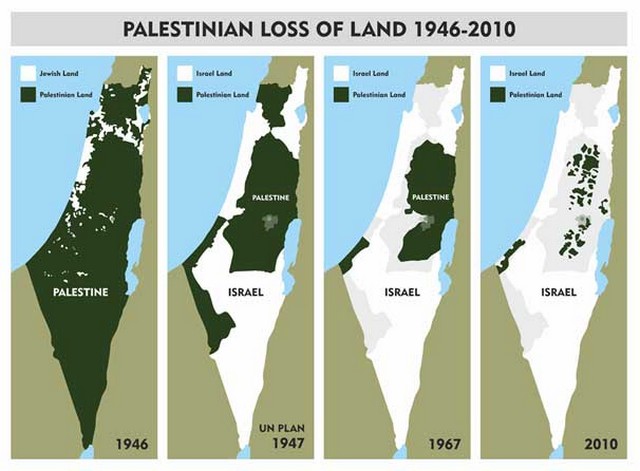
The United Nations has overwhelmingly approved a resolution calling for Palestinian self-determination and end to Israeli occupation of Palestinian territory since 1967. The resolution was approved on Thursday by the UN General Assembly’s Third Committee — the committee that deals with human rights and humanitarian affairs. It was passed 163 to 5, with 10 abstentions.

Those who voted against were: the United States, Israel, the Marshall Islands, Micronesia and Nauru also voted against the resolution.

Australia, Cameroon, Guatemala, Honduras, Kiribati, Palau, Papa New Guinea, Rwanda, Togo and Tonga all abstained.

The resolution emphasized “the right of the Palestinian people to self-determination, including the right to their independent State of Palestine” and “stressed the urgency of achieving without delay an end to the Israeli occupation that began in 1967 and a just, lasting and comprehensive peace settlement between the Palestinian and Israeli sides,” based on a two-state solution.

It is part of a large package of 20 pro-Palestinian resolutions that are passed by the General Assembly every year.

Palestinian Representative

The Palestinian representative thanked those countries that supported their right to self-determination. He pushed back at the charge that such UN resolutions were problematic.

“Support for this resolution is the only possible option for any country that believes in international law. The right to self-determination was enshrined in the UN charter,” he said.

Many UN countries have also been victims of colonialism and thus have an affinity with the Palestinian cause, he continued, adding: “The problem is not UN resolutions: The problem is their lack of implementation,” he said.

“A two-state solution based on the pre-1967 lines is a critical element for peace with Israel, and therefore all countries have an obligation not to support Israeli actions over the pre-1967 lines,” he said adding: “There is no doubt that the last day of Israel’s occupation of our land will be the first day of peace for all.”

UN resolution reaffirms peoples’ self-determination right

Meanwhile, the United Nations General Assembly’s (UNGA) Third Committee which deals with social, humanitarian and cultural issues Saturday unanimously a passed resolution on the right to self-determination of all people.

Co-sponsored by 71 countries, the resolution, submitted by Pakistan, was adopted without a vote in the 193-member Assembly’s Third Committee. The resolution, which Pakistan has been sponsoring since 1981, serves to focus the world’s attention on the struggle by peoples still struggling for their inalienable right to self-determination, including those in Kashmir and Palestine.

The resolution also declared the General Assembly’s firm opposition to acts of foreign military intervention, aggression and occupation, since these have resulted in the suppression of the right of peoples to self-determination and other human rights in certain parts of the world.

It called on those states responsible to cease immediately their military intervention in and occupation of foreign countries and territories, as well as all acts of repression, discrimination, exploitation and maltreatment. The resolution also deplored the plight of millions of refugees and displaced persons who have been uprooted as a result of these acts and reaffirms their right to return to their homes voluntarily in safety and honor.

It urges the Human Rights Council to give special attention to the violation of human rights, especially the right to self-determination, resulting from foreign military intervention, aggression or occupation. It also requests the Secretary-General to report to the next Session of the General Assembly on this question.

Abdus Sattar Ghazali is the Chief Editor of the Journal of America (www.journalofamerica.net) email: asghazali2011 (@) gmail.com

26 November 2020

Source: countercurrents.org

Allegations of War Crimes by Australian Forces in Afghanistan Shock the Nation

By Kalinga Seneviratne

SYDNEY (IDN) – The release of a report into a landmark four-year investigation into the behaviour of Australians special forces known as the SAS (Special Air Service) in Afghanistan, seem to have shocked the nation, judging from newspaper headlines on November 20. Yet, for many who opposed Australia’s involvement in the Afghanistan war, this is not surprising and such a report came too late. A whistle blower who leaked information to the media in 2018 of these atrocities is facing criminal charges for stealing state secrets.

Pip Hinman, of the Sydney ‘Stop The War Coalition’ is not too surprised by the findings. “The nearly 20-year war has been largely hidden (from the Australia public),” she told IDN.

“The media has not been able to go to Afghanistan unless they were embedded with the Australian Defence Force (ADF). Only a handful of independent journalists have managed to get in, and they too would only want to report on the good soldiers because otherwise they would never get back.”

Hinman added: “The federal government has and is actively trying to stop army whistle blowers. Thanks to those brave people, Australians have been getting a better understanding of the nature of this war and Australia’s role there.”

For the last four years, the Inspector-General of the ADF has been looking into such whistle blowing that Australian elite forces in Afghanistan were committing war crimes. The inquiry has now handed down its final report, completed by New South Wales Justice Paul Brereton, who is also a Major General in the Army Reserve.

The findings reveal that some of Australia’s most elite soldiers in the SAS have been involved in unlawful killing, blood lust, a warrior culture and cover-up of their alleged atrocities. It comes as a surprise to an Australian public, who believe that Australian military engagement in Afghanistan was designed to keep the world safe from terrorists. Australia first committed military personnel to Afghanistan in October 2001 to support US’s ‘war on terror’ campaign.

Alex Bainbridge, of the Socialist Alliance, which is opposed to Australia’s involvement in “imperialist wars” in foreign countries believes that the report could help to debunk a myth. “The government tries to pretend that the Australian military is ‘professional’ and only fights for noble causes, but this is a propaganda myth to win public support for unjust wars,” he told IDN.

The report’s most staggering revelation is that 39 Afghans were allegedly murdered by Australian special forces in 23 incidents. None of the alleged victims were combatants. Brereton said that the circumstances of each, were they to be eventually accepted by a jury, would constitute the war crime of murder.

The report has described a process, where young special forces soldiers would be instructed by their patrol commander to execute a detainee. Weapons or radios, known as “throwdowns”, were placed on the body and a cover story allegedly created to mask the crime and deflect any scrutiny. Operational reports were allegedly sanitized to make it appear as though special forces were complying with the laws of engagement.

Some of these incidents took place in 2009 and 2010, with the majority occurring in 2012 and 2013. ADF Chief General Angus Campbell has expressed shocked by the revelations, saying that it is damaging to the moral authority of the military force. “I would never have conceived an Australian would be doing this in the modern era,” he told a media briefing.

This is not the first time that such activities have come into the public domain. In 2018, David McBride, a former Australian Army lawyer, leaked ADF documents on activities of the SAS in Afghanistan to the Australian Broadcasting Corporation (ABC) which did a series of 7 stories based on these. In response to these stories, Australian Federal Police (AFP) raided the offices of the national broadcaster in Sydney in June 2019 and spent some 8 hours going through computers and confiscating all document related to the matter.

In June 2020, AFP instructed the Office of the Commonwealth Director of Public Prosecutor to lay charges against journalist Dan Oakes. But, last month (October), the office announced that though they may succeed in obtaining a conviction on several charges, they will not proceed with the case.

McBride, who is facing charges on theft of Commonwealth (Government) property, in a tweet on Thursday said “ a thorough examination of unit command and delegated authority is vital, extending to the very top. This includes the actions of those highly decorated senior officers who provided command during the Afghanistan campaign.”

But, despite these mechanisms being put in place, there are still serious questions about how potential criminal prosecutions would work, argues Professor David Letts, director of the Centre for Military and Security Law at the Australian National University.

“Investigating and prosecuting alleged crimes of this nature is incredibly difficult due to the passage of time, fading memories and inconsistency of witnesses. There are also practical challenges obtaining evidence in a country with a fragile security situation,” he notes in a commentary published by Canberra Times.

He also adds that the standard of proof required to convict an individual “beyond a reasonable doubt” in a criminal trial is quite high, meaning any successful prosecution might require stronger evidence than what has been included in the inquiry report.

Dr Rateb Jneid, President of the Australian Federation of Islamic Councils believes that Australia has made the right decision to investigate these crimes. But, this should be the start of a process where “we make a solemn commitment to stop invading other nations and we must stop supporting invaders and occupiers’ of other nations,” he said in a statement given to IDN.

“We must own up to our crimes and proceed with fair and just persecutions against the perpetrators and those who ordered them to commit such atrocious murders.”

But, the military may see the issue differently. “Our SAS fight against an enemy that wears no uniform and who can easily conceal weapons under the folds of their peasant garbs. Telling friend from foe is nigh impossible and split-second decisions are often needed to counter possible threats,” argues retired Lieutenant Colonel Derek Gogh, in a letter published by Canberra Times on November 20.

“Many of our soldiers have already been murdered by traitorous Afghani soldiers and our SAS troopers also have to cope with frequent roadside bombs and IEDs (improvised explosive devices). They constantly operate under extreme stress, not likely to be appreciated by those who have not walked in their shoes.”

But Bainbridge argues that the need of the hour is a fundamental change in the military thinking to “curtail their capacity to wage wars of aggression abroad”. “The people of Afghanistan have never threatened Australia,” adds Hinman. “They have told us they can handle their own despots and regimes (like Taliban) themselves, but the very presence of occupying Western forces, which helped ferment new terrorist gangs like the IS (Islamic State), made that struggle (to fight terror) even harder.”

Bainbridge believes that every exposure of imperialist war crimes and human rights abuses makes it easier to make an anti-war argument. “A million people protested against the Iraq war in February 2003 and around half the population were opposed to that war,” he points out. “So it is definitely possible to build a strong and successful anti-war movement in this country.”

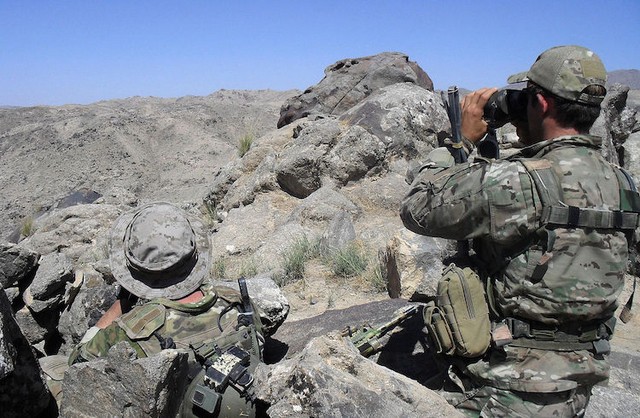
Photo: Two Australian soldiers during the Shah Wali Kot Offensive in Afghanistan. CC BY 2.0

IDN is flagship agency of the Non-profit International Press Syndicate.

20 November 2020

Source: www.indepthnews.net

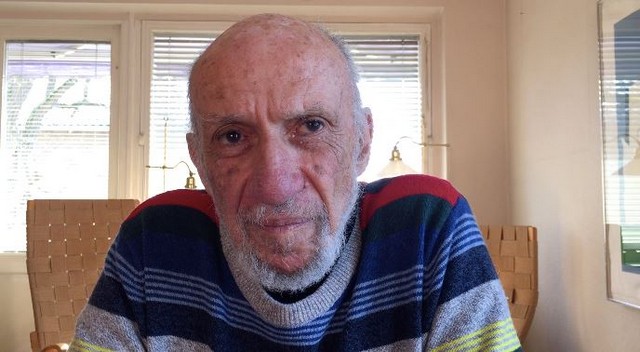
Richard Falk, a Citizen Pilgrim in Search of Justice and Peace, Turns 90

By Jan Oberg

13 Nov 2020 – We are blessed by having a number of peace and future scholars, world-leading in their professions, who have followed world events over many decades and continue to be committed to world order change and public education.

I say “blessed” because I assume that the reader share my reverence for high age and the sharing of long life experience as well as the wisdom that may accompany it in the midst of the youth-worshiping which characterises the ageing and increasingly grumpy West itself – also sometimes called age discrimination.

Last month we celebrated Johan Galtung at 90. And today, Richard Falk at 90 – both world-renowned mega-productive scholars restlessly seeking ways to make the world a more peaceful place. And both TFF Associates, mentors and friends of the founders even before we set up TFF in 1985.

As a student of sociology, peace and world affairs in the 1970s, I had been drawn to Falk’s pioneering writings and textbooks – and the “relevantly utopian” World Order Models Project, WOMP, that he participated in. I then met him in Lisbon for that project’s meeting in 1980 and have benefited ever since from his academic/law perspectives, peace thinking as well as from his sophisticated, elegantly complex style of writing.

To write this heart- and brain-felt homage, I went back first to TFF Associate’s “Treasures” section 1998-2005 and found 43 articles by Richard. Then on to TFF’s homepage – 2006-2012 and found 46 articles by him. Continuing to TFF Associates’ blog 2012-2017, I find that we published no less than 243 articles by Richard during those five years. And finally to our present site, The Transnational from 2018 where there are some 50.

In sum, more than 380 pieces of theory, visions, commentaries, analyses and debate articles. Although this is only a fraction of his total production, I allow myself to interpret this publication result as a modest token of my deep gratitude and my joy of paying back a little of what he has so generously given TFF and me personally during all these years – not the least, I may add, by reading and editing all these articles before I posted them!

It isn’t easy, perhaps actually impossible, to pin down who Richard Falk is, incessantly writing and speaking around the world, over so many years. But it suffices here to just celebrate the incredible diversity. Richard’s lifelong engagement with the Palestinian people stands out – as do critical analyses of USand NATO militarism and interventionism; Middle Eastern developments and wars, of course; international law and the UN in particular – we share a big heart for its basic idea and role in the world – as well as nonviolence and peace and analysis of topical issues such as this from just a couple of days ago. . .

Richard Falk is Jewish and explains what this identity means to him and, in passing, why he cannot in spite of his critical attitude to Zionism be categorized as he has been, as a self-hating Jew. He speaks rather from an ecumenical perspective – of great significance for world peace thinking:

“In a more fundamental respect my own evolution has always been suspicious of those who give priority to tribalist or sectarian identities. In other words, it is fine to affirm being Jewish, but it should not take precedence over being human or being open and receptive to the insight and wisdom of other traditions. We have reached a point in the political and cultural evolution that our future flourishing as a species vitally depends upon the spread of a more ecumenical ethos. We have expressed this embrace of otherness in relation to food, with the rise of ‘fusion’ cuisines, and with regard to popular culture, particularly music, where all kinds of borrowing and synthesis are perceived as exciting, authentic, valuable.”

And…

“In my experience what is most appropriate in our historical circumstances is an ecumenical and inclusive spiritual identity, and associated ethical and political commitments. In effect, what would awaken the collective sensibilities of the peoples of the earth to the challenges confronting humanity is a movement of spiritual and ethical globalization that approaches the universal through an immersion in a variety of particularities.

In this sense, I want to say, yes I am Jewish, and proud of it, but I am equally indigenous, Sufi, Hindu, Buddhist, Muslim, and Christian to the extent that I allow myself to participate in their rituals, partake of their sacred texts, and seek and avail myself of the opportunity to sit at the feet of their masters. Many persons living deprived lives do not have or desire such ecumenical opportunities, and can best approach this universal ideal, by seeking out the inclusive potentialities of their own religious and cultural reality.”

Of course, like many other experts critical of Israel’s policies in general and policies vis-a-vis the Palestinians, he has been accused of anti-Semitism. In this short video from autumn 2019, you’ll see how he – careful with formulations around the complexity of the issue – explains how Zionism’s rejection/diversion of all criticism as anti-Semitism has more dimensions and purposes than we may have thought of. Indeed, this short sequence a pearl of pedagogics.

Richard Falk on Zionism and anti-Semitism

Richard’s style of writing has literary qualities way beyond the normal academic text – and without losing its precision and attempted rational reasoning. That may very well have to do with his reading of fiction and his own writing of poetry.

You’ll see in Memoir sketch – Championing lost causes how literary-philosophical classics such as Albert Camus influences his thinking, not only about external academic issues and the world but what it means to be an intellectual acting responsibly into that world and – even in dark times – avoid the traps of losing hope and being overtaken by fear.

In this article he pays tribute to one of his dearest friends, literature professor Edward Said (1935-2003) taking as his point of departure Said’s 1997 essay “On lost causes”, something which he elaborates further on in this 2014 article in The Nation about the future of Palestine.

It wasn’t before he turned 80 that Falk started his personal blog, Global Justice in the 21st Century which contains posts of a fascinating diversity and in a quantity that makes you wonder whether the man ever sleeps (he maintains that he does but gives the impression that to him sleep is an unfortunate, necessary waste of time; it’s a feeling we share).

Not to be missed, throughout this blog, he explores directly and indirectly what it means to be what he calls a citizens pilgrim. He defines that as

an identity shaped through an appreciative reference to ‘the citizen pilgrim,’ that is, to the citizen whose conscience is directed at others without heeding boundaries of space or time, or such contingent features of identity as nationality, ethnicity, race, religion, gender, class. The citizen pilgrim has embarked upon what is essentially a spiritual journey or pilgrimage, seeking an inspirational future that seems neither feasible nor impossible. Such an inspirational dedication also minimizes the imaginative foreclosures of mortality, making the certainty of death a part of life, and accepting this destiny without seeking the comfort of metaphysical fictions, and thus not deeply disconcerted by ‘the dying of the light.’

As I’ve hinted above, parallel with his academic and political production, Richard has consistently grappled with what it means to be a responsible intellectual – over the moral aspects of his lifelong project and its meandering path. “Responsible scholarship in dark times” from 2007 is but one of many such thoughtful pieces – rare in the academic world – with the greatest relevance for today’s – no less dark – world in which true knowledge, not to mention wisdom, seems to have lost out to the fast market’s banality-driven timespan-contracting and impulsive clicking fad that gives priority to fast, smart opinions rather than the slower knowledge-building – in short, a new illiteracy.

The world as a whole and as we experience it today in a macro-historical perspective has not progressed to the better, towards what he has struggled and hoped for. But is he frustrated?

Anti-war and pro-peace

This little tribute to one of the most prolific and elegantly-reasoning social scientists of our time cannot be anything but kaleidoscopic. The reader is advised to explore the Falk universe and its enlightenment on their own, perhaps through some of the links provided in this article.

Of particular importance for our relations with him is, naturally, his deep belief in and advocacy of using all the civilian means at humanity’s disposal and only use violence as the last resort, completely in unison with the UN Charter’s Article 1 – the promotion of which is TFF’s mission.

An example. Already in September 2002 – about half a year before the U.S. invasion and destruction of Iraq with its allies under Goerge W. Bush, Falk pulled the entire project apart, intellectually, legally, politically and morally in this short article on TFF – “A roadmap to war: A flawed debate.”

Falk stated his factual and intuitive pre-war criticism succinctly as did other TFF Associates such as Hans von Sponeck, Johan Galtung, Brian Martin, David Krieger, Burns Weston, Birgitte Rahbek, Else Hammerich and myself to mention some of the more vocal anti-intervention voices at the time.

It’s noteworthy that all TFF Associates who advised strongly against that war before it started also predicted its catastrophic consequences it would have in Iraq as well as for the possibility of a new and more benign world order that had been made possible by the demise of the Soviet Union and the Warsaw Pact. But few politicians and media in the US and NATO countries had any wish or capacity to listen. Today the consequences of that insensitive and self-destructive militarism causes the decline of the US and NATO itself.

Falk’s devotion to Gandhi, to eclecticist nonviolent thinking and policies, can be enjoyed in this article on TFF’s homepage “Mahatma Gandhi and the revival of nonviolent politics at the end of the 20th century” – as early as 1998.

If a Nobel Peace Prize should, for the first time, be awarded to a peace and conflict scholar, Richard Falk would be on top of the shortlist. Fortunately, he is on the list of the Nobel Peace Prize Watch. Here you may read the motivation for his nomination, every year over the last 12.

However, like Johan Galtung and the other qualified people on that list, Falk is probably too central to the essential peace concerns as Alfred Nobel expressed them in his will to ever even be considered – not that I think it bothers him the slightest.

My wife and co-founder Christina – and many other TFF Associates – join you today to say thank you, dear Richard, for your friendship, mentorship and TFF Associateship over more than 40 years.

As we look forward, we wish you and you wife Hilal Elver everything good in years to come, good health in particular so you can continue happily your citizen’s pilgrimage which will, beyond a doubt, continue to inspire way beyond your own time and space. And do continue your daily ping-pong matches too…

You may congratulate Richard Falk by Joining the Discussion below or write him at either falk@global.ucsb.edu or rfalk@princeton.edu

Richard Falk is a member of the TRANSCEND Network, an international relations scholar, professor emeritus of international law at Princeton University, Distinguished Research Fellow, Orfalea Center of Global Studies, UCSB, author, co-author or editor of 60 books, and a speaker and activist on world affairs.

Prof. Jan Oberg, Ph.D. is director of the Transnational Foundation for Peace and Future Research, TFF and a member of the TRANSCEND Network for Peace Development Environment.

16 November 2020

Source: www.transcend.org

Interpreting the U.S. Election Results: Preliminary Observations

By Richard Falk

9 Nov 2020 – The victory by the Biden/Harris ticket in the 2020 American National Elections is basically good news for the country and the world, although not as good as expected (by pollsters or enthusiasts) or nearly as decisive as desirable given the dreadfully regressive behavior of Trump and the Republican Party over the past four years. And there is some bad news, as well, lurking just beneath the surface. Not only the strength of Trumpism in America, but the likely drift toward the center-right of the Biden presidency.

Why Good News?

Above all, Trump’s reelection would have meant a tighter embrace of an American version of fascism with constitutionalism, the rule of law, and human rights repudiated, and an autocratic/plutocratic style of leadership consolidated around an ideology of chauvinistic or nativist nationalism.

The vote was not as one-sided as anti-fascists might have hoped, but the Biden ticket did prevail in the popular vote by an almost 5 million margin, and won the electoral college by a comfortable margin. This achievement is even greater than the statistical results if account is taken of the various Republican voter suppression efforts.

In policy terms, the result seems clearly beneficial with respect to the short-term domestic agenda. The CORONA pandemic is likely to be immediately handled in accord with guidelines by health specialists rather than by the macho whims of the Trump White House, which means that the virus is likely to be brought under control as rapidly and humanely as possible, assuming that the inauguration of Biden occurs on January 20th. Beyond this, presuming some Congressional flexibility, a stimulus package beneficial to the poor and unemployed, as well as to small businesses is likely to be quickly forthcoming. Such policies should pave the way to a broader, more sustainable and fairer economic recovery, although the second wave COVID spike in Europe warrants caution as to what the future will bring.

Looking beyond these immediate challenges, it would seem reasonable to expect improvements in health care, public education, judicial appointments, racial and gender equality from the Biden presidency, with a realistic prospect of progress toward realizing such goals, especially if the two Georgia runoff elections on January 5th go the Democratic Party way, which seems possible, but not yet probable.

Internationally, the Biden victory will be greeted by world leaders around the world with a huge sigh of relief. It will have, additionally, some positive impacts on global problem-solving, giving rise overall to a more cooperative atmosphere. A revived posture of U.S. global activism is certain to be welcomed at first raising hopes of crafting compromise solutions to common problems. It seems also like to produce some increased appreciation of the role of the United Nations and international law, highlighted by reactivating membership in and refunding of the WHO. This kind of participation by the United States is likely to a partial renewal of the global leadership role that the U.S. played in the decades after the end of World War II, although in a more muted manner, due to preoccupations with domestic challenges, and in a spirit more related to functional concerns, above all, climate change and health, than to ideologically adversary geopolitical relations.

Now, the Bad News

While the referendum on Trump as leader and fascism as ideology were formally repudiated, the threats posed remain existentially viral, likely to become entrenched in some kind of organizational Trumpist format that will stalk the future of governance and quality of political life in the United States during the years ahead. It is chastening to acknowledge that if the pandemic had not struck the country so hard or Trump had handled it more prudently, he likely would have been reelected. The stock market would have attained a record high, while unemployment would have remained at record lows. As it was, as Republicans gleefully point out, their party won the 2020 elections except for the presidency—so far holding their Senate majority, even picking up several seats in the House of Representatives, gaining in Federal contexts, meaning greater influence among the legislatures and leadership in the 50 states. I can only imagine the dire morning after had there been no health crisis, no economic downturn, and no crazy leader in the White House!

Less obvious, but no less serious, the Biden victory is also a victory for the American deep state, which has presided over the implementation of an evolving bipartisan consensus that has shaped American foreign policy ever since the wartime unity governments of 1941-1945. This foreign policy consensus can be identified with four overlapping dimensions:

1. a global military security system consisting of hundreds of overseas military bases, all-oceans naval presences, operational intelligence capabilities in every strategically important country in the world, and a hegemonic control of nuclear weaponry;

2. a string of formal and informal alliances and special relationships that connect U.S. diplomacy and geopolitical muscle with strategic priorities such as the defense of Europe, Taiwan, and Israel;

3. a shifting continuing need to identify sufficient global security threats and interest to satisfy private sector arms sales interests and to ensure Congressional support for high defense budgets; the promotion of such goals tend to magnify security threats and induce geopolitical confrontations;

4. a support structure for a market-driven world economy premised on ‘Neoliberal Globalization,’ premised on facilitating transnational capital investments and beneficial trading frameworks, and backed up by international economic institutions (World Bank, IMF, World Trade Organization), and supplemented as necessary by various hostile responses by the U.S. Government in reaction to displays of foreign economic nationalism, including reliance on sanctions, covert interventions, and coercive diplomacy.

It is notable that the bureaucratic managers of the deep state, retirees from the CIA and Pentagon, were not comfortable with the Trump presidency because its leadership lacked a disciplined adherence to these four dimensions of the deep state consensus that had managed the transitions from World War II to the Cold War, from the Cold War to the War of Terror, and hopes perhaps for a new transition that generates tensions with Russia and/or China. It is not that Trump defied the consensus at the level of policy, but that he led with an unsteady hand less responsive to the nuances of geopolitical management of an increasingly complex global setting. With Biden the deep state has a reliable veteran adherent of the deep state consensus, someone who can be trusted to follow its signals as to policy initiatives, especially in the domains of foreign economic and security policy. In the present setting, Biden has almost total freedom to opt for the center-right on foreign policy as the political mood is currently dominated by how he delivers on the home front.

Finally, on the domestic scene, there is now a probable surfacing of post-Trump strife among the Democratic winners in the recent elections. The issue is one of policy influence as reflected by high profile appointments, policy priorities, and presidential tone. Will the progressive wing of the Democratic Party that preferred Bernie Sanders over Joe Biden as the anti-Trump candidate be given its due or will it be boxed in by the center-right leadership that blames the center-left for its setbacks in the 2020 elections? These self-styled Democratic moderates insist that progressive advocacy of the Green New Deal, Medicare for All, debt forgiveness for student loans were ‘socialist’ or hard left proposals that drove many Independents to vote Republican except for Biden/Harris. It seems doubtful that ‘the center will hold’ as Democrats on the left and right vie for influence, and it is quite possible that The Squad will go it alone, championing movement politics, while almost giving up on the two-party approach to American politics. We already finding the two wings each claiming credit for the Biden victory. The center-right contending that only a candidate of Biden’s conservative record could have won, and all other Democrat alternatives would have gone down to defeat. The center-left counters with the claim that without the progressive ground game and mobilization of voter turnout among minorities and youth, Biden/Harris would have been beaten by Trump/Pence.

Leading Where?

Too many uncertainties exist to support any confident assessment as to how these clashing tendencies will play out. What seems clear is that there were two outcomes of the American elections: Trump was beaten, but Trumpism was not, garnering the support under the most unfavorable circumstances of over 70 million voters and a heightened sense of militancy under circumstances of higher political stakes. Will Trumpists, and the Republican leadership, interpret the election as a defeat because Trump lost or as a mandate because Republican conservative policy positions despite the adverse presidential tide made gains at the Congressional and federal levels of government.

One unknowable issue is whether Trumpism can flourish without Trump in the White House, and closely related, whether Trump after returning to private life will seek to lead the movement he inspired or resume his life as freewheeling business magnate.

Another area of uncertainty is whether the deep state will opt for a geopolitical confrontation with China or will be content to promote economic growth and political stability at least for an interim period during which the U.S. recovers its geopolitical composure. It seems safe to assume that Biden will govern in light of a new articulation of a deep state consensus responsive to its reading of the global scene, but how that will be weighted is far from clear at this time.

Biden’s clarion call has been to bring civility, if not a spirit of unity, back to the ebb and flow of American politics. This is an understandable response to the slash and burn presidency of Trump, but if it persists, it could lead to some discrediting compromises, with respect to stimulus, health care, immigration, unlikely to appease Trumpists or even non-Trump Republicans, and foster an image of the Biden presidency as out of touch with the harsh realities of American politics in their present configuration. Obama made this mistake, and was outmaneuvered by Republicans who took all they could get without giving away anything in return. It will be important to watch closely Biden’s attempts to induce a more cooperative atmosphere and, especially, how he handles a non-responsive Republican Senate. Indications remain strong that the last thing Trump-oriented Republicans want is compromise. Forgetting that it takes two to tango could quickly alter the welcome image of Biden the unifier into that of Biden the dangerous fool who fails to understand the ethics and politics of polarization. Unless a presently unseen and almost unimaginable will emerges on the political right to seek some level of reconciliation with the Democratic establishment, wasting energy on finding common ground is like looking for sunlight deep inside a cave.

Richard Falk is a member of the TRANSCEND Network, an international relations scholar, professor emeritus of international law at Princeton University, Distinguished Research Fellow, Orfalea Center of Global Studies, UCSB, author, co-author or editor of 60 books, and a speaker and activist on world affairs.

16 November 2020

Source: www.transcend.org

Making Sense of Hunger Strikes and Symbolic Politics

By Richard Falk

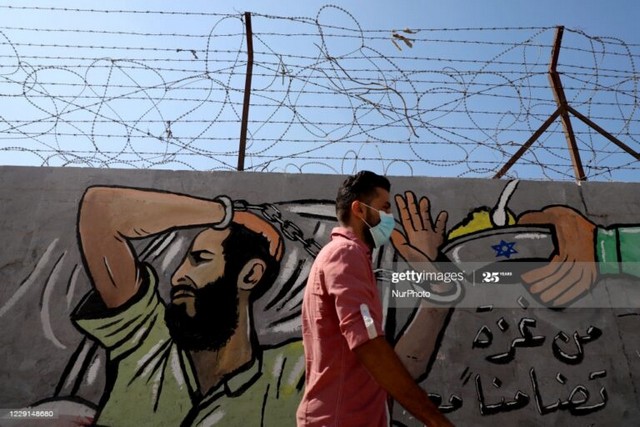
12 Nov 2020 – What follows is my contribution to a forthcoming publication bearing the title Shared Struggle: Stories of Palestinian and Irish Hunger Strikers. This is an important collection of writing prepared by Norma Hashim and Yousef M. Aljami. It appeared by way of exclusive arrangement on October 27, 2020 in the online magazine Politics Today. My essay speaks to the hunger strikes as political resistance of a sublime character, and at the same time to the selective silence of the Western media when it comes to heroic moments in the Palestinian struggle. Just days ago Maher Al-Akhras ended his 103 day hunger strike when Israel finally agreed to his release from prison after repeated confinement without charges under colonialist ‘administrative detention’ rulings.

Desperate circumstances give rise to desperate behavior. If by states, extreme violent behavior tends to be rationalized as ‘self-defense,’ ‘military necessity,’ or ‘counterterrorism,’ and claims of legal authorization are treated as appropriate. If even nonviolent acts of resistance by individuals associated with dissident movements, then the established order and its supportive media will routinely describe such acts as ‘terrorism,’ ‘criminality,’ and ‘fanaticism,’ and the behavior is criminalized, or at best exposed to scorn by the established order of sovereign states. Statist forms of combat almost always rely on violence to crush an enemy, while the desperation of resistance sometimes takes the form of inflicting hurt upon the self so as to shame an oppressor to relent or eventually even surrender, not due to empathy or a change of heart, but because fearful of alienating public opinion, intensifying resistance, losing international legitimacy, facing sanctions. It is against such an overall background that we should understand the role of the hunger strike in the wider context of resistance against all forms of oppressive, exploitative, and cruel governance. The long struggles in Northern Ireland and Palestine are among the most poignant instances of such political encounters that gripped the moral imagination of many persons of conscience in the years since the middle of the prior century.

Those jailed activists who have recourse to a hunger strike, either singly or in collaboration, are keenly aware that they are choosing an option of last resort, which exhibits a willingness to sacrifice their body and even life itself for goals deemed more important. These goals usually involve either safeguarding dignity or honor of subjugated people or mobilizing support for a collective struggle on behalf of freedom, rights, and equality. A hunger strike is an ultimate form of non-violence, comparable only to politically motivated acts of self-immolation, physically harmful only to the self, yet possessing in certain circumstances unlimited symbolic potential to change behavior and give rise to massive displays of discontent by a population believed to be successfully suppressed. Such desperate tactics have been integral to the struggles for basic rights and resistance to oppressive conditions in both Palestine and Northern Ireland.

An unacknowledged, yet vital, truth of recent history is that symbolic politics have often eventually controlled the outcomes of prolonged struggles against oppressive state actors that wield dominant control over combat zones and uncontested superiority in relation to weapons and military capabilities. And yet despite these hard power advantages thought decisive in such conflict, they go on in the end to endure political defeat. It may be helpful to remember that it was the self-immolation of Buddhist monks in Saigon during the 1960s was considered a scream of the culture in reaction to the American led military intervention. It led Vietnamese scholars to interpret these extreme acts of solitary individuals, endowed with the highest civilizational authority, as actually shifting the balance of forces in Vietnam in ways that then and there doomed the seemingly irresistible American military resolve to control the political future of Vietnam. These acts didn’t end the war, but to those with insight into Vietnamese culture it did signal an outcome contrary to what the war planners in Washington expected. Tragically before acknowledging defeat, the Vietnam war persisted for a decade, ravaging the land and bringing great suffering to the people of Vietnam. Self-immolation, setting oneself on fire as an irreversible instance of self-sacrifice, carries the logic of a hunger strike to its conclusion. Depending on the actor and context, self-immolation can be interpreted either as an expression of hopeless despair or as a desperate appeal for a just peace.

It was the self-immolation of a simple fruit and vegetable vendor, Mohamed Bouazizi in the Tunisian town of Sidi Bouzid on December 17, 2010 that called attention to the plight of the Tunisian people, igniting a nationwide uprising that drove a corrupt dictator, Ben Ali, from power. Bouazizi, without political motivation or spiritual authority of the Buddhist monks, sparked populist mobilizations that swept across the Arab world in 2011. Somehow Bouazizi’s entire personal self-immolation set the region ablaze. Such a reaction could not have been predicted and was not planned, yet afterwards it was interpreted as somehow generating revolutionary responses to intolerable underlying conditions.

Without doubt, the supreme example of triumphant symbolic politics in modern times was the extraordinary resistance and liberation movement led by Gandhi that merged his individual hunger strikes unto death with spectacular nonviolent forms of collective action (for instance, ‘the salt march’ of 1930), accomplishing what seemed impossible at the time, bringing the British Empire to its knees, and by so doing, restoring independent statehood and sovereignty to India.

Both the oppressed and the oppressors learn from past successes and failures of symbolic politics. The oppressed view it as an ultimate and ennobling approach to resistance and liberation. Oppressors learn that wars are often not decided by who wins on the battlefield but by the side that gains a decisive advantage symbolically in what I have previously called ‘legitimacy wars.’ With this knowledge of their vulnerability, oppressors fight back, defame and use violence to destroy by any means the will of the oppressed to resist, especially if the stakes involve giving up the high moral and legal ground. The Israeli leadership learned, especially, from the collapse of South African apartheid not to take symbolic politics lightly. Israel has been particularly unscrupulous in its responses to symbolic challenges to its abusive apartheid regime of control. Israel, with U.S. support, has mounted a worldwide defamatory pushback against criticism at the UN or from human rights defenders around the world, shamelessly playing ‘the anti-Semitic card’ in its effort to destroy nonviolent solidarity efforts such as the pro-Palestinian BDS Campaign modeled on an initiative that had mobilized worldwide opposition to South African apartheid. Notably, in the South African case, the BDS tactic was questioned for effectiveness and appropriateness, but its organizers and most militant supporters were never defamed, much less criminalized. This recognition of the potency of symbolic politics by Israel has obstructed the Palestinian liberation struggles despite what would seem to be the advantageous realities of the post-colonial setting.

Israel’s version of an apartheid regime evolved as a necessary side effect of establishing an exclusivist Jewish state in a non-Jewish state. This Zionist project required that the Palestinian people become victims of colonialist displacement in their own homeland. Israel learned from the South African experience techniques of racist hierarchy and repression, but they were also aware of the vulnerabilities of oppressors to sustained forms of non-violence that validated the persevering resistance of those oppressed. Israel is determined not to repeat the collapse of South African apartheid, and to do so requires not only repression of resistors but the demoralization of supporters.

A similar reality existed in Northern Ireland where the memories of colonies lost to weaker adversaries slowly taught the UK lessons of accommodation and compromise, which led the leaders in London to shift their focus from counterterrorism to diplomacy, with the dramatic climax of the Good Friday Agreement in 1998. Israel is not the UK, and the Irish are not the Palestinians. Israel shows no willingness to grant the Palestinian people their most basic rights, yet even Israel does not want to be humiliated in ways that can arouse international public opinion to move beyond the rhetoric of censure in the direction of sanctions. The Israeli Prison Service doesn’t want Palestinian hunger strikers to die while in captivity, not because of empathy, but to avoid bad publicity. To prevent such outcomes, Israeli prison authorities will make concessions, including even release, when a hunger striker is feared at the brink of death, and earlier attempts at force feeding have failed. Palestinian prospects are more dependent than ever on waging and winning victories in the domain of symbolic politics, and Israel, with the help of the United States, will go to any length to hide defeat in this longest of legitimacy wars.

It is against such a background that Palestinian and Irish contributions came to surface to underscore the essential similarity of these two epic anti-colonial struggles. What gives the stories of Palestinian and Irish hunger strikers the authority and persuasive power is the authenticity derived from words of those brave men and women who chose to undertake hunger strikes in situations of desperation and experienced not only their own spirit-enhancing ordeal but the pain of loss of martyred fallen comrades, grieving families, and their common effort to engage the wider struggles for rights and freedom being carried on outside the prison walls. Despite the vast differences in their respective struggles against oppression, the similarities of response created the deepest of bonds, especially of the Irish toward the Palestinians whose oppressive reality was more severe, and has proved more enduring, although the dreams of the Irish hunger strikers remain largely unrealized. At the same time, the inspirational example of the Irish hunger strikers who did not abandon their quest for elemental justice at the doorstep of death was not lost on the Palestinians.

Richard Falk is a member of the TRANSCEND Network, an international relations scholar, professor emeritus of international law at Princeton University, Distinguished Research Fellow, Orfalea Center of Global Studies, UCSB, author, co-author or editor of 60 books, and a speaker and activist on world affairs.

16 November 2020

Source: www.transcend.org

Questions

By Mazin Qumsiyeh

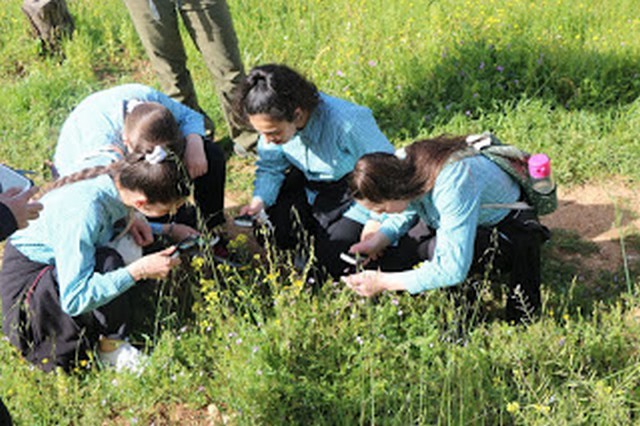
Girls exploring nature at the Palestine Institute for Biodiversity and Sustainability

12 Nov 2020 – How do we individually cope, keep our sanity in a spiraling crisis, and help others?

It is almost a year since the start of this global pandemic with over 50 million who were infected and over one million died from. Everyone of us can count personal loss economic and human. Countries like India, Brazil, and the US were especially hit hard because of their corrupt leadership. But every country and region in the world suffered.

Here in Palestine as an example, the viral infection rates are still on the rise especially in Gaza. Many Gaza Palestinians lost hope. Many young people are committing suicide. It is not only a pandemic of a virus but the pandemic of systematic racism and colonialism that spread. While Zionists spread hate and divisiveness to advance its goals around the world (via Hollywood, Bloomberg and Fox News etc), even they are starting to rethink what world are they making and will it be livable even for the billionaires. The stock market watched by the rich and powerful like Trump and Netanyahu went up because of the supposed potential vaccine. But this vaccine is no magic bullet. Its distribution will be a nightmare since it must be shipped on dry ice and stay very cold (freezer facilities of that kind are not found in most areas).

The virus is also mutating and there will be new viruses. As a biologist and medical geneticist I can tell you there are simply too many humans and lots of viruses around us evolving. Everyone also knows that the current economic system (capitalism/consumerism) is not only unable to deal with the new realities (pandemics, climate change, catastrophic wars) BUT IS ACTUALLY THE CAUSE OF THESE. Hence the challenge for common people: how to survive and create a better world to ensure our neighbors, friends, and children also live decent lives?

Most people of course at the most basic instinct want to survive as individuals and try to adapt as best as they could in times of crisis. I have seen people previously with decent jobs reduced to begging on the streets to survive. Debts are rising (individual, corporate, government) around the world. Few are doing well either by exploiting other people (I call it parasitic) or by having learned self sustenance (like intentional communities, farming to produce our own food etc). There are lessons to learn from indiginous/native people. Even in places that have forgotten their ancient ways, these can be revived.

For example our Canaanitic ancestors and even my own ancestors as recent as 3 generations back were able to sustain themselves fully from the land (their immediate surrounding). This even when the green season is but 3-4 months of the year in Palestine. I know it is doable. We developed a community garden and with few simple (permaculture techniques) we produce >70-80% of our (including volunteer) food. Very little waste is produced. This brings us satisfaction and a sense of control (keys to what is called happiness). Yet this is not sufficient because all around us people are unable to have decent jobs, feed their families, support themselves or feel a sense of empowerment. Personal satisfaction of even creating a team success (as at palestinenature.org) still seems deficient when our ecosystem is falling apart. A small batch of healthy forest cannot really survive long term when the rest of the forest is being destroyed. In this case it is even the rest of the global ecosystem.

As I started to write this on a sleepless night I was not sure where to go with it. But then I thought the best is merely to ask readers for their thoughts. There is so much negativity in this world (justifiable by the state of our world). There are few positive foci doing good things (and we should be proud of those). We do want to promote the latter while realistically dealing with the former. Psychology plays a great factor in that as anyone realizes: you cannot help yourself, or others if you are depressed. The motto we came up with for our Palestine Institute for Biodiversity and Sustainability is “Respect: for ourselves, for others, for our environment”. This is not easy. Many (including me who are still unsure of direction) would be curious to hear how different people help each other to develop these three levels of respect.

We all are learning. We all need emotional and intellectual feedback/support especially in these difficult (actually existential to our species) times. Homo sapiens is a social species. The (western) capitalist world system while packing us into urban areas (increasing urbanization) has ironically also isolated us in separate compartments/ apartments (physically and mentally). COVID-19 exacerbated this isolation. How do we cope with that? How do we support each other? How do we connect and communicate even more (online)? What is the new economic and social system that we should be building to replace the decaying/failing system we inherited? Please put your thoughts in the comments section of this blog or email me and I will post them.

Mazin Qumsiyeh, associate professor of genetics and director of cytogenetic services at Yale University School of Medicine, is founder and president of the Holy Land Conservation Foundation and ex-president of the Middle East Genetics Association.

16 November 2020

Source: www.transcend.org

A strategy comes home to roost

By Peter Lackowski

Traveling around Venezuela in 2005, it occurred to me that the paint merchants must be doing very well. There had been a recall referendum the year before. The question on the ballot was a simple yes or no: Shall President Hugo Chávez be recalled? The word “NO” was still painted on walls, pillars, even random rocks along the highway everywhere I went, reflecting the fact that he had won the vote, 59 to 41 percent, more than a year before.

But the opposition refused to accept those results, saying that there had been electoral fraud. The Carter Center and other international observers said they did not see any, and when they tried to investigate stories circulating, nothing factual turned up.

In 2005, Venezuela was still trying to recover from the employer lockout, and a massive popular uprising thwarted corporate strike that crippled the economy after the anti-Chávez coup of 2002. There were signs of poverty everywhere — people sleeping in doorways, begging, sitting at tables on the street hoping to sell a few trinkets to be able to eat.

I was struck though, by how many street vendors had racks of books with laws — basic laws about the rights of workers, education, land reform, indigenous and other minorities, elections, fisheries, and on and on. The biggest seller was the Bolivarian Constitution, in editions of every size, including little pocket sized ones that people carried around. I saw people buying those books on the street and reading them on the subway and in parks, a constitution that said that they have a human right to a job, housing, health care, education, and everything else that people need. Studying the new laws intended to make those rights real.

An election was coming up on December 4, 2005; the country was getting ready to elect a new National Assembly, the legislative body. There were people in line at street corner registration centers signing up to get a cédula, the official identity number that is used for voting, as well as everything else that involves filling out forms, like credit cards, bank accounts, etc. Many poor people had never had a cédula, but now there were reasons to get one, to fully participate in all the things that had previously been reserved for the middle class.

In sum, given all the new voters and the level of enthusiasm for the revolution among the poor—a big majority—there was every reason to believe that Chavistas would do very well. But there was a problem.

The Chavista government had introduced a new voting system, intended to make elections secure. The voter puts their thumb into a fingerprint-reading device that matches their thumbprint to their name and cédula. Their vote is registered on a machine, which also prints a slip of paper saying how they voted. The voter can check to see that the votes printed on the paper are the same as the ones entered into the machine, and that slip of paper is deposited in a ballot box. After the election, 54 percent of all ballot boxes are randomly selected and opened in the presence of representatives of all the parties, so the paper printouts can be matched to the figures reported from the machines. (The Carter Institute declared this Venezuelan system to be the best in the world.)

The opposition, however, raised objections to the system, claiming, among other things, that the government was going to somehow figure out how people had voted by matching the machines’ record with the order in which they voted. After a long process of negotiation, the National Electoral Council agreed to many opposition demands, and the country prepared for the contest on Sunday, December 4.

I happened to be in the mountain city of Merida on Thursday, December 1, when the news came: The opposition was pulling out of the election, telling their supporters to stay home! They claimed the election was rigged, the Chavistas were going to engage in massive fraud, and they refused to participate.

Given that the government was making progress on most problems, and that the opposition parties had tried so hard to sabotage the economy, it seemed obvious that the lower classes were set to deliver a big majority of delegates to the Chavistas. Crying “Fraud!” was a ploy to avoid another humiliating electoral defeat.

The position of the United States government, and the corporate media who promote its point of view, has been that Venezuelan elections are so corrupt that the opposition has no chance of winning. They have passed on wild stories of violent intimidation and blatant fraud that turn out to have no substance when they are investigated — just internet rumors.

Proof that Chávez was willing to accept electoral defeat came in 2007, when he proposed a package of reforms involving more than sixty changes in the constitution. The proposal failed by a 51 to 49 percent vote. Chávez accepted the results with the remark that it was better to lose than to win by such a close vote.

Claims of fraud have been advanced to excuse violence. After Enrique Capriles lost a close election to President Maduro in 2013 he told his followers to ‘discharge their rage,’ which they did by attacking Cuban staffed medical centers, killing several defenders, based on the bizarre rumor that ballots were being hidden in them.

The accusation of electoral fraud has been a standard feature of U. S. promoted regime change efforts. If it is backed up with sufficient violence, it can be an effective propaganda cover for a coup, as happened in Bolivia. But even in cases like Venezuela, where it is widely understood to be “fake news,” it can have a destabilizing effect, undermining the authority of elections and providing justification for violence.

The United States has used fake claims of electoral fraud to destabilize other countries; now Donald Trump is using this same weapon against the United States itself.

It is a strategy that has come home to roost.

Peter Lackowski, a retired teacher living in Burlington, Vermont, as a friend of the Bolivarian Venezuela regularly writes on Venezuela.

16 November 2020

Source: countercurrents.org

Special Edition: Making Space for Palestine

By David Palumbo-Liu

Palestinians aren’t just kept in misery and degradation by the Israeli occupation – they’re also silenced, at home and abroad. Palestinian activists and their supporters are trying to change that.(An important 7-minute read)

In her January 19, 2020 op-ed in the New York Times, Michelle Alexander argued that it is “Time to Break the Silence on Palestine.” After recounting the many ways people have been forced into silence on Palestine, she ends with this resolution: “In this new year, I aim to speak with greater courage and conviction about injustices beyond our borders, particularly those that are funded by our government, and stand in solidarity with struggles for democracy and freedom. My conscience leaves me no other choice.”

I greatly admire Alexander’s op-ed and stance. The occasion of her essay was Martin Luther King Day, prompting her to reflect on the stance he might have taken on Palestine. “Breaking the silence on Palestine,” however, did not include a single Palestinian voice. Alexander referred to the case of Bahia Amawi, a Palestinian who was fired for not signing an anti-boycott pledge, and she names the good work of several Palestinian organizations. But not a single quote from a Palestinian voice.

The tendency has been to refer to Palestinians as victims of oppression, but also omit the fact that they are among the most resilient and courageous peoples of the world, having endured that oppression and resisted it for decades. The media has been consistently awful at even recognizing the accomplishments of Palestinians and Palestinian Americans as human beings, and the stories of those accomplishments and histories have been erased and repressed everywhere.

Not everyone has a platform in the New York Times, so we should be immensely grateful to Alexander for using her column to say what she did. But we also need to note how rare this kind of statement is — and that there is no Palestinian or even Arab voice at the Times. Censored, shut down, and denied mainstream means to tell the Palestinian story with Palestinian voices, Palestinians and their supporters go to other places, media, venues, and invent their own.

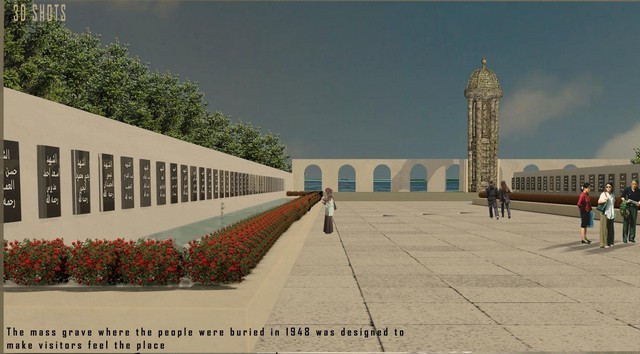
For instance, since 2016, graduating Palestinian architecture students have competed for the prestigious “Reconstruction of Destroyed Palestinian Villages” award. As reported in the Middle East Monitor, “the architectural competition, organised by the Palestine Land Society, brings together history, politics and contemporary architecture as young students compete to reconstruct over 500 villages destroyed during the Nakba in order to preserve and restore their heritage and draw a realistic, future blueprint for the return of Palestinian refugees.” And the Arab World Institute in Paris hosts an annual exhibit called “For a Palestinian National Museum,” which collects Palestine art, photography, and graphics in a series of galleries that stands in as a temporary “national museum” for Palestine.

Acknowledging the tremendous burden placed on Palestinians to create a counter to the erasures and distortions they have faced, Palestinian scholar and activist Edward Said once said, “The Palestinian must make the present since the present is not an imaginative luxury but a literal, existential necessity.”

Last year, a group of Palestinian, Palestinian-American, and US activists raised enough funds to produce a three-day event in New York City, “Palestine Writes,” with exactly the aim of creating a Palestinian present and presence at the heart of US cultural life. They raised enough funds to bring some of the most esteemed writers from Palestine; pay for visas and lodging; and put them in dialogue with US writers and activists such as Angela Davis, historian Robin D. G. Kelley, indigenous scholar and Red Nation activist Nick Estes, and others on translation, incarceration, indigeneity, and more; along with a series of workshops and events for children.

The event sold out all three days. And then the pandemic hit. The event organizers have regrouped and are doing an online event from December 2–6. Headlining the festival are luminaries of Palestinian writing in Arabic and English, including literary giants Ibrahim Nasrallah, two-time winner of the Arabic Booker Prize (Katara), and Mahmoud Shukair; acclaimed novelists Hala Alyan and Randa Jarrar; and notable Palestinian visual artists, including Samia Halaby.

And for the first time ever, Hanan Ashrawi, Jeremy Corbyn, and Angela Davis will share a stage to discuss culture, solidarity, and internationalism. All told, more than seventy international scholars, writers, artists, and activists will take part, including Kenyan poet and playwright Shailja Patel, Robin D. G. Kelley, Oglala Lakota educator and poet Mark Tilsen, and Nick Estes. Conference organizer and novelist Susan Abulhawa says, “Palestine Writes is part of a terrain where our humanity, creative genius, and ancient culture can thrive, as the physical land of our ancestors, our belonging, is being pulled from beneath our feet by colonizers.”

Like the Reconstruction of Destroyed Palestinian Villages project, Palestine Writes does not claim to restore Palestine, but it will aim to open space for thinking about Palestine’s history, present, and future in a uniquely Palestinian-grounded manner. Palestinian poet Mahmoud Darwish, once said, “Poems can’t establish a state. But they can establish a metaphorical homeland in the minds of the people. I think my poems have built some houses in this landscape.”

“Breaking the silence” on Palestine will require pressing the issue in multiple venues. Given the recent presidential election, one of the key areas will be in the new Joe Biden administration. Neither Biden nor Kamala Harris has shown even a modicum of concern for Palestinian rights, and it will be a test of the progressive wing of the Democratic Party to place conditions on any continuance of military and diplomatic support for Israel. Palestine Writes is an essential part of bringing a fuller spectrum of Palestinian life onto the world stage, so that politicians know the people whose rights and lives hang in the balance.

David Palumbo-Liu is the Louise Hewlett Nixon Professor at Stanford University

17 November 2020

Source: palestineupdates.com

A Convergence of Calamities

By Nick Turse

Record Numbers of War-Displaced to Be Dwarfed by Those Driven From Their Homes by Climate Change

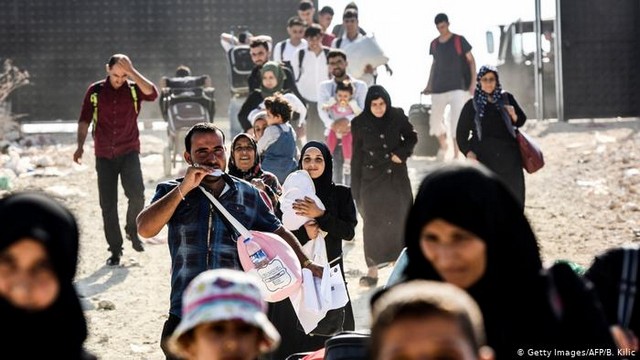
I saw them for only a few seconds. One glimpse and they were gone. The young woman wore a brown headwrap, a yellow short-sleeved shirt, and a long pink, red, and blue floral-patterned skirt. She held the reins of the donkey pulling her rust-pink cart. Across her lap lay an infant. Perched beside her at the edge of the metal wagon was a young girl who couldn’t have been more than eight. Some firewood, rugs, woven mats, rolled-up clothing or sheets, a dark green plastic tub, and an oversized plastic jerry can were lashed to the bed of the cart. Three goats tied to the rear of it ambled along behind.

They found themselves, as I did, on a hot, dusty road slowly being choked by families who had hastily hitched up their donkeys and piled whatever they could — kindling, sleeping mats, cooking pots — into sun-bleached carts or bush taxis. And they were the lucky ones. Many had simply set out on foot. Young boys tended small herds of recalcitrant goats. Women toted dazed toddlers. In the rare shade of a roadside tree, a family had stopped and a middle-aged man hung his head, holding it in one hand.

Earlier this year, I traveled that ochre-dirt road in Burkina Faso, a tiny landlocked nation in the African Sahel once known for having the largest film festival on the continent. Now, it’s the site of an unfolding humanitarian catastrophe. Those people were streaming down the main road from Barsalogho about 100 miles north of the capital, Ouagadougou, toward Kaya, a market town whose population has almost doubled this year, due to the displaced. Across the country’s northern stretches, other Burkinabe (as citizens are known) were making similar journeys toward towns offering only the most uncertain kinds of refuge. They were victims of a war without a name, a battle between Islamist militants who murder and massacre without compunction and armed forces that kill more civilians than militants.

I’ve witnessed variations of this wretched scene before — exhausted, upended families evicted by machete-wielding militiamen or Kalashnikov-carrying government troops, or the mercenaries of a warlord; dust-caked traumatized people plodding down lonesome highways, fleeing artillery strikes, smoldering villages, or towns dotted with moldering corpses. Sometimes motorbikes pull the carts. Sometimes, young girls carry the jerry cans on their heads. Sometimes, people flee with nothing more than what they’re wearing. Sometimes, they cross national borders and become refugees or, as in Burkina Faso, become internally displaced persons, or IDPs, in their own homeland. Whatever the particulars, such scenes are increasingly commonplace in our world and so, in the worst possible way, unremarkable. And though you would hardly know it in the United States, that’s what also makes them, collectively, one of the signature stories of our time.

At least 100 million people have been forced to flee their homes due to violence, persecution, or other forms of public disorder over the last decade, according to UNHCR, the United Nations refugee agency. That’s about one in every 97 people on the planet, roughly one percent of humanity. If such war victims had been given their own state to homestead, it would be the 14th largest nation, population-wise, in the world.

By the end of June, according to the Internal Displacement Monitoring Center, an additional 4.8 million people had been uprooted by conflict, with the most devastating increases in Syria, the Democratic Republic of Congo, and Burkina Faso. Yet, as dismal as these numbers may be, they’re set to be dwarfed by people displaced by another signature story of our time: climate change.

Already, shocking numbers have been put to flight by fires, derechos, and super storms, and so much worse is yet to come, according to experts. A recent forecast suggests that, by the year 2050, the number of people driven from their homes by ecological catastrophes could be 900% greater than the 100 million forced to flee conflicts over the last decade.

Worse Than World War II

Women, children, and men driven from their homes by conflict have been a defining feature of modern warfare. For almost a century now, combat correspondents have witnessed such scenes again and again. “Newly routed civilians, now homeless like the others with no idea of where they would next sleep or eat, with all their future lives an uncertainty, trudged back from the fighting zone,” the legendary Eric Sevareid reported, while covering Italy for CBS News during World War II. “A dust-covered girl clung desperately to a heavy, squirming burlap sack. The pig inside was squealing faintly. Tears made streaks down the girl’s face. No one moved to help her…”

The Second World War was a cataclysmic conflagration involving 70 nations and 70 million combatants. Fighting stretched across three continents in unparalleled destructive fury, including terror bombing, countless massacres, two atomic attacks, and the killing of 60 million people, most of them civilians, including six million Jews in a genocide known as the Holocaust. Another 60 million were displaced, more than the population of Italy (then the ninth-largest country in the world). An unprecedented global war causing unimaginable suffering, it nonetheless left far fewer people homeless than the 79.5 million displaced by conflicts and crises as 2019 ended.

How can violence-displaced people already exceed World War II’s total by almost 20 million (without even counting the nearly five million more added in the first half of 2020)?

The answer: these days, you can’t go home again.

In May 1945, the war in Europe came to an end. By the beginning of September, the war in the Pacific was over, too. A month later, most of Europe’s displaced — including more than two million refugees from the Soviet Union, 1.5 million French, 586,000 Italians, 274,000 Dutch, and hundreds of thousands of Belgians, Yugoslavs, Czechs, Poles, and others — had already returned home. A little more than a million people, mostly Eastern Europeans, still found themselves stranded in camps overseen by occupying forces and the United Nations.

Today, according to UNHCR, ever fewer war refugees and IDPs are able to rebuild their lives. In the 1990s, an average of 1.5 million refugees were able to return home annually. For the last 10 years, that number has dropped to around 385,000. Today, about 77% of the world’s refugees are trapped in long-term displacement situations thanks to forever wars like the conflict in Afghanistan that, in its multiple iterations, is now in its sixth decade.

War on (of and for) Terror

One of the most dramatic drivers of displacement over the last 20 years, according to researchers from Brown University’s Costs of War project, has been that conflict in Afghanistan and the seven other “most violent wars the U.S. military has launched or participated in since 2001.” In the wake of the killing of 2,974 people by al-Qaeda militants that September 11th and the decision of George W. Bush’s administration to launch a Global War on Terror, conflicts the United States initiated, escalated, or participated in — specifically, in Afghanistan, Iraq, Libya, Pakistan, the Philippines, Somalia, Syria, and Yemen — have displaced between 37 million and 59 million people.

While U.S. troops have also seen combat in Burkina Faso and Washington has pumped hundreds of millions of dollars of “security assistance” into that country, its displaced aren’t even counted in the Costs of War tally. And yet there’s a clear link between the U.S.-backed overthrow of Libya’s autocrat, Muammar Qaddafi, in 2011 and Burkina Faso’s desperate state today. “Ever since the West assassinated Qaddafi, and I’m conscious of using that particular word, Libya has been completely destabilized,” Chérif Sy, Burkina Faso’s defense minister, explained in a 2019 interview. “While at the same time it was the country with the most guns. It has become an arms cache for the region.”

Those arms helped destabilize neighboring Mali and led to a 2012 coup by a U.S.-trained officer. Two years later, another U.S.-trained officer seized power in Burkina Faso during a popular uprising. This year, yet another U.S.-trained officer overthrew yet another government in Mali. All the while, terrorist attacks have been ravaging the region. “The Sahel has seen the most dramatic escalation of violence since mid-2017,” according to a July report by the Africa Center for Strategic Studies, a Defense Department research institution.

In 2005, Burkina Faso didn’t even warrant mention in the “Africa Overview” section of the State Department’s annual report on terrorism. Still, more than 15 separate American security assistance programs were brought to bear there — about $100 million in the last two years alone. Meanwhile, militant Islamist violence in the country has skyrocketed from just three attacks in 2015 to 516 in the 12 months from mid-2019 to mid-2020, according to the Pentagon’s Africa Center.

Compounding Crises to Come

The violence in Burkina Faso has led to a cascade of compounding crises. Around one million Burkinabe are now displaced, a 1,500% increase since last January, and the number only keeps rising. So do the attacks and the fatalities. And this is just the beginning, since Burkina Faso finds itself on the frontlines of yet another crisis, a global disaster that’s expected to generate levels of displacement that will dwarf today’s historic figures.

Burkina Faso has been battered by desertification and environmental degradation since at least the 1960s. In 1973, a drought led to the deaths of 100,000 people there and in five other nations of the Sahel. Severe drought and hunger struck again in the mid-1980s and aid agencies began privately warning that those living in the north of the country would need to move southward as farming became ever less feasible. By the early 2000s, despite persistent droughts, the cattle population of the country had doubled, leading to increasing ethnic conflict between Mossi farmers and Fulani cattle herders. The war now tearing the country apart largely divides along those same ethnic lines.

In 2010, Bassiaka Dao, the president of the confederation of farmers in Burkina Faso, told the United Nations news agency, IRIN, that the impacts of climate change had been noticeable for years and were getting worse. As the decade wore on, rising temperatures and new rainfall patterns — droughts followed by flash floods — increasingly drove farmers from their villages, while desertification swelled the populations of urban centers.

In a report published earlier this year, William Chemaly of the Global Protection Cluster, a network of nongovernmental organizations, international aid groups, and United Nations agencies, noted that in Burkina Faso “climate change is crippling livelihoods, exacerbating food insecurity, and intensifying armed conflict and violent extremism.”

Sitting at the edge of the Sahara Desert, the country has long faced ecological adversity that’s only worsening as the frontlines of climate change steadily spread across the planet. Forecasts now warn of increasing ecological disasters and resource wars supercharging the already surging phenomenon of global displacement. According to a recent report by the Institute for Economics and Peace, a think tank that produces annual global terrorism and peace indexes, two billion people already face uncertain access to sufficient food — a number set to jump to 3.5 billion by 2050. Another one billion “live in countries that do not have the current resilience to deal with the ecological changes they are expected to face in the future.” The report warns that the global climate crisis may displace as many as 1.2 billion people by 2050.

On the Road to Kaya

I don’t know what happened to the mother and two children I spotted on the road to Kaya. If they ended up like the scores of people I spoke with in that market town, now bulging with displaced people, they’re facing a difficult time. Rents are high, jobs scarce, government assistance all but nil. People there are living on the edge of catastrophe, dependent on relatives and the kindness of new neighbors with little to spare themselves. Some, driven by want, are even heading back into the conflict zone, risking death to gather firewood.

Kaya can’t deal with the massive influx of people forced from their homes by Islamist militants. Burkina Faso can’t deal with the one million people already displaced by conflict. And the world can’t deal with the almost 80 million people already driven from their homes by violence. So how will we cope with 1.2 billion people — nearly the population of China or India — likely to be displaced by climate driven-conflicts, water wars, increasing ecological devastation, and other unnatural disasters in the next 30 years?

In the decades ahead, ever more of us will find ourselves on roads like the one to Kaya, running from the devastation of raging wildfires or uncontrolled floodwaters, successive hurricanes or supercharged cyclones, withering droughts, spiraling conflicts, or the next life-altering pandemic. As a reporter, I’ve already been on that road. Pray you’re the one speeding by in the four-wheel-drive vehicle and not the one choking in the dust, driving the donkey cart.

Nick Turse is the managing editor of TomDispatch and a fellow at the Type Media Center.

13 November 2020

Source: countercurrents.org

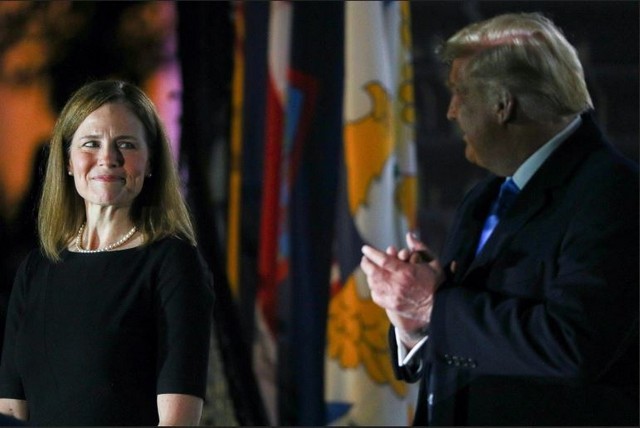
IF (ONLY) AMY CONEY BARRETT WAS A MUSLIM

By Azeezah Kanji

Why did so many Americans condemn the new supreme court justice’s extremely conservative ideology by likening her to a Muslim?

From beginning to end, Donald Trump’s presidency exposed and exploited structural flaws deeply embedded in the world’s self-proclaimed “oldest democracy” (more accurately classified as a “plutocracy,” according to some academic studies).

Such flaws include, for instance, the organisation of the electoral college with the original aim of upholding the interests of slaveholding states; the concentration of power in the hands of White propertied men (whose property derived in the first place from anti-Indigenous dispossession and genocide); the extension of abusive executive powers without judicial check; and the vulnerability of the courts to political manipulation and control.

Yet in the dysfunctional system that produced the spectacle of the Trump presidency, it is Islam and Muslims that continue to be upheld as the paradigm of illegitimate politics. Once again, in the opposition against new Supreme Court Justice Amy Coney Barrett, a popular rhetorical tactic was put on display: Condemning her extremely conservative ideology by likening her to a Muslim.

Since the 18th century, comparisons to Muslims and Islam have been treated as the ultimate insult in American political discourse. In law, judicial despotism is often emblematised by the trope of “kadi justice” – the image of a “kadi [Muslim judge] under a tree” dispensing judgements according to individual whim, an Orientalist figment plucked not from reality but directly from the pages of 1001 Nights.

Founding Father Benjamin Franklin went so far as to wonder in 1741 whether it was considered “worse to believe in Mahomet [Muhammad] or the Devil?” Of course, the fixation on “Mahomet” conveniently distracts from the “devils” embedded in the US’s own nationalist ideology, founded on church-sanctioned colonial genocide and enslavement.

The continuing replication of centuries-old modes of thinking would, in Muslims, be cited as a sign of stunted historical growth, one more piece of evidence that Islam remains “trapped in the past”. Yet in American politics, the demonising invocations of Islam persist, even among ostensible progressives – indicating the deep entrenchment of Islamophobic structures of thought.

Incensed about the legal assault on abortion rights? Call it “Christian sharia”; never mind that actual Islamic law was less oppressive and provided greater access to abortion.

Outraged about Donald Trump’s unchecked abuses of power? Denounce him as a “caliph” and his officials as “mullahs”; forget that the caliph, in Islamic legal theory, was not considered above the rule of law.

Infuriated by Trump’s regressive policies? Accuse him of waging a “jihad,” on everything from clean energy to immigration to Obamacare to absentee ballots. Funnily enough, the word crusade – which unlike “jihad” actually does mean “holy war” – is frequently used to connote something commendable; while the suggestion that “jihad”, literally “struggle,” might have any positive meaning elicits outrage.

To label these as caricatures of Islam would be a misnomer since caricature suggests a core of truth that is exaggerated. Rather, they are projections: Displacements of one’s own negative features and anxieties onto a denigrated other.

As the confirmation of Justice Barrett to the Supreme Court affirms, the characteristics commonly attributed to the Islamic legal tradition – its alleged irrationality, ideological rigidity, and subservience to authoritarian power – are in fact reflective of the American system itself.

While Muslim jurists were historically independent of the state, judges in the US are political appointees – a reality emphasised by the nakedly partisan political turf war of Supreme Court placements. Justice Barrett has been rammed through onto the bench with 52 Republican votes but zero Democratic votes; previous Trump-nominated Justices Brett Kavanaugh and Neil Gorsuch were backed by similarly one-sided Republican support.

The result is a court deeply polarised along ideological lines. Justices increasingly engage in “forms of judicial behaviour [that] constitute advocacy, rather than judging”, according to a 2019 study from Northwestern and Loyola Law Schools.

Republican presidents select ever-more-radical conservative judges, and Democratic presidents more centrist-to-liberal judges (although the frequent categorisation of Obama, droner- and deporter-in-chief, as a “liberal” indicates how hollow that descriptor has become). Muslim rulers like 13th-century Mamluk Sultan Baybars, in contrast, ensured space for the operation of multiple schools of law – legal pluralism being understood as valuable in and of itself, to offset the inescapable fallibility and contingency of human reasoning.

The combination of juridicial independence and pluralism enabled Muslims and non-Muslims to exert some agency in choosing the school of legal thought that best met their needs – a form of “sharia” development from below. That is until colonial powers codified monolithic law and imposed draconian interpretations, such as Wahhabism, originally rejected by Muslim scholars and communities. As on the US Supreme Court, retrograde ideologies have been entrenched not by popular will but by sheer political force.

Even before Barrett’s appointment, the Court’s pattern of prostration at the altar of corporate and political power was blatantly apparent. Since 2006, the Chamber of Commerce – the US’s largest business lobby group – has prevailed in 70 percent of Supreme Court cases in which it has filed a brief.

Constitutional provisions meant to guarantee legal equality for the formerly enslaved have been twisted to enshrine corporate “personhood” instead. The court has made it easier for corporations to influence elections, but more difficult for the marginalised to vote; easier to criminalise peaceful speech as “terrorism”, but more difficult to hold cops who kill to account; easier for the White House to wield war powers, but more difficult for the victims of US war crimes to access the courts. It has shielded corporations from legal consequences for international human rights violations while permitting migrants to be indefinitely detained.

Judges like Barrett’s mentor Justice Antonin Scalia have cloaked oppressive decisions in the mantle of “textualism” and “originalism”, claiming they were bound by the original meaning of legal texts. Except, notably, when the original meaning conflicts with the desired outcome – whether eviscerating anti-racism measures, expanding gun rights, or ensuring their party’s candidate is declared the election winner – in which case their originalist and textualist methodologies have been inconsistently applied or quietly discarded.

However, as Islamic legal history shows, textualism is not necessarily synonymous with regressivism. The Zahiri and Hanbali schools often characterised as the most textualist adopted certain positions that would today be considered more “liberal” or “progressive”. For example, Zahiris like 11th-century jurist Ibn Hazm rejected harsh punishments for “sodomy” since they were not specified in the Quran, and Hanbali jurists provided women with greater contractual freedom in marriage and prevented the powerful from escaping criminal sanction.

Perhaps “kadi justice” should instead be called “Scalia justice”.

Justice Barrett now joins the cadre of conservative Supreme Court judges anointed by the Federalist Society, the ultra-right-wing legal organisation on a crusade – not a “jihad” – to remake the US judicial landscape.

Hiding behind the unravelling fiction of the separation of law and politics, Barrett adamantly refused to answer questions about her legal positions during her Senate confirmation hearings. But her judicial record speaks for itself: 76 percent in favour of corporations, 86 percent in favour of police, 85 percent against victims claiming discrimination, and 88 percent against immigrants.

The millions of dollars of “dark money” pumped by the Federalist Society into influencing judicial nominations and subverting state judicial elections have been paying off. With Barrett, six of the nine sitting justices on the Supreme Court are members of the Society, and all but eight of Trump’s 51 appellate court appointments have connections to it. Many of these judges will still be on the bench decades after Trump’s presidency is a distant American nightmare. The effects are already evident: Trump-appointed judges proved themselves instrumental in exacerbating voter suppression leading up to the election.

Yet according to the Federalist Society, it is the supposed “spread of sharia law” – not the spread of Federalist Society law – that is imperilling “democracy, economic justice, and security”.

In the Federalist Society’s legal journal, it is asserted that “the Islamic law of the Middle East is the antithesis of Western law”, a quote attributed to former US Supreme Court Justice Robert Jackson. But by de-contextualising Justice Jackson’s words, his original meaning – that it is precisely because the Islamic legal tradition differs from America’s that it should be a source of insight and inspiration – is completely reversed. (So much for the Society’s stated commitment to originalism.)

“We should abandon the smug belief that the Muslim experience has nothing to teach us,” Justice Jackson wrote. “We may find divergence in legal experience as instructive as parallelism.”

Instead of reducing Islam to an object of derision, we should be anxious to learn from its history of legal pluralism and independence of jurists from the state.

Instead of fearing that Amy Coney Barrett is like a Muslim, we might hope she will be more like a Muslim – specifically, like the pre-modern Muslim jurists who fiercely refused to serve as pawns of political rulers and issued legal opinions checking power’s abuse.

As Justice Jackson urged, “It is time that we stopped thinking of ourselves as the only peoples in the world who love justice or who understand what justice is.” But the toxic combination of American exceptionalism and legal Orientalism ensures Islam is seen as a benchmark of barbarism, never a model to be emulated – to the detriment of Islamic and American legal traditions alike.

The views expressed in this article are the author’s own and do not necessarily reflect Al Jazeera’s editorial stance.

Azeezah Kanji Legal academic and writer based in Toronto.

9 November 2020

Source: www.aljazeera.com