By Edward Curtin
“I don’t believe in death without resurrection. If they kill me, I will rise again in the Salvadorian people…” – Archbishop Oscar Romero, martyred, 24 March 1980
Whether we are aware of it or not, we live by stories. We live by others’ stories while we tell our lives by how we live. Our actions tell our stories. Then when we die, others tell our stories as they wish.
This is the spiritual thread that links the meanings of our lives. It is the way we pass over to other lives and return to our own. But without truth, we end up in the wrong place, living the wrong stories.
And don’t the stories of certain special people inspire us to carry on their legacies because their spirits are far stronger than death? Their courage contagious? Their witness the triumph of life over death? Love over hate?
Don’t they challenge us to imitate them, to kindle in us the fire of their resurrected spirits?
For Christians, Holy Week is the time for deep reflection on the story of the death and resurrection of Jesus and what they mean for us today. This year, the anniversary of the murder of the Christian prophet and martyr, Martin Luther King, Jr., falls on Easter Sunday, April 4, which gives rise to doubly deeper thoughts that cross religious boundaries where people of all faiths or none can unite in the spirit of non-violent resistance to the forces of war, poverty, racism, and materialism – violence in all its forms. Everything that stands in the way of what King called “the Beloved Community.”
That Jesus met violence with non-violent love and voluntarily entered the darkness of death and abandonment is at the heart of the Christian faith. So too his Resurrection. If the Jewish radical Jesus had not been executed by the Roman state occupiers of Palestine, if all hope for his followers had not seemingly been lost, then his Resurrection could not have given birth to hope in his followers to carry on his spirit of love for the poor, the downtrodden, and the outcasts – his resistance to violence.
Like Oscar Romero in El Salvador, gunned down by U.S. trained death squads at the altar while offering Mass and subsequently named a saint by the Roman Catholic Church, Martin Luther King, Jr.’s witness and the truth about his death should be a central meditative focus this year. For the convergence of King’s death on April 4, 1968 with Easter this April 4th and the last day of Passover offers us a way to contemplate what is now demanded of all people who yearn for the end to hatred, violence, and injustice, and the creation of a beloved world community where love and kindness reign.
The spirit of all the prophets and martyrs is about now, not then; about us, not them; it confronts us with the challenge to interrogate ourselves.
Shall we turn away from their witness? What truly animates our souls? Where do we stand? Do we support the state’s power to kill and wage war, to deny people freedom, to discriminate, to oppress the poor?
It is always about now; the living truth is now.
To contemplate the lives of the prophets takes us very deep into the darkness where we encounter the murders of Jesus, King, Romero, and all those who have died trying to make peace and justice a reality. But only if we go into the darkest truths will we be able to see the light that leads us to accept the resurrected spirit of their resistance to evil.
Another prophet of our broken world, the Hindu Mohandas Gandhi, soul brother to King, echoed the words that many have heard, that “God chose what is weak in the world to shame the strong,” when, in crossing over to the Christian tradition, he told us: “We dare not think of birth without death on the cross. Living Christ means a Living Cross, without it life is a living death.”[1]
So what do we need to know about MLK, and why does it matter?
King’s True Story
Very few Americans are aware of the truth behind the assassination of Dr. Martin Luther King, Jr., the United States’ celebrated civil rights icon. Few books have been written about it, unlike other significant assassinations, especially JFK’s. For more than fifty years there has been a media blackout supported by government disinformation to hide the truth. And few people, in a massive act of self-deception, have chosen to question the official explanation, choosing, rather, to embrace a mythic fabrication intended to sugarcoat the bitter fruit that has resulted from the murder of one man capable of leading a mass movement for transformative change in the United States. Today we are eating the fruit of our denial as racial discrimination, poverty, and police violence garner the headlines.
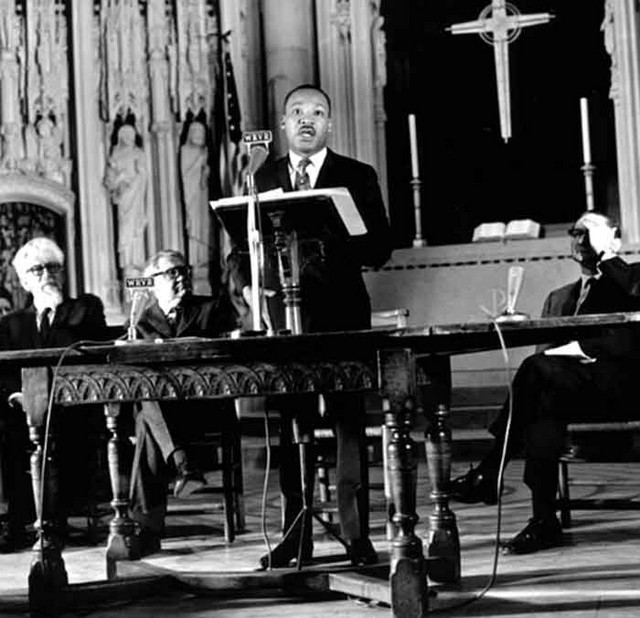
After more than a decade as America’s best-known and most respected civil rights leader, by 1968 Reverend Martin Luther King, Jr. had increasingly focused on poverty issues and publicly declared his intense opposition to the U.S. war against Vietnam in a famous speech – “Beyond Vietnam: The Time To Break the Silence” – at New York’s Riverside Church on April 4, 1967, one year to the day before he was assassinated.[2]
Having won the Nobel Peace Prize in 1964, he emerged in the mid-1960s as an international figure, whose opinions on human and economic rights and peaceful coexistence were influential world-wide. Shortly before his assassination, he was organizing the Poor People’s Campaign that would involve hundreds of thousands of Americans who would encamp in Washington, D.C to demand the end to economic inequality, racism, and war.
At the same time, Reverend King was hated by an array of racists throughout America, especially in the American South. Among his greatest declared enemies was FBI Director J. Edgar Hoover, who seemed convinced that King’s backers were Communists out to damage America’s interests. In the late 1960s, the FBI’s COINTELPRO program created a network of informants and agent provocateurs to undermine the civil rights and anti-war movements with a special focus on King.[3]
After King’s “I Have a Dream” speech in 1963, William Sullivan, the head of the FBI’s domestic intelligence division, wrote in a post-speech memo:
Personally, I believe in the light of King’s powerful, demagogic speech that he stands head and shoulders over all other Negro leaders put together when it comes to influencing great masses. We must mark him now, if we have not done so before, as the most dangerous Negro of the future in this Nation from the standpoint of communism, the Negro and national security.[4]
The FBI, after extensive eavesdropping on King, subsequently sent him an anonymous letter urging him to kill himself or else his extramarital sex life would be exposed. The FBI’s and its Director J Edgar Hoover’s hatred for King was so great that nothing was too low for them.[5]
This history is common knowledge as reported in the Washington Post, The New York Times, etc.
During the Senate Church Committee hearings in the mid-1970s, a parallel group within the CIA, code-named CHAOS, was uncovered. Despite its charter disallowing it from operating inside the United States, the CIA similarly used illegal means to disrupt the civil rights and anti-war movements.
Because MLK, in his Riverside Church speech, spoke clearly to what he identified there as “the greatest purveyor of violence in the world today – my own government” and continued to relentlessly confront his own government on its criminal war against Vietnam, he was universally condemned by the mass media and the government that later – once he was long and safely dead and no longer a threat – praised him to the heavens. This has continued to the present day of historical amnesia.
Today Martin Luther King’s birthday is celebrated with a national holiday, but his death day disappears down the memory hole. Across the country – in response to the King Holiday and Service Act passed by Congress and signed by President Bill Clinton in 1994 – people are encouraged to make the day one of service (from Latin, servus = slave). Etymological irony aside, such service does not include King’s commitment to protesting a decadent system of racial and economic injustice or non-violently resisting the warfare state that is the United States. Government sponsored service is cultural neo-liberalism at its finest.
The word service is a loaded word; it has become a smiley face and vogue word over the past thirty-five years. It’s use for MLK Day is clear: individuals are encouraged to volunteer for activities such as tutoring children, painting senior centers, delivering meals to the elderly, etc., activities that are good in themselves but far less good when used to conceal an American prophet’s message. After all, Martin Luther King’s work was not volunteering at the local food pantry with Oprah Winfrey cheering him on.
But service without truth is slavery. It is propaganda aimed at convincing decent people into thinking that they are serving the essence of MLK’s message while they are following a message of misdirection.
Educating people about who killed King, and why, and why it matters today, is the greatest service we can render to his memory.
What exactly is the relationship between King’s saying that “the greatest purveyor of violence in the world today – my own government” and his murder?
Let’s look at the facts.
When Ray, under extraordinary pressure, coercion, and a payoff from his lawyer to take a plea, pleaded guilty (only a few days later to request a trial that was denied) and was sentenced to 99 years in prison, the case seemed to be closed, and was dismissed from public consciousness. Another hate-filled lone assassin, as the government also termed Lee Harvey Oswald and Sirhan Sirhan, had committed a despicable deed.Martin Luther King, Jr. was assassinated on April 4, 1968, at 6:01 PM as he stood on the balcony of the Lorraine Motel in Memphis, Tennessee. He was shot in the lower right side of his face by one rifle bullet that shattered his jaw, damaged his upper spine, and came to rest below his left shoulder blade. The U.S. government claimed the assassin was a racist loner named James Earl Ray, who had escaped from the Missouri State Penitentiary on April 23, 1967. Ray was alleged to have fired the fatal shot from a second-floor bathroom window of a rooming house above the rear of Jim’s Grill across the street. Running to his rented room, Ray allegedly gathered his belongings, including the rifle, in a bedspread-wrapped bundle, rushed out the front door onto the adjoining street, and in a panic dropped the bundle in the doorway of the Canipe Amusement Company a few doors down. He was then said to have jumped into his white Mustang and to have driven to Atlanta where he abandoned the car. From there he fled to Canada and then to England and then to Portugal and back to England where he was eventually arrested at Heathrow Airport on June 8, 1968, and extradited to the U.S. The state claims that the money Ray needed to purchase the car and for all his travel was secured through various robberies and a bank heist. Ray’s alleged motive was racism and that he was a bitter and dangerous loner.
Ray had received erroneous advice from his attorney, Percy Foreman. Foreman had a long history representing government, corporate, intelligence, and mafia figures, including Jack Ruby, in cases where the government wanted to keep people silent. Ray was told that the government would go after Ray’s father and brother, Jerry, and that he’d get the electric chair if he didn’t plead guilty,
Ray initially acquiesced. He entered what is known as an Alford plea before Judge Preston Battle. In making his plea, Ray did not admit to any criminal act and asserted his innocence. The following day, he fired Percy Foreman, who, by offering money to induce a guilty plea, had committed a criminal offense. Foreman had also lied to Judge Battle about his contract with Ray. And, the transcript of Ray’s testimony was doctored to help support the government’s case. Ray was sentenced to life in prison. After three days, Ray tried to retract his plea and maintained his innocence for almost 30 years until his death.
The United State government’s case against James Earl Ray was extremely weak from the start, and in the intervening years has grown so weak that it is no longer believable. A vast body of evidence has accumulated that renders it patently false.
But before examining such evidence, it is important to point out that MLK, Jr, his father, Rev. M. L. King, Sr, and his maternal grandfather, Rev. A.D. Williams, all pastors of Atlanta’s Ebenezer Baptist Church, were spied on by Army Intelligence and the FBI since 1917.[6] All were considered dangerous because of their espousal of racial and economic equality. None of this had to do with war or foreign policy, but such spying was connected to their religious opposition to racist and economic policies that stretched back to slavery, realities that have been officially acknowledged today. But when MLK, Jr. forcefully denounced unjust and immoral war-making as well, especially the Vietnam war, and announced his Poor People’s Campaign and intent to lead a massive peaceful encampment of hundreds of thousands in Washington, D.C., he set off panic in the inner sanctums of the government. Seventy-five years of spying on black religious leaders here found its ultimate “justification.”
The corporate mass media has for more than fifty years echoed the government’s version of the King assassination. Here and there, however, mainly through the alternative media, and also through the monumental work and persistence of the King family lawyer, William Pepper, the truth about the assassination has surfaced. Through decades of research, a TV trial, a jury trial, and three meticulously researched books, Pepper has documented the parts played in the assassination by F.B.I. Director J. Edgar Hoover, the F.B.I., Army Intelligence, Memphis Police, and southern Mafia figures. In his last two books, An Act of State (2003) and later The Plot to Kill King (2016), Pepper presents his comprehensive case.
William Pepper’s decades-long investigation not only refutes the flimsy case against James Earl Ray, but definitively proves that King was killed by a government conspiracy led by J. Edgar Hoover and the FBI, Army Intelligence, and Memphis Police, assisted by southern Mafia figures. He is right to assert that “we have probably acquired more detailed knowledge about this political assassination than we have ever had about any previous historical event.” This makes the silence around this case even more shocking.
This shock is accentuated when one is reminded (or told for the first time) that in 1999 a Memphis jury, after a thirty-day trial with over seventy witnesses, found the U.S. government guilty in the killing of MLK.
In that 1999 Memphis civil trial (see complete transcript) brought by the King family, the jury found that King was murdered by a conspiracy that included governmental agencies.[7] The corporate media, when they reported it at all, dismissed the jury’s verdict and those who accepted it, including the entire King family led by Coretta Scott King[8], as delusional. Time magazine called the verdict a confirmation of the King family’s “lurid fantasies.” The Washington Post compared those who believed it with those who claimed that Hitler was unfairly accused of genocide. A smear campaign ensued that has continued to the present day and then the fact that a trial ever occurred disappeared down the memory hole so that today most people never heard of it and assume MLK was killed by a crazy white racist, James Earl Ray, if they know even that.
The civil trial was the King family’s last resort to get a public hearing to disclose the truth of the assassination. They and Pepper knew, and proved, that Ray was an innocent pawn, but Ray had died in prison in 1998 after trying for thirty years to get a trial and prove his innocence. During all these years, Ray had maintained that he had been manipulated by a shadowy figure named Raul, who supplied him with money and his white Mustang and coordinated all his complicated travels, including having him buy a rifle and come to Jim’s Grill and the boarding house on the day of the assassination to give it to Raul. The government has always denied Raul existed. Pepper proved that that was a lie.
Slowly, however, glimmers of light have been shed on that trial and truth of the assassination.
On March 30, 2018, The Washington Post’s crime reporter, Tom Jackman, published a four-column front-page article, “Who killed Martin Luther King Jr.? His family believes James Earl Ray was framed.” While not close to an endorsement of the trial’s conclusions, it is a far cry from past nasty dismissals of those who agreed with the jury’s verdict as conspiracy nuts or Hitler supporters. After decades of clouding over the truth of MLK’s assassination, some rays of truth have come peeping through, and on the front page of the WP at that.
Jackman makes it very clear that all the surviving King family members – Bernice, Dexter, and Martin III – are in full agreement that James Earl Ray, the accused assassin, did not kill their father, and that there was and continues to be a conspiracy to cover up the truth. He adds to that the words of the highly respected civil rights icon and now deceased U.S. Congressman from Georgia, Rep. John Lewis (D-Ga.), who said:
I think there was a major conspiracy to remove Dr. King from the American scene,
and former U.N. ambassador and Atlanta mayor Andrew Young, who was with King at the Lorraine Motel when he was shot, who concurs:
I would not accept the fact that James Earl Ray pulled the trigger, and that is all that matters.
Additionally, Jackman adds that Andrew Young emphasized that the assassination of King came after that of President Kennedy, Malcolm X, and a few months before that of Senator Robert Kennedy.
“We were living in a period of assassinations,” he quotes Young as saying, a statement clearly intimating their linkages and coming from a widely respected and honorable man.
In the years leading up to Pepper’s 1978 involvement in the MLK case, only a few lonely voices expressed doubts about the government’s case, such as, Harold Weisberg’s Frame Up in 1971 and Mark Lane’s and Dick Gregory’s Code Name “Zorro” in 1977. While other lonely researchers dug deeper, most of the country put themselves and the case to sleep.
As with the assassinations of President Kennedy and his brother, Robert (two months after MLK), all evidence points to the construction of scapegoats to take the blame for government executions. Ray, Oswald, and Sirhan Sirhan all bear striking resemblances in the ways they were chosen and moved as pawns over long periods of time into positions where their only reactions could be stunned surprise when they were accused of the murders.
It took Pepper many years to piece together the essential truths, once he and Reverend Ralph Abernathy, Dr. King’s associate, interviewed Ray in prison in 1978. The first giveaway that something was seriously amiss came with the 1979 House Select Committee on Assassinations’ report on the King assassination. Led by Robert Blakey, suspect in his conduct of the other assassination inquiries, who had replaced Richard Sprague, who was deemed to be too independent, “this multi-million-dollar investigation ignored or denied all evidence that raised the possibility that James Earl Ray was innocent,” and that government forces might be involved. Pepper lists in his book over twenty such omissions that rival the absurdities of the magical thinking of the Warren Commission. The HSCA report became the template “for all subsequent disinformation in print and visual examinations of this case” for the past forty-two years.
Blocked at every turn by the authorities and unable to get Ray a trial, Pepper arranged an unscripted, mock TV trial that aired on April 4, 1993, the twenty-fifth anniversary of the assassination. Jurors were selected from a pool of U.S. citizens, a former U.S. Attorney and a federal judge served as prosecutor and judge, with Pepper serving as defense attorney. He presented extensive evidence clearly showing that authorities had withdrawn all security for King; that the state’s chief witness was falling down drunk; that the alleged bathroom sniper’s nest was empty right before the shot was fired; that three eyewitnesses, including the New York Times’ Earl Caldwell, said that the shot came from the bushes behind the rooming house; and that two eyewitnesses saw Ray drive away in his white Mustang before the shooting, etc. The prosecution’s feeble case was rejected by the jury that found Ray not guilty.
As with all Pepper’s work on the case, the mainstream media responded with silence. And though this was only a TV trial, increasing evidence emerged that the owner of Jim’s Grill, Loyd Jowers, was deeply involved in the assassination. Pepper dug deeper, and on December 16, 1993, Loyd Jowers appeared on ABC’s Primetime Live that aired nationwide. Pepper writes:
Loyd Jowers cleared James Earl Ray, saying that he did not shoot MLK but that he, Jowers, had hired a shooter after he was approached by Memphis produce man Frank Liberto and paid $100,000 to facilitate the assassination. He also said that he had been visited by a man named Raul who delivered a rifle and asked him to hold it until arrangements were finalized …. The morning after the Primetime Live broadcast there was no coverage of the previous night’s program, not even on ABC …. Here was a confession, on prime-time television, to involvement in one of the most heinous crimes in the history of the Republic, and virtually no American mass-media coverage.
In the twenty-eight years since that confession, Pepper has worked tirelessly on the case and has uncovered a plethora of additional evidence that refutes the government’s claims and indicts it and the media for a continuing cover-up. The evidence he has gathered, detailed and documented in An Act of State and The Plot to Kill King, proves that Martin Luther King was killed by a conspiracy masterminded by the U.S. government. The foundation of his case proving that was presented at the 1999 trial, while other supporting documentation was subsequently discovered.
Since the names and details involved make clear that, as with the murders of JFK and RFK, the conspiracy was very sophisticated with many moving parts organized at the highest level, I will just highlight a few of his findings in what follows.
- Pepper refutes the government and proves, through multiple witnesses, telephonic, and photographic evidence, that Raul existed; that his full name is Raul Coelho and that he was James Earl Ray’s intelligence handler, who provided him with money and instructions from their first meeting in the Neptune Bar in Montreal, where Ray had fled in 1967 after his prison escape, until the day of the assassination. It was Raul who instructed Ray to return from Canada to the U.S. (an act that makes no sense for an escaped prisoner who had fled the country), gave him money for the white Mustang, helped him attain travel documents, and moved him around the country like a pawn on a chess board. The parallels to Lee Harvey Oswald are startling.
- He presents the case of Donald Wilson, a former FBI agent working out of the Atlanta office in 1968, who went with a senior colleague to check out an abandoned white Mustang with Alabama plates (Ray’s car, to which Raul had a set of keys) and opened the passenger door to find that an envelope and some papers fell out onto the ground. Thinking he may have disturbed a crime scene, the nervous Wilson pocketed them. Later, when he read them, their explosive content intuitively told him that if he gave them to his superiors they would be destroyed. One piece was a torn-out page from a 1963 Dallas telephone directory with the name Raul written at the top, and the letter “J” with a Dallas telephone number for a club run by Jack Ruby, Oswald’s killer. The page was for the letter H and had numerous phone numbers for H. L. Hunt, Dallas oil billionaire and a friend of FBI Director J. Edgar Hoover. Both men hated MLK. The second sheet contained Raul’s name and a list of names and sums and dates for payment. On the third sheet was written the telephone number and extension for the Atlanta FBI office. (Read James W. Douglass’s important interview with Donald Wilson in The Assassinations, pp.479-491.)
- Pepper shows that the alias Ray was given and used from July 1967 until April 4, 1968 – Eric Galt – was the name of a Toronto U.S. Army Intelligence operative, Eric St. Vincent Galt, who worked for Union Carbide with Top Secret clearance. The warehouse at the Canadian Union Carbide Plant in Toronto that Galt supervised “housed a top-secret munitions project funded jointly by the CIA, the U.S. Naval Surface Weapons Center, and the Army Electronics Research and Development Command …. In August 1967, Galt met with Major Robert M. Collins, a top aide to the head of the 902nd Military Intelligence Group (MIG), Colonel John Downie.” Downie selected four members for an Alpha 184 Sniper Unit that was sent to Memphis to back up the primary assassin of MLK. Meanwhile, Ray, set up as the scapegoat, was able to move about freely since he was protected by the pseudonymous NSA clearance for Eric Galt.
- To refute the government’s claim that Ray and his brother robbed the Alton, Illinois Bank to finance his travels and car purchase (therefore no Raul existed), Pepper “called the sheriff in Alton and the president of the bank; they gave the same statement. The Ray brothers had nothing to do with the robbery. No one from the HSCA, the FBI, or The New York Times had sought their opinion.” CNN later reiterated the media falsehood that became part of the official false story.
- Pepper shows that the fatal shot came from the bushes behind Jim’s Grill and the rooming house, not from the bathroom window. He presents overwhelming evidence for this, showing that the government’s claim, based on the testimony on a severely drunk Charlie Stephens, was absurd. His evidence includes the testimony of numerous eyewitnesses and that of Loyd Jowers (a nine-and-a-half-hour deposition), the owner of Jim’s Grill, who said he joined another person in the bushes, and after the shot was fired to kill King, he brought the rifle back into the Grill through the back door. Thus, Ray was not the assassin.
- He presents conclusive evidence that the bushes were cut down the morning after the assassination in an attempt to corrupt the crime scene. The order to do so came from Memphis Police Department Inspector Sam Evans to Maynard Stiles, a senior administrator of the Memphis Department of Public Works.
- He shows how King’s room was moved from a safe interior room, 201, to balcony room, 306, on the upper floor; how King was conveniently positioned alone on the balcony by members of his own entourage for the easy mortal head shot from the bushes across the street. (Many people only remember the iconic photograph taken after-the-fact with Jesse Jackson, Andrew Young, et al., standing over the fallen King and pointing across the street.) He uncovers the role of black Memphis Police Department Domestic Intelligence and military intelligence agent Marrell McCollough, attached to the 111th MIG, within the entourage. McCollough can be seen kneeling over the fallen King, checking to see if he’s dead. McCollough officially joined the CIA in 1974 (see Douglass Valentine’s “Deconstructing Kowalski: The DOJ’s Strange MLK Report”)
- Pepper confirms that all of this, including that the assassin in the bushes was dutifully photographed by Army Intelligence agents situated on the nearby Fire House roof.
- He presents evidence that all security for Dr. King was withdrawn from the area by the Memphis Police Department, including a special security unit of black officers, and four tactical police units. A black detective at the nearby fire station, Ed Redditt, was withdrawn from his post on the afternoon of April 4th, allegedly because of a death threat against him. And the only two black firemen at Fire Station No. 2 were transferred to another station.
- He confirms the presence of “Operation Detachment Alpha 184 team,” a Special Forces sniper team in civilian disguise at locations high above the Lorraine Motel balcony, and he names one soldier, John D. Hill, as part of Alpha 184 and another military team, Selma Twentieth SFG, that was in Memphis.
- He explains the use of two white mustangs in the operation to frame Ray.
- He proves that Ray had driven off before the shooting; that Lloyd Jowers took the rifle from the shooter who was in the bushes; that the Memphis police were working in close collaboration with the FBI, Army Intelligence, and the “Dixie Mafia,” particularly local produce dealer Frank Liberto and his New Orleans associate Carlos Marcello; and that every aspect of the government’s case was filled with holes that any person familiar with the details and possessing elementary logical abilities could refute.
- So importantly, Pepper shows how the mainstream media and government flacks have spent years covering up the truth of MLK’s murder through lies and disinformation, just as they have done with the Kennedy and Malcom X assassinations that are of a piece with this one.
There is such a mass of evidence through depositions, documents, interviews, photographs, etc. in Pepper’s An Act of State and The Plot to Kill King that makes it abundantly clear that the official explanation that James Earl Ray killed Martin Luther King is false and that there was a conspiracy to assassinate him that involved the FBI and other government agencies. Only those inoculated against the truth can ignore such evidence and continue to believe the official version.
Martin Luther King was a transmitter of a radical non-violent spiritual and political energy so plenipotent that his very existence was a threat to an established order based on institutionalized violence, racism, and economic exploitation. He was a very dangerous man to the U.S. government and all the institutional and deep state forces armed against him.
Revolutionaries are, of course, anathema to the power elites who, with all their might, resist such rebels’ efforts to transform society. If they can’t buy them off, they knock them off. Fifty-three years after King’s assassination, the causes he fought for – civil rights, the end to U.S. wars of aggression, and economic justice for all – remain not only unfulfilled, but have worsened in so many respects.
They will not be resolved until this nation decides to confront the truth of why and by whom he was killed.
For the government that honors Dr. King with a national holiday killed him. This is the suppressed truth behind the highly promoted MLK Day of service. It is what you are not supposed to know.
But it is what we need to know in order to resurrect his spirit in us, so we can carry on his mission and emulate his witness.
The time is now.
__________________________________________
Notes
[1] As quoted in James W. Douglass, The Non-Violent Cross, New York, 1968, p. 57
[2] See “50 Years Ago: Riverside Church and MLK’s Final Year of Experiments With Truth,” David Ratcliffe, rat haus reality press, 4 April 2017
A significant moment in Dr. King’s odyssey occurred on 14 January 1967 when he first saw a photographic essay by William Pepper about the children of Vietnam. Initially, while he hadn’t had a chance to read the text, it was the photographs that stopped him. Bernard Lee, who was present at the time, never forgot Martin King’s shock as he looked at photographs of young napalm victims: “Martin had known about the [Vietnam] war before then, of course, and had spoken out against it. But it was then that he decided to commit himself to oppose it.” The truth force in these photographs led directly to Dr. King’s Riverside Church exhortation in April.
See “The Truth of The Children of Vietnam: A Way of Liberation – How Will We Challenge Militarism, Racism, and Extreme Materialism?, David Ratcliffe, rat haus reality press, 30 November 2017
[3] Dr. Martin Luther King, Jr., Case Study, US Senate, Select Committee to Study Governmental Operations with Respect to Intelligence Activities (“Church Committee”), Final Report – Book III: Supplementary Detailed Staff Reports on Intelligence Activities and the Rights of Americans, 23 April 1976, pp. 79-184
[4] “MLK’s speech attracted FBI’s intense attention,” Tony Capaccio, Washington Post, 27 August 2013
[5] “What an Uncensored Letter to M.L.K. Reveals,” Beverly Gage, New York Times, 11 November 2014
[6] “Army feared King, secretly watched him, Spying on blacks started 75 years ago,” Stephen G. Tompkins, The Commercial Appeal, 21 March 1993
[7] An overview of the trial with links back into the court transcript is “The Martin Luther King Conspiracy Exposed in Memphis,” Jim Douglass, Probe Magazine, Spring 2000. Apart from the courtroom participants, Douglass was one of only two people who attended the entire thirty-day trial.
[8] See Transcript of the King Family Press Conference on the Martin Luther King Assassination Conspiracy Trial Verdict, Atlanta, Georgia, 9 December 1999
Many thanks to my good friends Dave Ratcliffe and Jim Douglass for all their help.
Edward Curtin is an independent writer whose work has appeared widely over many years.
4 April 2021
Source: countercurrents.org