Just International

Genocide denial and the reaffirmation of the Serbian nationalist project

By Ivan Kostic

A quarter of a century after the atrocities in Bosnia, dreams of a Greater Serbia still resonate.

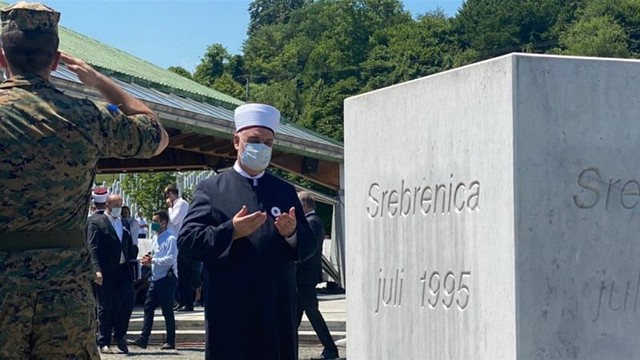
The 25th anniversary of the genocide in Srebrenica, the most horrific crime in Europe since World War II, just passed us.

The genocide that led to the death of over 8,000 men and the expulsion of over 25,000 women and children is however widely denied in the current Serbian political and public discourse, which is a blatant expression and the basis for reaffirmation of the expansionist “Greater Serbia” ideology, that already for one-and-half centuries claims territories from Bosnia and Herzegovina and Kosovo as part of Serbia.

This systematic reaffirmation of Serbian nationalist ideology has taken place under the careful tutelage of the current Serbian President Aleksandar Vucic, who in the 1990s served in the government of the “Balkan Butcher” Slobodan Milosevic and was one of the leaders of the neo-fascist Serbian Radical Party (SRS) led by the convicted war criminal Vojislav Seselj.

Part of Vucic’s political tool-kit is the pro-regime media machinery that insists on genocide denial through historical revisionism, rehabilitation, and promotion of convicted war criminals responsible for the genocide and ethnic cleansing against the Muslim population in Kosovo and Bosnia and Herzegovina.

Former high military personnel such as Nebojsa Pavkovic and Vladimir Lazarevic who had been sentenced by the Hague Tribunal are publishing books sponsored by the state and giving lectures in state academies. Moreover, numerous active politicians have also been convicted of war crimes, most notorious among them being Vojislav Seselj, who serves as an MP while advocating brutal fascist ideas and openly denying the Srebrenica genocide.

In addition, intellectuals, such as Srđa Trifkovis, Dragan Vanja Bokan and Darko Tanaskovic, all ardent proponents of Serbian expansionism and anti-Muslim sentiments during the 90s, are once again highlighted in the pro-regime media.

These intellectuals promote the idea of a threat by a “(pan)Islamic Serbo-phobic fundamentalism” and supposed plans to create some sort of an Islamic state in the Balkans. Apart from this “old guard,” in the past twenty years a new generation of academics, mainly historians, has successfully continued to popularise the extremist Serbian nationalist project.

In addition to glorifying the war criminals Ratko Mladic and Radovan Karadzic, they are devoted to the rehabilitation of the Chetnik movement which is responsible for genocide of the Muslim population in Eastern Bosnia and Sandzak region during the World War II.

Besides historical revisionism and the rehabilitation of war criminals, the current government also provides significant (in)direct support to ultra-right movements such as the National Avant-Garde, Serbian Right, Leviathan Association, and Serb Honor, which sow open hatred towards Muslims in Serbia and the wider region.

Also, through their social media accounts, they are reaching out to the younger generations to whom they are presenting the war criminals responsible for the genocide as a “pop-icons”.

As for relations with the countries that were affected by the genocide and the ethnic cleansing committed during the 1990s, Vucic and his government continue to degrade relations with representatives of the Kosovo Albanians.

During 2019, on several occasions the Prime Minister Ana Brnabic, the Minister of Interior Nebojsa Stefanovic and the Minister of Defense Aleksandar Vulin all openly threatened armed offensives on the territory of Kosovo.

Furthermore, the Serbian leadership constantly works together with Bosnian Serbs on the secession of the Republic of Srpska whose current President Milorad Dodik is a notorious denier of the Srebrenica genocide and a successor of Radovan Karadzic’s policies.

In this context, Milorad Dodik is repeatedly given space in Serbian electronic and print media to promote the idea of ending what began with the genocide of Bosnian Muslims in Bosnia in the near or distant future. Thus, on several occasions, Dodik has even drawn maps on which Serbia and Republika Srpska are one state.

Such aspirations should serve as a red flag to the international community, which already once allowed the Serbian nationalist ideology to result in the atrocities against the Bosnian Muslims and Kosovar Albanians.

In light of the reaffirmation of Serbian nationalism, the international community must keep in mind that this shadowy and racist ideology that resulted in the genocide of Muslims in Bosnia and the ethnic cleansing in Kosovo is still alive and manifests itself in transnational networks as well.

Ultra-right and neo-fascist groups from France, Germany, Poland, Austria, Italy, Romania, Russia and Serbia maintain close ties, exchanging ideas about Europe as a Christian continent to which Muslims do not belong.

It is in this narrative the main “heroes” of Serbian nationalism such as Radovan Karadzic and Ratko Mladic serve as a source of inspiration to white supremacist organisations. Terrorists such as Anders Breivik and Brenton Tarrant were influenced by their genocidal actions. Their names became references in personal accounts and political manifestos of violent far-right extremists like Breivik and Tarrant, who also perceived other individuals from Serbian history as the most important figures in the fight to save “Christian Europe” from the invasion of the “Mohammedan plague”.

In the light of 25th anniversary of the Srebrenica Genocide, widespread politics of genocide denial and reaffirmation of “Greater Serbia” ideology must be taken seriously by all international actors, not only because of the memory of all those killed but also because of the uncertain future facing Muslims in the Balkans.

Unlike their brothers and sisters in the West, who are endangered in exercising their legally guaranteed human rights, Muslims in the Balkans are constantly facing an elementary existential threat. In other words, as long as the dark Serbian nationalist ideology is in full swing, Muslims in the Balkans will wake up every morning wondering whether they will be exposed to a new genocide. The memory of Srebrenica, as well as the future, oblige all relevant world actors to remember and never forget this fact.

Ivan Kostic is a PhD student at the Faculty of Political Sciences, University of Belgrade.

13 July 2020

Source: www.trtworld.com

President Erdogan declares Hagia Sophia a mosque after Turkish court ruling

By Abdus Sattar Ghazali

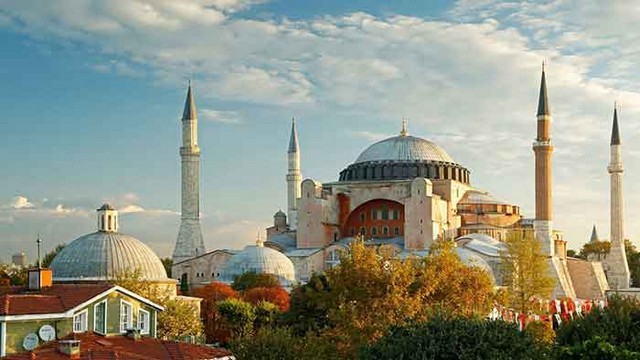
Turkish President Tayyip Erdogan declared Istanbul’s Hagia Sophia a mosque on Friday hours after a top court ruled the ancient building’s conversion to a museum by modern Turkey’s founding statesman was illegal.

“With this court ruling, and with the measures we took in line with the decision, Hagia Sophia became a mosque again, after 86 years, in the way Fatih the conqueror of Istanbul had wanted it to be,” Erdogan said in a national address.

President Erdogan said Turkey could now leave behind “the curse of Allah, profits and angels” that Fatih – the Ottoman Sultan Mehmet II – said would be on anyone who converted it from a mosque.

“Like all our mosques, the doors of Hagia Sophia will be open to all, locals and foreigners, Muslims and non-Muslims,” said Erdogan.

Tellingly, Hagia Sophia will be opened for prayers on July 24, the day when in 1923 Lausanne the treaty officially ended hostilities between the Allies and the Turkish state led by the Grand National Assembly and marked most of Turkey’s current borders.

It also reversed the extensive losses of Turkish-inhabited territories that were laid out in the Sevres Treaty, forced upon the Ottoman Empire by Allied powers, the daily Sabah said adding: It also put an end to the centuries-long economic concessions granted by the Ottoman Empire to European powers.

“It is about our sovereignty rights,” Erdoğan said in his speech on Friday.

The association which brought the court case, the latest in a 16-year legal battle, said Hagia Sophia was the property of Sultan Mehmet II who captured the city in 1453 and turned the already 900-year-old Greek Orthodox cathedral into a mosque.

The Ottomans built minarets alongside the vast domed structure, while inside they added panels bearing the Arabic names of God, the Prophet Mohammad, and Muslim caliphs. The golden mosaics and Christian icons, obscured by the Ottomans, were uncovered again when Hagia Sophia became a museum.

Dismissing claims as untrue that world historical heritage would be “shadowed or destroyed” by the decision, presidential spokesman Ibrahim Kalin has said: “In regards to the arguments of secularism, religious tolerance and coexistence, there are more than four hundred churches and synagogues open in Turkey today.”

Reaction to Turkish move

UNESCO said its World Heritage Committee would review Hagia Sophia’s status, saying it was “regrettable that the Turkish decision was not the subject of dialog nor notification beforehand”.

“UNESCO calls on the Turkish authorities to open a dialog without delay in order to avoid a step back from the universal value of this exceptional heritage whose preservation will be reviewed by the World Heritage Committee in its next session,” the United Nation’s cultural body said in a statement.

The United States on July 1 urged the Turkish government to continue to maintain the status of Hagia Sophia in Istanbul as a museum, pushing back on Turkish President Recep Tayyip Erdogan’s proposal to restore the mosque status of the UNESCO World Heritage Site.

“We urge the Government of Turkey to continue to maintain the Hagia Sophia as a museum, as an exemplar of its commitment to respect the faith traditions and diverse history that contributed to the Republic of Turkey, and to ensure it remains accessible to all,” Secretary of State Mike Pompeo said in a statement.

“The United States views a change in the status of the Hagia Sophia as diminishing the legacy of this remarkable building and its unsurpassed ability—so rare in the modern world—to serve humanity as a much-needed bridge between those of differing faith traditions and cultures,” Pompeo said in a statement.

By reversing one of Ataturk’s most symbolic steps, which underlined the former leader’s commitment to a secular republic, Erdogan has capped his own project to restore Islam in public life, said Soner Cagaptay, director of the Turkish Research Program at the Washington Institute for Near East Policy.

“Hagia Sophia is the crowning moment of Erdogan’s religious revolution which has been unfolding in Turkey for over a decade,” he said, pointing to greater emphasis on religion in education and across government.

Vladimir Dzhabarov, deputy head of the foreign affairs committee in the Russian upper house of parliament, called the action “a mistake”.

“Turning it into a mosque will not do anything for the Muslim world. It does not bring nations together, but on the contrary brings them into collision,” he said.

The Russian Orthodox Church said it regretted that the court did not take its concerns into account and said the decision could lead to even greater divisions.

Previously, Ecumenical Patriarch Bartholomew, the spiritual head of some 300 million Orthodox Christians worldwide and based in Istanbul, said converting it into a mosque would disappoint Christians and would “fracture” East and West.

Giulio Meotti of Gate Stone Institute, the New York-based anti-Muslim think tank, By turning Hagia Sophia into a mosque, Erdogan has been able to embarrass Washington, mock Brussels and defy Moscow. For Erdogan, Hagia Sophia is the prime symbol of Christianity’s subjugation to Islam.

For 916 years, Hagia Sophia had been the “world’s largest basilica” and the main seat of the Eastern Orthodox Church where, for centuries, emperors were crowned.

Abdus Sattar Ghazali is the Chief Editor of the Journal of America (www.journalofamerica.net) Email asghazali2011 (@) gmail.com

13 July 2020

Source: countercurrents.org
Survivors recount Bosnia’s Srebrenica genocide, 25 years on

By Mersiha Gadzo

At 4:15pm on July 11, 1995, Bosnia’s Srebrenica – a United Nations-protected safe zone where about 50,000 Bosniaks had sought refuge – fell to advancing Serb forces, who claimed the town for a Greater Serbia.

“Here we are … in Serb Srebrenica. On the eve of yet another Serb holiday, we give this town to the Serb people as a gift,” Bosnian Serb general Ratko Mladic said at the time in front of the TV cameras.

“Finally, after the rebellion against the dahis, the time has come to take revenge on the Turks in this region,” he said, using the term “dahis” to refer to renegade janissary officers who ruled Serbia during the Ottoman Empire.

By Turks he meant Muslims and in the ensuing days, Bosnian Serb forces along with a Serbian paramilitary unit killed more than 8,000 Bosniak men and boys in a massacre that constituted a genocide, according to the UN judges.

The Serb forces used bulldozers to throw the bodies in numerous mass graves. Their remains are still being searched for.

About 30,000 Bosniak women and children were deported in just two days. Thousands of women and girls were raped.

In 2017, the International Criminal Tribunal for former Yugoslavia (ICTY) convicted Mladic on 10 charges, including genocide and crimes against humanity.

Two survivors of the genocide have shared with Al Jazeera their stories and their perspective on the future.

Nedzad Avdic, 42

On July 11, 1995, 17-year-old Nedzad Avdic attempted to escape the mass shooting planned for him and his fellow Bosniaks by trekking through the forest along with his father, uncle and cousins, aiming to reach the city of Tuzla, located more than 100km away from the besieged territory.

About 15,000 Bosniaks joined in the trek, forming a column, but the chances of making it out alive were slim.

The trek is known as the Death March, as the column of men and boys was regularly ambushed and shot at with heavy artillery by the Serb forces. Only 3,000 Bosniaks survived – less than a quarter.

Avdic lost his father in the crowd and never saw him again.

Two days later, he was at the end of the column when they were shot at by the Serb forces. Many were injured, including his classmates.

Through a megaphone, the Serb police and army told the survivors from the field below to come down, promising that they would not be killed and that they would be reunited with their family.

When a group of them walked down, the injured were shot and killed and the rest, including Avdic, his teacher and classmates were loaded onto a truck, where they spent the night.

On July 14, in a row of trucks, Serb forces began transporting them and others they captured to an unknown location.

“I remember as we were going through [the nearby town of] Bratunac, before they covered the truck with tarpaulin, many [Serb] residents were watching us [being taken away] from their balconies, so people can’t say today that they didn’t know or they didn’t see anything,” Avdic said.

They were driven to a school. Group by group, they were taken out of the classrooms to be executed in front of the school.

As he was in the last classroom, his turn came at about midnight. He was ordered to take off his clothes and had his hands tied.

“Exiting the school, I saw piles of dead people to my left and right. My blood froze and in this moment, I realised that it was the end,” Avdic said.

He and his group were taken to a dam 10 minutes away.

“I went with my head down, aware that I’ll be killed. When I reached my spot [and looked up], I saw rows and rows of dead people lying in front of us.”

The group was told to lie down. The next thing Avdic remembers is that he was trembling, with the right half of his chest and stomach in pain as he had been shot thrice, and another bullet had hit his right hand.

Luckily, Avdic survived the massacre as none of the bullets hit his vital organs.

When the Serbs set the next row of five victims to be executed behind him, they were shooting everywhere and another bullet hit his foot.

“It was the fiercest pain. I really wanted to die. I was in a state between life and death … I was praying to God for them to come and kill me, but I didn’t dare call out to them.”

Avdic could smell the gunpowder in the air. Those who were still alive were howling from the pain, which stopped once the soldier shot them again.

“In that moment, I was waiting to die. I couldn’t take it any more,” Avdic said.

While the soldiers left to get more men and boys to kill, Avdic noticed someone moving in the rows in front of him.

“Are you alive?” Avdic asked. “I’m alive, come untie me!” said the man.

The two headed over to a channel nearby – Avdic, crawling all the way – where they hid while the next truck arrived and continued with the mass killing.

Once the massacre was over, the two crossed into a village, where they were taken to a military hospital nearby.

Avdic’s father and uncle did not survive the genocide.

In 2007, Avdic returned to Srebrenica where he lives with his wife and three daughters. At first, it seemed the situation was headed in a positive direction, but this was short-lived.

A climate of genocide denial pervades among the Serb society and politicians, including the current Serb mayor of Srebrenica, Mladen Grujicic.

According to a 2018 poll, 66 percent of Serbs in Republika Srpska, Bosnia’s Serb-run entity, deny the genocide. Convicted war criminals are regularly celebrated.

“With the Dayton peace agreement, the international community gave up Srebrenica to Republika Srpska and to those who deny the genocide. I’m disappointed,” Avdic said.

“After 25 years, not much has changed. It’s not that they just deny genocide, but the international verdicts as well. We can’t speak about [what happened] in schools,” he said.

“But we won’t give up. We didn’t even give up in 1995 when they were killing almost all of us. I still have faith and I see there are a lot of younger generations who are fighting against this more and more.”

Almasa Salihovic, 33

As the Serb forces entered Srebrenica on July 11, 1995, Almasa Salihovic, eight-year-old at the time, recalls her mother and siblings picking up what they could of their belongings from their uncle’s house where they had been staying and began running towards the UN base in the village of Potocari, about 22km (13.6 miles) away.

“I can’t hold you by the hand; just grab a piece of my clothing and whatever happens, don’t let go,” Salihovic remembers her mom telling her.

Salihovic was running alongside her four older siblings, but as a heavy stream of people were all headed in the same direction, her two eldest siblings Fatima, 19, and Abdulah, 17, got lost in the crowd.

Fatima and Abdulah managed to seek refuge inside the battery factory in Potocari, seen as a safe place.

As it was not possible for tens of thousands of people to stand inside, the UN soldiers closed the door so nobody could go in or out for three days.

The rest of the crowd stayed outside, including Salihovic, her mother and two other siblings.

She recalls the unbearable screams at night when Serb soldiers, dressed in UN uniforms, would walk among the people and pick out boys and men from the crowd and take them away, never to return them.

“I remember women trying to sleep on top of their husbands and sons [to hide them], just so the Serb soldiers don’t spot a young man or an older one,” Salihovic said.

In the morning of July 13, a line of trucks and buses arrived and a Serb soldier announced: “You’re going to Alija’s [the first Bosnian president’s] territory. First women and children. The men will join you later.”

As the genders were being separated, Salihovic saw UN troops standing by the road.

“None of them reacted in any sort of way to even try to prevent [what was happening],” Salihovic said.

“None of them did anything to even bring attention to what was going on … they knew what was going to happen to the people inside [the factory].”

Salihovic and her family got in one of the buses. Her mother pushed her 15-year-old brother Salih under the seat and threw some clothes on top of him to hide him, as she knew the Serb soldiers would search the bus again.

Driving through the nearby town of Bratunac, Salihovic recalls Serb children, women and boys spitting at the windows of their bus, cursing and throwing rocks or whatever they had at the bus.

Hours later, they reached the town of Kladanj, outside Serb control, and stopped at a meadow, which was full of people who were crying and waiting for news of their loved ones.

In the evening, Fatima arrived and found her family, but to their horror, she was alone.

When she said the Serbs did not let Abdulah with her on the bus, their mother fainted amid screams and cries.

About 13 years later, Salihovic received a phone call that 30 percent of Abdulah’s remains had been found in a secondary grave called Cancari near the town of Zvornik.

According to the reconstruction, experts found that Abdulah was shot.

Salihovic and her sisters buried him that year on July 11, 2008, as experts told them it was possible they would never find the rest of his remains.

It took Fatima 25 years to speak about what happened when she detailed her memories in a letter to Salihovic earlier this year.

The letter said a Serb soldier entered the factory, asking all men and boys older than 15 to write their names on the paper signed by a Dutch military commander.

A Bosnian translator also entered the factory and told the Bosniaks a negotiation was going on for their release and that Serb soldiers had demanded from the UN to sign their names.

For two days, they were collecting names, but some people decided not to sign it.

Fatima had debated with Abdulah whether to add his name. In the end, they thought the paper served as proof of existence and could save his life, so Abdulah signed it.

But it proved to be the opposite. When they left the factory, the boys and men were separated from the others and had to stay.
UN Srebrenica. Admir Delic/Al Jazeera

As they were leaving the factory, Fatima described “walking with Abdulah and looking in his eyes, eyes of a boy who knew that he was going to die”.

“She said she didn’t have the feeling that he was blaming her but she simply saw eyes that were saying the last goodbye,” Salihovic said.

In February, Salihovic visited the old factory, now a museum as a translator with a group of students.

She found a file of documents on a table that had a list of names. Turning to the last page, she saw her brother’s name written in his handwriting: Salihovic Abdulah – 1977.

His name was the second-last name on the list, number 238.

‘Hidden attacks’

On July 11, 25 years later, while some bury the remains of their loved ones, others celebrate.

Posters of Mladic have been put up around Srebrenica and Bratunac, reading: “Thank you General for 11th of July, the day of liberation of Srebrenica.”

“That’s what scares me the most,” Salihovic said. “Even if we don’t have incidents in Srebrenica like physical fights, we still have these hidden attacks which is far more worse.”

“You have people who pretend that they’re nice, they greet you, they’re good. And all of a sudden, you see that they’re part of this [celebration] and that’s terrifying,” she said.

“You have people who would still do the same thing tomorrow if they have the chance and if we don’t speak even more loudly than we do now, then I’m really not sure where this is going.”

Mersiha Gadzo is a journalist and online producer for Al Jazeera English.

11 July 2020

Source: www.aljazeera.com

In Srebrenica, a new war is waged

By Emir Suljagic

On October 15, 2019, my appointment as the director of the Srebrenica Memorial Centre was to be made official. As I was leaving the campus of the International University of Sarajevo, where I taught international relations, my phone rang. It was the hospital. My mother had died.

Later, I would come to realise that that day marked one chapter of my life closing for another one to open.

When I finally arrived in Srebrenica, it took me a few weeks to understand that there was no precedent for what we were trying to do.

During the Bosnian war of 1992-95, thousands of Muslims sought refuge in Srebrenica in the eastern part of Bosnia and Herzegovina, as Serb militias were committing genocide against the Muslim pupulation of the Drina Valley, hoping to create a homogeneous Serbian territory and open the border with Serbia.

Today the town falls within the boundaries of Republika Srpska, drawn by the 1995 Dayton Agreement, and in 2003, it was in its former industrial zone, where the UN base had once been, that the memorial and a cemetery for the victims of genocide were established in 2003.

It should not come as a surprise that we operate in an environment that is openly hostile and rife with genocide denial. Locals as well as the authorities in Banja Luka, the capital of Republika Srpska, continue to see and treat us as an enemy, undermining our work and our mandate.

The ruling party of Independent Social Democrats under the leadership of Milorad Dodik, the Serb member of the Presidency of Bosnia and Herzegovina, continues to invest public money into the production of “alternative facts” and alternative, counterfactual narratives about the events that took place in Srebrenica between May 1992 and July 1995.

Meanwhile, in Europe, there is a tendency to put the story behind and “move on”. The European way of dealing with genocide, mass-murder and organised violence is forgetting. This is not a value judgement, but a fact. The entire global order is based on the ability of the West to turn former enemies into allies.

That is very often the source of misunderstanding between us and our European friends who insist on reconciliation. Reconciliation is easy to talk about when the group targeted for genocide is simply no longer there, as was the case with the Jews after World War II. The Jewish communities across Europe were almost completely obliterated by 1945 and the few survivors ran as far away as possible for the most part.

The collaboration and crimes of many common citizens who benefitted from the murder of the Jews and took over their property were never really addressed. After the Nuremberg trials, which once again treated the Holocaust as a footnote, there was no mention of the crimes of Holocaust for another generation. Europe just moved on and the imperative of the ideological conflict between the West and the Soviet Union dominated public attention.

However, there is no precedent for victims and survivors returning to the sites and places where genocide was perpetrated and continuing to live there and memorialise their loss. There is no precedent for allowing the political structures responsible for genocide to rule the part of the land where it was perpetrated. The Nazis were not allowed self-rule in Bavaria, for instance, in 1946.

If we were not Muslim, the Bosnian Serbs would have been militarily defeated, all their war criminals summarily tried, and the ideology behind the mass murder thoroughly discredited. If we were not Muslim, the Bosnian army would not have been stopped on its march to Banja Luka in the autumn of 1995.

Recently, as part of research I have been working on, I came into possession of the transcripts of 57 sittings of the secessionist Bosnian Serb “assembly” which had been established in October 1991 by Radovan Karadzic. It is a common assumption, even among the scholars of genocide that genocidal intent is born and discussed in small, conspiratorial circles.

In this case, however, it was openly discussed in a forum of between 60 and 80 individuals, their discussions recorded for posterity on purpose. Every single aspect of the eradication of the Muslim population was debated in detail. Support for the “radical solution”, as Karadzic once referred to the genocidal operation in and around Srebrenica, was so overwhelming that the entire enterprise could safely be named “genocide by plebiscite”.

A number of deputies of this assembly are still alive and free. Some of them, like former chairman of the assembly and convicted war criminal Momcilo Krajisnik, have a voice in public.

Whereas the individual legal responsibility of high-ranking individuals in the Bosnian Serb and Serbian leadership was addressed before the International Criminal Tribunal for the former Yugoslavia, the political responsibility for the murder of more than 100,000, for the rape of tens of thousands, was ignored as state-building efforts were pushed to the fore by the international community.

We still see the people, who came to our villages in the 1990s to burn them down, walking in the streets freely; we still hear the same dehumanising vocabulary from the Bosnian Serb and Serbian politicians we heard back then; we are still the hated “Asiatic plague”, as a former University of Sarajevo professor and leading member of the Bosnian Serb assembly referred to us in one of the sittings.

That is why working at the Srebrenica Memorial sometimes still feels like being in a war-time enclave. I cannot say I mind the feeling. On the contrary, having once lived and survived the experience of an enclave, I have continued to feel surrounded even after 1995. It comes to me naturally, I even like being surrounded.

What I cannot handle are the open physical and social spaces of freedom. By coming back here, I decided to try and continue carrying the torch that my mother did not want me to carry. She never wanted me to take this job. She had lost one man in her life – her husband – here.

With my mother’s death, one war ended in my life, for another to start. It is a war for the interpretation of the war, as the renowned Bosnian poet Abdulah Sidran aptly put it. It is a war to honour the men and women I grew up with, who were murdered mercilessly, and to make sure their deaths are not forgotten.

Emir Suljagic is ex-deputy defence minister of Bosnia and Herzegovina.

11 July 2020

Source: www.aljazeera.com

Was the Srebrenica genocide aimed at the wider Muslim presence in Europe?

By Murat Sofuoglu

Some analysts see a connection between today’s Islamophobia and the toxic Serbian nationalism of the 1990s, which sought to erase the Muslim Bosnian presence in the Balkans.

Twenty-five years after the Serbian massacres of Bosnian Muslims took place in Srebrenica, very few lessons appear to have been learnt given the far-right movements and Islamophobia that continue to emerge and thrive across the Western world.

Despite the past experience of the Bosnian War, and recent white supremacist attacks, many European experts, officials and pundits, appear to focus on extreme groups that have a Muslim background. This approach, however, leaves rising far-right groups – some with violent intentions – quite free to conduct their cruel acts across the world.

Some experts think that some old prejudices of the Western world toward Muslims, coined as Islamophobia now for some time, might have played a serious role in its inaction towards the Bosnian War and further enabling the Serbian nationalist leadership to massacre the European Muslim population.

“I think Islamophobia played a role in that. If this had been other (non-Muslim) communities, they could have acted much sooner,” said Sami al Arian, an American-Palestinian professor, who is the director of the Center for Islam and Global Affairs at Istanbul Sabahattin Zaim University.

“But when it came to Muslims in Bosnia or Africans in Rwanda, the inaction of the United States, which was leading the world at the time, (and Europeans) spoke volumes to the fact that these lives don’t matter as much when European and other Anglo-Saxon type of conflicts take place within the context of the Cold War,” Arian told TRT World.

Some metaphors of Islamophobia and the main symbols of the Bosnian War also appear to have similar roots.

Then-Serbian President Slobodan Milosevic and his Serbian generals always referred to Muslim Bosnians alternatively as the Ottomans or the Turks – this despite Bosnians being ethnically Slavic and the Ottoman Empire having ceased to exist about seventy years ago.

After the terrible massacre of the Muslims in Christchurch, New Zealand, last year, a code word was found on the rifle of Australian murderer Brenton Tarrant. It was Turkofagos, which means “Eater of Turks”, a well-known expression, particularly, among the Greeks.

Greeks used the term to describe their fighters during the Greek Rebellion of 1821 against the Ottomans. It has other meanings, too.

“There is a darker meaning, however, lurking behind the term, a meaning that Greeks have long been keenly aware of—and of which the New Zealand terrorist clearly was, too. It traces to the very birth of the Greek nation, when the revolutionaries didn’t just fight the Ottoman army—they also committed brutal ethnic cleansing against Muslims and Jews,” wrote Yiannis Baboulias, an investigative journalist and co-founder of the Precarious Europe project.

Resembling the Greek ethnic cleansing of the Muslims in the 19th century, Milosevic’s Serbs were also planning to exterminate the Muslim Bosnian population in order to purify the Serbian nation and the Balkans from the remains of the Ottomans and the Turks – just as Tarrant wanted to do in the Pacific.

“In those times, a ‘Turk’ wasn’t just an Ottoman soldier: It was anyone who wasn’t a Christian. The darkest aspects of the term Turkofagos have more recently been resurrected by far-right and nationalist groups as they apply the term to honour any killer of Muslims,” Baboulias added.

Like Baboulias, Arian also believes that the historical context has a powerful presence across the Balkans, particularly, in the Bosnian War.

“States may act for geopolitical and strategic reasons. But when people start killing other people, especially their own neighbours they have lived for centuries, raping them and acting with other types of hatred, it has to do with history and religion unfortunately,” Arian said.

The psychological aspects of the Bosnian War

Every political incident is rooted in psychological engineering, according to Vamik Volkan, the emeritus professor of psychiatry at the University of Virginia, who received The Sigourney Award for 2015. It is generally regarded as the Nobel of psychoanalysis.

During a conference series organised by the Bahcesehir University in 2008, Volkan remembers how he psychologically reacted to Turkey’s Cyprus Operation back on July 15, 1974.

Volkan was born and raised in Cyprus as a Cypriot Turk. He is one of the founders and leading experts of political psychology discipline. He also led many field studies and wrote several books on psychology’s place in politics and international relations.

He was living in the US during Turkey’s Cyprus Operation. There was no direct flight from Virginia to Turkey in those days. He flew to a European country, and then went on to enter Turkey through the Balkans by road.

“During my travel, without having any concrete information coming from Cyprus, I was constantly crying when I saw remains of the Ottoman-era structures, identifying the incidents in Cyprus with what happened in the Balkans back in the day, falling into a psychological regression,” the professor recounted.

Volkan identifies this situation as “time collapse”, where a person or a social group could sometimes erase time differences between different incidents, identifying all as part of a single one.

In the above incident, at the time, the professor’s psychology identifies the Ottoman Empire’s Balkan losses during the disastrous Balkan Wars back in 1912, which heralded the collapse of the empire, with another possible loss in Cyprus.

But in 1974, Turkey successfully defeated Greek Cypriots to claim the northern part of the island, protecting its brethren, the Turkish Cypriots.

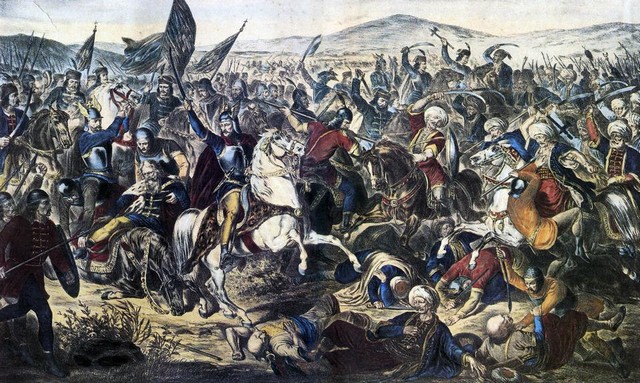
Volkan thinks that another “time collapse” happened when the Serbian leadership identified the disintegration of Yugoslavia in 1989 with the Battle of Kosovo, which happened in 1389 exactly six hundred years ago between the Ottomans and the Serbs. Both incidents have been regarded to weaken Serbian nationality, according to many experts.

The Serbian leadership, led by Milosevic, which was later tried for war crimes against Bosnian Muslims in The International Criminal Tribunal for the former Yugoslavia (ICTY), accused Bosnians of the fall of Yugoslavia, calling them directly as Ottomans or Turks.

“During the collapse of Yugoslavia, so many anxieties were present in the country because of the fear people felt that the country was being torn apart. But Milosevic comes and says ‘Never mind. We are going to bring the Kosovo War back. We will bring Prince Lazar back’,” Volkan said.

Lazar was the Serbian leader in the Battle of Kosovo, where he was killed. But the Ottoman Sultan, Murad I, was also killed during the battle. Some years after the Battle of Kosovo, much of Serbia came under the Ottoman rule and part of Serbian population converted to Islam under the Ottomans. This Muslim population has been called as Bosnians since then.

“Indeed, Lazar was dead for six hundred years. They put his body in a coffin and a six hundred years old corpse goes village to village, all the way back to Kosovo,” Volkan told TRT World.

“Within a year, societal processes fundamentally change. They believed afterwards that they were going to have a great Serbia. Prince Lazar is going to come back and they are going to kill all Ottomans which meant Bosnians. And genocide occurred,” Volkan analyses.

Serbian ‘Chosen Trauma’: The Battle of Kosovo

Milosevic, whose father and mother, along with his paternal grandfather and maternal uncle, committed suicide, had an interesting last name – it connected with the ups and downs of the Serbian history.

Milosevic means son of Milos, which was also the name of the person who allegedly killed the Ottoman Sultan Murad I in the Battle of Kosovo.

“Milošević ordered a huge monument to be built on a hill overlooking the Kosovo battlefield. Made of red stone symbolizing blood, it stands a hundred feet high. The numbers “1389-1989” are clearly inscribed on this monument, etching the intended “time collapse” in stone,” wrote Volkan in his groundbreaking paper, Slobodan Milošević and the Reactivation of the Serbian Chosen Trauma,in 2006.

“None should be surprised that Serbia raised its head because of Kosovo this summer. Kosovo is the pure centre of its history, culture and memory. Every nation has one love that warms its heart. For Serbia it is Kosovo,” Milosevic said during the ceremony.

“Six centuries later, now, we are being again engaged in battles and are facing battles,” he added.

Volkan thinks every nation and every personality have “chosen traumas” in different degrees. According to him, the Battle of Kosovo has emerged as the chosen trauma of Serbians in history. He cites a huge volume of Serbian literature, religious sermons and personal accounts, dedicated to the Battle of Kosovo.

Drink, Serbs, of God’s glory

And fulfill the Christian law;

And even though we have lost our kingdom,

Let us not lose our souls

(Markovic, M.S. (1983). The secret of Kosovo. In Landmarks in Serbian Culture and History, ed., V.D. Mihailovich, pp. 116. Pittsburg, PA: Serb National Federation.)

The above lines are from one of the most popular Serbian songs.

“… The single sound of that word—Kosovo—caused an indescribable excitement. This one word pointed to the black past—five centuries. In it exists the whole of our sad past—the tragedy of Prince Lazar and the entire Serbian people….” wrote a Serbian young soldier in his memoirs during the Balkan Wars of 1912, when Kosovo separated from the Ottoman Empire, being part of Serbia and its old ally Montenegro.

“Each of us created for himself a picture of Kosovo while we were still in the cradle. Our mothers lulled us to sleep with the songs of Kosovo, and in our schools, our teachers never ceased in their stories of Lazar and Miloš,” the soldier recounted.

“My God, what awaited us! To see a liberated Kosovo….When we arrived in Kosovo … the spirits of Lazar, Miloš and all the Kosovo martyrs gaze on us,” he reacted.

(The quotes are taken from Vojincki Glasnik, June 28, 1932, reported in Emmert, T.A. (1990). Serbian Golgotha: Kosovo, 1389. pp. 133-134. New York: Columbia University Press.)

In 1989, in the wake of the collapse of Yugoslavia, which means the Land of Southern Slavs, Milosevic was also considered himself as a man destined to rewrite the Serbian history.

“On June 28, 1989, the day marking the 600th anniversary of the Battle of Kosovo, a helicopter brought Milošević to Kosovo Polje—a symbolic gesture representing the return of Prince Lazar/Jesus Christ to earth to create a Greater Serbia,” Volkan recounted.

A similar psychological “time collapse” also appeared to happen ahead of the World War I, which was triggered by the assassination of Archduke Franz Ferdinand of Austria, a heir presumptive to the then-Austro-Hungarian Emperor, in Sarajevo, the current capital of Bosnia and Herzegovina.

The Serbian nationalist assassin, Gavrilo Princip, who was a member of the Serbian clandestine group called the Black Hand, killed the Austrian heir-apparent on June 28, 1914, a date particularly picked by the group to identify its act with the Battle of Kosovo.

The secret group, whose assassination was set up by the Serbian intelligence, was aiming for the liberation of South Slavic provinces, mainly Bosnia from the Austria-Hungary Empire, to create a Yugoslavia.

“It appeared that in Princip’s mind, the old [Ottomans] and new [Austrians] “oppressors” were condensed, and the desire for revenge was transferred to the Austro-Hungarian heir apparent,” Volkan wrote.

Like Princip, who has continued to be celebrated as a hero by both the mainland Serbs and Bosnian Serbs to date, Milosevic also thought himself as a saviour of the Serbian nation.

“Thereafter, a sense of entitlement to kill Bosniaks and Kosovar Albanian Moslems began to spread. Since the ancestors of these people had become Moslems under the Ottoman rule, they represented the original enemy, the Ottoman Turks,” Volkan said.

He also notes that long before the appearance of extreme groups like al Qaeda and others with Muslim roots, “there was, in Europe, an entitlement to kill Moslems in the name of a specific type of Christian religious ‘fundamentalism’.”

“Everyone knows what happened in the former Yugoslavia, and the details are beyond the scope of this paper,” Volkan also noted.

In July 1995, only in Srebrenica, which has been designated as a safe area by the UN during the Bosnian War, 8,000 Bosnian men and women were killed by Serbian forces, marking the largest massacre in the heart of Europe since the Holocaust. The world’s top two courts, the ICTY and the International Court of Justice (ICJ), have defined the Srebrenica killings as genocide.

Top Bosnian officials, citing The International Committee of the Red Cross (ICRC) data, believe that at least 200,000 people were killed, including 12,000 children, by Serbian forces. It went on to state that at least 50,000 Bosnian women were raped and 2.2 million were forced to flee their homes during the brutal war.

A number of prominent international and national political bodies, including a resolution by the United Nations General Assembly, as well as several other court decisions, have defined the incidents taking place in Bosnia as genocide.

In 2006, Milosevic died in the UN war crimes tribunal’s detention centre.

Murat Sofuoglu is a staff writer at TRT World.

11 July 2020

Source: www.trtworld.com

Genocide denial gains ground 25 years after Srebrenica massacre

By Shaun Walker

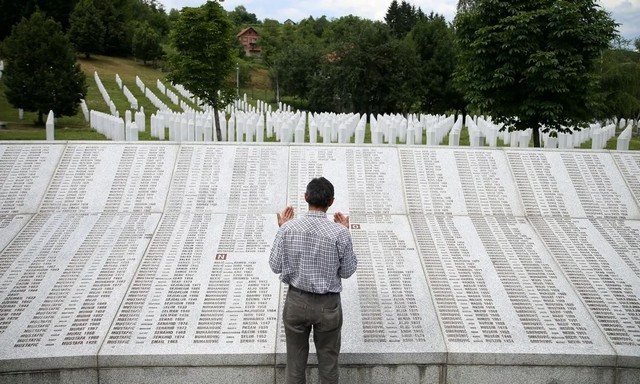
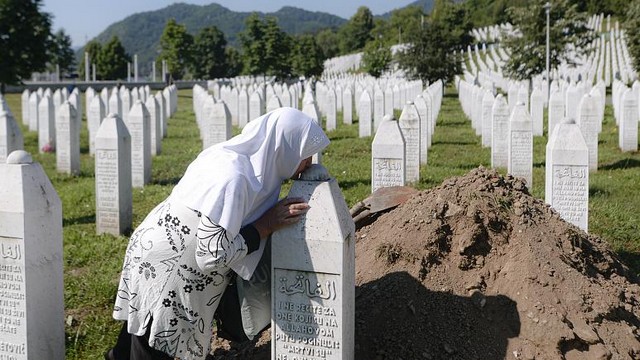
At the genocide memorial centre outside Srebrenica, thousands of simple white gravestones stretch across the gently inclined hillside for as far as the eye can see.

Nearby, over a number of days in July 1995, Bosnian Serb forces systematically murdered around 8,000 Bosniak (Bosnian Muslim) men and boys. It was the worst crime of the Bosnian war, and remains the only massacre on European soil since the second world war to be ruled a genocide.

Even today, remains of victims are still being found and identified. Owing to a cover-up operation to hide the crimes by digging up and dispersing the contents of mass graves, there are cases in which partial remains of the same individual have been found at as many as five sites several miles apart. At a 25th anniversary commemoration on Saturday, at least eight more victims will finally be laid to rest at the cemetery.

A quarter of a century after the events, however, the truth about what happened at Srebrenica is being subjected to a growing chorus of denial, starting in Bosnia itself and echoing around the world, moving from the fringes of the far right into mainstream discourse.

In Srebrenica, the denial starts with the mayor. The current population of around 7,000 is one-fifth of the pre-war total, and there are now more Serbs than Bosniaks, a reversal of the situation before the war and genocide. Four years ago, Srebrenica elected its first Serb mayor, Mladen Grujičić, and official rhetoric changed overnight.

Grujičić, 38, an energetic former chemistry teacher, has no time for talk of genocide. “No Serb would deny that Bosniaks were killed here in horrible crimes … but a genocide means the deliberate destruction of a people. There was no deliberate attempt to do that here,” he said in an interview at his office in the centre of Srebrenica.

He was 10 when the war started. His father was killed during the war in a village not far from Srebrenica. Grujičić pointed out that there were victims on all sides during the conflict, which tore apart multi-ethnic Bosnia after the collapse of Yugoslavia.

But what about the international courts that have forensically sifted the evidence and come to the conclusion that the systematic slaughter around Srebrenica in July 1995 did constitute genocide, unlike other crimes during the war? “Unfortunately, all these courts have been biased against the Serbs and this has only deepened divisions here,” he shrugged. He has not once during his time in office visited the genocide memorial, which is a five-minute drive from the town hall.

In Srebrenica, the denial starts with the mayor. The current population of around 7,000 is one-fifth of the pre-war total, and there are now more Serbs than Bosniaks, a reversal of the situation before the war and genocide. Four years ago, Srebrenica elected its first Serb mayor, Mladen Grujičić, and official rhetoric changed overnight.

Grujičić, 38, an energetic former chemistry teacher, has no time for talk of genocide. “No Serb would deny that Bosniaks were killed here in horrible crimes … but a genocide means the deliberate destruction of a people. There was no deliberate attempt to do that here,” he said in an interview at his office in the centre of Srebrenica.

He was 10 when the war started. His father was killed during the war in a village not far from Srebrenica. Grujičić pointed out that there were victims on all sides during the conflict, which tore apart multi-ethnic Bosnia after the collapse of Yugoslavia.

But what about the international courts that have forensically sifted the evidence and come to the conclusion that the systematic slaughter around Srebrenica in July 1995 did constitute genocide, unlike other crimes during the war? “Unfortunately, all these courts have been biased against the Serbs and this has only deepened divisions here,” he shrugged. He has not once during his time in office visited the genocide memorial, which is a five-minute drive from the town hall.

In a press conference before the prize-giving ceremony, when Handke was asked whether he accepted that the Srebrenica massacre had happened, he dodged the question, calling it “empty and ignorant” and comparing it to hate mail he said he had received containing soiled toilet paper.

Emir Suljagić, who runs the sombre genocide memorial centre at Potočari, just outside Srebrenica, said: “I am not a fan of cancel culture but if there’s one thing that should cancel you, surely it’s genocide denial, it’s speaking at Milošević’s funeral.”

The memorial centre is located in the former headquarters of the Dutch UN battalion that in July 1995 failed to protect the people gathered in Srebrenica, which had been declared a UN safe zone. Suljagić, who survived because he worked as a translator for the mission, spoke of the trauma for returnees who have to live in places where the crimes took place. He told a story from his years working as a journalist, covering war crimes trials in The Hague.

Suljagić was watching two former Bosnian Serb soldiers give evidence against their commander at one trial. The men testified under pseudonyms and with their voice and appearance altered, but as they recounted their role in a massacre, Suljagić pieced together their identities from information given to the court. He had been to school with both of them. He assumed they had been given immunity for their role in the massacre in exchange for testifying against their commander.

“Nine years later, I’m in the parking lot of the local supermarket and one of those guys comes out and recognises me and says: ‘Hi, how are you doing?’ They both live locally. And I’m thinking: ‘Do I tell him? Do I tell him I know?’ In the end, I said nothing, but I still see them occasionally.”

With survivors and perpetrators living side by side, and given the country’s divided politics, it is hard to imagine closure and reconciliation coming soon. Hasan Hasanović, who lost his twin brother and his father in the genocide, said it would be possible to talk about progress when school trips of Serb pupils come to tour the genocide memorial, where he works as a guide.

Schooling, like so much in Bosnia, is still divided along ethnic lines. Pupils are split into separate classes for “national subjects” such as history, and while the Bosniak textbooks cover the genocide, the Serb textbooks gloss it over. There is little hope of a unified curriculum in the country in the foreseeable future. “The main nationalist parties that continue to benefit from social division have no interest in changing a divisive status quo,” said Valery Perry, of the Democratization Policy Council in Sarajevo.

At Srebrenica’s elementary school, teachers avoid discussing the war at all, said the headmaster, Dragi Jovanović. “Even adults, when we sit together, we simply do not touch these topics … We are trying not to hurt people’s feelings, and at this point you can’t educate the children without hurting their feelings,” he said.

How, then, would he respond to a pupil who asked why there was such a vast cemetery on the outskirts of town? “I have never been asked such a question,” he said.

Shaun Walker is the Guardian’s central and eastern Europe correspondent.

10 July 2020

Source: www.theguardian.com

Srebrenica: 25 years on, Europe remembers its largest massacre since the Second World War

By Alice Tidey

Commemorations are being held in Bosnia on Saturday to mark the 25th anniversary of the Srebrenica massacre — Europe’s worst atrocity since the Second World War and the only one to be declared a genocide.

World leaders have paid tribute to victims and survivors. Former US President Bill Clinton and current Secretary of State Mike Pompeo, Britain’s Prince Charles, Spain’s Prime Minister Pedro Sanchez and Canada’s Justin Trudeau were among those who appeared via a series of video messages at a ceremony in the town.

The events to mark the occasion have been scaled back because of the COVID-19 pandemic.

Official commemorations in the morning were due to be followed by the burial of nine bodies of victims identified over the past year. Their remains will be laid to rest in the cemetery of a memorial centre to the genocide at Potocari, a village near Srebrenica which was home to a UN peacekeeping base during the Bosnian war.

Srebrenica was supposed to be a UN safe haven. Yet some 8,000 Muslim men and boys were killed by Bosnian Serb forces over a week from July 11, 1995 in and around the town, in what is now Bosnia and Herzegovina.

The Bosnian Serbs’ military and political chiefs, Radovan Karadzic et Ratko Mladic, were sentenced to life imprisonment by a world tribunal over the massacre and the siege of Sarajevo.

Twenty-five years after the Srebrenica genocide, the events that unfolded continue to be a source of dispute and tensions in the area.

Yugoslavia collapses

Nationalism and sectarianism began to rise in what was then Yugoslavia following the death of dictator Josip Broz Tito in 1980.

The fall of the Berlin Wall in late 1989 and the subsequent collapse of the Soviet Union deepened the crisis and in 1991, war erupted along ethnic lines after Slovenia and Croatia both declared their independence.

Bosnia followed suit by declaring independence in March 1992 with forces of the Republic of Bosnia and Herzegovina and those of the Republika Srpska — also known as Bosnian Serbs — quickly taking up arms.

The Bosnian war

By April and May 1992, the Bosnian Serb army, aided by the Yugoslav army and paramilitary groups from Serbia, started an “ethnic cleansing” campaign against all non-Serbian inhabitants from much of Bosnia.

Among the tactics used by Bosnian Serbs were forced evictions, destructions of religious sites, sieges, concentration camps, torture and rape. Between 20,000 and 50,000 women are estimated to have been raped during the three-year conflict.

The international community responded by calling for an end to the atrocities and sending in a few hundred United Nations peacekeepers.

A UN resolution in 1993 also established Srebrenica and its immediate surrounding as a safe haven to remain “free from any armed attack or any other hostile acts.”

The Srebrenica massacre

On July 11, 1995, UN peacekeepers in Srebrenica were awaiting the arrival of NATO airplanes. They had called for their assistance after Bosnian Serb forces had besieged and overwhelmed other UN posts in the enclave over the previous few days.

Instead, Bosnian Serb forces began shelling the area, prompting more than 20,000 civilians who had sought refuge in the city to flee towards another UN base in Potočari, three miles away.

Srebrenica was quickly captured by Bosnian Serbs who then advanced towards Potočari. Fearing for their lives, more than 10,000 Muslim men and boys set out on foot in the middle of the night for Tuzla, some 45 kilometres away.

Meanwhile, Bosnian Serb rounded up civilians in Potočari. Women and children were eventually bused to Tuzla but Muslim men and boys were taken to the nearby town of Bratunac.

The men who had set on foot were also met at various locations along the way by Bosnian Serb forces with hundreds shot on sight and large numbers taken captive.

On July 14, the execution of the thousands of men held in Bratunac began. They were buried in mass graves near the killing sites.

Between 7,000 and 8,000 men and boys were killed during that week in what the International Tribunal for the former Yugoslavia (ICTY) ruled was a genocide. It was the largest massacre in Europe since the Holocaust.

After Srebrenica

The scale of the massacre jolted the international community and prompted the Clinton administration in the US into action.

NATO started a prolonged bombing campaign against Bosnian Serb positions which shifted the tide of the war towards the Bosnian Croat forces.

A peace agreement was reached in November in Dayton in the US and signed in Paris in December.

Justice

A total of 161 people were indicted by the ICTY between its creation in 1993 and its dissolution in 2017, when the final trial in the first instance was completed.

Ratko Mladic, the former Bosnian Serb military commander who orchestrated the capture of Srebrenica, was convicted on November 22, 2017, for genocide, war crimes, and crimes against humanity.

Radovan Karadzic, a former President of the Republika Srpska, was convicted for genocide in 2013 while Slobodan Milosevic, a former president of Serbia, indicted in charges of genocide, crimes against humanity, grave breaches of the Geneva Conventions, and violations of the laws or customs of war died before his sentencing.

“This has given some satisfaction to the survivors and families of victims,” Jasna Dragovic-Soso, Professor of International Politics and History at Goldsmiths, University of London, told Euronews.

However, she added, “many former RS [Republika Srpska] soldiers and Serb paramilitaries who took part in the massacres have gone unpunished and kept their positions in the security and police forces.”

“Compensation and reparations for survivors and families have been insufficient and ‘ethnic cleansing’ carried out during the Bosnian War has for the most part not been reversed,” she went on to say.

Genocide denial

Twenty-five years later, and despite two international courts ruling that the events in Srebrenica were genocide, many around the region continue to reject the term.

“Disputes over the circumstances and nature of the massacres committed in July 1995 in Srebrenica continue to act as a source of tension and division,” Dragovic-Soso said.

“Widespread denial of the number of Bosniak men killed in and around Srebrenica and the refusal to accept the term ‘genocide’ by most Serbs continues to sour inter-ethnic relations,” she added.

A report commissioned by the Srebrenica memorial warned earlier this year that the 25th anniversary of the massacre also marked “25 years of genocide denial.”

“Rather than abating with time, denial of genocide has only grown more insidious in recent years — locally, regionally, as well as internationally,” it stated.

The authors of the report contend that the current president of Republika Srpska and the mayor of Srebrenica are among those peddling conspiracy theories about the event of July 1995.

They also flagged that in an official report released in 2002, the Documentation Center of Republic of Srpska for War Crimes Research referred to the event throughout as the “alleged massacre” and that it asserted that no more than 2,000 Bosnian Muslims, all of them armed soldiers rather than civilians, were killed in Srebrenica.

Ethno-nationalism

The fact that ethno-nationalism persists can be attributed to “insufficient political and institutional reform, continued reliance on corrupt informal networks of power, political party control of the segregated media, along with the inability of civil society efforts at ‘truth-telling’ about the war to reach broader audiences,” Dragovic-Soso stressed.

But it has also increasingly led to political gridlock in the country.

“It is now fully and cynically exploited and fueled by politicians and political forces in the region” and “threatens internal cohesion and increasingly ineffective governing structure,” a report from the US-based Center for Strategic and International Studies think tank warned last year.

The report urged Bosnia’s three constituencies to work together or for a new generation of politicians to emerge and outline a positive alternative.

“The idea of ethnic separatism is, unfortunately, gaining traction in the region as land swaps are contemplated and ethnic divisions are viewed as acceptable diplomatic solutions rather than clear warning signs. As ethno-nationalism is cynically deployed in Bosnia, the red lights are blinking brighter,” it added.

11 July 2020

Source: www.euronews.com

On Israel’s Bizarre Definitions: The West Bank is Already Annexed

By Dr Ramzy Baroud

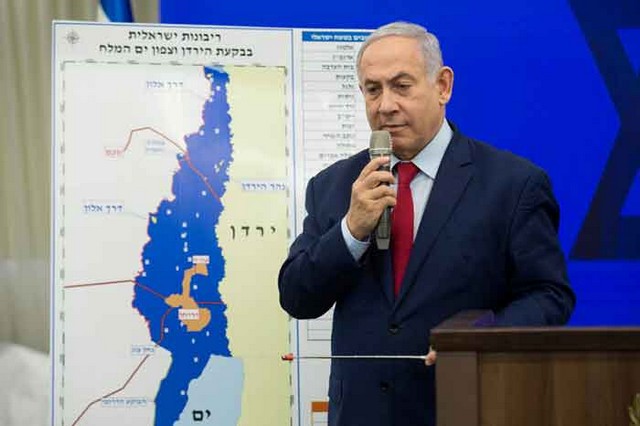
Wednesday, July 1, was meant to be the day on which the Israeli government officially annexed 30% of the occupied Palestinian West Bank and the Jordan Valley. This date, however, came and went and annexation was never actualized.

“I don’t know if there will be a declaration of sovereignty today,” said Israeli Foreign Minister, Gabi Ashkenazi, with reference to the self-imposed deadline declared earlier by Israeli Prime Minister, Benjamin Netanyahu. An alternative date was not immediately announced.

But does it really matter?

Whether Israel’s illegal appropriation of Palestinian land takes place with massive media fanfare and a declaration of sovereignty, or whether it happens incrementally over the course of the coming days, weeks, and months, Israel has, in reality, already annexed the West Bank – not just 30% of it but, in fact, the whole area.

It is critical that we understand such terms as ‘annexation’, ‘illegal’, ‘military occupation’, and so on, in their proper contexts.

For example, international law deems that all of Israel’s Jewish settlements, constructed anywhere on Palestinian land occupied during the 1967 war, are illegal.

Interestingly, Israel, too, uses the term ‘illegal’ with reference to settlements, but only to ‘outposts’ that have been erected in the occupied territories without the permission of the Israeli government.

In other words, while in the Israeli lexicon the vast majority of all settlement activities in occupied Palestine are ‘legal’, the rest can only be legalized through official channels. Indeed, many of today’s ‘legal’ 132 settlements in the West Bank and Jerusalem, housing over half a million Israeli Jewish settlers, began as ‘illegal outposts’.

Though this logic may satisfy the need of the Israeli government to ensure its relentless colonial project in Palestine follows a centralized blueprint, none of this matters in international law.

Article 49 of the Fourth Geneva Conventions states that “Individual or mass forcible transfers, as well as deportations of protected persons from occupied territory to the territory of the Occupying Power or to that of any other country, occupied or not, are prohibited, regardless of their motive”, adding that “The Occupying Power shall not deport or transfer parts of its own civilian population into the territory it occupies.”

Israel has violated its commitment to international law as an ‘Occupying Power’ on numerous occasions, rendering its very ‘occupation’ of Palestine, itself, a violation of how military occupations are conducted – which are meant to be temporary, anyway.

Military occupation is different from annexation. The former is a temporary transition, at the end of which the ‘Occupying Power’ is expected, in fact, demanded, to relinquish its military hold on the occupied territory after a fixed length of time. Annexation, on the other hand, is a stark violation of the Geneva Conventions and the Hague Regulations. It is tantamount to a war crime, for the occupier is strictly prohibited from proclaiming unilateral sovereignty over occupied land.

The international uproar generated by Netanyahu’s plan to annex a third of the West Bank is fully understandable. But the bigger issue at stake is that, in practice, Israel’s violations of the terms of occupation have granted it a de facto annexation of the whole of the West Bank.

So when the European Union, for example, demands that Israel abandons its annexation plans, it is merely asking Israel to re-embrace the status quo ante, that of de facto annexation. Both abhorring scenarios should be rejected.

Israel began utilizing the occupied territories as if they are contiguous and permanent parts of so-called Israel proper, immediately following the June 1967 war. Within a few years, it erected illegal settlements, now thriving cities, eventually moving hundreds of thousands of its own citizens to populate the newly acquired areas.

This exploitation became more sophisticated with time, as Palestinians were subjected to slow, but irreversible, ethnic cleansing. As Palestinian homes were destroyed, farms confiscated, and entire regions depopulated, Jewish settlers moved in to take their place. The post-1967 scenario was a repeat of the post-1948 history, which led to the establishment of the State of Israel on the ruins of historic Palestine.

Moshe Dayan, who served as Israel’s Defense Minister during the 1967 war, explained the Israeli logic best in a historical address at Israel’s Technion University in March 1969. “We came to this country which was already populated by Arabs, and we are establishing a Hebrew, that is a Jewish state here,” he said.

“Jewish villages were built in the place of Arab villages. You do not even know the names of these Arab villages, and I do not blame you, because these geography books no longer exist; not only do the books not exist, the Arab villages are not there, either … There is no one place built in this country that did not have a former Arab population,” he added.

The same colonial approach was applied to East Jerusalem and the West Bank after the war. While East Jerusalem was formally annexed in 1980, the West Bank was annexed in practice, but not through a clear legal Israeli proclamation. Why? In one word: demographics.

When Israel first occupied East Jerusalem, it went on a population transfer frenzy: moving its own population to the Palestinian city, strategically expanding the municipal boundaries of Jerusalem to include as many Jews and as few Palestinians as possible, slowly reducing the Palestinian population of Al Quds through numerous tactics, including the revocation of residency and outright ethnic cleansing.

And, thus, Jerusalem’s Palestinian population, which once constituted the absolute majority, has now been reduced to a dwindling minority.

The same process was initiated in parts of the West Bank, but due to the relatively large size of the area and population, it was not possible to follow a similar annexation stratagem without jeopardizing Israel’s drive to maintain Jewish majority.

Dividing the West Bank into Areas A, B, and C as a result of the disastrous Oslo accords, has given Israel a lifeline, for this allowed it to increase settlement activities in Area C – nearly 60% of the West Bank – without stressing too much about demographic imbalances. Area C, where the current annexation plan is set to take place, is ideal for Israeli colonialism, for it includes Palestine’s most arable, resource-rich, and sparsely populated lands.

It matters little whether the annexation will have a set date or will take place progressively through Israel’s declarations of sovereignty over smaller chunks of the West Bank in the future. The fact is, annexation is not a new Israeli political agenda dictated by political circumstances in Tel Aviv and Washington. Rather, annexation has been the ultimate Israeli colonial objective from the very onset.

Let us not get entangled in Israel’s bizarre definitions. The truth is that Israel rarely behaves as an ‘Occupying Power’, but as a sovereign in a country where racial discrimination and apartheid are not only tolerated or acceptable but are, in fact, ‘legal’ as well.

Ramzy Baroud is a journalist and the Editor of The Palestine Chronicle.

9 July 2020

Source: countercurrents.org
Turkey: Hagia Sophia should not be converted to a Mosque

By Dr Mike Ghouse

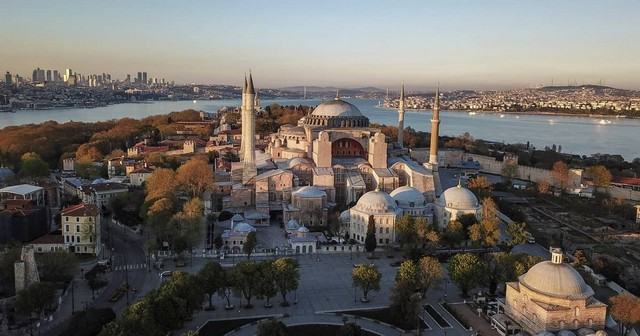
Washington, DC: President Recep Tayyip Erdoğan is considering converting the Hagia Sophia to a Mosque, which has been a museum since its conquest. As Muslims, we appeal to President Erdogan to keep it as a Museum, and not convert it to a Mosque.

“Hagia Sophia was one of the largest Christian Cathedral in the Eastern Roman Empire for 1000 years, and is one of the most contested buildings and is creating controversy again.” Aljazeera. Indeed, it will create animosity between Islam and Christianity.

The idea of converting Hagia Sofia to a mosque offers a short-term political gain, but at the cost of long-term harmony between Muslims and Christians.

The role of Muslims is to mitigate conflicts and nurture goodwill – a formula embedded in Prophet’s actions; he was a blessed peacemaker. Islam means peace, and it behooves us to achieve peace and harmony through our actions and words.

The Greek Orthodox Church mourns the loss of their Church to Muslim conquest; however, they have accepted it. If this is converted to a mosque, it amounts to rubbing salt on the wounds. It will rekindle hostilities that none of us want. Today, the societies are moving towards respecting the otherness of the others.

Hazrat Umar set a great example – after conquering Jerusalem, he was offered to pray in the Holy Sepulcher. He chose not to pray inside the church for the concern that the future generation of Muslims will convert it into a Mosque.

Quran 22:40 essentially says God’s name is extolled abundantly in Churches, Synagogues, and Mosques. We have to protect the places of Worship. God will most certainly assist him who succors His cause: verily, God is all-knowing and almighty.

The Islamic Society of North America (ISNA) has paved the way for building bridges among different communities in the United States. It is the largest Muslim civic body in America. It maintains good relationships with all populations, including the Greek Orthodox hierarchy. ISNA has played Amin’s role in building a cohesive America and has earned the goodwill of Jews, Christians, Hindus, and others. Out of a sense of righteousness, they have stood up for Muslims against Islamophobic rhetoric during 9/11, and it continues today. We, the Muslims, appreciate them.

Dr. Sayyid M. Saeed, President of ISNA, said, “The conversion of the Hagia Sophia was against the historical examples set by the righteous Caliphs, beginning with Abu Bakr when he advised his general heading to conquer foreign lands. The Umayyad Caliphs apologized and paid for the church land used to build the Umayyad Mosque in Damascus.

As American Muslims, we celebrate this Islamic provision in US law that enabled us to build 3 thousand mosques in the last half a century. Hagia Sophia is not just a Church but the main symbol of the Greek Orthodox Church. It is a slap on the entire system of the Greek Orthodox Church and Greece. It fostered permanent hate against Muslims and Islam in those quarters.”

Dr. Saeed further adds, “The destruction of the Babri Mosque in India is a historical example of religious bigotry. We cannot do the same thing to Hagia Sophia.”

Indeed, we have to be consistent in our policies – if we apply it in one place, we must be able to use it in every situation. As an Indian American Muslim, it hurts me to see the destruction of the Babri Mosque, and it equally hurts me to see the Hagia Sophia converted to a Mosque. We have to set an excellent example for the world. The Alhambra is a UNESCO World Heritage Site, let Hagia Sophia be one as well.

We urge President Erdogan to consider the Sunnah of Prophet Muhammad, who was and is a mercy to mankind. He granted permanent protection to places of Worship in the covenant he issued in 628 AD. A majority of Muslims believe in the sanctity of the location of Worship. We hope President Erdogan can be a catalyst in correcting false perceptions about Muslims and not convert Hagia Sophia into a Mosque. The majority of Muslims will applaud him for walking on the right path. May God bless him.

Dr. Mike Ghouse is the founder and president of the Center for Pluralism.

8 July 2020

Source: countercurrents.org
Columbus statues toppled in U.S.

By Countercurrents Collective

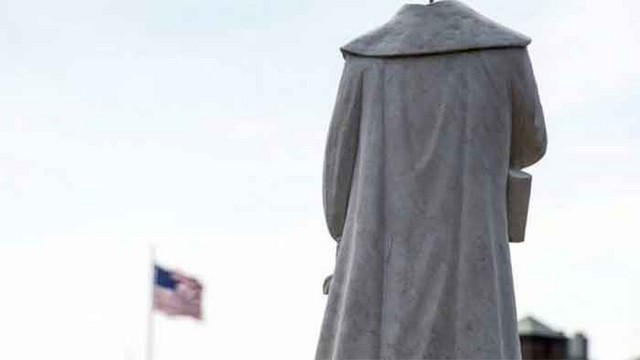
Protesters pulled down a statue of Christopher Columbus in Baltimore, U.S. They threw the statue into the city’s Inner Harbor.

Statues of Columbus have also been toppled in cities including Miami; Columbus, Ohio; Richmond, Virginia; St Paul, Minnesota; and Boston, where one was decapitated.

In Baltimore, Demonstrators used ropes to topple the monument on Saturday night near the Little Italy neighborhood.

Across the U.S., thousands of protesters mobilized by the death of George Floyd at the hands of police have called for the removal of statues of Columbus, Confederate figures and others.

They say the Italian explorer is responsible for the genocide and exploitation of native peoples in the Americas – the North and Latin America.

According to The Baltimore Sun, the statue was owned by the city and dedicated in 1984 by former mayor William Donald Schaefer and rightist President Ronald Reagan.

A spokesman for Baltimore mayor Bernard C. “Jack” Young told The Sun the toppling of the statue is a part of a national and global reexamination over monuments “that may represent different things to different people”.

“We understand the dynamics that are playing out in Baltimore are part of a national narrative,” Lester Davis said.

Video posted on Twitter showed a group using ropes to pull the statue from its pedestal in the city’s Little Italy neighborhood as others cheered. It was then rolled to the city’s Inner Harbor and pushed into the water, The Baltimore Sun reported.

Attacks on statues of controversial figures, including Confederate generals and other leaders who owned slaves or who supported slavery or racist policies, is part of the fallout from anti-racism protests across the nation in the wake of the brutal arrest death of African America George Floyd in Minneapolis in May.

The U.S. President Donald Trump has become particularly incensed by statue destruction. He has vowed to punish those responsible.

There are two other statues of Columbus in the city.

Columbus, Ohio, also took down a statue of Christopher Columbus

Columbus, Ohio, removed a statue of its namesake, Christopher Columbus, from outside its City Hall on Wednesday morning.

The monument is one of the most recent to be taken down amid the countrywide call to replace statues of colonizers, slave owners and other controversial historical figures.

Crews arrived early Wednesday to begin taking down the statue. The removal took approximately three hours.

The statue, a gift from Genoa, Italy, in 1955, will be placed at a secure city facility.

Mayor Andrew Ginther announced on June 18 that the statue would be removed, stating that it does not reflect the city.

“For many people in our community, the statue represents patriarchy, oppression and divisiveness. That does not represent our great city, and we will no longer live in the shadow of our ugly past,” Ginther said in a statement at the time. “Now is the right time to replace this statue with artwork that demonstrates our enduring fight to end racism and celebrate the themes of diversity and inclusion.”

Columbus is regularly criticized for his brutal treatment and killing of Native Americans.

Ginther said he asked the city’s art commission to take the lead in the process of replacing the statue with public art that better reflects Columbus’ citizens and “offers a shared vision for the future.”

“By replacing the statue, we are removing one more barrier to meaningful and lasting change to end systemic racism,” Ginther said in the statement. “Its removal will allow us to remain focused on critical police reforms and increasing equity in housing, health outcomes, education and employment.”

The monument is not the first Columbus statue to be taken down in the U.S. In June, a statue of Columbus was removed in Boston after protesters beheaded it.

Protesters nationwide have toppled or vandalized controversial monuments as many cities have announced the removal or relocation of public works paying tribute to embattled historical figures.

New York

Last week, New York City Mayor Bill de Blasio said The American Museum of Natural History will remove a prominent statue of Theodore Roosevelt from its entrance after years of criticism. Charleston, South Carolina, recently removed its statue of former vice president and slavery advocate John C. Calhoun.

Santa Fe

In Santa Fe, New Mexico, officials took down a statue of Diego de Vargas, a Spanish conquistador who brutalized Native Americans.

Denver

In Denver, Denver School Board member Tay Anderson has joined other activists to push for the renaming of schools named after figures such as George Washington and Thomas Jefferson, “who may have been founding fathers but they didn’t stand up to racism and slavery, so they were complicit.”.

Anderson also has been part of an effort to change the name of a neighborhood, Stapleton, named after former mayor and Ku Klux Klan member Benjamin Stapleton, whose name once also adorned the city’s airport.

“We are better than this,” says Anderson.

A new state flag for Mississippi

In past weeks, Mississippi passed a bill to create a new state flag without the Confederate battle emblem. In New Jersey, Princeton University took former President Woodrow Wilson’s name off a college, citing his racists views.

Countless other petitions and protests are calling for similar statue removals and name changes in an effort to at least spark a dialog about who deserves honoring. In many cases, such symbols were erected decades after the Civil War by the Daughters of the Confederacy, a civic group aimed at upholding the South’s racial segregation.

“There’s no question that all movements require conversation and dialog to truly move ahead,” says Melina Abdullah, a founding member of Black Lives Matter Los Angeles and a professor of Pan-African Studies at California State University, Los Angeles. “But what doesn’t require conversation is knowing things shouldn’t be named after people who dehumanized other people.”

It is hard to know how far this latest drive to rename landmarks will get. Almost every historical figure could be worthy of deeper review.

Orange County

In Orange County, south of Los Angeles, Democrats are pushing to rename John Wayne Airport because of racist statements made by the actor in a 1971 magazine interview. Wayne was quoted in Playboy as saying, “I believe in white supremacy.”

A Los Angeles Times editorial supporting the name change argues that it will help the county — a conservative stronghold in a largely Democratic state — confront its racist past. Wayne’s son, Ethan, 58, issued a statement strongly denying his father was a racist.

The fight over monuments

The statue of a young man, gun at his side, has sat outside the Harrison County Courthouse in Marshall, Texas, since 1905. Its main inscription reads “Confederate.”

That is enough to warrant its removal, says Demetria McFarland, a fifth-grade teacher who has started a petition to that end.

“That statue, in a public place, doesn’t represent my values as a Black woman, it represents slavery and the torture my ancestors went through,” says McFarland, founder of Marshall Against Violence. “Other cities are taking down these symbols of racial divide, so why not also here in our little east Texas town?”

History is on review as the 21st century’s latest civil rights movement catches fire, smoldering embers fanned by the death in police hands of George Floyd on Memorial Day.

From California to Washington, D.C., grassroots efforts such as McFarland’s are urging citizens and lawmakers to reject historical figures whose backstories reveal views or deeds that insult millions of Americans.

Amerigo Vespucci

Consider Amerigo Vespucci, the Italian seafarer who gave his name to America. Some historians contend that Vespucci exaggerated his claims, partnered in his enterprise with a man made rich from the slave trade, and stole the limelight from his contemporary, Christopher Columbus — whose own statues have been the target due to his murderous treatment of Indigenous people.

Change has arrived

Renaming is a powerful way to announce that change has arrived. For many people of color, the time has come to stop ignoring symbols of oppression, says Elena Ortiz, chair of the Santa Fe Freedom Council of The Red Nation, a New Mexico-based activist group focused on the liberation of indigenous peoples.

“The great reckoning is here,” says Ortiz, whose group successfully pushed to remove statues of Juan de Oñate, a 16th-century Spanish conquistador who raped Pueblo women and stole from enslaved tribal communities. “It’s time to fan the flames.”

Jefferson, a slaveholder

Ortiz says it is not appropriate to honor figures such as Thomas Jefferson, Andrew Jackson and explorer Kit Carson. “Jefferson was a slave holder, Jackson believed the only good Indian is a dead Indian and Carson was an Indian murderer,” she says. “When people ask do we need to rename Carson City, Nevada, the answer is yes.”

A new alliance in St. Louis

In St. Louis, Moji Sidiqi, executive director of the Regional Muslim Action Network, has joined forces with an Israeli restaurant owner to start a petition to not only remove a statue of King Louis, the city’s namesake, but also to rename the city itself.

“History tells us King Louis was a Christian zealot who was an Islamophobe and anti-Semite” in 13th-century France, says Sidiqi. “We don’t want to see the statue broken or trashed, but it doesn’t need to be in a public place where Muslims and Jews and African Americans go to make memories with their families.”

For Sidiqi, the current push to rename things isn’t about erasing history but rather choosing what is worthy of celebration.

“Are we supposed to keep pretending our beautiful nation doesn’t have symbols of anti-inclusion and slavery everywhere?” she says. “We’re trying to take away symbols of hate and replace them with symbols of love and community.”

The movement also includes a growing call to rename mountains, parks and other destinations, says Jennifer Runyon, a research staffer at the U.S. Board on Geographic Names in Washington, D.C., which meets monthly to review petitions requesting such changes.

“We’ve gotten a half a dozen proposals related to racial issues lately, requests to change names that may have ‘squaw’ or ‘negro’ or ‘digger,’ which is offensive to some Native Americans,” says Runyon. “We are a reactive body, we don’t go looking for an issue. But if people bring one to us, we’ll review it all and see what people locally say. You just have to have a good name ready to replace it.”

One example of such change, years in the making, is in California. Instead of Jeff Davis Peak near Lake Tahoe being a tribute to Confederate president Jefferson Davis, it will be called Da-ek Dow Go-et Mountain, Washoe for “saddle between two mountains.”

“We are open to all petitions,” says Runyon. “All we ask is that you have a good and relevant name ready that speaks to what people in the community care about.”

Who and how to honor

Black Lives Matter (BLM) leader Abdullah suggests that perhaps instead of more statues to Abraham Lincoln, who helped officially emancipate slaves, why not celebrate “people like Harriet Tubman, Sojourner Truth and Frederick Douglass, Black people who worked hard to free themselves and others?”

Activist Ortiz says why not move away from naming things after people, and instead focus on nature. “We need to step away from the worship of human beings, and in so doing accept that we’re not the center of the universe,” she says.

True societal shifts may remain elusive

Some said they are worried that by focusing intently on the removal of physical objects or name changes, true societal shifts may remain elusive.

“We strongly support the removal of statues that celebrate histories of genocide and aggression against Native people, we have to ensure that this doesn’t gloss over the real history of this continent,” says Michael Roberts, president of the First Nations Development Institute, a Longmont, Colorado, organization focused on the economic empowerment of Native Americans.

“These activities are only a first step toward true healing, justice and reconciliation between Native people and the larger society,” he says.

Historian Douglas Brinkley says in the past, presidents have made efforts to “expand the national narrative” on matters of race and equality, citing President Barack Obama’s executive orders on New York City’s Stonewall National Monument, which celebrates the fight for LGBTQ rights, and the Charles Young Buffalo Soldiers National Monument in Ohio, spotlighting African Americans who served in the U.S. military.

“That was the right thing to do then, and the right thing to do now is de-Confederatize America,” says Brinkley, professor of history at Rice University in Houston. “People aren’t in the mood for compromising.”

Not surprisingly, efforts to remove statues or rename places have drawn emotional reactions as some balk at what they see as the erasure of history.

A Catholic priest in San Francisco recently held a public exorcism on the site in Golden Gate Park where protestors had torn down a statue of Father Junipero Serra, who founded many California missions.

Serra was known to force Native Americans to convert and punish them if they rebelled.

“Evil has made itself present here,” Archbishop Salvatore Cordileone said in a video of the event.

In St. Louis, the local Roman Catholic Archdiocese issued a statement opposing efforts to change the name of the city. In siding with counter-protesters who do not want the statue removed or city renamed, the Archdiocese highlighted King Louis’ charity toward the poor, adding that “we should not seek to erase history, but recognize and learn from it, while working to create new opportunities for our brothers and sisters.”

Renaming does not solve the problem

Scholars say that the claim that taking away a statue or renaming a street erases history is questionable.

“We make a mistake saying memorials are about history,” says philosopher Susan Neiman, director of the Einstein Forum in Berlin, Germany, which promotes the cross-cultural exchange of ideas. “We don’t memorialize all our history, we pick and choose to remember men and women who live by the values we share.”

Neiman said the debates over which statues, streets and schools should be renamed should remain local, allowing community members to decide what gets scrapped, what finds its way to a museum with context and what perhaps gets turned into an art project that changes the meaning of the offending symbol.

“It’s not about history,” she says. “It’s about values.”

That was the approach South African leaders took in trying to reconcile that country’s racist past. The Truth and Reconciliation Commission, established by President Nelson Mandela in 1996, aimed to help Black and white South Africans come to grips with the country’s racist apartheid past while speeding up a transition to democracy.

While that process did not involve much statue and location renaming beyond the removal of tributes to Hendrik Vorwoerd, the architect of apartheid, it did highlight the impact of having government officials be part of the reckoning, says Ronald Slye, a law professor at Seattle University who was an advisor to the TRC.

“One of the lessons to be taken from the TRC is in order for real change to come about, the push for change needs to be part of a broader process in society and there needs to be clear political support for it,” says Slye.

Slye says the sheer size of the U.S. and its divided political makeup means it is more likely that local movements aimed at renaming landmarks will precede changes at a national level. But the point isn’t just to change a name, he says.

“In the end, it’s easy to change a name of a street or take down some monuments and say, ‘Now we’re fine,’” he says. “But it’s not the street that’s the problem, it’s broader.”

Robbie Powelson is fine with starting with a street. Growing up in Marin County, just across the Golden Gate Bridge, Powelson did not give much thought to the name of an English explorer whose name adorns a local street, school and statue.

But inspired by the Black Lives Matter social justice movement and its efforts to remove symbols of the Confederacy, Powelson now leads a campaign to revisit the tributes paid to Sir Francis Drake, best known for a 16th-century sail that claimed California for England and less known for being a slave trader.

“Changing the names of things is significant because it is visceral and real to people,” says Powelson, founder of Tam Equity Campaign, a local activist group. “Through these symbolic changes, we can have a substantive shift in local consciousness.”

6 July 2020

Source: countercurrents.org